EP0002902A1 - Methylthiofluorothioxanthene derivative, its preparation and compositions containing it - Google Patents
Methylthiofluorothioxanthene derivative, its preparation and compositions containing it Download PDFInfo
- Publication number
- EP0002902A1 EP0002902A1 EP78300779A EP78300779A EP0002902A1 EP 0002902 A1 EP0002902 A1 EP 0002902A1 EP 78300779 A EP78300779 A EP 78300779A EP 78300779 A EP78300779 A EP 78300779A EP 0002902 A1 EP0002902 A1 EP 0002902A1
- Authority
- EP
- European Patent Office
- Prior art keywords
- fluoro
- methylthio
- methyl
- piperidylidene
- thioxanthene
- Prior art date
- Legal status (The legal status is an assumption and is not a legal conclusion. Google has not performed a legal analysis and makes no representation as to the accuracy of the status listed.)
- Withdrawn
Links
- 238000002360 preparation method Methods 0.000 title claims description 3
- 239000000203 mixture Substances 0.000 title description 8
- ZRUJWMIMHBMIPF-UHFFFAOYSA-N 1-fluoro-2-methylsulfanyl-9h-thioxanthene Chemical class C1=CC=C2CC3=C(F)C(SC)=CC=C3SC2=C1 ZRUJWMIMHBMIPF-UHFFFAOYSA-N 0.000 title 1
- 150000001875 compounds Chemical class 0.000 claims abstract description 31
- 150000003839 salts Chemical class 0.000 claims abstract description 25
- YQMPXFBJHRFSPM-UHFFFAOYSA-N 4-(6-fluoro-2-methylsulfanylthioxanthen-9-ylidene)-1-methylpiperidine Chemical compound C12=CC(SC)=CC=C2SC2=CC(F)=CC=C2C1=C1CCN(C)CC1 YQMPXFBJHRFSPM-UHFFFAOYSA-N 0.000 claims abstract description 23
- 239000002253 acid Substances 0.000 claims abstract description 19
- 231100000252 nontoxic Toxicity 0.000 claims abstract description 13
- 230000003000 nontoxic effect Effects 0.000 claims abstract description 13
- 238000000034 method Methods 0.000 claims description 16
- VEXZGXHMUGYJMC-UHFFFAOYSA-N Hydrochloric acid Chemical compound Cl VEXZGXHMUGYJMC-UHFFFAOYSA-N 0.000 claims description 9
- 239000012458 free base Substances 0.000 claims description 8
- MUBZPKHOEPUJKR-UHFFFAOYSA-N Oxalic acid Chemical compound OC(=O)C(O)=O MUBZPKHOEPUJKR-UHFFFAOYSA-N 0.000 claims description 4
- 241001465754 Metazoa Species 0.000 abstract description 17
- 230000000694 effects Effects 0.000 abstract description 13
- 239000000243 solution Substances 0.000 abstract description 8
- 239000003826 tablet Substances 0.000 abstract description 7
- 239000002775 capsule Substances 0.000 abstract description 6
- 238000002347 injection Methods 0.000 abstract description 6
- 239000007924 injection Substances 0.000 abstract description 6
- 230000000701 neuroleptic effect Effects 0.000 abstract description 6
- 239000006188 syrup Substances 0.000 abstract description 4
- 235000020357 syrup Nutrition 0.000 abstract description 4
- 230000007059 acute toxicity Effects 0.000 abstract description 3
- 231100000403 acute toxicity Toxicity 0.000 abstract description 3
- 230000002349 favourable effect Effects 0.000 abstract description 3
- 230000005923 long-lasting effect Effects 0.000 abstract description 3
- 239000000843 powder Substances 0.000 abstract description 3
- 239000000829 suppository Substances 0.000 abstract description 3
- 230000001078 anti-cholinergic effect Effects 0.000 abstract description 2
- 238000002474 experimental method Methods 0.000 abstract description 2
- 231100001274 therapeutic index Toxicity 0.000 abstract description 2
- 238000012360 testing method Methods 0.000 description 19
- CSCPPACGZOOCGX-UHFFFAOYSA-N Acetone Chemical compound CC(C)=O CSCPPACGZOOCGX-UHFFFAOYSA-N 0.000 description 12
- 238000007912 intraperitoneal administration Methods 0.000 description 12
- 241000700159 Rattus Species 0.000 description 11
- QTBSBXVTEAMEQO-UHFFFAOYSA-N Acetic acid Chemical compound CC(O)=O QTBSBXVTEAMEQO-UHFFFAOYSA-N 0.000 description 10
- YMWUJEATGCHHMB-UHFFFAOYSA-N Dichloromethane Chemical compound ClCCl YMWUJEATGCHHMB-UHFFFAOYSA-N 0.000 description 9
- LFQSCWFLJHTTHZ-UHFFFAOYSA-N Ethanol Chemical compound CCO LFQSCWFLJHTTHZ-UHFFFAOYSA-N 0.000 description 9
- 241000699670 Mus sp. Species 0.000 description 9
- 239000000126 substance Substances 0.000 description 9
- 241000282472 Canis lupus familiaris Species 0.000 description 7
- RTZKZFJDLAIYFH-UHFFFAOYSA-N Diethyl ether Chemical compound CCOCC RTZKZFJDLAIYFH-UHFFFAOYSA-N 0.000 description 7
- XLYOFNOQVPJJNP-UHFFFAOYSA-N water Substances O XLYOFNOQVPJJNP-UHFFFAOYSA-N 0.000 description 7
- HEDRZPFGACZZDS-UHFFFAOYSA-N Chloroform Chemical compound ClC(Cl)Cl HEDRZPFGACZZDS-UHFFFAOYSA-N 0.000 description 6
- YXFVVABEGXRONW-UHFFFAOYSA-N Toluene Chemical compound CC1=CC=CC=C1 YXFVVABEGXRONW-UHFFFAOYSA-N 0.000 description 6
- 239000004480 active ingredient Substances 0.000 description 6
- 230000008485 antagonism Effects 0.000 description 6
- 239000002585 base Substances 0.000 description 6
- 238000001816 cooling Methods 0.000 description 5
- 239000011541 reaction mixture Substances 0.000 description 5
- KWTSXDURSIMDCE-QMMMGPOBSA-N (S)-amphetamine Chemical compound C[C@H](N)CC1=CC=CC=C1 KWTSXDURSIMDCE-QMMMGPOBSA-N 0.000 description 4
- NLXLAEXVIDQMFP-UHFFFAOYSA-N Ammonia chloride Chemical compound [NH4+].[Cl-] NLXLAEXVIDQMFP-UHFFFAOYSA-N 0.000 description 4
- VHUUQVKOLVNVRT-UHFFFAOYSA-N Ammonium hydroxide Chemical compound [NH4+].[OH-] VHUUQVKOLVNVRT-UHFFFAOYSA-N 0.000 description 4
- 241000282414 Homo sapiens Species 0.000 description 4
- PIJVFDBKTWXHHD-UHFFFAOYSA-N Physostigmine Natural products C12=CC(OC(=O)NC)=CC=C2N(C)C2C1(C)CCN2C PIJVFDBKTWXHHD-UHFFFAOYSA-N 0.000 description 4
- 229960000583 acetic acid Drugs 0.000 description 4
- QGZKDVFQNNGYKY-UHFFFAOYSA-N ammonia Natural products N QGZKDVFQNNGYKY-UHFFFAOYSA-N 0.000 description 4
- 229940025084 amphetamine Drugs 0.000 description 4
- 230000034994 death Effects 0.000 description 4
- 231100000517 death Toxicity 0.000 description 4
- 229960001697 physostigmine Drugs 0.000 description 4
- PIJVFDBKTWXHHD-HIFRSBDPSA-N physostigmine Chemical compound C12=CC(OC(=O)NC)=CC=C2N(C)[C@@H]2[C@@]1(C)CCN2C PIJVFDBKTWXHHD-HIFRSBDPSA-N 0.000 description 4
- 150000005075 thioxanthenes Chemical class 0.000 description 4
- BLGMFJSWCUYAKO-UHFFFAOYSA-N 4-(2-chlorothioxanthen-9-ylidene)-1-methylpiperidine Chemical compound C1CN(C)CCC1=C1C2=CC(Cl)=CC=C2SC2=CC=CC=C21 BLGMFJSWCUYAKO-UHFFFAOYSA-N 0.000 description 3
- UYGOENBGHHDHLT-UHFFFAOYSA-N 6-fluoro-9-(1-methylpiperidin-4-yl)-2-methylsulfanylthioxanthen-9-ol Chemical compound C12=CC(SC)=CC=C2SC2=CC(F)=CC=C2C1(O)C1CCN(C)CC1 UYGOENBGHHDHLT-UHFFFAOYSA-N 0.000 description 3
- UHOVQNZJYSORNB-UHFFFAOYSA-N Benzene Chemical compound C1=CC=CC=C1 UHOVQNZJYSORNB-UHFFFAOYSA-N 0.000 description 3
- DUGOZIWVEXMGBE-UHFFFAOYSA-N Methylphenidate Chemical compound C=1C=CC=CC=1C(C(=O)OC)C1CCCCN1 DUGOZIWVEXMGBE-UHFFFAOYSA-N 0.000 description 3
- HEMHJVSKTPXQMS-UHFFFAOYSA-M Sodium hydroxide Chemical compound [OH-].[Na+] HEMHJVSKTPXQMS-UHFFFAOYSA-M 0.000 description 3
- 229930006000 Sucrose Natural products 0.000 description 3
- CZMRCDWAGMRECN-UGDNZRGBSA-N Sucrose Chemical compound O[C@H]1[C@H](O)[C@@H](CO)O[C@@]1(CO)O[C@@H]1[C@H](O)[C@@H](O)[C@H](O)[C@@H](CO)O1 CZMRCDWAGMRECN-UGDNZRGBSA-N 0.000 description 3
- 235000011054 acetic acid Nutrition 0.000 description 3
- 230000003042 antagnostic effect Effects 0.000 description 3
- VMWNQDUVQKEIOC-CYBMUJFWSA-N apomorphine Chemical compound C([C@H]1N(C)CC2)C3=CC=C(O)C(O)=C3C3=C1C2=CC=C3 VMWNQDUVQKEIOC-CYBMUJFWSA-N 0.000 description 3
- 229960004046 apomorphine Drugs 0.000 description 3
- 230000002903 catalepsic effect Effects 0.000 description 3
- 238000006243 chemical reaction Methods 0.000 description 3
- 239000002552 dosage form Substances 0.000 description 3
- 229960001344 methylphenidate Drugs 0.000 description 3
- VLKZOEOYAKHREP-UHFFFAOYSA-N n-Hexane Chemical compound CCCCCC VLKZOEOYAKHREP-UHFFFAOYSA-N 0.000 description 3
- 239000008194 pharmaceutical composition Substances 0.000 description 3
- 239000008363 phosphate buffer Substances 0.000 description 3
- 238000001953 recrystallisation Methods 0.000 description 3
- 239000005720 sucrose Substances 0.000 description 3
- 230000008673 vomiting Effects 0.000 description 3
- FPANKUUAVASGAH-UHFFFAOYSA-N 1-methyl-4-(2-methylsulfanylthioxanthen-9-ylidene)piperidine Chemical compound C12=CC(SC)=CC=C2SC2=CC=CC=C2C1=C1CCN(C)CC1 FPANKUUAVASGAH-UHFFFAOYSA-N 0.000 description 2
- BEWBPMONLRTWDI-UHFFFAOYSA-N 1-methyl-4-[2-(trifluoromethyl)thioxanthen-9-ylidene]piperidine Chemical compound C1CN(C)CCC1=C1C2=CC(C(F)(F)F)=CC=C2SC2=CC=CC=C21 BEWBPMONLRTWDI-UHFFFAOYSA-N 0.000 description 2
- OIPUKSHAANONTB-UHFFFAOYSA-N 4-(2-chloro-6-fluorothioxanthen-9-ylidene)-1-methylpiperidine Chemical compound C1CN(C)CCC1=C1C2=CC(Cl)=CC=C2SC2=CC(F)=CC=C21 OIPUKSHAANONTB-UHFFFAOYSA-N 0.000 description 2
- BREQUYTUFSOAMH-UHFFFAOYSA-N 4-[6-fluoro-2-(trifluoromethyl)thioxanthen-9-ylidene]-1-methylpiperidine Chemical compound C1CN(C)CCC1=C1C2=CC(C(F)(F)F)=CC=C2SC2=CC(F)=CC=C21 BREQUYTUFSOAMH-UHFFFAOYSA-N 0.000 description 2
- MYGXGCCFTPKWIH-UHFFFAOYSA-N 4-chloro-1-methylpiperidine Chemical compound CN1CCC(Cl)CC1 MYGXGCCFTPKWIH-UHFFFAOYSA-N 0.000 description 2
- YKQMRAULXKEKNH-UHFFFAOYSA-N 4-fluoro-2-(4-methylsulfanylphenyl)sulfanylbenzoic acid Chemical compound C1=CC(SC)=CC=C1SC1=CC(F)=CC=C1C(O)=O YKQMRAULXKEKNH-UHFFFAOYSA-N 0.000 description 2
- XZJJZBVJKNVSRN-UHFFFAOYSA-N 6-fluoro-2-methylsulfanylthioxanthen-9-one Chemical compound FC1=CC=C2C(=O)C3=CC(SC)=CC=C3SC2=C1 XZJJZBVJKNVSRN-UHFFFAOYSA-N 0.000 description 2
- 229930000680 A04AD01 - Scopolamine Natural products 0.000 description 2
- 208000009132 Catalepsy Diseases 0.000 description 2
- STECJAGHUSJQJN-GAUPFVANSA-N Hyoscine Natural products C1([C@H](CO)C(=O)OC2C[C@@H]3N([C@H](C2)[C@@H]2[C@H]3O2)C)=CC=CC=C1 STECJAGHUSJQJN-GAUPFVANSA-N 0.000 description 2
- 229920004011 Macrolon® Polymers 0.000 description 2
- FYYHWMGAXLPEAU-UHFFFAOYSA-N Magnesium Chemical compound [Mg] FYYHWMGAXLPEAU-UHFFFAOYSA-N 0.000 description 2
- STECJAGHUSJQJN-UHFFFAOYSA-N N-Methyl-scopolamin Natural products C1C(C2C3O2)N(C)C3CC1OC(=O)C(CO)C1=CC=CC=C1 STECJAGHUSJQJN-UHFFFAOYSA-N 0.000 description 2
- 229910019142 PO4 Inorganic materials 0.000 description 2
- 229920005439 Perspex® Polymers 0.000 description 2
- NBIIXXVUZAFLBC-UHFFFAOYSA-N Phosphoric acid Chemical compound OP(O)(O)=O NBIIXXVUZAFLBC-UHFFFAOYSA-N 0.000 description 2
- JUJWROOIHBZHMG-UHFFFAOYSA-N Pyridine Chemical compound C1=CC=NC=C1 JUJWROOIHBZHMG-UHFFFAOYSA-N 0.000 description 2
- 239000004133 Sodium thiosulphate Substances 0.000 description 2
- 206010042008 Stereotypy Diseases 0.000 description 2
- QAOWNCQODCNURD-UHFFFAOYSA-N Sulfuric acid Chemical compound OS(O)(=O)=O QAOWNCQODCNURD-UHFFFAOYSA-N 0.000 description 2
- WYURNTSHIVDZCO-UHFFFAOYSA-N Tetrahydrofuran Chemical compound C1CCOC1 WYURNTSHIVDZCO-UHFFFAOYSA-N 0.000 description 2
- 206010047853 Waxy flexibility Diseases 0.000 description 2
- 150000007513 acids Chemical class 0.000 description 2
- 239000002671 adjuvant Substances 0.000 description 2
- 150000001412 amines Chemical class 0.000 description 2
- 229960001040 ammonium chloride Drugs 0.000 description 2
- 235000019270 ammonium chloride Nutrition 0.000 description 2
- 230000000561 anti-psychotic effect Effects 0.000 description 2
- WPYMKLBDIGXBTP-UHFFFAOYSA-N benzoic acid group Chemical group C(C1=CC=CC=C1)(=O)O WPYMKLBDIGXBTP-UHFFFAOYSA-N 0.000 description 2
- 230000037396 body weight Effects 0.000 description 2
- 239000000872 buffer Substances 0.000 description 2
- 239000003610 charcoal Substances 0.000 description 2
- NJMYODHXAKYRHW-DVZOWYKESA-N cis-flupenthixol Chemical compound C1CN(CCO)CCN1CC\C=C\1C2=CC(C(F)(F)F)=CC=C2SC2=CC=CC=C2/1 NJMYODHXAKYRHW-DVZOWYKESA-N 0.000 description 2
- 229960001184 clopenthixol Drugs 0.000 description 2
- 229910000397 disodium phosphate Inorganic materials 0.000 description 2
- 229940079593 drug Drugs 0.000 description 2
- 239000003814 drug Substances 0.000 description 2
- 239000000284 extract Substances 0.000 description 2
- 229960002419 flupentixol Drugs 0.000 description 2
- 239000012362 glacial acetic acid Substances 0.000 description 2
- 230000005764 inhibitory process Effects 0.000 description 2
- 238000002955 isolation Methods 0.000 description 2
- HQKMJHAJHXVSDF-UHFFFAOYSA-L magnesium stearate Chemical compound [Mg+2].CCCCCCCCCCCCCCCCCC([O-])=O.CCCCCCCCCCCCCCCCCC([O-])=O HQKMJHAJHXVSDF-UHFFFAOYSA-L 0.000 description 2
- 238000002844 melting Methods 0.000 description 2
- 230000008018 melting Effects 0.000 description 2
- BDAGIHXWWSANSR-UHFFFAOYSA-N methanoic acid Natural products OC=O BDAGIHXWWSANSR-UHFFFAOYSA-N 0.000 description 2
- 150000007524 organic acids Chemical class 0.000 description 2
- 239000003960 organic solvent Substances 0.000 description 2
- 239000008188 pellet Substances 0.000 description 2
- 230000000144 pharmacologic effect Effects 0.000 description 2
- NBIIXXVUZAFLBC-UHFFFAOYSA-K phosphate Chemical compound [O-]P([O-])([O-])=O NBIIXXVUZAFLBC-UHFFFAOYSA-K 0.000 description 2
- 239000010452 phosphate Substances 0.000 description 2
- 239000004926 polymethyl methacrylate Substances 0.000 description 2
- 239000013641 positive control Substances 0.000 description 2
- BWHMMNNQKKPAPP-UHFFFAOYSA-L potassium carbonate Chemical compound [K+].[K+].[O-]C([O-])=O BWHMMNNQKKPAPP-UHFFFAOYSA-L 0.000 description 2
- 239000002244 precipitate Substances 0.000 description 2
- 239000000047 product Substances 0.000 description 2
- STECJAGHUSJQJN-FWXGHANASA-N scopolamine Chemical compound C1([C@@H](CO)C(=O)O[C@H]2C[C@@H]3N([C@H](C2)[C@@H]2[C@H]3O2)C)=CC=CC=C1 STECJAGHUSJQJN-FWXGHANASA-N 0.000 description 2
- 229960002646 scopolamine Drugs 0.000 description 2
- AKHNMLFCWUSKQB-UHFFFAOYSA-L sodium thiosulfate Chemical compound [Na+].[Na+].[O-]S([O-])(=O)=S AKHNMLFCWUSKQB-UHFFFAOYSA-L 0.000 description 2
- 235000019345 sodium thiosulphate Nutrition 0.000 description 2
- 239000002904 solvent Substances 0.000 description 2
- 239000007858 starting material Substances 0.000 description 2
- 238000003756 stirring Methods 0.000 description 2
- 239000000725 suspension Substances 0.000 description 2
- 210000004916 vomit Anatomy 0.000 description 2
- JIAARYAFYJHUJI-UHFFFAOYSA-L zinc dichloride Chemical compound [Cl-].[Cl-].[Zn+2] JIAARYAFYJHUJI-UHFFFAOYSA-L 0.000 description 2
- WFPIAZLQTJBIFN-DVZOWYKESA-N zuclopenthixol Chemical compound C1CN(CCO)CCN1CC\C=C\1C2=CC(Cl)=CC=C2SC2=CC=CC=C2/1 WFPIAZLQTJBIFN-DVZOWYKESA-N 0.000 description 2
- WSPOMRSOLSGNFJ-AUWJEWJLSA-N (Z)-chlorprothixene Chemical compound C1=C(Cl)C=C2C(=C/CCN(C)C)\C3=CC=CC=C3SC2=C1 WSPOMRSOLSGNFJ-AUWJEWJLSA-N 0.000 description 1
- FNROCHFTHIONLL-UHFFFAOYSA-N 2-(9h-thioxanthen-10-ylidene)piperidine Chemical class N1CCCCC1=S1C2=CC=CC=C2CC2=CC=CC=C21 FNROCHFTHIONLL-UHFFFAOYSA-N 0.000 description 1
- XWGJRNPUUWDCDF-UHFFFAOYSA-N 2-[2-(2-aminoethyl)-3-propylphenyl]-2-hydroxy-2-phenylacetic acid Chemical compound CCCC1=C(C(=CC=C1)C(C2=CC=CC=C2)(C(=O)O)O)CCN XWGJRNPUUWDCDF-UHFFFAOYSA-N 0.000 description 1
- JTNCEQNHURODLX-UHFFFAOYSA-N 2-phenylethanimidamide Chemical compound NC(=N)CC1=CC=CC=C1 JTNCEQNHURODLX-UHFFFAOYSA-N 0.000 description 1
- FEWJPZIEWOKRBE-UHFFFAOYSA-M 3-carboxy-2,3-dihydroxypropanoate Chemical compound OC(=O)C(O)C(O)C([O-])=O FEWJPZIEWOKRBE-UHFFFAOYSA-M 0.000 description 1
- ITSGLMRTQBJTSF-UHFFFAOYSA-N 3-fluoro-7-methylsulfanylthioxanthen-1-one Chemical compound FC1=CC(=O)C2=CC3=CC(SC)=CC=C3SC2=C1 ITSGLMRTQBJTSF-UHFFFAOYSA-N 0.000 description 1
- OSWFIVFLDKOXQC-UHFFFAOYSA-N 4-(3-methoxyphenyl)aniline Chemical compound COC1=CC=CC(C=2C=CC(N)=CC=2)=C1 OSWFIVFLDKOXQC-UHFFFAOYSA-N 0.000 description 1
- YYROPELSRYBVMQ-UHFFFAOYSA-N 4-toluenesulfonyl chloride Chemical compound CC1=CC=C(S(Cl)(=O)=O)C=C1 YYROPELSRYBVMQ-UHFFFAOYSA-N 0.000 description 1
- SKTFQHRVFFOHTQ-UHFFFAOYSA-N 8-bromo-1,3-dimethyl-7h-purine-2,6-dione Chemical compound O=C1N(C)C(=O)N(C)C2=C1NC(Br)=N2 SKTFQHRVFFOHTQ-UHFFFAOYSA-N 0.000 description 1
- QTBSBXVTEAMEQO-UHFFFAOYSA-M Acetate Chemical compound CC([O-])=O QTBSBXVTEAMEQO-UHFFFAOYSA-M 0.000 description 1
- 229930003347 Atropine Natural products 0.000 description 1
- COVZYZSDYWQREU-UHFFFAOYSA-N Busulfan Chemical compound CS(=O)(=O)OCCCCOS(C)(=O)=O COVZYZSDYWQREU-UHFFFAOYSA-N 0.000 description 1
- KRKNYBCHXYNGOX-UHFFFAOYSA-K Citrate Chemical compound [O-]C(=O)CC(O)(CC([O-])=O)C([O-])=O KRKNYBCHXYNGOX-UHFFFAOYSA-K 0.000 description 1
- 206010053398 Clonic convulsion Diseases 0.000 description 1
- 206010010071 Coma Diseases 0.000 description 1
- 229920002261 Corn starch Polymers 0.000 description 1
- FEWJPZIEWOKRBE-JCYAYHJZSA-N Dextrotartaric acid Chemical compound OC(=O)[C@H](O)[C@@H](O)C(O)=O FEWJPZIEWOKRBE-JCYAYHJZSA-N 0.000 description 1
- 241000283086 Equidae Species 0.000 description 1
- 241000282326 Felis catus Species 0.000 description 1
- PLDUPXSUYLZYBN-UHFFFAOYSA-N Fluphenazine Chemical compound C1CN(CCO)CCN1CCCN1C2=CC(C(F)(F)F)=CC=C2SC2=CC=CC=C21 PLDUPXSUYLZYBN-UHFFFAOYSA-N 0.000 description 1
- 239000001828 Gelatine Substances 0.000 description 1
- CPELXLSAUQHCOX-UHFFFAOYSA-N Hydrogen bromide Chemical compound Br CPELXLSAUQHCOX-UHFFFAOYSA-N 0.000 description 1
- RKUNBYITZUJHSG-UHFFFAOYSA-N Hyosciamin-hydrochlorid Natural products CN1C(C2)CCC1CC2OC(=O)C(CO)C1=CC=CC=C1 RKUNBYITZUJHSG-UHFFFAOYSA-N 0.000 description 1
- JVTAAEKCZFNVCJ-UHFFFAOYSA-M Lactate Chemical compound CC(O)C([O-])=O JVTAAEKCZFNVCJ-UHFFFAOYSA-M 0.000 description 1
- GUBGYTABKSRVRQ-QKKXKWKRSA-N Lactose Natural products OC[C@H]1O[C@@H](O[C@H]2[C@H](O)[C@@H](O)C(O)O[C@@H]2CO)[C@H](O)[C@@H](O)[C@H]1O GUBGYTABKSRVRQ-QKKXKWKRSA-N 0.000 description 1
- AFVFQIVMOAPDHO-UHFFFAOYSA-M Methanesulfonate Chemical compound CS([O-])(=O)=O AFVFQIVMOAPDHO-UHFFFAOYSA-M 0.000 description 1
- 229910002651 NO3 Inorganic materials 0.000 description 1
- NHNBFGGVMKEFGY-UHFFFAOYSA-N Nitrate Chemical compound [O-][N+]([O-])=O NHNBFGGVMKEFGY-UHFFFAOYSA-N 0.000 description 1
- GRYLNZFGIOXLOG-UHFFFAOYSA-N Nitric acid Chemical class O[N+]([O-])=O GRYLNZFGIOXLOG-UHFFFAOYSA-N 0.000 description 1
- 241001494479 Pecora Species 0.000 description 1
- 208000028017 Psychotic disease Diseases 0.000 description 1
- 206010039424 Salivary hypersecretion Diseases 0.000 description 1
- QAOWNCQODCNURD-UHFFFAOYSA-L Sulfate Chemical compound [O-]S([O-])(=O)=O QAOWNCQODCNURD-UHFFFAOYSA-L 0.000 description 1
- ZFXYFBGIUFBOJW-UHFFFAOYSA-N Theophylline Natural products O=C1N(C)C(=O)N(C)C2=C1NC=N2 ZFXYFBGIUFBOJW-UHFFFAOYSA-N 0.000 description 1
- GFBKORZTTCHDGY-UWVJOHFNSA-N Thiothixene Chemical compound C12=CC(S(=O)(=O)N(C)C)=CC=C2SC2=CC=CC=C2\C1=C\CCN1CCN(C)CC1 GFBKORZTTCHDGY-UWVJOHFNSA-N 0.000 description 1
- 206010044565 Tremor Diseases 0.000 description 1
- 206010047700 Vomiting Diseases 0.000 description 1
- 229910000147 aluminium phosphate Inorganic materials 0.000 description 1
- PYHRZPFZZDCOPH-UHFFFAOYSA-N amphetamine sulfate Chemical compound OS(O)(=O)=O.CC(N)CC1=CC=CC=C1.CC(N)CC1=CC=CC=C1 PYHRZPFZZDCOPH-UHFFFAOYSA-N 0.000 description 1
- 150000001450 anions Chemical class 0.000 description 1
- 229940054058 antipsychotic thioxanthene derivative Drugs 0.000 description 1
- RKUNBYITZUJHSG-SPUOUPEWSA-N atropine Chemical compound O([C@H]1C[C@H]2CC[C@@H](C1)N2C)C(=O)C(CO)C1=CC=CC=C1 RKUNBYITZUJHSG-SPUOUPEWSA-N 0.000 description 1
- 229960000396 atropine Drugs 0.000 description 1
- NOWKCMXCCJGMRR-UHFFFAOYSA-O aziridinium Chemical compound C1C[NH2+]1 NOWKCMXCCJGMRR-UHFFFAOYSA-O 0.000 description 1
- 210000004556 brain Anatomy 0.000 description 1
- 239000003795 chemical substances by application Substances 0.000 description 1
- ZPEIMTDSQAKGNT-UHFFFAOYSA-N chlorpromazine Chemical compound C1=C(Cl)C=C2N(CCCN(C)C)C3=CC=CC=C3SC2=C1 ZPEIMTDSQAKGNT-UHFFFAOYSA-N 0.000 description 1
- 229960001076 chlorpromazine Drugs 0.000 description 1
- 229960001552 chlorprothixene Drugs 0.000 description 1
- QZUDBNBUXVUHMW-UHFFFAOYSA-N clozapine Chemical compound C1CN(C)CCN1C1=NC2=CC(Cl)=CC=C2NC2=CC=CC=C12 QZUDBNBUXVUHMW-UHFFFAOYSA-N 0.000 description 1
- 229960004170 clozapine Drugs 0.000 description 1
- 239000008120 corn starch Substances 0.000 description 1
- WZHCOOQXZCIUNC-UHFFFAOYSA-N cyclandelate Chemical compound C1C(C)(C)CC(C)CC1OC(=O)C(O)C1=CC=CC=C1 WZHCOOQXZCIUNC-UHFFFAOYSA-N 0.000 description 1
- 238000000354 decomposition reaction Methods 0.000 description 1
- 230000018044 dehydration Effects 0.000 description 1
- 238000006297 dehydration reaction Methods 0.000 description 1
- 229960004132 diethyl ether Drugs 0.000 description 1
- BNIILDVGGAEEIG-UHFFFAOYSA-L disodium hydrogen phosphate Chemical compound [Na+].[Na+].OP([O-])([O-])=O BNIILDVGGAEEIG-UHFFFAOYSA-L 0.000 description 1
- 239000003937 drug carrier Substances 0.000 description 1
- 238000001035 drying Methods 0.000 description 1
- 229950005627 embonate Drugs 0.000 description 1
- CCIVGXIOQKPBKL-UHFFFAOYSA-M ethanesulfonate Chemical compound CCS([O-])(=O)=O CCIVGXIOQKPBKL-UHFFFAOYSA-M 0.000 description 1
- 238000011156 evaluation Methods 0.000 description 1
- 238000001704 evaporation Methods 0.000 description 1
- 125000001153 fluoro group Chemical group F* 0.000 description 1
- 229960002690 fluphenazine Drugs 0.000 description 1
- 235000019253 formic acid Nutrition 0.000 description 1
- 229920000159 gelatin Polymers 0.000 description 1
- 235000019322 gelatine Nutrition 0.000 description 1
- 239000003365 glass fiber Substances 0.000 description 1
- 230000035929 gnawing Effects 0.000 description 1
- 229940093915 gynecological organic acid Drugs 0.000 description 1
- 230000003301 hydrolyzing effect Effects 0.000 description 1
- 238000011534 incubation Methods 0.000 description 1
- 239000002050 international nonproprietary name Substances 0.000 description 1
- 238000010253 intravenous injection Methods 0.000 description 1
- 239000008101 lactose Substances 0.000 description 1
- 239000007788 liquid Substances 0.000 description 1
- 238000005567 liquid scintillation counting Methods 0.000 description 1
- 239000011777 magnesium Substances 0.000 description 1
- 229910052749 magnesium Inorganic materials 0.000 description 1
- 235000019359 magnesium stearate Nutrition 0.000 description 1
- VZCYOOQTPOCHFL-UPHRSURJSA-N maleic acid Chemical compound OC(=O)\C=C/C(O)=O VZCYOOQTPOCHFL-UPHRSURJSA-N 0.000 description 1
- 238000004519 manufacturing process Methods 0.000 description 1
- 239000000463 material Substances 0.000 description 1
- 239000000155 melt Substances 0.000 description 1
- 229920000609 methyl cellulose Polymers 0.000 description 1
- 239000001923 methylcellulose Substances 0.000 description 1
- 235000010981 methylcellulose Nutrition 0.000 description 1
- 150000007522 mineralic acids Chemical class 0.000 description 1
- 230000000116 mitigating effect Effects 0.000 description 1
- 230000003551 muscarinic effect Effects 0.000 description 1
- 239000003176 neuroleptic agent Substances 0.000 description 1
- 235000005985 organic acids Nutrition 0.000 description 1
- IPCSVZSSVZVIGE-UHFFFAOYSA-N palmitic acid group Chemical group C(CCCCCCCCCCCCCCC)(=O)O IPCSVZSSVZVIGE-UHFFFAOYSA-N 0.000 description 1
- 239000000546 pharmaceutical excipient Substances 0.000 description 1
- 125000001997 phenyl group Chemical group [H]C1=C([H])C([H])=C(*)C([H])=C1[H] 0.000 description 1
- XHXFXVLFKHQFAL-UHFFFAOYSA-N phosphoryl trichloride Chemical compound ClP(Cl)(Cl)=O XHXFXVLFKHQFAL-UHFFFAOYSA-N 0.000 description 1
- 229960002516 physostigmine salicylate Drugs 0.000 description 1
- HZOTZTANVBDFOF-PBCQUBLHSA-N physostigmine salicylate Chemical compound OC(=O)C1=CC=CC=C1O.C12=CC(OC(=O)NC)=CC=C2N(C)[C@@H]2[C@@]1(C)CCN2C HZOTZTANVBDFOF-PBCQUBLHSA-N 0.000 description 1
- 229920000137 polyphosphoric acid Polymers 0.000 description 1
- 229910000343 potassium bisulfate Inorganic materials 0.000 description 1
- 229910000027 potassium carbonate Inorganic materials 0.000 description 1
- 229920001592 potato starch Polymers 0.000 description 1
- 238000004080 punching Methods 0.000 description 1
- UMJSCPRVCHMLSP-UHFFFAOYSA-N pyridine Natural products COC1=CC=CN=C1 UMJSCPRVCHMLSP-UHFFFAOYSA-N 0.000 description 1
- 239000013558 reference substance Substances 0.000 description 1
- 238000007363 ring formation reaction Methods 0.000 description 1
- 208000026451 salivation Diseases 0.000 description 1
- 239000011833 salt mixture Substances 0.000 description 1
- 230000000698 schizophrenic effect Effects 0.000 description 1
- 229940022808 scopolamine 0.4 mg Drugs 0.000 description 1
- WTGQALLALWYDJH-MOUKNHLCSA-N scopolamine hydrobromide (anhydrous) Chemical compound Br.C1([C@@H](CO)C(=O)O[C@H]2C[C@@H]3N([C@H](C2)[C@@H]2[C@H]3O2)C)=CC=CC=C1 WTGQALLALWYDJH-MOUKNHLCSA-N 0.000 description 1
- 239000012064 sodium phosphate buffer Substances 0.000 description 1
- 239000011343 solid material Substances 0.000 description 1
- 239000008174 sterile solution Substances 0.000 description 1
- IIACRCGMVDHOTQ-UHFFFAOYSA-N sulfamic acid Chemical class NS(O)(=O)=O IIACRCGMVDHOTQ-UHFFFAOYSA-N 0.000 description 1
- 229910021653 sulphate ion Inorganic materials 0.000 description 1
- 239000006228 supernatant Substances 0.000 description 1
- 208000024891 symptom Diseases 0.000 description 1
- 210000003568 synaptosome Anatomy 0.000 description 1
- 239000000454 talc Substances 0.000 description 1
- 235000012222 talc Nutrition 0.000 description 1
- 229910052623 talc Inorganic materials 0.000 description 1
- 229940095064 tartrate Drugs 0.000 description 1
- 238000010998 test method Methods 0.000 description 1
- YLQBMQCUIZJEEH-UHFFFAOYSA-N tetrahydrofuran Natural products C=1C=COC=1 YLQBMQCUIZJEEH-UHFFFAOYSA-N 0.000 description 1
- 229960000278 theophylline Drugs 0.000 description 1
- -1 theophylline acetic acids Chemical class 0.000 description 1
- 238000011287 therapeutic dose Methods 0.000 description 1
- 230000001519 thymoleptic effect Effects 0.000 description 1
- 229960005013 tiotixene Drugs 0.000 description 1
- 239000003204 tranquilizing agent Substances 0.000 description 1
- 230000002936 tranquilizing effect Effects 0.000 description 1
- VZCYOOQTPOCHFL-UHFFFAOYSA-N trans-butenedioic acid Natural products OC(=O)C=CC(O)=O VZCYOOQTPOCHFL-UHFFFAOYSA-N 0.000 description 1
- 238000005303 weighing Methods 0.000 description 1
- 239000011592 zinc chloride Substances 0.000 description 1
- 235000005074 zinc chloride Nutrition 0.000 description 1
Classifications
-
- C—CHEMISTRY; METALLURGY
- C07—ORGANIC CHEMISTRY
- C07D—HETEROCYCLIC COMPOUNDS
- C07D409/00—Heterocyclic compounds containing two or more hetero rings, at least one ring having sulfur atoms as the only ring hetero atoms
- C07D409/02—Heterocyclic compounds containing two or more hetero rings, at least one ring having sulfur atoms as the only ring hetero atoms containing two hetero rings
- C07D409/04—Heterocyclic compounds containing two or more hetero rings, at least one ring having sulfur atoms as the only ring hetero atoms containing two hetero rings directly linked by a ring-member-to-ring-member bond
-
- A—HUMAN NECESSITIES
- A61—MEDICAL OR VETERINARY SCIENCE; HYGIENE
- A61P—SPECIFIC THERAPEUTIC ACTIVITY OF CHEMICAL COMPOUNDS OR MEDICINAL PREPARATIONS
- A61P25/00—Drugs for disorders of the nervous system
Definitions
- the compound 2-methylthio-6-fluoro-9-(1-methyl- .4-piperidylidene)-thioxanthene as well as its non-toxic acid addition salts have both strong and relatively longlasting neuroleptic effects and, at the same time, a pharmacological profile which indicates low extrapyrimidal side effects when they are evaluated according to standard reliable published test methods. They also have a low acute toxicity compared with related thioxanthene derivatives, which makes the therapeutic index favorable. Moreover, they have strong anticholinergic effects.
- This invention also includes pharmaceutically acceptable salts of 2-methylthio-6-fluoro-9-(1-methyl-4-piperidylidene)-thioxanthene formed with non-toxic organic acids.
- Such salts are easily prepared by methods known to the art.
- the base is reacted with either the calculated amount of organic or inorganic acid in an aqueous miscible solvent, such as acetone or ethanol, with isolation of the salt by concentration and cooling or an excess of the acid in aqueous immiscible solvent, such as ethyl ether or chloroform, with the desired salt separating directly.
- an aqueous miscible solvent such as acetone or ethanol
- organic salts are those with maleic, fumaric, benzoic, ascorbic, embonic, succinic, oxalic, bis methylene-salicylic, methanesulfonic, ethanedisulfonic, acetic, propionic, tartaric, salicylic, citric, gluconic, laetic, malic, mandelic, cinnamic, citraconic, aspartic, stearic, palmitic, itaconic, glycolic, p-amino-benzoic, glutamic, benzene sulfonic and theophylline acetic acids as well as the 8-halotheophyllines, for example 8-bromo-theophylline.
- inorganic salts are those with hydrochloric, hydrobromic, sulfuric, sulfamic, phosphoric and nitric acids.
- these salts may also be prepared by the classical method of double decomposition of appropriate salts, which is wellknown to the art.
- the present invention relates to the novel compound 2-methylthio-6-fluoro-9-(1-methyl-4-piperidylidene)-thioxanthene and its non-toxic acid addition salts. which compounds have strong and longlasting neuroleptic properties and, at the same time, a low degree of undesired side effects such as extrapyrimidal side effects.
- the invention moreover relates to a method for the preparation of said novel compounds, pharmaceutical compositions containing same, which may be administered to animals, including human beings, orally or parenterally. Further the invention relates to a method for producing an antipsychotic effect in warm- blooded animals by administering to said animals an antipsychotic effective amount of one of said novel compounds.
- novel compounds of the invention may be administered both orally and parenterally, for example in the form of tablets, capsules, powders, syrups, suppositories or solutions for injection.
- 2-methylthio-6-fluoro-9-(1-methyl-4-piperidylidene)-thioxanthene and its non-toxic acid addition salts are prepared by dehydrating 2-methylthio-6-fluoro-9-(l-methyl-4-piperidylidene)-thioxanthen-ol-9 and isolating 2-methylthio-6-fluoro-9-(l-methyl-4-piperidylidene)-thioxanthene as the free base or a non-toxic acid addition salt thereof.
- the dehydration according to the method of invention is preferably carried out by means of a mixture of glacial acetic acid and concentrated hydrochloric acid.
- Other dehydrating agents may, however, be used with satisfactory results, such as hydrochloric acid in chloroform, formic acid, phosphorous oxychloride, p-toluene sulfochloride, sulfuric acid, zinc chloride, potassium bisulfate, and the like, in inert organic solvents, e.g. chloroform and methylene chloride.
- the starting material which is a novel compound and forms part of the invention, may conveniently be prepared by cyclising 4-fluoro-2-(4-methylthiophenylthio)-benzoic acid (Collec.Czech. Chem.Commun, 40, p.3523 (1975) ) with phosphoric acid, and reacting the resulting 6-fluoro-2-methylthio-thioxanthone-9-one with a Grignard compound prepared from 4-chloro-l-methylpiperidine and magnesium, and hydrolysing the resulting Grignard complex with cold aqueous ammoniumchloride and isolating the resulting free base.
- mice Male, weighing from 18-25 g, fasted from 4 p.m. the day before test day.
- mice Four treated groups and one control group, each of 4 mice, are used.
- the test substance is suspended in methyl cellulose o.5% and injected intraperitoneally.
- the animals are placed in Macrolon cages type II. After 24 hours the number of deaths are counted and LD50 is determined according to a statistic table. Furthermore the results are recorded according to the punching instructions as fractions: 0/4, 1/4, 2/4, 3/4 and 4/4 where 0, 1, 2, 3 and 4 indicate the number of deaths after the dose in question.
- Methylphenidate antagonism (ED50 mg/kg i.p.)
- test substance is given i.p. in the doses 0, 1/8, 1/32 and 1/128 of the determined "i.p. LD50". 3 x 2 mice are used for each dose level.
- test substance methylphenidate, 60 mg/kg, is injected s.c. acetone, and then filtered and dried to yield 142 grams of 2-methylthio-6-fluoro-9-(l-methyl-4-piperidyl)-thioxanthen-9-ol which melted at 180-189 degrees Centigrade.
- the analytically pure compound melts at 192-195 degrees Centigrade after recrystallization from diethylether.
- This product was purified by converting it to the oxalate, yielding 83 grams of oxalate melting at 212-218 degrees Centigrade (ethanol). The base was then liberated from the oxalate with dilute aqueous ammonia, extracted with methylene chloride, dried, filtered , concentrated in vacuo and crystallized from 96% ethanol to give 57 grams melting at 115-118 degrees Centigrade.
- a vertical wire netting (50 cm x 49 cm).
- the meshes (openings) of the netting are square (lcm x lcm).
- the wire diameter is 2mm. Stop watch. Rats, male, 180-200 g.
- the animals are labeled and used in groups of five.
- the test substance is injected subcutaneously (s.c.) (5 ml/kg) at 4 dose levels selected from the fixed dose scale.
- the animals are placed in the middle of the vertical wire netting 60, 120, 180, 240, 300 and 360 minutes after injection of the test compound.
- the animals are considered cetaleptic when they remain immobile during a period of 15 seconds. This cataleptic reaction is designated +. If the rats are "atonic” and passively slides down the wire mesh they are considered not cataleptic. If the animals climb up and down the wire mesh they are nor cataleptic. In both situations the designation - is used.
- mice male 20-25 g. Scopolamine bromide 0.04 mg/ml or 0.1 mg/ml. Physostigmine salicylate 0.2 mg/ml. Macrolon cages type II.
- the test compound is injected i.p. in doses 0, 1/4, 1/16 and 1/64 of the determined "i.p. LD50".
- Five mice are used for each dose level.
- One group, serving as positive control, is injected with scopolamine 0.4 mg/kg i.p.
- This dose of physostigmine induces tremor with salivation, clonic convulsions, coma and ; After administration of methylphenidate the mice are placed in the observation cages, 2 in each cage, where they remain for exactly 1 hour.
- mice are placed on corrugated paper, the corrugations facing upwards. It is examined whether the mice have been biting the corrugated paper or not. If not, the substance has had an antagonistic effect. If one or more of the control pairs have not been biting, the test has to be repeated on a new set of mice.
- Amphetamine antagonism (ED 50 m g /k g i. p .)
- test substance is given i.p. in a reasonable dose based on the determined LD 50 .
- an intravenous injection of amphetamine sulphate 13.6 mg/kg (-10 mg/kg amphetamine base) is given, after which the rats are placed individually in the cages.
- the cages are placed on white corrugated paper.
- Five rats are used for each dose level . Observations are made after 55 minutes and 65 minutes - observation time: 1 minute.
- the animals are observed for stereottypy (movements of the head, compulsive gnawing). If no stereotypy is demonstrated the substance has had an antagonistic effect. If the compound has full antagonistic effect another group of rats is used at a lower dose. If the compound shows no effect a higher dose is used.
- the result is stated as fractions: 0/5, 1/5, 2/5, 3/5, 4/5 and 5/5, where 0, 1, 2, 3, 4 and 5 indicate the number of rats which have not shown stereotypy at the dose in question.
- the results are calculated as ED 50 in mg/k g . buffer containing 10 mM sodium thiosulphate.
- the samples are filtered through Whatman GF/C glass fiber filters and washed with 30 ml ice cold 100 mM phosphate buffer.
- the filters with synaptosomes are transferred to scintillation vials and the radio-activity measured by liquid scintillation counting after addition of 10 ml Instal-Gel (Packard Inst.). All experiments are performed in triplicate.
- results are recorded as mean percentage inhibition calculated by EDP on the basis of the level of a control group. Furthermore, the IC50 (the concentration which displaces specific 3 H-PrBCM binding by 50%) is calculated. Specific 3 H-PrBCM binding is defined as the total binding minus the binding in the presence of 20 / uM atropine.
- test compound is injected subcutanelusly in the back of the neck four hours before apomorphine, which is given intravenously in a dose of 25 / ug/kg (volume o.l ml/kg).
- a control dog or a dog given an inactive dose of test compound will vomit in the course of few minutes after this threshold- dose of apomorphine.
- results are given as fractions, i.e. 0/2, 1/2 or 2/2, stating the number of dogs protected against vomiting over to the number of dogs. On account of the small number of animals the calculated ED 50 should be considered approximate. death. After 60 minutes the number of survivors are counted.
- Rats 150-200 g. Sodium-phosphate buffer (pH 7.4). 15mM (2.67 g Na 2 HPO 4 , 2H 2 0/1000 ml) and 100 mM (89 g Na 2 HP0 4 , 2H 2 0/5000 ml) 0.32 M sucrose (5.48 g/50 ml). Sodium thiosulphate 10 mM (2.48 g/1000 ml) 3 H -PrBCM ( N -2'-chloroethyl-N-[2", 3"- 3 H 2 ] propyl-2-amino- ethylbenzilate, spec. act. ⁇ 28 Ci/mM).
- a rat is killed by a blow on the head and exsanguinated.
- the whole brain is remonved and homogenized in 10 volumes of ice cold 0.32 M sucrose with a hand homogenizer.
- the homogenate is centrifuged at 600 g for 10 minutes (4°C)and the pellet discarded.
- the supernatant is then centrifuged at 25000 g for 55 minutes (4° C).
- the pellet fraction (P 2 ) is resuspended in the same volume of 0.32 M sucrose as previously used and stored on ice.
- 3 H-propylbenzilylcholine mustard ( 3 H-PrBCM) is prepared by cyclization at a concentration of 130 nM in 15 mM Na-phosphate buffer (pH 7.4) for 50 minutes at 20°C. The reaction is terminated by addition of 100 volumes of ice cold buffer.
- 150 / ul of the P 2 -suspension are mixed with 1 ml of 100 mM phosphate buffer, preincubated for 10 minutes at 30°C with test compound and then incubated with 3 H-PrBCM to give a final concentration of about 9 nM. The incubation is continued for 15 minutes and stopped by addition of 20 ml 100 mM phosphate
- neuroleptic drugs designated by their INN-names (International Non-proprietary Names) were used as reference substances: flupentixol, clopenthixol, chlorprothixene, fluphenazine, chlorpromazine, haloperidal and clozapine.
- novel compounds of the invention are administered orally in unit dosage form such as tablets or capsules, each dosage unit containing one of the said compounds in an amount of from about 0.05 to about 50 mg, most preferably however, from about 0.5 to 25 mg, calculated as the free amine, the total daily dosage usually ranging from about 0.5 to about 300 mg.
- the exact indivudual dosages as well as daily dosages in a particular case will, of course, be determined according to established medical principles under the direction of a physician.
- the active ingredient is for the most part mixed with ordinary tablet adjuvants such as corn starch, potato starch, talcum, magnesium stearate, gelatine, lactose, gums, or the like.
- compositions containing Lu 14-089 as the active ingredient are as follows:
- Lu 14-089 has the most favourable ratio for catalepsy/amphetamine antagonism. While Lu 13-016 has a comparable ratio it has a much lower neuroleptic activity as expressed by the amphetamine antagonism and, at the same time, a higher acute toxicity.
- Fumaric, benzoic, ascorbic, succinic, salicylic, bismethylenesalicylic, propionic, gluconic, malic, malonic, glycolic, benzenesulphonic, and sulphamic acids may also be emploued as acid addition saltforming acids.
- Lu 14-089 in the form of the free base When it is desired to isolate Lu 14-089 in the form of the free base, this may be done according to conventional procedure as by dissolving the isolated or unisolated salt in water, treating with a suitable alkaline material, extracting the liberated free base with a suitable organic solvent drying the extract and evaporating to dryness or fractionally distilling to effect isolation of the free basic. amine.
- the invention also comprises a method for the alleviation, palliation, mitigation or inhibition of the manifestations of certain physiological-psychological abnormalies of animals by'administering to a living animal body, including human beings, an adequate quantity of Lu 14-089 or a non-toxic acid addition salt thereof.
- An adequate quantity would be from about 0.001 mg to about 1 mg per kg of body weight in each unit dosage and from about 0.003 milligrams to about 3 milligrams/kg of body weight per day.
- any other pharmaceutical tableting adjuvants may be used provided that they are compatible with the active ingredient, and additional compositions and dosage forms may be similar to those presently used for neuroleptics such as thiothixene, clopenthixol or flupenthixol. Also combination of the novel compounds of the invention with other active ingredients, especially other neuroleptics, thymoleptics, tranquilizers or the like, fall within the scope of the present invention.
- the acid when isolating Lu 14-089 in the form of an acid addition salt, the acid is preferably selected so as to contain an anion which is non-toxic and pharmacologically acceptable, at least in usual therapeutic doses.
- Representative salts which are included in this preferred group are the hydrochloride, hydrobromide, sulphate, acetate, phosphate, nitrate, methanesulphonate, ethanesulphonate, lactate, citrate, tartrate or bitartrate, embonate and maleate of Lu 14-089.
- Other acids are likewise suitable and may-be employed if desired; for
- a pharmaceutical composition in unit dosage form comprising as an active ingredient 2-methylthio-6-fluoro-9-(l-methyl-4-piperidylidene)-thioxanthene or a non-toxic acid addition salt thereof together with a pharmaceutical carrier or excipient.
- each dosage unit contains the active ingredient in an amount ranging from 0.15 to 50 mg.
Landscapes
- Chemical & Material Sciences (AREA)
- Organic Chemistry (AREA)
- Health & Medical Sciences (AREA)
- Nuclear Medicine, Radiotherapy & Molecular Imaging (AREA)
- Pharmacology & Pharmacy (AREA)
- Neurosurgery (AREA)
- Biomedical Technology (AREA)
- Chemical Kinetics & Catalysis (AREA)
- General Chemical & Material Sciences (AREA)
- Medicinal Chemistry (AREA)
- Bioinformatics & Cheminformatics (AREA)
- Engineering & Computer Science (AREA)
- Neurology (AREA)
- Life Sciences & Earth Sciences (AREA)
- Animal Behavior & Ethology (AREA)
- General Health & Medical Sciences (AREA)
- Public Health (AREA)
- Veterinary Medicine (AREA)
- Pharmaceuticals Containing Other Organic And Inorganic Compounds (AREA)
- Plural Heterocyclic Compounds (AREA)
Abstract
The compound 2-methylthio-6-fluoro-9-(1-methyl-4-piperidylidene)-thioxanthene of the formula:
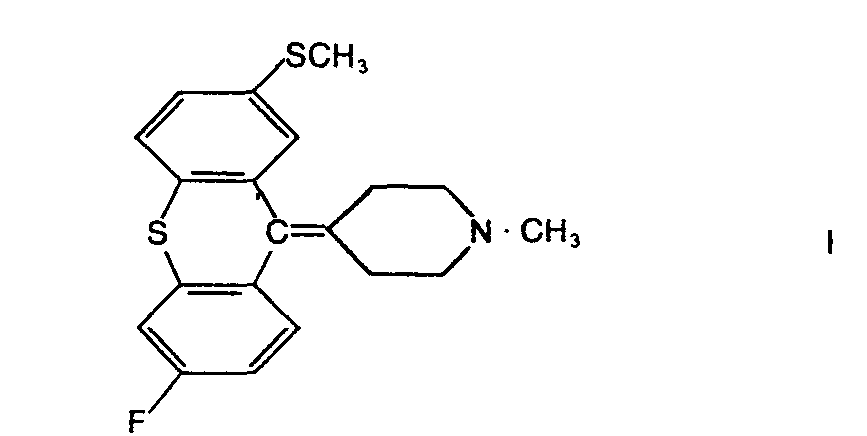
and its non-toxic acid addition salts have been shown in animal experiment to possess very strong and longlasting neuroleptic properties and, at the same time, a low degree of undesired side effects such as extrapyrimidal side effects. They also have a low acute toxicity which makes the therapeutic index favourable.
Moreover, they have strong anticholinergic effects.
The compound may conveniently be prepared by dehydrating 2-methylthio-6-fluoro-9-(1-methyl-4-piperidylidene)-thioxanthen-ol-9 of the formula:

by conventional means.
The compound of formula I and its acid addition salts may be administered in the form of tablets, capsules, powders, syrups, suppositories or solutions for injection.
Description
- cological effects associated with extrapyrimidal symptoms. Further, some piperidylidene-thioxanthene derivatives having almost no extrapyrimidal side effects have been described in Belgian Patent No. 835,224. However, the said known thioxanthene compounds which have the lowest extrapyrimidal side effects also have relatively short-acting neuroleptic effects.
- According to the present invention it has now surprisingly been found that the compound 2-methylthio-6-fluoro-9-(1-methyl- .4-piperidylidene)-thioxanthene, as well as its non-toxic acid addition salts have both strong and relatively longlasting neuroleptic effects and, at the same time, a pharmacological profile which indicates low extrapyrimidal side effects when they are evaluated according to standard reliable published test methods. They also have a low acute toxicity compared with related thioxanthene derivatives, which makes the therapeutic index favorable. Moreover, they have strong anticholinergic effects.
- This invention also includes pharmaceutically acceptable salts of 2-methylthio-6-fluoro-9-(1-methyl-4-piperidylidene)-thioxanthene formed with non-toxic organic acids. Such salts are easily prepared by methods known to the art. The base is reacted with either the calculated amount of organic or inorganic acid in an aqueous miscible solvent, such as acetone or ethanol, with isolation of the salt by concentration and cooling or an excess of the acid in aqueous immiscible solvent, such as ethyl ether or chloroform, with the desired salt separating directly. Exemplary of such organic salts are those with maleic, fumaric, benzoic, ascorbic, embonic, succinic, oxalic, bis methylene-salicylic, methanesulfonic, ethanedisulfonic, acetic, propionic, tartaric, salicylic, citric, gluconic, laetic, malic, mandelic, cinnamic, citraconic, aspartic, stearic, palmitic, itaconic, glycolic, p-amino-benzoic, glutamic, benzene sulfonic and theophylline acetic acids as well as the 8-halotheophyllines, for example 8-bromo-theophylline. Exemplary of such inorganic salts are those with hydrochloric, hydrobromic, sulfuric, sulfamic, phosphoric and nitric acids. Of course, these salts may also be prepared by the classical method of double decomposition of appropriate salts, which is wellknown to the art.
- The present invention relates to the novel compound 2-methylthio-6-fluoro-9-(1-methyl-4-piperidylidene)-thioxanthene and its non-toxic acid addition salts. which compounds have strong and longlasting neuroleptic properties and, at the same time, a low degree of undesired side effects such as extrapyrimidal side effects. The invention moreover relates to a method for the preparation of said novel compounds, pharmaceutical compositions containing same, which may be administered to animals, including human beings, orally or parenterally. Further the invention relates to a method for producing an antipsychotic effect in warm- blooded animals by administering to said animals an antipsychotic effective amount of one of said novel compounds.
- In the past, several drugs having a tricyclic structure have been found useful in the treatment of severe psychotic disorders, especially of the schizophrenic type. Some of these drugs are thioxanthenes which are substituted in the 2-positicn of one of the benzene rings, and some of the most active are described in U.S.Patent No. 3,116,291. Recently some thioxanthenes having a fluoro atom in the 6-position have been described, for example in British Patent No. 1,453,828, as having neuroleptic properties of the same level as the known thioxanthene-neuroleptics but a much lower level of pharma-
- Example: 2-Methylthio-6-fluoro-9-(l-methyl-4-piperidylidene)-thioxanthene and its salts.
- The starting material, 2-methylthio-6-fluoro-9-(l-methyl-4-piperidyl)-thioxanthen-9-ol, was prepared in the following way:
- 285 grams of 4-fluoro-2-(4-methylthiophenyl-thio)-benzoic acid (Collec. Czech. Chem.Commun, 40, p. 3523 (1975) ) were added to 2 kilograms of polyphosphoric acid while stirring, and the mixture then warmed at 105 degrees Centigrade for 3 hours. The reaction mixture was then poured unto ice, stirred and the precipitate filtered off, washed with water and then suspended in a mixture of acetone and water. The suspension was made alkaline with 25% aqueous ammonia, filtered and the solid material dried. It consisted of 270 grams of crude 2-methylthio-6-fluoro-thioxanthene-9-one which after recrystallization from 250 milliliters ofpyridineyilded 163 grams, which melted at 135-140 degrees Centigrade. Upon further recrystallization from pyridine 137 grams of almost pure 2-methylthio-6-fluoro-thioxanthene-8-one, which melted at 140-142 degrees Centigrade, were obtained.
- To a Grignard-solution prepared from 130 grams of 4-chloro-1-methylpiperidine and 24 grams of magnesium turnings in 500 milliliters of dry tetrahydrofuran was added 174 grams of 2-methylthio-6-fluoro-thioxanthene-9-one in portions while stirring and cooling in an ice-salt mixture. The reaction temperature was kept below 10 degrees Centigrade. The cooling bath was then removed and the reaction mixture was stirred at 35-40 degrees Centigrade for 1.5 hours. The reaction mixture was then poured into a mixture of ice, water and ammonium chloride. The crystalline precipitate which was obtained upon cooling was sucked off, washed with water and dissolved in 10% aqueous acetic acid. The solution was treated with charcoal, extracted three times with 100 milliliters of ether and then made alkaline with 10 N sodium hydroxide solution. After cooling the precipitated base was sucked off, washed with water, suspended in 100 milliliters of acetone, filtered, again suspended in 100 milliliters of The novel compounds of the invention may be administered both orally and parenterally, for example in the form of tablets, capsules, powders, syrups, suppositories or solutions for injection.
- According to the method of the invention 2-methylthio-6-fluoro-9-(1-methyl-4-piperidylidene)-thioxanthene and its non-toxic acid addition salts are prepared by dehydrating 2-methylthio-6-fluoro-9-(l-methyl-4-piperidylidene)-thioxanthen-ol-9 and isolating 2-methylthio-6-fluoro-9-(l-methyl-4-piperidylidene)-thioxanthene as the free base or a non-toxic acid addition salt thereof.
- The dehydration according to the method of invention is preferably carried out by means of a mixture of glacial acetic acid and concentrated hydrochloric acid. Other dehydrating agents may, however, be used with satisfactory results, such as hydrochloric acid in chloroform, formic acid, phosphorous oxychloride, p-toluene sulfochloride, sulfuric acid, zinc chloride, potassium bisulfate, and the like, in inert organic solvents, e.g. chloroform and methylene chloride.
- The starting material, which is a novel compound and forms part of the invention, may conveniently be prepared by cyclising 4-fluoro-2-(4-methylthiophenylthio)-benzoic acid (Collec.Czech. Chem.Commun, 40, p.3523 (1975) ) with phosphoric acid, and reacting the resulting 6-fluoro-2-methylthio-thioxanthone-9-one with a Grignard compound prepared from 4-chloro-l-methylpiperidine and magnesium, and hydrolysing the resulting Grignard complex with cold aqueous ammoniumchloride and isolating the resulting free base.
- The following example is given to illustrate the method and products of the present invention but, it is to be understood as exemplary only and is not to be construed as limiting.
- The pharmacological testing of 2-methylthio-6-fluoro-9-(l-methyl-4-piperidylidene)-thioxanthene, in the following called Lu 14-089 for short, and its non-toxic acid addition salts consisted of standard and reliable tests. Where the results with salts were compared with the results obtained with the free base it was found that the effect was the same as that obtained with the equivalent amount of free base.
- The tests may be described as follows:
- Mice, male, weighing from 18-25 g, fasted from 4 p.m. the day before test day.
- Four treated groups and one control group, each of 4 mice, are used.
The test substance is suspended in methyl cellulose o.5% and injected intraperitoneally. The animals are placed in Macrolon cages type II. After 24 hours the number of deaths are counted and LD50 is determined according to a statistic table. Furthermore the results are recorded according to the punching instructions as fractions: 0/4, 1/4, 2/4, 3/4 and 4/4 where 0, 1, 2, 3 and 4 indicate the number of deaths after the dose in question. - Perspex observation cages without bottom and lid, consisting of 5 sections each measuring 12 x 25 x 30 cm. White corrugated paper. Mice, male, 18-25 g.
- The test substance is given i.p. in the doses 0, 1/8, 1/32 and 1/128 of the determined "i.p. LD50". 3 x 2 mice are used for each dose level. Two or 24 hours after injection of test substance, methylphenidate, 60 mg/kg, is injected s.c. acetone, and then filtered and dried to yield 142 grams of 2-methylthio-6-fluoro-9-(l-methyl-4-piperidyl)-thioxanthen-9-ol which melted at 180-189 degrees Centigrade.
The analytically pure compound melts at 192-195 degrees Centigrade after recrystallization from diethylether. - A solution of 140 grams of 2-methylthio-6-fluoro-9-(1-methyl-4-piperidyl)-thioxanthen-9-ol in 420 milliliters of glacial acetic acid and 420 milliliters of concentrated hydrochloric acid was refluxed for 1.5 hours, whereupon 250 milliliters of liquid were distilled from the reaction mixture. The reaction mixture was then poured unto crushed ice, made alkaline with concentrated aqueous ammonia and extracted with toluene. The toluene solution was separated, washed with water, and extracted with dilute acetic acid. The base was then liberated from the acid extract with concentrated aqueous ammonia and extracted with methylene chloride, which was dried over anhydrous potassium carbonate, filtered with charcoal, and concentrated in vacuo to yield 78 grams of base which was taken up in hexane and crystallized to give 70 grams of 2-methylthio-6-fluoro-9-(l-methyl-4-piperidylidene)-thioxanthene which melted at 102-115 degrees Centigrade.
- This product was purified by converting it to the oxalate, yielding 83 grams of oxalate melting at 212-218 degrees Centigrade (ethanol). The base was then liberated from the oxalate with dilute aqueous ammonia, extracted with methylene chloride, dried, filtered , concentrated in vacuo and crystallized from 96% ethanol to give 57 grams melting at 115-118 degrees Centigrade.
- A vertical wire netting (50 cm x 49 cm). The meshes (openings) of the netting are square (lcm x lcm). The wire diameter is 2mm. Stop watch.
Rats, male, 180-200 g. - The animals are labeled and used in groups of five.
The test substance is injected subcutaneously (s.c.) (5 ml/kg) at 4 dose levels selected from the fixed dose scale. - The animals are placed in the middle of the vertical wire netting 60, 120, 180, 240, 300 and 360 minutes after injection of the test compound. The animals are considered cetaleptic when they remain immobile during a period of 15 seconds. This cataleptic reaction is designated +. If the rats are "atonic" and passively slides down the wire mesh they are considered not cataleptic. If the animals climb up and down the wire mesh they are nor cataleptic. In both situations the designation - is used.
- The results are recorded in fractions: 0/5, 1/5, 2/5, 3/5, 4/5 and 5/5, where 0, 1, 2, 3, 4 and 5 are the number of rats with designation + at the time where the dose in question possessed the strongest effect within the first 6 hours.
- Mice, male 20-25 g. Scopolamine bromide 0.04 mg/ml or 0.1 mg/ml. Physostigmine salicylate 0.2 mg/ml. Macrolon cages type II.
- The test compound is injected i.p. in doses 0, 1/4, 1/16 and 1/64 of the determined "i.p. LD50". Five mice are used for each dose level. One group, serving as positive control, is injected with scopolamine 0.4 mg/kg i.p. Thirty minutes after i.p. administration of test substance (or scopolamine), physostigmine 2 mg/kg, is injected i.p. This dose of physostigmine induces tremor with salivation, clonic convulsions, coma and ; After administration of methylphenidate the mice are placed in the observation cages, 2 in each cage, where they remain for exactly 1 hour. The cages are placed on corrugated paper, the corrugations facing upwards. It is examined whether the mice have been biting the corrugated paper or not. If not, the substance has had an antagonistic effect. If one or more of the control pairs have not been biting, the test has to be repeated on a new set of mice.
- The result is stated in fractions: 0/3, 1/3, 2/3 and 3/3 where 0, 1, 2 and 3 are the number of pairs which have not been biting on receipt of the dose in question. The results are calculated as the dose (ED50),which causes antagonism in 50% of the test animals.
- Perspex observation cages without bottom and lid, consisting of 5 sections each measuring 12 x 25 x 30 cm. White corrugated paper. Rats, male, 230-270 g.
- The test substance is given i.p. in a reasonable dose based on the determined LD50. Two hours later an intravenous injection of amphetamine sulphate 13.6 mg/kg (-10 mg/kg amphetamine base) is given, after which the rats are placed individually in the cages. The cages are placed on white corrugated paper. Five rats are used for each dose level . Observations are made after 55 minutes and 65 minutes - observation time: 1 minute. The animals are observed for stereottypy (movements of the head, compulsive gnawing). If no stereotypy is demonstrated the substance has had an antagonistic effect. If the compound has full antagonistic effect another group of rats is used at a lower dose. If the compound shows no effect a higher dose is used. The result is stated as fractions: 0/5, 1/5, 2/5, 3/5, 4/5 and 5/5, where 0, 1, 2, 3, 4 and 5 indicate the number of rats which have not shown stereotypy at the dose in question.
- The results are calculated as ED50 in mg/kg. buffer containing 10 mM sodium thiosulphate. The samples are filtered through Whatman GF/C glass fiber filters and washed with 30 ml ice cold 100 mM phosphate buffer. The filters with synaptosomes are transferred to scintillation vials and the radio-activity measured by liquid scintillation counting after addition of 10 ml Instal-Gel (Packard Inst.). All experiments are performed in triplicate.
- The results are recorded as mean percentage inhibition calculated by EDP on the basis of the level of a control group. Furthermore, the IC50 (the concentration which displaces specific 3H-PrBCM binding by 50%) is calculated. Specific 3H-PrBCM binding is defined as the total binding minus the binding in the presence of 20/uM atropine.
- Adult Beagle dogs of either sex, housed individually in kennels or in cages. 2-4 dogs are used per dose level.
- The test compound is injected subcutanelusly in the back of the neck four hours before apomorphine, which is given intravenously in a dose of 25 /ug/kg (volume o.l ml/kg). A control dog or a dog given an inactive dose of test compound will vomit in the course of few minutes after this threshold- dose of apomorphine.
- The results are given as fractions, i.e. 0/2, 1/2 or 2/2, stating the number of dogs protected against vomiting over to the number of dogs. On account of the small number of animals the calculated ED50 should be considered approximate. death. After 60 minutes the number of survivors are counted.
- The results are recorded in fractions: 0/5, 1/5, 2/5, 3/5, 4/5 and 5/5 where 0, 1, 2, 3, 4 and 5 inducate the number of animals in which the test compound has prevented the occurrence of death.
- If scopolamine (positive control group) does not protect all physostigmine treated animals a new test should be made, and the results should not be recorded.
- Rats, 150-200 g. Sodium-phosphate buffer (pH 7.4). 15mM (2.67 g Na2HPO4, 2H20/1000 ml) and 100 mM (89 g Na2HP04, 2H20/5000 ml) 0.32 M sucrose (5.48 g/50 ml). Sodium thiosulphate 10 mM (2.48 g/1000 ml) 3 H-PrBCM (N-2'-chloroethyl-N-[2", 3"-3H2] propyl-2-amino- ethylbenzilate, spec. act. ~ 28 Ci/mM).
- A rat is killed by a blow on the head and exsanguinated. The whole brain is remonved and homogenized in 10 volumes of ice cold 0.32 M sucrose with a hand homogenizer. The homogenate is centrifuged at 600 g for 10 minutes (4°C)and the pellet discarded. The supernatant is then centrifuged at 25000 g for 55 minutes (4° C). The pellet fraction (P2) is resuspended in the same volume of 0.32 M sucrose as previously used and stored on ice.
- The aziridinium ion of 3H-propylbenzilylcholine mustard (3H-PrBCM) is prepared by cyclization at a concentration of 130 nM in 15 mM Na-phosphate buffer (pH 7.4) for 50 minutes at 20°C. The reaction is terminated by addition of 100 volumes of ice cold buffer.
- 150 /ul of the P2-suspension are mixed with 1 ml of 100 mM phosphate buffer, preincubated for 10 minutes at 30°C with test compound and then incubated with 3H-PrBCM to give a final concentration of about 9 nM. The incubation is continued for 15 minutes and stopped by addition of 20 ml 100 mM phosphate
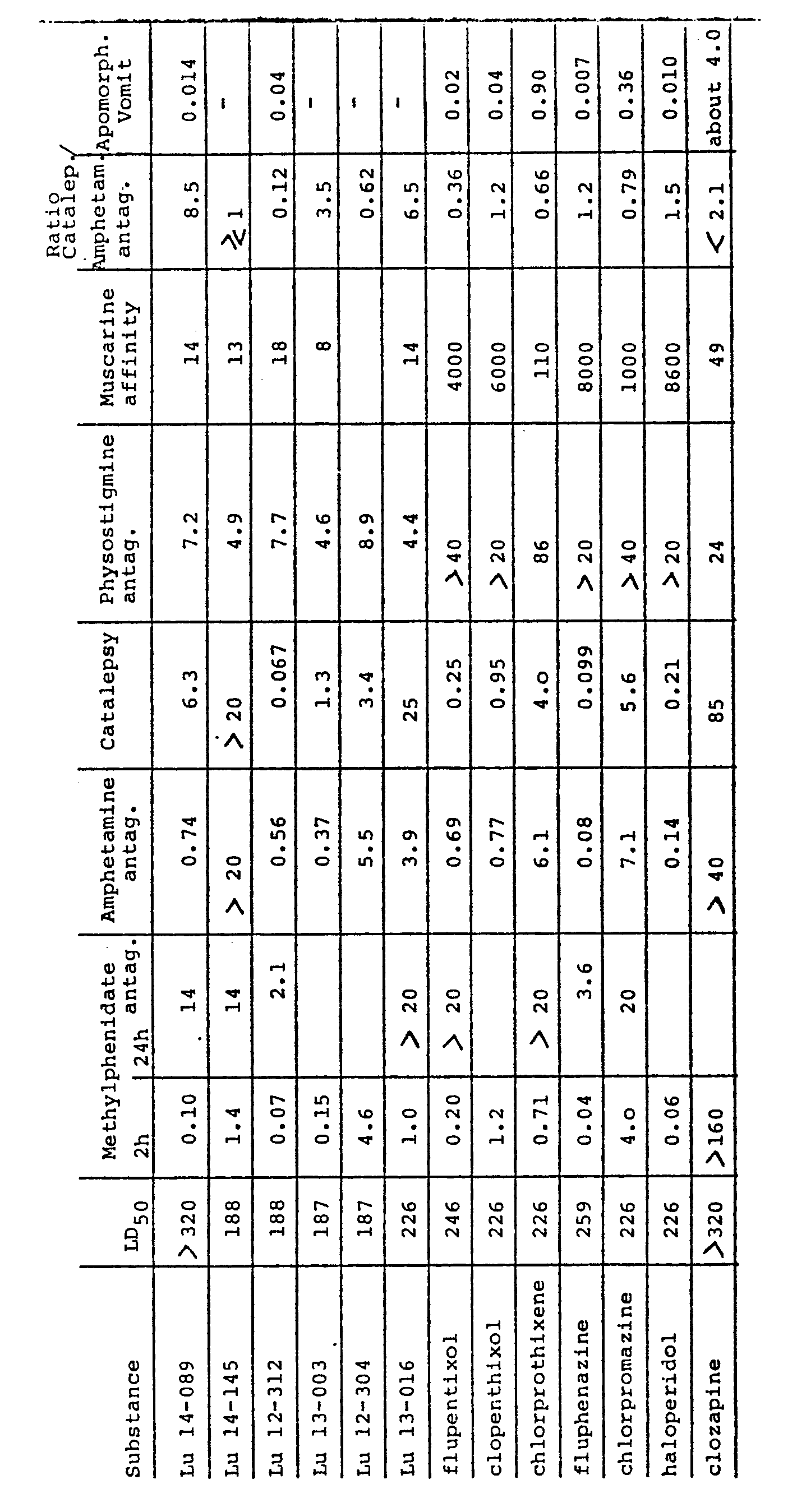
- Lu 14-089 was compared with the following substances:
- 2-Methylthio-9-(l-methyl-4-piperidylidene)-thioxanthene (Lu 14-145)
- 2-Trifluoromethyl-6-fluoro-9-(1-methyl-4-piperidylidene)-thioxanthene (Lu 12-312)
- 2-Trifluoromethyl-9-(l-methyl-4-piperidylidene)-thioxanthene (Lu 13-003)
- 2-Chloro-6-fluoro-9-(1-methyl-4-piperidylidene)-thioxanthene (Lu 12-304)
- 2-Chloro-9-(l-methyl-4-piperidylidene)-thioxanthene (Lu 13-016)
- Further the following neuroleptic drugs designated by their INN-names (International Non-proprietary Names) were used as reference substances: flupentixol, clopenthixol, chlorprothixene, fluphenazine, chlorpromazine, haloperidal and clozapine.
- The results obtained will appear from the following table:
- Lu 14-089 as well as the non-toxic acid addition salts thereof may be administered to animals such as dogs, cats, horses sheeps or the like, including human beings, both orally and parenterally, and may be used for example in the form of tablets capsules, powders, syrups, suppositories, or in the form of the usual sterile solutions for injection. Results upon administration to human beings have been very gratifying.
- Most conveniently the novel compounds of the invention are administered orally in unit dosage form such as tablets or capsules, each dosage unit containing one of the said compounds in an amount of from about 0.05 to about 50 mg, most preferably however, from about 0.5 to 25 mg, calculated as the free amine, the total daily dosage usually ranging from about 0.5 to about 300 mg. The exact indivudual dosages as well as daily dosages in a particular case will, of course, be determined according to established medical principles under the direction of a physician.
- When preparing tablets, the active ingredient is for the most part mixed with ordinary tablet adjuvants such as corn starch, potato starch, talcum, magnesium stearate, gelatine, lactose, gums, or the like.
- Typical examples of formulas for compositions containing Lu 14-089 as the active ingredient are as follows:
- 1) Tablets containing 1 milligram of Lu 14-089 calculated as the free base in the form of the hydrochloride:

- example: Fumaric, benzoic, ascorbic, succinic, salicylic, bismethylenesalicylic, propionic, gluconic, malic, malonic, glycolic, benzenesulphonic, and sulphamic acids may also be emploued as acid addition saltforming acids.
- When it is desired to isolate Lu 14-089 in the form of the free base, this may be done according to conventional procedure as by dissolving the isolated or unisolated salt in water, treating with a suitable alkaline material, extracting the liberated free base with a suitable organic solvent drying the extract and evaporating to dryness or fractionally distilling to effect isolation of the free basic. amine.
- The invention also comprises a method for the alleviation, palliation, mitigation or inhibition of the manifestations of certain physiological-psychological abnormalies of animals by'administering to a living animal body, including human beings, an adequate quantity of Lu 14-089 or a non-toxic acid addition salt thereof. An adequate quantity would be from about 0.001 mg to about 1 mg per kg of body weight in each unit dosage and from about 0.003 milligrams to about 3 milligrams/kg of body weight per day.
- It is to be understood that the invention is not limited to the exact details of operation or exact compound or compositions shown and described, as obvious medifications and equivalents will be apparent to one skilled in the art.
- 2) Solution for injection containing per ml:

- 3) Syrup containing per milliliter:

- 4) Capsules containing per capsule:

- Any other pharmaceutical tableting adjuvants may be used provided that they are compatible with the active ingredient, and additional compositions and dosage forms may be similar to those presently used for neuroleptics such as thiothixene, clopenthixol or flupenthixol. Also combination of the novel compounds of the invention with other active ingredients, especially other neuroleptics, thymoleptics, tranquilizers or the like, fall within the scope of the present invention.
- As previously stated, when isolating Lu 14-089 in the form of an acid addition salt, the acid is preferably selected so as to contain an anion which is non-toxic and pharmacologically acceptable, at least in usual therapeutic doses. Representative salts which are included in this preferred group are the hydrochloride, hydrobromide, sulphate, acetate, phosphate, nitrate, methanesulphonate, ethanesulphonate, lactate, citrate, tartrate or bitartrate, embonate and maleate of Lu 14-089. Other acids are likewise suitable and may-be employed if desired; for
- 6. A pharmaceutical composition in unit dosage form comprising as an active ingredient 2-methylthio-6-fluoro-9-(l-methyl-4-piperidylidene)-thioxanthene or a non-toxic acid addition salt thereof together with a pharmaceutical carrier or excipient.
- 7. A pharmaceutical composition according to Claim 6 characterized thereby that each dosage unit contains the active ingredient in an amount ranging from 0.15 to 50 mg.
- 8. A compound of the general formula:

Claims (5)
1. The compound 2-methylthio-6-fluoro-9-(l-methyl-4-piperidylidene)-thioxanthene of the formula:

and non-toxic acid addition salts thereof.
2. A compound according to Claim 1 which is 2-methylthio-6-fluoro-9-(1-methyl-4-piperidylidene)-thioxanthene.
3. A compound according to Claim 1 which is the hydrochloride of 2-methylthio-6-fluoro-9-(1-methyl-4-piperidylidene)-thioxanthene.
4. A compound according to Claim 1 which is the oxalate of 2-methylthio-6-fluoro-9-(l-methyl-4-piperidylidene)-thioxanthene.
5. A method for the preparation of the compounds defined in Claim 1, which comprises dehydrating 2-methylthio-6-fluoro-9-(1-methyl-4-piperidylidene)-thioxanthen-ol-9 of the formula

and isolating the compound of Formula I obtained as the free base or a non-toxic acid addition salt thereof.
Applications Claiming Priority (2)
| Application Number | Priority Date | Filing Date | Title |
|---|---|---|---|
| GB5417577 | 1977-12-29 | ||
| GB5417577 | 1977-12-29 |
Publications (1)
| Publication Number | Publication Date |
|---|---|
| EP0002902A1 true EP0002902A1 (en) | 1979-07-11 |
Family
ID=10470168
Family Applications (1)
| Application Number | Title | Priority Date | Filing Date |
|---|---|---|---|
| EP78300779A Withdrawn EP0002902A1 (en) | 1977-12-29 | 1978-12-08 | Methylthiofluorothioxanthene derivative, its preparation and compositions containing it |
Country Status (11)
| Country | Link |
|---|---|
| US (1) | US4235916A (en) |
| EP (1) | EP0002902A1 (en) |
| JP (1) | JPS5498778A (en) |
| AT (1) | AT366042B (en) |
| AU (1) | AU519403B2 (en) |
| CA (1) | CA1112245A (en) |
| ES (1) | ES476405A1 (en) |
| FI (1) | FI784010A7 (en) |
| NO (1) | NO784407L (en) |
| NZ (1) | NZ189108A (en) |
| ZA (1) | ZA786879B (en) |
Families Citing this family (2)
| Publication number | Priority date | Publication date | Assignee | Title |
|---|---|---|---|---|
| US4777177A (en) * | 1984-10-19 | 1988-10-11 | Ciba-Geigy Corporation | Pesticidal thioxanthen-9-ylidenepiperidines |
| US20040037760A1 (en) * | 2002-08-21 | 2004-02-26 | Abb Lummus Heat Transfer | Steam reforming catalytic reaction apparatus |
Citations (6)
| Publication number | Priority date | Publication date | Assignee | Title |
|---|---|---|---|---|
| US3055903A (en) * | 1960-02-25 | 1962-09-25 | Sandoz Ltd | 2-alkyl mercapto-9-(n-alkyl-piperidylidene-4'-thioxanthenes and the acetate salts thereof |
| US3116291A (en) * | 1958-12-04 | 1963-12-31 | Kefalas As | 9-(propene-3-ylidene-1), and 9-[3'-(nu-hydrox-yalkylpiperazino-nu)-propylidene], xanthenes and thiaxanthenes, and processes for their preparation |
| DE1470215A1 (en) * | 1961-05-06 | 1969-05-08 | Sandoz Ag | New heterocyclic compounds and processes for their preparation |
| BE835224A (en) * | 1974-11-06 | 1976-05-04 | NEW PIPERIDYLIDENIC DERIVATIVES, THEIR PROCESS OF PREPARATION AND THEIR THERAPEUTIC USE | |
| GB1453828A (en) * | 1972-12-08 | 1976-10-27 | Kefalas As | Fluoro-substituted thiaxanthene derivatives |
| US4086350A (en) * | 1974-11-06 | 1978-04-25 | Smithkline Corporation | Pharmaceutical compositions and method of producing anti-psychotic activity without extrapyramidal symptoms |
-
1978
- 1978-12-06 NZ NZ189108A patent/NZ189108A/en unknown
- 1978-12-07 ZA ZA00786879A patent/ZA786879B/en unknown
- 1978-12-08 EP EP78300779A patent/EP0002902A1/en not_active Withdrawn
- 1978-12-19 AT AT0906178A patent/AT366042B/en not_active IP Right Cessation
- 1978-12-20 US US05/971,509 patent/US4235916A/en not_active Expired - Lifetime
- 1978-12-22 AU AU42851/78A patent/AU519403B2/en not_active Expired
- 1978-12-27 JP JP16019678A patent/JPS5498778A/en active Pending
- 1978-12-28 ES ES476405A patent/ES476405A1/en not_active Expired
- 1978-12-28 CA CA318,765A patent/CA1112245A/en not_active Expired
- 1978-12-28 NO NO784407A patent/NO784407L/en unknown
- 1978-12-28 FI FI784010A patent/FI784010A7/en unknown
Patent Citations (7)
| Publication number | Priority date | Publication date | Assignee | Title |
|---|---|---|---|---|
| US3116291A (en) * | 1958-12-04 | 1963-12-31 | Kefalas As | 9-(propene-3-ylidene-1), and 9-[3'-(nu-hydrox-yalkylpiperazino-nu)-propylidene], xanthenes and thiaxanthenes, and processes for their preparation |
| US3055903A (en) * | 1960-02-25 | 1962-09-25 | Sandoz Ltd | 2-alkyl mercapto-9-(n-alkyl-piperidylidene-4'-thioxanthenes and the acetate salts thereof |
| DE1470215A1 (en) * | 1961-05-06 | 1969-05-08 | Sandoz Ag | New heterocyclic compounds and processes for their preparation |
| GB1453828A (en) * | 1972-12-08 | 1976-10-27 | Kefalas As | Fluoro-substituted thiaxanthene derivatives |
| BE835224A (en) * | 1974-11-06 | 1976-05-04 | NEW PIPERIDYLIDENIC DERIVATIVES, THEIR PROCESS OF PREPARATION AND THEIR THERAPEUTIC USE | |
| DE2549841A1 (en) * | 1974-11-06 | 1976-05-13 | Smithkline Corp | PIPERIDYLIDEN DERIVATIVES, THEIR SALTS, METHOD FOR THEIR MANUFACTURING AND MEDICINAL PREPARATIONS |
| US4086350A (en) * | 1974-11-06 | 1978-04-25 | Smithkline Corporation | Pharmaceutical compositions and method of producing anti-psychotic activity without extrapyramidal symptoms |
Also Published As
| Publication number | Publication date |
|---|---|
| ZA786879B (en) | 1979-12-27 |
| NO784407L (en) | 1979-07-02 |
| CA1112245A (en) | 1981-11-10 |
| AU4285178A (en) | 1979-07-05 |
| AT366042B (en) | 1982-03-10 |
| JPS5498778A (en) | 1979-08-03 |
| ES476405A1 (en) | 1980-03-01 |
| NZ189108A (en) | 1982-02-23 |
| ATA906178A (en) | 1981-07-15 |
| US4235916A (en) | 1980-11-25 |
| AU519403B2 (en) | 1981-12-03 |
| FI784010A7 (en) | 1979-06-30 |
Similar Documents
| Publication | Publication Date | Title |
|---|---|---|
| US5294619A (en) | Arylpiperidine derivatives | |
| US4012393A (en) | 2-[5-(CYCLIC AMINO) ETHYL-10,11-DIHYDRO-5H-dibenzo[a,d]-cyclohepten-5- yl]-5 | |
| US4086350A (en) | Pharmaceutical compositions and method of producing anti-psychotic activity without extrapyramidal symptoms | |
| IE46737B1 (en) | 2-(2,2-diarylalkyl)-1-azabicyclo (2.2.2)octane and related compounds | |
| CA1055945A (en) | Pharmaceutical compositions and method of producing antipsychotic activity without extrapyramidal symptoms | |
| DE3002292C2 (en) | ||
| IE44639B1 (en) | Oxadiazoloyl-substituted compounds having pharmacological activity | |
| US4309429A (en) | Xanthene and thioxanthene derivatives, compositions thereof, and treatment therewith | |
| DE69007905T2 (en) | 1-Oxa-2-oxo-8-azaspiro [4,5] decane derivatives, process for their preparation and pharmaceutical compositions therefrom. | |
| US4235916A (en) | 2-Methylthio-6-fluoro-9-(1-methyl-4-piperidylidene)-thioxanthene and salts thereof, neuroleptic compositions and method of use | |
| US4042695A (en) | Thiaxanthene derivatives, compositions thereof and methods of treating therewith | |
| Kaiser et al. | Analogs of phenothiazines. 5. Synthesis and neuropharmacological activity of some piperidylidene derivatives of thioxanthenes, xanthenes, dibenzoxepins, and acridans | |
| US4073912A (en) | Piperidylidene derivatives of benzo-fused xanthenes, thioxanthenes and dibenzoxepins and antipsychotic use thereof | |
| CA1048038A (en) | Xanthene and thioxanthene derivatives and method | |
| US4707484A (en) | Substituted piperidinomethylindolone and cyclopent(b)indolone derivatives | |
| US3435042A (en) | Novel morphanthridine derivatives | |
| US3743735A (en) | Pharmaceutical compositions containing tropanol esters of alpha-phenyl-alpha-cyclopentyl-acetic acid and methods of use | |
| US3786059A (en) | 1,2,3,6-tetrahydro-4-pyridylmethyl carboxylates | |
| US4022786A (en) | 4,4-Diarylpiperidines and process of making the same | |
| US3966952A (en) | Alpha-isomer of the palmitic acid ester of 10-[3-(4-hydroxy-ethyl-1-piperazinyl)propylidene]-2-trifluoromethyl thiaxanthene, compositions thereof and a method of preparaton thereof and use thereof | |
| US3891636A (en) | 10-(Piperidino-alkyl) -phenothiazines | |
| US4022896A (en) | Xanthene and thioxanthene compositions and method of treating | |
| US4035503A (en) | Xanthene and thioxanthene derivatives, compositions thereof and a method of preparation thereof | |
| US3466290A (en) | 9,10-dihydro-4h-benzo(4,5)cyclohepta(1,2-b)thiophene ethers | |
| US3700663A (en) | Dibenzothiazepine ethers |
Legal Events
| Date | Code | Title | Description |
|---|---|---|---|
| PUAI | Public reference made under article 153(3) epc to a published international application that has entered the european phase |
Free format text: ORIGINAL CODE: 0009012 |
|
| AK | Designated contracting states |
Designated state(s): BE CH DE FR GB IT LU NL SE |
|
| 17P | Request for examination filed | ||
| STAA | Information on the status of an ep patent application or granted ep patent |
Free format text: STATUS: THE APPLICATION IS DEEMED TO BE WITHDRAWN |
|
| 18D | Application deemed to be withdrawn |
Effective date: 19820526 |
|
| RIN1 | Information on inventor provided before grant (corrected) |
Inventor name: BOGESO, KLAUS PETER |