EP0002136B1 - Substituted benzonitriles, their preparation, liquid crystal compositions containing them and display devices employing such compositions - Google Patents
Substituted benzonitriles, their preparation, liquid crystal compositions containing them and display devices employing such compositions Download PDFInfo
- Publication number
- EP0002136B1 EP0002136B1 EP78300649A EP78300649A EP0002136B1 EP 0002136 B1 EP0002136 B1 EP 0002136B1 EP 78300649 A EP78300649 A EP 78300649A EP 78300649 A EP78300649 A EP 78300649A EP 0002136 B1 EP0002136 B1 EP 0002136B1
- Authority
- EP
- European Patent Office
- Prior art keywords
- compound
- liquid crystal
- formula
- mixture
- trans
- Prior art date
- Legal status (The legal status is an assumption and is not a legal conclusion. Google has not performed a legal analysis and makes no representation as to the accuracy of the status listed.)
- Expired
Links
- 239000000203 mixture Substances 0.000 title claims description 67
- 239000004973 liquid crystal related substance Substances 0.000 title claims description 64
- 238000002360 preparation method Methods 0.000 title description 7
- 150000008359 benzonitriles Chemical class 0.000 title description 5
- 150000001875 compounds Chemical class 0.000 claims description 102
- 125000000217 alkyl group Chemical group 0.000 claims description 19
- 125000004432 carbon atom Chemical group C* 0.000 claims description 16
- UHOVQNZJYSORNB-UHFFFAOYSA-N Benzene Chemical compound C1=CC=CC=C1 UHOVQNZJYSORNB-UHFFFAOYSA-N 0.000 claims description 12
- 239000004988 Nematic liquid crystal Substances 0.000 claims description 11
- 238000000034 method Methods 0.000 claims description 11
- 238000006297 dehydration reaction Methods 0.000 claims description 10
- 125000004093 cyano group Chemical group *C#N 0.000 claims description 6
- 230000018044 dehydration Effects 0.000 claims description 6
- YXLVGINZBGVEHL-UHFFFAOYSA-M magnesium;bromobenzene;bromide Chemical compound [Mg+2].[Br-].BrC1=CC=[C-]C=C1 YXLVGINZBGVEHL-UHFFFAOYSA-M 0.000 claims description 6
- 125000001246 bromo group Chemical group Br* 0.000 claims description 5
- 238000004519 manufacturing process Methods 0.000 claims description 5
- JFDZBHWFFUWGJE-UHFFFAOYSA-N benzonitrile Chemical compound N#CC1=CC=CC=C1 JFDZBHWFFUWGJE-UHFFFAOYSA-N 0.000 description 45
- YXFVVABEGXRONW-UHFFFAOYSA-N Toluene Chemical compound CC1=CC=CC=C1 YXFVVABEGXRONW-UHFFFAOYSA-N 0.000 description 27
- 239000000047 product Substances 0.000 description 23
- VLKZOEOYAKHREP-UHFFFAOYSA-N n-Hexane Chemical compound CCCCCC VLKZOEOYAKHREP-UHFFFAOYSA-N 0.000 description 21
- 239000000463 material Substances 0.000 description 18
- 239000000243 solution Substances 0.000 description 16
- 210000002858 crystal cell Anatomy 0.000 description 12
- XLYOFNOQVPJJNP-UHFFFAOYSA-N water Substances O XLYOFNOQVPJJNP-UHFFFAOYSA-N 0.000 description 10
- VEXZGXHMUGYJMC-UHFFFAOYSA-N Hydrochloric acid Chemical compound Cl VEXZGXHMUGYJMC-UHFFFAOYSA-N 0.000 description 9
- LFQSCWFLJHTTHZ-UHFFFAOYSA-N Ethanol Chemical compound CCO LFQSCWFLJHTTHZ-UHFFFAOYSA-N 0.000 description 8
- SECXISVLQFMRJM-UHFFFAOYSA-N N-Methylpyrrolidone Chemical compound CN1CCCC1=O SECXISVLQFMRJM-UHFFFAOYSA-N 0.000 description 8
- XRFQQRWQOLWBDB-UHFFFAOYSA-N 4-(4-heptylcyclohexen-1-yl)benzonitrile Chemical compound C1C(CCCCCCC)CCC(C=2C=CC(=CC=2)C#N)=C1 XRFQQRWQOLWBDB-UHFFFAOYSA-N 0.000 description 7
- DBEBPKRPYXUECZ-UHFFFAOYSA-N 4-(4-pentylcyclohexen-1-yl)benzonitrile Chemical compound C1C(CCCCC)CCC(C=2C=CC(=CC=2)C#N)=C1 DBEBPKRPYXUECZ-UHFFFAOYSA-N 0.000 description 7
- 238000006243 chemical reaction Methods 0.000 description 7
- 239000013078 crystal Substances 0.000 description 7
- MZRVEZGGRBJDDB-UHFFFAOYSA-N N-Butyllithium Chemical compound [Li]CCCC MZRVEZGGRBJDDB-UHFFFAOYSA-N 0.000 description 6
- 239000010410 layer Substances 0.000 description 6
- 238000003756 stirring Methods 0.000 description 6
- 238000009835 boiling Methods 0.000 description 5
- 239000007788 liquid Substances 0.000 description 5
- 239000002904 solvent Substances 0.000 description 5
- 0 *C(CC1)CCC1=O Chemical compound *C(CC1)CCC1=O 0.000 description 4
- SWJPEBQEEAHIGZ-UHFFFAOYSA-N 1,4-dibromobenzene Chemical compound BrC1=CC=C(Br)C=C1 SWJPEBQEEAHIGZ-UHFFFAOYSA-N 0.000 description 4
- YCOKNHGOCLLXHY-UHFFFAOYSA-N 4-(4-ethylcyclohexen-1-yl)benzonitrile Chemical compound C1C(CC)CCC(C=2C=CC(=CC=2)C#N)=C1 YCOKNHGOCLLXHY-UHFFFAOYSA-N 0.000 description 4
- CHFGJAJYNHOMTJ-UHFFFAOYSA-N 4-[4-(4-propylcyclohexen-1-yl)phenyl]benzonitrile Chemical compound C1C(CCC)CCC(C=2C=CC(=CC=2)C=2C=CC(=CC=2)C#N)=C1 CHFGJAJYNHOMTJ-UHFFFAOYSA-N 0.000 description 4
- NQEDLIZOPMNZMC-UHFFFAOYSA-N 4-propylcyclohexan-1-one Chemical compound CCCC1CCC(=O)CC1 NQEDLIZOPMNZMC-UHFFFAOYSA-N 0.000 description 4
- WYURNTSHIVDZCO-UHFFFAOYSA-N Tetrahydrofuran Chemical compound C1CCOC1 WYURNTSHIVDZCO-UHFFFAOYSA-N 0.000 description 4
- 238000009472 formulation Methods 0.000 description 4
- 238000002844 melting Methods 0.000 description 4
- 230000008018 melting Effects 0.000 description 4
- 125000004123 n-propyl group Chemical group [H]C([H])([H])C([H])([H])C([H])([H])* 0.000 description 4
- CHKVPAROMQMJNQ-UHFFFAOYSA-M potassium bisulfate Chemical compound [K+].OS([O-])(=O)=O CHKVPAROMQMJNQ-UHFFFAOYSA-M 0.000 description 4
- 239000001120 potassium sulphate Substances 0.000 description 4
- HQJQYILBCQPYBI-UHFFFAOYSA-N 1-bromo-4-(4-bromophenyl)benzene Chemical group C1=CC(Br)=CC=C1C1=CC=C(Br)C=C1 HQJQYILBCQPYBI-UHFFFAOYSA-N 0.000 description 3
- OJMCVJADCILEFS-UHFFFAOYSA-N 4-(4-propylcyclohexen-1-yl)benzonitrile Chemical compound C1C(CCC)CCC(C=2C=CC(=CC=2)C#N)=C1 OJMCVJADCILEFS-UHFFFAOYSA-N 0.000 description 3
- 239000003810 Jones reagent Substances 0.000 description 3
- OKKJLVBELUTLKV-UHFFFAOYSA-N Methanol Chemical compound OC OKKJLVBELUTLKV-UHFFFAOYSA-N 0.000 description 3
- ZMXDDKWLCZADIW-UHFFFAOYSA-N N,N-Dimethylformamide Chemical compound CN(C)C=O ZMXDDKWLCZADIW-UHFFFAOYSA-N 0.000 description 3
- MUBZPKHOEPUJKR-UHFFFAOYSA-N Oxalic acid Chemical compound OC(=O)C(O)=O MUBZPKHOEPUJKR-UHFFFAOYSA-N 0.000 description 3
- NPXOKRUENSOPAO-UHFFFAOYSA-N Raney nickel Chemical compound [Al].[Ni] NPXOKRUENSOPAO-UHFFFAOYSA-N 0.000 description 3
- 229910000564 Raney nickel Inorganic materials 0.000 description 3
- HEMHJVSKTPXQMS-UHFFFAOYSA-M Sodium hydroxide Chemical compound [OH-].[Na+] HEMHJVSKTPXQMS-UHFFFAOYSA-M 0.000 description 3
- 238000000862 absorption spectrum Methods 0.000 description 3
- 230000015572 biosynthetic process Effects 0.000 description 3
- 210000004027 cell Anatomy 0.000 description 3
- 238000001816 cooling Methods 0.000 description 3
- DOBRDRYODQBAMW-UHFFFAOYSA-N copper(i) cyanide Chemical compound [Cu+].N#[C-] DOBRDRYODQBAMW-UHFFFAOYSA-N 0.000 description 3
- 238000000921 elemental analysis Methods 0.000 description 3
- 238000010438 heat treatment Methods 0.000 description 3
- 125000002496 methyl group Chemical group [H]C([H])([H])* 0.000 description 3
- 125000000740 n-pentyl group Chemical group [H]C([H])([H])C([H])([H])C([H])([H])C([H])([H])C([H])([H])* 0.000 description 3
- 239000012299 nitrogen atmosphere Substances 0.000 description 3
- 239000012044 organic layer Substances 0.000 description 3
- 238000000926 separation method Methods 0.000 description 3
- BZRVTWXLAZABOC-UHFFFAOYSA-N (4-butylphenyl)imino-(4-methoxyphenyl)-oxidoazanium Chemical compound C1=CC(CCCC)=CC=C1N=[N+]([O-])C1=CC=C(OC)C=C1 BZRVTWXLAZABOC-UHFFFAOYSA-N 0.000 description 2
- JLEQZACKSXNUMB-UHFFFAOYSA-N (4-ethylphenyl)imino-(4-methoxyphenyl)-oxidoazanium Chemical compound C1=CC(CC)=CC=C1N=[N+]([O-])C1=CC=C(OC)C=C1 JLEQZACKSXNUMB-UHFFFAOYSA-N 0.000 description 2
- DYLIWHYUXAJDOJ-OWOJBTEDSA-N (e)-4-(6-aminopurin-9-yl)but-2-en-1-ol Chemical compound NC1=NC=NC2=C1N=CN2C\C=C\CO DYLIWHYUXAJDOJ-OWOJBTEDSA-N 0.000 description 2
- DSQICSMRCBUXKU-UHFFFAOYSA-N 1-bromo-4-(4-ethylcyclohexen-1-yl)benzene Chemical compound C1C(CC)CCC(C=2C=CC(Br)=CC=2)=C1 DSQICSMRCBUXKU-UHFFFAOYSA-N 0.000 description 2
- DVZVQLOCNGQNIO-UHFFFAOYSA-N 1-bromo-4-(4-pentylcyclohexen-1-yl)benzene Chemical compound C1C(CCCCC)CCC(C=2C=CC(Br)=CC=2)=C1 DVZVQLOCNGQNIO-UHFFFAOYSA-N 0.000 description 2
- OKSDJGWHKXFVME-UHFFFAOYSA-N 4-ethylcyclohexan-1-one Chemical compound CCC1CCC(=O)CC1 OKSDJGWHKXFVME-UHFFFAOYSA-N 0.000 description 2
- UKLNPJDLSPMJMQ-UHFFFAOYSA-N 4-pentylcyclohexan-1-one Chemical compound CCCCCC1CCC(=O)CC1 UKLNPJDLSPMJMQ-UHFFFAOYSA-N 0.000 description 2
- CSCPPACGZOOCGX-UHFFFAOYSA-N Acetone Chemical compound CC(C)=O CSCPPACGZOOCGX-UHFFFAOYSA-N 0.000 description 2
- IJGRMHOSHXDMSA-UHFFFAOYSA-N Atomic nitrogen Chemical compound N#N IJGRMHOSHXDMSA-UHFFFAOYSA-N 0.000 description 2
- 229910021578 Iron(III) chloride Inorganic materials 0.000 description 2
- FYYHWMGAXLPEAU-UHFFFAOYSA-N Magnesium Chemical compound [Mg] FYYHWMGAXLPEAU-UHFFFAOYSA-N 0.000 description 2
- KDLHZDBZIXYQEI-UHFFFAOYSA-N Palladium Chemical compound [Pd] KDLHZDBZIXYQEI-UHFFFAOYSA-N 0.000 description 2
- OCBFFGCSTGGPSQ-UHFFFAOYSA-N [CH2]CC Chemical group [CH2]CC OCBFFGCSTGGPSQ-UHFFFAOYSA-N 0.000 description 2
- 235000010290 biphenyl Nutrition 0.000 description 2
- 125000004802 cyanophenyl group Chemical group 0.000 description 2
- HPXRVTGHNJAIIH-PTQBSOBMSA-N cyclohexanol Chemical class O[13CH]1CCCCC1 HPXRVTGHNJAIIH-PTQBSOBMSA-N 0.000 description 2
- 125000000113 cyclohexyl group Chemical group [H]C1([H])C([H])([H])C([H])([H])C([H])(*)C([H])([H])C1([H])[H] 0.000 description 2
- 238000004821 distillation Methods 0.000 description 2
- 230000000694 effects Effects 0.000 description 2
- 238000005984 hydrogenation reaction Methods 0.000 description 2
- RBTARNINKXHZNM-UHFFFAOYSA-K iron trichloride Chemical compound Cl[Fe](Cl)Cl RBTARNINKXHZNM-UHFFFAOYSA-K 0.000 description 2
- 125000001280 n-hexyl group Chemical group C(CCCCC)* 0.000 description 2
- 230000001590 oxidative effect Effects 0.000 description 2
- ANRQGKOBLBYXFM-UHFFFAOYSA-M phenylmagnesium bromide Chemical compound Br[Mg]C1=CC=CC=C1 ANRQGKOBLBYXFM-UHFFFAOYSA-M 0.000 description 2
- 238000001953 recrystallisation Methods 0.000 description 2
- 238000010992 reflux Methods 0.000 description 2
- 239000007858 starting material Substances 0.000 description 2
- YLQBMQCUIZJEEH-UHFFFAOYSA-N tetrahydrofuran Natural products C=1C=COC=1 YLQBMQCUIZJEEH-UHFFFAOYSA-N 0.000 description 2
- 238000005292 vacuum distillation Methods 0.000 description 2
- 238000005406 washing Methods 0.000 description 2
- OCHLRMQEVOPMSK-UHFFFAOYSA-N (4-butylphenyl)-(4-butylphenyl)imino-oxidoazanium Chemical compound C1=CC(CCCC)=CC=C1N=[N+]([O-])C1=CC=C(CCCC)C=C1 OCHLRMQEVOPMSK-UHFFFAOYSA-N 0.000 description 1
- 125000001140 1,4-phenylene group Chemical group [H]C1=C([H])C([*:2])=C([H])C([H])=C1[*:1] 0.000 description 1
- ABHFHXPJTHMWQW-UHFFFAOYSA-N 1-(4-bromophenyl)-4-ethylcyclohexan-1-ol Chemical compound C1CC(CC)CCC1(O)C1=CC=C(Br)C=C1 ABHFHXPJTHMWQW-UHFFFAOYSA-N 0.000 description 1
- HICJYIYSJHKFFF-UHFFFAOYSA-N 1-(4-heptylcyclohexen-1-yl)cyclohexa-2,4-diene-1-carbonitrile Chemical compound C1C(CCCCCCC)CCC(C2(C=CC=CC2)C#N)=C1 HICJYIYSJHKFFF-UHFFFAOYSA-N 0.000 description 1
- VCFYCPWLAZXEBT-UHFFFAOYSA-N 1-(4-hexylcyclohexen-1-yl)cyclohexa-2,4-diene-1-carbonitrile Chemical compound C1C(CCCCCC)CCC(C2(C=CC=CC2)C#N)=C1 VCFYCPWLAZXEBT-UHFFFAOYSA-N 0.000 description 1
- NJUFBBSGUAQDGA-UHFFFAOYSA-N 1-(4-pentylcyclohexen-1-yl)cyclohexa-2,4-diene-1-carbonitrile Chemical compound C1C(CCCCC)CCC(C2(C=CC=CC2)C#N)=C1 NJUFBBSGUAQDGA-UHFFFAOYSA-N 0.000 description 1
- WPWHSFAFEBZWBB-UHFFFAOYSA-N 1-butyl radical Chemical group [CH2]CCC WPWHSFAFEBZWBB-UHFFFAOYSA-N 0.000 description 1
- GRZJZRHVJAXMRR-UHFFFAOYSA-N 1-cyclohexyl-2-phenylbenzene Chemical group C1CCCCC1C1=CC=CC=C1C1=CC=CC=C1 GRZJZRHVJAXMRR-UHFFFAOYSA-N 0.000 description 1
- ZGOWXOZNUNZPAV-UHFFFAOYSA-N 4-(4-heptylphenyl)benzonitrile Chemical group C1=CC(CCCCCCC)=CC=C1C1=CC=C(C#N)C=C1 ZGOWXOZNUNZPAV-UHFFFAOYSA-N 0.000 description 1
- HCMLVHVMDBBJCY-UHFFFAOYSA-N 4-(4-hexylcyclohexen-1-yl)benzonitrile Chemical compound C1C(CCCCCC)CCC(C=2C=CC(=CC=2)C#N)=C1 HCMLVHVMDBBJCY-UHFFFAOYSA-N 0.000 description 1
- YWLXZWFXPQOJBF-UHFFFAOYSA-N 4-(4-methylcyclohexen-1-yl)benzonitrile Chemical compound C1C(C)CCC(C=2C=CC(=CC=2)C#N)=C1 YWLXZWFXPQOJBF-UHFFFAOYSA-N 0.000 description 1
- GPGGNNIMKOVSAG-UHFFFAOYSA-N 4-(4-octoxyphenyl)benzonitrile Chemical group C1=CC(OCCCCCCCC)=CC=C1C1=CC=C(C#N)C=C1 GPGGNNIMKOVSAG-UHFFFAOYSA-N 0.000 description 1
- FTIDCJQEXSAINH-UHFFFAOYSA-N 4-(4-octylcyclohexen-1-yl)benzonitrile Chemical compound C1C(CCCCCCCC)CCC(C=2C=CC(=CC=2)C#N)=C1 FTIDCJQEXSAINH-UHFFFAOYSA-N 0.000 description 1
- KLSLBUSXWBJMEC-UHFFFAOYSA-N 4-Propylphenol Chemical compound CCCC1=CC=C(O)C=C1 KLSLBUSXWBJMEC-UHFFFAOYSA-N 0.000 description 1
- PDOFFPLWTRZAQV-UHFFFAOYSA-N 4-[4-(4-pentylcyclohexen-1-yl)phenyl]benzonitrile Chemical compound C1C(CCCCC)CCC(C=2C=CC(=CC=2)C=2C=CC(=CC=2)C#N)=C1 PDOFFPLWTRZAQV-UHFFFAOYSA-N 0.000 description 1
- HHPCNRKYVYWYAU-UHFFFAOYSA-N 4-cyano-4'-pentylbiphenyl Chemical group C1=CC(CCCCC)=CC=C1C1=CC=C(C#N)C=C1 HHPCNRKYVYWYAU-UHFFFAOYSA-N 0.000 description 1
- RVTKUJWGFBADIN-UHFFFAOYSA-N 4-ethylcyclohexan-1-ol Chemical compound CCC1CCC(O)CC1 RVTKUJWGFBADIN-UHFFFAOYSA-N 0.000 description 1
- ZNPSUQQXTRRSBM-UHFFFAOYSA-N 4-n-Pentylphenol Chemical compound CCCCCC1=CC=C(O)C=C1 ZNPSUQQXTRRSBM-UHFFFAOYSA-N 0.000 description 1
- VHWGPISIUNUREA-UHFFFAOYSA-N 4-pentylcyclohexan-1-ol Chemical compound CCCCCC1CCC(O)CC1 VHWGPISIUNUREA-UHFFFAOYSA-N 0.000 description 1
- IKCSWJVIMSYLDP-UHFFFAOYSA-N 4-phenyl-1-(4-propylcyclohexen-1-yl)cyclohexa-2,4-diene-1-carbonitrile Chemical compound C1C(CCC)CCC(C2(C=CC(=CC2)C=2C=CC=CC=2)C#N)=C1 IKCSWJVIMSYLDP-UHFFFAOYSA-N 0.000 description 1
- YVPZFPKENDZQEJ-UHFFFAOYSA-N 4-propylcyclohexan-1-ol Chemical compound CCCC1CCC(O)CC1 YVPZFPKENDZQEJ-UHFFFAOYSA-N 0.000 description 1
- ZCYVEMRRCGMTRW-UHFFFAOYSA-N 7553-56-2 Chemical compound [I] ZCYVEMRRCGMTRW-UHFFFAOYSA-N 0.000 description 1
- CPELXLSAUQHCOX-UHFFFAOYSA-M Bromide Chemical compound [Br-] CPELXLSAUQHCOX-UHFFFAOYSA-M 0.000 description 1
- KXDHJXZQYSOELW-UHFFFAOYSA-N Carbamic acid Chemical group NC(O)=O KXDHJXZQYSOELW-UHFFFAOYSA-N 0.000 description 1
- 229940126062 Compound A Drugs 0.000 description 1
- 239000007818 Grignard reagent Substances 0.000 description 1
- NLDMNSXOCDLTTB-UHFFFAOYSA-N Heterophylliin A Natural products O1C2COC(=O)C3=CC(O)=C(O)C(O)=C3C3=C(O)C(O)=C(O)C=C3C(=O)OC2C(OC(=O)C=2C=C(O)C(O)=C(O)C=2)C(O)C1OC(=O)C1=CC(O)=C(O)C(O)=C1 NLDMNSXOCDLTTB-UHFFFAOYSA-N 0.000 description 1
- UFHFLCQGNIYNRP-UHFFFAOYSA-N Hydrogen Chemical compound [H][H] UFHFLCQGNIYNRP-UHFFFAOYSA-N 0.000 description 1
- CTQNGGLPUBDAKN-UHFFFAOYSA-N O-Xylene Chemical compound CC1=CC=CC=C1C CTQNGGLPUBDAKN-UHFFFAOYSA-N 0.000 description 1
- VYPSYNLAJGMNEJ-UHFFFAOYSA-N Silicium dioxide Chemical compound O=[Si]=O VYPSYNLAJGMNEJ-UHFFFAOYSA-N 0.000 description 1
- 239000004990 Smectic liquid crystal Substances 0.000 description 1
- ADSXDBCZNVXTRD-UHFFFAOYSA-N [Mg]C1=CC=CC=C1 Chemical compound [Mg]C1=CC=CC=C1 ADSXDBCZNVXTRD-UHFFFAOYSA-N 0.000 description 1
- 239000002253 acid Substances 0.000 description 1
- 239000003377 acid catalyst Substances 0.000 description 1
- 125000001931 aliphatic group Chemical group 0.000 description 1
- PNEYBMLMFCGWSK-UHFFFAOYSA-N aluminium oxide Inorganic materials [O-2].[O-2].[O-2].[Al+3].[Al+3] PNEYBMLMFCGWSK-UHFFFAOYSA-N 0.000 description 1
- 239000000010 aprotic solvent Substances 0.000 description 1
- 239000007864 aqueous solution Substances 0.000 description 1
- 125000003118 aryl group Chemical group 0.000 description 1
- GAUZCKBSTZFWCT-UHFFFAOYSA-N azoxybenzene Chemical compound C=1C=CC=CC=1[N+]([O-])=NC1=CC=CC=C1 GAUZCKBSTZFWCT-UHFFFAOYSA-N 0.000 description 1
- 150000001555 benzenes Chemical group 0.000 description 1
- 239000004305 biphenyl Substances 0.000 description 1
- -1 biphenyl Grignard reagent Chemical class 0.000 description 1
- 150000004074 biphenyls Chemical class 0.000 description 1
- 230000031709 bromination Effects 0.000 description 1
- 238000005893 bromination reaction Methods 0.000 description 1
- 125000003178 carboxy group Chemical group [H]OC(*)=O 0.000 description 1
- 150000001732 carboxylic acid derivatives Chemical class 0.000 description 1
- 239000003054 catalyst Substances 0.000 description 1
- 230000003197 catalytic effect Effects 0.000 description 1
- 239000007795 chemical reaction product Substances 0.000 description 1
- 238000004587 chromatography analysis Methods 0.000 description 1
- 238000011097 chromatography purification Methods 0.000 description 1
- KRVSOGSZCMJSLX-UHFFFAOYSA-L chromic acid Substances O[Cr](O)(=O)=O KRVSOGSZCMJSLX-UHFFFAOYSA-L 0.000 description 1
- 239000012141 concentrate Substances 0.000 description 1
- 239000012043 crude product Substances 0.000 description 1
- 150000001934 cyclohexanes Chemical class 0.000 description 1
- JHIVVAPYMSGYDF-UHFFFAOYSA-N cyclohexanone Chemical compound O=C1CCCCC1 JHIVVAPYMSGYDF-UHFFFAOYSA-N 0.000 description 1
- 238000004090 dissolution Methods 0.000 description 1
- DLAHAXOYRFRPFQ-UHFFFAOYSA-N dodecyl benzoate Chemical group CCCCCCCCCCCCOC(=O)C1=CC=CC=C1 DLAHAXOYRFRPFQ-UHFFFAOYSA-N 0.000 description 1
- 230000001747 exhibiting effect Effects 0.000 description 1
- 238000000605 extraction Methods 0.000 description 1
- 238000001914 filtration Methods 0.000 description 1
- AWJWCTOOIBYHON-UHFFFAOYSA-N furo[3,4-b]pyrazine-5,7-dione Chemical compound C1=CN=C2C(=O)OC(=O)C2=N1 AWJWCTOOIBYHON-UHFFFAOYSA-N 0.000 description 1
- 238000005911 haloform reaction Methods 0.000 description 1
- 125000003187 heptyl group Chemical group [H]C([*])([H])C([H])([H])C([H])([H])C([H])([H])C([H])([H])C([H])([H])C([H])([H])[H] 0.000 description 1
- ZSIAUFGUXNUGDI-UHFFFAOYSA-N hexan-1-ol Chemical class CCCCCCO ZSIAUFGUXNUGDI-UHFFFAOYSA-N 0.000 description 1
- 239000002035 hexane extract Substances 0.000 description 1
- 229910052739 hydrogen Inorganic materials 0.000 description 1
- 239000001257 hydrogen Substances 0.000 description 1
- 125000002887 hydroxy group Chemical group [H]O* 0.000 description 1
- 229910052740 iodine Inorganic materials 0.000 description 1
- 239000011630 iodine Substances 0.000 description 1
- 239000011777 magnesium Substances 0.000 description 1
- 229910052749 magnesium Inorganic materials 0.000 description 1
- 229910052753 mercury Inorganic materials 0.000 description 1
- 125000003136 n-heptyl group Chemical group [H]C([H])([H])C([H])([H])C([H])([H])C([H])([H])C([H])([H])C([H])([H])C([H])([H])* 0.000 description 1
- 150000002825 nitriles Chemical class 0.000 description 1
- 229910052757 nitrogen Inorganic materials 0.000 description 1
- 235000006408 oxalic acid Nutrition 0.000 description 1
- 239000007800 oxidant agent Substances 0.000 description 1
- 230000003647 oxidation Effects 0.000 description 1
- 238000007254 oxidation reaction Methods 0.000 description 1
- 229910052763 palladium Inorganic materials 0.000 description 1
- 125000001997 phenyl group Chemical group [H]C1=C([H])C([H])=C(*)C([H])=C1[H] 0.000 description 1
- ZUOUZKKEUPVFJK-UHFFFAOYSA-N phenylbenzene Natural products C1=CC=CC=C1C1=CC=CC=C1 ZUOUZKKEUPVFJK-UHFFFAOYSA-N 0.000 description 1
- NHKJPPKXDNZFBJ-UHFFFAOYSA-N phenyllithium Chemical compound [Li]C1=CC=CC=C1 NHKJPPKXDNZFBJ-UHFFFAOYSA-N 0.000 description 1
- 229910000343 potassium bisulfate Inorganic materials 0.000 description 1
- 239000002244 precipitate Substances 0.000 description 1
- 125000001436 propyl group Chemical group [H]C([*])([H])C([H])([H])C([H])([H])[H] 0.000 description 1
- 238000000746 purification Methods 0.000 description 1
- 239000002994 raw material Substances 0.000 description 1
- 239000000741 silica gel Substances 0.000 description 1
- 229910002027 silica gel Inorganic materials 0.000 description 1
- KIEOKOFEPABQKJ-UHFFFAOYSA-N sodium dichromate Chemical compound [Na+].[Na+].[O-][Cr](=O)(=O)O[Cr]([O-])(=O)=O KIEOKOFEPABQKJ-UHFFFAOYSA-N 0.000 description 1
- QDRKDTQENPPHOJ-UHFFFAOYSA-N sodium ethoxide Chemical compound [Na+].CC[O-] QDRKDTQENPPHOJ-UHFFFAOYSA-N 0.000 description 1
- 239000007787 solid Substances 0.000 description 1
- JOXIMZWYDAKGHI-UHFFFAOYSA-N toluene-4-sulfonic acid Chemical compound CC1=CC=C(S(O)(=O)=O)C=C1 JOXIMZWYDAKGHI-UHFFFAOYSA-N 0.000 description 1
- 239000008096 xylene Substances 0.000 description 1
Classifications
-
- C—CHEMISTRY; METALLURGY
- C09—DYES; PAINTS; POLISHES; NATURAL RESINS; ADHESIVES; COMPOSITIONS NOT OTHERWISE PROVIDED FOR; APPLICATIONS OF MATERIALS NOT OTHERWISE PROVIDED FOR
- C09K—MATERIALS FOR MISCELLANEOUS APPLICATIONS, NOT PROVIDED FOR ELSEWHERE
- C09K19/00—Liquid crystal materials
- C09K19/04—Liquid crystal materials characterised by the chemical structure of the liquid crystal components, e.g. by a specific unit
- C09K19/06—Non-steroidal liquid crystal compounds
- C09K19/08—Non-steroidal liquid crystal compounds containing at least two non-condensed rings
- C09K19/30—Non-steroidal liquid crystal compounds containing at least two non-condensed rings containing saturated or unsaturated non-aromatic rings, e.g. cyclohexane rings
- C09K19/3098—Unsaturated non-aromatic rings, e.g. cyclohexene rings
-
- C—CHEMISTRY; METALLURGY
- C07—ORGANIC CHEMISTRY
- C07C—ACYCLIC OR CARBOCYCLIC COMPOUNDS
- C07C17/00—Preparation of halogenated hydrocarbons
- C07C17/26—Preparation of halogenated hydrocarbons by reactions involving an increase in the number of carbon atoms in the skeleton
- C07C17/263—Preparation of halogenated hydrocarbons by reactions involving an increase in the number of carbon atoms in the skeleton by condensation reactions
-
- C—CHEMISTRY; METALLURGY
- C07—ORGANIC CHEMISTRY
- C07C—ACYCLIC OR CARBOCYCLIC COMPOUNDS
- C07C17/00—Preparation of halogenated hydrocarbons
- C07C17/26—Preparation of halogenated hydrocarbons by reactions involving an increase in the number of carbon atoms in the skeleton
- C07C17/263—Preparation of halogenated hydrocarbons by reactions involving an increase in the number of carbon atoms in the skeleton by condensation reactions
- C07C17/2637—Preparation of halogenated hydrocarbons by reactions involving an increase in the number of carbon atoms in the skeleton by condensation reactions between a compound containing only oxygen and possibly halogen as hetero-atoms and a halogenated hydrocarbon
-
- C—CHEMISTRY; METALLURGY
- C07—ORGANIC CHEMISTRY
- C07C—ACYCLIC OR CARBOCYCLIC COMPOUNDS
- C07C17/00—Preparation of halogenated hydrocarbons
- C07C17/35—Preparation of halogenated hydrocarbons by reactions not affecting the number of carbon or of halogen atoms in the reaction
-
- C—CHEMISTRY; METALLURGY
- C07—ORGANIC CHEMISTRY
- C07C—ACYCLIC OR CARBOCYCLIC COMPOUNDS
- C07C29/00—Preparation of compounds having hydroxy or O-metal groups bound to a carbon atom not belonging to a six-membered aromatic ring
- C07C29/17—Preparation of compounds having hydroxy or O-metal groups bound to a carbon atom not belonging to a six-membered aromatic ring by hydrogenation of carbon-to-carbon double or triple bonds
- C07C29/19—Preparation of compounds having hydroxy or O-metal groups bound to a carbon atom not belonging to a six-membered aromatic ring by hydrogenation of carbon-to-carbon double or triple bonds in six-membered aromatic rings
- C07C29/20—Preparation of compounds having hydroxy or O-metal groups bound to a carbon atom not belonging to a six-membered aromatic ring by hydrogenation of carbon-to-carbon double or triple bonds in six-membered aromatic rings in a non-condensed rings substituted with hydroxy groups
-
- C—CHEMISTRY; METALLURGY
- C07—ORGANIC CHEMISTRY
- C07C—ACYCLIC OR CARBOCYCLIC COMPOUNDS
- C07C29/00—Preparation of compounds having hydroxy or O-metal groups bound to a carbon atom not belonging to a six-membered aromatic ring
- C07C29/36—Preparation of compounds having hydroxy or O-metal groups bound to a carbon atom not belonging to a six-membered aromatic ring increasing the number of carbon atoms by reactions with formation of hydroxy groups, which may occur via intermediates being derivatives of hydroxy, e.g. O-metal
- C07C29/38—Preparation of compounds having hydroxy or O-metal groups bound to a carbon atom not belonging to a six-membered aromatic ring increasing the number of carbon atoms by reactions with formation of hydroxy groups, which may occur via intermediates being derivatives of hydroxy, e.g. O-metal by reaction with aldehydes or ketones
- C07C29/40—Preparation of compounds having hydroxy or O-metal groups bound to a carbon atom not belonging to a six-membered aromatic ring increasing the number of carbon atoms by reactions with formation of hydroxy groups, which may occur via intermediates being derivatives of hydroxy, e.g. O-metal by reaction with aldehydes or ketones with compounds containing carbon-to-metal bonds
-
- C—CHEMISTRY; METALLURGY
- C07—ORGANIC CHEMISTRY
- C07C—ACYCLIC OR CARBOCYCLIC COMPOUNDS
- C07C45/00—Preparation of compounds having >C = O groups bound only to carbon or hydrogen atoms; Preparation of chelates of such compounds
- C07C45/27—Preparation of compounds having >C = O groups bound only to carbon or hydrogen atoms; Preparation of chelates of such compounds by oxidation
- C07C45/29—Preparation of compounds having >C = O groups bound only to carbon or hydrogen atoms; Preparation of chelates of such compounds by oxidation of hydroxy groups
-
- C—CHEMISTRY; METALLURGY
- C07—ORGANIC CHEMISTRY
- C07C—ACYCLIC OR CARBOCYCLIC COMPOUNDS
- C07C45/00—Preparation of compounds having >C = O groups bound only to carbon or hydrogen atoms; Preparation of chelates of such compounds
- C07C45/27—Preparation of compounds having >C = O groups bound only to carbon or hydrogen atoms; Preparation of chelates of such compounds by oxidation
- C07C45/29—Preparation of compounds having >C = O groups bound only to carbon or hydrogen atoms; Preparation of chelates of such compounds by oxidation of hydroxy groups
- C07C45/292—Preparation of compounds having >C = O groups bound only to carbon or hydrogen atoms; Preparation of chelates of such compounds by oxidation of hydroxy groups with chromium derivatives
-
- C—CHEMISTRY; METALLURGY
- C07—ORGANIC CHEMISTRY
- C07C—ACYCLIC OR CARBOCYCLIC COMPOUNDS
- C07C49/00—Ketones; Ketenes; Dimeric ketenes; Ketonic chelates
- C07C49/385—Saturated compounds containing a keto group being part of a ring
- C07C49/403—Saturated compounds containing a keto group being part of a ring of a six-membered ring
-
- C—CHEMISTRY; METALLURGY
- C12—BIOCHEMISTRY; BEER; SPIRITS; WINE; VINEGAR; MICROBIOLOGY; ENZYMOLOGY; MUTATION OR GENETIC ENGINEERING
- C12C—BEER; PREPARATION OF BEER BY FERMENTATION; PREPARATION OF MALT FOR MAKING BEER; PREPARATION OF HOPS FOR MAKING BEER
- C12C11/00—Fermentation processes for beer
- C12C11/02—Pitching yeast
-
- C—CHEMISTRY; METALLURGY
- C07—ORGANIC CHEMISTRY
- C07B—GENERAL METHODS OF ORGANIC CHEMISTRY; APPARATUS THEREFOR
- C07B2200/00—Indexing scheme relating to specific properties of organic compounds
- C07B2200/09—Geometrical isomers
-
- C—CHEMISTRY; METALLURGY
- C07—ORGANIC CHEMISTRY
- C07C—ACYCLIC OR CARBOCYCLIC COMPOUNDS
- C07C2601/00—Systems containing only non-condensed rings
- C07C2601/12—Systems containing only non-condensed rings with a six-membered ring
- C07C2601/14—The ring being saturated
Definitions
- the present invention relates to novel compounds which are Np liquid crystal materials, i.e. they form nematic liquid crystals with a positive dielectric anisotropy.
- a compound (11) is obtained by reacting the corresponding 4-alkylcyclohexanone with phenylmagnesium bromide to synthesize a mixture of cis-and trans-4-alkylphenylcyclohexanols, separating the cis- and trans-isomers by chromatography using silica gel, hydrogenating in the presence of a Raney nickel catalyst the resulting cis-isomer wherein the R and OH groups are in the cis configuration, hydrogenating in the presence of a palladium catalyst the corresponding trans-isomer, the two hydrogenations thereby both giving the same trans-4-alkyl-1-phenylcyclohexane which is then acetylated and thereafter oxidised using the halo form reaction to give the corresponding carboxylic acid, and the acid is thereafter amidated and dehydrated to give the nitrile.
- This lengthy sequence can be expressed by the following reaction scheme:
- the present inventors have found compounds which are analogous to the compounds of formula (II) and to the compounds of the French Patent specification, but which are easier to prepare and which exhibit a stable liquid crystal state and give good results in display devices.
- R represents a straight-chain alkyl group having 1 to 9 carbon atoms and n is 1 or 2.
- n 1, the compounds are 4-(4-alkyl-1-cyclohexenyl)benzonitriles, otherwise referred to as 1-(p-cyanophenyl)-4-alkylhexenes, while when n is 2, the compounds are 4-(4"-a!ky!-1"-cyc)ohexenyt-1',4'-phenylene)benzonitriles, otherwise referred to as 1-(4'-cyano-4-biphenyl)-4-alkylcyclohexenes.
- Preferred compounds are those of the general formula wherein R' represents a straight-chain alkyl gorup having 3 to 7 carbon atoms, and those of the general formula wherein R 2 represents a straight-chain alkyl group having 3 to 5 carbon atoms.
- the compounds of formula (I) can be prepared by a process which is more simple than that described for compounds of formula (II) by Eidenschink et al. This simplicity is founded in part on the discovery that a 4-alkylcyclohexanol substituted at the 1-position with a substituted benzene ring can be dehydrated as it is and without the need to separate out the cis and trans-isomers.
- the present process for preparing a compound of formula (I) comprises three steps. Depending upon whther n is 1 or 2 in the desired compound of formula (I), the first step involves either reacting a 4-alkylcyclohexanone with 4-bromophenylmagnesium bromide or 4-bromopohenyllithium to prepare a 1-(4-bromophenyl)-4-alkyl cyclohexanol as a mixture of its cis- and trans-isomers, or reacting a 4-alkylcyclohexanone with 4'-bromobiphenyl-4'-yllithium to prepare a 1-(4"-bromobiphenyl-4'-yl)-4-alkylcyclohexanol as a mixture of its cis- and trans-isomers.
- the second step then involves converting the mixture of cis- and trans-isomers into a 1-bromo-4-(4-alkyl-1-cyclohexenyl)benzene (that is, a 1-(p-bromophenyl)-4-alkylcyclohexene) or into a 1-(4"-bromobiphenyl-4'-yl)-4-alkylcyclohexene (that is, a 1-(4'-bromo-4-biphenyl-4-alkylcyclohexene), as the case may be, by using a dehydration reaction.
- the bromo substituent is replaced by a cyano group to give the desired compound.
- the present invention provides a method for producing a compound of the general formula wherein R represents a straight-chain alkyl group having 1 to 9 carbon atoms, which method comprises:
- the 4-alkylcyclohexanones which are required as a starting material in the first step can be obtained by oxidising a mixture of cis- and trans- forms of the corresponding 4-alkylcydohexanol which itself can be obtained by hydrogenation of a 4-alkylphenol.
- the oxidation can be satisfactorily carried out using anhydrous chromic acid, sodium bichromate or the like oxidising agent.
- 4-bromophenylmagnesium bromide is easily obtained by reacting 1,4-dibromobenzene with an equivalent amount of metallic magnesium
- 4-bromophenyllithium or 4-bromobiphenyl-4'-yllithium is easily obtained by reacting 1,4-dibromobenzene or, as the case may be, 4,4'-dibromobiphenyl with an equivalent amount of butyllithium.
- the second step can be carried out with good efficiency by heating a compound (A) either in the absence of a solvent or, more preferably, in the presence of a solvent such as for example toluene or xylene, and by employing an acid catalyst such as potassium hydrogensulphate, oxalic acid, p-toluenesulphonic acid or the like catalytic material.
- a solvent such as for example toluene or xylene
- an acid catalyst such as potassium hydrogensulphate, oxalic acid, p-toluenesulphonic acid or the like catalytic material.
- the same alkylcyclohexene (B) is formed from either the cis-isomer of a compound (A) (i.e. A-cis) or from the trans-isomer of the compound (A) (i.e. A-trans). It is therefore not at all necessary to separate the cis- and trans-isomers prior to the dehydration. This lack of
- the compound (B) is reacted in a third step with cuprous cyanide in a solvent with a high boiling point, preferably a dipolar aprotic solvent such as N-methyl-2-pyrrolidone, dimethylformamide or the like.
- This third step then gives the desired 4-(4-alkyl-1-cyclohexenyl)benzonitrile or 4-(4"-alkyl-1"-cyclohexenyl-l', 4'-phenylene)benzonitrile of the formula (I), that is a 1-(4-cyanophenyl)-4-alkylcyclohexene or a 1-(4"-cyanobiphenyl-4'-yl)-4-alkylcyclohexene.
- the compound (B) can be prepared by reacting a 4-cyclohexanone with phenylmagnesium bromide or phenyllithium to form a 1-phenyl-4-alkylcyclohexanol or a 1-(biphenyl-4'-yl)-4-alkylcyclohexanol (both these hexanols being a mixture of cis- and trans-isomers), brominating the substituted cyclohexanol at the desired 4- or 4"- position of the benzene ring and then dehydrating the product to give the compound (B).
- This method has the disadvantage that the bromination often also occurs at other positions and that purification of the compound (B) is difficult.
- the compounds (I) could be prepared without the intermediate formation of a compound (B).
- a compound (B) For example, it is possible to proceed by dehydrating a 1-phenyl-4-alkylcyclohexanol to give a 1-phenyl-4-alkylcyclohexene which is then acylated to give a 1-(4-acetylphenyl)-4-alkylcyclohexene, oxidising this latter compound to give a 1-(4-carboxyphenyl)-4- alkylcyclohexene, and thereafter converting the carboxyl group into a cyano group via formation of a carboxyamide group.
- this reaction sequence takes many stages and there is no particular practical advantage to be achieved.
- the compounds of formula (I) are liquid crystal materials, and accordingly the invention further provides a nematic liquid crystal composition which contains at least one compound of formula (I).
- the compounds of formula (I) of the present invention are characterised by a viscosity which is lower than conventional liquid crystal compounds and which is similar to that of compounds of formula (II) given above and which have a cyclohexane ring. This low viscosity results in the present compounds exhibiting a short response time when they are employed in liquid crystal display devices.
- the compounds of the present invention are Np liquid crystal materials and it is possible to use a mixture of the present compounds, without other compounds, for a twisted nematic type liquid crystal cell.
- the present compounds exhibit good compatibility with other liquid crystal materials such as the liquid crystal compounds with azoxybenzene, alkylbiphenyl or cyanophenyl alkylbenzoate groups, and it is thus possible to use one or more of the present compounds as a mixed type liquid crystal in admixture with other liquid crystal material.
- the present invention therefore provides nematic liquid crystal compositions containing at least one compound of the general formula wherein R represents a straight alkyl group having 1 to 9 carbon atoms and n is 1 or 2.
- a composition can contain one or more compounds of formula (I) wherein n is 1, and can contain one or more compounds of formula (I) wherein n is 2.
- nematic liquid crystal materials include the 4-alkyl-4'-cyanobisphenyls, 1-(4-cyanophenyl)-4'-alkylcyclohexanes, 4-alkylbenzoic acid-4-cyanophenyl esters and the 4-alkylbeiizylidene-4'-cyanoanilines.
- the temperature was further maintained at 30 to 35°C for about 1.5 hour in order to complete the formation of 4-bromophenylmagnesium bromide.
- the flask was then cooled with ice and 128.2 g (1 mol) of 4-ethylcyclohexanone added dropwise over 20 minutes while allowing the temperature to return to room temperature.
- the 4-ethylcyclohexanone employed in this case was prepared by oxidizing a commercial grade of 4-ethylcyclohexanol with Jones reagent and had a boiling point of 87 to 89°C/26 mm Hg.)
- a small amount of 6N hydrochloric acid was added to the above-mentioned reaction product, followed by 200 ml of water and 200 ml of hexane. After separation of the layers, the water layer was extracted with 200 ml of hexane and the hexane extracts thus obtained were combined, washed once with water and the solvent distilled off.
- This product was a monotropic liquid crystal material having a C-I point (melting point) of 22°C and a N-I point of 10°C. Further the elemental analysis values of this product showed good agreement with the theoretical values, as will be apparent from the following figures for C 15 H 17 N:
- the 4-pentylcyclohexanone was obtained by hydrogenating 4-pentylphenol in the presence of a Raney nickel catalyst to form 4-pentylcyclohexanol (b.p.: 122 to 130°C/10 mm Hg), and by then oxidizing this material with Jones reagent (b.p. of product: 130 to 134°C/22 mm Hg)).
- the product was then recrystallized twice from ethanol to give crystals having a melting point of 67 to 68°C.
- the cyanogenation reaction was carried out in the same manner as in Example 1 to give the desired product (b.p.: 153 to 161°C/0.5 mm Hg, yield: about 90%), which was then recrystallized from methanol to give colourless crystals.
- This was a Np liquid crystal material and had a C-N point of 42 to 42.4°C and a N-I point of 56.7°C. Elemental analysis of the product accorded well with the theoretical values for C 18 C 23 N:
- the 4-propylcyclohexanone was prepared as follows: a commercial 4-propylphenol was hydrogenated in the presence of ethanol, sodium ethoxide and Raney nickel catalyst, under a hydrogen pressure of 100 atm, at 150°C to form 4-propylcyclohexanol, which was then oxidized with Jones reagent (Cr0 3 /H 2 S0 4 /H 2 O) in acetone to obtain 4-n-propylcyclohexanone having a b.p. of 110-113°C/26 mm Hg.)
- the viscosity of this mixture was 36cp at 25°C, which is a much lower value than those of conventional liquid crystal compositions.
- the mixture was sealed in a twisted nematic type liquid crystal cell having a thickness of 10 ⁇ m; its actuation threshold voltage was measured to be 1.8V, and its saturation voltage was 3.0V.
- a liquid crystal mixture consisting of 213 parts of 4-(4-ethyl-1-cyclohexenyl)benzonitrile, i.e. 1-(4-cyanophenyl)-4-n-ethylcyclohexene, as obtained in Example 1, 38.5 parts of 4-(4-pentyl-1-cyclohexenyl)benzonitrile, i.e. 1-(4-cyanophenyl)-4-n-pentylcyclohexene as obtained in Example 2 and ' 38.5 parts of 4-(4-heptyl-1-cyclohexenyl)benzonitrile i.e.
- Example 7 1-(4-cyanophenyl)-4-n-heptylcyclohexene, as obtained in Example 7 was prepared.
- the mixture had a liquid crystal temperature range of -15 to 48°C, and its viscosity at 25°C was as low as a value as 25cp.
- a twisted nematic type liquid crystal cell of 8.5 ⁇ m thick was constructed employing the mixture.
- the actuation threshold voltage was measured to be 1.5V, and the actuation saturation voltage was 2.2V.
- the response times were short, with a rise time of 70 msec and a decay time of 50 msec, both at 25°C, while even at 0°C, the rise time and the decay time were 500 msec and 250 msec, respectively. Accordingly when this liquid crystal mixture is employed, it is possible even at 0°C to effect an on-off actuation for display of seconds.
- the short response time is due to the low viscosity of this liquid crystal mixture.
- a liquid crystal mixture consisting of 17 parts of 4-(4-pentyl-1-cyclohexenyl)benzonitrile, i.e. 1-(4-cyanophenyl)-4-n-pentylcyclohexene, as obtained in Examnple 2, 17 parts of 4-(4-heptyl-1-cyclohexenyl)benzonitrile i.e. 1-(4-cyanophenyl)-4-n-heptylcyclohexene, as obtained in Example 7, 24 parts of 4-methoxy-4'-ethylazoxybenzene and 42 parts of 4-methoxy-4'-butylazoxybenzene was prepared.
- a twisted nematic type liquid crystal cell having a thickness'of 10 ⁇ m was filled with the liquid crystal mixture and had an actuation threshold voltage of 2.5V and an actuation saturation voltage of 3.5V.
- This liquid crystal mixture can thus be suitably employed as a liquid crystal material for multiplex driving.
- a liquid composition having the following formulation was prepared:
- This liquid crystal composition had a clear point of 60°C, and even when it was preserved at -10°C over a period of several months, no crystals precipitated. Furthermore, the viscosity of this liquid crystal composition was 35cp at 25°C.
- the composition was sealed into a twisted nematic type liquid crystal cell having a thickness of 10 ⁇ m.
- the actuation threshold voltage and actuation saturation voltage were found to be 1.5V and 2.2V, respectively.
- the rise time and decay time were 90 msec and 70 msec, respectively (measured at 3V, 32 Hz and 25°C).
- a liquid crystal composition having the following formulation was prepared:
- the resulting composition had a clear point of 61 °C, and the lower limit of its nematic temperature range was -4°C. Furthermore its viscosity was 35cp at 25°C.
- the composition was sealed into a twisted nematic type liquid crystal cell having a thickness of 9.5 ⁇ m.
- the actuation threshold voltage and actuation saturation voltage were measured to be 1.5 V and 2.2V, respectively.
- the rise time and the decay time were 90 msec and 75 msec, respectively (measured at 25°C, 3V and 32 Hz).
- a liquid crystal composition having the following formulation was prepared:
- the resulting composition had a clear point of 78°C, and even when it was preserved at -10°C over a period of several months, no crystals precipitated.
- This composition was sealed in a twisted nematic type liquid crystal cell having a thickness of 10 ,um.
- the actuation characteristics were measured at 25°C and showed an actuation threshold voltage of 1.4V and an actuation saturation voltage of 2.2V.
- the rise response time and decay response time were 110 msec and 90 msec, respectively (measured at 25°C, 3V and 32 Hz).
- a liquid crystal mixture consisting of
- a liquid crystal composition consisting of
- a liquid crystal compoosition consisting of
Landscapes
- Chemical & Material Sciences (AREA)
- Organic Chemistry (AREA)
- Chemical Kinetics & Catalysis (AREA)
- Engineering & Computer Science (AREA)
- Life Sciences & Earth Sciences (AREA)
- Biochemistry (AREA)
- General Engineering & Computer Science (AREA)
- Mycology (AREA)
- Food Science & Technology (AREA)
- Health & Medical Sciences (AREA)
- Materials Engineering (AREA)
- Bioinformatics & Cheminformatics (AREA)
- Microbiology (AREA)
- General Health & Medical Sciences (AREA)
- Genetics & Genomics (AREA)
- Wood Science & Technology (AREA)
- Zoology (AREA)
- Crystallography & Structural Chemistry (AREA)
- Organic Low-Molecular-Weight Compounds And Preparation Thereof (AREA)
- Liquid Crystal Substances (AREA)
Description
- The present invention relates to novel compounds which are Np liquid crystal materials, i.e. they form nematic liquid crystals with a positive dielectric anisotropy.
- Display equipment which utilizes liquid crystals has recently come into practical use in various fields. Of the display devices available, those which use so-called twisted nematic type liquid crystals cells and wherein the nematic liquid crystals have a positive dielectric anisotropy have come to be the most widely employed. Many demands are placed on the liquid crystal materials and they are rquired to ' possess a number of characteristics, for example a broad temperature range, good stability, low actuation threshold voltage and short response time, among others. It is difficult for a single compound to fulfil such requirements, and it is thus the present state of the art that admixtures of various compounds are employed in order to obtain the desired properties.
- R. Eidenschink et al have recently reported (Angw. Chem. 89, 103 (1977)) that the 4-trans-4-alkylcyclohex-yl)benzonitriles expressed by the following formula (II) are superior nematic liquid crystal materials with a low viscosity:

- The method for preparing such a compound is very complicated because the alkyl group, R, and the cyanophenyl group have to be in the trans configuration on the cyclohexane ring in order that a liquid crystal state is obtained. As such, separation of the trans-compound from the cis-compound is found necessary.
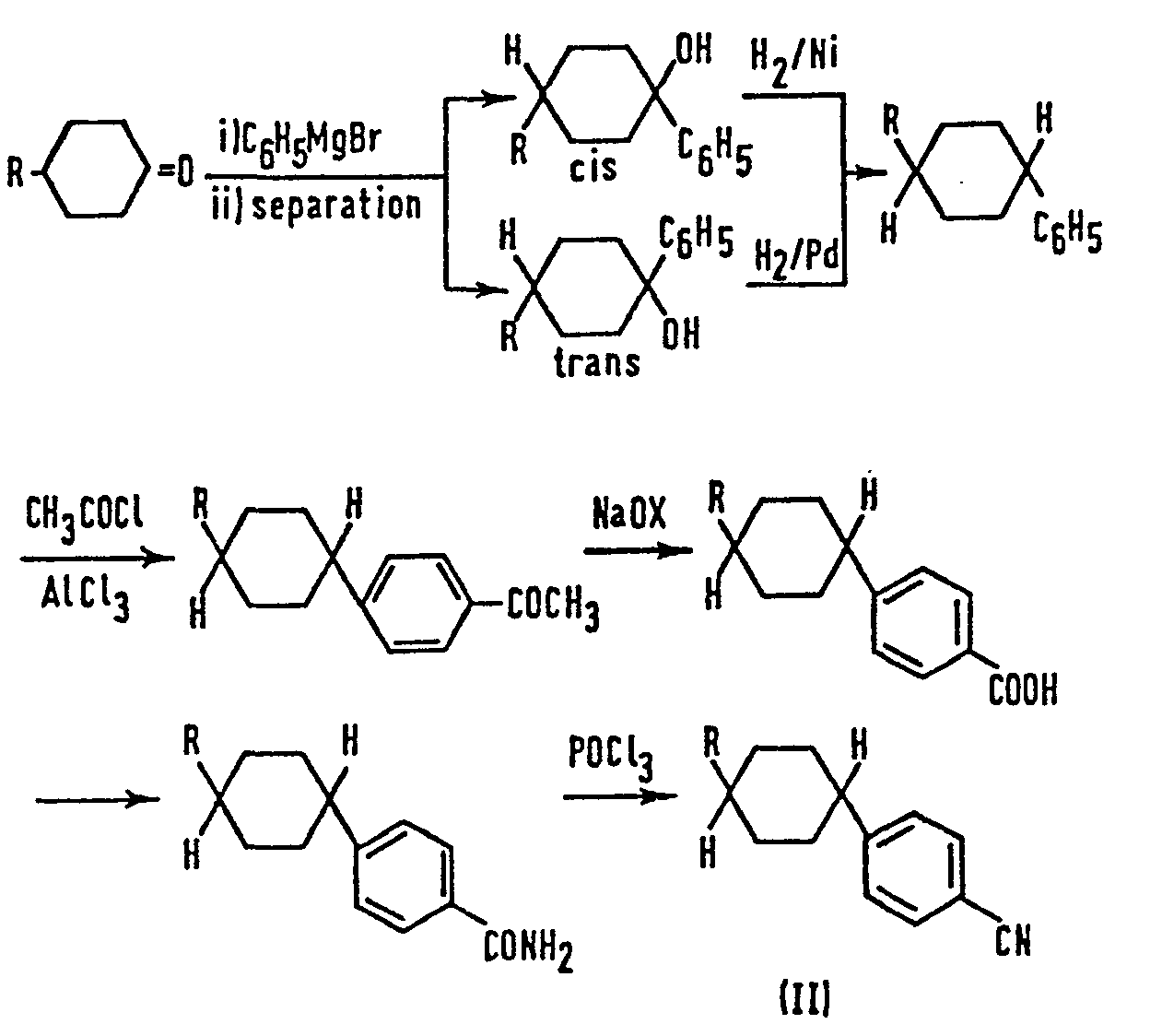
- As described in the report by Eidenschink et al, a compound (11) is obtained by reacting the corresponding 4-alkylcyclohexanone with phenylmagnesium bromide to synthesize a mixture of cis-and trans-4-alkylphenylcyclohexanols, separating the cis- and trans-isomers by chromatography using silica gel, hydrogenating in the presence of a Raney nickel catalyst the resulting cis-isomer wherein the R and OH groups are in the cis configuration, hydrogenating in the presence of a palladium catalyst the corresponding trans-isomer, the two hydrogenations thereby both giving the same trans-4-alkyl-1-phenylcyclohexane which is then acetylated and thereafter oxidised using the halo form reaction to give the corresponding carboxylic acid, and the acid is thereafter amidated and dehydrated to give the nitrile. This lengthy sequence can be expressed by the following reaction scheme:
- Apart from the difficulty in their preparation the compounds of formula (II) possess properties which make them good candidates for use in display devices based on Np liquid crystals.
- More recently still, in French Patent Specification No. 2377376 published on 11 August 1978 there have been disclosed corresponding hexahydroterphenyl derivatives such as 4-cyano-4'-(trans-4-alkylkyclohexyl)biphenyls, that is, 4-(trans-4-alkylcyclohexyl-1', 4'-phenylene)benzonitriles. Compared to the compounds disclosed by Eidenschink et al, these compounds of French Patent Specification No. 2377376 have a 1,4-phenylene link interposed between the aromatic and aliphatic rings. As with Eidenschink, mention is made of the possible use of the compounds in liquid crystal compositions.
- The synthetic route proposed in French Patent Specification No. 2377376 is generally the same as proposed by Eidenschink, but with use of a biphenyl Grignard reagent instead of phenylmagnesium' bromide. The difficulty in preparation is thus similar.
- The present inventors have found compounds which are analogous to the compounds of formula (II) and to the compounds of the French Patent specification, but which are easier to prepare and which exhibit a stable liquid crystal state and give good results in display devices.
- According to the present invention, we provide compounds of formula (I):

- Preferred compounds are those of the general formula


- The compounds of formula (I) can be prepared by a process which is more simple than that described for compounds of formula (II) by Eidenschink et al. This simplicity is founded in part on the discovery that a 4-alkylcyclohexanol substituted at the 1-position with a substituted benzene ring can be dehydrated as it is and without the need to separate out the cis and trans-isomers.
- The present process for preparing a compound of formula (I) comprises three steps. Depending upon whther n is 1 or 2 in the desired compound of formula (I), the first step involves either reacting a 4-alkylcyclohexanone with 4-bromophenylmagnesium bromide or 4-bromopohenyllithium to prepare a 1-(4-bromophenyl)-4-alkyl cyclohexanol as a mixture of its cis- and trans-isomers, or reacting a 4-alkylcyclohexanone with 4'-bromobiphenyl-4'-yllithium to prepare a 1-(4"-bromobiphenyl-4'-yl)-4-alkylcyclohexanol as a mixture of its cis- and trans-isomers. The second step then involves converting the mixture of cis- and trans-isomers into a 1-bromo-4-(4-alkyl-1-cyclohexenyl)benzene (that is, a 1-(p-bromophenyl)-4-alkylcyclohexene) or into a 1-(4"-bromobiphenyl-4'-yl)-4-alkylcyclohexene (that is, a 1-(4'-bromo-4-biphenyl-4-alkylcyclohexene), as the case may be, by using a dehydration reaction. In the third step, the bromo substituent is replaced by a cyano group to give the desired compound.
- In other words, the present invention provides a method for producing a compound of the general formula

- reacting a 4-alkylcyclohexanone (wherein the alkyl group has a straight chain of 1 to 9 carbon atoms) with 4-bromophenylmagnesium bromide or 4-bromophenyllithium to form a mixture of cis- and trans-1-(4-bromophenyl)-4-alkylcyclohexanols;
- subjecting the mixture of cis- and trans-isomers to dehydration to form a 1-(4-bromophenyl)-4-alkylcyclohexene (ie. a 1-bromo-4-(4-alkyl-1-cyclohexenyl)benzene); and
- replacing the bromo group of the compound thus prepared with a cyano group to give the desired compound of formula (lc), and it also provides a method for producing a compound of the general formula

- reacting a 4-alkylcyclohexanone (wherein the alkyl group has a straight chain of 1 to 9 carbon atoms) with 4-bromo-4'-biphenyllithium to prepare a mixture of cis- and trans- 1-(4'-bromobiphenyl-4'-yl)-4-alkylcyclohexanols;
- subjecting the mixture of cis- and trans-isomers to dehydration to form a 1-(4'-bromo-4-biphenyl)-4-alkylcyclohexene (ie. a 1-4" -bromobiphenyl-4'-yl)-4-alkylcyclohexene) and
- replacing the bromo group of the compound thus prepared with a cyano group to give a compound of formula (id).
- In a preferred sequence, the process of the present invention is carried out in the following manner:
- Firstly, a 4-alkylcyclohexanone is reacted to prepare either a 1-(4-bromophenyl)-4-alkylcyclohexanol or a 1-(4"-bromobiphenyl-4"-yl)-4-alkylcyclohexanol. For convenience, we refer hereinafter to such a substituted cyclohexanol product as a compound (A). The compounds (A) are prepared as a mixture of cis and trans-isomers by the reaction of the 4-alkylcyclohexanone with 4-bromophenylmagnesium bromide, 4-bromophenyllithium or 4'-bromobiphenyl-4-yllithium, as may be appropriate.
- (In passing, we mention that the 4-alkylcyclohexanones which are required as a starting material in the first step can be obtained by oxidising a mixture of cis- and trans- forms of the corresponding 4-alkylcydohexanol which itself can be obtained by hydrogenation of a 4-alkylphenol. The oxidation can be satisfactorily carried out using anhydrous chromic acid, sodium bichromate or the like oxidising agent. Moreover, the 4-bromophenylmagnesium bromide is easily obtained by reacting 1,4-dibromobenzene with an equivalent amount of metallic magnesium, while 4-bromophenyllithium or 4-bromobiphenyl-4'-yllithium is easily obtained by reacting 1,4-dibromobenzene or, as the case may be, 4,4'-dibromobiphenyl with an equivalent amount of butyllithium.)
- Secondly, the crude product from the first step and containing a compound (A) is directly subjected as it is to dehydration in the second step in order to prepare the corresponding 1-bromo-4-(4-alkyl-1-cyclohexenyl)benzene or 1-(4"-bromobiphenyl-4'-yl)-4-alkylcyclohexane. These cyclo- hexanes, which may alternatively be named as 1-(4-bromophenyl)-4-alkylcyclohexenes or 1-(4-bromobiphenyl-4'-yl)-4-alkylcyclohexenes, respectively, are referred to hereinafter as compounds (B). The second step can be carried out with good efficiency by heating a compound (A) either in the absence of a solvent or, more preferably, in the presence of a solvent such as for example toluene or xylene, and by employing an acid catalyst such as potassium hydrogensulphate, oxalic acid, p-toluenesulphonic acid or the like catalytic material. In this reaction, the same alkylcyclohexene (B) is formed from either the cis-isomer of a compound (A) (i.e. A-cis) or from the trans-isomer of the compound (A) (i.e. A-trans). It is therefore not at all necessary to separate the cis- and trans-isomers prior to the dehydration. This lack of a need for isomeric separation is a characteristic feature of the present preparative process.
- Thirdly, the compound (B) is reacted in a third step with cuprous cyanide in a solvent with a high boiling point, preferably a dipolar aprotic solvent such as N-methyl-2-pyrrolidone, dimethylformamide or the like. This third step then gives the desired 4-(4-alkyl-1-cyclohexenyl)benzonitrile or 4-(4"-alkyl-1"-cyclohexenyl-l', 4'-phenylene)benzonitrile of the formula (I), that is a 1-(4-cyanophenyl)-4-alkylcyclohexene or a 1-(4"-cyanobiphenyl-4'-yl)-4-alkylcyclohexene.
- The preferred process as described above can be represented by the following reaction sequence:

- In an alternative method for preparing a compound of formula (I), the compound (B) can be prepared by reacting a 4-cyclohexanone with phenylmagnesium bromide or phenyllithium to form a 1-phenyl-4-alkylcyclohexanol or a 1-(biphenyl-4'-yl)-4-alkylcyclohexanol (both these hexanols being a mixture of cis- and trans-isomers), brominating the substituted cyclohexanol at the desired 4- or 4"- position of the benzene ring and then dehydrating the product to give the compound (B). This method has the disadvantage that the bromination often also occurs at other positions and that purification of the compound (B) is difficult.
- It is also conceivable that the compounds (I) could be prepared without the intermediate formation of a compound (B). For example, it is possible to proceed by dehydrating a 1-phenyl-4-alkylcyclohexanol to give a 1-phenyl-4-alkylcyclohexene which is then acylated to give a 1-(4-acetylphenyl)-4-alkylcyclohexene, oxidising this latter compound to give a 1-(4-carboxyphenyl)-4- alkylcyclohexene, and thereafter converting the carboxyl group into a cyano group via formation of a carboxyamide group. However this reaction sequence takes many stages and there is no particular practical advantage to be achieved.
- The compounds of formula (I) are liquid crystal materials, and accordingly the invention further provides a nematic liquid crystal composition which contains at least one compound of formula (I).
- The compounds of formula (I) of the present invention are characterised by a viscosity which is lower than conventional liquid crystal compounds and which is similar to that of compounds of formula (II) given above and which have a cyclohexane ring. This low viscosity results in the present compounds exhibiting a short response time when they are employed in liquid crystal display devices. The compounds of the present invention are Np liquid crystal materials and it is possible to use a mixture of the present compounds, without other compounds, for a twisted nematic type liquid crystal cell. Moreover the present compounds exhibit good compatibility with other liquid crystal materials such as the liquid crystal compounds with azoxybenzene, alkylbiphenyl or cyanophenyl alkylbenzoate groups, and it is thus possible to use one or more of the present compounds as a mixed type liquid crystal in admixture with other liquid crystal material.
- The present invention therefore provides nematic liquid crystal compositions containing at least one compound of the general formula

- The following Table 1 gives details of the properties of the compounds of formula (I) which were prepared as in the following Examples 1 to 12.

- As can be seen from the values for the nematic temperature ranges given in Table 1, the compounds wherein n = 1 and R is C2H5 to C7H15 are particularly suitable as liquid crystal components for liquid crystal display elements, and they can thus be employed as a main component for such an element. Moreover, the compounds wherein n = 2 exhibit a liquid crystal state over a relatively wide temperature range and are suitable for formulation of a liquid crystal composition having a broad nematic temperature range by employing them in admixture with compounds (I) wherein n = 1. Furthermore, the compounds (I) wherein n = 2 can serve the purpose of broadening the nematic temperature range not only of compounds of formula (I) wherein n = 1, but also of other nematic liquid crystal materials having a positive dielectric anisotropy. Examples of such other nematic liquid crystal materials include the 4-alkyl-4'-cyanobisphenyls, 1-(4-cyanophenyl)-4'-alkylcyclohexanes, 4-alkylbenzoic acid-4-cyanophenyl esters and the 4-alkylbeiizylidene-4'-cyanoanilines. In addition, by adding a compound of formula (I) wherein n = 2 to a liquid crystal material which has a negative dielectric anisotropy and is itself unsuitable for a twisted nematic type liquid crystal display cell, it is possible to convert the unsuitable material into a suitable liquid crystal composition having a positive dielectric anistropy.
- Preparation methods for the compounds of the present invention will now be described in more detail by way of non-limitative Examples.
- 30.4 g (1.25 mol) of magnesium metal was introduced into a 21 three-neck flask, dry nitrogen was passed through the flask to ensure the flask was adequately dry, and then 50 ml of anhydrous tetrahydrofuran and a trace of iodine were added. While the resulting mixture was stirred, a solution obtained by dissolving 283.1 g (1.2 mol) of 1,4-dibromobenzene in 600 ml of tetrahydrofuran was added dropwise to the mixture through a dropping funnel over a period of about 1.5 hour, during which time the reaction temperature was maintained at 30 to 35°C by water cooling. After the dropwise addition, the temperature was further maintained at 30 to 35°C for about 1.5 hour in order to complete the formation of 4-bromophenylmagnesium bromide. The flask was then cooled with ice and 128.2 g (1 mol) of 4-ethylcyclohexanone added dropwise over 20 minutes while allowing the temperature to return to room temperature. (The 4-ethylcyclohexanone employed in this case was prepared by oxidizing a commercial grade of 4-ethylcyclohexanol with Jones reagent and had a boiling point of 87 to 89°C/26 mm Hg.) To the above-mentioned reaction product was added a small amount of 6N hydrochloric acid by dropwise addition to acidify the resulting solution, followed by 200 ml of water and 200 ml of hexane. After separation of the layers, the water layer was extracted with 200 ml of hexane and the hexane extracts thus obtained were combined, washed once with water and the solvent distilled off. The resulting residue was a mixture of crude cis- and trans-isomers of 1-(4-bromophenyl)-4-ethylcyclohexanol (i.e. compound A where R = C2H5 and n = 1.
- To this mixture of A-cis and A-trans compound was added 50 g of potassium hydrogensulphate, and the temperature was gradually raised while maintaining a nitrogen atmosphere and stirring the mix. In this way a dehydration reaction was carried out by heating at 230 to 250°C for 3 hours. After cooling of the product, hexane was added to dissolve out the desired compound. After distilling off of hexane, further distillation was carried out under a reduced pressure to collect a fraction having a boiling point of 126 to 134°C/1 mm Hg (143 g) and which solidified. This product was recrystallized twice from ethanol to give about 110 g of colourless crystals of 1-bromo-4-(4-ethyl-1-cyclohexenyl)benzene, otherwise 1-(p-bromophenyl)-4-ethylcyclohexene i.e. the compound B where R = C2H5 and n = 1, having a melting point of 53 to 54°C.
- 100 g of this B compound was heated together with 41 g of cuprous cyanide in 300 ml of N-methyl-2-pyrrolidone under reflux for 4 hours, followed by distillation off of about 200 ml of N-methyl-2-pyrrolidone under atmospheric pressure. The resulting residue was treated with an aqueous solution of ferric chloride at 50°C. Hexane-extraction, acid-washing, alkali-washing, and recrystallization from ethanol were then carried out to give 52 g of colourless crystals of the desired 4-(4-ethyl-1-cyclohexenyl)benzonitrile (i.e. 1-(p-cyanophenyl)-4-ethylcyclohexene) with yield: 65%. This product was a monotropic liquid crystal material having a C-I point (melting point) of 22°C and a N-I point of 10°C. Further the elemental analysis values of this product showed good agreement with the theoretical values, as will be apparent from the following figures for C15H17N:

- Moreover the NMR and infrared absorption spectra of the product were entirely consistent with the product being the compound of formula (I) where R = CzHs and n = 1.
- 236 g (1 mol) of 1,4-dibromobenzene and 1 of dry toluene were introduced into a three-neck flask under a dry nitrogen atmosphere and dissolution effected with stirring at 50°C. To the resulting solution was dropwise added 525 ml of a hexane solution of 1.67N commercial butyllithium (0.88 mol), the addition being over a period of 30 minutes. After the addition, the temperature was maintained at 50°C for a further 30 minutes and then lowered down to 25°C. To the solution was then dropwise added over a period of 30 minutes a solution obtained by dissolving 135 g (0.8 mol) of 4-pentylcyclohexanone in 125 ml of toluene. The stirring was thereafter continued for 30 minutes at 30°C, and then 250 ml of 6N hydrochloric acid was added dropwise while maintaining the temperature at 30°C or lower, thus completing the first step.
- (The 4-pentylcyclohexanone was obtained by hydrogenating 4-pentylphenol in the presence of a Raney nickel catalyst to form 4-pentylcyclohexanol (b.p.: 122 to 130°C/10 mm Hg), and by then oxidizing this material with Jones reagent (b.p. of product: 130 to 134°C/22 mm Hg)).
- The resulting organic layer was separated, 25 g of potassium hydrogen sulphate was added thereto, and after hexane was distilled off with stirring, the resulting residue was concentrated until the liquid temperature reached 110°C, thereby completing the dehydration reaction of the second step.
- The resulting concentrate was distilled under a reduced pressure to give 160 g of a fraction at 160 to 170°C/1 mm Hg which was 1-bromo-4-(4-pentyl-1-cyclohexenyl)benzene, i.e. 1-(p-bromophenyl)-4-n-pentylcyclohexene, a compound B where R = n-C5H11 and n = 1, in a yield of 62.4%. The product was then recrystallized twice from ethanol to give crystals having a melting point of 67 to 68°C.
- The cyanogenation reaction, the third step, was carried out in the same manner as in Example 1 to give the desired product (b.p.: 153 to 161°C/0.5 mm Hg, yield: about 90%), which was then recrystallized from methanol to give colourless crystals. This was a Np liquid crystal material and had a C-N point of 42 to 42.4°C and a N-I point of 56.7°C. Elemental analysis of the product accorded well with the theoretical values for C18C23N:

- The NMR and infrared absorption spectra of this product were consistent with the product being the desired compound.
-
- 3: 4-(4-methyl-1-cyclohexenyl)benzonitrile
- 4: 4-(4-propyl-1-cyclohexenyl)benzonitrile
- 5: 4-(4-butyl-1-cyclohexenyllbenzonitrile
- 6: 4-(4-hexyl-1-cyclohexeny)benzonitrile
- 7: 4-(4-heptyl-1-cyclohexenyl)benzonitrile
- 8: 4-(4-octyl-1-cyclohexenyl)benzonitrile
- These Examples were carried out in the same manner as in Example 1 or Example 2 except that the 4-alkylcyclohexanol employed as a starting material for each of Examples 3 to 8 had an alkyl group corresponding to that of the desired product which respectively were products of formula (I) where n = 1 and R = CH3, n-C3H7, n-C4H9, n-C6H13, n-C7Hl5 or n-C8H17. The properties of the products as liquid crystals are shown together with those of other compounds in Table 1 given above.
- 312 g (1 mol) of 4,4'-dibromobiphenyl and 1.51 of dry toluene were introduced into a 3 I three- necked flask with a dry nitrogen atmosphere and at 55°C to give a solution. To this solution was added dropwise over a period of about 30 minutes 660 ml of a hexane solution of 1.67N commercial butyllithium (1.1 mol); during the addition the solution temperature was maintained at 50 to 55°C. After cooling of the resulting mixture down to 25°C, 140 g (1 mol) of 4-propylcyclohexanone was added dropwise over 30 minutes while maintaining the temperature at 25-30°C. After the addition, 50 ml of water was added dropwise over 30 minutes with stirring at 30°C, followed by dropwise adding of 200 ml of 6N hydrochloric acid while maintaining the temperature at 30°C or lower.
- (The 4-propylcyclohexanone was prepared as follows: a commercial 4-propylphenol was hydrogenated in the presence of ethanol, sodium ethoxide and Raney nickel catalyst, under a hydrogen pressure of 100 atm, at 150°C to form 4-propylcyclohexanol, which was then oxidized with Jones reagent (Cr03/H2S04/H2O) in acetone to obtain 4-n-propylcyclohexanone having a b.p. of 110-113°C/26 mm Hg.)
- The resulting liquid layers were separated and the lower water layer was discarded. To the upper organic layer, a solution consisting mainly of 1-(4"-bromobiphenyl-4'-yl)-4-propylcyclohexanol in cis-and trans-forms, was added 20 g of potassium hydrogensulphate (KHS04) followed by distilling off of the solvent by heating and concentration until the solution temperature reached 110°C. During this period, the required dehydration reaction proceeded. The resulting solution while hot was transferred to an Erlenmeyer flask to precipitate the compound (B) where R = 2n-C3H7 and n = 2, containing a small amount of 4,4'-dibromobiphenyl. The precipitate was then filtered off and collected. A fraction boiling at 220 to 250°C/3 mm Hg was obtained by vacuum distillation. Recrystallization from toluene gave 206g of the compound (B) where R = n-C3H7 and n = 2, yield 58% based on raw material. This product was pale yellow crystals, and melted at 165°C to give a smectic liquid crystal; at 235°C it formed an isotropic liquid.
- 195.4 g (0.55 mol) of this B compound, i.e., 1-(4"-bromobiphenyl-4'-yl)-4-propylcyclohexene, 57.5 g (0.32 mol) of cuprous cyanide, Cu2(CN)Z, and 550 ml of N-methyl-2-pyrrolidone were heated together in a three-neck flask under reflux with stirring for 5 hours. 500 ml of toluene was added thereto, the mixture was cooled, and a solution consisting of 65 g of ferric chloride, 16 ml of cone hydrochloric acid and 750 ml of water was added and the mixture stirred for 30 minutes at 60 to 70°C. The resulting layers were separated and the organic layer washed with dilute hydrochloric acid, then, with dilute aqueous sodium hydroxide, and further with water. After a small amount of solid matter had been eliminated by filtration, toluene was distilled off, and vacuum-distillation was carried out to obtain in crude form 127 g of a fraction boiling at 200 to 210°C/1 mm Hg which was 4-(4"-propyl-1 "-cyclohexenyl-l',4'-phenylene)benzonitrile, a compound of formula (I) where R = n-C3H7 and n = 2, yield: 76% based on the compound (B). The product was then dissolved in toluene, the resulting solution passed through an alumina layer to effect chromatographic purification, the toluene solution concentrated and the product recrystallized to give 105 g of the purified compound of formula (t), 4(4"- propyl-1 "-cyclohexenyl-1'4'-phenylene)benzonitrile, i.e. 1-(4-cyano-4-biphenylyl)-4-n-propylcyclo- hexene. This product had a melting point (C-N point) of 110°C and a clear point (N-I point) of 232°C, and elemental analysis of this product accorded well with the calculated values for C22H23N:

- Further, the infrared absorption spectra of this product were consistent with that for the desired compound.
-
- 10: 4-(4"-methyl-1 "-cyclohexenyl-1',4'-phenylene)benzonitrile
- 1 1 : 4-(4"-butyl-1 "-cyclohexenyl-1',4'-phenylene)benzonitrile
- 12: 4-(4"-pentyl-1 "-cyclohexenyl-1',4'-phenylene)benzonitrile
- Example 9 was repeated except that the 4-n-propylcyclohexanone of Example 9 was replaced by 4―CH3―, 4-n-C4H9- or 4-n-C5H11-cyclohexanone, to obtain compounds of formula (I) wherein n = 2 and R = CH3, n-C4Hg or n-C5H11, respectively. Their properties as liquid crystals are shown together with those of other compounds in Table 1.
- The present invention will now be further described by way of Examples which relate to the use of the compounds of formula (I) in liquid crystal cells.
- A 1:1 by weight mixture of 4-(4-pentyl-1-cyclohexenyl)benzonitrile, i.e. 1-(4-cyanophenyl)-4-n-pentylcyclohexene, as obtained in Example 2 and 4-(4-heptyl-l-cyclohexenyl)benzonitrile, i.e. 1-(4-cyanophenyl)-4-n-heptyl-cyclohexene, as obtained in Example 7 was prepared and found to behave as a nematic liquid crystal with a positive dielectric anistropy, i.e. it was a Np liquid crystal material, at 25°C and formed an isotropic liquid at 59°C. The viscosity of this mixture was 36cp at 25°C, which is a much lower value than those of conventional liquid crystal compositions. The mixture was sealed in a twisted nematic type liquid crystal cell having a thickness of 10 µm; its actuation threshold voltage was measured to be 1.8V, and its saturation voltage was 3.0V.
- A liquid crystal mixture consisting of 213 parts of 4-(4-ethyl-1-cyclohexenyl)benzonitrile, i.e. 1-(4-cyanophenyl)-4-n-ethylcyclohexene, as obtained in Example 1, 38.5 parts of 4-(4-pentyl-1-cyclohexenyl)benzonitrile, i.e. 1-(4-cyanophenyl)-4-n-pentylcyclohexene as obtained in Example 2 and ' 38.5 parts of 4-(4-heptyl-1-cyclohexenyl)benzonitrile i.e. 1-(4-cyanophenyl)-4-n-heptylcyclohexene, as obtained in Example 7 was prepared. The mixture had a liquid crystal temperature range of -15 to 48°C, and its viscosity at 25°C was as low as a value as 25cp. A twisted nematic type liquid crystal cell of 8.5 µm thick was constructed employing the mixture. The actuation threshold voltage was measured to be 1.5V, and the actuation saturation voltage was 2.2V. Furthermore, the response times were short, with a rise time of 70 msec and a decay time of 50 msec, both at 25°C, while even at 0°C, the rise time and the decay time were 500 msec and 250 msec, respectively. Accordingly when this liquid crystal mixture is employed, it is possible even at 0°C to effect an on-off actuation for display of seconds. The short response time is due to the low viscosity of this liquid crystal mixture.
- A liquid crystal mixture consisting of 17 parts of 4-(4-pentyl-1-cyclohexenyl)benzonitrile, i.e. 1-(4-cyanophenyl)-4-n-pentylcyclohexene, as obtained in Examnple 2, 17 parts of 4-(4-heptyl-1-cyclohexenyl)benzonitrile i.e. 1-(4-cyanophenyl)-4-n-heptylcyclohexene, as obtained in Example 7, 24 parts of 4-methoxy-4'-ethylazoxybenzene and 42 parts of 4-methoxy-4'-butylazoxybenzene was prepared. It did not crystallize even at -20°C and maintained a liquid crystal state up to 68°C. A twisted nematic type liquid crystal cell having a thickness'of 10 µm was filled with the liquid crystal mixture and had an actuation threshold voltage of 2.5V and an actuation saturation voltage of 3.5V. This liquid crystal mixture can thus be suitably employed as a liquid crystal material for multiplex driving.
- A liquid composition having the following formulation was prepared:
- 4-(4-propyl-1-cyclohexenyl)benzonitrile, i.e.
- 1-(4-cyanophenyl)-4-propylcyclohexene (a compound of formula (I) wherein R n-C3H7, n = 1) 0.38 mol
- 1-(4-pentyl-1-cyclohexenyl)benzonitrile, i.e.
- 1-(4-cyanophenyl)-4-pentylcyclohexene (a compound of formula (I) wherein R = n-C5H11, n =1 0.29 mol
- 1-(4-hexyl-1-cyclohexenyl)benzonitrile, i.e.
- 1-(4-cyanophenyl)-4-hexylcyclohexene (a compound of formula (I) wherein R = n-C6H13, n = 1) 0.16 mol
- 1-(4-heptyl-1-cyclohexenyl)benzonitrile, i.e.
- 1-(4-cyanophenyl)-4)-heptylcyclohexene (a compound of formula (I) wherein R = n-C7H15, n = 1 0.12 mol
- 4-(4"-propyl-1 "-cyclohexenyl-1',4'-phenylene)benzonitrile, i.e.
- 1-(4'-cyanobiphenyl-4-yl)-4-n-propylcyclohexene (a compound of formula (I) wherein R = n-C3H7, n = 2) 0.043 mol
- This liquid crystal composition had a clear point of 60°C, and even when it was preserved at -10°C over a period of several months, no crystals precipitated. Furthermore, the viscosity of this liquid crystal composition was 35cp at 25°C. The composition was sealed into a twisted nematic type liquid crystal cell having a thickness of 10 µm. The actuation threshold voltage and actuation saturation voltage were found to be 1.5V and 2.2V, respectively. As for the response times, the rise time and decay time were 90 msec and 70 msec, respectively (measured at 3V, 32 Hz and 25°C).
- A liquid crystal composition having the following formulation was prepared:

- The resulting composition had a clear point of 61 °C, and the lower limit of its nematic temperature range was -4°C. Furthermore its viscosity was 35cp at 25°C. The composition was sealed into a twisted nematic type liquid crystal cell having a thickness of 9.5 µm. The actuation threshold voltage and actuation saturation voltage were measured to be 1.5 V and 2.2V, respectively. As for the response times, the rise time and the decay time were 90 msec and 75 msec, respectively (measured at 25°C, 3V and 32 Hz).
- A liquid crystal composition having the following formulation was prepared:

- The resulting composition had a clear point of 78°C, and even when it was preserved at -10°C over a period of several months, no crystals precipitated. This composition was sealed in a twisted nematic type liquid crystal cell having a thickness of 10 ,um. The actuation characteristics were measured at 25°C and showed an actuation threshold voltage of 1.4V and an actuation saturation voltage of 2.2V. With regard to the response times, the rise response time and decay response time were 110 msec and 90 msec, respectively (measured at 25°C, 3V and 32 Hz).
- A liquid crystal mixture consisting of
- 15 parts by weight of 4,4'-di-n-butylazoxybenzene,
- 23 parts by weight of 4-methoxy-4'-ethylazoxybenzene, and
- 47 parts by weight of 4-methoxy-4'-n-butylazoxybenzene
- On the other hand a liquid crystal composition obtained by further adding thereto
- 8 parts of 4-(41-propyl-1"-cyclohexenyl-1',4'-phenylene)benzonitrile (1-(4'-cyano-4-biphenylyl)-4-n-propylcyclohexene) and
- 8 parts of 4-(4"-pentyl-1 "-cyclohexenyl-1',4'-phenylene)benzonitrile (1-(4-cyanobiphenyl-4'-yl)-4-n-pentylcyclohexene
- A liquid crystal composition consisting of
- 4-n-pentyl-4'-cyanobiphenyl (11 parts),
- 4-n-heptyl-4'-cyanobiphenyl (27 parts),
- 4-n-octyloxy-4'-cyanobiphenyl (16 parts) and
- 4-(4"-propyl-1 "-cyclohexenyl-1',4'-phenylene)benzonitrile,
- A liquid crystal compoosition consisting of
- 4-n-propylcyclohexyl-4'-cyanobenzene (34 parts),
- 4-n-pentylcyclohexyl-4'-cyanobenzene (34 parts),
- 4-n-heptylcyclohexyl-4'-cyanobenzene (22 parts) and
- 4-(4"-propyl-1"-cyclohexenyl-1',4'-phenylene)benzonitrile.
has a negative dielectric anistropy and hence cannot be employed for a twisted nematic type liquid crystal cell.
both being compounds of formula (I) of the present invention, has a positive dielectric anisotropy, does not crystallize even at -15°C, and maintains its nematic state up to 93°C. Employing this liquid crystal composition, a twisted nematic type liquid crystal cell having a clearance thickness of 9.5 um was constructed and its actuation characteristics were measured. The actuation threshold voltage was 2.5V and the actuation saturation voltage was 3.4V. This liquid crystal composition can be suitably employed as a liquid crystal material for multiplex driving.
i.e. 1-(4-cyanobiphenyl-4'-yl)-4-n-propylcyclohexene (11 parts) has a nematic liquid crystal temperature range of -15°C to +62°C and a viscosity at 25°C of 45 cp. This composition was sealed into a twisted nematic type liquid crystal cell having a thickness of 10 µrn and its actuation threshold voltage and its actuation saturation voltage were measured and found to be 1.5V and 2.2V, respectively. The rise response time and decay response time were 90 msec and 90 msec, respectively (measured at 3V, 32 Hz, and 25°C).
i.e. 1-(4-cyanobiphenyl-4'-yl)-4-n-propylcyclohexene (10 parts) has a nematic liquid crystal temperature range of -10°C to +68°C, and its viscosity at 25°C is 25 cp. This liquid crystal composition was sealed in a twisted nematic type liquid crystal cell having a thickness of 10 µm and the actuation threshold voltage and actuation saturation voltage of this cell were measured. The voltages were 1.5V and 2.4V, respectively. Furthermore the rise response time and decay response time were 110 msec and 60 msec, respectively (measured at 3V, 32 Hz and 25°C).
Claims (7)




Applications Claiming Priority (4)
| Application Number | Priority Date | Filing Date | Title |
|---|---|---|---|
| JP13961077A JPS5473760A (en) | 1977-11-21 | 1977-11-21 | Liquid crystal compound |
| JP139610/77 | 1977-11-21 | ||
| JP67938/78 | 1978-06-06 | ||
| JP6793878A JPS54160349A (en) | 1978-06-06 | 1978-06-06 | Liquid crystal compound |
Publications (2)
| Publication Number | Publication Date |
|---|---|
| EP0002136A1 EP0002136A1 (en) | 1979-05-30 |
| EP0002136B1 true EP0002136B1 (en) | 1981-10-21 |
Family
ID=26409154
Family Applications (1)
| Application Number | Title | Priority Date | Filing Date |
|---|---|---|---|
| EP78300649A Expired EP0002136B1 (en) | 1977-11-21 | 1978-11-21 | Substituted benzonitriles, their preparation, liquid crystal compositions containing them and display devices employing such compositions |
Country Status (5)
| Country | Link |
|---|---|
| US (1) | US4211666A (en) |
| EP (1) | EP0002136B1 (en) |
| CA (1) | CA1106406A (en) |
| DD (1) | DD140567A5 (en) |
| DE (1) | DE2861217D1 (en) |
Families Citing this family (19)
| Publication number | Priority date | Publication date | Assignee | Title |
|---|---|---|---|---|
| US4322354A (en) * | 1979-03-05 | 1982-03-30 | Timex Corporation | 5-Substituted-2-(4-cyanophenyl)-1,3,-dioxanes |
| US4219256A (en) * | 1979-08-01 | 1980-08-26 | The Secretary Of State For Defence In Her Britannic Majesty's Government Of The United Kingdom Of Great Britain And Northern Ireland | Liquid crystal compounds and materials and devices containing them |
| DE2948836A1 (en) * | 1979-12-05 | 1981-06-11 | Merck Patent Gmbh, 6100 Darmstadt | PARTLY HYDRATED OLIGO-1,4-PHENYLENE, ITS CONTAINING DIELECTRICS AND ELECTRO-OPTICAL DISPLAY ELEMENT |
| DE2949080A1 (en) * | 1979-12-06 | 1981-06-11 | Merck Patent Gmbh, 6100 Darmstadt | NAPHTHALINE DERIVATIVES, THESE DIELECTRICS AND ELECTRO-OPTICAL DISPLAY ELEMENT |
| DE3006666A1 (en) * | 1980-02-22 | 1981-09-17 | Merck Patent Gmbh, 6100 Darmstadt | PHENYLCYCLOHEXEN DERIVATIVES, METHOD FOR THE PRODUCTION THEREOF, THE LIQUID CRYSTALINE CONTAINING THEM AND ELECTRO-OPTICAL DISPLAY ELEMENT |
| CH644574A5 (en) * | 1980-06-02 | 1984-08-15 | Merck Patent Gmbh | ANISOTROPE CYCLOHEXEN COMPOUNDS AND LIQUID CRYSTAL MIXTURES. |
| US4405488A (en) * | 1980-10-09 | 1983-09-20 | Chisso Corporation | Liquid-crystalline halogenobenzene derivatives |
| DE3042391A1 (en) * | 1980-11-10 | 1982-06-16 | Merck Patent Gmbh, 6100 Darmstadt | FLUORINE CYCLOHEXYLBIPHENYL DERIVATIVES, THESE DIELECTRICS AND ELECTRO-OPTICAL DISPLAY ELEMENT |
| US4325830A (en) * | 1980-12-24 | 1982-04-20 | Timex Corporation | Three ring dioxane liquid crystalline compounds |
| DE3136624A1 (en) * | 1981-09-15 | 1983-03-31 | Merck Patent Gmbh, 6100 Darmstadt | LIQUID CRYSTALLINE HALOGEN COMPOUNDS, METHOD FOR THE PRODUCTION THEREOF, THESE DIELECTRICS CONTAINING THEM AND ELECTRO-OPTICAL DISPLAY ELEMENT |
| DE3465192D1 (en) * | 1983-03-16 | 1987-09-10 | Hoffmann La Roche | Liquid crystal components having an alkenyl chain |
| DE3575158D1 (en) * | 1984-07-12 | 1990-02-08 | Hoffmann La Roche | LIQUID CRYSTALLINE MIXING COMPONENTS WITH A 4-ALKENYL OR 2Z-ALKENYL SIDE CHAIN. |
| CH666259A5 (en) * | 1984-11-14 | 1988-07-15 | Nii Prikladnych | FLUESSIGKRISTALLINE 4-N-pentylphenyl 4 '- (trans-4' '- N-alkylcyclohex-2-enoyloxy) benzoic acids. |
| US4605510A (en) * | 1985-01-25 | 1986-08-12 | Nauchno-Issledovatelsky Institut Prikladnykh Problem Imeni A.N. Sevchenko | Liquid crystal composition for electrooptical devices for presentation of information |
| US4605520A (en) * | 1985-01-25 | 1986-08-12 | Nauchno-Issledovatelsky Institut Prikladnykh Fizicheskikh Problem Imeni A.N. Sevchenko | Liquid crystal 4-(4'-cyanodiphenyl) esters of trans-4"-N-alkylocyclohex-2-enecarboxylic acids |
| US4698177A (en) * | 1985-04-16 | 1987-10-06 | Dainippon Ink And Chemicals, Inc. | Cyclohexylcyclohexene derivatives |
| DE3703145A1 (en) * | 1986-03-14 | 1988-08-18 | Merck Patent Gmbh | METHOD FOR PRODUCING TERTIAL ALCOHOLS WITH METAL ORGANIC COMPOUNDS |
| DE4411806B4 (en) * | 1993-04-09 | 2013-11-28 | Merck Patent Gmbh | Liquid crystalline medium |
| DE102017007672A1 (en) * | 2017-08-14 | 2019-02-14 | Merck Patent Gmbh | Liquid crystalline compounds |
Family Cites Families (3)
| Publication number | Priority date | Publication date | Assignee | Title |
|---|---|---|---|---|
| GB1433130A (en) * | 1972-11-09 | 1976-04-22 | Secr Defence | Substituted biphenyl and polyphenyl compounds and liquid crystal materials and devices containing them |
| DE2636684C3 (en) * | 1976-08-14 | 1980-06-19 | Merck Patent Gmbh, 6100 Darmstadt | Phenylcyclohexane derivatives and their use in liquid-crystalline dielectrics |
| DE2701591C3 (en) * | 1977-01-15 | 1979-12-20 | Merck Patent Gmbh, 6100 Darmstadt | Hexahydroterphenyl derivatives and their use in liquid crystalline dielectrics |
-
1978
- 1978-11-07 CA CA315,948A patent/CA1106406A/en not_active Expired
- 1978-11-14 US US05/960,710 patent/US4211666A/en not_active Expired - Lifetime
- 1978-11-21 DD DD78209223A patent/DD140567A5/en unknown
- 1978-11-21 EP EP78300649A patent/EP0002136B1/en not_active Expired
- 1978-11-21 DE DE7878300649T patent/DE2861217D1/en not_active Expired
Also Published As
| Publication number | Publication date |
|---|---|
| US4211666A (en) | 1980-07-08 |
| DD140567A5 (en) | 1980-03-12 |
| CA1106406A (en) | 1981-08-04 |
| EP0002136A1 (en) | 1979-05-30 |
| DE2861217D1 (en) | 1981-12-24 |
Similar Documents
| Publication | Publication Date | Title |
|---|---|---|
| EP0209622B1 (en) | Hydroterphenyls | |
| US4797228A (en) | Cyclohexane derivative and liquid crystal composition containing same | |
| US4211666A (en) | Liquid crystal compounds | |
| US4405488A (en) | Liquid-crystalline halogenobenzene derivatives | |
| DE69001923T2 (en) | Trifluorobenzene derivatives and liquid crystal compositions containing them. | |
| DE3317597A1 (en) | BICYCLOHEXYLETHANE | |
| WO1986005486A1 (en) | Cyclohexane derivatives | |
| US4439340A (en) | Cyano-mono-or diphenylbicyclohexane derivatives | |
| EP0172360A2 (en) | Cyclohexanecarbonitriles and their use as components for liquid crystals | |
| WO1987004426A2 (en) | Vinyl compositions | |
| US5811029A (en) | Benzene derivatives, and a liquid-crystalline medium | |
| DE3136624A1 (en) | LIQUID CRYSTALLINE HALOGEN COMPOUNDS, METHOD FOR THE PRODUCTION THEREOF, THESE DIELECTRICS CONTAINING THEM AND ELECTRO-OPTICAL DISPLAY ELEMENT | |
| US4472293A (en) | High temperature liquid crystal substances of four rings and liquid crystal compositions containing the same | |
| EP0084974B1 (en) | Carbocyclic compounds with liquid-crystal properties | |
| EP0834491A1 (en) | Bisalkenyl bicyclohexane and liquid crystal medium | |
| US4910350A (en) | Fluorine-substituted cyclohexylcyclohexene derivative | |
| US5230829A (en) | Phenylcyclohexanes, and a liquid-crystalline medium | |
| US5213710A (en) | Benzene derivatives and a liquid-crystalline medium | |
| EP0439089A1 (en) | Halogenated terphenyls and liquid crystal medium | |
| WO1991016295A1 (en) | Tretra-substituted methanes with liquid crystal properties | |
| US5342546A (en) | 1,4-substituted dihydrobenzene derivatives | |
| JP3632778B2 (en) | (2-Cyclohexyl) propylbenzene derivative | |
| JP4151115B2 (en) | Optically active compound | |
| KR810001415B1 (en) | Manufacturing method of liquid crystal compound | |
| EP0571652B1 (en) | Liquid crystalline substituted dihydrobenzene derivatives |
Legal Events
| Date | Code | Title | Description |
|---|---|---|---|
| PUAI | Public reference made under article 153(3) epc to a published international application that has entered the european phase |
Free format text: ORIGINAL CODE: 0009012 |
|
| AK | Designated contracting states |
Designated state(s): CH DE FR GB |
|
| 17P | Request for examination filed | ||
| DET | De: translation of patent claims | ||
| GRAA | (expected) grant |
Free format text: ORIGINAL CODE: 0009210 |
|
| AK | Designated contracting states |
Designated state(s): CH DE FR GB |
|
| REF | Corresponds to: |
Ref document number: 2861217 Country of ref document: DE Date of ref document: 19811224 |
|
| PGFP | Annual fee paid to national office [announced via postgrant information from national office to epo] |
Ref country code: FR Payment date: 19831115 Year of fee payment: 6 |
|
| PGFP | Annual fee paid to national office [announced via postgrant information from national office to epo] |
Ref country code: CH Payment date: 19831205 Year of fee payment: 6 |
|
| PGFP | Annual fee paid to national office [announced via postgrant information from national office to epo] |
Ref country code: DE Payment date: 19831227 Year of fee payment: 6 |
|
| PG25 | Lapsed in a contracting state [announced via postgrant information from national office to epo] |
Ref country code: CH Effective date: 19841130 |
|
| GBPC | Gb: european patent ceased through non-payment of renewal fee | ||
| PG25 | Lapsed in a contracting state [announced via postgrant information from national office to epo] |
Ref country code: FR Free format text: LAPSE BECAUSE OF NON-PAYMENT OF DUE FEES Effective date: 19850731 |
|
| REG | Reference to a national code |
Ref country code: CH Ref legal event code: PL |
|
| PG25 | Lapsed in a contracting state [announced via postgrant information from national office to epo] |
Ref country code: DE Effective date: 19850801 |
|
| REG | Reference to a national code |
Ref country code: FR Ref legal event code: ST |
|
| PG25 | Lapsed in a contracting state [announced via postgrant information from national office to epo] |
Ref country code: GB Effective date: 19881117 |
|
| PLBE | No opposition filed within time limit |
Free format text: ORIGINAL CODE: 0009261 |
|
| STAA | Information on the status of an ep patent application or granted ep patent |
Free format text: STATUS: NO OPPOSITION FILED WITHIN TIME LIMIT |