EP0002012A1 - Coupled hydrocarbon polymers and process for their preparation - Google Patents
Coupled hydrocarbon polymers and process for their preparation Download PDFInfo
- Publication number
- EP0002012A1 EP0002012A1 EP78101302A EP78101302A EP0002012A1 EP 0002012 A1 EP0002012 A1 EP 0002012A1 EP 78101302 A EP78101302 A EP 78101302A EP 78101302 A EP78101302 A EP 78101302A EP 0002012 A1 EP0002012 A1 EP 0002012A1
- Authority
- EP
- European Patent Office
- Prior art keywords
- polymer
- coupling
- coupled
- carbon atoms
- living
- Prior art date
- Legal status (The legal status is an assumption and is not a legal conclusion. Google has not performed a legal analysis and makes no representation as to the accuracy of the status listed.)
- Withdrawn
Links
- 229920000642 polymer Polymers 0.000 title claims abstract description 142
- 238000000034 method Methods 0.000 title claims description 31
- 230000008569 process Effects 0.000 title claims description 18
- 239000004215 Carbon black (E152) Substances 0.000 title claims description 6
- 229930195733 hydrocarbon Natural products 0.000 title claims description 6
- 150000002430 hydrocarbons Chemical class 0.000 title claims description 6
- 238000002360 preparation method Methods 0.000 title description 2
- 238000005859 coupling reaction Methods 0.000 claims abstract description 79
- 238000010168 coupling process Methods 0.000 claims abstract description 78
- 230000008878 coupling Effects 0.000 claims abstract description 76
- 239000007822 coupling agent Substances 0.000 claims abstract description 47
- 229910052783 alkali metal Inorganic materials 0.000 claims abstract description 17
- 150000001340 alkali metals Chemical class 0.000 claims abstract description 17
- MYRTYDVEIRVNKP-UHFFFAOYSA-N 1,2-Divinylbenzene Chemical compound C=CC1=CC=CC=C1C=C MYRTYDVEIRVNKP-UHFFFAOYSA-N 0.000 claims description 45
- 125000004432 carbon atom Chemical group C* 0.000 claims description 26
- 238000006116 polymerization reaction Methods 0.000 claims description 17
- 239000000178 monomer Substances 0.000 claims description 16
- 229920001577 copolymer Polymers 0.000 claims description 13
- 150000001993 dienes Chemical class 0.000 claims description 12
- 125000000391 vinyl group Chemical group [H]C([*])=C([H])[H] 0.000 claims description 12
- UGFAIRIUMAVXCW-UHFFFAOYSA-N Carbon monoxide Chemical compound [O+]#[C-] UGFAIRIUMAVXCW-UHFFFAOYSA-N 0.000 claims description 11
- WHXSMMKQMYFTQS-UHFFFAOYSA-N Lithium Chemical compound [Li] WHXSMMKQMYFTQS-UHFFFAOYSA-N 0.000 claims description 11
- 229910002091 carbon monoxide Inorganic materials 0.000 claims description 11
- 229910052744 lithium Inorganic materials 0.000 claims description 11
- 229920002554 vinyl polymer Polymers 0.000 claims description 11
- CURLTUGMZLYLDI-UHFFFAOYSA-N Carbon dioxide Chemical compound O=C=O CURLTUGMZLYLDI-UHFFFAOYSA-N 0.000 claims description 10
- 238000005984 hydrogenation reaction Methods 0.000 claims description 10
- 239000003999 initiator Substances 0.000 claims description 7
- VVQNEPGJFQJSBK-UHFFFAOYSA-N Methyl methacrylate Chemical compound COC(=O)C(C)=C VVQNEPGJFQJSBK-UHFFFAOYSA-N 0.000 claims description 6
- UFWIBTONFRDIAS-UHFFFAOYSA-N Naphthalene Chemical compound C1=CC=CC2=CC=CC=C21 UFWIBTONFRDIAS-UHFFFAOYSA-N 0.000 claims description 6
- 239000005062 Polybutadiene Substances 0.000 claims description 6
- LIKFHECYJZWXFJ-UHFFFAOYSA-N dimethyldichlorosilane Chemical compound C[Si](C)(Cl)Cl LIKFHECYJZWXFJ-UHFFFAOYSA-N 0.000 claims description 6
- 229920001519 homopolymer Polymers 0.000 claims description 6
- 229920002857 polybutadiene Polymers 0.000 claims description 6
- 229920006216 polyvinyl aromatic Polymers 0.000 claims description 6
- 150000001491 aromatic compounds Chemical class 0.000 claims description 5
- 125000003118 aryl group Chemical group 0.000 claims description 5
- 229910002092 carbon dioxide Inorganic materials 0.000 claims description 5
- 239000001569 carbon dioxide Substances 0.000 claims description 5
- ZUOUZKKEUPVFJK-UHFFFAOYSA-N diphenyl Chemical group C1=CC=CC=C1C1=CC=CC=C1 ZUOUZKKEUPVFJK-UHFFFAOYSA-N 0.000 claims description 5
- 125000001183 hydrocarbyl group Chemical group 0.000 claims description 5
- 229910052739 hydrogen Inorganic materials 0.000 claims description 4
- 239000001257 hydrogen Substances 0.000 claims description 4
- ZZHIDJWUJRKHGX-UHFFFAOYSA-N 1,4-bis(chloromethyl)benzene Chemical group ClCC1=CC=C(CCl)C=C1 ZZHIDJWUJRKHGX-UHFFFAOYSA-N 0.000 claims description 3
- DGAQECJNVWCQMB-PUAWFVPOSA-M Ilexoside XXIX Chemical compound C[C@@H]1CC[C@@]2(CC[C@@]3(C(=CC[C@H]4[C@]3(CC[C@@H]5[C@@]4(CC[C@@H](C5(C)C)OS(=O)(=O)[O-])C)C)[C@@H]2[C@]1(C)O)C)C(=O)O[C@H]6[C@@H]([C@H]([C@@H]([C@H](O6)CO)O)O)O.[Na+] DGAQECJNVWCQMB-PUAWFVPOSA-M 0.000 claims description 3
- ZLMJMSJWJFRBEC-UHFFFAOYSA-N Potassium Chemical compound [K] ZLMJMSJWJFRBEC-UHFFFAOYSA-N 0.000 claims description 3
- 150000004996 alkyl benzenes Chemical class 0.000 claims description 3
- 125000000217 alkyl group Chemical group 0.000 claims description 3
- 239000003054 catalyst Substances 0.000 claims description 3
- 239000003085 diluting agent Substances 0.000 claims description 3
- 229910052700 potassium Inorganic materials 0.000 claims description 3
- 239000011591 potassium Substances 0.000 claims description 3
- 229910052708 sodium Inorganic materials 0.000 claims description 3
- 239000011734 sodium Substances 0.000 claims description 3
- 125000001424 substituent group Chemical group 0.000 claims description 3
- RGDYIHSZBVIIND-UHFFFAOYSA-N 1-(dichloromethyl)-4-methylbenzene Chemical group CC1=CC=C(C(Cl)Cl)C=C1 RGDYIHSZBVIIND-UHFFFAOYSA-N 0.000 claims description 2
- UFHFLCQGNIYNRP-UHFFFAOYSA-N Hydrogen Chemical compound [H][H] UFHFLCQGNIYNRP-UHFFFAOYSA-N 0.000 claims description 2
- 238000009826 distribution Methods 0.000 claims description 2
- 125000004435 hydrogen atom Chemical group [H]* 0.000 claims description 2
- 230000000379 polymerizing effect Effects 0.000 claims 1
- 238000005227 gel permeation chromatography Methods 0.000 description 9
- 239000000203 mixture Substances 0.000 description 8
- PPBRXRYQALVLMV-UHFFFAOYSA-N Styrene Chemical compound C=CC1=CC=CC=C1 PPBRXRYQALVLMV-UHFFFAOYSA-N 0.000 description 7
- 229920002725 thermoplastic elastomer Polymers 0.000 description 7
- KAKZBPTYRLMSJV-UHFFFAOYSA-N Butadiene Chemical compound C=CC=C KAKZBPTYRLMSJV-UHFFFAOYSA-N 0.000 description 6
- 230000015572 biosynthetic process Effects 0.000 description 6
- 229920001400 block copolymer Polymers 0.000 description 6
- 239000004568 cement Substances 0.000 description 6
- 229910052751 metal Inorganic materials 0.000 description 6
- 239000002184 metal Substances 0.000 description 6
- KFZMGEQAYNKOFK-UHFFFAOYSA-N isopropyl alcohol Natural products CC(C)O KFZMGEQAYNKOFK-UHFFFAOYSA-N 0.000 description 5
- 239000002904 solvent Substances 0.000 description 5
- RRHGJUQNOFWUDK-UHFFFAOYSA-N Isoprene Chemical compound CC(=C)C=C RRHGJUQNOFWUDK-UHFFFAOYSA-N 0.000 description 4
- YXFVVABEGXRONW-UHFFFAOYSA-N Toluene Chemical compound CC1=CC=CC=C1 YXFVVABEGXRONW-UHFFFAOYSA-N 0.000 description 4
- 239000003153 chemical reaction reagent Substances 0.000 description 4
- 239000002798 polar solvent Substances 0.000 description 4
- UHOVQNZJYSORNB-UHFFFAOYSA-N Benzene Chemical compound C1=CC=CC=C1 UHOVQNZJYSORNB-UHFFFAOYSA-N 0.000 description 3
- XEKOWRVHYACXOJ-UHFFFAOYSA-N Ethyl acetate Chemical compound CCOC(C)=O XEKOWRVHYACXOJ-UHFFFAOYSA-N 0.000 description 3
- MZRVEZGGRBJDDB-UHFFFAOYSA-N N-Butyllithium Chemical compound [Li]CCCC MZRVEZGGRBJDDB-UHFFFAOYSA-N 0.000 description 3
- IMNFDUFMRHMDMM-UHFFFAOYSA-N N-Heptane Chemical compound CCCCCCC IMNFDUFMRHMDMM-UHFFFAOYSA-N 0.000 description 3
- 229910052799 carbon Inorganic materials 0.000 description 3
- 150000001875 compounds Chemical class 0.000 description 3
- 239000000126 substance Substances 0.000 description 3
- KVNYFPKFSJIPBJ-UHFFFAOYSA-N 1,2-diethylbenzene Chemical compound CCC1=CC=CC=C1CC KVNYFPKFSJIPBJ-UHFFFAOYSA-N 0.000 description 2
- SDJHPPZKZZWAKF-UHFFFAOYSA-N 2,3-dimethylbuta-1,3-diene Chemical compound CC(=C)C(C)=C SDJHPPZKZZWAKF-UHFFFAOYSA-N 0.000 description 2
- YEJRWHAVMIAJKC-UHFFFAOYSA-N 4-Butyrolactone Chemical compound O=C1CCCO1 YEJRWHAVMIAJKC-UHFFFAOYSA-N 0.000 description 2
- IJGRMHOSHXDMSA-UHFFFAOYSA-N Atomic nitrogen Chemical compound N#N IJGRMHOSHXDMSA-UHFFFAOYSA-N 0.000 description 2
- OKTJSMMVPCPJKN-UHFFFAOYSA-N Carbon Chemical compound [C] OKTJSMMVPCPJKN-UHFFFAOYSA-N 0.000 description 2
- XDTMQSROBMDMFD-UHFFFAOYSA-N Cyclohexane Chemical compound C1CCCCC1 XDTMQSROBMDMFD-UHFFFAOYSA-N 0.000 description 2
- RGSFGYAAUTVSQA-UHFFFAOYSA-N Cyclopentane Chemical compound C1CCCC1 RGSFGYAAUTVSQA-UHFFFAOYSA-N 0.000 description 2
- OFBQJSOFQDEBGM-UHFFFAOYSA-N Pentane Chemical compound CCCCC OFBQJSOFQDEBGM-UHFFFAOYSA-N 0.000 description 2
- 150000004945 aromatic hydrocarbons Chemical class 0.000 description 2
- 239000004305 biphenyl Substances 0.000 description 2
- 235000010290 biphenyl Nutrition 0.000 description 2
- 238000011088 calibration curve Methods 0.000 description 2
- JJWKPURADFRFRB-UHFFFAOYSA-N carbonyl sulfide Chemical compound O=C=S JJWKPURADFRFRB-UHFFFAOYSA-N 0.000 description 2
- 238000006243 chemical reaction Methods 0.000 description 2
- 239000003795 chemical substances by application Substances 0.000 description 2
- 230000015271 coagulation Effects 0.000 description 2
- 238000005345 coagulation Methods 0.000 description 2
- 238000001914 filtration Methods 0.000 description 2
- -1 hydrocarbyl alkali metal Chemical class 0.000 description 2
- 239000004615 ingredient Substances 0.000 description 2
- 239000007788 liquid Substances 0.000 description 2
- 238000004519 manufacturing process Methods 0.000 description 2
- 230000004048 modification Effects 0.000 description 2
- 238000012986 modification Methods 0.000 description 2
- VLKZOEOYAKHREP-UHFFFAOYSA-N n-Hexane Chemical compound CCCCCC VLKZOEOYAKHREP-UHFFFAOYSA-N 0.000 description 2
- 239000011414 polymer cement Substances 0.000 description 2
- 239000008096 xylene Substances 0.000 description 2
- PMJHHCWVYXUKFD-SNAWJCMRSA-N (E)-1,3-pentadiene Chemical group C\C=C\C=C PMJHHCWVYXUKFD-SNAWJCMRSA-N 0.000 description 1
- DQFAIOJURQGXBT-UHFFFAOYSA-N 1,2,4-tris(ethenyl)benzene Chemical compound C=CC1=CC=C(C=C)C(C=C)=C1 DQFAIOJURQGXBT-UHFFFAOYSA-N 0.000 description 1
- ZJQIXGGEADDPQB-UHFFFAOYSA-N 1,2-bis(ethenyl)-3,4-dimethylbenzene Chemical compound CC1=CC=C(C=C)C(C=C)=C1C ZJQIXGGEADDPQB-UHFFFAOYSA-N 0.000 description 1
- SZEZDFQBIICMNO-UHFFFAOYSA-N 1,3-bis(ethenyl)-5-(4-ethenylphenyl)benzene Chemical group C1=CC(C=C)=CC=C1C1=CC(C=C)=CC(C=C)=C1 SZEZDFQBIICMNO-UHFFFAOYSA-N 0.000 description 1
- PRJNEUBECVAVAG-UHFFFAOYSA-N 1,3-bis(ethenyl)benzene Chemical compound C=CC1=CC=CC(C=C)=C1 PRJNEUBECVAVAG-UHFFFAOYSA-N 0.000 description 1
- TUDTVAXRTPHZAJ-UHFFFAOYSA-N 1,3-bis(ethenyl)naphthalene Chemical compound C1=CC=CC2=CC(C=C)=CC(C=C)=C21 TUDTVAXRTPHZAJ-UHFFFAOYSA-N 0.000 description 1
- LNYICAAAODICCH-UHFFFAOYSA-N 1,5,8-tributyl-2,4-bis(ethenyl)naphthalene Chemical compound C1=C(C=C)C(CCCC)=C2C(CCCC)=CC=C(CCCC)C2=C1C=C LNYICAAAODICCH-UHFFFAOYSA-N 0.000 description 1
- FTUDIUREWUBVKL-UHFFFAOYSA-N 1,8-bis(ethenyl)naphthalene Chemical compound C1=CC(C=C)=C2C(C=C)=CC=CC2=C1 FTUDIUREWUBVKL-UHFFFAOYSA-N 0.000 description 1
- VDNSZPNSUQRUMS-UHFFFAOYSA-N 1-cyclohexyl-4-ethenylbenzene Chemical compound C1=CC(C=C)=CC=C1C1CCCCC1 VDNSZPNSUQRUMS-UHFFFAOYSA-N 0.000 description 1
- WJNKJKGZKFOLOJ-UHFFFAOYSA-N 1-dodecyl-4-ethenylbenzene Chemical compound CCCCCCCCCCCCC1=CC=C(C=C)C=C1 WJNKJKGZKFOLOJ-UHFFFAOYSA-N 0.000 description 1
- JZHGRUMIRATHIU-UHFFFAOYSA-N 1-ethenyl-3-methylbenzene Chemical compound CC1=CC=CC(C=C)=C1 JZHGRUMIRATHIU-UHFFFAOYSA-N 0.000 description 1
- RRRXUCMQOPNVAT-UHFFFAOYSA-N 1-ethenyl-4-(4-methylphenyl)benzene Chemical compound C1=CC(C)=CC=C1C1=CC=C(C=C)C=C1 RRRXUCMQOPNVAT-UHFFFAOYSA-N 0.000 description 1
- VVTGQMLRTKFKAM-UHFFFAOYSA-N 1-ethenyl-4-propylbenzene Chemical compound CCCC1=CC=C(C=C)C=C1 VVTGQMLRTKFKAM-UHFFFAOYSA-N 0.000 description 1
- IGGDKDTUCAWDAN-UHFFFAOYSA-N 1-vinylnaphthalene Chemical compound C1=CC=C2C(C=C)=CC=CC2=C1 IGGDKDTUCAWDAN-UHFFFAOYSA-N 0.000 description 1
- JVXPEVSEOVECRV-UHFFFAOYSA-N 2,4-bis(ethenyl)-1-phenylbenzene Chemical group C=CC1=CC(C=C)=CC=C1C1=CC=CC=C1 JVXPEVSEOVECRV-UHFFFAOYSA-N 0.000 description 1
- XPUJOEOXHUYRPJ-UHFFFAOYSA-N 2,4-ditert-butyl-4-methylcyclohexa-1,5-dien-1-ol Chemical compound CC(C)(C)C1=C(O)C=CC(C)(C(C)(C)C)C1 XPUJOEOXHUYRPJ-UHFFFAOYSA-N 0.000 description 1
- IWJWVBAQOZZLFQ-UHFFFAOYSA-N 2-ethenyl-2h-naphthalen-1-one Chemical compound C1=CC=C2C(=O)C(C=C)C=CC2=C1 IWJWVBAQOZZLFQ-UHFFFAOYSA-N 0.000 description 1
- VXEGSRKPIUDPQT-UHFFFAOYSA-N 4-[4-(4-methoxyphenyl)piperazin-1-yl]aniline Chemical compound C1=CC(OC)=CC=C1N1CCN(C=2C=CC(N)=CC=2)CC1 VXEGSRKPIUDPQT-UHFFFAOYSA-N 0.000 description 1
- DXFURPHVJQITAC-UHFFFAOYSA-N 4-benzyl-1-ethenyl-2-ethylbenzene Chemical compound C1=C(C=C)C(CC)=CC(CC=2C=CC=CC=2)=C1 DXFURPHVJQITAC-UHFFFAOYSA-N 0.000 description 1
- UGWOAPBVIGCNOV-UHFFFAOYSA-N 5-ethenyldec-5-ene Chemical compound CCCCC=C(C=C)CCCC UGWOAPBVIGCNOV-UHFFFAOYSA-N 0.000 description 1
- WKBOTKDWSSQWDR-UHFFFAOYSA-N Bromine atom Chemical compound [Br] WKBOTKDWSSQWDR-UHFFFAOYSA-N 0.000 description 1
- ZATOFRITFRPYBT-UHFFFAOYSA-N C1=CC=C2C([Li])=CC=CC2=C1 Chemical compound C1=CC=C2C([Li])=CC=CC2=C1 ZATOFRITFRPYBT-UHFFFAOYSA-N 0.000 description 1
- ZAMOUSCENKQFHK-UHFFFAOYSA-N Chlorine atom Chemical compound [Cl] ZAMOUSCENKQFHK-UHFFFAOYSA-N 0.000 description 1
- LFQSCWFLJHTTHZ-UHFFFAOYSA-N Ethanol Chemical compound CCO LFQSCWFLJHTTHZ-UHFFFAOYSA-N 0.000 description 1
- NHTMVDHEPJAVLT-UHFFFAOYSA-N Isooctane Chemical compound CC(C)CC(C)(C)C NHTMVDHEPJAVLT-UHFFFAOYSA-N 0.000 description 1
- RJUFJBKOKNCXHH-UHFFFAOYSA-N Methyl propionate Chemical compound CCC(=O)OC RJUFJBKOKNCXHH-UHFFFAOYSA-N 0.000 description 1
- CTQNGGLPUBDAKN-UHFFFAOYSA-N O-Xylene Chemical compound CC1=CC=CC=C1C CTQNGGLPUBDAKN-UHFFFAOYSA-N 0.000 description 1
- 101150097527 PARN gene Proteins 0.000 description 1
- 235000010627 Phaseolus vulgaris Nutrition 0.000 description 1
- 244000046052 Phaseolus vulgaris Species 0.000 description 1
- 239000004793 Polystyrene Substances 0.000 description 1
- 241001208007 Procas Species 0.000 description 1
- NINIDFKCEFEMDL-UHFFFAOYSA-N Sulfur Chemical compound [S] NINIDFKCEFEMDL-UHFFFAOYSA-N 0.000 description 1
- FYOQEFGAZKEPGG-UHFFFAOYSA-N [Li]C1=CC=C(C)C=C1 Chemical compound [Li]C1=CC=C(C)C=C1 FYOQEFGAZKEPGG-UHFFFAOYSA-N 0.000 description 1
- 238000010521 absorption reaction Methods 0.000 description 1
- 230000002411 adverse Effects 0.000 description 1
- 125000001931 aliphatic group Chemical group 0.000 description 1
- 239000003513 alkali Substances 0.000 description 1
- 125000002877 alkyl aryl group Chemical group 0.000 description 1
- XYLMUPLGERFSHI-UHFFFAOYSA-N alpha-Methylstyrene Chemical compound CC(=C)C1=CC=CC=C1 XYLMUPLGERFSHI-UHFFFAOYSA-N 0.000 description 1
- 235000013361 beverage Nutrition 0.000 description 1
- GDTBXPJZTBHREO-UHFFFAOYSA-N bromine Substances BrBr GDTBXPJZTBHREO-UHFFFAOYSA-N 0.000 description 1
- 229910052794 bromium Inorganic materials 0.000 description 1
- CVDGHGWEHQIJTE-UHFFFAOYSA-N bromo(bromomethoxy)methane Chemical compound BrCOCBr CVDGHGWEHQIJTE-UHFFFAOYSA-N 0.000 description 1
- MPMBRWOOISTHJV-UHFFFAOYSA-N but-1-enylbenzene Chemical compound CCC=CC1=CC=CC=C1 MPMBRWOOISTHJV-UHFFFAOYSA-N 0.000 description 1
- MTAZNLWOLGHBHU-UHFFFAOYSA-N butadiene-styrene rubber Chemical compound C=CC=C.C=CC1=CC=CC=C1 MTAZNLWOLGHBHU-UHFFFAOYSA-N 0.000 description 1
- 229930188620 butyrolactone Natural products 0.000 description 1
- 150000001721 carbon Chemical group 0.000 description 1
- QGJOPFRUJISHPQ-NJFSPNSNSA-N carbon disulfide-14c Chemical compound S=[14C]=S QGJOPFRUJISHPQ-NJFSPNSNSA-N 0.000 description 1
- 239000000460 chlorine Substances 0.000 description 1
- 229910052801 chlorine Inorganic materials 0.000 description 1
- 238000010924 continuous production Methods 0.000 description 1
- 125000004122 cyclic group Chemical group 0.000 description 1
- 125000000753 cycloalkyl group Chemical group 0.000 description 1
- 230000001627 detrimental effect Effects 0.000 description 1
- VJIYRPVGAZXYBD-UHFFFAOYSA-N dibromosilane Chemical compound Br[SiH2]Br VJIYRPVGAZXYBD-UHFFFAOYSA-N 0.000 description 1
- 229920001971 elastomer Polymers 0.000 description 1
- 230000001747 exhibiting effect Effects 0.000 description 1
- 238000002474 experimental method Methods 0.000 description 1
- 238000010528 free radical solution polymerization reaction Methods 0.000 description 1
- 239000007789 gas Substances 0.000 description 1
- 239000011521 glass Substances 0.000 description 1
- 230000009477 glass transition Effects 0.000 description 1
- 229910052736 halogen Inorganic materials 0.000 description 1
- 150000002367 halogens Chemical class 0.000 description 1
- DMEGYFMYUHOHGS-UHFFFAOYSA-N heptamethylene Natural products C1CCCCCC1 DMEGYFMYUHOHGS-UHFFFAOYSA-N 0.000 description 1
- 230000000977 initiatory effect Effects 0.000 description 1
- PNDPGZBMCMUPRI-UHFFFAOYSA-N iodine Chemical compound II PNDPGZBMCMUPRI-UHFFFAOYSA-N 0.000 description 1
- 125000001449 isopropyl group Chemical group [H]C([H])([H])C([H])(*)C([H])([H])[H] 0.000 description 1
- 239000007791 liquid phase Substances 0.000 description 1
- SZAVVKVUMPLRRS-UHFFFAOYSA-N lithium;propane Chemical compound [Li+].C[CH-]C SZAVVKVUMPLRRS-UHFFFAOYSA-N 0.000 description 1
- 125000002496 methyl group Chemical group [H]C([H])([H])* 0.000 description 1
- 229940017219 methyl propionate Drugs 0.000 description 1
- DVSDBMFJEQPWNO-UHFFFAOYSA-N methyllithium Chemical compound C[Li] DVSDBMFJEQPWNO-UHFFFAOYSA-N 0.000 description 1
- 229910052757 nitrogen Inorganic materials 0.000 description 1
- 239000012454 non-polar solvent Substances 0.000 description 1
- 150000002900 organolithium compounds Chemical class 0.000 description 1
- 125000001979 organolithium group Chemical group 0.000 description 1
- NHKJPPKXDNZFBJ-UHFFFAOYSA-N phenyllithium Chemical compound [Li]C1=CC=CC=C1 NHKJPPKXDNZFBJ-UHFFFAOYSA-N 0.000 description 1
- 230000000704 physical effect Effects 0.000 description 1
- PMJHHCWVYXUKFD-UHFFFAOYSA-N piperylene Natural products CC=CC=C PMJHHCWVYXUKFD-UHFFFAOYSA-N 0.000 description 1
- 229920003023 plastic Polymers 0.000 description 1
- 239000004033 plastic Substances 0.000 description 1
- 229920001195 polyisoprene Polymers 0.000 description 1
- 239000003505 polymerization initiator Substances 0.000 description 1
- 229920002223 polystyrene Polymers 0.000 description 1
- 229920005604 random copolymer Polymers 0.000 description 1
- 239000005060 rubber Substances 0.000 description 1
- 238000007789 sealing Methods 0.000 description 1
- 239000005049 silicon tetrachloride Substances 0.000 description 1
- 239000007787 solid Substances 0.000 description 1
- 238000010561 standard procedure Methods 0.000 description 1
- 238000003756 stirring Methods 0.000 description 1
- 229910052717 sulfur Inorganic materials 0.000 description 1
- 239000011593 sulfur Substances 0.000 description 1
- 150000003512 tertiary amines Chemical class 0.000 description 1
- 229920001169 thermoplastic Polymers 0.000 description 1
- 239000004416 thermosoftening plastic Substances 0.000 description 1
- 150000003568 thioethers Chemical class 0.000 description 1
- FQDIANVAWVHZIR-OWOJBTEDSA-N trans-1,4-Dichlorobutene Chemical compound ClC\C=C\CCl FQDIANVAWVHZIR-OWOJBTEDSA-N 0.000 description 1
- ORGHESHFQPYLAO-UHFFFAOYSA-N vinyl radical Chemical compound C=[CH] ORGHESHFQPYLAO-UHFFFAOYSA-N 0.000 description 1
Images


Classifications
-
- C—CHEMISTRY; METALLURGY
- C08—ORGANIC MACROMOLECULAR COMPOUNDS; THEIR PREPARATION OR CHEMICAL WORKING-UP; COMPOSITIONS BASED THEREON
- C08G—MACROMOLECULAR COMPOUNDS OBTAINED OTHERWISE THAN BY REACTIONS ONLY INVOLVING UNSATURATED CARBON-TO-CARBON BONDS
- C08G81/00—Macromolecular compounds obtained by interreacting polymers in the absence of monomers, e.g. block polymers
- C08G81/02—Macromolecular compounds obtained by interreacting polymers in the absence of monomers, e.g. block polymers at least one of the polymers being obtained by reactions involving only carbon-to-carbon unsaturated bonds
- C08G81/021—Block or graft polymers containing only sequences of polymers of C08C or C08F
- C08G81/022—Block or graft polymers containing only sequences of polymers of C08C or C08F containing sequences of polymers of conjugated dienes and of polymers of alkenyl aromatic compounds
-
- C—CHEMISTRY; METALLURGY
- C08—ORGANIC MACROMOLECULAR COMPOUNDS; THEIR PREPARATION OR CHEMICAL WORKING-UP; COMPOSITIONS BASED THEREON
- C08C—TREATMENT OR CHEMICAL MODIFICATION OF RUBBERS
- C08C19/00—Chemical modification of rubber
- C08C19/30—Addition of a reagent which reacts with a hetero atom or a group containing hetero atoms of the macromolecule
- C08C19/42—Addition of a reagent which reacts with a hetero atom or a group containing hetero atoms of the macromolecule reacting with metals or metal-containing groups
- C08C19/44—Addition of a reagent which reacts with a hetero atom or a group containing hetero atoms of the macromolecule reacting with metals or metal-containing groups of polymers containing metal atoms exclusively at one or both ends of the skeleton
-
- C—CHEMISTRY; METALLURGY
- C08—ORGANIC MACROMOLECULAR COMPOUNDS; THEIR PREPARATION OR CHEMICAL WORKING-UP; COMPOSITIONS BASED THEREON
- C08F—MACROMOLECULAR COMPOUNDS OBTAINED BY REACTIONS ONLY INVOLVING CARBON-TO-CARBON UNSATURATED BONDS
- C08F8/00—Chemical modification by after-treatment
Definitions
- alkadienes as well as monovinylarenes can be polymerised into homopolymers, random copolymere or block copolymers utilising alkali metal initiator systems.
- Lithium has boon proven to be a particularly good metal for this process.
- organe- monoalkali metal initiator a living polymer is produced the moleules of which consist essentially of a polymer chain having attached terminally thereto an alkali metal atom.
- the polymers having attached thereto an alkali metal atom can be coupled.
- two or more of these molecules are chemically connected to a central unit originating from the coupling agent so that two or more polymer chaine are attached to this one central unit.
- This proces of coupling is used primarily for increasing the gream tensile etrongth of rubbery polymate and for making linear and radial block copolymers that may have the desirable proporties of thermoplastic elastomers.
- Thermoplastic clastomers can be obtained by coupling more than two living monoalkali polymor chaine guch as to form a radial teleblock copolymer having polymer chains connected to one central unit, the free ends of which consist of polymer blocks that are capable of forming physical crosslinks, whereas at least-a portion of the remaining polymer chains contributes to the rubbery properties of the so formed composition.
- These thermoplastic elastomers have the desirable property of having high tensile strength without being chemically crosslinked and cnn be melted and formed into various shapes like plastics.
- Another object of this invention is to provide a new process for coupling living alkali metal initiated polymers with both a high degree of coupling and a high coupling efficiency.
- Yet a further object of this invention is to provide novel coupled polymers.
- Still another object of this invention is to provide novel thermoplastic elastomers.
- a high degree of coupling and a high coupling efficiency can be achieved by coupling an alkali metal initiated polymer in a first coupling step by reacting a living alkali initiated polymer with a non-terminating coupling agent and to couple the initial living coupled polymer formed in this first step with a second coupling agent to form a final coupled polymer.
- a general rule and preferably tho non-terminating first coupling agent utilized is one that is capable of coupling monoalkali metal polymers with a high degrea of coupling
- the second coupling agent is one that io capable of coupling monoalkali metal polymers to a low degree of coupling.
- this invention provides for a polymer having the formula wherein m' polymer chains Q- and e units - Y-Q' are attached to a central hydrocarbyl unit X' and where Q is a polymer or copolymer of at least one alkadiene of 4 to about 12 carbon atoms, X' is a central hydrocarbyl unit derived from coupling agents of 10 to about 30 carbon atoms having two or three vinyl radicals directly attached to otherwise unsubstituted or alkyl substituted benzene, biphenyl or naphthalene, Y is a radical or bond resulting from a coupling process with a difunctional coupling agent capable of coupling alkali-metal terminated polymers, the radicals 0' which can be the same or different are -Q or (X'-Q m "), e.
- m' and m" being integers and the average number of polymer chains Q being present in the molecules is in the range of 8 to 15 and wherein X" is a central hydrocarbyl unit derived from coupling agents of 10 to about 30 carbon atoms having two or three vinyl radicals directly attached to otherwise unsubstituted or alkyl substituted benzene, biphenyl, or naphthalene, and central units X' and X" being the same or different.
- the average number of polymer chains Q incorporated into one polymer molecule can be defined as the degree of coupling; the degree of coupling is determined by a method explained later.
- the polymens of this invention thus have a degree of coupling in the range of 8 to 15.
- the preferred polymer chains Q as well as the preferred central units X' and radicals Y are described in more detail in connection with the process to produce the polymers.
- the living polymers to be coupled by this process are those prepared by hydrocarbyl alkali metal initiated, solution polymerization methods as described, for example, in U.S. patents 2,975,160; 3,265,765: 3,281,383 and 3,301,840. These living polymers can he prepared in a batch procass, in a continuous process, or in combinations thereof.
- the intermediate formation of living polymers is normally carried out in an inert hydrocarbon solvent which is not detrimental to the polymerization process. Suitable solvents include paraffinic, cycloparaffinic, and aromatic hydrocarbons, and mixtures thereof.
- solvents examples include n-pentane, n-hexane, n-heptane, 2,2,4-trimethylpentane, cyclohexane, cyclopentane, benzene, toluene, and xylene.
- a mixture of non-polar and polar solvents may be employed if It is desired to enhance the formation of a particular polymer structure, e.g. to influence the vinyl content or the formation of random copolymor, or to improve the efficiency of the polymerization process.
- Such a polar solvent preferably should not interact in an adverse manner with the initiator, monomers, coupling agents, or other ingredients of the polymerization recipe.
- Polar solvents which may be used include cyclic and acyclic ethers, thioethers, tertiary amines, and other such polar solvents used for this purpose as disclosed in the art.
- Monomers suitable for the preparation of the living polymers are the conjugated alkadienes and the monovinylarenes having the vinyl radical, attached directly to a carbon atom of the aromatic ring.
- Suitable conjugated dienes are those containing from about 4 to 12 carbon atoms per molecule, more preferably from 4 to 8 carbon atoms per molecule.
- Examples of such monomers are 1,3-butadiene, isoprene, 2,3-dimethyl-1,3-butadiene, piperylene, 3-butyl-1,3-octadiene, and 2-phanyl-1,3-butadiene and mixtures thereof.
- 1,3-butadiene and isoprene due to their availability and favornble cost.
- the monovinglarene monomers normally contain from about 8 to 20 carbon atoms per molecule and can contain alkyl, cycloalkyl, and nryl substituents, and combinations thereof such as alkylaryl, in which the total number of carbon atoms in the combined substituents is generally not greater than 12.
- aromatic monomers examples include styrene, ⁇ -methylstyrene, 3-methylstyrene, 4-n-propylstyrene, 4-cyclohexylstyrene, 4-dodecylstyrene, 2-ethyl-4-benzylstyrene, 4-p-tolylstyrene, 4-(4-phenyl-n-butyl)atyrene, 1-vinylnaphthalene, and 2-vinylnaphthalone.
- Styrene is the presently preferred monovinylarene because of its availability and effectiveness to form physical crosslinks in the block copolymers herein described.
- Suitable polymerization initiators arc the organomonoalkali compounds. More specifically organomonosodium, -monopotassium and -monolithium compounds can be used.
- the organolithium compounds of the general formula RLi, wherein R is a hydrocarbyl radical selected from the group consisting of aliphatic, cycloaliphatic, and aromatic radicals, and combinations thareof are the preferred initiators.
- the R in the above formula is a hydrocarbyl radical with from 1 to about 20, carbon atoms. High molecular weight initiator compounds can be utilized.
- organomonolithium compounds include methyllithium, isopropyllithium, n-butyllithium, aec-butyllithium, t-octyllithium, n-dodecyllithium, n-eicosyllithium, phenyllithium, 1-naphthyllithium, p-tolyl- lithium, 4-phenylbutyllithium, cyclohexyllithium, and 4-cyclohexylbutyllithium.
- organolithium initiator The amount of organolithium initiator to be used depends upon the desired molecular weight of the polymer. Normally in the range of about 0.1 to 100 milliequivalents of lithium per 100 grams of total monomer are used.
- Polymerization conditions generally known to the art are employed to form the monoalkali polymer.
- the polymerization temperature can vary over a broad range and is generally about -50° to 150° C. It is preferable to operate within a temperature range of 50° to 150° C.
- the pressure is selected to be high enough to maintain the diluent substantially in the liquid phase.
- the living polymers to be coupled by this process include homopolymers, random copolymers and block copolymers, the latter including those containing random or tapered block segments, and mixtures thereof.
- the preferred living polymer has the formula in which E represents a polymer block capable of forming physical crosslinks and D represents a portion of a polymer chain that renders the molecule rubbery; M is an abbreviation for an alkali metal atom, specifically one selected from the group consisting of sodium, potassium and lithium, with lithium being the preferred alkali metal.
- E is a polymer block selected from the group of polyvinyl- arene from monovinylarenes having 8 to 20 carbon atoms per molecule, proferably from styrene, and hydrogenated low vinyl polybutadiene.
- the block D preferably is a homopolymer of an alkadiene having 4 to 12 carbon atoms per monomer molecule or a random, tapered or block copolymer section of one or more alkadienes of 4 to 12 carbon atoms per molecule and one or more monovinylarene monomers of 8 to 20 carbon atoms per molecule.
- the preferred slkadiene monomers as well as the preferred nonovinylarene monomers are the same as those described above.
- the coupled polymers of this invention are generally described as radial polymers, being highly branched and typically having 8 to 15 branches per molecule.
- These coupled polymers include liquid, semi-liquid, and solid (all under normal conditions) homo- and copolymers of conjurated dienos in which the diene monomer addition can be in the 1,2 mode or the 1,4 mode or combinations thereof.
- the coupled polymers obtained by the process of this invention have a mumber average molecular weight of 5,000 to 3,000,000, more preferably 50,000 to 1,500,000.
- the initial or first coupling agent utilized in accordance with this invention is a non-terminating coupling agent.
- non-terminating coupling agents such chemicals arc meant that do not remove the alkali metal to any substantial degree from the.coupled polymer but rather form a living coupled polymer in which a plurality of polymer chains are attached to a central unit and approximately the same number of alkali metals are also attached to this central unit. Therefore, particularly halogen-based coupling agents such as silicon tetrachloride are not within the scope of the initial or first non-terminating coupling agent.
- the initial coupling step is accomplished referably uaing a non-terminating coupling agent capable of coupling tho living polymer to a high degree of coupling of about 8-15.
- Polyvinyl aromatic compounds are the preferred non-terminating coupling agents.
- Polyvinyl aromatic compounds useful in accordance with this invention are exemplified by the following R cneral formulae: wherein Y is a vinyl group, and wherein each R' is hydrogen or an alkyl group containing from 1 to 4 carbon atoms with a total of the alkyl substituents having no more than 12 carbon atoms, and wherein n is an integer of 2 or 3.
- the vinyl substituents in the above formales (b) and (c) can be on either or both rings.
- Exemplsry of suitable polyvinyl aromatic compounds are 1,2- divinylbenzene; 1,3-divinylbenzene; 1,4-divinylbenzens; 1,2,4-trivinylbenzene; 1,3-divinylnaphthalene: 1,8-divinylnaphthalene; 1,3,5,-trivinylnaphthalene; 2,4-divinylbiphenyl; 3,5,4'-trivinylbiphenyl; 1,2-divinyl-3,4-dimethylbenzene; 1,5,6-trivinyl-3,7-disthylnapthalene; 1,3-divinyl-4,5,8-tributylnaphthalene; and 2.2'-divinyl-4-othyl-4'-propylbiphenyl.
- pivinyl aromatic hydrocarbons containing up to 26 carbon atoms per molecule nre preferred for employment according to this invention, particularly divinylbenzens in either its ortho, meta, or parn inemer.
- Commercial divinylbenzene which is a mixture of said isomers is also quite satinfactoxy.
- non-terminating coupling agent broadly covers a polyvinyl aromatic compoundialkali metal molar ratio of 0.25:1 to 10:1, more preferably 1.5:1 to 5:1.
- the second coupling agent does not have to be a non-terminating coupling agent.
- the second coupling agent which is added sequentially after the first coupling agent, is usually one that is capable of coupling a living polymer to a low degreo of coupling of atout 2.
- the preferred group of second coupling agents is composed of those which are capable of coupling only two living polymer chains, i.e. dicoupling agents. The depree of coupling both for the initial non-terminating coupling agent and for the second coupling agent is determined and measured as will be described in detail later.
- second coupling agents are carbon monoxide, carbon dioxide, carbon disulfide, carbonyl sulfide, ⁇ , ⁇ -dichloro-p-xylene, methyl methacrylate, bromine, chlorine, iodine, ethyl acetate, methyl propionate, butyrolactone, bis(bromomethyl) ether, 1,4-dichloro-2-butene, dimethyldichlorosilane, and dibromosilane.
- the amount of second coupling agent which can be used is generally in the range of molar ratios of difunctional coupling agentialkali metal of 0.2:1 to 5:1, more preferably 0.2:1 to 1.25:1.
- the coupling agents can be added neat to the polymer cement (polymer solution as formed), or as a solution in an inert hydrocarbon solvent. Exemples of such solvents are the same as those of the diluents for the polymerization process given above.
- the temperature range applicable for the coupling reactions is the same as that for the polymerization reaction.
- the polymerization cements (polymer solutions an formed) with the added coupling agents are agitated, e.g. by stirring or tumhling for the duration of the coupling roaction.
- the coupling reaction with divinylhenzene or other polyvinyl aromatic compound in allowed to procaed for 10 minuten to 2 hours, more generally from 30 to 60 minutes.
- the difunctional coupling agents are generally allowed to react 1 to 60 minutes, more generally 5 to 30 minutes.
- the coupled polymers are recovered from the polymerization mixtures by typical procedures known in the art such as coagulation in an alcohol.
- the living polymers that are coupled in accordance with this invention can be described as having the general formula wherein Q is a hydrocarbon polymer or copolymer of an alkadiene and/or a monovinyl-substituted arena and wherein M stands for an alkali metal atom.
- M stands for an alkali metal atom.
- the preferred group of alkali metal atoms M is scleeted from the group consisting of sodium, potassium and lithium, lithium being the moat preferred.
- a living coupled polymer is obtained that has the formula wherein X represents a central unit obtained or derived from the coupling sgent and m and m' are integers that are generally equal to each other.
- E represents a block that is capable of forming a physical crosslink.
- Such blocks can either be characterized as polymer blocks capable of forming crystalline regions (eventually after their hydrogenation) or as blocks forming domains having a glass transition temperature above their normal temperature of use.
- Preferred examples of those blocks E are low vinyl polybutadiene blocks and polymono- vinylarene blocks from monovinylarenes having 8 to 20 carbon atoms.
- the low vinyl polybutadiene end block after hydrogenation forms polyethylene-like crystalline canters wherens, for example, polyntyrene blocks form glassy polystyrene areas; both function as a physical cronsslink giving the final polymer a very high tensile strength without actual chemical croselinking.
- the block D is a homopolymer or a copolymer of an alkadiene having 4 to 12 carbon atoms per molecule and contrihuting rubbery propertion to the polymer.
- This section D can be a single block or can he composed of several blocks. Examples for this block D are medium vinyl polybutadiene, polyisoprene, and a random butadiene/styrene copolymer block.
- the final coupled polymer is subjected to an additional step of at least partially hydrogenating the olefinic unsaturation thereof leaving the aromatic unsaturation essentially unchanged.
- This hydrogenation step is carried out in the presence of hydrogen and in the presence of a hydrogenation catalyst under hydrogenation conditions.
- a hydrogenation catalyst under hydrogenation conditions.
- Such hydrogenation catalysts and hydrogenation conditions are generally well known in the art and a detailed description thereof can therefore be avoided.
- the hydrogenated coupled polymer is finally recovered as the product of the process. The latter can be done, for instance, by a standard procedure, such as coagulation and filtration.
- thermoplastic elastomer starting from polymars having the above defined formula E - D - M with E being a e.g. low vinyl polybntadiene block.
- coupled polymers are provided which can be defined as being obtainable by a process as defined.
- the coupled copolymers of this invention therefore are those obtained by coupling a living polymer in a first coupling step as defined followed by a second coupling atop as defined in detail above.
- the polymers of the present invention can be used in various applications, depending upon their specific properties. Many of these polymers are rubbery and these polymers can therefore be shaped into articles which desirably have elastic properties. These articles can be then crosslinked by methods well known in the art. Other applications of the polymers of this invention are in the field of thermoplastic elastomers. These polymers as described can be formed into various shapes such as hoses or belts exhibiting high tensile strength without chemical curing.
- Step II 2,4-di-t-butyl-4-methylphenol (one part by weight per hundred parts of total monomers) was added in a 50/50 (by volume) tolueno/isopropyl alcohol solution to a sample of each of the polymerization cements (polymer cement as formed), and the polymers recovered by adding the polymerization mixtures to isopropyl alcohol.
- the coagulated polymers were collected by filtration and dried under reduced pressure. Physical properties of these butadiene-styrene linear block copolymers are tabulated in Table I and serve as comparisons for the coupled polymers produced by addition of coupling agents to additional samples of the polymerization cements containing the living polymers A, D, C, and D.
- Living polymers A and C from Example I were coupled by treating the respective polymerisation cements in a first coupling step with divinylbonzene and thereafter in a second coupling step with carbon monoxide according to Recipe 2.
- Divinylbenzene was charged as a solution ( ⁇ 20%) in ethylstyrene and diethylbenzene.
- Carbon monoxide was charged as a gas from a 50-ml. syringe.
- Living polymers B and C from Example I were coupled by treating the respective polymerization cements with divinylbenzene and carbon dioxide according to Recipe 3. Coupling agents were added as described in Example II.
Landscapes
- Chemical & Material Sciences (AREA)
- Health & Medical Sciences (AREA)
- Chemical Kinetics & Catalysis (AREA)
- Medicinal Chemistry (AREA)
- Polymers & Plastics (AREA)
- Organic Chemistry (AREA)
- General Chemical & Material Sciences (AREA)
- Graft Or Block Polymers (AREA)
- Addition Polymer Or Copolymer, Post-Treatments, Or Chemical Modifications (AREA)
Abstract
A high degree of coupling with high coupling efficiency can be achieved by coupling alkali metal initiated polymers in at least two coupling steps. In a first coupling step, alkali metal initiated polymers are coupled with a non-terminating coupling agent to form a living coupled polymer. This living coupled polymer of the first step is then coupled in a further coupling step with a further coupling agent.
Description
- It is known that alkadienes as well as monovinylarenes can be polymerised into homopolymers, random copolymere or block copolymers utilising alkali metal initiator systems. Lithium has boon proven to be a particularly good metal for this process. When the initiation is done with an organe- monoalkali metal initiator, a living polymer is produced the moleules of which consist essentially of a polymer chain having attached terminally thereto an alkali metal atom.
- As is also well known in the art, the polymers having attached thereto an alkali metal atom can be coupled. In one procedure, two or more of these molecules are chemically connected to a central unit originating from the coupling agent so that two or more polymer chaine are attached to this one central unit. This proces of coupling is used primarily for increasing the gream tensile etrongth of rubbery polymate and for making linear and radial block copolymers that may have the desirable proporties of thermoplastic elastomers. Thermoplastic clastomers can be obtained by coupling more than two living monoalkali polymor chaine guch as to form a radial teleblock copolymer having polymer chains connected to one central unit, the free ends of which consist of polymer blocks that are capable of forming physical crosslinks, whereas at least-a portion of the remaining polymer chains contributes to the rubbery properties of the so formed composition. These thermoplastic elastomers have the desirable property of having high tensile strength without being chemically crosslinked and cnn be melted and formed into various shapes like plastics.
- As a general rule, it is desirable to achieve a high degrem of coupling as well as a high coupling efficiency. To improve these features of a process for making coupled polymers as described remains a continuing problem.
- It is one object of this invention to provide a new process for making coupled polymers.
- Another object of this invention is to provide a new process for coupling living alkali metal initiated polymers with both a high degree of coupling and a high coupling efficiency.
- Yet a further object of this invention is to provide novel coupled polymers.
- Still another object of this invention is to provide novel thermoplastic elastomers.
- These and other objects, advantages, aspects, features, details and embodiments of thin invention will become apparent to those skilled in the . art from the following detailed description of the invention, the examples, and attached claims.
- In accordance with this invention, I have found that a high degree of coupling and a high coupling efficiency can be achieved by coupling an alkali metal initiated polymer in a first coupling step by reacting a living alkali initiated polymer with a non-terminating coupling agent and to couple the initial living coupled polymer formed in this first step with a second coupling agent to form a final coupled polymer. As a general rule and preferably tho non-terminating first coupling agent utilized is one that is capable of coupling monoalkali metal polymers with a high degrea of coupling, whereas the second coupling agent is one that io capable of coupling monoalkali metal polymers to a low degree of coupling.
- In accordance with one embodiment, this invention provides for a polymer having the formula

- The living polymers to be coupled by this process are those prepared by hydrocarbyl alkali metal initiated, solution polymerization methods as described, for example, in U.S. patents 2,975,160; 3,265,765: 3,281,383 and 3,301,840. These living polymers can he prepared in a batch procass, in a continuous process, or in combinations thereof. The intermediate formation of living polymers is normally carried out in an inert hydrocarbon solvent which is not detrimental to the polymerization process. Suitable solvents include paraffinic, cycloparaffinic, and aromatic hydrocarbons, and mixtures thereof. Examples of such solvents include n-pentane, n-hexane, n-heptane, 2,2,4-trimethylpentane, cyclohexane, cyclopentane, benzene, toluene, and xylene. A mixture of non-polar and polar solvents may be employed if It is desired to enhance the formation of a particular polymer structure, e.g. to influence the vinyl content or the formation of random copolymor, or to improve the efficiency of the polymerization process. Such a polar solvent preferably should not interact in an adverse manner with the initiator, monomers, coupling agents, or other ingredients of the polymerization recipe. Polar solvents which may be used include cyclic and acyclic ethers, thioethers, tertiary amines, and other such polar solvents used for this purpose as disclosed in the art.
- Monomers suitable for the preparation of the living polymers are the conjugated alkadienes and the monovinylarenes having the vinyl radical, attached directly to a carbon atom of the aromatic ring..
- Suitable conjugated dienes are those containing from about 4 to 12 carbon atoms per molecule, more preferably from 4 to 8 carbon atoms per molecule. Examples of such monomers are 1,3-butadiene, isoprene, 2,3-dimethyl-1,3-butadiene, piperylene, 3-butyl-1,3-octadiene, and 2-phanyl-1,3-butadiene and mixtures thereof. Especially preferred are 1,3-butadiene and isoprene due to their availability and favornble cost.
- The monovinglarene monomers normally contain from about 8 to 20 carbon atoms per molecule and can contain alkyl, cycloalkyl, and nryl substituents, and combinations thereof such as alkylaryl, in which the total number of carbon atoms in the combined substituents is generally not greater than 12. Examples of aromatic monomers include styrene, α-methylstyrene, 3-methylstyrene, 4-n-propylstyrene, 4-cyclohexylstyrene, 4-dodecylstyrene, 2-ethyl-4-benzylstyrene, 4-p-tolylstyrene, 4-(4-phenyl-n-butyl)atyrene, 1-vinylnaphthalene, and 2-vinylnaphthalone. Styrene is the presently preferred monovinylarene because of its availability and effectiveness to form physical crosslinks in the block copolymers herein described.
- Suitable polymerization initiators arc the organomonoalkali compounds. More specifically organomonosodium, -monopotassium and -monolithium compounds can be used. The organolithium compounds of the general formula RLi, wherein R is a hydrocarbyl radical selected from the group consisting of aliphatic, cycloaliphatic, and aromatic radicals, and combinations thareof are the preferred initiators. The R in the above formula is a hydrocarbyl radical with from 1 to about 20, carbon atoms. High molecular weight initiator compounds can be utilized. Examples of suitable organomonolithium compounds include methyllithium, isopropyllithium, n-butyllithium, aec-butyllithium, t-octyllithium, n-dodecyllithium, n-eicosyllithium, phenyllithium, 1-naphthyllithium, p-tolyl- lithium, 4-phenylbutyllithium, cyclohexyllithium, and 4-cyclohexylbutyllithium.
- The amount of organolithium initiator to be used depends upon the desired molecular weight of the polymer. Normally in the range of about 0.1 to 100 milliequivalents of lithium per 100 grams of total monomer are used.
- Polymerization conditions generally known to the art are employed to form the monoalkali polymer. The polymerization temperature can vary over a broad range and is generally about -50° to 150° C. It is preferable to operate within a temperature range of 50° to 150° C. The pressure is selected to be high enough to maintain the diluent substantially in the liquid phase.
- The living polymers to be coupled by this process include homopolymers, random copolymers and block copolymers, the latter including those containing random or tapered block segments, and mixtures thereof. For the production of thermoplastic elastomers the preferred living polymer has the formula

- The coupled polymers of this invention are generally described as radial polymers, being highly branched and typically having 8 to 15 branches per molecule. These coupled polymers include liquid, semi-liquid, and solid (all under normal conditions) homo- and copolymers of conjurated dienos in which the diene monomer addition can be in the 1,2 mode or the 1,4 mode or combinations thereof. Generally the coupled polymers obtained by the process of this invention have a mumber average molecular weight of 5,000 to 3,000,000, more preferably 50,000 to 1,500,000.
- The initial or first coupling agent utilized in accordance with this invention is a non-terminating coupling agent. By the term "non-terminating coupling agents", such chemicals arc meant that do not remove the alkali metal to any substantial degree from the.coupled polymer but rather form a living coupled polymer in which a plurality of polymer chains are attached to a central unit and approximately the same number of alkali metals are also attached to this central unit. Therefore, particularly halogen-based coupling agents such as silicon tetrachloride are not within the scope of the initial or first non-terminating coupling agent.
- The initial coupling step is accomplished referably uaing a non-terminating coupling agent capable of coupling tho living polymer to a high degree of coupling of about 8-15. Polyvinyl aromatic compounds are the preferred non-terminating coupling agents. Polyvinyl aromatic compounds useful in accordance with this invention are exemplified by the following Rcneral formulae:


- The amounts of non-terminating coupling agent to be used broadly covers a polyvinyl aromatic compoundialkali metal molar ratio of 0.25:1 to 10:1, more preferably 1.5:1 to 5:1.
- The second coupling agent does not have to be a non-terminating coupling agent. The second coupling agent which is added sequentially after the first coupling agent, is usually one that is capable of coupling a living polymer to a low degreo of coupling of atout 2. The preferred group of second coupling agents is composed of those which are capable of coupling only two living polymer chains, i.e. dicoupling agents. The depree of coupling both for the initial non-terminating coupling agent and for the second coupling agent is determined and measured as will be described in detail later. Preferred examples of second coupling agents are carbon monoxide, carbon dioxide, carbon disulfide, carbonyl sulfide, α,α-dichloro-p-xylene, methyl methacrylate, bromine, chlorine, iodine, ethyl acetate, methyl propionate, butyrolactone, bis(bromomethyl) ether, 1,4-dichloro-2-butene, dimethyldichlorosilane, and dibromosilane. The amount of second coupling agent which can be used is generally in the range of molar ratios of difunctional coupling agentialkali metal of 0.2:1 to 5:1, more preferably 0.2:1 to 1.25:1.
- The coupling agents can be added neat to the polymer cement (polymer solution as formed), or as a solution in an inert hydrocarbon solvent. Exemples of such solvents are the same as those of the diluents for the polymerization process given above.
- The temperature range applicable for the coupling reactions is the same as that for the polymerization reaction. The polymerization cements (polymer solutions an formed) with the added coupling agents are agitated, e.g. by stirring or tumhling for the duration of the coupling roaction. The coupling reaction with divinylhenzene or other polyvinyl aromatic compound in allowed to procaed for 10 minuten to 2 hours, more generally from 30 to 60 minutes. The difunctional coupling agents are generally allowed to react 1 to 60 minutes, more generally 5 to 30 minutes. Following the coupling reactions, the coupled polymers are recovered from the polymerization mixtures by typical procedures known in the art such as coagulation in an alcohol.
- The living polymers that are coupled in accordance with this invention can be described as having the general formula


- For the production of thermoplastic elastomers, those living polymers having the general formula

- In accordance with a further embodiment of this invention, the final coupled polymer is subjected to an additional step of at least partially hydrogenating the olefinic unsaturation thereof leaving the aromatic unsaturation essentially unchanged. This hydrogenation step is carried out in the presence of hydrogen and in the presence of a hydrogenation catalyst under hydrogenation conditions. Such hydrogenation catalysts and hydrogenation conditions are generally well known in the art and a detailed description thereof can therefore be avoided. The hydrogenated coupled polymer is finally recovered as the product of the process. The latter can be done, for instance, by a standard procedure, such as coagulation and filtration. The hydrogenation of the olefinic unsaturations described is particularly well suited as a means for producing a thermoplastic elastomer starting from polymars having the above defined formula E - D - M with E being a e.g. low vinyl polybntadiene block.
- In accordance with a still further embodiment of this invention, coupled polymers are provided which can be defined as being obtainable by a process as defined. The coupled copolymers of this invention therefore are those obtained by coupling a living polymer in a first coupling step as defined followed by a second coupling atop as defined in detail above.
- The polymers of the present invention can be used in various applications, depending upon their specific properties. Many of these polymers are rubbery and these polymers can therefore be shaped into articles which desirably have elastic properties. These articles can be then crosslinked by methods well known in the art. Other applications of the polymers of this invention are in the field of thermoplastic elastomers. These polymers as described can be formed into various shapes such as hoses or belts exhibiting high tensile strength without chemical curing.
- The invention will be more fully understood from the following examples, which are intended to illustrate yet more preferred embodiments of this invention but not to unduly limit the scope thereof.
- Polymerizations were carried out employing essentially anhydrous reagents and conditions under an inert atmosphere (nitrogen) in 26-oz. beverage bottles equipped with a perforated Crown cap over a self-sealing rubber gasket. Ingredients were charged and the polymerizations conducted at the conditions as shown in the following Recipe 1.
-

- Following the completion of Step II, 2,4-di-t-butyl-4-methylphenol (one part by weight per hundred parts of total monomers) was added in a 50/50 (by volume) tolueno/isopropyl alcohol solution to a sample of each of the polymerization cements (polymer cement as formed), and the polymers recovered by adding the polymerization mixtures to isopropyl alcohol. The coagulated polymers were collected by filtration and dried under reduced pressure. Physical properties of these butadiene-styrene linear block copolymers are tabulated in Table I and serve as comparisons for the coupled polymers produced by addition of coupling agents to additional samples of the polymerization cements containing the living polymers A, D, C, and D.
-

- Living polymers A and C from Example I were coupled by treating the respective polymerisation cements in a first coupling step with divinylbonzene and thereafter in a second coupling step with carbon monoxide according to Recipe 2. Divinylbenzene was charged as a solution (~20%) in ethylstyrene and diethylbenzene. Carbon monoxide was charged as a gas from a 50-ml. syringe.
-

- Following the completion of Step II, the polymera were recovered according to the procedure described in Example I.
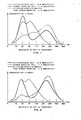
- Properties of the coupled polymers prepared using Recipe 2 are tabulated in Table II. Figures 1 and 2 show the GPG (gel permastion chromatograph) curves and makes reference to the individual polymer a of this example.

- Comparison of the inherent viacosity and molocular weight of the coupled polymers E, F. and G with their uncoupled counterparts A and C (Table I) show that coupling occure with either divinylbenzeno or carbon monoxide. The coupling efficiency observed using either of these agents alone at the stipulated molar ratios indicates that only about one half of the living polymer has bean coupled. The degree of coupling observed using divinylbentene slone (R and F) is indicative of the formation of a radial coupled by each divinylbenzene molccule. The depree of coupling of 2 achieved with the carbon monoxide illustrates its difunctional character in coupling two polymerlithiume to form a linear coupled product.
- The sequential coupling of polyrmerlithium with divinylbenzene and carbon monoxide results in sigaificantly higher coupling efficiencies (II and I), indicating that carbon monoxide effectively couples the imperfectly divinylbenzene coupled polymer product. When the imperfectly coupled polymer product obtained using a 1:1 divinylbenzene/lithium molar ratio was further coupled with carbon mnoxide (II), two coupled products were formed. The distribution of polymer products and the degree of coupling calculated from the gel permeation chromatographic curve indicated that 40% of the living polymer coupled to linear polymer, a degree of coupling of 2, and 60% coupled to a radial polymer with a degree of coupling of 9.
- A completely unexpected result occurred when the divinylbenzene/lithima molar ratio was increased to 2:1 and this product than further coupled with carbon monoxide. On the GPC curve no coupling of uncoupled polymerlithium to a linear chain (degree of coupling of 2) could be detected, but instead the GPC curve shows that only radial polymer was formed having a degree of coupling of 11, i.e. the final polymer had an average of 11 of the original polymerlithium chains coupled to a highly branched radial polymer.
- Living polymers B and C from Example I were coupled by treating the respective polymerization cements with divinylbenzene and carbon dioxide according to Recipe 3. Coupling agents were added as described in Example II.
-

- Properties of the coupled polymers prepared using Recipe 3 are tabulated in Table III. Figures 3 and 4 show GPC curves similar to Figures 1 and 2.

- The results of this experiment are analogous with those obtained with carbon monoxide (Example II), sequential addition of the two coupling agents resulting in high coupling efficiency, and the use of 2:1 molar ratio of divinylbenzeno/lithium followed by carbon dioxide unexpectedly resulting in no formation of linear product detectable on a CPC curve as is obtained when a 1:1 divinylbenzene/lithium molar ratio is used.
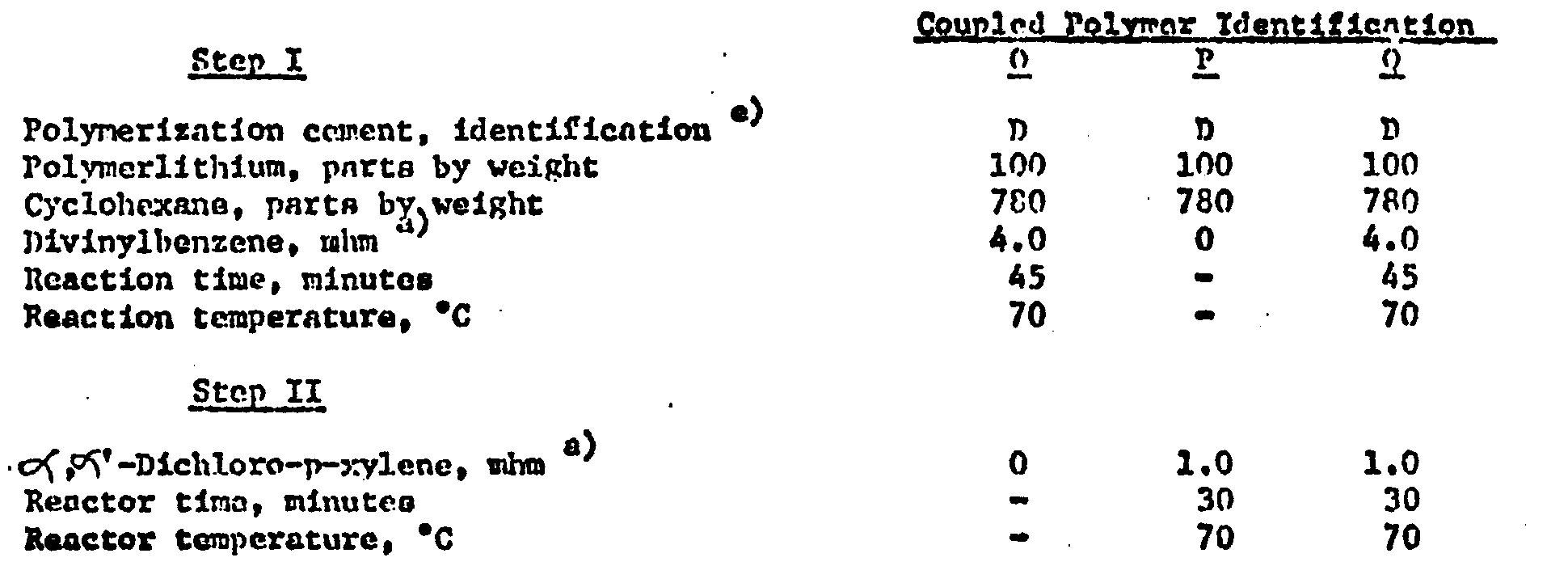
- Living polyner D from Example I was coupled with divinylbenzene and α,α'-dichloro-p-xylene according to Recipe 4. Divinylbenzene was added as the solution described in Example II. α,α'-Dichlororo-xylene was added as a dilute solution (~0.5 molar) in cyclohexane.
-
- Polymers were recovered using the procedure described in Example I.
- Properties of the coupled polymers prepared using Recipe 4 are tabulated in Table IV. Figure 6 shows GPC curves for the uncoupled polymer and the three coupled polymers as identified.
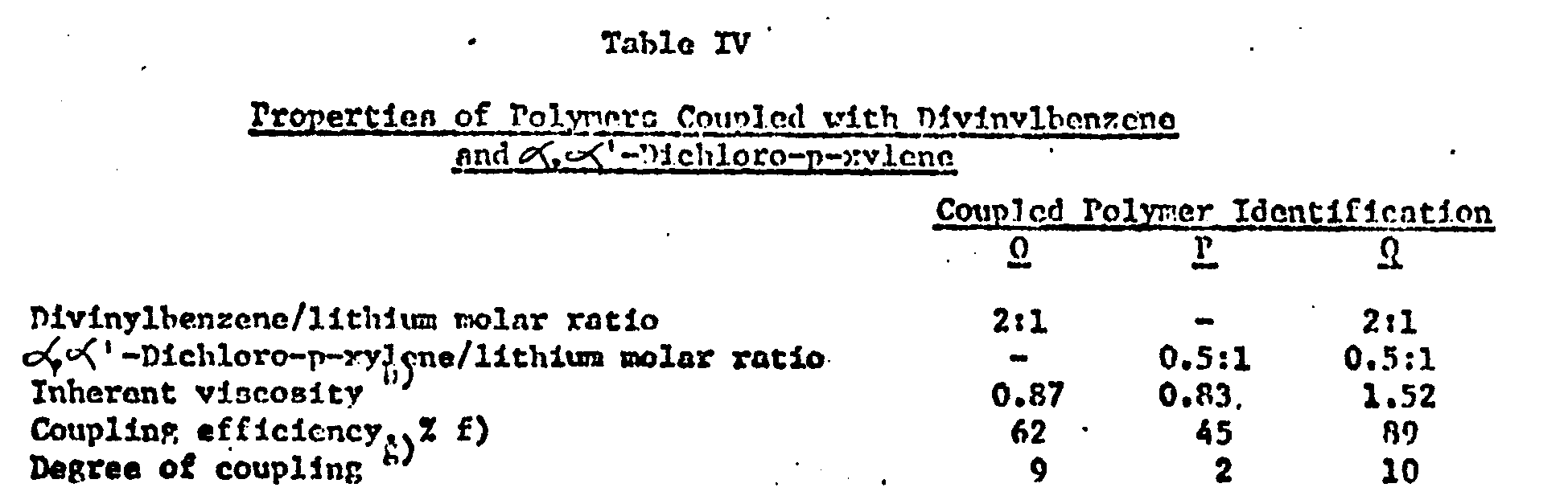
- These data illustrate the enhanced coupling efficiency and the absence of linear product obtained hy sequential coupling of polymerlithium using 2:1 molar ratio of divinylbenzene/lithium followed by α,α'-dichloro- p-xyleno.
- Living polymer D from Example I was coupled with divinylbenzene and methyl methacrylate according to Recipe 5. Coupling reagents were added as solutions as described in Example IV.
-

- Polymers were recovered using the procedure described in Example I.
- Properties of the coupled polymers prepared using Recipe 5 are tabulated in Table V. Figure 5 shows GPC curves for the uncoupled polymer and the three coupled polymers.

- These data illustrate that sequential nddition of divinylbenzene and methyl methaerylate to polymcrlithium results in tho formation of a highly branched radial copolymer with a high degree of coupling efficiency, this combination of parametors not being obtainable with either of the coupling agents alone when used at these molar ratios and reaction conditions.
- Living polymer D from Example I was coupled with divinylbenzene and dimethyldichlorosilane according to Recipe 6. Coupling reagents ware added as solutions as described in Example IV.
-

- Polymers were recovered using the procedure described in Example I.
- Properties of the coupled polymers prepared uoing Recipe 6 are tabulated in Table VI. Figure 7 shows GPC curves of the uncoupled polymer and the coupled polymers.

- These data illustrate that the coupling efficiency obtained using a sequential addition of divinylbenzene and dimethyldichlorosilane is greater than can be achieved using either coupling agent alone at the given molar ratio and given reaction conditions and that a highly branched, radial teleblock copolymer can he obtained from a given living polymer using the sequential addition of two coupling agents which has a higher inherent viscosity (higher molecular weight) than can he obtained using divinylbenzene alone.
-
- a) Millimoles per 100 grams of total monomers used to prepare the polymerlithium.
- b) Inherent viscosity was determined according to the procedure given in U.S. Patent 3,278,503, colunn 20, Note a with the modification that the solution was not filtered through a sulfur absorption tube but rather a sample of the solution was filtered throngh a fritted glass filter stick of grade C porosity and pressured directly into the visconeter.
- c) Molecular weights were determined from gel permeation chromatography curves by a procedure described by Gerard Kraus and C. J. Stacy, J. Poly. Sci.: Symposium 43, 329-343 (1973).
- d) Not determined.
- e) Polynerization cement (polymer solution as formed) identifications and properties are given in Recipe 1 and Table I of Example I.
- f) Coupling efficiency (Ec) is defined as the pereentage of the living polymer molecules which are incorporated into the coupled polymer. Ec is calculated from the gel permention chromatographic curve by dividing the area under the peak representing the coupled polymer by the arean under the peaks representing the coupled and uncoupled polymers and multiplying by 100.
- g) Degree of coupling (p) is defined as the number of living polymer molecules attached to one central unit derived from a coupling reagent and is determined from the gel permeation chrormtographic curve using the formula


- Reasonable variations and modifications which will become apparent to those skilled in the art can be made in this invention without departing from the spirit and scope thereof. I
Claims (10)
1. A process to couple a living polymer having the formula

wherein Q is a hydrocarbon polymer having one alkali metal atom M terminally attached thereto with a coupling agent in order to chemically connect such living polymer molecules to form larger polymer molecules, characterized in that said coupling comprises two coupling steps of
(a) in a first coupling step reacting said living polymer Q - M with a non-terminating first coupling agent such as to form an initial living coppled polymer having the formula

wherein Q represents one of m' polymer chains Q coupled via the coupling unit X which is derived from said non-terminating first coupling agent, and m' and m are integers essentially equal to each other,
(b) in a second coupling step further coupling said coupled living polymer Qm, - X - Mm with a second coupling agent to form a further coupled polymer.
2.A process according to claim 1) characterized in that said living polymer has the formula

wherein E represents a block selected from the group of poly- a monovinylarene blocks from monovinylarenes having from 8 to 20 carbon atoms per molecule, and hydrogenated low vinyl polybutadiene blocks and D consists of one or more homopolymer or copolymer blocks of alkadienes having 4 - 12 carbon atoms per molecule, said section D contributing to rubbery properties of the coupled polymer.
3. A process in accordance with claim 1) or 2) characterized in that a polyvinyl aromatic compound selected from the group defined by the following general formulae


is used as said non-terminating first coupling agent, wherein Y is a vinyl group, R' is selected from the group consisting of hydrogen, and alkyl groups containing from 1 to 4 carbon atoms with the total of actual substituents having not more than 12 carbon atoms, n is an integer of 2 or 3 and the vinyl substituents in the formula (b) and (c) being attached to one or both of the aromatic rings and in that said second coupling agent is selected from the group consisting of carbon monoxide, carbon dioxide, α,α-dichloro-p-xylene, methyl methacrylate and dimethyl dichlorosilane.
'4. A process in accordance with one of claims 1) to 3) characterized by at least partially hydrogenating the olefinic unsaturations of the coupled polymer while leaving the aromatic unsaturations essentially unchanged by contacting the final coupled polymer with hydrogen and a hydrogenation catalyst under hydrogenation conditions, and recovering a hydrogenated coupled polymer as the product of the process.
5. A process in accordance with one of claims 1) to 4) characterized in that said living polymer Q - M is produced by polymerizing the monomers in at least one polymerization step under polymerization conditions in a hydrocarbon diluent and utilizing a monoalkali initiator having the formula

wherein R is a hydrocarbyl radical having 1 to about 20 carbon atoms per molecule and M is an alkali metal selected from the group consisting of sodium, potassium and lithium.
6. A coupled polymer made by a process defined in one of claims 1) to 5).
7. A coupled polymer having a molecular weight distribution as characterized by the GPC curves of the two-step coupled polymer shown in the drawing.
8. A polymer having the formula

wherein m' polymerchains Q - and e units - Y - Q' are attached to a central hydrocarbyl unit X' and wherein Q is a polymer or copolymer of at least one alkadiene of 4 to about 12 carbon atoms, Y is a radical or bond resulting from a coupling process with a difunctional coupling agent capable of coupling alkali metal terminated Q polymers, the radicals Q' which can be the same or different are -Q or 4X" - Qm"), X' and X" is a central, hydrocarbyl unit derived from coupling agents of 10 to about 30 carbon atoms having two or three vinyl radicals directly attached to otherwise unsubstituted or alkyl substituted benzene, bi-phenyl, or naphthalene, the central units X' and X" being the same or different, and e, m' and m" being integers and the average number of polymer chains Q being present in the molecules is in the range of 8 to 15.
9. A polymer in accordance with claim 8) characterized in that said central units X' are derived from divinylbenzene and said radical Y is derived from a coupling agent selected from the group consisting of carbon monoxide, carbon dioxide, α,α'-dichloro-p-xylene, methyl methacrylate and dimethyl dichlorosilane.
10. A polymer in accordance with claim 8) or 9) characterized in that Q is a polymer chain of the structure

wherein E represents a block selected from the group of hydrogenated low vinyl polybutadiene and poly- vinylarene from monovinylarene monomers having 8 to 20 carbon atoms per molecules and D comprises one or more homopolymer or copolymer blocks of alkadiene monomers of 4 - 12 carbon atoms contributing rubbery properties to the polymer.
Applications Claiming Priority (2)
| Application Number | Priority Date | Filing Date | Title |
|---|---|---|---|
| US85074977A | 1977-11-11 | 1977-11-11 | |
| US850749 | 1977-11-11 |
Publications (1)
| Publication Number | Publication Date |
|---|---|
| EP0002012A1 true EP0002012A1 (en) | 1979-05-30 |
Family
ID=25309008
Family Applications (1)
| Application Number | Title | Priority Date | Filing Date |
|---|---|---|---|
| EP78101302A Withdrawn EP0002012A1 (en) | 1977-11-11 | 1978-11-03 | Coupled hydrocarbon polymers and process for their preparation |
Country Status (3)
| Country | Link |
|---|---|
| EP (1) | EP0002012A1 (en) |
| AU (1) | AU515569B2 (en) |
| ES (1) | ES474962A1 (en) |
Cited By (8)
| Publication number | Priority date | Publication date | Assignee | Title |
|---|---|---|---|---|
| EP0050832A3 (en) * | 1980-10-23 | 1982-07-14 | Phillips Petroleum Company | A process of coupling living polymers with gamma-hydroxy acid-lactones |
| US4764572A (en) * | 1985-07-23 | 1988-08-16 | Shell Oil Company | Anionic polymerization process |
| WO1989010378A1 (en) * | 1988-04-27 | 1989-11-02 | Labofina S.A. | Process for the preparation of block copolymers |
| WO1991004993A1 (en) * | 1989-10-03 | 1991-04-18 | Exxon Chemical Patents Inc. | Functionalization of polymeric organolithium compounds by carbonation |
| WO1995010544A1 (en) * | 1993-10-15 | 1995-04-20 | University Of Massachusetts At Lowell | Capping of living polymers |
| US5773521A (en) * | 1995-12-19 | 1998-06-30 | Shell Oil Company | Coupling to produce inside-out star polymers with expanded cores |
| RU2138517C1 (en) * | 1993-02-15 | 1999-09-27 | Фина Рисеч С.А. | Method for production of graft block copolymers |
| US9834559B2 (en) | 2013-06-12 | 2017-12-05 | Janssen Pharmaceutica Nv | 4-Amino-6-phenyl-5,6-dihydroimidazo[1,5-a]pyrazin-3(2H)-one derivatives as inhibitors of beta-secretase (BACE) |
Families Citing this family (1)
| Publication number | Priority date | Publication date | Assignee | Title |
|---|---|---|---|---|
| IT1184428B (en) * | 1985-04-12 | 1987-10-28 | Pirelli Cavi Spa | HYDROGEN ABSORBENT COMPOSITION FOR CABLES AND ELECTRIC CABLES, FIBER OPTIC CABLES AND THEIR INCORPORATING COMPONENTS SAID COMPOSITION |
Citations (6)
| Publication number | Priority date | Publication date | Assignee | Title |
|---|---|---|---|---|
| US3661873A (en) * | 1971-01-06 | 1972-05-09 | Firestone Tire & Rubber Co | Process and product of treating live polymers with divinyl benzene and a haloalkane |
| US3725369A (en) * | 1971-01-06 | 1973-04-03 | Firestone Tire & Rubber Co | Process for postreaction of alkali metal-active polymers with silicic compounds and dialkenyl compounds |
| US3725370A (en) * | 1971-01-06 | 1973-04-03 | Firestone Tire & Rubber Co | Process and product of treating live polymers with divinyl benzene and an active halogen compound |
| FR2186483A1 (en) * | 1972-05-31 | 1974-01-11 | Shell Int Research | |
| DE2529065A1 (en) * | 1974-07-15 | 1976-02-05 | Univ Akron | PROCESS FOR MANUFACTURING BRANCHED POLYMERIZES |
| FR2340959A1 (en) * | 1976-02-10 | 1977-09-09 | Shell Int Research | HYDROGENIC POLYMERS AND THEIR MANUFACTURING PROCESS |
-
1978
- 1978-10-13 AU AU40704/78A patent/AU515569B2/en not_active Expired
- 1978-11-03 EP EP78101302A patent/EP0002012A1/en not_active Withdrawn
- 1978-11-10 ES ES474962A patent/ES474962A1/en not_active Expired
Patent Citations (6)
| Publication number | Priority date | Publication date | Assignee | Title |
|---|---|---|---|---|
| US3661873A (en) * | 1971-01-06 | 1972-05-09 | Firestone Tire & Rubber Co | Process and product of treating live polymers with divinyl benzene and a haloalkane |
| US3725369A (en) * | 1971-01-06 | 1973-04-03 | Firestone Tire & Rubber Co | Process for postreaction of alkali metal-active polymers with silicic compounds and dialkenyl compounds |
| US3725370A (en) * | 1971-01-06 | 1973-04-03 | Firestone Tire & Rubber Co | Process and product of treating live polymers with divinyl benzene and an active halogen compound |
| FR2186483A1 (en) * | 1972-05-31 | 1974-01-11 | Shell Int Research | |
| DE2529065A1 (en) * | 1974-07-15 | 1976-02-05 | Univ Akron | PROCESS FOR MANUFACTURING BRANCHED POLYMERIZES |
| FR2340959A1 (en) * | 1976-02-10 | 1977-09-09 | Shell Int Research | HYDROGENIC POLYMERS AND THEIR MANUFACTURING PROCESS |
Cited By (12)
| Publication number | Priority date | Publication date | Assignee | Title |
|---|---|---|---|---|
| EP0050832A3 (en) * | 1980-10-23 | 1982-07-14 | Phillips Petroleum Company | A process of coupling living polymers with gamma-hydroxy acid-lactones |
| US4764572A (en) * | 1985-07-23 | 1988-08-16 | Shell Oil Company | Anionic polymerization process |
| WO1989010378A1 (en) * | 1988-04-27 | 1989-11-02 | Labofina S.A. | Process for the preparation of block copolymers |
| EP0344140A1 (en) * | 1988-04-27 | 1989-11-29 | Fina Research S.A. | Process for the preparation of block copolymers |
| BE1001592A3 (en) * | 1988-04-27 | 1989-12-12 | Fina Research | Method of preparation of block copolymers. |
| WO1991004993A1 (en) * | 1989-10-03 | 1991-04-18 | Exxon Chemical Patents Inc. | Functionalization of polymeric organolithium compounds by carbonation |
| RU2138517C1 (en) * | 1993-02-15 | 1999-09-27 | Фина Рисеч С.А. | Method for production of graft block copolymers |
| WO1995010544A1 (en) * | 1993-10-15 | 1995-04-20 | University Of Massachusetts At Lowell | Capping of living polymers |
| US5637647A (en) * | 1993-10-15 | 1997-06-10 | University Of Massachusetts Lowell | Capping of living polymers |
| US5677386A (en) * | 1993-10-15 | 1997-10-14 | University Of Massachusetts Lowell | Capping of living polymers |
| US5773521A (en) * | 1995-12-19 | 1998-06-30 | Shell Oil Company | Coupling to produce inside-out star polymers with expanded cores |
| US9834559B2 (en) | 2013-06-12 | 2017-12-05 | Janssen Pharmaceutica Nv | 4-Amino-6-phenyl-5,6-dihydroimidazo[1,5-a]pyrazin-3(2H)-one derivatives as inhibitors of beta-secretase (BACE) |
Also Published As
| Publication number | Publication date |
|---|---|
| AU4070478A (en) | 1980-04-17 |
| AU515569B2 (en) | 1981-04-09 |
| ES474962A1 (en) | 1979-12-01 |
Similar Documents
| Publication | Publication Date | Title |
|---|---|---|
| US4039633A (en) | Coupling of alkali metal-terminated polymers | |
| US4185042A (en) | Coupling agent | |
| US4152370A (en) | Preparation, composition, and use of block polymers | |
| KR950008156B1 (en) | Process for preparing polydiene rubber mixture | |
| KR100659410B1 (en) | Process for preparing coupled block copolymer composition and composition prepared thereby | |
| US4163764A (en) | Coupled block copolymers with improved tack for adhesives | |
| KR100258271B1 (en) | Anionic polymerization modifier | |
| US4168286A (en) | Tetrablock polymers and their hydrogenated analogs | |
| US4088813A (en) | Promoters in the polymerization of monovinyl-aromatic compounds with primary lithium initiators | |
| US4405754A (en) | Haze-free, clear, impact-resistant resinous polymers | |
| JPS6348311A (en) | Manufacture of vinyl group-containing polymer | |
| CA1143896A (en) | Continuous solution polymerization process | |
| US3959412A (en) | Block polymer preparation | |
| US4131653A (en) | Epoxidized block copolymers | |
| EP0250015B1 (en) | Anionic polymerization process | |
| EP0002012A1 (en) | Coupled hydrocarbon polymers and process for their preparation | |
| US4408017A (en) | Coupling process | |
| US4158098A (en) | Organo lithium initiator | |
| US4105714A (en) | Coupling of alkali metal-terminated polymers | |
| US4163765A (en) | Polymeric compositions | |
| US4049753A (en) | Coupling of alkali metal-terminated polymers | |
| US5290872A (en) | Branched and hydrogenated block copolymer, procedures for its preparation and use | |
| US4134928A (en) | Tetrablock polydienes | |
| US3931126A (en) | Modification of conjugated diene polymers by treatment with organolithium and n,n,n',n'-tetramethylalkylenediamine compounds | |
| JPH07188360A (en) | Method for producing asymmetric radial polymer |
Legal Events
| Date | Code | Title | Description |
|---|---|---|---|
| PUAI | Public reference made under article 153(3) epc to a published international application that has entered the european phase |
Free format text: ORIGINAL CODE: 0009012 |
|
| AK | Designated contracting states |
Designated state(s): BE DE FR GB |
|
| 17P | Request for examination filed | ||
| STAA | Information on the status of an ep patent application or granted ep patent |
Free format text: STATUS: THE APPLICATION HAS BEEN WITHDRAWN |
|
| 18W | Application withdrawn |
Withdrawal date: 19820714 |
|
| RIN1 | Information on inventor provided before grant (corrected) |
Inventor name: NAYLOR, FLOYD EDMOND |