EP0001186B1 - Process for producing polyisobutenes - Google Patents
Process for producing polyisobutenes Download PDFInfo
- Publication number
- EP0001186B1 EP0001186B1 EP78300374A EP78300374A EP0001186B1 EP 0001186 B1 EP0001186 B1 EP 0001186B1 EP 78300374 A EP78300374 A EP 78300374A EP 78300374 A EP78300374 A EP 78300374A EP 0001186 B1 EP0001186 B1 EP 0001186B1
- Authority
- EP
- European Patent Office
- Prior art keywords
- process according
- catalyst
- isobutene
- weight
- feedstock
- Prior art date
- Legal status (The legal status is an assumption and is not a legal conclusion. Google has not performed a legal analysis and makes no representation as to the accuracy of the status listed.)
- Expired
Links
- 238000000034 method Methods 0.000 title claims description 20
- 229920002367 Polyisobutene Polymers 0.000 title claims description 12
- 239000003054 catalyst Substances 0.000 claims description 40
- VQTUBCCKSQIDNK-UHFFFAOYSA-N Isobutene Chemical compound CC(C)=C VQTUBCCKSQIDNK-UHFFFAOYSA-N 0.000 claims description 35
- 239000000203 mixture Substances 0.000 claims description 8
- 238000006243 chemical reaction Methods 0.000 claims description 7
- UAIZDWNSWGTKFZ-UHFFFAOYSA-L ethylaluminum(2+);dichloride Chemical compound CC[Al](Cl)Cl UAIZDWNSWGTKFZ-UHFFFAOYSA-L 0.000 claims description 7
- 239000002904 solvent Substances 0.000 claims description 7
- XDTMQSROBMDMFD-UHFFFAOYSA-N Cyclohexane Chemical compound C1CCCCC1 XDTMQSROBMDMFD-UHFFFAOYSA-N 0.000 claims description 5
- 150000002899 organoaluminium compounds Chemical class 0.000 claims description 5
- NHTMVDHEPJAVLT-UHFFFAOYSA-N Isooctane Chemical compound CC(C)CC(C)(C)C NHTMVDHEPJAVLT-UHFFFAOYSA-N 0.000 claims description 4
- 125000005234 alkyl aluminium group Chemical group 0.000 claims description 4
- 235000013844 butane Nutrition 0.000 claims description 4
- JVSWJIKNEAIKJW-UHFFFAOYSA-N dimethyl-hexane Natural products CCCCCC(C)C JVSWJIKNEAIKJW-UHFFFAOYSA-N 0.000 claims description 4
- WKBOTKDWSSQWDR-UHFFFAOYSA-N Bromine atom Chemical group [Br] WKBOTKDWSSQWDR-UHFFFAOYSA-N 0.000 claims description 3
- GDTBXPJZTBHREO-UHFFFAOYSA-N bromine Chemical group BrBr GDTBXPJZTBHREO-UHFFFAOYSA-N 0.000 claims description 3
- 229910052794 bromium Chemical group 0.000 claims description 3
- 239000000460 chlorine Substances 0.000 claims description 3
- 229910052801 chlorine Inorganic materials 0.000 claims description 3
- 229910001507 metal halide Inorganic materials 0.000 claims description 3
- 150000005309 metal halides Chemical class 0.000 claims description 3
- IJDNQMDRQITEOD-UHFFFAOYSA-N n-butane Chemical class CCCC IJDNQMDRQITEOD-UHFFFAOYSA-N 0.000 claims description 3
- CPELXLSAUQHCOX-UHFFFAOYSA-M Bromide Chemical compound [Br-] CPELXLSAUQHCOX-UHFFFAOYSA-M 0.000 claims description 2
- 229910021623 Tin(IV) bromide Inorganic materials 0.000 claims description 2
- 229910021627 Tin(IV) chloride Inorganic materials 0.000 claims description 2
- 150000001338 aliphatic hydrocarbons Chemical class 0.000 claims description 2
- 125000004432 carbon atom Chemical group C* 0.000 claims description 2
- 125000001309 chloro group Chemical group Cl* 0.000 claims description 2
- 150000005375 primary alkyl halides Chemical class 0.000 claims description 2
- 150000005376 secondary alkyl halides Chemical class 0.000 claims description 2
- NBRKLOOSMBRFMH-UHFFFAOYSA-N tert-butyl chloride Chemical compound CC(C)(C)Cl NBRKLOOSMBRFMH-UHFFFAOYSA-N 0.000 claims description 2
- 125000000383 tetramethylene group Chemical group [H]C([H])([*:1])C([H])([H])C([H])([H])C([H])([H])[*:2] 0.000 claims description 2
- LTSUHJWLSNQKIP-UHFFFAOYSA-J tin(iv) bromide Chemical compound Br[Sn](Br)(Br)Br LTSUHJWLSNQKIP-UHFFFAOYSA-J 0.000 claims description 2
- HPGGPRDJHPYFRM-UHFFFAOYSA-J tin(iv) chloride Chemical compound Cl[Sn](Cl)(Cl)Cl HPGGPRDJHPYFRM-UHFFFAOYSA-J 0.000 claims description 2
- UBZYKBZMAMTNKW-UHFFFAOYSA-J titanium tetrabromide Chemical compound Br[Ti](Br)(Br)Br UBZYKBZMAMTNKW-UHFFFAOYSA-J 0.000 claims description 2
- KAKZBPTYRLMSJV-UHFFFAOYSA-N butadiene group Chemical group C=CC=C KAKZBPTYRLMSJV-UHFFFAOYSA-N 0.000 description 7
- -1 alkyl aluminium halide Chemical class 0.000 description 6
- VSCWAEJMTAWNJL-UHFFFAOYSA-K aluminium trichloride Chemical compound Cl[Al](Cl)Cl VSCWAEJMTAWNJL-UHFFFAOYSA-K 0.000 description 6
- 229930195733 hydrocarbon Natural products 0.000 description 5
- 150000002430 hydrocarbons Chemical class 0.000 description 5
- XJDNKRIXUMDJCW-UHFFFAOYSA-J titanium tetrachloride Chemical compound Cl[Ti](Cl)(Cl)Cl XJDNKRIXUMDJCW-UHFFFAOYSA-J 0.000 description 5
- 239000004215 Carbon black (E152) Substances 0.000 description 4
- 229910003074 TiCl4 Inorganic materials 0.000 description 4
- 150000001350 alkyl halides Chemical class 0.000 description 3
- 230000000052 comparative effect Effects 0.000 description 3
- MTHSVFCYNBDYFN-UHFFFAOYSA-N diethylene glycol Chemical compound OCCOCCO MTHSVFCYNBDYFN-UHFFFAOYSA-N 0.000 description 3
- 125000000217 alkyl group Chemical group 0.000 description 2
- 230000000694 effects Effects 0.000 description 2
- NNPPMTNAJDCUHE-UHFFFAOYSA-N isobutane Chemical compound CC(C)C NNPPMTNAJDCUHE-UHFFFAOYSA-N 0.000 description 2
- 229920001083 polybutene Polymers 0.000 description 2
- 229920000642 polymer Polymers 0.000 description 2
- XLYOFNOQVPJJNP-UHFFFAOYSA-N water Substances O XLYOFNOQVPJJNP-UHFFFAOYSA-N 0.000 description 2
- VXNZUUAINFGPBY-UHFFFAOYSA-N 1-Butene Chemical class CCC=C VXNZUUAINFGPBY-UHFFFAOYSA-N 0.000 description 1
- ZAMOUSCENKQFHK-UHFFFAOYSA-N Chlorine atom Chemical compound [Cl] ZAMOUSCENKQFHK-UHFFFAOYSA-N 0.000 description 1
- 238000005727 Friedel-Crafts reaction Methods 0.000 description 1
- 230000002411 adverse Effects 0.000 description 1
- 150000001336 alkenes Chemical class 0.000 description 1
- 239000001273 butane Substances 0.000 description 1
- KOYGZROXUOTUEE-UHFFFAOYSA-N butane;but-1-ene Chemical compound CCCC.CCC=C KOYGZROXUOTUEE-UHFFFAOYSA-N 0.000 description 1
- WFYPICNXBKQZGB-UHFFFAOYSA-N butenyne Chemical group C=CC#C WFYPICNXBKQZGB-UHFFFAOYSA-N 0.000 description 1
- 229940038926 butyl chloride Drugs 0.000 description 1
- 229920005549 butyl rubber Polymers 0.000 description 1
- 238000004523 catalytic cracking Methods 0.000 description 1
- 230000003197 catalytic effect Effects 0.000 description 1
- 125000002091 cationic group Chemical group 0.000 description 1
- 150000001875 compounds Chemical class 0.000 description 1
- 238000007865 diluting Methods 0.000 description 1
- MGDOJPNDRJNJBK-UHFFFAOYSA-N ethylaluminum Chemical compound [Al].C[CH2] MGDOJPNDRJNJBK-UHFFFAOYSA-N 0.000 description 1
- 238000005227 gel permeation chromatography Methods 0.000 description 1
- 239000001282 iso-butane Substances 0.000 description 1
- 238000002955 isolation Methods 0.000 description 1
- 239000000178 monomer Substances 0.000 description 1
- OFBQJSOFQDEBGM-UHFFFAOYSA-N n-pentane Natural products CCCCC OFBQJSOFQDEBGM-UHFFFAOYSA-N 0.000 description 1
- 239000002574 poison Substances 0.000 description 1
- 231100000614 poison Toxicity 0.000 description 1
- 238000006116 polymerization reaction Methods 0.000 description 1
- 239000000376 reactant Substances 0.000 description 1
- 238000004227 thermal cracking Methods 0.000 description 1
- 238000005406 washing Methods 0.000 description 1
Classifications
-
- C—CHEMISTRY; METALLURGY
- C08—ORGANIC MACROMOLECULAR COMPOUNDS; THEIR PREPARATION OR CHEMICAL WORKING-UP; COMPOSITIONS BASED THEREON
- C08F—MACROMOLECULAR COMPOUNDS OBTAINED BY REACTIONS ONLY INVOLVING CARBON-TO-CARBON UNSATURATED BONDS
- C08F10/00—Homopolymers and copolymers of unsaturated aliphatic hydrocarbons having only one carbon-to-carbon double bond
-
- C—CHEMISTRY; METALLURGY
- C08—ORGANIC MACROMOLECULAR COMPOUNDS; THEIR PREPARATION OR CHEMICAL WORKING-UP; COMPOSITIONS BASED THEREON
- C08F—MACROMOLECULAR COMPOUNDS OBTAINED BY REACTIONS ONLY INVOLVING CARBON-TO-CARBON UNSATURATED BONDS
- C08F10/00—Homopolymers and copolymers of unsaturated aliphatic hydrocarbons having only one carbon-to-carbon double bond
- C08F10/04—Monomers containing three or four carbon atoms
- C08F10/08—Butenes
- C08F10/10—Isobutene
Definitions
- the present invention relates to a method of producing high molecular weight polyisobutenes using a novel catalyst system.
- a typical example is a Friedel-Crafts catalyst such as aluminium chloride dissolved in an alkyl halide. It has been necessary to use an alkyl halide as solvent because aluminium chloride is virtually insoluble in hydrocarbons. Even in alkyl halides, aluminium chloride is only sparingly soluble. This low solubility has given rise to many difficulties in the control of the polymerisation reaction. For example, it is difficult to prepare the catalyst, determine precisely the amount of catalyst to be used and yet more difficult to calculate the introduction rate of the catalyst into the reactor.
- the present invention is a process for producing polyisobutenes by polymerising at a temperature below 0°C a C 4 feedstock comprising isobutene in the presence of a catalyst system comprising (i) an organo aluminium compound of the formula R " AIX 3-n wherein R represents the same or different alkyl radicals having between 1 and 6 carbon atoms, X represents chlorine or bromine and n is an integer not greater than 3 and (ii) tertiary butyl chloride or bromide characterised in that the polymerisation is carried out in a homogeneous phase at a temperature between -5°C and -25°C in the presence of the catalyst system which contains in addition a metal halide selected from SnCl 4 , SnBr 4 , TiCI 4 and TiBr 4 so as to produce a high molecular weight polyisobutene having an SSU viscosity above 1,000,000 at 98.88°C.
- a catalyst system comprising (i) an organo aluminiu
- high molecular weight polyisobutenes polyisobutenes having an SSU viscosity above 1,000,000 at 98.88°C. Such polyisobutenes are considered to have a weight average molecular weight (Mw) above 10,000 determined by gel permeation chromatography.
- the C 4 hydrocarbon feedstock may be the products of a thermal or catalytic cracking operation but in both cases butadienes and acetylenic compounds must be removed prior to polymerisation.
- the feedstock may contain between 10 and 100% by weight of isobutenes. It would be preferable to use a feedstock containing at least 50% by weight of isobutene. However, conventional feedstock containing between 15 and 50% by weight of isobutene may be used to obtain the desired product.
- Hydrocarbon feedstocks containing in addition to isobutene between 10 and 20% by weight of butanes and/or between 20 and 40% by weight of normal butenes may be used without adverse effects on the polyisobutene product.
- the alkyl aluminium compound in the catalyst system has the general formula R n AIX 3-n where R may be a C, to C . alkyl radical and X may either be chlorine or bromine. Where the organo aluminium compound has more than one alkyl group, these alkyl groups may be the same or different. Ethyl aluminium dihalides and particularly ethyl aluminium dichloride, are preferred.
- the relative concentrations of the three components in the catalyst system of the present invention may vary over a moderately wide range depending upon the nature of the organo aluminium compound used.
- the three catalyst components are preferably used in substantially equimolar amounts.
- the catalyst concentration for the reaction would depend upon the feed composition, the product desired, the temperature and the residence time.
- the catalyst concentration assuming substantially equimolar proportions are used but based on the organo aluminium compound content thereof, is suitably between 20 and 2000 ppm, preferably between 50 and 300 ppm and most preferably between 80 and 120 ppm by weight of the C 4- stream.
- the catalyst system is suitably introduced into the polymerisation reactor as a solution thereof in a solvent which is inert under the reaction conditions.
- solvents include primary and secondary alkyl halides and aliphatic hydrocarbon solvents. It is preferable to produce separate solutions of the alkyl aluminium halide on the one hand and a mixture of the metal halide and tertiary butyl halide on the other hand.
- the hydrocarbon solvent is suitably a mixture of cyclohexane and isooctane. Even if separate solutions are produced, it is preferable to feed the two catalyst component streams simultaneously into the polymerisation reactor.
- the polymerisation rection is carried out at a temperature between -5°C and -25°C.
- a C Q -stream of the composition shown below was fed at a rate of 1800 ml/h (1080 g/h) to a flask maintained at -10°C to -14°C over a period of 2.5 h, the reactor capacity being such that the residence time was 7.5 min.
- Simultaneously two catalyst component streams were fed to the reactor. The first was a solution of ethylaluminium-dichloride dissolved in a 4 to 1 mixture of cyclohexane and isooctane and the second was a similar solution of titanium tetrachloride and teit.-butylchloride, the three catalyst components being fed in equimolar amounts.
- the catalysts were added as solutions in a 4:1 v/v mixture of cyclohexane and isooctane.
- the polymerisation products were worked up in a conventional manner by killing the catalyst with diethylene glycol, diluting with cyclohexane, water washing and stripping in vacuum to 200°C at 5 mm Hg pressure.
- Example 1 was repeated using 166 ppm of AICI 3 alone as catalyst.
- the SSU viscosity of the product at 98.88°C was 700,000.
Landscapes
- Chemical & Material Sciences (AREA)
- Health & Medical Sciences (AREA)
- Chemical Kinetics & Catalysis (AREA)
- Medicinal Chemistry (AREA)
- Polymers & Plastics (AREA)
- Organic Chemistry (AREA)
- Addition Polymer Or Copolymer, Post-Treatments, Or Chemical Modifications (AREA)
- Transition And Organic Metals Composition Catalysts For Addition Polymerization (AREA)
- Polymerization Catalysts (AREA)
Description
- The present invention relates to a method of producing high molecular weight polyisobutenes using a novel catalyst system.
- It is known to produce polybutenes using cationic polymerisation catalysts. A typical example is a Friedel-Crafts catalyst such as aluminium chloride dissolved in an alkyl halide. It has been necessary to use an alkyl halide as solvent because aluminium chloride is virtually insoluble in hydrocarbons. Even in alkyl halides, aluminium chloride is only sparingly soluble. This low solubility has given rise to many difficulties in the control of the polymerisation reaction. For example, it is difficult to prepare the catalyst, determine precisely the amount of catalyst to be used and yet more difficult to calculate the introduction rate of the catalyst into the reactor. In addition, high molecular weight polybutenes have hitherto been produced commercially only by using a relatively pure C4 isomer because mixed isomers have resulted only in polymers of low or moderate molecular weight. An example of this type of prior art process can be found in US Patent No. 3560458 (Esso). In this patent, a process for homo- or copolymerising mono- or di-olefins using a catalyst system comprising (1) either an alkyl aluminium or an alkyl aluminium halide and (2) a catalyst promoter which may be tertiary butyl halide is disclosed. However, the products of this process are of the butyl rubber type which have a relatively low molecular weight i.e. below 1,000,000 SSU viscosity at 98.88°C. The process also uses extremely low polymerisation temperatures, i.e. -30°C or below as is evident from the Examples in the specification Moreover, relatively pure monomers are used as reactants and the catalyst system used is a two- component system.
- It has now been found that high molecular weight polyisobutenes having a SSU viscosity above 1,000,000 at 98.88°C can be produced from mixed butane-butene streams with the necessary control on catalyst quality, concentration and solubility by using a new three-component catalyst system.
- Accordingly, the present invention is a process for producing polyisobutenes by polymerising at a temperature below 0°C a C4 feedstock comprising isobutene in the presence of a catalyst system comprising (i) an organo aluminium compound of the formula R"AIX3-n wherein R represents the same or different alkyl radicals having between 1 and 6 carbon atoms, X represents chlorine or bromine and n is an integer not greater than 3 and (ii) tertiary butyl chloride or bromide characterised in that the polymerisation is carried out in a homogeneous phase at a temperature between -5°C and -25°C in the presence of the catalyst system which contains in addition a metal halide selected from SnCl4, SnBr4, TiCI4 and TiBr4 so as to produce a high molecular weight polyisobutene having an SSU viscosity above 1,000,000 at 98.88°C.
- By the term "high molecular weight polyisobutenes" is meant here and throughout the specification polyisobutenes having an SSU viscosity above 1,000,000 at 98.88°C. Such polyisobutenes are considered to have a weight average molecular weight (Mw) above 10,000 determined by gel permeation chromatography.
- The C4 hydrocarbon feedstock may be the products of a thermal or catalytic cracking operation but in both cases butadienes and acetylenic compounds must be removed prior to polymerisation. The feedstock may contain between 10 and 100% by weight of isobutenes. It would be preferable to use a feedstock containing at least 50% by weight of isobutene. However, conventional feedstock containing between 15 and 50% by weight of isobutene may be used to obtain the desired product. Hydrocarbon feedstocks containing in addition to isobutene between 10 and 20% by weight of butanes and/or between 20 and 40% by weight of normal butenes may be used without adverse effects on the polyisobutene product.
- The alkyl aluminium compound in the catalyst system has the general formula RnAIX3-n where R may be a C, to C. alkyl radical and X may either be chlorine or bromine. Where the organo aluminium compound has more than one alkyl group, these alkyl groups may be the same or different. Ethyl aluminium dihalides and particularly ethyl aluminium dichloride, are preferred.
- The relative concentrations of the three components in the catalyst system of the present invention may vary over a moderately wide range depending upon the nature of the organo aluminium compound used. Thus, if an alkyl aluminium dihalide is used the three catalyst components are preferably used in substantially equimolar amounts. The catalyst concentration for the reaction would depend upon the feed composition, the product desired, the temperature and the residence time. As a general guide, the catalyst concentration, assuming substantially equimolar proportions are used but based on the organo aluminium compound content thereof, is suitably between 20 and 2000 ppm, preferably between 50 and 300 ppm and most preferably between 80 and 120 ppm by weight of the C4-stream.
- The catalyst system is suitably introduced into the polymerisation reactor as a solution thereof in a solvent which is inert under the reaction conditions. Examples of solvents include primary and secondary alkyl halides and aliphatic hydrocarbon solvents. It is preferable to produce separate solutions of the alkyl aluminium halide on the one hand and a mixture of the metal halide and tertiary butyl halide on the other hand. For both solutions, the hydrocarbon solvent is suitably a mixture of cyclohexane and isooctane. Even if separate solutions are produced, it is preferable to feed the two catalyst component streams simultaneously into the polymerisation reactor.
- The polymerisation rection is carried out at a temperature between -5°C and -25°C.
- The invention is further illustrated with reference to the following Examples.
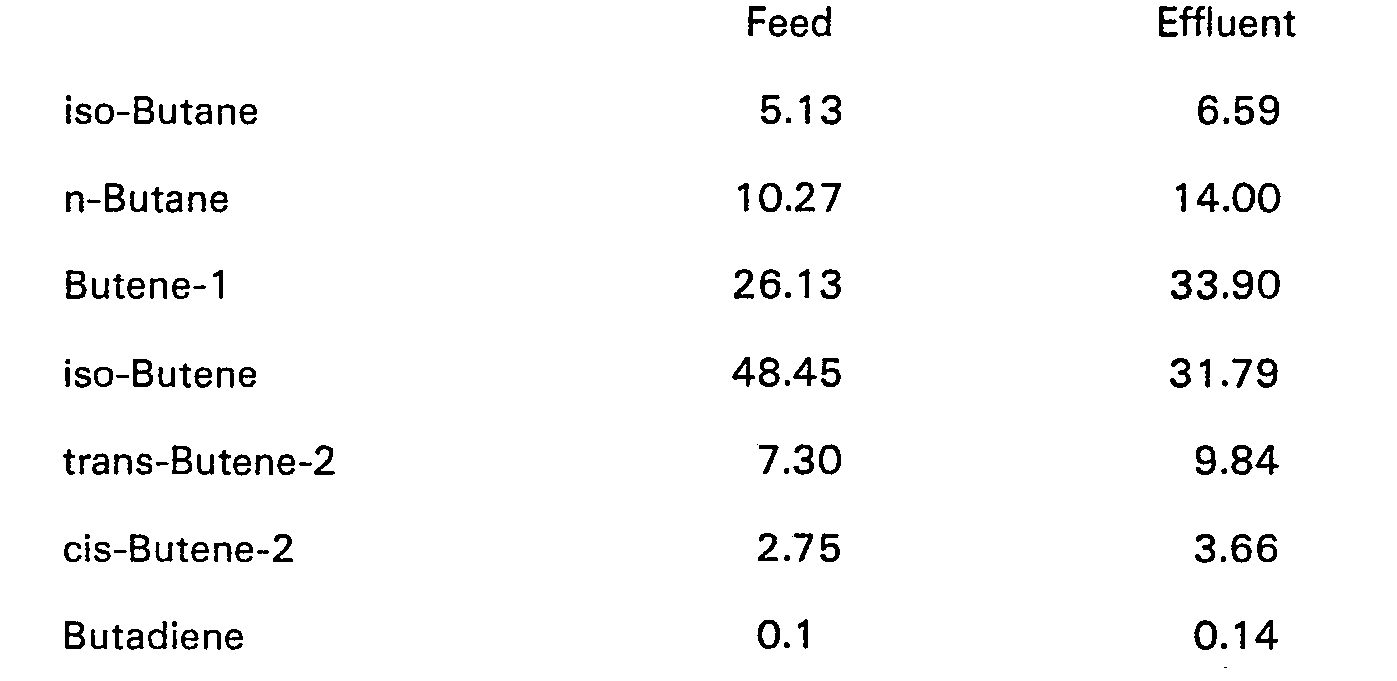
- A CQ-stream of the composition shown below was fed at a rate of 1800 ml/h (1080 g/h) to a flask maintained at -10°C to -14°C over a period of 2.5 h, the reactor capacity being such that the residence time was 7.5 min. Simultaneously two catalyst component streams were fed to the reactor. The first was a solution of ethylaluminium-dichloride dissolved in a 4 to 1 mixture of cyclohexane and isooctane and the second was a similar solution of titanium tetrachloride and teit.-butylchloride, the three catalyst components being fed in equimolar amounts. The weight of ethylaluminium-dichloride fed amounted to 100 ppm of the C4-stream.
- Polymerisation was rapid and the unconverted C4-hydrocarbons had the composition shown below:
- After isolation of the polymer it was found to have the following properties:

- The above Example clearly shows that it is possible to obtain high molecular weight products at relatively high temperatures and with minimal catalyst consumption.
- These Examples were carried out as follows:
- The hydrocarbon feed to the reaction in all these Examples was a "butadiene plant raffinate" containing 45-48% isobutene, n-butenes, and a minor proportion of butanes. In this feedstock the level of catalyst poisons was very low, namely water <10 ppm, vinyl acetylene <10 ppm and butadiene <0.2%.
- The catalysts were added as solutions in a 4:1 v/v mixture of cyclohexane and isooctane.
- The polymerisation products were worked up in a conventional manner by killing the catalyst with diethylene glycol, diluting with cyclohexane, water washing and stripping in vacuum to 200°C at 5 mm Hg pressure.

- The procedure of Examples 2-14 was repeated using the reaction conditions and catalyst indicated below. The catalyst concentration (ppm) was based on the feedstock, in this case butadiene raffinate.

- This example shows that very low concentrations of EADC and TBC in the presence of TiCl4 have an acceptably high activity for the polymerisation of isobutene in mixed dry C4's. At these levels without TiCl4, no polymerisation would occur (see Comparative Test 1 below).
- The process of Examples 2-14 was repeated using the following reaction conditions and catalyst concentration (ppm) based on the feedstock which in this case was isobutene/isobutane/n- butane.

- The results show that the EADC/TiCl4/TBC catalyst combination is also highly active for polymerisation of isobutene in the absence of linear C4 olefins.
- Using a feedstock similar to that of Example 15, a test was carried out with the catalyst system EADC/TBC without the TiCl4. The catalyst concentration (ppm) was based on the feedstock. The reaction conditions and results are shown below.

- The results show that even high concentrations of EADC/TBC catalyst have a low catalytic activity for polymerisation of isobutene in mixed C4 which contain a relatively high proportion of isobutene and give a product of relatively low molecular weight and viscosity.
- Example 1 was repeated using 166 ppm of AICI3 alone as catalyst. The SSU viscosity of the product at 98.88°C was 700,000.
Claims (11)
Applications Claiming Priority (2)
| Application Number | Priority Date | Filing Date | Title |
|---|---|---|---|
| GB3826677 | 1977-09-14 | ||
| GB3826677 | 1977-09-14 |
Publications (2)
| Publication Number | Publication Date |
|---|---|
| EP0001186A1 EP0001186A1 (en) | 1979-03-21 |
| EP0001186B1 true EP0001186B1 (en) | 1981-08-12 |
Family
ID=10402347
Family Applications (1)
| Application Number | Title | Priority Date | Filing Date |
|---|---|---|---|
| EP78300374A Expired EP0001186B1 (en) | 1977-09-14 | 1978-09-12 | Process for producing polyisobutenes |
Country Status (5)
| Country | Link |
|---|---|
| US (1) | US4379899A (en) |
| EP (1) | EP0001186B1 (en) |
| JP (1) | JPS5460387A (en) |
| DE (1) | DE2860946D1 (en) |
| IT (1) | IT1099068B (en) |
Families Citing this family (7)
| Publication number | Priority date | Publication date | Assignee | Title |
|---|---|---|---|---|
| EP0001186B1 (en) * | 1977-09-14 | 1981-08-12 | BP Chemicals Limited | Process for producing polyisobutenes |
| DE3300155A1 (en) | 1983-01-05 | 1984-07-05 | Basf Ag, 6700 Ludwigshafen | METHOD FOR THE CONTINUOUS PRODUCTION OF ISOBUTYLENE POLYMERISATS |
| CA2019908A1 (en) * | 1989-12-28 | 1991-06-28 | Rudolf Lukas | Graft copolymers and the method and initiation system for preparation thereof |
| FR2707651B1 (en) * | 1993-07-13 | 1995-08-25 | Bp Chemicals Snc | Process for increasing the activity of a Ziegler-Natta type catalyst. |
| US5906665A (en) * | 1995-09-26 | 1999-05-25 | General Technology Applications, Inc. | High molecular weight fuel additive |
| CN101585891B (en) * | 2008-05-19 | 2012-02-29 | 中国石油化工股份有限公司 | Initiator system for preparing isoolefine homopolymers or copolymers, and method for preparing isoolefine homopolymers or copolymers by using same |
| UY37974A (en) | 2017-11-20 | 2019-06-28 | Lanxess Deutschland Gmbh | ALUMINUM GLASSES CONTAINING DICARBONIC DIESTERS |
Family Cites Families (9)
| Publication number | Priority date | Publication date | Assignee | Title |
|---|---|---|---|---|
| US3058963A (en) * | 1955-04-07 | 1962-10-16 | Hercules Powder Co Ltd | Process for polymerizing olefins |
| NL248023A (en) * | 1956-02-08 | 1900-01-01 | ||
| US3066123A (en) * | 1958-09-10 | 1962-11-27 | Exxon Research Engineering Co | Activated friedel-crafts catalysts for polymerization |
| US3432513A (en) * | 1964-02-12 | 1969-03-11 | Continental Oil Co | Olefin polymerization process for producing highly isotactic polymers |
| US3560458A (en) * | 1964-05-01 | 1971-02-02 | Exxon Research Engineering Co | Process for polymerization of cationically polymerizable monomers |
| GB1163339A (en) * | 1966-01-25 | 1969-09-04 | Montedison Spa | Polyisobutene |
| US3957743A (en) * | 1971-07-09 | 1976-05-18 | Montecatini Edison S.P.A. | Process for producing elastomers and intermediates for synthetic rubbers |
| IT989189B (en) | 1973-06-15 | 1975-05-20 | Snam Progetti | PROCESS FOR THE PRODUCTION OF POLYETHYLENE |
| EP0001186B1 (en) * | 1977-09-14 | 1981-08-12 | BP Chemicals Limited | Process for producing polyisobutenes |
-
1978
- 1978-09-12 EP EP78300374A patent/EP0001186B1/en not_active Expired
- 1978-09-12 DE DE7878300374T patent/DE2860946D1/en not_active Expired
- 1978-09-13 IT IT27631/78A patent/IT1099068B/en active
- 1978-09-14 JP JP11349678A patent/JPS5460387A/en active Pending
-
1981
- 1981-10-20 US US06/312,953 patent/US4379899A/en not_active Expired - Fee Related
Also Published As
| Publication number | Publication date |
|---|---|
| IT7827631A0 (en) | 1978-09-13 |
| IT1099068B (en) | 1985-09-18 |
| JPS5460387A (en) | 1979-05-15 |
| US4379899A (en) | 1983-04-12 |
| EP0001186A1 (en) | 1979-03-21 |
| DE2860946D1 (en) | 1981-11-12 |
Similar Documents
| Publication | Publication Date | Title |
|---|---|---|
| US7244870B2 (en) | Method for producing polyisobutenes | |
| US5304615A (en) | Preparation of butene polymers using an ionic liquid | |
| US6300444B1 (en) | Process for producing butene polymer | |
| US4410750A (en) | Preparation of linear olefin products | |
| US4377720A (en) | Preparation of linear olefin products | |
| JPH0692453B2 (en) | Cationic polymerization of 1-olefin | |
| KR20020037083A (en) | Method for producing polybutene | |
| EP2604635B1 (en) | Polymerization initiating system and method to produce highly reactive olefin functional polymers | |
| US4434313A (en) | Preparation of linear olefin products | |
| EP1347995A2 (en) | Method for producing homopolymers and copolymers of isobutene | |
| EP0001186B1 (en) | Process for producing polyisobutenes | |
| US4361714A (en) | Preparation of linear olefin products | |
| EP1081165B1 (en) | Method of dehalogenating hydrocarbon containing carbon-carbon double bond | |
| US10047174B1 (en) | Polymerization initiating system and method to produce highly reactive olefin functional polymers | |
| EP3421509B1 (en) | Polymerization initiating system and method to produce highly reactive olefin functional polymers | |
| US4007133A (en) | Process for the manufacture of a catalyst | |
| US3810952A (en) | Liquid copolymers of 1,3-butadiene and 1-monoolefins,their preparation and uses | |
| EP0556965A1 (en) | Poly(iso)butenes | |
| US10829573B1 (en) | Method for forming highly reactive olefin functional polymers | |
| US3707530A (en) | Method for producing polymers of ethylene | |
| US4899013A (en) | Viscous polymers of isobutylene and dienes | |
| EP0048627A1 (en) | Catalyst system for cationic (co)polymerisation of 1-olefins | |
| US3510465A (en) | Process for polymerizing olefinic hydrocarbons | |
| US3282906A (en) | Polymerization catalyst and process | |
| SU1080285A1 (en) | Catalyst for polymerization of ethylene |
Legal Events
| Date | Code | Title | Description |
|---|---|---|---|
| PUAI | Public reference made under article 153(3) epc to a published international application that has entered the european phase |
Free format text: ORIGINAL CODE: 0009012 |
|
| AK | Designated contracting states |
Designated state(s): BE DE FR GB NL |
|
| 17P | Request for examination filed | ||
| GRAA | (expected) grant |
Free format text: ORIGINAL CODE: 0009210 |
|
| AK | Designated contracting states |
Designated state(s): BE DE FR GB NL |
|
| REF | Corresponds to: |
Ref document number: 2860946 Country of ref document: DE Date of ref document: 19811112 |
|
| PGFP | Annual fee paid to national office [announced via postgrant information from national office to epo] |
Ref country code: NL Payment date: 19820930 Year of fee payment: 5 |
|
| PGFP | Annual fee paid to national office [announced via postgrant information from national office to epo] |
Ref country code: DE Payment date: 19830708 Year of fee payment: 6 |
|
| PGFP | Annual fee paid to national office [announced via postgrant information from national office to epo] |
Ref country code: FR Payment date: 19830719 Year of fee payment: 6 |
|
| PGFP | Annual fee paid to national office [announced via postgrant information from national office to epo] |
Ref country code: BE Payment date: 19830831 Year of fee payment: 6 |
|
| PG25 | Lapsed in a contracting state [announced via postgrant information from national office to epo] |
Ref country code: NL Effective date: 19840401 |
|
| GBPC | Gb: european patent ceased through non-payment of renewal fee | ||
| NLV4 | Nl: lapsed or anulled due to non-payment of the annual fee | ||
| PG25 | Lapsed in a contracting state [announced via postgrant information from national office to epo] |
Ref country code: BE Effective date: 19840930 |
|
| PG25 | Lapsed in a contracting state [announced via postgrant information from national office to epo] |
Ref country code: FR Free format text: LAPSE BECAUSE OF NON-PAYMENT OF DUE FEES Effective date: 19850531 |
|
| PG25 | Lapsed in a contracting state [announced via postgrant information from national office to epo] |
Ref country code: DE Effective date: 19850601 |
|
| REG | Reference to a national code |
Ref country code: FR Ref legal event code: ST |
|
| PG25 | Lapsed in a contracting state [announced via postgrant information from national office to epo] |
Ref country code: GB Effective date: 19881117 |
|
| PLBE | No opposition filed within time limit |
Free format text: ORIGINAL CODE: 0009261 |
|
| STAA | Information on the status of an ep patent application or granted ep patent |
Free format text: STATUS: NO OPPOSITION FILED WITHIN TIME LIMIT |