EP0000107B1 - Objet métallique ou métallisé revêtu d'un film d'oxyde de polyphénylène comportant des groupes réactifs, sa préparation par voie électrochimique et son usage - Google Patents
Objet métallique ou métallisé revêtu d'un film d'oxyde de polyphénylène comportant des groupes réactifs, sa préparation par voie électrochimique et son usage Download PDFInfo
- Publication number
- EP0000107B1 EP0000107B1 EP78400001A EP78400001A EP0000107B1 EP 0000107 B1 EP0000107 B1 EP 0000107B1 EP 78400001 A EP78400001 A EP 78400001A EP 78400001 A EP78400001 A EP 78400001A EP 0000107 B1 EP0000107 B1 EP 0000107B1
- Authority
- EP
- European Patent Office
- Prior art keywords
- metallised
- metallic
- film
- polyphenylene oxide
- formula
- Prior art date
- Legal status (The legal status is an assumption and is not a legal conclusion. Google has not performed a legal analysis and makes no representation as to the accuracy of the status listed.)
- Expired
Links
Classifications
-
- C—CHEMISTRY; METALLURGY
- C09—DYES; PAINTS; POLISHES; NATURAL RESINS; ADHESIVES; COMPOSITIONS NOT OTHERWISE PROVIDED FOR; APPLICATIONS OF MATERIALS NOT OTHERWISE PROVIDED FOR
- C09D—COATING COMPOSITIONS, e.g. PAINTS, VARNISHES OR LACQUERS; FILLING PASTES; CHEMICAL PAINT OR INK REMOVERS; INKS; CORRECTING FLUIDS; WOODSTAINS; PASTES OR SOLIDS FOR COLOURING OR PRINTING; USE OF MATERIALS THEREFOR
- C09D5/00—Coating compositions, e.g. paints, varnishes or lacquers, characterised by their physical nature or the effects produced; Filling pastes
- C09D5/44—Coating compositions, e.g. paints, varnishes or lacquers, characterised by their physical nature or the effects produced; Filling pastes for electrophoretic applications
- C09D5/4476—Coating compositions, e.g. paints, varnishes or lacquers, characterised by their physical nature or the effects produced; Filling pastes for electrophoretic applications comprising polymerisation in situ
-
- C—CHEMISTRY; METALLURGY
- C08—ORGANIC MACROMOLECULAR COMPOUNDS; THEIR PREPARATION OR CHEMICAL WORKING-UP; COMPOSITIONS BASED THEREON
- C08G—MACROMOLECULAR COMPOUNDS OBTAINED OTHERWISE THAN BY REACTIONS ONLY INVOLVING UNSATURATED CARBON-TO-CARBON BONDS
- C08G65/00—Macromolecular compounds obtained by reactions forming an ether link in the main chain of the macromolecule
- C08G65/34—Macromolecular compounds obtained by reactions forming an ether link in the main chain of the macromolecule from hydroxy compounds or their metallic derivatives
- C08G65/38—Macromolecular compounds obtained by reactions forming an ether link in the main chain of the macromolecule from hydroxy compounds or their metallic derivatives derived from phenols
- C08G65/44—Macromolecular compounds obtained by reactions forming an ether link in the main chain of the macromolecule from hydroxy compounds or their metallic derivatives derived from phenols by oxidation of phenols
-
- Y—GENERAL TAGGING OF NEW TECHNOLOGICAL DEVELOPMENTS; GENERAL TAGGING OF CROSS-SECTIONAL TECHNOLOGIES SPANNING OVER SEVERAL SECTIONS OF THE IPC; TECHNICAL SUBJECTS COVERED BY FORMER USPC CROSS-REFERENCE ART COLLECTIONS [XRACs] AND DIGESTS
- Y10—TECHNICAL SUBJECTS COVERED BY FORMER USPC
- Y10T—TECHNICAL SUBJECTS COVERED BY FORMER US CLASSIFICATION
- Y10T428/00—Stock material or miscellaneous articles
- Y10T428/31504—Composite [nonstructural laminate]
-
- Y—GENERAL TAGGING OF NEW TECHNOLOGICAL DEVELOPMENTS; GENERAL TAGGING OF CROSS-SECTIONAL TECHNOLOGIES SPANNING OVER SEVERAL SECTIONS OF THE IPC; TECHNICAL SUBJECTS COVERED BY FORMER USPC CROSS-REFERENCE ART COLLECTIONS [XRACs] AND DIGESTS
- Y10—TECHNICAL SUBJECTS COVERED BY FORMER USPC
- Y10T—TECHNICAL SUBJECTS COVERED BY FORMER US CLASSIFICATION
- Y10T428/00—Stock material or miscellaneous articles
- Y10T428/31504—Composite [nonstructural laminate]
- Y10T428/31678—Of metal
Definitions
- the present invention relates to polyphenylene oxide films comprising reactive groups and their preparation by electrochemical means.
- the invention relates more particularly to new polymers comprising reactive chemical groups and which are prepared electrolytically and deposited in the form of films on metal surfaces.
- the object of the present invention is to carry out, by the electrolytic polymerization process mentioned above, the synthesis of reactive polymers which is characterized by the presence, in each link of their chain, of functional groups capable of reacting according to a chemical reaction specific.
- the invention relates more particularly to the polymer films obtained from monomers of formula (I) in which - (CH 2 ) n ⁇ R represents a formyl, acetyl, propionyl, benzoyl, 3-oxo butyl, hydroxymethyl, carboxymethyl aminoethyl or anilinomethyl.
- the polymers of the invention therefore have as reactive functional group a carbonyl, hydroxy, carboxy or amino group per unit.
- the polymer films are prepared by anodic oxidation of the monomeric phenols (I) in an alcoholic and strongly basic electrolytic bath.
- the polymers formed are deposited directly on the anode, where appropriate a conductive substrate - or made conductive - which it is desired to coat with a thin layer of polymer.
- the alcohols usable for the bath are lower alcohols, such as methanol, ethanol, propanol or isopropanol, or a mixture of lower alcohol and polyol such as glycol or glycerol.
- the strong bases can be, for example, sodium or potassium hydroxide, or else sodium amide. Their concentration can be from 0.05 to 1 M, preferably 0.1 to 0.3 M to ensure the smooth running of the electrolysis.
- the monomeric phenol is used at concentrations of at least 6 g / l of electrolyte, preferably from 12 to 25 g / l.
- the anode or the conductive substrate to be covered by the polymer of the invention can consist of most common metals such as iron, silver, nickel, chromium, copper, gold, platinum , etc., or their alloys.
- the electrolysis is carried out in a tank (for example made of steel) in the usual way at room temperature with an initial output voltage of the generator of the order of 10 Volt and an initial current density of 0.1 to 1 A / dm 2 .
- the polymer film quickly forms on the surface of the anode (or of the substrate) and a total covering, generally obtained between 5 to 30 minutes, can be detected when the current becomes very weak.
- the substrate coated with the polymer film is washed with water and then with alcohol in order to remove the residual traces of base, of phenol monomer and of any secondary products.
- the polymer films obtained according to the invention are homogeneous, continuous, uniform. thin (300 to 3500 A depending on the polymer) insoluble in water and alcohols, very adherent and hydrophilic depending on the reactive group they contain.
- Electrolysis of a solution of 0.62 g (0.1 M) of metahydroxybenzyl alcohol and 0.6 g of sodium hydroxide (0.3 M) in 50 cm 3 of methyl alcohol is carried out using as solid copper anode before a surface of 12 cm 2 .
- a potential difference ⁇ V 0.94 volts is applied relative to a saturated calomel electrode (DHW).
- a film having a thickness of 2500 A is obtained, measured with a Tolansky interference device mounted on a Leitz metalloplan microscope.
- the polymer films were treated with characteristic chemical agents to verify the presence and reactivity of the functional chemical groups.
- the polymers comprising the carbonyl group were treated with an ethanolic solution of 1% of 2,4-dinitro-phenyl-hydrazine (2,4 DNPH) and of 2% of concentrated HCl; the electrodes were soaked for 5 minutes in this boiling solution and then washed in ethanol by ultrasonic stirring.
- the polymers comprising the hydroxy or amino group have been treated with acetyl chloride.
- the polymer films of the invention as well as the films treated with the chemical agents were identified by multiple-reflection IR spectroscopy and / or by ESCA (Electron Spectroscopy for Chemical Analysis).
- the polymer films of the invention can be used for the grafting of various materials reacting on these functions.
Landscapes
- Chemical & Material Sciences (AREA)
- Health & Medical Sciences (AREA)
- Life Sciences & Earth Sciences (AREA)
- Organic Chemistry (AREA)
- Wood Science & Technology (AREA)
- Materials Engineering (AREA)
- Engineering & Computer Science (AREA)
- Molecular Biology (AREA)
- Chemical Kinetics & Catalysis (AREA)
- Medicinal Chemistry (AREA)
- Polymers & Plastics (AREA)
- Polyoxymethylene Polymers And Polymers With Carbon-To-Carbon Bonds (AREA)
- Electrolytic Production Of Non-Metals, Compounds, Apparatuses Therefor (AREA)
- Macromolecular Compounds Obtained By Forming Nitrogen-Containing Linkages In General (AREA)
Description
- La présente invention a pour objet des films d'oxydes de polyphénylène comportant des groupes réactifs et leur préparation par voie électrochimique.
- L'invention concerne plus particulièrement de nouveaux polymères comportant des groupes chimiques _réactifs et qui sont préparés par voie électrolytique et déposés sous forme de films sur des surface métalliques.
- La polymérisation par oxydation électrolytique du phénol et de certains de ses dérivés ainsi que le dépôt sur des surfaces métalliques des films polymères obtenus sont connus d'après le brevet des Etats-Unis d'Amérique N° 2.961.384. Par ailleurs, l'obtention de films polymères à partir de phénols disubstitués en positions 2 et 6 et leur dépôt électrolytique sur des métaux tels que le fer, le cuivre et le nickel sont décrits dans le brevet francais N° 74.16158. Ces couches polymères sont très adhérentes, hydrophobes et uniformes et trouvent leur application dans la protection des métaux.
- Bien entendu, les divers polymères ainsi obtenus ne comportent pas de groupes réactifs. Certains auteurs ont cependant réussi à introduire des groupes chimiques réactifs dans des films polymères par des méthodes physiques élaborées. Dans un tel cas, des groupes carbonyles ont été introduits sur le surface du polymère (polypropylène) par action de l'oxygène après une irradiation de la surface par UV ou électrons (K. KATO, J. of Applied Polymer Science, 19 (1975), p. 951-957). On a également pu introduire des groupes NH2 par le procédé de la décharge électrique. (J. R. Hollahan et Coll. J. Appl. Polym. Science, 13, (1969), p. 807). Les rares groupes réactifs ainsi introduits dans les films sont distribués au hasard et par ailleurs les films ont tendance à vieillir en raison du grand nombre d'espèces radicalaires piégées (M. MILLARD, Synthesis of Organic Polymer Films in Plasmas, Chap. V. p. 177, dans technics and Application of Plasma Chemistry. J. H. HOLLAHAN et A. T. BELL, 1974, J. WILEY).
- Le but de la présente invention est de réaliser, par le procédé de polymérisation électrolytique mentionné ci-dessus, la synthèse de polymères réactifs qui se caractérise par la présence, dans chaque maillon de leur chaîne, de groupes fonctionnels capables de réagir selon une réaction chimique spécifique.
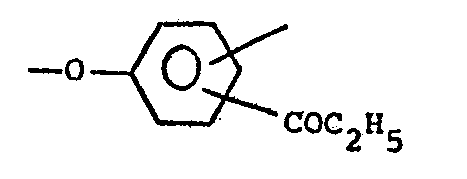
- Les films polymères de l'invention sont obtenus à partir de phénols répondant à la formule

- R représente un groupe acyle de 1 à 7 atoms de carbone, un groupe hydroxy, carboxy, alcoxycarbonyle, amino, alkylamino ou phénylamino, et
- n est un nombre entier, qui peut être nul dans le cas où R rest un groupe acyle.
- L'invention concerne plus particulièrement les films polymères obtenus à partir de monomères de formule (I) dans laquelle ―(CH2)n―R représente un groupe formyle, acétyle, propionyle, benzoyle, oxo-3 butyle, hydroxyméthyle, carboxyméthyle aminoéthyle ou anilinométhyle.
- Les polymères de l'invention comportent donc comme groupe fonctionnel réactif un groupe carbonyle, hydroxy, carboxy ou amino par motif.
- Selon l'invention les films polymères sont préparés par oxydation anodique des phénols monomères (I) dans un bain électrolytique alcoolique et fortement basique. Les polymères formés se déposent directement sur l'anode, le cas échéant un substrat conducteur - ou rendu conducteur - que l'on désire revêtir d'une mince couche de polymère.
- Les alcools utilisables pour le bain sont des alcools inférieurs, tels que le méthanol, éthanol, propanol ou isopropanol, ou un mélange d'alcool inférieur et de polyol tel que le glycol ou le glycérol.
- Les bases fortes peuvent être par exemple l'hydroxyde de sodium ou de potassium, ou bien l'amidure de sodium. Leur concentration peut être de 0,05 à 1 M, de préférence 0,1 à 0,3 M pour assurer le bon déroulement de l'électrolyse.
- Le phénol monomère est utilisé à des concentrations d'au moins 6 g/I d'électrolyte, de préférence de 12 à 25 g/I.
- Par ailleurs il est recommandé de prévoir environ 3 g de monomère par dm2 de substrat à revêtir.
- L'anode ou le substrat conducteur devant être recouvert par le polymère de l'invention peut être constitué par la plupart des métaux courants tels que le fer, l'argent, le nickel, le chrome, le cuivre, l'or, le platine, etc., ou leurs alliages.
- L'électrolyse est effectuée dans une cuve (par exemple en acier) de manière habituelle à température ambiante avec une tension de sortie initiale du générateur de l'ordre de 10 Volt et ne densité de courant initiale de 0,1 à 1 A/dm2. Le film polymère se forme rapidement sur la surface de l'anode (ou du substrat) et un recouvrement total, obtenu en général entre 5 à 30 minutes, peut être décelé lorsque le courant devient très faible.
- Après l'électrolyse, le substrat revêtu du film polymère est lavé à l'eau puis à l'alcool afin d'éliminer les traces résiduelles de base, de phénol monomère et des produits secondaires éventuels.
- Les films polymères obtenus selon l'invention sont homogènes, continus, uniformes. de faible épaisseur (300 à 3500 A selon le polymère) insolubles dans l'eau et les alcools, très adhérents et hydrophiles selon le groupe réactif qu'ils comportent.
- Les exemples suivants illustrent l'invention.
- On effecture l'électrolyse d'une solution de 0,62 g (0,1 M) d'alcool métahydroxybenzylique et 0,6 g d'hydroxyde de sodium (0,3 M) dans 50 cm3 d'alcool méthylique en utilisant comme anode du cuivre massif avant une surface de 12 cm2. On applique une différence de potentiel ΔV = 0,94 volt par rapport à une électrode de calomel saturé (ECS). La densité de courant est initialement i, = 2 mA/cm2 et tombe à if= 0,5 mA/cm2 au bout de t = 40 minutes.
- On obtient un film ayant une épaisseur de 2500 A mesuré avec un appareil interférentiel Tolansky monté sur un microscope métalloplan Leitz.
- De la même manière que dans l'exemple 1, on effectue l'électrolyse d'une solution de 0,76 g (0,1 M) d'acide salicylique et 0,6 g de NaOH dans 50 cm3 d'alcool méthylique, en utilisant comme anode un miroir de fer (fer évaporé sur une plaque de verre) et en appliquant une tension de ΔV = 0,85 V/ECS

-
- a) De la même manière que dans l'exemple 1, on effectue l'électrolyse d'une solution méthanolique (50 cm3) de 0,68 g de parahydroxyphényl-2 éthylamine (Tyramine) et de 0,6 g de NaOH en utilisant une anode en cuivre massif de 18 cm2. ΔV=0,5 V/ECS.Le film obtenu a 2500 A d'épaisseur.

- b) On a répété l'expérience ci-dessus en remplacant l'anode cuivre par un miroir de fer de 8,8 cm2. ΔV = 0,9 V/ECS.

-
- a) On a effectué l'électrolyse de la même manière que dans les exemples précédents mais en faisant varier la différence de potentiel ΔV de 0 à 1,3 V/ECS et en utilisant un miroir de fer de 9 cm2.Epaisseur du film: 3000 A

- b) On a répété l'expérience avec du fer massif (7 cm2) et tension constante.

-
- a) De la même manière que dans les exemples 1 à 3, on effectue l'électrolyse de 0,82 g (0,1 M) de p-hydroxyphényl-4 butanone-2 en utilisant une anode de fer massif de 5 cm2.épaisseur du film: 3 500 A.

- b) On utilise une anode d'acier de 10 cm2.

- c) On utilise une anode en titane massif de 16 cm2.

- Dans le tableau 1 suivant sont rassemblés, en plus des exemples précédents, divers phénols substitués qui ont été polymérisés selon l'invention. Toutes les polymérisations ont été suivies in situ par polaromicrotribométrie (PMT) qui permet de détecter les modifications physicochimiques sur la surface métallique (voir par exemple J. E. DUBOIS, P. C. LACAZE, R. COURTEL, C. C. HERMANN, D. MAUGIS, J. of Electrochem. Soc., 122, (1975) p 1454).


- Les films polymères ont été traités par des agents chimiques caractéristiques pour la vérification de la présence et de la réactivité des groupes chimiques fonctionnels. Les polymères comportant le groupe carbonyle ont été traités par une solution éthanolique de 1 % de dinitro-2,4 phényl-hydrazine (2,4 DNPH) et de 2 % HCI concentré; les électrodes étaient trempées pendant 5 minutes dans cette solution à l'ébullition puis lavées dans de l'éthanol par agitation ultrasonique. Les polymères comportant le groupe hydroxy ou amino ont été traités par du chlorure d'acétyle.
- Les films polymères de l'invention ainsi que les films traités par les agents chimiques ont été identifiés par spectroscopie IR à réflexions multiples et/ou par ESCA (Electron Spectroscopy for Chemical Analysis).
- Dans le tableau Il suivant sont indiqués les pics caractéristiques des groupes chimiques pour des polymères dont les spectres IR sont bien résolus, tandis que des résultats obtenus en ESCA seront donnés dans le tableau III pour les autres.
- Dans tous les spectres IR obtenus, la bande correspondant au groupe OH phénolique est complètement absente; par contre le pic caractérisant le groupe polyoxyde apparaît aux environs de 1200 cm-1. La présence de très intenses bandes d'absorption C=O, correspondant soit à la fonction aldéhyde (1700 cm-1) soit cétone (1680 cm-1) prouve que ces groupes restent inattaqués durant l'électrolyse.


- L'analyse ESCA des anodes confirme aussi la présence des polymères sur leur surface. Les spectres C1s mettent en évidence les groupes chimiques distincts par les valeurs des énergies de liaison caractéristiques. On obtient les mêmes résultats pour les dérivés ortho, méta ou para.

- Compte tenu de la présence d'un groupe chimique réactif sur toute la surface les films polymères de l'invention peuvent être utilisés pour le greffage de diverses matières réagissant sur ces fonctions.
- Ainsi il est possible de fixer des enzymes ou bien de faire réagir d'autres composés comportant des groupes réactifs, par exemple des chlorures ou anhydrides d'acides sur les films polymères portant un groupe hydroxy ou amine (ce qui permet d'obtenir une surface de poly-ester et respectivement polyamide). Cette propriété permet l'utilisation des films polymères de l'invention comme couches intermédiaires pour la fixation des résines, laques et peintures, notamment sur les métaux auxquels celles-ci adhèrent très mal.
Claims (15)




Applications Claiming Priority (2)
| Application Number | Priority Date | Filing Date | Title |
|---|---|---|---|
| FR777717851A FR2393835A1 (fr) | 1977-06-10 | 1977-06-10 | Films d'oxydes de polyphenylene comportant des groupes reactifs et leur preparation par voie electrochimique |
| FR7717851 | 1977-06-10 |
Publications (2)
| Publication Number | Publication Date |
|---|---|
| EP0000107A1 EP0000107A1 (fr) | 1978-12-20 |
| EP0000107B1 true EP0000107B1 (fr) | 1980-07-23 |
Family
ID=9191958
Family Applications (1)
| Application Number | Title | Priority Date | Filing Date |
|---|---|---|---|
| EP78400001A Expired EP0000107B1 (fr) | 1977-06-10 | 1978-06-01 | Objet métallique ou métallisé revêtu d'un film d'oxyde de polyphénylène comportant des groupes réactifs, sa préparation par voie électrochimique et son usage |
Country Status (5)
| Country | Link |
|---|---|
| US (1) | US4334054A (fr) |
| EP (1) | EP0000107B1 (fr) |
| DE (1) | DE2860042D1 (fr) |
| FR (1) | FR2393835A1 (fr) |
| IT (1) | IT1109599B (fr) |
Families Citing this family (9)
| Publication number | Priority date | Publication date | Assignee | Title |
|---|---|---|---|---|
| US4488943A (en) * | 1980-11-18 | 1984-12-18 | The United States Of America As Represented By The United States Department Of Energy | Polymer blends for use in photoelectrochemical cells for conversion of solar energy to electricity and methods for manufacturing such blends |
| US4563263A (en) * | 1982-01-15 | 1986-01-07 | Terumo Corporation | Selectively permeable film and ion sensor |
| US4444627A (en) * | 1982-02-25 | 1984-04-24 | Formosa Plastics Corporation | Prevention of polymer buildup in polymerization reactors using thin organic coatings by electrolysis of phenol |
| US4432840A (en) * | 1982-04-26 | 1984-02-21 | Formosa Plastics Corporation | Prevention of polymer buildup in polymerization reactors using thin organic coatings by electrolysis of phenol |
| US4820790A (en) * | 1987-03-13 | 1989-04-11 | Amoco Corporation | Chain-extended poly(aryl ether ketones) |
| DE3816458A1 (de) * | 1988-05-13 | 1989-12-21 | Josowicz Mira | Ultramikroelektrode, verfahren zu deren herstellung und ihre verwendung |
| DE4128569C1 (fr) * | 1991-08-28 | 1992-12-24 | Mira Dr.Rer.Nat. Josowicz | |
| GB2262524A (en) * | 1991-12-18 | 1993-06-23 | Sandoz Ltd | Pharmaceutically active 2-hydroxy-benzylamines |
| US5739864A (en) * | 1994-08-24 | 1998-04-14 | Macrovision Corporation | Apparatus for inserting blanked formatted fingerprint data (source ID, time/date) in to a video signal |
Family Cites Families (7)
| Publication number | Priority date | Publication date | Assignee | Title |
|---|---|---|---|---|
| US2961384A (en) * | 1956-12-27 | 1960-11-22 | American Marietta Co | Electrolytic polymerization of phenol |
| US3226361A (en) * | 1961-11-29 | 1965-12-28 | Gen Electric | Functional aromatic substituents in polyphenylene oxides |
| CH508000A (de) * | 1967-03-28 | 1971-05-31 | Sumitomo Chemical Co | Verfahren zur Herstellung von Polyphenylenoxydverbindungen |
| NL6810338A (fr) * | 1968-07-19 | 1970-01-21 | ||
| US3681285A (en) * | 1971-02-24 | 1972-08-01 | Basf Ag | Manufacture of colorless high molecular polyphenylene ethers |
| FR2270338A1 (en) * | 1974-05-10 | 1975-12-05 | Anvar | Electrolytic coating of conductive substrates - using electrolytic bath contg. 2,6-substd phenol dissolved in e.g. alcohol |
| US4129555A (en) * | 1977-03-23 | 1978-12-12 | General Electric Company | Poly-phenylene oxide process employing aminophenol reactants |
-
1977
- 1977-06-10 FR FR777717851A patent/FR2393835A1/fr active Granted
-
1978
- 1978-06-01 EP EP78400001A patent/EP0000107B1/fr not_active Expired
- 1978-06-01 DE DE7878400001T patent/DE2860042D1/de not_active Expired
- 1978-06-05 US US05/912,740 patent/US4334054A/en not_active Expired - Lifetime
- 1978-06-09 IT IT68346/78A patent/IT1109599B/it active
Also Published As
| Publication number | Publication date |
|---|---|
| FR2393835A1 (fr) | 1979-01-05 |
| DE2860042D1 (en) | 1980-11-13 |
| IT1109599B (it) | 1985-12-23 |
| EP0000107A1 (fr) | 1978-12-20 |
| US4334054A (en) | 1982-06-08 |
| FR2393835B1 (fr) | 1980-02-29 |
| IT7868346A0 (it) | 1978-06-09 |
Similar Documents
| Publication | Publication Date | Title |
|---|---|---|
| Miller et al. | Electrode surface modification via polymer adsorption | |
| EP0000107A1 (fr) | Objet métallique ou métallisé revêtu d'un film d'oxyde de polyphénylène comportant des groupes réactifs, sa préparation par voie électrochimique et son usage | |
| FR2699556A1 (fr) | Bains pour former un dépôt électrolytique de cuivre et procédé de dépôt électrolytique utilisant ce bain. | |
| Bersellini et al. | Development of latent fingerprints on metallic surfaces using electropolymerization processes | |
| Perrin et al. | Characterization and mechanism of direct film formation on a Cu electrode through electro-oxidation of 2-mercaptobenzimidazole | |
| Fleischmann et al. | A Raman spectroscopic investigation of the electropolymerization of phenol on silver electrodes | |
| RU2216559C2 (ru) | Полимеризуемые композиции для нанесения органического покрытия на металлические материалы | |
| US2961384A (en) | Electrolytic polymerization of phenol | |
| EP0188486B1 (fr) | Nouveau polymere fluore ionique, son procede de preparation et les membranes d'electrolyse formees a partir de ce polymere | |
| EP0659794B1 (fr) | Procédé et bain de dépÔt électrolytique de polypyrrole sur une surface de métal oxydable par électropolymérisation | |
| LU83242A1 (fr) | Polyfluorure de vinylidene traite en vue de son adherence sur metaux,procede de traitement | |
| Tsai et al. | Surface characterization of novel plasma‐polymerized primers for rubber‐to‐metal bonding | |
| FR2707673A1 (fr) | Procédé de métallisation de substrats non-conducteurs. | |
| FR2519031A1 (fr) | Bain de dorure et procede pour appliquer des depots d'or par galvanoplastie | |
| CN1226848A (zh) | 用于通过浸渍自动聚合来涂覆金属的组合物和方法 | |
| Desbene-Monvernay et al. | Polaromicrotribometric (PMT) study of the electrochemical formation of polymer films on metallic surfaces: Polyacrolein films | |
| FR2726289A1 (fr) | Procede d'electrodeposition d'un revetement de chrome comportant des inclusions solides et bain mis en oeuvre dans ce procede | |
| JP2001316872A (ja) | 導電性金属についての表面機能化の方法 | |
| FR2679240A1 (fr) | Procede d'obtention d'une couche mince de polymere d'aniline ou d'heterocycles aromatiques, sur un substrat metallique, par polymerisation et deposition par voie chimique. | |
| Shimura et al. | Improvement of the film thickness by modification of the hydroxymethylbenzene SAM with tetraethoxysilane and octanediol for protection of iron from corrosion in 0.5 M NaCl | |
| EP3192854B1 (fr) | Article dont la surface est traitee avec un agent de couplage a caractere oleophobe et/ou hydrophobe | |
| Prissanaroon et al. | Electropolymerization of DBSA‐doped polypyrrole films on PTFE via an electroless copper interlayer | |
| EP1937758A1 (fr) | Procédé de modification de surfaces de polymères, notamment d 'hydroxylation de surfaces de polymères, et produits tels qu' obtenus | |
| JPH02232356A (ja) | 装身具 | |
| FR2486876A1 (fr) | Procede de preparation des plaques de base pour impression |
Legal Events
| Date | Code | Title | Description |
|---|---|---|---|
| PUAI | Public reference made under article 153(3) epc to a published international application that has entered the european phase |
Free format text: ORIGINAL CODE: 0009012 |
|
| AK | Designated contracting states |
Kind code of ref document: A1 Designated state(s): BE CH DE FR GB NL SE |
|
| 17P | Request for examination filed | ||
| GRAA | (expected) grant |
Free format text: ORIGINAL CODE: 0009210 |
|
| DET | De: translation of patent claims | ||
| AK | Designated contracting states |
Kind code of ref document: B1 Designated state(s): BE CH DE FR GB NL SE |
|
| PG25 | Lapsed in a contracting state [announced via postgrant information from national office to epo] |
Ref country code: SE Effective date: 19800723 |
|
| REF | Corresponds to: |
Ref document number: 2860042 Country of ref document: DE Date of ref document: 19801113 |
|
| PGFP | Annual fee paid to national office [announced via postgrant information from national office to epo] |
Ref country code: FR Payment date: 19890518 Year of fee payment: 12 |
|
| PGFP | Annual fee paid to national office [announced via postgrant information from national office to epo] |
Ref country code: GB Payment date: 19890531 Year of fee payment: 12 Ref country code: BE Payment date: 19890531 Year of fee payment: 12 |
|
| PGFP | Annual fee paid to national office [announced via postgrant information from national office to epo] |
Ref country code: NL Payment date: 19890630 Year of fee payment: 12 Ref country code: DE Payment date: 19890630 Year of fee payment: 12 |
|
| PGFP | Annual fee paid to national office [announced via postgrant information from national office to epo] |
Ref country code: CH Payment date: 19890919 Year of fee payment: 12 |
|
| PG25 | Lapsed in a contracting state [announced via postgrant information from national office to epo] |
Ref country code: GB Effective date: 19900601 |
|
| PG25 | Lapsed in a contracting state [announced via postgrant information from national office to epo] |
Ref country code: CH Effective date: 19900630 Ref country code: BE Effective date: 19900630 |
|
| BERE | Be: lapsed |
Owner name: ANVAR AGENCE NATIONALE DE VALORISATION DE LA RECH Effective date: 19900630 |
|
| PG25 | Lapsed in a contracting state [announced via postgrant information from national office to epo] |
Ref country code: NL Effective date: 19910101 |
|
| GBPC | Gb: european patent ceased through non-payment of renewal fee | ||
| NLV4 | Nl: lapsed or anulled due to non-payment of the annual fee | ||
| PG25 | Lapsed in a contracting state [announced via postgrant information from national office to epo] |
Ref country code: FR Effective date: 19910228 |
|
| REG | Reference to a national code |
Ref country code: CH Ref legal event code: PL |
|
| PG25 | Lapsed in a contracting state [announced via postgrant information from national office to epo] |
Ref country code: DE Effective date: 19910301 |
|
| REG | Reference to a national code |
Ref country code: FR Ref legal event code: ST |
|
| PLBE | No opposition filed within time limit |
Free format text: ORIGINAL CODE: 0009261 |
|
| STAA | Information on the status of an ep patent application or granted ep patent |
Free format text: STATUS: NO OPPOSITION FILED WITHIN TIME LIMIT |