EP0000052B1 - Chlorination or chlorosulfonation of polyethylene in mixed solvent - Google Patents
Chlorination or chlorosulfonation of polyethylene in mixed solvent Download PDFInfo
- Publication number
- EP0000052B1 EP0000052B1 EP78100093A EP78100093A EP0000052B1 EP 0000052 B1 EP0000052 B1 EP 0000052B1 EP 78100093 A EP78100093 A EP 78100093A EP 78100093 A EP78100093 A EP 78100093A EP 0000052 B1 EP0000052 B1 EP 0000052B1
- Authority
- EP
- European Patent Office
- Prior art keywords
- polyethylene
- solvent
- pressure
- phase
- temperature
- Prior art date
- Legal status (The legal status is an assumption and is not a legal conclusion. Google has not performed a legal analysis and makes no representation as to the accuracy of the status listed.)
- Expired
Links
Images
Classifications
-
- C—CHEMISTRY; METALLURGY
- C08—ORGANIC MACROMOLECULAR COMPOUNDS; THEIR PREPARATION OR CHEMICAL WORKING-UP; COMPOSITIONS BASED THEREON
- C08F—MACROMOLECULAR COMPOUNDS OBTAINED BY REACTIONS ONLY INVOLVING CARBON-TO-CARBON UNSATURATED BONDS
- C08F8/00—Chemical modification by after-treatment
- C08F8/34—Introducing sulfur atoms or sulfur-containing groups
- C08F8/38—Sulfohalogenation
Definitions
- This invention relates to a process for chlorinating or chlorosulfonating polyethylene utilizing sulfuryl chloride and a particular solvent.
- Valuable products can be made by chlorinating or chlorosulfonating polyethylene. It is known that chlorosulfonated solid polymers of ethylene, which contain 25 percent to 40 percent chlorine and 0.4 to 3 percent sulfur, can be cured to form elastic products which have exceptional resistance to attack by oxygen, ozone and corrosive chemicals. Valuable products are also made by chlorinating polyethylene with sulfuryl chloride and crosslinking the polymer with peroxides or other free radical sources. Generally, the chlorosulfonated polymers are manufactured commercially by simultaneously chlorinating polyethylene to replace hydrogen by chlorine and reacting the chlorinated polyethylene with a mixture of chlorine and sulfur dioxide to introduce chlorosulfonic groups into the chlorinated polymer. These procedures are described in detail in U.S. Patents 2,586,363 and 3,296,222.
- the distribution of the chlorine atoms on the polyethylene has a most substantial effect on the elastomeric properties of the resulting chlorinated polyolefin.
- the effect of chlorinating is to convert the crystalline polyethylene to an amorphous chlorinated polyethylene, and the more even the distribution of the chlorine atoms on the polymer the more efficient the conversion from a crystalline to an amorphous polymer.
- the chlorination or chlorosulfonation of the polyethylene with sulfuryl chloride is conducted in a single phase in solution as described in U.S. Patent 3,299,014.
- the present invention is directed to an improvement in a continuous process for chlorinating or chlorosulfonating polyethylene by dissolving polyethylene in a solvent and reacting the resultant solution with sulfuryl chloride at a temperature and under sufficient pressure to maintain reactants, the resulting chlorinated or chlorosulfonated polyethylene and product gases in a single liquid phase, the improvement comprising using as the solvent a mixture of methylene chloride and trichlorofluoromethane in a weight ratio of 0.3-1.6, and reducing the pressure or increasing the temperature of the single liquid phase to form two liquid phases, one a polymer-rich phase and the other a solvent-rich phase, and separating the phases.
- polyethylene can be utilized in the process of this invention, such as linear, high density polyethylene or low density, branched- chain polyethylene.
- the polyethylene preferably, has a sufficiently high molecular weight, e.g., at least about 10,000 wt. avg. generally 80,000, to yield an elastomeric material having high tensile strength upon chlorination or chlorosulfonation.
- polyethylene is also intended to include polymers of ethylene containing minor amounts, i.e., up to 10 weight percent, of other ethylenically unsaturated monomers copolymerizable therewith, especially other lower alkenes such as propylene or butent-1, or other monomers such as acrylic or methacrylic acids.
- the polyethylene is melted and then dissolved at a temperature of from 90-125°C in a solvent mixture of methylene chloride- trichlorofluoromethane.
- concentration of polyethylene in the solution usually ranges from about 2-20 weight percent.
- the weight ratio of methylene chloride to trichlorofluoromethane in the solvent mixture is within a range of 0.3-1.6 preferably 0.7-1.2.
- the choice of a particular ratio depends on the desired degree of chlorination (% CI in the product) and the final reaction temperature and is made so that the reactor contents remain single phase but two phases are produced when the pressure is reduced or the temperature increased as the solution passes to a vessel for separation, e.g., a decanter.
- An increase in the ratio of methylene chloride to trichlorofluoromethane is usually required when the degree of chlorination or the reactor temperature are increased, although small changes in these variables can be compensated by increased reactor pressure.
- Sulfuryl chloride is used in both the chlorosulfonation and the chlorination of polyethylene.
- the process utilizes about the stoichiometric amount of chlorine in sulfuryl chloride so that the amount introduced corresponds to the desired amount of chlorination.
- 77-385 parts of sulfuryl chloride is added for each 100 parts by weight of polyethylene.
- the attachment of chlorine atoms along the polyethylene molecule in place of hydrogen atoms originally present takes place in both instances and thus effects chlorination.
- Chlorosulfonation occurs when there is attachment of a -S0 2 CI radical to the polyethylene molecule in significant amounts in addition to the substitution of chlorine atoms.
- Chlorosulfonated polyethylene usually contains from 0.1-4, preferably 0.7-1.5, weight percent sulfur and from 15-60, preferably 25-45, weight percent chlorine; however, higher or lower amounts can be present. Chlorinated polyethylene usually contains 25-50 weight percent chlorine.
- the reaction between polyethylene in solution in methylene chloride and trichlorofluoromethane and sulfuryl chloride takes place in an elongated reaction zone, generally, a tubular reactor.
- the solution of polyethylene, sulfuryl chloride and solvent mixture of methylene chloride and trichlorofluoromethane passes through the reactor under viscous laminar flow and is under pressure sufficient to maintain the reactants, the resultant chlorinated polyolefin, and product gases in a single phase in the solvent.
- Any pressure range that accomplishes this result is suitable and the upper value is limited only by apparatus restrictions.
- pressures of the order of from 4.5 MPa - 21 MPa, usually 7-17 MPa are used.
- the temperature at the beginning of the reactor is at least sufficient to dissolve the polyethylene, usually at least about 90°C, and as the reaction proceeds the temperature can increase up to the point where polymer degradation begins, usually not more than about 190°C. It is important to maintain the mixture in the tubular reactor in a single liquid phase so as to obtain an even distribution of the chlorine atoms on the polyethylene molecule. Such even distribution of the chlorine atoms on the polyethylene lessens the crystallinity of the chlorinated polyolefin, imparts elastomeric properties to the polyolefin, and improves durability of the product in many applications.
- the mixture flows through the tubular reactor with little or no mixing of more rapidly flowing portions of the mixture at or near the centre of the tube with the more slowly flowing portions at or near the wall of the tube.
- a conventional free radical initiator for chlorination or chlorosulfonation of the polyethylene is present during the reaction thus aiding in the production of active sites on the polyethylene molecule.
- free radical initiators are azobisisobutyronitrile, azodicyclohexenecarbo- nitrile, and 2,(2'-hydroxyethyiazo)-2,4-dimethy!- valeronitrile, organic peroxides such as lauroyl peroxide or ditertiarybutyl peroxide, and other free radical initiators such as described in U.S. Patent Nos. 2,503,252 and 2,640,048.
- Chlorosulfonation is enhanced when a conventional chlorosulfonation catalyst is present during the reaction with polyethylene.
- Suitable catalysts include tertiary amines, e.g., pyridine, quinoline, quinaldine, nicotine, piperidine, dimethylaniline, tributylamine, and others described in U.S. Patent No. 2,383,319, and sulfhydryl compounds such as 2-mercaptothiazoline and ally thiourea, and amides such as dimethyl formamide or acetamide.
- the single-phase liquid mixture of chlorinated polyolefin and solvent flows from the reactor to a phase decanter for separation of the chlorinated or chlorosulfonated polyethylene from the solvent. Separation of the chlorinated or chlorosulfonated polyethylene and solvent is accomplished by reducing the pressure or increasing the temperature on the single phase material until two phases separate. One phase, the upper lighter material, is the solvent-rich phase, whereas the lower phase heavier material is the polymer-rich phase. Phase separation occurs when the pressure is reduced generally, from 3-15 MPa, below the reactor pressure. There is no need to regulate the temperature of the material and it remains about the same during phase separation as it was leaving the reactor, i.e. 130-180°C, usually 140-170°C.
- the particular solvent mixture used in the process allows phase decantation, provides low solution viscosities, high volatility and high diffusion rates, all of which are essential to an economical process for making chlorinated polyethylene.
- the polymer-rich phase is readily separated from the solvent rich phase in the settling chamber of the decanter by the action of gravity.
- the solvent-rich phase is removed overhead and can be recirculated after byproduct gases are removed.
- the polymer-rich phase flows to a devolatizing extruder maintained at subatmospheric pressure for further removal of traces of solvent.
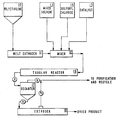
- Solid polyethylene in particulate form is supplied from hopper 10 to melt extrude 11 where the polyethylene is pumped and heated to a temperature, usually from 100-180°C, to form a molten mass.
- the resultant liquid polyethylene then flows to mixer 12.
- a solvent mixture of methylene chloride and trichlorofluoromethane in a weight ratio of 0.3-1.6 is introduced from solvent supply vessel 13 to mixer 12.
- sulfuryl chloride is introduced from supply vessel 14 to mixer 12.
- a free radical initiator, and if the polyethylene is to be chlorosulfonated, a conventional chlorosulfonating catalyst, e.g., a tertiary amine, are introduced from storage vessel 15 to mixer 12.
- All the ingredients are intimately mixed in mixer 12 to dissolve the polyethylene and the reactants in the solvent, and form a solution which has a temperature of 90-125°C. Adequate mixing is accomplished in about 1 to 10 seconds at which time the ingredients are passed to tubular reactor 16 and, due to the fact that the chlorination or chlorosulfonation reaction is exothermic, exits from tubular reactor 16 at a temperature of 140-180°C. Pressure and temperature are maintained in tubular reactor 16 to keep the reaction mixture in a single phase.
- reactants such as catalysts, free radical initiator, and product gases
- Pressures of at least 4.5 MPa are generally used; the maximum amount of pressure that can be employed is limited only by apparatus restrictions. Usually, from a practical standpoint, the maximum pressure is not greater than 21 MPa. It is important to the successful operation of this invention that the reaction in which the chlorinated polyolefin is made is conducted in a single liquid phase. This is necessary in order to obtain a homogeneous product that exhibits improved durability in use as well as elastomeric properties which are due primarily to evenness of distribution of the chlorine atoms in the polyethylene molecule.
- the single phase reaction mixture that contains, primarily, chlorinated polyolefin and solvent is passed through a pressure regulator to phase decanter 17 where formation and separation of the solvent-rich phase from the polymer-rich phase takes place as a result of the reduction in pressure.
- phase decanter 17 where formation and separation of the solvent-rich phase from the polymer-rich phase takes place as a result of the reduction in pressure.
- pressure reductions of from 3-15 MPa below the reactor pressure or, alternatively, an increase in the temperature of the single liquid phase by at least 10-20°C above the reactor temperature.
- phase decanter 17 The polymer-rich phase from phase decanter 17 is drawn off by gravity flow and passed to devolatilizing extruder 18 where the remaining solvents, HCI and S0 2 , are removed at subatmospheric pressures and the dried chlorinated polyolefin product is recovered.
- Solvent and S0 2 from the phase decanter and devolatilizing extruder can be recovered by distillation, as described, for example, in Kalil, U.S. Patent 3,299,014, and re-used in the process.
- a solution of polyethylene in a mixed solvent is prepared by continuously mixing 30 g/min. molten polyethylene at a temperature of 160°C with a mixture of 200 g/min. of trichlorofluoromethane solvent and 105 g/min. of methylene chloride solvent. To this solution is added 66 g/min. of a solution of 0.5 g azobisisobutyronitrile and 1 cm 3 of pyridine per liter of methylene chloride and subsequently 64 g/min. of sulfuryl chloride.
- Pressure in the reactor is maintained at 7.5 MPa by a control valve at the exit; thus the reactants, chlorinated polyethylene and product gases are a single liquid phase.
- the solution coming from the reactor is conducted to a decanter which is a pressure vessel maintained at at a pressure of about 2.8 MPa and a temperature of 148°C where it separates into a solvent-rich phase containing less than 2 wt. % polymer and polymer-rich phase containing about 35 wt. % polymer.
- the polymer-rich phase is separated by gravity flow and is passed into a devolatilizing extruder where the remaining product gases are removed. Chlorosulfonated polyethylene containing 34 wt. % CI and 1 wt. % sulfur is recovered at a rate of 46 g/min.
- Example II To produce a chlorinated polyethylene with a minimum number of sulfuryl chloride side groups, the procedure described above in Example I is repeated except that the pyridine is omitted. Infrared analysis of the chlorinated polyethylene indicates that the polymer contains 34 wt. % CI and less than .02 wt. % sulfur.
- Example II The procedure described in Example I is repeated except that the temperature of the material entering the chlorosulfonation reactor is adjusted to 120°C; the heat of reaction increases the temperature of the solution to about 163°C. 15 MPa pressure in the reactor is required to maintain a single liquid phase in the reactor. Phase separation is achieved by reducing the pressure to 3 MPa in the decanter. The temperature remains at about 160°C and a solvent-rich phase is removed overhead. The heavier polymer-rich phase is drawn off the bottom of the separator.
Landscapes
- Chemical & Material Sciences (AREA)
- General Chemical & Material Sciences (AREA)
- Health & Medical Sciences (AREA)
- Chemical Kinetics & Catalysis (AREA)
- Medicinal Chemistry (AREA)
- Polymers & Plastics (AREA)
- Organic Chemistry (AREA)
- Addition Polymer Or Copolymer, Post-Treatments, Or Chemical Modifications (AREA)
Description
- This invention relates to a process for chlorinating or chlorosulfonating polyethylene utilizing sulfuryl chloride and a particular solvent.
- Valuable products can be made by chlorinating or chlorosulfonating polyethylene. It is known that chlorosulfonated solid polymers of ethylene, which contain 25 percent to 40 percent chlorine and 0.4 to 3 percent sulfur, can be cured to form elastic products which have exceptional resistance to attack by oxygen, ozone and corrosive chemicals. Valuable products are also made by chlorinating polyethylene with sulfuryl chloride and crosslinking the polymer with peroxides or other free radical sources. Generally, the chlorosulfonated polymers are manufactured commercially by simultaneously chlorinating polyethylene to replace hydrogen by chlorine and reacting the chlorinated polyethylene with a mixture of chlorine and sulfur dioxide to introduce chlorosulfonic groups into the chlorinated polymer. These procedures are described in detail in U.S. Patents 2,586,363 and 3,296,222.
- When polyethylene is chlorinated or chlorosulfonated to produce the resulting elastomeric polyolefin the distribution of the chlorine atoms on the polyethylene has a most substantial effect on the elastomeric properties of the resulting chlorinated polyolefin. The effect of chlorinating is to convert the crystalline polyethylene to an amorphous chlorinated polyethylene, and the more even the distribution of the chlorine atoms on the polymer the more efficient the conversion from a crystalline to an amorphous polymer. In order to obtain evenness of distribution of chlorine on polyethylene, the chlorination or chlorosulfonation of the polyethylene with sulfuryl chloride is conducted in a single phase in solution as described in U.S. Patent 3,299,014. However, when such procedure is used a problem arises because it is difficult and expensive to remove the solvent from the chlorinated polyolefin. Solvents suitable for use in commercial processes to dissolve both polyethylene and chlorinated products are not volatile enough to be vaporized by the heat of reaction. Accordingly, it has been necessary to heat the mixture of solvent and chlorinated product to remove solvent from the polymer. The separation procedure is slow and expensive. When more volatile solvents are used the chlorinated polyethylene forms a separate phase in the reactor before chlorination is complete, thus leading to uneven distribution of chlorine atoms on the polyethylene. There has been a need for a procedure for making chlorinated polyethylene with sulfuryl chloride by which one can obtain not only an even Gistribution of chlorine atoms on the polyethylene but also a process in which the chlorinated polyethylene can be easily and readily separated from solvent. The present invention provides such a continuous process for making chlorinated or chlorosulfonated polyethylene.
- The present invention is directed to an improvement in a continuous process for chlorinating or chlorosulfonating polyethylene by dissolving polyethylene in a solvent and reacting the resultant solution with sulfuryl chloride at a temperature and under sufficient pressure to maintain reactants, the resulting chlorinated or chlorosulfonated polyethylene and product gases in a single liquid phase, the improvement comprising using as the solvent a mixture of methylene chloride and trichlorofluoromethane in a weight ratio of 0.3-1.6, and reducing the pressure or increasing the temperature of the single liquid phase to form two liquid phases, one a polymer-rich phase and the other a solvent-rich phase, and separating the phases.
- Any polyethylene can be utilized in the process of this invention, such as linear, high density polyethylene or low density, branched- chain polyethylene. The polyethylene, preferably, has a sufficiently high molecular weight, e.g., at least about 10,000 wt. avg. generally 80,000, to yield an elastomeric material having high tensile strength upon chlorination or chlorosulfonation. The term "polyethylene" is also intended to include polymers of ethylene containing minor amounts, i.e., up to 10 weight percent, of other ethylenically unsaturated monomers copolymerizable therewith, especially other lower alkenes such as propylene or butent-1, or other monomers such as acrylic or methacrylic acids.
- The polyethylene is melted and then dissolved at a temperature of from 90-125°C in a solvent mixture of methylene chloride- trichlorofluoromethane. The concentration of polyethylene in the solution usually ranges from about 2-20 weight percent. The weight ratio of methylene chloride to trichlorofluoromethane in the solvent mixture is within a range of 0.3-1.6 preferably 0.7-1.2. The choice of a particular ratio depends on the desired degree of chlorination (% CI in the product) and the final reaction temperature and is made so that the reactor contents remain single phase but two phases are produced when the pressure is reduced or the temperature increased as the solution passes to a vessel for separation, e.g., a decanter. An increase in the ratio of methylene chloride to trichlorofluoromethane is usually required when the degree of chlorination or the reactor temperature are increased, although small changes in these variables can be compensated by increased reactor pressure.
- Sulfuryl chloride is used in both the chlorosulfonation and the chlorination of polyethylene. The process utilizes about the stoichiometric amount of chlorine in sulfuryl chloride so that the amount introduced corresponds to the desired amount of chlorination. Generally, 77-385 parts of sulfuryl chloride is added for each 100 parts by weight of polyethylene. The attachment of chlorine atoms along the polyethylene molecule in place of hydrogen atoms originally present takes place in both instances and thus effects chlorination. Chlorosulfonation occurs when there is attachment of a -S02CI radical to the polyethylene molecule in significant amounts in addition to the substitution of chlorine atoms. Chlorosulfonated polyethylene usually contains from 0.1-4, preferably 0.7-1.5, weight percent sulfur and from 15-60, preferably 25-45, weight percent chlorine; however, higher or lower amounts can be present. Chlorinated polyethylene usually contains 25-50 weight percent chlorine.
- The reaction between polyethylene in solution in methylene chloride and trichlorofluoromethane and sulfuryl chloride takes place in an elongated reaction zone, generally, a tubular reactor. The solution of polyethylene, sulfuryl chloride and solvent mixture of methylene chloride and trichlorofluoromethane passes through the reactor under viscous laminar flow and is under pressure sufficient to maintain the reactants, the resultant chlorinated polyolefin, and product gases in a single phase in the solvent. Any pressure range that accomplishes this result is suitable and the upper value is limited only by apparatus restrictions. Generally, pressures of the order of from 4.5 MPa - 21 MPa, usually 7-17 MPa, are used. The temperature at the beginning of the reactor is at least sufficient to dissolve the polyethylene, usually at least about 90°C, and as the reaction proceeds the temperature can increase up to the point where polymer degradation begins, usually not more than about 190°C. It is important to maintain the mixture in the tubular reactor in a single liquid phase so as to obtain an even distribution of the chlorine atoms on the polyethylene molecule. Such even distribution of the chlorine atoms on the polyethylene lessens the crystallinity of the chlorinated polyolefin, imparts elastomeric properties to the polyolefin, and improves durability of the product in many applications. The mixture flows through the tubular reactor with little or no mixing of more rapidly flowing portions of the mixture at or near the centre of the tube with the more slowly flowing portions at or near the wall of the tube.
- Optionally, and preferably, a conventional free radical initiator for chlorination or chlorosulfonation of the polyethylene is present during the reaction thus aiding in the production of active sites on the polyethylene molecule. Typical of such free radical initiators are azobisisobutyronitrile, azodicyclohexenecarbo- nitrile, and 2,(2'-hydroxyethyiazo)-2,4-dimethy!- valeronitrile, organic peroxides such as lauroyl peroxide or ditertiarybutyl peroxide, and other free radical initiators such as described in U.S. Patent Nos. 2,503,252 and 2,640,048.
- Chlorosulfonation is enhanced when a conventional chlorosulfonation catalyst is present during the reaction with polyethylene. Suitable catalysts include tertiary amines, e.g., pyridine, quinoline, quinaldine, nicotine, piperidine, dimethylaniline, tributylamine, and others described in U.S. Patent No. 2,383,319, and sulfhydryl compounds such as 2-mercaptothiazoline and ally thiourea, and amides such as dimethyl formamide or acetamide.
- The single-phase liquid mixture of chlorinated polyolefin and solvent flows from the reactor to a phase decanter for separation of the chlorinated or chlorosulfonated polyethylene from the solvent. Separation of the chlorinated or chlorosulfonated polyethylene and solvent is accomplished by reducing the pressure or increasing the temperature on the single phase material until two phases separate. One phase, the upper lighter material, is the solvent-rich phase, whereas the lower phase heavier material is the polymer-rich phase. Phase separation occurs when the pressure is reduced generally, from 3-15 MPa, below the reactor pressure. There is no need to regulate the temperature of the material and it remains about the same during phase separation as it was leaving the reactor, i.e. 130-180°C, usually 140-170°C. Alternatively, one obtains two liquid phases if the temperature of the single liquid phase solution is increased. For example, if the temperature of the solution leaving the reactor is increased at least 10-20°C in the decanter, two separate liquid phases form and can be separated. The upper temperature value is limited only by the decomposition temperature of the product. Since this procedure requires energy input, it is less desirable. In any event, by regulating pressure or temperature in the decanter one can achieve phase separation and the formation of a polymer-rich phase and a solvent-rich phase. The particular solvent mixture used in the process allows phase decantation, provides low solution viscosities, high volatility and high diffusion rates, all of which are essential to an economical process for making chlorinated polyethylene.
- The polymer-rich phase is readily separated from the solvent rich phase in the settling chamber of the decanter by the action of gravity. The solvent-rich phase is removed overhead and can be recirculated after byproduct gases are removed. The polymer-rich phase flows to a devolatizing extruder maintained at subatmospheric pressure for further removal of traces of solvent.
- The invention may be more clearly understood by reference to the accompanying drawing, which illustrates diagrammatically equipment adapted for carrying out this invention.
- Solid polyethylene in particulate form is supplied from
hopper 10 to melt extrude 11 where the polyethylene is pumped and heated to a temperature, usually from 100-180°C, to form a molten mass. The resultant liquid polyethylene then flows tomixer 12. Simultaneously, a solvent mixture of methylene chloride and trichlorofluoromethane in a weight ratio of 0.3-1.6 is introduced fromsolvent supply vessel 13 tomixer 12. At the same time sulfuryl chloride is introduced fromsupply vessel 14 tomixer 12. A free radical initiator, and if the polyethylene is to be chlorosulfonated, a conventional chlorosulfonating catalyst, e.g., a tertiary amine, are introduced fromstorage vessel 15 tomixer 12. All the ingredients are intimately mixed inmixer 12 to dissolve the polyethylene and the reactants in the solvent, and form a solution which has a temperature of 90-125°C. Adequate mixing is accomplished in about 1 to 10 seconds at which time the ingredients are passed totubular reactor 16 and, due to the fact that the chlorination or chlorosulfonation reaction is exothermic, exits fromtubular reactor 16 at a temperature of 140-180°C. Pressure and temperature are maintained intubular reactor 16 to keep the reaction mixture in a single phase. Thus, polyethylene and resulting chlorinated polyolefin together with other reactants, such as catalysts, free radical initiator, and product gases, remain dissolved in the solvent. Pressures of at least 4.5 MPa are generally used; the maximum amount of pressure that can be employed is limited only by apparatus restrictions. Usually, from a practical standpoint, the maximum pressure is not greater than 21 MPa. It is important to the successful operation of this invention that the reaction in which the chlorinated polyolefin is made is conducted in a single liquid phase. This is necessary in order to obtain a homogeneous product that exhibits improved durability in use as well as elastomeric properties which are due primarily to evenness of distribution of the chlorine atoms in the polyethylene molecule. - The single phase reaction mixture that contains, primarily, chlorinated polyolefin and solvent is passed through a pressure regulator to phase
decanter 17 where formation and separation of the solvent-rich phase from the polymer-rich phase takes place as a result of the reduction in pressure. Generally, such conditions require pressure reductions of from 3-15 MPa below the reactor pressure or, alternatively, an increase in the temperature of the single liquid phase by at least 10-20°C above the reactor temperature. - The polymer-rich phase from
phase decanter 17 is drawn off by gravity flow and passed todevolatilizing extruder 18 where the remaining solvents, HCI and S02, are removed at subatmospheric pressures and the dried chlorinated polyolefin product is recovered. - Solvent and S02 from the phase decanter and devolatilizing extruder can be recovered by distillation, as described, for example, in Kalil, U.S. Patent 3,299,014, and re-used in the process.
- The following examples are presented as illustrative of the process of the invention.
- A solution of polyethylene in a mixed solvent is prepared by continuously mixing 30 g/min. molten polyethylene at a temperature of 160°C with a mixture of 200 g/min. of trichlorofluoromethane solvent and 105 g/min. of methylene chloride solvent. To this solution is added 66 g/min. of a solution of 0.5 g azobisisobutyronitrile and 1 cm3 of pyridine per liter of methylene chloride and subsequently 64 g/min. of sulfuryl chloride. The resulting solution, containing 0.85 g of methylene chloride per gram of trichlorofluoromethane at a temperature of about 105°C, is fed to the bottom of a 5 cm diameter x 120 cm long cylindrical reactor (vol. = 2400 cm3) where during the average residence time of 6 min. the chlorosulfonation reaction takes place and the heat of reaction raises the temperature of the solution to about 150°C. Pressure in the reactor is maintained at 7.5 MPa by a control valve at the exit; thus the reactants, chlorinated polyethylene and product gases are a single liquid phase. The solution coming from the reactor is conducted to a decanter which is a pressure vessel maintained at at a pressure of about 2.8 MPa and a temperature of 148°C where it separates into a solvent-rich phase containing less than 2 wt. % polymer and polymer-rich phase containing about 35 wt. % polymer. The containing about 35 wt. % polymer. The polymer-rich phase is separated by gravity flow and is passed into a devolatilizing extruder where the remaining product gases are removed. Chlorosulfonated polyethylene containing 34 wt. % CI and 1 wt. % sulfur is recovered at a rate of 46 g/min.
- To produce a chlorinated polyethylene with a minimum number of sulfuryl chloride side groups, the procedure described above in Example I is repeated except that the pyridine is omitted. Infrared analysis of the chlorinated polyethylene indicates that the polymer contains 34 wt. % CI and less than .02 wt. % sulfur.
- The procedure described in Example I is repeated except that the temperature of the material entering the chlorosulfonation reactor is adjusted to 120°C; the heat of reaction increases the temperature of the solution to about 163°C. 15 MPa pressure in the reactor is required to maintain a single liquid phase in the reactor. Phase separation is achieved by reducing the pressure to 3 MPa in the decanter. The temperature remains at about 160°C and a solvent-rich phase is removed overhead. The heavier polymer-rich phase is drawn off the bottom of the separator.
Claims (11)
Applications Claiming Priority (2)
| Application Number | Priority Date | Filing Date | Title |
|---|---|---|---|
| US05/805,151 US4145491A (en) | 1977-06-09 | 1977-06-09 | Chlorination or chlorosulfonation of polyethylene in mixed solvent |
| US805151 | 1977-06-09 |
Publications (2)
| Publication Number | Publication Date |
|---|---|
| EP0000052A1 EP0000052A1 (en) | 1978-12-20 |
| EP0000052B1 true EP0000052B1 (en) | 1980-10-15 |
Family
ID=25190800
Family Applications (1)
| Application Number | Title | Priority Date | Filing Date |
|---|---|---|---|
| EP78100093A Expired EP0000052B1 (en) | 1977-06-09 | 1978-06-06 | Chlorination or chlorosulfonation of polyethylene in mixed solvent |
Country Status (8)
| Country | Link |
|---|---|
| US (1) | US4145491A (en) |
| EP (1) | EP0000052B1 (en) |
| JP (1) | JPS6056166B2 (en) |
| CA (1) | CA1105195A (en) |
| DE (1) | DE2860215D1 (en) |
| DK (1) | DK254278A (en) |
| IE (1) | IE46930B1 (en) |
| IT (1) | IT1098317B (en) |
Families Citing this family (11)
| Publication number | Priority date | Publication date | Assignee | Title |
|---|---|---|---|---|
| JPS5670929A (en) * | 1979-11-13 | 1981-06-13 | Kitai Seisakusho:Kk | Molding of long-sized product having fancy film along convexes and concaves on surface thereof |
| JPS57123201A (en) * | 1981-01-23 | 1982-07-31 | Denki Kagaku Kogyo Kk | Production of chlorosulfonated polyethylene polymer |
| JPS5918708A (en) * | 1982-07-21 | 1984-01-31 | Toyo Soda Mfg Co Ltd | Manufacture of chlorosulfonated polyethylene with high freeze resistance |
| JPS5933303A (en) * | 1982-08-18 | 1984-02-23 | Toyo Soda Mfg Co Ltd | Control of amount of added sulfur in chloro-sulfonated polyethylene |
| US4560731A (en) * | 1983-07-15 | 1985-12-24 | Union Carbide Corporation | Preparation of elastomeric, chlorosulfonated ethylene polymers |
| US4685873A (en) * | 1984-11-21 | 1987-08-11 | Owens-Corning Fiberglas Corporation | Process for the continuous production of pipe from particulate materials |
| US4945133A (en) * | 1987-09-28 | 1990-07-31 | The Dow Chemical Company | Oxidation of halogenated polymers and anticaking halogenated polymers |
| US4923931A (en) * | 1987-09-28 | 1990-05-08 | The Dow Chemical Company | Oxidation of halogenated polymers |
| DE10113010A1 (en) * | 2001-03-17 | 2002-09-19 | Bosch Gmbh Robert | Method and device for monitoring an exhaust gas aftertreatment system |
| US20090247719A1 (en) * | 2008-03-31 | 2009-10-01 | Dupont Performance Elastomers L.L.C. | Process for chlorosulfonating polyolefins |
| CA2984245C (en) * | 2015-04-30 | 2019-12-31 | Exxonmobil Chemical Patents Inc. | System and process for halogenating olefinic-derived elastomers in the bulk phase |
Family Cites Families (9)
| Publication number | Priority date | Publication date | Assignee | Title |
|---|---|---|---|---|
| IT566027A (en) * | 1955-07-28 | |||
| US2964509A (en) * | 1956-10-16 | 1960-12-13 | Du Pont | Process for chlorination of olefine polymers |
| US3296222A (en) * | 1963-12-27 | 1967-01-03 | Du Pont | Process for continuously chlorosulfonating polyethylene at higher temperatures |
| US3314925A (en) * | 1963-12-27 | 1967-04-18 | Du Pont | Process for chlorosulfonating solid polyethylene |
| US3299014A (en) * | 1964-08-19 | 1967-01-17 | Du Pont | Process for chlorosulfonating olefinic hydrocarbon polymers using sulfuryl chloride |
| US3347835A (en) * | 1964-11-20 | 1967-10-17 | Du Pont | Process for the chlorosulfonation of polyethylene |
| US3252921A (en) * | 1965-03-18 | 1966-05-24 | Dow Chemical Co | High stability partially sulfonated cation exchange resins |
| US3542747A (en) * | 1968-05-07 | 1970-11-24 | Du Pont | Continuous process for the chlorosulfonation and chlorination of polyethylene |
| US3960821A (en) * | 1974-12-13 | 1976-06-01 | Basf Wyandotte Corporation | Chloronitrosylated, chlorosulfonated hydrocarbon polymers and a process for the preparation thereof |
-
1977
- 1977-06-09 US US05/805,151 patent/US4145491A/en not_active Expired - Lifetime
-
1978
- 1978-06-06 EP EP78100093A patent/EP0000052B1/en not_active Expired
- 1978-06-06 DE DE7878100093T patent/DE2860215D1/en not_active Expired
- 1978-06-07 IE IE1159/78A patent/IE46930B1/en unknown
- 1978-06-07 JP JP53067874A patent/JPS6056166B2/en not_active Expired
- 1978-06-07 CA CA304,922A patent/CA1105195A/en not_active Expired
- 1978-06-08 DK DK254278A patent/DK254278A/en not_active Application Discontinuation
- 1978-06-08 IT IT24359/78A patent/IT1098317B/en active
Also Published As
| Publication number | Publication date |
|---|---|
| IE781159L (en) | 1978-12-09 |
| IT1098317B (en) | 1985-09-07 |
| DK254278A (en) | 1978-12-10 |
| DE2860215D1 (en) | 1981-01-22 |
| IE46930B1 (en) | 1983-11-02 |
| JPS543896A (en) | 1979-01-12 |
| JPS6056166B2 (en) | 1985-12-09 |
| CA1105195A (en) | 1981-07-14 |
| IT7824359A0 (en) | 1978-06-08 |
| EP0000052A1 (en) | 1978-12-20 |
| US4145491A (en) | 1979-03-20 |
Similar Documents
| Publication | Publication Date | Title |
|---|---|---|
| US4145491A (en) | Chlorination or chlorosulfonation of polyethylene in mixed solvent | |
| EP0057687B1 (en) | Process for chlorination of poly(vinyl chloride) with liquid chlorine, and chlorinated poly(vinyl chloride) composition | |
| US3296222A (en) | Process for continuously chlorosulfonating polyethylene at higher temperatures | |
| JPS5871928A (en) | Thermoplastic non-bridgeable anhydrous polymer and imide polymer and manufacture | |
| DE69207902T2 (en) | GRAFT POLYMERS MADE OF ISOMONOOLEFIN AND ALKYLSTYROL | |
| US3364187A (en) | Halogenation of olefin/unsaturated carboxylic acid and derivatives thereof by kneading | |
| US2920064A (en) | Process for halogenation of polymers | |
| DE1520310B2 (en) | Process for the production of a graft polymer composition | |
| US3347835A (en) | Process for the chlorosulfonation of polyethylene | |
| NO144571B (en) | PROCEDURE FOR MELTING A PARTICULAR, SOLID POLYMER | |
| JPH10182727A (en) | Method for producing methyl methacrylate polymer | |
| USH1582H (en) | Process for preparation of chlorinated and chlorosulfonated olefin polymers having low levels of residual monofluorobenzene reaction solvent and its chlorinated by-products | |
| US3542747A (en) | Continuous process for the chlorosulfonation and chlorination of polyethylene | |
| US4386189A (en) | Process for the post-chlorination of vinyl chloride polymers | |
| EP0806438A2 (en) | Process for the preparation of copolymers of ethylene and polar comonomers | |
| US3585117A (en) | Chlorination of homopolymers or copolymers of vinyl chloride and/or ethylene in suspension in the presence of dimethylsulfoxide | |
| US3287336A (en) | Process for chlorinating vinyl chloride polymers with an oxygen catalyst | |
| JP2600165B2 (en) | Preparation of chlorinated and chlorosulfonated polyolefins | |
| EP0066389A2 (en) | Thermal stabilization of acrylonitrile copolymer fibers | |
| US4277579A (en) | Increasing the molecular weight of a chlorinated polymer of ethylene by treatment with a sulfur compound either before or during chlorination of said polymer | |
| US5214107A (en) | Chlorination of olefin polymers in chlorofluorobenzene | |
| JPS63172702A (en) | Method of chlorination or chlorination and chlorosulfonation | |
| US3435019A (en) | Deactivating residual polymerization catalyst in polypropylene | |
| NO743936L (en) | ||
| ATE37379T1 (en) | PROCESS FOR THE PRODUCTION OF ETHYLENE POLYMERS AT PRESSURES ABOVE 500 BAR IN A ONE-ZONE TUBE REACTOR. |
Legal Events
| Date | Code | Title | Description |
|---|---|---|---|
| PUAI | Public reference made under article 153(3) epc to a published international application that has entered the european phase |
Free format text: ORIGINAL CODE: 0009012 |
|
| AK | Designated contracting states |
Kind code of ref document: A1 Designated state(s): BE DE FR GB LU NL |
|
| 17P | Request for examination filed | ||
| GRAA | (expected) grant |
Free format text: ORIGINAL CODE: 0009210 |
|
| AK | Designated contracting states |
Kind code of ref document: B1 Designated state(s): BE DE FR GB LU NL |
|
| REF | Corresponds to: |
Ref document number: 2860215 Country of ref document: DE Date of ref document: 19810122 |
|
| PG25 | Lapsed in a contracting state [announced via postgrant information from national office to epo] |
Ref country code: LU Free format text: LAPSE BECAUSE OF NON-PAYMENT OF DUE FEES Effective date: 19810630 |
|
| PGFP | Annual fee paid to national office [announced via postgrant information from national office to epo] |
Ref country code: FR Payment date: 19890220 Year of fee payment: 12 |
|
| PGFP | Annual fee paid to national office [announced via postgrant information from national office to epo] |
Ref country code: BE Payment date: 19890306 Year of fee payment: 12 |
|
| PGFP | Annual fee paid to national office [announced via postgrant information from national office to epo] |
Ref country code: DE Payment date: 19890310 Year of fee payment: 12 |
|
| PGFP | Annual fee paid to national office [announced via postgrant information from national office to epo] |
Ref country code: LU Payment date: 19890315 Year of fee payment: 12 |
|
| PGFP | Annual fee paid to national office [announced via postgrant information from national office to epo] |
Ref country code: GB Payment date: 19890331 Year of fee payment: 12 |
|
| PGFP | Annual fee paid to national office [announced via postgrant information from national office to epo] |
Ref country code: NL Payment date: 19890630 Year of fee payment: 12 |
|
| PG25 | Lapsed in a contracting state [announced via postgrant information from national office to epo] |
Ref country code: GB Effective date: 19900606 |
|
| PG25 | Lapsed in a contracting state [announced via postgrant information from national office to epo] |
Ref country code: BE Effective date: 19900630 |
|
| BERE | Be: lapsed |
Owner name: E.I. DU PONT DE NEMOURS AND CY Effective date: 19900630 |
|
| PG25 | Lapsed in a contracting state [announced via postgrant information from national office to epo] |
Ref country code: NL Effective date: 19910101 |
|
| GBPC | Gb: european patent ceased through non-payment of renewal fee | ||
| NLV4 | Nl: lapsed or anulled due to non-payment of the annual fee | ||
| PG25 | Lapsed in a contracting state [announced via postgrant information from national office to epo] |
Ref country code: FR Effective date: 19910228 |
|
| PG25 | Lapsed in a contracting state [announced via postgrant information from national office to epo] |
Ref country code: DE Effective date: 19910301 |
|
| REG | Reference to a national code |
Ref country code: FR Ref legal event code: ST |
|
| PLBE | No opposition filed within time limit |
Free format text: ORIGINAL CODE: 0009261 |
|
| STAA | Information on the status of an ep patent application or granted ep patent |
Free format text: STATUS: NO OPPOSITION FILED WITHIN TIME LIMIT |