EP0000036B1 - Fluorinated alkylamines and process for preparing same - Google Patents
Fluorinated alkylamines and process for preparing same Download PDFInfo
- Publication number
- EP0000036B1 EP0000036B1 EP78100059A EP78100059A EP0000036B1 EP 0000036 B1 EP0000036 B1 EP 0000036B1 EP 78100059 A EP78100059 A EP 78100059A EP 78100059 A EP78100059 A EP 78100059A EP 0000036 B1 EP0000036 B1 EP 0000036B1
- Authority
- EP
- European Patent Office
- Prior art keywords
- fluoromethyl
- compounds
- compound
- hci
- formula
- Prior art date
- Legal status (The legal status is an assumption and is not a legal conclusion. Google has not performed a legal analysis and makes no representation as to the accuracy of the status listed.)
- Expired
Links
- 0 *CC(C(O)=O)N Chemical compound *CC(C(O)=O)N 0.000 description 2
- IWDCLRJOBJJRNH-UHFFFAOYSA-N Cc(cc1)ccc1O Chemical compound Cc(cc1)ccc1O IWDCLRJOBJJRNH-UHFFFAOYSA-N 0.000 description 2
- ZFRKQXVRDFCRJG-UHFFFAOYSA-N Cc1c[nH]c2ccccc12 Chemical compound Cc1c[nH]c2ccccc12 ZFRKQXVRDFCRJG-UHFFFAOYSA-N 0.000 description 1
Classifications
-
- C—CHEMISTRY; METALLURGY
- C07—ORGANIC CHEMISTRY
- C07D—HETEROCYCLIC COMPOUNDS
- C07D233/00—Heterocyclic compounds containing 1,3-diazole or hydrogenated 1,3-diazole rings, not condensed with other rings
- C07D233/54—Heterocyclic compounds containing 1,3-diazole or hydrogenated 1,3-diazole rings, not condensed with other rings having two double bonds between ring members or between ring members and non-ring members
- C07D233/64—Heterocyclic compounds containing 1,3-diazole or hydrogenated 1,3-diazole rings, not condensed with other rings having two double bonds between ring members or between ring members and non-ring members with substituted hydrocarbon radicals attached to ring carbon atoms, e.g. histidine
-
- A—HUMAN NECESSITIES
- A61—MEDICAL OR VETERINARY SCIENCE; HYGIENE
- A61P—SPECIFIC THERAPEUTIC ACTIVITY OF CHEMICAL COMPOUNDS OR MEDICINAL PREPARATIONS
- A61P43/00—Drugs for specific purposes, not provided for in groups A61P1/00-A61P41/00
-
- A—HUMAN NECESSITIES
- A61—MEDICAL OR VETERINARY SCIENCE; HYGIENE
- A61P—SPECIFIC THERAPEUTIC ACTIVITY OF CHEMICAL COMPOUNDS OR MEDICINAL PREPARATIONS
- A61P9/00—Drugs for disorders of the cardiovascular system
- A61P9/02—Non-specific cardiovascular stimulants, e.g. drugs for syncope, antihypotensives
-
- A—HUMAN NECESSITIES
- A61—MEDICAL OR VETERINARY SCIENCE; HYGIENE
- A61P—SPECIFIC THERAPEUTIC ACTIVITY OF CHEMICAL COMPOUNDS OR MEDICINAL PREPARATIONS
- A61P9/00—Drugs for disorders of the cardiovascular system
- A61P9/12—Antihypertensives
-
- C—CHEMISTRY; METALLURGY
- C07—ORGANIC CHEMISTRY
- C07D—HETEROCYCLIC COMPOUNDS
- C07D209/00—Heterocyclic compounds containing five-membered rings, condensed with other rings, with one nitrogen atom as the only ring hetero atom
- C07D209/02—Heterocyclic compounds containing five-membered rings, condensed with other rings, with one nitrogen atom as the only ring hetero atom condensed with one carbocyclic ring
- C07D209/04—Indoles; Hydrogenated indoles
- C07D209/10—Indoles; Hydrogenated indoles with substituted hydrocarbon radicals attached to carbon atoms of the hetero ring
- C07D209/14—Radicals substituted by nitrogen atoms, not forming part of a nitro radical
- C07D209/16—Tryptamines
Definitions
- the present invention is concerned with novel 1-fluoromethyl substituted alkylamines.
- nonfluorinated substituted alkylamines such as histamine, 2-(3,4-dihydroxyphenyl) ethylamine (dopamine), tyramine, amphetamine and hydroxyamphetamine. These compounds exhibit various physiological activities and have various clinical utilities (See D. M. Aviado "Sympathomimetic Drugs", Charles C. Thomas, Publisher, 1970).
- G.B. 976,353 discloses 1-trifluoromethylphenylalkylamines having anorectic properties. No 1-monofluoromethylaralkylamines are suggested.
- 3,839,170 discloses a-CH 2 F amines and amino acids and the process for direct replacement of a hydrogen atom with a F atom using fluoroxyperfluoroalkanes and fluoroxy- pentafluorosulfur in liquid or solid phase under specific reaction conditions. No 1-fluoromethylamines of the type disclosed in the present invention are suggested.
- 1-Fluoromethyl substituted alkyl amines have been discovered. These amines have decarboxylase inhibiting activity.
- An embodiment of the present invention is compounds having the formula wherein R is a substituted C1-C4 alkyl group.
- the pharmaceutically acceptable acid addition salts of the formula I compounds are also included.
- the salts are those of the formula I base with a suitable organic or inorganic acid.
- Preferred inorganic acid salts are the hydrohalides e.g., hydrochlorides, hydroiodides, hydrobromides; the sulfates, and the phosphates.
- the hydrohalides, and especially the hydrochlorides, are more preferred.
- the formula I compounds have a chiral center and may occur in optically active forms i.e., as optical isomers. These isomers are designated conventionally by the symbols L and D, + and -, I and d, S and R or combinations thereof. Where the compound name or formula has no isomer designation, the name or formula includes the individual isomers, mixtures thereof and racemates.
- the compounds having the S-isomer configuration are, in general preferred.
- R is a substituted C 1 -C 4 alkyl group exemplified by where R 1 is H or C 2 -C 6 alkanoyl e.g., CH 3- CO, CH 3 (CH 2 ) 4 _CO, (CH 3 ) 3 C-CO and the like; preferably
- Preferred compounds of formula I are those where R is
- Another particularly preferred compound has the formula
- Another preferred compound has the formula
- Another preferred compound has the formula
- Still another preferred compound has the formula
- the compounds of the present invention have potent decarboxylase inhibiting activity.
- Decarboxylases are enzymes which act on ⁇ -amino acid substrates, effecting decarboxylation to produce the corresponding amine. This action is illustrated by the following equation: L- alkyl or aralkyl group
- ⁇ -fluoromethyl dopamine inhibits dopa decarboxylase and can be used in combination with dopa to potentiate the latter's usefulness in the treatment of Parkinson's disease.
- the present compounds also are substantially specific in their decarboxylase inhibition activity, that is an ⁇ -fluoromethyl substituted alkylamine generally inhibits the decarboxylation of the corresponding non a-fluoromethyl-a amino acid.
- ⁇ -fluoromethyl dopamine inhibits the decarboxylation of dopa
- a-fluoromethyl histamine will inhibit the decarboxylation of histidine
- 4-FM-GABA (4-fluoromethyl-4-amino-butyric acid) inhibits glutamic acid decarboxylase; etc.
- the present compounds are also useful as diagnostic tools to determine the presence and importance of the corresponding decarboxylase in relation to diseases or to the functioning of biological systems.
- CNS central nervous system
- the role of catechol amines in certain CNS functions can be studied by inhibiting their biosynthesis with an appropriate a-fluoromethyl-alkylamine; a-fluoromethyl-tryptamine displays antihypertensive activity; and the study and treatment of ulcers can be advanced through modulation of histamine biosynthesis using a-fluoromethyl histamine.
- Representative compounds have been determined to have decarboxylase inhibiting activity using a conventional in-vitro assay.
- 4-FM-GABA displays CNS activities, including sedative and antidepressant indications.
- the compounds of the present invention may be prepared using any convenient method.
- One such useful process involves the reaction of an a-hydroxymethyl substituted alkyl amine with SF 4 in liquid HF, as illustrated by the following equation:
- the starting compounds as or can be obtained according to ENz et al., Helv. Chim. Acta 29, 1048-1060 (1946).
- the reaction is generally carried out at temperatures ranging from about -80°C to about 20°C.
- This general reaction is also referred to as fluorodehydroxylation and is described in the Journal of Organic Chemistry 40, 3809-10 (1975).
- An acid addition salt of a compound of the present invention may be prepared by conventional treatment of the a-fluoromethyl-substituted amine with a useful acid generally in a suitable solvent.
- a single enantiomer of the present compounds may be obtained by (1) resolving the fluoromethyl-substituted amine racemate using conventional resolution techniques or (2) resolving the precursor a-hydroxymethyl-substituted amine using conventional resolution techniques and then fluoro- dehydroxylating the precursor enantiomer.
- a conventional resolution technique may involve formation of a salt of the appropriately substituted amine with an optically active acid and subsequent recovering the specific enantiomer from the salt.
- the product is located by the UV absorption monitor, which is connected with a chart recorder.
- the UV absorbing peak is released by the last solvent listed.
- the appropriate fractions are combined and evaporated to dryness in vacuo, to deliver the hydrochloride of R - a - hydroxymethyl - dopamine.
- For final purification this is recrystallized from isopropanol, to give crystalline product, m.p. 159-160°C. [ ⁇ ] D : 19.5 ⁇ 0.5° (c, 1 in 1 M aq. HCI).
- SF 4 gas (1.5 ml, measured as liquid at -78°C) is passed in then under continuous cooling and stirring and the solution left standing overnight, while the reactor is being kept in the cooling bath, but without replenishing dry ice.
- the solvent is removed the next morning by passing through a stream of N 2 and the residue is redissolved in 2.5 M aq. HCI (25 ml), evaporated to dryness and the residue purified by elution chromatography on a column made of cation-exchange resin (190 ml of Dowex 50 AG50-X-8, (Registered Trade Mark) 200/400 mesh U.S. Bureau of Standards, Standard Screen Sieves 1919). Elution with water, followed by 0.5M aq.
- S- ⁇ -Fluoromethyl dopamine.HCI is synthesized in an entirely analogous manner as described in example 1 for the R isomer; however to obtain the S isomer, the methyl ester of L-DOPA is employed as starting material.
- the intermediate S-hydroxymethyl dopamine has a melting point of 159-60°C; [ ⁇ ] D : -20.1 ⁇ 0.5° (C, 1 in 1M aq. HCI).
- D-histidinol is placed into a KEL-F reactor; the reactor is immersed into a dry-ice-acetone cooling bath and HF gas is passed in until a volume of 40 ml collects.
- SF 4 gas is passed in (2.0 ml, measured as liquid, at -78°C) and the mixture kept at -78°C for 5 hours.
- the cooling bath is removed and the solvent evaporated by passing N 2 gas through it.
- the residue is dissolved in cc. aq. HCI (15 ml), the solution is evaporated to dryness in vacuo to yield substantially pure R-a-fluoromethyl-histamine hydrochloride-hydrofluoride salt.
- this product is dissolved in water and charged onto a cation-exchange resin column Dowex 50-X-8 (resin, H + form). The column is washed first with H 2 0 until the effluent becomes neutral, then the product is eluted with 4M aq. HCI (275 ml). This effluent is evaporated to dryness to deliver substantially pure R-a-fluoromethyl-histamine dihydrochloride. This is recrystallized by dissolving it in 40 ml of boiling ethanol 2BA, concentrating this solution by evaporation in vacuo to 15 ml volume and cooled (ice-bath) for 2 hours. The crystals formed are collected by filtration and dried in vacuo to give R-a-fluoromethyl-histamine dihydrochloride, m.p. 181-2°.
- the free amines are obtained from the hydrochloride salts by conventional neutralization.
- S(L)-Tryptophanol (0.7 g, 3.7 mmoles) was placed in a Kel-F reactor, cooled in a dry ice-acetone bath (-78°C) and approximately 20 ml of anhydrous HF was condensed with stirring at -78°C.
- Sulfur tetrafluoride (approx. 1.5 ml, 26 mmoles) was added with stirring at -78°C over a 15-minute period.
- the reaction mixture was stirred for 30 minutes at -78°C and then the HF was blown off with a fast stream of N 2 over a 2.5-hr. period at -78°C.
- the desired product (S)-a-fluoromethyl-trypamine was contained in fractions No. 31-60 (12 ml each). They were combined and evaporated to dryness to yield S- ⁇ -fluoromethyl_ tryptamine characterized as the tartrate salt, by 300 MHz 1 H NMR, mass spectroscopy and microanalysis.
- HCI is added and the solution refluxed for 16 hours, then evaporated to dryness in vacuo, redissolved in 100 ml of water and chromatographed on a column of cation-exchange resin. 3 l of AG-50-X-8 (200-400 mesh, U.S. Bureau of Standards, Standard Screen Sieves 1919) resin is employed in the H + form. Elution: 18 liters of water, followed by 0.4 N aq. HCI. The effluent is monitored by UVICORD Model III ultra-violet absorption monitor, filter 206 nm. 22 ml fractions are collected.
- Fractions 410-610 are combined and evaporated to dryness in vacuo to deliver 4 - fluoromethyl - 4 - amino-butyric acid hydrochloride.
- the 4-FM-GABA.HCI is dissolved in water and passed through an AG-50-X-8 ion-exchange resin column (100 ml of resin). The column is first washed with water, then eluted with 2 N aq. NH 4 0H. Evaporation of the NH 4 0H solution in vacuo gives R,S - 4 - fluoromethyl - 4 - amino butyric acid. It is recrystallized from H 2 0/isopropanol and characterized by C-H-N-F analysis and 1 H and 19 F NMR spectroscopy.
Landscapes
- Chemical & Material Sciences (AREA)
- Organic Chemistry (AREA)
- Health & Medical Sciences (AREA)
- Engineering & Computer Science (AREA)
- Bioinformatics & Cheminformatics (AREA)
- Life Sciences & Earth Sciences (AREA)
- General Health & Medical Sciences (AREA)
- Medicinal Chemistry (AREA)
- Nuclear Medicine, Radiotherapy & Molecular Imaging (AREA)
- Pharmacology & Pharmacy (AREA)
- Chemical Kinetics & Catalysis (AREA)
- Animal Behavior & Ethology (AREA)
- General Chemical & Material Sciences (AREA)
- Public Health (AREA)
- Veterinary Medicine (AREA)
- Cardiology (AREA)
- Heart & Thoracic Surgery (AREA)
- Acyclic And Carbocyclic Compounds In Medicinal Compositions (AREA)
- Organic Low-Molecular-Weight Compounds And Preparation Thereof (AREA)
- Pharmaceuticals Containing Other Organic And Inorganic Compounds (AREA)
- Indole Compounds (AREA)
Description
- The present invention is concerned with novel 1-fluoromethyl substituted alkylamines.
- Various nonfluorinated substituted alkylamines such as histamine, 2-(3,4-dihydroxyphenyl) ethylamine (dopamine), tyramine, amphetamine and hydroxyamphetamine, are known. These compounds exhibit various physiological activities and have various clinical utilities (See D. M. Aviado "Sympathomimetic Drugs", Charles C. Thomas, Publisher, 1970). G.B. 976,353 discloses 1-trifluoromethylphenylalkylamines having anorectic properties. No 1-monofluoromethylaralkylamines are suggested. U.S. 3,839,170 discloses a-CH2F amines and amino acids and the process for direct replacement of a hydrogen atom with a F atom using fluoroxyperfluoroalkanes and fluoroxy- pentafluorosulfur in liquid or solid phase under specific reaction conditions. No 1-fluoromethylamines of the type disclosed in the present invention are suggested.
- 1-Fluoromethyl substituted alkyl amines have been discovered. These amines have decarboxylase inhibiting activity.
- 1-Fluoromethyl substituted alkylamines and salts thereof.
- An embodiment of the present invention is compounds having the formula

- The pharmaceutically acceptable acid addition salts of the formula I compounds are also included. In general, the salts are those of the formula I base with a suitable organic or inorganic acid. Preferred inorganic acid salts are the hydrohalides e.g., hydrochlorides, hydroiodides, hydrobromides; the sulfates, and the phosphates. The hydrohalides, and especially the hydrochlorides, are more preferred.
- The formula I compounds have a chiral center and may occur in optically active forms i.e., as optical isomers. These isomers are designated conventionally by the symbols L and D, + and -, I and d, S and R or combinations thereof. Where the compound name or formula has no isomer designation, the name or formula includes the individual isomers, mixtures thereof and racemates.
- The compounds having the S-isomer configuration are, in general preferred.
- R is a substituted C1-C4 alkyl group exemplified by


- Preferred compounds of formula I are those where R is


- Compounds which are particularly preferred have the formula

- Another particularly preferred compound has the formula

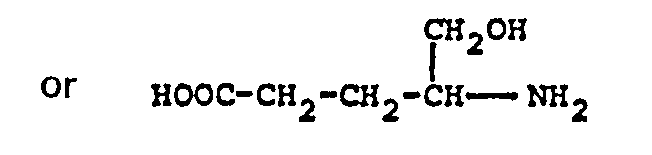
- Another preferred compound has the formula

- Another preferred compound has the formula

- Still another preferred compound has the formula

- The compounds of the present invention have potent decarboxylase inhibiting activity. Decarboxylases are enzymes which act on α-amino acid substrates, effecting decarboxylation to produce the corresponding amine. This action is illustrated by the following equation:

- By inhibiting this decarboxylation, the biosynthetic pathway to a number of biologically significant amines can be modulated or inhibited with physiologically useful consequences. For example, α-fluoromethyl dopamine inhibits dopa decarboxylase and can be used in combination with dopa to potentiate the latter's usefulness in the treatment of Parkinson's disease.
- The present compounds also are substantially specific in their decarboxylase inhibition activity, that is an α-fluoromethyl substituted alkylamine generally inhibits the decarboxylation of the corresponding non a-fluoromethyl-a amino acid. For example, α-fluoromethyl dopamine inhibits the decarboxylation of dopa; a-fluoromethyl histamine will inhibit the decarboxylation of histidine; 4-FM-GABA (4-fluoromethyl-4-amino-butyric acid) inhibits glutamic acid decarboxylase; etc.
- Because of this specificity and potency as decarboxylase inhibitors, the present compounds are also useful as diagnostic tools to determine the presence and importance of the corresponding decarboxylase in relation to diseases or to the functioning of biological systems. For example, the role of catechol amines in certain CNS (central nervous system) functions can be studied by inhibiting their biosynthesis with an appropriate a-fluoromethyl-alkylamine; a-fluoromethyl-tryptamine displays antihypertensive activity; and the study and treatment of ulcers can be advanced through modulation of histamine biosynthesis using a-fluoromethyl histamine.
- Representative compounds have been determined to have decarboxylase inhibiting activity using a conventional in-vitro assay.
- A representative compound, S-(and R) 1 - fluoromethyl - 2(3,4 - dihydroxyphenyl)-ethylamine, also referred to as a-fluoromethyl dopamine, was found to effect a pressor response in rats. This indicates that some of the present compounds may also be useful for treating hypotension in humans.
- 4-FM-GABA displays CNS activities, including sedative and antidepressant indications.
- The compounds of the present invention may be prepared using any convenient method.
- One such useful process involves the reaction of an a-hydroxymethyl substituted alkyl amine with SF4 in liquid HF, as illustrated by the following equation:




- Another useful method for preparation of a-fluoromethyl-substituted amines involves photofluorination, e.g.:

- An acid addition salt of a compound of the present invention may be prepared by conventional treatment of the a-fluoromethyl-substituted amine with a useful acid generally in a suitable solvent.
- A single enantiomer of the present compounds may be obtained by (1) resolving the fluoromethyl-substituted amine racemate using conventional resolution techniques or (2) resolving the precursor a-hydroxymethyl-substituted amine using conventional resolution techniques and then fluoro- dehydroxylating the precursor enantiomer. A conventional resolution technique may involve formation of a salt of the appropriately substituted amine with an optically active acid and subsequent recovering the specific enantiomer from the salt.
- Compounds of the formula

- The following examples illustrate preparation of representative compounds of the present invention. All temperatures are in °C. Melting points are determined in open capillary and are uncorrected.
- Four and 55/100 g of sodium borohydride is suspended by stirring (magnetic stirring bar) with 250 ml of tetrahydrofuran (THF). To the stirred suspension there is added 6.7 g of CaCI2 (powder), the mixture stirred for 30 minutes at room temperature, then refluxed under stirring for 90 minutes. To the Ca(BH4)2 solution thus obtained, a solution of 10.2 g of methyl ester of D-DOPA (DOPA=3,4-dihydroxy-phenylalanine) in 55 ml of THF is admixed. After 15 minutes at room temperature, the suspension is refluxed with continued stirring for 5-1/2 hours. (Note: The whole operation described above was conducted under a protective blanket of dry N2 gas.) The solvent is evaporated in vacuo and methanol (300 ml) is added with caution. After the gas evolution ceases, the solvent is removed by distillation in vacuo, fresh methanol is added again, the HCI gas is passed in until saturation. Solvent is removed again by evaporation in vacuo and the whole CH30H/HCl treatment is repeated. (These treatments split the borate complex formed in the reduction as well as removing the methyl borate). The residue is dissolved in H20, 109 ml of 0.55M aq. H2S04 is added and the mixture aged at 5°C overnight. The CaS04-2H20 is then removed by filtration, washed with water (10 ml) and isopropanol (2 x 30 mt). The combined filtrates were evaporated in vacuo to dryness, the solid residue is stirred with isopropanol (100 ml) for 1/2 h., filtered, cake washed with isopropanol (2 x 30 ml), the combined filtrates evaporated to dryness in vacuo. This crude product is further purified by elution chromatography (cation-exchange resin column made of 0.95 1 AG50-X-8 resin, 200/400 mesh U.S. Bureau of Standards, Standard Screen Sieves 1919; H form). Effluent is monitored by LKB UVICORD II UV monitor. Elution is as follows:

- Elution rate: 0.6 1/hour.
- The product is located by the UV absorption monitor, which is connected with a chart recorder. The UV absorbing peak is released by the last solvent listed. The appropriate fractions are combined and evaporated to dryness in vacuo, to deliver the hydrochloride of R - a - hydroxymethyl - dopamine. For final purification this is recrystallized from isopropanol, to give crystalline product, m.p. 159-160°C. [α]D: 19.5 ± 0.5° (c, 1 in 1 M aq. HCI).
- One g of the product obtained under a) is charged into a KEL-F (Registered Trade Mark) reactor. HF gas is passed in while the reactor is immersed in a dry-ice-acetone bath, until a solution with 30 ml volume forms. The cooling bath is removed and the solvent evaporated by passing through a stream of N2 gas. The residue thus obtained represents the HF salt of R-a-hydroxymethyl-dopamine. This is redissolved by condensing into the reactor HF again by cooling it in a dry-ice-acetone bath and passing in HF gas until a solution with volume 50 ml forms. SF4 gas (1.5 ml, measured as liquid at -78°C) is passed in then under continuous cooling and stirring and the solution left standing overnight, while the reactor is being kept in the cooling bath, but without replenishing dry ice. The solvent is removed the next morning by passing through a stream of N2 and the residue is redissolved in 2.5 M aq. HCI (25 ml), evaporated to dryness and the residue purified by elution chromatography on a column made of cation-exchange resin (190 ml of Dowex 50 AG50-X-8, (Registered Trade Mark) 200/400 mesh U.S. Bureau of Standards, Standard Screen Sieves 1919). Elution with water, followed by 0.5M aq. HCI with 5% methanol (2 I), followed by 0.6M aq. HCI with 10% methanol (4 I). UV absorption of the effluent is followed by LKB UVICORD II recording UV monitor. The effluent fractions containing UV absorbing material are evaporated to dryness in vacuo to deliver R-a-fluoromethyl-dopamine.HCI. 0.6 g of this crude product is dissolved in isopropanol (4 ml), treated with DARCO G-60 (Registered Trade Mark) then 26 ml of ethyl acetate is added. The crystalline product is recrystallized once more in a similar manner, to give 0.545 g of pure HCI salt, m.p. 152-3°C [a]p: 18.4 ± 0.5 (C, 1 in 1 M aq. HCI).
- S-α-Fluoromethyl dopamine.HCI is synthesized in an entirely analogous manner as described in example 1 for the R isomer; however to obtain the S isomer, the methyl ester of L-DOPA is employed as starting material. The intermediate S-hydroxymethyl dopamine has a melting point of 159-60°C; [α]D: -20.1 ±0.5° (C, 1 in 1M aq. HCI). The S-a-fluoromethyl-dopamine.HCI obtained from this fluorodehydroxylation, has a m.p. = 151-3°C, [α]D: -19.2 ± 0.5° (C, 1 in 1 M aq. HCI).
- One g of D-histidinol is placed into a KEL-F reactor; the reactor is immersed into a dry-ice-acetone cooling bath and HF gas is passed in until a volume of 40 ml collects. SF4 gas is passed in (2.0 ml, measured as liquid, at -78°C) and the mixture kept at -78°C for 5 hours. The cooling bath is removed and the solvent evaporated by passing N2 gas through it. The residue is dissolved in cc. aq. HCI (15 ml), the solution is evaporated to dryness in vacuo to yield substantially pure R-a-fluoromethyl-histamine hydrochloride-hydrofluoride salt. For transformation into the dihydrochloride salt, this product is dissolved in water and charged onto a cation-exchange resin column Dowex 50-X-8 (resin, H+ form). The column is washed first with H20 until the effluent becomes neutral, then the product is eluted with 4M aq. HCI (275 ml). This effluent is evaporated to dryness to deliver substantially pure R-a-fluoromethyl-histamine dihydrochloride. This is recrystallized by dissolving it in 40 ml of boiling ethanol 2BA, concentrating this solution by evaporation in vacuo to 15 ml volume and cooled (ice-bath) for 2 hours. The crystals formed are collected by filtration and dried in vacuo to give R-a-fluoromethyl-histamine dihydrochloride, m.p. 181-2°.
- S-α-Fluoromethyl histamine.HCl is prepared from L-histidinol via the method described in Example 3 for R-α-fluoromethyl-histamine.2HCl, m.p. = 182-83°C.
- The free amines are obtained from the hydrochloride salts by conventional neutralization.
- S(L)-Tryptophanol (0.7 g, 3.7 mmoles) was placed in a Kel-F reactor, cooled in a dry ice-acetone bath (-78°C) and approximately 20 ml of anhydrous HF was condensed with stirring at -78°C. Sulfur tetrafluoride (approx. 1.5 ml, 26 mmoles) was added with stirring at -78°C over a 15-minute period. The reaction mixture was stirred for 30 minutes at -78°C and then the HF was blown off with a fast stream of N2 over a 2.5-hr. period at -78°C. The dark residue was dissolved in 25 ml 3N HCI and evaporated to dryness at 25°C, in vacuo. The residue was dissolved in 10 ml H20, basified with 2.5N NaOH, and the separated amine was extracted with 2 x 50 ml ether. The combined ether extracts were dried over MgS04 and evaporated to dryness in vacuo at room temperature. The crude product (4 spots, by TLC on silica gel plates developed with ethyl acetate-methanol-water 85:10:5) was chromatographed on silica gel H (E. Merck, 120g.) using ethyl acetate-methanol-water 88:10:2 as the elution solvent. The desired product (S)-a-fluoromethyl-trypamine, was contained in fractions No. 31-60 (12 ml each). They were combined and evaporated to dryness to yield S-α-fluoromethyl_ tryptamine characterized as the tartrate salt, by 300 MHz 1H NMR, mass spectroscopy and microanalysis.
- Employing the procedure described in Example 5, but using R(D)-tryptophanol as starting material, R-a-fluoromethyl-tryptamine is obtained.
- Eleven and 7/10 g of 4-methyl-4-aminobutyric acid is placed in a KEL-F reactor and dissolved in 200 ml of liquid HF; then CF30F gas is passed in while the reactor is immersed in a dry-ice/acetone cooling bath. The solution is irradiated (through a window on the top) by a 2500 W ultraviolet light source. (See J. of Am. Chem. Soc. 98, 5591-93 (1976) and ibid 92, 7494 (1970) for a general description of photofluorination).
- First, 3 ml liquid C30F is allowed to evaporate and passed into the solution during a 70 minute period, followed by another 40 min. period with irradiation. Two additional 2 ml (liq.) increments of CF30F are passed into the reaction mixture with continuing irradiation, each in a time period of about 2 hours. The liquid HF is then removed by a stream of nitrogen gas. The residue is dissolved in 50 ml of 2.5 N aq. HCI and evaporated to dryness in vacuo. This treatment is repeated. The residue thus obtained is dissolved in 270 ml of water; 270 ml of conc. aq. HCI is added and the solution refluxed for 16 hours, then evaporated to dryness in vacuo, redissolved in 100 ml of water and chromatographed on a column of cation-exchange resin. 3 l of AG-50-X-8 (200-400 mesh, U.S. Bureau of Standards, Standard Screen Sieves 1919) resin is employed in the H+ form. Elution: 18 liters of water, followed by 0.4 N aq. HCI. The effluent is monitored by UVICORD Model III ultra-violet absorption monitor, filter 206 nm. 22 ml fractions are collected. Fractions 410-610 are combined and evaporated to dryness in vacuo to deliver 4 - fluoromethyl - 4 - amino-butyric acid hydrochloride. For liberation of the acid, the 4-FM-GABA.HCI is dissolved in water and passed through an AG-50-X-8 ion-exchange resin column (100 ml of resin). The column is first washed with water, then eluted with 2 N aq. NH40H. Evaporation of the NH40H solution in vacuo gives R,S - 4 - fluoromethyl - 4 - amino butyric acid. It is recrystallized from H20/isopropanol and characterized by C-H-N-F analysis and 1H and 19F NMR spectroscopy.
Claims (8)





Applications Claiming Priority (2)
| Application Number | Priority Date | Filing Date | Title |
|---|---|---|---|
| US80235077A | 1977-06-01 | 1977-06-01 | |
| US802350 | 1977-06-01 |
Publications (2)
| Publication Number | Publication Date |
|---|---|
| EP0000036A1 EP0000036A1 (en) | 1978-12-20 |
| EP0000036B1 true EP0000036B1 (en) | 1981-10-14 |
Family
ID=25183471
Family Applications (1)
| Application Number | Title | Priority Date | Filing Date |
|---|---|---|---|
| EP78100059A Expired EP0000036B1 (en) | 1977-06-01 | 1978-06-01 | Fluorinated alkylamines and process for preparing same |
Country Status (6)
| Country | Link |
|---|---|
| EP (1) | EP0000036B1 (en) |
| JP (1) | JPS5416422A (en) |
| DE (1) | DE2861148D1 (en) |
| DK (1) | DK240578A (en) |
| IE (1) | IE46910B1 (en) |
| IT (1) | IT1104712B (en) |
Families Citing this family (6)
| Publication number | Priority date | Publication date | Assignee | Title |
|---|---|---|---|---|
| AU3872678A (en) * | 1977-09-01 | 1980-02-14 | Merrell Toraude & Co | Alpha-halomethyl amines |
| US4326071A (en) * | 1977-09-28 | 1982-04-20 | Merrell Toraude Et Compagnie | Halomethyl derivatives of gamma-aminobutyric acid and related compounds |
| NZ188498A (en) * | 1977-10-19 | 1980-08-26 | Merrell Toraude & Co | 2-halomethyl derivatives of histamine and pharmaceutical compositions |
| NZ194348A (en) * | 1979-07-26 | 1982-09-14 | Merrell Toraude & Co | Fluorinated methyl-beta-alanine derivatives and pharmaceutical compositions |
| US4542802A (en) * | 1982-04-02 | 1985-09-24 | Woodward Governor Company | Engine and transmission control system for combines and the like |
| CA1302919C (en) * | 1985-07-03 | 1992-06-09 | Robert T. Buckler | Histamine derivatives, immunogen conjugates and antibodies raised thereto |
Family Cites Families (3)
| Publication number | Priority date | Publication date | Assignee | Title |
|---|---|---|---|---|
| FR104F (en) * | 1960-11-05 | |||
| GB1218135A (en) * | 1967-07-28 | 1971-01-06 | Abbott Lab | Substituted phenethylamine derivatives |
| US3839170A (en) * | 1970-08-03 | 1974-10-01 | Merck & Co Inc | Process for the preparation of 3-fluoro-d-alanine |
-
1978
- 1978-05-30 IE IE1076/78A patent/IE46910B1/en unknown
- 1978-05-31 DK DK240578A patent/DK240578A/en not_active Application Discontinuation
- 1978-05-31 IT IT49634/78A patent/IT1104712B/en active
- 1978-06-01 DE DE7878100059T patent/DE2861148D1/en not_active Expired
- 1978-06-01 EP EP78100059A patent/EP0000036B1/en not_active Expired
- 1978-06-01 JP JP6501478A patent/JPS5416422A/en active Granted
Also Published As
| Publication number | Publication date |
|---|---|
| IE781076L (en) | 1978-12-01 |
| DK240578A (en) | 1978-12-02 |
| IT1104712B (en) | 1985-10-28 |
| IE46910B1 (en) | 1983-11-02 |
| IT7849634A0 (en) | 1978-05-31 |
| DE2861148D1 (en) | 1981-12-24 |
| JPS6123177B2 (en) | 1986-06-04 |
| JPS5416422A (en) | 1979-02-07 |
| EP0000036A1 (en) | 1978-12-20 |
Similar Documents
| Publication | Publication Date | Title |
|---|---|---|
| US4325961A (en) | Fluorinated amino acids | |
| EP0099789B1 (en) | 3-aminoquinuclidin derivatives, process for their preparation and their use as therapeutical agents | |
| CH653999A5 (en) | AMINOMETHYL-5 OXAZOLIDINIC DERIVATIVES, PREPARATION METHOD AND PHARMACEUTICAL COMPOSITION. | |
| Wikstroem et al. | Monophenolic octahydrobenzo [f] quinolines: central dopamine-and serotonin-receptor stimulating activity | |
| Chen et al. | Syntheses, resolution, and structure-activity relationships of potent acetylcholinesterase inhibitors: 8-carbaphysostigmine analogs | |
| AU680672B2 (en) | Substituted kynurenines, a process for their preparation, and use as medicaments | |
| Smith et al. | Stereoisomers of allenic amines as inactivators of monoamine oxidase type B. Stereochemical probes of the active site | |
| FR2776660A1 (en) | DIAZEPINO-INDOLES OF IV PHOSPHODIESTERASES | |
| EP0193405A1 (en) | Racemization process | |
| HK18184A (en) | Fluorinated amino acids | |
| EP0000036A1 (en) | Fluorinated alkylamines and process for preparing same | |
| US4695588A (en) | Fluorinated amino acids | |
| CZ345297A3 (en) | Process for preparing ropivacaine hydrochloride monohydrate | |
| EP0000034B1 (en) | Fluorinated amines, compositions and process for preparing said compounds | |
| Harada et al. | Sterically controlled syntheses of optically active organic compounds. XVI. Temperature dependence of hydrogenolytic asymmetric transamination | |
| Hurtado-Guzmán et al. | Monoamine oxidase inhibitory properties of optical isomers and N-substituted derivatives of 4-methylthioamphetamine | |
| US4431817A (en) | Fluorinated imidazolyl alkylamines | |
| US4431821A (en) | Fluorinated tryptamines | |
| EP0074903A2 (en) | Derivatives of 2-amino-1,2,3,4-tetrahydronaphthalene, their preparation and their therapeutic use | |
| JPH03167172A (en) | Chemical resolution of 5-alkoxy-substituted (+-)-1, 3-dimethyloxindolylethylamine | |
| US4288601A (en) | Fluorination process | |
| Van Dort et al. | Synthesis and carbon‐11 labeling of the stereoisomers of meta‐hydroxyephedrine (HED) and meta‐hydroxypseudoephedrine (HPED) | |
| Thurkauf et al. | Synthesis, pharmacological action, and receptor binding affinity of the enantiomeric 1-(1-phenyl-3-methylcyclohexyl) piperidines | |
| US4990534A (en) | Aralkyl esters and processes for their preparation | |
| Fryer et al. | 2-(2-Aminoethylamino)-1, 2-diphenylethanol derivatives, a new class of topical antiinflammatory agents |
Legal Events
| Date | Code | Title | Description |
|---|---|---|---|
| PUAI | Public reference made under article 153(3) epc to a published international application that has entered the european phase |
Free format text: ORIGINAL CODE: 0009012 |
|
| AK | Designated contracting states |
Kind code of ref document: A1 Designated state(s): BE CH DE FR GB LU NL SE |
|
| 17P | Request for examination filed | ||
| GRAA | (expected) grant |
Free format text: ORIGINAL CODE: 0009210 |
|
| AK | Designated contracting states |
Kind code of ref document: B1 Designated state(s): BE CH DE FR GB LU NL SE Designated state(s): BE CH DE FR GB LU NL SE |
|
| REF | Corresponds to: |
Ref document number: 2861148 Country of ref document: DE Date of ref document: 19811224 |
|
| KL | Correction list |
Free format text: 82/06 NEUDRUCK |
|
| PGFP | Annual fee paid to national office [announced via postgrant information from national office to epo] |
Ref country code: BE Payment date: 19840331 Year of fee payment: 7 |
|
| PGFP | Annual fee paid to national office [announced via postgrant information from national office to epo] |
Ref country code: SE Payment date: 19840630 Year of fee payment: 7 |
|
| PG25 | Lapsed in a contracting state [announced via postgrant information from national office to epo] |
Ref country code: SE Effective date: 19850602 |
|
| PG25 | Lapsed in a contracting state [announced via postgrant information from national office to epo] |
Ref country code: BE Effective date: 19850630 |
|
| BERE | Be: lapsed |
Owner name: MERCK & CO. INC. Effective date: 19850601 |
|
| PGFP | Annual fee paid to national office [announced via postgrant information from national office to epo] |
Ref country code: CH Payment date: 19940316 Year of fee payment: 17 |
|
| PGFP | Annual fee paid to national office [announced via postgrant information from national office to epo] |
Ref country code: FR Payment date: 19940325 Year of fee payment: 17 |
|
| PGFP | Annual fee paid to national office [announced via postgrant information from national office to epo] |
Ref country code: GB Payment date: 19940331 Year of fee payment: 17 |
|
| PGFP | Annual fee paid to national office [announced via postgrant information from national office to epo] |
Ref country code: DE Payment date: 19940525 Year of fee payment: 17 |
|
| PGFP | Annual fee paid to national office [announced via postgrant information from national office to epo] |
Ref country code: NL Payment date: 19940630 Year of fee payment: 17 |
|
| EUG | Se: european patent has lapsed |
Ref document number: 78100059.1 Effective date: 19860728 |
|
| PG25 | Lapsed in a contracting state [announced via postgrant information from national office to epo] |
Ref country code: GB Effective date: 19950601 |
|
| PG25 | Lapsed in a contracting state [announced via postgrant information from national office to epo] |
Ref country code: CH Effective date: 19950630 |
|
| PG25 | Lapsed in a contracting state [announced via postgrant information from national office to epo] |
Ref country code: NL Effective date: 19960101 |
|
| GBPC | Gb: european patent ceased through non-payment of renewal fee |
Effective date: 19950601 |
|
| PG25 | Lapsed in a contracting state [announced via postgrant information from national office to epo] |
Ref country code: FR Effective date: 19960229 |
|
| REG | Reference to a national code |
Ref country code: CH Ref legal event code: PL |
|
| NLV4 | Nl: lapsed or anulled due to non-payment of the annual fee |
Effective date: 19960101 |
|
| PG25 | Lapsed in a contracting state [announced via postgrant information from national office to epo] |
Ref country code: DE Effective date: 19960301 |
|
| PGFP | Annual fee paid to national office [announced via postgrant information from national office to epo] |
Ref country code: LU Payment date: 19960301 Year of fee payment: 19 |
|
| REG | Reference to a national code |
Ref country code: FR Ref legal event code: ST |
|
| PG25 | Lapsed in a contracting state [announced via postgrant information from national office to epo] |
Ref country code: LU Free format text: LAPSE BECAUSE OF NON-PAYMENT OF DUE FEES Effective date: 19970601 |
|
| PLBE | No opposition filed within time limit |
Free format text: ORIGINAL CODE: 0009261 |
|
| STAA | Information on the status of an ep patent application or granted ep patent |
Free format text: STATUS: NO OPPOSITION FILED WITHIN TIME LIMIT |