DE69822977T2 - Process for producing a shaped body - Google Patents
Process for producing a shaped body Download PDFInfo
- Publication number
- DE69822977T2 DE69822977T2 DE69822977T DE69822977T DE69822977T2 DE 69822977 T2 DE69822977 T2 DE 69822977T2 DE 69822977 T DE69822977 T DE 69822977T DE 69822977 T DE69822977 T DE 69822977T DE 69822977 T2 DE69822977 T2 DE 69822977T2
- Authority
- DE
- Germany
- Prior art keywords
- polymerization
- monomer
- group
- mixture
- polymer
- Prior art date
- Legal status (The legal status is an assumption and is not a legal conclusion. Google has not performed a legal analysis and makes no representation as to the accuracy of the status listed.)
- Expired - Fee Related
Links
- 238000000034 method Methods 0.000 title claims description 27
- 230000008569 process Effects 0.000 title claims description 9
- 239000000203 mixture Substances 0.000 claims description 196
- 239000000178 monomer Substances 0.000 claims description 148
- 238000006116 polymerization reaction Methods 0.000 claims description 147
- 229920000642 polymer Polymers 0.000 claims description 92
- 239000003505 polymerization initiator Substances 0.000 claims description 74
- -1 carbamate compound Chemical class 0.000 claims description 65
- 239000002516 radical scavenger Substances 0.000 claims description 55
- 238000004519 manufacturing process Methods 0.000 claims description 28
- 125000000008 (C1-C10) alkyl group Chemical group 0.000 claims description 8
- YLFIGGHWWPSIEG-UHFFFAOYSA-N aminoxyl Chemical compound [O]N YLFIGGHWWPSIEG-UHFFFAOYSA-N 0.000 claims description 6
- 125000002947 alkylene group Chemical group 0.000 claims description 5
- 125000004435 hydrogen atom Chemical group [H]* 0.000 claims description 5
- 150000002497 iodine compounds Chemical class 0.000 claims description 5
- 125000003903 2-propenyl group Chemical group [H]C([*])([H])C([H])=C([H])[H] 0.000 claims description 3
- 230000000379 polymerizing effect Effects 0.000 claims description 3
- 125000000391 vinyl group Chemical group [H]C([*])=C([H])[H] 0.000 claims description 3
- 125000003647 acryloyl group Chemical group O=C([*])C([H])=C([H])[H] 0.000 claims description 2
- 125000003277 amino group Chemical group 0.000 claims description 2
- 238000007080 aromatic substitution reaction Methods 0.000 claims description 2
- 125000002915 carbonyl group Chemical group [*:2]C([*:1])=O 0.000 claims description 2
- 125000004093 cyano group Chemical group *C#N 0.000 claims description 2
- 230000005670 electromagnetic radiation Effects 0.000 claims description 2
- 125000002887 hydroxy group Chemical group [H]O* 0.000 claims description 2
- 125000001424 substituent group Chemical group 0.000 claims description 2
- 238000006243 chemical reaction Methods 0.000 description 48
- 238000003860 storage Methods 0.000 description 38
- PPBRXRYQALVLMV-UHFFFAOYSA-N Styrene Chemical compound C=CC1=CC=CC=C1 PPBRXRYQALVLMV-UHFFFAOYSA-N 0.000 description 34
- 230000036961 partial effect Effects 0.000 description 33
- OZAIFHULBGXAKX-UHFFFAOYSA-N 2-(2-cyanopropan-2-yldiazenyl)-2-methylpropanenitrile Chemical compound N#CC(C)(C)N=NC(C)(C)C#N OZAIFHULBGXAKX-UHFFFAOYSA-N 0.000 description 28
- NIXOWILDQLNWCW-UHFFFAOYSA-M Acrylate Chemical compound [O-]C(=O)C=C NIXOWILDQLNWCW-UHFFFAOYSA-M 0.000 description 25
- UHOVQNZJYSORNB-UHFFFAOYSA-N monobenzene Chemical group C1=CC=CC=C1 UHOVQNZJYSORNB-UHFFFAOYSA-N 0.000 description 25
- 150000003254 radicals Chemical class 0.000 description 21
- 239000011521 glass Substances 0.000 description 17
- 230000005855 radiation Effects 0.000 description 15
- ATUOYWHBWRKTHZ-UHFFFAOYSA-N Propane Chemical compound CCC ATUOYWHBWRKTHZ-UHFFFAOYSA-N 0.000 description 14
- 230000000052 comparative effect Effects 0.000 description 14
- 238000010438 heat treatment Methods 0.000 description 13
- VVQNEPGJFQJSBK-UHFFFAOYSA-N Methyl methacrylate Chemical compound COC(=O)C(C)=C VVQNEPGJFQJSBK-UHFFFAOYSA-N 0.000 description 11
- 239000003921 oil Substances 0.000 description 11
- SOGAXMICEFXMKE-UHFFFAOYSA-N Butylmethacrylate Chemical compound CCCCOC(=O)C(C)=C SOGAXMICEFXMKE-UHFFFAOYSA-N 0.000 description 10
- XMLYCEVDHLAQEL-UHFFFAOYSA-N 2-hydroxy-2-methyl-1-phenylpropan-1-one Chemical compound CC(C)(O)C(=O)C1=CC=CC=C1 XMLYCEVDHLAQEL-UHFFFAOYSA-N 0.000 description 9
- 230000008859 change Effects 0.000 description 9
- XEKOWRVHYACXOJ-UHFFFAOYSA-N Ethyl acetate Chemical compound CCOC(C)=O XEKOWRVHYACXOJ-UHFFFAOYSA-N 0.000 description 8
- 239000003999 initiator Substances 0.000 description 8
- 239000001294 propane Substances 0.000 description 7
- QYTDEUPAUMOIOP-UHFFFAOYSA-N TEMPO Chemical group CC1(C)CCCC(C)(C)N1[O] QYTDEUPAUMOIOP-UHFFFAOYSA-N 0.000 description 6
- WYURNTSHIVDZCO-UHFFFAOYSA-N Tetrahydrofuran Chemical compound C1CCOC1 WYURNTSHIVDZCO-UHFFFAOYSA-N 0.000 description 6
- 239000007983 Tris buffer Substances 0.000 description 6
- AUZONCFQVSMFAP-UHFFFAOYSA-N disulfiram Chemical compound CCN(CC)C(=S)SSC(=S)N(CC)CC AUZONCFQVSMFAP-UHFFFAOYSA-N 0.000 description 6
- 239000012634 fragment Substances 0.000 description 6
- 238000000465 moulding Methods 0.000 description 6
- 239000002904 solvent Substances 0.000 description 6
- AHNYHYYIECFEQY-UHFFFAOYSA-N 2-phenylethenylsilicon Chemical compound [Si]C=CC1=CC=CC=C1 AHNYHYYIECFEQY-UHFFFAOYSA-N 0.000 description 4
- 239000000654 additive Substances 0.000 description 4
- NSGXIBWMJZWTPY-UHFFFAOYSA-N 1,1,1,3,3,3-hexafluoropropane Chemical compound FC(F)(F)CC(F)(F)F NSGXIBWMJZWTPY-UHFFFAOYSA-N 0.000 description 3
- ZWEHNKRNPOVVGH-UHFFFAOYSA-N 2-Butanone Chemical compound CCC(C)=O ZWEHNKRNPOVVGH-UHFFFAOYSA-N 0.000 description 3
- CSCPPACGZOOCGX-UHFFFAOYSA-N Acetone Chemical compound CC(C)=O CSCPPACGZOOCGX-UHFFFAOYSA-N 0.000 description 3
- HRPVXLWXLXDGHG-UHFFFAOYSA-N Acrylamide Chemical compound NC(=O)C=C HRPVXLWXLXDGHG-UHFFFAOYSA-N 0.000 description 3
- LYCAIKOWRPUZTN-UHFFFAOYSA-N Ethylene glycol Chemical compound OCCO LYCAIKOWRPUZTN-UHFFFAOYSA-N 0.000 description 3
- KFZMGEQAYNKOFK-UHFFFAOYSA-N Isopropanol Chemical compound CC(C)O KFZMGEQAYNKOFK-UHFFFAOYSA-N 0.000 description 3
- ZMXDDKWLCZADIW-UHFFFAOYSA-N N,N-Dimethylformamide Chemical compound CN(C)C=O ZMXDDKWLCZADIW-UHFFFAOYSA-N 0.000 description 3
- DNIAPMSPPWPWGF-UHFFFAOYSA-N Propylene glycol Chemical compound CC(O)CO DNIAPMSPPWPWGF-UHFFFAOYSA-N 0.000 description 3
- XUIMIQQOPSSXEZ-UHFFFAOYSA-N Silicon Chemical compound [Si] XUIMIQQOPSSXEZ-UHFFFAOYSA-N 0.000 description 3
- YXFVVABEGXRONW-UHFFFAOYSA-N Toluene Chemical compound CC1=CC=CC=C1 YXFVVABEGXRONW-UHFFFAOYSA-N 0.000 description 3
- 150000001252 acrylic acid derivatives Chemical class 0.000 description 3
- NIXOWILDQLNWCW-UHFFFAOYSA-N acrylic acid group Chemical group C(C=C)(=O)O NIXOWILDQLNWCW-UHFFFAOYSA-N 0.000 description 3
- WURBFLDFSFBTLW-UHFFFAOYSA-N benzil Chemical compound C=1C=CC=CC=1C(=O)C(=O)C1=CC=CC=C1 WURBFLDFSFBTLW-UHFFFAOYSA-N 0.000 description 3
- RWCCWEUUXYIKHB-UHFFFAOYSA-N benzophenone Chemical compound C=1C=CC=CC=1C(=O)C1=CC=CC=C1 RWCCWEUUXYIKHB-UHFFFAOYSA-N 0.000 description 3
- 239000012965 benzophenone Substances 0.000 description 3
- 239000002131 composite material Substances 0.000 description 3
- 150000001875 compounds Chemical class 0.000 description 3
- MTHSVFCYNBDYFN-UHFFFAOYSA-N diethylene glycol Chemical compound OCCOCCO MTHSVFCYNBDYFN-UHFFFAOYSA-N 0.000 description 3
- 239000000463 material Substances 0.000 description 3
- 125000000962 organic group Chemical group 0.000 description 3
- 125000001997 phenyl group Chemical group [H]C1=C([H])C([H])=C(*)C([H])=C1[H] 0.000 description 3
- 230000002829 reductive effect Effects 0.000 description 3
- 229910052710 silicon Inorganic materials 0.000 description 3
- 239000010703 silicon Substances 0.000 description 3
- YLQBMQCUIZJEEH-UHFFFAOYSA-N tetrahydrofuran Natural products C=1C=COC=1 YLQBMQCUIZJEEH-UHFFFAOYSA-N 0.000 description 3
- 238000006276 transfer reaction Methods 0.000 description 3
- 238000010792 warming Methods 0.000 description 3
- MYRTYDVEIRVNKP-UHFFFAOYSA-N 1,2-Divinylbenzene Chemical compound C=CC1=CC=CC=C1C=C MYRTYDVEIRVNKP-UHFFFAOYSA-N 0.000 description 2
- KWOLFJPFCHCOCG-UHFFFAOYSA-N Acetophenone Chemical compound CC(=O)C1=CC=CC=C1 KWOLFJPFCHCOCG-UHFFFAOYSA-N 0.000 description 2
- 239000004342 Benzoyl peroxide Substances 0.000 description 2
- OMPJBNCRMGITSC-UHFFFAOYSA-N Benzoylperoxide Chemical compound C=1C=CC=CC=1C(=O)OOC(=O)C1=CC=CC=C1 OMPJBNCRMGITSC-UHFFFAOYSA-N 0.000 description 2
- OTMSDBZUPAUEDD-UHFFFAOYSA-N Ethane Chemical compound CC OTMSDBZUPAUEDD-UHFFFAOYSA-N 0.000 description 2
- YNQLUTRBYVCPMQ-UHFFFAOYSA-N Ethylbenzene Chemical compound CCC1=CC=CC=C1 YNQLUTRBYVCPMQ-UHFFFAOYSA-N 0.000 description 2
- CERQOIWHTDAKMF-UHFFFAOYSA-M Methacrylate Chemical compound CC(=C)C([O-])=O CERQOIWHTDAKMF-UHFFFAOYSA-M 0.000 description 2
- CERQOIWHTDAKMF-UHFFFAOYSA-N Methacrylic acid Chemical compound CC(=C)C(O)=O CERQOIWHTDAKMF-UHFFFAOYSA-N 0.000 description 2
- IMNFDUFMRHMDMM-UHFFFAOYSA-N N-Heptane Chemical compound CCCCCCC IMNFDUFMRHMDMM-UHFFFAOYSA-N 0.000 description 2
- WHNWPMSKXPGLAX-UHFFFAOYSA-N N-Vinyl-2-pyrrolidone Chemical compound C=CN1CCCC1=O WHNWPMSKXPGLAX-UHFFFAOYSA-N 0.000 description 2
- URLKBWYHVLBVBO-UHFFFAOYSA-N Para-Xylene Chemical group CC1=CC=C(C)C=C1 URLKBWYHVLBVBO-UHFFFAOYSA-N 0.000 description 2
- 238000010521 absorption reaction Methods 0.000 description 2
- ROOXNKNUYICQNP-UHFFFAOYSA-N ammonium persulfate Chemical compound [NH4+].[NH4+].[O-]S(=O)(=O)OOS([O-])(=O)=O ROOXNKNUYICQNP-UHFFFAOYSA-N 0.000 description 2
- QVGXLLKOCUKJST-UHFFFAOYSA-N atomic oxygen Chemical compound [O] QVGXLLKOCUKJST-UHFFFAOYSA-N 0.000 description 2
- 235000019400 benzoyl peroxide Nutrition 0.000 description 2
- 230000015572 biosynthetic process Effects 0.000 description 2
- CQEYYJKEWSMYFG-UHFFFAOYSA-N butyl acrylate Chemical compound CCCCOC(=O)C=C CQEYYJKEWSMYFG-UHFFFAOYSA-N 0.000 description 2
- 150000004657 carbamic acid derivatives Chemical class 0.000 description 2
- 238000005266 casting Methods 0.000 description 2
- ZQMIGQNCOMNODD-UHFFFAOYSA-N diacetyl peroxide Chemical compound CC(=O)OOC(C)=O ZQMIGQNCOMNODD-UHFFFAOYSA-N 0.000 description 2
- 239000000945 filler Substances 0.000 description 2
- 230000000977 initiatory effect Effects 0.000 description 2
- OKJPEAGHQZHRQV-UHFFFAOYSA-N iodoform Chemical compound IC(I)I OKJPEAGHQZHRQV-UHFFFAOYSA-N 0.000 description 2
- 230000001678 irradiating effect Effects 0.000 description 2
- 238000010550 living polymerization reaction Methods 0.000 description 2
- 239000002075 main ingredient Substances 0.000 description 2
- 125000002496 methyl group Chemical group [H]C([H])([H])* 0.000 description 2
- VLKZOEOYAKHREP-UHFFFAOYSA-N n-Hexane Chemical compound CCCCCC VLKZOEOYAKHREP-UHFFFAOYSA-N 0.000 description 2
- 230000003287 optical effect Effects 0.000 description 2
- 239000001301 oxygen Substances 0.000 description 2
- 229910052760 oxygen Inorganic materials 0.000 description 2
- 230000035699 permeability Effects 0.000 description 2
- 150000002978 peroxides Chemical class 0.000 description 2
- 229920001296 polysiloxane Polymers 0.000 description 2
- 239000011148 porous material Substances 0.000 description 2
- 238000010526 radical polymerization reaction Methods 0.000 description 2
- 239000011347 resin Substances 0.000 description 2
- 229920005989 resin Polymers 0.000 description 2
- 230000002441 reversible effect Effects 0.000 description 2
- 239000000243 solution Substances 0.000 description 2
- 241000894007 species Species 0.000 description 2
- 238000003756 stirring Methods 0.000 description 2
- 238000006467 substitution reaction Methods 0.000 description 2
- CIHOLLKRGTVIJN-UHFFFAOYSA-N tert‐butyl hydroperoxide Chemical compound CC(C)(C)OO CIHOLLKRGTVIJN-UHFFFAOYSA-N 0.000 description 2
- OGZXNLDUAWNVGY-UHFFFAOYSA-N (2-ethenylphenyl)-trimethylsilane Chemical compound C[Si](C)(C)C1=CC=CC=C1C=C OGZXNLDUAWNVGY-UHFFFAOYSA-N 0.000 description 1
- ZODNDDPVCIAZIQ-UHFFFAOYSA-N (2-hydroxy-3-prop-2-enoyloxypropyl) 2-methylprop-2-enoate Chemical compound CC(=C)C(=O)OCC(O)COC(=O)C=C ZODNDDPVCIAZIQ-UHFFFAOYSA-N 0.000 description 1
- NBTWXNAAIDXOJS-UHFFFAOYSA-N (3-ethenylphenyl)-trimethylsilane Chemical compound C[Si](C)(C)C1=CC=CC(C=C)=C1 NBTWXNAAIDXOJS-UHFFFAOYSA-N 0.000 description 1
- OXHSYXPNALRSME-UHFFFAOYSA-N (4-ethenylphenyl)-trimethylsilane Chemical compound C[Si](C)(C)C1=CC=C(C=C)C=C1 OXHSYXPNALRSME-UHFFFAOYSA-N 0.000 description 1
- LJQNUWWVYJMKTA-UHFFFAOYSA-N (4-nitrophenyl) 1-$l^{1}-oxidanyl-2,2,5,5-tetramethylpyrrolidine-3-carboxylate Chemical group CC1(C)N([O])C(C)(C)CC1C(=O)OC1=CC=C([N+]([O-])=O)C=C1 LJQNUWWVYJMKTA-UHFFFAOYSA-N 0.000 description 1
- BASDZFQDZBHCAV-UHFFFAOYSA-N 1,1,1-triiodoethane Chemical compound CC(I)(I)I BASDZFQDZBHCAV-UHFFFAOYSA-N 0.000 description 1
- JNVXRQOSRUDXDY-UHFFFAOYSA-N 1,1-diiodoethane Chemical compound CC(I)I JNVXRQOSRUDXDY-UHFFFAOYSA-N 0.000 description 1
- GBBZLMLLFVFKJM-UHFFFAOYSA-N 1,2-diiodoethane Chemical compound ICCI GBBZLMLLFVFKJM-UHFFFAOYSA-N 0.000 description 1
- LFRLQEYQYOFGCG-UHFFFAOYSA-N 1,2-diphenylethane-1,2-dione hydroiodide Chemical compound I.C=1C=CC=CC=1C(=O)C(=O)C1=CC=CC=C1 LFRLQEYQYOFGCG-UHFFFAOYSA-N 0.000 description 1
- KOMNUTZXSVSERR-UHFFFAOYSA-N 1,3,5-tris(prop-2-enyl)-1,3,5-triazinane-2,4,6-trione Chemical compound C=CCN1C(=O)N(CC=C)C(=O)N(CC=C)C1=O KOMNUTZXSVSERR-UHFFFAOYSA-N 0.000 description 1
- VGWWQZSCLBZOGK-UHFFFAOYSA-N 1-ethenyl-2-(trifluoromethyl)benzene Chemical compound FC(F)(F)C1=CC=CC=C1C=C VGWWQZSCLBZOGK-UHFFFAOYSA-N 0.000 description 1
- VTPNYMSKBPZSTF-UHFFFAOYSA-N 1-ethenyl-2-ethylbenzene Chemical compound CCC1=CC=CC=C1C=C VTPNYMSKBPZSTF-UHFFFAOYSA-N 0.000 description 1
- NVZWEEGUWXZOKI-UHFFFAOYSA-N 1-ethenyl-2-methylbenzene Chemical compound CC1=CC=CC=C1C=C NVZWEEGUWXZOKI-UHFFFAOYSA-N 0.000 description 1
- FDHHXIJQVOWNDS-UHFFFAOYSA-N 1-ethenyl-2-octylbenzene Chemical compound CCCCCCCCC1=CC=CC=C1C=C FDHHXIJQVOWNDS-UHFFFAOYSA-N 0.000 description 1
- ARHOUOIHKWELMD-UHFFFAOYSA-N 1-ethenyl-3-(trifluoromethyl)benzene Chemical compound FC(F)(F)C1=CC=CC(C=C)=C1 ARHOUOIHKWELMD-UHFFFAOYSA-N 0.000 description 1
- XHUZSRRCICJJCN-UHFFFAOYSA-N 1-ethenyl-3-ethylbenzene Chemical compound CCC1=CC=CC(C=C)=C1 XHUZSRRCICJJCN-UHFFFAOYSA-N 0.000 description 1
- JZHGRUMIRATHIU-UHFFFAOYSA-N 1-ethenyl-3-methylbenzene Chemical compound CC1=CC=CC(C=C)=C1 JZHGRUMIRATHIU-UHFFFAOYSA-N 0.000 description 1
- VKHPZPZWJZQGQS-UHFFFAOYSA-N 1-ethenyl-3-octylbenzene Chemical compound CCCCCCCCC1=CC=CC(C=C)=C1 VKHPZPZWJZQGQS-UHFFFAOYSA-N 0.000 description 1
- CEWDRCQPGANDRS-UHFFFAOYSA-N 1-ethenyl-4-(trifluoromethyl)benzene Chemical compound FC(F)(F)C1=CC=C(C=C)C=C1 CEWDRCQPGANDRS-UHFFFAOYSA-N 0.000 description 1
- WHFHDVDXYKOSKI-UHFFFAOYSA-N 1-ethenyl-4-ethylbenzene Chemical compound CCC1=CC=C(C=C)C=C1 WHFHDVDXYKOSKI-UHFFFAOYSA-N 0.000 description 1
- HLRQDIVVLOCZPH-UHFFFAOYSA-N 1-ethenyl-4-octylbenzene Chemical compound CCCCCCCCC1=CC=C(C=C)C=C1 HLRQDIVVLOCZPH-UHFFFAOYSA-N 0.000 description 1
- GMXOTWPDUBXCMS-UHFFFAOYSA-N 1-hydroxy-2,2,5,5-tetramethylpyrrole-3-carboxamide Chemical group CC1(C)C=C(C(N)=O)C(C)(C)N1O GMXOTWPDUBXCMS-UHFFFAOYSA-N 0.000 description 1
- BTUGGGLMQBJCBN-UHFFFAOYSA-N 1-iodo-2-methylpropane Chemical compound CC(C)CI BTUGGGLMQBJCBN-UHFFFAOYSA-N 0.000 description 1
- VLCPISYURGTGLP-UHFFFAOYSA-N 1-iodo-3-methylbenzene Chemical compound CC1=CC=CC(I)=C1 VLCPISYURGTGLP-UHFFFAOYSA-N 0.000 description 1
- UDHAWRUAECEBHC-UHFFFAOYSA-N 1-iodo-4-methylbenzene Chemical compound CC1=CC=C(I)C=C1 UDHAWRUAECEBHC-UHFFFAOYSA-N 0.000 description 1
- OAMHTTBNEJBIKA-UHFFFAOYSA-N 2,2,2-trichloro-1-phenylethanone Chemical compound ClC(Cl)(Cl)C(=O)C1=CC=CC=C1 OAMHTTBNEJBIKA-UHFFFAOYSA-N 0.000 description 1
- 125000004206 2,2,2-trifluoroethyl group Chemical group [H]C([H])(*)C(F)(F)F 0.000 description 1
- XMNIXWIUMCBBBL-UHFFFAOYSA-N 2-(2-phenylpropan-2-ylperoxy)propan-2-ylbenzene Chemical compound C=1C=CC=CC=1C(C)(C)OOC(C)(C)C1=CC=CC=C1 XMNIXWIUMCBBBL-UHFFFAOYSA-N 0.000 description 1
- 125000000954 2-hydroxyethyl group Chemical group [H]C([*])([H])C([H])([H])O[H] 0.000 description 1
- DYHCCCWROHIOFM-UHFFFAOYSA-N 2-iodoethyl acetate Chemical compound CC(=O)OCCI DYHCCCWROHIOFM-UHFFFAOYSA-N 0.000 description 1
- YXIMMRXXZQYICY-UHFFFAOYSA-N 2-iodoethyl propanoate Chemical compound CCC(=O)OCCI YXIMMRXXZQYICY-UHFFFAOYSA-N 0.000 description 1
- IGAWKPMXUGZZIH-UHFFFAOYSA-N 2-prop-2-enoyloxyethyl 2-methylprop-2-enoate Chemical compound CC(=C)C(=O)OCCOC(=O)C=C IGAWKPMXUGZZIH-UHFFFAOYSA-N 0.000 description 1
- FRIBMENBGGCKPD-UHFFFAOYSA-N 3-(2,3-dimethoxyphenyl)prop-2-enal Chemical compound COC1=CC=CC(C=CC=O)=C1OC FRIBMENBGGCKPD-UHFFFAOYSA-N 0.000 description 1
- MMNYKXJVNIIIEG-UHFFFAOYSA-N 3-(aminomethyl)-PROXYL Chemical group CC1(C)CC(CN)C(C)(C)N1[O] MMNYKXJVNIIIEG-UHFFFAOYSA-N 0.000 description 1
- XNNPAWRINYCIHL-UHFFFAOYSA-N 3-carbamoyl-PROXYL Chemical group CC1(C)CC(C(N)=O)C(C)(C)N1[O] XNNPAWRINYCIHL-UHFFFAOYSA-N 0.000 description 1
- GEPIUTWNBHBHIO-UHFFFAOYSA-N 3-carboxy-PROXYL Chemical group CC1(C)CC(C(O)=O)C(C)(C)N1[O] GEPIUTWNBHBHIO-UHFFFAOYSA-N 0.000 description 1
- RQRRZZIMMXPAGX-UHFFFAOYSA-N 3-cyano-PROXYL Chemical group CC1(C)CC(C#N)C(C)(C)N1[O] RQRRZZIMMXPAGX-UHFFFAOYSA-N 0.000 description 1
- HGNHBHXFYUYUIA-UHFFFAOYSA-N 3-maleimido-PROXYL Chemical group CC1(C)N([O])C(C)(C)CC1N1C(=O)C=CC1=O HGNHBHXFYUYUIA-UHFFFAOYSA-N 0.000 description 1
- HZHPOJPIGFWDTD-UHFFFAOYSA-N 3-prop-2-enoyloxypropyl 2-methylprop-2-enoate Chemical compound CC(=C)C(=O)OCCCOC(=O)C=C HZHPOJPIGFWDTD-UHFFFAOYSA-N 0.000 description 1
- YFICSDVNKFLZRQ-UHFFFAOYSA-N 3-trimethylsilylpropyl 2-methylprop-2-enoate Chemical compound CC(=C)C(=O)OCCC[Si](C)(C)C YFICSDVNKFLZRQ-UHFFFAOYSA-N 0.000 description 1
- BESKSSIEODQWBP-UHFFFAOYSA-N 3-tris(trimethylsilyloxy)silylpropyl 2-methylprop-2-enoate Chemical compound CC(=C)C(=O)OCCC[Si](O[Si](C)(C)C)(O[Si](C)(C)C)O[Si](C)(C)C BESKSSIEODQWBP-UHFFFAOYSA-N 0.000 description 1
- JLBJTVDPSNHSKJ-UHFFFAOYSA-N 4-Methylstyrene Chemical compound CC1=CC=C(C=C)C=C1 JLBJTVDPSNHSKJ-UHFFFAOYSA-N 0.000 description 1
- UXBLSWOMIHTQPH-UHFFFAOYSA-N 4-acetamido-TEMPO Chemical group CC(=O)NC1CC(C)(C)N([O])C(C)(C)C1 UXBLSWOMIHTQPH-UHFFFAOYSA-N 0.000 description 1
- XUXUHDYTLNCYQQ-UHFFFAOYSA-N 4-amino-TEMPO Chemical group CC1(C)CC(N)CC(C)(C)N1[O] XUXUHDYTLNCYQQ-UHFFFAOYSA-N 0.000 description 1
- CYQGCJQJIOARKD-UHFFFAOYSA-N 4-carboxy-TEMPO Chemical group CC1(C)CC(C(O)=O)CC(C)(C)N1[O] CYQGCJQJIOARKD-UHFFFAOYSA-N 0.000 description 1
- UZFMOKQJFYMBGY-UHFFFAOYSA-N 4-hydroxy-TEMPO Chemical group CC1(C)CC(O)CC(C)(C)N1[O] UZFMOKQJFYMBGY-UHFFFAOYSA-N 0.000 description 1
- NLHHRLWOUZZQLW-UHFFFAOYSA-N Acrylonitrile Chemical compound C=CC#N NLHHRLWOUZZQLW-UHFFFAOYSA-N 0.000 description 1
- SOVQNZUIXOMRAU-UHFFFAOYSA-N C(C)C1=CC=CC=C1.[I] Chemical compound C(C)C1=CC=CC=C1.[I] SOVQNZUIXOMRAU-UHFFFAOYSA-N 0.000 description 1
- HMWOBFSDFQIPIT-UHFFFAOYSA-N CCOC(=O)NCCCCCCN(C)C(=O)OC(C)(C)C Chemical compound CCOC(=O)NCCCCCCN(C)C(=O)OC(C)(C)C HMWOBFSDFQIPIT-UHFFFAOYSA-N 0.000 description 1
- 239000004641 Diallyl-phthalate Substances 0.000 description 1
- 239000004593 Epoxy Substances 0.000 description 1
- YCKRFDGAMUMZLT-UHFFFAOYSA-N Fluorine atom Chemical compound [F] YCKRFDGAMUMZLT-UHFFFAOYSA-N 0.000 description 1
- 229940123457 Free radical scavenger Drugs 0.000 description 1
- YIVJZNGAASQVEM-UHFFFAOYSA-N Lauroyl peroxide Chemical compound CCCCCCCCCCCC(=O)OOC(=O)CCCCCCCCCCC YIVJZNGAASQVEM-UHFFFAOYSA-N 0.000 description 1
- CTQNGGLPUBDAKN-UHFFFAOYSA-N O-Xylene Chemical compound CC1=CC=CC=C1C CTQNGGLPUBDAKN-UHFFFAOYSA-N 0.000 description 1
- 244000028419 Styrax benzoin Species 0.000 description 1
- 235000000126 Styrax benzoin Nutrition 0.000 description 1
- 235000008411 Sumatra benzointree Nutrition 0.000 description 1
- ZJCCRDAZUWHFQH-UHFFFAOYSA-N Trimethylolpropane Chemical compound CCC(CO)(CO)CO ZJCCRDAZUWHFQH-UHFFFAOYSA-N 0.000 description 1
- XTXRWKRVRITETP-UHFFFAOYSA-N Vinyl acetate Chemical compound CC(=O)OC=C XTXRWKRVRITETP-UHFFFAOYSA-N 0.000 description 1
- CKESHWQHGBKZBB-UHFFFAOYSA-N [4-(diethylcarbamothioylsulfanylmethyl)phenyl]methyl n,n-diethylcarbamodithioate Chemical compound CCN(CC)C(=S)SCC1=CC=C(CSC(=S)N(CC)CC)C=C1 CKESHWQHGBKZBB-UHFFFAOYSA-N 0.000 description 1
- SSEPDPMQXPHEQG-UHFFFAOYSA-L [Na+].[K+].OS([O-])(=O)=O.OS(=O)(=O)OOS([O-])(=O)=O Chemical compound [Na+].[K+].OS([O-])(=O)=O.OS(=O)(=O)OOS([O-])(=O)=O SSEPDPMQXPHEQG-UHFFFAOYSA-L 0.000 description 1
- KYIKRXIYLAGAKQ-UHFFFAOYSA-N abcn Chemical compound C1CCCCC1(C#N)N=NC1(C#N)CCCCC1 KYIKRXIYLAGAKQ-UHFFFAOYSA-N 0.000 description 1
- 150000003926 acrylamides Chemical class 0.000 description 1
- 230000000996 additive effect Effects 0.000 description 1
- 230000002411 adverse Effects 0.000 description 1
- 125000000217 alkyl group Chemical group 0.000 description 1
- XYLMUPLGERFSHI-UHFFFAOYSA-N alpha-Methylstyrene Chemical compound CC(=C)C1=CC=CC=C1 XYLMUPLGERFSHI-UHFFFAOYSA-N 0.000 description 1
- 229910001870 ammonium persulfate Inorganic materials 0.000 description 1
- 235000019395 ammonium persulphate Nutrition 0.000 description 1
- 239000003963 antioxidant agent Substances 0.000 description 1
- 230000003078 antioxidant effect Effects 0.000 description 1
- OVLWSTDMLQQYJE-UHFFFAOYSA-M azanium sodium sulfooxy hydrogen sulfate sulfite Chemical compound S(=O)([O-])[O-].[Na+].S(=O)(=O)(O)OOS(=O)(=O)O.[NH4+] OVLWSTDMLQQYJE-UHFFFAOYSA-M 0.000 description 1
- 229960002130 benzoin Drugs 0.000 description 1
- PASDCCFISLVPSO-UHFFFAOYSA-N benzoyl chloride Chemical compound ClC(=O)C1=CC=CC=C1 PASDCCFISLVPSO-UHFFFAOYSA-N 0.000 description 1
- MRVHGCMXWNDJBQ-UHFFFAOYSA-N benzyl carbamodithioate Chemical compound NC(=S)SCC1=CC=CC=C1 MRVHGCMXWNDJBQ-UHFFFAOYSA-N 0.000 description 1
- SNBMGLUIIGFNFE-UHFFFAOYSA-N benzyl n,n-diethylcarbamodithioate Chemical compound CCN(CC)C(=S)SCC1=CC=CC=C1 SNBMGLUIIGFNFE-UHFFFAOYSA-N 0.000 description 1
- HLZBIKHKXIJIHX-UHFFFAOYSA-N benzyl n,n-dimethylcarbamodithioate Chemical compound CN(C)C(=S)SCC1=CC=CC=C1 HLZBIKHKXIJIHX-UHFFFAOYSA-N 0.000 description 1
- QUDWYFHPNIMBFC-UHFFFAOYSA-N bis(prop-2-enyl) benzene-1,2-dicarboxylate Chemical compound C=CCOC(=O)C1=CC=CC=C1C(=O)OCC=C QUDWYFHPNIMBFC-UHFFFAOYSA-N 0.000 description 1
- FPODCVUTIPDRTE-UHFFFAOYSA-N bis(prop-2-enyl) hexanedioate Chemical compound C=CCOC(=O)CCCCC(=O)OCC=C FPODCVUTIPDRTE-UHFFFAOYSA-N 0.000 description 1
- 239000002639 bone cement Substances 0.000 description 1
- CDQSJQSWAWPGKG-UHFFFAOYSA-N butane-1,1-diol Chemical compound CCCC(O)O CDQSJQSWAWPGKG-UHFFFAOYSA-N 0.000 description 1
- 125000000484 butyl group Chemical group [H]C([*])([H])C([H])([H])C([H])([H])C([H])([H])[H] 0.000 description 1
- NRJXPXBNIOUCGG-UHFFFAOYSA-N butyl n,n-dimethylcarbamodithioate Chemical compound CCCCSC(=S)N(C)C NRJXPXBNIOUCGG-UHFFFAOYSA-N 0.000 description 1
- DKVNPHBNOWQYFE-UHFFFAOYSA-N carbamodithioic acid Chemical compound NC(S)=S DKVNPHBNOWQYFE-UHFFFAOYSA-N 0.000 description 1
- CSNJTIWCTNEOSW-UHFFFAOYSA-N carbamothioylsulfanyl carbamodithioate Chemical compound NC(=S)SSC(N)=S CSNJTIWCTNEOSW-UHFFFAOYSA-N 0.000 description 1
- NKQCFTGGMPNPMC-UHFFFAOYSA-N carbamothioylsulfanyl n,n-dimethylcarbamodithioate Chemical compound CN(C)C(=S)SSC(N)=S NKQCFTGGMPNPMC-UHFFFAOYSA-N 0.000 description 1
- 238000003776 cleavage reaction Methods 0.000 description 1
- 238000001816 cooling Methods 0.000 description 1
- 238000004132 cross linking Methods 0.000 description 1
- 230000009849 deactivation Effects 0.000 description 1
- 230000003247 decreasing effect Effects 0.000 description 1
- 230000001419 dependent effect Effects 0.000 description 1
- ISAOCJYIOMOJEB-UHFFFAOYSA-N desyl alcohol Natural products C=1C=CC=CC=1C(O)C(=O)C1=CC=CC=C1 ISAOCJYIOMOJEB-UHFFFAOYSA-N 0.000 description 1
- 238000001514 detection method Methods 0.000 description 1
- LSXWFXONGKSEMY-UHFFFAOYSA-N di-tert-butyl peroxide Chemical compound CC(C)(C)OOC(C)(C)C LSXWFXONGKSEMY-UHFFFAOYSA-N 0.000 description 1
- NZZFYRREKKOMAT-UHFFFAOYSA-N diiodomethane Chemical compound ICI NZZFYRREKKOMAT-UHFFFAOYSA-N 0.000 description 1
- RYVPESHKXHNTOG-UHFFFAOYSA-N dimethylcarbamodithioic acid;1,4-xylene Chemical compound CN(C)C(S)=S.CN(C)C(S)=S.CC1=CC=C(C)C=C1 RYVPESHKXHNTOG-UHFFFAOYSA-N 0.000 description 1
- REQPQFUJGGOFQL-UHFFFAOYSA-N dimethylcarbamothioyl n,n-dimethylcarbamodithioate Chemical compound CN(C)C(=S)SC(=S)N(C)C REQPQFUJGGOFQL-UHFFFAOYSA-N 0.000 description 1
- 230000003292 diminished effect Effects 0.000 description 1
- SZXQTJUDPRGNJN-UHFFFAOYSA-N dipropylene glycol Chemical compound OCCCOCCCO SZXQTJUDPRGNJN-UHFFFAOYSA-N 0.000 description 1
- 238000007323 disproportionation reaction Methods 0.000 description 1
- 238000010494 dissociation reaction Methods 0.000 description 1
- 230000005593 dissociations Effects 0.000 description 1
- 239000012990 dithiocarbamate Substances 0.000 description 1
- 239000003480 eluent Substances 0.000 description 1
- 239000003822 epoxy resin Substances 0.000 description 1
- AVMMXNKUHBWIMU-UHFFFAOYSA-N ethyl 2-iodopropanoate Chemical compound CCOC(=O)C(C)I AVMMXNKUHBWIMU-UHFFFAOYSA-N 0.000 description 1
- 125000001495 ethyl group Chemical group [H]C([H])([H])C([H])([H])* 0.000 description 1
- DAPKEMXFFNUVPN-UHFFFAOYSA-N ethylcarbamothioyl n-ethylcarbamodithioate Chemical compound CCNC(=S)SC(=S)NCC DAPKEMXFFNUVPN-UHFFFAOYSA-N 0.000 description 1
- 230000005284 excitation Effects 0.000 description 1
- 230000007717 exclusion Effects 0.000 description 1
- 239000000835 fiber Substances 0.000 description 1
- 230000004992 fission Effects 0.000 description 1
- 229910052731 fluorine Inorganic materials 0.000 description 1
- 239000011737 fluorine Substances 0.000 description 1
- 125000003709 fluoroalkyl group Chemical group 0.000 description 1
- 235000019382 gum benzoic Nutrition 0.000 description 1
- 238000004128 high performance liquid chromatography Methods 0.000 description 1
- 210000004394 hip joint Anatomy 0.000 description 1
- 150000002430 hydrocarbons Chemical group 0.000 description 1
- 125000002768 hydroxyalkyl group Chemical group 0.000 description 1
- 239000013033 iniferter Substances 0.000 description 1
- 238000002347 injection Methods 0.000 description 1
- 239000007924 injection Substances 0.000 description 1
- HVTICUPFWKNHNG-UHFFFAOYSA-N iodoethane Chemical compound CCI HVTICUPFWKNHNG-UHFFFAOYSA-N 0.000 description 1
- 230000002427 irreversible effect Effects 0.000 description 1
- ZUBZATZOEPUUQF-UHFFFAOYSA-N isopropylhexane Natural products CCCCCCC(C)C ZUBZATZOEPUUQF-UHFFFAOYSA-N 0.000 description 1
- 125000005395 methacrylic acid group Chemical group 0.000 description 1
- BALADIHEPAEKQJ-UHFFFAOYSA-N methyl 2-iodopropanoate Chemical compound COC(=O)C(C)I BALADIHEPAEKQJ-UHFFFAOYSA-N 0.000 description 1
- YLHXLHGIAMFFBU-UHFFFAOYSA-N methyl phenylglyoxalate Chemical compound COC(=O)C(=O)C1=CC=CC=C1 YLHXLHGIAMFFBU-UHFFFAOYSA-N 0.000 description 1
- 238000002156 mixing Methods 0.000 description 1
- 238000006303 photolysis reaction Methods 0.000 description 1
- 230000015843 photosynthesis, light reaction Effects 0.000 description 1
- 239000000049 pigment Substances 0.000 description 1
- 239000004033 plastic Substances 0.000 description 1
- 229920003023 plastic Polymers 0.000 description 1
- 229920000647 polyepoxide Polymers 0.000 description 1
- USHAGKDGDHPEEY-UHFFFAOYSA-L potassium persulfate Chemical compound [K+].[K+].[O-]S(=O)(=O)OOS([O-])(=O)=O USHAGKDGDHPEEY-UHFFFAOYSA-L 0.000 description 1
- 235000019394 potassium persulphate Nutrition 0.000 description 1
- 238000002360 preparation method Methods 0.000 description 1
- SOGFHWHHBILCSX-UHFFFAOYSA-J prop-2-enoate silicon(4+) Chemical compound [Si+4].[O-]C(=O)C=C.[O-]C(=O)C=C.[O-]C(=O)C=C.[O-]C(=O)C=C SOGFHWHHBILCSX-UHFFFAOYSA-J 0.000 description 1
- 125000001436 propyl group Chemical group [H]C([*])([H])C([H])([H])C([H])([H])[H] 0.000 description 1
- 239000007870 radical polymerization initiator Substances 0.000 description 1
- 230000006798 recombination Effects 0.000 description 1
- 238000005215 recombination Methods 0.000 description 1
- 230000007017 scission Effects 0.000 description 1
- 230000035945 sensitivity Effects 0.000 description 1
- 150000003440 styrenes Chemical class 0.000 description 1
- 239000000126 substance Substances 0.000 description 1
- 238000012719 thermal polymerization Methods 0.000 description 1
- KUAZQDVKQLNFPE-UHFFFAOYSA-N thiram Chemical compound CN(C)C(=S)SSC(=S)N(C)C KUAZQDVKQLNFPE-UHFFFAOYSA-N 0.000 description 1
- ZIBGPFATKBEMQZ-UHFFFAOYSA-N triethylene glycol Chemical compound OCCOCCOCCO ZIBGPFATKBEMQZ-UHFFFAOYSA-N 0.000 description 1
- 125000004205 trifluoroethyl group Chemical group [H]C([H])(*)C(F)(F)F 0.000 description 1
- 229920002554 vinyl polymer Polymers 0.000 description 1
- 239000003643 water by type Substances 0.000 description 1
- 239000008096 xylene Substances 0.000 description 1
Classifications
-
- C—CHEMISTRY; METALLURGY
- C08—ORGANIC MACROMOLECULAR COMPOUNDS; THEIR PREPARATION OR CHEMICAL WORKING-UP; COMPOSITIONS BASED THEREON
- C08F—MACROMOLECULAR COMPOUNDS OBTAINED BY REACTIONS ONLY INVOLVING CARBON-TO-CARBON UNSATURATED BONDS
- C08F4/00—Polymerisation catalysts
Landscapes
- Chemical & Material Sciences (AREA)
- Engineering & Computer Science (AREA)
- Materials Engineering (AREA)
- Health & Medical Sciences (AREA)
- Chemical Kinetics & Catalysis (AREA)
- Medicinal Chemistry (AREA)
- Polymers & Plastics (AREA)
- Organic Chemistry (AREA)
- Addition Polymer Or Copolymer, Post-Treatments, Or Chemical Modifications (AREA)
- Polymerisation Methods In General (AREA)
- Casting Or Compression Moulding Of Plastics Or The Like (AREA)
Description
VERFAHREN ZUR HERSTELLUNG EINES FORMKÖRPERSMANUFACTURING METHOD A MOLDED BODY
Die vorliegende Erfindung betrifft ein Verfahren zur Herstellung eines Formkörpers. Insbesondere betrifft sie ein Verfahren zur Herstellung eines Formkörpers, der geeignet ist zur Herstellung von Formteilen oder Gussteilen, z. B. dreidimensionalen Formkörpern, die spezielle Formen aufweisen, wie z. B. Okularlinsen, wie z. B. Kontaktlinsen oder Intraokularlinsen, Kameralinsen, Aufnahmelinsen oder Pickuplinsen für Compaktdisks (CDs) oder Linsen für Brillen oder für die Herstellung von Verbundwerkstoffen oder Verbundprodukten oder Compounderzeugnissen, wie z. B. Knochenzement als Ersatz oder Substitut von künstlichen Hüftgelenken.The present invention relates to a method for producing a shaped body. In particular concerns a method for producing a shaped body which is suitable for Manufacture of molded parts or castings, e.g. B. three-dimensional Moldings, which have special shapes such. B. eyepiece lenses such. B. Contact lenses or intraocular lenses, camera lenses, taking lenses or pickup lenses for Compact discs (CDs) or lenses for Glasses or for the production of composite materials or composite products or compound products, such as B. bone cement as a replacement or substitute for artificial Hip joints.
Bislang wurden Okularlinsen, wie z. B. Kontaktlinsen oder Intraokularlinsen, nach einem so genannten Form- oder Gieß- oder Gusspolymerisationsverfahren hergestellt, wobei ein Monomer in eine Form gefüllt wird und in der Form unter Verwendung von Azobisisobutyronitril oder einem Peroxid als Polymerisationsinitiator polymerisiert wird.So far, eyepiece lenses, such as z. B. contact lenses or intraocular lenses, according to a so-called form or casting or cast polymerization process, wherein a monomer filled in a mold and in the form using azobisisobutyronitrile or a peroxide is polymerized as a polymerization initiator.
Wenn jedoch ein solches Formpolymerisationsverfahren eingesetzt wird, gibt es einen Nachteil der Art, dass eine Polymerisationsschrumpfung auftritt, wenn die Polymerisation des Monomers in der Form fortschreitet, wobei es schwierig ist, einen Formkörper herzustellen, der in seiner Form genau der Form (in die das Monomer gefüllt wird) entspricht.However, if such a mold polymerization process is used, there is a disadvantage of the type that polymerization shrinkage occurs when the polymerization of the monomer proceeds in the form wherein it is difficult to produce a molded article which is in its Form corresponds exactly to the form (into which the monomer is filled).
Ferner wurde vor kurzem eine so genannte "Stereo Lightgraphy"-Technik eingesetzt, bei der ein Polymer durch Photopolymerisation laminiert wird, um ein dreidimensional geformtes Produkt oder Formkörper zu erhalten. Bei einem solchen Verfahren ist es in vielen Fällen üblich, ein Epoxyharz oder einen Epoxykunststoff einzusetzen, das oder der weniger empfindlich gegenüber Polymerisationsschrumpfung ist. Wenn jedoch ein gegenüber Polymerisationsschrumpfung empfindliches Harz verwendet wird, wie z. B. ein Acrylmonomer, neigt die Genauigkeit des Formkörpers in seinen Ausmaßen dazu, gering zu sein, und es ist schwierig, einen Formkörper zu erhalten, der eine gewünschte Form aufweist. Diese Technik besitzt daher ein Problem der Art, dass die Typen geeigneter Harze beträchtlich beschränkt sind.Furthermore, a so-called "stereo lightgraphy" technique was recently used, in which a polymer is laminated by photopolymerization in order to to obtain a three-dimensionally shaped product or molded body. At a In such processes, it is common in many cases to use an epoxy resin or a Use epoxy that is less sensitive to polymerization shrinkage is. However, when facing one Polymerization shrinkage sensitive resin is used, such as z. B. an acrylic monomer, the accuracy of the molded body tends in its dimensions to be small, and it is difficult to mold get the one you want Has shape. This technique therefore has a problem of the kind that the types of suitable resins considerably limited are.
Wie aus den obigen Beispielen hervorgeht, ist es wichtig, die Polymerisationsschrumpfung auf vielen Gebieten, bei denen eine Polymerisationshärtung eines Monomers angewendet wird, zu vermindern.As can be seen from the examples above, it’s important to shrink polymerization in many areas, where polymerization curing of a monomer is used to decrease.
Man geht in der Regel davon aus, dass die Polymerisationsschrumpfung während der Polymerisation eines Monomers stattfindet, weil sich der Van-der-Waals-Abstand unter den Monomermolekülen zu einem kovalenten Bindungsabstand durch die Polymerisation verändert. Demzufolge ist die Polymerisationsschrumpfung umso geringer, je kleiner die Menge des Monomers ist, das bei der Polymerisation eingesetzt wird. In einem Fall, bei dem eine Polymerisation aus einem teilweise polymerisierten Zustand wieder aufgenommen wird, nimmt der Grad der Polymerisationsschrumpfung auf einen Wert ab, welcher der Menge des verbleibenden Monomers entspricht. Zum Beispiel ist bei der radikalischen Blockpolymerisation von Methylmethacrylat bekannt, dass die Polymerisationsschrumpfung etwa 21% beträgt, wenn die Polymerisation von dem Monomer ausgehend durchgeführt wird. In einem Fall, bei dem eine Mischung, die zu einem Grad von 50% teilweise polymerisiert oder teilpolymerisiert ist, weiter polymerisiert wird, verringert sich die Polymerisationsschrumpfung auf einen Wert von 10%.One usually assumes that the polymerization shrinkage during the polymerization of a Monomers takes place because the van der Waals distance is below the monomer molecules changed to a covalent bond distance by the polymerization. As a result, the smaller the polymerization shrinkage, the smaller the Amount of the monomer that is used in the polymerization. In a case where polymerization from a partially polymerized State resumes, the degree of polymerization shrinkage to a value which corresponds to the amount of the remaining monomer equivalent. For example, in radical block polymerization of methyl methacrylate is known to cause polymerization shrinkage is about 21%, when the polymerization is carried out from the monomer. In a case where a mixture that is 50% is partially polymerized or partially polymerized, further polymerized the polymerization shrinkage is reduced to a value of 10%.
Durch Berücksichtigung eines solchen Punkts wurde vorgeschlagen, ein teilweise polymerisiertes oder teilpolymerisiertes Material in eine vorbestimmte Form oder Kavität oder Hohlraum zu füllen, und sie nochmals zu polymerisieren, um die Polymerisationsschrumpfung zu verringern.By considering such Punktts has been suggested to be a partially polymerized or partially polymerized Filling material into a predetermined shape or cavity or cavity, and polymerize them again to reduce the polymerization shrinkage to reduce.
Bei einem solchen Vorschlag war es üblich, als Polymerisationsinitiator eine Azoverbindung zu verwenden, wie z. B. Azobisisobutyronitril, einen thermischen Polymerisationsinitiator, wie z. B. eine Peroxidverbindung, wie z. B. Benzoylperoxid, oder einen Photopolymerisationsinitiator, wie z. B. Benzophenon, Benzil oder eine Benzoinverbindung. Bei der Polymerisation mit diesen Polymerisationsinitiatoren haften oder fügen sich aktive freie Radikale, sobald sie von dem Polymerisationsinitiator dissoziert werden, sofort an das Monomer, und die Polymerkette wächst kontinuierlich, außer es findet eine Deaktivierung während der Polymerisation auf Grund einer Kettenübertragung oder einer Kettenabbruchsreaktion statt. Sobald eine Polymerisation gestartet ist, ist es demzufolge nicht möglich, die Polymerisation abzubrechen, außer die wachsende Spezies wird deaktiviert. Sobald die wachsende Spezies deaktiviert wird, kann die Polymerisationsfähigkeit nicht wiedererlangt werden. Eine solche Charakteristik oder Eigenart macht es schwierig, eine teilweise polymerisierte Mischung quantitativ in einem gewünschten Zustand zu erhalten. Es ist z. B. schwierig, die Polymerisation vollständig abzubrechen, selbst wenn das Material, bei dem die Polymerisation einmal gestartet wurde, in eine Umgebung niedriger Temperatur überführt wird, um die tatsächliche Reaktionsgeschwindigkeit zu verringern, wobei es ein Problem der Art gibt, dass die Polymerisation während der Lagerung schrittweise weiter abläuft, und das Material dadurch gehärtet wird und unbrauchbar wird. Ferner ist es unter dem Gesichtspunkt der Wiederaufnahme der Polymerisation ausgehend von einem teilweise polymerisierten Zustand unmöglich, eine Polymerisation ausgehend von einer teilweise polymerisierten Mischung, die einmal deaktiviert wurde, aus einem solchen deaktivierten Zustand wiederaufzunehmen, und ein zusätzlicher Mischvorgang wird notwendig, um einen frischen Polymerisationsinitiator einzuverleiben, und ein solches Verfahren kann kaum geeignet sein für einen üblichen Anwender, der über keine Ausrüstung verfügt, die für einen solchen Vorgang benötigt wird.In such a proposal, it was common to use an azo compound as the polymerization initiator, e.g. B. azobisisobutyronitrile, a thermal polymerization initiator, such as. B. a peroxide compound such. B. benzoyl peroxide, or a photopolymerization initiator, such as. As benzophenone, benzil or a benzoin compound. When polymerized with these polymerization initiators, as soon as they are dissociated from the polymerization initiator, active free radicals immediately adhere or attach to the monomer and the polymer chain grows continuously unless there is deactivation during polymerization due to chain transfer or chain termination reaction. As a result, once polymerization is started, the polymerization cannot be stopped unless the growing species is deactivated. Once the growing species is deactivated, the polymerizability cannot be regained. Such a characteristic or peculiarity makes it difficult to obtain a partially polymerized mixture quantitatively in a desired state. It is Z. For example, it is difficult to terminate the polymerization completely even if the material once the polymerization is started is transferred to a low temperature environment to slow down the actual reaction rate, and there is a problem that the polymerization occurs during the Storage continues gradually, and the material is thereby hardened and unusable. Further, from the point of resumption of polymerization from a partially polymerized state, it is impossible to resume polymerization from a partially polymerized mixture that has been deactivated once from such a deactivated state, and an additional mixing operation becomes necessary to a fresh polymerization initiator, and such a method may hardly be suitable for a common user who does not have the equipment required for such a process.
Die vorliegende Erfindung wurde im Hinblick auf den oben beschriebenen Stand der Technik gemacht, und es ist eine Aufgabe der vorliegenden Erfindung, ein Verfahren zur Herstellung eines Formkörpers bereitzustellen durch ein Verfahren, bei dem die Polymerisationsschrumpfung vermindert wird, um einen Formkörper hoch genau in der Form der Form (in die die polymerisierbare Mischung eingefüllt wird (Vorlagenform)) herzustellen, oder einen Ver bundwerkstoff herzustellen, bei dem kein Zwischenraum gebildet wird, wobei das Verfahren zur Verringerung der Polymerisationsschrumpfung die Herstellung einer teilweise polymerisierten mischung und die Wiederaufnahme der Polymerisation durch ein optionales oder nicht notwendigerweise vorgesehenes Verfahren umfasst, wobei die teilweise polymerisierte Mischung quantitativ erhalten werden kann, die Polymerisation während der Lagerung nicht fortschreitet, und die Polymerisation aus dem teilweise polymerisierten Zustand des wieder aufgenommen werden kann, ohne irgendein aktives Mittel zugeben zu müssen.The present invention was made in In view of the prior art described above, and it is an object of the present invention to provide a method for Production of a shaped body to be provided by a method in which the polymerization shrinkage is reduced to a shaped body high exactly in the form of the form (in which the polymerizable mixture filled will produce (template form)), or to produce a composite material, in which no space is formed, the method for Reducing polymerization shrinkage to produce a partially polymerized mixture and resumption of polymerization by an optional or not necessarily provided method comprises, the partially polymerized mixture quantitative can be obtained, the polymerization does not progress during storage, and the polymerization from the partially polymerized state which can be resumed without any active means to admit.
Die vorliegende Erfindung stellt ein Verfahren zur Herstellung eines Formkörpers bereit, wobei das Verfahren folgendes umfasst: ein Polymerisieren einer einen Radikal-Fänger, einen Polymerisationsinitiator und ein radikalisch polymerisierbares Monomer umfassenden Mischung, um eine teilweise polymerisierte Mischung zu erhalten, die einen Polymerisationsgrad oder eine Überführung des Monomers in das Polymer von 5 bis 90 Gew.-% aufweist, ein Füllen der teilweise polymerisierten Mischung in einen vorbestimmten Hohlraum oder eine vorbestimmte Kavität und dann ein erneutes Zuführen oder Anwenden von Polymerisationsenergie zu der teilweise polymerisierten Mischung, um die Polymerisation zu vervollständigen.The present invention provides a method for producing a molded article, the method includes: polymerizing a one radical scavenger, one Polymerization initiator and a radically polymerizable monomer comprehensive blend to form a partially polymerized blend to obtain a degree of polymerization or a transfer of Monomers in the polymer from 5 to 90 wt .-%, filling the partially polymerized mixture in a predetermined cavity or a predetermined cavity and then re-feeding or applying polymerization energy to the partially polymerized one Mixture to complete the polymerization.
Bei der vorliegenden Erfindung steht der Radikal-Fänger dafür, was vorübergehend oder temporär eine Polymerisationsreaktion beenden oder abbrechen kann durch Bindung von Propagations-Radikalen oder Kettenwachstums-Radikalen und aktive Radikale erzeugen kann durch reversible Dissoziation. Der Radikal-Fänger kann ein Radikal sein, muss aber kein Radikal sein, wenn die Mischung zubereitet wird.In the present invention the radical scavenger for this, what is temporary or temporarily one The polymerization reaction can be terminated or terminated by binding of propagation radicals or chain growth radicals and active Can generate radicals through reversible dissociation. The radical scavenger can be a radical, but need not be a radical if the mixture is prepared.
Bei der vorliegenden Erfindung steht der Polymerisationsinitiator dafür, was Radikale erzeugt, die eine die Polymerisation initierende oder startende Funktion aufweisen nach einem Aussetzen gegenüber Energie, wie z. B. Licht oder Wärme.In the present invention the polymerization initiator for it which generates radicals that initiate or initiate the polymerization have starting function after exposure to energy, such as z. B. light or heat.
Bei der vorliegenden Erfindung steht die teilweise polymeriserte Mischung für eine Mischung eines Polymers und eines nicht polymerisierten Monomers, die einen Polymerisationsgrad oder eine Überführung oder Umsetzung des Monomers in das Polymer von unter 100% aufweist.In the present invention the partially polymerized blend for a blend of a polymer and an unpolymerized monomer having a degree of polymerization or a transfer or implementation of the monomer in the polymer is less than 100%.
Die vorliegende Erfindung wird nun in Einzelheiten in Bezug auf die bevorzugten Ausführungsformen beschrieben.The present invention will now described in detail with respect to the preferred embodiments.
Gemäß der vorliegenden Erfindung kann ein Formkörper hoch genau hergestellt werden, wie oben beschrieben, durch Polymerisation einer Mischung, die einen Radikal-Fänger, einen Polymerisationsinitiator und ein radikalisch polymerisierbares Monomer umfasst, um eine teilweise polymerisierte Mischung zu erhalten, die einen Polymerisationsgrad oder eine Umsetzung des Monomers in das Polymer von 5 bis 90 Gew.-% aufweist, ein Einfüllen der teilweise polymerisierten Mischung in einen vorbestimmten Hohlraum und dann ein erneutes Zuführen von Polymerisationsenergie zu der teilweise polymerisierten Mischung, um die Polymerisation zu vervollständigen.According to the present invention can be a molded body can be produced with high precision, as described above, by polymerization a mixture containing a radical scavenger, a polymerization initiator and comprises a radically polymerizable monomer to a partial to obtain polymerized mixture that has a degree of polymerization or a conversion of the monomer into the polymer from 5 to 90% by weight has a filling the partially polymerized mixture into a predetermined cavity and then re-feeding from polymerization energy to the partially polymerized mixture, to complete the polymerization.
Das Verfahren zur Herstellung eines Formkörpers der vorliegenden Erfindung besitzt ein Merkmal der Art, dass ein Radikal-Fänger und ein Polymerisationsinitiator in Kombination verwendet werden.The process of making a molding The present invention has a feature such that a Radical scavenger and a polymerization initiator can be used in combination.
In einem Fall, bei dem ein herkömmlicher Initiator für die radikalische Polymerisation zum Starten der Polymerisation verwendet wird durch Bildung aktiver freier Radikale durch thermische Spaltung, wie z. B. Azobisisobutyronitril, oder durch Bildung aktiver Radikale durch Photolyse, wie zum Beispiel Benzil oder Benzophenon, alleine als Polymerisationsinitiator verwendet wird, endet der Fortschritt der Polymerisationsreaktion an den wachsenden Enden des Polymers auf Grund verschiedener oder zahlreicher Elementarreaktionen, sie z. B. Kettentransfer-Reaktionen, die die Kette zu dem Initiator-F, anderen Polymeren oder das Lösungsmittel oder eine Kettenabbruchreaktion übertragen oder transferieren. An den wachsenden Enden, an denen der Fortschritt der Polymerisationsreaktion der Art beendet wurde, wird die Polymerisationsreaktion nicht mehr wieder aufgenommen.In a case where a conventional Initiator for the radical polymerization used to start the polymerization is formed by the formation of active free radicals by thermal fission, such as B. azobisisobutyronitrile, or by the formation of active radicals by photolysis alone, such as benzil or benzophenone Progress ends as a polymerization initiator the polymerization reaction at the growing ends of the polymer due to various or numerous elementary reactions, z. B. chain transfer reactions that link the chain to initiator-F, other polymers or the solvent or transferred a chain termination reaction or transfer. At the growing ends where progress the polymerization reaction of the kind has ended, the polymerization reaction no longer resumed.
Im Gegensatz dazu nimmt man an, dass das System das einen Radikal-Fänger und einen Polymerisationsinitiator I-I in Kombination gemäß der vorliegenden Erfindung verwendet, die folgenden Reaktionen bei einem Aussetzen gegenüber Energie, wie z. B. ultravioletten Strahlen oder Wärme, durchläuft.In contrast, it is believed that the system is a radical scavenger and a polymerization initiator I-I in combination according to the present Invention uses the following responses upon exposure across from Energy such as B. ultraviolet rays or heat.
Zuerst, wird ein Initiatorbruchstück oder
Initiatorfragment I· gebildet,
wie durch die folgende Formel (A) gezeigt wird:
Danach geht das wachsende Ende des
polymerisierten Polymers IMn-1· eine Kettentransferreaktion
mit dem relativ stabilen freien Radikal T· ein, wie in der folgenden
Formel (D) gezeigt:
Das Radikal T·, das als der Radikal-Fänger wirkt, kann eine die Polymerisation startende Fähigkeit aufweisen oder auch nicht.The radical T · that acts as the radical scavenger can have a polymerization-initiating ability or else Not.
Wie oben beschrieben ist, schreitet die Polymerisation unter Verwendung eines Radikal-Fängers und eines Polymerisationsinitiators in Kombination bei der vorliegenden Erfindung wie eine lebende Polymerisation fort, wie es durch die Formeln (A) bis (F) gezeigt ist. In anderen Worten ausgedrückt bedeutet dies, dass der Polymerisationsinitiator eine Eigenschaft der Art besitzt, dass er die Polymerisationsreaktion des Monomers fördert, wenn er Energie ausgesetzt ist, und dass er gestattet, dass der Radikal-Fänger die Polymerisationsreaktion des Monomers auf einfache Weise stoppt, wenn er nicht länger einer Energie ausgesetzt ist, und dass er wieder zum Start der Polymerisationsreaktion des Monomers dient, wenn er wieder einer Energie ausgesetzt ist.As described above, it is proceeding polymerization using a radical scavenger and one Polymerization initiator in combination in the present invention like a living polymerization, as represented by the formulas (A) to (F) is shown. In other words, it means that the polymerization initiator has a property of the kind that it undergoes the polymerization reaction of the monomer, when he is exposed to energy and that he allows the Radical scavenger stops the polymerization reaction of the monomer in a simple manner, if he is no longer is exposed to energy and that it starts again to start the polymerization reaction serves the monomer when it is again exposed to energy.
Wenn demzufolge ein Monomer zu einem gegebenenfalls teilweise polymerisierten Zustand polymerisiert wird, z. B. durch Bestrahlung mit ultravioletter Strahlung, und wenn die Strahlung mit ultravioletter Strahlung gestoppt wird, kann der teilweise polymerisierte Zustand aufrechterhalten werden ohne einen weiteren Fortschritt der Polymerisation. Wenn es notwendig ist, kann die teilweise polymerisierte Mischung in eine vorbestimmte Form oder einen Hohlraum gefüllt werden und wieder mit ultravioletter Strahlung bestrahlt werden, wobei die Polymerisation gestartet wird, und wenn das Monomer tatsächlich verbraucht oder umgesetzt ist, endet die Polymerisation und ein Formkörper wird erhalten. Im Gegensatz zu herkömmlichen radikalischen Polymerisationsinitiatoren, die irreversibel eine Kettentransferreaktion oder eine Kettenabbruchreaktion induzieren, stellt die vorliegende Erfindung eine reversible Polymerisationseigenschaft der Art bereit, dass die Regeneration einer wachsenden aktiven Spezies ausgeführt werden kann allein durch die Gegenwart oder Abwesenheit einer externen Energie, wie z. B. ultravioletter Strahlung.Accordingly, if a monomer becomes one optionally polymerized partially polymerized state, z. B. by irradiation with ultraviolet radiation, and if the Radiation stopped with ultraviolet radiation can partially polymerized state can be maintained without further progress the polymerization. If necessary, the partially polymerized Mixture can be filled into a predetermined shape or cavity and again irradiated with ultraviolet radiation, whereby the polymerization is started and when the monomer actually consumes or is implemented, the polymerization ends and a molded body is receive. In contrast to conventional ones radical polymerization initiators that are irreversible Induce chain transfer reaction or a chain termination reaction, the present invention provides a reversible polymerization property the kind ready to regenerate a growing active species accomplished can be created solely by the presence or absence of an external Energy such as B. ultraviolet radiation.
Der Radikal-Fänger, der gemäß der vorliegenden Erfindung verwendet wird, ist vorzugsweise mindestens ein Element, das ausgewählt ist aus der Gruppe, bestehend aus einem stabilen Nitroxyl-Radikal, einer Carbamatverbindung und einer Iod-Verbindung.The radical scavenger according to the present Invention is used is preferably at least one element that selected is from the group consisting of a stable nitroxyl radical, a carbamate compound and an iodine compound.
Ein typisches Beispiel des obigen
stabilen Nitroxyl-Radikals kann z. B. ein stabiles Nitroxyl-Radikal
der folgenden Formel (I) sein: 
Wenn R1 und R2 in der Formel (n Alkylengruppen sind, kann als organische Gruppe, die R1 und R2 verbindet zum Beispiel eine 1,1,4,4-Tetramethylbutylen-Gruppe, eine 1,1,5,5-Tetramethylpentylen-Gruppe oder eine 1,1,6,6-Tetramethylhexylen-Gruppe genannt werden.When R 1 and R 2 in the formula (n are alkylene groups, as the organic group connecting R 1 and R 2 , for example, a 1,1,4,4-tetramethylbutylene group, a 1,1,5,5- Tetramethylpentylene group or a 1,1,6,6-tetramethylhexylene group can be called.
Spezielle Beispiele des stabilen Nitroxyl-Radikals der Formel (I) schließen 2,2,6,6-Tetramethyl-1-piperidinyloxy, 4-Amino-2,2,6,6-tetramethyl-1-piperidinyloxy, 4-Acetamid-2,2,6,6-tetramethyl-1-piperidinyloxy, 4-Phosphonoxy-2,2,6,6-tetramethyl-1-piperidinyloxy, 4-Carboxy-2,2,6,6-tetramethyl-1-piperidinyloxy, 4-Cyano-2,2,6,6-tetramethyl-1-piperidinyloxy, 4-Hydroxy-2,2,6,6-tetramethyl-1-piperidinyloxy, 3-Aminomethyl-2,2,5,5-tetramethyl-1-pyrrolidinyloxy, 3-Carbamoyl-2,2,5,5-tetramethyl-1-pyrrolidinyloxy, 3-Carboxy-2,2,5,5-tetramethyl-1-pyrrolidinyloxy, 3-Cyano-2,2,5,5-tetramethyl-1-pyrrolidinyloxy, 3-Maleimido--2,2,5,5-tetramethyl-1-pyrrolidinyloxy, 3-(4-Nitrophenoxycarbonyl)-2,2,5,5-tetramethyl-1-pyrrolidinyloxy, 3,3-Dimethyl-1-oxa-4-azaspiro[4.5]dec-4-yloxy, 2-Butyl-4,4-dimethyl-2-pentyl-3-oxazolidinyloxy, 4,4-dimethyl-2,2-dinonyl-3-oxazolidinyloxy, 4-Phenacyliden-2,2,5,5-tetramethylimidazolidin-1-yloxy, 4-Acetyl-2,2,6,6-tetramethyl-piperazinyloxy, 2,2,5,5-Tetramethyl-3-carbamido-3-pyrrolin-1-oxyl, N,N-Di-tert.-butylaminoxyl, N,N-Di(1,1-dimethylethyl)aminoxyl, 2,2,7,7-Tetramethyl-1-homopiperidinyloxy, 4-Amino-2,2,7,7-tetramethyl-1-homopiperidinyloxy, 4-Acetamido-2,2,7,7-tetramethyl-1-homopiperidinyloxy, 4-Phosphonooxy-2,2,7,7-tetramethyl-1-homopiperidinyloxy, 4-Carboxy-2,2,7,7-tetramethyl-1-homopiperidinyloxy, 4-Cyano-2,2,7,7-tetramethyl-1-homopiperidinyloxy, 4-Hydroxy-2,2,7,7-tetramethyl-1-homopiperidinyloxy, 4-Maleimid-2,2,7,7-tetramethyl-1-homopiperidinyloxy und 4-(4-Nitrobenzoyloxy)-2,2,7,7-tetramethyl-1-homopiperidinyloxy ein. Diese stabilen Nitroxyl-Radikale können alleine oder in Kombination als eine Mischung von zwei oder mehreren von ihnen verwendet werden.Specific examples of the stable Nitroxyl radicals of the formula (I) include 2,2,6,6-tetramethyl-1-piperidinyloxy, 4-amino-2,2,6,6-tetramethyl-1-piperidinyloxy, 4-acetamide-2,2,6,6-tetramethyl-1-piperidinyloxy, 4-phosphonoxy-2,2,6,6-tetramethyl-1-piperidinyloxy, 4-carboxy-2,2,6,6-tetramethyl-1-piperidinyloxy, 4-cyano-2,2,6,6-tetramethyl-1-piperidinyloxy, 4-hydroxy-2,2,6,6-tetramethyl-1-piperidinyloxy, 3-aminomethyl-2,2,5,5-tetramethyl-1-pyrrolidinyloxy, 3-carbamoyl-2,2,5,5-tetramethyl-1-pyrrolidinyloxy, 3-carboxy-2,2,5,5-tetramethyl-1-pyrrolidinyloxy, 3-cyano-2,2,5,5-tetramethyl-1-pyrrolidinyloxy, 3-maleimido - 2,2,5,5-tetramethyl-1-pyrrolidinyloxy, 3- (4-nitrophenoxycarbonyl) -2,2,5,5-tetramethyl-1-pyrrolidinyloxy, 3,3-dimethyl-1-oxa-4-azaspiro [4.5] dec-4-yloxy, 2-butyl-4,4-dimethyl-2-pentyl-3-oxazolidinyloxy, 4,4-dimethyl-2,2-dinonyl-3-oxazolidinyloxy, 4-phenacylidene-2,2,5,5-tetramethylimidazolidin-1-yloxy, 4-acetyl-2,2,6,6-tetramethyl-piperazinyloxy, 2,2,5,5-tetramethyl-3-carbamido-3-pyrroline-1-oxyl, N, N-di-tert-butylaminoxyl, N, N-di (1,1-dimethylethyl) aminoxyl, 2,2,7,7-tetramethyl-1-homopiperidinyloxy, 4-amino-2,2,7,7-tetramethyl-1-homopiperidinyloxy, 4-acetamido-2,2,7,7-tetramethyl-1-homopiperidinyloxy, 4-phosphonooxy-2,2,7,7-tetramethyl-1-homopiperidinyloxy, 4-carboxy-2,2,7,7-tetramethyl-1-homopiperidinyloxy, 4-cyano-2,2,7,7-tetramethyl-1-homopiperidinyloxy, 4-hydroxy-2,2,7,7-tetramethyl-1-homopiperidinyloxy, 4-maleimide-2,2,7,7-tetramethyl-1-homopiperidinyloxy and 4- (4-nitrobenzoyloxy) -2,2,7,7-tetramethyl-1-homopiperidinyloxy on. These stable nitroxyl radicals can be used alone or in combination can be used as a mixture of two or more of them.
Ein typisches Beispiel der obigen
Carbamatverbindung kann z. B. eine Carbamatverbindung sein, die eine
Gruppe der folgenden Formel aufweist: 
Ein typisches Beispiel der oben genannten
Carbamatverbindung kann eine Carbamatverbindung der Formel (II)
sein:
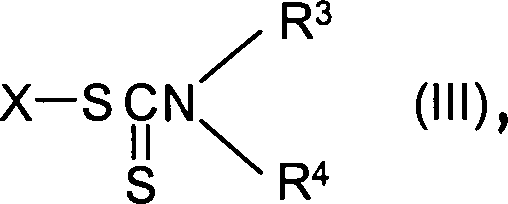


Spezielle Beispiele der Carbamatverbindungen der Formeln (III) bis (VII) schließen n-Butyl-N,N-dimethyldithiocarbamat, Benzyldithiocarbamat, Benzyl-N,N-dimethyldithio carbamat, Benzyl-N,N-diethyldithiocarbamat, Thiurammonosulfid, N,N'-Dimethylthiurammonosulfid, N,N,N',N'-Tetramethylthiurammonosulfid, N,N'-Diethylthiurammonosulfid, N,N,N',N'-Tetraethylthiurammonosulfid, Thiuramdisulfid, N,N-Dimethylthiuramdisulfid, N,N,N',N'-Tetramethylthiuramdisulfid, N,N'-Diethylthiuramdisulfid, N,N'-Dimethylthiuramtetrasulfid, N,N,N',N'-Tetraethylthiuramdisulfid, p-Xylolbis(dithiocarbamat), p-Xylolbis(N,N-dimethyldithiocarbamat), p-Xylolbis(N,N-diethyldithiocarbamat), 1,2-Bis(N,N-diethyldithiocarbamyl)ethan, 1,2-Bis(N,N-dimethyldithiocarbamyl)ethan, 1,2,3-Tris(N,N-dimethyldithiocarbamyl)propan, 1,2,4,5-Tetrakis(N,N-diethyldithiocarbamylmethyl)benzol und 1-(N,N-Diethyldithiocarbamyl)ethylacetat. Diese Carbamatverbindungen können allein verwendet werden oder in Kombination als eine Mischung von zwei oder mehreren von diesen.Specific examples of the carbamate compounds of the formulas (III) to (VII) include n-butyl-N, N-dimethyldithiocarbamate, benzyldithiocarbamate, Benzyl-N, N-dimethyldithio carbamate, benzyl-N, N-diethyldithiocarbamate, Thiurammonosulfide, N, N'-dimethylthiurammonosulfid, N, N, N ', N'-tetramethylthiuram monosulfide, N, N'-diethylthiuram monosulfide, N, N, N ', N'-tetraethylthiuram, Thiuram disulfide, N, N-dimethylthiuram disulfide, N, N, N ', N'-tetramethylthiuram disulfide, N, N'-Diethylthiuramdisulfid, N, N'-Dimethylthiuramtetrasulfid, N, N, N ', N'-tetraethyl, p-xylene bis (dithiocarbamate), p-xylene bis (N, N-dimethyldithiocarbamate), p-xylene bis (N, N-diethyldithiocarbamate), 1,2-bis (N, N-diethyldithiocarbamyl) ethane, 1,2-bis (N, N-dimethyldithiocarbamyl) ethane, 1,2,3-tris (N, N-dimethyldithiocarbamyl) propane, 1,2,4,5-tetrakis (N, N-diethyldithiocarbamylmethyl) benzene and 1- (N, N-diethyldithiocarbamyl) ethyl acetate. These carbamate compounds can used alone or in combination as a mixture of two or more of these.
Typische Beispiele der obigen Iod-Verbindung schließen Iodoform, Diiodmethan, Iod-1-phenylethane, Benziliodid, Iodoethan, 1,1-Diiodethan, 1,1,1-Triiodoethan, 1,2-Diiodoethan, 1-Iod-2-methylpropan, 2-(1-Ethoxy)ethylacetat, Methyl-2-iod-2-butanoat, Ethyl-2-iod-2-butanoat, Methyl-2-iodpropionat, Ethyl-2-iodpropionat, 4-Iodtoluol, 3-Iodtoluol, 2-Iodoethyl acetat und 2-Iodethylpropionat ein. Sie können allein verwendet werden oder in Kombination als eine Mischung von zwei oder mehreren von diesen.Typical examples of the above iodine compound conclude Iodoform, diiodomethane, iodine-1-phenylethane, benzil iodide, Iodoethane, 1,1-diiodethane, 1,1,1-triiodoethane, 1,2-diiodoethane, 1-iodo-2-methylpropane, 2- (1-ethoxy) ethyl acetate, methyl 2-iodo-2-butanoate, Ethyl-2-iodo-2-butanoate, Methyl 2-iodopropionate, ethyl 2-iodopropionate, 4-iodotoluene, 3-iodotoluene, 2-iodoethyl acetate and 2-iodoethyl propionate. You can do it alone used or in combination as a mixture of two or more of these.
Der Polymerisationsinitiator der in der vorliegenden Erfindung verwendet wird zusammen mit dem Radikal-Fänger, wie z. B. ein stabiles Nitroxyl-Radikal, eine Carbamat-Verbindung oder eine Iod-Verbindung, ist ein Radilalinitiator der herkömmlicherweise für eine radikalische Polymerisation verwendet wird.The polymerization initiator of the used in the present invention together with the radical scavenger, such as z. B. a stable nitroxyl radical, a carbamate compound or a Iodine compound, is a radical initiator which is conventional for one radical polymerization is used.
Als ein typisches Beispiel des Radikalinitiators können z. B. Peroxide, wie z. B. Benzoylperoxid, Acetylperoxid, Lauroylperoxid, Kaliumperoxydisulfat, Ammoniumperoxydisulfat, Cumolhydroperoxid, tert.-Butylhydroperoxid, Dicumylperoxid und Di-tert.-butylperoxid; Azoverbindungen, wie z. B. Azobisisobutyronitril, Azobis-2,4-dimethylvaleronitril, Azobiscyclohexancarbonitril und Azobis-2-amidinopropanhydrochlorid; Kombinationen vom Redox-Typ, wie z. B. Kaliumperoxydisulfat-Natriumsulfat und Ammoniumperoxydisulfat-Natriumsulfit; und Photoinitiatoren, wie z. B. Benzil, Benzophenon, Acetophenon, Trichloracetophenon, Methylbenzoylformiat und 2-Hydroxy-2-methyl-1-phenylpropan-1-on genannt werden.As a typical example of the radical initiator can z. B. peroxides such. B. benzoyl peroxide, acetyl peroxide, lauroyl peroxide, Potassium peroxydisulfate, ammonium peroxydisulfate, cumene hydroperoxide, tert-butyl hydroperoxide, dicumyl peroxide and di-tert-butyl peroxide; Azo compounds such as B. azobisisobutyronitrile, azobis-2,4-dimethylvaleronitrile, Azobiscyclohexane carbonitrile and azobis-2-amidinopropane hydrochloride; Combinations of the redox type, such as B. potassium peroxydisulfate sodium sulfate and ammonium peroxydisulfate sodium sulfite; and Photoinitiators such as B. benzil, benzophenone, acetophenone, trichloroacetophenone, Methylbenzoyl formate and 2-hydroxy-2-methyl-1-phenylpropan-1-one to be named.
Das radikalisch polymerisierbare Monomer, das in der vorliegenden Erfindung verwendet wird, kann geeignet ausgewählt werden für die Verwendung, abhängig von dem speziellen Zweck des Formkörpers, unter solchen, die von der oben beschriebenen Kombination eines Radikal-Fängers und eine Polymerisationsintiators polymerisierbar sind.The radically polymerizable Monomer used in the present invention may be suitable selected be for the use, depending of the special purpose of the molded body, among those by the combination of a radical scavenger described above and a polymerization initiator are polymerizable.
Speziell ist ein Monomer, das eine polymerisierbare ungesättigte Doppelbindung enthält, ausgewählt aus der Gruppe, bestehend aus einer Acryloylgruppe, einer Methacryloylgruppe, einer Vinylgruppe und einer Allylgruppe, besonderes geeignet für die Verwendung in der vorliegenden Erfindung, da ein solches Monomer hervorragend in der Polymerisierbarkeit ist durch die Kombination eines Radikal-Fängers und eine Polymerisationsintiators. Typische Beispiele eines solchen Monomers schließen ein Alkyl(meth)acrylat ein, wie z. B. Methyl(meth)acrylat, Ethyl(meth)acrylat, Propyl(meth)acrylat und Butyl(meth)acrylat; Fluoralkyl(meth)acrylate, wie z. B. Trifluorethyl(methjacrylat, Tetrafluorpropyl(meth)acrylat, Hexafluorisopropyl(meth)acrylat und Octafluorpentyl(meth)acrylat; Silicium enthaltende (Meth)acrylate, wie z. B. Trimethylsilylpropyl(meth)acrylat und Tris(trimethylsiloxy)silylpropyl(meth)acrylat; Hydroxyalkyl(meth)acrylate, wie z. B. 2-Hydroxyethyl(meth)acrylat und 2-Hydroxybutyl(meth)acrylat; (Meth)acrylamide, wie z. B. (Meth)acrylamid, N,N-Dimethyl(meth)acrylamid und N,N-Diethyl(meth)acrylamid; Styrol; Alkylstyrole, wie z. B. o-Methylstyrol, m-Methylstyrol, p-Methylstyrol, o-Ethylstyrol, m-Ethylstyrol, p-Ethylstyrol, o-Octylstyrol, m-Octylstyrol oder p-Octylstyrol; Fluoralkylstyrole, wie z. B. o-Trifluormethylstyrol, m-Trifluormethylstyrol und p-Trifluormethylstyrol; Silicium enthaltende Styrole, wie z. B. o-Trimethylsilylstyrol, m-Trimethylsilylstyrol, p-Trimethylsilylstyrol, o-Tris(trimethylsiloxy)silylstyrol, m-Tris(trimethylsiloxy)silylstyrol und p-Tris(trimethylsiloxy)silylstyrol; Vinylacetat; (Meth)acrylnitril; (Meth)acrylsäure; α-Methylstryol; und N-Vinylpyrrolidon. Diese Monomere können alleine verwendet werden oder in Kombination als eine Mischung von zwei oder mehreren von diesen.One monomer in particular is one polymerizable unsaturated Contains double bond, selected from the group consisting of an acryloyl group, a methacryloyl group, a vinyl group and an allyl group, particularly suitable for use in the present invention because such a monomer is excellent is in the polymerizability by the combination of a radical scavenger and a polymerization initiator. Typical examples of such Close monomers an alkyl (meth) acrylate such as e.g. B. methyl (meth) acrylate, ethyl (meth) acrylate, Propyl (meth) acrylate and butyl (meth) acrylate; Fluoroalkyl (meth) acrylates, such as z. B. trifluoroethyl (methacrylate, tetrafluoropropyl (meth) acrylate, Hexafluoroisopropyl (meth) acrylate and octafluoropentyl (meth) acrylate; Silicon containing (meth) acrylates, such as. B. Trimethylsilylpropyl (meth) acrylate and tris (trimethylsiloxy) silylpropyl (meth) acrylate; Hydroxyalkyl (meth) acrylates, such as B. 2-hydroxyethyl (meth) acrylate and 2-hydroxybutyl (meth) acrylate; (Meth) acrylamides, e.g. B. (meth) acrylamide, N, N-dimethyl (meth) acrylamide and N, N-diethyl (meth) acrylamide; styrene; Alkylstyrenes, such as. B. o-methylstyrene, m-methylstyrene, p-methylstyrene, o-ethylstyrene, m-ethylstyrene, p-ethylstyrene, o-octylstyrene, m-octylstyrene or p-octylstyrene; Fluoralkylstyrole, such as B. o-trifluoromethylstyrene, m-trifluoromethylstyrene and p-trifluoromethylstyrene; Silicon-containing styrenes, such as. B. o-trimethylsilylstyrene, m-trimethylsilylstyrene, p-trimethylsilylstyrene, o-tris (trimethylsiloxy) silylstyrene, m-tris (trimethylsiloxy) silylstyrene and p-tris (trimethylsiloxy) silylstyrene; vinyl acetate; (Meth) acrylonitrile; (Meth) acrylic acid; α-methylstyrene; and N-vinylpyrrolidone. These monomers can be used alone or in combination as a mixture of two or more of this.
In dieser Beschreibung steht "(Meth)acryl...." für "Acryl...." und/oder "Methacryl....".In this description, "(meth) acrylic ...." stands for "acrylic ...." and / or "methacrylic ....".
Um die mechanische Festigkeit oder Haltbarkeit des Formkörpers zu verbessern, ist es bevorzugt, ein vernetzbares Monomer einzusetzen, das eine polyfunktionale polymerisierbare Verbindung ist, die mindestens zwei copolymerisierbare ungesättigte Doppelbindungen in einem Molekül aufweist.To mechanical strength or Shelf life of the molded body to improve, it is preferred to use a crosslinkable monomer, which is a polyfunctional polymerizable compound having at least two copolymerizable unsaturated Double bonds in one molecule having.
Ein solches vernetzbares Monomer kann z. B. sein: Ethylenglykoldi(meth)acrylat, Diethylenglykoldi(meth)acrylat, Triethylenglykoldi(meth)acrylat, Propylenglykoldi(meth)acrylat, Dipropylenglykoldi(meth)acrylat, Allyl(meth)acrylat, Vinyl(meth)acrylat, Trimethylolpropantri(meth)acrylat, Methacryloyloxyethylacrylat, 3-Acryloyloxy-2-hydroxypropylmethacrylat, 3-Acryloyloxypropylmethacrylat, Butandiol(meth)acrylat, Divinylbenzol, Diallylphthalat, Diallyladipat, 2,2-Bis(4-(meth)acryloyloxyethoxyphenyl)propan, 2,2-Bis(4-(meth)acryloyloxypolyethoxyphenyl)propan, 2,2-Bis[(4-(3-(meth)acryloyloxy-2-hydroxypropoxy)-phenyl]propan, Di((meth)acryloyloxyethyl)trimethylhexamethylendiurethan, Triallylisocyanurat, α-Methylen-N-vinylpyrrolidon, 4-Allylbenzyl(meth)acrylat, 4-Vinylbenzyl(meth)acrylat, 3-Vinylbenzyl(meth)acrylat, 2,2-Bis(p-(meth)acryloyloxyphenyl)-hexafluorpropan, 2,2-Bis(m-(meth)acryloyloxyphenyl)hexafluorpropan, 2,2-Bis(o(meth)acryloyloxyphenyl)hexafluorpropan, 2,2-Bis(p-(meth)acryloyloxyphenyl)propan, 2,2-Bis(m-(meth)acryloyloxyphenyl)propan, 2,2-Bis(o-(meth)acryloyloxyphenyl)propan, 1,4-Bis(2-(meth)acryloyloxyhexafluorisopropyl)benzol, 1,3-Bis(2-(meth)acryloyloxyhexafluorisopropyl)benzol, 1,2-Bis(2-(meth)acryloyloxyhexafluorisopropyl)benzol, 1,4-Bis(2-(meth)-acryloyloxyisopropyl)benzol, 1,3-Bis(2-(meth)acryloyloxyisopropyl)benzol oder 1,2-Bis(2-(meth)acryloyloxyisopropyl)benzol. Diese vernetzbaren Monomere können alleine verwendet werden oder in Kombination als eine Mischung von zwei oder mehreren von diesen.Such a crosslinkable monomer can e.g. B. be: ethylene glycol di (meth) acrylate, diethylene glycol di (meth) acrylate, Triethylene glycol di (meth) acrylate, propylene glycol di (meth) acrylate, Dipropylene glycol di (meth) acrylate, allyl (meth) acrylate, vinyl (meth) acrylate, Trimethylolpropane tri (meth) acrylate, methacryloyloxyethyl acrylate, 3-acryloyloxy-2-hydroxypropyl methacrylate, 3-acryloyloxypropyl methacrylate, butanediol (meth) acrylate, divinylbenzene, Diallyl phthalate, diallyl adipate, 2,2-bis (4- (meth) acryloyloxyethoxyphenyl) propane, 2,2-bis (4- (meth) acryloyloxypolyethoxyphenyl) propane, 2,2-bis [(4- (3- (meth) acryloyloxy-2-hydroxypropoxy) phenyl] propane, di ((meth) acryloyloxyethyl) trimethylhexamethylene diurethane, Triallyl isocyanurate, α-methylene-N-vinylpyrrolidone, 4-allylbenzyl (meth) acrylate, 4-vinylbenzyl (meth) acrylate, 3-vinylbenzyl (meth) acrylate, 2,2-bis (p- (meth) acryloyloxyphenyl) hexafluoropropane, 2,2-bis (m- (meth) acryloyloxyphenyl) hexafluoropropane, 2,2-bis (o (meth) acryloyloxyphenyl) hexafluoropropane, 2,2-bis (p- (meth) acryloyloxyphenyl) propane, 2,2-bis (m- (meth) acryloyloxyphenyl) propane, 2,2-bis (o- (meth) acryloyloxyphenyl) propane, 1,4-bis (2- (meth) acryloyloxyhexafluoroisopropyl) benzene, 1,3-bis (2- (meth) acryloyloxyhexafluoroisopropyl) benzene, 1,2-bis (2- (meth) acryloyloxyhexafluoroisopropyl) benzene, 1,4-bis (2- (meth) acryloyloxyisopropyl) benzene, 1,3-bis (2- (meth) acryloyloxyisopropyl) benzene or 1,2-bis (2- (meth) acryloyloxyisopropyl) benzene. These crosslinkable monomers can used alone or in combination as a mixture of two or more of these.
Die Menge des vernetzbaren Monomers kann in der Regel geeignet eingestellt werden, abhängig von dem Typ des Formkörpers.The amount of crosslinkable monomer can usually be set appropriately, depending on the Shaped body type.
Bei der vorliegenden Erfindung hat die Viskosität oder Fließfähigkeit der teilweise polymerisierten Mischung, die eine Umsetzung des Monomers in das Polymere oder eine Polymerisationsrate von 5 bis 90 Gew.-% aufweist, Einfluss auf die Betriebseigenschaften oder die Effizienz beim Betrieb beim Füllen der teilweise polymerisierten Mischung in einen vorherbestimmten Hohlraum, wie z. B. in eine Form. Demzufolge ist es bei der vorliegenden Erfindung bevorzugt, die Menge des vernetzbaren Monomers innerhalb eines Bereichs einzustellen, der die Viskosität oder Fließfähigkeit der teilweise polymerisierten Mischung nicht nachteilig beeinflusst.In the present invention the viscosity or fluidity the partially polymerized mixture, which is a reaction of the monomer into the polymer or a polymerization rate of 5 to 90% by weight has an impact on operational characteristics or efficiency during operation when filling the partially polymerized mixture into a predetermined one Cavity, such as B. in a form. Hence it is with the present Invention preferred the amount of crosslinkable monomer within a range to adjust the viscosity or flowability of the partially polymerized Mixture not adversely affected.
Die Menge des vernetzbaren Monomers kann nicht allgemein definiert werden, da die Viskosität oder Fließeigenschaft der teilweise polymerisierten Mischung verschieden ist, abhängig von dem Typ des verwendeten Monomers oder abhängig von der Umsetzung des Monomers in das Polymere oder der Polymerisationsrate der teilweise polymerisierten Mischung. In der Regel beträgt sie jedoch vorzugsweise mindestens 0,01 Gew.-% bezogen auf die Gesamtmenge des verwendeten Monomers, um einen ausreichenden Vernetzungsgrad zu erreichen, und höchstens 5 Gew.-%, um eine hohe Viskosität oder Fließeigenschaft zu vermeiden.The amount of crosslinkable monomer cannot be generally defined because of viscosity or flow properties of the partially polymerized mixture is different depending on the type of monomer used or depending on the implementation of the Monomers in the polymer or the rate of polymerization of the partial polymerized mixture. As a rule, however, it is preferably at least 0.01 wt .-% based on the total amount of used Monomers in order to achieve a sufficient degree of crosslinking, and at the most 5% by weight to have a high viscosity or flow property to avoid.
Nun werden einige Beispiele für die Verwendung der obigen Monomere, abhängig von den Typen und den Verwendungen der Formkörper, beschrieben.Now some examples of use of the above monomers of the types and uses of the moldings.
Zum Beispiel ist es in einem Fall, bei dem eine optische Linse, wie z. B. eine Intraokularlinse, eine Kameralinse oder eine Linse für Brillen, hergestellt wird, bevorzugt, ein Monomer zu verwenden, das Methylmethacrylat als die Hauptkomponente umfasst. In einem Fall, bei dem eine optische Kunststofffaser hergestellt wird, ist es bevorzugt, ein Monomer zu verwenden, das Methylmethacrylat als den Hauptbestandteil für den Kernbereich umfasst und ein Monomer, das ein Fluoralkylmethacrylat als den Hauptbestandteil für den Mantelbereich oder den Hüllenbereich umfasst. Ferner ist es z. B. in einem Fall, bei dem eine Kontaktlinse hergestellt wird, die eine hohe Sauerstoffpermeabilität oder Sauerstoffdurchlässigkeit aufweist, bevorzugt, Methylmethacrylat und ein Silicium oder Silikon enthaltendes Methacrylat, wie z. B. Trimethylsilylpropylmethacrylat oder Tris(trimethylsiloxy)silylpropylmethacrylat, ein Fluor enthaltendes (Meth)acrylat, wie z. B. 2,2,2-Trifluorethyl(meth)acrylat oder 2,2,2,2',2',2'-Hexafluorisopropyl(meth)acrylat, ein Silicium oder Silikon enthaltendes Styrol, wie z. B. Tris(trimethylsiloxy)silylstyrol, oder ein hydrophiles Monomer, wie z. B. N-Vinylpyrrolidon oder Methacrylsäure in Kombination zu verwenden.For example, in one case in which an optical lens, such as. B. an intraocular lens, a Camera lens or a lens for Glasses, is manufactured, preferably using a monomer which includes methyl methacrylate as the main component. In one Case where an optical plastic fiber is manufactured it prefers to use a monomer which is called methyl methacrylate the main ingredient for comprises the core area and a monomer which is a fluoroalkyl methacrylate as the main ingredient for the jacket area or the envelope area includes. Furthermore, it is e.g. B. in a case where a contact lens is produced that has a high oxygen permeability or oxygen permeability comprises, preferably, methyl methacrylate and a silicon or silicone containing methacrylate, such as. B. trimethylsilylpropyl methacrylate or Tris (trimethylsiloxy) silylpropyl methacrylate, a fluorine-containing (Meth) acrylate, such as. B. 2,2,2-trifluoroethyl (meth) acrylate or 2,2,2,2 ', 2', 2'-hexafluoroisopropyl (meth) acrylate Silicon or silicone containing styrene, such as. B. tris (trimethylsiloxy) silylstyrene, or a hydrophilic monomer such as e.g. B. N-vinylpyrrolidone or methacrylic acid in combination to use.
Das Polymerisationsverhalten der obigen Mischung, die den Radikal-Fänger, den Polymerisationsinitiator und das radikalisch polymerisierbare Monomer umfasst, ist wie eine lebende Polymerisation, und das Polymerisationsgewicht des sich ergebenden Polymers wird beeinflusst von der Menge des Polymerisationsinitiators.The polymerization behavior of the above mixture, which contains the radical scavenger, the polymerization initiator and comprising the radically polymerizable monomer is like one living polymerization, and the polymerization weight of itself resulting polymer is affected by the amount of the polymerization initiator.
Allgemein wird das Molekulargewicht des sich ergebenden Polymers groß, wenn die Menge des Polymerisationsinitiator gering ist, wobei die Viskosität der teilweise polymeri sierten Mischung dazu neigt, groß zu sein, was umgekehrt die Betriebseigenschaften negativ beeinflusst beim Einfüllen der teilweise polymerisierten Mischung in einen vorher bestimmten Hohlraum, wie z. B. in eine Form. Ferner neigt die Zeit oder Dauer, die für die Polymerisation benötigt wird, dazu lang oder groß zu werden, wenn die Menge des Polymerisationsinitiators gering ist. Unter diesen Gesichtspunkten beträgt die Menge des Iniferters in der Regel mindestens 0,005 Gew.-Teile, vorzugsweise mindestens 0,01 Gew.-Teile, pro 100 Gew.-Teile des radikalisch polymerisierbaren Monomers.Generally the molecular weight of the resulting polymer is large when the amount of the polymerization initiator is low, the viscosity the partially polymerized mixture tends to be large which in turn negatively affects the operating characteristics of the pour in the partially polymerized mixture into a predetermined one Cavity, such as B. in a form. Furthermore, the time or duration tends the for the polymerization needed is too long or big to when the amount of the polymerization initiator is small. From this point of view, the amount of the iniferter is usually at least 0.005 parts by weight, preferably at least 0.01 parts by weight per 100 parts by weight of the radically polymerizable monomer.
Andererseits neigt das Molekulargewicht des sich ergebenden Polymers dazu, gering zu sein, wenn die Menge des Polymerisationsinitiators zu groß ist, und die mechanische Festigkeit neigt dazu, gering zu sein. Demzufolge beträgt die Menge des Polymerisationsinitiators in der Regel höchstens 10 Gew.-Teile, vorzugsweise höchstens 5 Gew.-Teile, pro 100 Gew.-Teile des radikalisch polymerisierbaren Monomers.On the other hand, the molecular weight tends of the resulting polymer to be small when the amount of the polymerization initiator is too large, and the mechanical Strength tends to be low. As a result, the amount is of the polymerization initiator generally at most 10 parts by weight, preferably at the most 5 parts by weight, per 100 parts by weight of the radically polymerizable Monomer.
Wie oben beschrieben ist die kombinierte Verwendung eines Polymerisationsinitiators und eines Radikal-Fängers ein Hauptmerkmal der vorliegenden Erfindung. Bei dem Verfahren der vorliegenden Erfindung unterliegen Propagations- oder Fortpflanzungsradikale oder Radikale die der Polymerisation unterliegen, einer Terminieruings oder Abbruchreaktion, wie z. B. einer Rekombination oder Disproportionierung während der Polymerisation, wenn die Menge des Radikal-Fängers zu gering ist, und wenn eine Polymerisationsenergie wieder auf die teilweise polymerisierte Mischung angewendet wird, kann eine Polymerisation nicht wieder neu aufgenommen werden oder von statten gehen. Um dies zu vermeiden beträgt die Menge des Radikal-Fängers in der Regel mindestens 10 mol, vorzugsweise mindestens 30 mol, pro 100 mol des Initiations- oder Startfragments, das von dem Polymerisationsinitiator erzeugt wird.As described above, the combined one Use of a polymerization initiator and a radical scavenger Main feature of the present invention. In the process of the present Invention are subject to propagation or propagation radicals or radicals that are subject to polymerization, a termination or termination reaction, such as B. a recombination or disproportionation while polymerization if the amount of radical scavenger is too small and if a polymerization energy back to the partially polymerized If mixture is applied, polymerization cannot occur again to be newly included or to take place. To avoid this is the amount of radical scavenger in usually at least 10 mol, preferably at least 30 mol, per 100 moles of the initiation or starting fragment from the polymerization initiator is produced.
Wenn andererseits die Menge des Radikal-Fängers zu groß ist, ist die Radikal-Konzentration des Systems während der Polymerisation so niedrig, dass ein langer oder großer Zeitraum für die Ppolymerisation benötigt wird. Unter diesen Gesichtspunkten beträgt die Menge des Radikal-Fängers in der Regel höchstens 500 mol, vorzugsweise höchstens 200 mol, pro 100 mol des Initiations- oder Startfragments, das von dem Polymerisationsinitiator erzeugt wird.On the other hand, if the amount of radical scavenger increases is great is the radical concentration of the system during polymerization so low that a long or long period of time for the Polymerization needed becomes. From this point of view, the amount of the radical scavenger is in usually at most 500 mol, preferably at most 200 mol, per 100 mol of the initiation or starting fragment, which of the polymerization initiator is generated.
Wenn jedoch 1 mol des verwendeten Radikal-Fängers mindestens 2 mol des stabilen Radikals (T·) erzeugt, kann die Menge des Radikal-Fängers vermindert oder gesenkt werden gemäß der Anzahl der Mole oder der Stoffmenge des erzeugten stabilen Radikals.However, if 1 mol of the used Radical scavenger generates at least 2 mol of the stable radical (T ·), the amount of the radical scavenger be reduced or decreased according to the number of moles or the amount of substance of the stable radical generated.
Sofern es notwendig ist, kann ein Zusatzstoff, wie z. B. ein Farbstoff, ein Pigment, ein Füllstoff oder ein Antioxidans, zu der Mischung die den Radikal-Fänger, den Polymerisationsinitiator und das radikalisch polymerisierbare Monomer enthält, innerhalb eines Bereichs zugegeben werden, um den Zweck der vorliegenden Erfindung nicht zu beeinträchtigen. Wenn solche Additive eingesetzt werden, ist es bevorzugt, sie so zu mischen, dass die Additive einheitlich in der Mischung, die den Radikal-Fänger, den Polymerisationsinitiator und das radikalisch polymerisierbare Monomer umfasst, dispergiert oder gelöst sind.If necessary, a Additive such as B. a dye, a pigment, a filler or an antioxidant, to the mixture that contains the radical scavenger Polymerization initiator and the radically polymerizable monomer contains be added within a range for the purpose of the present invention not to interfere. If such additives are used, it is preferred to do so to mix that the additives are uniform in the mixture that the Radical scavenger, the polymerization initiator and the radically polymerizable Monomer comprises, dispersed or dissolved.
Ferner kann ein Lösungsmittel oder dergleichen zu der Mischung, die den Radikal-Fänger, den Polymerisationsinitiator und das radikalisch polymerisierbare Monomer umfasst, gegeben werden, sofern es notwendig ist.Furthermore, a solvent or the like to the mixture that contains the radical scavenger Polymerization initiator and the radically polymerizable monomer includes, if necessary.
Es ist bevorzugt, als ein solches Lösungsmittel ein Lösungsmittel einzusetzen, das in der Lage oder geeignet oder im Stande ist, das radikalisch polymerisierbare Monomer, den Radikal-Fänger, den Polymerisationsinitiator und die Zusatzstoffe als auch das sich ergebende Polymer zu lösen, und das die Polymerisation des obigen Monomers nicht behindert und keine charakteristische Absorption im Wellenlängenbereich von Lichtstrahlen für die Polymerisation zeigt, wenn die Polymerisation durch Licht induziert oder ausgeführt wird. Als ein Lösungsmittel, das eine solche Eigenschaft oder Natur aufweist, kann z. B. Toluol, Xylol, Ethylbenzol, Aceton, Methylethylketon, Ethylacetat, Dimethylformamid, Isopropylalkohol, Hexan oder Heptan genannt werden.It is preferred as such solvent a solvent use that is capable or suitable or capable of radically polymerizable monomer, the radical scavenger, the Polymerization initiator and the additives as well dissolving the resulting polymer and that does not hinder the polymerization of the above monomer and no characteristic absorption in the wavelength range of light rays for the Polymerization shows when polymerization is induced by light or executed becomes. As a solvent, which has such a property or nature, z. B. toluene, Xylene, ethylbenzene, acetone, methyl ethyl ketone, ethyl acetate, dimethylformamide, Isopropyl alcohol, hexane or heptane can be called.
Eine teilweise polymerisierte Mischung, die eine Umsetzung des Monomers in das Polymer oder einen Polymerisationsgrad von 5 bis 90 Gew.-% aufweist, wird durch Polymerisation einer Mischung hergestellt, die den Radikal-Fänger, den Polymerisationsinitiator und das radikalisch polymerisierbare Monomer umfasst, oder, sofern es notwendig ist, einer Lösung einer Mischung, die den Radikal-Fänger, den Polymerisationsinitiator und das radikalisch polymerisierbare Monomer, gelöst in dem oben beschriebenen Lösungsmittel, umfasst.A partially polymerized mixture which is a conversion of the monomer into the polymer or a degree of polymerization from 5 to 90% by weight is obtained by polymerizing a mixture made the radical scavenger, the polymerization initiator and the radically polymerizable Monomer comprises, or, if necessary, a solution of one Mixture that the radical scavenger, the polymerization initiator and the radically polymerizable Monomer, dissolved in the solvent described above, includes.
Als ein Verfahren für die Polymerisation der Mischung kann z. B. eine Photopolymerisation oder eine Polymerisation mit Wärme oder einem Erwärmen genannt werden.As a process for polymerization the mixture can e.g. B. a photopolymerization or a polymerization with warmth or a warming to be named.
Die Polymerisationsenergie, die verwendet wird für die Polymerisation der Mischung, kann z. B. eine elektromagnetische Strahlungsenergie sein, wie z. B. Lichtstrahlen, oder eine Wärmeenergie, die z. B. durch Erwärmen erzeugt wird. Diese Typen von Energien können alleine oder in Kombination verwendet werden.The polymerization energy used is for the polymerization of the mixture, e.g. B. an electromagnetic Radiant energy, such as B. light rays, or a thermal energy, the z. B. by heating is produced. These types of energies can work alone or in combination be used.
Ultraviolettes Licht kann als typisches Licht oder Lichtstrahlen (elektromagnetische Strahlung) genannt werden, die verwendet werden für die Photopolymerisation. Die Intenstität und die Wellenlänge solchen ultravioletten Lichts können nicht allgemein definiert werden, da sie verschieden sind, in Abhängigkeit von den Typen des Radikal-Fängers, des Polymerisationsinitiators und des verwendeten Monomers, etc. In der Regel beträgt die Wellenlänge solch ultravioletten Lichts oder solcher ultravioletten Strahlen vorzugsweise mindestens 250 nm, um die Zersetzung des Monomers durch Exzitation zu vermeiden. Andererseits, wenn die Wellenlänge des ultravioletten Lichts oder der ultravioletten Strahlen lang wird nahe zu dem Wellenlängenbereich des sichtbaren Lichts, wird es notwendig das sichtbare Licht sorgfältig abzuschirmen, und das Verfahren neigt dazu, etwas beschwerlich zu werden. Demzufolge beträgt die Wellenlänge des ultravioletten Lichts oder der ultravioletten Strahlen vorzugsweise höchstens 450 nm.Ultraviolet light can be typical Light or rays of light (electromagnetic radiation) are called, that are used for photopolymerization. The intensity and the wavelength such ultraviolet light can cannot be generally defined since they are different depending the types of radical scavenger, the polymerization initiator and the monomer used, etc. Usually amounts to the wavelength such ultraviolet light or ultraviolet rays preferably at least 250 nm to decompose the monomer by Avoid excitation. On the other hand, if the wavelength of the ultraviolet light or the ultraviolet rays become long close to the wavelength range of visible light, it becomes necessary to carefully shield the visible light, and the process tends to get a little cumbersome. As a result, is the wavelength the ultraviolet light or the ultraviolet rays preferably at the most 450 nm.
In einem Fall, bei dem die Polymerisation des Monomers ausgeführt wird durch eine Bestrahlung mit Lichtstrahlen, ist es möglich, die Polymerisation auszuführen durch Hineingeben des Monomers in einen Behälter der Licht durch lässt und durch Bestrahlen des Mono mers mit Lichtstrahlen von außerhalb des Behälters. Die Temperatur zu diesem Zeitpunkt kann Raumtemperatur betragen oder höher oder niedriger sein als Raumtemperatur. Unter dem Gesichtspunkt eines effizienten Betriebs beträgt die Temperatur vorzugsweise Raumtemperatur.In a case where the polymerization of the monomer is carried out by irradiation with Light rays, it is possible to carry out the polymerization by putting the monomer in a container which allows light to pass through and by irradiating the monomer with light rays from outside the container. The temperature at this time can be room temperature or higher or lower than room temperature. From the viewpoint of efficient operation, the temperature is preferably room temperature.
Andererseits beträgt die Erwärmungstemperatur oder Heiztemperatur in der Regel von 10 bis 250°C, vorzugsweise 50 bis 130°C, in einem Fall, bei dem die Polymerisation durch Erwärmen ausgeführt wird. Da die optimale Temperatur verschieden ist in Abhängigkeit von dem verwendeten Radikal-Fänger und dem Polymerisationsinitiator, wird die Erwärmungs- oder Heiztemperatur vorzugsweise gemäß den Typen von dem verwendeten Radikal-Fänger und dem Polymerisationsinitiator verändert.On the other hand, the heating temperature or heating temperature is usually from 10 to 250 ° C, preferably 50 to 130 ° C, in a case where the polymerization is carried out by heating. Since the optimal temperature is different depending of the radical scavenger used and the polymerization initiator, the heating or heating temperature is preferably according to the types of the radical scavenger used and the polymerization initiator changed.
In einem Fall, bei dem die Polymerisation induziert oder ausgeführt wird durch Bestrahlen mit Lichtstrahlen, verändert sich die Polymerisationszeit, in Abhängigkeit von einem geringfügigen Unterschied in dem Abstand von der Lichtquelle, dem Typ des Behälters, der verwendet wird, oder der Menge des Monomers, selbst wenn das gleiche Monomer, der gleiche Radikal-Fänger und der gleiche Polymerisationsinitiator eingesetzt werden. Daher kann die Polymerisationszeit nicht allgemein definiert werden, und sie wird vorzugsweise ungefähr eingestellt, in Abhängigkeit von den verschiedenen Polymerisationsbedingungen.In a case where the polymerization induced or executed is irradiated with light rays, the polymerization time changes, dependent on from a minor Difference in the distance from the light source, the type of container that is used, or the amount of monomer, even if the same Monomer, the same radical scavenger and the same polymerization initiator can be used. Therefore the polymerization time cannot be generally defined, and it preferably becomes approximate set, depending of the different polymerization conditions.
Wie oben ausgeführt, wird die vorliegende Erfindung durch die Verwendung eines Radikal-Fängers gekennzeichnet, wobei das Fortschreiten und die Beendigung oder der Abbruch der Polymerisation des Monomers kontrolliert oder gesteuert werden kann durch Einstellen der Bestrahlung und der Beendigung der Bestrahlung mit Lichtstrahlen oder durch Einstellen des Erwärmens.As stated above, the present invention characterized by the use of a radical scavenger, where the progress and termination or termination of the polymerization of the monomer can be controlled or controlled by adjusting the irradiation and the termination of the irradiation with light rays or by stopping heating.
Demzufolge kann eine teilweise polymerisierte Mischung hergestellt werden, die einen vorherbestimmten Polymerisationsgrad oder eine vorherbestimmte Umsetzung des Monomers in das Polymer aufweist, durch Polymerisation der Mischung, die den Radikal-Fänger, den Polymerisationsinitiator und das radikalisch polymerisierbare Monomer umfasst auf eine solche Art und Weise, dass die Bestrahlung mit Lichtstrahlen oder das Erwärmen gestoppt wird durch Abschirmen des Lichts oder Kühlen, wenn die Polymerisation des Monomers bis zu einem vorherbestimmten Polymerisationsgrad oder Umsetzung des Monomers in das Polymer fortgeschritten ist.As a result, a partially polymerized one Mixture are produced that have a predetermined degree of polymerization or a predetermined conversion of the monomer into the polymer has, by polymerization of the mixture containing the radical scavenger Polymerization initiator and the radically polymerizable monomer includes in such a way that irradiation with Rays of light or warming is stopped by shielding the light or cooling when the polymerization of the monomer up to a predetermined degree of polymerization or Conversion of the monomer into the polymer has progressed.
Der Polymerisationsgrad oder die Umsetzung des Monomers in das Polymer wird in dieser Beschreibung dargestellt durch den prozentualen Gewichtsanteil, der erhalten wird, durch Teilen der Menge (nach Gewicht) des polymerisierten Monomers durch die Menge (nach Gewicht) des Monomers vor dem Start oder Beginn der Polymerisation, wie es durch die folgende Formel dargestellt wird:The degree of polymerization or the Implementation of the monomer in the polymer is described in this description represented by the percentage weight obtained by dividing the amount (by weight) of the polymerized Monomer by the amount (by weight) of the monomer before starting or start the polymerization as indicated by the following formula is pictured:


Um die Polymerisationsschrumpfung während der Herstellung eines Polymers aus dem Halbpolymer zu senken oder reduzieren, wird die Umsetzung des Monomers in das Polymer der teilweise polymerisierten Mischung, die erhältlich ist durch Polymerisation der Mischung, die den Radikal-Fänger, den Polymerisationsinitiator und das radikalisch polymerisierbare Monomer umfasst, so eingestellt, dass sie mindestens 5 Gew.-%, vorzugsweise mindestens 10 Gew.-%, ganz besonders bevorzugt mindestens 20 Gew.-%, beträgt. Andererseits beträgt die die Umsetzung des Monomers in das Polymer in der Regel höchstens 90 Gew.-%, vorzugsweise höchstens 80 Gew.-%, um eine Möglichkeit zu vermeiden, dass die Viskosität der teilweise polymerisierten Mischung dazu neigt, so hoch zu sein, dass der effiziente Betrieb für ein Einfüllen der teilweise polymerisierten Mischung in eine vorgeschriebene Kavität oder einen Hohlraum dazu neigt, vermindert oder verschlechtert zu sein.To shrink the polymerization while the manufacture of a polymer from the semi-polymer or reduce, the conversion of the monomer into the polymer will partially polymerized mixture obtainable by polymerization the mixture that catches the radical, the polymerization initiator and the radically polymerizable Monomer comprises, adjusted so that it is at least 5% by weight, preferably at least 10% by weight, very particularly preferably at least 20% by weight, is. On the other hand, the conversion of the monomer into the polymer usually at most 90% by weight, preferably at most 80 wt% to one possibility to avoid the viscosity the partially polymerized mixture tends to be so high that efficient operation for a filling the partially polymerized mixture into a prescribed cavity or Cavity tends to be diminished or deteriorated.
Um die Polymerisation zu beenden oder stoppen, wenn sie die gewünschte Umsetzung des Monomers in das Polymer erreicht hat, ist es bevorzugt, im Vorhinein das Verhältnis zwischen der Umsetzung des Monomers in das Polymer und der Bestrahlungszeit mit Lichtstrahlen oder der Heizdauer zu erfassen oder festzulegen.To end the polymerization or stop when you get the one you want Conversion of the monomer into the polymer, it is preferred the relationship beforehand between the conversion of the monomer into the polymer and the irradiation time to capture or fix with light rays or the duration of heating.
Die teilweise polymerisierte Mischung, die auf diese Weise erhalten wird, kann unmittelbar verwendet werden für die nachfolgende Stufe oder den nachfolgenden Schritt, oder sie kann gelagert werden, so dass sie verwendet werden kann, wenn sie benötigt wird.The partially polymerized mixture, obtained in this way can be used immediately for the subsequent stage or step, or it can stored so that it can be used when needed.
Bei der obigen teilweise polymerisierten Mischung schreitet die Polymerisation unter einer Bedingung, bei der Lichtstrahlen abgeschirmt werden, nicht fort, wenn ein Radikal-Fänger und ein Polymerisationsinitiator verwendet werden, die im Stande sind, mit Licht zu funktionieren. Auf gleiche Weise schreitet eine Polymerisation bei einer Temperatur, die niedriger ist als die Grenztemperatur für die Polymerisation nicht fort, wenn ein Radikal-Fänger und ein Polymerisationsinitiator verwendet werden, die im Stande oder geeignet sind, mit Wärme zu funktionieren. Die teilweise polymerisierte Mischung kann daher in diesem Zustand gelagert werden. Demzufolge ist es notwendig, Licht abzuschirmen, so dass Lichtstrahlen die teilweise polymerisierte Mischung nicht bestrahlen, wenn die teilweise polymerisierte Mischung gelagert wird, oder sie bei einer Temperatur zu halten oder aufzubewahren, die niedriger ist als die Grenztemperatur, vorzugsweise unter der Bedingung einer niedrigen Temperatur.In the above partially polymerized mixture, the polymerization does not proceed under a condition in which light rays are shielded when using a radical scavenger and a polymerization initiator capable of functioning with light. Likewise, when a radical scavenger and a polymerization initiator are used which are capable or capable of functioning with heat, polymerization does not proceed at a temperature lower than the limit temperature for the polymerization. The partially polymerized mixture can therefore be stored in this state. Accordingly, it is necessary to shield light so that light rays do not irradiate the partially polymerized mixture when the partially polymerized mixture is stored, or to keep or store it at a temperature lower than the cut-off temperature, preferably under the condition of a low temperature ,
Einige der oben genannten Radikal-Fänger können sich während der Lagerung der teilweise polymerisierte Mischung zersetzen und ein Härten oder Polymerisieren der teilweise polymerisierte Mischung verursachen oder hervorrufen. Dementsprechend sollte die Temperatur während der Lagerung der teilweise polymerisierten Mischung, die unter Verwendung eines solchen Radikal-Fängers erhalten wurde, vorzugsweise nicht zu hoch sein. Unter einem solchen Gesichtspunkt ist es in der Regel bevorzugt, die oben genannte teilweise polymeri sierte Mischung, wenn sie gelagert wird, bei einer Temperatur zu lagern, die nicht höher ist als Raumtemperatur.Some of the free radical scavengers listed above can while decompose the storage of the partially polymerized mixture and a hardening or polymerize the partially polymerized mixture or evoke. Accordingly, the temperature during the Storage of the partially polymerized mixture using of such a radical scavenger obtained, preferably not to be too high. Under one From the point of view, it is usually preferred to partially address the above polymerized mixture when stored at one temperature to store that not higher is as room temperature.
Die Eigenschaft, dass die teilweise polymerisierte Mischung gelagert werden kann, wie oben beschrieben, bietet einen weiten Bereich von Vorzügen. Zum Beispiel ist es dem Hersteller möglich, die teilweise polymerisierte Mischung nach ihrer Herstellung in einem Vorrat bis zu ihrer Verwendung für die Herstellung eines Formkörpers aufzubewahren.The property that the partial polymerized mixture can be stored as described above offers a wide range of benefits. For example it is Manufacturer possible the partially polymerized mixture after its preparation in to be kept in a store until they are used for the production of a shaped body.
Dann wird die teilweise polymerisierte Mischung wieder mit Lichtstrahlen bestrahlt oder erhitzt, um ihre Polymerisation zu vervollständigen.Then the partially polymerized Mix again irradiated with light rays or heated to their polymerization to complete.
Bisher war es, um einen Formkörper aus der teilweise polymerisierten Mischung herzustellen, notwendig, einen Polymerisationsinitiator oder dergleichen frisch dazuzugeben, um die Polymerisation wieder aufzunehmen oder wieder neu zu starten. Wenn ein Polymerisationsinitiator zu einer solchen teilweise polymerisierten Mischung hinzugegeben wird, ist es jedoch schwierig, einen solchen Polymerisationsinitiator gleichförmig in der teilweise polymerisierten Mischung zu verteilen oder dispergieren, und, wie oben ausgeführt, kann ein solches Verfahren nicht von einem Anwender verwendet werden, der keine Ausrüstung besitzt, die benötigt wird, um einen solchen Polymerisationsinitiator zu mischen.So far it was made out of a molded body to produce the partially polymerized mixture, freshly add a polymerization initiator or the like, to start the polymerization again or to start again. When a polymerization initiator partially polymerized to one Mixture is added, however, it is difficult to add one Polymerization initiator uniform in distribute or disperse the partially polymerized mixture, and, as stated above, such a method cannot be used by a user of no equipment owns that is needed to mix such a polymerization initiator.
Im Gegensatz dazu kann mit der teilweise polymerisierten Mischung, die in der vorliegenden Erfindung verwendet wird, eine Polymerisation einfach wieder aufgenommen werden durch Bestrahlen mit Lichtstrahlen oder durch ein Erwärmen ohne eine Zugabe eines frischen Polymerisationsinitiators, wobei ein Formkörper, der eine einheitliche Zusammensetzung aufweist, einfach und wirtschaftlich hergestellt werden kann.In contrast, with the partial polymerized mixture used in the present invention will be resumed simply by polymerization Irradiate with light rays or by heating without adding any fresh polymerization initiator, wherein a molded body, the has a uniform composition, simple and economical can be manufactured.
Durch ein Einfüllen der obigen teilweise polymerisierten Mischung in eine vorherbestimmte Kavität oder einen Hohlraum, wie z. B. eine Form, und ein Vervollständigen der Polymerisation ist es möglich, einen Formkörper zu erhalten, der hervorragende Übertragbarkeit oder Herausnehmbarkeit aus der Form aufweist oder ein gehärtetes Füllmaterial ohne Poren.By filling the above partially polymerized Mix in a predetermined cavity or cavity, such as z. B. a shape, and is completion of the polymerization it possible a molded body to get the excellent portability or has removability from the mold or a hardened filler without pores.
In einem Fall, bei dem der obige Formkörper eine Linse ist für eine Brille oder eine Okular- oder Augenlinse, wie z. B. eine Kontaktlinse, wird die obige teilweise polymerisierte Mischung in einen Hohlraum einer Form, welche die vorherbestimmte Linsenform aufweist, gefüllt, gefolgt von einer Bestrahlung mit Lichtstrahlen oder einem Erwärmen, um die Polymerisation zu vervollständigen, um eine Linse, welche die vorherbestimmte Form aufweist, herzustellen.In a case where the above moldings a lens is for glasses or an eyepiece or eye lens, such as B. a contact lens, the above partially polymerized mixture is placed in a cavity a shape having the predetermined lens shape, followed from exposure to light rays or heating to to complete the polymerization, to manufacture a lens having the predetermined shape.
Es ist dadurch möglich, einen Formkörper zu erhalten, der eine hoch genaue vorherbestimmte Form aufweist, weil er schon auf der Stufe der teilweise polymerisierten Mischung zu einem vorherbestimmten Polymerisationsgrad oder einer vorherbestimmten Umsetzung des Monomers in das Polymer polymerisiert ist, und eine Polymerisationsschrumpfung auf der Stufe der Herstellung des Formkörpers aus der teilweise polymerisierten Mischung sehr gering ist.This makes it possible to form a molded body obtained which has a highly precise predetermined shape because he already at the stage of the partially polymerized mixture a predetermined degree of polymerization or a predetermined Implementation of the monomer in the polymer is polymerized, and a Polymerization shrinkage at the stage of the production of the molded body the partially polymerized mixture is very low.
Nun wird das Verfahren zur Herstellung eines Formkörpers der vorliegenden Erfindung in weiteren Einzelheiten an Hand von Beispielen beschrieben. Dies soll jedoch so ver standen werden, dass die vorliegende Erfindung keineswegs auf solche spezielle Beispiele beschränkt ist.Now the manufacturing process of a shaped body of the present invention in more detail with reference to Examples described. However, this should be understood to mean that the present invention in no way applies to such specific examples limited is.
BEISPIEL 1EXAMPLE 1
100 Gewichtsteile Styrol als ein Monomer wurden mit 0,53 Gewichtsteilen Azobisisobutyronitril als Polymerisationsinitiator und 1 Gewichtsteil 2,2,6,6-Tetramethyl-1-piperidinyloxy als Radilal-Fänger gemischt, um eine Mischung, die eine einheitlichte Zusammensetzung aufweist, zu erhalten. 20 g der erhaltenen Mischung wurden in einem Gläschen oder Behälter (V-20, hergestellt von Nichiden Rika Glass K. K.) verschlossen oder abgedichtet, und in einem Öl-Bad bei etwa 100°C 4 Stunden lang stehen gelassen und 2 Tage lang bei etwa 130°C, um einen teilweise polymerisierten Zustand zu erhalten. Als Ergebnis wurde eine Zunahme in der Viskosität beobachtet, und eine teilweise polymerisierte Mischung wurde erhalten.100 parts by weight of styrene as one Monomer was used with 0.53 parts by weight of azobisisobutyronitrile Polymerization initiator and 1 part by weight of 2,2,6,6-tetramethyl-1-piperidinyloxy as Radilal Catcher mixed to form a mixture that has a uniform composition has to get. 20 g of the mixture obtained were in one glass or container (V-20, manufactured by Nichiden Rika Glass K.K.) closed or sealed, and in an oil bath at about 100 ° C Allow to stand for 4 hours and at about 130 ° C for 2 days to get partially polymerized state. As a result an increase in viscosity observed and a partially polymerized mixture was obtained.
Dann wurde der Polymerisationsgrad oder die Umsetzung des Monomers in das Polymer und das Molekulargewicht der erhaltenen teilweise polymerisierten Mischung durch einen Gelpermeationschromatograph, der mit einem Ultraviolett-Absorbtions-Detektor und einem Differential-Refraktometer ausgestattet war, gemessen. Als Ergebnis wurde gefunden, dass die Umsetzung des Monomers in das Polymer etwa 66 Gew.-% betrug, und dass das Molekulargewicht-Zahlenmittel etwa 10.600 betrug.Then the degree of polymerization or the conversion of the monomer into the polymer and the molecular weight the partially polymerized mixture obtained by a gel permeation chromatograph with an ultraviolet absorption detector and a differential refractometer was equipped, measured. As a result, it was found that the Conversion of the monomer into the polymer was about 66 wt .-%, and that the number average molecular weight was about 10,600.
Die Bedingungen bei der Analyse durch den Gelpermeationschromatograph waren wie folgt.The conditions when analyzing the gel permeation chromatograph were as follows.
Instrument: DG-980-50 (3-Linien Entgaser), PU-980 (HPLC Pumpe), CO-965 (Säulenofen), RI-930 (RI Detektor) and UV-970 (UV-VIS Detektor) hergestellt von Nippon Bunko K. K.Instrument: DG-980-50 (3-line degasser), PU-980 (HPLC pump), CO-965 (column oven), RI-930 (RI detector) and UV-970 (UV-VIS detector) manufactured by Nippon Bunko K.K.
Laufmittel: Tetrahydrofuran (THF) der garantierten Reinheit, NakaraitesqueEluent: tetrahydrofuran (THF) of guaranteed purity, nakaraitesque
Flussrate: 1 ml/minFlow rate: 1 ml / min
Säulentemperatur: 40 DEG CColumn temperature: 40 ° C.
Säule:
KF805 + KF804 + KF803 + Waters Ultrastyragel 100 A + KF801, die
in dieser Reihenfolge in der Flussrichtung verbunden sind
Ausschlussgrenze
des Molekulargewichts: etwa 3.000.000 bis zu mehreren ZehnerstellenColumn: KF805 + KF804 + KF803 + Waters Ultrastyragel 100 A + KF801, which are connected in this order in the direction of flow
Exclusion limit of the molecular weight: about 3,000,000 up to several tens
Proben-Schleifenvolumen: 100 μlSample loop volume: 100 μl
Detektor: Ein RI Detektor und ein UV Detektor (Detektionswellenlänge: 280 nm für Styrol, und 240 nm for andere), die in Reihe oder hintereinander oder seriell angeordnet sindDetector: One RI detector and one UV detector (detection wavelength: 280 nm for Styrene, and 240 nm for others) in series or in series or are arranged in series
Datenprozessor: CR-7Ae
Empfindlichkeit:
RI × 4
UV × (10 für Styrol,
und 7 für
Methylmethacrylat, n-Butylacrylat
und n-Butylmethacrylat)Data processor: CR-7Ae
Sensitivity: RI × 4
UV × (10 for styrene, and 7 for methyl methacrylate, n-butyl acrylate and n-butyl methacrylate)
Probenkonzentration: Eingestellt
auf etwa 0,1 Gew.-% in THF-Lösung
Injektionsvolumen:
Etwa 0,5 mlSample concentration: Adjusted to approximately 0.1% by weight in THF solution
Injection volume: About 0.5 ml
Dann wurde die auf diese Weise erhaltene teilweise polymerisierte Mischung wieder in ein Gläschen oder einen Behälter gegeben und auf etwa 130°C erwärmt, woraufhin die Polymerisation wieder aufgenommen und vervollständigt wurde, um ein Polymer (einen Formkörper) zu erhalten.Then the one obtained in this way partially polymerized mixture back into a glass or a container given and to about 130 ° C. heated whereupon the polymerization was resumed and completed, around a polymer (a molded article) to obtain.
Die Polymerisationsschrumpfung des auf diese erhaltenen Produkts oder Erzeugnisses oder Körpers wurde nach der folgenden Formel berechnet und betrug 6,7%.The polymerization shrinkage of the on this received product or product or body calculated according to the following formula and was 6.7%.

VERGLEICHSBEISPIEL 1COMPARATIVE EXAMPLE 1
100 Gewichtsteile Styrol als ein Monomer wurden mit 0,53 Gewichtsteilen Azobisisobutyronitril als Polymerisationsinitiator gemischt, um eine Mischung, die eine einheitlichte Zusammensetzung aufweist, zu erhalten. 20 g der erhaltenen Mischung wurden in dem gleichen Gläschen oder Behälter wie er in Beispiel 1 verwendet wurde verschlossen oder abgedichtet, und in einem Öl-Bad bei 50°C 22 Stunden lang, bei 60°C 8 Stunden lang und bei 80°C 72 Stunden lang stehen gelassen, woraufhin die Polymerisation vervollständigt war.100 parts by weight of styrene as one Monomer was used with 0.53 parts by weight of azobisisobutyronitrile Polymerization initiator mixed to form a mixture that is uniform Has composition to obtain. 20 g of the mixture obtained were in the same jar or container sealed or sealed as used in Example 1, and in an oil bath at 50 ° C For 22 hours, at 60 ° C For 8 hours and at 80 ° C Allow to stand for 72 hours, after which the polymerization was complete.
Dann wurde die Polymerisationsschrumpfung des erhaltenen Polymers auf die gleiche Art und Weise wie in Beispiel 1 berechnet und gefunden, dass sie 17% betrug, was die 2,5-fache Schrumpfung von Beispiel 1 anzeigt.Then the polymerization shrinkage of the polymer obtained in the same manner as in Example 1 calculated and found that it was 17%, which was 2.5 times the shrinkage of Example 1 displays.
Aus den Ergebnissen von Beispiel 1 und Vergleichsbeispiel 1 ist ersichtlich, dass wenn ein Verfahren wie in Beispiel 1 verwendet wird, das ein Herstellen einer teilweise polymerisierten Mischung durch einen Radikal-Fänger und einen Polymerisationsinitiator, und dann ein Herstellen eines Formkörpers umfasst, eine Polymerisation wieder aufgenommen und vervollständigt werden kann durch einen einfachen Betrieb, wie z. B. ein Erwärmen in diesem Zustand, wobei es möglich ist, einen Formkörper zu erhalten, der eine geringe Polymerisationsschrumpfung aufweist.From the results of example 1 and comparative example 1 it can be seen that if a method such as is used in Example 1, which is a partial manufacture polymerized mixture by a radical scavenger and a polymerization initiator, and then comprises producing a molded body, polymerization resumed and completed can be by a simple operation such. B. heating in this state, being possible is a molded body to obtain, which has a low polymerization shrinkage.
BEISPIEL 2EXAMPLE 2
100 Gewichtsteile Styrol als ein Monomer wurden mit 0,53 Gewichtsteilen Azobisisobutyronitril als Polymerisationsinitiator und 1 Gewichtsteil 2,2,6,6-Tetramethyl-1-piperidinyloxy als Radilal-Fänger gemischt, um eine Mischung, die eine einheitlichte Zusammensetzung aufweist, zu erhalten. 20 g der erhaltenen Mischung wurden in dem gleichen Gläschen oder Behälter wie in Beispiel 1 verschlossen oder abgedichtet, und in einem Ö1-Bad bei etwa 90°C 3 Stunden lang und bei etwa 125°C 20 Stunden lang stehen gelassen, bis zu einem teilweise polymerisierten Zustand. Als Ergebnis wurde eine Zunahme in der Viskosität beobachtet, und eine teilweise polymerisierte Mischung wurde erhalten.100 parts by weight of styrene as one Monomer was used with 0.53 parts by weight of azobisisobutyronitrile Polymerization initiator and 1 part by weight of 2,2,6,6-tetramethyl-1-piperidinyloxy as Radilal Catcher mixed to form a mixture that has a uniform composition has to get. 20 g of the mixture obtained were in the same glasses or container sealed or sealed as in Example 1, and in an Ö1 bath about 90 ° C For 3 hours and at about 125 ° C Let stand for 20 hours until partially polymerized Status. As a result, an increase in viscosity was observed and a partially polymerized mixture was obtained.
Dann wurde die Umsetzung des Monomers in das Polymer und das Molekulargewicht der erhaltenen teilweise polymerisierten Mischung auf die gleiche Art und Weise wie in Beispiel 1 gemessen. Als Ergebnis wurde gefunden, dass die Umsetzung des Monomers in das Polymer etwa 28 Gew.-% betrug, und dass das Molekulargewicht-Zahlenmittel etwa 5.630 betrug.Then the reaction of the monomer partially in the polymer and the molecular weight of the obtained polymerized mixture in the same way as in Example 1 measured. As a result, it was found that the implementation of the Monomer in the polymer was about 28% by weight and that the number average molecular weight was about 5,630.
Ferner wurde die obige teilweise polymerisierte Mischung etwa 2 Wochen lang bei einer niedrigen Temperatur (etwa 5°C) oder bei Raumtemperatur gelagert und dann auf die gleiche Art und Weise analysiert. Es gab keine Veränderung in der Umsetzung des Monomers in das Polymere oder in dem Molekulargewicht-Zahlenmittel, und es wurde kein Fortschreiten in der Polymerisation während dieses Zeitraums beobachtet. Auf diese Weise wurde gezeigt, dass die teilweise polymerisierte Mischung hervorragend in der Stabilität während der Lagerung war.Furthermore, the above partially polymerized mixture was stored at a low temperature (about 5 ° C) or at room temperature for about 2 weeks, and then analyzed in the same manner. There was no change in the conversion of the monomer to the polymer or in the number average molecular weight, and no progress in the polymerization was observed during this period. In this way it was shown that the partially polymerized mixture was excellent in stability during storage.
VERGLEICHSBEISPIEL 2COMPARATIVE EXAMPLE 2
100 Gewichtsteile Styrol als ein Monomer wurden mit 0,79 Gewichtsteilen Azobisisobutyronitril als Polymerisationsinitiator gemischt, um eine Mischung, die eine einheitlichte Zusammensetzung aufweist, zu erhalten. 10 g der erhaltenen Mischung wurden in dem gleichen Gläschen oder Behälter wie er in Beispiel 1 verwendet wurde verschlossen oder abgedichtet, und in einem Öl-Bad bei 60°C 2 Stunden lang stehen gelassen bis zu einem teilweise polymerisierten Zustand. Als Ergebnis wurde eine Zunahme in der Viskosität beobachtet, und eine teilweise polymerisierte Mischung wurde erhalten.100 parts by weight of styrene as one Monomer was blended with 0.79 parts by weight of azobisisobutyronitrile Polymerization initiator mixed to form a mixture that is uniform Has composition to obtain. 10 g of the mixture obtained were in the same jar or container sealed or sealed as used in Example 1, and in an oil bath at 60 ° C Let stand for 2 hours until partially polymerized Status. As a result, an increase in viscosity was observed and a partially polymerized mixture was obtained.
Dann wurde die Umsetzung des Monomers in das Polymer und das Molekulargewicht der erhaltenen teilweise polymerisierten Mischung auf die gleiche Art und Weise wie in Beispiel 1 gemessen. Als Ergebnis wurde gefunden, dass die Umsetzung des Monomers in das Polymer etwa 13 Gew.-% betrug, und dass das Molekulargewicht-Zahlenmittel etwa 97.800 betrug.Then the reaction of the monomer partially in the polymer and the molecular weight of the obtained polymerized mixture in the same way as in Example 1 measured. As a result, it was found that the implementation of the Monomer in the polymer was about 13% by weight and that the number average molecular weight was approximately 97,800.
Ferner wurde die obige teilweise polymerisierte Mischung etwa 2 Wochen lang bei einer niedrigen Temperatur (etwa 5°C) oder bei Raumtemperatur gelagert und dann auf die gleiche Art und Weise analysiert. Als Ergebnis wurde gefunden, dass sich die Umsetzung des Monomers in das Polymer und das Molekulargewicht-Zahlenmittel verändert hatten. Die Umsetzung des Monomers in das Polymer und das Molekulargewicht-Zahlenmittel betrugen nach 19 Tagen Lagerung bei Raumtemperatur 79 Gew.-% bzw. 126.000, was einen Fortschritt der Polymerisation während der Lagerung und eine schlechte Lagerstabilität anzeigt.Furthermore, the above was partial polymerized mixture at low temperature for about 2 weeks (about 5 ° C) or stored at room temperature and then in the same way and Way analyzed. As a result, it was found that the implementation of the monomer into the polymer and the number average molecular weight changed had. The conversion of the monomer into the polymer and the number average molecular weight after storage for 19 days at room temperature were 79% by weight or 126,000, indicating progress in polymerization during the Storage and poor storage stability indicates.
Aus den Ergebnissen von Beispiel 2 und Vergleichsbeispiel 2 ist ersichtlich, dass wenn ein Verfahren wie in Beispiel 2 verwendet wird, das ein Herstellen einer teilweise polymerisierten Mischung unter Verwendung eines Radikal-Fängers und eines Polymerisationsinitiators umfasst, die Lagerstabilität in einem teilweise polymerisierten Zustand hervorragend ist.From the results of example 2 and comparative example 2 it can be seen that if a method such as used in Example 2, which is a manufacturing of a partial polymerized mixture using a radical scavenger and of a polymerization initiator, the storage stability in one partially polymerized state is excellent.
BEISPIEL 3EXAMPLE 3
100 Gewichtsteile Styrol als ein Monomer wurden mit 0,62 Gewichtsteilen Benzoylchlorid als Polymerisationsinitiator und 0,6 Gewichtsteilen 2,2,6,6-Tetramethyl-1- piperidinyloxy als Radilal-Fänger gemischt, um eine Mischung, die eine einheitlichte Zusammensetzung aufweist, zu erhalten. 20 g der erhaltenen Mischung wurden in dem gleichen Gläschen oder Behälter wie in Beispiel 1 verschlossen oder abgedichtet, und in einem Öl-Bad bei etwa 100°C 90 Minuten lang und bei etwa 135°C 330 Minuten lang stehen gelassen, bis zu einem teilweise polymerisierten Zustand. Als Ergebnis wurde eine Zunahme in der Viskosität beobachtet, und eine teilweise polymerisierte Mischung wurde erhalten.100 parts by weight of styrene as one Monomer was added with 0.62 parts by weight of benzoyl chloride as a polymerization initiator and 0.6 parts by weight of 2,2,6,6-tetramethyl-1-piperidinyloxy mixed as a Radilal scavenger, around a mixture that has a uniform composition, to obtain. 20 g of the mixture obtained were mixed in the same glass or container sealed or sealed as in Example 1 and in an oil bath about 100 ° C For 90 minutes and at about 135 ° C Let stand for 330 minutes until partially polymerized Status. As a result, an increase in viscosity was observed and a partially polymerized mixture was obtained.
Dann wurde die Umsetzung des Monomers in das Polymer und das Molekulargewicht der erhaltenen teilweise polymerisierten Mischung auf die gleiche Art und Weise wie in Beispiel 1 gemessen. Als Ergebnis wurde gefunden, dass die Umsetzung des Monomers in das Polymer etwa 28 Gew.-% betrug, und dass das Molekulargewicht-Zahlenmittel etwa 8.560 betrug.Then the reaction of the monomer partially in the polymer and the molecular weight of the obtained polymerized mixture in the same way as in Example 1 measured. As a result, it was found that the implementation of the Monomer in the polymer was about 28% by weight and that the number average molecular weight was about 8,560.
Ferner wurde die obige teilweise polymerisierte Mischung etwa 13 Tage lang bei einer niedrigen Temperatur (etwa 5°C) gelagert und dann auf die gleiche Art und Weise analysiert. Es gab keine Veränderung in der Umsetzung des Monomers in das Polymere oder in dem Molekulargewicht-Zahlenmittel, und es wurde kein Fortschreiten in der Polymerisation während dieses Zeitraums beobachtet. Auf diese Weise wurde gezeigt, dass die teilweise polymerisierte Mischung hervorragend in der Stabilität während der Lagerung war.Furthermore, the above was partial polymerized mixture at low temperature for about 13 days (about 5 ° C) stored and then analyzed in the same way. There was no change in the conversion of the monomer into the polymer or in the number average molecular weight, and there was no progress in the polymerization during this Period observed. In this way it was shown that the partial polymerized mixture excellent in stability during the Storage was.
Dann wurde die teilweise polymerisierte Mischung wieder in ein Gläschen oder einen Behälter gegeben und bei etwa 130°C erwärmt, woraufhin eine Polymerisation wieder aufgenommen und vervollständigt wurde, um ein Polymer (einen Formkörper) zu erhalten.Then the partially polymerized Mix again in a glass or a container given and at about 130 ° C. heated whereupon polymerization was resumed and completed, around a polymer (a molded article) to obtain.
Aus diesen Ergebnissen ist ersichtlich, dass es möglich ist, wenn ein Radikal-Fänger und ein Polymerisationsinitiator in Kombination verwendet werden, eine Polymerisation frei oder nach belieben zu stoppen oder unterbrechen, wieder aufzunehmen oder starten und zu vervollständigen, und die Lagerstabilität in einem teilweise polymerisierten Zustand hervorragend ist.From these results it can be seen that it's possible is when a radical scavenger and a polymerization initiator can be used in combination, to stop or interrupt a polymerization freely or at will, to resume or start and complete, and storage stability in one part polymerized state is excellent.
BEISPIEL 4EXAMPLE 4
100 Gewichtsteile Styrol als ein Monomer wurden mit 0,79 Gewichtsteilen 2-Hydroxy-2-methyl-1-phenylpropan-1-on (Darocure 1173, Handelsname, hergestellt von Ciba-Geigy Corp.) als Polymerisationsinitiator und 1,42 Gewichtsteilen N,N,N',N'-Tetraethylthiuramdisulfid als Radilal-Fänger gemischt, um eine Mischung, die eine einheitlichte Zusammensetzung aufweist, zu erhalten. 20 g der erhaltenen Mischung wurden in eine Probenflasche (SV-20, hergestellt von Nichiden Rika Glass K. K.) gegossen und mit Lichtstrahlen (ultraviolettes Licht) aus einer Entfernung von 10 cm mit unsichtbarer Strahlung (National Black Light Blue FL10BL-B, hergestellt von Matsushita Electric Industrial Co., Ltd.) bis zu einem teilweise polymerisierten Zustand bestrahlt, während mit einem Magnetrührer gerührt wurde. Als Ergebnis wurde eine Zunahme in der Viskosität beobachtet, und eine teilweise polymerisierte Mischung wurde erhalten.100 parts by weight of styrene as a monomer was mixed with 0.79 parts by weight of 2-hydroxy-2-methyl-1-phenylpropan-1-one (Darocure 1173, trade name, manufactured by Ciba-Geigy Corp.) as a polymerization initiator and 1.42 parts by weight of N, N, N ', N'-tetraethylthiuram disulfide mixed as a Radilal scavenger to obtain a mixture having a uniform composition. 20 g of the mixture obtained were placed in a Sample bottle (SV-20, manufactured by Nichiden Rika Glass KK) poured and with light rays (ultraviolet light) from a distance of 10 cm with invisible radiation (National Black Light Blue FL10BL-B, manufactured by Matsushita Electric Industrial Co., Ltd.) irradiated to a partially polymerized state while stirring with a magnetic stirrer. As a result, an increase in viscosity was observed and a partially polymerized mixture was obtained.
Dann wurde die Umsetzung des Monomers in das Polymer und das Molekulargewicht der erhaltenen teilweise polymerisierten Mischung auf die gleiche Art und Weise wie in Bei spiel 1 gemessen. Als Ergebnis wurde gefunden, dass die Umsetzung des Monomers in das Polymer etwa 39 Gew.-% betrug, und dass das Molekulargewicht-Zahlenmittel etwa 10.700 betrug.Then the reaction of the monomer partially in the polymer and the molecular weight of the obtained polymerized mixture in the same way as in example 1 measured. As a result, it was found that the implementation of the Monomer in the polymer was about 39% by weight and that the number average molecular weight was about 10,700.
Ferner wurde die obige teilweise polymerisierte Mischung etwa 15 Tage lang bei einer niedrigen Temperatur (etwa 5°C) oder bei Raumtemperatur gelagert, während sie von Licht abgeschirmt wurde, und dann auf die gleiche Art und Weise analysiert. Es gab keine Veränderung in der Umsetzung des Monomers in das Polymer oder in dem Molekulargewicht-Zahlenmittel, und es wurde kein Fortschreiten in der Polymerisation während dieses Zeitraums beobachtet. Auf diese Weise wurde gezeigt, dass die teilweise polymerisierte Mischung hervorragend in der Stabilität während der Lagerung war.Furthermore, the above was partial polymerized mixture at low temperature for about 15 days (about 5 ° C) or stored at room temperature while shielded from light and then analyzed in the same way. There was no change in the conversion of the monomer into the polymer or in the number average molecular weight, and there was no progress in the polymerization during this Period observed. In this way it was shown that the partial polymerized mixture excellent in stability during the Storage was.
VERGLEICHSBEISPIEL 3COMPARATIVE EXAMPLE 3
100 Gewichtsteile Styrol als ein Monomer wurden mit 0,79 Gewichtsteilen 2-Hydroxy-2-methyl-1-phenylpropan-1-on wie in Beispiel 4 als Polymerisationsinitiator gemischt, um eine Mischung, die eine einheitlichte Zusammensetzung aufweist, zu erhalten. 20 g der erhaltenen Mischung wurden in die gleiche Probenflasche wie in Beispiel 4 gegossen, und mit Lichtstrahlen (ultraviolettes Licht) aus einer Entfernung von 10 cm mit der gleichen unsuchtbaren Strahlung die in Beispiel 4 verwendet wurde, bis zu einem teilweise polymerisierten Zustand bestrahlt, während mit einem Magnetrührer gerührt wurde. Als Ergebnis wurde eine Zunahme in der Viskosität beobachtet, und eine teilweise polymerisierte Mischung wurde erhalten.100 parts by weight of styrene as one Monomer was mixed with 0.79 parts by weight of 2-hydroxy-2-methyl-1-phenylpropan-1-one mixed as in Example 4 as a polymerization initiator to produce a To obtain mixture, which has a uniform composition. 20 g of the mixture obtained were placed in the same sample bottle as cast in Example 4, and with light rays (ultraviolet light) from a distance of 10 cm with the same unsayable radiation used in Example 4 to a partially polymerized one Irradiated state while with a magnetic stirrer touched has been. As a result, an increase in viscosity was observed and a partially polymerized mixture was obtained.
Dann wurde die Umsetzung des Monomers in das Polymer und das Molekulargewicht der erhaltenen teilweise polymerisierten Mischung auf die gleiche Art und Weise wie in Beispiel 1 gemessen. Als Ergebnis wurde gefunden, dass die Umsetzung des Monomers in das Polymer etwa 41 Gew.-% betrug, und dass das Molekulargewicht-Zahlenmittel etwa 34.100 betrug.Then the reaction of the monomer partially in the polymer and the molecular weight of the obtained polymerized mixture in the same way as in Example 1 measured. As a result, it was found that the implementation of the Monomer in the polymer was about 41% by weight and that the number average molecular weight was about 34,100.
Ferner wurde die obige teilweise polymerisierte Mischung etwa 20 Tage lang bei einer niedrigen Temperatur (etwa 5°C) oder bei Raumtemperatur gelagert, während sie von Licht abgeschirmt wurde, und dann auf die gleiche Art und Weise analysiert. Als Ergebnis wurde gefunden, dass die Polymerisation langsam oder schrittweise fortschritt während der Lagerung bei niedriger Temperatur und bei Raumtemperatur. Die Umsetzung des Monomers in das Polymer hatte sich verändert auf 50 Gew.-% nach der Lagerung bei Raumtemperatur, was eine schlechte Lagerstabilität anzeigt.Furthermore, the above was partial polymerized mixture at a low temperature for about 20 days (about 5 ° C) or stored at room temperature while shielded from light and then analyzed in the same way. As a result it was found that the polymerization was slow or gradual progress during storage at low temperature and at room temperature. The Conversion of the monomer into the polymer had changed 50 wt% after storage at room temperature, which is a bad one storage stability displays.
Aus den Ergebnissen von Beispiel 4 und Vergleichsbeispiel 3 ist ersichtlich, dass wenn ein Verfahren wie in Beispiel 4 verwendet wird, das ein Herstellen einer teilweise polymerisierten Mischung unter Verwendung eines Radikal-Fängers und eines Polymerisationsinitiators umfasst, die Lagerstabilität in einem teilweise polymerisierten Zustand hervorragend ist.From the results of example 4 and comparative example 3 it can be seen that if a method such as used in Example 4, which is a partial manufacture polymerized mixture using a radical scavenger and of a polymerization initiator, the storage stability in one partially polymerized state is excellent.
BEISPIEL 5EXAMPLE 5
100 Gewichtsteile Methylmethacrylat als ein Monomer wurden mit 0,82 Gewichtsteilen 2-Hydroxy-2-methyl-1-phenylpropan-1-on als Polymerisationsinitiator und 1,5 Gewichts teilen N,N,N',N'-Tetraethylthiuramdisulfid als Radilal-Fänger wie in Beispiel 4 gemischt, um eine Mischung, die eine einheitlichte Zusammensetzung aufweist, zu erhalten. 30 g der erhaltenen Mischung wurden in die gleiche Probenflasche wie in Beispiel 4 gegossen und mit Lichtstrahlen (ultraviolettes Licht) aus einer Entfernung von 10 cm mit der gleichen unsichtbaren Strahlung die in Beispiel 4 verwendet wurde, bis zu einem teilweise polymerisierten Zustand bestrahlt, während mit einem Magnetrührer gerührt wurde. Als Ergebnis wurde eine Zunahme in der Viskosität beobachtet, und eine teilweise polymerisierte Mischung wurde erhalten.100 parts by weight of methyl methacrylate as a monomer, 0.82 parts by weight of 2-hydroxy-2-methyl-1-phenylpropan-1-one as a polymerization initiator and 1.5 parts by weight of N, N, N ', N'-tetraethylthiuram disulfide as a Radilal catcher mixed as in Example 4 to produce a mixture that is uniform Has composition to obtain. 30 g of the mixture obtained were poured into the same sample bottle as in Example 4 and with light rays (ultraviolet light) from a distance of 10 cm with the same invisible radiation as in Example 4 was used until a partially polymerized state irradiated while with a magnetic stirrer touched has been. As a result, an increase in viscosity was observed and a partially polymerized mixture was obtained.
Dann wurde die Umsetzung des Monomers in das Polymer und das Molekulargewicht der erhaltenen teilweise polymerisierten Mischung auf die gleiche An und Weise wie in Beispiel 1 gemessen. Als Ergebnis wurde gefunden, dass die Umsetzung des Monomers in das Polymer etwa 47 Gew.-% betrug, und dass das Molekulargewicht-Zahlenmittel etwa 15.700 betrug.Then the reaction of the monomer partially in the polymer and the molecular weight of the obtained polymerized mixture in the same manner as in Example 1 measured. As a result, it was found that the implementation of the Monomer in the polymer was about 47% by weight and that the number average molecular weight was about 15,700.
Ferner wurde die obige teilweise polymerisierte Mischung etwa 15 Tage lang bei einer niedrigen Temperatur (etwa 5°C) oder bei Raumtemperatur gelagert, während sie von Licht abgeschirmt wurde, und dann auf die gleiche An und Weise analysiert. Es gab keine Veränderung in der Umsetzung des Monomers in das Polymer oder in dem Molekulargewicht-Zahlenmittel, und es wurde kein Fortschreiten in der Polymerisation während dieses Zeitraums beobachtet. Auf diese Weise wurde gezeigt, dass die teilweise polymerisierte Mischung hervorragend in der Stabilität während der Lagerung war.Furthermore, the above was partial polymerized mixture at low temperature for about 15 days (about 5 ° C) or stored at room temperature while shielded from light and then analyzed in the same way. There was no change in the conversion of the monomer into the polymer or in the number average molecular weight, and there was no progress in the polymerization during this Period observed. In this way it was shown that the partial polymerized mixture excellent in stability during the Storage was.
Dann wurde die teilweise polymerisierte Mischung wieder in eine Probenflasche gegeben und mit Lichtstrahlen (ultraviolettes Licht) der unsichtbaren Strahlung auf die gleiche An und Weise wie oben beschrieben bestrahlt, woraufhin eine Polymerisation wieder aufgenommen und vervollständigt wurde, um ein Polymer (einen Formkörper) zu erhalten.Then the partially polymerized Mix again in a sample bottle and with light rays (ultraviolet light) the invisible radiation to the same Irradiated and as described above, whereupon a polymerization resumed and completed to obtain a polymer (a molded article).
VERGLEICHSBEISPIEL 4COMPARATIVE EXAMPLE 4
100 Gewichtsteile Methylmethacrylat als ein Monomer wurden mit 0,82 Gewichtsteilen 2-Hydroxy-2-methyl-1-phenylpropan-1-on als Polymerisationsinitiator wie in Beispiel 4 gemischt, um eine Mischung, die eine einheitlichte Zusammensetzung aufweist, zu erhalten. 30 g der erhaltenen Mischung wurden in die gleiche Probenflasche wie in Beispiel 4 gegossen, und mit Lichtstrahlen (ultraviolettes Licht) aus einer Entfernung von 10 cm mit der gleichen unsichtbaren Strahlung die in Beispiel 4 verwendet wurde, bis zu einem teilweise polymerisierten Zustand bestrahlt, während mit einem Magnetrührer gerührt wurde. Als Ergebnis wurde eine Zunahme in der Viskosität beobachtet, und eine teilweise polymerisierte Mischung wurde erhalten.100 parts by weight of methyl methacrylate as a monomer, 0.82 parts by weight of 2-hydroxy-2-methyl-1-phenylpropan-1-one mixed as a polymerization initiator as in Example 4 to a To obtain mixture, which has a uniform composition. 30 g of the mixture obtained were placed in the same sample bottle cast as in Example 4, and with light rays (ultraviolet Light) from a distance of 10 cm with the same invisible Radiation used in Example 4 to a partial extent polymerized state irradiated while stirring with a magnetic stirrer. As a result, an increase in viscosity was observed, and a partial one polymerized mixture was obtained.
Dann wurde die Umsetzung des Monomers in das Polymer und das Molekulargewicht der erhaltenen teilweise polymerisierten Mischung auf die gleiche Art und Weise wie in Beispiel 1 gemessen. Als Ergebnis wurde gefunden, dass die Umsetzung des Monomers in das Polymer etwa 20 Gew.-% betrug, und dass das Molekulargewicht-Zahlenmittel etwa 37.600 betrug.Then the reaction of the monomer partially in the polymer and the molecular weight of the obtained polymerized mixture in the same way as in Example 1 measured. As a result, it was found that the implementation of the Monomer in the polymer was about 20% by weight and that the number average molecular weight was about 37,600.
Ferner wurde die obige teilweise polymerisierte Mischung etwa 20 Tage lang bei einer niedrigen Temperatur (etwa 5°C) oder bei Raumtemperatur gelagert, während sie von Licht abgeschirmt wurde, und dann auf die gleiche An und Weise analysiert. Als Ergebnis wurde gefunden, dass die Polymerisation langsam oder schrittweise fortschritt, während der Lagerung bei niedriger Temperatur und bei Raumtemperatur. Die Umsetzung des Monomers in das Polymer hatte sich verändert auf 27 Gew.-% nach der Lagerung bei Raumtemperatur, was eine schlechte Lagerstabilität anzeigt.Furthermore, the above was partial polymerized mixture at a low temperature for about 20 days (about 5 ° C) or stored at room temperature while shielded from light and then analyzed in the same way. As a result it was found that the polymerization was slow or gradual progress while storage at low temperature and at room temperature. The Conversion of the monomer into the polymer had changed 27 wt% after storage at room temperature, which is a bad one storage stability displays.
Aus den Ergebnissen von Beispiel 5 und Vergleichsbeispiel 4 ist ersichtlich, dass wenn ein Verfahren wie in Beispiel 5 verwendet wird, das ein Herstellen einer teilweise polymerisierten Mischung unter Verwendung eines Radikal-Fängers und eines Polymerisationsinitiators umfasst, die Lagerstabilität in einem teilweise polymerisierten Zustand hervorragend ist, und eine Polymerisation wieder aufgenommen und vervollständigt werden kann durch einen einfachen Schritt oder einen einfachen Betrieb wie durch ein Bestrahlen mit Licht in diesem Zustand.From the results of example 5 and Comparative Example 4 it can be seen that if a method like used in Example 5, which is a partial manufacture polymerized mixture using a radical scavenger and of a polymerization initiator, the storage stability in one partially polymerized state is excellent, and polymerization to be resumed and completed can be done by a simple step or a simple operation like irradiating light in this state.
BEISPIEL 6EXAMPLE 6
100 Gewichtsteile Styrol als ein Monomer wurden mit 0,79 Gewichtsteilen Azobisisobutyronitril als Polymerisationsinitiator und 1,4 Gewichtsteilen N,N,N',N'-Tetraethylthiuramdisulfid als Radilal-Fänger gemischt, um eine Mischung, die eine einheitlichte Zusammensetzung aufweist, zu erhalten. 10 g der erhaltenen Mischung wurden in dem gleichen Gläschen oder Gefäß wie in Beispiel 1 verschlossen oder abgedichtet und und in einem Öl-Bad bei etwa 70°C 4.5 Stunden lang stehen gelassen bis zu einem teilweise polymerisierten Zustand. Als Ergebnis wurde eine Zunahme in der Viskosität beobachtet, und eine teilweise polymerisierte Mischung wurde erhalten.100 parts by weight of styrene as one Monomer was blended with 0.79 parts by weight of azobisisobutyronitrile Polymerization initiator and 1.4 parts by weight of N, N, N ', N'-tetraethylthiuram disulfide as a Radilal catcher mixed to form a mixture that has a uniform composition has to get. 10 g of the mixture obtained were in the same glasses or vessel as in Example 1 closed or sealed and and in an oil bath at about 70 ° C for 4.5 hours left long until partially polymerized. As a result, an increase in viscosity was observed, and a partial one polymerized mixture was obtained.
Dann wurde die Umsetzung des Monomers in das Polymer und das Molekulargewicht der erhaltenen teilweise polymerisierten Mischung auf die gleiche Art und Weise wie in Beispiel 1 gemessen. Als Ergebnis wurde gefunden, dass die Umsetzung des Monomers in das Polymer etwa 44 Gew.-% betrug, und dass das Molekulargewicht-Zahlenmittel etwa 17.700 betrug.Then the reaction of the monomer partially in the polymer and the molecular weight of the obtained polymerized mixture in the same way as in Example 1 measured. As a result, it was found that the implementation of the Monomer in the polymer was about 44% by weight and that the number average molecular weight was about 17,700.
Ferner wurde die obige teilweise polymerisierte Mischung etwa 15 Tage lang bei einer niedrigen Temperatur (etwa 5°C) gelagert, während sie von Licht abgeschirmt wurde, und dann auf die gleiche An und Weise analysiert. Es gab keine Veränderung in der Umsetzung des Monomers in das Polymer oder in dem Molekulargewicht-Zahlenmittel, und es wurde kein Fortschreiten in der Polymerisation während dieses Zeitraums beobachtet. Auf diese Weise wurde gezeigt, dass die teilweise polymerisierte Mischung hervorragend in der Stabilität während der Lagerung war.Furthermore, the above was partial polymerized mixture at low temperature for about 15 days (about 5 ° C) stored while it was shielded from light, and then to the same type and Way analyzed. There was no change in the implementation of the Monomers in the polymer or in the number average molecular weight, and there was no progress in the polymerization during this Period observed. In this way it was shown that the partial polymerized mixture excellent in stability during the Storage was.
Dann wurde die teilweise polymerisierte Mischung wieder in ein Gläschen oder einen Behälter gegeben und bei etwa 130°C erwärmt, woraufhin eine Polymerisation wieder aufgenommen und vervollständigt wurde, um ein Polymer (einen Formkörper) zu erhalten.Then the partially polymerized Mix again in a glass or a container given and at about 130 ° C. heated whereupon polymerization was resumed and completed, around a polymer (a molded article) to obtain.
VERGLEICHSBEISPIEL 5COMPARATIVE EXAMPLE 5
100 Gewichtsteile Styrol als ein Monomer wurden mit 0,79 Gewichtsteilen Azobisisobutyronitril als Polymerisationsinitiator gemischt, um eine Mischung, die eine einheitlichte Zusammensetzung aufweist, zu erhalten. 10 g der erhaltenen Mischung wurden in dem gleichen Gläschen oder Behälter wie in Beispiel 1 verschlossen oder abgedichtet, und in einem Öl-Bad bei etwa 60°C 2 Stunden lang stehen gelassen, bis zu einem teilweise polymerisierten Zustand. Als Ergebnis wurde eine Zunahme in der Viskosität beobachtet, und eine teilweise polymerisierte Mischung wurde erhalten.100 parts by weight of styrene as a monomer was mixed with 0.79 parts by weight of azobisisobutyronitrile as a polymerization initiator to obtain a mixture having a uniform composition. 10 g of the mixture obtained were sealed or sealed in the same vial or container as in Example 1, and allowed to stand in part in an oil bath at about 60 ° C for 2 hours wise polymerized state. As a result, an increase in viscosity was observed and a partially polymerized mixture was obtained.
Dann wurde die Umsetzung des Monomers in das Polymer und das Molekulargewicht der erhaltenen teilweise polymerisierten Mischung auf die gleiche Art und Weise wie in Beispiel 1 gemessen. Als Ergebnis wurde gefunden, dass die Umsetzung des Monomers in das Polymer etwa 13 Gew.-% betrug, und dass das Molekulargewicht-Zahlenmittel etwa 97.800 betrug.Then the reaction of the monomer partially in the polymer and the molecular weight of the obtained polymerized mixture in the same way as in Example 1 measured. As a result, it was found that the implementation of the Monomer in the polymer was about 13% by weight and that the number average molecular weight was approximately 97,800.
Ferner wurde die obige teilweise polymerisierte Mischung etwa 19 Tage lang bei einer niedrigen Temperatur (etwa 5°C) oder bei Raumtemperatur gelagert und dann auf die gleiche Art und Weise analysiert. Als Ergebnis wurde gefunden, dass sich sowohl die Umsetzung des Monomers in das Polymer und das Molekulargewicht-Zahlenmittel während der Lagerung verändert hatten. Die Umsetzung des Monomers in das Polymer und das Molekulargewicht-Zahlenmittel betrugen nach 19 Tagen Lagerung bei Raumtemperatur 79 Gew.-% bzw. 343.000, was ein Fortschreiten der Polymerisation während der Lagerung anzeigt.Furthermore, the above was partial polymerized mixture at low temperature for about 19 days (about 5 ° C) or stored at room temperature and then in the same way and Way analyzed. As a result, it was found that both the conversion of the monomer into the polymer and the number average molecular weight while storage changed had. The conversion of the monomer into the polymer and the number average molecular weight were after 19 days of storage at room temperature 79% by weight or 343,000, indicating the progress of the polymerization during storage.
Aus den Ergebnissen von Beispiel 6 und Vergleichsbeispiel 5 ist ersichtlich, dass wenn ein Verfahren wie in Beispiel 6 verwendet wird, das ein Herstellen einer teilweise polymerisierten Mischung unter Verwendung eines Radikal-Fängers und eines Polymerisationsinitiators umfasst, die Lagerstabilität in einem teilweise polymerisierten Zustand hervorragend ist, und eine Polymerisation wieder aufgenommen oder gestartet und vervollständigt werden kann, durch einen einfachen Schritt oder einen einfachen Betrieb wie ein Erwärmen in diesem Zustand.From the results of example 6 and comparative example 5 it can be seen that if a method such as used in Example 6, which is a partial manufacture polymerized mixture using a radical scavenger and of a polymerization initiator, the storage stability in one partially polymerized state is excellent, and polymerization can be resumed or started and completed by a simple step or simple operation like heating in this Status.
BEISPIEL 7EXAMPLE 7
100 Gewichtsteile n-Butylacrylat als ein Monomer wurden mit 0,11 Gewichtsteilen 2-Hydroxy-2-methyl-1-phenylpropan-1-on als Polymerisationsinitiator und 0,58 Gewichtsteilen N,N,N',N'-Tetraethylthiuramdisulfid als Radilal-Fänger wie in Beispiel 4 gemischt, um eine Mischung, die eine einheitlichte Zusammensetzung aufweist, zu erhalten. 12,8 g der erhaltenen Mischung wurden in die gleiche Probenflasche wie in Beispiel 4 gegossen und mit Lichtstrahlen (ultraviolettes Licht) aus einer Entfernung von 10 cm von der gleichen unsichtbaren Strahlung die in Beispiel 4 verwendet wurde, bis zu einem teilweise polymerisierten Zustand bestrahlt, während mit einem Magnetrührer gerührt wurde. Als Ergebnis wurde eine Zunahme in der Viskosität beobachtet, und eine teilweise polymerisierte Mischung wurde erhalten.100 parts by weight of n-butyl acrylate as a monomer, 0.11 part by weight of 2-hydroxy-2-methyl-1-phenylpropan-1-one as a polymerization initiator and 0.58 parts by weight of N, N, N ', N'-tetraethylthiuram disulfide as a Radilal catcher mixed as in Example 4 to produce a mixture that is uniform Has composition to obtain. 12.8 g of the mixture obtained were poured into the same sample bottle as in Example 4 and with light rays (ultraviolet light) from a distance of 10 cm of the same invisible radiation as in Example 4 was used until a partially polymerized state irradiated while with a magnetic stirrer touched has been. As a result, an increase in viscosity was observed and a partially polymerized mixture was obtained.
Dann wurde die Umsetzung des Monomers in das Polymer und das Molekulargewicht der erhaltenen teilweise polymerisierten Mischung auf die gleiche Art und Weise wie in Bei spiel 1 gemessen. Als Ergebnis wurde gefunden, dass die Umsetzung des Monomers in das Polymer etwa 54 Gew.-% betrug, und dass das Molekulargewicht-Zahlenmittel etwa 30.500 betrug.Then the reaction of the monomer partially in the polymer and the molecular weight of the obtained polymerized mixture in the same way as in example 1 measured. As a result, it was found that the implementation of the Monomer in the polymer was about 54% by weight and that the number average molecular weight was about 30,500.
Ferner wurde die obige teilweise polymerisierte Mischung etwa 12 Tage lang bei einer niedrigen Temperatur (etwa 5°C) oder bei Raumtemperatur gelagert, während sie von Licht abgeschirmt wurde, und dann auf die gleiche Art und Weise analysiert. Es gab keine Veränderung in der Umsetzung des Monomers in das Polymer oder in dem Molekulargewicht-Zahlenmittel, und es wurde kein Fortschreiten in der Polymerisation während dieses Zeitraums beobachtet. Auf diese Weise wurde gezeigt, dass die teilweise polymerisierte Mischung hervorragend in der Stabilität während der Lagerung war.Furthermore, the above was partial polymerized mixture at low temperature for about 12 days (about 5 ° C) or stored at room temperature while shielded from light and then analyzed in the same way. There was no change in the conversion of the monomer into the polymer or in the number average molecular weight, and there was no progress in the polymerization during this Period observed. In this way it was shown that the partial polymerized mixture excellent in stability during the Storage was.
Dann wurde die teilweise polymerisierte Mischung wieder in eine Probenflasche gegeben und mit Lichtstrahlen (ultraviolettes Licht) der unsichtbaren Strahlung auf die gleiche Art und Weise, wie oben beschrieben, bestrahlt, woraufhin die Polymerisation wieder aufgenommen und vervollständigt wurde, um ein Polymer (einen Formkörper) zu erhalten.Then the partially polymerized Mix again in a sample bottle and with light rays (ultraviolet light) the invisible radiation to the same Way, as described above, irradiated, whereupon the polymerization resumed and completed to obtain a polymer (a molded article).
Aus diesen Ergebnissen ist ersichtlich, dass es möglich ist, wenn ein Radikal-Fänger und ein Polymerisationsinitiator in Kombination verwendet werden, eine Polymerisation frei oder nach belieben zu stoppen oder unterbrechen, wieder aufzunehmen oder starten und zu vervollständigen, und die Lagerstabilität in einem teilweise polymerisierten Zustand hervorragend ist.From these results it can be seen that it's possible is when a radical scavenger and a polymerization initiator can be used in combination, to stop or interrupt a polymerization freely or at will, to resume or start and complete, and storage stability in one part polymerized state is excellent.
BEISPIEL 8EXAMPLE 8
100 Gewichtsteile Methylmethacrylat als ein Monomer wurden mit 0,82 Gewichtsteilen Azobisisobutyronitril als Polymerisationsinitiator und 1,5 Gewichtsteilen N,N,N',N'-Tetraethylthiuramdisulfid als Radilal-Fänger gemischt, um eine Mischung, die eine einheitlichte Zusammensetzung aufweist, zu erhalten. 10 g der erhaltenen Mischung wurden in dem gleichen Gläschen oder Gefäß wie in Beispiel 1 verschlossen oder abgedichtet und in einem Öl-Bad bei etwa 70°C 4.5 Stunden lang stehen gelassen bis zu einem teilweise polymerisierten Zustand. Als Ergebnis wurde eine Zunahme in der Viskosität beobachtet, und eine teilweise polymerisierte Mischung wurde erhalten.100 parts by weight of methyl methacrylate As a monomer, 0.82 parts by weight of azobisisobutyronitrile mixed as a polymerization initiator and 1.5 parts by weight of N, N, N ', N'-tetraethylthiuram disulfide as a Radilal scavenger, around a mixture that has a uniform composition, to obtain. 10 g of the obtained mixture were mixed in the same glass or vessel as in Example 1 closed or sealed and in an oil bath about 70 ° C Let stand for 4.5 hours until partially polymerized Status. As a result, an increase in viscosity was observed and a partially polymerized mixture was obtained.
Dann wurde die Umsetzung des Monomers in das Polymer und das Molekulargewicht der erhaltenen teilweise polymerisierten Mischung auf die gleiche Art und Weise wie in Beispiel 1 gemessen. Als Ergebnis wurde gefunden, dass die Umsetzung des Monomers in das Polymer etwa 41 Gew.-% betrug, und dass das Molekulargewicht-Zahlenmittel etwa 22.500 betrug.Then the conversion of the monomer into the polymer and the molecular weight of the partially polymerized mixture obtained were measured in the same manner as in Example 1. As a result, it was found that the conversion of the monomer into the polymer was about 41% by weight, and that Number average molecular weight was about 22,500.
Ferner wurde die obige teilweise polymerisierte Mischung etwa 15 Tage lang bei einer niedrigen Temperatur (etwa 5°C) oder bei Raumtemperatur gelagert, während sie von Licht abgeschirmt wurde, und dann auf die gleiche Art und Weise analysiert. Es gab keine Veränderung in der Umsetzung des Monomers in das Polymer oder in dem Molekulargewicht-Zahlenmittel, und es wurde kein Fortschreiten in der Polymerisation während dieses Zeit raums beobachtet. Auf diese Weise wurde gezeigt, dass die teilweise polymerisierte Mischung hervorragend in der Stabilität während der Lagerung war.Furthermore, the above was partial polymerized mixture at low temperature for about 15 days (about 5 ° C) or stored at room temperature while shielded from light and then analyzed in the same way. There was no change in the conversion of the monomer into the polymer or in the number average molecular weight, and there was no progress in the polymerization during this Observed over time. In this way it was shown that the partial polymerized mixture excellent in stability during the Storage was.
Dann wurde die teilweise polymerisierte Mischung wieder in ein Gläschen gegeben und bei 60°C 55 Stunden lang und bei 80°C 65 Stunden lang erwärmt, woraufhin die Polymerisation wieder aufgenommen und vervollständigt wurde, um ein Polymer (einen Formkörper) zu erhalten.Then the partially polymerized Mix again in a glass given and at 60 ° C. For 55 hours and at 80 ° C Warmed for 65 hours, whereupon the polymerization was resumed and completed, around a polymer (a molded article) to obtain.
VERGLEICHSBEISPIEL 6COMPARATIVE EXAMPLE 6
100 Gewichtsteile Methylmethacrylat als ein Monomer wurden mit 0,82 Gewichtsteilen Azobisisobutyronitril als Polymerisationsinitiator gemischt, um eine Mischung, die eine einheitlichte Zusammensetzung aufweist, zu erhalten. 10 g der erhaltenen Mischung wurden in dem gleichen Gläschen oder Behälter wie in Beispiel 1 verschlossen oder abgedichtet, und in einem Öl-Bad bei etwa 40°C 150 Minuten lang stehen gelassen, bis zu einem teilweise polymerisierten Zustand. Als Ergebnis wurde eine Zunahme in der Viskosität beobachtet, und eine teilweise polymerisierte Mischung wurde erhalten.100 parts by weight of methyl methacrylate As a monomer, 0.82 parts by weight of azobisisobutyronitrile mixed as a polymerization initiator to form a mixture that a has uniform composition. 10 g of the obtained Mixture was in the same vial or container as sealed or sealed in Example 1, and in an oil bath about 40 ° C Allow to stand for 150 minutes until partially polymerized Status. As a result, an increase in viscosity was observed and a partially polymerized mixture was obtained.
Dann wurde die Umsetzung des Monomers in das Polymer und das Molekulargewicht der erhaltenen teilweise polymerisierten Mischung auf die gleiche Art und Weise wie in Beispiel 1 gemessen. Als Ergebnis wurde gefunden, dass die Umsetzung des Monomers in das Polymer etwa 9 Gew.-% betrug, und dass das Molekulargewicht-Zahlenmittel etwa 302.000 betrug.Then the reaction of the monomer partially in the polymer and the molecular weight of the obtained polymerized mixture in the same way as in Example 1 measured. As a result, it was found that the implementation of the Monomer in the polymer was about 9% by weight and that the number average molecular weight was about 302,000.
Ferner wurde die obige teilweise polymerisierte Mischung etwa 20 Tage lang bei einer niedrigen Temperatur (etwa 5°C) oder bei Raumtemperatur gelagert, während sie von Licht abgeschirmt wurde, und dann auf die gleiche Art und Weise analysiert. Als Ergebnis wurde gefunden, dass sich sowohl die Umsetzung des Monomers in das Polymer und das Molekulargewicht-Zahlenmittel während der Lagerung verändert hatten. Die Umsetzung des Monomers in das Polymer und das Molekulargewicht-Zahlenmittel betrugen nach der Lagerung bei niedriger Temperatur 16 Gew.-% bzw. 538.000, und nach der Lagerung bei Raumtemperatur 82 Gew.-% bzw. 555.000, was ein Fortschreiten der Polymerisation während der Lagerung und eine schlechte Lagerstabilität anzeigt.Furthermore, the above was partial polymerized mixture at a low temperature for about 20 days (about 5 ° C) or stored at room temperature while shielded from light and then analyzed in the same way. As a result it was found that both the conversion of the monomer into the Polymer and number average molecular weight had changed during storage. The Conversion of the monomer into the polymer and the number average molecular weight after storage at low temperature were 16% by weight or 538,000, and after storage at room temperature 82% by weight or 555,000, which is a progress of the polymerization during the Storage and poor storage stability indicates.
Aus den Ergebnissen von Beispiel 8 und Vergleichsbeispiel 6 ist ersichtlich, dass wenn ein Verfahren wie in Beispiel 8 verwendet wird, das ein Herstellen einer teilweise polymerisierten Mischung unter Verwendung eines Radikal-Fängers und eines Polymerisationsinitiators umfasst, die Lagerstabilität in einem teilweise polymerisierten Zustand hervorragend ist, und eine Polymerisation wieder aufgenommen oder gestartet und vervollständigt werden kann, durch einen einfachen Schritt oder einen einfachen Betrieb wie ein Erwärmen in diesem Zustand.From the results of example 8 and comparative example 6 it can be seen that if a method like used in Example 8, which is a partial manufacture polymerized mixture using a radical scavenger and of a polymerization initiator, the storage stability in one partially polymerized state is excellent, and polymerization can be resumed or started and completed by a simple step or simple operation like heating in this Status.
BEISPIEL 9EXAMPLE 9
100 Gewichtsteile Methylmethacrylat als ein Monomer wurden mit 0,82 Gewichtsteilen 2-Hydroxy-2-methyl-1-phenylpropan-1-on als Polymerisationsinitiator und 1,5 Gewichtsteilen N,N,N',N'-Tetraethylthiuramdisulfid als Radial-Fänger wie in Beispiel 4 gemischt, um eine Mischung, die eine einheitlichte Zusammensetzung aufweist, zu erhalten. 30 g der erhaltenen Mischung wurden in die gleiche Probenflasche wie in Beispiel 4 gegossen und mit Lichtstrahlen (ultraviolettes Licht) aus einer Entfernung von 15 cm von der gleichen unsichtbaren Strahlung die in Beispiel 4 verwendet wurde, bis zu einem teilweise polymerisierten Zustand bestrahlt, während mit einem Magnetrührer gerührt wurde. Als Ergebnis wurde eine Zunahme in der Viskosität beobachtet, und eine teilweise polymerisierte Mischung wurde erhalten.100 parts by weight of methyl methacrylate as a monomer, 0.82 parts by weight of 2-hydroxy-2-methyl-1-phenylpropan-1-one as a polymerization initiator and 1.5 parts by weight of N, N, N ', N'-tetraethylthiuram disulfide as a radial catcher mixed as in Example 4 to produce a mixture that is uniform Has composition to obtain. 30 g of the mixture obtained were poured into the same sample bottle as in Example 4 and with light rays (ultraviolet light) from a distance of 15 cm from the same invisible radiation as in Example 4 was used until a partially polymerized state irradiated while with a magnetic stirrer touched has been. As a result, an increase in viscosity was observed and a partially polymerized mixture was obtained.
Dann wurde die Umsetzung des Monomers in das Polymer und das Molekulargewicht der erhaltenen teilweise polymerisierten Mischung auf die gleiche Art und Weise wie in Beispiel 1 gemessen. Als Ergebnis wurde gefunden, dass die Umsetzung des Monomers in das Polymer etwa 36 Gew.-% betrug.Then the reaction of the monomer partially in the polymer and the molecular weight of the obtained polymerized mixture in the same way as in Example 1 measured. As a result, it was found that the implementation of the Monomer in the polymer was about 36% by weight.
Dann wurde die teilweise polymerisierte Mischung in dem gleichen Gläschen wie in Beispiel 1 verschlossen oder abgedichtet und in einem Öl-Bad bei etwa 90°C 2 Tage lang stehen gelassen, woraufhin die Polymerisation wieder aufgenommen und vervollständigt wurde, um ein Polymer (einen Formkörper) zu erhalten.Then the partially polymerized Mix in the same glass sealed or sealed as in Example 1 and in an oil bath about 90 ° C Let stand for 2 days, after which the polymerization again recorded and completed to obtain a polymer (a molded article).
Dann wurde die Polymerisationsschrumpfung des erhaltenen Polymers auf die gleiche An und Weise wie in Beispiel 1 berechnet und gefunden, dass sie etwa 12,9% betrug.Then the polymerization shrinkage of the polymer obtained in the same manner as in Example 1 calculated and found that it was about 12.9%.
VERGLEICHSBEISPIEL 7COMPARATIVE EXAMPLE 7
100 Gewichtsteile Methylmethacrylat als ein Monomer wurden mit 0,82 Gewichtsteilen 2-Hydroxy-2-methyl-1-phenylpropan-1-on als Polymerisationsinitiator wie in Beispiel 4 gemischt, um eine Mischung, die eine einheitlichte Zusammensetzung aufweist, zu erhalten. 10 g der erhaltenen Mischung wurden in die gleiche Probenflasche wie in Beispiel 4 gegossen, und mit Lichtstrahlen (ultraviolettes Licht) aus einer Entfernung von 15 cm von der gleichen unsichtbaren Strahlung die in Beispiel 4 verwendet wurde, bestrahlt, während mit einem Magnetrührer gerührt wurde, und ein Polymer wurde erhalten.100 parts by weight of methyl methacrylate as a monomer, 0.82 parts by weight of 2-hydroxy-2-methyl-1-phenylpropan-1-one mixed as a polymerization initiator as in Example 4 to a To obtain mixture, which has a uniform composition. 10 g of the mixture obtained were placed in the same sample bottle cast as in Example 4, and with light rays (ultraviolet Light) from a distance of 15 cm from the same invisible Radiation used in Example 4 was irradiated with a magnetic stirrer touched and a polymer was obtained.
Dann wurde die Polymerisationsschrumpfung des erhaltenen Polymers auf die gleiche An und Weise wie in Beispiel 1 berechnet und gefunden, dass sie 20,9% betrug. Auf diese Weise war die Polymerisationsschrumpfung um das 1,6-fache größer im Vergleich zu Beispiel 9, wenn die Polymerisationdurchgeführt wurde ohne dass sie bei einem teilweise polymerisierten Zustand gestoppt oder unterbrochen wurde.Then the polymerization shrinkage of the polymer obtained in the same manner as in Example 1 calculated and found that it was 20.9%. In this way the polymerization shrinkage was 1.6 times greater in comparison to Example 9, if the polymerization was carried out without stopped or interrupted in a partially polymerized state has been.
Aus den Ergebnissen von Beispiel 9 und Vergleichsbeispiel 7 ist ersichtlich, dass wenn ein Verfahren wie in Beispiel 9 verwendet wird, das ein Herstellen einer teilweise polymerisierten Mischung unter Verwendung eines Radikal-Fängers und eines Polymerisationsinitiators, und dann ein Herstellen eines Formkörpers umfasst, die Polymerisation wieder aufgenommen und vervollständigt werden kann durch einen einfachen Betrieb oder Schritt, wie z. B. einem Erwärmen in diesem Zustand, wobei es möglich ist, einen Formkörper zu erhalten, der eine geringe Polymerisationsschrumpfung aufweist.From the results of example 9 and Comparative Example 7 it can be seen that if a method like used in Example 9, which is a partial manufacture polymerized mixture using a radical scavenger and a polymerization initiator and then comprises producing a shaped body, the polymerization can be resumed and completed can be done by a simple operation or step such. B. one Heat in this state, being possible is a molded body to obtain, which has a low polymerization shrinkage.
BEISPIEL 10EXAMPLE 10
42 Gewichtsteile Styrol und 58 Gewichtsteile n-Butylmethacrylat als Monomere wurden mit 0,45 Gewichtsteilen Azobisisobutyronitril als Polymerisationsinitiator und 0,85 Gewichtsteilen 2,2,6,6-Tetramethyl-1-piperidinyloxy als Radilal-Fänger gemischt, um eine Mischung, die eine einheitlichte Zusammensetzung aufweist, zu erhalten. 12 g der erhaltenen Mischung wurden in dem gleichen Gläschen oder Gefäß wie in Beispiel 1 verschlossen oder abgedichtet und in einem Öl-Bad bei etwa 90°C 3 Stunden lang und etwa 125°C 20 Stunden lang stehen gelassen bis zu einem teilweise polymerisierten Zustand. Als Ergebnis wurde eine Zunahme in der Viskosität beobachtet, und eine teilweise polymerisierte Mischung wurde erhalten.42 parts by weight of styrene and 58 parts by weight n-Butyl methacrylate as monomers were mixed with 0.45 parts by weight of azobisisobutyronitrile as a polymerization initiator and 0.85 parts by weight of 2,2,6,6-tetramethyl-1-piperidinyloxy as a Radilal catcher mixed to form a mixture that has a uniform composition has to get. 12 g of the mixture obtained were in the same glasses or vessel as in Example 1 closed or sealed and in an oil bath about 90 ° C For 3 hours and about 125 ° C Let stand for 20 hours until partially polymerized Status. As a result, an increase in viscosity was observed and a partially polymerized mixture was obtained.
Dann wurde die Umsetzung des Monomers in das Polymer und das Molekulargewicht der erhaltenen teilweise polymerisierten Mischung auf die gleiche Art und Weise wie in Beispiel 1 gemessen. Als Ergebnis wurde gefunden, dass die Umsetzung des Monomers in das Polymer etwa 20 Gew.-% für Styrol, 19 Gew.-% für n-Butylmethacrylat und 20 Gew.-% gesamt betrug.Then the reaction of the monomer partially in the polymer and the molecular weight of the obtained polymerized mixture in the same way as in Example 1 measured. As a result, it was found that the implementation of the Monomers in the polymer about 20 wt .-% for styrene, 19 wt .-% for n-butyl methacrylate and was 20% by weight in total.
Ferner wurde die obige teilweise polymerisierte Mischung etwa 2 Wochen lang bei einer niedrigen Temperatur (etwa 5°C) oder bei Raumtemperatur gelagert und dann auf die gleiche Art und Weise analysiert. Es gab keine Veränderung in der Umsetzung des Monomers in das Polymer oder in dem Molekulargewicht-Zahlenmittel, und es wurde kein Fortschreiten in der Polymerisation während dieses Zeitraums beobachtet. Auf diese Weise wurde gezeigt, dass die teilweise polymerisierte Mischung hervorragend in der Stabilität während der Lagerung war.Furthermore, the above was partial polymerized mixture at low temperature for about 2 weeks (about 5 ° C) or stored at room temperature and then in the same way and Way analyzed. There was no change in the implementation of the Monomers in the polymer or in the number average molecular weight, and there was no progress in the polymerization during this Period observed. In this way it was shown that the partial polymerized mixture excellent in stability during the Storage was.
Dann wurde die teilweise polymerisierte Mischung wieder in ein Gläschen gegeben und erwärmt bei etwa 130°C, woraufhin die Polymerisation wieder aufgenommen und vervollständigt wurde, um ein Polymer (einen Formkörper) zu erhalten.Then the partially polymerized Mix again in a glass given and warmed at about 130 ° C, whereupon the polymerization was resumed and completed, around a polymer (a molded article) to obtain.
BEISPIEL 11EXAMPLE 11
45 Gewichtsteile Styrol und 55 Gewichtsteile n-Butylmethacrylat als Monomere wurden mit 0,48 Gewichtsteilen Azobisisobutyronitril als Polymerisationsinitiator und 0,9 Gewichtsteilen 2,2,6,6-Tetramethyl-1-piperidinyloxy als Radilal-Fänger gemischt, um eine Mischung, die eine einheitlichte Zusammensetzung aufweist, zu erhalten. 12 g der erhaltenen Mischung wurden in dem gleichen Gläschen oder Gefäß wie in Beispiel 1 verschlossen oder abgedichtet und in einem Öl-Bad bei etwa 90°C 3 Stunden lang und etwa 125°C 20 Stunden lang stehen gelassen bis zu einem teilweise polymerisierten Zustand. Als Ergebnis wurde eine Zunahme in der Viskosität beobachtet, und eine teilweise polymerisierte Mischung wurde erhalten.45 parts by weight of styrene and 55 parts by weight n-Butyl methacrylate as monomers were mixed with 0.48 parts by weight of azobisisobutyronitrile as a polymerization initiator and 0.9 parts by weight of 2,2,6,6-tetramethyl-1-piperidinyloxy as a Radilal catcher mixed to form a mixture that has a uniform composition has to get. 12 g of the mixture obtained were in the same glasses or vessel as in Example 1 closed or sealed and in an oil bath about 90 ° C For 3 hours and about 125 ° C Let stand for 20 hours until partially polymerized Status. As a result, an increase in viscosity was observed and a partially polymerized mixture was obtained.
Dann wurde die Umsetzung des Monomers in das Polymer und das Molekulargewicht der erhaltenen teilweise polymerisierten Mischung auf die gleiche Art und Weise wie in Beispiel 1 gemessen. Als Ergebnis wurde gefunden, dass die Umsetzung des Monomers in das Polymer 38 Gew.-% für Styrol, 35 Gew.-% für n-Butylmethacrylat und 36 Gew.-% gesamt betrug.Then the reaction of the monomer partially in the polymer and the molecular weight of the obtained polymerized mixture in the same way as in Example 1 measured. As a result, it was found that the implementation of the Monomer in the polymer 38 wt .-% for styrene, 35 wt .-% for n-butyl methacrylate and was 36% by weight in total.
Ferner wurde die obige teilweise polymerisierte Mischung etwa 2 Wochen lang bei einer niedrigen Temperatur (etwa 5°C) oder bei Raumtemperatur gelagert und dann auf die gleiche Art und Weise analysiert. Es gab keine Veränderung in der Umsetzung des Monomers in das Polymer oder in dem Molekulargewicht-Zahlenmittel, und es wurde kein Fortschreiten in der Polymerisation während dieses Zeitraums beobachtet. Auf diese Weise wurde gezeigt, dass die teilweise polymerisierte Mischung hervorragend in der Stabilität während der Lagerung war.Furthermore, the above partially polymerized mixture was stored at a low temperature (about 5 ° C) or at room temperature for about 2 weeks, and then analyzed in the same manner. There was no change in the conversion of the monomer to the polymer or in the number average molecular weight, and no progress in the polymerization was observed during this period. In this way it was shown that the partially polymerized mixture has excellent stability was during storage.
Dann wurde die teilweise polymerisierte Mischung wieder in ein Gläschen gegeben und erwärmt bei etwa 130°C, woraufhin die Polymerisation wieder aufgenommen und vervollständigt wurde, um ein Polymer (einen Formkörper) zu erhalten.Then the partially polymerized Mix again in a glass given and warmed at about 130 ° C, whereupon the polymerization was resumed and completed, around a polymer (a molded article) to obtain.
Aus den Ergebnissen der Beispiele 10–11 ist ersichtlich, dass wenn ein Verfahren verwendet wird, das ein Herstellen einer teilweise polymerisierten Mischung unter Verwendung eines Radikal-Fängers und eines Polymerisationsinitiators, und dann ein Herstellen eines Formkörpers umfasst, die Lagerstabilität in einem teilweise polymerisierten Zustand hervorragend ist, und die Polymerisation wieder aufgenommen und vervollständigt werden kann durch einen einfachen Schritt oder einen einfachen Betrieb wie durch ein Erwärmen in diesem Zustand.From the results of the examples 10-11 it can be seen that if a method is used that a Prepare a partially polymerized mixture using of a radical catcher and a polymerization initiator, and then making one molding includes storage stability is excellent in a partially polymerized state, and the polymerization can be resumed and completed can be done by a simple step or a simple operation like warming up in this condition.
Gemäß dem Verfahren zur Herstellung eines Formkörpers der vorliegenden Erfindung ist es möglich, einen Formkörper herzustellen, der eine geringe Polymerisationsschrumpfung aufweist und der im Wesentlichen in der gleichen Form ist wie erwünscht.According to the manufacturing process of a shaped body the present invention it is possible to produce a shaped body which has a low polymerization shrinkage and which in Is essentially in the same form as is desired.
Demzufolge ist das Verfahren zur Herstellung eines Formkörpers der vorliegenden Erfindung geeignet für die Herstellung eines dreidimensionalen Formkörpers, der spezielle Formen aufweist, einschließlich eines Formkörpers, für den ein hoher Grad an Präzision in seinen Ausmaßen notwendig ist, wie z. B. bei einer Okularlinse, oder für die Herstellung einer zu härtenden Verbindung, die nach dem Härten keine Hohlräume oder Poren aufweist.Accordingly, the procedure for Production of a shaped body of the present invention suitable for the manufacture of a three-dimensional Molding, which has special shapes, including a molded body for which a high degree of precision in its dimensions is necessary, such as B. in an eyepiece lens, or for the manufacture one to be hardened Compound after hardening no voids or has pores.
Claims (7)


Applications Claiming Priority (2)
| Application Number | Priority Date | Filing Date | Title |
|---|---|---|---|
| JP9333155A JPH11166005A (en) | 1997-12-03 | 1997-12-03 | Manufacturing method of molded body |
| JP33315597 | 1997-12-03 |
Publications (2)
| Publication Number | Publication Date |
|---|---|
| DE69822977D1 DE69822977D1 (en) | 2004-05-13 |
| DE69822977T2 true DE69822977T2 (en) | 2004-08-12 |
Family
ID=18262913
Family Applications (1)
| Application Number | Title | Priority Date | Filing Date |
|---|---|---|---|
| DE69822977T Expired - Fee Related DE69822977T2 (en) | 1997-12-03 | 1998-11-24 | Process for producing a shaped body |
Country Status (4)
| Country | Link |
|---|---|
| US (1) | US6265499B1 (en) |
| EP (1) | EP0921134B1 (en) |
| JP (1) | JPH11166005A (en) |
| DE (1) | DE69822977T2 (en) |
Families Citing this family (8)
| Publication number | Priority date | Publication date | Assignee | Title |
|---|---|---|---|---|
| US20030128336A1 (en) * | 2001-12-28 | 2003-07-10 | Jethmalani Jagdish M. | Customized lenses |
| CA2368168C (en) * | 1999-03-16 | 2007-10-30 | David S. Soane | Precision integral articles |
| US6649722B2 (en) * | 1999-12-10 | 2003-11-18 | Novartis Ag | Contact lens |
| US6416690B1 (en) | 2000-02-16 | 2002-07-09 | Zms, Llc | Precision composite lens |
| US6569969B2 (en) * | 2000-09-28 | 2003-05-27 | Symyx Technologies, Inc. | Control agents for living-type free radical polymerization, methods of polymerizing and polymers with same |
| US6380335B1 (en) * | 2000-09-28 | 2002-04-30 | Symyx Technologies, Inc. | Control agents for living-type free radical polymerization, methods of polymerizing and polymers with same |
| US20050059779A1 (en) * | 2002-10-21 | 2005-03-17 | Symyx Technologies, Inc. | Olefin-hydrophilic block copolymers of controlled sizes and methods of making and using the same |
| US20050056954A1 (en) * | 2003-09-12 | 2005-03-17 | Devlin Brian Gerrard | Method for making contact lenses |
Family Cites Families (3)
| Publication number | Priority date | Publication date | Assignee | Title |
|---|---|---|---|---|
| WO1994000495A1 (en) * | 1992-06-30 | 1994-01-06 | Toray Industries, Inc. | Process for producing clear sulfur-containing polymer |
| US5322912A (en) * | 1992-11-16 | 1994-06-21 | Xerox Corporation | Polymerization processes and toner compositions therefrom |
| KR970027117A (en) * | 1995-11-10 | 1997-06-24 | 고사이 아끼오 | Process for producing styrene based polymer |
-
1997
- 1997-12-03 JP JP9333155A patent/JPH11166005A/en active Pending
-
1998
- 1998-11-24 EP EP98122309A patent/EP0921134B1/en not_active Expired - Lifetime
- 1998-11-24 DE DE69822977T patent/DE69822977T2/en not_active Expired - Fee Related
- 1998-11-27 US US09/200,467 patent/US6265499B1/en not_active Expired - Fee Related
Also Published As
| Publication number | Publication date |
|---|---|
| US6265499B1 (en) | 2001-07-24 |
| EP0921134A1 (en) | 1999-06-09 |
| JPH11166005A (en) | 1999-06-22 |
| DE69822977D1 (en) | 2004-05-13 |
| EP0921134B1 (en) | 2004-04-07 |
Similar Documents
| Publication | Publication Date | Title |
|---|---|---|
| DE69707566T2 (en) | Process for producing a shaped body | |
| DE69309959T2 (en) | POLYMER COMPOSITION FOR CONTACT LENS | |
| DE3784152T3 (en) | High refractive index resin, process for its production and optical materials made from this resin. | |
| DE69302855T2 (en) | Optical material with a high refractive index and method of manufacture | |
| DE69013287T2 (en) | MANUFACTURING PROCESS FOR A TRANSPARENT POLYMER LENS WITH MODULATED BREAKING INDEX. | |
| DE69128940T2 (en) | COATING FOR POLYMERS ITEMS | |
| EP0655470B1 (en) | Cross-linkable copolymers and hydrogels | |
| DE69121581T2 (en) | SURFACE-ACTIVE MACROMONOMERS | |
| DE69416293T2 (en) | POLYMERIZABLE YELLOW DYES AND THEIR USE IN OPHTALMIC LENSES | |
| DE69524861T2 (en) | NON-DOUBLE-BREAKING OPTICAL RESIN MATERIAL, METHOD FOR THE PRODUCTION AND ITEM WITH LIQUID CRYSTAL ELEMENT CONTAINING OPTICAL RESIN MATERIAL | |
| DE60111940T2 (en) | HARDENING COMPOSITION AND PHOTOCHROME HARDENED OBJECTS | |
| DE60121946T2 (en) | NETWORKABLE COMPOSITION COMPRISING A PHOTOCHROMIC COMPOUND | |
| DE69822977T2 (en) | Process for producing a shaped body | |
| JP2001200058A (en) | Optical material manufacturing method | |
| DE60119166T2 (en) | MONOMER COMPOSITION, POLYMER OBTAINED THEREOF AND OCULAR LENSES | |
| DE1495067A1 (en) | Process for the production of a foam stabilizer oil | |
| DE69018661T2 (en) | High refractive index resin. | |
| DE68915658T2 (en) | Optical material containing a high refractive index resin. | |
| DE69813851T2 (en) | METHOD FOR PRODUCING A MOLDED BODY | |
| EP2188317B1 (en) | Improved process for preparing tinted polymers | |
| DE69535130T2 (en) | QUANTITATIVE STAINING | |
| DE3872606T2 (en) | METHOD FOR PRODUCING MOLDED OBJECTS FROM VINYL FLAVOR RESIN. | |
| JP4756810B2 (en) | Photochromic products and preparation methods | |
| DE602004006722T2 (en) | POLYMERIZABLE MASSES WITH HIGH BREAKING INDEX | |
| DE60102085T2 (en) | PHOTOCHROMIC RESINS AND OBJECTS, PRODUCTION AND PRECURSOR COMPOSITIONS |
Legal Events
| Date | Code | Title | Description |
|---|---|---|---|
| 8364 | No opposition during term of opposition | ||
| 8339 | Ceased/non-payment of the annual fee |