DE69722136T2 - Glass compositions for core-clad type optical element with refractive index distribution - Google Patents
Glass compositions for core-clad type optical element with refractive index distribution Download PDFInfo
- Publication number
- DE69722136T2 DE69722136T2 DE69722136T DE69722136T DE69722136T2 DE 69722136 T2 DE69722136 T2 DE 69722136T2 DE 69722136 T DE69722136 T DE 69722136T DE 69722136 T DE69722136 T DE 69722136T DE 69722136 T2 DE69722136 T2 DE 69722136T2
- Authority
- DE
- Germany
- Prior art keywords
- mol
- glass
- core
- sio
- index distribution
- Prior art date
- Legal status (The legal status is an assumption and is not a legal conclusion. Google has not performed a legal analysis and makes no representation as to the accuracy of the status listed.)
- Expired - Fee Related
Links
- 239000011521 glass Substances 0.000 title claims description 173
- 238000009826 distribution Methods 0.000 title claims description 72
- 239000000203 mixture Substances 0.000 title claims description 56
- 230000003287 optical effect Effects 0.000 title claims description 22
- 229910018068 Li 2 O Inorganic materials 0.000 claims description 61
- 238000005253 cladding Methods 0.000 claims description 45
- 229910004298 SiO 2 Inorganic materials 0.000 claims description 39
- 229910010413 TiO 2 Inorganic materials 0.000 claims description 33
- 238000000034 method Methods 0.000 claims description 28
- 230000008569 process Effects 0.000 claims description 21
- 229910018072 Al 2 O 3 Inorganic materials 0.000 claims description 13
- 238000004519 manufacturing process Methods 0.000 claims description 10
- 239000003381 stabilizer Substances 0.000 claims description 7
- 229910021193 La 2 O 3 Inorganic materials 0.000 claims description 3
- 239000000470 constituent Substances 0.000 claims description 2
- 239000011248 coating agent Substances 0.000 claims 2
- 238000000576 coating method Methods 0.000 claims 2
- 239000011734 sodium Substances 0.000 description 21
- 239000000835 fiber Substances 0.000 description 19
- 238000005342 ion exchange Methods 0.000 description 15
- 230000015572 biosynthetic process Effects 0.000 description 13
- 238000004031 devitrification Methods 0.000 description 13
- 150000002500 ions Chemical class 0.000 description 13
- 239000006123 lithium glass Substances 0.000 description 9
- 239000003365 glass fiber Substances 0.000 description 8
- 229910052792 caesium Inorganic materials 0.000 description 7
- TVFDJXOCXUVLDH-UHFFFAOYSA-N caesium atom Chemical compound [Cs] TVFDJXOCXUVLDH-UHFFFAOYSA-N 0.000 description 6
- 229910052708 sodium Inorganic materials 0.000 description 6
- 229910052716 thallium Inorganic materials 0.000 description 6
- BKVIYDNLLOSFOA-UHFFFAOYSA-N thallium Chemical compound [Tl] BKVIYDNLLOSFOA-UHFFFAOYSA-N 0.000 description 6
- 239000003513 alkali Substances 0.000 description 5
- 239000000463 material Substances 0.000 description 5
- 239000000126 substance Substances 0.000 description 5
- 229910052783 alkali metal Inorganic materials 0.000 description 4
- 150000001340 alkali metals Chemical class 0.000 description 4
- 239000006121 base glass Substances 0.000 description 4
- 238000010438 heat treatment Methods 0.000 description 4
- 238000002844 melting Methods 0.000 description 4
- 230000008018 melting Effects 0.000 description 4
- 230000004048 modification Effects 0.000 description 4
- 238000012986 modification Methods 0.000 description 4
- WHXSMMKQMYFTQS-UHFFFAOYSA-N Lithium Chemical compound [Li] WHXSMMKQMYFTQS-UHFFFAOYSA-N 0.000 description 3
- 230000008901 benefit Effects 0.000 description 3
- 230000000052 comparative effect Effects 0.000 description 3
- 238000005520 cutting process Methods 0.000 description 3
- 230000001771 impaired effect Effects 0.000 description 3
- 229910052744 lithium Inorganic materials 0.000 description 3
- 238000005259 measurement Methods 0.000 description 3
- 150000003839 salts Chemical class 0.000 description 3
- 238000010276 construction Methods 0.000 description 2
- 230000000694 effects Effects 0.000 description 2
- 239000004615 ingredient Substances 0.000 description 2
- 239000007788 liquid Substances 0.000 description 2
- CPLXHLVBOLITMK-UHFFFAOYSA-N magnesium oxide Inorganic materials [Mg]=O CPLXHLVBOLITMK-UHFFFAOYSA-N 0.000 description 2
- BASFCYQUMIYNBI-UHFFFAOYSA-N platinum Chemical compound [Pt] BASFCYQUMIYNBI-UHFFFAOYSA-N 0.000 description 2
- 239000007787 solid Substances 0.000 description 2
- DGAQECJNVWCQMB-PUAWFVPOSA-M Ilexoside XXIX Chemical compound C[C@@H]1CC[C@@]2(CC[C@@]3(C(=CC[C@H]4[C@]3(CC[C@@H]5[C@@]4(CC[C@@H](C5(C)C)OS(=O)(=O)[O-])C)C)[C@@H]2[C@]1(C)O)C)C(=O)O[C@H]6[C@@H]([C@H]([C@@H]([C@H](O6)CO)O)O)O.[Na+] DGAQECJNVWCQMB-PUAWFVPOSA-M 0.000 description 1
- 238000004132 cross linking Methods 0.000 description 1
- 230000007547 defect Effects 0.000 description 1
- 230000001419 dependent effect Effects 0.000 description 1
- 229920006240 drawn fiber Polymers 0.000 description 1
- 230000006872 improvement Effects 0.000 description 1
- YEXPOXQUZXUXJW-UHFFFAOYSA-N lead(II) oxide Inorganic materials [Pb]=O YEXPOXQUZXUXJW-UHFFFAOYSA-N 0.000 description 1
- 239000007791 liquid phase Substances 0.000 description 1
- 230000007246 mechanism Effects 0.000 description 1
- 238000000465 moulding Methods 0.000 description 1
- 229910052697 platinum Inorganic materials 0.000 description 1
- 230000010287 polarization Effects 0.000 description 1
- 230000007704 transition Effects 0.000 description 1
- 230000001960 triggered effect Effects 0.000 description 1
Classifications
-
- C—CHEMISTRY; METALLURGY
- C03—GLASS; MINERAL OR SLAG WOOL
- C03B—MANUFACTURE, SHAPING, OR SUPPLEMENTARY PROCESSES
- C03B37/00—Manufacture or treatment of flakes, fibres, or filaments from softened glass, minerals, or slags
- C03B37/01—Manufacture of glass fibres or filaments
- C03B37/02—Manufacture of glass fibres or filaments by drawing or extruding, e.g. direct drawing of molten glass from nozzles; Cooling fins therefor
- C03B37/022—Manufacture of glass fibres or filaments by drawing or extruding, e.g. direct drawing of molten glass from nozzles; Cooling fins therefor from molten glass in which the resultant product consists of different sorts of glass or is characterised by shape, e.g. hollow fibres, undulated fibres, fibres presenting a rough surface
- C03B37/023—Fibres composed of different sorts of glass, e.g. glass optical fibres, made by the double crucible technique
-
- C—CHEMISTRY; METALLURGY
- C03—GLASS; MINERAL OR SLAG WOOL
- C03C—CHEMICAL COMPOSITION OF GLASSES, GLAZES OR VITREOUS ENAMELS; SURFACE TREATMENT OF GLASS; SURFACE TREATMENT OF FIBRES OR FILAMENTS MADE FROM GLASS, MINERALS OR SLAGS; JOINING GLASS TO GLASS OR OTHER MATERIALS
- C03C13/00—Fibre or filament compositions
- C03C13/04—Fibre optics, e.g. core and clad fibre compositions
- C03C13/045—Silica-containing oxide glass compositions
-
- Y—GENERAL TAGGING OF NEW TECHNOLOGICAL DEVELOPMENTS; GENERAL TAGGING OF CROSS-SECTIONAL TECHNOLOGIES SPANNING OVER SEVERAL SECTIONS OF THE IPC; TECHNICAL SUBJECTS COVERED BY FORMER USPC CROSS-REFERENCE ART COLLECTIONS [XRACs] AND DIGESTS
- Y10—TECHNICAL SUBJECTS COVERED BY FORMER USPC
- Y10T—TECHNICAL SUBJECTS COVERED BY FORMER US CLASSIFICATION
- Y10T428/00—Stock material or miscellaneous articles
- Y10T428/29—Coated or structually defined flake, particle, cell, strand, strand portion, rod, filament, macroscopic fiber or mass thereof
- Y10T428/2913—Rod, strand, filament or fiber
- Y10T428/2929—Bicomponent, conjugate, composite or collateral fibers or filaments [i.e., coextruded sheath-core or side-by-side type]
Landscapes
- Chemical & Material Sciences (AREA)
- Engineering & Computer Science (AREA)
- Organic Chemistry (AREA)
- Life Sciences & Earth Sciences (AREA)
- Geochemistry & Mineralogy (AREA)
- Materials Engineering (AREA)
- Optics & Photonics (AREA)
- Chemical Kinetics & Catalysis (AREA)
- General Chemical & Material Sciences (AREA)
- Physics & Mathematics (AREA)
- General Life Sciences & Earth Sciences (AREA)
- Manufacturing & Machinery (AREA)
- Glass Compositions (AREA)
- Manufacture, Treatment Of Glass Fibers (AREA)
Description
ALLGEMEINER STAND DER TECHNIKGENERAL STATE OF THE ART
GEBIET DER ERFINDUNGFIELD OF THE INVENTION
Die vorliegende Erfindung betrifft eine Glaszusammensetzung geeignet für die Herstellung eines optischen Elements mit Indexverteilung, das einen Brechungsindex aufweist, der in Radialrichtung verteilt ist durch ein thermisches Interdiffusionsverfahren unter Verwendung eines Doppeltiegels, und ein optisches Element mit Indexverteilung, das mittels dieser Glaszusammensetzung hergestellt wird.The present invention relates to a glass composition suitable for the manufacture of an optical Index-distributed element that has a refractive index, which is distributed in the radial direction by a thermal interdiffusion process using a double crucible, and using an optical element Index distribution made using this glass composition becomes.
BESCHREIBUNG DES STANDS DER TECHNIKDESCRIPTION THE PRIOR ART
Ein optisches Element mit Indexverteilung, das eine parabolisch ungleichmäßige Brechungsindexverteilung über seinen Querschnitt aufweist, ist häufig z. B. für optische Köpfe in einer Kopiermaschine, einem optischen Drucker, einem Fernkopiergerät und ähnlichem, verwendet worden, da das optische Element mit Indexverteilung einen Mechanismus zum Bildaufbau gleich einer sphärischen Linse aufweist, sogar wenn die Stirnfläche des Elements flach ist, und Vorteile wie die Möglichkeit zum Herstellen einer Linse mit einem kleineren Durchmesser und einer kürzeren Brennpunktlänge aufweist.An optical element with index distribution, which has a parabolically uneven refractive index distribution over its Cross-section is common z. B. for optical heads in a copying machine, an optical printer, a facsimile machine and the like, has been used because the optical element with index distribution has a Mechanism for image formation has the same as a spherical lens, even if the face of the item is flat, and benefits like the ability to make one Has a lens with a smaller diameter and a shorter focal length.
Gewöhnlich hat es drei Arten von Glas gegeben, und zwar Thalliumglas, Cäsiumglas und Lithiumglas, die als Glasmaterialien für ein optisches Element mit Indexverteilung (z. B. eine Stablinse) verwendet worden sind, das durch Faserbildung und nachfolgenden Ionenaustausch in Salzschmelze hergestellt wird.It usually has three types of Given glass, namely thallium glass, cesium glass and lithium glass, the as glass materials for an optical element with index distribution (e.g. a rod lens) have been used by fiber formation and subsequent Ion exchange is produced in molten salt.
Thalliumglas ermöglicht, dass eine Stablinse mit Indexverteilung aufgrund ihrer großen elektronischen Polarisation einen sehr großen Akzeptanzwinkel aufweist, wobei andererseits ein Farbfehler der aus Thalliumglas hergestellten Stablinse so groß wird, dass eine solche Stablinse nicht für Farboptiksysteme verwendet werden kann.Thallium glass allows a rod lens with index distribution due to their large electronic polarization a very big one Has acceptance angle, on the other hand a color error of rod lens made of thallium glass becomes so large that such a rod lens not for Color optics systems can be used.
Im Gegensatz zu Thalliumglas kann Cäsiumglas einen Farbfehler der Stablinse durch das Material verkleinern, jedoch kann eine solche Stablinse nur einen kleinen Unterschied der Brechungsindizes aufweisen, da das Glas unmöglich eine größere Menge an Cäsium enthalten kann. Darüber hinaus ist die Schmelztemperatur von Cäsiumglas ziemlich hoch. Des weiteren weist Cäsiumglas wirtschaftliche Nachteile in Form von sehr hohen Kosten auf.In contrast to thallium glass cesium glass reduce a color defect of the rod lens through the material, however such a rod lens can only make a small difference in the refractive indices because the glass is impossible a larger amount of cesium may contain. About that in addition, the melting temperature of cesium glass is quite high. Of another has cesium glass economic disadvantages in the form of very high costs.
Im Unterschied zu diesen Thallium- und Cäsiumgläsern ermöglicht Lithiumglas einer daraus hergestellten Stablinse einen geeigneten Unterschied der Brechungsindizes und einen ziemlich kleinen Farbfehler, womit es ein sehr brauchbares Glas für Hochleistungsstablinsen mit Indexverteilung darstellt, was die optischen Eigenschaften betrifft. Auch die Schmelztemperatur von Lithiumglas ist für die Faserbildung geeignet. Das Lithiumglas neigt jedoch zum Entglasen, so dass Vorsicht geboten ist, was den Faserbildungsschritt betrifft.Unlike these thallium and cesium glasses enables lithium glass a rod lens made from it a suitable difference of the refractive indices and a fairly small color error, with what it is a very useful glass for High performance rod lenses with index distribution represents what the optical Properties concerns. Also the melting temperature of lithium glass is for suitable for fiber formation. However, the lithium glass tends to devitrify, so caution is required with regard to the fiber formation step.
Bezüglich dem Verfahren zum Formen einer Grundglasfaser für die Stablinse mit Indexverteilung, bei dem die Entglasung von Glas verhindert wird, schlägt die Japanische Patentschrift Nr. 5-72337 ein Verfahren vor, bei dem die Außenfläche eines stark entglasenden Lithiumglaskerns von einem schwach entglasenden Glas umhüllt wird. Gemäß diesem Verfahren wird eine Brechungsindexverteilung für die Grundglasfaser durch einen Ionenaustauschvorgang anschließend an die Faserbildungs- und Schneidvorgänge geschaffen.Regarding the molding process a basic glass fiber for the rod lens with index distribution, in which the devitrification of glass is prevented Japanese Patent No. 5-72337 discloses a method in which the outer surface of a strongly devitrifying lithium glass core from a weakly devitrifying glass wrapped becomes. According to this The method uses a refractive index distribution for the basic glass fiber Ion exchange process afterwards to the fiber formation and cutting processes.
Die Zusammensetzungen für Lithiumglas sind zum Beispiel in den folgenden Entgegenhaltungen bekannt.The compositions for lithium glass are known, for example, in the following references.
Japanische Patentschrift Nr. 63-64941 offenbart die Glaszu sammensetzung, die durch Ionenaustausch zum Schaffen einer Brechungsindexverteilung geeignet ist, d. h. die Glaszusammensetzung, bei der SiO2, TiO2 und MgO als Hauptbestandteile und Li2O und Na2O als basische Bestandteile gemischt werden, wobei die Maximalkonzentration von Li2O 15 Mol% beträgt.Japanese Patent No. 63-64941 discloses the glass composition which is suitable for providing a refractive index distribution by ion exchange, that is, the glass composition in which SiO 2 , TiO 2 and MgO as main components and Li 2 O and Na 2 O as basic components are mixed , the maximum concentration of Li 2 O being 15 mol%.
Die Japanische Patentschrift Nr. 59-49134 offenbart die Glaszusammensetzung, die SiO2, TiO2, MgO + PbO, Li2O und Na2O als Hauptbestandteile umfasst, wobei die Maximalkonzentration von Li2O 18 Mol% beträgt.Japanese Patent Publication No. 59-49134 discloses the glass composition comprising SiO 2 , TiO 2 , MgO + PbO, Li 2 O and Na 2 O as main components, the maximum concentration of Li 2 O being 18 mol%.
Die Entgegenhaltung „Soviet J. Glass Phy. & Chem. 1979, vol. 5, p207" offenbart die Kombination von Alkaliionen als Beitrag zu einem großen Unterschied der Brechungsindizes, sowie dass die Kombination von Lithium- und Natrium wünschenswert ist. Diese Entgegenhaltung erörtert des weiteren die Entglasung und die chemische Haltbarkeit (oder Lebensdauer) von Lithiumglas, und zeigt, die Glaszusammensetzung, die 40 Mol% SiO2, 20 Mol% B2O3, 6,5 Mol% Al2O3, 25 Mol% Li2O, 5 Mol% Na2O und 3,5 Mol% ZrO2 umfasst.The document "Soviet J. Glass Phy. & Chem. 1979, vol. 5, p207 "discloses the combination of alkali ions as contributing to a large difference in refractive indices, and that the combination of lithium and sodium is desirable. This citation further discusses the devitrification and chemical durability (or life) of lithium glass, and shows , the glass composition containing 40 mol% SiO 2 , 20 mol% B 2 O 3 , 6.5 mol% Al 2 O 3 , 25 mol% Li 2 O, 5 mol% Na 2 O and 3.5 mol% ZrO 2 includes.
Die folgenden Entgegenhaltungen offenbaren die Glaszusammensetzungen, die eine große Menge an Lithium enthalten.The following citations disclose the glass compositions containing a large amount of lithium.
Die Entgegenhaltung „J. Am. Ceram. Soc., 1969, vol. 52, p169" offenbart die Glaszusammensetzung, die 75 Mol% SiO2 und 25 Mol% Li2O umfasst, und die Glaszusammensetzung, in der ein Teil des Li2O dieser Zusammensetzung durch Na2O, K2O oder Cs2O ersetzt ist.The document "J. At the. Ceram. Soc., 1969, vol. 52, p169 "discloses the glass composition comprising 75 mol% SiO 2 and 25 mol% Li 2 O and the glass composition in which a part of the Li 2 O thereof Composition is replaced by Na 2 O, K 2 O or Cs 2 O.
Die Entgegenhaltung „J. Am. Ceram. Soc., 1972, vol55, p254" offenbart die Glaszusammensetzung, die 50,0 Mol% SiO2, 25,0 Mol% Al2O3 und 25 Mol% Li2O umfasst.The document "J. At the. Ceram. Soc., 1972, vol55, p254 "discloses the glass composition comprising 50.0 mol% SiO 2 , 25.0 mol% Al 2 O 3 and 25 mol% Li 2 O.
Die Entgegenhaltung „J.Non-Crystalline Solids, 1980, vol38, p705" offenbart die Glaszusammensetzung, die 74 Mol% SiO2, 25 Mol% Li2O und 1 Mol% P2O5 umfasst.The document "J.Non-Crystalline Solids, 1980, vol38, p705" discloses the glass composition comprising 74 mol% SiO 2 , 25 mol% Li 2 O and 1 mol% P 2 O 5 .
Die Entgegenhaltung „ICG, 1980, vol. 12, p385" offenbart die Glaszusammensetzungen, die 65,0 Mol% SiO2, 4,5 Mol% B2O3, 12,5 Mol% Al2O3 und 18,0 Mol% Li2O; bzw. 60,0 Mol% SiO2, 10,0 Mol% Al2O3 und 30,0 Mol% Li2O umfassen.The document “ICG, 1980, vol. 12, p385 "discloses the glass compositions containing 65.0 mol% SiO 2 , 4.5 mol% B 2 O 3 , 12.5 mol% Al 2 O 3 and 18.0 mol% Li 2 O; 0 mol% SiO 2 , 10.0 mol% Al 2 O 3 and 30.0 mol% Li 2 O.
Die Entgegenhaltung „J.Material Science, 1983, vol. 18, p1049" offenbart die Glaszusammensetzung, die 66,75 Mol% SiO2, 23,45 Mol% Li2O, 1,00 Mol% K2O, 8,00 Mol% ZnO und 0,80 Mol% P2O5 umfasst.The citation “J.Material Science, 1983, vol. 18, p1049 "discloses the glass composition comprising 66.75 mol% SiO 2 , 23.45 mol% Li 2 O, 1.00 mol% K 2 O, 8.00 mol% ZnO and 0.80 mol% P 2 O. 5 includes.
Die Entgegenhaltung „J. Am. Ceram. Soc., 1984, vol. 67, p270" offenbart die Glaszusammensetzungen, die 76,9 Mol% SiO2 und 23,1 Mol% Li2O; 71,4 Mol% SiO2 und 28,6 Mol% Li2O; 50 Mol% SiO2, 20 Mol% Al2O3 und 20 Mol% Li2O; 50 Mol% SiO2, 25 Mol% Al2O3 und 25 Mol% Li2O; 72,5 Mol% SiO2, 7,25 Mol% Al2O3 und 20, 25 Mol% Li2O; 69,4 Mol% SiO2, 6,95 Mol% Al2O3 und 23,65 Mol% Li2O; 66,7 Mol% SiO2, 6,65 Mol% Al2O3 und 26,65 Mol% Li2O; bzw. 64,1 Mol% SiO2, 6,4 Mol% Al2O3 und 29,5 Mol% Li2O umfassen.The document "J. At the. Ceram. Soc., 1984, vol. 67, p270 "discloses the glass compositions containing 76.9 mol% SiO 2 and 23.1 mol% Li 2 O; 71.4 mol% SiO 2 and 28.6 mol% Li 2 O; 50 mol% SiO 2 , 20 Mol% Al 2 O 3 and 20 mol% Li 2 O; 50 mol% SiO 2 , 25 mol% Al 2 O 3 and 25 mol% Li 2 O; 72.5 mol% SiO 2 , 7.25 mol% Al 2 O 3 and 20, 25 mol% Li 2 O; 69.4 mol% SiO 2 , 6.95 mol% Al 2 O 3 and 23.65 mol% Li 2 O; 66.7 mol% SiO 2 , 6.65 Mol% Al 2 O 3 and 26.65 mol% Li 2 O; or 64.1 mol% SiO 2 , 6.4 mol% Al 2 O 3 and 29.5 mol% Li 2 O.
Als Verfahren zum Herstellen einer Stablinse mit Indexverteilung durch einen anderen Vorgang als Ionenaustausch ist eine Anzahl von Verfahren bekannt, bei denen eine Brechungsindexverteilung durch thermische Interdiffusion zwischen Kernglas und Ummantelungsglas geschaffen wird, wobei ein Doppeltiegel verwendet wird (zum Beispiel in den Japanischen Patentschriften 47-824, 47-26983, 49-48774 und 62-21737).As a method of making one Rod lens with index distribution by a process other than ion exchange a number of methods are known in which a refractive index distribution through thermal interdiffusion between core glass and cladding glass is created using a double crucible (for example in Japanese Patents 47-824, 47-26983, 49-48774 and 62-21737).
Gemäß dem thermischen Interdiffusionsvorgang unter Verwendung eines Doppeltiegels, der Doppelmantelstutzen aufweist, werden zwei Arten von Glas für Kern und Umhüllung in den Doppeltiegel gegossen und darin erwärmt. Die dabei entstehenden zwei Arten von Glasfluss werden aus den Doppelmantelstutzen des Doppeltiegels gezogen. Der Glas fluss für den Kern aus dem inneren Tiegel und der Glasfluss für die Umhüllung aus dem äußeren Tiegel werden bei hoher Temperatur in Kontakt gebracht, um positive Ionen, die Modifikationsoxid im Glas für den Kern darstellen, mit positiven Ionen, die Modifikationsoxid im Glas für die Umhüllung darstellen, auszutauschen. Als Ergebnis bildet sich eine Brechungsindexverteilung, die in Radialrichtung der Grundglasfaser stufenlos variiert, in einer Grundglasfaser des Kern-Umhüllungs-Typs. Stablinsen mit Indexverteilung können erlangt werden, indem die Grundglasfaser auf eine geeignete Länge zugeschnitten wird. Folglich weist das Verfahren durch den thermischen Interdiffusionsvorgang die Vorteile auf, dass die Stablinsen mit Indexverteilung kontinuierlich in kurzer Zeit hergestellt werden können.According to the thermal interdiffusion process using a double crucible, which has double jacket spigots, are two types of glass for Core and cladding poured into the double crucible and heated in it. The resulting two types of glass flow are made from the double jacket of the Double crucible pulled. The glass flows for the core from the inside Crucible and the glass flow for the wrapping from the outer crucible are brought into contact at high temperature to generate positive ions, the modification oxide in the glass for the core, with positive ions, is the modification oxide in the glass for the wrapping represent, exchange. The result is a refractive index distribution which varies continuously in the radial direction of the basic glass fiber, in a core cladding-type base glass fiber. Rod lenses with index distribution can can be obtained by cutting the basic glass fiber to a suitable length. Consequently, the process is characterized by the thermal interdiffusion process the advantages of the fact that the rod lenses with index distribution are continuous can be produced in a short time.
Das Profil der Brechungsindexverteilung
der Stablinse mit Indexverteilung des Kern-Umhüllungs-Typs ist in
In dieser Beschreibung wird das Bilden einer Brechungsindexverteilung durch thermische Interdiffusion von Ionen zwischen zwei Arten hochviskoser Flüssigkeit in Kontakt als ein thermischer Interdiffusionsvorgang bezeichnet, und das Bilden einer Brechungsindexverteilung durch Ionenaustausch zwischen Festkörper und Flüssigkeit (d. h. Salzschmelze) wird als ein Ionenaustauschvorgang bezeichnet. Bilden einer Brechungsindexverteilung durch Eintauchen eines Glasstabs des Kern-Umhüllungs-Typs in Salzschmelze wird ebenfalls als Ionenaustauschvorgang bezeichnet.In this description, the making a refractive index distribution by thermal interdiffusion of Ions between two types of highly viscous liquid in contact as one thermal interdiffusion process, and the formation of a Refractive index distribution by ion exchange between solid and liquid (i.e. molten salt) is referred to as an ion exchange process. Form a refractive index distribution by immersing a glass rod of the core cladding type in molten salt is also referred to as the ion exchange process.
Gemäß dem Verfahren, das in der Japanischen Patentschrift Nr. 5-72337 beschrieben ist, muss die Dicke eines schwach entglasenden Glases, das das Kernglas umhüllt, so dünn wie möglich sein, um den Ionenaustausch zum Kernglas durchzuführen. Ist die Dicke des schwach entglasenden Glases zu dick, um die Entglasung des Kernglases zu unterdrücken, kann die erhaltene Stablinse mit Indexverteilung keine guten optischen Eigenschaften aufweisen. Ist die Dicke des schwach entglasenden Glases zu dünn, um den Ionenaustausch erfolgreich durchzuführen, kann es unmöglich sein, die Entglasung von Glas zu verhindern. Darum beträgt die Konzentration von Li2O im Glas bis zu 15 Mol% und der Akzeptanzwinkel der erhaltenen Stablinse höchstens 15,3 Grad, wenn sich die Grundglasfaser bildet, während die Außenfläche des hoch entglasenden Lithiumglases mit dem schwach entglasenden Glas umhüllt ist.According to the method described in Japanese Patent Publication No. 5-72337, the thickness of a weakly devitrifying glass that envelops the core glass must be as thin as possible in order to carry out the ion exchange to the core glass. If the thickness of the weakly devitrifying glass is too thick to suppress devitrification of the core glass, the rod lens obtained with index distribution cannot have good optical properties. If the thickness of the weakly devitrified glass is too thin to successfully carry out the ion exchange, it may be impossible to prevent the devitrification of glass. Therefore, the concentration of Li 2 O in the glass is up to 15 mol% and the acceptance angle of the rod lens obtained is at most 15.3 degrees when the base glass fiber forms, while the outer surface of the highly devitrifying lithium glass is coated with the weakly devitrifying glass.
Es ist anzumerken, dass der Akzeptanzwinkel,
wie in
Das Verfahren zum Herstellen einer Stablinse mit Indexverteilung unter Verwendung eines Ionenaustauschvorgangs weist die Schwierigkeit auf, dass es lange dauert, die Stablinse herzustellen, da eine Grundglasfaser gebildet und dann auf eine geeignete Länge abgeschnitten wird, und dann die geschnittene Grundglasfaser einem Ionenaustauschvorgang ausgesetzt wird. Des weiteren ist der Ionenaustauschvorgang eine Chargenverarbeitung, wodurch die Länge der Stablinse, die hergestellt werden soll, beschränkt ist.The method of manufacturing an index distribution rod lens using an ion exchange process has a problem that it takes a long time to manufacture the rod lens because a base glass fiber is formed and then cut to an appropriate length, and then the cut base glass fiber is exposed to an ion exchange process. Furthermore, the ion exchange process is batch processing, which limits the length of the rod lens to be manufactured.
Im Gegensatz dazu kann beim Verfahren zum Herstellen einer Stablinse mit Indexverteilung unter Verwendung eines thermischen Interdiffusionsvorgangs ein Doppeltiegel verwendet werden, so dass die kontinuierliche Faserbildung unter der Bedingung möglich ist, dass die Glasmaterialien für Kern und Umhüllung kontinuierlich zugeführt werden, wodurch die Länge der herzustellenden Stablinse nicht beschränkt ist. Demgemäß kann nicht nur eine Stablinse mit Indexverteilung, sondern auch eine lange Faser mit Indexverteilung hergestellt werden.In contrast, the process for producing a rod lens with index distribution using of a thermal interdiffusion process uses a double crucible be, so the continuous fiber formation on the condition possible is that the glass materials for Core and cladding fed continuously be what the length the rod lens to be manufactured is not limited. Accordingly, can not just a rod lens with index distribution, but also a long one Fiber with index distribution can be produced.
Der thermische Interdiffusionsvorgang ist eine weitgehend bekannte Technik, und dieser Vorgang ist häufig bei Thalliumglas angewendet worden. Es gab jedoch wenige Fälle, in denen Lithiumglas mit Hilfe des thermischen Interdiffusionsvorgangs fasergeformt wurde. Obwohl den Erfindern dieser Patentanmeldung die Stablinsen mit Indexverteilung, die in der Japanischen Patentschrift Nr. 52-121333 und 52-124013 beschrieben sind, bekannt gewesen sind, ist die Li2O-Konzentration im Glas in jeder Stablinse, die in diesen Patentschriften offenbart ist, kleiner oder gleich 11,3 Mol%, wodurch sich ein kleiner Akzeptanzwinkel ergibt.The thermal interdiffusion process is a well known technique and this process has been widely used with thallium glass. However, there have been few cases where lithium glass has been fiber molded using the thermal interdiffusion process. Although the inventors of this patent application were aware of the index distribution rod lenses described in Japanese Patent Nos. 52-121333 and 52-124013, the concentration of Li 2 O in the glass in each rod lens disclosed in these patents is , less than or equal to 11.3 mol%, which results in a small acceptance angle.
KURZDARSTELLUNG DER ERFINDUNGSUMMARY THE INVENTION
Die Aufgabe der vorliegenden Erfindung ist eine Glaszusammensetzung bereitzustellen, die geeignet ist für einen Kern-Umhüllungs-Aufbau, der für ein optisches Element mit Indexverteilung verwendet wird, das einen geringen Farbfehler und einen großen Akzeptanzwinkel aufweist.The object of the present invention provide a glass composition that is suitable for a Core-sheath structure, the for an optical element with index distribution is used, the one has low color errors and a large acceptance angle.
Eine andere Aufgabe der vorliegenden Erfindung ist das Bereitstellen eines optischen Elements mit Indexverteilung, das aus der Glaszusammensetzung hergestellt ist.Another task of the present Invention is the provision of an optical element with index distribution, which is made from the glass composition.
Eine weitere Aufgabe der vorliegenden Erfindung ist das Bereitstellen eines Verfahrens zum Herstellen eines optischen Elements mit Indexverteilung unter Verwendung der Glaszusammensetzung.Another task of the present The invention is to provide a method of manufacturing an optical element with index distribution using the Glass composition.
Die vorliegende Erfindung stellt Glaszusammensetzungen für ein optisches Element mit Indexverteilung des Kern-Umhüllungs-Typs bereit, das durch einen thermischen Interdiffusionsvorgang unter Verwendung eines Doppeltiegels hergestellt wird. Die Glaszusammensetzungen umfassen eine Glaszusammensetzung für den Kern, die 18 Mol% < Li2O ≤ 30 Mol%, 0 Mol% ≤ Na2O ≤ 12 Mol%, 0 Mol% ≤ PbO ≤ 5 Mol%, 8 Mol% ≤ MgO ≤ 18 Mol%, 0,5 Mol% ≤ BaO ≤ 5 Mol%, 1 Mol% ≤ TiO2 ≤ 10 Mol% und 40 Mol% ≤ SiO2 ≤ 65 Mol% als Hauptbestandteile enthält, wobei 18 Mol% < (Li2O + Na2O) ≤ 30 Mol%, 50 Mol% ≤ (SiO2 + TiO2) ≤ 66 Mol% und 8 Mol% ≤ (MgO + PbO) ≤ 22 Mol% gilt; und umfassen eine Glaszusammensetzung für die Umhüllung, die 18 Mol% < R2O ≤ 30 Mol% (R2O = Na2O + K2O), 0 Mol% ≤ PbO ≤ 5 Mol%, 8 Mol% ≤ MgO ≤ 18 Mol%, 0,5 Mol% ≤ BaO ≤ 5 Mol%, 1 Mol% ≤ TiO2 ≤ 10 Mol% und 40 Mol% ≤ SiO2 ≤ 65 Mol% als Hauptbestandteile enthält, wobei 50 Mol% ≤ (SiO2 + TiO2) ≤ 66 Mol% und 8 Mol% ≤ (MgO + PbO) ≤ 22 Mol% gilt.The present invention provides glass compositions for a core cladding type index distribution optical element manufactured by a thermal interdiffusion process using a double crucible. The glass compositions comprise a glass composition for the core which is 18 mol% <Li 2 O ≤ 30 mol%, 0 mol% ≤ Na 2 O ≤ 12 mol%, 0 mol% ≤ PbO ≤ 5 mol%, 8 mol% ≤ MgO ≤ Contains 18 mol%, 0.5 mol% ≤ BaO ≤ 5 mol%, 1 mol% ≤ TiO 2 ≤ 10 mol% and 40 mol% ≤ SiO 2 ≤ 65 mol% as main components, whereby 18 mol% <(Li 2 O + Na 2 O) ≤ 30 mol%, 50 mol% ≤ (SiO 2 + TiO 2 ) ≤ 66 mol% and 8 mol% ≤ (MgO + PbO) ≤ 22 mol% applies; and include a glass composition for the cladding that is 18 mol% <R 2 O ≤ 30 mol% (R 2 O = Na 2 O + K 2 O), 0 mol% ≤ PbO ≤ 5 mol%, 8 mol% ≤ MgO ≤ Contains 18 mol%, 0.5 mol% ≤ BaO ≤ 5 mol%, 1 mol% ≤ TiO 2 ≤ 10 mol% and 40 mol% ≤ SiO 2 ≤ 65 mol% as main components, whereby 50 mol% ≤ (SiO 2 + TiO 2 ) ≤ 66 mol% and 8 mol% ≤ (MgO + PbO) ≤ 22 mol% applies.
Gemäß der vorliegenden Erfindung kann die Konzentration von Li2O für Kernglas so hoch sein, dass sie im Bereich von 18 Mol% < Li2O ≤ 30 Mol% liegt, so dass es möglich ist, eine Stablinse mit Indexverteilung herzustellen, die einen großen Akzeptanzwinkel von bis zu 25,3 Grad aufweist. Die mit einem thermischen Interdiffusionsvorgang unter Verwendung eines Doppeltiegels hergestellte Stablinse mit Indexverteilung weist Kernglas und Umhüllungsglas auf, das das Kernglas konzentrisch umhüllt. Diese Stablinse weist denselben Aufbau auf, wie die Stablinse, die in der Japanischen Patentschrift Nr. 5-72337 beschrieben ist. Gemäß dem thermischen Interdiffusionsvorgang, der sich vom Ionenaustauschvorgang unterscheidet, ist die Dicke des Umhüllungsglases während dem Vorgang nicht beschränkt. Folglich wird es möglich, die Stablinse mit Indexverteilung herzustellen, die eine Kernglaszusammensetzung, die Li2O (neigt zum Entglasen) im Ausmaß von 18 Mol% < Li2O ≤ 30 Mol% enthält, aufweist, indem die Dicke des Umhüllungsglases abhängig von der Entglasung des Glases kontrolliert wird.According to the present invention, the concentration of Li 2 O for core glass can be so high as to be in the range of 18 mol% <Li 2 O 30 30 mol%, so that it is possible to produce a rod lens with an index distribution which is large Acceptance angle of up to 25.3 degrees. The rod lens with index distribution, which is produced by means of a thermal interdiffusion process using a double crucible, has core glass and cladding glass which wraps the core glass concentrically. This rod lens has the same structure as that of the rod lens described in Japanese Patent Publication No. 5-72337. According to the thermal interdiffusion process, which is different from the ion exchange process, the thickness of the cladding glass is not limited during the process. Accordingly, it becomes possible to manufacture the index-distribution rod lens having a core glass composition containing Li 2 O (tendency to devitrify) to the extent of 18 mol% <Li 2 O ≤ 30 mol% by making the thickness of the cladding glass dependent on that Devitrification of the glass is checked.
Gemäß dem Ionenaustauschvorgang, sind die optischen Eigenschaften der Stablinse mit Indexverteilung (siehe Japanische Patent-Auslegeschrift Nr. 63-64941) beeinträchtigt, wenn das Verhältnis der Konzentration von Li2O zu der von Na2O keine besonderen Werte, z. B. von 1,2 bis 1,6 aufweist. Im Gegensatz dazu hat man herausgefunden, dass eine Stablinse mit Indexverteilung des Kern-Umhüllungs-Typs der vorliegenden Erfindung gute optische Eigenschaften aufweisen kann, sogar wenn das Verhältnis der Li2O-Konzentration zur Na2O-Konzentration im Kernglas nicht im Bereich der genannten besonderen Werte liegt. Man hat des weiteren herausgefunden, dass es wünschenswert ist, wenn Na2O im Kernglas enthalten ist, obwohl die Qualität der Stablinse in einem bestimmten Ausmaß auch erhalten werden kann, so lange die von der Stablinse abgebildeten Bilder bewertet werden, sogar wenn gar kein Na2O im Kernglas enthalten ist.According to the ion exchange process, the optical properties of the rod lens with index distribution (see Japanese Patent Laid-Open No. 63-64941) are impaired if the ratio of the concentration of Li 2 O to that of Na 2 O does not have any particular values, e.g. B. from 1.2 to 1.6. In contrast, it has been found that a core-sheath type index lens of the present invention can have good optical properties even if the ratio of the Li 2 O concentration to the Na 2 O concentration in the core glass is not in the range of the above special values. It has also been found that it is desirable to have Na 2 O in the core glass, although the quality of the rod lens can be maintained to a certain extent as long as the images imaged by the rod lens are evaluated, even if no Na 2 O is contained in the core glass.
Die Konzentration aller Alkalimetalle (Li2O + Na2O + K2O) im Glas weist eine große Wirkung auf die chemische Haltbarkeit des Glases auf. Gemäß der vorliegenden Erfindung kann die Li2O-Konzentration im Kernglas unabhängig von der Na2O-Konzentration kontrolliert werden, so dass alle Alkalimetalle Lithium zugeordnet werden können, um die Stablinse mit Indexverteilung herzustellen. In diesem Fall wird vorzugsweise die Glaszusammensetzung, die Li2O im Bereich von 18 Mol% < Li2O ≤ 30 Mol% enthält, als Kernglas verwendet.The concentration of all alkali metals (Li 2 O + Na 2 O + K 2 O) in the glass has a great effect on the chemical durability of the glass. According to the present invention, the Li 2 O concentration in the core glass can be controlled independently of the Na 2 O concentration, so that all alkali metals can be assigned to lithium in order to produce the rod lens with an index distribution. In this case, the glass composition containing Li 2 O in the range of 18 mol% <Li 2 O 30 30 mol% is preferably used as the core glass.
Wenn die Li2O-Konzentration des Kernglases kleiner oder gleich 18 Mol% ist, wird der Akzeptanzwinkel der Stablinse groß, und wenn die Li2O-Konzentration größer als 30 Mol% ist, ist die Entglasung des Glases zu groß, um eine Faser zu bilden, sogar wenn thermische Interdiffusion durch einen Doppeltiegel verwendet wird. Es ist darum wünschenswert, dass die Li2O-Konzentration 18 Mol% < Li2O ≤ 30 Mol%, noch besser 18 Mol% < Li2O ≤ 25 Mol%, oder sogar 20 Mol% < Li2O ≤ 25 Mol% beträgt.If the Li 2 O concentration of the core glass is less than or equal to 18 mol%, the acceptance angle of the rod lens becomes large, and if the Li 2 O concentration is greater than 30 mol%, the devitrification of the glass is too large to be a fiber to form even when thermal interdiffusion through a double crucible is used. It is therefore desirable that the Li 2 O concentration be 18 mol% <Li 2 O ≤ 30 mol%, even better 18 mol% <Li 2 O ≤ 25 mol%, or even 20 mol% <Li 2 O ≤ 25 mol % is.
Die Konzentration aller Alkalimetalle ist vorzugsweise kleiner oder gleich 30 Mol% angesichts der chemischen Haltbarkeit des Kernglases. Folglich beträgt die Na2O-Konzentration ≤ 12 Mol%, noch besser ≤ 10 Mol%, oder sogar 3 Mol% ≤ Na2O ≤ 7 Mol%.The concentration of all alkali metals is preferably less than or equal to 30 mol% in view of the chemical durability of the core glass. Consequently, the Na 2 O concentration is ≤ 12 mol%, better still ≤ 10 mol%, or even 3 mol% ≤ Na 2 O ≤ 7 mol%.
Es ist daher nicht notwendig, dass das Verhältnis der Na2O-Konzentration zur Li2O-Konzentration auf die Werte von 1,2 bis 1,6 beschränkt ist, wie in der Japanischen Patentschrift Nr. 59-41934 beschrieben.It is therefore not necessary that the ratio of the Na 2 O concentration to the Li 2 O concentration is limited to the values of 1.2 to 1.6, as described in Japanese Patent No. 59-41934.
SiO2 ist ein Hauptbestandteil, der die Netzstruktur von Glas darstellt. Wenn die SiO2-Konzentration kleiner als 40 Mol% beträgt, sind die Entglasung und die chemische Haltbarkeit des Glases übermäßig beeinträchtigt. Wenn die SiO-2 Konzentration andererseits mehr als 65 Mol% beträgt, ist der Gehalt an Modifikationsoxid zum Bilden einer Brechungsindexverteilung eingeschränkt und der Unterschied der Brechungsindizes der Stablinse wird klein. Als Ergebnis davon kann keine Stablinse mit Indexverteilung erreicht werden, die für praktische Verwendung geeignet ist, und manchmal macht das sich ergebende Ansteigen der Schmelztemperatur die Faserbildung des Glases schwierig. Demgemäß beträgt die SiO2-Konzentration vorzugsweise 40 Mol% ≤ SiO2 ≤ 65 Mol%, oder noch besser 50 Mol% < SiO2 ≤ 60 Mol%.SiO 2 is a main component that represents the network structure of glass. If the SiO 2 concentration is less than 40 mol%, the devitrification and the chemical durability of the glass are excessively impaired. On the other hand, when the SiO- 2 concentration is more than 65 mol%, the content of the modification oxide for forming a refractive index distribution is restricted and the difference in the refractive index of the rod lens becomes small. As a result, an index distribution rod lens suitable for practical use cannot be achieved, and sometimes the resulting increase in melting temperature makes fiber formation of the glass difficult. Accordingly, the SiO 2 concentration is preferably 40 mol% Si SiO 2 65 65 mol%, or more preferably 50 mol% <SiO 2 60 60 mol%.
TiO2 ist ein Hauptbestandteil zum Bilden einer geeigneten Brechungsindexverteilung und ist ein wesentlicher Bestandteil der Glaszusammensetzung gemäß der vorliegenden Erfindung. Es ist wünschenswert, dass der Gehalt an TiO2 so gut wie möglich an den Gehalt an Li2O und anderen Bestandteilen angepasst ist. Wenn die TiO2-Konzentration jedoch weniger als 1 Mol% beträgt, ist seine Auswirkung auf die Bildung einer Brechungsindexverteilung nicht ausreichend, und wenn sie mehr als 10 Mol% beträgt, wird die Entglasung des Glases so stark, dass die Faserbildung schwierig wird. Besonders da die Glaszusammensetzung der vorliegenden Erfindung eine große Menge an Li2O enthält, wird die Entglasung des Glases leicht hervorgerufen.TiO 2 is a major ingredient in forming an appropriate refractive index distribution and is an essential ingredient in the glass composition according to the present invention. It is desirable that the content of TiO 2 be as close as possible to the content of Li 2 O and other components. However, if the TiO 2 concentration is less than 1 mol%, its effect on the formation of a refractive index distribution is insufficient, and if it is more than 10 mol%, the devitrification of the glass becomes so strong that fiber formation becomes difficult. Especially since the glass composition of the present invention contains a large amount of Li 2 O, devitrification of the glass is easily caused.
Obwohl TiO2 ein wesentlicher Bestandteil ist, ist es demgemäß angesichts der Entglasung des Glases wünschenswert, den Gehalt an TiO2 zu beschränken auf den Bereich, in dem ein geeigneter Brechungsindex gebildet wird. Folglich beträgt die TiO2-Konzentration vorzugsweise 1 Mol% ≤ TiO2 ≤ 10 Mol%, noch besser 2 Mol% ≤ TiO2 ≤ 7 Mol%, oder sogar 3 Mol% ≤ TiO2 ≤ 6 Mol%.Accordingly, although TiO 2 is an essential component, in view of the devitrification of the glass, it is desirable to limit the content of TiO 2 to the range in which a suitable refractive index is formed. Accordingly, the TiO 2 concentration is preferably 1 mol% Ti TiO 2 10 10 mol%, more preferably 2 mol% Ti TiO 2 7 7 mol%, or even 3 mol% Ti TiO 2 6 6 mol%.
Gemäß der Glaszusammensetzung, die in der Japanischen Patentschrift Nr. 59-41934 beschrieben ist, wird die Brechungsindexverteilung durch den Ionenaustauschvorgang geschaffen, so dass die TiO2-Konzentration größer oder gleich 2 Mol% betragen muss. Es ist auch beschrieben, dass die TiO2-Konzentration bis zu 16 Mol% betragen kann.According to the glass composition described in Japanese Patent No. 59-41934, the refractive index distribution is created by the ion exchange process, so that the TiO 2 concentration must be greater than or equal to 2 mol%. It is also described that the TiO 2 concentration can be up to 16 mol%.
Gemäß der vorliegenden Erfindung wird die Brechungsindexverteilung durch den thermischen Interdiffusionsvorgang geschaffen, so dass die Untergrenze der TiO2-Konzentration 1 Mol betragen kann, und die Obergrenze 10 Mol%.According to the present invention, the refractive index distribution is created by the thermal interdiffusion process, so that the lower limit of the TiO 2 concentration can be 1 mol and the upper limit 10 mol%.
SiO2 + TiO2 sind Bestandteile zum Bilden der Glasvernetzung, und ihr Gehalt beträgt vorzugsweise 50 Mol% ≤ (SiO2 + TiO2) ≤ 66 Mol%.SiO 2 + TiO 2 are components for forming the glass crosslinking, and their content is preferably 50 mol% ((SiO 2 + TiO 2 ) 66 66 mol%.
MgO und PbO sind als das Modifikationsoxid für Glas enthalten, und sind anderen RO-Oxiden überlegen angesichts der Vergrößerung des Unterschieds zwischen dem Brechungsindex im Zentrum der Stablinse und dem an deren Rand.MgO and PbO are as the modification oxide for glass contained, and are superior to other RO oxides in view of the enlargement of the Difference between the refractive index in the center of the rod lens and on the edge.
Insbesondere MgO ist ein wichtiger Bestandteil zum Bilden einer geeigneten Brechungsindexverteilung, und ist somit ein wesentlicher Bestandteil in der Glaszusammensetzung gemäß der vorliegenden Erfindung. Wenn die MgO-Konzentration kleiner oder gleich 8 Mol% beträgt, wird der Unterschied der Brechungsindizes klein, und wenn sie mehr als 18 Mol% beträgt, kann keine geeignete Brechungsindexverteilung erlangt werden.MgO in particular is an important one Component for forming a suitable refractive index distribution, and is therefore an essential component in the glass composition according to the present Invention. If the MgO concentration is less than or equal to 8 mol% is, the difference in the refractive indices becomes small and if they are more than 18 mol%, no suitable refractive index distribution can be obtained.
PbO ist kein wesentlicher Bestandteil, ist jedoch der bessere Bestandteil angesichts der Verbesserung der Entglasung des Glases ohne den Unterschied der Brechungsindizes zu verkleinern. Die PbO-Konzentration kann im Bereich von 0 Mol ≤ PbO ≤ 5 Mol% liegen. Ist die PbO-Konzentration größer als 5 Mol%, wird die chemische Haltbarkeit des Glases beeinträchtigt.PbO is not an essential part, however, is the better part given the improvement in Devitrification of the glass without the difference in the refractive indices to zoom out. The PbO concentration can be in the range of 0 mol ≤ PbO ≤ 5 mol%. If the PbO concentration is greater than 5 mol%, the chemical durability of the glass is impaired.
Folglich liegt die Konzentration von MgO+PbO vorzugsweise im Bereich von 8 Mol% ≤ (MgO + PbO) ≤ 22 Mol%, oder noch besser 10 Mol% ≤ (MgO + PbO) ≤ 20 Mol%.Hence the concentration of MgO + PbO preferably in the range of 8 mol% ≤ (MgO + PbO) ≤ 22 mol%, or even better 10 Mol% ≤ (MgO + PbO) ≤ 20 Mol%.
Gemäß der vorliegenden Erfindung kann den Hauptbestandteilen zumindest ein Stabilisator aus der Gruppe bestehend aus 0 Mol% ≤ ZrO2 ≤ 3 Mol%, 0 Mol% ≤ Sb2O3 ≤ 1 Mol%, 0 Mol% ≤ BPO4S4 Mol%, 0 Mol% ≤ ZnO ≤ 3 Mol%, 0 Mol% ≤ La2O3S3 Mol%, 0 Mol% ≤ Y2O3 ≤ 3 Mol%, 0 Mol% ≤ Al2O3 ≤ 3 Mol% und 0 Mol% ≤ As2O3 ≤ 1 Mol% zugefügt werden, wobei die Hauptbestandteile insgesamt 100 Mol% ausmachen, ohne die Eigenschaften der Stablinse mit Indexverteilung zu beeinträchtigen.According to the present invention, the main constituents can be at least one stabilizer from the group consisting of 0 mol% Z ZrO 2 3 3 mol%, 0 mol% S Sb 2 O 3 1 1 mol%, 0 mol% BP BPO 4 S 4 mol%, 0 mol% ≤ ZnO ≤ 3 mol%, 0 mol% ≤ La 2 O 3 S 3 mol%, 0 mol% ≤ Y 2 O 3 ≤ 3 mol%, 0 mol% ≤ Al 2 O 3 ≤ 3 mol% and 0 Mol% ≤ As 2 O 3 ≤ 1 mol% can be added, the main components making up a total of 100 mol% without impairing the properties of the rod lens with index distribution.
Es ist wünschenswert, dass das Umhüllungsglas, das zusammen mit dem Kernglas verwendet wird, abgesehen von den Alkalimetallen dieselbe Zusammensetzung wie das Kernglas aufweist. Das Umhüllungsglas weist im Vergleich zum Kernglas eine hohe Widerstandsfähigkeit gegen Entglasung auf, da das gesamte Li2O durch R2O (Na2O + K2O) ersetzt ist. Des weiteren weist das Umhüllungsglas dieselbe Netzstruktur wie das Kernglas auf, so dass thermische Interdiffusion dazu neigt, leicht ausgelöst zu werden, was eine Brechungsindexverteilung entlang der idealen parabolischen Kurve ergibt.It is desirable that the cladding glass used with the core glass has the same composition as the core glass except for the alkali metals. The enveloping glass has a high resistance to devitrification in comparison to the core glass, since the whole Li 2 O is replaced by R 2 O (Na 2 O + K 2 O). Furthermore, the cladding glass has the same network structure as the core glass, so that thermal interdiffusion tends to be triggered easily, which results in a refractive index distribution along the ideal parabolic curve.
Des weiteren weist das Umhüllungsglas dieselbe Dichte auf, wie das Kernglas, da die Bestandteile des Umhüllungsglases und des Kernglases im Wesentlichen dieselben sind. Es ist wichtig für den thermischen Interdiffusionsvorgang unter Verwendung eines Doppeltiegels, dass die jeweiligen Dichten von Kernglas und Umhüllungsglas nahe beieinander liegen. Das beruht auf der Tatsache, dass die Geschwindigkeiten und Mengen an Kernglas und Umhüllungsglas, die aus dem Doppeltiegel zu ziehen sind, verschieden sind, wenn die Dichten rdes Kernglases und des Umhüllungsglases sehr verschieden sind, so dass die Kontrolle der Faserbildung schwierig wird, die thermische Interdiffusion nicht erfolgreich verläuft und keine Brechungsindexverteilung entlang einer parabolischen Kurve erreicht werden kann.Furthermore, the wrapping glass has same density as the core glass, because the components of the cladding glass and the core glass are substantially the same. It is important for the thermal interdiffusion process using a double crucible, that the respective densities of core glass and cladding glass are close to each other lie. That is due to the fact that the speeds and amounts of core glass and cladding glass, which are to be pulled out of the double crucible are different if the densities of the core glass and the cladding glass are very different are so difficult to control fiber formation that thermal interdiffusion is not successful and no refractive index distribution can be achieved along a parabolic curve.
Gemäß dem thermischen Interdiffusionsvorgang unter Verwendung eines Doppeltiegels vermischen sich Ionen zwischen dem Kernglas und dem Umhüllungsglas untereinander. Es ist daher wünschenswert, dass die entsprechende Anzahl (Konzentration) von Alkaliionen im Kernglas und im Umhüllungsglas sehr ähnlich ist.According to the thermal interdiffusion process using a double crucible, ions mix between the core glass and the cladding glass among themselves. It is therefore desirable that the corresponding number (concentration) of alkali ions in the Core glass and in the cladding glass is very similar.
Liegt die Anzahl von Alkaliionen im Kernglas und im Umhüllungsglas übermäßig weit auseinander, könnten die gegenseitigen Ionen, die wechselseitig zu vermischen sind, nicht vorhanden sein, so dass die thermische Interdiffusion nicht erfolgreich abläuft.Is the number of alkali ions Excessively wide in core glass and cladding glass apart, could the mutual ions that are to be mixed together are not be present so that thermal interdiffusion is unsuccessful expires.
Folglich ist es wünschenswert, dass das Verhältnis der Konzentration von (Li2O + Na2O), das Alkaliionen im Kernglas enthält, zur Konzentration von (Na2O + K2O), das Alkaliionen in der Umhüllung enthält, im Bereich von 0,8–1,2 liegt.Accordingly, it is desirable that the ratio of the concentration of (Li 2 O + Na 2 O) containing alkali ions in the core glass to the concentration of (Na 2 O + K 2 O) containing alkali ions in the cladding ranges from 0.8-1.2.
KURZE BESCHREIBUNG DER ZEICHNUNGENSHORT DESCRIPTION THE DRAWINGS
Man wird die oben genannten und andere Aufgaben, Aspekte und Vorteile aus der folgenden detaillierten Beschreibung bevorzugter Ausführungsformen der Erfindung unter Bezugnahme auf die Zeichnungen besser verstehen.One becomes the above and others Tasks, aspects and advantages from the following detailed description preferred embodiments understand the invention with reference to the drawings.
BESCHREIBUNG DES AUSFÜHRUNGSBEISPIELSDESCRIPTION OF THE EXAMPLE
Im Folgenden wird die vorliegende Erfindung gemäß den bevorzugten Ausführungsformen erklärt. Es ist jedoch anzumerken, dass die vorliegende Erfindung nicht auf diese Ausführungsformen beschränkt ist.The following is the present Invention according to the preferred embodiments explained. However, it should be noted that the present invention does not apply to these embodiments limited is.
Zunächst ist ein thermischer Interdiffusionsvorgang
unter Bezugnahme auf
Ein Topfabschnitt weist eine Doppelkonstruktion
auf, die einen inneren Topf
Jeweils aus einer Glasbruchzuführung
Ersatzweise kann der Glasbruch auch in anderen Schmelztöpfen geschmolzen werden, und die damit erhaltenen zwei Arten von Glasfluss für den Kern und die Umhüllung können jeweils in die Töpfe gefüllt werden. Es ist des weiteren wünschenswert, dass das Oberflächenniveau des Glasflusses in jedem Topf konstant gehalten wird, um das Mengenverhältnis zwischen Kern und Umhüllung konstant zu halten.Alternatively, the broken glass can in other melting pots be melted, and the two types of glass flow obtained therewith for the Core and wrapping can each in the pots filled become. It is also desirable that the surface level of the glass flow in each pot is kept constant in order to determine the ratio between Core and cladding to keep constant.
Während
das geschmolzene Kernglas und Umhüllungsglas durch einen Stutzen
Der Abschnitt des Doppeltiegels
Die Temperaturbedingungen für die Heizbereiche
Das aus der Spitze des Stutzens
Stablinsen mit Indexverteilung mit Kern-Umhüllungs-Aufbau können durch Schneiden der gezogenen Glasfaser hergestellt werden, das heißt, die Grundglasfaser ist auf die vorherbestimmte Länge abzuschneiden.Rod lenses with index distribution with Core-sheath structure can be made by cutting the drawn fiber, the is called, the basic glass fiber is to be cut to the predetermined length.
Die gemessenen Ergebnisse für dadurch erlangte Stablinsen (Muster) sind in den Tabellen 1–9 gezeigt, die Glaszusammensetzungen, verschiedenen Eigenschaften der Glaszusammensetzung, die Menge an hinzugefügtem Stabilisator und den Akzeptanzwinkel umfassen.The measured results for this rod lenses obtained (samples) are shown in Tables 1-9, the glass compositions, various properties of the glass composition, the amount of added Stabilizer and the acceptance angle include.
In Tabelle 1 sind Hauptbestandteile
des Glases für
Kern/Umhüllung,
das für
das Herstellen der Muster (
Tabelle
1 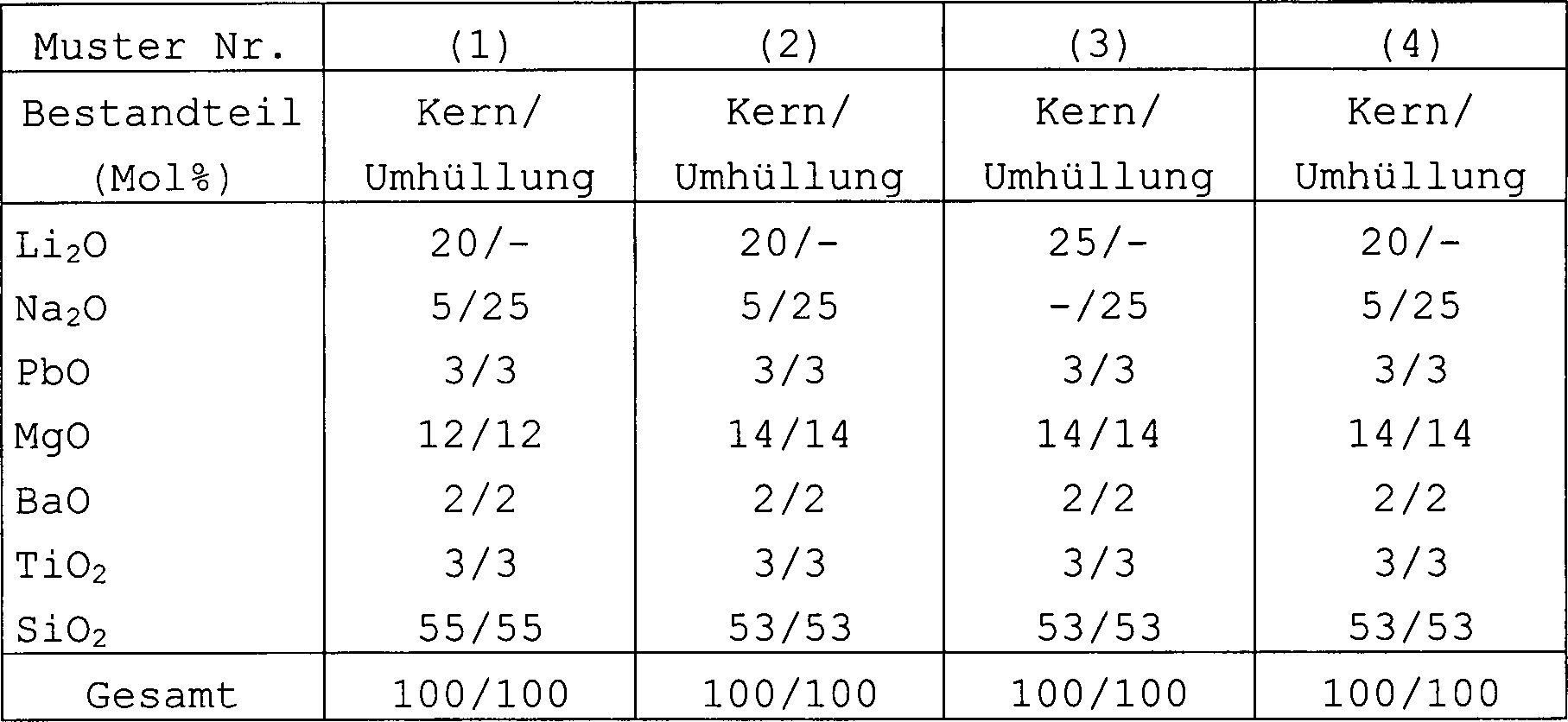
Die Menge der dem Glas für Kern/Umhüllung, das
zum Herstellen der Muster (
Tabelle
2 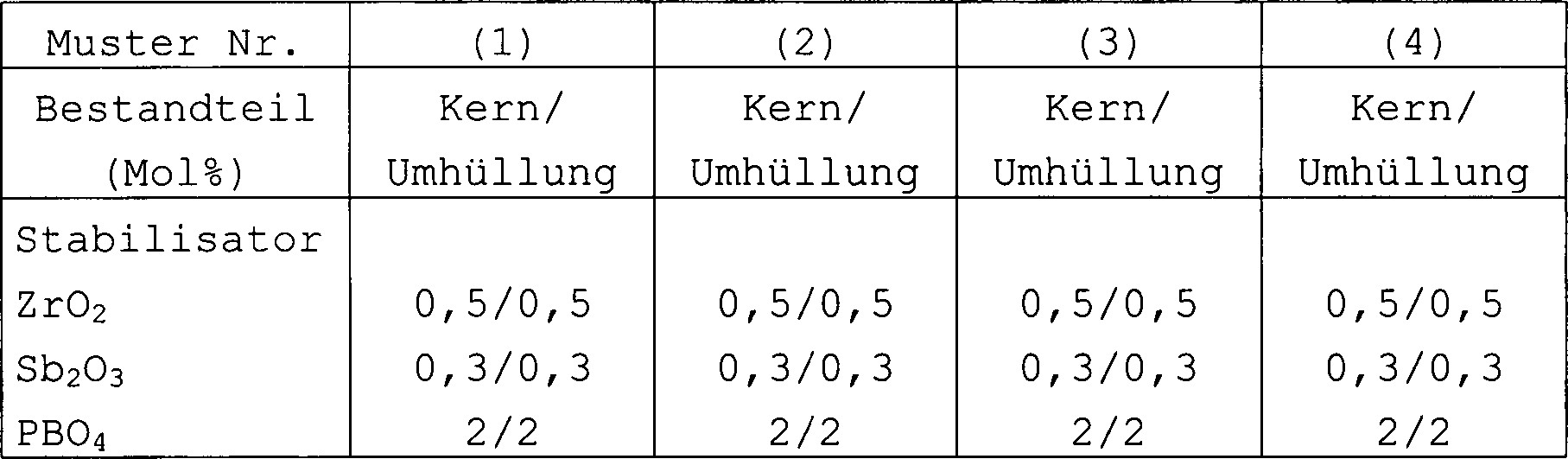
Es ist anzumerken, dass der Gehalt an Stabilisatoren in Mol% in Bezug auf die Gesamtsumme von 100 Mol% der Hauptbestandteile angegeben ist.It should be noted that the salary of stabilizers in mol% in relation to the total of 100 mol% of the main components is specified.
Tabelle 3 zeigt verschiedene Eigenschaften
des Kernglases und des Umhüllungsglases
für die
Muster (
Tabelle
3 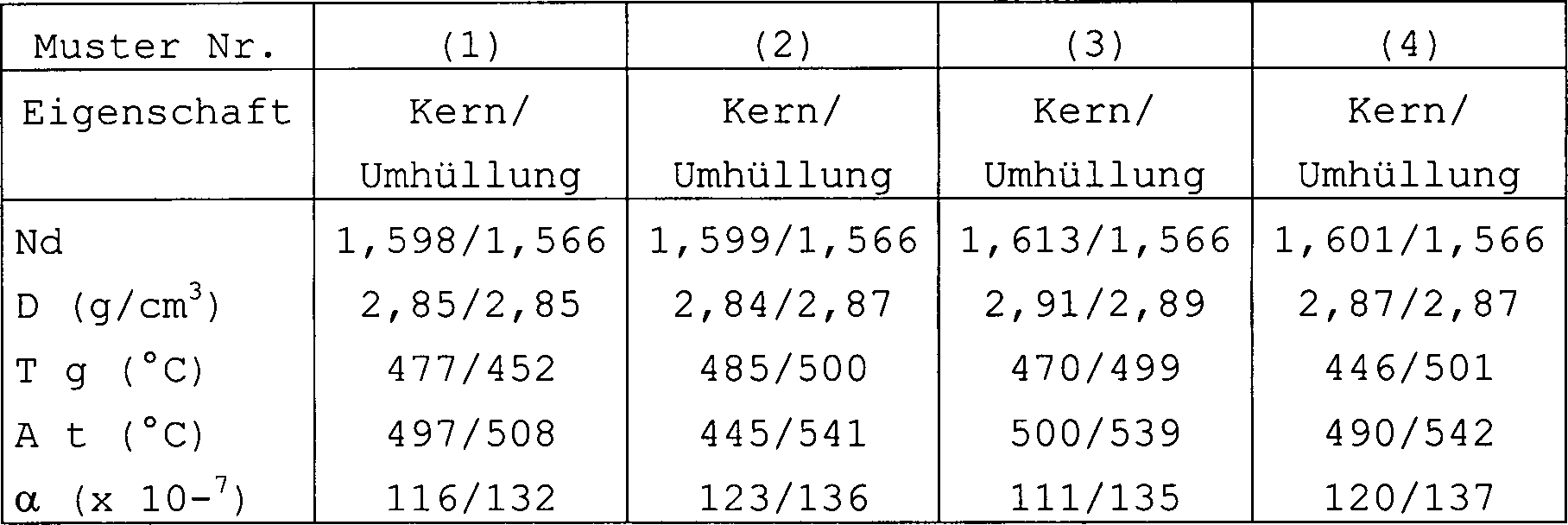
Die Tabellen 4 und 5 zeigen die Messergebnisse
für einen
Durchmesser (mm), ein Kernverhältnis
(%) und einen Akzeptanzwinkel (Grad) für mehrere Muster in Bezug auf
jedes der Muster (
Tabelle
4 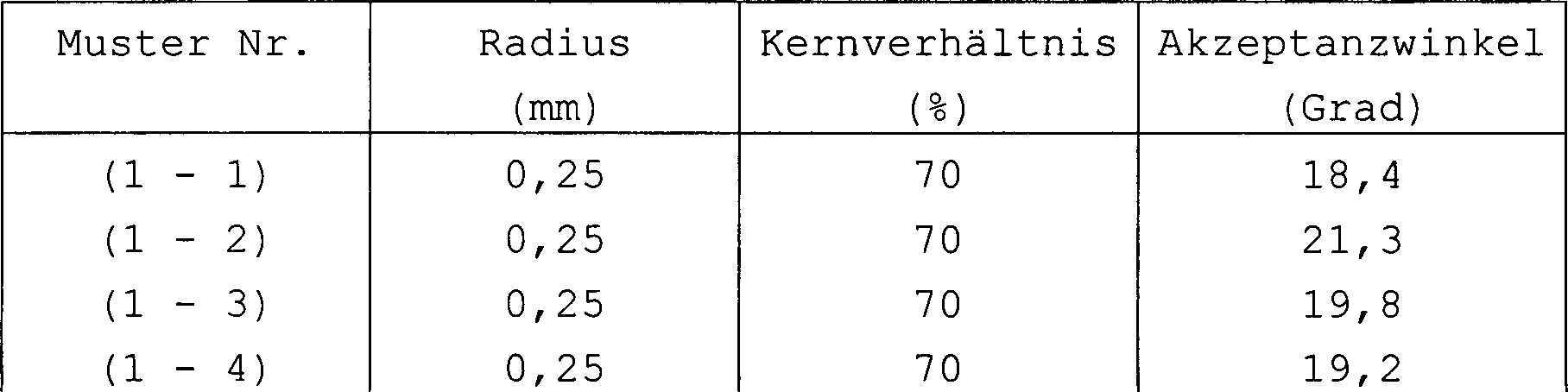
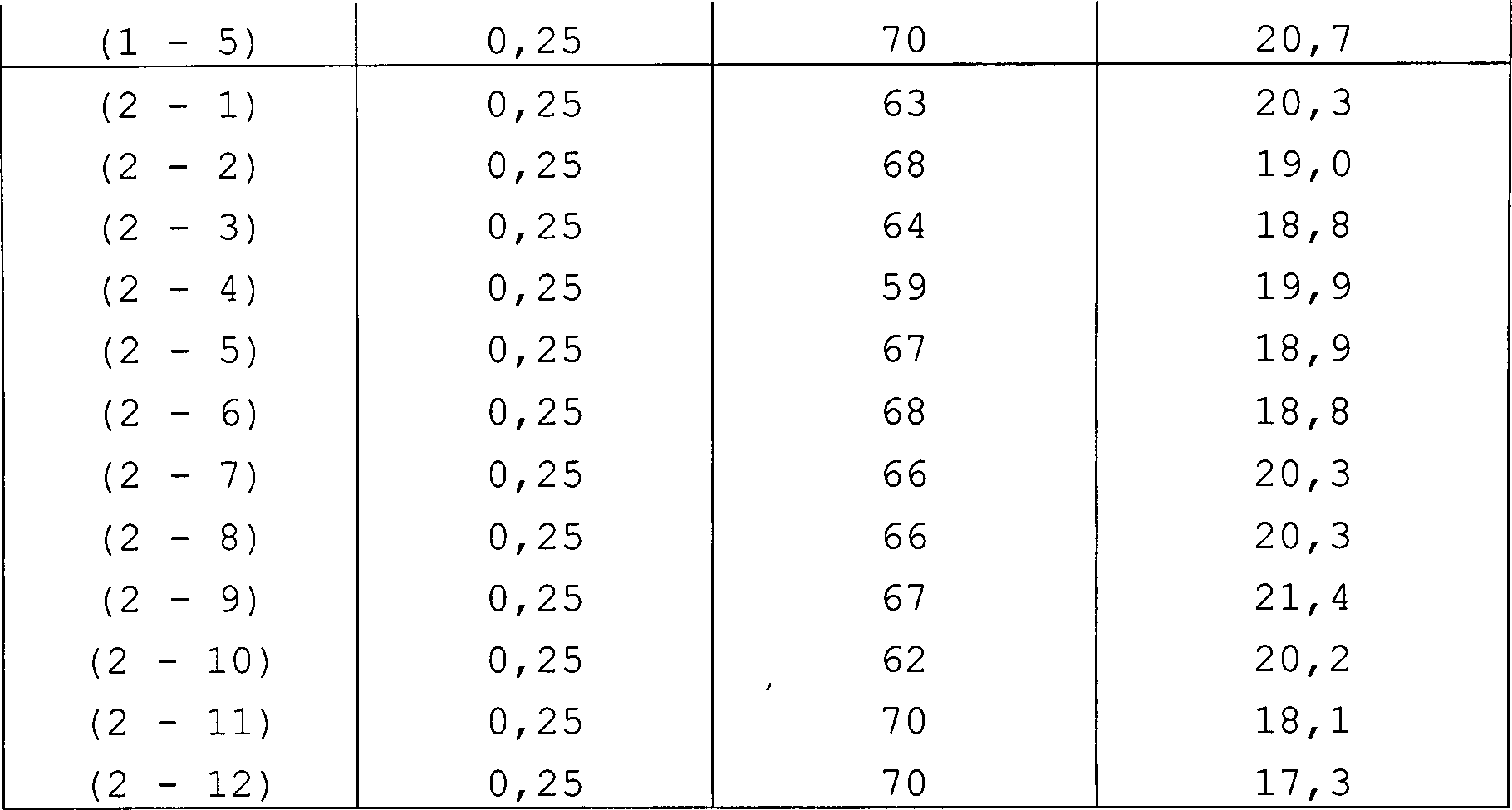
Tabelle
5 
Tabelle 6 zeigt Hauptbestandteile
von Glas für
Kern/Umhüllung,
das für
Vergleichsmuster (
Tabelle
6 
Zusätzlich zu Tabelle 6 zeigt Tabelle
7 die Menge an Stabilisatoren, die dem Kernglas und dem Umhüllungsglas,
das zum Herstellen der Vergleichsmuster (
Tabelle
7 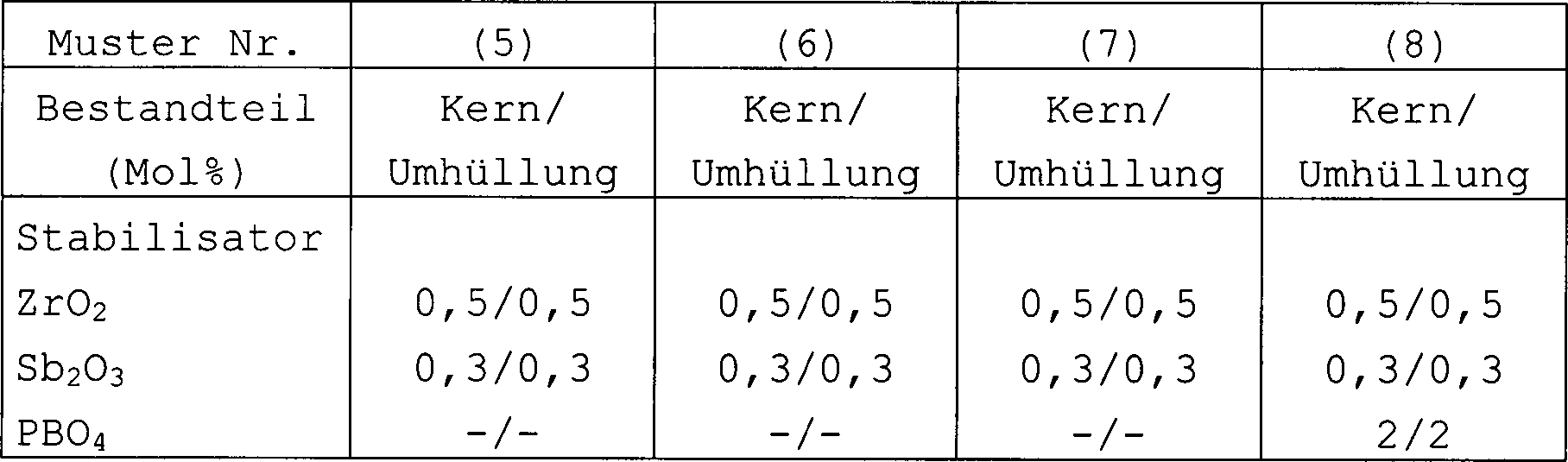
Die Messergebnisse für einen
Durchmesser, ein Kernver hältnis
und einen Akzeptanzwinkel für
mehrere Muster aus den Vergleichsmustern (
Tabelle
8 
Tabelle
9 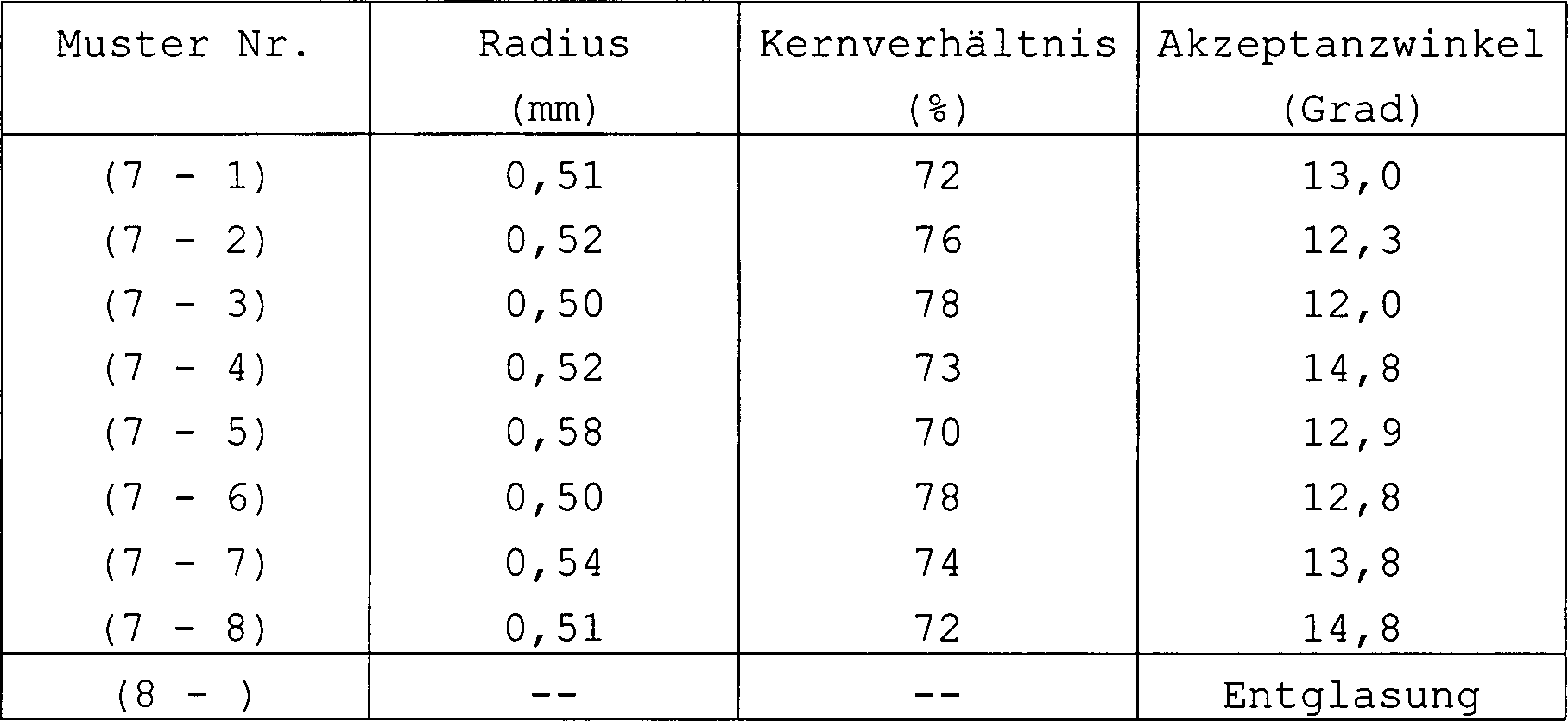
Gemäß Tabelle 9 ist ersichtlich, dass das Vergleichsmuster Nr. 8, das 31 Mol% Li2O in der Glaszusammensetzung für den Kern enthält, entglast ist. Man wird auch verstehen, dass ein Akzeptanzwinkel nicht groß werden kann, wenn der Gehalt an Li2O in der Glaszusammensetzung für den Kern kleiner oder gleich 18 Mol% ist.According to Table 9, it can be seen that comparative sample No. 8, which contains 31 mol% Li 2 O in the glass composition for the core, is devitrified. It will also be understood that an acceptance angle cannot become large if the content of Li 2 O in the glass composition for the core is less than or equal to 18 mol%.
Gemäß der Balkengraphik in
Während die Ausführungsformen gemäß Stablinsen mit Indexverteilung erläutert worden sind, ist offensichtlich, dass die vorliegende Erfindung auf Fasern mit Indexverteilung angewendet werden kann.While the embodiments according to rod lenses explained with index distribution , it is apparent that the present invention can be applied to fibers with index distribution.
Wie oben beschrieben, können gemäß der vorliegenden Erfindung die Glaszusammensetzungen, die zum Herstellen des Kern-Umhüllungs-Typs optischer Elemente mit Indexverteilung geeignet sind, bereitgestellt werden. Des weiteren können unter Verwendung dieser Glaszusammensetzungen Stablinsen oder Fasern mit Indexverteilung, die einen kleinen Farbfehler, einen großen Akzeptanzwinkel und eine gute Haltbarkeit aufweisen, hergestellt werden.As described above, according to the present Invention the glass compositions used to make the core cladding type optical elements with index distribution are provided become. Furthermore you can using these glass compositions rod lenses or fibers with index distribution, a small color error, a large acceptance angle and have good durability.
Des weiteren ist es gemäß der Glaszusammensetzungen der vorliegenden Erfindung nicht erforderlich, dass das Glas, wie in der Japanischen Patentschrift Nr. 59-41934 beschrieben, eine große Menge an TiO2 enthält, was nützlich zum Vermeiden der Entglasung von Glas ist.Furthermore, according to the glass compositions of the present invention, the glass as described in Japanese Patent No. 59-41934 does not need to contain a large amount of TiO 2 , which is useful for avoiding devitrification of glass.
Obwohl die Erfindung in Form von bevorzugten Ausführungsformen beschrieben worden ist, werden Fachleute erkennen, dass die Erfindung mit Abänderungen im Sinn und im Schutzumfang der angehängten Ansprüche praktiziert werden kann.Although the invention takes the form of preferred embodiments Those skilled in the art will appreciate that the invention has been described with changes can be practiced in the spirit and scope of the attached claims.
Claims (7)
Applications Claiming Priority (2)
| Application Number | Priority Date | Filing Date | Title |
|---|---|---|---|
| JP30861796 | 1996-11-06 | ||
| JP30861796A JP3983322B2 (en) | 1996-11-06 | 1996-11-06 | Glass composition for gradient index optical element having core / cladding structure |
Publications (2)
| Publication Number | Publication Date |
|---|---|
| DE69722136D1 DE69722136D1 (en) | 2003-06-26 |
| DE69722136T2 true DE69722136T2 (en) | 2004-04-01 |
Family
ID=17983210
Family Applications (1)
| Application Number | Title | Priority Date | Filing Date |
|---|---|---|---|
| DE69722136T Expired - Fee Related DE69722136T2 (en) | 1996-11-06 | 1997-11-04 | Glass compositions for core-clad type optical element with refractive index distribution |
Country Status (5)
| Country | Link |
|---|---|
| US (1) | US6010787A (en) |
| EP (1) | EP0841306B1 (en) |
| JP (1) | JP3983322B2 (en) |
| CN (1) | CN1101346C (en) |
| DE (1) | DE69722136T2 (en) |
Families Citing this family (12)
| Publication number | Priority date | Publication date | Assignee | Title |
|---|---|---|---|---|
| US6233001B1 (en) * | 1998-06-04 | 2001-05-15 | Fuji Photo Film Co., Ltd. | Image recording apparatus |
| US6279352B1 (en) * | 1999-12-30 | 2001-08-28 | Corning Incorporated | Long hot zone furnace element and optical fiber drawing method practiced therewith |
| JP2002121048A (en) * | 2000-10-11 | 2002-04-23 | Nippon Sheet Glass Co Ltd | Mother glass composition for index distributed lens |
| JP4193396B2 (en) * | 2002-02-08 | 2008-12-10 | 住友電気工業株式会社 | Transmission metal cable |
| TW200405139A (en) * | 2002-09-04 | 2004-04-01 | Nippon Sheet Glass Co Ltd | Glass composition for graded-index rod lens cover, graded-index rod lens, and method for manufacturing the same |
| JP2006056768A (en) * | 2004-07-23 | 2006-03-02 | Nippon Sheet Glass Co Ltd | Clad glass composition for gradient index rod lens, mother glass rod of gradient index rod lens using it, gradient index rod lens and its manufacturing method |
| JP2006106324A (en) * | 2004-10-05 | 2006-04-20 | Nippon Sheet Glass Co Ltd | Gradient index rod lens and its production method |
| IL188559A0 (en) * | 2008-01-03 | 2008-11-03 | D T N R Ltd | Method of production of glass coated metal wires and metal microwires |
| WO2012050116A1 (en) * | 2010-10-12 | 2012-04-19 | オリンパスメディカルシステムズ株式会社 | Endoscope |
| CN105060700B (en) * | 2015-08-07 | 2018-01-12 | 中国科学院上海光学精密机械研究所 | Soft glass preform producing device and method |
| JP7488260B2 (en) | 2018-11-26 | 2024-05-21 | オウェンス コーニング インテレクチュアル キャピタル リミテッド ライアビリティ カンパニー | High performance glass fiber composition having improved elastic modulus - Patents.com |
| KR102768030B1 (en) | 2018-11-26 | 2025-02-13 | 오웬스 코닝 인텔렉츄얼 캐피탈 엘엘씨 | High-performance fiberglass composition with improved modulus |
Family Cites Families (16)
| Publication number | Priority date | Publication date | Assignee | Title |
|---|---|---|---|---|
| US3858964A (en) * | 1969-01-22 | 1975-01-07 | Philips Corp | Light-absorbing silicate glass for fibre-optical elements |
| US3841882A (en) * | 1971-02-08 | 1974-10-15 | Owens Corning Fiberglass Corp | Cladding glass compositions for light transmitting glass fibers |
| US3784386A (en) * | 1971-02-16 | 1974-01-08 | Corning Glass Works | Cladding glasses for photochromic optical fibers |
| US4452508A (en) * | 1977-06-28 | 1984-06-05 | British Telecommunications | Graded index optical fibres |
| NL8103089A (en) * | 1981-06-26 | 1983-01-17 | Philips Nv | OPTICAL FIBER OF THE GRADED INDEX TYPE AND METHOD FOR THE MANUFACTURE THEREOF |
| NL8202648A (en) * | 1982-07-01 | 1984-02-01 | Philips Nv | OPTICAL FIBERS WITH LARGE NUMERIC APERTURE. |
| JPS5918131A (en) * | 1984-01-27 | 1984-01-30 | Nippon Kogaku Kk <Nikon> | Lightweight glass for eyeglass lenses |
| JPH0788234B2 (en) * | 1986-09-05 | 1995-09-27 | 日本板硝子株式会社 | Light focusing lens |
| JPS6370247A (en) * | 1986-09-11 | 1988-03-30 | Fuji Photo Film Co Ltd | Drying method for band-shaped material |
| JPS63144145A (en) * | 1986-12-04 | 1988-06-16 | Nippon Sheet Glass Co Ltd | Ion-exchange treatment of glass |
| JPS63170247A (en) * | 1986-12-29 | 1988-07-14 | Ohara Inc | Production of glass having distributed refractive index |
| JPS6476931A (en) * | 1987-09-16 | 1989-03-23 | Nippon Sheet Glass Co Ltd | Production of refractive index-distributing type lens |
| JPH03107807A (en) * | 1989-09-21 | 1991-05-08 | Sumitomo Electric Ind Ltd | optical connector receptacle |
| JPH03259106A (en) * | 1990-03-09 | 1991-11-19 | Oki Electric Ind Co Ltd | Coupler for receptacle type photosemiconductor |
| ES2078658T3 (en) * | 1991-06-14 | 1995-12-16 | Cookson Group Plc | GLASS COMPOSITIONS. |
| JPH08211255A (en) * | 1995-02-07 | 1996-08-20 | Matsushita Electric Ind Co Ltd | Optical fiber module and method for manufacturing receptacle connector for optical fiber module |
-
1996
- 1996-11-06 JP JP30861796A patent/JP3983322B2/en not_active Expired - Lifetime
-
1997
- 1997-11-04 US US08/963,959 patent/US6010787A/en not_active Expired - Fee Related
- 1997-11-04 EP EP97308837A patent/EP0841306B1/en not_active Expired - Lifetime
- 1997-11-04 DE DE69722136T patent/DE69722136T2/en not_active Expired - Fee Related
- 1997-11-05 CN CN97122428A patent/CN1101346C/en not_active Expired - Fee Related
Also Published As
| Publication number | Publication date |
|---|---|
| EP0841306B1 (en) | 2003-05-21 |
| CN1182720A (en) | 1998-05-27 |
| JPH10139468A (en) | 1998-05-26 |
| CN1101346C (en) | 2003-02-12 |
| US6010787A (en) | 2000-01-04 |
| EP0841306A1 (en) | 1998-05-13 |
| JP3983322B2 (en) | 2007-09-26 |
| DE69722136D1 (en) | 2003-06-26 |
Similar Documents
| Publication | Publication Date | Title |
|---|---|---|
| DE60021839T2 (en) | gradient lens | |
| DE2824478C2 (en) | Method for producing a coupling element | |
| DE2723972C2 (en) | Optical coupling element and positioning devices for such elements | |
| DE2940451C2 (en) | ||
| EP3782961B1 (en) | Highly transmissive glasses with high solarisation resistance, use thereof and method for production thereof | |
| DE102007063463B4 (en) | Core glass in the alkali-zinc-silicate glass system for a fiber optic light guide and the use of the core glass in a light guide | |
| DE19616633C1 (en) | Chemically toughenable alumino-silicate glass | |
| DE69722136T2 (en) | Glass compositions for core-clad type optical element with refractive index distribution | |
| DE3229442C2 (en) | ||
| DE2635140C2 (en) | Spectacle lenses hardened by means of ion exchange | |
| DE3607259A1 (en) | MICRO LENS PLATE AND METHOD FOR THEIR PRODUCTION | |
| DE2908697A1 (en) | NEAR-INFRARED ABSORPTION FILTERS FOR COLOR TV CAMERAS | |
| DE69824814T2 (en) | Lens with axial refractive index gradient | |
| DE2263501C2 (en) | Glass lenses with reduced chromatic aberration | |
| DE69509736T2 (en) | Colorless ophthalmic glasses | |
| DE3874615T2 (en) | OPTICAL OBJECT WITH BREAKING INDEX AND METHOD FOR THE PRODUCTION THEREOF. | |
| DE1621002A1 (en) | Infrared permeable, amorphous glass containing germanium and selenium | |
| DE3103771C2 (en) | Infrared radiation transmissive glass fibers and processes for their manufacture | |
| DE112006001070T5 (en) | Bismuth oxide-containing optical glass | |
| DE2456894C3 (en) | Inorganic, vitreous material for use in an ion exchange for the purpose of generating a refractive index gradient while largely avoiding a change in the coefficient of thermal expansion | |
| DE3333017C2 (en) | ||
| DE112006000940T5 (en) | Bismuth oxide-containing optical glass | |
| DE69616835T2 (en) | Fiber optic plate | |
| DE2457085A1 (en) | EYE GLASS MIX | |
| DE102021000094A1 (en) | DISPLAY COVER GLASS, VEHICLE DISPLAY DEVICE AND METHOD OF MANUFACTURING A COVER GLASS FOR AN ADVERTISEMENT |
Legal Events
| Date | Code | Title | Description |
|---|---|---|---|
| 8364 | No opposition during term of opposition | ||
| 8339 | Ceased/non-payment of the annual fee |