DE202008009863U1 - Arrangement for closing a carrying bag - Google Patents
Arrangement for closing a carrying bag Download PDFInfo
- Publication number
- DE202008009863U1 DE202008009863U1 DE202008009863U DE202008009863U DE202008009863U1 DE 202008009863 U1 DE202008009863 U1 DE 202008009863U1 DE 202008009863 U DE202008009863 U DE 202008009863U DE 202008009863 U DE202008009863 U DE 202008009863U DE 202008009863 U1 DE202008009863 U1 DE 202008009863U1
- Authority
- DE
- Germany
- Prior art keywords
- tab
- bag
- leg
- section
- Prior art date
- Legal status (The legal status is an assumption and is not a legal conclusion. Google has not performed a legal analysis and makes no representation as to the accuracy of the status listed.)
- Expired - Lifetime
Links
- 210000002414 leg Anatomy 0.000 claims description 42
- 210000000689 upper leg Anatomy 0.000 claims description 26
- 239000010985 leather Substances 0.000 claims description 6
- 238000004026 adhesive bonding Methods 0.000 claims description 4
- 238000011161 development Methods 0.000 description 3
- 230000018109 developmental process Effects 0.000 description 3
- 101001017827 Mus musculus Leucine-rich repeat flightless-interacting protein 1 Proteins 0.000 description 1
- 230000003993 interaction Effects 0.000 description 1
- 238000004519 manufacturing process Methods 0.000 description 1
- 239000000463 material Substances 0.000 description 1
- 230000003287 optical effect Effects 0.000 description 1
- 238000009958 sewing Methods 0.000 description 1
- 230000000087 stabilizing effect Effects 0.000 description 1
Classifications
-
- A—HUMAN NECESSITIES
- A45—HAND OR TRAVELLING ARTICLES
- A45C—PURSES; LUGGAGE; HAND CARRIED BAGS
- A45C13/00—Details; Accessories
- A45C13/10—Arrangement of fasteners
-
- A—HUMAN NECESSITIES
- A45—HAND OR TRAVELLING ARTICLES
- A45C—PURSES; LUGGAGE; HAND CARRIED BAGS
- A45C13/00—Details; Accessories
- A45C13/18—Devices to prevent theft or loss of purses, luggage or hand carried bags
- A45C13/185—Devices to prevent theft or loss of purses, luggage or hand carried bags of purses, money-bags or wallets
-
- A—HUMAN NECESSITIES
- A45—HAND OR TRAVELLING ARTICLES
- A45C—PURSES; LUGGAGE; HAND CARRIED BAGS
- A45C3/00—Flexible luggage; Handbags
- A45C3/06—Ladies' handbags
Landscapes
- Purses, Travelling Bags, Baskets, Or Suitcases (AREA)
Abstract
Anordnung zum Verschließen einer Tragetasche, bestehend aus einem Verschlusselement und zwei von diesem zum Verschließen der Tragetasche zu übergreifenden Flächenabschnitten (6', 7') einander gegenüberliegender Taschenwände (6, 7), wobei die Taschenwände (6, 7) zumindest in den Flächenabschnitten (6', 7'), welche jeweils am Rand (8) einer Eingriffsöffnung (9) der Tragetasche angeordnet und mit jeweils einer Außenkante Teil des die Eingriffsöffnung (9) einfassenden Randes (8) sind, steif ausgebildet sind, dadurch gekennzeichnet, dass es sich bei dem Verschlusselement um eine Lasche (1) aus einem steifen flächigen Element handelt, welches zur Ausbildung der Lasche (1) einen Falz (2) aufweist, über den zwei Schenkel (3, 4) des Elements mit einander zugewandten Innenflächen (3'', 4'') und voneinander abgewandten Außenflächen (3', 4') verbunden sind und dass einer der Schenkel (3) ein freies Ende (5) aufweist und der andere Schenkel (4) mit seinem Ende an dem steifen Flächenabschnitt (6') einer Taschenwand (6) so angelenkt ist, dass er von einer...arrangement to close a carrying bag, consisting of a closure element and two from this to closing the carrying bag overarching surface sections (6 ', 7') opposed to each other pocket walls (6, 7), the pocket walls (6, 7) at least in the surface sections (6 ', 7 '), each at the edge (8) of an engagement opening (9) of the carrying bag arranged and each having an outer edge part of the engagement opening (9) bordering edge (8) are stiff, characterized in that in that the closure element is a tab (1) made of a stiff flat Element is, which for forming the tab (1) a fold (2), about the two legs (3, 4) of the element with inner surfaces (3 '', 4 '') and opposite outer surfaces (3 ', 4') are connected and that one of the legs (3) has a free end (5) and the other leg (4) with its end on the rigid surface portion (6 ') of a pocket wall (6) is hinged so that it is from a ...
Description
Die Erfindung betrifft eine Anordnung zum Verschließen einer Tragetasche, wie einer Handtasche oder einer Umhängetasche. Ihr Gegenstand ist dabei weniger eine Lösung zum vollständigen beziehungsweise zugangssicheren Verschließen der betreffenden Tasche, als eine Anordnung, mit der im verschlossenen Zustand das Aufsperren einer Eingriffsöffnung der Tasche verhindert wird. Im Zusammenhang damit bezieht sich die Erfindung auf eine Anordnung mit einem speziell ausgebildeten Verschlusselement und mit zum Zusammenwirken mit diesem Verschlusselement ausgebildeten Randbereichen einer entsprechenden Eingriffsöffnung der Tasche.The The invention relates to an arrangement for closing a carrying bag, such as a handbag or a shoulder bag. Their subject matter is less a solution to the complete or access-safe closing the bag in question, as an arrangement, with the locked Condition prevents the opening of an engagement opening of the bag becomes. In this context, the invention relates to an arrangement with a specially designed closure element and with the interaction formed with this closure element edge regions of a corresponding engagement opening the pocket.
Zum Verschließen von Tragetaschen ist eine Vielzahl unterschiedlicher Lösungen bekannt und gebräuchlich. Diese unterscheiden sich entsprechend dem jeweils angestrebten Ziel in ihrer Funktionalität teilweise erheblich. So werden zum vollständigen Verschließen von Tragetaschen beispielsweise Reißverschlüsse oder Schnappverschlüsse verwendet, bei denen der Zugang zum Inhalt der Tasche erst nach dem Öffnen des entsprechenden Verschlusses möglich ist. Reißverschlüsse werden dabei unmittelbar in der Wandeinfassung einer Eingriffsöffnung der Tasche angeordnet, so dass sie beim Zuziehen die entsprechende Eingriffsöffnung vollständig verschließen.To the close of carrier bags a variety of different solutions is known and in use. These differ according to the respective target partially in their functionality considerably. So are the complete closing of Carrying bags such as zippers or latches used, where access to the contents of the bag only after opening the corresponding closure is possible. Zippers are while directly in the wall enclosure an engagement opening of the bag arranged so that they completely close the corresponding engagement opening when pulling.
Darüber hinaus werden insbesondere bei Handtaschen beziehungsweise bei Tragetaschen, welche als modisches Accessoire dienen, Laschen zum Verschließen derartiger Taschen verwendet. Dabei ist eines der beiden Enden einer solchen Lasche an einer Außenseite der Tasche befestigt, während das andere Ende im geöffneten Zustand der Tasche ein loses Ende darstellt. Zum Verschließen einer Eingriffsöffnung der Tasche werden die Lasche und ihr loses Ende über die Eingriffsöffnung geführt, so dass die Eingriffsöffnung von der Lasche übergriffen wird. Schließlich wird dann das ursprünglich lose Ende der Lasche in geeigneter Weise an einem an einer Außenseite der Tasche angeordneten und befestigten Element fixiert, wobei die letztgenannte Außenseite der Tasche derjenigen gegenüberliegt, an welcher das, auch im offen Zustand der Tasche nicht freie Ende der Lasche befestigt ist. Hierdurch werden die beiden einander gegenüberliegenden Außenseiten beziehungsweise Taschenwände der Tasche zusammengehalten, so dass die Eingriffsöffnung nicht aufsperrt. Dennoch ist es dabei möglich, an der die Eingriffsöffnung übergreifenden Lasche vorbei in das Innere der Tasche zu greifen. Entsprechende Verschlüsse dienen somit weniger einem zugangssicheren Verschließen der Tasche als dazu, zu verhindern, dass Teile des Tascheninhalts durch ein Aufsperren der Eingriffsöffnung eventuell verloren gehen. Neben dieser Funktionalität dienen derartige Verschlüsse häufig auch als optisches Gestaltungsmerkmal für die Taschen.Furthermore Especially in handbags or carrier bags, which serve as a fashion accessory, tabs for closing such Bags used. One of the two ends is one of these Tab on an outside attached to the bag while that other end in the open Condition of the bag represents a loose end. To close a engagement opening the bag, the tab and its loose end are guided over the engagement opening, so that the engagement opening overlapped by the flap becomes. After all will then be the original one loose end of the tab suitably on one on an outside the bag arranged and fastened element fixed, the the latter outside Pocket opposite to that at which the, not in the open state of the bag not free end the tab is attached. As a result, the two opposite each other Outer sides respectively pocket walls the bag held together so that the engagement hole is not unlocks. Nevertheless, it is possible at the cross-the engagement opening Latch over to reach inside the bag. Appropriate closures thus serve less secure access closure of the Bag as to prevent parts of the bag contents from getting through an unlocking the engagement opening possibly lost. In addition to serve this functionality such closures often too as an optical design feature for the bags.
Zum Fixieren des angesprochenen, bei geöffneter Tasche losen Endes der Lasche zum Zwecke des Verschließens der Tasche ist wiederum eine Vielzahl unterschiedlicher Elemente gebräuchlich. Die Fixierung erfolgt beispielsweise mittels einer Gürtelschnalle oder eines Magnetelements. Aber auch Klettverschlüsse und Schnappverschlüsse sind zum Fixieren dieses Endes der Lasche gebräuchlich. Je nach der konkreten Art ihrer Ausbildung sind Verschlüsse, welche sich einer Lasche bedienen, unterschiedlich aufwendig gestaltet und bedingen somit gegebenenfalls einen erhöhten oder aber einen eher geringen Fertigungsaufwand.To the Fixing the addressed, with open pocket loose end the tab for the purpose of closing the bag is in turn a variety of different elements in use. The fixation takes place for example by means of a belt buckle or a magnetic element. But also Velcro and latches are used to fix this end of the tab. Depending on the specific Type of training are closures, which is a tab operate, different elaborately designed and condition thus possibly an elevated one or a rather low production cost.
Aufgabe der Erfindung ist es, eine alternative Anordnung zum Verschließen einer Tragetasche bereitzustellen, welche bei einer einfachen Gestaltung das Aufsperren der Eingriffsöffnung einer Tasche verhindert. Die Anordnung soll einfach herstellbar und unter Verwendung preiswerter Materialien realisierbar sein.task The invention is an alternative arrangement for closing a Carrying bag to provide, which in a simple design the Unlocking the intervention opening prevents a bag. The arrangement should be easy to produce and be realizable using inexpensive materials.
Die Aufgabe wird durch eine Anordnung mit den Merkmalen des Hauptanspruchs gelöst. Vorteilhafte Aus- beziehungsweise Weiterbildungen der Erfindung sind durch die Unteransprüche gegeben.The The object is achieved by an arrangement having the features of the main claim solved. Advantageous embodiments or further developments of the invention are by the subclaims given.
Die vorgeschlagene Anordnung zum Verschließen einer Tragetasche besteht aus einem Verschlusselement und zwei von diesem zum Verschließen der Trage tasche zu übergreifenden Flächenabschnitten einander gegenüberliegender Taschenwände. Dabei sind die vorgenannten Taschenwände zumindest in den von dem Verschlusselement übergriffenen Flächenabschnitten, welche jeweils am Rand einer Eingriffsöffnung der Tragetasche angeordnet und mit jeweils einer Außenkante Teil des die Eingriffsöffnung einfassenden Randes sind, steif ausgebildet.The proposed arrangement for closing a carrying bag consists from a closure element and two of these for closing the Carry bag to overarching surface sections opposite each other Pocket walls. The aforementioned pocket walls are at least in the of the Closing element overlapped Surface sections, which are each arranged on the edge of an engagement opening of the carrier bag and each with an outer edge Part of the intervention opening bordering edge are stiff.
Erfindungsgemäß handelt es sich bei dem Verschlusselement um eine, aus einem steifen flächigen Element ausgebildete Lasche. Zur Ausbildung der Lasche weist das flächige Element einen Falz auf, über den zwei Schenkel des Elements mit einander zugewandten Innenflächen und voneinander abgewandten Außenflächen verbunden sind. Einer der Schenkel des Elements weist ein freies Ende auf, während der andere Schenkel mit seinem Ende an dem steifen Flächenabschnitt einer der eingangs genannten Taschenwände angelenkt ist. Der betreffende Schenkel der Lasche ist dabei so angelenkt, dass er von einer Lage, bei der seine dem Schenkel mit dem freien Ende abgewandte Außenfläche der mit ihm verbundenen Taschenwand zugewandt und die Tragetasche geöffnet ist, in eine Lage überführbar ist, bei welcher derselbe Schenkel an dem steifen Flächenabschnitt der mit ihm verbundenen Taschenwand mit seiner Innenfläche anliegt. In der letztgenannten Lage, bei welcher die Tasche verschlossen ist, drückt gleichzeitig der andere, das freie Ende aufweisende Schenkel der Lasche, die Eingriffsöffnung der Tasche übergreifend, zumindest mit einem Teil seiner Innenfläche von außen gegen den steifen Flächenabschnitt der gegenüberliegenden Taschenwand. In dieser Lage beziehungsweise Position der Lasche werden die steifen Flächenabschnitte der beiden einander gegenüberliegenden Taschenwände aneinander gedrückt, so dass sie die Eingriffsöffnung der Tragetasche verschließen. Der bereits angesprochene, die Schenkel des Verschlusselementes miteinander verbindende Falz ist erfindungsgemäß in jeder Lage der Schenkel der das Verschlusselement ausbildenden Lasche in einem Abstand zum Rand der Eingriffsöffnung angeordnet. Erfindungswesentlich ist es zudem, dass das freie Ende des einen Schenkels auch im geschlossenen Zustand der Tasche frei bleibt, also nicht an der Taschenwand fixiert wird, an welcher der betreffende Schenkel in diesem Zustand anliegt.According to the invention, the closure element is a lug formed from a rigid, flat element. To form the tab, the planar element has a fold, via which two legs of the element are connected to mutually facing inner surfaces and outer surfaces facing away from each other. One of the legs of the element has a free end, while the other leg is articulated with its end to the rigid surface portion of one of the aforementioned pocket walls. The leg of the tab in question is articulated in such a way that it can be transferred to a position in which its outer surface facing away from the leg with the free end facing the pocket wall connected thereto and the carrying bag is opened, in which the same leg rests against the rigid surface portion of the pocket wall connected to it with its inner surface. In the latter position, in which the bag is closed, simultaneously pushes the other, the free end having legs of the tab, the engagement opening of the bag across, at least with a part of its inner surface from the outside against the rigid surface portion of the opposite pocket wall. In this position or position of the tab, the rigid surface portions of the two opposite pocket walls are pressed against each other, so that they close the engagement opening of the carrying bag. The already mentioned, the legs of the closure element interconnecting fold is arranged according to the invention in each position of the legs of the closure element forming tab at a distance from the edge of the engagement opening. It is also essential to the invention that the free end of the one leg remains free even in the closed state of the bag, that is not fixed to the pocket wall, on which the leg in question rests in this state.
Zur Befestigung des einen Schenkels der Lasche an einer Taschenwand der Tragetasche ist gemäß einer vorteilhaften Ausbildungsform der Erfindung an dem Ende des betreffenden Schenkels ein der Befestigung dienender Flächenabschnitt ausgebildet. Dieser wird durch ein entsprechendes Falzen des die Lasche ausbildenden steifen, flächigen Elements ausgebildet. Im Bereich des an seinem Ende ausgebildeten Flächenabschnitts liegt der befestigte Schenkel der Lasche mit seiner Außenseite an dem steifen Flächenabschnitt der mit ihm verbundenen Taschenwand an. An dem betreffenden steifen Flächenabschnitt der Taschenwand ist der an dem Ende des Schenkels ausgebildete Flächenabschnitt vorzugsweise durch Kleben oder mittels wenigstens einer Naht befestigt. Grundsätzlich denkbar ist es aber auch, den am Ende des befestigten Schenkels gebildeten Flächenabschnitt mittels eines Klettverschlusses zu befestigen. Hierbei ist einer der miteinander korrespondierenden Teile des Klettverschlusses an dem am Ende des Schenkels ausgebildeten Flächenabschnitt und der andere Teil an dem steifen Flächenabschnitt der Taschenwand angeklebt oder angenäht.to Attaching the one leg of the tab to a pocket wall the carrying bag is in accordance with a advantageous embodiment of the invention at the end of the relevant Leg formed an attachment serving surface portion. This is formed by a corresponding folding of the tab stiff, flat Elements formed. In the area of trained at its end surface section the attached leg of the tab lies with its outside on the rigid surface section the connected with him pocket wall. At the concerned stiff surface section the pocket wall is the surface portion formed at the end of the leg preferably attached by gluing or by at least one seam. in principle but it is also possible, at the end of the attached thigh formed surface section to attach by means of a Velcro fastener. Here is one the corresponding parts of the hook and loop fastener on the formed at the end of the leg surface portion and the other Part of the stiff surface section the pocket wall glued or sewn.
Entsprechend einer vorgesehenen Ausbildungsform der Erfindung ist die als Verschlusselement dienende Lasche so ausgebildet, dass bei verschlossener Tasche das freie Ende des nicht an der Tasche befestigten Schenkels gegen den steifen Flächenabschnitt der entsprechenden Taschenwand drückt. Diese Ausbildungsform kann dadurch weitergebildet sein, dass an das freie Ende des Schenkels durch mehrmaliges Falzen eine nach innen, also in Richtung der Taschenwand, gewandte Geometrie angeformt ist. Dabei kann die betreffende Geometrie beispielsweise einen dreieckigen Querschnitt oder einen trapezförmigen Querschnitt aufweisen. Im erstgenannten Fall ist die Geometrie so ausgebildet, dass eine ihrer Kanten bei verschlossener Tasche gegen den steifen Flächenabschnitt der Taschenwand drückt, an welchem das freie Ende des Schenkels der Lasche anliegt. Im Falle einer Geometrie mit einem trapezförmigen Querschnitt ist diese so ausgebildet, dass eine die kurze Oberseite des trapezförmigen Querschnitts ausbildende Fläche bei verschlossener Tasche gegen den steifen Flächenabschnitt der betreffenden Taschenwand drückt.Corresponding a proposed embodiment of the invention is as a closure element serving tab designed so that when the bag is closed the free end of the not attached to the pocket leg against the stiff surface section presses the corresponding pocket wall. This training form can be developed by the fact that at the free end of the leg through repeated folding one inwards, ie in the direction of the pocket wall, turned geometry is formed. In this case, the geometry in question, for example have a triangular cross section or a trapezoidal cross section. In the former case, the geometry is designed so that a its edges with closed pocket against the stiff surface section the pocket wall pushes, where the free end of the leg of the tab is applied. In the event of a geometry with a trapezoidal cross section is this designed so that one the short top of the trapezoidal cross-section training area with closed pocket against the stiff surface section of the concerned Pocket wall presses.
Eine andere sehr vorteilhafte Ausbildungsform der erfindungsgemäßen Anordnung ist dadurch gegeben, dass zur Ausbildung von einer Art Griffelement an das frei bleibende Ende des einen Schenkels durch mehrmaliges Falzen eine nach außen gewandte Geometrie mit einem dreieckigen oder trapezförmigen Querschnitt angeformt ist. Die entsprechende Geometrie ist vergleichbar der des zuvor beschriebenen Ausführungsbeispiels, aber abweichend von dieser nach außen gewandt ausgebildet. Die Lasche beziehungsweise die Tragetasche kann somit wahlweise durch Angreifen der Lasche im Bereich des ihre beiden Schenkel miteinander verbindenden Falzes und Ziehen der Lasche in Richtung des an der Tasche befestigten Schenkels oder aber dadurch geöffnet werden, dass die Lasche durch Angreifen an dem, am freien Ende des einen Schenkels gebildeten Griffelement über die Eingriffsöffnung der Tasche hinweggeschoben wird.A another very advantageous embodiment of the arrangement according to the invention is given by that to form a kind of handle element to the free end of one leg by repeated Fold one out facing geometry with a triangular or trapezoidal cross-section is formed. The corresponding geometry is comparable to the embodiment described above, but deviated from this turned outward. The Tab or the carrying case can thus either by Attack the tab in the area of its two legs with each other connecting fold and pulling the tab towards the at the pocket fastened thigh or else be opened by the tab by engaging on the grip element formed at the free end of the one leg over the engagement opening the bag is pushed away.
Die als Verschlusselement dienende Lasche besteht gemäß einer möglichen Ausbildungsform der Erfindung aus mehreren miteinander verklebten Lagen von Pappe. Die Lagen sind dabei vorzugsweise aus einem einzigen Stück Pappe durch mehrmaliges Falzen gebildet. Darüber hinaus ist es denkbar, die Lasche aus Leder und Pappe auszubilden. Dabei wird die Lasche vorzugsweise so ausgebildet, dass die Außenflächen ihrer Schenkel aus Leder sind und im Innern der Lasche wenigstens eine Lage Pappe zur Versteifung der Lasche eingefügt ist. Die Pappe und das Leder können dabei entweder miteinander verklebt oder durch Vernähen zusammengefügt sein. Auch bei der ausschließlich aus Pappe bestehenden Variante der Lasche kann gegebenenfalls zwischen die durch Falzen erzeugten Papplagen ein zusätzliches, stabilisierendes beziehungsweise versteifendes flächiges Element eingefügt werden, welches beispielsweise ebenfalls aus Pappe bestehen kann.The As a closure element serving tab consists of a potential Form of the invention of several glued together Layers of cardboard. The layers are preferably made of a single Piece of cardboard formed by repeated folding. In addition, it is conceivable to form the flap of leather and cardboard. This is the tab preferably designed so that the outer surfaces of her thighs made of leather and inside the flap at least one layer of cardboard for stiffening inserted the tab is. The cardboard and the leather can either glued together or joined together by sewing. Also at the exclusively made of cardboard variant of the tab may optionally between the By folding produced pap paging an additional, stabilizing or stiffening planar Element inserted be, which may for example also consist of cardboard.
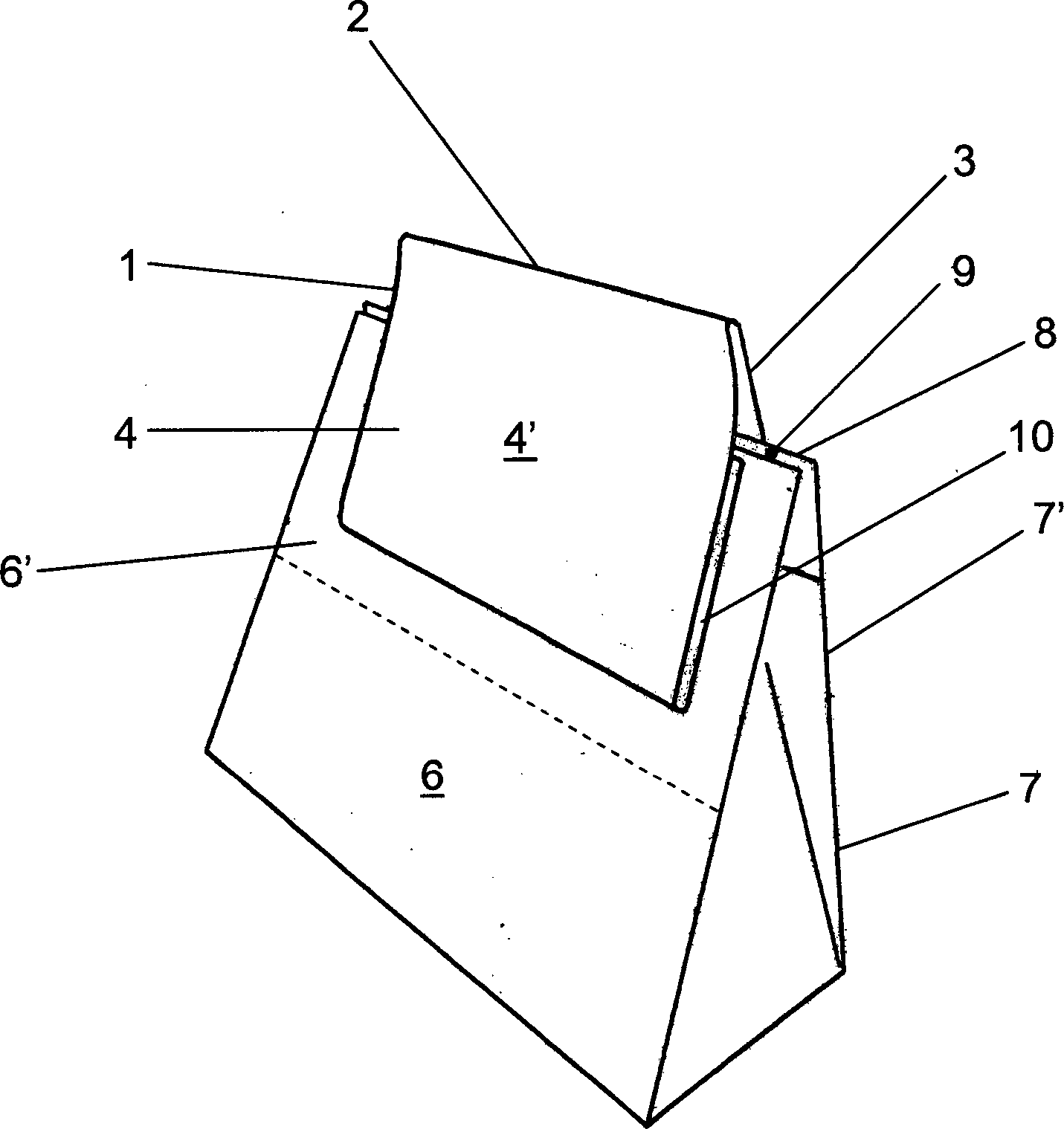
Nachfolgend sollen anhand von Ausführungsbeispielen nochmals wesentliche Aspekte der Erfindung verdeutlicht werden. In den zugehörigen Zeichnungen zeigen:following are based on embodiments again essential aspects of the invention will be clarified. In the accompanying drawings demonstrate:
Die
Die
Die
- 11
- Lascheflap
- 22
- Falzfold
- 33
- Schenkelleg
- 3'3 '
-
Außenfläche Schenkel
3 Outer surface thighs3 - 3''3 ''
-
Innenfläche Schenkel
3 Inner surface thighs3 - 44
- Schenkelleg
- 4'4 '
-
Außenfläche Schenkel
4 Outer surface thighs4 - 4''4 ''
-
Innenfläche Schenkel
4 Inner surface thighs4 - 55
-
freies
Ende Schenkel
3 free end of the thigh3 - 66
- Taschenwandpocket wall
- 6'6 '
-
steifer
Flächenabschnitt
der Taschenwand
6 Stiff surface portion of the pocket wall6 - 77
- Taschenwandpocket wall
- 7'7 '
-
Steifer
Flächenabschnitt
der Taschenwand
7 Stiff surface portion of the pocket wall7 - 88th
- Randedge
- 99
- Eingriffsöffnungengagement opening
- 1010
-
Flächenabschnitt
des Schenkels
4 Surface portion of the leg4
Claims (10)
Priority Applications (1)
| Application Number | Priority Date | Filing Date | Title |
|---|---|---|---|
| DE202008009863U DE202008009863U1 (en) | 2008-04-29 | 2008-04-29 | Arrangement for closing a carrying bag |
Applications Claiming Priority (2)
| Application Number | Priority Date | Filing Date | Title |
|---|---|---|---|
| DE202008009863U DE202008009863U1 (en) | 2008-04-29 | 2008-04-29 | Arrangement for closing a carrying bag |
| DE200810001454 DE102008001454B3 (en) | 2008-04-29 | 2008-04-29 | Carrying bag e.g. handbag, closing arrangement, has bracket, which overlaps contact opening of carrying bag, and fold with distance to edge of contact opening in each position of brackets of flap, which forms closing element |
Publications (1)
| Publication Number | Publication Date |
|---|---|
| DE202008009863U1 true DE202008009863U1 (en) | 2008-11-06 |
Family
ID=39942534
Family Applications (2)
| Application Number | Title | Priority Date | Filing Date |
|---|---|---|---|
| DE202008009863U Expired - Lifetime DE202008009863U1 (en) | 2008-04-29 | 2008-04-29 | Arrangement for closing a carrying bag |
| DE200810001454 Expired - Fee Related DE102008001454B3 (en) | 2008-04-29 | 2008-04-29 | Carrying bag e.g. handbag, closing arrangement, has bracket, which overlaps contact opening of carrying bag, and fold with distance to edge of contact opening in each position of brackets of flap, which forms closing element |
Family Applications After (1)
| Application Number | Title | Priority Date | Filing Date |
|---|---|---|---|
| DE200810001454 Expired - Fee Related DE102008001454B3 (en) | 2008-04-29 | 2008-04-29 | Carrying bag e.g. handbag, closing arrangement, has bracket, which overlaps contact opening of carrying bag, and fold with distance to edge of contact opening in each position of brackets of flap, which forms closing element |
Country Status (1)
| Country | Link |
|---|---|
| DE (2) | DE202008009863U1 (en) |
Families Citing this family (1)
| Publication number | Priority date | Publication date | Assignee | Title |
|---|---|---|---|---|
| DE102009016138A1 (en) | 2009-04-03 | 2010-10-14 | Ipsen International Gmbh | Method and computer program for controlling the heat treatment of metallic workpieces |
Family Cites Families (1)
| Publication number | Priority date | Publication date | Assignee | Title |
|---|---|---|---|---|
| IT227206Y1 (en) * | 1992-02-11 | 1997-09-16 | Dott Ing Fabbi Giorgio | BAG FOR THE HAND TRANSPORT OF ITEMS PURCHASED IN COMMERCIAL YEARS. |
-
2008
- 2008-04-29 DE DE202008009863U patent/DE202008009863U1/en not_active Expired - Lifetime
- 2008-04-29 DE DE200810001454 patent/DE102008001454B3/en not_active Expired - Fee Related
Also Published As
| Publication number | Publication date |
|---|---|
| DE102008001454B3 (en) | 2009-07-30 |
Similar Documents
| Publication | Publication Date | Title |
|---|---|---|
| DE112008001589B4 (en) | Slider for waterproof zippers | |
| DE102005060035A1 (en) | Zipper | |
| DE1931800A1 (en) | shoe | |
| DE856947C (en) | purse | |
| DE3323837A1 (en) | BOOK | |
| EP1364892B1 (en) | Bag | |
| DE102008001454B3 (en) | Carrying bag e.g. handbag, closing arrangement, has bracket, which overlaps contact opening of carrying bag, and fold with distance to edge of contact opening in each position of brackets of flap, which forms closing element | |
| DE69701217T2 (en) | Flexible bag with opening sleeve | |
| DE202019105370U1 (en) | suitcase | |
| DE69707199T2 (en) | document holder | |
| DE60300208T2 (en) | Foldable box | |
| DE10318804A1 (en) | Cardboard box | |
| DE102006010576A1 (en) | bag | |
| DE69707593T2 (en) | Bag with a clasp | |
| DE202019001811U1 (en) | Insect protection device for an access opening | |
| DE102010016939B4 (en) | bag | |
| DE4419869C2 (en) | Tarpaulin for a motor vehicle or the like. | |
| DE102009056942A1 (en) | Shopping bag for transporting objects i.e. bottles, has folding base with grid at side that is turned towards base of bag, where grid is limited by longitudinal walls and connected with one of side walls or with another folding base | |
| DE19903899A1 (en) | Ring binder for displaying documents comprises writing case with upper and lower cases with an elongate sheet having middle section interposed between first and second lateral sides | |
| DE102024127084A1 (en) | Packaging bag | |
| DE102004030286B4 (en) | Writing utensil case with concealed connection seam | |
| DE102004019348A1 (en) | Document file comprises C shaped devices which serve for holding loose sheets with punched holes, partially protrude from slits in file cover elements, and interact with fixing elements | |
| DE102022128436A1 (en) | Saddlebag | |
| DE102005030146A1 (en) | Lockable bag | |
| DE202013102770U1 (en) | Attachment element for a stackable system box |
Legal Events
| Date | Code | Title | Description |
|---|---|---|---|
| R207 | Utility model specification |
Effective date: 20081211 |
|
| R156 | Lapse of ip right after 3 years |
Effective date: 20111101 |