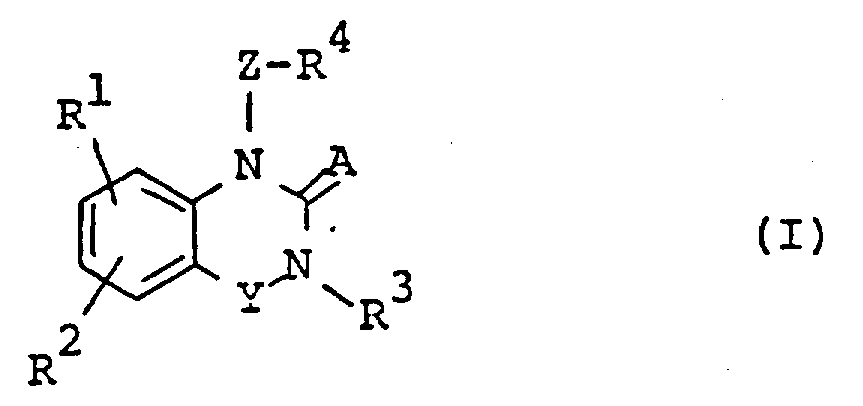
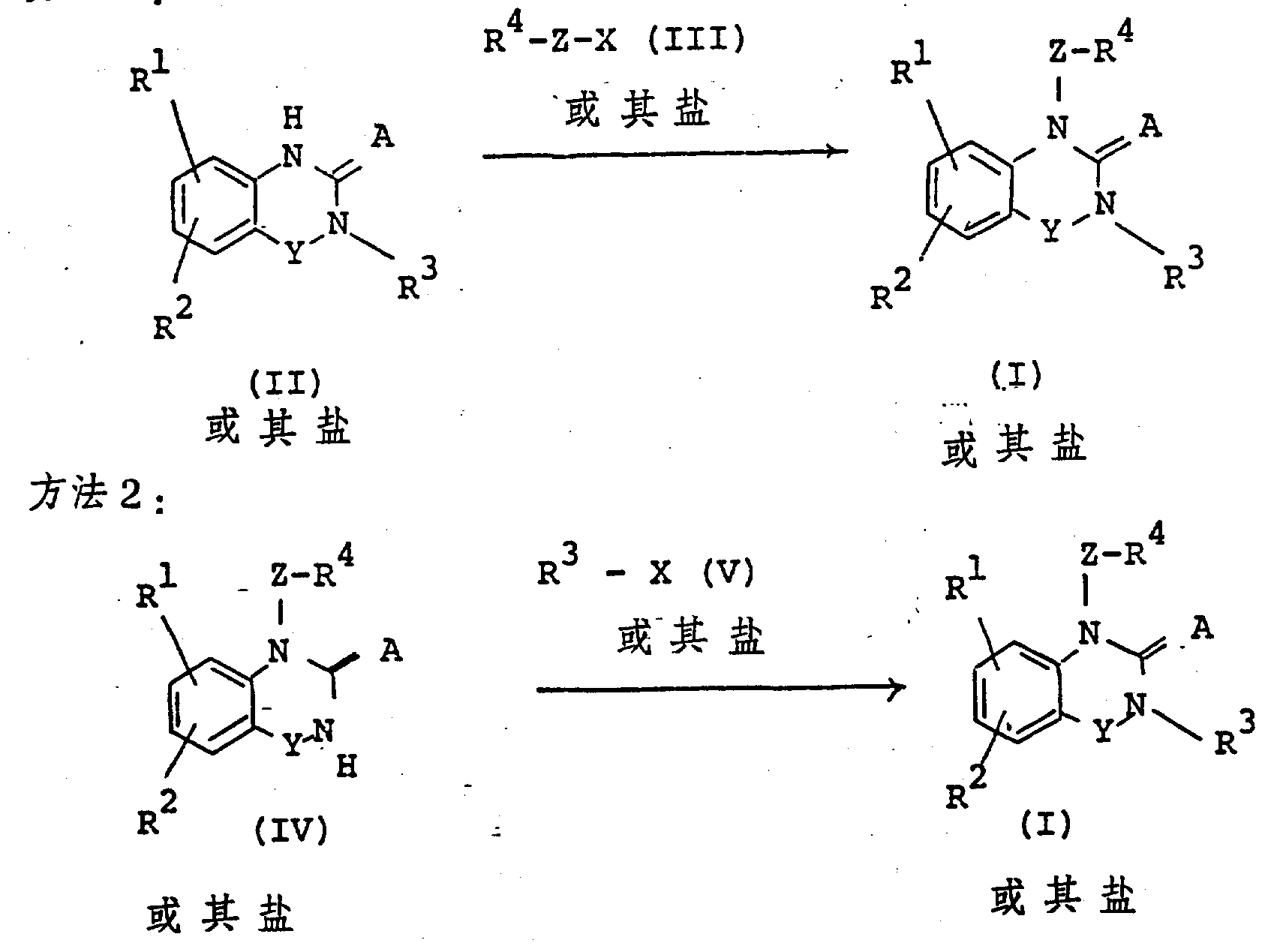
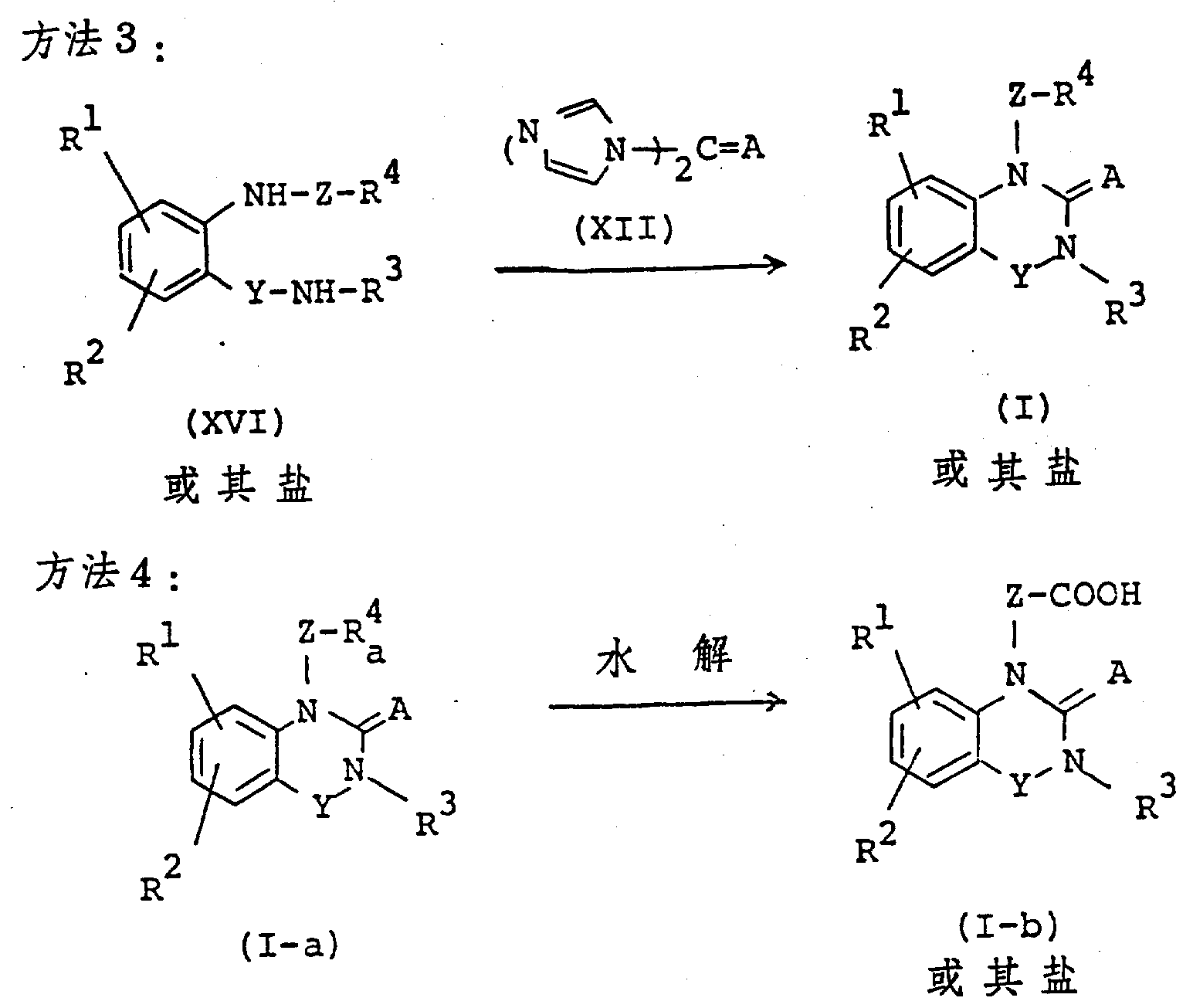
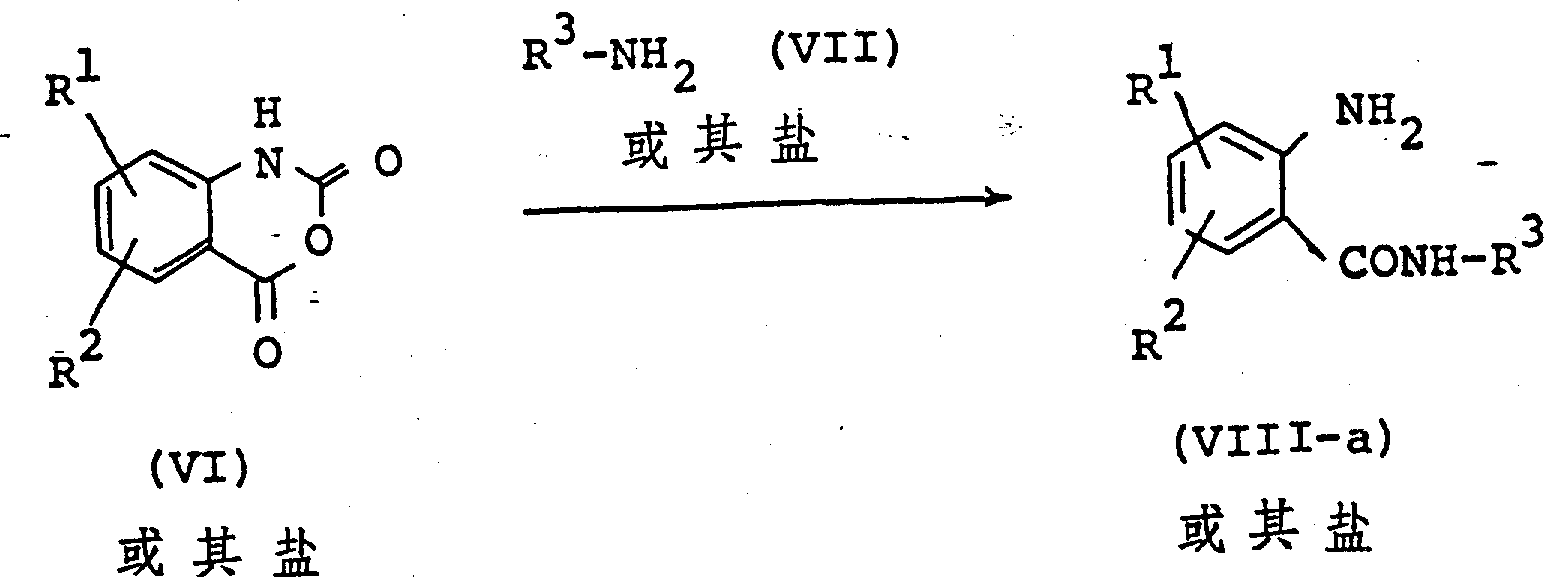
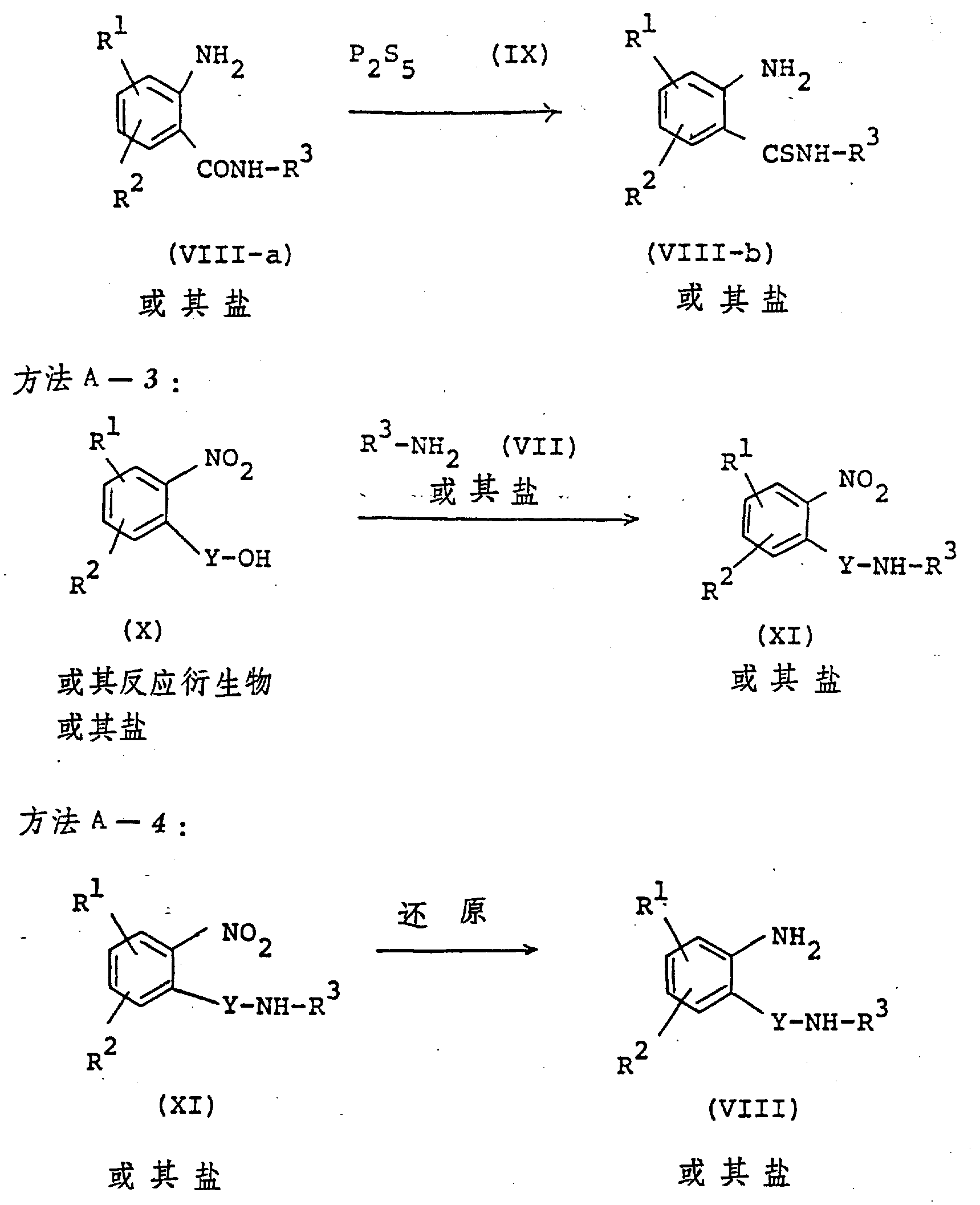
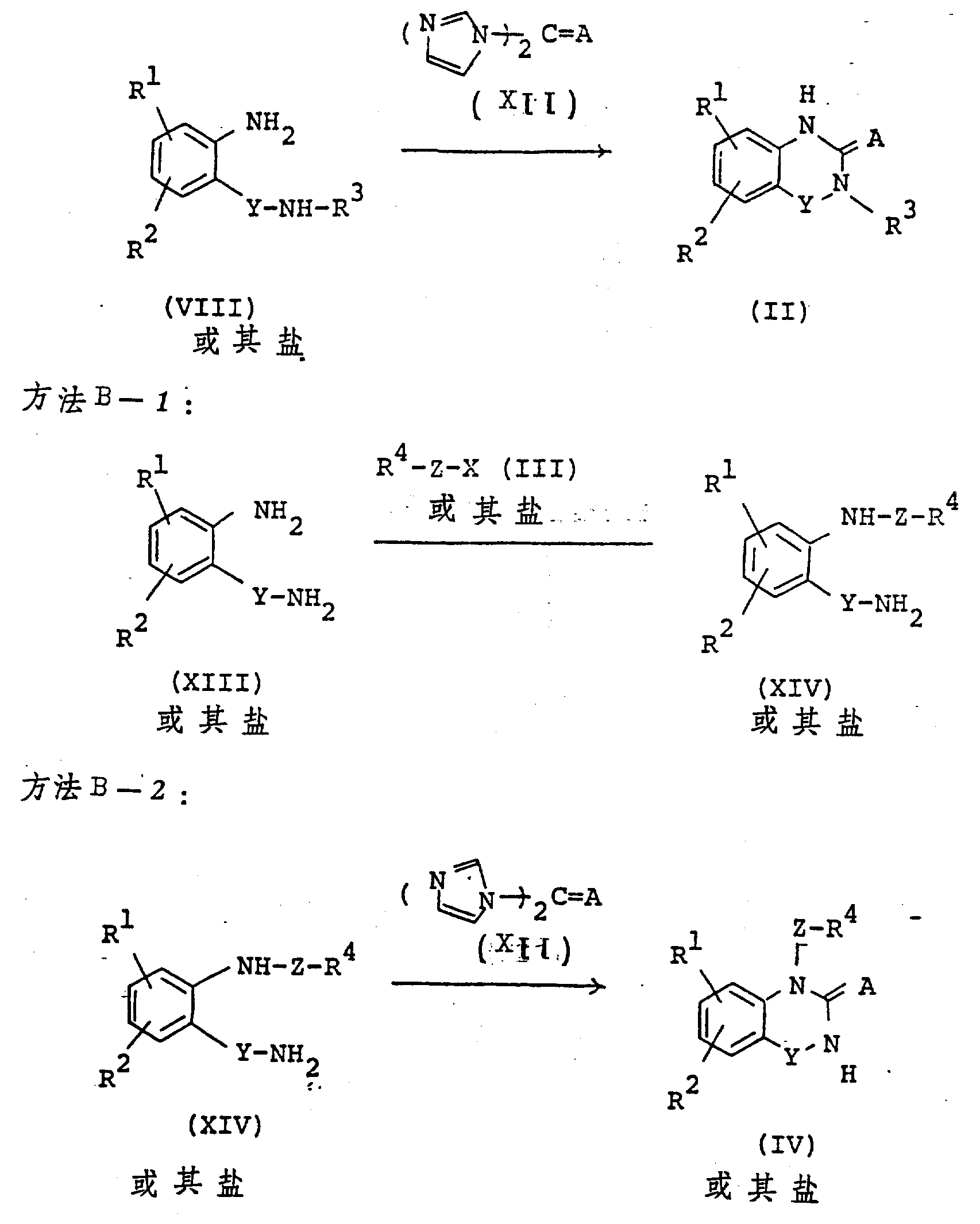
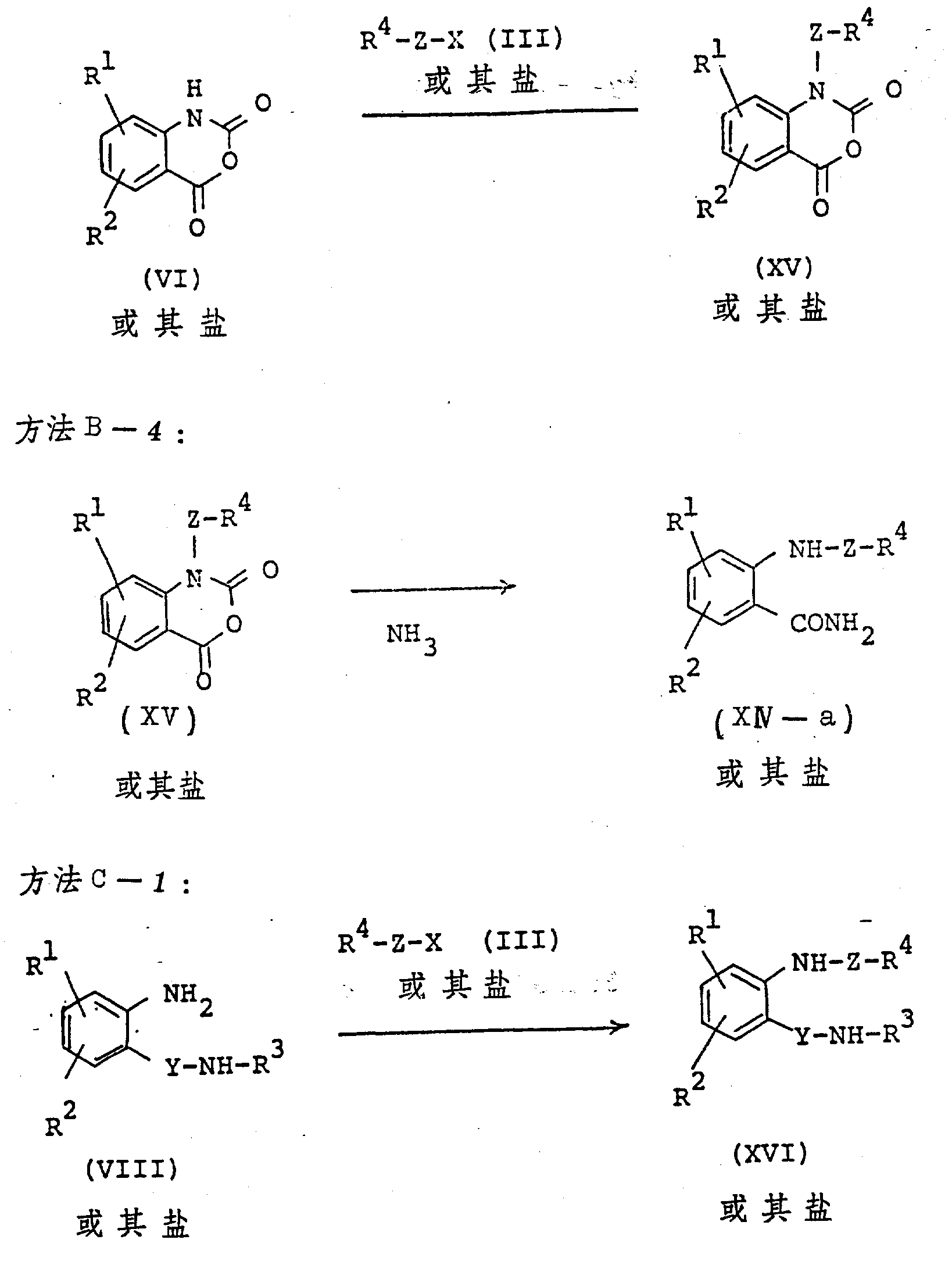
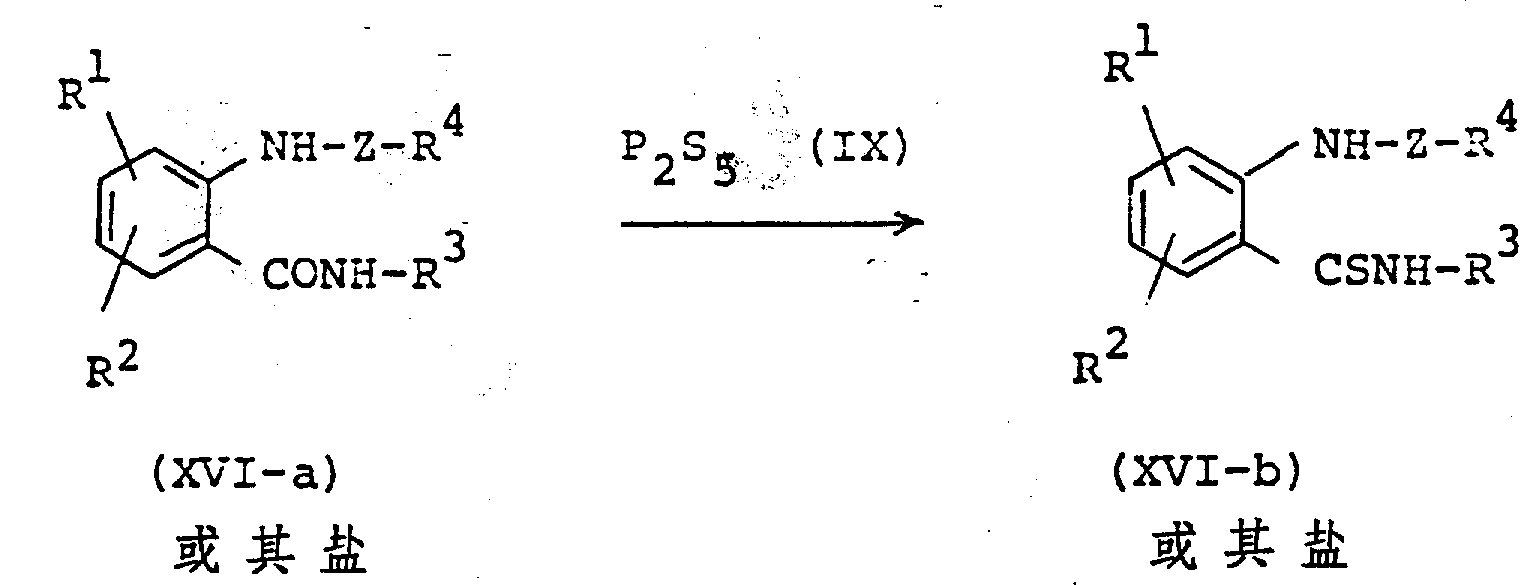
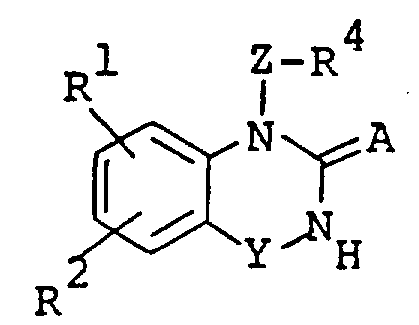
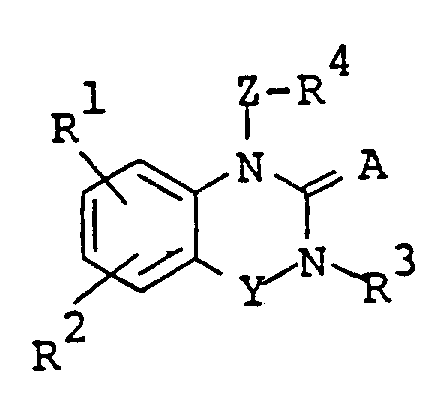
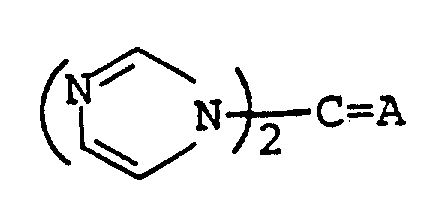
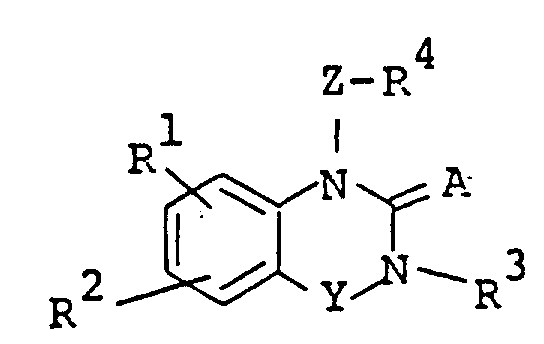
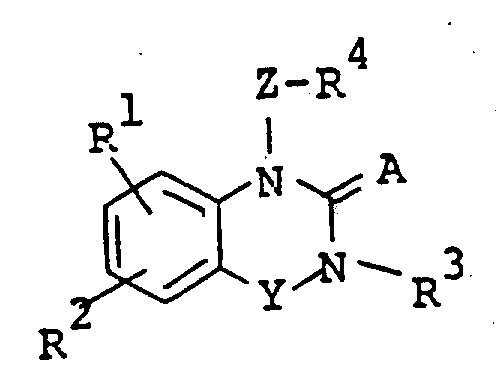
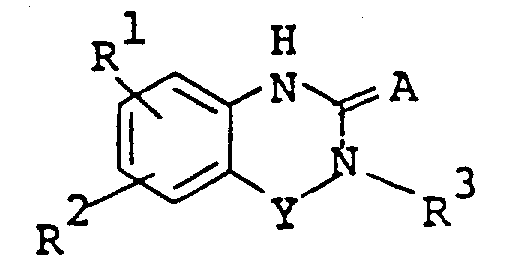
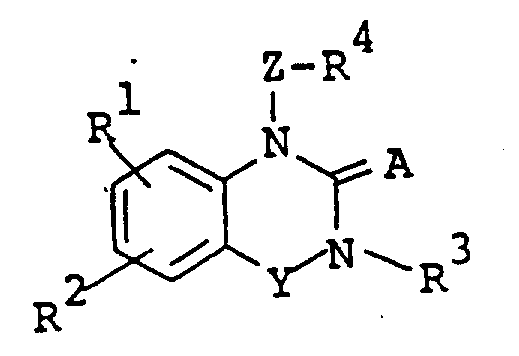
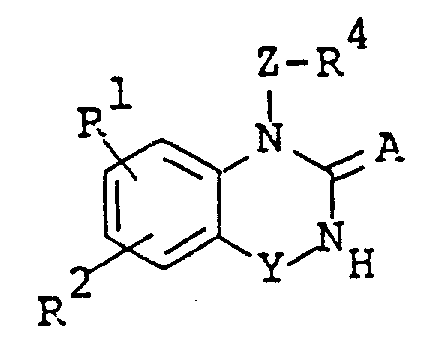
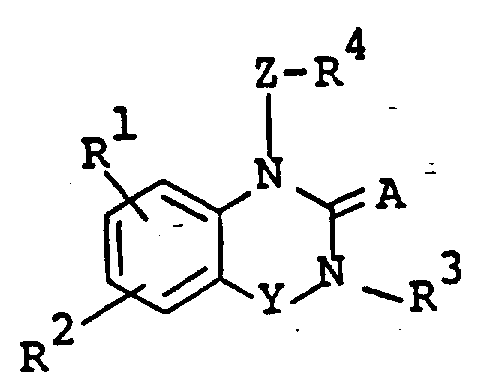
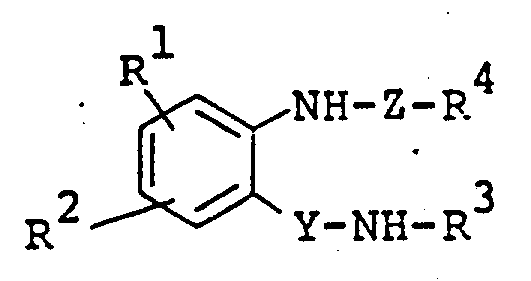
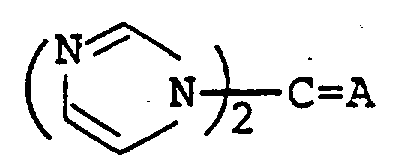
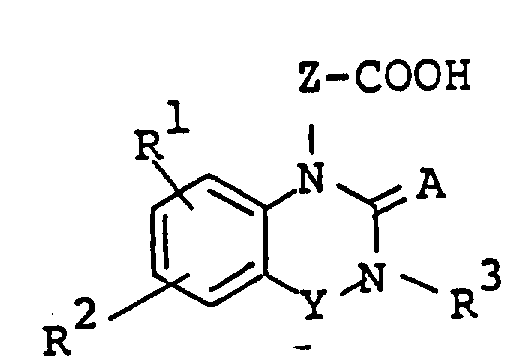
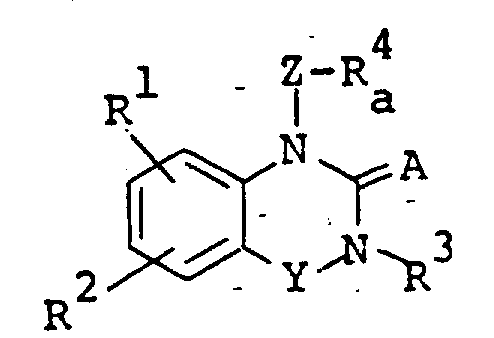
The following preparations and examples illustrate the present invention in more detail.
The following preparations and examples were made:
IR stands for infrared spectrum
NMR representation
Nujol represents liquid Paraffin
Preparation 1
(1) A mixture of 2H-3, 1-benzoxazine-2, 4- (1H) -dione (20 g) and 3, 4-dichlorobenzylamine (16.4 ml) was refluxed in benzene (200 ml) for 3 hours. After cooling, the solvent was removed under reduced pressure, and the resulting residue was recrystallized from ethyl N-hexane-acetate (1:2) to give 2-amino-N- (3, 4-dichlorobenzyl) benzamide (30.5 g)
IR(Nujol):3450,3350,3300,1620cm-1
NMR(DMSO-d6,δ):3.30(2H,broad s),4.30(2H,
d,J=7Hz),6.00-7.70(7H,m),8.70(1H,t,
J=7Hz)
The following compounds were obtained in substantially the same manner as in preparation 1-1.
(2) 2-Amino-N- (4-bromo-2-fluorobenzyl) benzamide
mp:117-117.5°C
IR(Nujol):3470,3350,3270,1765,1730,
1610,1585,1540cm-1
NMR(DMSO-d6,δ):4.40(2H,d,J=6Hz),6.39(2H,
broad s),6.4-6.8(2H,m),7.0-7.8(5H,m),
8.70(1H,t,J=6Hz)
Preparation 2
A mixture of 2-amino-N- (3, 4-dichlorobenzyl) benzamide (3.5 g) and phosphorus pentasulfide (4.74 g) in dioxane (56 ml) was stirred at room temperature for 5 hours. The reaction mixture was poured into an aqueous solution of sodium hydrogencarbonate and extracted with ethyl acetate. The extract was washed with water and dried. The solvent was distilled off to obtain a residue, and the obtained residue was chromatographed on silica gel. Eluting with chloroform followed by recrystallization from isopropyl ether gave 2-amino-N- (3, 4-dichlorobenzyl) thiobenzamide (1.56 g).
mp:89-91°C
IR(Nujol):3370,1605cm-1
Preparation 3
(1) A solution of 2-nitrobenzenesulfonyl chloride (5 g) in chloroform (20 ml) was added to a solution of 3, 4-dichlorobenzylamine (3.97 g) and triethylamine (3.5 ml) in chloroform (80 ml) with stirring at 0℃and the mixture was stirred at the same temperature for 30 minutes. The reaction mixture was washed with dilute hydrochloric acid and then with water, then dried and the solvent was evaporated to give N- (3, 4-dichlorobenzyl) -2-nitrobenzenesulfonamide (6.87 g).
IR(Nujol):3330,1530,1160cm-1
NMR(DMSO-d6,δ):4.23(2H,d,J=5Hz),
7.15-8.03(7H,m),8.67(1H,t,J=5Hz)
The following compounds were obtained in substantially the same manner as in preparation 3-1.
(2) N- (4-bromo-2-fluorobenzyl) -3-methoxy-2-nitrobenzamide
IR(Nujol):3300,1640,1610cm-1
NMR(DMSO-d6,δ):3.95(3H,s),4.39(2H,d,J=6Hz),
7.13-7.63(6H,m),9.22(1H,t,J=6Hz)
Preparation 4
(1) A mixture of N- (3, 4-dichlorobenzyl) -2-nitrobenzenesulfonamide (4 g) and iron (2 g) in acetic acid (30 ml) was stirred at 100℃for 45 minutes. After cooling, iron was removed by filtration. The filtrate was basified with dilute sodium hydroxide solution and extracted with ethyl acetate. The extract was washed with water, dried and evaporated. Recrystallisation from diethyl ether gave 2-amino-N- (3, 4-dichlorobenzyl) benzenesulfonamide (3.40 g)
IR(Nujol):3500,3380,3290,1615cm-1
NMR(DMSO-d6,δ):3.99(2H,s),5.88(2H,broad s),6.44-7.54(7H,m),8.12(1H,broad s)
The following compounds were prepared in substantially the same manner as in preparation 4-1.
(2) 2-Amino-N- (4-bromo-2-fluorobenzyl) -3-methoxybenzamide
IR(Nujol):3500,3380,3300,1630,1600cm-1
NMR(DMSO-d6,δ):3.82(3H,s),4.43(2H,d,
J=6Hz),6.12(2H,broad s),6.52-7.57(6H,m),
8.72(1H,t,J=6Hz)
Preparation 5
(1) A mixture of 2-amino-N- (3, 4-dichlorobenzyl) benzamide (0.295 g) and N, N' -carbonyldiimidazole (0.18 g) in benzene (3 ml) was refluxed for 15 minutes. After cooling, the resulting crystals were collected and washed with ethanol to give 3- (3, 4-dichlorobenzyl) -1,2,3, 4-tetrahydro-2, 4-dioxoquinazoline (0.25 g).
mp:274-275°C
IR(Nujol):1710,1660cm-1
NMR(DMSO-d6,δ):5.07(2H,s),7.10-8.07(7H,m),
11.50(1H,broad s)
The following compounds can be obtained by substantially the same method as in preparation 5-1.
(2) 3- (4-Bromo-2-fluorobenzyl) -1,2,3, 4-tetrahydro-2, 4-dioxoquinazoline
mp:251-252°C
IR(Nujol):1720,1660cm-1
NMR(DMSO-d6,δ):5.15(2H,s),8.70-8.0(7H,m),
11.50(1H,broad s)
(3) 3- (3, 4-Dichlorobenzyl) -1,2,3, 4-tetrahydro-2-oxo-4-thioquinazoline
mp:287-288°C
IR(Nujol):1690,1590cm-1
NMR(DMSO-d6,δ):5.73(2H,s),7.13-8.50(7H,m),
12.03(1H,broad s)
(4) 2- (3, 4-Dichlorophenyl) -3, 4-dihydro-3-oxo-2H-1, 2, 4-benzothiadiazine 1, 1-dioxide
IR(Nujol):1695,1600cm-1
NMR(DMSO-d6,δ):5.00(2H,s),7.18-7.95(7H,m),
11.53(1H,broad s)
(5) 3- (4-Bromo-2-fluorobenzyl) -8-methoxy-1, 2,3, 4-tetrahydro-2, 4-dioxoquinazoline
IR(Nujol):1720,1660cm-1
Preparation 6
(1) A mixture of 2-aminobenzamide (100 g), ethyl bromoacetate (97.74 g) and potassium carbonate (253.78 g) in N, N-dimethylformamide (400 ml) was stirred at 60℃for 4.5 hours. After cooling, the reaction mixture was poured into ice-water (2 liters) and the resulting crystals were collected by filtration. The resulting product was purified by recrystallization from ethanol to give ethyl N- (2-carbamoylphenyl) aminoacetate (123.93 g).
mp:147-148°C
IR(Nujol):3380,3180,1740,1635,1615cm-1
NMR(DMSO-d6,δ):1.22(3H,t,J=7Hz),4.02(2H,s),
4.14(2H,q,J=7Hz),6.48-6.68(2H,m),
7.11-7.68(4H,m)
The compounds described below can be obtained in substantially the same manner as in preparation 6-1.
(2) N- (2-carbamoyl-5-methoxyphenyl) glycine ethyl ester
IR(Nujol):3420,3390,3320,3240,1725,1655,
1625cm-1
NMR(DMSO-d6,δ):1.20(3H,t,J=7Hz),3.73(3H,s),4.00(2H,d,J=5Hz),4.12(2H,q,J=7Hz),6.00(1H,dd,J=2,8Hz),6.22(1H,d,J=2Hz),7.23(2H,broad s),7.57(1H,d,J=8Hz),8.73(1H,t,J=5Hz)
(3) N- (2-carbamoyl-4-methoxyphenyl) glycine ethyl ester
mp:108-110°C
IR(Nujol):3375,3200,1720,1645,1600,1510cm-1
NMR(DMSO-d6,δ):1.20(3H,t,J=7Hz),3.73(3H,s),3.92-4.28(4H,m),6.53(1H,d,J=6Hz),6.97(1H,dd,J=2,6Hz),7.23(1H,d,J=2Hz),7.98(2H,m)
(4) N- (2-carbamoyl-5-chlorophenyl) glycine ethyl ester
IR(Nujol):3420,1730,1670,1645,1610cm-1
NMR(DMSO-d6,δ):1.22(3H,t,J=7Hz),4.14(2H,q,J=7Hz),4.08(1H,d,J=9Hz),4.82(1H,d,J=9Hz),6.50-8.60(6H,m)
(5) N- (2-carbamoyl-4-chlorophenyl) glycine ethyl ester
mp:139-140°C
IR(Nujol):3400,3225,1720,1650,1615cm-1
NMR(CDCl3,δ):1.28(3H,t,J=7Hz),3.93(2H,d,J=6Hz),4.23(2H,q,J=7Hz),6.05(2H,broad s),6.47(1H,d,J=9Hz),7.24(1H,dd,J=2,9Hz),7.40(1H,d,J=2Hz),8.17(1H,t,J=6Hz)
(6) N- (2-carbamoyl-3-chlorophenyl) glycine ethyl ester
mp:151-154°C
IR(Nujol):3370,3180,1750,1645,1615cm-1
(7) N- (2-carbamoyl-3-methoxyphenyl) glycine ethyl ester
mp:138-140°C
IR(Nujol):3425,3310,3180,1735,1630,1605,1590cm-1
Preparation 7
(1) A mixture of ethyl N- (2-carbamoylphenyl) aminoacetate (54 g) and N, N' -carbonyldiimidazole (78.8 g) was stirred at 130℃for 40 min. After cooling, the resulting crystals were collected by filtration and washed with ethanol to give ethyl 2- (1, 2,3, 4-tetrahydro-2, 4-dioxoquinazolin-1-yl) acetate (54.96 g).
mp:249-250°C
IR(Nujol):3170,3050,1740,1705,1685,1605cm-1
NMR(DMSO-d6,δ):1.24(3H,t,J=7Hz),4.16(2H,q,J=7Hz),4.91(2H,s),7.13-8.10(4H,m)
The following compounds can be obtained by substantially the same method as in preparation 7-1
(2) 2- (1, 2,3, 4-Tetrahydro-7-methoxy-2, 4-dioxoquinazolin-1-yl) -acetic acid ethyl ester
IR(Nujol):3150,1730,1710,1695,1610cm-1
NMR(DMSO-d6,δ):1.22(3H,t,J=7Hz),3.87(3H,s),4.18(2H,q,J=7Hz),4.92(2H,s),6.77(1H,dd,J=2,8Hz),6.93(1H,d,J=2Hz),7.97(1H,d,J=8Hz)
(3) 2- (1, 2,3, 4-Tetrahydro-6-methoxy-2, 4-dioxoquinazolin-1-yl) -acetic acid ethyl ester
mp:260-261°C
IR(Nujol):3175,3050,1740,1705,1670,1480cm-1
NMR(DMSO-d6,δ):1.22(3H,t,J=7Hz),3.83(3H,s),
4.20(2H,q,J=7Hz),4.88(2H,s),7.32(2H,m),
7.47(1H,m),11.73(1H,broad s)
(4) 2- (6-Chloro-1, 2,3, 4-tetrahydro-2, 4-dioxoquinazolin-1-yl) acetic acid ethyl ester
mp:251-252°C
IR(Nujol):1735,1700(sh),1690,1610cm-1
NMR(DMSO-d6,δ):1.60(3H,t,J=7Hz),
4.15(2H,q,J=7Hz),4.90(2H,s),
7.42(1H,d,J=9Hz),7.78(1H,dd,J=3,9Hz),
7.95(1H,d,J=3Hz),11.90(1H,broad s)
(5) 2- (5-Chloro-1, 2,3, 4-tetrahydro-2, 4-dioxoquinazolin-1-yl) acetic acid ethyl ester
mp:233-235°C
IR(Nujol):1735,1720,1690,1590,1580cm-1
(6) 2- (1, 2,3, 4-Tetrahydro-5-methoxy-2, 4-dioxoquinazolin-1-yl) acetic acid ethyl ester
mp:258-260°C
IR(Nujol):3175,1740,1700,1680,1600,1590(sh)cm-1
Preparation 8
Ethyl N- (2-carbamoyl-5-chlorophenyl) aminoacetate (357 g) and N, N' -carbonyldiimidazole (451 g) were dissolved in 1, 4-dioxane (1.5 l), and the 1, 4-dioxane was concentrated to about 0.5 l by distillation. The resulting mixture was stirred at 150 ℃ for 30 minutes. After cooling, the precipitated crystals were collected by filtration and washed with ethanol to give 2- (7-chloro-1, 2,3, 4-tetrahydro-2, 4-)Ethyl dioxoquinazolin-1-yl acetate (353 g).
IR(Nujol):3200,3070,1740,1710,1690,1605,1580cm-1
NMR(DMSO-d6,δ):1.23(3H,t,J=7Hz),4.18(2H,q,J=7Hz),4.92(2H,s),7.32(1H,dd,J=2,8Hz),7.55(1H,d,J=2Hz),8.00(1H,d,J=8Hz)
Preparation 9
A mixture of 2-benzyloxycarbonylamino-4-chlorobenzoic acid (564 g) and phosphorus tribromide (1.5 kg) in diethyl ether (9 l) was refluxed for 40 hours and left at room temperature for 5 days. The resulting precipitate was collected by filtration and washed with diethyl ether (5 liters) and ethanol (3 liters) in sequence to give 7-chloro-2H-3, 1-benzoxazine-2, 4 (1H) -dione (335 g).
mp:282-283°C(dec.)
IR(Nujol):3175,1740(broad),1710,1615cm-1
NMR(DMSO-d6,δ):7.15(1H,d,J=1.5Hz),7.30(1H,dd,J=1.5,5Hz),7.93(1H,d,J=5Hz),11.83(1H,s)
Preparation 10
Chromium trioxide (16 g) was added over 15 minutes to a suspension of 4, 6-dichloroindole-2, 3-dione (5.95 g) in acetic acid (95 ml) with stirring at 60 ℃, and the mixture was stirred at 70-75 ℃ for 1 hour. After cooling, the reaction mixture was poured into water (360 ml) and the resulting precipitate was collected by filtration. The filtrate was extracted with ethyl acetate. The extract was washed with water and dried. Removing the solvent to give a residue, and subjecting the residue to a solvent removal processThe residue was combined with the precipitate. Recrystallization from isopropyl ether gave 5, 7-dichloro-2H-3, 1-benzoxazine-2, 4 (1H) -dione (2.85 g).
mp:267-268°C。
IR(Nujol):3225,3200,3100,3075,1790,1775,1705,1610,1585cm-1
NMR(DMSO-d6,δ):7.09(1H,d,J=1.2Hz),7.48(1H,d,J=1.2Hz)
Preparation 11
A mixture of 7-chloro-2H-3, 1-benzoxazine-2, 4 (1H) -dione (18.4 g) and 4-bromo-2-fluorobenzylamine (26 g) in tetrahydrofuran (200 ml) was refluxed for 15 minutes. After cooling, tetrahydrofuran was removed by evaporation to give a residue. Recrystallization from isopropyl ether gave 2-amino-N- (4-bromo-2-fluorobenzyl) -4-chlorobenzamide (26.6 g)
mp:119.5°C
IR(Nujol):3460,3350,3260,1625,1605cm-1
NMR(DMSO-d6,δ):4.4(2H,d,J=5.6Hz),6.5-6.8(4H,m),7.3-7.6(4H,m),8.8(1H,t,J=5.6Hz)
Preparation 12
(1) A solution of 4-bromo-2-nitrobenzoyl chloride (2.69 g) in chloroform (10 ml) was added dropwise to a solution of 4-bromo-2-fluorobenzylamine (2.3 g) and triethylamine (1.55 ml) in chloroform (40 ml) with stirring at 0℃and the mixture was stirred at the same temperature for an additional 1 hour. The reaction mixture was washed with dilute hydrochloric acid and water in this order, followed by drying. The solvent was evaporated and recrystallized from diethyl ether to give 4-bromo-N- (4-bromo-2-fluorobenzyl) -2-nitrobenzamide (3.60 g).
mp:192-193°C
IR(Nujol):3275,1650,1605,1555,1535,1485cm-1
NMR(DMSO-d6,δ):4.42(2H,d,J=5.7Hz),7.39-7.62(4H,m),8.02(1H,dd,J=1.9,8.2Hz),
The following compounds can be prepared by substantially the same method as for preparation 12-1
(2) N- (4-bromo-2-fluorobenzyl) -4-iodo-2-nitrobenzamide
mp:204-205°C
IR(Nujol):3270,1645,1580,1570,1535,1485cm-1
NMR(DMSO-d6,δ):4.42(2H,d,J=6Hz),7.34-7.58(4H,m),8.17(1H,d,J=1.3,8Hz)8.36(1H,d,J=1.3Hz),9.26(1H,t,J=5.8Hz)
(3) N- (4-bromo-2-fluorobenzyl) -4-fluoro-2-nitrobenzamide
mp:157-159°C
IR(Nujol):3250,1620,1540,1360cm-1
NMR(CDCl3,δ):4.62(2H,d,J=5.9Hz),6.24(1H,br s),7.24-7.78(6H,m)
(4) N- (4-bromo-2-fluorobenzyl) -4-chloro-2-nitrobenzamide
IR(Nujol):3300,1645,1610,1540,1360cm-1
(5) N- (4-bromo-2-fluorobenzyl) -3-chloro-2-nitrobenzamide
mp:198-200°C
IR(Nujol):3260,1635cm-1
NMR(DMSO-d6,δ):4.43(2H,d,J=6Hz),7.23-8.07(6H,m),9.50(1H,t,J=6Hz)
(6) 4-Chloro-N- [ 4-chloro-3- (trifluoromethyl) benzyl ] -2-nitrobenzamide
mp:151-152°C
IR(Nujol):3260,1640,1600,1550,1530cm-1
NMR(DMSO-d6,δ):4.55(2H,d,J=6Hz),7.52-8.08(5H,m),8.17(1H,d,J=2Hz),9.33(1H,t,J=6Hz)
(7) N- (4-bromo-2-fluorobenzyl) -2-nitro-4- (trifluoromethyl) benzamide
mp:174-175°C
IR(Neat):1640,1530,1400,1360,1320,1120cm-1
(8) 4-Fluoro-N- (2-fluoro-4-iodobenzyl) -2-nitrobenzamide
IR(Nujol):3250,3050,1640,1620,1605,1535,1360cm-1
NMR(DMSO-d6,δ):4.4(2H,d,J=5.6Hz),7.2(1H,dd,J=8,8Hz),7.6-7.8(5H,m),8.0(1H,dd,J=1.8,8.6Hz),9.3(1H,t,J=5.6Hz)
(9) N- (2-fluoro-4-iodobenzyl) -4-iodo-2-nitrobenzamide
mp:213-214°C
IR(Nujol):3270,3080,1650,1540,1360,860cm-1
NMR(DMSO-d6,δ):9.29(1H,t,J=5.8Hz),8.36-7.18(6H,m),4.41(2H,d,J=5.8Hz)
Preparation 13
A mixture of 4-bromo-2-nitrobenzoic acid (3.0 g) and N, N' -carbonyldiimidazole (2.37 g) in tetrahydrofuran (30 ml) was stirred at room temperature for 4 hours. A solution of 2-fluoro-4-iodobenzylamine (3.37 g) in tetrahydrofuran (10 ml) was added to the above mixture, and the resulting mixture was stirred at room temperature overnight. The reaction mixture was poured into a mixture of ethyl acetate and 0.5N hydrochloric acid. The organic layer was separated, washed with water, an aqueous sodium hydrogencarbonate solution, water and a saturated aqueous sodium chloride solution in this order, and dried over magnesium sulfate. The solvent was removed under vacuum and the crystallized residue was recrystallized from a mixture of ethyl acetate and hexane to give 4-bromo-N- (2-fluoro-4-iodobenzyl) -2-nitrobenzamide (4.88 g).
mp:139-140°C
IR(Nujol):3260,1645cm-1
NMR(DMSO-d6,δ):4.43(2H,d,J=5.5Hz),7.23(1H,t,J=8Hz),7.58-7.67(3H,m),8.03(1H,dd,J=2,8Hz),8.28(1H,d,J=2Hz),9.28(1H,t,J=5.5Hz)
Preparation 14
(1) A mixture of 4-bromo-N- (4-bromo-2-fluorobenzyl) -2-nitrobenzamide (3.4 g) and iron (1.45 g) in acetic acid (66 ml) was stirred at 100℃for 30 minutes. After cooling, iron was removed by filtration. The filtrate was evaporated to give a residue, which was basified with 1N aqueous sodium hydroxide solution and extracted with ethyl acetate. The extract is washed with water and dried. The solvent was removed to give 2-amino-4-bromo-N- (4-bromo-2-fluorobenzyl) benzamide (3.10 g).
mp:143-144°C
IR(Nujol):3460,3350,3260,1630,1610,1580,1535,1485cm-1
NMR(DMSO-d6,δ):4.39(2H,d,J=6Hz),6.64(1H,d,J=1.5Hz),6.68(2H,s),6.92(1H,d,J=1.5Hz),7.25-7.54(4H,m),8.85(1H,t,J=5.8Hz)
The following compounds can be obtained by substantially the same method as in preparation 14-1.
(2) 2-Amino-N- (4-bromo-2-fluorobenzyl) -4-iodobenzamide
mp:180°C
IR(Nujol):3450,3350,3275,1635,1605,1570,1535cm-1
NMR(DMSO-d6,δ):4.39(2H,d,J=6Hz),6.58(2H,s),6.84(1H,d,J=8Hz),7.13(1H,s),7.25-7.54(4H,m),8.84(1H,t,J=6Hz).
(3) 2-Amino-N- (4-bromo-2-fluorobenzyl) -4-chlorobenzamide
IR(Nujol):3460,3350,3260,1625,1605cm-1
(4) 2-Amino-N- (4-bromo-2-fluorobenzyl) -3-chlorobenzamide
mp:170-171°C
IR(Nujol):3480,3375,3290,1625,1605cm-1
NMR(DMSO-d6,δ):4.43(2H,d,J=6Hz),6.50(2H,br.s),6.57-7.70(6H,m),8.97(1H,t,J=6Hz)
(5) 2-Amino-4-chloro-N- [ 4-chloro-3- (trifluoromethyl) -benzyl ] benzamide
mp:122-125°C
IR(Nujol):3450,3300,1630,1580,1525,1480cm-1
NMR(DMSO-d6,δ):4.48(2H,d,J=6Hz),6.43-6.93(4H,m),7.47-7.90(4H,m),8.87(1H,t,J=6Hz)
(6) 2-Amino-4-bromo-N- (2-fluoro-4-iodobenzyl) benzamide
mp:111-112°C
IR(Nujol):3400,3300,3270,1630cm-1
NMR(DMSO-d6,δ):4.43(2H,d,J=5.5Hz),7.24(1H,t,J=8Hz),7.57-7.67(3H,m),8.16(1H,dd,J=2,8Hz),8.28(1H,d,J=2Hz),9.28(1H,t,J=5.5Hz)
(7) 2-Amino-4-fluoro-N- (2-fluoro-4-iodobenzyl) benzamide
IR(Nujol):3460,3350,3260,1630,1600cm-1
NMR(DMSO-d6,δ):4.4(2H,d,J=5.5Hz),6.3-6.5(2H,m),6.8(2H,s),7.1(1H,dd,J=8,8Hz),7.5-7.7(3H,m),8.8(1H,t,J=5.5Hz)
Preparation 15
(1) A solution of N- (4-bromo-2-fluorobenzyl) -4-fluoro-2-nitrobenzamide (4.79 g) and stannous chloride (12.24 g) in ethanol (26 ml) was stirred at 70-80℃under nitrogen for 30 min. After cooling, the reaction mixture was poured into ice-cooled water and neutralized with saturated aqueous sodium bicarbonate. The resulting precipitate was filtered off and washed with ethyl acetate. Extracting the filtrate with ethyl acetate, washing the extractive solution with water, and drying. The solvent was removed to give 2-amino-N- (4-bromo-2-fluorobenzyl) -4-fluorobenzamide (3.58 g).
mp:120-121°C
IR(Nujol):3250,1610,1520,1360cm-1
NMR(DMSO-d6,δ):4.41(2H,d,J=5.6Hz),6.33(1H,t,J=8.3Hz),6.47(1H,d,J=8.3Hz),6.78(2H,s),7.67-7.27(4H,m),8.78(1H,t,J=5.6Hz)
The following compounds can be obtained by substantially the same method as in preparation 15-1.
(2) 2-Amino-N- (4-bromo-2-fluorobenzyl) -4- (trifluoromethyl) benzamide
mp:174-175°C
IR(Nujol):1640,1590,1530,1370cm-1
(3) 2-Amino-N- (2-fluoro-4-iodobenzyl) -4-iodobenzamide
mp:178-179°C
IR(Nujol):3470,3150,3260,1630,1600,1570,1530,1300,860,720cm-1
NMR(DMSO-d6,δ):4.44(2H,d,J=5.5Hz),6.65-7.70(6H,m),8.89(1H,t,J=5.5Hz)
Preparation 16
2-Amino-4-bromo-N- (4-bromo-2-fluorobenzyl) benzamide (2.90 g) and N, N' -carbonyldiimidazole (4.68 g) were dissolved in dioxane (50 ml). The solution was evaporated to give a residue which was stirred at 150 ℃ for 30 minutes. After cooling, the precipitate was collected by filtration and washed with ethanol to give 7-bromo-3- (4-bromo-2-fluorobenzyl) -1,2,3, 4-tetrahydro-2, 4-dioxoquinazoline (2.92 g).
mp:>280°C
IR(Nujol):1720,1660,1610,1595,1580,1485cm-1
NMR(DMSO-d6,δ):5.07(2H,s),7.19-7.86(6H,m)
The following compounds can be obtained in substantially the same manner as in preparation 16-1.
(2) 3- (4-Bromo-2-fluorobenzyl) -7-iodo-1, 2,3, 4-tetrahydro-2, 4-dioxoquinazoline
mp:>280°C
IR(Nujol):1715,1660,1605,1590,1580,1485cm-1
NMR(DMSO-d6,δ):5.06(2H,s),7.16(1H,dd,J=8,8Hz),7.32(1H,d,J=8Hz),7.51-7.59(3H,m),7.66(1H,d,J=8Hz)
(3) 3- (4-Bromo-2-fluorobenzyl) -7-fluoro-1, 2,3, 4-tetrahydro-2, 4-dioxoquinazoline
mp:250-251°C
IR(Nujol):1720,1660,1600,1360cm-1
NMR(DMSO-d6,δ):5.08(2H,s),7.57-6.93(5H,m),8.01(1H,dd,J=6,7Hz)
(4) 3- (4-Bromo-2-fluorobenzyl) -7-fluoro-1, 2,3, 4-tetrahydro-2, 4-dioxoquinazoline
mp:>280°C
IR(Nujol):3200,3060,1720,1660,1615,1600,1580cm-1
NMR(DMSO-d6,δ):5.1(2H,s),7.2-7.3(4H,m),7.5(1H,d,J=8Hz),7.9(1H,d,J=8Hz)
(5) 3- (4-Bromo-2-fluorobenzyl) -8-chloro-1, 2,3, 4-tetrahydro-2, 4-dioxoquinazoline
mp:288-290°C
IR(Nujol):1715,1660,1610cm-1
NMR(DMSO-d6,δ):5.10(2H,s),7.10-8.00(6H,m)
(6) 7-Chloro-3- [ 4-chloro-3- (trifluoromethyl) benzyl ] -1,2,3, 4-tetrahydro-2, 4-dioxoquinazoline
mp:239°C
IR(Nujol):1720,1700,1630cm-1
NMR(DMSO-d6,δ):5.15(2H,s),7.07-7.40(2H,m),7.53-8.13(4H,m)
(7) 3- (4-Bromo-2-fluorobenzyl) -7-trifluoromethyl-1, 2,3, 4-tetrahydro-2, 4-dioxoquinazoline
mp:260-261°C
IR(Nujol):1720,1660,1600,1380,1360,1170,1130cm-1
Preparation 17
(1) A mixture of 2-amino-4-bromo-N- (2-fluoro-4-iodobenzyl) benzamide (3.80 g), N, N' -carbonyldiimidazole (5.5 g) and 1, 4-dioxane (30 ml) was refluxed for 2 hours. The resulting crystals were collected by filtration, washed with 1, 4-dioxane and dried over phosphorus pentoxide to give 7-bromo-3- (2-fluoro-4-iodobenzyl) -1,2,3, 4-tetrahydro-2, 4-dioxoquinazoline (2.85 g).
mp:303-304°C
IR(Nujol):1715,1655cm-1
NMR(DMSO-d6,δ):5.05(2H,s),7.00(1H,t,J=8Hz),7.37(2H,s),7.46(1H,t,J=8Hz),7.63(1H,d,J=9Hz),7.85(1H,d,J=9Hz).
The following compounds can be obtained by substantially the same method as in preparation 17-1.
(2) 7-Fluoro-3- (2-fluoro-4-iodobenzyl) -1,2,3, 4-tetrahydro-2, 4-dioxoquinazoline
IR(Nujol):1720,1660,1620,1610,1600cm-1
NMR(DMSO-d6,δ):5.1(2H,s),6.9-7.1(3H,m),7.5(1H,dd,J=1.4,8.1Hz),7.6(1H,dd,J=1.6,9.7Hz),8.0(1H,dd,J=6.2,8.8Hz)
(3) 3- (2-Fluoro-4-iodobenzyl) -7-iodo-1, 2,3, 4-tetrahydro-2, 4-dioxoquinazoline
mp:320-322°C
IR(Nujol):3470,3360,3270,1720,1660,1600,1480,960,860,760cm-1
NMR(DMSO-d6,δ):5.0(2H,s),7.0(1H,t,J=8Hz),7.45-7.68(5H,m)
Preparation 18
(1) Ethyl N- (2-carbamoyl-4, 5-dichlorophenyl) aminoacetate (4.6 g) and N, N' -carbonyldiimidazole (5.12 g) were dissolved in dioxane (50 ml). The solution was evaporated to a residue which was stirred at 140 ℃ for 30 minutes. After cooling, the precipitate was collected by filtration and washed with ethanol to give ethyl 2- (6, 7-dichloro-1, 2,3, 4-tetrahydro-2, 4-dioxoquinazolin-1-yl) acetate (4.40 g).
mp:>280°C
IR(Nujol):1735,1720,1690,1605,1570cm-1
NMR(DMSO-d6,δ):1.22(3H,t,J=7Hz),4.17(2H,q,J=7Hz),4.90(2H,s),7.86(1H,s),8.11(1H,s)
The following compounds can be prepared in substantially the same manner as in preparation 18-1.
(2) 2- (5, 7-Dichloro-1, 2,3, 4-tetrahydro-2, 4-dioxoquinazolin-1-yl) acetic acid ethyl ester
mp:244-247°C
IR(Nujol):1750,1740(sh),1710,1690,1590,1565cm-1
NMR(DMSO-d6,δ):1.22(3H,t,J=7Hz),4.18(2H,q,J=7Hz),4.92(2H,s),7.49(1H,s),7.57(1H,s),11.89(1H,s)
Preparation 19
(1) Sodium hydride (60% in mineral oil, 86.8 g) was added to a solution of 7-chloro-2H-3, 1-benzoxazine-2, 4- (1H) -dione (330 g) in N, N-dimethylformamide (3.3 l) at 20 ℃ and the mixture stirred at 5 ℃ for 30 minutes. Ethyl bromoacetate (222 ml) was added to the above solution at 10 ℃ over 30 minutes and the resulting mixture was stirred at room temperature for 1.5 hours. Below 10 ℃, 28% aqueous ammonia (696 ml) was added to the reaction mixture and the resulting mixture was stirred at 5 ℃ for 20 minutes. The mixture was poured into 1N hydrochloric acid (16.5 l). The precipitate was collected by filtration and washed with water (three times) and diethyl ether in this order to give ethyl N- (2-carbamoyl-5-chlorophenyl) aminoacetate.
mp:157-155°C
IR(Nujol):3400,1725,1650,1610cm-1
NMR(DMSO-d6,δ):1.20(3H,t,J=4.5Hz),4.05(2H,d,J=4Hz),4.15(2H,q,J=4.5Hz),6.58(1H,d,J=1.5Hz),6.62(1H,dd,J=1.5,6Hz),7.63(1H,d,J=6Hz),7.7(2H,broad),8.67(1H,t,J=4Hz)
The following compounds can be obtained by substantially the same method as in preparation 19-1.
2) N- (2-carbamoyl-4, 5-dichlorophenyl) glycine ethyl ester
mp:181°C
IR(Nujol):3400,3360,3225,1720,1655,1620,1570,1505cm-1
NMR(DMSO-d6,δ):1.21(3H,t,J=7Hz),4.09(2H,d,J=5.5Hz),4.15(2H,q,J=7Hz),6.80(1H,s),7.86(1H,s),8.58(1H,t,J=5.5Hz)
3) N- (2-carbamoyl-3, 5-dichlorophenyl) glycine ethyl ester
mp:171-173°C
IR(Nujol):3400(sh),3375,3200,1750,1645,1615,1585,1565cm-1
NMR(DMSO-d6,δ):1.21(3H,t,J=7Hz),3.99(2H,d,J=5.5Hz),4.14(2H,q,J=7Hz),5.87(1H,t,J=5.5Hz),6.53(1H,s),6.78(1H,s),7.80(1H,s),7.98(1H,s)
Preparation 20
1) A mixture of 2-amino-N-benzylbenzamide (400 mg), ethyl bromoacetate (295 mg) and potassium carbonate (244 mg) was dissolved in N, N-dimethylformamide (10 ml), and the solution was stirred at 100℃for 17 hours. After cooling, the reaction mixture was poured into ice water and extracted with diethyl ether. Washing the extractive solution with water, and drying. The solvent was removed and the resulting residue was separated by silica gel chromatography with chloroform as eluent. Ethyl 2- [2- (N-benzylcarbamoyl) -anilino ] acetate (137 mg) was obtained.
IR(Nujol):1735,1630cm-1
NMR(CDCl3,δ):3.25(3H,t,J=7Hz),3.95(2H,d,J=5Hz),4.20(2H,q,J=7Hz),4.60(2H,d,J=5Hz),6.60(2H,d,J=8Hz),7.10-7.50(9H,m),8.00(1H,br.s)
The following compounds can be obtained by substantially the same method as in preparation of 20-1
2) 2- [2- { N- (3, 4-dichlorobenzyl) carbamoyl } anilino ] ethyl acetate
Preparation 21
A mixture of ethyl 2- [2- { N- (3, 4-dichlorobenzyl) carbamoyl } anilino ] acetate (16.3 g), phosphorus pentasulfide (19.0 g) and dioxane (320 ml) was refluxed for 1 hour. The reaction mixture was filtered and the filtrate concentrated in vacuo. The residue was chromatographed on silica gel (300 g), eluting with chloroform, to give ethyl 2- [2- { N- (3, 4-dichlorobenzyl) thiocarbamoyl } anilino ] acetate (13.72 g).
IR(CHCl3):3400,1740cm-1
NMR(CDCl3,δ):1.29(3H,t,J=7Hz),3.83(2H,s),4.22(2H,q,J=7Hz),4.96(2H,d,J=5.5Hz),6.47(1H,d,J=8Hz),6.67(1H,dt,J=1,8Hz),7.12-7.29(3H,m),7.42-7.51(2H,m),8.23(1H,t,J=5.5Hz)
Example 1
1) 1G of 3- (3, 4-dichlorobenzyl) -1,2,3, 4-tetrahydro-2, 4-dioxoquinazoline are suspended in 15 ml of N, N-dimethylformamide. At 0 ℃, 0.17 g sodium hydride (60% in mineral oil) was added to the suspension with stirring, at the same timeThe mixture was stirred at a temperature for 15 minutes. To this mixture was added 0.45 ml of ethyl bromoacetate and stirred at room temperature for 1 hour. The reaction mixture was poured into dilute hydrochloric acid, followed by extraction with ethyl acetate. The extract was washed with brine and dried and evaporated to give a residue. Recrystallization from isopropyl ether gave 1.21 g of ethyl 2- [ 3- (3, 4-dichlorobenzyl) -1,2,3, 4-tetrahydro-2, 4-dioxoquinazolin-1-yl ] acetate.
mP:121-122°C
IR(Nujol):1725,1700,1665,1605cm-1
In practice, the following compounds can be obtained by substantially the same method as in preparation example 1-1.
2) 2- [3- (4-Bromo-2-fluorobenzyl) -1,2,3, 4-tetrahydro-2, 4-dioxoquinazolin-1-yl) acetic acid ethyl ester
mp 153-154°C
IR(Nujol):1735,1715,1665,1605cm-1
NMR(DMSO-d6,δ):1.15(3H,t,J=7Hz),4.15(2H,q,J=7Hz),4.97(2H,s),5.15(2H,s),7.0-8.2(7H,m)
3) 2- [ 3-Benzyl-1, 2,3, 4-tetrahydro-2, 4-dioxoquinazolin-1-yl) acetic acid ethyl ester
IR(Nujol):1740,1700,1660,1650cm-1
NMR(DMSO-d6,δ):1.30(3H,t,J=7Hz),3.32(2H,s),4.25(2H,q,J=7Hz),5.10(2H,d,J=10Hz),7.30-8.30(9H,m)
4) 2- [3- (3, 4-Dichlorophenyl) -1,2,3, 4-tetrahydro-2, 4-dioxoquinazolin-1-yl ] acetic acid ethyl ester
IR(Nujol):1740,1710,1665,1605cm-1
NMR(DMSO-d6,δ):1.23(3H,t,J=7Hz),4.18(2H,q,J=7Hz),4.97(2H,s),7.18-8.15(7H,m)
5) 2- [3- (3, 4-Dichlorobenzyl) -1,2,3, 4-tetrahydro-2, 4-dioxoquinazolin-1-yl ] propionic acid ethyl ester
mP:130-131°C
IR(Nujol):1735,1700,1655,1605cm-1
6) 2- [3- (3, 4-Dichlorobenzyl) -1,2,3, 4-tetrahydro-2-oxo-4-thioquinazolin-1-yl ] acetic acid ethyl ester
mP 157-158°C
IR(Nujol):1740,1690,1605,1590cm-1
NMR(CDCl3,δ):1.27(3H,t,J=7Hz),4.25(2H,q,J=7Hz),4.90(2H,s),5.85(2H,s),6.87-8.85(7H,m)
7) 2- [2- (3, 4-Dichlorobenzyl) -3, 4-dihydro-3-oxo-2H-1, 2, 4-benzothiadiazin-4-yl ] acetic acid ethyl ester 1, 1-dioxide
IR(CHCl3):1740,1690,1600cm-1
8) 2- [ 3- (4-Bromo-2-fluorobenzyl) -1,2,3, 4-tetrahydro-8-methoxy-2, 4-dioxoquinazolin-1-yl ] acetic acid ethyl ester
IR(Nujol):1755,1745,1700,1660,1600cm-1
NMR(DMSO-d6,δ):1.22(3H,t,J=7Hz),3.83(3H,s),4.18(2H,q,J=7Hz),5.03(2H,s),5.17(2H,s),7.00-7.80(6H,m)
9) 2- [3- (4-Chlorobenzyl) -1,2,3, 4-tetrahydro-2, 4-dioxoquinazolin-1-yl ] acetic acid ethyl ester
mP:137°C
IR(Nujol):1730,1700,1670,1605,1480cm-1
10 2- [3- (2, 6-Dichlorobenzyl) -1,2,3, 4-tetrahydro-2, 4-dioxoquinazolin-1-yl ] acetic acid ethyl ester
mP:182-183°C
IR(Nujol):1745,1720,1680,1610,1480cm-1
11 2- [3- (3, 5-Dichlorobenzyl) -1,2,3, 4-tetrahydro-2, 4-dioxoquinazolin-1-yl ] acetic acid ethyl ester
mp 122-123°C
IR(Nujol):1730,1700,1660,1600,1570,1480cm-1
12 2- [3- (2, 4-Dichlorobenzyl) -1,2,3, 4-tetrahydro-2, 4-dioxoquinazolin-1-yl ] acetic acid ethyl ester
IR(Nujol):1730,1710,1660,1610cm-1
13 2- [3- (2, 5-Dichlorobenzyl) -1,2,3, 4-tetrahydro-2, 4-dioxoquinazolin-1-yl ] acetic acid ethyl ester
IR(Nujol):1740,1705,1660,1605cm-1
14 2- [1, 2,3, 4-Tetrahydro-3- (4-methoxybenzyl) -2, 4-dioxoquinazolin-1-yl ] acetic acid ethyl ester
mP:135°C
IR(Nujol):1730,1700,1660,1600,1480cm-1
15 2- [1,2, 3, 4-Tetrahydro-3- (1-naphthylmethyl) -2, 4-dioxoquinazolin-1-yl ] acetic acid ethyl ester
mP:164-167°C
IR(Nujol):1745,1700,1660,1605cm-1
16 2- [1, 2,3, 4-Tetrahydro-2, 4-dioxo-3- (2-picolyl) quinazolin-1-yl) acetic acid ethyl ester
mP:141-143°C
IR(Nujol):1740,1700,1650,1610cm-1
17 2- [ 3- (4-Bromo-2-fluorobenzyl) -1,2,3, 4-tetrahydro-7-methoxy-2, 4-dioxoquinazolin-1-yl ] acetic acid ethyl ester
IR(Nujol):1740,1690,1650,1610cm-1
18 2- [ 3- (4-Bromo-2-fluorobenzyl) -1,2,3, 4-tetrahydro-6-methoxy-2, 4-dioxoquinazolin-1-yl ] acetic acid ethyl ester
mP:160-160.5°C
IR(Nujol):1725,1700,1655,1500,1480cm-1
19 2- [3- (4-Bromo-2-fluorobenzyl) -6-chloro-1, 2,3, 4-tetrahydro-2, 4-dioxoquinazolin-1-yl ] acetic acid ethyl ester
mP:146-147°C
IR(Nujol):1730,1710,1675,1610cm-1
20 2- [3- (2-Fluoro-4-iodobenzyl) -1,2,3, 4-tetrahydro-2, 4-dioxoquinazolin-1-yl ] acetic acid ethyl ester
mP:157°C
IR(Nujol):1750,1705,1670,1610,1480cm-1
21 2- [3- (4-Chloro-2-fluorobenzyl) -1,2,3, 4-tetrahydro-2, 4-dioxoquinazolin-1-yl ] acetic acid ethyl ester
mP:144-145°C
IR(Nujol):1730,1705,1660,1610,1480cm-1
222- [3- (4-Bromo-3-chlorobenzyl) -1,2,3, 4-tetrahydro-2, 4-dioxoquinazolin-1-yl) acetic acid ethyl ester
mP:128-129°C
IR(Nujol):1735,1700,1660,1600,1480cm-1
23 2- [3- (2, 3-Dichlorobenzyl) -1,2,3, 4-tetrahydro-2, 4-dioxoquinazolin-1-yl ] acetic acid ethyl ester
mP:158-160°C
IR(Nujol):1740,1705,1660,1605,1480cm-1
24 2- [1,2, 3, 4-Tetrahydro-3- (4-methylbenzyl) -2, 4-dioxoquinazolin-1-yl ] acetic acid ethyl ester
mP:140-141°C
IR(Nujol):1735,1700,1660,1605,1480cm-1
25 2- [3- (4-Chloro-3-methoxybenzyl) -1,2,3, 4-tetrahydro-2, 4-dioxoquinazolin-1-yl ] acetic acid ethyl ester
IR(Nujol):1740,1705,1660,1610cm-1
26 2- [3- (3-Chloro-4-methoxybenzyl) -1,2,3, 4-tetrahydro-2, 4-dioxoquinazolin-1-yl ] acetic acid ethyl ester
IR(Nujol):1730,1700,1660,1605cm-1
27 2- [1,2, 3, 4-Tetrahydro-2, 4-dioxo-3- (2-thiophenylmethyl) quinazolin-1-yl ] acetic acid ethyl ester
mP:115-120°C
IR(Nujol):1730,1700,1660,1605cm-1
28 2- [1,2, 3, 4-Tetrahydro-2, 4-dioxo-3- (2-naphthylmethyl) quinazolin-1-yl ] acetic acid ethyl ester
mP:149-150°C
29 2- [3- (4-Bromo-2-fluorobenzyl) -5-chloro-1, 2,3, 4-tetrahydro-2, 4-dioxoquinazolin-1-yl ] acetic acid ethyl ester
mP:186-187°C
IR(Nujol):1740,1710,1670,1590cm-1
30 2- [ 3- (4-Bromo-2-fluorobenzyl) -1,2,3, 4-tetrahydro-5-methoxy-2, 4-dioxoquinazolin-1-yl ] acetic acid ethyl ester
mP:166-168°C
IR(Nujol):1735,1710,1665,1600,1580cm-1
31 2- [3- (3, 4-Dichlorobenzyl) -1,2,3, 4-tetrahydro-2, 4-dioxoquinazolin-1-yl ] acetic acid
mP:225-227°C
IR(Nujol):1695,1650,1600cm-1
32 2- [3- (4-Bromo-2-fluorobenzyl) -1,2,3, 4-tetrahydro-2, 4-dioxoquinazolin-1-yl ] acetic acid
mP:208-210°C
IR(Nujol):1730,1700,1660,1610cm-1
33 2- [ 3-Benzyl-1, 2,3, 4-tetrahydro-2, 4-dioxoquinazolin-1-yl ] acetic acid
mp:222-223°C
IR(Nujol):1725,1700,1655,1605,1480cm-1
34 2- [3- (3, 4-Dichlorobenzyl) -1,2,3, 4-tetrahydro-2, 4-dioxoquinazolin-1-yl ] propionic acid
mp:93°C
IR(Nujol):1700,1655,1605cm-1
35 2- [3- (3, 4-Dichlorobenzyl) -1,2,3, 4-tetrahydro-2-oxo-4-thioquinazolin-1-yl ] acetic acid
mp:253.5-254.5°C
IR(Nujol):1705,1680,1660,1600,1585cm-1
36 2- [3- (4-Chlorobenzyl) -1,2,3, 4-tetrahydro-2, 4-dioxoquinazolin-1-yl ] acetic acid
mp:229-230°C
IR(Nujol):1725,1705,1660,1600,1480cm-1
37 2- [3- (2, 6-Dichlorobenzyl) -1,2,3, 4-tetrahydro-2, 4-dioxoquinazolin-1-yl ] acetic acid
mp:273-275°C
IR(Nujol):1720,1660,1605,1475cm-1
38 2- [3- (3, 5-Dichlorobenzyl) -1,2,3, 4-tetrahydro-2, 4-dioxoquinazolin-1-yl ] acetic acid
mp:212-213°C
IR(Nujol):1740,1720,1690,1635,1605,1560,1480cm-1
39 2- [3- (2, 4-Dichlorobenzyl) -1,2,3, 4-tetrahydro-2, 4-dioxoquinazolin-1-yl ] acetic acid
mp:223°C
IR(Nujol):1720,1675,1615cm-1
40 2- [3- (2, 5-Dichlorobenzyl) -1,2,3, 4-tetrahydro-2, 4-dioxoquinazolin-1-yl ] acetic acid
mp:207°C
IR(Nujol):1710,1665,1605cm-1
41 2- [1,2, 3, 4-Tetrahydro-3- (4-methoxybenzyl) -2, 4-dioxoquinazolin-1-yl ] acetic acid
mp:213-215°C
IR(Nujol):1720,1700,1660,1600,1480cm-1
42 2- [ 1,2,3, 4-Tetrahydro-3- (1-naphthylmethyl) -2, 4-dioxoquinazolin-1-yl ] acetic acid
mp:216-218°C
IR(Nujol):1705,1660,1605cm-1
43 2- [1,2, 3, 4-Tetrahydro-2, 4-dioxo-3- (2-picolyl) quinazolin-1-yl ] acetic acid
mp:220-223°C
IR(Nujol):1710,1660,1610cm-1
44 2- [3- (4-Bromo-2-fluorobenzyl) -1,2,3, 4-tetrahydro-7-methoxy-2, 4-dioxoquinazolin-1-yl ] acetic acid
mp:222-223°C
IR(Nujol):1715,1660,1620cm-1
45 2- [3- (4-Bromo-2-fluorobenzyl) -1,2,3, 4-tetrahydro-6-methoxy-2, 4-dioxoquinazolin-1-yl ] acetic acid
mp:224-226°C
IR(Nujol):1740,1690,1640,1500,1480cm-1
46 2- [3- (4-Bromo-2-fluorobenzyl) -7-chloro-1, 2,3, 4-tetrahydro-2, 4-dioxoquinazolin-1-yl ] acetic acid
mp:223-224°C
IR(Nujol):1720,1700,1660,1600cm-1
47 2- [3- (4-Bromo-2-fluorobenzyl) -6-chloro-1, 2,3, 4-tetrahydro-2, 4-dioxoquinazolin-1-yl ] acetic acid
mp:238-239°C
IR(Nujol):1725,1710(Sh),1665,1605cm-1
48 2- [2- (3, 4-Dichlorobenzyl) -3, 4-dihydro-3-oxo-2H-1, 2, 4-benzothiadiazin-4-yl ] acetic acid 1, 1-dioxide
mp:190°C
IR(Nujol):1720,1690,1660cm-1
49 2- [3- (2-Fluoro-4-iodobenzyl) -1,2,3, 4-tetrahydro-2, 4-dioxoquinazolin-1-yl ] acetic acid
mp:217°C
IR(Nujol):1765,1705,1645,1605,1480cm-1
50 2- [3- (4-Chloro-2-fluorobenzyl) -1,2,3, 4-tetrahydro-2, 4-dioxoquinazolin-1-yl ] acetic acid
mp:215°C
IR(Nujol):1730,1710,1665,1630,1610,1480cm-1
51 2- [3- (4-Bromo-3-chlorobenzyl) -1,2,3, 4-tetrahydro-2, 4-dioxoquinazolin-1-yl ] acetic acid
mp:233-234°C
IR(Nujol):1695,1680,1600,1470cm-1
52 2- [ 3- (2, 3-Dichlorobenzyl) -1,2,3, 4-tetrahydrochysene ]2, 4-Dioxoquinazolin-1-yl acetic acid
mp 212°C
IR(Nujol):1720,1700,1660,1600,1480cm-1
NMR(DMSO-d6,δ):4.93(2H,s),5.27(2H,s),6.83-8.23(7H,m)
53 2- [ 1,2,3, 4-Tetrahydro-3- (4-methylbenzyl) -2, 4-dioxoquinazolin-1-yl ] acetic acid
mp 223-224°C
IR(Nujol):1725,1700,1655,1605,1480cm-1
NMR(DMSO-d6,δ):2.27(3H,s),4.88(2H,s),5.10(2H,s),6.97-8.20(8H,m)
54 2- [3- (4-Chloro-3-methoxybenzyl) -1,2,3, 4-tetrahydro-2, 4-dioxoquinazolin-1-yl ] acetic acid
mp 184°C
IR(Nujol):1725,1700,1650,1610cm-1
NMR(DMSO-d6,δ):3.81(3H,s),4.92(2H,s),5.18(2H,s),6.78-8.18(7H,m)
55 2- [3- (3-Chloro-4-methoxybenzyl) -1,2,3, 4-tetrahydro-2, 4-dioxoquinazolin-1-yl ] acetic acid
mp:198°C
IR(Nujol):1740,1695,1640,1605cm-1
56 2- [3- (4-Bromo-2-fluorobenzyl) -1,2,3, 4-tetrahydro-8-methoxy-2, 4-dioxoquinazolin-1-yl ] acetic acid
mp:204-206°C
IR(Nujol):1730,1700,1660,1600cm-1
57 2- [1,2, 3, 4-Tetrahydro-2, 4-dioxo-3- (2-)Thienomethyl) -quinazolin-1-yl acetic acid
mp:248-250°C(decomp.)
IR(Nujol):1725,1700,1655,1605cm-1
58 2- [ 1,2,3, 4-Tetrahydro-3- (2-naphthylmethyl) -2, 4-dioxoquinazolin-1-yl ] acetic acid
mp:183-185°C
59 2- [3- (4-Bromo-2-fluorobenzyl) -5-chloro-1, 2,3, 4-tetrahydro-2, 4-dioxoquinazolin-1-yl ] acetic acid
mp:217-218°C
IR(Nujol):1725,1710,1660,1590cm-1
60 2- [3- (4-Bromo-2-fluorobenzyl) -1,2,3, 4-tetrahydro-5-methoxy-2, 4-dioxoquinazolin-1-yl ] acetic acid
mp:253-255°C
IR(Nujol):1735,1700,1640,1600cm-1
Example 2
A solution of 2g of ethyl 2- (1, 2,3, 4-tetrahydro-2, 4-dioxoquinazolin-1-yl) acetate and 35 ml of N, N-dimethylformamide are added with stirring to a suspension of 367 mg of sodium hydride (60% in mineral oil) and 15ml of N, N-dimethylformamide at room temperature under nitrogen flow, the mixture is stirred at room temperature for 15 minutes, 1.48 g of 4-chlorobenzyl chloride are added to the mixture with stirring at room temperature, the mixture was stirred at room temperature for 1 hour, the solvent was distilled off in vacuo to give a residue, which was dissolved in ethyl acetate, the ethyl acetate solution was washed with water and dried, the solvent was distilled off to give a residue, which was washed with N-hexane to give 2.55 g of ethyl 2- [ 3- (4-chlorobenzyl) -1,2,3, 4-tetrahydro-2, 4-dioxoquinazolin-1-yl ] acetate.
mp 137°C
IR(Nujol):1730,1700,1670,1605,1480cm-1
NMR(DMSO-d6,δ):1.20(3H,t,J=7Hz),4.20(2H,q,J=7Hz),5.00(2H,s),5.13(2H,s),7.17-8.23(8H,m)
The following compounds can be obtained by substantially the same method as in preparation example 2-1
2) 2- [3- (2, 6-Dichlorobenzyl) -1,2,3, 4-tetrahydro-2, 4-dioxoquinazolin-1-yl ] acetic acid ethyl ester
mp 182-183°C
IR(Nujol):1745,1720,1680,1610,1480cm-1
NMR(DMSO-d6,δ):1.17(3H,t,J=7Hz),4.15(2H,q,J=7Hz),4.93(2H,s),5.40(2H,s),7.17-8.17(7H,m)
3) 2- [3- (3, 5-Dichlorobenzyl) -1,2,3, 4-tetrahydro-2, 4-dioxoquinazolin-1-yl ] acetic acid ethyl ester
mp 122-123°C
IR(Nujol):1730,1700,1660,1600,1570,1480cm-1
NMR(DMSO-d6,δ):1.22(3H,t,J=7Hz),4.18(2H,q,J=7Hz),5.00(2H,s),5.17(2H,s),7.15-8.23(7H,m)
4) 2- [3- (2, 4-Dichlorobenzyl) -1,2,3, 4-tetrahydro-2, 4-dioxoquinazolin-1-yl ] acetic acid ethyl ester
IR(Nujol):1730,1710,1660,1610cm-1
NMR(DMSO-d6,δ):1.20(3H,t,J=7Hz),4.17(2H,q,J=7Hz),5.00(2H,s),5.20(2H,s),7.02-8.18(7H,m)
5) 2- [3- (2, 5-Dichlorobenzyl) -1,2,3, 4-tetrahydro-2, 4-dioxoquinazolin-1-yl ] acetic acid ethyl ester
IR(Nujol):1740,1705,1660,1605cm-1
NMR(DMSO-d6,δ):1.21(3H,t,J=7Hz),4.18(2H,q,J=7Hz),5.00(2H,s),5.20(2H,s),7.06-8.17(7H,m)
6) 2- [1,2, 3, 4-Tetrahydro-3- (4-methoxybenzyl) -2, 4-dioxoquinazolin-1-yl ] acetic acid ethyl ester
mp 135°C
IR(Nujol):1730,1700,1660,1600,1480cm-1
NMR(DMSO-d6,δ):1.20(3H,t,J=7Hz),3.72(3H,s),4.23(2H,q,J=7Hz),5.00(2H,s),5.10(2H,s),6.85(2H,d,J=9Hz),7.30(2H,d,J=9Hz),7.17-8.20(4H,m)
7) 2- [1,2, 3, 4-Tetrahydro-3- (1-naphthylmethyl) -2, 4-dioxoquinazolin-1-yl ] acetic acid ethyl ester
mp 164-167°C
IR(Nujol):1745,1700,1660,1605cm-1
NMR(CDCl3,δ):1.25(3H,t,J=7Hz),4.23(2H,q,J=7Hz),4.90(2H,s),5.80(2H,s),6.90-8.43(11H,m)
8) 2- [1,2, 3, 4-Tetrahydro-2, 4-dioxo-3- (2-picolyl) quinazolin-1-yl ] acetic acid ethyl ester
mp 141-143°C
IR(Nujol):1740,1700,1650,1610cm-1
NMR(CDCl3,δ):1.25(3H,t,J=7Hz),4.23(2H,q,J=7Hz),4.90(2H,s),5.43(2H,s),6.93-8.67(8H,m)
9) 2- [ 3- (4-Bromo-2-fluorobenzyl) -1,2,3, 4-tetrahydro-7-methoxy-2, 4-dioxoquinazolin-1-yl ] acetic acid ethyl ester
IR(Nujol):1740,1690,1650,1610cm-1
NMR(DMSO-d6,δ):1.20(3H,t,J=7Hz),3.88(3H,s),4.14(2H,q,J=7Hz),4.97(2H,s),5.10(2H,s),6.83-8.05(6H,m)
10 2- [ 3- (4-Bromo-2-fluorobenzyl) -1,2,3, 4-tetrahydro-6-methoxy-2, 4-dioxoquinazolin-1-yl ] acetic acid ethyl ester
mp 160-160.5°C
IR(Nujol):1725,1700,1655,1500,1480cm-1
NMR(DMSO-d6,δ):1.20(3H,t,J=7Hz),3.88(3H,s),4.23(2H,q,J=7Hz),5.00(2H,s),5.20(2H,s),6.95-7.67(6H,m)
11 2- [3- (4-Bromo-2-fluorobenzyl) -6-chloro-1, 2,3, 4-tetrahydro-2, 4-dioxoquinazolin-1-yl ] acetic acid ethyl ester
mp 146-147°C
IR(Nujol):1730,1710,1675,1610cm-1
NMR(CDCl3,δ):1.27(3H,t,J=7Hz),4.25(2H,q,J=7Hz),4.87(2H,s),5.30(2H,s),6.87-8.33(6H,m)
122- [3- (2-Fluoro-4-iodobenzyl) -1,2,3, 4-tetrahydro-2, 4-dioxoquinazolin-1-yl ] acetic acid ethyl ester
mp 157°C
IR(Nujol):1750,1705,1670,1610,1480cm-1
NMR(DMSO-d6,δ):1.22(3H,t,J=7Hz),4.18(2H,q,J=7Hz),4.98(2H,s),5.15(2H,s),6.77-8.20(7H,m)
13 2- [3- (4-Chloro-2-fluorobenzyl) -1,2,3, 4-tetrahydro-2, 4-dioxoquinazolin-1-yl ] acetic acid ethyl ester
mp 144-145°C
IR(Nujol):1730,1705,1660,1610,1480cm-1
NMR(DMSO-d6,δ):1.18(3H,t,J=7Hz),4.18(2H,q,J=7Hz),4.97(2H,s),5.17(2H,s),7.10-8.23(7H,m)
14 2- [3- (4-Bromo-3-chlorobenzyl) -1,2,3, 4-tetrahydro-2, 4-dioxoquinazolin-1-yl ] acetic acid ethyl ester
mp 128-129°C
IR(Nujol):1735,1700,1660,1600,1480cm-1
NMR(DMSO-d6,δ):1.22(3H,t,J=7Hz),4.20(2H,q,J=7Hz),5.0(2H,s),5.13(2H,s),7.10-8.23(7H,m)
15 2- [3- (2, 3-Dichlorobenzyl) -1,2,3, 4-tetrahydro-2, 4-dioxoquinazolin-1-yl ] acetic acid ethyl ester
mp 158-160°C
IR(Nujol):1740,1705,1660,1605,1480cm-1
NMR(DMSO-d6,δ):1.22(3H,t,J=7Hz),4.20(2H,q,J=7Hz),5.02(2H,s),5.25(2H,s),6.88-8.22(7H,m)
16 2- [1,2, 3, 4-Tetrahydro-3- (4-methylbenzyl) -2, 4-dioxoquinazolin-1-yl ] acetic acid ethyl ester
mp 140-141°C
IR(Nujol):1735,1700,1660,1605,1480cm-1
NMR(DMSO-d6,δ):1.20(3H,t,J=7Hz),2.30(3H,s),4.25(2H,q,J=7Hz),5.03(2H,s),5.17(2H,s),7.01-8.30(8H,m)
17 2- [3- (4-Chloro-3-methoxybenzyl) -1,2,3, 4-tetrahydro-2, 4-dioxoquinazolin-1-yl ] acetic acid ethyl ester
IR(Nujol):1740,1705,1660,1610cm-1
NMR(DMSO-d6,δ):1.20(3H,t,J=7Hz),3.81(3H,s),4.16(2H,q,J=7Hz),4.98(2H,s),5.13(2H,s),6.77-8.13(7H,m)
18 2- [3- (3-Chloro-4-methoxybenzyl) -1,2,3, 4-tetrahydro-2, 4-dioxoquinazolin-1-yl ] acetic acid ethyl ester
IR(Nujol):1730,1700,1660,1605cm-1
NMR(DMSO-d6,δ):1.21(3H,t,J=7Hz),3.83(3H,s),4.21(2H,q,J=7Hz),5.00(2H,s),5.08(2H,s),6.98-8.18(7H,m)
192- [1, 2,3, 4-Tetrahydro-2, 4-dioxo-3- (2-thiophenylmethyl) quinazolin-1-yl ] acetic acid ethyl ester
mp 115-120°C
IR(Nujol):1730,1700,1660,1605cm-1
NMR(CDCl3,δ):1.25(3H,t,J=7Hz),4.23(2H,q,J=7Hz),4.88(2H,s),5.42(2H,s),6.82-8.40(7H,m)
20 2- [1,2, 3, 4-Tetrahydro-2, 4-dioxo-3- (2-naphthylmethyl) quinazolin-1-yl) acetic acid ethyl ester
mp 149-150°C
NMR(CDCl3,δ):1.23(3H,t,J=7Hz),4.22(2H,q,J=7Hz),4.87(2H,s),5.43(2H,s),6.87-8.40(11H,m)
21 2- [3- (4-Bromo-2-fluorobenzyl) -5-chloro-1, 2,3, 4-tetrahydro-2, 4-dioxoquinazolin-1-yl ] acetic acid ethyl ester
mp:186-187°C
IR(Nujol):1740,1710,1670,1590cm-1
22 2- [ 3- (4-Bromo-2-fluorobenzyl) -1,2,3, 4-tetrahydro-5-methoxy-2, 4-dioxoquinazolin-1-yl ] acetic acid ethyl ester
mp:166-168°C
IR(Nujol):1735,1710,1665,1600,1580cm-1
23 2- [3- (3, 4-Dichlorobenzyl) -1,2,3, 4-tetrahydro-2, 4-dioxoquinazolin-1-yl ] acetic acid ethyl ester
mp:121-122°C
IR(Nujol):1725,1700,1665,1605cm-1
24 2- [3- (4-Bromo-2-fluorobenzyl) -1,2,3, 4-tetrahydro-2, 4-dioxoquinazolin-1-yl ] acetic acid ethyl ester
mp:153-154°C
IR(Nujol):1735,1715,1665,1605cm-1
252- [ 3-Benzyl-1, 2,3, 4-tetrahydro-2, 4-dioxoquinazolin-1-yl ] acetic acid ethyl ester
IR(Nujol):1740,1700,1660,1650cm-1
26 2- [3- (3, 4-Dichlorobenzyl) -1,2,3, 4-tetrahydro-2, 4-dioxoquinazolin-1-yl ] propionic acid ethyl ester
mp:130-131°C
IR(Nujol):1735,1700,1655,1605cm-1
27 2- [ 3- (3, 4-Dichlorobenzyl) -1,2,3, 4-tetrahydro-2-Oxo-4-thioquinazolin-1-yl ] acetic acid ethyl ester
mp:157-158°C
IR(Nujol):1740,1690,1605,1590cm-1
28 2- [2- (3, 4-Dichlorobenzyl) -3, 4-dihydro-3-oxo-2H-1, 2, 4-benzothiadiazin-4-yl ] acetic acid ethyl ester 1, 1-dioxide
IR(CHcl3):1740,1690,1600cm-1
29 2- [ 3- (4-Bromo-2-fluorobenzyl) -1,2,3, 4-tetrahydro-8-methoxy-2, 4-dioxoquinazolin-1-yl ] acetic acid ethyl ester
IR(Nujol):1755,1745,1700,1660,1600cm-1
Example 3
1) 1.2 G of ethyl 2- [3- (3, 4-dichlorobenzyl) -1,2,3, 4-tetrahydro-2, 4-dioxoquinazolin-1-yl ] acetate and 3 ml of 1N aqueous sodium hydroxide solution are dissolved in 25ml of methanol, and the mixture is refluxed for 1 hour. After cooling, the solvent was distilled off under reduced pressure to give a residue, which was acidified with 1N aqueous hydrochloric acid and then extracted with ethyl acetate. The extract was washed with brine, dried and evaporated to give a product which was recrystallized from isopropyl ether to give 1.075 g of ethyl 2- [3- (3, 4-dichlorobenzyl) -1,2,3, 4-tetrahydro-2, 4-dioxoquinazolin-1-yl ] acetate
mp 225-227°C
IR(Nujol):1695,1650,1600cm-1
NMR(DMSO-d6,δ):4.88(2H,s),5.13(2H,s),7.17-8.20(7H,m)
The following compounds were obtained in substantially the same manner as in example 3-1.
2) 2- [ 3- (4-Bromo-2-fluorobenzyl) -1,2,3, 4-tetrahydro- ]2, 4-Dioxoquinazolin-1-yl acetic acid
mp 208-210°C
IR(Nujol):1730,1700,1660,1610cm-1
NMR(DMSO-d6,δ):4.90(2H,s),5.17(2H,s),6.9-8.1(7H,m)
3) 2- [ 3-Benzyl-1, 2,3, 4-tetrahydro-2, 4-dioxoquinazolin-1-yl ] acetic acid
mp 222-223°C
IR(Nujol):1725,1700,1655,1605,1480cm-1
NMR(DMSO-d6,δ):4.87(2H,s),5.15(2H,s),7.17-8.23(9H,m)
4) 2- [3- (3, 4-Dichlorophenyl) -1,2,3, 4-tetrahydro-2, 4-dioxoquinazolin-1-yl ] acetic acid
mp 268°C
IR(Nujol):1730,1720,1670,1640,1610cm-1
NMR(DMSO-d6,δ):4.88(2H,s),7.18-8.17(7H,m)
5) 2- [3- (3, 4-Dichlorobenzyl) -1,2,3, 4-tetrahydro-2, 4-dioxoquinazolin-1-yl ] propionic acid
mp 93°C
IR(Nujol):1700,1655,1605cm-1
NMR(CDCl3,δ):1.70(3H,d,J=7Hz),5.15(2H,s),5.38(1H,q,J=7Hz),7.00-8.37(7H,m)
6) 2- [3- (3, 4-Dichlorobenzyl) -1,2,3, 4-tetrahydro-2-oxo-4-thioquinazolin-1-yl ] acetic acid
mp 253.5-254.5°C
IR(Nujol):1705,1680,1660,1600,1585cm-1
NMR(DMSO-d6,δ):4.95(2H,s),5.80(2H,s),7.20-8.70(7H,m)
7) 2- [3- (4-Chlorobenzyl) -1,2,3, 4-tetrahydro-2, 4-dioxoquinazolin-1-yl ] acetic acid
mp 229-230°C
IR(Nujol):1725,1705,1660,1600,1480cm-1
NMR(DMSO-d6,δ):4.90(2H,s),5.13(2H,s),7.23-8.23(8H,m)
8) 2- [3- (2, 6-Dichlorobenzyl) -1,2,3, 4-tetrahydro-2, 4-dioxoquinazolin-1-yl ] acetic acid
mp 273-275°C
IR(Nujol):1720,1660,1605,1475cm-1
NMR(DMSO-d6,δ):4.85(2H,s),5.40(2H,s),7.07-8.13(7H,m)
9) 2- [3- (3, 5-Dichlorobenzyl) -1,2,3, 4-tetrahydro-2, 4-dioxoquinazolin-1-yl ] acetic acid
mp 212-213°C
IR(Nujol):1740,1720,1690,1635,1605,1560,1480cm-1
NMR(DMSO-d6,δ):4.88(2H,s),5.13(2H,s),7.13-8.20(7H,m)
10 2- [3- (2, 4-Dichlorobenzyl) -1,2,3, 4-tetrahydro-2, 4-dioxoquinazolin-1-yl ] acetic acid
mp 223°C
IR(Nujol):1720,1675,1615cm-1
NMR(DMSO-d6,δ):4.90(2H,s),5.18(2H,s),7.00-8.15(7H,m)
11 2- [3- (2, 5-Dichlorobenzyl) -1,2,3, 4-tetrahydro-2, 4-dioxoquinazolin-1-yl ] acetic acid
mp 207°C
IR(Nujol):1710,1665,1605cm-1
NMR(DMSO-d6,δ):4.90(2H,s),5.20(2H,s),7.09-8.17(7H,s)
12 2- [1,2, 3, 4-Tetrahydro-3- (4-methoxybenzyl) -2, 4-dioxoquinazolin-1-yl ] acetic acid
mp 213-215°C
IR(Nujol):1720,1700,1660,1600,1480cm-1
NMR(DMSO-d6,δ):3.70(3H,s),4.88(2H,s),5.08(2H,s),6.90(2H,d,J=6Hz),7.30(2H,d,J=6Hz),7.22-8.22(4H,m)
13 2- [ 1,2,3, 4-Tetrahydro-3- (1-naphthylmethyl) -2, 4-dioxoquinazolin-1-yl ] acetic acid
mp 216-218°C
IR(Nujol):1705,1660,1605cm-1
NMR(DMSO-d6,δ):4.93(2H,s),5.67(2H,s),7.03-8.40(11H,m),13.20(1H,broad s)
142- [1,2, 3, 4-Tetrahydro-2, 4-dioxo-3- (2-picolyl) quinazolin-1-yl ] acetic acid
mp 220-223°C
IR(Nujol):1710,1660,1610cm-1
NMR(DMSO-d6,δ):4.90(2H,s),5.27(2H,s),7.15-8.55(8H,m)
15 2- [3- (4-Bromo-2-fluorobenzyl) -1,2,3, 4-tetrahydro-7-methoxy-2, 4-dioxoquinazolin-1-yl ] acetic acid
mp 222-223°C
IR(Nujol):1715,1660,1620cm-1
NMR(DMSO-d6,δ):3.88(3H,s),4.88(2H,s),5.12(2H,s),6.83-8.07(6H,m)
16 2- [3- (4-Bromo-2-fluorobenzyl) -1,2,3, 4-tetrahydro-6-methoxy-2, 4-dioxoquinazolin-1-yl ] acetic acid
mp 224-226°C
IR(Nujol):1740,1690,1640,1500,1480cm-1
NMR(DMSO-d6,δ):3.83(3H,s),4.87(2H,s),5.17(2H,s),6.87-7.73(6H,m)
17 2- [3- (4-Bromo-2-fluorobenzyl) -6-chloro-1, 2,3, 4-tetrahydro-2, 4-dioxoquinazolin-1-yl ] acetic acid
mp 238-239°C
IR(Nujol):1725,1710(sh),1665,1605cm-1
NMR(DMSO-d6,δ):4.88(2H,s),5.15(2H,s),7.05-8.12(6H,m)
18 2- [2- (3, 4-Dichlorobenzyl) -3, 4-dihydro-3-oxo-2H-1, 2, 4-benzothiadiazin-4-yl ] acetic acid 1, 1-dioxide
mp 190°C
IR(Nujol):1720,1690,1660cm-1
NMR(DMSO-d6,δ):3.98(2H,s),4.90(2H,s),7.20-8.07(7H,m)
192- [3- (2-Fluoro-4-iodobenzyl) -1,2,3, 4-tetrahydro-2, 4-dioxoquinazolin-1-yl ] acetic acid
mp 217°C
IR(Nujol):1765,1705,1645,1605,1480cm-1
NMR(DMSO-d6,δ):4.87(2H,s),5.13(2H,s),6.77-8.23(7H,m)
20 2- [3- (4-Chloro-2-fluorobenzyl) -1,2,3, 4-tetrahydro-2, 4-dioxoquinazolin-1-yl ] acetic acid
mp 215°C
IR(Nujol):1730,1710,1665,1630,1610,1480cm-1
NMR(DMSO-d6,δ):4.88(2H,s),5.18(2H,s),7.12-8.22(7H,m)
21 2- [3- (4-Bromo-3-chlorobenzyl) -1,2,3, 4-tetrahydro-2, 4-dioxoquinazolin-1-yl ] acetic acid
mp 233-234°C
IR(Nujol):1695,1680,1600,1470cm-1
NMR(DMSO-d6,δ):4.93(2H,s),5.17(2H,s),7.05-8.25(7H,m)
222- [3- (2, 3-Dichlorobenzyl) -1,2,3, 4-tetrahydro-2, 4-dioxoquinazolin-1-yl ] acetic acid
mp 212°C
IR(Nujol):1720,1700,1660,1600,1480cm-1
NMR(DMSO-d6,δ):4.93(2H,s),5.27(2H,s),6.83-8.23(7H,m)
23 2- [ 1,2,3, 4-Tetrahydro-3- (4-methylbenzyl) -2, 4-dioxoquinazolin-1-yl ] acetic acid
mp 223-224°C
IR(Nujol):1725,1700,1655,1605,1480cm-1
NMR(DMSO-d6,δ):2.27(3H,s),4.88(2H,s),5.10(2H,s),6.97-8.20(8H,m)
24 2- [3- (4-Chloro-3-methoxybenzyl) -1,2,3, 4-tetrahydro-2, 4-dioxoquinazolin-1-yl ] acetic acid
mp 184°C
IR(Nujol):1725,1700,1650,1610cm-1
NMR(DMSO-d6,δ):3.81(3H,s),4.92(2H,s),5.18(2H,s),6.78-8.18(7H,m)
252- [3- (3-Chloro-4-methoxybenzyl) -1,2,3, 4-tetrahydro-2, 4-dioxoquinazolin-1-yl ] acetic acid
mp 198°C
IR(Nujol):1740,1695,1640,1605cm-1
NMR(DMSO-d6,δ):3.83(3H,s),4.90(2H,s),5.08(2H,s),6.99-8.15(7H,m)
26 2- [3- (4-Bromo-2-fluorobenzyl) -1,2,3, 4-tetrahydro-8-methoxy-2, 4-dioxoquinazolin-1-yl ] acetic acid
mp 204-206°C
IR(Nujol):1730,1700,1660,1600cm-1
NMR(DMSO-d6,δ):3.83(3H,s),5.00(2H,s),5.15(2H,s),7.13-7.80(6H,m)
27 2- [1,2, 3, 4-Tetrahydro-2, 4-dioxo-3- (2-thiophenylmethyl) quinazolin-1-yl ] acetic acid
mp 248-250°C(decomp.)
IR(Nujol):1725,1700,1655,1605cm-1
NMR(DMSO-d6,δ):4.88(2H,s),5.28(2H,s),6.87-8.23(7H,m),12.67(1H,broad s)
28 2- [ 1,2,3, 4-Tetrahydro-3- (2-naphthylmethyl) -2, 4-dioxoquinazolin-1-yl ] acetic acid
mp 183-185°C
NMR(DMSO-d6,δ):4.92(2H,s),5.33(2H,s),7.23-8.23(11H,m)
29 2- [3- (4-Bromo-2-fluorobenzyl) -5-chloro-1, 2,3, 4-tetrahydro-2, 4-dioxoquinazolin-1-yl ] acetic acid
mp:217-218°C
IR(Nujol):1725,1710,1660,1590cm-1
30 2- [3- (4-Bromo-2-fluorobenzyl) -1,2,3, 4-tetrahydro-5-methoxy-2, 4-dioxoquinazolin-1-yl ] acetic acid
mp 253-255°C
IR(Nujol):1735,1700,1640,1600cm-1
NMR(DMSO-d6,δ):3.83(3H,s),4.83(2H,s),5.08(2H,s),6.80-7.80(6H,m)
Example 4
176 G of ethyl 2- (7-chloro-1, 2,3, 4-tetrahydro-2, 4-dioxoquinazolin-1-yl) acetate was dissolved in 3.5 l of N, N-dimethylformamide at 0℃32.3 g of sodium hydride (60% in mineral oil) were added to the above solution, and the mixture was stirred at room temperature for 4 hours, within 20 minutes, below 20℃200 g of 4-bromo-2-fluorobenzyl bromide in 100ml of N, N-dimethylformamide was added to the above reaction mixture, stirred again at room temperature for 1 hour, below 15℃62.2 ml of 3N aqueous hydrochloric acid was added to the mixture, and then the resulting mixture was further stirred for 15 minutes under vacuum to remove the solvent, the organic layer was separated off and the aqueous salt solution was washed, dried over magnesium sulfate, the solvent was evaporated under vacuum to crystallize with the addition of isopropyl ether, and the crystals were collected and the crude crystals were washed with ethyl acetate and 1-4-bromo-2, 4-2-1-dioxoquinazolin-1, 4-yl 2, 4-1-dioxo-1-yl) acetate was obtained by mixing the above solution, 1-bromo-2, 3-2-fluorobenzyl bromide and 1-2-dimethyl-2-oxoquinazolin-1-yl acetate-Ethyl acetate.
IR(Nujol):1740,1720,1680,1610,1580cm-1
NMR(DMSO-d6,δ):1.20(3H,t,J=7Hz),4.17(2H,q,J=7Hz),4.98(2H,s),5.13(2H,s),7.07-8.15(6H,m)
Example 5
249 G of ethyl 2- [ 3- (4-bromo-2-fluorobenzyl) -7-chloro-1, 2,3, 4-tetrahydro-2, 4-dioxoquinazolin-1-yl ] acetate and 795 ml of 1N aqueous sodium hydroxide solution are dissolved in 1.6 l of methanol, and the mixture is stirred under reflux for 30 minutes. The solvent was distilled off, and the residue was dissolved in 5 liters of hot water. This aqueous solution was poured into 3 liters of ice-cooled 0.5N hydrochloric acid. The precipitate was collected by filtration and recrystallized from a mixture of 6 liters of ethanol and 3 liters of water to finally yield 198 g of 2- [ 3- (4-bromo-2-fluorobenzyl) -7-chloro-1, 2,3, 4-tetrahydro-2, 4-dioxoquinazolin-1-yl ] -acetic acid.
mp:223-224°C
IR(Nujol):1720,1700,1660,1600cm-1
NMR(DMSO-d6,δ):4.88(2H,s),5.12(2H,s),7.05-8.12(6H,m)
Example 6
1) 500 Mg of 3- (4-bromo-2-fluorobenzyl) -7-chloro-1, 2,3, 4-tetrahydro-2, 4-dioxoquinazoline, 218 mg of ethyl bromoacetate and 360 mg of potassium carbonate are dissolved in 5ml of N, N-dimethylformamide, and the mixture is stirred at 30℃for 30 minutes. The solvent was distilled off, and the residue was dissolved in ethyl acetate. The solution was washed successively with 0.5N aqueous hydrochloric acid and water, dried over magnesium sulfate, and the solvent was distilled off in vacuo to give a crystalline residue, which was then washed with a mixture of ethyl acetate and N-hexaneRecrystallization gave 550 mg of ethyl 2- [3- (4-bromo-2-fluorobenzyl) -7-chloro-1, 2,3, 4-tetrahydro-2, 4-dioxoquinazolin-1-yl ] -acetate.
IR(Nujol):1740,1720,1680,1610,1580cm-1
The following compounds were obtained in substantially the same manner as in example 6-1.
2) 2- [ 7-Fluoro-3- (2-fluoro-4-iodobenzyl) -1,2,3, 4-tetrahydro-2, 4-dioxoquinazolin-1-yl ] acetic acid ethyl ester
IR(Nujol):1730,1710,1680,1625,1600,1570cm-1
NMR(DMSO-d6,δ):1.2(3H,t,J=7.0Hz),4.2(2H,q,J=7.0Hz),5.0(2H,s),5.1(2H,s),7.0(1H,dd,J=δ,8Hz),7.2(1H,dd,J=8,8Hz),7.5-7.7(3H,m),8.1(1H,dd,J=6,8Hz)
Example 7
2.80 G of 7-bromo-3- (4-bromo-2-fluorobenzyl) -1,2,3, 4-tetrahydro-2, 4-dioxoquinazoline are dissolved in 56 ml of N, N-dimethylformamide, and 334 mg of sodium hydride (60% in mineral oil) are added to the above solution under stirring in a stream of nitrogen at 0 ℃. The mixture was stirred at room temperature for 1 hour. 0.85 ml of ethyl bromoacetate was added dropwise to the above mixture, followed by stirring at room temperature for 2 hours. The solvent was distilled off under reduced pressure to give a residue, which was poured into water and extracted with ethyl acetate. The extract was washed with water and then dried. The solvent was distilled off, and after recrystallization from isopropyl ether, 3.11 g of ethyl 2- [ 7-bromo-3- (4-bromo-2-fluorobenzyl) -1,2,3, 4-tetrahydro-2, 4-dioxoquinazolin-1-yl ] acetate were obtained.
mp:163-164°C
IR(Nujol):1740,1710,1675,1600,1580,1490cm-1
NMR(DMSO-d6,δ):1.20(3H,t,J=7Hz),4.16(2H,q,J=7Hz),4.98(2H,s),5.13(2H,s),7.14(1H,dd,J=8,8Hz),7.35(1H,d,J=8Hz),7.52-7.57(2H,m),7.83(1H,s),7.99(1H,d,J=8Hz)
The following compounds were obtained in substantially the same manner as in example 7-1.
2) 2- [3- (4-Bromo-2-fluorobenzyl) -8-chloro-1, 2,3, 4-tetrahydro-2, 4-dioxoquinazolin-1-yl ] acetic acid ethyl ester
mp:83-85°C
IR(Nujol):1735,1710,1660,1595cm-1
NMR(CDCl3,δ):1.25(3H,t,J=7Hz),4.25(2H,q,J=7Hz),5.25(2H,s),5.27(2H,s),7.10-8.33(6H,m)
3) 2- [ 7-Chloro-3- { 4-chloro-3- (trifluoromethyl) benzyl } -1,2,3, 4-tetrahydro-2, 4-dioxoquinazolin-1-yl ] acetic acid ethyl ester
mp:133-134°C
IR(Nujol):1730,1700,1650,1600cm-1
NMR(DMSO-d6,δ):1.20(3H,t,J=7Hz),4.20(2H,q,J=7Hz),4.98(2H,s),5.18(2H,s),7.23-8.20(6H,m)
4) 2- [3- (4-Bromo-2-fluorobenzyl) -1,2,3, 4-tetrahydro-7-iodo-2, 4-dioxoquinazolin-1-yl ] acetic acid ethyl ester
mp:169-169.5°C
IR(Nujol):1740,1710,1675,1595,1575,1490cm-1
NMR(DMSO-d6,δ):1.20(3H,t,J=7Hz),4.17(2H,q,J=7Hz),4.97(2H,s),5.12(2H,s),7.13(1H,dd,J=8,8Hz),7.34(1H,d,J=8Hz),7.55(1H,d,J=8Hz),7.75(2H,m),7.92(1H,s)
5) 2- [3- (4-Bromo-2-fluorobenzyl) -7-fluoro-1, 2,3, 4-tetrahydro-2, 4-dioxoquinazolin-1-yl ] acetic acid ethyl ester
mp:144-145°C
IR(Nujol):1700,1660,1600,1370cm-1
NMR(DMSO-d6,δ):1.20(3H,t,J=7Hz),4.16(2H,q,J=7Hz),4.96(2H,s),5.14(2H,s),7.10-7.58(5H,m),8.16(1H,dd,J=7,7Hz)
6) 2- [ 3- (4-Bromo-2-fluorobenzyl) -7-trifluoromethyl-1, 2,3, 4-tetrahydro-2, 4-dioxoquinazolin-1-yl ] acetic acid ethyl ester
mp:150-152°C
IR(Nujol):1700,1660,1600,1370,1260cm-1
7) 2- [ 7-Bromo-3- (2-fluoro-4-iodobenzyl) -1,2,3, 4-tetrahydro-2, 4-dioxoquinazolin-1-yl ] acetic acid ethyl ester
mp:183-184°C
IR(Nujol):1735,1710,1670cm-1
NMR(DMSO-d6,δ):1.20(3H,t,J=7Hz),4.17(2H,q,J=7Hz),4.98(2H,s),5.11(2H,s),6.96(1H,t,J=8Hz),7.51(2H,t,J=8Hz),7.64(1H,d,J=10Hz),7.82(1H,s),7.99(1H,d,J=8Hz)
8) 2- [3- (2-Fluoro-4-iodobenzyl) -7-iodo-1, 2,3, 4-tetrahydro-2, 4-dioxoquinazolin-1-yl ] acetic acid ethyl ester
mp:184-185°C
IR(Nujol):1740,1715,1670,1600,720cm-1
NMR(DMSO-d6,δ):1.2(3H,t,J=7Hz),4.2(2H,q,J=7Hz),5.0(2H,s),5.1(2H,s),7.0(1H,t,J=8Hz),7.5-8.3(5H,m)
9) 2- [ 3- (4-Bromo-2-fluorobenzyl) -6, 7-dichloro-1, 2,3, 4-tetrahydro-2, 4-dioxoquinazolin-1-yl ] acetic acid ethyl ester
IR(Nujol):1730,1710,1675,1575,1490cm-1
10 2- [ 3- (4-Bromo-2-fluorobenzyl) -5, 7-dichloro-1, 2,3, 4-tetrahydro-2, 4-dioxoquinazolin-1-yl ] acetic acid ethyl ester
IR(Nujol):1730,1720,1680,1595,1570cm-1
11 2- [ 7-Chloro-3- (2-fluoro-4-iodobenzyl) -1,2,3, 4-tetrahydro-2, 4-dioxoquinazolin-1-yl ] acetic acid ethyl ester
IR(Nujol):1740,1715,1675,1610cm-1
12 2- [ 7-Chloro-3- (2-fluoro-3-iodobenzyl) -1,2,3, 4-tetrahydro-2, 4-dioxoquinazolin-1-yl ] acetic acid ethyl ester
IR(Nujol):1750,1720,1660,1610cm-1
13 2- [ 7-Chloro-3- (3-chloro-4-iodobenzyl) -1,2,3, 4-tetrahydro-2, 4-dioxoquinazolin-1-yl ] acetic acid ethyl ester
IR(Nujol):1735,1710,1670,1605,1580cm-1
14 2- [ 7-Chloro-3- {3, 5-bis (trifluoromethyl) benzyl } -1,2,3, 4-tetrahydro-2, 4-dioxoquinazolin-1-yl ] acetic acid ethyl ester
IR(Nujol):1735,1710,1665,1610,1580cm-1
15 2- [ 6, 7-Dichloro-3- (2-fluoro-4-iodobenzyl) -1,2,3, 4-tetrahydro-2, 4-dioxoquinazolin-1-yl ] acetic acid ethyl ester
mp:225-226°C
IR(Nujol):1725,1710,1675,1605,1575cm-1
16 2- [3- (4-Bromo-2-fluorobenzyl) -7-chloro-1, 2,3, 4-tetrahydro-2, 4-dioxoquinazolin-1-yl ] acetic acid sodium salt
mp:>300°C
IR(Nujol):3500,1705,1670,1610cm-1
17 2- [ 7-Bromo-3- (4-bromo-2-fluorobenzyl) -1,2,3, 4-tetrahydro-2, 4-dioxoquinazolin-1-yl ] acetic acid
IR(Nujol):1725,1710,1660,1600,1580,1490cm-1
18 2- [3- (4-Bromo-2-fluorobenzyl) -1,2,3, 4-tetrahydro-7-iodo-2, 4-dioxoquinazolin-1-yl ] acetic acid
IR(Nujol):1710,1670,1600,1580,1490cm-1
19 2- [3- (4-Bromo-2-fluorobenzyl) -7-fluoro-1, 2,3, 4-tetrahydro-2, 4-dioxoquinazolin-1-yl ] acetic acid
IR(Nujol):1710,1660,1580,1360cm-1
20 2- [ 7-Chloro-3- (2-fluoro-4-iodobenzyl) -1,2,3, 4-tetrahydro-2, 4-dioxoquinazolin-1-yl ] acetic acid
IR(Nujol):1730,1710,1670,1610cm-1
21 2- [ 7-Chloro-3- (2-fluoro-3-iodobenzyl) -1,2,3, 4-tetrahydro-2, 4-dioxoquinazolin-1-yl ] acetic acid
IR(Nujol):1720,1700,1660,1600cm-1
222- [ 7-Chloro-3- (3-chloro-4-iodobenzyl) -1,2,3, 4-tetrahydro-2, 4-dioxoquinazolin-1-yl ] acetic acid
IR(Nujol):1725,1710,1665,1605,1580cm-1
23 2- [ 7-Chloro-3- { 4-chloro-3- (trifluoromethyl) benzyl } -1,2,3, 4-tetrahydro-2, 4-dioxoquinazolin-1-yl ] acetic acid
IR(Nujol):1720,1705,1660,1600,1575cm-1
24 2- [ 7-Chloro- {3, 5-bis (trifluoromethyl) benzyl } -1,2,3, 4-tetrahydro-2, 4-dioxoquinazolin-1-yl ] acetic acid
IR(Nujol):1740,1700,1650,1605,1590cm-1
25 2- [3- (4-Bromo-2-fluorobenzyl) -8-chloro-1, 2,3, 4-tetrahydro-2, 4-dioxoquinazolin-1-yl ] acetic acid
IR(Nujol):1730,1710,1670,1605(Sh)1595cm-1
26 2- [ 3- (4-Bromo-2-fluorobenzyl) -6, 7-dichloro-1, 2,3, 4-tetrahydro-2, 4-dioxoquinazolin-1-yl ] acetic acid
IR(Nujol):1720,1675,1600,1570,1485cm-1
27 2- [ 3- (4-Bromo-2-fluorobenzyl) -5, 7-dichloro-1, 2,3, 4-tetrahydro-2, 4-dioxoquinazolin-1-yl ] acetic acid
IR(Nujol):3250,1730,1710,1670,1665(Sh),1605,1590,1570cm-1
28 2- [ 3- (4-Bromo-2-fluorobenzyl) -7-trifluoromethyl-1, 2,3, 4-tetrahydro-2, 4-dioxoquinazolin-1-yl ] acetic acid
IR(Nujol):1700,1660,1580,1360cm-1
29 2- [ 6, 7-Dichloro-3- (2-fluoro-4-iodobenzyl) -1,2,3, 4-tetrahydro-2, 4-dioxoquinazolin-1-yl ] acetic acid
mp:255-257°C
IR(Nujol):1725(Sh),1710,1675,1600,1570cm-1
30 2- [ 7-Bromo-3- (2-fluoro-4-iodobenzyl) -1,2,3, 4-tetrahydro-2, 4-dioxoquinazolin-1-yl ] acetic acid
mp:252-253°C
IR(Nujol):1715,1675,1600cm-1
31 2- [ 7-Fluoro-3- (2-fluoro-4-iodobenzyl) -1,2,3, 4-tetrahydro-2, 4-dioxoquinazolin-1-yl ] acetic acid
mp:214-215°C
IR(Nujol):3480,1710,1660,1620,1600cm-1
32 2- [3- (2-Fluoro-4-iodobenzyl) -7-iodo-1, 2,3, 4-tetrahydro-2, 4-dioxoquinazolin-1-yl ] acetic acid
mp:279-281°C
IR(Nujol):1715,1680,1600,1340,1260,840cm-1
33 2- [ 3-Benzyl-1, 2,3, 4-tetrahydro-4-oxo-2-thioquinazolin-1-yl ] acetic acid
mp:194-197°C
IR(Nujol):1720,1700cm-1
34 2- [3- (3, 4-Dichlorobenzyl) -1,2,3, 4-tetrahydro-4-oxo-2-thioquinazolin-1-yl ] acetic acid
mp:105-110°C
IR(CHcl3):1700cm-1
35 2- [3- (3, 4-Dichlorobenzyl) -1,2,3, 4-tetrahydro-2, 4-dithioquinazolin-1-yl) acetic acid ethyl ester
mp:155-156°C
IR(Nujol):1725cm-1
36 2- [3- (3, 4-Dichlorobenzyl) -1,2,3, 4-tetrahydro-2, 4-dithioquinazolin-1-yl ] acetic acid
mp:222°C-223°C(dec.)
IR(Nujol):1710,1685cm-1
Example 8
1) 2.0 G of ethyl 2- (6, 7-dichloro-1, 2,3, 4-tetrahydro-2, 4-dioxoquinazolin-1-yl) acetate are suspended in 50ml of N, N-dimethylformamide, 288 mg of sodium hydride (60% in mineral oil) are added to the suspension at room temperature with stirring, and the mixture is stirred at room temperature for 1 hour. To this mixture, 1.93 g of 4-bromo-2-fluorobenzyl bromide was added with stirring at room temperature, and then stirred at the same temperature for 2 hours. The solvent was distilled off, and the resulting residue was poured into water. The precipitate was collected by filtration and washed with n-hexane to give 2.94 g of ethyl 2- [ 3- (4-bromo-2-fluorobenzyl) -6, 7-dichloro-1, 2,3, 4-tetrahydro-2, 4-dioxoquinazolin-1-yl ] acetate.
mp:220-221°C
IR(Nujol):1730,1710,1675,1575,1490cm-1
NMR(DMSO-d6,δ):1.20(3H,t,J=7Hz),4.16(2H,q,J=7Hz),4.97(2H,s),5.12(2H,s),7.16(1H,dd,J=8,8Hz),7.34(1H,d,J=8Hz),7.55(1H,d,J=8Hz),7.97(1H,s),8.19(1H,s)
The following compounds were obtained in substantially the same manner as in example 8-1.
2) 2- [ 3- (4-Bromo-2-fluorobenzyl) -5, 7-dichloro-1, 2,3, 4-tetrahydro-2, 4-dioxoquinazolin-1-yl ] acetic acid ethyl ester
mp:172-173°C
IR(Nujol):1730,1720,1680,1595,1570cm-1
NMR(CDCl3,δ):1.30(3H,t,J=7Hz),4.28(2H,q,J=7Hz),4.86(2H,s),5.26(2H,s),6.87-7.33(5H,m)
3) 2- [ 7-Chloro-3- (2-fluoro-4-iodobenzyl) -1,2,3, 4-tetrahydro-2, 4-dioxoquinazolin-1-yl ] acetic acid ethyl ester
mp:178-179°C
IR(Nujol):1740,1715,1675,1610cm-1
NMR(CDCl3,δ):1.29(3H,t,J=7Hz),4.27(2H,q,J=7Hz),4.85(2H,s),5.28(2H,s),6.97-8.20(6H,m)
4) 2- [ 7-Chloro-3- (2-fluoro-3-iodobenzyl) -1,2,3, 4-tetrahydro-2, 4-dioxoquinazolin-1-yl ] acetic acid ethyl ester
mp:140-141°C
IR(Nujol):1750,1720,1660,1610Cm-1
5) 2- [ 7-Chloro-3- (3-chloro-4-iodobenzyl) -1,2,3, 4-tetrahydro-2, 4-dioxoquinazolin-1-yl ] acetic acid ethyl ester
mp:144-145°C
IR(Nujol):1735,1710,1670,1605,1580cm-1
6) 2- [ 7-Chloro-3- {3, 5-bis (trifluoromethyl) benzyl } -1,2,3, 4-tetrahydro-2, 4-dioxoquinazolin-1-yl ] acetic acid ethyl ester
mp:111-112°C
IR(Nujol):1735,1710,1665,1610,1580cm-1
7) 2- [ 6, 7-Dichloro-3- (2-fluoro-4-iodobenzyl) -1,2,3, 4-tetrahydro-2, 4-dioxoquinazolin-1-yl ] acetic acid ethyl ester
mp:225-226°C
IR(Nujol):1725,1710,1675,1605,1575cm-1
NMR(DMSO-d6,δ):1.19(3H,t,J=7Hz),4.16(2H,q,J=7Hz),4.97(2H,s),5.11(2H,s),6.90-7.75(3H,m),7.96(1H,s),8.19(1H,s)
8) 2- [ 7-Bromo-3- (4-bromo-2-fluorobenzyl) -1,2,3, 4-tetrahydro-2, 4-dioxoquinazolin-1-yl ] acetic acid ethyl ester
IR(Nujol):1740,1710,1675,1600,1580,1490cm-1
9) 2- [3- (4-Bromo-2-fluorobenzyl) -8-chloro-1, 2,3, 4-tetrahydro-2, 4-dioxoquinazolin-1-yl ] acetic acid ethyl ester
IR(Nujol):1735,1710,1660,1595cm-1
10 2- [ 7-Chloro-3- { 4-chloro-3- (trifluoromethyl) benzyl } -1,2,3, 4-tetrahydro-2, 4-dioxoquinazolin-1-yl ] acetic acid ethyl ester
IR(Nujol):1730,1700,1650,1600cm-1
11 2- [3- (4-Bromo-2-fluorobenzyl) -1,2,3, 4-tetrahydro-7-iodo-2, 4-dioxoquinazolin-1-yl ] acetic acid ethyl ester
IR(Nujol):1740,1710,1675,1595,1575,1490cm-1
12 2- [3- (4-Bromo-2-fluorobenzyl) -7-fluoro-1, 2,3, 4-tetrahydro-2, 4-dioxoquinazolin-1-yl ] acetic acid ethyl ester
IR(Nujol):1700,1660,1600,1370cm-1
13 2- [ 3- (4-Bromo-2-fluorobenzyl) -7-trifluoromethyl-1, 2,3, 4-tetrahydro-2, 4-dioxoquinazolin-1-yl ] acetic acid ethyl ester
IR(Nujol):1700,1660,1600,1370,1260cm-1
14 2- [ 7-Fluoro-3- (2-fluoro-4-iodobenzyl) -1,2,3, 4-tetrahydro-2, 4-dioxoquinazolin-1-yl ] acetic acid ethyl ester
IR(Nujol):1730,1710,1680,1625,1600,1570cm-1
15 2- [ 7-Bromo-3- (2-fluoro-4-iodobenzyl) -1,2,3, 4-tetrahydro-2, 4-dioxoquinazolin-1-yl ] acetic acid ethyl ester
mp:183-184°C
IR(Nujol):1735,1710,1670cm-1
16 2- [3- (2-Fluoro-4-iodobenzyl) -7-iodo-1, 2,3, 4-tetrahydro-2, 4-dioxoquinazolin-1-yl ] acetic acid ethyl ester
mp:184-185°C
IR(Nujol):1740,1715,1670,1600,720cm-1
17 2- [ 3- (3, 4-Dichlorobenzyl) -1,2,3, 4-tetrahydrochysene ]2, 4-Dithioquinazolin-1-yl ethyl acetate
mp:155-156°C
IR(Nujol):1725cm-1
Example 9
69 G of ethyl 2- [ 3- (4-bromo-2-fluorobenzyl) -7-chloro-1, 2,3, 4-tetrahydro-2, 4-dioxoquinazolin-1-yl ] acetate and 191 ml of 1N aqueous sodium hydroxide solution are dissolved in 350 ml of ethanol and the solution is stirred at 60℃for 3 hours. After cooling to 0 ℃, the precipitate was collected by filtration, washed with water and dried over phosphorus pentoxide. Recrystallisation from 360 ml of water gave 39.2 g of sodium 2- [ 3- (4-bromo-2-fluorobenzyl) -7-chloro-1, 2,3, 4-tetrahydro-2, 4-dioxoquinazolin-1-yl ] acetate
mp:>300°C
IR(Nujol):3500,1705,1670,1610cm-1
NMR(D2O,δ):4.66(2H,s),5.21(2H,s),7.1-7.4(6H,m),8.04(1H,d,J=9Hz)
Example 10
1) A solution of 3.0 g of ethyl 2- [ 7-bromo-3- (4-bromo-2-fluorobenzyl) -1,2,3, 4-tetrahydro-2, 4-dioxoquinazolin-1-yl ] acetate, 5.83 ml of 1N aqueous sodium hydroxide solution and 69.6 ml of methanol was stirred and refluxed for 1 hour, cooled, and then the solvent was distilled off to obtain a residue, which was acidified with 1N aqueous hydrochloric acid and extracted with ethyl acetate. The extract was washed with brine and dried. The solvent was distilled off to leave a residue, which was recrystallized from a mixture of ethyl acetate and n-hexane to give 2.36 g of 2- [ 7-bromo-3- (4-bromo-2-fluorobenzyl) -1,2,3, 4-tetrahydro-2, 4-dioxoquinazolin-1-yl ] acetic acid.
mp:217°C
IR(Nujol):1725,1710,1660,1600,1580,1490cm-1
NMR(DMSO-d6,δ):4.90(2H,s),5.13(2H,s),7.14(1H,dd,J=8,8Hz),7.34(1H,d,J=8Hz),7.50-7.58(2H,m),7.78(1H,s),7.99(1H,d,J=8Hz)
The following compounds were obtained in substantially the same manner as in example 10-1.
2) 2- [3- (4-Bromo-2-fluorobenzyl) -1,2,3, 4-tetrahydro-7-iodo-2, 4-dioxoquinazolin-1-yl ] acetic acid
mp:251-252.5°C
IR(Nujol):1710,1670,1600,1580,1490cm-1
NMR(DMSO-d6,δ):4.89(2H,s),5.13(2H,s),7.13(1H,dd,J=8,8Hz),7.34(1H,d,J=8Hz),7.55(1H,d,J=8Hz),7.75(2H,m),7.89(1H,s)
3) 2- [3- (4-Bromo-2-fluorobenzyl) -7-fluoro-1, 2,3, 4-tetrahydro-2, 4-dioxoquinazolin-1-yl ] acetic acid
mp:210-211°C
IR(Nujol):1710,1660,1580,1360cm-1
NMR(DMSO-d6,δ):3.50(1H,br s),4.87(2H,s),5.14(2H,s),7.10-7.56(5H,m),8.15(1H,dd,J=6.6,7.5Hz)
4) 2- [ 7-Chloro-3- (2-fluoro-4-iodobenzyl) -1,2,3, 4-tetrahydro-2, 4-dioxoquinazolin-1-yl ] acetic acid
mp:232-233°C
IR(Nujol):1730,1710,1670,1610cm-1
NMR(DMSO-d6,δ):4.90(2H,s),5.12(2H,s),6.93-8.10(6H,m)
5) 2- [ 7-Chloro-3- (2-fluoro-3-iodobenzyl) -1,2,3, 4-tetrahydro-2, 4-dioxoquinazolin-1-yl ] acetic acid
mp:165-167°C
IR(Nujol):1720,1700,1660,1600cm-1
6) 2- [ 7-Chloro-3- (3-chloro-4-iodobenzyl) -1,2,3, 4-tetrahydro-2, 4-dioxoquinazolin-1-yl ] acetic acid
mp:240°C
IR(Nujol):1725,1710,1665,1605,1580cm-1
7) 2- [ 7-Chloro-3- { 4-chloro-3- (trifluoromethyl) benzyl } -1,2,3, 4-tetrahydro-2, 4-dioxoquinazolin-1-yl ] acetic acid
mp:212-213°C
IR(Nujol):1720,1705,1660,1600,1575cm-1
8) 2- [ 7-Chloro-3- {3, 5-bis (trifluoromethyl) benzyl } -1,2,3, 4-tetrahydro-2, 4-dioxoquinazolin-1-yl ] acetic acid
mp:202-203°C
IR(Nujol):1740,1700,1650,1605,1590cm-1
9) 2- [3- (4-Bromo-2-fluorobenzyl) -8-chloro-1, 2,3, 4-tetrahydro-2, 4-dioxoquinazolin-1-yl ] acetic acid
mp:212-215°C
IR(Nujol):1730,1710,1670,1605(sh),1595cm-1
NMR(DMSO-d6,δ):5.03(2H,s),5.12(2H,s),7.10-8.23(6H,m)
10 2- [ 3- (4-Bromo-2-fluorobenzyl) -6, 7-dichloro-1, 2,3, 4-tetrahydro-2, 4-dioxoquinazolin-1-yl ] acetic acid
mp:255°C
IR(Nujol):1720,1675,1600,1570,1485cm-1
NMR(DMSO-d6,δ):4.90(2H,s),5.13(2H,s),7.17(1H,dd,J=8,8Hz),7.34(1H,d,J=8Hz),7.55(1H,d,J=8Hz),7.93(1H,s),8.19(1H,s)
11 2- [ 3- (4-Bromo-2-fluorobenzyl) -5, 7-dichloro-1, 2,3, 4-tetrahydro-2, 4-dioxoquinazolin-1-yl ] acetic acid
mp:238-239°C
IR(Nujol):3250,1730,1710,1670,1665(sh),1605,1590,1570cm-1
NMR(DMSO-d6,δ):4.92(2H,s),5.10(2H,s),7.13-7.63(5H,m)
12 2- [ 3- (4-Bromo-2-fluorobenzyl) -7-trifluoromethyl-1, 2,3, 4-tetrahydro-2, 4-dioxoquinazolin-1-yl ] acetic acid
mp:230-231°C
IR(Nujol):1700,1660,1580,1360cm-1
13 2- [ 6, 7-Dichloro-3- (2-fluoro-4-iodobenzyl) -1,2,3, 4-tetrahydro-2, 4-dioxoquinazolin-1-yl ] acetic acid
mp:255-257°C
IR(Nujol):1725(sh),1710,1675,1600,1570cm-1
NMR(DMSO-d6,δ):4.90(2H,s),5.12(2H,s),6.90-7.70(3H,m),7.93(1H,s),8.18(1H,s),13.30(1H,br s)
14 2- [ 7-Bromo-3- (2-fluoro-4-iodobenzyl) -1,2,3, 4-tetrahydro-2, 4-dioxoquinazolin-1-yl ] acetic acid
mp:252-253°C
IR(Nujol):1715,1675,1600cm-1
NMR(DMSO-d6,δ):4.90(2H,s),5.12(2H,s),6.96(1H,t,J=8Hz),7.50(2H,t,J=8Hz),7.64(1H,d,J=10Hz),7.78(1H,s),7.98(1H,d,J=8Hz)
15 2- [ 7-Fluoro-3- (2-fluoro-4-iodobenzyl) -1,2,3, 4-tetrahydro-2, 4-dioxoquinazolin-1-yl ] acetic acid.
mp:214-215°C
IR(Nujol):3480,1710,1660,1620,1600cm-1
NMR(DMSO-d6,δ):4.9(2H,s),5.1(2H,s),7.0(1H,dd,J=8,8Hz),7.2(1H,dd,J=8,8Hz),7.4-7.7(3H,m),8.1(1H,dd,J=7,8Hz)
16 2- [3- (2-Fluoro-4-iodobenzyl) -7-iodo-1, 2,3, 4-tetrahydro-2, 4-dioxoquinazolin-1-yl ] acetic acid
mp:279-281°C
IR(Nujol):1715,1680,1600,1340,1260,840cm-1
NMR(DMSO-d6,δ):4.90(2H,s),5.12(2H,s),6.96(1H,t,J=8Hz),7.46-7.89(5H,m)
Example 11
1) A mixture of 1.5 g of ethyl 2- [ 2- (N-benzylcarbamoyl) anilino ] acetate and 2.85 g of N, N-thiocarbonyldiimidazole was stirred at 120℃for 30 minutes. After cooling, the reaction mixture was diluted with chloroform, which was separated by column chromatography on silica gel, as an eluent, to give ethyl 2- (3-benzyl-1, 2,3, 4-tetrahydro-4-oxo-2-thioquinazolin-1-yl) acetate, ethyl 2- (3-benzyl-1, 2,3, 4-tetrahydro-4-oxo-2-thioquinazolin-1-yl) acetate and 2ml of 1N sodium hydroxide were dissolved in 10ml of methanol.
mp:194-197°C
IR(Nujol):1720,1700cm-1
NMR(CD3OD,δ):4.90(2H,s),5.20(2H,s),7.00-7.50(9H,m)
The following compounds were obtained in substantially the same manner as in example 11-1.
2) 2- [3- (3, 4-Dichlorobenzyl) -1,2,3, 4-tetrahydro-4-oxo-2-thioquinazolin-1-yl ] acetic acid
mp:105-110°C
IR(CHcl3):1700cm-1
Example 12
1) A mixture of 4 g of ethyl 2- [ 2- { N- (3, 4-dichlorobenzyl) thiocarbamoyl } anilino ] acetate and 8.97 g of N, N' -thiocarbonyldiimidazole was heated at 120℃for 15 minutes, and the reaction mixture was separated by a column chromatography on 100 g of silica gel with chloroform as eluent. After mixing the components containing the desired compounds, they are concentrated in vacuo. Residues ofRecrystallisation from a mixture of ethyl acetate and hexane gives 560 mg of ethyl 2- [ 3- (3, 4-dichlorobenzyl) -1,2,3, 4-tetrahydro-2, 4-dithioquinazolin-1-yl ] acetate.
mp:155-156°C
IR(Nujol):1725cm-1
NMR(CDCl3,δ):1.31(3H,t,J=7Hz),4.30(2H,q,J=7Hz),5.55(2H,br s),6.53(2H,s),7.06-7.39(5H,m),7.71(1H,dt,J=1.5,8Hz),8.71(1H,dd,J=1.5,8Hz)
The following compounds were obtained in substantially the same manner as in example 12-1.
2) 2- [3- (3, 4-Dichlorobenzyl) -1,2,3, 4-tetrahydro-2, 4-dioxoquinazolin-1-yl ] acetic acid ethyl ester
mp:121-122°C
IR(Nujol):1725,1700,1665,1605cm-1
3) 2- [3- (4-Bromo-2-fluorobenzyl) -1,2,3, 4-tetrahydro-2, 4-dioxoquinazolin-1-yl ] acetic acid ethyl ester
mp:153-154°C
IR(Nujol):1735,1715,1665,1605cm-1
4) 2- [ 3-Benzyl-1, 2,3, 4-tetrahydro-2, 4-dioxoquinazolin-1-yl ] acetic acid ethyl ester
IR(Nujol):1740,1700,1660,1650cm-1
5) 2- [3- (3, 4-Dichlorophenyl) -1,2,3, 4-tetrahydro-2, 4-dioxoquinazolin-1-yl ] acetic acid ethyl ester
IR(Nujol):1740,1710,1665,1605cm-1
6) 2- [ 3- (3, 4-Dichlorobenzyl) -1,2,3, 4-tetrahydrochysene ]2, 4-Dioxoquinazolin-1-yl propionic acid ethyl ester
mp:130-131°C
IR(Nujol):1735,1700,1655,1605cm-1
7) 2- [3- (3, 4-Dichlorobenzyl) -1,2,3, 4-tetrahydro-2-oxo-4-thioquinazolin-1-yl ] acetic acid ethyl ester
mp:157-158°C
IR(Nujol):1740,1690,1605,1590cm-1
8) 2- [2- (3, 4-Dichlorobenzyl) -3, 4-dihydro-3-oxo-2H-1, 2, 4-benzothiadiazin-4-yl ] acetic acid ethyl ester 1, 1-dioxide
IR(CHcl3):1740,1690,1600cm-1
9) 2- [ 3- (4-Bromo-2-fluorobenzyl) -1,2,3, 4-tetrahydro-8-methoxy-2, 4-dioxoquinazolin-1-yl ] acetic acid ethyl ester
IR(Nujol):1755,1745,1700,1660,1600cm-1
10 2- [3- (4-Chlorobenzyl) -1,2,3, 4-tetrahydro-2, 4-dioxoquinazolin-1-yl ] acetic acid ethyl ester
mp:137°C
IR(Nujol):1730,1700,1670,1605,1480cm-1
11 2- [3- (2, 6-Dichlorobenzyl) -1,2,3, 4-tetrahydro-2, 4-dioxoquinazolin-1-yl ] acetic acid ethyl ester
mp:182-183°C
IR(Nujol):1745,1720,1680,1610,1480cm-1
12 2- [3- (3, 5-Dichlorobenzyl) -1,2,3, 4-tetrahydro-2, 4-dioxoquinazolin-1-yl ] acetic acid ethyl ester
mp:122-123°C
IR(Nujol):1730,1700,1660,1600,1570,1480cm-1
13 2- [3- (2, 4-Dichlorobenzyl) -1,2,3, 4-tetrahydro-2, 4-dioxoquinazolin-1-yl ] acetic acid ethyl ester
IR(Nujol):1730,1710,1660,1610cm-1
14 2- [3- (2, 5-Dichlorobenzyl) -1,2,3, 4-tetrahydro-2, 4-dioxoquinazolin-1-yl ] acetic acid ethyl ester
IR(Nujol):1740,1705,1660,1605cm-1
15 2- [1,2, 3, 4-Tetrahydro-3- (4-methoxybenzyl) -2, 4-dioxoquinazolin-1-yl ] acetic acid ethyl ester
mp:135°C
IR(Nujol):1730,1700,1660,1600,1480cm-1
16 2- [1,2, 3, 4-Tetrahydro-3- (1-naphthylmethyl) -2, 4-dioxoquinazolin-1-yl ] acetic acid ethyl ester
mp:164-167°C
IR(Nujol):1745,1700,1660,1605cm-1
17 2- [1,2, 3, 4-Tetrahydro-2, 4-dioxo-3- (2-picolyl) quinazolin-1-yl ] acetic acid ethyl ester
mp:141-143°C
IR(Nujol):1740,1700,1650,1610cm-1
18 2- [ 3- (4-Bromo-2-fluorobenzyl) -1,2,3, 4-tetrahydro-7-methoxy-2, 4-dioxoquinazolin-1-yl ] acetic acid ethyl ester
IR(Nujol):1740,1690,1650,1610Cm-1
19 2- [ 3- (4-Bromo-2-fluorobenzyl) -1,2,3, 4-tetrahydro-6-methoxy-2, 4-dioxoquinazolin-1-yl ] acetic acid ethyl ester
mp:160-160.5°C
IR(Nujol):1725,1700,1655,1500,1480cm-1
20 2- [3- (4-Bromo-2-fluorobenzyl) -6-chloro-1, 2,3, 4-tetrahydro-2, 4-dioxoquinazolin-1-yl ] acetic acid ethyl ester
mp:146-147°C
IR(Nujol):1730,1710,1675,1610cm-1
21 2- [3- (2-Fluoro-4-iodobenzyl) -1,2,3, 4-tetrahydro-2, 4-dioxoquinazolin-1-yl ] acetic acid ethyl ester
mp:157°C
IR(Nujol):1750,1705,1670,1610,1480cm-1
222- [3- (4-Chloro-2-fluorobenzyl) -1,2,3, 4-tetrahydro-2, 4-dioxoquinazolin-1-yl ] acetic acid ethyl ester
mp:144-145°C
IR(Nujol):1730,1705,1660,1610,1480cm-1
23 2- [3- (4-Bromo-3-chlorobenzyl) -1,2,3, 4-tetrahydro-2, 4-dioxoquinazolin-1-yl ] acetic acid ethyl ester
mp:128-129°C
IR(Nujol):1735,1700,1660,1600,1480cm-1
24 2- [3- (2, 3-Dichlorobenzyl) -1,2,3, 4-tetrahydro-2, 4-dioxoquinazolin-1-yl ] acetic acid ethyl ester
mp:158-160°C
IR(Nujol):1740,1705,1660,1605,1480cm-1
25 2- [1,2, 3, 4-Tetrahydro-3- (4-methylbenzyl) -2, 4-dioxoquinazolin-1-yl ] acetic acid ethyl ester
mp:140-141°C
IR(Nujol):1735,1700,1660,1605,1480cm-1
26 2- [3- (4-Chloro-3-methoxybenzyl) -1,2,3, 4-tetrahydro-2, 4-dioxoquinazolin-1-yl ] acetic acid ethyl ester
IR(Nujol):1740,1705,1660,1610cm-1
27 2- [3- (3-Chloro-4-methoxybenzyl) -1,2,3, 4-tetrahydro-2, 4-dioxoquinazolin-1-yl ] acetic acid ethyl ester
IR(Nujol):1730,1700,1660,1605cm-1
28 2- [1,2, 3, 4-Tetrahydro-2, 4-dioxo-3- (2-thiophenylmethyl) quinazolin-1-yl ] acetic acid ethyl ester
mp:115-120°C
IR(Nujol):1730,1700,1660,1605cm-1
29 2- [1,2, 3, 4-Tetrahydro-2, 4-dioxo-3- (2-naphthylmethyl) quinazolin-1-yl ] acetic acid ethyl ester
mp:149-150°C
30 2- [3- (4-Bromo-2-fluorobenzyl) -5-chloro-1, 2,3, 4-tetrahydro-2, 4-dioxoquinazolin-1-yl ] acetic acid ethyl ester
mp:186-187°C
IR(Nujol):1740,1710,1670,1590cm-1
31 2- [ 3- (4-Bromo-2-fluorobenzyl) -1,2,3, 4-tetrahydro-5-methoxy-2, 4-dioxoquinazolin-1-yl ] acetic acid ethyl ester
mp:166-168°C
IR(Nujol):1735,1710,1665,1600,1580cm-1
32 2- [3- (4-Bromo-2-fluorobenzyl) -7-chloro-1, 2,3, 4-tetrahydro-2, 4-dioxoquinazolin-1-yl ] acetic acid ethyl ester
IR(Nujol):1740,1720,1680,1610,1580cm-1
33 2- [ 7-Fluoro-3- (2-fluoro-4-iodobenzyl) -1,2,3, 4-tetrahydro-2, 4-dioxoquinazolin-1-yl ] acetic acid ethyl ester
IR(Nujol):1730,1710,1680,1625,1600,1570cm-1
34 2- [ 7-Bromo-3- (4-bromo-2-fluorobenzyl) -1,2,3, 4-tetrahydro-2, 4-dioxoquinazolin-1-yl ] acetic acid ethyl ester
mp:163-164°C
IR(Nujol):1740,1710,1675,1600,1580,1490cm-1
35 2- [3- (4-Bromo-2-fluorobenzyl) -8-chloro-1, 2,3, 4-tetrahydro-2, 4-dioxoquinazolin-1-yl ] acetic acid ethyl ester
mp:83-85°C
IR(Nujol):1735,1710,1660,1595cm-1
36 2- [ 7-Chloro-3- { 4-chloro-3- (trifluoromethyl) benzyl } -1,2,3, 4-tetrahydro-2, 4-dioxoquinazolin-1-yl ] acetic acid ethyl ester
mp:133-134°C
IR(Nujol):1730,1700,1650,1600cm-1
37 2- [3- (4-Bromo-2-fluorobenzyl) -1,2,3, 4-tetrahydro-7-iodo-2, 4-dioxoquinazolin-1-yl ] acetic acid ethyl ester
mp:169-169.5°C
IR(Nujol):1740,1710,1675,1595,1575,1490cm-1
38 2- [3- (4-Bromo-2-fluorobenzyl) -7-fluoro-1, 2,3, 4-tetrahydro-2, 4-dioxoquinazolin-1-yl ] acetic acid ethyl ester
mp:144-145°C
IR(Nujol):1700,1660,1600,1370cm-1
39 2- [ 3- (4-Bromo-2-fluorobenzyl) -7-trifluoromethyl-1, 2,3, 4-tetrahydro-2, 4-dioxoquinazolin-1-yl ] acetic acid ethyl ester
mp:150-152°C
IR(Nujol):1700,1660,1600,1370,1260cm-1
40 2- [ 7-Bromo-3- (2-fluoro-4-iodobenzyl) -1,2,3, 4-tetrahydro-2, 4-dioxoquinazolin-1-yl ] acetic acid ethyl ester
mp:183-184°C
IR(Nujol):1735,1710,1670cm-1
41 2- [3- (2-Fluoro-4-iodobenzyl) -7-iodo-1, 2,3, 4-tetrahydro-2, 4-dioxoquinazolin-1-yl ] acetic acid ethyl ester
mp:184-185°C
IR(Nujol):1740,1715,1670,1600,720cm-1
42 2- [3- (4-Bromo-2-fluorobenzyl) -6, 7-dichloro-1, 2,3, 4-tetrahydro-2, 4-dioxoquinazolin-1-yl ] acetic acid ethyl ester
IR(Nujol):1730,1710,1675,1575,1490cm-1
43 2- [ 3- (4-Bromo-2-fluorobenzyl) -5, 7-dichloro-1, 2,3, 4-tetrahydro-2, 4-dioxoquinazolin-1-yl ] acetic acid ethyl ester
IR(Nujol):1730,1720,1680,1595,1570cm-1
44 2- [ 7-Chloro-3- (2-fluoro-4-iodobenzyl) -1,2,3, 4-tetrahydro-2, 4-dioxoquinazolin-1-yl ] acetic acid ethyl ester
IR(Nujol):1740,1715,1675,1610cm-1
45 2- [ 7-Chloro-3- (2-fluoro-3-iodobenzyl) -1,2,3, 4-tetrahydro-2, 4-dioxoquinazolin-1-yl ] acetic acid ethyl ester
IR(Nujol):1750,1720,1660,1610cm-1
46 2- [ 7-Chloro-3- (3-chloro-4-iodobenzyl) -1,2,3, 4-tetrahydro-2, 4-dioxoquinazolin-1-yl ] acetic acid ethyl ester
IR(Nujol):1735,1710,1670,1605,1580cm-1
47 2- [ 7-Chloro-3- {3, 5-bis (trifluoromethyl) benzyl } -1,2,3, 4-tetrahydro-2, 4-dioxoquinazolin-1-yl ] acetic acid ethyl ester
IR(Nujol):1735,1710,1665,1610,1580cm-1
48 2- [ 6, 7-Dichloro-3- (2-fluoro-4-iodobenzyl) -1,2,3, 4-tetrahydro-2, 4-dioxoquinazolin-1-yl ] acetic acid ethyl ester
mp:225-226°C
IR(Nujol):1725,1710,1675,1605,1575cm-1
Example 13
A mixture of 85 mg of ethyl 2- [ 3- (3, 4-dichlorobenzyl) -1,2,3, 4-tetrahydro-2, 4-dithioquinazolin-1-yl ] acetate, 0.5ml of 1N aqueous sodium hydroxide solution and 1 ml of tetrahydrofuran was stirred at room temperature for 20 hours. The reaction mixture was poured into a mixture of ethyl acetate and 0.5N hydrochloric acid. The organic layer was separated, washed with water and brine and dried over magnesium sulfate. The solvent was distilled off, and the residue was recrystallized from chloroform to give 36 mg of 2- [ 3- (3, 4-dichlorobenzyl) -1,2,3, 4-tetralinHydrogen-2, 4-dithioquinazolin-1-yl acetic acid
mp:222-223°C(dec.)
IR(Nujol):1710,1685cm-1
NMR(DMSO-d6,δ):5.54(2H,br s),5.75(2H,s),7.17-7.60(5H,m),7.88(1H,t,J=7Hz),8.16(1H,d,J=8Hz)