CN215800078U - Avoid polypropylene fibre silk collection roller of knoing - Google Patents
Avoid polypropylene fibre silk collection roller of knoing Download PDFInfo
- Publication number
- CN215800078U CN215800078U CN202121605761.1U CN202121605761U CN215800078U CN 215800078 U CN215800078 U CN 215800078U CN 202121605761 U CN202121605761 U CN 202121605761U CN 215800078 U CN215800078 U CN 215800078U
- Authority
- CN
- China
- Prior art keywords
- outer side
- plate
- supporting plate
- mounting block
- mounting
- Prior art date
- Legal status (The legal status is an assumption and is not a legal conclusion. Google has not performed a legal analysis and makes no representation as to the accuracy of the status listed.)
- Active
Links
Images




Landscapes
- Nonwoven Fabrics (AREA)
Abstract
The utility model discloses a knotting-preventing polypropylene fiber collecting roller, which comprises: the lower end face of the supporting plate is fixedly provided with an installation plate through a bolt, the outer side of the lower end of the installation plate is fixedly connected with a base, the outer side of the right end of the supporting plate is provided with a motor, and the outer side of the left end of the motor is connected with a collecting roller body positioned on the inner side of the supporting plate; the lower end of the belt is connected to the outer side of the left end of the motor, a first connecting rod positioned on the inner side of the upper end of the supporting plate is installed inside the upper end of the belt, and a guide block is connected to the outer side of the first connecting rod; the support frame, its fixed mounting is in the upper end middle part outside of mounting panel, and the upper end outside of support frame is connected with electric telescopic handle. This avoid the polypropylene fibre silk of knoing to collect the roller, has strengthened the neat effect that the polypropylene fibre silk winding was collected, avoids appearing the phenomenon of knoing in the collection process, has improved the tensioning effect to the polypropylene fibre silk simultaneously, the better collection work of being convenient for.
Description
Technical Field
The utility model relates to the technical field of polypropylene fiber production rollers, in particular to a knotting-preventing polypropylene fiber collecting roller.
Background
The polypropylene fiber is a synthetic fiber isotactic polypropylene fiber prepared by using the byproduct propylene of petroleum refining as a raw material, is widely used in the life of people, and has an important function of a collecting roller in the production and processing process of the polypropylene fiber.
The utility model discloses a roller is collected to novel silk thread of polypropylene fibre silk spinner for CN213536822U, including frame, line concentration mechanism and winding displacement mechanism all establish in the frame, line concentration mechanism includes carousel and two line roller that set up side by side from top to bottom, two line roller perpendicular to and swing joint in the carousel drives two line roller through the carousel and carries out upper and lower position replacement the line roller is gone up the cover and is equipped with the line concentration dish that is used for collecting the polypropylene fibre the guiding mechanism of control polypropylene fibre silk direction and the straining device of fixed fastening line concentration dish are equipped with in the frame. The utility model has simple structure and reasonable design; the guiding mechanism is arranged to better guide the winding direction of the polypropylene fiber, so that the polypropylene fiber is always in a straightening and tightening state, the polypropylene fiber is tight and compact during winding, the polypropylene fiber is orderly and disorderly wound, and knotting is avoided; the tensioning mechanism is arranged, so that the wire collecting disc can be better fixed, and the wire collecting disc is convenient to fix and disassemble.
The above-mentioned prior art scheme still has some defects, for example, its structure is comparatively simple, makes the neat effect of polypropylene fibre winding collection relatively poor, and the tensioning effect to the polypropylene fibre in the course of collecting relatively poor, thus is inconvenient to use, therefore, the utility model provides a polypropylene fibre collection roller which avoids knotting, in order to solve the above-mentioned problem that proposes.
SUMMERY OF THE UTILITY MODEL
The utility model aims to provide a knotting-preventing polypropylene fiber collecting roller, which aims to solve the problems that the structure is simple, the tidy effect of winding and collecting polypropylene fibers is poor, the tensioning effect of the polypropylene fibers in the collecting process is poor, and the polypropylene fibers are inconvenient to use.
In order to achieve the purpose, the utility model provides the following technical scheme: a knotted-free polypropylene filament take-up roll comprising:
the lower end face of the supporting plate is fixedly provided with an installation plate through a bolt, the outer side of the lower end of the installation plate is fixedly connected with a base, the outer side of the right end of the supporting plate is provided with a motor, and the outer side of the left end of the motor is connected with a collecting roller body positioned on the inner side of the supporting plate;
the lower end of the belt is connected to the outer side of the left end of the motor, a first connecting rod positioned on the inner side of the upper end of the supporting plate is installed inside the upper end of the belt, and a guide block is connected to the outer side of the first connecting rod;
the support frame is fixedly arranged on the outer side of the middle part of the upper end of the mounting plate, the outer side of the upper end of the support frame is connected with an electric telescopic rod, and the upper end of the electric telescopic rod is connected with a mounting assembly;
the connecting groove is formed in the inner portion of the rear end of the supporting plate, and a second connecting rod located in the middle of the inner portion of the supporting plate is arranged behind the collecting roller body.
Preferably, the first joint rod is connected with the guide block in a sliding manner, and a bidirectional spiral groove-shaped structure is arranged on the outer side of the first joint rod.
Preferably, the diameter size of the first engaging rod is equal to the diameter size of the second engaging rod, and guide blocks are installed at outer sides of the first engaging rod and the second engaging rod.
Preferably, the mounting assembly comprises a mounting block, a spring and a connecting plate;
the mounting block is mounted on the inner side of the rear end of the mounting plate, and the lower end face of the mounting block is connected with the electric telescopic rod;
a spring mounted inside the mounting block through a groove-shaped structure;
and the lower end face of the connecting plate is connected with the spring, and the connecting plate is positioned at the lower end of the middle part of the mounting block.
Preferably, the connecting plate passes through the spring and constitutes extending structure with the installation piece, and the spring is around the vertical axis front and back symmetry setting of installation piece.
Preferably, the outer end face of the mounting block is fixedly connected with a protruding structure, and the mounting block is slidably connected with the support plate through a connecting groove.
Compared with the prior art, the utility model has the beneficial effects that: the knotted polypropylene fiber collecting roller has the advantages that the tidy effect of winding and collecting polypropylene fibers is enhanced, the knotting phenomenon in the collecting process is avoided, meanwhile, the tensioning effect of the polypropylene fibers is improved, and better collecting work is facilitated;
1. the first connecting rod is connected with the guide block in a sliding mode, a bidirectional spiral groove-shaped structure is arranged on the outer side of the first connecting rod, the diameter of the first connecting rod is equal to that of the second connecting rod, and the guide blocks are arranged on the outer sides of the first connecting rod and the second connecting rod, so that the guide effect on the polypropylene fiber is enhanced, and the knotting phenomenon in the collecting process is avoided;
2. 2 groups of belts are connected to the outer side of the left end of the motor, a first joint rod is connected to the upper end of one group of belts, and the other group of belts is connected with the first joint rod and the second joint rod respectively, so that the first joint rod and the second joint rod are driven to synchronously rotate, and polypropylene fibers can be wound on the outer side of the collecting roller body regularly and uniformly;
3. the connecting plate is connected with the inner sliding part through the mounting block, the connecting plate forms an expansion structure through the spring and the mounting block, the spring is symmetrically arranged around the vertical central axis of the mounting block, the mounting block is connected with the supporting plate in a sliding mode through the connecting groove, the tensioning effect on the polypropylene fiber is improved, and better collection work is facilitated.
Drawings
FIG. 1 is a schematic front sectional view of the present invention;
FIG. 2 is a schematic side view of the cross-sectional structure of the present invention;
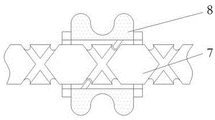
FIG. 3 is a schematic view of a first engagement rod and a guide block of the present invention in a front view;
FIG. 4 is an enlarged view of the structure at A in FIG. 2 according to the present invention;
fig. 5 is a schematic top sectional view of the mounting assembly and support plate connection of the present invention.
In the figure: 1. a support plate; 2. mounting a plate; 3. a base; 4. a motor; 5. a collecting roller body; 6. a belt; 7. a first engagement rod; 8. a guide block; 9. a support frame; 10. an electric telescopic rod; 11. mounting the component; 1101. mounting blocks; 1102. a spring; 1103. a connecting plate; 12. connecting grooves; 13. a second engagement rod.
Detailed Description
The technical solutions in the embodiments of the present invention will be clearly and completely described below with reference to the drawings in the embodiments of the present invention, and it is obvious that the described embodiments are only a part of the embodiments of the present invention, and not all of the embodiments. All other embodiments, which can be derived by a person skilled in the art from the embodiments given herein without making any creative effort, shall fall within the protection scope of the present invention.
Referring to fig. 1-5, the present invention provides a technical solution: a polypropylene fiber collecting roller capable of avoiding knotting comprises a mounting plate 2 fixedly mounted on the lower end face of a supporting plate 1 through bolts, a base 3 fixedly connected to the outer side of the lower end of the mounting plate 2, a motor 4 mounted on the outer side of the right end of the supporting plate 1, a collecting roller body 5 arranged on the inner side of the supporting plate 1 and connected to the outer side of the left end of the motor 4, a belt 6 connected to the outer side of the left end of the motor 4 and provided with a first connecting rod 7 arranged on the inner side of the upper end of the supporting plate 1 inside the upper end of the belt 6, a guide block 8 connected to the outer side of the first connecting rod 7, a supporting frame 9 fixedly mounted on the outer side of the middle part of the upper end of the mounting plate 2, an electric telescopic rod 10 connected to the outer side of the upper end of the supporting frame 9, a mounting assembly 11 connected to the upper end of the electric telescopic rod 10, and a second connecting rod 13 arranged on the middle part of the inner part of the supporting plate 1 and arranged behind the collecting roller body 5, the combination forms a polypropylene fiber collecting roller which avoids knotting.
When the knotting-preventing polypropylene fiber collecting roller is used, as shown in fig. 1 and 2, firstly, the whole is placed on a plane through the mounting plate 2 and the base 3, then one end of the polypropylene fiber to be collected is placed on the outer side of the collecting roller body 5, at this time, the motor 4 positioned on the outer side of the right end of the supporting plate 1 is turned on, so that the motor 4 drives the collecting roller body 5 positioned inside the mounting plate 2 to rotate through the rod-shaped structure, because the outer side of the left end of the motor 4 is connected with 2 groups of belts 6, and the upper end of one group of belts 6 is internally connected with a first connecting rod 7, and the other group is respectively connected with the first joint rod 7 and the second joint rod 13, thereby driving the first joint rod 7 and the second joint rod 13 to synchronously rotate, and then be convenient for have the effect of direction through guide block 8 to the polypropylene fibre silk, be convenient for make the polypropylene fibre silk at the outside of collecting roller body 5 regularly evenly twine.
As shown in fig. 1 and 3, the first connecting rod 7 is connected with the guide block 8 in a sliding manner, the outer side of the first connecting rod 7 is provided with a bidirectional spiral groove-shaped structure, meanwhile, the diameter of the first connecting rod 7 is equal to that of the second connecting rod 13, the guide blocks 8 are mounted on the outer sides of the first connecting rod 7 and the second connecting rod 13, and the guide blocks 8 respectively reciprocate on the outer sides of the first connecting rod 7 and the second connecting rod 13, so that the guide blocks 8 can drive the polypropylene fibers to move and collect, better winding and collecting work can be facilitated, and meanwhile, the first connecting rod 7 is positioned above the right side of the second connecting rod 13, the guide effect on the polypropylene fibers is enhanced, and the knotting phenomenon in the collecting process is avoided.
Specifically, as shown in fig. 2, 4 and 5, when the tension of the polypropylene fiber needs to be adjusted during the collection process of the polypropylene fiber, only the electric telescopic rod 10 located on the upper surface of the supporting frame 9 needs to be opened, so that the electric telescopic rod 10 drives the mounting block 1101 to move, at this time, the protruding structure fixedly connected to the outer end surface of the mounting block 1101 is slidably connected to the supporting plate 1 through the connecting groove 12, so that the position of the mounting block 1101 is changed, and the angle of the polypropylene fiber connected to the inside of the mounting block 1101 is changed, because the connecting plate 1103 is slidably connected to the inside of the mounting block 1101, and the connecting plate 1103 forms a telescopic structure with the mounting block 1101 through the spring 1102, the springs 1102 are symmetrically arranged in front and back with respect to the vertical central axis of the mounting block 1101, and when the mounting block 1101 moves upwards, the connecting plate 1103 is slidably connected to the mounting block 1101 under the action of the polypropylene fiber, and the spring 1102 is compressed, the deformation is generated, and the connecting plate 1103 is supported, so that the supporting effect on the polypropylene fiber is enhanced, and the tension of the polypropylene fiber is convenient to adjust.
The standard parts used in the utility model can be purchased from the market, the special-shaped parts can be customized according to the description of the specification and the accompanying drawings, the specific connection mode of each part adopts conventional means such as bolts, rivets, welding and the like mature in the prior art, the machinery, parts and equipment adopt conventional models in the prior art, and the circuit connection adopts the conventional connection mode in the prior art, and the details are not described, and the content not described in detail in the specification belongs to the prior art known by persons skilled in the art.
Although the present invention has been described in detail with reference to the foregoing embodiments, it will be apparent to those skilled in the art that various changes in the embodiments and/or modifications of the utility model can be made, and equivalents and modifications of some features of the utility model can be made without departing from the spirit and scope of the utility model.
Claims (6)
1. A polypropylene filament collection roller avoiding knotting, comprising:
the device comprises a supporting plate (1), wherein a mounting plate (2) is fixedly mounted on the lower end face of the supporting plate through a bolt, a base (3) is fixedly connected to the outer side of the lower end of the mounting plate (2), a motor (4) is mounted on the outer side of the right end of the supporting plate (1), and a collecting roller body (5) located on the inner side of the supporting plate (1) is connected to the outer side of the left end of the motor (4);
the lower end of the belt (6) is connected to the outer side of the left end of the motor (4), a first connecting rod (7) located on the inner side of the upper end of the supporting plate (1) is installed inside the upper end of the belt (6), and a guide block (8) is connected to the outer side of the first connecting rod (7);
the supporting frame (9) is fixedly arranged on the outer side of the middle part of the upper end of the mounting plate (2), the outer side of the upper end of the supporting frame (9) is connected with an electric telescopic rod (10), and the upper end of the electric telescopic rod (10) is connected with a mounting assembly (11);
the connecting groove (12) is arranged inside the rear end of the supporting plate (1), and a second connecting rod (13) located in the middle of the inside of the supporting plate (1) is arranged behind the collecting roller body (5).
2. The knotting prevention polypropylene fiber collecting roll of claim 1, wherein: the first connecting rod (7) is connected with the guide block (8) in a sliding mode, and a bidirectional spiral groove-shaped structure is arranged on the outer side of the first connecting rod (7).
3. The knotting prevention polypropylene fiber collecting roll of claim 1, wherein: the diameter size of the first joint rod (7) is equal to that of the second joint rod (13), and guide blocks (8) are mounted on the outer sides of the first joint rod (7) and the second joint rod (13).
4. The knotting prevention polypropylene fiber collecting roll of claim 1, wherein: the mounting assembly (11) comprises a mounting block (1101), a spring (1102) and a connecting plate (1103);
the mounting block (1101) is mounted on the inner side of the rear end of the mounting plate (2), and the lower end face of the mounting block (1101) is connected with the electric telescopic rod (10);
a spring (1102) mounted inside the mounting block (1101) by a groove-like structure;
and the lower end face of the connecting plate (1103) is connected with the spring (1102), and the connecting plate (1103) is positioned at the lower end of the middle part of the mounting block (1101).
5. The knotting prevention polypropylene fiber collecting roll according to claim 4, wherein: the connecting plate (1103) and the mounting block (1101) form a telescopic structure through a spring (1102), and the spring (1102) is arranged in a front-back symmetrical mode relative to a vertical central axis of the mounting block (1101).
6. The knotting prevention polypropylene fiber collecting roll according to claim 4, wherein: the outer end face of the mounting block (1101) is fixedly connected with a protruding structure, and the mounting block (1101) is connected with the support plate (1) in a sliding mode through a connecting groove (12).
Priority Applications (1)
| Application Number | Priority Date | Filing Date | Title |
|---|---|---|---|
| CN202121605761.1U CN215800078U (en) | 2021-07-15 | 2021-07-15 | Avoid polypropylene fibre silk collection roller of knoing |
Applications Claiming Priority (1)
| Application Number | Priority Date | Filing Date | Title |
|---|---|---|---|
| CN202121605761.1U CN215800078U (en) | 2021-07-15 | 2021-07-15 | Avoid polypropylene fibre silk collection roller of knoing |
Publications (1)
| Publication Number | Publication Date |
|---|---|
| CN215800078U true CN215800078U (en) | 2022-02-11 |
Family
ID=80182540
Family Applications (1)
| Application Number | Title | Priority Date | Filing Date |
|---|---|---|---|
| CN202121605761.1U Active CN215800078U (en) | 2021-07-15 | 2021-07-15 | Avoid polypropylene fibre silk collection roller of knoing |
Country Status (1)
| Country | Link |
|---|---|
| CN (1) | CN215800078U (en) |
-
2021
- 2021-07-15 CN CN202121605761.1U patent/CN215800078U/en active Active
Similar Documents
| Publication | Publication Date | Title |
|---|---|---|
| CN215800078U (en) | Avoid polypropylene fibre silk collection roller of knoing | |
| CN108382923A (en) | It is matched in the welding wire barrelling device of welding wire machine | |
| CN209455759U (en) | A kind of rolling-up mechanism of nonwoven production | |
| CN111648081A (en) | Cotton yarn production is with rubbing cotton device | |
| CN208544933U (en) | Edge recycling lap former | |
| CN215854413U (en) | Polyester-viscose fabric winding machine | |
| CN207986382U (en) | It is matched in the welding wire barrelling device of welding wire machine | |
| CN214612905U (en) | Yarn doubling machine for laboratory | |
| CN215366233U (en) | Anti-rolling cloth yarn-saving weaving equipment | |
| CN212687223U (en) | Improved yarn guide equipment for polyester fibers | |
| CN210824886U (en) | Non-woven machine tension adjusting device convenient to adjust tension | |
| CN209337836U (en) | A kind of direct yarn beaming device | |
| CN112391708A (en) | Locking device for spinning spindle or twisting spindle | |
| CN211446093U (en) | Wool yarn feeding mechanism for computerized flat knitting machine | |
| CN219297763U (en) | Thread guiding device for clothing sewing buckle | |
| CN111926421A (en) | A yarn direction collection device for weaving field | |
| CN219157139U (en) | Glass fiber tube braiding mechanism | |
| CN216947338U (en) | Track dividing device of drawing frame for sewing thread production | |
| CN216614972U (en) | Drawing traction equipment for cotton spinning | |
| CN220011710U (en) | Tension-adjustable yarn guide frame | |
| CN213770880U (en) | Be applied to and carry guide cotton yarn device | |
| CN221501341U (en) | Yarn guiding device of white blank four-side spring texturing machine | |
| CN216302942U (en) | Waxing device for production of knitted textiles | |
| CN210237874U (en) | Improved artificial grass two-for-one twister | |
| CN220907780U (en) | Semi-worsted drawing device for silk floss cashmere |
Legal Events
| Date | Code | Title | Description |
|---|---|---|---|
| GR01 | Patent grant | ||
| GR01 | Patent grant |