Disclosure of Invention
To the problem that exists among the prior art, the utility model provides a pencil dismounting device utilizes clamping part centre gripping pencil, and the first lead screw of rotary drive portion makes the clamping part along the direction of first lead screw steady removal, and pulling force does not have the control and causes pencil and/or inside device to damage when avoiding using manual pull-out pencil.
The utility model provides a wire harness dismounting device, including body, clamping part and drive division, the clamping part is used for the pencil on the centre gripping work piece, and on the drive division was fixed in the first face of body, clamping part and drive division fixed connection, drive division included first lead screw, and rotatory first lead screw makes the clamping part remove along first lead screw.
Furthermore, the driving part also comprises a moving part, a first fixing part and a second fixing part, the first fixing part and the second fixing part are fixed on the first surface of the body, the first lead screw penetrates through the first fixing part and is rotationally fixed on the second fixing part, the moving part is a rectangular frame, the first edge is fixed on the nut seat of the first lead screw, and the second edge and the fourth edge which are connected with the first edge penetrate through the guide hole of the second fixing part and are connected with the third edge.
Further, the clamping part comprises two clamping jaws, a second lead screw and a guide rail which are oppositely arranged, the second lead screw is parallel to the guide rail, the two clamping jaws are respectively fixed on the sliding block of the guide rail, and the second lead screw penetrates through the two clamping jaws and is used for changing the distance between the clamping jaws.
Further, the second lead screw is a trapezoidal lead screw.
Further, the guide rail is fixed to the driving portion.
Further, the part of the opposite sides of the two claws for clamping the wire harness is arc-shaped.
Furthermore, a protective layer made of polyurethane material is arranged at the part of the clamping jaw for clamping the wire harness.
Further, the second surface of the body is provided with a positioning concave part, and the positioning concave part is matched with the convex shape of the workpiece wire harness and used for limiting the relative movement of the wire harness dismounting device and the workpiece.
Further, a stopping portion is arranged on the first surface of the body and used for limiting the moving distance of the moving portion.
Further, the wire harness dismounting device further comprises handles fixed on two sides of the body.
Compared with the prior art, the utility model provides a pencil dismounting device has following beneficial effect: utilize clamping part centre gripping pencil, the first lead screw of rotary drive portion makes the clamping part move along the direction of first lead screw is stable, and pulling force uncontrolled causes pencil and/or inside device to damage when avoiding using manual pulling out the pencil.
Detailed Description
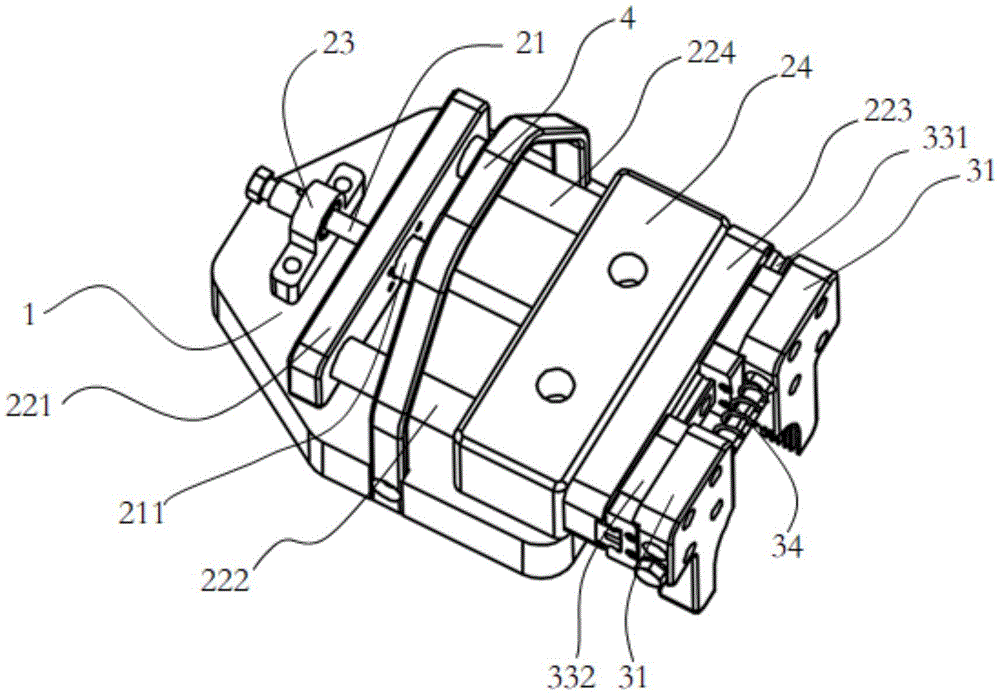
As shown in fig. 1 and 2, the wire harness detaching device according to an embodiment of the present invention includes a body 1, a clamping portion and a driving portion, wherein the clamping portion is used for clamping a wire harness on a workpiece, the driving portion is fixed on a first surface of the body 1, and the clamping portion is connected with the driving portion.
The driving part includes a first lead screw 21, a moving part, a first fixing part 23 and a second fixing part 24.
The first fixing portion 23 and the second fixing portion 24 are fixed to the first surface of the body 1.
The first lead screw 21 is rotatably fixed to the second fixing portion 24 through the first fixing portion 23. One end of the first lead screw 21 penetrating through the first fixing portion 23 is provided with a rotating portion, and the rotating portion is hexagonal, so that the ratchet wrench can be conveniently used to rotate the first lead screw 21.
The moving part has a rectangular frame shape, the first side 221 is fixed to the nut holder 211 of the first screw 21, and the opposite sides, the second side 222 and the fourth side 224, connected to the first side 221 are connected to the third side 223 through the guide hole 241 of the second fixing part 24. In this embodiment, as shown in fig. 2, the first side 221, the second side 222, and the fourth side 224 are fixed by screws, and the third side 223, the second side 222, and the fourth side 224 are fixed by screws. In other embodiments, the sides may be connected to form a rectangular frame by, for example, adhesive bonding, riveting, integral molding, or the like.
When the first lead screw 21 is rotated by the rotating portion using the ratchet wrench, the nut holder 211 moves along the second lead screw 21, and the first edge 221 of the moving portion is moved along the first lead screw 21, so that the second and fourth edges 222 and 224 of the moving portion-rectangular frame move along the guide hole 241 of the second fixing portion 24 (the guide hole 241 is parallel to the first lead screw 21), and accordingly, the third edge 223 also moves stably along the first lead screw 21.
The clamping part comprises two jaws 31, a second lead screw 32 and a guide rail 331 which are oppositely arranged, and the jaws 31 are used for clamping the wire harness; a second lead screw 32 passes through the two jaws 31 for changing the spacing between the jaws 31 in order to clamp or unclamp the wiring harness. In this embodiment, the second lead screw 32 is a trapezoidal lead screw, specifically SFK0601T3DFC 7-80.
As shown in fig. 2, the guide rail 331 is fixed to the driving part, specifically, to the outside of the third side 223 by screws, and the guide rail 331 has two sliders 332, and the two jaws 31 are respectively fixed to the sliders 332 of the guide rail 331 so that the two jaws 31 can move along the guide rail 331.
The second lead screw 32 is parallel to the guide rail 331, and in this embodiment, the jaw 31 on one side (for example, the left jaw in fig. 1 and 3) can be fixed, and the jaw 31 on the other side (for example, the right jaw in fig. 1 and 3) can be moved by means of the second lead screw 32. Of course, in other embodiments, the left-side jaw may be moved, or the jaw on one side may not be fixed, and may be moved toward the middle or both sides.
When the third side 223 moves along the first lead screw 21, the two claws 31 are driven to move along the first lead screw 21.
Utilize two jack catchs 31 centre gripping pencil of clamping part, the first lead screw 21 of rotatory drive division for the clamping part is along the stable removal of first lead screw 21's direction, and pulling force is uncontrolled when avoiding using manual pulling-out pencil and is caused pencil and/or inside device to damage.
As shown in fig. 3, a spring 34 is disposed between the two jaws 31, the shaft passes through the jaws 31, the spring 34 is sleeved on the shaft, when the wire harness is clamped, the spring 34 is compressed, and the restoring force of the spring 34 is used for assisting in returning the two jaws 31 to the original positions respectively when the wire harness is loosened.
The parts of the opposite sides of the two claws 31 for clamping the wire harness are arc-shaped, match the shape of the wire harness and are easy to clamp the wire harness.
The part of the clamping jaw 31 for clamping the wire harness is provided with a protective layer made of polyurethane material, so that the rubber part of the wire harness is prevented from being damaged during disassembly.
The surface of the contact surface of the claw 31 with the surface of the wire harness is provided with corrugations to increase the friction force when clamping the wire harness, so that the wire harness is easier to clamp and pull out.
In the embodiment, as shown in fig. 4, a positioning concave part 11 is arranged on the second surface of the body 1, and the positioning concave part 11 is matched with the convex shape of the workpiece wire harness, so as to limit the relative movement of the wire harness dismounting device and the workpiece and facilitate the dismounting of the wire harness.
In other embodiments, the wire harness removing device may be fixed by using a screw hole already provided in the workpiece.
The first surface of the body 1 may further include a stopper (not shown) for limiting a moving distance of the moving portion, and specifically, the stopper is disposed between the first edge 221 and the third edge 223 of the moving portion to prevent the moving distance of the moving portion from being too large, so as to prevent the wire harness and/or internal devices from being damaged due to uncontrolled distance when the wire harness is pulled out.
The wire harness dismounting device further comprises handles 4 fixed on two sides of the body 1, as shown in fig. 1 and 5, and the wire harness dismounting device is convenient to place and move.
As shown in fig. 6, in the present embodiment, a specific process of detaching the wire harness 101 of the workpiece 100 is as follows:
(1) placing a workpiece 100 on a tool fixture;
(2) detaching the cover plate screw of the workpiece 100 by using a screwdriver and removing the cover plate;
(3) disassembling a connector of the wire harness 101 in the workpiece 100 to separate the connector from the fixing bolt;
(4) placing the harness detachment device on the workpiece 100 so that the positioning recess 11 of the second face of the body 1 matches the convex shape at the workpiece harness;
(5) clamping the rubber part of the wire harness 101 between the clamping jaws 31 of the clamping part, rotating a second lead screw 32 of the clamping head by using a ratchet wrench, and reducing the distance between the two clamping jaws 31 so that the wire harness 101 is clamped between the clamping jaws 31 and the identification line;
(6) the first lead screw 21 is rotated clockwise by using a ratchet wrench, the moving part moves along the first lead screw 21, and the clamping part is driven to stably move along the first lead screw 21, so that the wire harness 101 is separated from a fixed position;
(7) rotating the second screw 32 to increase the distance between the claws 31 and loosen the wire harness 101;
(8) the first lead screw 21 is rotated counterclockwise, the moving part moves along the first lead screw 21 toward the first fixed part 23, and the initial state is restored;
(9) and taking down the wire harness dismounting device, pinching a connector of the wire harness 101 in the workpiece 100 by fingers, carefully penetrating through the magnetic ring, and dismounting the wire harness.
Although the present invention has been described with reference to the preferred embodiments, the present invention is not limited thereto. Various changes and modifications can be made by one skilled in the art without departing from the spirit and scope of the invention, and the scope of the invention is to be determined by the appended claims.