CN203513702U - Heating system using low-temperature waste heat of blast furnace slag flushing water - Google Patents
Heating system using low-temperature waste heat of blast furnace slag flushing water Download PDFInfo
- Publication number
- CN203513702U CN203513702U CN201320506124.8U CN201320506124U CN203513702U CN 203513702 U CN203513702 U CN 203513702U CN 201320506124 U CN201320506124 U CN 201320506124U CN 203513702 U CN203513702 U CN 203513702U
- Authority
- CN
- China
- Prior art keywords
- water
- plate
- heat exchange
- blast furnace
- equidistant
- Prior art date
- Legal status (The legal status is an assumption and is not a legal conclusion. Google has not performed a legal analysis and makes no representation as to the accuracy of the status listed.)
- Withdrawn - After Issue
Links
Images





Classifications
-
- Y—GENERAL TAGGING OF NEW TECHNOLOGICAL DEVELOPMENTS; GENERAL TAGGING OF CROSS-SECTIONAL TECHNOLOGIES SPANNING OVER SEVERAL SECTIONS OF THE IPC; TECHNICAL SUBJECTS COVERED BY FORMER USPC CROSS-REFERENCE ART COLLECTIONS [XRACs] AND DIGESTS
- Y02—TECHNOLOGIES OR APPLICATIONS FOR MITIGATION OR ADAPTATION AGAINST CLIMATE CHANGE
- Y02P—CLIMATE CHANGE MITIGATION TECHNOLOGIES IN THE PRODUCTION OR PROCESSING OF GOODS
- Y02P10/00—Technologies related to metal processing
- Y02P10/25—Process efficiency
Landscapes
- Heat-Exchange Devices With Radiators And Conduit Assemblies (AREA)
Abstract
The utility model discloses a heating system using the low-temperature waste heat of blast furnace slag flushing water, and relates to a heating system. The heating system is characterized in that a horizontal flow tank is provided with an inlet for leading in the blast furnace slag flushing water in a blast furnace slag flushing water tank, and an outlet of the horizontal flow tank is communicated with a stage filter; a water outlet of the stage filter is communicated with a first water inlet of a non-equidistant heat exchanger; a drain outlet of the stage filter is communicated with a sewage discharge linkage device; and the non-equidistant heat exchanger is provided with a heating water inlet and a heating water delivery pipe as well as a heat exchange backflow pipe connected to the blast furnace slag flushing water tank. Water flowing into the non-equidistant heat exchanger does not contain impurities or contains few impurities through grading filtration, so that the blockage of the non-equidistant heat exchanger is reduced; in addition, as the non-equidistant heat exchanger is in a non-equidistant structure, the blockage and the abrasion caused by sundries in water can be further reduced, thus the maintenance of the whole system caused by blockage and abrasion is decreased, and the maintenance cost of the whole system is reduced, and the stability of system operation is improved.
Description
Technical field
The utility model relates to heating system, particularly relates to a kind ofly recycling the system that blast furnace slag quenching water low temperature exhaust heat heats.
Background technology
Current domestic each Iron Works slag is processed representational technique and can be divided into Lhasa (RASA) method, end filter (OCP) method, Yin Ba (INBA) method, Tula (TYNA) method, good permanent method and Ming Teke (MTC) method.In utilizing flushing cinder hydro-thermal amount process, because flushing cinder water water quality is different, run into difficulty in various degree.Flushing cinder water under most residues processing techniques can be to producing wearing and tearing and stopping up with hot equipment; Comparatively speaking, the flushing cinder water dregginess under end filtering technology is few, and wear pattern is lighter, but in use also can produce obstruction because of constantly separating out slag wool in pulp water.In order to reach safety and stability, utilize the object of flushing cinder hydro-thermal amount, must solve the wearing and tearing that produce in process for flushing cinder water conservancy, Corrosion blockage problem.
Recent year utilizes the technique of blast furnace slag quenching water heat can roughly be divided into direct utilization and heat exchange utilizes two kinds, wherein, without filtering directly to utilize, does not solve pulp water wearing and tearing, Corrosion blockage problem completely, and system is very easily stopped up, can not steady running; And utilize after filtering, solved pulp water wear problem and a part of suspended substance blockage problem, but the slag wool of separating out in pulp water can cause system jams, and filtration process is invested and maintenance cost is high.Without filtering direct heat exchange, often adopt wide runner interchanger, have wearing and tearing and the low problem of heat exchange efficiency, can not solve blockage problem completely; After filtering there is filtration process investment and the high problem of maintenance cost in heat exchange, also has interchanger blockage problem simultaneously.
There is at present a kind for the treatment of system of utilizing waste heat of hot water for slag flushing in blast furnace to carry out heating, what adopt is the cascade filtration that coarse filtration equipment coordinates with smart filter plant, the rear hot water for slag flushing in blast furnace of filtration enters interchanger again and carries out heat exchange, but cascade filtration exists equipment investment cost high, and can not guarantee filter effect completely, still have blocking pipe and plant issue, need frequent maintenance between heating period, maintenance cost is high.Also has at present a kind of system of utilizing the heating of blast furnace slag using exhaust heat of slag flushing water, strainer used is full-automatic back washing fiber bundle filter, in this strainer, the filter core of fibrous bundle filtering layer used adopts the compound of improved polypropylene and polypropylene fibre, but the structure of filtering layer of this strainer is complicated, cost of investment is high, also exist between heating period and can often stop up, the problem that maintenance cost is high.
Utility model content
The technical problems to be solved in the utility model is to provide a kind of heating system that utilizes blast furnace slag quenching water low temperature exhaust heat, can effectively filter the foreign material in blast furnace slag quenching water, avoid stopping up interchanger, thereby solve the existing heat-exchange system of blast furnace slag quenching water waste heat that utilizes, easily stop up the high problem of maintenance cost in use.
For solving the problems of the technologies described above, the utility model provides a kind of heating system that utilizes blast furnace slag quenching water low temperature exhaust heat, comprising:
Horizontal flow basin, stage filter, not equidistant interchanger and blowdown linkage system; Wherein,
Described horizontal flow basin is provided with the entrance of introducing the blast furnace slag quenching water in blast furnace slag flushing pond, and the outlet of described horizontal flow basin is communicated with described stage filter;
The water outlet of described stage filter is communicated with described not the first water-in of equidistant interchanger; The sewage draining exit of described stage filter is communicated with described blowdown linkage system;
Described not equidistant interchanger is provided with heating water entrance and heating water output tube, and is provided with heat-exchanging water entrance and the heat exchange return line being connected with described blast furnace slag flushing pond.
The horizontal flow basin that passes through of the present utility model, vortex dirt-remover and stage filter coordinate formation classified filtering, the not water of equidistant interchanger be can guarantee to flow into and slag and foreign material do not contained or contain less, reduced the not obstruction of equidistant interchanger, and the not equidistant channel architecture that not equidistant interchanger self has, also can further reduce obstruction and the wearing and tearing that in water, foreign material cause, thereby reduce whole system to the maintenance of stopping up and wearing and tearing are carried out, reduce the maintenance cost of whole system, improved the stability of system operation, also improved the utilising efficiency to blast furnace slag quenching water waste heat, this heating system structure is relatively simple in addition, invest less.
Accompanying drawing explanation
In order to be illustrated more clearly in the technical scheme of the utility model embodiment, below the accompanying drawing of required use during embodiment is described is briefly described, apparently, accompanying drawing in the following describes is only embodiment more of the present utility model, for those of ordinary skill in the art, do not paying under the prerequisite of creative work, can also obtain other accompanying drawings according to these accompanying drawings.
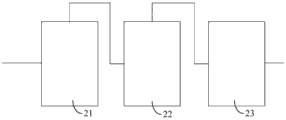
The heating system structural representation that Fig. 1 provides for the utility model embodiment;
The structural representation of the stage filter of the heating system that Fig. 2 provides for the utility model embodiment;
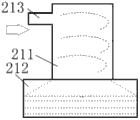
The schematic diagram of the first separator-filter of the stage filter of the heating system that Fig. 2 a provides for the utility model embodiment;
The schematic diagram of the vortex dirt-remover of the stage filter of the heating system that Fig. 2 b provides for the utility model embodiment;
The vertical view of the vortex dirt-remover of the stage filter of the heating system that Fig. 2 c provides for the utility model embodiment;
The not structural representation of equidistant interchanger of the heating system that Fig. 3 provides for the utility model embodiment;
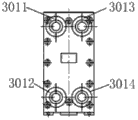
The not overall schematic of equidistant interchanger of the heating system that Fig. 3 a provides for the utility model embodiment;
The not side schematic view of equidistant interchanger that Fig. 3 b provides for the utility model embodiment;
The equidistant channel cross-section schematic diagram of heat exchange plate of the not equidistant interchanger that Fig. 3 c provides for the utility model embodiment;
The schematic diagram of water flow direction in the equidistant interchanger that Fig. 3 d provides for the utility model embodiment.
Embodiment
Below the technical scheme in the utility model embodiment is clearly and completely described, obviously, described embodiment is only the utility model part embodiment, rather than whole embodiment.Based on embodiment of the present utility model, those of ordinary skills, not making the every other embodiment obtaining under creative work prerequisite, belong to protection domain of the present utility model.
As shown in Figure 1, the utility model embodiment provides a kind of heating system that utilizes blast furnace slag quenching water low temperature exhaust heat, and as shown in Figure 1, this system comprises: horizontal flow basin 1, stage filter 2, not equidistant interchanger 3 and blowdown linkage system 4;
Wherein, horizontal flow basin 1 is provided with the entrance of introducing the blast furnace slag quenching water in blast furnace slag flushing pond 10, and the outlet of horizontal flow basin 1 is communicated with stage filter 2;
The water outlet of stage filter 2 is communicated with the first water-in 31 of not equidistant interchanger 3; The sewage draining exit of stage filter 2 is communicated with blowdown linkage system 4;
Not equidistant interchanger 3 is provided with heating water entrance 32 and heating water output tube 33, and is provided with the heat exchange return line 34 being connected with blast furnace slag flushing pond 10.
In above-mentioned heating system, on the delivery conduit of horizontal flow basin 1, be also provided with water transfer pump 11, by water transfer pump 11, horizontal flow basin 1 water outlet can be squeezed into stage filter 2 in the mode of pressurization, thereby realize better filter effect in stage filter 2.
As shown in Figure 2, in above-mentioned heating system, stage filter 2 comprises: first, second separator-filter 21,22 and vortex dirt-remover 23; Wherein, the first separator-filter 21 is connected with vortex dirt-remover 23 with the second separator-filter 22 successively.
Further, first, second separator-filter 21,22 structures in stage filter 2 are identical, and first separator-filter 21 of take below describes its structure as example, and as shown in Figure 2 a, the first separator-filter 21 comprises: spin chamber 211 and settling pocket 212,
Wherein, spin chamber 211 is arranged on above settling pocket 212, is communicated with settling pocket 211; Spin chamber's 211 inwalls are circular;
Spin chamber's 211 sidewalls are provided with water-in 213; By the mode of water-in 213 is set at sidewall, can guarantee that the Shui Keyan spin chamber 211 inwall rotations that enter spin chamber 211 drop to settling pocket 212;
The height of settling pocket 212 is lower than the height of spin chamber 211, and the cross-sectional area of spin chamber 211 is less than the cross-sectional area of settling pocket 212, can guarantee that like this Shui spin chamber 211 is fully after rotation, then enters settling pocket 212 and carry out sedimentation.
Vortex dirt-remover 23 in above-mentioned stage filter 2 is as third stage filter plant, and its structure as shown in Figure 2 b, comprising: water inlet pipe 231, cylindrical shell 230, blow-off pipe 232, wash water valve, dirt collecting bucket, rising pipe 233, filtering net and vapor pipe 235;
Wherein, water inlet pipe 231 is arranged on cylindrical shell 230 sidewalls, is communicated with cylindrical shell 230 is interior;
Blow-off pipe 232 is arranged on the bottom of cylindrical shell 230, is communicated with cylindrical shell 230 is interior;
On blow-off pipe 232, wash water valve is set; The interior dirt collecting bucket that arranges of cylindrical shell 230 of blow-off pipe 232 tops;
Rising pipe 233 is arranged on the top of cylindrical shell 230, is communicated with the interior filtering net that arranges of rising pipe 233 with cylindrical shell 230 is interior;
The vortex dirt-remover of said structure, can make the water after first, second separator-filter is processed entering within it with cyclone mode, reach the object of removing impurity in it, and discharge from bottom sedimentation, cleaner water outlet is discharged from top rising pipe, thereby effectively reduce the not possibility of equidistant interchanger of follow-up obstruction.
Preferably, can to adopt mesh diameter be the filtering net of 3.5~4 millimeters to the filtering net in above-mentioned vortex dirt-remover;
Preferably, the cylindrical shell 230 in above-mentioned vortex dirt-remover is columnar structured, and its bottom can be provided with support footing.
Further, above-mentioned vortex dirt-remover can also arrange blowdown porthole 234, is arranged on the sidewall of cylindrical shell 230, which is provided with sealing cover, to facilitate the disposition of observing in vortex dirt-remover, the foreign material that separate on also can easy cleaning vortex dirt-remover Inner filter net.
In above-mentioned heating system, the structure of equidistant interchanger 3, as shown in Fig. 3,3a, 3b, not comprising: a plurality of heat exchange plates 303, fixed clamping plate 301, active clamped plate 302, rubber plate 308, upper and lower guide rod 305,306, heating water output tube 3013, heat exchange return line 3012, fishbolt 307 and pillar 3010;
Wherein, be equipped with along plate and face connection Duo Tiaoao road, angle on two plate faces of each heat exchange plate 303, the width in two plate face fovea superior roads is unequal, the not equidistant recessed road that same heat exchange plate 302 two sides arrange; Can, after a plurality of heat exchange plates compress side by side, between two heat exchange plates, form a passage like this; Due to same heat exchange plate 302 two sides that Ao road is set is not equidistant, the passage forming on same heat exchange plate two sides is like this equidistant passage; Wider passage can have been avoided obstruction for high stove flushing cinder water, compared with narrow passage, can be used for walking heating water;
A plurality of heat exchange plates 303 compress side by side and are arranged between fixed clamping plate 301 and active clamped plate 302, a plurality of heat exchange plates 303 that compress form two mutual disconnected passages 3031,3032 by the described recessed road on each heat exchange plate plate face between each heat exchange plate, first channel 3031 one end are provided with heating water entrance 3014, the other end is connected with described heating water output tube 3013, second passage 3032 one end are provided with heat-exchanging water entrance 3011, and the other end is connected with described heat exchange return line 3012; First channel 3031(is used for walking supplying hot water) width be narrower than second passage 3012(for walking blast furnace slag quenching water) width (seeing Fig. 3 C), the upper and lower end of a plurality of heat exchange plates 302 is connected with active clamped plate 302 with fixed clamping plate 301 by upper and lower guide rod 305,306 respectively; Can be specifically that upper and lower end at each heat exchange plate arranges respectively the groove that clamps upper and lower guide rod 305,306, by groove, each heat exchange plate is installed on upper and lower guide rod 305,306;
The side that fixed clamping plate 301 is connected with active clamped plate 302 is fixedly connected with by fishbolt 307.
As shown in Figure 3 c, in above-mentioned not equidistant interchanger, the width of first channel 3031 is 6mm, and the width of second passage 3032 is 15mm.
As shown in Figure 3 d, in above-mentioned not equidistant interchanger, blast furnace slag quenching water is in the direction of arrow inflow by from shown in B, by arrow, be shown in not equidistantly and flow to D outflow in the second passage of interchanger, heating water flows into from the direction of arrow shown in A, by arrow, be shown in not equidistantly and flow to C outflow in the first channel of interchanger, because forming interval between the heat exchange plate of equidistant interchanger not, first channel and second passage arrange, can realize effective heat exchange of blast furnace slag quenching water and heating water, and second passage is wider, avoid the obstruction that in blast furnace slag quenching water, foreign material cause.
The not equidistant interchanger of this structure is by arranging not equidistant heat exchanger channels, blast furnace slag quenching water be can well solve and serious wearing and tearing, Corrosion blockage situation when equipment is used, can be produced, with common plate-type heat exchanger, because of distance between plates relative narrower, medium easily stops up between plate.Not equidistant distance between plates, from relatively large, eliminated medium and has been held susceptible to plugging deficiency.
The heating system that utilizes blast furnace slag quenching water low temperature exhaust heat of the present utility model, it is the Novel flushing pulp water heat-exchange system for the thermal design of this special medium of ironmaking flushing cinder water, by pulp water stage treatment and the equipment such as not equidistant interchanger not with equidistant runner, coordinate, well overcome and utilized flushing cinder water to have the problems such as cost is high, easy obstruction, have that less investment, maintenance are little, grain slag and suspended substance are separated out process, high to the compatible amount of pulp water operating mode, prevent from stopping up, can be used as the heating system that each iron work utilizes flushing cinder hydro-thermal amount.
Below in conjunction with accompanying drawing and use procedure, heating system of the present utility model is described in further detail.
When above-mentioned heating system uses, blast furnace slag quenching water is after horizontal flow basin, enter first, second separator-filter and the vortex dirt-remover of stage filter, remove most of solid particulate, and filter and remove fine particle and the scrubbing of suspended substance physics, dirt impurity can slave unit lower end sewage draining exit manually or self-timing blowdown, thereby met the nonclogging requirement of heat-exchange system.
By heating system of the present utility model, utilize blast furnace slag quenching water residual heat resources to carry out heat supply and there is very large advantage, can avoid building boiler house; and do not need coal yard, process lime-ash; thereby reduce floor space, save energy, environment protection is significant, meets national energy-saving and reduce discharging policy.For the northern area that has Steel Plant, adopt this kind of method heating, there is significant economic benefit, social benefit and environmental benefit.
Industrial production uses boiler with common specified quantity of steam 10t/h, the model of thermo-efficiency >=78% is example, and consumption of coal per hour is 4t, and it is example that Enterprise Staff life bath be take specified quantity of steam 6t/h model with boiler, consumption of coal per hour is 0.82t, and Heating Period is pressed 120d/a and calculated.
Add up to annual this boiler house consumption of coal to be: 4t * 24h * 120d+0.82t * 12h * 365d=15112t/a
Press the efficiency calculation of boiler 78%, consumption raw coal amount is 19374t.
, enterprise's heating and bathing consumption of coal add up to 19374t, consider that not predictable 10% consumes, and a year consumption raw coal is 21527t, and amounting to standard coal is 15377tce.Be roughly equal to 9324.8 ten thousand yuan of Renminbi.
Blast furnace slag flushing water heating system running cost comprises: Heating Season electric quantity consumption, new water consumption, labour cost, maintenance cost.Approximately 1,800,000 yuan of single Heating Season running costs.
Heating Period flushing cinder water heating system income is:
9324.8 ten thousand yuan of – 180=9144.8
Meanwhile, blast furnace slag quenching water UTILIZATION OF VESIDUAL HEAT IN technology can reduce carbonic acid gas, sulfurous gas, oxynitrides, the discharge of hydrocarbon polymer and flue dust.
The non-heating time can the outer confession of waste heat, refrigeration, and generating, benefit is still very considerable.
It is shorter that this Technology not only has payback period, is the advantage of enterprise's joint money, economize on electricity, water saving, and has by heat exchange, makes flushing cinder water pond temperature-averaging reduce the function of 10 ℃, improved production cycle utilising efficiency, reduced production cost.
In heating system of the present utility model, horizontal flow basin can substitute with filter tank, the end, and the configuration of subsequent technique equipment is identical, forms the not heating system of equidistant plate-type heat exchanger of filter tank+classified filtering+diagonal angle, the end, its result of use and horizontal flow basin basically identical.
Further, the stage filter in the utility model heating system also can adopt the equipment of the filter of coarse filtration+essence or cascade filtration.
Further, the equidistant plate-type heat exchanger in the diagonal angle in the utility model heating system changes other corrosion-resistant resistance to high-performance metal materials plate-type heat exchangers of washing away into and substitutes.
The above; it is only preferably embodiment of the utility model; but protection domain of the present utility model is not limited to this; anyly be familiar with those skilled in the art in the technical scope that the utility model discloses; the variation that can expect easily or replacement, within all should being encompassed in protection domain of the present utility model.Therefore, protection domain of the present utility model should be as the criterion with the protection domain of claims.
Claims (10)
1. a heating system that utilizes blast furnace slag quenching water low temperature exhaust heat, is characterized in that, comprising:
Horizontal flow basin, stage filter, not equidistant interchanger and blowdown linkage system; Wherein,
Described horizontal flow basin is provided with the entrance of introducing the blast furnace slag quenching water in blast furnace slag flushing pond, and the outlet of described horizontal flow basin is communicated with described stage filter;
The water outlet of described stage filter is communicated with described not the first water-in of equidistant interchanger; The sewage draining exit of described stage filter is communicated with described blowdown linkage system;
Described not equidistant interchanger is provided with heating water entrance and heating water output tube, and is provided with heat-exchanging water entrance and the heat exchange return line being connected with described blast furnace slag flushing pond.
2. the system as claimed in claim 1, is characterized in that, is also provided with water transfer pump on the delivery conduit of described horizontal flow basin.
3. system as claimed in claim 1 or 2, is characterized in that, described stage filter comprises:
First, second separator-filter and vortex dirt-remover; Wherein,
Described the first separator-filter is connected with described vortex dirt-remover with described the second separator-filter successively.
4. system as claimed in claim 3, is characterized in that, described first, second separator-filter structure is identical, and described the first separator-filter comprises:
Spin chamber and settling pocket, wherein,
Described spin chamber is arranged on above described settling pocket, is communicated with described settling pocket;
Described spin chamber sidewall is provided with water-in;
The height of described settling pocket is lower than the height of described spin chamber.
5. system as claimed in claim 3, is characterized in that, described vortex dirt-remover comprises:
Water inlet pipe, cylindrical shell, blow-off pipe, wash water valve, dirt collecting bucket, rising pipe, filtering net and vapor pipe; Wherein,
Described water inlet pipe is arranged on described cylinder lateral wall, and is communicated with in described cylindrical shell;
Described blow-off pipe is arranged on the bottom of described cylindrical shell, and is communicated with in described cylindrical shell;
Described wash water valve is set on described blow-off pipe;
In the described cylindrical shell of described blow-off pipe top, described dirt collecting bucket is set;
Described rising pipe is arranged on the top of described cylindrical shell, and is communicated with in described cylindrical shell, and described filtering net is set in described rising pipe;
Described vapor pipe is arranged on the top of described cylindrical shell.
6. system as claimed in claim 5, is characterized in that, the mesh diameter of described filtering net is 3.5~4 millimeters;
Described cylindrical shell is columnar structured, and its bottom is provided with support footing.
7. system as claimed in claim 5, is characterized in that, also comprises: blowdown porthole, be arranged on the sidewall of described cylindrical shell, and which is provided with sealing cover.
8. the system as claimed in claim 1, is characterized in that, described not equidistant interchanger comprises:
A plurality of heat exchange plates, fixed clamping plate, active clamped plate, rubber plate, upper and lower guide rod, heating water output tube, heat exchange return line, fishbolt and pillar;
Wherein, be equipped with along plate and face connection Duo Tiaoao road, angle on the biside plate face of described each heat exchange plate, the width in described biside plate face fovea superior road is unequal;
Described rubber plate is arranged on the medial surface of described fixed clamping plate; On described active clamped plate outer side, described pillar is set;
Described a plurality of heat exchange plate compresses side by side and is arranged between described fixed clamping plate and active clamped plate, a plurality of heat exchange plates that compress form two mutual disconnected passages by the described recessed road on each heat exchange plate plate face between each heat exchange plate, first channel one end is provided with heating water entrance, the other end is connected with described heating water output tube, second passage one end is provided with heat-exchanging water entrance, and the other end is connected with described heat exchange return line; The width of first channel is narrower than the width of second passage, and the upper and lower end of described a plurality of heat exchange plates is connected with active clamped plate with described fixed clamping plate by upper and lower guide rod respectively;
The side that described fixed clamping plate is connected with active clamped plate is fixedly connected with by described fishbolt.
9. system as claimed in claim 8, is characterized in that, the width of described first channel is 6mm.
10. system as claimed in claim 8 or 9, is characterized in that, the width of described second passage is 15mm.
Priority Applications (1)
| Application Number | Priority Date | Filing Date | Title |
|---|---|---|---|
| CN201320506124.8U CN203513702U (en) | 2013-08-19 | 2013-08-19 | Heating system using low-temperature waste heat of blast furnace slag flushing water |
Applications Claiming Priority (1)
| Application Number | Priority Date | Filing Date | Title |
|---|---|---|---|
| CN201320506124.8U CN203513702U (en) | 2013-08-19 | 2013-08-19 | Heating system using low-temperature waste heat of blast furnace slag flushing water |
Publications (1)
| Publication Number | Publication Date |
|---|---|
| CN203513702U true CN203513702U (en) | 2014-04-02 |
Family
ID=50372659
Family Applications (1)
| Application Number | Title | Priority Date | Filing Date |
|---|---|---|---|
| CN201320506124.8U Withdrawn - After Issue CN203513702U (en) | 2013-08-19 | 2013-08-19 | Heating system using low-temperature waste heat of blast furnace slag flushing water |
Country Status (1)
| Country | Link |
|---|---|
| CN (1) | CN203513702U (en) |
Cited By (3)
| Publication number | Priority date | Publication date | Assignee | Title |
|---|---|---|---|---|
| CN103436645A (en) * | 2013-08-19 | 2013-12-11 | 北京国信安科技术有限公司 | Heat supply system using low temperature waste heat of slag flushing water in blast furnace |
| CN112303911A (en) * | 2019-07-31 | 2021-02-02 | 芜湖美的厨卫电器制造有限公司 | Gas combustion equipment |
| CN113699286A (en) * | 2021-08-23 | 2021-11-26 | 江苏鑫特尔冶金机械制造有限公司 | Wear-resistant slag flushing system with internally-adhered ceramic lining plate |
-
2013
- 2013-08-19 CN CN201320506124.8U patent/CN203513702U/en not_active Withdrawn - After Issue
Cited By (3)
| Publication number | Priority date | Publication date | Assignee | Title |
|---|---|---|---|---|
| CN103436645A (en) * | 2013-08-19 | 2013-12-11 | 北京国信安科技术有限公司 | Heat supply system using low temperature waste heat of slag flushing water in blast furnace |
| CN112303911A (en) * | 2019-07-31 | 2021-02-02 | 芜湖美的厨卫电器制造有限公司 | Gas combustion equipment |
| CN113699286A (en) * | 2021-08-23 | 2021-11-26 | 江苏鑫特尔冶金机械制造有限公司 | Wear-resistant slag flushing system with internally-adhered ceramic lining plate |
Similar Documents
| Publication | Publication Date | Title |
|---|---|---|
| CN201648300U (en) | Water seal decontamination cycle device of coke furnace raiser | |
| CN102517411B (en) | Heating system by utilization of waste heat of blast furnace slag flushing water and method thereof | |
| CN203513702U (en) | Heating system using low-temperature waste heat of blast furnace slag flushing water | |
| CN202880931U (en) | Automatic water taking and pollution removing device and system using sewage or surface water cold-heat source | |
| CN201148443Y (en) | AOD revolving furnace flue gas waste heat recovery apparatus | |
| CN203479104U (en) | Non-equidistant heat exchanger for blast furnace cinder flushing water low-temperature exhaust heat heating system | |
| CN201187960Y (en) | Apparatus for recovering waste water heat energy | |
| CN204996189U (en) | Other system of straining of integrated multi -ported valve circulating water | |
| CN102492796A (en) | After heat heating system and method for filtering blast furnace slag flushing water by using bottom filter tank | |
| CN202415575U (en) | System for utilizing waste heat of slag quenching water of blast furnace | |
| CN104651220B (en) | Solar heating system for multiphase flow methane pool | |
| CN201177469Y (en) | Sewage water heat-energy recovering apparatus | |
| CN208332303U (en) | A kind of business supply of cooling, heating and electrical powers waste-heat recovery device | |
| CN104215095A (en) | Waste water heat energy recovery system | |
| CN103436645B (en) | Heat supply system using low temperature waste heat of slag flushing water in blast furnace | |
| CN206369214U (en) | The energy recovery subsystem and wet slag removal system of a kind of wet slag removal system | |
| CN205991640U (en) | Source pump and the dead-beat source crude sewage heating system using this source pump | |
| CN204779502U (en) | Raw gas ash removal system | |
| CN203772068U (en) | Heat exchanger with on-line back washing capacity and for slag water waste heat | |
| CN209873049U (en) | Zinc pressure leaching device | |
| CN204661741U (en) | Blast furnace slag quenching water comprehensive utilization system for heat energy | |
| CN104896970B (en) | On-line back flushing residue water afterheat heat exchange device | |
| CN202482332U (en) | System for recovering waste heat of slag flushing water of blast furnace | |
| CN204752768U (en) | Blast furnace slag water waste heat recovery system | |
| CN112573752A (en) | Printing and dyeing sewage treatment and waste heat recovery integrated system |
Legal Events
| Date | Code | Title | Description |
|---|---|---|---|
| C14 | Grant of patent or utility model | ||
| GR01 | Patent grant | ||
| AV01 | Patent right actively abandoned |
Granted publication date: 20140402 Effective date of abandoning: 20150422 |