CN1708994A - Light source spectra for projection displays - Google Patents
Light source spectra for projection displays Download PDFInfo
- Publication number
- CN1708994A CN1708994A CNA2003801025519A CN200380102551A CN1708994A CN 1708994 A CN1708994 A CN 1708994A CN A2003801025519 A CNA2003801025519 A CN A2003801025519A CN 200380102551 A CN200380102551 A CN 200380102551A CN 1708994 A CN1708994 A CN 1708994A
- Authority
- CN
- China
- Prior art keywords
- filter
- light
- light source
- spectrum
- optical
- Prior art date
- Legal status (The legal status is an assumption and is not a legal conclusion. Google has not performed a legal analysis and makes no representation as to the accuracy of the status listed.)
- Pending
Links
Images

Classifications
-
- H—ELECTRICITY
- H04—ELECTRIC COMMUNICATION TECHNIQUE
- H04N—PICTORIAL COMMUNICATION, e.g. TELEVISION
- H04N9/00—Details of colour television systems
- H04N9/12—Picture reproducers
- H04N9/31—Projection devices for colour picture display, e.g. using electronic spatial light modulators [ESLM]
- H04N9/3141—Constructional details thereof
- H04N9/315—Modulator illumination systems
-
- H—ELECTRICITY
- H04—ELECTRIC COMMUNICATION TECHNIQUE
- H04N—PICTORIAL COMMUNICATION, e.g. TELEVISION
- H04N9/00—Details of colour television systems
- H04N9/12—Picture reproducers
- H04N9/31—Projection devices for colour picture display, e.g. using electronic spatial light modulators [ESLM]
-
- H—ELECTRICITY
- H04—ELECTRIC COMMUNICATION TECHNIQUE
- H04N—PICTORIAL COMMUNICATION, e.g. TELEVISION
- H04N9/00—Details of colour television systems
- H04N9/64—Circuits for processing colour signals
Landscapes
- Engineering & Computer Science (AREA)
- Multimedia (AREA)
- Signal Processing (AREA)
- Projection Apparatus (AREA)
- Video Image Reproduction Devices For Color Tv Systems (AREA)
- Spectrometry And Color Measurement (AREA)
Abstract
提供了一些优化投影显示系统里所用的光源光谱的方法,目的是减少系统在分色/复合中光量损失。还公开了依据这些方法设计的投影系统。
Methods for optimizing the light source spectrum used in projection display systems are provided to reduce light loss during color separation/compositing. Projection systems designed based on these methods are also disclosed.
Description
相关的临时申请的交叉参考文献Cross-references to relevant provisional applications
本申请要求2002年11月1日提出的美国临时申请No.60/423,032的35US(§119e)属下的权益,其内容全面结合于此。This application claims the benefit of 35 US (§ 119e) of US Provisional Application No. 60/423,032, filed November 1, 2002, the contents of which are hereby incorporated in their entirety.
发明的技术领域technical field of invention
本发明涉及到投影光学系统,尤其是平板式投影光学系统中用的光源。参看,例如名称为“滚动彩色顺序照明系统”的编号为No.US2003/0001990的美国专利申请公报,其内容引用结合于此。The present invention relates to a projection optical system, especially a light source used in a flat panel projection optical system. See, eg, US Patent Application Publication No. US2003/0001990 entitled "Rolling Color Sequential Illumination System", the contents of which are incorporated herein by reference.
发明的背景background of the invention
在彩色投影显示器中,从灯发出的光被分为红、绿和蓝色等彩色信道,然后在每个信道中独立地被调制,最后在屏上复合成一个图像。换句话说,投影显示中彩色的保持包括两步:分色和彩色复合。彩色信道可以在空间中分离(例如三板显示)或在时间上分离(例如单板显示)。In a color projection display, the light emitted from the lamp is divided into red, green and blue color channels, then modulated independently in each channel, and finally composited into an image on the screen. In other words, color retention in projection displays involves two steps: color separation and color compounding. The color channels can be separated in space (such as a three-panel display) or temporally (such as a single-panel display).
分色必须在每个信道中提供要求的(期望要的)色纯度,它可以用彩色坐标来加以量化,这在E.Stupp和M.Brennesholtz合著的“Projection Display”(投影显示)一书中(Wiley,1999,p.310-312)已有描述。从所有三个信道来的彩色复合必须得出要求的(期望要的)白色,它也可以用彩色坐标或色温来描述。电影和电视工程学会:推荐的实践RP145-1999标题为“SMPTE C ColorMonitor Caloribertry”(SMPTEC彩色监视器色度计)一文中提出了一个通用的色标准。Color separations must provide the required (desired) color purity in each channel, which can be quantified using color coordinates, as described in the book "Projection Display" by E. Stupp and M. Brennesholtz It has been described in (Wiley, 1999, p.310-312). Color composite from all three channels must result in the required (desired) white color, which can also be described by color coordinates or color temperature. Society of Motion Picture and Television Engineering: Recommended Practice RP145-1999 titled "SMPTE C ColorMonitor Caloribertry" (SMPTEC Color Monitor Colorimeter) proposes a common color standard.
发明的概述Overview of the invention
光源的光谱与信道中所有光学元件的随波长变化的透射决定该信道的光谱。在大多数情况下,光学设计包括光谱滤波器,就是它们改变光谱从而得到期望的彩色坐标。准确地选择这样的滤波器能为具有任何给定光谱的光源提供要求的(期望的)色纯度,当然,假定光源在整个可见光范围内都发射光。The spectrum of the light source and the wavelength-dependent transmission of all optical elements in a channel determine the spectrum of that channel. In most cases, the optical design includes spectral filters, that is, they change the spectrum to obtain the desired color coordinates. Accurate selection of such a filter can provide the required (desired) color purity for a light source with any given spectrum, assuming, of course, that the light source emits light throughout the visible range.
彩色复合是把来自三个不同信道的光混合起来的过程。为了达到所期望的白点,从所用的每个信道来的光的比例要加以调节。换句话说,一个或两个信道的光功率要减小。Color compounding is the process of mixing light from three different channels. To achieve the desired white point, the proportion of light from each channel used is adjusted. In other words, the optical power of one or two channels is reduced.
依据此发明,由于彩色要求所引起的光量损失可以使用下面这种类型的算法加以估计(模拟):According to this invention, the amount of light lost due to color requirements can be estimated (simulated) using an algorithm of this type:
·把从光源来的全部明视加权能(photopic weighted energy)(以流明计)取作100%。光度学的论述,包括是明视加权,可以在Warren J.Smith著的ModernOptical Engineering(规代光学工程)一书的第8章:“光学系统的设计”中找到,也可以在Robert E.Fischer及Warren J.Smith合编的Optical andElectro-Optical Engineening Series(光学及电光工程丛书)(第2版,McGraw-Hill,New York 1990出版)pp.205-233里找到,特别是参看8.9节。扼要地说,光源的明视加权能是把光源的光谱(S(λ))按数字方法通过具有人眼灵敏度的滤波器获得的。• Take the total photopic weighted energy (in lumens) from the light source as 100%. A discussion of photometry, including photopic weighting, can be found in Chapter 8: "Design of Optical Systems" in Modern Optical Engineering by Warren J. Smith, also in Robert E. Fischer and Warren J. Smith, Optical and Electro-Optical Engineering Series (Optical and Electro-Optical Engineering Series) (2nd Edition, McGraw-Hill, New York 1990 Publishing) pp. 205-233, especially see section 8.9. Briefly speaking, the photopic weighted energy of a light source is obtained by digitally passing the light spectrum (S(λ)) through a filter with the sensitivity of the human eye.
·假定理想的彩色滤光器把光分为三个原色信道,在每个单个信道中具有要求的(期望的)色纯度。这些理想滤波器的特性假定是:在期望的光谱范围内,透射系数为100%,并且在这个区域之外的任何地方都为0%。不考虑有关吸收、Fresnel反射、偏振或衍射的损失,不过,如期望的话,也可考虑。• Assume an ideal color filter splitting light into three primary color channels, with a required (desired) color purity in each individual channel. The characteristic assumption of these ideal filters is that the transmission coefficient is 100% in the desired spectral range and 0% everywhere outside this region. Losses related to absorption, Fresnel reflection, polarization or diffraction are not considered, but may be considered if desired.
·将所有三种原色按要求的比例混合以产生恰当的(期望的)白点。然后把混合光的明视加权能以从光源发射的光的明视加权能中所占的百分数计算出来。• Mix all three primary colors in the required proportions to produce the correct (desired) white point. The photopic weighted energy of the mixed light is then calculated as a percentage of the photopic weighted energy of the light emitted from the light source.
这个方法只能估计与保持彩色有关的系统的光量损失。This method can only estimate the amount of light loss of the system associated with maintaining color.
例如,在投影显示中最常用的是UHP灯(参看H.Monch,G.Derra,E.Fischer著的Optimized Light Sources for Projection Displays(投影显示器用的优化光源)。SID99,p.1076-1079)它有图1中所示那种类型的光谱。(图1中的光谱相当于图3中的S(λ),因而是以瓦而不是以流明来量度的。图1中光谱是以相对单位示出的)。这个光被分为三个信道(带有要求的(期望的)色纯度)之后,然后把所有的光复合为一个图像,白色的屏看起来无法接受(较强浅绿色)。为了提供白光的要求的(期望的)质量,必须把绿色和蓝色信道中的光强减小。结果,显示变暗了。在用这种灯的系统中有关彩色保持的效率典型地只有70%。换句话说,由于光源的光谱不理想,30%的光损失了。For example, UHP lamps are most commonly used in projection displays (see Optimized Light Sources for Projection Displays by H.Monch, G.Derra, E.Fischer. SID99, p.1076-1079) It has a spectrum of the type shown in Figure 1. (The spectrum in Figure 1 is equivalent to S(λ) in Figure 3 and is thus measured in watts rather than lumens. The spectrum in Figure 1 is shown in relative units). After this light is divided into three channels (with the required (desired) color purity) and then all the lights are combined into one image, the white screen looks unacceptable (stronger light green). In order to provide the required (desired) quality of white light, the light intensity in the green and blue channels must be reduced. As a result, the display is dimmed. The efficiency with respect to color maintenance in systems using such lamps is typically only 70%. In other words, 30% of the light is lost due to the suboptimal spectrum of the light source.
依据本发明,为了使投影显示中的光量损失减少或最小化,光源的光谱要考虑1)红、绿和蓝彩色信道所要求的(期望的)色纯度2)复合光所要求的(期望的)白光来加以选择及/或调节。In accordance with the present invention, in order to reduce or minimize light loss in a projection display, the spectrum of the light source takes into account 1) the required (desired) color purity of the red, green and blue color channels 2) the required (desired) color purity of the composite light ) white light to be selected and/or adjusted.
平板投影系统中当前在使用的各类灯所提供的光的质量(即光谱能量分布)并不足以保证能有效地使用该灯在屏幕上生成期望的白色。依据此发明,在选择和/或设计投影系统中所使用的灯时已考虑到在红、绿和蓝色信道中需要达到正确颜色所强加的附加限制。当前各种灯的光谱并没有把这点考虑进去。因此造成在投影系统中使用它们时降低了效率。The quality of light (ie spectral power distribution) provided by the types of lamps currently in use in flat panel projection systems is not sufficient to ensure that the lamps can be used effectively to produce the desired white color on the screen. In accordance with this invention, the additional constraints imposed by the need to achieve correct color in the red, green and blue channels have been taken into account when selecting and/or designing the lamps used in the projection system. The current spectrum of various lamps does not take this into account. This results in reduced efficiency when using them in projection systems.
对于分色步骤来说,需要使用滤色器去满足每个信道中色纯度的要求。但是对彩色复合步骤来说,依据本发明,其目标是最好不使用任何滤色器即,目标就是利用从所有信道来的所有可用光,把它们混合起来得到所需要的白点。(要注意到,在使用二向色滤光片/镜来在空间上分裂彩色信道的情况下,使用具有等于分光二向色特性元件的二向色元件组合,至少在理论上能够实现“无损失”复合。适当地选择灯的起始光谱,能使彩色复合步骤达到期望的白点而最好基本上没有光量损失。For the color separation step, it is necessary to use color filters to meet the requirements of color purity in each channel. But for the color compounding step, according to the invention, the goal is preferably not to use any color filters ie the goal is to take all available light from all channels and mix them to get the desired white point. (It is to be noted that where dichroic filters/mirrors are used to spatially split the color channels, using a combination of dichroic elements with elements equal to the splitting dichroic property enables, at least in theory, "no Loss" compounding. Proper selection of the starting spectrum of the lamp enables the color compounding step to achieve the desired white point preferably with substantially no loss of light.
如此处所用的理想滤色器是假设性的元件,它在某光谱范围内的透射系数为100%,而其它范围内的透射系数为0%。例如图2中所示的是理想绿色滤色器的可见光谱上的透射系数。类似的图形也适用于理想的红色及蓝色滤色器,其中红色滤色器的通过波长在一个预先设定的值,例如588nm以上,而吸收波长在此值以下,并且蓝色滤色器通过波长在一个预选值,例如494nm之下,而吸收波长在那个值以上。就实际滤色器而言,理想滤色器的透射截止点(即透射从全部通过到全部不通过的波长)可以取作是等于相应实际滤色器的50%透射点。An ideal color filter, as used herein, is a hypothetical element that has 100% transmission in some spectral range and 0% transmission in other ranges. For example, shown in Figure 2 is the transmission coefficient over the visible spectrum of an ideal green color filter. A similar graph is also applicable to ideal red and blue color filters, where the pass wavelength of the red color filter is above a preset value, such as 588nm, and the absorption wavelength is below this value, and the blue color filter The pass wavelength is below a preselected value, eg 494 nm, and the absorption wavelength is above that value. As far as practical color filters are concerned, the transmission cut-off point of an ideal color filter (ie, the wavelength at which the transmission goes from all pass to all no pass) can be taken to be equal to the 50% transmission point of the corresponding practical color filter.
依据这个发明,灯的光谱和理想滤色器的特性要加以选择为各个彩色信道以及在屏上混合所有三种彩色生成的白光获得计算的理想色坐标。According to this invention, the spectrum of the lamp and the characteristics of the ideal color filter are chosen to obtain the calculated ideal color coordinates for each color channel and the white light produced by mixing all three colors on the screen.
更具体地说,依据此发明的第一方面,它提供了确定在投影系统中使用的光源的目标光谱的方法,其中包括;More specifically, according to a first aspect of the invention there is provided a method of determining the target spectrum of a light source for use in a projection system, comprising;
(A)指定红光、绿光和蓝光期望的彩色坐标;(A) Specify desired color coordinates for red, green, and blue light;
(B)指定由系统的分色/滤色/复合过程产生的白光(“复合的白光”)所期望的彩色坐标;(B) designate the desired color coordinates for the white light produced by the system's color separation/filtering/compositing process ("composite white light");
(C)指定系统的红、绿和蓝色滤色器的一组滤色器特性;(C) a set of color filter characteristics specifying the system's red, green, and blue color filters;
(D)根据判据的组合确定(i)光源的目标光谱或(ii)光源的目标光谱与红、绿和蓝色滤色器的一组修改过的滤色器特性的组合,判据包括:(D) determining (i) the target spectrum of the light source or (ii) the combination of the target spectrum of the light source and a set of modified color filter characteristics of the red, green, and blue color filters based on a combination of criteria, including :
(A)减小滤后红光、滤后绿光和滤后蓝光的计算的彩色坐标与那些光的指定期望要的彩色坐标之间的差异;(A) reducing differences between calculated color coordinates of filtered red light, filtered green light, and filtered blue light and specified desired color coordinates of those lights;
(B)减小复合白光的计算出的彩色坐标与那光的指定期望的彩色坐标之间的差异;以及(B) reducing the difference between the calculated color coordinates of composite white light and the specified desired color coordinates of that light; and
(C)提高分光/滤色/复合过程的计算出的光透射效率。(C) Improving the calculated light transmission efficiency of the splitting/filtering/combining process.
在本发明的某些实施例中,还使用了下面这些更准确的判据之一或几个:In some embodiments of the present invention, one or several of the following more accurate criteria are also used:
(A)使滤后红光、滤后绿光与滤后蓝光的计算出的彩色坐标与那些光的指定期望的彩色坐标的差异减至最小;(A) minimizing the difference between the calculated color coordinates of the filtered red light, the filtered green light, and the filtered blue light and the specified desired color coordinates of those lights;
(B)使复合白光计算出的彩色坐标与那光的指定期望的彩色坐标的差异减至最小;以及(B) minimizing the difference between the calculated color coordinates of the composite white light and the specified desired color coordinates of that light; and
(C)使分裂/滤光/复合过程的计算出的光透射效率最大化。(C) Maximizing the calculated light transmission efficiency of the splitting/filtering/recombining process.
在此发明的某些较佳的实施例中,按这种方法得到的光源的目标光谱被用来作构造投影系统的准则。较佳的,这样的投影系统,其分光/滤光/复合过程的计算出的光透射效率至少有75%,更佳的,至少有85%,最佳的至少有95%。In certain preferred embodiments of the invention, the target spectrum of the light source obtained in this way is used as a criterion for constructing the projection system. Preferably, such a projection system has a calculated light transmission efficiency of the splitting/filtering/combining process of at least 75%, more preferably at least 85%, most preferably at least 95%.
依据第二方面,此发明提供的投影系统至少包含一个光源及多个彩色滤波器,其中:According to the second aspect, the projection system provided by this invention includes at least one light source and a plurality of color filters, wherein:
(A)光源具有测到的光能分布是波长的函数S(λ);(A) The light source has a measured light energy distribution as a function of wavelength S(λ);
(B)光源具有一个明视加权的强度Y(λ),它是使用具有人眼灵敏度的滤光器用数学方法将S(λ)过滤得出的;(B) The light source has a photopic-weighted intensity Y(λ) obtained by mathematically filtering S(λ) using a filter having the sensitivity of the human eye;
(C)颜色滤光器具有测到的50%的截止点;以及(C) the color filter has a measured 50% cutoff point; and
(D)当:(D) when:
(i)用这个测到的50%截止点来定义理想滤光器,(i) use this measured 50% cutoff point to define the ideal filter,
(ii)用理想滤光器按数学方法作用于S(λ)产生几个经过滤光的光,以及(ii) mathematically acting on S(λ) with an ideal filter produces several filtered lights, and
(iii)这几个经过滤的光按数学方法组合起来产生模拟白光,(iii) These several filtered lights are mathematically combined to produce simulated white light,
这样得到的模拟白光具有一个计算出的明视加权强度Yb(λ),它在可见光谱上的积分至少是Y(λ)在可见光谱上积分的75%,较佳的至少是85%,最佳的至少是95%,其中可见光谱的范围取作从390nm延伸到770nm。The simulated white light thus obtained has a calculated photopic-weighted intensity Yb(λ) whose integral over the visible spectrum is at least 75%, preferably at least 85%, and most Preferably at least 95%, where the range of the visible spectrum is taken to extend from 390nm to 770nm.
在以下的详述中还提出了此发明的其它特点,通过那个描述,本领域的技术人员至少能部分了解它们或者按这里描述通过实践来认识。加上附图是为了提供对本发明的进一步理解,它们已结合在本文中构成本说明书的一部分。不言自明,无论是前面的总的描述还是后面的详述,都是本发明的举例说明,目的是给理解此发明的性质和特征提供一个概观或框架。Additional features of the invention are set forth in the following detailed description, and those skilled in the art will at least in part be able to appreciate them from that description or by practice as described herein. The accompanying drawings are included to provide a further understanding of the invention, and are incorporated in and constitute a part of this specification. It is self-evident that both the foregoing general description and the following detailed description are illustrative of the present invention and are intended to provide an overview or framework for understanding the nature and character of the invention.
附图的概述Overview of the drawings
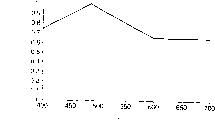
图1示出了UHP灯的光谱。Figure 1 shows the spectrum of a UHP lamp.
图2示出了理想绿色滤光器在可见光谱上的透射系数。Figure 2 shows the transmission coefficient of an ideal green filter over the visible spectrum.
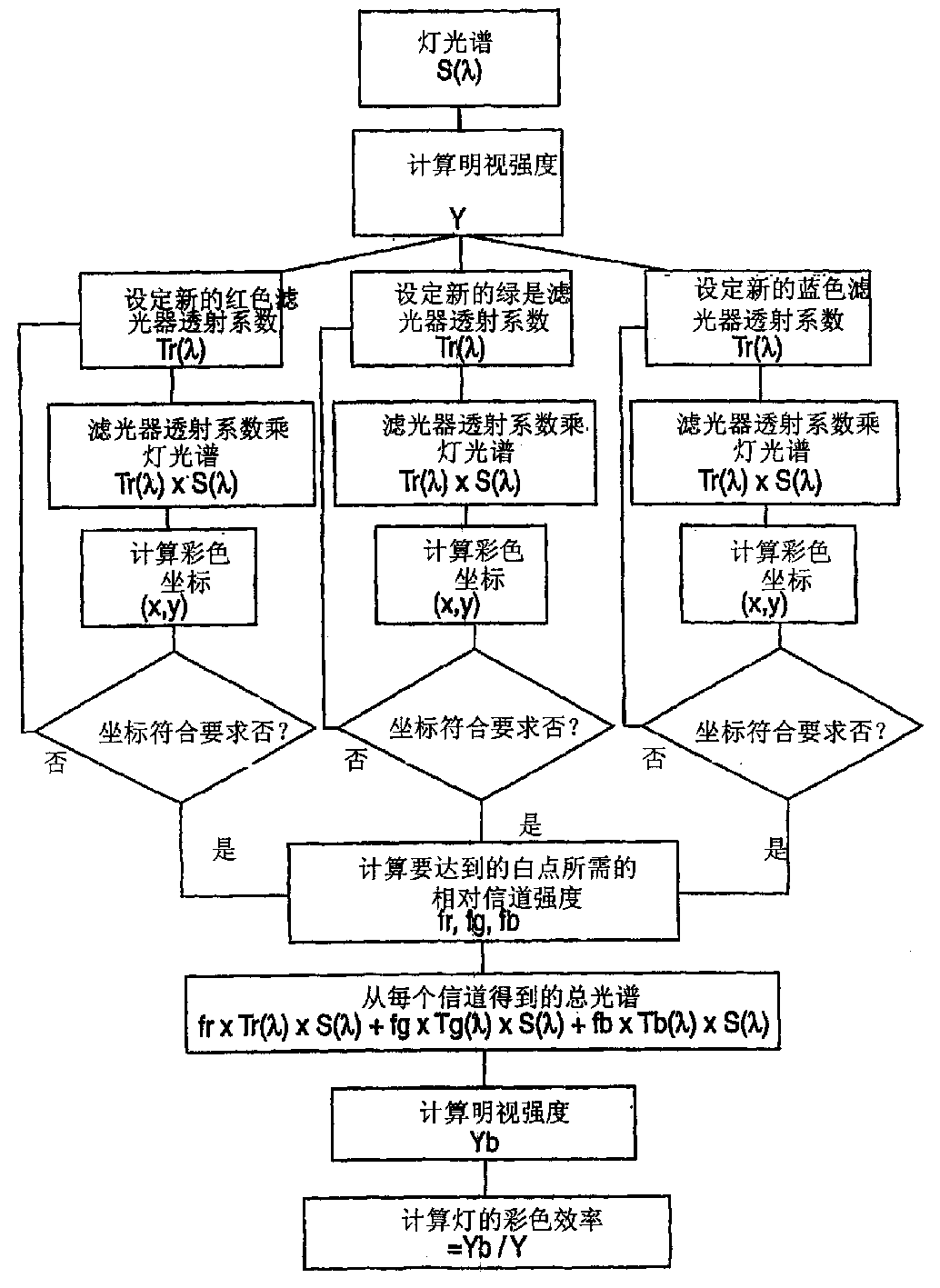
图3示出了为了减少投影显示器中光的损失,在选择灯的光谱及理想滤光器的特性的计算流程图。Fig. 3 shows a flow chart of calculations in selecting the spectrum of the lamp and the characteristics of an ideal filter in order to reduce light loss in a projection display.
图4示出了一个光源的优化了光谱,具体地说是依据本发明使用图3中流程图的过程确定的一个理想(理论上)的灯的光谱。特别是,这个光谱是设计来在投影显示器中达到SMPTE C彩色点的,同时减少光量损失或使光量损失最小化。FIG. 4 shows the optimized spectrum of a light source, in particular the spectrum of an ideal (theoretical) lamp determined in accordance with the present invention using the process of the flowchart in FIG. 3 . In particular, this spectrum is designed to achieve the SMPTE C color point in projection displays while reducing or minimizing light loss.
发明的详述Detailed Description of the Invention
为了选择(1)灯光谱及(2)理想滤光器的适当的特性,计算最好在编程计算机上按照图3中所示那种流程来进行。图3中所描述的数学运算可以使用本技术领域的技术人员都熟悉的各种计算机及软件,例如传统的台式计算机或便携式计算机以及市场上可购得的科学计算程序来进行。Calculations are preferably performed on a programmed computer following the flow shown in FIG. 3 in order to select (1) the appropriate characteristics of the lamp spectrum and (2) the ideal filter. The mathematical operations described in FIG. 3 can be performed using various computers and software familiar to those skilled in the art, such as conventional desktop or portable computers and commercially available scientific calculation programs.
使用图3的计算过程迭代调整灯的光谱及滤光器的特性,从而确认有一个或多个灯光谱和一组滤光器特性(例如一组截止波长),它能在分色/复合过程中提供最小的损失(最高的效率)。Iteratively adjust the lamp spectrum and filter characteristics using the calculation process of Figure 3, thereby confirming that there are one or more lamp spectra and a set of filter characteristics (such as a set of cut-off wavelengths), which can be used in the color separation/recombination process. Provides the smallest loss (highest efficiency) in .
可以调节的系统变量的例子包括:Examples of system variables that can be adjusted include:
1)灯的光谱;1) The spectrum of the lamp;
2)蓝色滤光器的截止点;2) the cut-off point of the blue filter;
3)绿色滤光器的左截止点;3) the left cut-off point of the green filter;
4)绿色滤光器的右截止点;4) the right cut-off point of the green filter;
5)红色滤光器的截止点。5) Cutoff point of the red filter.
要达到的目标是:The goals to be achieved are:
1)蓝色光的彩色坐标;1) Color coordinates of blue light;
2)绿色光的彩色坐标;2) Color coordinates of green light;
3)红色光的彩色坐标;3) Color coordinates of red light;
4)白色光的彩色坐标;4) Color coordinates of white light;
5)与分色/复合有关的损失应减小或最小化。5) Losses related to color separation/compositing should be reduced or minimized.
用上面所描述的那种类型的算法所得到的优化的灯光谱及理想滤光器的特性,然后用它们来选择及/或设计用于构造平板显示器的实际灯和滤波器。一般来说实际的灯和滤波器并不需要也不会严格符合使用上述算法得到的理论特性,不过只是使用理论值作指导,与现有的灯/滤光器相比较,达到了改善的效率。The optimized lamp spectrum and ideal filter characteristics obtained using algorithms of the type described above are then used to select and/or design actual lamps and filters for use in constructing flat panel displays. In general, actual lamps and filters do not need and will not strictly conform to the theoretical characteristics obtained using the above algorithm, but only use the theoretical values as a guide to achieve improved efficiencies compared to existing lamps/filters .
图4中示出了使用图3的算法所得到的一个优化的理论上的灯光谱的例子。为了获得这个光谱,开始时用一个平的光谱,然后迭代地实施图3那样的过程,直至红、绿和蓝色信道的纯度、由组合诸信道生成的白的彩色坐标以及系统的总效率都达到可接受的水平。要注意,这个光谱并不是一个唯一的解法,而其它解法也会维持这个作为例子的光谱的总的特性。在确定图4的光谱中所用的理想颜色滤光器的特性已列在表1。(注意,表1中不同信道光谱的重叠(即蓝/绿为484/494nm以及绿/红为588/599nm)该特性能够在一个顺序系统中加以调节,其中各彩色信道在时间上被分开,或在空间上分开的、三平板显示系统中在不同信道上使用不同的偏振。表2中列出了单个信道中得到的彩色坐标以及在彩色复合后所获得的白点的彩色坐标。这张表还有引自SMPTE C标准的参考数据。An example of an optimized theoretical lamp spectrum obtained using the algorithm of FIG. 3 is shown in FIG. 4 . To obtain this spectrum, start with a flat spectrum, and then iteratively carry out the process as in Figure 3 until the purity of the red, green and blue channels, the color coordinates of white produced by combining the channels, and the overall efficiency of the system are all equal. reach an acceptable level. Note that this spectrum is not the only solution, and other solutions will maintain the general characteristics of this example spectrum. The properties of the ideal color filters used in determining the spectrum of Figure 4 are listed in Table 1. (Note that the overlap of the different channel spectra in Table 1 (i.e. 484/494nm for blue/green and 588/599nm for green/red) This characteristic can be accommodated in a sequential system where the color channels are separated in time, Or use different polarizations on different channels in a spatially separated, three-panel display system. The color coordinates obtained in a single channel and the color coordinates of the white point obtained after color compounding are listed in Table 2. This The table also has reference data from the SMPTE C standard.
这个系统(灯和理想滤光器)说明它有98%的颜色保持效率。This system (lamp and ideal filter) shows a color retention efficiency of 98%.
前面是作说明用的简化例。为了计算实际系统的优化的灯光谱的要求,较佳的要考虑所用滤波器的实际的而不是理想的特性以及系统的其它设计参数。然而上面的例子说明了光源的光谱是一个强有力的变量,可以极有利地用来在显示系统中减小光量损失或使光量损失最小。The preceding is a simplified example for illustration. In order to calculate the optimal lamp spectrum requirements for a practical system, it is preferable to take into account the actual rather than ideal characteristics of the filters used and other design parameters of the system. However, the above examples illustrate that the spectrum of a light source is a powerful variable that can be used to great advantage in reducing or minimizing light loss in display systems.
应该注意到,可供调节的变量数典型地要小于描述所期望的目标的参量数。就实际方面而言,这表明图3的过程可以典型地停止在计算出的效率小于100%的点上。即在运用算法中,达到期望的红、绿和蓝色信道和组合白光的颜色坐标典型地而且更佳地优先于达到绝对的最高效率。It should be noted that the number of variables available for adjustment is typically smaller than the number of parameters describing the desired goal. In practical terms, this means that the process of Figure 3 can typically stop at a point where the calculated efficiency is less than 100%. That is, achieving the desired red, green and blue channels and color coordinates of the combined white light is typically and preferably prioritized over achieving absolute maximum efficiency in implementing the algorithm.
依据本文所描述的技术一种可能优化的的光源是等离子体灯,在Espian等人的U.S.Patent Applicalion(美国专利申请)No.US 2002/0011802 A1中已作了描述。这种灯的光谱取决于它的气体混合物,它在射频电磁场激活之后就发射光。气体混合物的配方可以改变来提供期望的光谱。参考,例如US PatentNos.4,978,891和5,404,076。虽然不很合意,灯的、光发射二极管的、或灯和光发射二极管的组合都可以用来达到作投影系统光源期望的总光谱。One possible optimized light source according to the techniques described herein is the plasma lamp, described in U.S. Patent Application No. US 2002/0011802 Al by Espian et al. The spectrum of this lamp depends on its gas mixture, which emits light when activated by an RF electromagnetic field. The formulation of the gas mixture can be varied to provide the desired spectrum. Reference, eg, US Patent Nos. 4,978,891 and 5,404,076. Although less desirable, lamps, light emitting diodes, or a combination of lamps and light emitting diodes can be used to achieve the desired overall spectrum as a light source for a projection system.
依据上述方法设计的投影系统具有下列特性:The projection system designed according to the above method has the following characteristics:
(1)它们包含一个光源及多个彩色滤光器;(1) They contain a light source and multiple color filters;
(2)光源的光能具有一个测量出的分布,它是波长的函数S(λ);(2) The light energy of the source has a measured distribution which is a function of wavelength S(λ);
(3)光源具有一个明视加权强度Y(λ),它是用具有人眼的灵敏度的滤光器按数学方法对S(λ)进行滤光得到的;(3) The light source has a photopic weighted intensity Y(λ), which is obtained by mathematically filtering S(λ) with a filter having the sensitivity of the human eye;
(4)这些彩色滤光器具有测量到的50%截止点;以及(4) These color filters have a measured 50% cut-off point; and
(5)当:(5) When:
(i)测到的50%截止点用来定义理想滤光器;(i) The measured 50% cut-off point is used to define the ideal filter;
(ii)理想滤波器按数学方法作用于S(λ)产生多个滤过的光,以及(ii) an ideal filter mathematically applied to S(λ) produces a plurality of filtered lights, and
(iii)多个经滤过的光按数学方法组合起来产生模拟白光,(iii) multiple filtered lights combined mathematically to produce simulated white light,
这样得到的模拟白光有一个计算得出的明视加权强度Yb(λ),它在可见光谱上的积分至少是Y(λ)在可见光谱上的积分的75%,较佳的至少是85%,最佳的至少是95%,其中可见光谱取作从390nm延伸到770nm。The simulated white light thus obtained has a calculated photopic-weighted intensity Yb(λ) whose integral over the visible spectrum is at least 75%, preferably at least 85%, of the integral of Y(λ) over the visible spectrum , optimally at least 95%, where the visible spectrum is taken to extend from 390nm to 770nm.
虽然已描述并说明了本发明的实施例,应该明白,根据前述公开材料,对没有脱离本发明的范围和精神所作的各种改动,在本技术领域的技术人员来看将是显而易见的。While embodiments of the present invention have been described and illustrated, it should be understood that various modifications that do not depart from the scope and spirit of the invention will be apparent to those skilled in the art from the foregoing disclosure.
表1 Table 1
理想滤波器的特性
表2 Table 2
达到的和要求的1931CIE彩色坐标
*参看E.Stupp与M.Brennesholtz合著的“Projection Displays”(投影显示器)Wiley,1999,p.310-312及Society of Motion Picture andTelevision Engineers:Recom-mended Praetice(电影与电视工程师学会:推荐的实践,RP 145-1999标题“SMPTE c Color Monitor Calorimetry”(SMPTEC彩色监视器量热术)。*See E.Stupp and M.Brennesholtz "Projection Displays" (projection display) Wiley, 1999, p.310-312 and Society of Motion Picture and Television Engineers: Recom-mended Praetice (Society of Film and Television Engineers: Recommended Practice, RP 145-1999 title "SMPTE c Color Monitor Calorimetry" (SMPTEC Color Monitor Calorimetry).
Claims (20)
Applications Claiming Priority (2)
| Application Number | Priority Date | Filing Date | Title |
|---|---|---|---|
| US42303202P | 2002-11-01 | 2002-11-01 | |
| US60/423,032 | 2002-11-01 |
Publications (1)
| Publication Number | Publication Date |
|---|---|
| CN1708994A true CN1708994A (en) | 2005-12-14 |
Family
ID=32312591
Family Applications (1)
| Application Number | Title | Priority Date | Filing Date |
|---|---|---|---|
| CNA2003801025519A Pending CN1708994A (en) | 2002-11-01 | 2003-10-29 | Light source spectra for projection displays |
Country Status (8)
| Country | Link |
|---|---|
| US (1) | US7142302B2 (en) |
| EP (1) | EP1557047A1 (en) |
| JP (1) | JP2006505012A (en) |
| KR (1) | KR20050063794A (en) |
| CN (1) | CN1708994A (en) |
| AU (1) | AU2003287240A1 (en) |
| TW (1) | TWI292055B (en) |
| WO (1) | WO2004043077A1 (en) |
Cited By (1)
| Publication number | Priority date | Publication date | Assignee | Title |
|---|---|---|---|---|
| CN104504262A (en) * | 2014-12-19 | 2015-04-08 | 东南大学 | Methods for optimizing distribution of transmittance spectral lines of color filters of displays |
Families Citing this family (2)
| Publication number | Priority date | Publication date | Assignee | Title |
|---|---|---|---|---|
| US8556472B2 (en) | 2010-09-28 | 2013-10-15 | Simon Magarill | Light reflectors and flood lighting systems |
| JP7172294B2 (en) | 2018-08-30 | 2022-11-16 | セイコーエプソン株式会社 | Projector, color correction system, and projector control method |
Family Cites Families (7)
| Publication number | Priority date | Publication date | Assignee | Title |
|---|---|---|---|---|
| US4978891A (en) * | 1989-04-17 | 1990-12-18 | Fusion Systems Corporation | Electrodeless lamp system with controllable spectral output |
| US5404076A (en) * | 1990-10-25 | 1995-04-04 | Fusion Systems Corporation | Lamp including sulfur |
| US5903388A (en) * | 1992-06-11 | 1999-05-11 | Sedlmayr Steven R | High efficiency electromagnetic beam projector and systems and method for implementation thereof |
| FR2694103B1 (en) * | 1992-07-24 | 1994-08-26 | Thomson Csf | Color image projector. |
| US5680180A (en) * | 1995-05-08 | 1997-10-21 | Texas Instruments Incorporated | Color balance compensation for digital display system with color wheel |
| US6737809B2 (en) * | 2000-07-31 | 2004-05-18 | Luxim Corporation | Plasma lamp with dielectric waveguide |
| EP1407618A4 (en) * | 2001-06-21 | 2007-12-26 | 3M Innovative Properties Co | Scrolling color sequential illumination system |
-
2003
- 2003-10-29 AU AU2003287240A patent/AU2003287240A1/en not_active Abandoned
- 2003-10-29 CN CNA2003801025519A patent/CN1708994A/en active Pending
- 2003-10-29 WO PCT/US2003/034231 patent/WO2004043077A1/en not_active Ceased
- 2003-10-29 US US10/695,844 patent/US7142302B2/en not_active Expired - Fee Related
- 2003-10-29 KR KR1020057007521A patent/KR20050063794A/en not_active Withdrawn
- 2003-10-29 EP EP03781422A patent/EP1557047A1/en not_active Withdrawn
- 2003-10-29 JP JP2004550164A patent/JP2006505012A/en not_active Withdrawn
- 2003-10-31 TW TW092130513A patent/TWI292055B/en active
Cited By (2)
| Publication number | Priority date | Publication date | Assignee | Title |
|---|---|---|---|---|
| CN104504262A (en) * | 2014-12-19 | 2015-04-08 | 东南大学 | Methods for optimizing distribution of transmittance spectral lines of color filters of displays |
| CN104504262B (en) * | 2014-12-19 | 2017-07-21 | 青岛海信电器股份有限公司 | Display colour filter transmitance spectral line distribution optimization method |
Also Published As
| Publication number | Publication date |
|---|---|
| KR20050063794A (en) | 2005-06-28 |
| AU2003287240A1 (en) | 2004-06-07 |
| JP2006505012A (en) | 2006-02-09 |
| EP1557047A1 (en) | 2005-07-27 |
| TWI292055B (en) | 2008-01-01 |
| WO2004043077A1 (en) | 2004-05-21 |
| TW200422657A (en) | 2004-11-01 |
| US7142302B2 (en) | 2006-11-28 |
| US20040125376A1 (en) | 2004-07-01 |
Similar Documents
| Publication | Publication Date | Title |
|---|---|---|
| CN102520571B (en) | Light-emitting device and projection system | |
| US20090207583A1 (en) | Led lighting unit | |
| US6683423B2 (en) | Lighting apparatus for producing a beam of light having a controlled luminous flux spectrum | |
| RU2536582C2 (en) | Lighting installation with wakening function | |
| CN104373838B (en) | A kind of LED light source module and LED lamp | |
| CN1713736A (en) | Color signal processing apparatus and method | |
| CN202710914U (en) | Light source system and projection system | |
| WO2015027786A1 (en) | Led lamp | |
| TW201541180A (en) | A light source system and a projection system and a projection | |
| EP3587901B1 (en) | Method of providing color temperature correction of a light beam using a color filter system | |
| WO2016161933A1 (en) | Projection display system and control method therefor | |
| EP2998641B1 (en) | Light-emitting device and stage lamp system | |
| CN106950786B (en) | Light source module group and its light source control method, optical projection system | |
| CN111326641A (en) | A method for reducing blue light hazards of white light emitting diodes | |
| CN1708994A (en) | Light source spectra for projection displays | |
| CN102650815B (en) | Projection device, light source system and improvement method of light source system | |
| US9068718B2 (en) | Indirect excitation of photoreactive materials coated on a substrate with spectrum simulation | |
| CN1722856A (en) | Method of displaying images in image display device using sequential driving method | |
| WO2019024362A1 (en) | Light source | |
| JP6376338B2 (en) | Lighting device | |
| CN111163556A (en) | A light distribution method for realizing arbitrary color LED light source | |
| CN102640566B (en) | Light-emitting diode lighting device for generating polychromatic light radiation | |
| CN109856894A (en) | The aobvious LED movies-making lamp of height and its color temperature adjusting method | |
| CN102548091A (en) | Projection device and light source driving method thereof | |
| JP2006505012A5 (en) |
Legal Events
| Date | Code | Title | Description |
|---|---|---|---|
| C06 | Publication | ||
| PB01 | Publication | ||
| C10 | Entry into substantive examination | ||
| SE01 | Entry into force of request for substantive examination | ||
| C02 | Deemed withdrawal of patent application after publication (patent law 2001) | ||
| WD01 | Invention patent application deemed withdrawn after publication |