CN1533552B - Genetic algorithm optimization method - Google Patents
Genetic algorithm optimization method Download PDFInfo
- Publication number
- CN1533552B CN1533552B CN028112253A CN02811225A CN1533552B CN 1533552 B CN1533552 B CN 1533552B CN 028112253 A CN028112253 A CN 028112253A CN 02811225 A CN02811225 A CN 02811225A CN 1533552 B CN1533552 B CN 1533552B
- Authority
- CN
- China
- Prior art keywords
- sensor
- genetic algorithm
- individuality
- implemented method
- computer implemented
- Prior art date
- Legal status (The legal status is an assumption and is not a legal conclusion. Google has not performed a legal analysis and makes no representation as to the accuracy of the status listed.)
- Expired - Fee Related
Links
Images


Classifications
-
- G—PHYSICS
- G06—COMPUTING OR CALCULATING; COUNTING
- G06N—COMPUTING ARRANGEMENTS BASED ON SPECIFIC COMPUTATIONAL MODELS
- G06N3/00—Computing arrangements based on biological models
- G06N3/12—Computing arrangements based on biological models using genetic models
-
- G—PHYSICS
- G06—COMPUTING OR CALCULATING; COUNTING
- G06N—COMPUTING ARRANGEMENTS BASED ON SPECIFIC COMPUTATIONAL MODELS
- G06N3/00—Computing arrangements based on biological models
- G06N3/12—Computing arrangements based on biological models using genetic models
- G06N3/126—Evolutionary algorithms, e.g. genetic algorithms or genetic programming
Landscapes
- Engineering & Computer Science (AREA)
- Physics & Mathematics (AREA)
- Health & Medical Sciences (AREA)
- Life Sciences & Earth Sciences (AREA)
- Biophysics (AREA)
- Theoretical Computer Science (AREA)
- Bioinformatics & Cheminformatics (AREA)
- Bioinformatics & Computational Biology (AREA)
- Evolutionary Biology (AREA)
- Computational Linguistics (AREA)
- General Engineering & Computer Science (AREA)
- Biomedical Technology (AREA)
- Genetics & Genomics (AREA)
- Data Mining & Analysis (AREA)
- Evolutionary Computation (AREA)
- General Health & Medical Sciences (AREA)
- Molecular Biology (AREA)
- Computing Systems (AREA)
- Artificial Intelligence (AREA)
- General Physics & Mathematics (AREA)
- Mathematical Physics (AREA)
- Software Systems (AREA)
- Physiology (AREA)
- Testing Or Calibration Of Command Recording Devices (AREA)
- Feedback Control In General (AREA)
- Control Of Non-Electrical Variables (AREA)
Abstract
Description
本发明请求于2001年4月6日提交的题为“基因算法优化方法”的美国临时申请No.60/282366的优先权,该申请所公开的全部内容被并入本申请中。This application claims priority to US Provisional Application No. 60/282,366, entitled "Genetic Algorithm Optimization Method," filed April 6, 2001, the entire disclosure of which is incorporated herein by reference.
发明领域field of invention
本发明总体上涉及改进的优化方法。特别地,本发明涉及基因算法并且可以用于对高度多模式和欺骗函数进行优化,其一个例子为选择一个传感器网络的传感器个体用于跟踪一个特定目标。The present invention generally relates to improved optimization methods. In particular, the invention relates to genetic algorithms and can be used to optimize highly multimodal and deception functions, an example of which is the selection of individual sensors of a sensor network for tracking a specific target.
发明背景Background of the invention
对具有多个独立变量的高度多模式和欺骗函数进行优化是非常耗费时间的,这是因为这些函数所展现出的大的搜索空间和多个最适合条件。通常,函数具有越多的独立变量,优化过程就越难实现。Optimizing highly multimodal and spoof functions with many independent variables is very time-consuming due to the large search spaces and multiple optimum conditions exhibited by these functions. In general, the more independent variables a function has, the harder it is to optimize.
特别难以优化的函数通常共享某种特性,这些特性包含:多模式、不可微分性、不连续性、特征类型(不规则)变量、以及大量的独立变量。这种函数的经典的数学例子包含例如Rastringin的函数、欺骗函数、Holland的Royal Road函数。Functions that are particularly difficult to optimize often share properties including: multimodality, non-differentiability, discontinuity, characteristic type (irregular) variables, and a large number of independent variables. Classical mathematical examples of such functions include eg Rastringin's function, spoof function, Holland's Royal Road function.
还存在许多实际的情况,在这些情况中,由高度多模式和/或欺骗函数来表示问题。这种实际情况的例子包含在计算机/无线网络中对路由器的选择、对芯片上晶体管的组织、例如蛋白质折叠和RNA折叠的生物计算应用、可展开的硬件、工作车间调度和维护调度问题、制定时间表、通过传感器网络跟踪目标、传感器部署计划工具以及对传感器网络的控制和管理。对传感器网络的控制和管理将作为一个示例性的大型多模式的实际问题被进一步考虑。There are also many practical situations where problems are represented by highly multimodal and/or deceptive functions. Examples of such realities include the selection of routers in computer/wireless networks, the organization of transistors on chips, biological computing applications such as protein folding and RNA folding, expandable hardware, job shop scheduling and maintenance scheduling problems, formulating Schedules, tracking of targets through sensor networks, sensor deployment planning tools, and control and management of sensor networks. The control and management of sensor networks will be further considered as an exemplary large-scale multimodal practical problem.
无人看管的地面传感器(“UGS”)可以极大地增加军事行动的有效性和能力。在市场上最容易买到的UGS是独立工作的多功能、集成传感器平台。UGS的一个例子是一种声学UGS,该声学UGS包含三个声学麦克风(用于实现准确的方位角测量)、一个地震传感器、一个磁传感器、一个全球定位传感器、一个方位传感器、集成通信和信号处理电子器件,以及一个电池。这样一个平台的体积通常约为1ft3(28320cm3),并且价格非常昂贵。因为存在这些缺点,这种UGS通常不被用来支持用于小的、快速可部署的军事行动的远程监视应用。Unattended ground sensors ("UGS") can greatly increase the effectiveness and capabilities of military operations. The most readily available UGSs on the market are multifunctional, integrated sensor platforms that work independently. An example of a UGS is an acoustic UGS that contains three acoustic microphones (for accurate azimuth measurements), a seismic sensor, a magnetic sensor, a global positioning sensor, an azimuth sensor, integrated communications and signal Handle the electronics, as well as a battery. Such a platform typically has a volume of about 1ft 3 (28320cm 3 ) and is very expensive. Because of these shortcomings, such UGSs are not generally used to support long-range surveillance applications for small, rapidly deployable military operations.
对这种较大的、昂贵的传感器平台的一种替换的方案是使用大约为2in3(大约33cm3)的小型UGS,这种小型UGS比较便宜并且可方便地由单个战斗机对其进行部署。较小的传感器,例如那些在这种小型UGS中使用的传感器,通常只能在较短范围内进行通信和目标感应,并且可能仅可以感应单个目标特性(如地震振动或化学探测)。另外,较小的传感器通常具有较短的工作寿命,这是由于电池较小的缘故。由于这些特性,为了实现与较大的UGS所能实现的目标相同的目标,不得不部署更多的这种小UGS。但是,单独进行工作的单个小型UGS将不能执行监视任务。An alternative to this larger, expensive sensor platform is to use a small UGS of about 2in 3 (about 33cm 3 ), which is less expensive and can be easily deployed by a single fighter. Smaller sensors, such as those used in such small UGSs, typically only communicate and target at short ranges and may only sense a single target characteristic (such as seismic vibration or chemical detection). Additionally, smaller sensors typically have a shorter operating life due to the smaller battery. Because of these characteristics, more of such small UGSs had to be deployed in order to achieve the same goals that larger UGSs could achieve. However, a single small UGS working alone will not be able to perform surveillance tasks.
对这种问题的一种替换的方案是将这种小的、低造价的UGS“散播”在监视区域,并且使这些传感器可以对它们自己进行组织并协同工作。如这样的一种UGS网络将会具有体积较大的单个进行工作的传感器所不具有的许多优点。例如,位于中间的UGS可以为位于较远位置的传感器充当“短距离”通信中继站。一个网络中具有更多传感器可以允许具有不同类型的传感器,这将使得网络的联合操作具备更广泛的功能。另外,网络中内置的冗余将会使得该网络受单点故障和/或传感器信号丢失的影响较小。An alternative solution to this problem is to "scatter" the small, low-cost UGSs over the surveillance area and allow the sensors to organize themselves and work together. A UGS network such as this would have many advantages over the larger individual operating sensors. For example, a UGS located in the middle can act as a "short-range" communication relay station for sensors located further away. Having more sensors in a network allows for different types of sensors, which will allow for a wider range of capabilities in joint operation of the network. Additionally, built-in redundancy in the network will make the network less susceptible to single points of failure and/or loss of sensor signals.
为了使具有多个小的、便宜的UGS的网络能够以可以接受的方式进行工作,必须开发出一种用来组织和控制这样一种网络的算法和方法。以下的问题被认为是一个没有唯一的解决方案的多目标优化问题:选择一个传感器的最佳集合用来对进入监视区域的目标进行探测、跟踪以及分类,而与此同时使该传感器网络的功率消耗最小化。另外,如果目标或传感器数目是按线性规律增加的,则优化会导致组合的搜索空间按照指数规律增加。In order for a network with many small, inexpensive UGSs to work in an acceptable manner, an algorithm and method for organizing and controlling such a network must be developed. The following problem is considered as a multi-objective optimization problem without a unique solution: select an optimal set of sensors to detect, track and classify objects entering the surveillance area, while at the same time maximizing the power of the sensor network Consumption is minimized. Alternatively, if the number of objects or sensors increases linearly, the optimization results in an exponential increase in the combined search space.
美国专利No.6055523(Hillis)公开了一种用于在使用一个或多个传感器进行的多目标跟踪中分配传感器报告的方法。该方法通过多次时间扫描从至少一个传感器接收传感器报告,使用公式将基因算法总体中的个体表示为这些传感器报告的排列,并且然后使用标准基因算法技术来发现被跟踪的目标的路径。该方法使用基因算法来确定被跟踪的目标的路径,而不是选择传感器或传感器报告以进行使用。US Patent No. 6055523 (Hillis) discloses a method for distributing sensor reports in multi-target tracking using one or more sensors. The method receives sensor reports from at least one sensor over multiple time sweeps, uses formulas to represent individuals in a genetic algorithm population as permutations of these sensor reports, and then uses standard genetic algorithm techniques to discover the path of the tracked target. The method uses a genetic algorithm to determine the path of a tracked target, rather than selecting sensors or sensor reports for use.
因此,需要一种改进的算法,该算法可以为了完成对性能的多个不同变量同时进行优化的目的而从网络中选择单个的传感器。Therefore, there is a need for an improved algorithm that can select individual sensors from a network for the purpose of simultaneously optimizing several different variables of performance.
发明概述Summary of the invention
根据本发明,提供了一种用于从一个传感器网络中选择传感器以用于对至少一个目标进行跟踪的方法,该方法具有以下步骤:定义具有n个染色体的基因算法结构的个体,其中每个染色体代表一个传感器,根据想要的跟踪的特性来定义适合性函数,选择一个或多个个体并将其包含进一个初始总体,对该初始总体执行一种基因算法直到所规定的趋同(convergence)标准被满足,其中基因算法的执行具有以下步骤:从该总体中选择最适合的个体,从该总体中选择随机个体以及通过该最适合的和随机选择的个体来创造后代。According to the present invention, there is provided a method for selecting sensors from a sensor network for tracking at least one target, the method having the following steps: defining an individual with a genetic algorithm structure of n chromosomes, where each Chromosomes represent a sensor, define a fitness function according to the properties you want to track, select one or more individuals and include them into an initial population, perform a genetic algorithm on the initial population until the specified convergence (convergence) The criteria are met wherein the genetic algorithm is performed with the steps of selecting the fittest individual from the population, selecting a random individual from the population and creating offspring from the fittest and randomly selected individuals.
根据本发明的另一种实施方案,提供了一种用于从一个传感器网络中选择传感器以用于对至少一个目标进行跟踪的方法,该方法具有以下步骤:定义具有n个染色体的基因算法结构的个体,其中每个染色体代表一个传感器,根据想要的跟踪的特性来定义适合性函数,选择一个或多个个体并将其包含进一个初始总体,对该初始总体执行一种基因算法直到所规定的趋同标准被满足,其中对基因算法的执行具有以下步骤:从该总体中选择最适合的个体,以及通过该最适合的个体创造后代,其中仅通过突变来实现对后代的创造,其中在任何一次突变期间仅有i个染色体发生突变,并且其中i的值为从2到n-1。According to another embodiment of the present invention, there is provided a method for selecting sensors from a sensor network for tracking at least one target, the method having the following steps: defining a genetic algorithm structure with n chromosomes , where each chromosome represents a sensor, define a fitness function according to the characteristics you want to track, select one or more individuals and include them into an initial population, and perform a genetic algorithm on the initial population until all The specified convergence criteria are met, wherein the execution of the genetic algorithm has the steps of selecting the most fit individual from the population, and creating offspring from the most fit individual, wherein the creation of the offspring is achieved by mutation only, where in Only i chromosomes are mutated during any one mutation, and the value of i is from 2 to n-1.
根据本发明的另一种实施方案,提供了一种用于跟踪目标的传感器网络,包含N个传感器、一种用于N个传感器与控制器进行通信的装置和一个可以通过利用根据本发明的方法从而控制和管理该N个传感器的控制器。According to another embodiment of the present invention, a sensor network for tracking a target is provided, including N sensors, a device for communicating with a controller for N sensors and a The method thus controls and manages the controller of the N sensors.
优选地,通过突变、交叉(crossover)或者它们的组合来创造后代。更加优选地,仅通过突变来实现对后代的改变。Preferably, progeny are created by mutation, crossover or a combination thereof. Even more preferably, changes to progeny are effected only by mutation.
优选地,后代的改变发生在i个染色体,其中i的值从2到n-1,其中n是组成一个染色体的基因的数目。更加优选地,i的值为2。Preferably, the progeny is altered in i chromosomes, where i has a value from 2 to n-1, where n is the number of genes making up a chromosome. More preferably, the value of i is 2.
附图简述Brief description of the drawings
图1描述了一个基因算法的总体的一般结构。Figure 1 depicts the overall general structure of a genetic algorithm.
图2描述了代表一个基因算法中的步骤的普遍化的流程图。Figure 2 depicts a generalized flowchart representing the steps in a genetic algorithm.
图3a描述了一种单点、单染色体交叉。Figure 3a depicts a single-point, single-chromosomal crossover.
图3b描述了一种双点、单染色体交叉。Figure 3b depicts a two-point, single-chromosomal crossover.
图4a描述了一种突变,其中因为突变的概率,仅有一个基因发生了突变。图4b描述了一种突变,其中因为突变的概率,两个基因发生了突变。Figure 4a depicts a mutation in which only one gene is mutated due to mutation probability. Figure 4b depicts a mutation in which two genes are mutated because of mutation probability.
图5描述了一种根据本发明的单点、C2交叉。Figure 5 depicts a single point, C2 crossover in accordance with the present invention.
图6描述了一种根据本发明的C2突变。Figure 6 depicts a C2 mutation according to the invention.
图7描述了一种基因算法的结构,该基因算法用于为目标跟踪/标识选择最佳传感器的过程。Figure 7 depicts the structure of a genetic algorithm used in the process of selecting the best sensor for object tracking/identification.
图8描述了一种代表根据本发明的一个方面的方法的普遍化的流程图,该方法用于控制和管理一个传感器网络。Figure 8 depicts a flow chart representing a generalization of a method according to an aspect of the invention for controlling and managing a sensor network.
图9描述了八种算法在使传感器控制优化方面的性能的平均最佳适合性。Figure 9 depicts the average best fit of the performance of the eight algorithms in optimizing the sensor control.
图10描述了图9中所表示的五种算法所进行的优化所必需的时间和有效性。FIG. 10 depicts the time and efficiency necessary for the optimization performed by the five algorithms represented in FIG. 9 .
图11描述了图10中所描述的五种算法改进百分比随时间发生变化的情况。Figure 11 depicts the percent improvement over time for the five algorithms depicted in Figure 10.
优选实施方案详述DETAILED DESCRIPTION OF THE PREFERRED EMBODIMENT
发明装置invention device
根据本发明的一种装置包含至少一个传感器、一个处理器,以及一种基因算法。A device according to the invention comprises at least one sensor, a processor, and a genetic algorithm.
术语“实体”将被用于对本发明的通篇描述。术语实体应该被理解为广泛地包含多种不同的电子术语,例如任何被用于感应目标或者可以被用于感应目标的传感器,或者在计算机或无线网络中的路由器。实体一般是指,例如可以被用来探测目标的一种特性的传感器。这种特性的例子包含速度、位置、方位、类型(或者标识)、大小。本发明并不限于任意特定类型或数量的传感器。尽管一种优选的实施方案包含小的、便宜的传感器,通篇使用的实体这一术语并不受此限制。可替换地,术语实体还可以指从任意类型的实体(例如一个传感器)中接收到的数据。The term "entity" will be used throughout the description of the present invention. The term entity should be understood broadly to encompass a variety of different electronic terms, such as any sensor that is or can be used to sense an object, or a router in a computer or wireless network. An entity generally refers to, for example, a sensor that can be used to detect a property of an object. Examples of such properties include speed, position, bearing, type (or identity), size. The invention is not limited to any particular type or number of sensors. The term entity is not so limited as used throughout, although a preferred embodiment involves small, inexpensive sensors. Alternatively, the term entity may also refer to data received from any type of entity, such as a sensor.
优选地,用于本发明的一种实施方案的传感器是这样一种传感器:它小于大约2in3(大约33cm3),它的生产和运行成本都比较低,并且可以被容易地部署。这样一种传感器几乎可以是任意类型的传感器,包含但并不限于声学传感器、地震传感器、机械传感器,或者半导体激光传感器。许多公司生产的传感器都可以被用于本发明的一种实施方案,这样的公司的例子包含但不限于Northrop-Grumman、SenTech、Raytheon、BAE、Aliant and Rockwell Sciences Center。Preferably, the sensor used in one embodiment of the present invention is one that is smaller than about 2 in 3 (about 33 cm 3 ), is relatively inexpensive to produce and operate, and can be easily deployed. Such a sensor could be almost any type of sensor, including but not limited to acoustic sensors, seismic sensors, mechanical sensors, or semiconductor laser sensors. Sensors produced by a number of companies may be used in an embodiment of the present invention, examples of such companies include, but are not limited to, Northrop-Grumman, SenTech, Raytheon, BAE, Aliant and Rockwell Sciences Center.
术语“网络”是指多于一个的传感器,这些传感器可以与其它传感器进行通信并且受一个或多个系统或处理器的控制。网络中的一些传感器可能并不能被使用,例如因为它们可能在范围之外,或者它们的电池没电了,或者可能仅仅是它们未被使用但仍然被认为是网络的一部分。网络中的传感器之间的通信可以通过有线或无线方式来实现。只要存在用于控制传感器的一个单独的计划或方法,一个单个的处理器或者多个不同的处理器就可以控制该网络。The term "network" refers to more than one sensor that can communicate with other sensors and be controlled by one or more systems or processors. Some sensors in the network may not be used, for example because they may be out of range, or their batteries are dead, or it may simply be that they are not being used but are still considered part of the network. Communication between sensors in the network can be achieved by wired or wireless means. A single processor or multiple different processors can control the network as long as there is a single scheme or method for controlling the sensors.
术语“处理器”是指一个或多个设备,这一个或多个设备可以确定如何控制和管理传感器以及实际地对传感器进行控制和管理。通常,这种处理器包含可以执行本方法的必要的步骤并可以控制网络的单个传感器的任意可以被使用的处理系统。可以执行处理器功能的处理系统的例子包含但不限于一种500MHz Compaq膝上型计算机。可以理解,控制可编程计算机的软件程序、基于硬件的装置都可以替换地实施本方法并且是本发明的设备的一部分,其中基于硬件的装置包含通用的或由客户设计的集成电路设备,这些通用的或由客户设计的集成电路设备包含集成电路微处理器和永久指令保持存储器。The term "processor" refers to one or more devices that can determine how and actually control and manage a sensor. In general, such a processor comprises any processing system that can be used that can carry out the necessary steps of the method and can control the individual sensors of the network. An example of a processing system that can perform the functions of a processor includes, but is not limited to, a 500 MHz Compaq laptop computer. It will be appreciated that a software program controlling a programmable computer, hardware-based apparatus including general-purpose or custom-designed integrated circuit devices, which may alternatively implement the method and be part of the apparatus of the present invention, An integrated circuit device designed by or by a customer contains an integrated circuit microprocessor and permanent instruction retention memory.
术语“目标”是指正在被跟踪的物体、动物,或者人类。优选地,正在被跟踪的目标为一个物体,例如一个陆地或空中交通工具。通常,对传感器进行配置从而获得关于该目标的一些类型的信息。这些信息可以包含但不限于该目标的大小、标识、速度,以及方位。The term "target" refers to the object, animal, or human being being tracked. Preferably, the target being tracked is an object, such as a land or air vehicle. Typically, sensors are configured to obtain some type of information about the target. Such information may include, but is not limited to, the target's size, identity, speed, and orientation.
术语“感应”或者“被感应”是指获得关于目标的一些信息随时间而发生变化的情况的过程。通过感应而获得的这些信息包含但不限于经典的通过跟踪、取平均值从而获得的目标位置随时间发生变化的信息。这种位置通常为2维x、y坐标,或者3维x、y、z坐标。感应还包含获得其它关于标识的信息,例如目标的一些物理特性。The term "sensing" or "sensed" refers to the process of obtaining some information about a target as it changes over time. The information obtained through sensing includes, but is not limited to, information on changes in target positions over time obtained through classic tracking and averaging. This position is typically a 2-dimensional x,y coordinate, or a 3-dimensional x,y,z coordinate. Sensing also involves obtaining other information about the identity, such as some physical characteristics of the target.
基本基因算法Basic genetic algorithm
本发明的方法和设备使用改进的基因算法。为了理解该改进的基因算法,首先将对基本基因算法和它们的术语进行讨论。The methods and apparatus of the present invention use a modified genetic algorithm. In order to understand the improved genetic algorithm, the basic genetic algorithms and their terminology will first be discussed.
基因算法是基于自然选择和遗传学的搜索算法。通常来讲,它们将适者生存的概念和信息的随机化交换结合在一起。每个基因算法代中都有一个包含个体的总体。这些个体可以被看作正被解决的问题的候选解决方案。在每个连续的代中,使用上一代的最适合的部分从而创造一个新的个体集合。但是,还要非经常性地将随机化新信息包含进来,以便使重要数据不会丢失和被忽视掉。A genetic algorithm is a search algorithm based on natural selection and genetics. Typically, they combine the concept of survival of the fittest with a randomized exchange of information. Each GA generation has a population containing individuals. These individuals can be viewed as candidate solutions to the problem being solved. In each successive generation, a new set of individuals is created using the best-fit part of the previous generation. However, randomized new information should also be included infrequently so that important data is not lost and overlooked.
图1举例说明了基因算法所基于的结构。基因算法的一个基本概念是:它就一个总体中的个体而言对一个问题的可能的解决方案进行了定义。染色体100,也被称作位字符串,包含多个基因105,其中该基因105也被称作特征、特性、或者位。每个基因105具有一个等位基因,或者可能值110。一个特定的基因105还具有一个位置或者字符串位置115,该位置或者字符串位置115表示基因在染色体100中的位置。Figure 1 illustrates the structure on which the genetic algorithm is based. A basic concept of genetic algorithm is that it defines possible solutions to a problem in terms of individuals in a population. A
在一个正在运行的基因算法中,通过对问题的可能的解决方案进行编码从而确定染色体100。例如,考虑到达一个特定目的地的可能的路线以及完成每种路线所需的时间。多种因素将会决定任意一种特定的路线将会花费多长的时间,这些因素中的一些因素包含,例如:路线的长度、该路线上的交通流量状况、该路线上的路面状况,以及该路线上的天气情况。可以通过为这些因素(或者基因105)的每个因素赋值(或者同位基因110)从而为每个路线构建染色体100。In a running genetic algorithm,
一个基因型,也被称作结构或者个体120,可以包含一个或多个染色体100。在图1中,一个基因型120包含3个单独的染色体100。依此类推,如果问题包含用于包含多个路段的总路程的多种可能的路线,那么就存在具有多于一个染色体100的基因型或者个体120。该总路程的每个路段将会有一座城市(或者染色体100)。一组个体120组成总体125。总体125中的个体120的数量(所谓的总体大小)取决于正在被解决的特定的问题。A genotype, also called a structure or
在前面已经解释了基因算法运行所基于的结构,接下来将讨论这些基因算法运行的方式。图2描述了一种基因算法的运行情况。Having previously explained the structure upon which genetic algorithms operate, the manner in which these genetic algorithms operate will be discussed next. Figure 2 describes the operation of a genetic algorithm.
第一步是初始化步骤150。初始化是通过由操作基因(operator)指定涉及基因算法运行的方式的一些细节来实现的。需要在初始化步骤150被指定或者被选择的细节包含,例如总体大小、特定的操作基因发生的概率,以及对最终解决方案的预期。初始化所必需的细节部分地取决于基因算法的准确的运行。在初始化时被选择的参数可以使用基因算法支配为了确定想要的解决方案所必需的时间和资源。还应该理解,该初始化步骤150是可选的,这是因为通过初始化步骤150获得的所有信息可以被包含在算法自身当中,并且在该初始化步骤期间可以不用要求用户输入。The first step is an
基因算法中的下一步是对初始总体的选择步骤155。对初始总体的选择通常是通过对个体120的随机选择来实现的,但是也可以通过其它方法来实现。组成初始总体的个体120的数量部分地是由在初始化步骤150所选择的参数来确定的。通常,使用一个随机数发生器通过为每个染色体100中的每个基因105确定值110从而创建初始总体。The next step in the genetic algorithm is the
接下来,被随机选择的总体的个体120的适合性在适合性的确定步骤160中被确定。个体120的适合性取决于指派基因算法对其进行优化的特定的问题。例如,适合性可能取决于个体120的成本、个体120对于特定任务的有效性,或者它们的组合。个体120的适合性必须可以定量地被测量和确定,例如使用一个公式。总体中的每个个体120都具有一个特定的适合性值。Next, the suitability of the randomly selected population of
下一步是检查趋同标准是否已经被实现的步骤165。在经典的基因算法中,这一步骤通常指在进行检查的时候查看个体的适合性是否满足某些定义的适合性标准。通常,在实际的应用中,适合性的可能的或者可接收的水平可能是未知的,所以基因算法例如在一些代后被停止,或者在其中最适合的个体不发生变化的一些代后被停止。在以上两种情况的任意一种情况中,这一步骤检查从而确定要求,即代的数量或是总体的适合值,是否已经得到了满足。任意给定的总体要么会满足该标准,要么不会满足该标准。如果总体满足了趋同标准,该总体将会被认为是用来跟踪目标的传感器的最佳总体,也就是最终总体。在这种情况下,接下来的步骤是最终总体的输出步骤185。最终总体的输出可以通过多种不同的方式来实现,包含但不限于将最终总体的属性打印为一种硬复制版本、将最终总体的属性保存为电子格式,或者使用最终总体来控制或管理一些过程。The next step is a
如果检查趋同标准是否已经被实现的步骤165显示该总体并没有满足所要求的标准,那么接下来的步骤是交配集合选择步骤170。基因算法中的交配集合选择步骤170可以通过多种方式来实现,但是通常部分地基于所涉及的个体的适合性。例如,可以使用偏置的轮盘来选择个体,其中该偏置基于个体的适合性。用来选择交配集合的另一种方法严格地基于适合性值;总体中的一定比例的最适合个体被选择从而进行交配。还有另一种方法使用比赛选择,首先,随机选择k个个体120。然后,确定每k个元组中最适合的个体120,并且这些个体被复制进交配集合。If the
接下来的步骤是后代的创造步骤180。在该步骤中,对在交配集合选择步骤170中选择的双亲进行有修改或无修改地组合以创造后代。并不是交配集合所创造的每个成员都要在后代的创造步骤180中被修改。通常,交配集合的一个特定的成员是否要被修改是由概率确定的。例如,这些概率既可以在初始时被指定,也可以通过从交配总体或交配对中获得的信息来确定。可以通过多种方式来实现对后代的修改,所述方式被称作操作基因。通常,按照给定的概率对交配集合的成员施加操作基因。通常所使用的操作基因包含但不限于交叉、突变、倒位、优势改变、分离和易位,以及染色体内复制。这里仅解释交叉和突变。The next step is the
交叉是这样一种方法,通过该方法,两个不同的染色体100上的基因105被分散到这两个染色体100之间。单点交叉是通过沿染色体100随机选择一个位置k来实现的,该位置位于1和染色体长度减1之间。两个后代是通过交换位于位置k+1和染色体100的全长之间的所有基因105被创造出来的。有多种不同类型的交叉,包含但不限于单点、双点、一致(uniform)。还可以在一个个体120的一个或多个染色体100上实现交叉。通常,仅在一个染色体上或在每个染色体上实现交叉。Crossover is a method by which
图3a举例说明了一种单点、单染色体交叉。在两个未经修改的后代个体120上选择一个交叉点130。位于包含交叉点130的基因105之内的等位基因110被交换到交叉点130之后。基因105仅在该染色体100上被交换。在进行完交叉之后,创造出了被修改的后代个体120’。图3b举例说明了一种双点、单染色体交叉。在双点、单染色体交叉中,交叉点130和第二交叉点132是在同一个染色体100内随机选择的。在这种交叉中,在到达第二交叉点132之前,在一个染色体100之内位于交叉点130之后的等位基因110被交换,在第二交换点132处,等位基因110保持它们和在最初的染色体100中相同。理论上,在任意一个染色体中,有多少个基因105就可以选择多少个交叉点。Figure 3a illustrates a single-point, single-chromosomal crossover. An
突变是这样一种方法,通过这种方法,染色体100上的一个或多个基因105被修改。按照通常在基因算法的初始化步骤中被确定的突变的概率来选择用于突变的基因105。在一次事件中可以对一个染色体100上的多于一个基因105进行突变。突变的概率通常比交叉的概率要低得多。突变通常被认为是用来确保有用的基因不会丢失的一种方法。在一个或多于一个染色体100上可以发生多个突变。可以发生突变的染色体100的数量的范围是从1到n,其中n是在一个个体120中的染色体100的数量。Mutation is a method by which one or
图4a表示了一种单染色体突变。基因105处的占据突变点140的等位基因110被改变为某种其它的等位基因110。在一种二进制编码中,突变是将0变为1,或者将1变为0。因为通常发生突变的概率比较低,所以某些基因发生突变,而某些基因不发生突变。在后代的创造步骤180之后,适合性的确定步骤160被重复,在适合性的确定步骤160之后跟有检查是否已经实现趋同标准的步骤165。如果总体没有满足标准的话,该循环就一直进行。如上述,如果总体满足了趋同标准,就执行输出步骤185并且算法被完成。Figure 4a shows a single-chromosomal mutation. The
改进的基因算法Improved genetic algorithm
为了解决例如传感器网络的控制和管理的多模式问题,本发明包含改进的基因算法。在前面进行的对基本的基因算法的讨论形成了在这里所提供的改进的算法的基础。本发明使用了三种单独的改进。这些改进可以被分别用于基本的基因算法,可以被共同用于基本的基因算法,可以被用于非基本的基因算法,或者以上这几种情况的组合。To address multimodal problems such as the control and management of sensor networks, the present invention incorporates improved genetic algorithms. The discussion of the basic genetic algorithm performed above forms the basis for the improved algorithm presented here. The present invention uses three separate modifications. These improvements can be used in the basic genetic algorithm separately, can be used in the basic genetic algorithm together, can be used in the non-basic genetic algorithm, or the combination of the above several situations.
在本发明中使用的第一种改进被称作Ci交叉。Ci交叉描述了这样一种交叉的发生,该交叉恰好影响一个个体120中的i个染色体100。每个交叉可以为任意类型的交叉,包含但不限于单点、多点,或者一致。单点交叉是当基因材料,也就是等位基因110,的交换仅发生在每个受到影响的染色体100的单个点处。多点交叉是当基因材料,也就是等位基因110,的交换仅发生在每个受到影响的染色体100的多个点处(如双点交叉执行双亲中的两个点之间的交换)。一致交叉是当来自双亲的基因被随机打乱。用于Ci交叉的i的值可以从1变化到n,其中n是个体120中的染色体100的数量。优选地,根据本发明的用于Ci交叉的i的值从2到n-1。更加优选地,用于Ci交叉的i的值是2。本发明的优选的C2交叉可以包含任意类型的交叉,包含但不限于单点、双点,或者一致。优选地,优选的C2交叉包含单点类型的交叉。The first modification used in the present invention is called Ci crossover. A C i crossover describes the occurrence of a crossover that affects exactly i
图5表示在两个个体120之间的一种单点、C2交叉。在一种单点C2交叉中,从个体中随机选择两个染色体从而对其进行交叉。然后为两个个体120随机选择相同的交叉点130。染色体100上的位于交叉点130之后的等位基因110在两个个体120之间被交换。所得到的个体120’被显示在图5的底部。恰好有两个染色体经历了交叉。FIG. 5 shows a single-point, C2 crossover between two
在本发明中使用的另一种改进被称作Ci突变。Ci突变描述了这样一种突变的发生,这种突变恰好影响一个个体120中的i个染色体100。尽管只有i个染色体100受到Ci突变的影响,在每个染色体100上可以有多于一个的突变。在单个的染色体100上可以发生的突变的数量的范围可以从1到m,其中m是一个染色体100中的基因105的数量(这由突变的概率所决定)。进一步,如果有多于一个染色体100受到突变的影响(如果i大于1),那么每个受到影响的染色体100可以具有相等或者不相等的突变的数量。Another modification used in the present invention is called Ci mutation. The C i mutation describes the occurrence of a mutation affecting exactly i
用于Ci突变的i的值可以从1变化到n,其中n是个体120中染色体100的数量。优选地,根据本发明的用于Ci突变的i的值为从2到n-1。更加优选地,用于Ci突变的i的值为2。The value of i for the C i mutation can vary from 1 to n, where n is the number of
图6描述了C2突变。个体120至少具有两个染色体100和100’。在C2突变这种特定的例子中,随机选择两个染色体用于对其进行突变。然后如通常所做的那样,按照突变的概率(在初始化时被定义或者被某种其它的方法所定义)将突变应用于每个被选择的染色体的每个基因。在突变点140、142和144处的基因105的等位基因110会被不同的等位基因110所替代。得到的突变的染色体100”和100”’导致了突变的后代个体120’。Figure 6 depicts the C2 mutation.
根据本发明在基因算法中使用的另一种改进是对选择要在交配步骤175中进行交配的双亲的方法的改进。通常,双亲都是被随机选择的,或者双亲是基于它们的适合性被选择的(如通过在前面所提到过的轮盘选择、比赛选择、等级选择)。在本发明的基因算法中使用的改进会导致一种被称作国王(king)基因算法的基因算法。在国王基因算法中,被选择用于交配的第一双亲总是总体中最适合的个体120。总体中最适合的个体120是通过在算法中使用的适合性的特定的测量标准来被确定的。该双亲被用作第一配偶从而创造下一代的每个成员。被选择用来与第一双亲进行交配的双亲被称作第二双亲,并且该第二双亲是通过一种随机方法来选择的。用于选择第二双亲的方法包含但不限于轮盘选择、比赛选择,或者随机数生成。Another improvement used in the genetic algorithm according to the present invention is an improvement to the method of selecting the parents to be mated in the mating step 175 . Usually, the parents are chosen randomly, or the parents are chosen based on their suitability (eg by roulette selection, competition selection, rating selection as mentioned above). The improvements used in the genetic algorithm of the present invention lead to a genetic algorithm known as the king genetic algorithm. In the King Genetic Algorithm, the first parent selected for mating is always the
该改进不同于基本的基因算法,这是因为基本的基因算法通常使用相同类型的方法来选择双亲。例如,通过转盘选择来选择双亲或者通过比赛选择来选择双亲。This refinement differs from basic genetic algorithms because basic genetic algorithms generally use the same type of method to select parents. For example, parents can be selected by wheel selection or parents can be selected by race selection.
尽管根据本发明的基因算法包含那些具有上述三种改进中的任意一种改进或者这些改进的组合的基因算法,但本发明优选的基因算法为使用C2突变的国王基因算法和使用C2交叉的国王基因算法。使用C2突变的国王基因算法包含选择总体中最适合的个体作为双亲,接着仅进行C2类型的突变(仅对2个染色体100进行突变)。因为仅发生突变(交叉的概率为零,Pc=0),所以仅需要出现一对双亲,因而第二双亲就不用被选择。但是,在任意一个染色体100上可以发生突变的基因105的数量是不受限制的,并且在两个发生突变的染色体100上所发生的突变的数量不必是相等的。Although the genetic algorithm according to the present invention includes those genetic algorithms with any one of the above three improvements or a combination of these improvements, the preferred genetic algorithm of the present invention is the King's Genetic Algorithm using C2 mutation and using C2 crossover The King Genetic Algorithm. The King's Gene Algorithm using C2 mutations involves selecting the most fit individuals in the population as parents, followed by only C2 type mutations (only 2
本发明的第二优选的基因算法为使用C2交叉和C2突变的国王基因算法。该算法包含选择总体中最适合的个体120作为第一双亲,随后随机选择第二双亲,并且仅进行C2类型的交叉和突变(仅在两个染色体上进行交叉和突变)。但是,可以发生突变的基因105的数量,或者说在任意一个染色体100上的交叉点的数量并不限于1。另外,在两个不同的染色体100上的突变或交叉点的数量并不必相同。A second preferred genetic algorithm of the present invention is the King Genetic Algorithm using C2 crossover and C2 mutation. The algorithm involves selecting the most fit individual 120 in the population as the first parent, followed by random selection of the second parent, and performing only C2 type crossovers and mutations (crossovers and mutations on only two chromosomes). However, the number of
基因算法在UGS网络上的应用Application of Genetic Algorithm in UGS Network
本发明的基因算法的一种实际应用包含UGS网络的控制和管理。接下来将描述可以通过根据本发明的一种基因算法从而被管理和控制的UGS网络的例子。One practical application of the genetic algorithm of the present invention involves the control and management of UGS networks. Next, an example of a UGS network that can be managed and controlled by a genetic algorithm according to the present invention will be described.
这样一种网络的一个例子包含可以报告目标的分类或标识和目标的方位角的声学传感器。这样一种传感器网络几乎可以具有任意数量的传感器。传感器的数量部分地由被监视的区域、要被执行的任务、传感器的视野领域和范围等决定。通常,将以下这样一些任务目的分配给这种UGS网络:对进入监视区域的目标进行探测、跟踪和分类并且使传感器的组合功率消耗最小化(即延长网络的工作寿命)。One example of such a network includes acoustic sensors that can report the classification or identity of the target and the azimuth of the target. Such a sensor network can have almost any number of sensors. The number of sensors is determined in part by the area to be monitored, the tasks to be performed, the field of view and range of the sensors, and the like. Typically, such UGS networks are assigned some of the following mission objectives: to detect, track and classify objects entering the surveillance area and to minimize the combined power consumption of the sensors (ie to extend the working life of the network).
例如,为了使用方位角数据通过三角关系测量从而准确地对目标进行定位,生成对于目标是最小的位置误差的一组三个传感器的集合为最佳传感器集合。通过使用可以被应用于UGS网络的运行的费用标准和限制组合搜索空间的一种有效的最佳策略,作为一个网络进行工作的多个UGS可以优化地自我组织和对其自身进行管理从而实现远程区域监视。For example, in order to accurately locate the target by triangulation using the azimuth data, a set of three sensors with the smallest position error for the target is generated as the optimal sensor set. Multiple UGSs operating as a network can optimally self-organize and manage themselves to achieve remote Area monitoring.
为了确定用于可以对一种示例性UGS网络进行控制的本发明的基因算法的参数,有必要更充分地规定跟踪过程。对于一个UGS网络来说,一个想要的属性是能够跟踪目标到任何地方,而不受道路的限制。因此,优选地是具有一个可以实现不受限制的跟踪的UGS网络。跟踪是这样一种过程:它通过传感器测量结果来确定在传感器视野内的所有目标的位置。当使用只感测声音、方位角的传感器处理时,为了执行跟踪,每一个目标需要三个传感器。In order to determine the parameters for the genetic algorithm of the invention that can control an exemplary UGS network, it is necessary to specify the tracking process more fully. A desired attribute for a UGS network is the ability to track objects anywhere, independent of road constraints. Therefore, it is preferable to have a UGS network that enables unrestricted tracking. Tracking is the process of using sensor measurements to determine the positions of all objects within the sensor's field of view. When processing with sensors that only sense sound, azimuth, three sensors are required per target in order to perform tracking.
优化的目标是选择UGS网络中的传感器的一个集合,该集合可以在以最小的误差完成跟踪过程,同时使费用标准最小化。当可以使用不同的费用标准时,经常被考虑使用的一种通常的标准是每个时刻传感器所使用的总能量。当考虑需要完成多个目的时(即目标探测、跟踪,以及传感器功率使用的最小化),为了获得最佳性能,网络不得不对它的传感器的使用进行优化从而满足这些目的函数中的每一个。The goal of optimization is to select a set of sensors in the UGS network that can complete the tracking process with the minimum error while minimizing the cost criterion. While different cost metrics can be used, a common metric that is often considered for use is the total energy used by the sensor at each moment. When considering the need to accomplish multiple objectives (ie object detection, tracking, and minimization of sensor power usage), for best performance the network has to optimize its use of sensors to satisfy each of these objective functions.
本发明的一种基因算法被用来选择传感器的准优化集合从而对目的进行优化。这一问题被视作并不存在唯一解决方案的多目的优化问题。进一步,对于数量按线性规律增加的目标或传感器,可能的解决方案的数量将会导致组合搜索空间按指数规律增加。为了选择可以提供最佳性能的传感器集合,需要为网络目的中的每个目的提供适合的测量标准或费用标准。A genetic algorithm of the present invention is used to select a quasi-optimal set of sensors to optimize for the purpose. This problem is viewed as a multipurpose optimization problem for which no unique solution exists. Further, for a linearly increasing number of targets or sensors, the number of possible solutions will result in an exponentially increasing combinatorial search space. In order to select the sensor set that can provide the best performance, it is necessary to provide suitable metrics or cost criteria for each of the network purposes.
使用本发明的一种基因算法可以最有效地实现对目的函数的优化。现在将结合图7解释本发明的基因算法所基于的结构的一个例子。基因算法总体125的每个个体120包含多个染色体100。每个染色体100包含构成传感器标识的多个基因105。被基因算法选择从而在任意给定时刻起作用的所有传感器具有在染色体中被编码的唯一的、二进制编码的标识,也就是基因105的等位基因110。网络目的包含可疑的目标和相关于该目标的所需操作。对于跟踪,有多少被用来实现跟踪的传感器,在个体中就有多少染色体100。The optimization of the objective function can be realized most effectively by using a genetic algorithm of the present invention. An example of the structure on which the genetic algorithm of the present invention is based will now be explained with reference to FIG. 7 . Each individual 120 of the
作为一个例子,假设要对5个目标进行跟踪,并且跟踪每个目标需要3个传感器。另外假设每个染色体100包含数量足够多的基因105从而具有一个传感器的一个唯一的二进制标识。在这种情况中,每个个体120都将具有代表跟踪5个目标所必需的15个传感器的15个染色体100。在这15个染色体100当中,有可能(并且通常代表了最佳解决方案)一个传感器被代表了多于一次。如果一个传感器被代表了多于一次,这意味着一个给定的传感器将被用于跟踪多于一个目标。总体125中个体120的数量取决于基因算法的特殊的设计。As an example, assume that 5 targets are to be tracked and that 3 sensors are required to track each target. It is further assumed that each
一种使用本发明的基因算法的适合性函数可以处理用户所希望处理的任意数量的变量。可能的变量的例子包含效率、传感器寿命、费用、跟踪误差,以及获得信息的速度。一个示例性适合性函数处理两个目的:使目标位置的准确度最大化(即使位置跟踪误差最小化)和使网络功率消耗最小化。该适合性函数可以被表示为如下形式。A fitness function using the genetic algorithm of the present invention can handle as many variables as the user wishes. Examples of possible variables include efficiency, sensor life, cost, tracking error, and speed of obtaining information. An exemplary fitness function addresses two objectives: maximizing the accuracy of the target position (ie, minimizing position tracking error) and minimizing network power consumption. This fitness function can be expressed as follows.
其中Ei(i=1,2,...,n)是为第i个目标所估计的位置误差;Pj(j=1,2,...,m)是第j个传感器的功率消耗值;n是目标的数量;m是所选择的传感器的总数量,并且w1和w2是两个加权常数。w1和w2的值将取决于使误差最小化和使功率消耗最小化的相对重要性。where E i (i=1, 2, ..., n) is the estimated position error for the i-th target; P j (j = 1, 2, ..., m) is the power of the j-th sensor Consumption value; n is the number of targets; m is the total number of sensors selected, and w 1 and w 2 are two weighting constants. The values of w1 and w2 will depend on the relative importance of minimizing error and minimizing power consumption.
这种用于基因算法和适合性函数F的结构可以与根据本发明的基因算法相结合从而创造用来控制和管理一个UGS传感器网络的方法。This structure for the genetic algorithm and the fitness function F can be combined with the genetic algorithm according to the invention to create a method for controlling and managing a UGS sensor network.
工作实例working example
下面的实例举例说明了本发明的应用和好处,并且这些实例并不对本发明起限制作用。The following examples illustrate the application and benefits of the invention and are not intended to limit the invention.
实例1Example 1
根据本发明的算法和不根据本发明的算法都被用来对Rastringin的函数进行优化。Rastringin的函数由下面的方程给出:Both the algorithm according to the invention and the algorithm not according to the invention were used to optimize the function of Rastringin. Rastringin's function is given by the following equation:
Rastringin的函数由10个独立的变量所确定,并且按照这种形式的Rastringin的函数被认为是大规模多模式的。为了使用基因算法解这个函数,每个独立的变量被编码为基因算法总体中的独立的染色体。在这种情况下每个个体包含10个染色体。Rastringin's function is determined by 10 independent variables, and in this form Rastringin's function is considered massively multimodal. To solve this function using a genetic algorithm, each independent variable is encoded as a separate chromosome in the genetic algorithm population. In this case each individual contains 10 chromosomes.
使用8种不同版本的基因算法对该函数进行优化。第一种算法为使用非特定交叉和突变的一种基本的基因算法(表1中的GA)。接下来是也使用交叉和突变但是其中的交叉仅限于C2类型的交叉的基本的基因算法(表1中的GA_C2)。在此之后是仅使用非特定突变的基本的基因算法(表1中的GA突变)。然后是仅使用C2突变的基本的基因算法(表1中的GA突变_C2)。接下来是使用非特定突变和交叉的国王基因算法(表1中的国王GA)。接下来是仅使用非特定突变和C2交叉的国王基因算法(表1中的国王GA_C2)。仅使用非特定突变的国王基因算法(表1中的国王突变)。最后是仅使用C2突变的国王基因算法(表1中的国王突变_C2)。The function was optimized using 8 different versions of the genetic algorithm. The first algorithm is a basic genetic algorithm (GA in Table 1) using non-specific crossover and mutation. This is followed by a basic genetic algorithm (GA_C2 in Table 1) that also uses crossovers and mutations but where the crossovers are limited to C2 type crossovers. This was followed by a basic genetic algorithm using only non-specific mutations (GA mutations in Table 1). Then there is a basic genetic algorithm using only the C2 mutation (GA mutation_C2 in Table 1). This is followed by the King Gene Algorithm (King GA in Table 1) using non-specific mutations and crossovers. This was followed by the King Gene Algorithm (King GA_C2 in Table 1) using only non-specific mutations and C2 crossovers. The king gene algorithm using only non-specific mutations (king mutations in Table 1). Finally there is the king gene algorithm using only the C2 mutation (king mutation_C2 in Table 1).
该表给出了用于所检查的每种不同的基因算法的交叉的概率Pc,以及突变的概率Pm。总体大小以及被重复的代的数量对于所检查的不同的算法来说是保持一致的,并且分别是100和450。最佳次数代表函数的最佳值被确定时运行过的次数。每种算法总共被运行30次。最佳次数和运行的总次数被用来计算各种算法的有效性,该有效性是趋同到全局优化的运行所占的百分比。The table gives the probability P c of crossover and the probability P m of mutation for each of the different genetic algorithms examined. The overall size as well as the number of repeated generations are consistent for the different algorithms examined and are 100 and 450, respectively. Optimal times represent the number of times the function was run when the optimal value was determined. Each algorithm was run a total of 30 times. The number of optimums and the total number of runs were used to calculate the effectiveness of the various algorithms, which is the percentage of runs that converged to the global optimization.
表1:不同的基因算法在优化Rastringin函数方面的性能Table 1: Performance of different genetic algorithms in optimizing the Rastringin function


仅发生C2突变的国王基因算法(国王突变C2)给出了所有被研究的基因算法的最佳结果。当与不使用这些本发明的改进的基本的基因算法进行比较的时候,有效性增加了5倍。The King GA with only the C 2 mutation (king mutation C 2 ) gave the best results of all the GAs studied. When compared to the basic genetic algorithm without these improvements of the present invention, the effectiveness was increased by a factor of 5.
实例2Example 2
将来自上述实例1的最佳表现的算法与在K.Deb,S.Agrawal所写的“Understanding Interactions Among Genetic Algorithm Parameters(理解基因算法参数之间的相互作用)”(Foundations of Genetic Algorithm 5(基因算法基础5),W.Banzhaf,C.Reeves(eds.),Morgan Kaufmann出版有限公司,San Francisco,CA,第265-186页,1999(“Deb”))中被测试的最佳基因算法进行比较。The best performing algorithm from Example 1 above was compared with "Understanding Interactions Among Genetic Algorithm Parameters" by K. Deb, S. Agrawal, Foundations of Genetic Algorithm 5 (Genetic Algorithm Parameters). Algorithm Basis 5), W. Banzhaf, C. Reeves (eds.), Morgan Kaufmann Publishing Ltd., San Francisco, CA, pp. 265-186, 1999 ("Deb")) performed by the best genetic algorithm tested Compare.
如上面给出的,为了优化的Rastringin的函数,对Deb的最佳基因算法进行测试。与用于Deb中基因算法的总体大小1000相比,仅使用C2突变的国王基因算法的总体大小对于两次运行都为10。来自该参考的基因算法仅在具有大的总体的时候才运行良好,并且对来自参考的那些被使用的基因算法来说,总体大小为1000是最佳的。As given above, Deb's optimal genetic algorithm was tested for the optimized Rastringin's function. The population size of the king genetic algorithm using only the C2 mutation was 10 for both runs compared to the population size of 1000 used for the genetic algorithm in Deb. Genetic algorithms from this reference only work well with large populations, and a population size of 1000 was optimal for those from the reference that were used.
下面的表2给出了使用根据本发明的基因算法和来自Deb的最佳基因算法的结果。该表给出了用于所检查的每种不同的基因算法的突变的概率Pm,以及交叉的概率Pc。该表还给出了总体大小以及被重复的代的数量,并且可以从中看出它们对于所检查的不同的算法来说并不是保持一致的。重要的因素是由每种算法所进行的适合性函数评价的次数。该值是通过将总体大小与代的数量相乘而得到的。由于每个这样的计算所花费的名义上的时间的缘故,该值是重要的。对适合性函数所必须进行的评价的次数越少,就可以越快实现对函数的优化。Table 2 below presents the results of using the genetic algorithm according to the present invention and the best genetic algorithm from Deb. The table gives the probability of mutation P m for each of the different genetic algorithms examined, and the probability of crossover P c . The table also gives the overall size and number of generations that were repeated, and it can be seen that they are not consistent for the different algorithms examined. An important factor is the number of fitness function evaluations performed by each algorithm. This value is obtained by multiplying the overall size by the number of generations. This value is important because of the nominal time each such calculation takes. The fewer evaluations that must be performed on the fitness function, the faster the optimization of the function can be achieved.
该最佳次数代表获得函数的最佳值时运行过的次数。运行的次数对于根据本发明的基因算法和来自Deb的那些基因算法来说也是不同的。然后,基于优化运行的次数来计算有效性。该表还显示了函数必须被评价的次数(函数评价次数),该次数被用来计算根据本发明的两种基因算法相对于来自Deb的最佳算法所节省的时间。The optimal number of times represents the number of runs to obtain the optimal value of the function. The number of runs is also different for the genetic algorithm according to the present invention and those from Deb. Effectiveness is then calculated based on the number of optimization runs. The table also shows the number of times the function has to be evaluated (function evaluation times), which is used to calculate the time savings of the two genetic algorithms according to the invention relative to the best algorithm from Deb.
表2:国王突变C2和Deb算法在优化Rastringin函数方面的性能Table 2: Performance of King Mutation C2 and Deb Algorithms in Optimizing the Rastringin Function

实例3Example 3
在该例中,将本发明的基因算法与用于一个“欺骗函数”的基本的基因算法进行比较。在该例中被优化的函数为单位函数。该单位函数为这样一种函数:它的值仅取决于它所作用的字符串中的1和0的数量。单位函数u计算一个字符串中的1的数量。在该例中被优化的欺骗函数就具有下面的数学表达形式:In this example, the genetic algorithm of the present invention is compared to a basic genetic algorithm for a "spoof function". The function being optimized in this example is the unit function. The identity function is a function whose value depends only on the number of 1s and 0s in the string it acts on. The unit function u counts the number of 1s in a string. The optimized spoof function in this example has the following mathematical expression:
其中u是单位函数。where u is the unit function.
在下面的表3中给出了单位函数u的值从0到4时函数g(u)的值。The values of the function g(u) for the values of the unit function u from 0 to 4 are given in Table 3 below.
表3:对于u的值从0到4的情况的g(u)的值Table 3: Values of g(u) for values of u ranging from 0 to 4
所以,对于一个4位字符串,下面的表4给出了g(u)的结果:So, for a 4-bit string, Table 4 below gives the result of g(u):
表4:对于4位字符串的g(u)的值Table 4: Values of g(u) for 4-bit strings
fs是一种难解的欺骗函数,这是因为相应于欺骗吸引子(attractor)(全0字符串)的低阶构建块比相应于全局吸引子(全1字符串)的低阶构建块要好。f s is a difficult deception function because the lower-order building blocks corresponding to the deception attractor (all 0 strings) are smaller than the lower-order building blocks corresponding to the global attractor (all 1 strings) better.
被检查的基因算法包含与在上述实例1中被检查的8种变化相同的变化,并且包含以下的变化。第一种变化是使用非特定交叉和突变的基本的基因算法(下面表5中的GA)。接下来是也使用交叉和突变但是其中的交叉仅限于C2类型的交叉的基本的基因算法(表5中的GA-_C2)。在此之后是仅使用非特定突变的基本的基因算法(表5中的GA突变)。然后是仅使用C2突变的基本的基因算法(表5中的GA突变_C2)。接下来是使用非特定突变和交叉的国王基因算法(表5中的国王GA)。接下来是仅使用非特定突变和C2交叉的国王基因算法(表5中的国王GA_C2)。然后检查的是仅使用非特定突变的国王基因算法(表5中的国王突变)。最后是仅使用C2突变的国王基因算法(表5中的国王突变_C2)。The genetic algorithm examined contained the same 8 variations examined in Example 1 above, and contained the following changes. The first variation is the basic genetic algorithm (GA in Table 5 below) using non-specific crossover and mutation. This is followed by a basic genetic algorithm that also uses crossovers and mutations but where the crossovers are limited to C2 type crossovers (GA-_C2 in Table 5). This was followed by a basic genetic algorithm using only non-specific mutations (GA mutations in Table 5). Then there is a basic genetic algorithm using only the C2 mutation (GA mutation_C2 in Table 5). This was followed by the King Gene Algorithm (King GA in Table 5) using non-specific mutations and crossovers. This was followed by the King Gene Algorithm (King GA_C2 in Table 5) using only non-specific mutations and C2 crossovers. Then checked was the king gene algorithm using only non-specific mutations (king mutations in Table 5). Finally there is the king gene algorithm using only the C2 mutation (king mutation_C2 in Table 5).
下面的表5给出了这些比较的结果。该表给出了用于所检查的每种不同的基因算法的交叉的概率Pc,以及突变的概率Pm。总体大小以及经历的代的数目对于所检查的不同的方法来说是保持一致的,并且分别是100和450。最佳次数代表函数的最佳值被确定时运行过的次数。每种算法总共被运行30次。最佳次数和运行的总次数被用来计算各种算法的有效性。Table 5 below presents the results of these comparisons. The table gives the probability P c of crossover and the probability P m of mutation for each of the different genetic algorithms examined. The overall size as well as the number of passed generations remained consistent for the different methods examined and were 100 and 450, respectively. Optimal times represent the number of times the function was run when the optimal value was determined. Each algorithm was run a total of 30 times. The optimal number of times and the total number of runs were used to calculate the effectiveness of various algorithms.
表5:本发明的不同基因算法改进在欺骗函数优化方面的性能Table 5: Performance of different genetic algorithm improvements of the present invention in deception function optimization
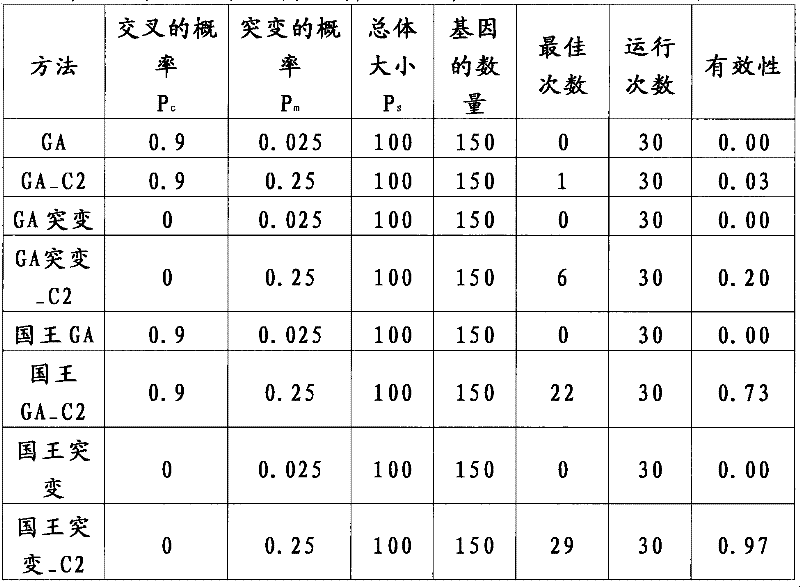
与基本的GA的结果为0.0的有效性相比,国王突变C2实现了达到0.97的非常高的有效性。King mutation C2 achieved a very high effectiveness reaching 0.97 compared to the base GA's result of 0.0 effectiveness.
实例4Example 4
本发明的基因算法与基本的基因算法相比较,用于对用于跟踪7个目标的传感器测试函数进行优化。The genetic algorithm of the present invention is compared with the basic genetic algorithm for optimizing the sensor test function for tracking 7 targets.
在该实例中被模拟的传感器网络包含可以报告目标的分类或识别和方位角的声学传感器。该被模拟的传感器网络具有181个传感器,这181个传感器每个都具有360°的FOV(视野),其中半径为4km,并且这181个传感器被随机地分布在面积为625km2的监视区域上。The sensor network simulated in this example contains acoustic sensors that can report the classification or identification and azimuth of a target. The simulated sensor network has 181 sensors, each of which has a 360° FOV (field of view) with a radius of 4 km, and the 181 sensors are randomly distributed over a surveillance area with an area of 625 km .
该网络的任务目的是对进入监视区域的目标进行探测、跟踪和分类并且使传感器的联合功率消耗最小化(即延长网络的工作寿命)。例如,为了使用方位角数据通过三角关系测量从而准确地对目标进行定位,在最低的联合功率消耗下生成对于目标来说是最小的位置误差的一组三个传感器的集合为最佳传感器集合。为了确定可以被优化的目的函数,有必要对这两个因素进行特殊地加权。The purpose of the network's mission is to detect, track and classify targets entering the surveillance area and to minimize the combined power consumption of the sensors (ie to extend the working life of the network). For example, in order to accurately locate a target by triangulation using azimuth data, a set of three sensors that produces the smallest position error for the target at the lowest combined power consumption is the optimal sensor set. In order to determine the objective function that can be optimized, it is necessary to weight these two factors specifically.
因为这7个目标中的每个目标都需要找到3个传感器,所以基因算法中的每个个体包含7*3=21个染色体。每个染色体包含一个传感器的标识号。被使用的基因算法与在图8中描述的基因算法相似。Since each of the 7 targets needs to find 3 sensors, each individual in the genetic algorithm contains 7*3=21 chromosomes. Each chromosome contains an identification number for a sensor. The genetic algorithm used was similar to the one described in Figure 8.
用于这种基因算法结构的适合性函数处理两个目的:使目标位置的准确度最大化(即,使位置跟踪误差最小化)和使网络功率消耗最小化。该适合性函数可以被表达如下。The fitness function for this genetic algorithm structure addresses two objectives: maximizing the accuracy of the target position (ie, minimizing position tracking error) and minimizing network power consumption. This fitness function can be expressed as follows.
其中Ei(i=1,2,...,n)是为第i个目标所估计的位置误差;Pj(j=1,2,...,m)是第j个传感器的功率消耗值;n是目标的数量;m是所选择的传感器的总数量,并且w1和w2是两个加权常数。w1和w2的值将取决于使误差最小化和使功率消耗最小化的相对重要性。where E i (i=1, 2, ..., n) is the estimated position error for the i-th target; P j (j = 1, 2, ..., m) is the power of the j-th sensor Consumption value; n is the number of targets; m is the total number of sensors selected, and w 1 and w 2 are two weighting constants. The values of w1 and w2 will depend on the relative importance of minimizing error and minimizing power consumption.
然后使用模拟的声学传感器测量数据对基因算法进行评价。该模拟的数据包含传感器位置、方位角测量和来自每个传感器的目标识别数据。对属于被跟踪的交通工具的类的7个目标的运动轨迹进行模拟。这些目标位于相同的邻近范围内,这意味着最佳传感器选择将会是这样一种选择:其中特定的传感器被共享。The genetic algorithm is then evaluated using the simulated acoustic sensor measurements. Data for this simulation includes sensor positions, azimuth measurements, and object recognition data from each sensor. The motion trajectories of seven objects belonging to the class of vehicles being tracked are simulated. These targets are in the same proximity, which means that the optimal sensor selection will be one in which specific sensors are shared.
表6:用于7个目标的不同基因算法在优化适合性函数方面的性能Table 6: Performance of different genetic algorithms for 7 objectives in optimizing the fitness function

图9是描述所使用的不同算法的平均最佳适合性的图。可以看出,无论所使用的是哪种基因算法,那些仅使用C2交叉或突变的基因算法的工作情况总是更好一些。Figure 9 is a graph depicting the average best fit for the different algorithms used. It can be seen that regardless of the genetic algorithm used, those using only C2 crossovers or mutations always work better.
图10比较了在表6中被检查的5种不同的基因算法的有效性和所必需的时间。在图10中被描述的这些方法包含以下一些基因算法:没有进行试验并且总体大小为50的基本的基因算法、经过试验后的基本的基因算法(较小的总体大小会产生更好的有效性)、仅使用突变的基本的基因算法、仅使用突变的国王基因算法,以及仅使用C2类型突变的国王基因突变。Figure 10 compares the effectiveness and time necessary for the five different genetic algorithms examined in Table 6. The methods depicted in Figure 10 include the following GAs: a basic GA without trials and a population size of 50, a basic GA after trials (a smaller population size yields better efficiency ), a basic genetic algorithm using only mutations, a king genetic algorithm using only mutations, and a king gene mutation using only C2 type mutations.
图11描述了对于在上述图10中描述的相同的5种基因算法变化,其百分比改进随时间发生变化的情况。Figure 11 depicts the percent improvement over time for the same 5 GA changes described in Figure 10 above.
以上的详述、实例和数据提供了对本发明的组成的制造和使用的完整的描述。因为可以在不偏离本发明的精神和范围的情况下实现本发明的多种实施方案,所以本发明归属于此后所附的权利要求。The above specification, examples and data provide a complete description of the manufacture and use of the composition of the invention. Since various embodiments of the invention can be made without departing from the spirit and scope of the invention, the invention resides in the claims hereinafter appended.
Claims (28)
Applications Claiming Priority (5)
| Application Number | Priority Date | Filing Date | Title |
|---|---|---|---|
| US28236601P | 2001-04-06 | 2001-04-06 | |
| US60/282,366 | 2001-04-06 | ||
| US09/893,108 US6957200B2 (en) | 2001-04-06 | 2001-06-27 | Genotic algorithm optimization method and network |
| US09/893,108 | 2001-06-27 | ||
| PCT/US2002/010477 WO2002082371A2 (en) | 2001-04-06 | 2002-04-04 | Genetic algorithm optimization method |
Publications (2)
| Publication Number | Publication Date |
|---|---|
| CN1533552A CN1533552A (en) | 2004-09-29 |
| CN1533552B true CN1533552B (en) | 2011-07-13 |
Family
ID=26961400
Family Applications (1)
| Application Number | Title | Priority Date | Filing Date |
|---|---|---|---|
| CN028112253A Expired - Fee Related CN1533552B (en) | 2001-04-06 | 2002-04-04 | Genetic algorithm optimization method |
Country Status (7)
| Country | Link |
|---|---|
| US (1) | US6957200B2 (en) |
| EP (1) | EP1382013A2 (en) |
| JP (1) | JP2004530208A (en) |
| KR (1) | KR20030085594A (en) |
| CN (1) | CN1533552B (en) |
| TW (1) | TW556097B (en) |
| WO (1) | WO2002082371A2 (en) |
Families Citing this family (86)
| Publication number | Priority date | Publication date | Assignee | Title |
|---|---|---|---|---|
| US7958266B1 (en) | 2003-07-30 | 2011-06-07 | Chen Sun | Multiple URL identity syntaxes and identities |
| US7444309B2 (en) * | 2001-10-31 | 2008-10-28 | Icosystem Corporation | Method and system for implementing evolutionary algorithms |
| US7065510B2 (en) * | 2001-11-09 | 2006-06-20 | Hewlett-Packard Development Company, L.P. | Combinatorial fitness function circuit |
| US7092378B1 (en) * | 2001-12-10 | 2006-08-15 | At & T Corp. | System for utilizing a genetic algorithm to provide constraint-based routing of packets in a communication network |
| US7337455B2 (en) * | 2001-12-31 | 2008-02-26 | Koninklijke Philips Electronics N.V. | Method, apparatus, and program for evolving algorithms for detecting content in information streams |
| EP1345167A1 (en) * | 2002-03-12 | 2003-09-17 | BRITISH TELECOMMUNICATIONS public limited company | Method of combinatorial multimodal optimisation |
| US7680747B2 (en) * | 2002-03-14 | 2010-03-16 | Intuit Inc. | Cash generation from portfolio disposition using multi objective genetic algorithms |
| US6836241B2 (en) * | 2002-04-19 | 2004-12-28 | Sirf Technology, Inc. | Method for optimal search scheduling in satellite acquisition |
| GB2390706A (en) * | 2002-07-12 | 2004-01-14 | Fujitsu Ltd | Signal processing using genetic algorithms |
| US7075482B2 (en) * | 2003-02-24 | 2006-07-11 | Network Fab Corporation | Direction finding method and system using transmission signature differentiation |
| EP1611546B1 (en) | 2003-04-04 | 2013-01-02 | Icosystem Corporation | Methods and systems for interactive evolutionary computing (iec) |
| EP1649346A2 (en) | 2003-08-01 | 2006-04-26 | Icosystem Corporation | Methods and systems for applying genetic operators to determine system conditions |
| US7991712B1 (en) * | 2003-08-20 | 2011-08-02 | Xilinx, Inc. | Consensus as an evaluation function for evolvable hardware |
| US7356518B2 (en) * | 2003-08-27 | 2008-04-08 | Icosystem Corporation | Methods and systems for multi-participant interactive evolutionary computing |
| GB2408599A (en) * | 2003-11-29 | 2005-06-01 | Ibm | Multi-objective genetic optimization method |
| US7398257B2 (en) * | 2003-12-24 | 2008-07-08 | Yamaha Hatsudoki Kabushiki Kaisha | Multiobjective optimization apparatus, multiobjective optimization method and multiobjective optimization program |
| US9062992B2 (en) * | 2004-07-27 | 2015-06-23 | TriPlay Inc. | Using mote-associated indexes |
| US7707220B2 (en) | 2004-07-06 | 2010-04-27 | Icosystem Corporation | Methods and apparatus for interactive searching techniques |
| SG122839A1 (en) * | 2004-11-24 | 2006-06-29 | Nanyang Polytechnic | Method and system for timetabling using pheromone and hybrid heuristics based cooperating agents |
| WO2007035848A2 (en) | 2005-09-21 | 2007-03-29 | Icosystem Corporation | System and method for aiding product design and quantifying acceptance |
| US20070118496A1 (en) * | 2005-11-21 | 2007-05-24 | Christof Bornhoevd | Service-to-device mapping for smart items |
| US8156208B2 (en) * | 2005-11-21 | 2012-04-10 | Sap Ag | Hierarchical, multi-tiered mapping and monitoring architecture for service-to-device re-mapping for smart items |
| US8005879B2 (en) * | 2005-11-21 | 2011-08-23 | Sap Ag | Service-to-device re-mapping for smart items |
| US8522341B2 (en) * | 2006-03-31 | 2013-08-27 | Sap Ag | Active intervention in service-to-device mapping for smart items |
| KR20070102864A (en) * | 2006-04-17 | 2007-10-22 | 주식회사넥스젠인터랙티브 | Passenger and cargo aircraft loading management system and method |
| US8296408B2 (en) * | 2006-05-12 | 2012-10-23 | Sap Ag | Distributing relocatable services in middleware for smart items |
| US8065411B2 (en) * | 2006-05-31 | 2011-11-22 | Sap Ag | System monitor for networks of nodes |
| US8296413B2 (en) * | 2006-05-31 | 2012-10-23 | Sap Ag | Device registration in a hierarchical monitor service |
| US8131838B2 (en) * | 2006-05-31 | 2012-03-06 | Sap Ag | Modular monitor service for smart item monitoring |
| US7895021B1 (en) * | 2006-06-13 | 2011-02-22 | The United States Of America As Represented By The Secretary Of The Navy | Method of sensor disposition |
| US7519476B1 (en) | 2006-07-28 | 2009-04-14 | Seisnetics, Llc | Method of seismic interpretation |
| US8396788B2 (en) * | 2006-07-31 | 2013-03-12 | Sap Ag | Cost-based deployment of components in smart item environments |
| US7792816B2 (en) | 2007-02-01 | 2010-09-07 | Icosystem Corporation | Method and system for fast, generic, online and offline, multi-source text analysis and visualization |
| EP2126611A2 (en) * | 2007-03-12 | 2009-12-02 | Elta Systems Ltd. | Method and system for detecting motorized objects |
| WO2008115930A1 (en) * | 2007-03-20 | 2008-09-25 | Ion Geophysical Corporation | Apparatus and method for processing geophysical information |
| US8069127B2 (en) * | 2007-04-26 | 2011-11-29 | 21 Ct, Inc. | Method and system for solving an optimization problem with dynamic constraints |
| US20080306798A1 (en) * | 2007-06-05 | 2008-12-11 | Juergen Anke | Deployment planning of components in heterogeneous environments |
| US8229867B2 (en) * | 2008-11-25 | 2012-07-24 | International Business Machines Corporation | Bit-selection for string-based genetic algorithms |
| TWI391839B (en) * | 2009-01-17 | 2013-04-01 | Univ Nat Taiwan Science Tech | System and method for assigning resources of semiconductor industry |
| CN101931609B (en) * | 2009-06-22 | 2014-07-30 | Sap股份公司 | Layout abiding service-level agreement for multiple-tenant database |
| US9015093B1 (en) | 2010-10-26 | 2015-04-21 | Michael Lamport Commons | Intelligent control with hierarchical stacked neural networks |
| US8775341B1 (en) | 2010-10-26 | 2014-07-08 | Michael Lamport Commons | Intelligent control with hierarchical stacked neural networks |
| CN102013038A (en) * | 2010-11-29 | 2011-04-13 | 中山大学 | Wireless sensor network service life optimizing genetic algorithm based on forward encoding strategy |
| US8660949B2 (en) | 2011-09-09 | 2014-02-25 | Sap Ag | Method and system for working capital management |
| CN102663910B (en) * | 2012-03-14 | 2014-12-10 | 北京邮电大学 | Automatic questions selecting method of examination system on network based on layered genetic algorithm |
| CN102663911B (en) * | 2012-03-14 | 2014-04-02 | 北京邮电大学 | Method for distributing paper options evenly of on-line examination system based on pseudo random number |
| CN102892188B (en) * | 2012-10-09 | 2016-07-06 | 中兴通讯股份有限公司 | Based on the ascending power control method of genetic algorithm and device in communication network |
| TWI502523B (en) * | 2013-09-11 | 2015-10-01 | Nat Univ Tsing Hua | Multi-objective semiconductor product capacity planning system and method thereof |
| US10438111B2 (en) * | 2016-01-05 | 2019-10-08 | Evolv Technology Solutions, Inc. | Machine learning based webinterface generation and testing system |
| US11403532B2 (en) | 2017-03-02 | 2022-08-02 | Cognizant Technology Solutions U.S. Corporation | Method and system for finding a solution to a provided problem by selecting a winner in evolutionary optimization of a genetic algorithm |
| US10726196B2 (en) | 2017-03-03 | 2020-07-28 | Evolv Technology Solutions, Inc. | Autonomous configuration of conversion code to control display and functionality of webpage portions |
| US10846616B1 (en) * | 2017-04-28 | 2020-11-24 | Iqvia Inc. | System and method for enhanced characterization of structured data for machine learning |
| CN107167768B (en) * | 2017-05-31 | 2023-04-21 | 华南理工大学 | A high-precision visible light positioning method based on genetic algorithm and its positioning system |
| US11074503B2 (en) | 2017-09-06 | 2021-07-27 | SparkCognition, Inc. | Execution of a genetic algorithm having variable epoch size with selective execution of a training algorithm |
| US11106978B2 (en) | 2017-09-08 | 2021-08-31 | SparkCognition, Inc. | Execution of a genetic algorithm with variable evolutionary weights of topological parameters for neural network generation and training |
| US10635978B2 (en) | 2017-10-26 | 2020-04-28 | SparkCognition, Inc. | Ensembling of neural network models |
| US11107024B2 (en) | 2018-01-15 | 2021-08-31 | Nmetric, Llc | Genetic smartjobs scheduling engine |
| US11574201B2 (en) | 2018-02-06 | 2023-02-07 | Cognizant Technology Solutions U.S. Corporation | Enhancing evolutionary optimization in uncertain environments by allocating evaluations via multi-armed bandit algorithms |
| CN108805503A (en) * | 2018-06-12 | 2018-11-13 | 合肥工业大学 | High-end Hydraulic Elements manufacturing based on digital workshop stores the method and system of parts |
| US11755979B2 (en) | 2018-08-17 | 2023-09-12 | Evolv Technology Solutions, Inc. | Method and system for finding a solution to a provided problem using family tree based priors in Bayesian calculations in evolution based optimization |
| CN109725294B (en) * | 2018-12-12 | 2022-11-18 | 西安电子科技大学 | Radar array sparse optimization method based on improved genetic algorithm |
| CN110047090B (en) * | 2019-03-28 | 2022-10-14 | 淮阴工学院 | RGB-D target tracking method based on evolution feature learning |
| CN110390395A (en) * | 2019-07-15 | 2019-10-29 | 电子科技大学中山学院 | Improved genetic algorithm suitable for self-adaptive mutation crossing of SDN multi-controller deployment problem |
| CN110598832B (en) * | 2019-08-22 | 2022-05-03 | 北京青藤文化股份有限公司 | Character perspective correction method based on genetic optimization algorithm |
| CN112421673B (en) * | 2019-08-22 | 2024-02-06 | 国网河南省电力公司安阳供电公司 | Multi-source coordination-based power distribution network loss optimization control method and system |
| CN112787833B (en) * | 2019-11-07 | 2022-08-12 | 中国电信股份有限公司 | Method and device for deploying CDN (content delivery network) server |
| CN112947006B (en) * | 2019-11-26 | 2023-08-29 | 上海微电子装备(集团)股份有限公司 | Alignment mark selection method, device, equipment, photolithography system and medium |
| US11281722B2 (en) | 2020-01-06 | 2022-03-22 | International Business Machines Corporation | Cognitively generating parameter settings for a graph database |
| CN113391307A (en) * | 2020-03-12 | 2021-09-14 | 中国人民解放军火箭军研究院系统工程研究所 | Method and device for quickly estimating missile terminal motion parameters in incomplete signals |
| CN111582552B (en) * | 2020-04-16 | 2023-04-25 | 浙江大学城市学院 | Shared bicycle parking point distribution method based on multi-target genetic algorithm |
| CN111683378B (en) * | 2020-06-05 | 2023-05-30 | 国网河南省电力公司经济技术研究院 | Reconfigurable wireless sensor network relay deployment method for power distribution network |
| CN112529241B (en) * | 2020-09-18 | 2024-06-14 | 北京空间飞行器总体设计部 | A cost-effectiveness optimization method for remote sensing satellites |
| CN112699607A (en) * | 2020-12-31 | 2021-04-23 | 中国计量大学 | Multi-objective optimization selection assembly method based on genetic algorithm |
| CN112953830B (en) * | 2021-01-28 | 2022-12-23 | 北京邮电大学 | Method and device for routing planning and scheduling of traffic frames in time-sensitive network |
| CN112908416B (en) * | 2021-04-13 | 2024-02-02 | 湖北工业大学 | Biomedical data feature selection method and device, computing equipment and storage medium |
| EP4075210A1 (en) | 2021-04-14 | 2022-10-19 | Siemens Aktiengesellschaft | Optimization method for a control unit, control system, automated installation and computer program product |
| CN113487142B (en) * | 2021-06-15 | 2024-11-12 | 宿迁渊统智能科技有限公司 | An evolutionary optimization method and system for e-government performance evaluation management |
| CN113590191A (en) * | 2021-06-28 | 2021-11-02 | 航天科工防御技术研究试验中心 | Software reliability model parameter estimation method based on genetic algorithm |
| CN114727373B (en) * | 2022-03-08 | 2024-04-23 | 中国科学院上海微系统与信息技术研究所 | A fault-tolerant WSN target tracking sleep scheduling method |
| US12101224B2 (en) | 2022-06-17 | 2024-09-24 | International Business Machines Corporation | Device lifetime-aware creation of customizable surrogate-based models |
| CN115982908B (en) * | 2022-12-29 | 2026-04-07 | 中煤科工西安研究院(集团)有限公司 | Sensor Configuration Method for Mine Digital Twin System Based on Multi-Task Optimization Algorithm |
| CN116293718A (en) * | 2023-05-24 | 2023-06-23 | 中城院(北京)环境科技股份有限公司 | Self-adaptive PID incinerator temperature control method and device based on snake optimization algorithm |
| CN117408206B (en) * | 2023-12-14 | 2024-04-16 | 湖南大学 | A broadband impedance matching design method for electroacoustic transducers based on Pareto optimization |
| CN118014541B (en) * | 2024-02-23 | 2024-12-03 | 浙江思维特数字科技有限公司 | IPA production conversion time optimization method, system and device based on big data fusion algorithm |
| CN118740557A (en) * | 2024-05-27 | 2024-10-01 | 南京邮电大学 | A pilot optimization method based on the combination of genetic algorithm and random search algorithm for OTFS system |
| CN120197523B (en) * | 2025-05-26 | 2025-09-09 | 中国人民解放军国防科技大学 | Multi-objective transportation network optimization method based on adaptive constraint relaxation strategy |
Family Cites Families (18)
| Publication number | Priority date | Publication date | Assignee | Title |
|---|---|---|---|---|
| US4935877A (en) * | 1988-05-20 | 1990-06-19 | Koza John R | Non-linear genetic algorithms for solving problems |
| US5742738A (en) * | 1988-05-20 | 1998-04-21 | John R. Koza | Simultaneous evolution of the architecture of a multi-part program to solve a problem using architecture altering operations |
| US5343554A (en) * | 1988-05-20 | 1994-08-30 | John R. Koza | Non-linear genetic process for data encoding and for solving problems using automatically defined functions |
| US5148513A (en) * | 1988-05-20 | 1992-09-15 | John R. Koza | Non-linear genetic process for use with plural co-evolving populations |
| US5465218A (en) | 1993-02-12 | 1995-11-07 | Kabushiki Kaisha Toshiba | Element placement method and apparatus |
| US5479523A (en) | 1994-03-16 | 1995-12-26 | Eastman Kodak Company | Constructing classification weights matrices for pattern recognition systems using reduced element feature subsets |
| US5541848A (en) * | 1994-12-15 | 1996-07-30 | Atlantic Richfield Company | Genetic method of scheduling the delivery of non-uniform inventory |
| GB2299729B (en) * | 1995-04-01 | 1999-11-17 | Northern Telecom Ltd | Traffic routing in a telecommunications network |
| US5719794A (en) | 1995-07-19 | 1998-02-17 | United States Of America As Represented By The Secretary Of The Air Force | Process for the design of antennas using genetic algorithms |
| US5778317A (en) | 1996-05-13 | 1998-07-07 | Harris Corporation | Method for allocating channels in a radio network using a genetic algorithm |
| US6067409A (en) | 1996-06-28 | 2000-05-23 | Lsi Logic Corporation | Advanced modular cell placement system |
| US5777948A (en) | 1996-11-12 | 1998-07-07 | The United States Of America As Represented By The Secretary Of The Navy | Method and apparatus for preforming mutations in a genetic algorithm-based underwater target tracking system |
| US5793931A (en) | 1996-11-18 | 1998-08-11 | The United States Of America As Represented By The Secretary Of The Army | Method and apparatus for multi-sensor, multi-target tracking using intelligent search techniques |
| JP3254393B2 (en) * | 1996-11-19 | 2002-02-04 | 三菱電機株式会社 | Genetic algorithm machine, method of manufacturing genetic algorithm machine, and method of executing genetic algorithm |
| US6112126A (en) | 1997-02-21 | 2000-08-29 | Baker Hughes Incorporated | Adaptive object-oriented optimization software system |
| US6055523A (en) | 1997-07-15 | 2000-04-25 | The United States Of America As Represented By The Secretary Of The Army | Method and apparatus for multi-sensor, multi-target tracking using a genetic algorithm |
| US6006604A (en) | 1997-12-23 | 1999-12-28 | Simmonds Precision Products, Inc. | Probe placement using genetic algorithm analysis |
| US6505180B1 (en) * | 1998-09-10 | 2003-01-07 | Wm. L. Crowley & Associates, Inc. | Information encoding and retrieval through synthetic genes |
-
2001
- 2001-06-27 US US09/893,108 patent/US6957200B2/en not_active Expired - Lifetime
-
2002
- 2002-04-04 KR KR10-2003-7013114A patent/KR20030085594A/en not_active Withdrawn
- 2002-04-04 CN CN028112253A patent/CN1533552B/en not_active Expired - Fee Related
- 2002-04-04 WO PCT/US2002/010477 patent/WO2002082371A2/en not_active Ceased
- 2002-04-04 JP JP2002580260A patent/JP2004530208A/en active Pending
- 2002-04-04 EP EP02739128A patent/EP1382013A2/en not_active Withdrawn
- 2002-04-08 TW TW091106962A patent/TW556097B/en not_active IP Right Cessation
Non-Patent Citations (1)
| Title |
|---|
| BUCZAK A L ET AL.BUCZAK A L ET AL:" Genetic algorithm convergence studyfor sensor network optimization".INFORMATION SCIENCES.2001,268. * |
Also Published As
| Publication number | Publication date |
|---|---|
| EP1382013A2 (en) | 2004-01-21 |
| US6957200B2 (en) | 2005-10-18 |
| JP2004530208A (en) | 2004-09-30 |
| TW556097B (en) | 2003-10-01 |
| US20030050902A1 (en) | 2003-03-13 |
| WO2002082371A3 (en) | 2003-11-27 |
| WO2002082371A2 (en) | 2002-10-17 |
| KR20030085594A (en) | 2003-11-05 |
| CN1533552A (en) | 2004-09-29 |
Similar Documents
| Publication | Publication Date | Title |
|---|---|---|
| CN1533552B (en) | Genetic algorithm optimization method | |
| Rossi et al. | Vehicle trajectory prediction and generation using LSTM models and GANs | |
| CN107145161B (en) | Track planning method and device for UAV visiting multiple target points | |
| Chaari et al. | SmartPATH: An efficient hybrid ACO-GA algorithm for solving the global path planning problem of mobile robots | |
| CN106647744B (en) | Robot path planning method and device | |
| CN107238388A (en) | Multiple no-manned plane task is distributed and trajectory planning combined optimization method and device | |
| Heng et al. | Aco-ga-based optimization to enhance global path planning for autonomous navigation in grid environments | |
| CN111667124A (en) | Unmanned aerial vehicle path planning method and device | |
| Chen et al. | An ant colony path planning optimization based on opposition-based learning for AUV in irregular regions | |
| Alnasser et al. | An efficient genetic algorithm for the global robot path planning problem | |
| Aishwaryaprajna et al. | UAV path planning in presence of occlusions as noisy combinatorial multi-objective optimisation | |
| Wang et al. | Improved DV-Hop based on parallel compact Willow Catkin Optimization algorithm for 3D nodes localization in WSN | |
| Parvez et al. | Path planning optimization using genetic algorithm | |
| CN119105485A (en) | A public security patrol route planning method and system | |
| Plaku et al. | Multi‐group motion planning in virtual environments | |
| CN109190787A (en) | The more monitoring point access path planing methods of the dual population of underwater vehicle | |
| Wang et al. | Global path planning of wheeled robots using a multi-objective memetic algorithm | |
| Bautin et al. | Towards a communication free coordination for multi-robot exploration | |
| Attea et al. | Multi-objective evolutionary algorithm based on decomposition for efficient coverage control in mobile sensor networks | |
| Li et al. | Vehicle path planning based on gradient statistical mutation quantum genetic algorithm | |
| CN113655811A (en) | Desired formation acquisition method for unmanned aerial vehicle (UAV) cooperative tracking of ground targets under implicit communication | |
| CN118605580A (en) | A method, device, electronic device and storage medium for planning full coverage path of unmanned aerial vehicle | |
| Zhang et al. | Evolutionary design of a collective sensory system | |
| Feng et al. | Multi-strategy secretary bird optimization algorithm for UAV path planning in complex environment | |
| Miao et al. | A new path planning strategy of a data collection problem utilising multi-mobile nodes in wireless sensor networks |
Legal Events
| Date | Code | Title | Description |
|---|---|---|---|
| C06 | Publication | ||
| PB01 | Publication | ||
| C10 | Entry into substantive examination | ||
| SE01 | Entry into force of request for substantive examination | ||
| C14 | Grant of patent or utility model | ||
| GR01 | Patent grant | ||
| CF01 | Termination of patent right due to non-payment of annual fee |
Granted publication date: 20110713 Termination date: 20190404 |
|
| CF01 | Termination of patent right due to non-payment of annual fee |