CN1279110C - Dimaleimide resin microball, its preparation method and application thereof - Google Patents
Dimaleimide resin microball, its preparation method and application thereof Download PDFInfo
- Publication number
- CN1279110C CN1279110C CN 200410040866 CN200410040866A CN1279110C CN 1279110 C CN1279110 C CN 1279110C CN 200410040866 CN200410040866 CN 200410040866 CN 200410040866 A CN200410040866 A CN 200410040866A CN 1279110 C CN1279110 C CN 1279110C
- Authority
- CN
- China
- Prior art keywords
- hours
- bimaleimide resin
- preparation
- parts
- resin
- Prior art date
- Legal status (The legal status is an assumption and is not a legal conclusion. Google has not performed a legal analysis and makes no representation as to the accuracy of the status listed.)
- Expired - Fee Related
Links
Images

Landscapes
- Manufacture Of Porous Articles, And Recovery And Treatment Of Waste Products (AREA)
- Solid-Sorbent Or Filter-Aiding Compositions (AREA)
- Processes Of Treating Macromolecular Substances (AREA)
Abstract
本发明涉及双马来酰亚胺树脂微球、其制备方法及其用途,本双马来酰亚胺树脂微球的制备方法为:先将50~90重量份双马来酰亚胺树脂预聚体与10~50重量份惰性热塑性树脂在80~180℃混料;或是采用35~60重量份双马来酰亚胺树脂预聚体、10~50重量份惰性热塑性树脂及15~50重量份烯丙基双酚A在80~180℃中进行混料,将所得混合物浇注于模具中;然后将置于模具内的混合物先在150~180℃中固化2~5小时,再在180~250℃中固化2~8小时;最后用有机溶剂溶解并洗净硬化物中所含的惰性热塑性树脂,得到双马来酰亚胺树脂微球。本发明双马来酰亚胺树脂微球是理想的液相色谱填料,可应用于色谱分离和快速色谱分离,及生命科学、生物工程产品的纯化、分析和快速分离。

The present invention relates to bismaleimide resin microspheres, its preparation method and application. The preparation method of the bismaleimide resin microspheres is as follows: 50 to 90 parts by weight of bismaleimide resin are pre-prepared Polymer and 10-50 parts by weight of inert thermoplastic resin are mixed at 80-180 ° C; or 35-60 parts by weight of bismaleimide resin prepolymer, 10-50 parts by weight of inert thermoplastic resin and 15-50 parts by weight Parts by weight of allyl bisphenol A are mixed at 80-180°C, and the resulting mixture is poured into a mold; then the mixture placed in the mold is first cured at 150-180°C for 2-5 hours, and then at 180°C Curing at ~250°C for 2-8 hours; finally dissolving and washing the inert thermoplastic resin contained in the hardened product with an organic solvent to obtain bismaleimide resin microspheres. The bismaleimide resin microsphere of the present invention is an ideal liquid chromatography filler, and can be applied to chromatographic separation and fast chromatographic separation, as well as purification, analysis and fast separation of life science and bioengineering products.
Description
(一)技术领域:(1) Technical field:
本发明涉及液相色谱填料,具体地说是双马来酰亚胺树脂微球,本发明还涉及这种双马来酰亚胺树脂微球的制备方法及其用途。The invention relates to a liquid chromatography filler, specifically bismaleimide resin microspheres, and also relates to a preparation method and application of the bismaleimide resin microspheres.
(二)背景技术:(two) background technology:
近年来,高效疏水性相互作用色谱(HPHIC)技术得到迅速的发展,该技术主要涉及单分散、无孔的交联高分子微球、其制备方法和应用,由于此类交联高分子微球可以避免使用含有大量有机溶剂的淋洗体系,并能有效地保持待分离样品的生物活性,因此其在生物大分子特别是蛋白质的分离纯化方面被广泛应用。例如申请号为86101723,名称为《液相色谱用高分子均匀微球及制备》的中国发明专利,它公开了在液体石蜡、聚乙二醇、聚丙二醇、丙二醇—四氢呋喃共聚物、二甲基硅油、苯甲基硅油中通过相分离聚合苯乙烯和二乙烯苯的方法,这是一种静态的合成交联聚合苯乙烯—二乙烯苯微球的方法,而无需用搅拌来产生单体的、分散的、细小的液滴,其反应操作简单,容易控制,由于不需要添加悬浮稳定剂和乳化剂,所得到的微球易于洗涤。另外,所合成微球的尺寸分布高度均一,不需要再筛分,从而使制备颗粒均匀的交联高分子微球的过程大大简化。又如《化学通报》1993年、第三期50页中记载的,苏天升以分散聚合方法合成出含有聚乙二醇表面改性的环氧树脂无孔微球,并用于快速分离混合蛋白。这种无孔微球在分离过程中可以有效地避免溶质在固定相颗粒内部的吸附与扩散,加之粒度小而刚性好,所以对于改善柱效,提高样品回收率,保持溶质分子生物活性均十分有利,尤其对于实现生物大分子的快速分离特别有利。《分析化学》1997年、第二期103页所记载,杨树明合成了两种非多孔树脂,即二乙烯苯交联的聚甲基丙烯酸甲酯微球和丁酯微球,用于分离蛋白质,取得了很好的效果。《分析化学》2000年、第五期544页记载了余晓合成了单分散非多空聚甲基丙烯酸环氧丙酯微球,其机械强度高,非常适用于生物大分子的快速分离和纯化。《分析科学学报》2001年、第六期480页记载了,周瑞林合成了聚苯酰胺树脂非多孔微球,并用作亲和色谱固定相填料。与多空微球基体相比,这种非多孔微球基体缩短了生物大分子的保留时间,所以能保证其高度的生物活性和回收率。但以上所述的树脂微球色谱填料均存在耐热性差、耐溶剂性差和刚性不足等缺点。In recent years, high-performance hydrophobic interaction chromatography (HPHIC) technology has been developed rapidly. This technology mainly involves monodisperse, non-porous cross-linked polymer microspheres, their preparation methods and applications. It can avoid the use of a elution system containing a large amount of organic solvents, and can effectively maintain the biological activity of the sample to be separated, so it is widely used in the separation and purification of biological macromolecules, especially proteins. For example, the application number is 86101723, and the Chinese invention patent titled "Uniform Polymer Microspheres for Liquid Chromatography and Its Preparation" discloses the use of liquid paraffin, polyethylene glycol, polypropylene glycol, propylene glycol-tetrahydrofuran copolymer, dimethyl A method of polymerizing styrene and divinylbenzene by phase separation in silicone oil and phenylmethyl silicone oil, which is a static method of synthesizing cross-linked polymerized styrene-divinylbenzene microspheres without stirring to produce monomers , Dispersed, fine droplets, the reaction operation is simple, easy to control, and the obtained microspheres are easy to wash because no suspension stabilizer and emulsifier are needed. In addition, the size distribution of the synthesized microspheres is highly uniform, and no further sieving is required, so that the process of preparing cross-linked polymer microspheres with uniform particles is greatly simplified. Another example is "Chemistry Bulletin" in 1993, the third issue on page 50, Su Tiansheng synthesized epoxy resin non-porous microspheres with surface modification of polyethylene glycol by dispersion polymerization method, and used them for rapid separation of mixed proteins. This kind of non-porous microspheres can effectively avoid the adsorption and diffusion of solutes inside the stationary phase particles during the separation process. In addition, the particle size is small and the rigidity is good, so it is very good for improving column efficiency, increasing sample recovery, and maintaining the biological activity of solute molecules. Advantageous, especially for the rapid separation of biomacromolecules. "Analytical Chemistry" 1997, the second issue 103 records, Yang Shuming synthesized two kinds of non-porous resins, namely divinylbenzene cross-linked polymethyl methacrylate microspheres and butyl ester microspheres, used to separate proteins, Good results have been achieved. "Analytical Chemistry" 2000, page 544 of the fifth issue records that Yu Xiao synthesized monodisperse non-porous polyglycidyl methacrylate microspheres, which have high mechanical strength and are very suitable for the rapid separation and purification of biological macromolecules . "Journal of Analytical Science" 2001, page 480 of the sixth issue records that Zhou Ruilin synthesized polybenzamide resin non-porous microspheres and used them as stationary phase fillers for affinity chromatography. Compared with the porous microsphere matrix, this non-porous microsphere matrix shortens the retention time of biomacromolecules, so it can ensure its high biological activity and recovery rate. However, the resin microsphere chromatographic fillers mentioned above all have disadvantages such as poor heat resistance, poor solvent resistance and insufficient rigidity.
(三)发明内容:(3) Contents of the invention:
本发明将公开一种具有优异的力学强度和耐热性能的双马来酰亚胺树脂微球,本发明还将公开这种双马来酰亚胺树脂微球的制备方法及其用途。The invention will disclose a bismaleimide resin microsphere with excellent mechanical strength and heat resistance, and the invention will also disclose the preparation method and application of the bismaleimide resin microsphere.
本发明双马来酰亚胺树脂微球的制备方法,步骤如下:The preparation method of bismaleimide resin microsphere of the present invention, step is as follows:
1)先将50~90重量份双马来酰亚胺树脂预聚体与10~50重量份惰性热塑性树脂在80~180℃中进行混料;或是采用双马来酰亚胺树脂预聚体、惰性热塑性树脂及烯丙基双酚A在80~180℃中进行混料,此时所述双马来酰亚胺树脂预聚体以重量份计为35~60份;惰性热塑性树脂以重量份计为10~50重量份;烯丙基双酚A以重量份计为15~50份;所述的混料工艺一般为加热搅拌真空脱气混料或加热密练真空脱气混料或螺杆挤出混料或在加有有机溶剂的条件下混料,当然还可以采用其它的混料工艺;在加有有机溶剂条件下混料,采用的有机溶剂一般为氯仿、四氢呋喃、N-甲基吡咯烷酮、N-二甲基甲酰胺和N-二甲基乙酰胺,而所述的惰性热塑性树脂为不参与双马来酰亚胺树脂单体的聚合、交联反应的惰性热塑性树脂,例如聚醚酰亚胺或聚酯酰亚胺或聚醚砜或聚醚醚酮,当然还可以采用其它的惰性热塑性树脂;1) Mix 50-90 parts by weight of bismaleimide resin prepolymer with 10-50 parts by weight of inert thermoplastic resin at 80-180°C; or use bismaleimide resin to prepolymerize Body, inert thermoplastic resin and allyl bisphenol A are mixed at 80-180°C, at this time, the bismaleimide resin prepolymer is 35-60 parts by weight; the inert thermoplastic resin is Parts by weight are 10 to 50 parts by weight; allyl bisphenol A is 15 to 50 parts by weight; the mixing process is generally heating and stirring vacuum degassing or heating and compacting vacuum degassing Or screw extrusion mixing or mixing under the condition of adding an organic solvent, of course, other mixing processes can also be used; under the condition of adding an organic solvent, the organic solvent used is generally chloroform, tetrahydrofuran, N- Methylpyrrolidone, N-dimethylformamide and N-dimethylacetamide, and the inert thermoplastic resin is an inert thermoplastic resin that does not participate in the polymerization and crosslinking reaction of the bismaleimide resin monomer, Such as polyetherimide or polyesterimide or polyethersulfone or polyether ether ketone, of course other inert thermoplastic resins can also be used;
2)将所得混合物浇注于模具中;为了加快混合物的固化,还可以采用先预热好的模具;即预先将模具加热到140-175℃2) Pour the obtained mixture into a mold; in order to accelerate the curing of the mixture, you can also use a preheated mold; that is, heat the mold to 140-175°C in advance
3)将置于模具内的混合物在150~250℃中固化成型;可采取先在150~180℃中固化2~5小时,再在180~250℃中固化2~8小时的固化方式使其成型;而较好的固化方式则是将模具内的混合物先在155~165℃固化2~4小时,再在180~190℃固化2~4小时,最后在195~215℃固化2~4小时使其成型;最佳的固化方式则是采取先在160℃固化3小时,再在185℃固化3小时,最后在200℃固化3小时;3) The mixture placed in the mold is cured at 150-250°C; it can be cured at 150-180°C for 2-5 hours, and then at 180-250°C for 2-8 hours to make it Molding; and a better curing method is to cure the mixture in the mold at 155-165°C for 2-4 hours, then at 180-190°C for 2-4 hours, and finally at 195-215°C for 2-4 hours Make it into shape; the best curing method is to cure at 160°C for 3 hours, then at 185°C for 3 hours, and finally at 200°C for 3 hours;
4)最后用有机溶剂溶解并洗涤固化物中所含的惰性热塑性树脂,即得到双马来酰亚胺树脂微球;所述的有机溶剂一般为氯仿或N,-二甲基乙酰胺或N-二甲基甲酰胺或N-甲基吡咯烷酮等能溶解惰性热塑性树脂但不能溶解双马来酰亚胺树脂的有机溶剂;溶解、洗涤固化物中的惰性热塑性树脂时,可以在搅拌或超声波振荡或机械球磨的辅助作用下进行;洗涤次数一般为3次。4) finally dissolve and wash the inert thermoplastic resin contained in the cured product with an organic solvent to obtain bismaleimide resin microspheres; the organic solvent is generally chloroform or N,-dimethylacetamide or N - Organic solvents such as dimethylformamide or N-methylpyrrolidone that can dissolve inert thermoplastic resins but cannot dissolve bismaleimide resins; when dissolving and washing inert thermoplastic resins in cured products, stirring or ultrasonic vibration can be used Or with the assistance of mechanical ball milling; the number of washings is generally 3 times.
在惰性热塑性树脂和双马来酰亚胺树脂(热固性树脂)共混体系中,由于双马来酰亚胺树脂单体的固化反应导致共混体系中组分变化并引发不相容,体系发生spinodal(旋节线)相分离,体积分数较大的双马来酰亚胺树脂以珠滴状分散在惰性热塑性树脂基体中,然后再用适当的有机溶剂,在搅拌或超声波振荡或机械球磨的辅助作用下,溶解并洗净固化体系中的惰性热塑性树脂部分,即得到不溶于有机溶剂的高玻璃化温度、单分散、非多孔的双马来酰亚胺树脂微球。由于这种树脂微球具有高力学强度、高玻璃化温度,因此完全可克服现有的树脂微球色谱填料所存在的耐热性差、耐溶剂性差和刚性不足等缺点,且本发明双马来酰亚胺树脂微球的制备方法,操作简单,易于控制,所得到的微球易于洗涤干净,其粒度颗粒度均匀,可以很好地控制在1~30微米之间,无需再经过筛分,从而使得制备颗粒度均匀的交联高分子微球的过程大大简化。本发明双马来酰亚胺树脂微球作为一种理想的液相色谱填料,可应用于色谱分离和快速色谱分离,及生命科学、生物工程产品的纯化、分析和快速分离。In the blend system of inert thermoplastic resin and bismaleimide resin (thermosetting resin), due to the curing reaction of bismaleimide resin monomer, the components in the blend system change and cause incompatibility, the system occurs The spinodal (spinodal) phase separation, the bismaleimide resin with a large volume fraction is dispersed in the inert thermoplastic resin matrix in the form of beads, and then an appropriate organic solvent is used under stirring or ultrasonic vibration or mechanical ball milling Under the auxiliary action, dissolve and wash away the inert thermoplastic resin part in the curing system to obtain high glass transition temperature, monodisperse, non-porous bismaleimide resin microspheres insoluble in organic solvents. Since this resin microsphere has high mechanical strength and high glass transition temperature, it can completely overcome the shortcomings of existing resin microsphere chromatographic fillers such as poor heat resistance, poor solvent resistance and insufficient rigidity, and the bismaleic acid of the present invention The preparation method of imide resin microspheres is simple to operate and easy to control. The obtained microspheres are easy to wash and clean, and the particle size is uniform, which can be well controlled between 1 and 30 microns, without further screening. Therefore, the process of preparing cross-linked polymer microspheres with uniform particle size is greatly simplified. As an ideal liquid chromatography filler, the bismaleimide resin microsphere of the present invention can be applied to chromatographic separation and rapid chromatographic separation, as well as purification, analysis and rapid separation of life science and bioengineering products.
(四)附图说明:(4) Description of drawings:
图1为双马来酰亚胺树脂微球的照片。Figure 1 is a photograph of bismaleimide resin microspheres.
图2为以双马来酰亚胺树脂为填料分离混合物的色谱图。Figure 2 is a chromatogram of a mixture separated by a bismaleimide resin.
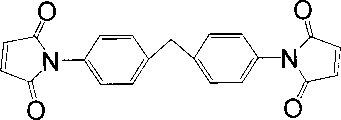
图3为双马来酰亚胺树脂预聚体分子结构示意图。Figure 3 is a schematic diagram of the molecular structure of a bismaleimide resin prepolymer.
(五)具体实施方式:(5) Specific implementation methods:
在下述实施方式中,如无特别规定,单位均为克(g)。In the following embodiments, unless otherwise specified, the unit is gram (g).
实施例1:Example 1:
将50克双马来酰亚胺预聚体、50克烯丙基双酚A、20克聚醚酰亚胺,在150℃进行加热搅拌真空脱气混料;然后将混料后所得混合物进行减压,并浇注于预热好的模具中;再将置于模具内的混合物在160℃中固化3小时,然后在185℃中固化3小时,最后在200℃中固化3小时;将固化后所得的硬化物加入400~500克氯仿,并在超声波振荡的辅助作用下溶解并洗涤硬化物中所含的聚醚酰亚胺,反复洗涤3次,沉降,最后得到5~7微米的双马来酰亚胺树脂微球97克。50 grams of bismaleimide prepolymer, 50 grams of allyl bisphenol A, and 20 grams of polyetherimide were heated and stirred at 150°C for vacuum degassing and mixing; then the resulting mixture was mixed Decompress and pour into a preheated mold; then cure the mixture placed in the mold at 160°C for 3 hours, then at 185°C for 3 hours, and finally at 200°C for 3 hours; after curing Add 400-500 grams of chloroform to the obtained hardened product, dissolve and wash the polyetherimide contained in the hardened product with the assistance of ultrasonic vibration, wash repeatedly for 3 times, settle, and finally obtain a double horse of 5-7 microns 97 grams of imide resin microspheres.
实施例2:Example 2:
将57克双马来酰亚胺预聚体、43克烯丙基双酚A、30克聚酯酰亚胺,在170℃进行加热密练真空脱气混料;然后将混料后所得混合物减压,并浇注于预热好的模具中;再将置于模具内的混合物在160℃中固化3小时,然后在175℃中固化3小时,最后在200℃中固化3小时;将固化后所得的硬化物加入500~700克N,N’-二甲基乙酰胺,并在机械球磨的辅助作用下溶解并洗涤硬化物中所含的聚酯酰亚胺,反复洗涤3次,沉降,最后得到3~7微米的双马来酰亚胺树脂微球96克。57 grams of bismaleimide prepolymer, 43 grams of allyl bisphenol A, and 30 grams of polyester imide were heated and compacted at 170°C for vacuum degassing and mixing; then the resulting mixture was mixed Decompress and pour into a preheated mold; then cure the mixture placed in the mold at 160°C for 3 hours, then at 175°C for 3 hours, and finally at 200°C for 3 hours; after curing Add 500 to 700 grams of N,N'-dimethylacetamide to the obtained hardened product, and dissolve and wash the polyesterimide contained in the hardened product with the assistance of mechanical ball milling, wash repeatedly 3 times, settle, Finally, 96 grams of bismaleimide resin microspheres of 3 to 7 microns were obtained.
实施例3:Example 3:
将57克双马来酰亚胺预聚体、43克烯丙基双酚A、40克聚醚砜,在250℃下于小型螺杆挤出机混料;然后将混料后浇注于预热好的模具中;再将置于模具内的混合物在160℃中固化3小时,然后在180℃中固化3小时,最后在200℃中固化3小时;将固化后所得的硬化物加入450~500克N-甲基吡咯烷酮,并在搅拌的辅助作用下溶解并洗涤硬化物中所含的聚醚砜,反复洗涤3次,沉降,最后得到2~6微米的双马来酰亚胺树脂微球96克。实施例4:Mix 57 grams of bismaleimide prepolymer, 43 grams of allyl bisphenol A, and 40 grams of polyethersulfone in a small screw extruder at 250°C; then pour the mixture into a preheated In a good mold; then cure the mixture placed in the mold at 160°C for 3 hours, then at 180°C for 3 hours, and finally at 200°C for 3 hours; add the cured product obtained after curing to 450-500 gram of N-methylpyrrolidone, and dissolve and wash the polyethersulfone contained in the hardened product with the aid of stirring, wash repeatedly 3 times, settle, and finally obtain bismaleimide resin microspheres of 2 to 6 microns 96 grams. Example 4:
将100克双马来酰亚胺预聚体、50克聚醚醚酮,在100℃进行加热搅拌真空脱气混料;然后将混料后所得混合物进行减压,并浇注于预热好的模具中;再将置于模具内的混合物在155℃中固化2小时,然后在180℃中固化2小时,最后在195℃中固化2小时;将固化后所得的硬化物加入500~600克氯仿,并在超声波振荡的辅助作用下溶解并洗涤硬化物中所含的聚醚酰亚胺,反复洗涤3次,沉降,最后得到7~11微米的双马来酰亚胺树脂微球85克。100 grams of bismaleimide prepolymer and 50 grams of polyether ether ketone were heated and stirred at 100°C for vacuum degassing and mixed; then the mixture obtained after mixing was decompressed and poured into the preheated In the mold; then cure the mixture placed in the mold at 155°C for 2 hours, then at 180°C for 2 hours, and finally at 195°C for 2 hours; add 500-600 grams of chloroform to the cured product , and dissolve and wash the polyetherimide contained in the hardened product under the auxiliary effect of ultrasonic vibration, wash repeatedly 3 times, settle, and finally obtain 85 grams of bismaleimide resin microspheres of 7 to 11 microns.
实施例5:Example 5:
将100克双马来酰亚胺、20克聚酯酰亚胺,在120℃进行加热密练真空脱气混料;然后将混料后所得混合物减压,并浇注于预热好的模具中;再将置于模具内的混合物在165℃中固化3小时,然后在190℃中固化3小时,最后在205℃中固化3小时;将固化后所得的硬化物加入500~克700N-二甲基甲酰胺,并在机械球磨的辅助作用下溶解并洗涤硬化物中所含的聚酯酰亚胺,反复洗涤3次,沉降,最后得到4~7微米的双马来酰亚胺树脂微球92克。100 grams of bismaleimide and 20 grams of polyester imide were heated and compacted at 120°C for vacuum degassing and mixing; then the mixture obtained after mixing was decompressed and poured into a preheated mold ;Then cure the mixture placed in the mold at 165°C for 3 hours, then at 190°C for 3 hours, and finally at 205°C for 3 hours; Add 500-g of 700N-dimethyl base formamide, and with the help of mechanical ball milling, dissolve and wash the polyesterimide contained in the hardened product, wash repeatedly 3 times, settle, and finally obtain bismaleimide resin microspheres of 4 to 7 microns 92 grams.
实施例6:Embodiment 6:
将100克双马来酰亚胺、35克聚醚砜,在160℃加入200~300克有机溶剂条件下混料,所述的有机溶剂为氯仿;然后将混料后所得混合物减压,并浇注于预热好的模具中;再将置于模具内的混合物在160℃中固化4小时,然后在185℃中固化4小时,最后在200℃中固化4小时;将固化后所得的硬化物加入500~600克N-甲基吡咯烷酮,并在搅拌的辅助作用下溶解并洗涤硬化物中所含的聚醚砜,反复洗涤3次,沉降,最后得到5~8微米的双马来酰亚胺树脂微球87克。Mix 100 grams of bismaleimide and 35 grams of polyethersulfone at 160°C with the addition of 200 to 300 grams of organic solvent, the organic solvent being chloroform; then depressurize the mixture obtained after mixing, and Pour into a preheated mold; then cure the mixture placed in the mold at 160°C for 4 hours, then at 185°C for 4 hours, and finally at 200°C for 4 hours; Add 500-600 grams of N-methylpyrrolidone, dissolve and wash the polyethersulfone contained in the hardened product with the assistance of stirring, wash repeatedly for 3 times, settle, and finally obtain 5-8 microns of bismaleimide Amine resin microspheres 87 grams.
实施例7:Embodiment 7:
如图1所示,利用30cm×7.8mm色谱柱,并以实施例6所得的5~8μm的双马来酰亚胺树脂微球为填料,用水做流动相,其流速为1.2ml/min,测试温度为90℃,成功分离了含有麦芽糖1、葡萄糖2、果糖3、甘露糖4、山梨糖5的混合物。As shown in Figure 1, utilize 30cm * 7.8mm chromatographic column, and the bismaleimide resin microsphere of 5~8 μm that embodiment 6 gains is used as filler, and water is made mobile phase, and its flow velocity is 1.2ml/min, The test temperature was 90°C, and the mixture containing maltose 1, glucose 2, fructose 3, mannose 4 and sorbose 5 was successfully separated.
Claims (10)
Priority Applications (1)
| Application Number | Priority Date | Filing Date | Title |
|---|---|---|---|
| CN 200410040866 CN1279110C (en) | 2004-10-15 | 2004-10-15 | Dimaleimide resin microball, its preparation method and application thereof |
Applications Claiming Priority (1)
| Application Number | Priority Date | Filing Date | Title |
|---|---|---|---|
| CN 200410040866 CN1279110C (en) | 2004-10-15 | 2004-10-15 | Dimaleimide resin microball, its preparation method and application thereof |
Publications (2)
| Publication Number | Publication Date |
|---|---|
| CN1624042A CN1624042A (en) | 2005-06-08 |
| CN1279110C true CN1279110C (en) | 2006-10-11 |
Family
ID=34763671
Family Applications (1)
| Application Number | Title | Priority Date | Filing Date |
|---|---|---|---|
| CN 200410040866 Expired - Fee Related CN1279110C (en) | 2004-10-15 | 2004-10-15 | Dimaleimide resin microball, its preparation method and application thereof |
Country Status (1)
| Country | Link |
|---|---|
| CN (1) | CN1279110C (en) |
Families Citing this family (5)
| Publication number | Priority date | Publication date | Assignee | Title |
|---|---|---|---|---|
| CN101735611B (en) * | 2009-11-24 | 2011-11-16 | 广东生益科技股份有限公司 | High-thermal-conductivity thermosetting resin composition, prepreg and copper-clad laminate prepared from same |
| CN103602066A (en) * | 2013-11-11 | 2014-02-26 | 哈尔滨理工大学 | Method for toughening modification of bismaleimide by using polyether sulfone |
| WO2017164289A1 (en) * | 2016-03-23 | 2017-09-28 | 株式会社ダイセル | Chromatography stationary phase |
| CN109825082A (en) * | 2019-02-10 | 2019-05-31 | 成都其其小数科技有限公司 | A kind of polyesterimide/bismaleimide resin composite material and preparation method |
| CN110527019B (en) * | 2019-08-07 | 2021-04-02 | 北京化工大学 | A kind of bismaleimide resin microsphere and preparation method thereof |
-
2004
- 2004-10-15 CN CN 200410040866 patent/CN1279110C/en not_active Expired - Fee Related
Also Published As
| Publication number | Publication date |
|---|---|
| CN1624042A (en) | 2005-06-08 |
Similar Documents
| Publication | Publication Date | Title |
|---|---|---|
| Downey et al. | Poly (divinylbenzene) microspheres as an intermediate morphology between microgel, macrogel, and coagulum in cross-linking precipitation polymerization | |
| Saba et al. | Hierarchically porous polymer monoliths by combining controlled macro-and microphase separation | |
| CN102389755B (en) | Preparation method of agar gel microspheres | |
| Hilder et al. | Polymeric monolithic stationary phases for capillary electrochromatography | |
| CN104861102B (en) | A kind of porous crosslinked polystyrene microballoon and preparation method thereof | |
| Xiao et al. | Microporous poly (glycidyl methacrylate-co-ethylene glycol dimethyl acrylate) microspheres: synthesis, functionalization and applications | |
| CN114245757A (en) | Ion exchange type nanofiber framework three-dimensional separation material with controllable structure and preparation method thereof | |
| CN1412244A (en) | Toughened thermosetting resin and its preparation method | |
| CN108341415A (en) | A kind of preparation method of macroporous silica core-shell particles | |
| CN101293148B (en) | Method for preparing epoxy resin base polyalcohol integral pole and special mold thereof | |
| CN101074311A (en) | Production of micron-solid epoxy-resin microsphere containing surface active group | |
| CN103980519A (en) | Preparation method of magnetic agarose bead | |
| CN102924691A (en) | Method for preparing low-dielectric epoxy resin composite material | |
| CN106905486A (en) | The preparation and the application in chiral separation of cyclodextrin SDEB styrene diethylenebenzene microballoon | |
| CN114160110A (en) | Pre-activated polysaccharide microsphere and preparation method and application thereof | |
| CN106589820B (en) | A kind of multiphase composite material with high dielectric constant and preparation method thereof with isolation structure | |
| Wu et al. | Fabrication of a thermo-responsive membrane with cross-linked smart gates via a ‘grafting-to’method | |
| CN1624042A (en) | Dimaleimide resin microball, its preparation method and application thereof | |
| Wang et al. | Preparation of organic-silica hybrid monolith with anion exchange/hydrophilic interaction mixed-mode via epoxy–amine ring-opening polymerization using polyethylenimine as functional monomer | |
| CN107603047B (en) | The preparation method of polymer blending gradient function composite material | |
| CN114380951A (en) | Polar component grafted polypropylene material and preparation method and application thereof | |
| CN112778683A (en) | Fracture-resistant composite glass material and preparation method thereof | |
| CN107552022B (en) | Star-shaped magnetic response organic adsorption material and preparation method thereof | |
| CN1785526A (en) | Non-porous single dispersed polymer weak cation exchange resin, its preparation method and use | |
| CN115779875B (en) | Polysaccharide microsphere, preparation method thereof and adsorption column |
Legal Events
| Date | Code | Title | Description |
|---|---|---|---|
| C06 | Publication | ||
| PB01 | Publication | ||
| C10 | Entry into substantive examination | ||
| SE01 | Entry into force of request for substantive examination | ||
| C14 | Grant of patent or utility model | ||
| GR01 | Patent grant | ||
| C19 | Lapse of patent right due to non-payment of the annual fee | ||
| CF01 | Termination of patent right due to non-payment of annual fee |