CN1244503C - Corrosion Inhibitors for Water Systems - Google Patents
Corrosion Inhibitors for Water Systems Download PDFInfo
- Publication number
- CN1244503C CN1244503C CNB028110706A CN02811070A CN1244503C CN 1244503 C CN1244503 C CN 1244503C CN B028110706 A CNB028110706 A CN B028110706A CN 02811070 A CN02811070 A CN 02811070A CN 1244503 C CN1244503 C CN 1244503C
- Authority
- CN
- China
- Prior art keywords
- acid
- corrosion
- hypophosphite
- water
- reaction
- Prior art date
- Legal status (The legal status is an assumption and is not a legal conclusion. Google has not performed a legal analysis and makes no representation as to the accuracy of the status listed.)
- Expired - Lifetime
Links
Classifications
-
- C—CHEMISTRY; METALLURGY
- C02—TREATMENT OF WATER, WASTE WATER, SEWAGE, OR SLUDGE
- C02F—TREATMENT OF WATER, WASTE WATER, SEWAGE, OR SLUDGE
- C02F5/00—Softening water; Preventing scale; Adding scale preventatives or scale removers to water, e.g. adding sequestering agents
- C02F5/08—Treatment of water with complexing chemicals or other solubilising agents for softening, scale prevention or scale removal, e.g. adding sequestering agents
- C02F5/10—Treatment of water with complexing chemicals or other solubilising agents for softening, scale prevention or scale removal, e.g. adding sequestering agents using organic substances
- C02F5/14—Treatment of water with complexing chemicals or other solubilising agents for softening, scale prevention or scale removal, e.g. adding sequestering agents using organic substances containing phosphorus
-
- C—CHEMISTRY; METALLURGY
- C02—TREATMENT OF WATER, WASTE WATER, SEWAGE, OR SLUDGE
- C02F—TREATMENT OF WATER, WASTE WATER, SEWAGE, OR SLUDGE
- C02F5/00—Softening water; Preventing scale; Adding scale preventatives or scale removers to water, e.g. adding sequestering agents
- C02F5/08—Treatment of water with complexing chemicals or other solubilising agents for softening, scale prevention or scale removal, e.g. adding sequestering agents
- C02F5/10—Treatment of water with complexing chemicals or other solubilising agents for softening, scale prevention or scale removal, e.g. adding sequestering agents using organic substances
- C02F5/14—Treatment of water with complexing chemicals or other solubilising agents for softening, scale prevention or scale removal, e.g. adding sequestering agents using organic substances containing phosphorus
- C02F5/145—Treatment of water with complexing chemicals or other solubilising agents for softening, scale prevention or scale removal, e.g. adding sequestering agents using organic substances containing phosphorus combined with inorganic substances
-
- C—CHEMISTRY; METALLURGY
- C09—DYES; PAINTS; POLISHES; NATURAL RESINS; ADHESIVES; COMPOSITIONS NOT OTHERWISE PROVIDED FOR; APPLICATIONS OF MATERIALS NOT OTHERWISE PROVIDED FOR
- C09K—MATERIALS FOR MISCELLANEOUS APPLICATIONS, NOT PROVIDED FOR ELSEWHERE
- C09K5/00—Heat-transfer, heat-exchange or heat-storage materials, e.g. refrigerants; Materials for the production of heat or cold by chemical reactions other than by combustion
- C09K5/08—Materials not undergoing a change of physical state when used
- C09K5/10—Liquid materials
-
- C—CHEMISTRY; METALLURGY
- C09—DYES; PAINTS; POLISHES; NATURAL RESINS; ADHESIVES; COMPOSITIONS NOT OTHERWISE PROVIDED FOR; APPLICATIONS OF MATERIALS NOT OTHERWISE PROVIDED FOR
- C09K—MATERIALS FOR MISCELLANEOUS APPLICATIONS, NOT PROVIDED FOR ELSEWHERE
- C09K8/00—Compositions for drilling of boreholes or wells; Compositions for treating boreholes or wells, e.g. for completion or for remedial operations
- C09K8/54—Compositions for in situ inhibition of corrosion in boreholes or wells
-
- C—CHEMISTRY; METALLURGY
- C23—COATING METALLIC MATERIAL; COATING MATERIAL WITH METALLIC MATERIAL; CHEMICAL SURFACE TREATMENT; DIFFUSION TREATMENT OF METALLIC MATERIAL; COATING BY VACUUM EVAPORATION, BY SPUTTERING, BY ION IMPLANTATION OR BY CHEMICAL VAPOUR DEPOSITION, IN GENERAL; INHIBITING CORROSION OF METALLIC MATERIAL OR INCRUSTATION IN GENERAL
- C23F—NON-MECHANICAL REMOVAL OF METALLIC MATERIAL FROM SURFACE; INHIBITING CORROSION OF METALLIC MATERIAL OR INCRUSTATION IN GENERAL; MULTI-STEP PROCESSES FOR SURFACE TREATMENT OF METALLIC MATERIAL INVOLVING AT LEAST ONE PROCESS PROVIDED FOR IN CLASS C23 AND AT LEAST ONE PROCESS COVERED BY SUBCLASS C21D OR C22F OR CLASS C25
- C23F11/00—Inhibiting corrosion of metallic material by applying inhibitors to the surface in danger of corrosion or adding them to the corrosive agent
- C23F11/08—Inhibiting corrosion of metallic material by applying inhibitors to the surface in danger of corrosion or adding them to the corrosive agent in other liquids
- C23F11/10—Inhibiting corrosion of metallic material by applying inhibitors to the surface in danger of corrosion or adding them to the corrosive agent in other liquids using organic inhibitors
-
- C—CHEMISTRY; METALLURGY
- C23—COATING METALLIC MATERIAL; COATING MATERIAL WITH METALLIC MATERIAL; CHEMICAL SURFACE TREATMENT; DIFFUSION TREATMENT OF METALLIC MATERIAL; COATING BY VACUUM EVAPORATION, BY SPUTTERING, BY ION IMPLANTATION OR BY CHEMICAL VAPOUR DEPOSITION, IN GENERAL; INHIBITING CORROSION OF METALLIC MATERIAL OR INCRUSTATION IN GENERAL
- C23F—NON-MECHANICAL REMOVAL OF METALLIC MATERIAL FROM SURFACE; INHIBITING CORROSION OF METALLIC MATERIAL OR INCRUSTATION IN GENERAL; MULTI-STEP PROCESSES FOR SURFACE TREATMENT OF METALLIC MATERIAL INVOLVING AT LEAST ONE PROCESS PROVIDED FOR IN CLASS C23 AND AT LEAST ONE PROCESS COVERED BY SUBCLASS C21D OR C22F OR CLASS C25
- C23F11/00—Inhibiting corrosion of metallic material by applying inhibitors to the surface in danger of corrosion or adding them to the corrosive agent
- C23F11/08—Inhibiting corrosion of metallic material by applying inhibitors to the surface in danger of corrosion or adding them to the corrosive agent in other liquids
- C23F11/10—Inhibiting corrosion of metallic material by applying inhibitors to the surface in danger of corrosion or adding them to the corrosive agent in other liquids using organic inhibitors
- C23F11/12—Oxygen-containing compounds
- C23F11/128—Esters of carboxylic acids
-
- C—CHEMISTRY; METALLURGY
- C23—COATING METALLIC MATERIAL; COATING MATERIAL WITH METALLIC MATERIAL; CHEMICAL SURFACE TREATMENT; DIFFUSION TREATMENT OF METALLIC MATERIAL; COATING BY VACUUM EVAPORATION, BY SPUTTERING, BY ION IMPLANTATION OR BY CHEMICAL VAPOUR DEPOSITION, IN GENERAL; INHIBITING CORROSION OF METALLIC MATERIAL OR INCRUSTATION IN GENERAL
- C23F—NON-MECHANICAL REMOVAL OF METALLIC MATERIAL FROM SURFACE; INHIBITING CORROSION OF METALLIC MATERIAL OR INCRUSTATION IN GENERAL; MULTI-STEP PROCESSES FOR SURFACE TREATMENT OF METALLIC MATERIAL INVOLVING AT LEAST ONE PROCESS PROVIDED FOR IN CLASS C23 AND AT LEAST ONE PROCESS COVERED BY SUBCLASS C21D OR C22F OR CLASS C25
- C23F11/00—Inhibiting corrosion of metallic material by applying inhibitors to the surface in danger of corrosion or adding them to the corrosive agent
- C23F11/08—Inhibiting corrosion of metallic material by applying inhibitors to the surface in danger of corrosion or adding them to the corrosive agent in other liquids
- C23F11/10—Inhibiting corrosion of metallic material by applying inhibitors to the surface in danger of corrosion or adding them to the corrosive agent in other liquids using organic inhibitors
- C23F11/167—Phosphorus-containing compounds
-
- C—CHEMISTRY; METALLURGY
- C23—COATING METALLIC MATERIAL; COATING MATERIAL WITH METALLIC MATERIAL; CHEMICAL SURFACE TREATMENT; DIFFUSION TREATMENT OF METALLIC MATERIAL; COATING BY VACUUM EVAPORATION, BY SPUTTERING, BY ION IMPLANTATION OR BY CHEMICAL VAPOUR DEPOSITION, IN GENERAL; INHIBITING CORROSION OF METALLIC MATERIAL OR INCRUSTATION IN GENERAL
- C23F—NON-MECHANICAL REMOVAL OF METALLIC MATERIAL FROM SURFACE; INHIBITING CORROSION OF METALLIC MATERIAL OR INCRUSTATION IN GENERAL; MULTI-STEP PROCESSES FOR SURFACE TREATMENT OF METALLIC MATERIAL INVOLVING AT LEAST ONE PROCESS PROVIDED FOR IN CLASS C23 AND AT LEAST ONE PROCESS COVERED BY SUBCLASS C21D OR C22F OR CLASS C25
- C23F11/00—Inhibiting corrosion of metallic material by applying inhibitors to the surface in danger of corrosion or adding them to the corrosive agent
- C23F11/08—Inhibiting corrosion of metallic material by applying inhibitors to the surface in danger of corrosion or adding them to the corrosive agent in other liquids
- C23F11/10—Inhibiting corrosion of metallic material by applying inhibitors to the surface in danger of corrosion or adding them to the corrosive agent in other liquids using organic inhibitors
- C23F11/173—Macromolecular compounds
-
- C—CHEMISTRY; METALLURGY
- C23—COATING METALLIC MATERIAL; COATING MATERIAL WITH METALLIC MATERIAL; CHEMICAL SURFACE TREATMENT; DIFFUSION TREATMENT OF METALLIC MATERIAL; COATING BY VACUUM EVAPORATION, BY SPUTTERING, BY ION IMPLANTATION OR BY CHEMICAL VAPOUR DEPOSITION, IN GENERAL; INHIBITING CORROSION OF METALLIC MATERIAL OR INCRUSTATION IN GENERAL
- C23F—NON-MECHANICAL REMOVAL OF METALLIC MATERIAL FROM SURFACE; INHIBITING CORROSION OF METALLIC MATERIAL OR INCRUSTATION IN GENERAL; MULTI-STEP PROCESSES FOR SURFACE TREATMENT OF METALLIC MATERIAL INVOLVING AT LEAST ONE PROCESS PROVIDED FOR IN CLASS C23 AND AT LEAST ONE PROCESS COVERED BY SUBCLASS C21D OR C22F OR CLASS C25
- C23F14/00—Inhibiting incrustation in apparatus for heating liquids for physical or chemical purposes
- C23F14/02—Inhibiting incrustation in apparatus for heating liquids for physical or chemical purposes by chemical means
-
- C—CHEMISTRY; METALLURGY
- C02—TREATMENT OF WATER, WASTE WATER, SEWAGE, OR SLUDGE
- C02F—TREATMENT OF WATER, WASTE WATER, SEWAGE, OR SLUDGE
- C02F2103/00—Nature of the water, waste water, sewage or sludge to be treated
- C02F2103/02—Non-contaminated water, e.g. for industrial water supply
- C02F2103/023—Water in cooling circuits
Landscapes
- Chemical & Material Sciences (AREA)
- Engineering & Computer Science (AREA)
- Organic Chemistry (AREA)
- Materials Engineering (AREA)
- Metallurgy (AREA)
- Mechanical Engineering (AREA)
- Chemical Kinetics & Catalysis (AREA)
- Life Sciences & Earth Sciences (AREA)
- General Chemical & Material Sciences (AREA)
- Environmental & Geological Engineering (AREA)
- General Life Sciences & Earth Sciences (AREA)
- Hydrology & Water Resources (AREA)
- Water Supply & Treatment (AREA)
- Thermal Sciences (AREA)
- Combustion & Propulsion (AREA)
- Inorganic Chemistry (AREA)
- Physics & Mathematics (AREA)
- Preventing Corrosion Or Incrustation Of Metals (AREA)
- Organic Low-Molecular-Weight Compounds And Preparation Thereof (AREA)
- Treatment Of Water By Oxidation Or Reduction (AREA)
- Fireproofing Substances (AREA)
Abstract
Description
发明领域field of invention
本发明涉及一种新型的次膦酸类缓蚀剂,和制备该缓蚀剂的方法,以及该缓蚀剂在抑制黑色金属水系统的腐蚀方面的应用。The invention relates to a novel phosphinic acid corrosion inhibitor, a method for preparing the corrosion inhibitor, and the application of the corrosion inhibitor in inhibiting corrosion of ferrous metal water systems.
发明背景Background of the invention
黑色金属,例如碳钢,是工业水系统中最常用的建筑材料。众所周知,金属腐蚀是有黑色金属与水溶液接触的工业水系统中的主要问题之一。由于均匀腐蚀产生的金属损失使得材料强度降低,会导致系统结构完整性的破坏。金属腐蚀还会引起系统中其它地方的其它问题,例如沉积物的腐蚀、热传递效率的下降,或甚至由于腐蚀产物在低流动率或受几何制约地方的迁移和聚集会产生流水管线的堵塞。Ferrous metals, such as carbon steel, are the most commonly used materials of construction in industrial water systems. It is well known that metal corrosion is one of the major problems in industrial water systems where ferrous metals come into contact with aqueous solutions. The loss of material strength due to metal loss due to uniform corrosion can lead to a loss of the structural integrity of the system. Metal corrosion can also cause other problems elsewhere in the system, such as corrosion of deposits, loss of heat transfer efficiency, or even clogging of flow lines due to migration and accumulation of corrosion products in places with low flow rates or geometric constraints.
缓蚀剂可在水系统或含水系统中用于抑制黑色金属的腐蚀。这些水系统包括,但不限于,冷却水系统,它包括敞开式循环、密闭式循环和直流式三种系统;用于石油生产(如套筒、运输管线等)和炼制的系统、地热井及其它的油田应用;锅炉和锅炉水系统或用于发电的系统、采矿包括洗矿、浮选和选矿的生产用水;造纸厂的浸煮器、洗涤器、漂白车间、白水系统和磨碾水系统;纸浆工业的黑液蒸发器;气体洗涤器和空气洗涤器;冶金工业的连铸生产;空调和制冷系统;建筑消防系统和热水器;工业和石油生产用水;间接接触的冷却和加热用水,例如巴氏杀菌水;水回用和净化系统;膜过滤水系统;食品加工液流和废水处理系统,以及澄清池、液固施工、城市污水处理系统;和工业或城市供水系统。Corrosion inhibitors can be used in aqueous or aqueous systems to inhibit the corrosion of ferrous metals. These water systems include, but are not limited to, cooling water systems, which include open circulation, closed circulation and once-through systems; systems for oil production (such as sleeves, transportation pipelines, etc.) and refining, geothermal wells and other oil field applications; boilers and boiler water systems or systems for power generation, production water for mining including ore washing, flotation and beneficiation; digesters, scrubbers, bleaching plants, white water systems and milling water in paper mills systems; black liquor evaporators in the pulp industry; gas scrubbers and air scrubbers; continuous casting production in the metallurgical industry; air conditioning and refrigeration systems; building fire protection systems and water heaters; industrial and oil production water; indirect contact cooling and heating water, Examples include pasteurized water; water reuse and purification systems; membrane filtration water systems; food processing fluid and wastewater treatment systems, as well as clarifiers, liquid-solid construction, municipal sewage systems; and industrial or municipal water supply systems.
局部腐蚀如点蚀会对系统正常的运行产生比均匀腐蚀更大的威胁,因为这种腐蚀在孤立的小面积上会强烈地产生,而且比均匀腐蚀更难探测和监控。局部腐蚀会快速和突然性的引起穿孔,而且是没有给任何易察觉的早期警示。显然,这些穿孔会导致渗漏,这会使得工业水系统需要不定期关闭。由于腐蚀引起的设备突然性故障也会导致环境破坏和/或对工厂运行的安全性产生严重威胁。Localized corrosion such as pitting poses a greater threat to proper system operation than general corrosion because it develops strongly in isolated small areas and is more difficult to detect and monitor than general corrosion. Localized corrosion can cause perforation quickly and suddenly, without any noticeable early warning. Clearly, these perforations can lead to leaks, which can cause industrial water systems to require occasional shutdowns. Sudden failure of equipment due to corrosion can also cause environmental damage and/or pose a serious threat to the safety of plant operations.
工业水系统中的黑色金属腐蚀预防通常是通过添加一种缓蚀剂来实现的。例如,许多金属离子缓蚀剂如铬酸盐、钼酸盐和锌离子已经单独或结合起来用于各种化学处理配方中。然而,这些缓蚀剂已被发现对环境是有毒和有害的,而且通常它们在敞开式循环冷却水系统中的应用是受限制的。无机磷酸盐如正磷酸盐和焦磷酸盐也被广泛应用。但已发现,如果无机磷酸盐使用不当会引起结垢(如磷酸钙、磷酸铁和磷酸锌盐)。Ferrous corrosion prevention in industrial water systems is usually achieved by adding a corrosion inhibitor. For example, many metal ion corrosion inhibitors such as chromates, molybdates, and zinc ions have been used alone or in combination in various chemical treatment formulations. However, these corrosion inhibitors have been found to be toxic and harmful to the environment, and generally their application in open loop cooling water systems is limited. Inorganic phosphates such as orthophosphate and pyrophosphate are also widely used. However, it has been found that if the improper use of inorganic phosphates can cause scaling (such as calcium phosphate, iron phosphate and zinc phosphate salts).
为了能同时得到满意的腐蚀预防和结垢控制效果,通常要求有加强的处理方案、频繁的测试和监控来确保性能。由于水化学(如磷酸盐、pH、钙离子等)或运行条件(如温度、流速、聚合物剂量等)的变化,上述这些要求很难实现,尤其在一个长保留时间指数(如超过3天)的系统里。In order to achieve satisfactory corrosion prevention and scale control effects at the same time, intensive treatment programs, frequent testing and monitoring are usually required to ensure performance. Due to changes in water chemistry (e.g. phosphate, pH, calcium ions, etc.) ) system.
“保留时间指数”用于定义一个加入到蒸发冷却系统的惰性种类如钾离子的半衰期。有着长保留时间指数的蒸发冷却系统对用于处理的化学品有极高的要求,这些化学品必须在长时间内保持稳定和正常的功能。The "Retention Time Index" is used to define the half-life of an inert species such as potassium ions added to an evaporative cooling system. Evaporative cooling systems with long retention time indices place extremely high demands on the chemicals used for processing, which must remain stable and functional over long periods of time.
正磷酸盐和焦磷酸盐常被共同使用而得到最佳的预防腐蚀的效果,尤其是针对碳钢点蚀。正磷酸盐通常作为一种阳极缓蚀剂。焦磷酸盐作为一种阴极缓蚀剂。Orthophosphate and pyrophosphate are often used together to obtain the best corrosion prevention effect, especially for carbon steel pitting corrosion. Orthophosphate is often used as an anodic corrosion inhibitor. Pyrophosphate as a cathodic corrosion inhibitor.
众所周知,阳极缓蚀剂和阴极缓蚀剂的联合使用会为降低局部腐蚀(如点蚀)和均匀腐蚀提供一种实质的协同优点。可惜的是,焦磷酸盐在冷却水系统中不稳定,它会通过一个水解过程还原为正磷酸盐。还原率取决于很多因素包括系统保留时间指数、温度、pH、金属离子浓度和细菌活性。而且,系统中的还原率通常是不可预料的。为了维持满意的预防腐蚀的效果,必须通过频繁的监控和当含量低于特定值时活化产物的添加,使系统中维持一定量的焦磷酸盐(例如超过1.5ppmp-PO4)。尽管这一途径能成功实现,但还存在许多重大缺陷。It is well known that the combined use of anodic and cathodic corrosion inhibitors provides a substantial synergistic advantage in reducing localized corrosion (such as pitting) and generalized corrosion. Unfortunately, pyrophosphate is not stable in cooling water systems, it will be reduced to orthophosphate through a process of hydrolysis. The reduction rate depends on many factors including system retention time index, temperature, pH, metal ion concentration and bacterial activity. Also, the rate of reduction in the system is often unpredictable. In order to maintain a satisfactory corrosion prevention effect, a certain amount of pyrophosphate (eg more than 1.5ppmp- PO4 ) must be maintained in the system by frequent monitoring and addition of activation products when the content is below a certain value. Despite the success of this approach, there are a number of significant drawbacks.
这些缺陷包括焦磷酸盐的维持需要增加聚合物分散剂的投加剂量,以及由于水中存在较高的总无机磷酸盐含量而产生形成磷酸盐垢的更大威胁,尤其当“干扰”发生时。干扰在此处的上下文中是指无机磷酸盐浓度不可预料的变化,或是pH值、浓度循环的突然变化,以及由于在冷却水中非稳定运行产生的温度增加。而且,在一些有很长保留时间指数(HTI)的系统中,要保持焦磷酸盐在某个特定的量,通过一个容许的焦磷酸盐投加剂量是不可能实现的。These drawbacks include the need for increased dosage of polymeric dispersants for the maintenance of pyrophosphate, and the greater threat of phosphate scale formation due to the presence of higher total inorganic phosphate levels in the water, especially when "jamming" occurs. Disturbances in this context are unforeseen changes in inorganic phosphate concentrations, or sudden changes in pH, concentration cycles, and temperature increases due to unstable operation in cooling water. Also, in some systems with a very long retention time index (HTI), it may not be possible to maintain pyrophosphate at a specific level with an acceptable pyrophosphate dosage.
一些有机膦酸酯,例如2-膦酰基-丁烷-1,2,4-三羧酸(PBTC)、1-羟基亚乙基-1,1二膦酸(HEDP)和氨基三亚甲基膦酸(AMP)以前也单独或与其它缓蚀剂结合起来在各种化学处理配方中用作缓蚀剂。然而这些膦酸酯的处理效率通常显著低于无机缓蚀剂的处理效率。Some organic phosphonates, such as 2-phosphono-butane-1,2,4-tricarboxylic acid (PBTC), 1-hydroxyethylidene-1,1 diphosphonic acid (HEDP), and aminotrimethylenephosphine Acid (AMP) has also previously been used as a corrosion inhibitor alone or in combination with other corrosion inhibitors in various chemical treatment formulations. However, the treatment efficiency of these phosphonates is generally significantly lower than that of inorganic corrosion inhibitors.
一些羟基羧酸,例如葡糖酸、葡糖二酸、柠檬酸、酒石酸和乳糖酸也出现在一些处理配方中。然而这些酸的使用又造成了对控制微生物生长的重大挑战,因为这些羟基羧酸是细菌生长容易消耗的营养物。此外,它们抑制腐蚀的效率也比无机缓蚀剂要低得多。因此,它们典型地用于低防腐要求和易处理的系统中,例如一些适度冷却系统。Some hydroxycarboxylic acids, such as gluconic acid, glucaric acid, citric acid, tartaric acid and lactobionic acid are also present in some treatment formulations. However, the use of these acids poses a significant challenge in controlling microbial growth, since these hydroxycarboxylic acids are readily consumed nutrients for bacterial growth. In addition, they are much less effective at inhibiting corrosion than inorganic corrosion inhibitors. Therefore, they are typically used in systems with low corrosion protection requirements and easy handling, such as some moderate cooling systems.
美国专利号4606890公开了2-羟基-膦酰基乙酸(HPA)可作为冷却水的缓蚀剂。发现HPA是一种比HEDP和PBTC更有效的缓蚀剂(参见A.Yeoman和A.Harris,腐蚀/86,第14卷,NACE(1986))。然而,HPA遇卤素就不稳定,当卤素类杀菌剂存在时HPA就会还原成正磷酸盐。由于漂白剂或次溴酸钠是冷却水系统中使用最广泛的杀菌剂,HPA的遇卤素不稳定性会制约它使用的可能,并降低它的效率。此外,HPA是一种对碳酸钙垢的抑制效率相对较低的阻垢剂。US Patent No. 4606890 discloses 2-hydroxy-phosphonoacetic acid (HPA) as a corrosion inhibitor for cooling water. HPA was found to be a more effective corrosion inhibitor than HEDP and PBTC (see A. Yeoman and A. Harris, Corrosion/86, Vol. 14, NACE (1986)). However, HPA is unstable in the presence of halogens, and HPA will be reduced to orthophosphate in the presence of halogen-based fungicides. Since bleach or sodium hypobromite is the most widely used fungicide in cooling water systems, the instability of HPA with halogens will limit its use and reduce its efficiency. In addition, HPA is a scale inhibitor with relatively low inhibitory efficiency against calcium carbonate scale.
为了解决HPA的一些局限,有机膦酸混合物已经多次用作冷却水系统的低碳钢缓蚀剂(参见美国专利号5606105)。这一缓蚀剂的活性成分是有机膦酸的混合物,H-[CH(COONa)CH(COONa)]n-PO3Na2,其中n<5且n(平均)=1.4,在下文中用“PCAM”表示。这个混合物在冷却水应用条件下遇卤素稳定。此外,据称有机膦酸是一种比HPA更好的碳酸钙垢阻垢剂。To address some of the limitations of HPA, organic phosphonic acid mixtures have been used several times as corrosion inhibitors for mild steel in cooling water systems (see US Patent No. 5606105). The active ingredient of this corrosion inhibitor is a mixture of organic phosphonic acids, H-[CH(COONa)CH(COONa)] n -PO 3 Na 2 , where n<5 and n(average)=1.4, hereinafter referred to as " PCAM” said. This mixture is stable in the presence of halogens under cooling water application conditions. In addition, organic phosphonic acid is said to be a better antiscalant for calcium carbonate scale than HPA.
美国专利号5023000公开和要求保护一种控制碳酸钙垢在系统结构部件上沉淀的方法,该部件暴露于沉淀形成条件下的含有碳酸钙的碱性冷却水中。该专利解决了两项对应专利:英国专利号1521440和美国专利号4088678的缺点。这些专利公开了磷酸亚基双(丁二酸)一钠和相关化合物的制备方法。这些有机次膦酸混合物是通过顺丁烯二酸和次磷酸钠在一种水溶性引发剂存在的条件下反应而制备的。顺丁烯二酸和次磷酸盐最佳的摩尔比是2.2。这些参考文献清楚地说明顺丁烯二酸过量更多不会得到更好的产物。与上述的有机膦酸混合物相比,这些混合物主要是由不同化学类型的有机磷化合物即有机次膦酸组成的。有机次膦酸的盐类为次膦酸盐。US Patent No. 5,023,000 discloses and claims a method of controlling the deposition of calcium carbonate scale on system structural components exposed to alkaline cooling water containing calcium carbonate under deposit-forming conditions. This patent addresses the shortcomings of two counterpart patents: UK Patent No. 1521440 and US Patent No. 4088678. These patents disclose the preparation of monosodium bis(succinate) phosphate subunits and related compounds. These organic phosphinic acid mixtures are prepared by reacting maleic acid and sodium hypophosphite in the presence of a water soluble initiator. The optimum molar ratio of maleic acid and hypophosphite is 2.2. These references clearly state that a greater excess of maleic acid does not give a better product. These mixtures are mainly composed of organophosphorus compounds of a different chemical type, ie, organophosphinic acids, compared to the abovementioned organophosphonic acid mixtures. Salts of organic phosphinic acids are phosphinates.
美国专利号5018577公开了一种主要含有次膦酸盐的组合物在油井中的应用,尤其在为了防止和去除油井表面和油井铸件的连接部位产生垢的挤压处理中。US Patent No. 5,018,577 discloses the use of a composition mainly containing phosphinates in oil wells, especially in extrusion treatments for the purpose of preventing and removing scale from oil well surfaces and joints of oil well castings.
同样,美国专利号5085794公开了一种由顺丁烯二酐、水和一种过硫酸盐阻聚剂反应的产物用于垢控制,指出公开的磷酸亚基丁二酸低聚物被视为是组成活性螯合剂或阻垢剂的一种至关重要的成分。Likewise, U.S. Patent No. 5,085,794 discloses a reaction product of maleic anhydride, water, and a persulfate inhibitor for scale control, stating that the disclosed phospholidene succinic acid oligomers are considered It is a vital component of active chelating agent or antiscalant.
在所有这些参考文献中引用了由次磷酸盐和顺丁烯二酸反应产生的有机次膦酸用于阻垢,其中顺丁烯二酸、次磷酸盐和引发剂反应产物的低聚物部分被认为是用作阻垢剂的关键部分。这些参考文献都没有教导此反应产物作为水系统中的缓蚀剂的使用。而且,这些参考文献也没有教导一种在一个简单的过程中生产出理想的有机次膦酸的方法,该方法能基本上把所有的次磷酸盐和单体原材料都转变为理想的有机次膦酸产物。In all these references organic phosphinic acids produced from the reaction of hypophosphite and maleic acid are cited for scale inhibition, wherein the oligomeric fraction of the reaction product of maleic acid, hypophosphite and initiator is It is considered as a key part of antiscalant. None of these references teach the use of this reaction product as a corrosion inhibitor in aqueous systems. Also, these references do not teach a method of producing the desired organophosphinic acid in a simple process that converts substantially all of the hypophosphite and monomeric starting materials to the desired organophosphinate acid product.
由于上述提到的缺点,因此需要一种更经济有效的缓蚀剂,它能够抑制局部和均匀腐蚀,并对环境无害而且遇卤素稳定,能够在高压(如长HTI、高钙离子等)条件下保持其缓蚀效率同时还能阻垢。Due to the shortcomings mentioned above, there is a need for a more economical and effective corrosion inhibitor, which can inhibit local and uniform corrosion, is environmentally friendly and stable in the presence of halogens, and can withstand high pressure (such as long HTI, high calcium ions, etc.) It maintains its corrosion inhibition efficiency under the same conditions and can also inhibit scale.
发明概述Summary of the invention
本发明公开一种创新、高效的次膦酸类有机缓蚀剂。本发明中的膦基丁二酸混合物具有缓蚀剂所需要的全部特性,具体来说,它是一种比传统的有机膦酸混合物PCAM更有效的缓蚀剂。在一定条件下,膦基丁二酸混合物也比MoO4 2-、VO3 3-、亚硝酸盐、HEDP、PBTC、AMP、聚丙烯酸酯、膦酸丁二酸、正磷酸盐、焦磷酸盐和葡糖酸盐更有效。膦基丁二酸混合物也与HPA一样有效。The invention discloses an innovative and efficient phosphinic acid organic corrosion inhibitor. The phosphinosuccinic acid mixture in the present invention has all the required properties of a corrosion inhibitor, specifically, it is a more effective corrosion inhibitor than the traditional organic phosphonic acid mixture PCAM. Under certain conditions, the phosphinosuccinic acid mixture is also more effective than MoO 4 2- , VO 3 3- , nitrite, HEDP, PBTC, AMP, polyacrylate, phosphonosuccinic acid, orthophosphate, pyrophosphate and gluconate are more effective. A mixture of phosphinosuccinic acids was also as effective as HPA.
膦基丁二酸混合物也可以按配比与其它典型用于冷却水处理的组份(例如:聚合物、正磷酸盐等)混合,用于提供最经济有效的腐蚀控制。The phosphinosuccinic acid mixture can also be mixed with other components typically used in cooling water treatment (such as polymers, orthophosphates, etc.) in proportion to provide the most cost-effective corrosion control.
因此,在其主要方面,本发明涉及一种在水系统中抑制腐蚀的方法,该方法包括向系统添加一种包含有单、双和低聚膦基丁二酸加合物的组合物。该组合物包括36-49摩尔%的双膦基丁二酸加合物和26-35摩尔%的低聚膦基丁二酸加合物。Accordingly, in its broad aspect, the present invention relates to a method of inhibiting corrosion in an aqueous system comprising adding to the system a composition comprising mono-, di- and oligophosphinosuccinic acid adducts. The composition comprises 36-49 mole percent bisphosphinosuccinic acid adduct and 26-35 mole percent oligomeric phosphinosuccinic acid adduct.
发明详述Detailed description of the invention
本发明的次膦酸类缓蚀剂用于防止水系统中黑色金属的腐蚀,特别是工业水系统包括冷却水系统、石油系统或矿物加工系统。次膦酸类缓蚀剂添加到水系统中的量为0.1~约10000ppm,优选的是约0.2~100ppm。The phosphinic acid corrosion inhibitor of the invention is used to prevent the corrosion of ferrous metals in water systems, especially industrial water systems including cooling water systems, petroleum systems or mineral processing systems. The amount of the phosphinic acid corrosion inhibitor added to the water system is 0.1 to about 10000 ppm, preferably about 0.2 to 100 ppm.
在本发明的优选方案中,该工业水系统是一种冷却水系统。In a preferred embodiment of the invention, the industrial water system is a cooling water system.
次膦酸类缓蚀剂可以单独使用或者与其它黑色金属缓蚀剂、黄色金属缓蚀剂、阻垢剂、分散剂、杀菌剂和工业水系统添加剂结合使用。这种结合将在缓蚀、阻垢、分散力和微生物生长控制方面产生一种协同作用。Phosphinic acid corrosion inhibitors can be used alone or in combination with other ferrous metal corrosion inhibitors, yellow metal corrosion inhibitors, scale inhibitors, dispersants, bactericides and industrial water system additives. This combination will produce a synergistic effect in terms of corrosion inhibition, scale inhibition, dispersancy and microbial growth control.
能与次膦酸类缓蚀剂结合使用的代表性缓蚀剂包括但不限于,含磷无机化学品,如正磷酸盐、焦磷酸盐、多磷酸盐;羟基羧酸和它们的盐类,如葡糖酸;葡糖二酸;Zn2+、Ce2+;钼酸盐、钒酸盐和钨酸盐;亚硝酸盐;羧酸盐;硅酸盐;膦酸盐、HEDP和PBTC。Representative corrosion inhibitors that can be used in combination with phosphinic acid corrosion inhibitors include, but are not limited to, phosphorus-containing inorganic chemicals such as orthophosphates, pyrophosphates, polyphosphates; hydroxycarboxylic acids and their salts, Such as gluconic acid; glucaric acid; Zn 2+ , Ce 2+ ; molybdate, vanadate and tungstate; nitrite; carboxylate; silicate; phosphonate, HEDP and PBTC.
能与次膦酸类缓蚀剂结合使用的代表性黄色金属缓蚀剂包括但不限于,苯并三唑、甲苯基三唑(tolytriazole)、巯基苯并噻唑、卤代唑和其它唑类化合物。Representative yellow metal corrosion inhibitors that can be used in combination with phosphinic acid corrosion inhibitors include, but are not limited to, benzotriazole, tolytriazole, mercaptobenzothiazole, haloazole and other azole compounds .
能与次膦酸类缓蚀剂结合使用的代表性阻垢剂包括但不限于,聚丙烯酸酯、聚甲基丙烯酸酯、丙烯酸和甲基丙烯酸酯的共聚物、丙烯酸和丙烯酰胺的共聚物、聚顺丁烯二酸、丙烯酸和磺酸的共聚物、丙烯酸和顺丁烯二酸的共聚物、聚酯、聚天冬氨酸、官能化聚天冬氨酸、丙烯酸的三元共聚物和丙烯酰胺/磺甲基化的丙烯酰胺共聚物、HEDP(1-羟基亚乙基-1,1二膦酸)、PBTC(2-膦酰基-丁烷-1,2,4-三羧酸)、AMP(氨基三(亚甲基膦酸))和它们的混合物。Representative antiscalants that can be used in combination with phosphinic acid corrosion inhibitors include, but are not limited to, polyacrylates, polymethacrylates, copolymers of acrylic acid and methacrylates, copolymers of acrylic acid and acrylamide, Polymaleic acid, copolymers of acrylic acid and sulfonic acid, copolymers of acrylic acid and maleic acid, polyesters, polyaspartic acid, functionalized polyaspartic acid, terpolymers of acrylic acid and propylene Amide/sulfomethylated acrylamide copolymer, HEDP (1-hydroxyethylidene-1,1-diphosphonic acid), PBTC (2-phosphono-butane-1,2,4-tricarboxylic acid), AMP (aminotris(methylenephosphonic acid)) and mixtures thereof.
能与次膦酸类缓蚀剂结合使用的代表性杀菌剂包括但不限于,氧化型杀菌剂,如氯气、次氯酸钠、溴、次溴酸钠、二氧化氯、臭氧、过氧化氢、氨基磺酸稳定的氯、氨基磺酸稳定的溴、溴氯乙内酰脲、氰尿酸稳定的氯或溴(如三氯异氰尿酸盐和溴化钠混合物、二氯异氰尿酸盐和溴化钠混合物)、或非氧化型杀菌剂,如戊二醛、异噻唑啉类(5-氯-2-甲基-4-异噻唑啉-5-酮和2-甲基-4-异噻唑啉-3-酮)、DBNPA或二溴硝基丙酰胺、三丁基连氮(terbuthylazine)和季铵。Representative biocides that can be used in combination with phosphinic acid corrosion inhibitors include, but are not limited to, oxidizing biocides such as chlorine, sodium hypochlorite, bromine, sodium hypobromite, chlorine dioxide, ozone, hydrogen peroxide, sulfamic acid Acid stabilized chlorine, sulfamic acid stabilized bromine, bromochlorohydantoin, cyanuric acid stabilized chlorine or bromine (such as trichloroisocyanurate and sodium bromide mixture, dichloroisocyanurate and bromine sodium chloride mixture), or non-oxidizing fungicides such as glutaraldehyde, isothiazolines (5-chloro-2-methyl-4-isothiazolin-5-one and 2-methyl-4-isothiazoline lin-3-one), DBNPA or dibromonitropropionamide, terbutylazine and quaternary ammonium.
本发明的次膦酸类缓蚀剂是一种组合物,它包含有分别如式如I和II所示的单、双和低聚膦基丁二酸加合物,以及一个或多个低聚物种类。虽然如式I和II所示的单和双加合物在下面表示为中性的有机次膦酸类,但可理解为次膦酸和羧酸基也能以盐的形式存在。除了膦基丁二酸和低聚物种类,缓蚀剂混合物中还可以含有一些由加合物I的氧化而衍生出的膦酸丁二酸,以及一些杂质,如分子式为H2PO2 -、HPO3 2-、PO4 3-的各种无机磷副产物。The phosphinic acid corrosion inhibitor of the present invention is a kind of composition, and it comprises as shown in formula I and II respectively mono, bis and oligomeric phosphinosuccinic acid adducts, and one or more low polymer type. Although the mono- and di-adducts shown in Formulas I and II are shown below as neutral organic phosphinic acids, it is understood that the phosphinic acid and carboxylic acid groups can also be present in the form of salts. In addition to phosphinosuccinic acid and oligomer species, the corrosion inhibitor mixture may also contain some phosphonosuccinic acid derived from the oxidation of adduct I, and some impurities, such as the molecular formula H 2 PO 2 - , HPO 3 2- , PO 4 3- various inorganic phosphorus by-products.
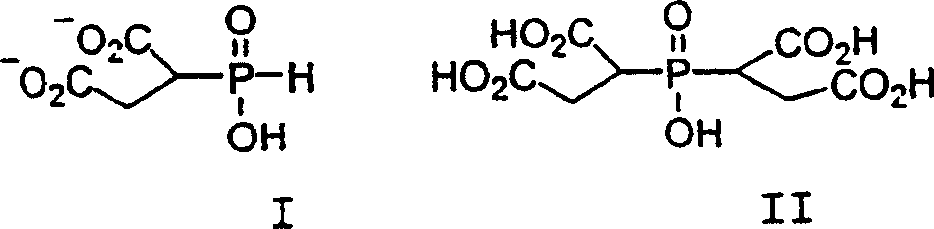
低聚物种类可能的构造在美国专利号为5085794、5023000和5018577中提出。此外,低聚物种类还可以含有膦酸丁二酸的酯类,其中该膦酸酯类被丁二酸酯衍生的烷基酯化。Possible configurations of oligomer species are set forth in US Pat. Nos. 5,085,794, 5,023,000 and 5,018,577. In addition, the oligomeric species may also contain esters of phosphonic acid succinic acid, wherein the phosphonic acid esters are esterified with succinate-derived alkyl groups.
单、双和低聚组份典型地用一组在pH值为5的水中得到的质子去偶磷NMR谱中的峰值表征,如下所示:Mono-, di- and oligomeric components are typically characterized by a set of peaks in a proton-decoupled phosphorous NMR spectrum obtained in water at pH 5, as follows:
单:在26~29ppm之间一个峰值;Single: a peak between 26-29ppm;
双:在30~35ppm之间两个峰值;且Double: two peaks between 30-35ppm; and
低聚:在29~33ppm之间多个峰值。Low poly: multiple peaks between 29-33ppm.
在本发明的优选方案中,以组合物的磷计算,双加合物占约20~85摩尔%。In a preferred embodiment of the present invention, the bis-adduct comprises about 20 to 85 mole percent, calculated on the phosphorus of the composition.
此组合物是这样制备的:(1)把次磷酸盐加入到顺丁烯二酸或反丁烯二酸的淤浆或水溶液中而生成一种反应混合物;以及(2)通过向反应混合物引入一种自由基引发剂而进行反应。在淤浆的情况中,只要淤浆能混合,其中的固态含量就不是关键的。典型地是,淤浆中固体含量为约35~50wt.%。The composition is prepared by (1) adding hypophosphite to a slurry or aqueous solution of maleic acid or fumaric acid to form a reaction mixture; and (2) by introducing A free radical initiator reacts. In the case of slurries, the solids content is not critical as long as the slurry is mixable. Typically, the solids content of the slurry is about 35-50 wt.%.
“次磷酸盐”表示的是次磷酸或次磷酸的一种盐如次磷酸钠。"Hypophosphite" means hypophosphorous acid or a salt of hypophosphorous acid such as sodium hypophosphite.
反应混合物可非必要地加热,优选的温度范围为约40℃~约75℃,接着加入次磷酸盐,以在一个合适的短时间段内来使混合物转变为所希望产生的膦基丁二酸加合物。The reaction mixture may optionally be heated, preferably at a temperature in the range of about 40°C to about 75°C, followed by the addition of hypophosphite to convert the mixture to the desired phosphinosuccinic acid produced over a suitably short period of time adduct.
反应混合物可部分或全部与碱中和。优选的碱是氢氧化钠水溶液,它能提供包含顺丁烯二酸盐和/或反丁烯二酸盐的淤浆。也可以使用其它能和反丁烯二酸或顺丁烯二酸形成盐类的碱,如氢氧化钾和氢氧化铵。碱可以在加次磷酸盐之前、之后或与之同时加入。The reaction mixture can be partially or completely neutralized with a base. A preferred base is aqueous sodium hydroxide, which provides a slurry comprising maleate and/or fumarate. Other bases which form salts with fumaric acid or maleic acid, such as potassium hydroxide and ammonium hydroxide, may also be used. The base can be added before, after or simultaneously with the addition of hypophosphite.
适合的自由基引发剂包括过硫酸盐、过氧化物和重氮基化合物。优选的引发剂是过硫酸铵。引发剂可以一次加入到反应混合物中,也可以在几个小时的反应时间段中缓慢地引入反应混合物中。优选的引发剂添加量为次磷酸盐的约10~约15摩尔%。Suitable free radical initiators include persulfates, peroxides and diazo compounds. A preferred initiator is ammonium persulfate. The initiator can be added to the reaction mixture all at once or introduced slowly into the reaction mixture over a reaction period of several hours. The preferred amount of initiator added is from about 10 to about 15 mole percent of the hypophosphite.
在制备次膦酸组合物的一个典型的现有技术过程中,使用顺丁烯二酸与次磷酸盐的比例约为2∶1。反应的产物主要是上述的单、双和低聚的膦基丁二酸加合物和无机磷酸盐。In a typical prior art process for preparing phosphinic acid compositions, a ratio of about 2:1 maleic acid to hypophosphite is used. The products of the reaction are mainly the above-mentioned mono-, di- and oligomeric phosphinosuccinic acid adducts and inorganic phosphates.
我们意外地发现如果用反丁烯二酸(反1,4-丁二酸)代替顺丁烯二酸(顺1,4-丁二酸)进行反应,单、双和低聚的膦基丁二酸加合物的比例被改变,结果由此产生的组合物相对于在相同反应条件下使用顺丁烯二酸产生的组合物具有更有效的抑制腐蚀的特性。We have unexpectedly found that if the reaction is carried out with fumaric acid (trans 1,4-butanedioic acid) instead of maleic acid (cis 1,4-butanedioic acid) The ratio of the diacid adduct is varied so that the resulting composition has more effective corrosion inhibiting properties than a composition produced using maleic acid under the same reaction conditions.
具体地说,由于更加有效地把次磷酸盐和反丁烯二酸转变成所希望的次膦酸,因此使用反丁烯二酸的方法提供了一个简单的方法来增加组合物中双加合物的产量并降低组合物中副产物的产量。In particular, the use of fumaric acid provides an easy way to increase the amount of di-addition in the composition due to the more efficient conversion of hypophosphite and fumaric acid to the desired phosphinic acid. production and reduce the production of by-products in the composition.
为了在顺丁烯二酸方法中获得一个类似的结果,一种合适的顺丁烯二酸形式(如顺丁烯二酐)必须与引发剂同时加入到反应过程中。由于这些条件或者是需要使用专门的设备来把固体试剂投加到反应器中,或者是长时间的人工添加固体试剂,这样会增加工人对化学试剂的曝露,或者是向反应器添加相对大量的单体溶液,这样会将产物稀释成不理想的水平,因此当大规模运行时它们是不希望出现的。此外,使用顺丁烯二酸方法还不能将基本上所有的次磷酸盐和单体(顺丁烯二酸或反丁烯二酸)试剂有效地转化成理想的有机磷产物。In order to obtain a similar result in the maleic acid process, a suitable form of maleic acid such as maleic anhydride must be added to the reaction process simultaneously with the initiator. Due to these conditions, either it is necessary to use special equipment to add solid reagents to the reactor, or to manually add solid reagents for a long time, which will increase the exposure of workers to chemical reagents, or to add a relatively large amount of chemical reagents to the reactor. Monomer solutions, which dilute the product to undesired levels, so they are undesirable when operating on a large scale. Furthermore, substantially all hypophosphite and monomeric (maleic or fumaric) reagents have not been efficiently converted to the desired organophosphorus products using the maleic acid process.
次磷酸盐的完全转化是重要的,因为它使所希望产物的产量最大化,而使副产物的产量最小化,这些副产物包含相对昂贵的次磷酸盐和它的氧化产物(无机亚磷酸盐和磷酸盐),当所希望的产物用于水系统中抑制腐蚀时,所述副产物会导致结垢。Complete conversion of hypophosphite is important because it maximizes the yield of the desired product while minimizing the production of by-products, which include relatively expensive hypophosphite and its oxidation products (inorganic phosphite and phosphate), which can lead to scaling when the desired product is used to inhibit corrosion in water systems.
单体(顺丁烯二酸或反丁烯二酸)的完全转化是重要的,出于经济考虑(产量最大化)以及由于未反应的单体倾向从混合产物中沉淀出来产生一种物理性质不稳定的产物。因此,本发明使用的反丁烯二酸方法以一种比在先公开的方法更经济有效的方式,生产了一种具有最佳缓蚀性能的膦基丁二酸混合产物。Complete conversion of the monomer (maleic or fumaric acid) is important, both for economic considerations (maximum yield) and for a physical property due to the tendency of unreacted monomer to precipitate out of the mixed product Unstable product. Thus, the fumaric acid process used in the present invention produces a phosphinosuccinic acid mixture product with optimum corrosion inhibition properties in a more cost-effective manner than previously disclosed processes.
通常,除了用反丁烯二酸代替顺丁烯二酸外,使用反丁烯二酸方法与使用顺丁烯二酸方法非常类似。优选的是,反丁烯二酸由顺丁烯二酸的异构化产生。更优选的是,反丁烯二酸的制备是通过在水溶液中水解顺丁烯二酐来产生一种顺丁烯二酸水溶液,它再通过加热或者加入一种适合的催化剂被异构,最后形成一种反丁烯二酸水溶液。In general, the fumaric acid method is very similar to the maleic acid method, except that fumaric acid is used instead of maleic acid. Preferably, fumaric acid is produced by isomerization of maleic acid. More preferably, fumaric acid is prepared by hydrolyzing maleic anhydride in aqueous solution to produce an aqueous solution of maleic acid, which is isomerized by heating or adding a suitable catalyst, and finally An aqueous solution of fumaric acid was formed.
异构可以仅在高温条件下加热完成,因此通常使用催化剂使反应能够在相对温和的条件下进行。用于这种转化的适合催化剂包括硫脲和氧化剂与各种溴化合物的混合物。优选的催化剂是一种溴盐与过硫酸盐的混合物(美国专利号3389173,Ind.Eng.Chem.Res.1991,30,2138~2143,Chem.Eng.Process.,30(1991),15~20)。优选的是,溴化钠和过硫酸铵的混合物用于在水介质中进行转变。Isomerization can be accomplished only with heat at elevated temperatures, so catalysts are often used to enable the reaction to proceed under relatively mild conditions. Suitable catalysts for this transformation include thiourea and mixtures of oxidizing agents with various bromine compounds. Preferred catalyzer is the mixture of a kind of bromide and persulfate (U.S. Patent No. 3389173, Ind.Eng.Chem.Res.1991,30,2138~2143, Chem.Eng.Process., 30(1991), 15~ 20). Preferably, a mixture of sodium bromide and ammonium persulfate is used to carry out the transformation in an aqueous medium.
接着,通过把次磷酸盐和自由基引发剂加入到前述的反丁烯二酸溶液中,反丁烯二酸水溶液转变成本发明的次膦酸类缓蚀剂。反应混合物中优选的反丁烯二酸与次磷酸盐的比例为约大于1.75~3。优选的是,在若干小时的时间段里添加引发剂,同事将反应混合物在60℃下加热。接着反应继续进行,直到次磷酸盐几乎完全转变为有机磷产物。Next, by adding hypophosphite and a free radical initiator into the aforementioned fumaric acid solution, the aqueous solution of fumaric acid is transformed into the phosphinic acid corrosion inhibitor of the present invention. The preferred ratio of fumaric acid to hypophosphite in the reaction mixture is greater than about 1.75-3. Preferably, the initiator is added over a period of several hours while heating the reaction mixture at 60°C. The reaction then continues until the hypophosphite is almost completely converted to the organophosphorus product.
这种优选方法的一个优点是它更经济,因为使用了便宜的顺丁烯二酐作为原材料代替了更贵的反丁烯二酸。An advantage of this preferred method is that it is more economical because the less expensive maleic anhydride is used as the raw material instead of the more expensive fumaric acid.
使用反丁烯二酸方法的另一个优点是产物中剩余无机磷的总量少于总磷的3摩尔%。Another advantage of using the fumaric acid process is that the total amount of residual inorganic phosphorus in the product is less than 3 mole percent of the total phosphorus.
因此,在另一方面,本发明涉及一种制备含有单、双和低聚膦基丁二酸加合物的组合物的方法,该方法包括:Therefore, in another aspect, the present invention relates to a method for preparing a composition containing mono-, di- and oligophosphinosuccinic acid adducts, the method comprising:
1)向反丁烯二酸淤浆或水溶液中加入次磷酸盐,产生一种反应混合物;以及1) adding hypophosphite to a fumaric acid slurry or aqueous solution to produce a reaction mixture; and
2)通过向反应混合物引入一种自由基引发剂来进行反应。2) The reaction is carried out by introducing a free radical initiator into the reaction mixture.
在一个优选的方案中,反应混合物的制备是通过把含水顺丁烯二酸淤浆转变为含水反丁烯二酸淤浆。In a preferred embodiment, the reaction mixture is prepared by converting an aqueous maleic acid slurry to an aqueous fumaric acid slurry.
在另一个优选方案中,反应混合物含有约35~50wt%的固体含量。In another preferred embodiment, the reaction mixture has a solids content of about 35-50 wt%.
在另一个优选方案中,反应混合物与碱中和。In another preferred embodiment, the reaction mixture is neutralized with a base.
在另一个优选方案中,反应混合物中反丁烯二酸与次磷酸盐的摩尔比为约大于1.75~3。In another preferred embodiment, the molar ratio of fumaric acid to hypophosphite in the reaction mixture is greater than about 1.75-3.
在另一个优选方案中,次磷酸盐选自次磷酸或次磷酸的一种盐。In another preferred embodiment, the hypophosphite is selected from hypophosphorous acid or a salt of hypophosphorous acid.
在另一个优选方案中,反应混合物需要加热。In another preferred embodiment, the reaction mixture requires heating.
在另一个优选方案中,自由基引发剂在反应的若干小时中被缓慢添加到反应混合物中。In another preferred embodiment, the free radical initiator is slowly added to the reaction mixture over several hours of the reaction.
另一个方案是,本发明涉及一种含有单、双和低聚膦基丁二酸加合物的含水组合物,所述组合物由以下方法制备:In another aspect, the present invention relates to an aqueous composition containing mono-, di- and oligophosphinosuccinic acid adducts, said composition being prepared by:
1)向反丁烯二酸淤浆或水溶液中加入次磷酸盐,产生一种反应混合物;以及1) adding hypophosphite to a fumaric acid slurry or aqueous solution to produce a reaction mixture; and
2)通过向反应混合物引入一种自由基引发剂来进行反应。2) The reaction is carried out by introducing a free radical initiator into the reaction mixture.
通过参考下面的实施例可以更好地理解前面的描述,给出这些实施例的目的是为了说明,而不是限制本发明的范围。The foregoing description may be better understood by reference to the following examples, which are given for purposes of illustration, not limitation, of the scope of the invention.
实施例1Example 1
本实施例中使用的反丁烯二酸与次磷酸盐的摩尔比为2.1∶1。向1升树脂烧瓶中的104.4份的水中添加75.9份的顺丁烯二酐碎块,其中所述烧瓶装配有机械搅拌器、冷凝器、氮入口和加热器。顺丁烯二酐在40℃时水解生成顺丁烯二酸溶液,接着反应被加热至60℃,并加入溴化钠溶液(0.16份的溴化钠溶入0.20份的水中),紧跟着加入过硫酸铵溶液(0.43份的过硫酸铵溶入1.49份的水中)。在60分钟里,放热反应接着发生,使得顺丁烯二酸溶液转变为183.6份的49.2wt.%反丁烯二酸水淤浆,由质子NMR测定。The molar ratio of fumaric acid to hypophosphite used in this example was 2.1:1. 75.9 parts of maleic anhydride chips were added to 104.4 parts of water in a 1 liter resin flask equipped with a mechanical stirrer, condenser, nitrogen inlet and heater. Maleic anhydride is hydrolyzed at 40°C to generate maleic acid solution, then the reaction is heated to 60°C, and sodium bromide solution (0.16 parts of sodium bromide dissolved in 0.20 parts of water) is added, followed by Ammonium persulfate solution (0.43 parts of ammonium persulfate dissolved in 1.49 parts of water) was added. Over 60 minutes, an exothermic reaction ensued, converting the maleic acid solution to 183.6 parts of a 49.2 wt.% fumaric acid slurry in water, as determined by proton NMR.
向1升树脂烧瓶中的182.6份的49.2wt.%反丁烯二酸水淤浆中添加次磷酸钠一水化物(38.9组份),所述烧瓶装配有机械搅拌器、冷凝器、氮入口和加热器。接着在保持反应温度为60℃和氮气保护条件下,在5个小时反应时间段中加入过硫酸铵溶液(10.9g)的过硫酸铵溶入36.9份的水中)。反应溶液继续加热1~5小时,接着在外部冷却条件下用96.2份的50%氢氧化钠水溶液调整溶液pH值为6。最后,18份的水被加入。由下表描述的次磷酸盐/反丁烯二酸加合物的盐类组成的产物,显示了各组分的摩尔比例,这是由磷NMR分析得到的。第1列数据表示根据上述方法在400~600g规模下进行的4组反应的平均值。第2列数据表示在126g规模下,除了反丁烯二酸淤浆是反丁烯二酸与水混合制成的外,其余与前述的方法相同的反应的结果。Sodium hypophosphite monohydrate (38.9 components) was added to 182.6 parts of a 49.2 wt.% aqueous slurry of fumaric acid in a 1 liter resin flask equipped with a mechanical stirrer, condenser, nitrogen inlet and heater. Next, ammonium persulfate solution (10.9 g of ammonium persulfate dissolved in 36.9 parts of water) was added in a reaction period of 5 hours while maintaining the reaction temperature at 60° C. under nitrogen protection. The reaction solution was continued to be heated for 1-5 hours, and then the pH value of the solution was adjusted to 6 with 96.2 parts of 50% aqueous sodium hydroxide solution under external cooling conditions. Finally, 18 parts of water were added. The products consisting of the salts of the hypophosphite/fumaric acid adducts described in the table below, showing the molar ratios of the components, were obtained by phosphorus NMR analysis. The data in column 1 represent the average of 4 reactions carried out according to the method described above at the 400-600 g scale. The data in column 2 represent the results of the same reaction as previously described except that the fumaric acid slurry was prepared by mixing fumaric acid with water at the 126 g scale.
组分 摩尔%Component Mole %
磷酸亚基双(丁二酸)盐类(结构式II) 48,45Phosphosubunit bis(succinate) salts (structural formula II) 48,45
磷酸亚基丁二酸盐类(结构式I) 17,24Phosphonidene succinates (structural formula I) 17, 24
膦酸丁二酸盐类 8,4Phosphonic acid succinates 8,4
磷酸亚基丁二酸低聚物盐类(结构式III) 27,27Oligomer salts of phospho-succinic acid (structural formula III) 27,27
次磷酸盐、亚磷酸盐和磷酸盐类 <1,<1Hypophosphite, phosphite and phosphate <1, <1
实施例2Example 2
本实施例中使用的反丁烯二酸与次磷酸盐的比例为2.5∶1。反应条件与实施例1的描述相同。由下表描述的次磷酸盐/反丁烯二酸加合物的盐类组成的产物,显示了各组分的摩尔比例,这是由磷NMR分析得到的。The ratio of fumaric acid to hypophosphite used in this example was 2.5:1. The reaction conditions were the same as described in Example 1. The products consisting of the salts of the hypophosphite/fumaric acid adducts described in the table below, showing the molar ratios of the components, were obtained by phosphorus NMR analysis.
组分 摩尔%Component Mole %
磷酸亚基双(丁二酸)盐类(结构式II) 49Phosphosubunit bis(succinate) salts (structural formula II) 49
磷酸亚基丁二酸盐类(结构式I) 7Phosphonidene succinates (structural formula I) 7
膦酸丁二酸盐类 3Phosphonic acid succinates 3
磷酸亚基丁二酸低聚物盐类(结构式III) 38Oligomer salts of phospho-succinic acid (structural formula III) 38
次磷酸盐、亚磷酸盐和磷酸盐类 <1Hypophosphite, phosphite and phosphate <1
实施例3Example 3
这是一个对比实施例,以与实施例2相同的2.5∶1摩尔比,用顺丁烯二酸代替反丁烯二酸。结果证明由反丁烯二酸得到的结果是意料之外的。第1列数据是在实验室中用上述整个过程得到的结果,第2列数据是用相同的顺丁烯二酸与反丁烯二酸摩尔比在工厂运行中得到的结果。This is a comparative example in which fumaric acid was replaced with maleic acid in the same 2.5:1 molar ratio as in Example 2. It turned out that the results obtained with fumaric acid were unexpected. The data in column 1 are the results obtained in the laboratory using the entire process described above, and the data in column 2 are the results obtained in the plant operation using the same mole ratio of maleic acid to fumaric acid.
除了顺丁烯二酸以相同的摩尔含量代替反丁烯二酸之外,实施例1描述的整个反应条件被重复。由下表描述的次磷酸盐/顺丁烯二酸加合物的盐类组成的产物,显示了各组分的摩尔比例,这是由磷NMR分析得到的。The entire reaction conditions described in Example 1 were repeated except that maleic acid was substituted for fumaric acid at the same molar content. The products consisting of the salts of the hypophosphite/maleic acid adduct described in the table below, showing the molar proportions of the components, were obtained by phosphorus NMR analysis.
组分 摩尔%Component Mole %
磷酸亚基双(丁二酸)盐类(结构式II) 22,17Phosphosubunit bis(succinate) salts (structural formula II) 22,17
磷酸亚基丁二酸盐类(结构式I) 24,22Phosphonidene succinates (structural formula I) 24,22
膦酸丁二酸盐类 2,12Phosphonic acid succinates 2, 12
磷酸亚基丁二酸低聚物盐类(结构式III) 43,35Oligomer salts of phosphorylidene succinate (structural formula III) 43,35
次磷酸盐、亚磷酸盐和磷酸盐类 5,8Hypophosphite, phosphite and phosphates 5,8
实施例4Example 4
本实施例中使用的反丁烯二酸与次磷酸盐的比例较低,为1.75∶1。结果是不能生产出超过30%的双加合产物,而且生成大量不希望产生的无机磷。除了使用大量的次磷酸盐使得反丁烯二酸与次磷酸盐的摩尔比为1.75∶1之外,实施例1描述的反应条件被重复。由下表描述的次磷酸盐/反丁烯二酸加合物的盐类组成的产物,显示了各组分的摩尔比例,这是由磷NMR分析得到的。The ratio of fumaric acid to hypophosphite used in this example was as low as 1.75:1. The result is that no more than 30% of the double-adduct product can be produced, and large amounts of undesired inorganic phosphorus are formed. The reaction conditions described in Example 1 were repeated except that a large amount of hypophosphite was used such that the molar ratio of fumaric acid to hypophosphite was 1.75:1. The products consisting of the salts of the hypophosphite/fumaric acid adducts described in the table below, showing the molar ratios of the components, were obtained by phosphorus NMR analysis.
组分 摩尔%Component Mole %
磷酸亚基双(丁二酸)盐类(结构式II) 30Phosphosubunit bis(succinate) salts (structural formula II) 30
磷酸亚基丁二酸盐类(结构式I) 35Phosphosubunitene succinates (structural formula I) 35
膦酸丁二酸盐类 8Phosphonic acid succinates 8
磷酸亚基丁二酸低聚物盐类(结构式III) 22Oligomer salts of phosphorylidene succinic acid (structural formula III) 22
次磷酸盐、亚磷酸盐和磷酸盐类 6Hypophosphite, phosphite and phosphates 6
实施例5Example 5
本实施例中使用的基本上中和了的反丁烯二酸钠淤浆的比例为2.1∶1,通过使用一种反丁烯二酸盐使得整个反应过程在一个宽的pH值范围内进行。在这种情况下,约80%的反丁烯二酸羧酸被转变为羧酸钠的形式,pH值从约1升高至约6。The ratio of substantially neutralized sodium fumarate slurry used in this example was 2.1:1, and the entire reaction process was carried out over a wide pH range by using a fumarate salt. . In this case, about 80% of the fumaric carboxylic acid was converted to the sodium carboxylate form, and the pH increased from about 1 to about 6.
向250ml树脂烧瓶中的61.0g的49.1wt.%反丁烯二酸水淤浆中添加次磷酸钠一水化物(13.0g),所述烧瓶装配有机械搅拌器、冷凝器、氮入口和加热器。接着在混合和冷却条件下加入32.1g的50%氢氧化钠水溶液。在保持反应温度为60℃和氮气保护条件下,在5个小时反应时间段中再加入过硫酸铵溶液(3.6g的过硫酸铵溶入6.0g的水中)。反应溶液继续加热1~5小时,并加入6g水。由下表描述的次磷酸盐/反丁烯二酸加合物的盐类组成的产物,显示了各组分的摩尔比例,这是由磷NMR分析得到的。Sodium hypophosphite monohydrate (13.0 g) was added to 61.0 g of a 49.1 wt.% aqueous slurry of fumaric acid in a 250 ml resin flask equipped with a mechanical stirrer, condenser, nitrogen inlet and heating device. Next, 32.1 g of a 50% aqueous sodium hydroxide solution were added with mixing and cooling. Under the conditions of keeping the reaction temperature at 60° C. and nitrogen protection, ammonium persulfate solution (3.6 g of ammonium persulfate dissolved in 6.0 g of water) was added during the reaction period of 5 hours. The reaction solution was continued to be heated for 1-5 hours, and 6 g of water was added. The products consisting of the salts of the hypophosphite/fumaric acid adducts described in the table below, showing the molar ratios of the components, were obtained by phosphorus NMR analysis.
组分 摩尔%Component Mole %
磷酸亚基双(丁二酸)盐类(结构式II) 46Phosphosubunit bis(succinate) salts (structural formula II) 46
磷酸亚基丁二酸盐类(结构式I) 18Phosphosubuccinates (structural formula I) 18
膦酸丁二酸盐类 8Phosphonic acid succinates 8
磷酸亚基丁二酸低聚物盐类(结构式III) 26Oligomer salts of phospho-succinic acid (structural formula III) 26
次磷酸盐、亚磷酸盐和磷酸盐类 <1Hypophosphite, phosphite and phosphate <1
实施例6Example 6
步骤1:磷酸亚基双(丁二酸二甲酯)一钠Step 1: Monosodium Phosphate Subunit Bis(dimethylsuccinate)
本实施例中使用的顺丁烯二酸二甲酯与次磷酸盐的比例为2.1∶1。向装配有磁性搅拌器、冷凝器、氮入口、加热器和滴液漏斗的树脂烧瓶中的6.25份的水和12.5份的乙醇中添加7.325份的过磷酸钠。反应溶液加热至80℃。在4.75个小时的反应时间段中,再逐滴地把由20.75份的顺丁烯二酸二甲酯、0.86份的过氧化苯甲酰(70%溶液)和25份的乙醇组成的溶液加入到反应烧瓶中。反应混合溶液再额外加热15分钟后冷却。溶剂通过在减压条件下旋转气化去除。The ratio of dimethyl maleate to hypophosphite used in this example is 2.1:1. To 6.25 parts of water and 12.5 parts of ethanol in a resin flask equipped with a magnetic stirrer, condenser, nitrogen inlet, heater and dropping funnel was added 7.325 parts of sodium superphosphate. The reaction solution was heated to 80°C. During the reaction period of 4.75 hours, a solution consisting of 20.75 parts of dimethyl maleate, 0.86 parts of benzoyl peroxide (70% solution) and 25 parts of ethanol was added dropwise. into the reaction flask. The reaction mixture was heated for an additional 15 minutes and cooled. Solvent was removed by rotary vaporization under reduced pressure.
步骤2:磷酸亚基双(丁二酸)钠Step 2: Sodium phosphate bis(succinate)
向装配有磁性搅拌器、冷凝器和加热器的反应烧瓶中的20份的水和55.4份的50%氢氧化钠溶液中添加34.5份的磷酸亚基双(丁二酸二甲酯)一钠。反应加热至100℃并保持2小时。产物被20份的水稀释,然后再用40.4份的盐酸中和至pH值约为6。To 20 parts of water and 55.4 parts of 50% sodium hydroxide solution in a reaction flask equipped with a magnetic stirrer, condenser and heater was added 34.5 parts of monosodium bis(dimethylsuccinate) phosphate . The reaction was heated to 100°C and held for 2 hours. The product was diluted with 20 parts of water and then neutralized to a pH of about 6 with 40.4 parts of hydrochloric acid.
由下表描述的次磷酸盐/顺丁烯二酸加合物的盐类组成的产物,显示了各组分的摩尔比例,这是由磷NMR分析得到的。The products consisting of the salts of the hypophosphite/maleic acid adduct described in the table below, showing the molar proportions of the components, were obtained by phosphorus NMR analysis.
组分 摩尔%Component Mole %
磷酸亚基双(丁二酸)盐类(结构式II) 88Phosphosubunit bis(succinate) salts (structural formula II) 88
磷酸亚基丁二酸盐类(结构式I) 9Phosphonidene succinates (structural formula I) 9
膦酸丁二酸盐类 1Phosphonic acid succinates 1
次磷酸盐、亚磷酸盐和磷酸盐类 2Hypophosphite, phosphite and phosphates 2
实施例7Example 7
表1-3为用电化学试验测定的腐蚀率。Table 1-3 is the corrosion rate determined by electrochemical test.
用MICROSTOP STOP-OFFTM漆(金字塔塑料制品有限公司)密封,并安装在松木转子上的预抛光的碳钢(低碳钢,C1010或C1008)圆柱管(长度为0.5in,外直径为0.5in,面积为5cm2)作为工作电极。此电极用600粒度(grit)的碳化硅砂纸抛光,再用丙酮和去离子水清洗,并在使用油漆之前用一张干净的KimwipeTM擦干。然后,电极在空气中放置15分钟使得它在浸泡前油漆能变干。反电极是两个高密度的石墨棒。饱和的甘汞电极或银/氯化银电极作为参比电极。通过将小的卢金毛细管开口放置在距工作电极的表面约1~2mm处,使溶液欧姆降达到最小。A.C.阻抗试验显示,在低腐蚀率条件下(如Rp>3000ohmcm2或者<7~9mpy)欧姆降通常不会大于总测定极化电阻(Rp)的10%。Pre-polished carbon steel (mild steel, C1010 or C1008) cylindrical tube (0.5 in length, 0.5 in outside diameter) sealed with MICROSTOP STOP-OFF TM paint (Pyramid Plastic Products Co., Ltd.) and mounted on a pine rotor , with an area of 5cm 2 ) as the working electrode. The electrode was polished with 600 grit silicon carbide sandpaper, rinsed with acetone and deionized water, and dried with a clean Kimwipe( TM) before applying the paint. Then, the electrode was left in air for 15 minutes to allow the paint to dry before it was soaked. The counter electrodes are two high-density graphite rods. A saturated calomel electrode or a silver/silver chloride electrode is used as a reference electrode. The solution ohmic drop was minimized by placing the small Lukin capillary opening approximately 1-2 mm from the surface of the working electrode. AC impedance test shows that under the condition of low corrosion rate (such as R p >3000ohmcm 2 or <7~9mpy), the ohmic drop is usually not greater than 10% of the total measured polarization resistance (R p ).
装有700ml(表3为10.8升)溶液的试验槽用于试验。试验溶液由去离子水、分析级化合物和根据本发明描述的方法合成的化学品制备而成。在浸泡工作电极前,溶液被充气并使其达到热化学稳定态(典型的为~0.5小时)。试验槽的全部开口用橡皮塞或Saran WrapTM封住,这可使由蒸发产生的溶液损失减到最小。在24小时内由蒸发产生的损失通常小于10%。工作台面腐蚀试验在38±0.3℃或48.9±0.3℃条件下进行,除非有其它规定。pH值控制器通过加入稀释液硫酸或二氧化碳气体(二氧化碳仅用于表3所示的试验中)控制试验溶液的pH值。在试验中还可通过通入空气来对试验溶液充气。A test tank containing 700 ml (10.8 liters in Table 3) solution was used for the test. Test solutions were prepared from deionized water, analytical grade compounds, and chemicals synthesized according to the methods described in this invention. The solution was gassed and allowed to reach thermochemical stability (typically ~0.5 hours) before soaking the working electrode. All openings of the test cell are closed with rubber stoppers or Saran Wrap ™ , which minimizes loss of solution by evaporation. Losses from evaporation are typically less than 10% within 24 hours. The tabletop corrosion test is carried out at 38±0.3°C or 48.9±0.3°C unless otherwise specified. The pH controller controls the pH of the test solution by adding diluent sulfuric acid or carbon dioxide gas (carbon dioxide is used only in the tests shown in Table 3). The test solution can also be aerated during the test by introducing air.
Gamry电势恒定器和Gamry腐蚀软件用于进行电化学测定。在超过16小时的浸泡之后,电极的极化电阻通过施加一个小的超电势(Ecorr±15mV)于工作电极上并在稳定状态下测定形成的电流而确定。准稳态动电位阴极和阳极扫描(如0.5mV/sec)在极化电阻测定后立即进行。这些测定在阴极或阳极方向的腐蚀电压被极化至200mV时开始。先记录阴极。在阴极扫描后~0.5小时再进行阳极扫描。平均表面积(即总)腐蚀率的测定是来自对阳极或阴极的线性对数(i)相对于腐蚀电压极化曲线的电势区的外推,或者是利用Stern-Geary等式通过极化电阻求出的。阳极和阴极的极化曲线的200mV/dec塔菲尔(Tafel)斜率由几组准稳态动电位扫描测定的平均值和在先试验测定而得,这些斜率用于从测定的极化电阻来计算总腐蚀率。表1~3所示的腐蚀率是由极化电阻率、阳极塔菲尔斜率和阴极塔菲尔斜率外推率计算的平均值。A Gamry potentiostat and Gamry corrosion software were used to perform electrochemical measurements. After more than 16 hours of immersion, the polarization resistance of the electrodes was determined by applying a small overpotential (E corr ± 15 mV) to the working electrode and measuring the resulting current at steady state. Quasi-steady-state potentiodynamic cathodic and anodic scans (eg, 0.5 mV/sec) were performed immediately after the polarization resistance measurement. These measurements were initiated when the corrosion voltage was polarized to 200 mV in the cathodic or anodic direction. Record the cathode first. Anodic scans were performed ~0.5 hours after cathodic scans. The average surface area (i.e., total) corrosion rate was determined from extrapolation to the potential region of the linear log(i) versus corrosion voltage polarization curve for the anode or cathode, or from the polarization resistance using the Stern-Geary equation. out. The 200mV/dec Tafel (Tafel) slopes of the polarization curves of the anode and cathode were obtained from the average of several sets of quasi-steady-state potentiodynamic scan measurements and previous experiments, and these slopes were used to derive from the measured polarization resistance Calculate the total corrosion rate. The corrosion rates shown in Tables 1 to 3 are average values calculated from polarization resistivity, anode Tafel slope and cathode Tafel slope extrapolation rate.
在某些情况下(如表3的结果和表1中100F的结果),碳钢电极在浸泡入试验槽之前,首先在试验温度下在0.5wt.%苯甲酸钠溶液中预钝化2至20小时。在可比试验条件下,在此描述的不同试样制备方法得到的腐蚀率并没有明显不同(如各自的腐蚀率差别小于20~30%)。In some cases (such as the results in Table 3 and the results at 100F in Table 1), the carbon steel electrodes were first pre-passivated in a 0.5 wt. Hour. Under comparable test conditions, the corrosion rates obtained by the different sample preparation methods described here are not significantly different (eg, the difference between the respective corrosion rates is less than 20-30%).
使用分析级化学品、市售的产品或根据本发明描述的方法合成的化学品制备了所有溶液。All solutions were prepared using analytical grade chemicals, commercially available products, or chemicals synthesized according to the methods described in this invention.
表1 Table 1
缓蚀剂筛选试验结果—硬水 Corrosion Inhibitor Screening Test Results - Hard Water
360ppm氯化钙,200ppm硫酸镁,100ppm碳酸氢钠,pH=8.4,120°F,160rpm;16小时浸泡360ppm Calcium Chloride, 200ppm Magnesium Sulfate, 100ppm Sodium Bicarbonate, pH=8.4, 120°F, 160rpm; 16 hours soak
化合物 酸形式或规定形式的活性剂的剂量 MS总腐蚀率(mpy)Compound Dosage of active agent in acid form or specified form MS overall corrosion rate (mpy)
空白 无 43.50Blank None 43.50
正磷酸盐 15ppm PO4 17.35Orthophosphate 15ppm PO 4 17.35
焦磷酸盐 30ppm PO4 11.99Pyrophosphate 30ppm PO 4 11.99
HPA 15ppm 2.13HPA 15ppm 2.13
30ppm 2.47 3次试验均值30ppm 2.47 3 test average
PCAM 15ppm 15.43PCAM 15ppm 15.43
PCAM 20ppm 6.26PCAM 20ppm 6.26
PCAM 30ppm 23.68PCAM 30ppm 23.68
PCAM 40ppm 15.28 6次试验均值PCAM 40ppm 15.28 Average of 6 tests
实施例1 15ppm 2.78Embodiment 1 15ppm 2.78
实施例1 20ppm 2.16Embodiment 1 20ppm 2.16
实施例1 30ppm 0.97Embodiment 1 30ppm 0.97
实施例1 40ppm 2.17 2次试验均值Embodiment 1 40ppm 2.17 2 times test average
HEDP 15ppm 13.05HEDP 15ppm 13.05
HEDP 30ppm 8.09HEDP 30ppm 8.09
AMP 15ppm 9.25AMP 15ppm 9.25
AMP 30ppm 16.11AMP 30ppm 16.11
PBTC 15ppm 6.17PBTC 15ppm 6.17
PBTC 30ppm 10.49PBTC 30ppm 10.49
聚丙烯酸酯 15ppm 11.84Polyacrylate 15ppm 11.84
(MW=2000)(MW=2000)
聚丙烯酸酯 30ppm 34.49Polyacrylate 30ppm 34.49
(MW=2000)(MW=2000)
钼酸盐 15ppm MoO4 19.89Molybdate 15ppm MoO 4 19.89
钒酸盐 15ppm VO3 17.43Vanadate 15ppm VO 3 17.43
亚硝酸盐 30ppm NO2 9.38Nitrite 30ppm NO 2 9.38
Zn2+ 5ppm Zn 37.24Zn 2+ 5ppm Zn 37.24
葡糖酸盐 30ppm 5.69Gluconate 30ppm 5.69
膦酸丁二酸 15ppm 6.80Phosphonic acid succinic acid 15ppm 6.80
在100°F得到的吹气结果Air Blow Results at 100°F
空白 无 21.5 2次试验均值Blank None None 21.5 Average of 2 trials
实施例1 40ppm 0.98 2次试验均值Embodiment 1 40ppm 0.98 2 times test average
实施例1 40ppm实施例1 0.92 3次试验均值Example 1 40ppm Example 1 0.92 3 times test mean
+聚合物1 +10ppm聚合物1+Polymer 1 +10ppm Polymer 1
PCAM 40ppmPCAM 19.50 3次试验均值PCAM 40ppmPCAM 19.50 Average of 3 tests
+聚合物1 +10ppm聚合物1+Polymer 1 +10ppm Polymer 1
注意:HPA=2-羟基-膦酰基乙酸(phosphonacetic acid)Note: HPA = 2-hydroxy-phosphonoacetic acid (phosphonacetic acid)
PCAM=膦酰基羧酸混合物,H-[CH(COOH)CH(COOH)]n-PO3H2,其中,n<5且n平均=1.4PCAM = mixture of phosphonocarboxylic acids, H-[CH(COOH)CH(COOH)] n - PO3H2 , where n< 5 and naverage =1.4
HEDP=1-羟基亚乙基-1,1二膦酸HEDP = 1-hydroxyethylidene-1,1 diphosphonic acid
AMP=氨基三(亚甲基膦酸)AMP = Aminotris(methylenephosphonic acid)
PBTC=2-膦酰基-丁烷-1,2,4-三羧酸PBTC = 2-phosphono-butane-1,2,4-tricarboxylic acid
聚合物1=丙烯酸(50~60摩尔%)/丙烯酰胺(20~36摩尔%)/氨基甲磺酸盐(14~20%)三元共聚物Polymer 1 = acrylic acid (50-60 mol%)/acrylamide (20-36 mol%)/urethane sulfonate (14-20%) terpolymer
表1的结果显示本发明的化合物(例如实施例1)是比PCAM更有效的低碳钢缓蚀剂。实施例1的化合物也比MoO4 2-、VO3 3-、亚硝酸盐、HEDP、PBTC、AMP、聚丙烯酸酯、膦酸丁二酸、正磷酸盐、焦磷酸盐和葡糖酸盐更有效。它与HPA一样有效。在存在一种磷酸盐分散剂聚合物(聚合物1,一般用于冷却水系统中用于阻垢)的情况下,实施例1的化合物仍是比PCAM更有效的低碳钢缓蚀剂。The results in Table 1 show that compounds of the present invention (eg, Example 1) are more effective corrosion inhibitors for low carbon steel than PCAM. The compound of Example 1 is also more active than MoO 4 2- , VO 3 3- , nitrite, HEDP, PBTC, AMP, polyacrylate, phosphonosuccinate, orthophosphate, pyrophosphate and gluconate. efficient. It works just as well as HPA. The compound of Example 1 was still a more effective mild steel corrosion inhibitor than PCAM in the presence of a phosphate dispersant polymer (Polymer 1, typically used in cooling water systems for scale inhibition).
表2 Table 2
缓蚀剂筛选试验结果:组合物变化的影响 Corrosion Inhibitor Screening Test Results: Effect of Composition Variations
处理组合物(基于P31NMR结果) MS总腐蚀率(mpy)Treatment composition (based on P 31 NMR results) MS total corrosion rate (mpy)
处理标号 单加合物(%) 双加合物(%) 低聚物(%) Ing P(%) PSA(%) 15ppm处理 30ppm处理 备注Treatment label Single adduct (%) Double adduct (%) Oligomer (%) Ing P (%) PSA (%) 15ppm treatment 30ppm treatment Remarks
A 34 17 35 8 5 11.9 17.7A 34 17 35 8 8 5 11.9 17.7
B 66 15 0 18 1 11.8 3.16B 66 15 0 18 1 1 11.8 3.16
C 65 15 0 20 0 5.72 5.78C 65 15 0 20 20 0 5.72 5.78
D(实施例1) 15 49 28 <1 7 2.78 0.97D (Example 1) 15 49 28 <1 7 2.78 0.97
E 19 45 29 1 6 2.16 2.17E 19 45 29 1 1 6 2.16 2.17
(20ppm) (40ppm)(20ppm) (40ppm)
F 0 43 27 0 27 2.69 N/A 3%未确定F 0 43 27 0 27 2.69 N/A 3% not determined
G 0 0 60 3 31 21.1 9.2 6%未确定G 0 0 0 60 3 3 31 21.1 9.2 6% not determined
H 9 0 56 4 15 6.9 12.2 18%未确定H 9 0 56 4 15 6.9 12.2 18% not determined
PSA 0 0 0 0 100 6.8 27.1PSA 0 0 0 0 0 0 100 6.8 27.1
PCAM 0 0 0 0 60 15.4 23.6PCAM 0 0 0 0 0 0 60 15.4 23.6
空白 0 0 0 0 0 43.5Blank 0 0 0 0 0 0 43.5
硬水:360ppm氯化钙,200ppm硫酸镁,100ppm碳酸氢钠,(全以碳酸钙计算),pH=8.4,120°F,160rpm,16小时浸泡Hard water: 360ppm calcium chloride, 200ppm magnesium sulfate, 100ppm sodium bicarbonate, (all calculated as calcium carbonate), pH=8.4, 120°F, 160rpm, soak for 16 hours
表3 table 3
缓蚀剂筛选试验结果:组合物变化的影响Corrosion Inhibitor Screening Test Results: Effect of Composition Variations
条件:除空白试验没有缓蚀剂外,总缓蚀剂浓度为40ppm,C1008电极,360ppm氯化钙,200ppm硫酸镁,100ppm碳酸氢钠,(全以碳酸钙计算),pH=8.4,100°F,160rpm,24~72小时浸泡。Conditions: In addition to the blank test without corrosion inhibitor, the total corrosion inhibitor concentration is 40ppm, C1008 electrode, 360ppm calcium chloride, 200ppm magnesium sulfate, 100ppm sodium bicarbonate, (all calculated as calcium carbonate), pH=8.4, 100° F, 160rpm, soak for 24-72 hours.
处理组合物(基于P31NMR结果)Treatment composition (based on P31 NMR results)
处理标号 单加合物(%) 双加合物(%) 低聚物(%) Ing P(%) PSA(%) MS总腐蚀率(mpy)Treatment label Mono-adduct (%) Bi-adduct (%) Oligomer (%) Ing P (%) PSA (%) MS total corrosion rate (mpy)
I 25 36 31 1.2 7 0.98I 25 36 31 1.2 7 0.98
J 15.9 42 34.6 0.8 6.7 1.82J 15.9 42 34.6 0.8 6.7 1.82
D(实施例1) 15 49 28 <1 7 1.36D (Example 1) 15 49 28 <1 7 1.36
50%D+50%K 12 68.7 14 1.3 4 2.7050%D+50%K 12 68.7 14 1.3 4 2.70
25%D+75%K 10.5 78.6 7 1.2 2.5 1.8325%D+75%K 10.5 78.6 7 1.2 2.5 1.83
K 9 88.4 0 1.6 1 7.67K 9 88.4 0 0 1.6 1 7.67
空白 0 0 0 0 0 21.5Blank 0 0 0 0 0 0 21.5
表2和表3的数据显示(1)包括各种百分比的单、双和低聚膦基丁二酸加合物的混合物是有效的低碳钢缓蚀剂;以及(2)如果双加合物占的百分比范围在~17%至88%之间,那么将可获得最好的缓蚀活性。The data in Tables 2 and 3 show that (1) mixtures comprising various percentages of mono-, di-, and oligophosphinosuccinic acid adducts are effective mild steel corrosion inhibitors; and (2) if the bis-adducted The best corrosion inhibition activity will be obtained if the percentage range of 17% to 88%.
虽然本发明的原理连同少数几个实施方案已被说明和描述,应该清楚地理解这些实施方案只用作实施例而不具有限制性。While the principles of the invention have been illustrated and described in conjunction with a few embodiments, it should be clearly understood that these embodiments are by way of example only and not limitation.
Claims (4)
Applications Claiming Priority (2)
| Application Number | Priority Date | Filing Date | Title |
|---|---|---|---|
| US82449201A | 2001-04-02 | 2001-04-02 | |
| US09/824,492 | 2001-04-02 |
Publications (2)
| Publication Number | Publication Date |
|---|---|
| CN1512968A CN1512968A (en) | 2004-07-14 |
| CN1244503C true CN1244503C (en) | 2006-03-08 |
Family
ID=25241530
Family Applications (1)
| Application Number | Title | Priority Date | Filing Date |
|---|---|---|---|
| CNB028110706A Expired - Lifetime CN1244503C (en) | 2001-04-02 | 2002-02-25 | Corrosion Inhibitors for Water Systems |
Country Status (14)
| Country | Link |
|---|---|
| US (1) | US6572789B1 (en) |
| EP (1) | EP1379473B1 (en) |
| JP (1) | JP4180383B2 (en) |
| KR (1) | KR100983521B1 (en) |
| CN (1) | CN1244503C (en) |
| AT (1) | ATE527218T1 (en) |
| AU (1) | AU2002252089B2 (en) |
| BR (1) | BR0208594B1 (en) |
| CA (1) | CA2442474C (en) |
| ES (1) | ES2374284T3 (en) |
| HU (1) | HU228325B1 (en) |
| PL (1) | PL206324B1 (en) |
| RU (1) | RU2324767C2 (en) |
| WO (1) | WO2002079105A1 (en) |
Families Citing this family (90)
| Publication number | Priority date | Publication date | Assignee | Title |
|---|---|---|---|---|
| PT1392914E (en) * | 2001-06-06 | 2011-02-03 | Dequest Ag | Method and aqueous composition for the production of improved pulp |
| MY129053A (en) * | 2001-06-06 | 2007-03-30 | Thermphos Trading Gmbh | Composition for inhibiting calcium salt scale |
| MY138251A (en) * | 2001-06-06 | 2009-05-29 | Thermphos Trading Gmbh | Method for inhibiting calcium salt scale |
| US7578968B1 (en) | 2002-05-03 | 2009-08-25 | Albemarle Corporation | Microbiological control in oil or gas field operations |
| US20040120853A1 (en) * | 2002-12-20 | 2004-06-24 | Carpenter Joel F. | Biocidal control in recovery of oil by water injection |
| US7152662B2 (en) * | 2003-07-30 | 2006-12-26 | Alcoa Inc. | Method of preventing cracking in direct chill cast ingots |
| US7223719B1 (en) | 2004-03-16 | 2007-05-29 | Albemarle Corporation | Breaker composition and process |
| KR101300541B1 (en) | 2005-06-24 | 2013-09-02 | 프레스톤 프로닥츠 코포레이션 | Method for inhibiting corrosion in brazed metal surfaces and coolants and additives for use therein |
| US8673297B2 (en) | 2006-02-28 | 2014-03-18 | Basf Corporation | Chlorine dioxide based cleaner/sanitizer |
| RU2327650C1 (en) * | 2006-08-30 | 2008-06-27 | Сергей Васильевич Петров | Composition for prevention of scaling and corrosion |
| US20080169243A1 (en) * | 2007-01-11 | 2008-07-17 | Dave Bhasker B | Method of inhibiting scale formation and deposition in desalination systems |
| US20090101587A1 (en) * | 2007-10-22 | 2009-04-23 | Peter Blokker | Method of inhibiting scale formation and deposition in desalination systems |
| US9187650B2 (en) * | 2007-11-02 | 2015-11-17 | United Technologies Corporation | Anodic-cathodic corrosion inhibitor-conductive polymer composite |
| US8771542B2 (en) * | 2008-07-11 | 2014-07-08 | Prestone Products Corporation | Heat transfer fluid, additive package, system and method |
| JP5914907B2 (en) * | 2008-08-11 | 2016-05-11 | 株式会社オートネットワーク技術研究所 | Rust preventive and surface-treated metal |
| US20100063180A1 (en) * | 2008-09-05 | 2010-03-11 | Seungkoo Kang | Fire protection and/or fire fighting additives, associated compositions, and associated methods |
| US8021607B2 (en) * | 2008-10-31 | 2011-09-20 | General Electric Company | Methods for inhibiting corrosion in aqueous media |
| US8025840B2 (en) * | 2008-10-31 | 2011-09-27 | General Electric Company | Compositions and methods for inhibiting corrosion in aqueous media |
| CN102272260B (en) * | 2008-11-07 | 2016-04-20 | 霍尼韦尔国际公司 | Heat-transfer fluid and corrosion inhibitor formulations used thereof |
| KR101090702B1 (en) | 2009-06-25 | 2011-12-08 | 현대자동차주식회사 | Composition for reducing white rust of aluminum |
| RU2430997C2 (en) * | 2009-09-24 | 2011-10-10 | Федеральное государственное унитарное предприятие "Российский научный центр "Прикладная химия" | Corrosion inhibitor |
| WO2011044718A1 (en) | 2009-10-16 | 2011-04-21 | Dow Global Technologies Llc | Aqueous cutting fluid for use with diamond wiresaw |
| MX2009013704A (en) * | 2009-12-15 | 2011-06-15 | Mexicano Inst Petrol | New gemini surfactants, obtaining process and use as multifunctional corrosion inhibitors. |
| US8496894B2 (en) | 2010-02-04 | 2013-07-30 | ADA-ES, Inc. | Method and system for controlling mercury emissions from coal-fired thermal processes |
| US8951487B2 (en) | 2010-10-25 | 2015-02-10 | ADA-ES, Inc. | Hot-side method and system |
| CN102080233B (en) * | 2010-12-23 | 2012-05-30 | 常州市科威精细化工有限公司 | Phosphorus-free pre-film agent for pre-film treatment of circulating cooling water system and application method thereof |
| KR101852650B1 (en) * | 2011-03-04 | 2018-06-04 | 아쿠이스 바써-루프트-시스테메 게엠베하, 린다우, 쯔바이그니더라숭 렙슈타인 | Water conditioner for preventing or reducing mineral precipitation |
| BR112013024257A2 (en) * | 2011-03-22 | 2016-12-27 | Cytec Tech Corp | method for reducing or preventing fouling in a wet process phosphoric acid production process |
| RU2489467C2 (en) * | 2011-04-18 | 2013-08-10 | Государственное образовательное учреждение высшего профессионального образования "Санкт-Петербургский государственный университет низкотемпературных и пищевых технологий" | Coolant |
| CN102747372B (en) * | 2011-04-22 | 2014-09-17 | 比亚迪股份有限公司 | Copper protective agent and its preparation method and copper protection method |
| US10259734B1 (en) * | 2011-04-26 | 2019-04-16 | Mansour S. Bader | Effective de-scaling for desalination plants and a new brine-forward multi-stage flash concept |
| US8845986B2 (en) | 2011-05-13 | 2014-09-30 | ADA-ES, Inc. | Process to reduce emissions of nitrogen oxides and mercury from coal-fired boilers |
| RU2486139C2 (en) * | 2011-06-22 | 2013-06-27 | Государственное образовательное учреждение высшего профессионального образования Уральский государственный лесотехнический университет | Method of preventing scaling and corrosion in water supply systems |
| KR101782585B1 (en) | 2011-08-03 | 2017-09-28 | 삼성디스플레이 주식회사 | Light sensing panel and display apparatus having the same |
| US8883099B2 (en) | 2012-04-11 | 2014-11-11 | ADA-ES, Inc. | Control of wet scrubber oxidation inhibitor and byproduct recovery |
| US9957454B2 (en) | 2012-08-10 | 2018-05-01 | ADA-ES, Inc. | Method and additive for controlling nitrogen oxide emissions |
| US9023235B2 (en) | 2012-09-07 | 2015-05-05 | Prestone Products Corporation | Heat transfer fluid additive composition |
| US9567507B2 (en) | 2012-09-07 | 2017-02-14 | Prestone Products Corporation | Heat transfer fluids and corrosion inhibitor formulations for use thereof |
| US9994755B2 (en) | 2012-09-07 | 2018-06-12 | Prestone Products Corporation | Heat transfer fluids and corrosion inhibitor formulations for use thereof |
| US8613866B1 (en) | 2012-09-07 | 2013-12-24 | Prestone Products Corporation | Heat transfer fluids and corrosion inhibitor formulations for use thereof |
| US8617416B1 (en) | 2012-09-07 | 2013-12-31 | Prestone Products Corporation | Heat transfer fluids and corrosion inhibitor formulations for use thereof |
| US9023784B2 (en) | 2012-09-13 | 2015-05-05 | Ecolab Usa Inc. | Method of reducing soil redeposition on a hard surface using phosphinosuccinic acid adducts |
| US9752105B2 (en) | 2012-09-13 | 2017-09-05 | Ecolab Usa Inc. | Two step method of cleaning, sanitizing, and rinsing a surface |
| US20140308162A1 (en) | 2013-04-15 | 2014-10-16 | Ecolab Usa Inc. | Peroxycarboxylic acid based sanitizing rinse additives for use in ware washing |
| US8871699B2 (en) | 2012-09-13 | 2014-10-28 | Ecolab Usa Inc. | Detergent composition comprising phosphinosuccinic acid adducts and methods of use |
| US8748365B2 (en) * | 2012-09-13 | 2014-06-10 | Ecolab Usa Inc. | Solidification matrix comprising phosphinosuccinic acid derivatives |
| US9994799B2 (en) | 2012-09-13 | 2018-06-12 | Ecolab Usa Inc. | Hard surface cleaning compositions comprising phosphinosuccinic acid adducts and methods of use |
| CN104955929B (en) | 2012-12-06 | 2018-06-05 | 陶氏环球技术有限责任公司 | aqueous cutting fluid composition |
| JP6227248B2 (en) * | 2012-12-27 | 2017-11-08 | 出光興産株式会社 | Water-based coolant |
| US20140261567A1 (en) * | 2013-03-15 | 2014-09-18 | Ecolab Usa Inc. | Inhibiting corrosion of aluminum on alkaline media by phosphinosuccinate oligomers and mixtures thereof |
| US9175405B2 (en) | 2013-03-15 | 2015-11-03 | Ecolab Usa Inc. | Corrosion control compositions and methods of mitigating corrosion |
| US9023779B2 (en) | 2013-03-15 | 2015-05-05 | Ecolab Usa Inc. | Inhibiting corrosion of aluminum on consumer ware washing product using phosphinosuccinic acid oligomers |
| ES2749612T3 (en) * | 2013-12-02 | 2020-03-23 | Ecolab Usa Inc | Tetrazole based corrosion inhibitors |
| CN103693765B (en) * | 2014-01-03 | 2014-12-24 | 广州市特种承压设备检测研究院 | Phosphorus-free corrosion and scale inhibitor for central air-conditioning circulating cooling water and preparation method thereof |
| EP3089944A1 (en) * | 2014-01-03 | 2016-11-09 | Solenis Technologies Cayman, L.P. | Device and method for regulating the concentration of a treatment chemical inside a liquid bearing system |
| CN103739093B (en) * | 2014-01-03 | 2016-03-09 | 广州市特种承压设备检测研究院 | For the Ternary polymerization type corrosion inhibiting and descaling agent and preparation method thereof of central air-conditioning recirculated cooling water |
| EP3105366B1 (en) * | 2014-02-12 | 2018-04-04 | Kurita Water Industries Ltd. | Use of phospho-tartaric acid and the salts thereof for the treatment of water in water-conducting systems |
| US9677031B2 (en) | 2014-06-20 | 2017-06-13 | Ecolab Usa Inc. | Catalyzed non-staining high alkaline CIP cleaner |
| WO2016022814A1 (en) | 2014-08-08 | 2016-02-11 | Nch Corporation | Composition and method for treating white rust |
| PT3265535T (en) | 2015-03-04 | 2020-05-11 | Prestone Products Corp | Super concentrate additive solution composition |
| US20180119289A1 (en) * | 2015-05-13 | 2018-05-03 | Rhodia Operations | Corrosion inhibitor formulations |
| WO2016191672A1 (en) * | 2015-05-28 | 2016-12-01 | Ecolab Usa Inc. | 2-substituted imidazole and benzimidazole corrosion inhibitors |
| BR112017024847B8 (en) | 2015-05-28 | 2022-04-12 | Ecolab Usa Inc | Method for inhibiting corrosion of a metal surface in contact with an aqueous system |
| JP6829212B2 (en) | 2015-05-28 | 2021-02-10 | エコラボ ユーエスエー インコーポレイティド | Water-soluble pyrazole derivative as a corrosion inhibitor |
| EP3331962B1 (en) | 2015-08-07 | 2021-02-17 | Ecolab USA Inc. | Carbonyl functional inversion agents for water-in-oil latices and methods of use |
| MX2018001621A (en) | 2015-08-07 | 2018-05-28 | Ecolab Usa Inc | Nonionic inversion agents for water-in-oil latices and methods of use. |
| CA2994684A1 (en) | 2015-08-07 | 2017-02-16 | Xiaojin Harry Li | Phosphorus functional inversion agents for water-in-oil latices and methods of use |
| CN105112920A (en) * | 2015-08-14 | 2015-12-02 | 苏州康博电路科技有限公司 | Thermal-state non-stop cleaning prefilming agent of circulating water system and cleaning prefilming method of thermal-state non-stop cleaning prefilming agent |
| US10081758B2 (en) | 2015-12-04 | 2018-09-25 | Ecolab Usa Inc. | Controlled release solid scale inhibitors |
| CN105647486A (en) * | 2016-01-03 | 2016-06-08 | 安徽律正科技信息服务有限公司 | Cooling treatment agent for computer equipment |
| US11104587B2 (en) | 2016-04-14 | 2021-08-31 | Nch Corporation | System and method for automated control, feed, delivery verification, and inventory management of corrosion and scale treatment products for water systems |
| US10351453B2 (en) * | 2016-04-14 | 2019-07-16 | Nch Corporation | Composition and method for inhibiting corrosion |
| US11085118B2 (en) | 2016-04-14 | 2021-08-10 | Nch Corporation | Composition and method for inhibiting corrosion and scale |
| WO2017200864A1 (en) | 2016-05-16 | 2017-11-23 | Ecolab USA, Inc. | Slow-release scale inhibiting compositions |
| MX2019000553A (en) | 2016-07-12 | 2019-10-04 | Prestone Products Corp | Heat transfer fluids and methods for preventing corrosion in heat transfer systems. |
| US11149202B1 (en) | 2016-12-13 | 2021-10-19 | Ecolab Usa Inc. | Tetracarboxylic acid combinations for corrosion inhibition |
| US11142680B2 (en) | 2016-12-23 | 2021-10-12 | Championx Usa Inc. | Controlled release solid scale inhibitors |
| TW201927706A (en) * | 2017-12-13 | 2019-07-16 | 美商藝康美國公司 | Hydrophosphorylated polycarboxylic acids and their synergistic combinations as corrosion and scale inhibitors |
| CN108033578A (en) * | 2017-12-28 | 2018-05-15 | 新疆环境工程技术有限责任公司 | A kind of Treated sewage reusing low-phosphorus antiincrustation corrosion inhibitor and preparation method thereof |
| US20190226094A1 (en) * | 2018-01-19 | 2019-07-25 | Baker Hughes, A Ge Company, Llc | Phosphorous-free, and iron activating agent-free rust removal, inhibition, and passivation |
| CN108285207A (en) * | 2018-04-02 | 2018-07-17 | 重庆康元水处理设备有限责任公司 | A kind of Scale Inhibitors for Water and preparation method thereof |
| WO2020251772A1 (en) | 2019-06-11 | 2020-12-17 | Ecolab Usa Inc. | Corrosion inhibitor formulation for geothermal reinjection well |
| BR112021025844A2 (en) | 2019-06-21 | 2022-04-26 | Baker Hughes Holdings Llc | Aqueous Aqueous Delay System for Well Stimulation |
| CN112226772B (en) * | 2019-07-15 | 2022-06-24 | 中国石油化工股份有限公司 | Composite corrosion inhibitor and method for inhibiting carbon steel corrosion in Fischer-Tropsch synthesis reaction water by using same |
| CA3148228C (en) | 2019-08-06 | 2025-07-22 | Ecolab Usa Inc. | Detergent composition containing a maleic acid tetrapolymer |
| US12203176B2 (en) * | 2019-08-07 | 2025-01-21 | Ecolab Usa Inc. | Corrosion inhibitor for systems with mixed metallurgy |
| US11585196B2 (en) | 2019-10-23 | 2023-02-21 | Baker Hughes Oilfield Operations Llc | Methods of using energized well treating fluids |
| JP2023527312A (en) | 2020-05-28 | 2023-06-28 | エコラボ ユーエスエー インコーポレイティド | Closed-loop cooling water corrosion inhibition using polymaleate and non-borate buffers |
| WO2023250310A1 (en) * | 2022-06-23 | 2023-12-28 | Ecolab Usa Inc. | Method of inhibiting corrosion of a metal in an industrial water system |
| CN115233231B (en) * | 2022-07-29 | 2024-08-20 | 北京蓝星清洗有限公司 | Composition with cleaning function and application |
Family Cites Families (9)
| Publication number | Priority date | Publication date | Assignee | Title |
|---|---|---|---|---|
| US3389173A (en) * | 1966-03-31 | 1968-06-18 | Halcon International Inc | Process for preparing fumaric acid of good color from maleic acid |
| GB1521440A (en) | 1976-07-01 | 1978-08-16 | Nalco Chemical Co | Method of producing phosphinico substituted aliphatic carboxylic acids |
| US4088678A (en) | 1976-07-01 | 1978-05-09 | Nalco Chemical Company | Substituted succinic acid compounds and their use as chelants |
| AU572825B2 (en) | 1983-03-03 | 1988-05-19 | Fmc Corporation (Uk) Limited | Inhibition of corrosion and scale formation of metal surfaces |
| US5023000A (en) | 1990-05-10 | 1991-06-11 | Nalco Chemical Company | Oligomer-containing phosphate scale inhibitors |
| US5085794A (en) | 1990-04-25 | 1992-02-04 | Nalco Chemical Company | Oligomer containing phosphinate compositions and their method of manufacture |
| US5018577A (en) | 1990-08-02 | 1991-05-28 | Nalco Chemical Company | Phosphinate inhibitor for scale squeeze applications |
| US5386038A (en) | 1990-12-18 | 1995-01-31 | Albright & Wilson Limited | Water treatment agent |
| GB9610112D0 (en) * | 1996-05-15 | 1996-07-24 | Albright & Wilson | Water treatment compositions |
-
2001
- 2001-12-06 US US10/010,021 patent/US6572789B1/en not_active Expired - Lifetime
-
2002
- 2002-02-25 JP JP2002577739A patent/JP4180383B2/en not_active Expired - Lifetime
- 2002-02-25 CA CA002442474A patent/CA2442474C/en not_active Expired - Lifetime
- 2002-02-25 AU AU2002252089A patent/AU2002252089B2/en not_active Expired
- 2002-02-25 AT AT02721144T patent/ATE527218T1/en active
- 2002-02-25 RU RU2003132068/15A patent/RU2324767C2/en active
- 2002-02-25 PL PL364137A patent/PL206324B1/en unknown
- 2002-02-25 BR BRPI0208594-1A patent/BR0208594B1/en not_active IP Right Cessation
- 2002-02-25 KR KR1020037013011A patent/KR100983521B1/en not_active Expired - Lifetime
- 2002-02-25 EP EP02721144A patent/EP1379473B1/en not_active Expired - Lifetime
- 2002-02-25 HU HU0303762A patent/HU228325B1/en unknown
- 2002-02-25 CN CNB028110706A patent/CN1244503C/en not_active Expired - Lifetime
- 2002-02-25 ES ES02721144T patent/ES2374284T3/en not_active Expired - Lifetime
- 2002-02-25 WO PCT/US2002/005598 patent/WO2002079105A1/en not_active Ceased
Also Published As
| Publication number | Publication date |
|---|---|
| ES2374284T3 (en) | 2012-02-15 |
| AU2002252089B2 (en) | 2007-11-29 |
| US6572789B1 (en) | 2003-06-03 |
| WO2002079105A1 (en) | 2002-10-10 |
| HU228325B1 (en) | 2013-03-28 |
| BR0208594B1 (en) | 2011-02-08 |
| JP2004532351A (en) | 2004-10-21 |
| PL364137A1 (en) | 2004-12-13 |
| EP1379473A4 (en) | 2005-08-10 |
| PL206324B1 (en) | 2010-07-30 |
| CA2442474A1 (en) | 2002-10-10 |
| JP4180383B2 (en) | 2008-11-12 |
| RU2324767C2 (en) | 2008-05-20 |
| HUP0303762A2 (en) | 2004-03-01 |
| HUP0303762A3 (en) | 2008-03-28 |
| KR20030097819A (en) | 2003-12-31 |
| RU2003132068A (en) | 2005-03-10 |
| BR0208594A (en) | 2004-12-21 |
| EP1379473A1 (en) | 2004-01-14 |
| EP1379473B1 (en) | 2011-10-05 |
| ATE527218T1 (en) | 2011-10-15 |
| CN1512968A (en) | 2004-07-14 |
| CA2442474C (en) | 2009-12-08 |
| KR100983521B1 (en) | 2010-09-27 |
Similar Documents
| Publication | Publication Date | Title |
|---|---|---|
| CN1512968A (en) | Corrosion Inhibitors for Water Systems | |
| AU2002252089A1 (en) | Corrosion inhibitors for aqueous systems | |
| JP4167869B2 (en) | Metal corrosion protection polymers in aqueous systems. | |
| CN1034684C (en) | Cooling water corrosion inhibition method | |
| CN101622199B (en) | Method of inhibiting scale formation and deposition in desalination systems | |
| CN1407058A (en) | Method for inhibiting metal corrosion in aqueous system | |
| US6585933B1 (en) | Method and composition for inhibiting corrosion in aqueous systems | |
| CN1098816C (en) | Water-treating agent and method for treating water | |
| JP5680289B2 (en) | Water treatment agent and water treatment method | |
| JP6169654B2 (en) | One-component water treatment composition with improved storage stability | |
| JP2003183862A (en) | Control of metal corrosion in aqueous systems. | |
| JPS5944119B2 (en) | water treatment agent | |
| CN1019989C (en) | Method for Improving the Performance of Corrosion Inhibitor in Industrial Cooling Water | |
| JP5686581B2 (en) | Water treatment agent and water treatment method | |
| JP4076190B2 (en) | Environment-friendly corrosion inhibitor in water system and method for producing the same | |
| JP2019108310A (en) | Sterilization algicidal agent composition and sterilization algicidal method, water treatment agent composition and water treatment method | |
| CS259294B1 (en) | Composition for alkaline treatment of circulating cooling water | |
| TH51550A (en) | Methods and mixtures for corrosion inhibition in applications |
Legal Events
| Date | Code | Title | Description |
|---|---|---|---|
| C06 | Publication | ||
| PB01 | Publication | ||
| C10 | Entry into substantive examination | ||
| SE01 | Entry into force of request for substantive examination | ||
| C14 | Grant of patent or utility model | ||
| GR01 | Patent grant | ||
| CX01 | Expiry of patent term | ||
| CX01 | Expiry of patent term |
Granted publication date: 20060308 |