CN1175373C - Method and system for lossy/lossless region of interest image coding - Google Patents
Method and system for lossy/lossless region of interest image coding Download PDFInfo
- Publication number
- CN1175373C CN1175373C CNB988139065A CN98813906A CN1175373C CN 1175373 C CN1175373 C CN 1175373C CN B988139065 A CNB988139065 A CN B988139065A CN 98813906 A CN98813906 A CN 98813906A CN 1175373 C CN1175373 C CN 1175373C
- Authority
- CN
- China
- Prior art keywords
- image data
- digital image
- interest
- region
- sorting
- Prior art date
- Legal status (The legal status is an assumption and is not a legal conclusion. Google has not performed a legal analysis and makes no representation as to the accuracy of the status listed.)
- Expired - Lifetime
Links
Images


Classifications
-
- H—ELECTRICITY
- H04—ELECTRIC COMMUNICATION TECHNIQUE
- H04N—PICTORIAL COMMUNICATION, e.g. TELEVISION
- H04N19/00—Methods or arrangements for coding, decoding, compressing or decompressing digital video signals
- H04N19/60—Methods or arrangements for coding, decoding, compressing or decompressing digital video signals using transform coding
- H04N19/649—Methods or arrangements for coding, decoding, compressing or decompressing digital video signals using transform coding the transform being applied to non rectangular image segments
-
- H—ELECTRICITY
- H04—ELECTRIC COMMUNICATION TECHNIQUE
- H04N—PICTORIAL COMMUNICATION, e.g. TELEVISION
- H04N19/00—Methods or arrangements for coding, decoding, compressing or decompressing digital video signals
- H04N19/10—Methods or arrangements for coding, decoding, compressing or decompressing digital video signals using adaptive coding
- H04N19/102—Methods or arrangements for coding, decoding, compressing or decompressing digital video signals using adaptive coding characterised by the element, parameter or selection affected or controlled by the adaptive coding
- H04N19/127—Prioritisation of hardware or computational resources
-
- H—ELECTRICITY
- H04—ELECTRIC COMMUNICATION TECHNIQUE
- H04N—PICTORIAL COMMUNICATION, e.g. TELEVISION
- H04N19/00—Methods or arrangements for coding, decoding, compressing or decompressing digital video signals
- H04N19/10—Methods or arrangements for coding, decoding, compressing or decompressing digital video signals using adaptive coding
- H04N19/102—Methods or arrangements for coding, decoding, compressing or decompressing digital video signals using adaptive coding characterised by the element, parameter or selection affected or controlled by the adaptive coding
- H04N19/129—Scanning of coding units, e.g. zig-zag scan of transform coefficients or flexible macroblock ordering [FMO]
-
- H—ELECTRICITY
- H04—ELECTRIC COMMUNICATION TECHNIQUE
- H04N—PICTORIAL COMMUNICATION, e.g. TELEVISION
- H04N19/00—Methods or arrangements for coding, decoding, compressing or decompressing digital video signals
- H04N19/10—Methods or arrangements for coding, decoding, compressing or decompressing digital video signals using adaptive coding
- H04N19/134—Methods or arrangements for coding, decoding, compressing or decompressing digital video signals using adaptive coding characterised by the element, parameter or criterion affecting or controlling the adaptive coding
- H04N19/146—Data rate or code amount at the encoder output
- H04N19/147—Data rate or code amount at the encoder output according to rate distortion criteria
-
- H—ELECTRICITY
- H04—ELECTRIC COMMUNICATION TECHNIQUE
- H04N—PICTORIAL COMMUNICATION, e.g. TELEVISION
- H04N19/00—Methods or arrangements for coding, decoding, compressing or decompressing digital video signals
- H04N19/10—Methods or arrangements for coding, decoding, compressing or decompressing digital video signals using adaptive coding
- H04N19/134—Methods or arrangements for coding, decoding, compressing or decompressing digital video signals using adaptive coding characterised by the element, parameter or criterion affecting or controlling the adaptive coding
- H04N19/162—User input
-
- H—ELECTRICITY
- H04—ELECTRIC COMMUNICATION TECHNIQUE
- H04N—PICTORIAL COMMUNICATION, e.g. TELEVISION
- H04N19/00—Methods or arrangements for coding, decoding, compressing or decompressing digital video signals
- H04N19/10—Methods or arrangements for coding, decoding, compressing or decompressing digital video signals using adaptive coding
- H04N19/134—Methods or arrangements for coding, decoding, compressing or decompressing digital video signals using adaptive coding characterised by the element, parameter or criterion affecting or controlling the adaptive coding
- H04N19/167—Position within a video image, e.g. region of interest [ROI]
-
- H—ELECTRICITY
- H04—ELECTRIC COMMUNICATION TECHNIQUE
- H04N—PICTORIAL COMMUNICATION, e.g. TELEVISION
- H04N19/00—Methods or arrangements for coding, decoding, compressing or decompressing digital video signals
- H04N19/10—Methods or arrangements for coding, decoding, compressing or decompressing digital video signals using adaptive coding
- H04N19/169—Methods or arrangements for coding, decoding, compressing or decompressing digital video signals using adaptive coding characterised by the coding unit, i.e. the structural portion or semantic portion of the video signal being the object or the subject of the adaptive coding
- H04N19/17—Methods or arrangements for coding, decoding, compressing or decompressing digital video signals using adaptive coding characterised by the coding unit, i.e. the structural portion or semantic portion of the video signal being the object or the subject of the adaptive coding the unit being an image region, e.g. an object
-
- H—ELECTRICITY
- H04—ELECTRIC COMMUNICATION TECHNIQUE
- H04N—PICTORIAL COMMUNICATION, e.g. TELEVISION
- H04N19/00—Methods or arrangements for coding, decoding, compressing or decompressing digital video signals
- H04N19/30—Methods or arrangements for coding, decoding, compressing or decompressing digital video signals using hierarchical techniques, e.g. scalability
- H04N19/36—Scalability techniques involving formatting the layers as a function of picture distortion after decoding, e.g. signal-to-noise [SNR] scalability
-
- H—ELECTRICITY
- H04—ELECTRIC COMMUNICATION TECHNIQUE
- H04N—PICTORIAL COMMUNICATION, e.g. TELEVISION
- H04N19/00—Methods or arrangements for coding, decoding, compressing or decompressing digital video signals
- H04N19/60—Methods or arrangements for coding, decoding, compressing or decompressing digital video signals using transform coding
- H04N19/61—Methods or arrangements for coding, decoding, compressing or decompressing digital video signals using transform coding in combination with predictive coding
-
- H—ELECTRICITY
- H04—ELECTRIC COMMUNICATION TECHNIQUE
- H04N—PICTORIAL COMMUNICATION, e.g. TELEVISION
- H04N19/00—Methods or arrangements for coding, decoding, compressing or decompressing digital video signals
- H04N19/60—Methods or arrangements for coding, decoding, compressing or decompressing digital video signals using transform coding
- H04N19/63—Methods or arrangements for coding, decoding, compressing or decompressing digital video signals using transform coding using sub-band based transform, e.g. wavelets
-
- H—ELECTRICITY
- H04—ELECTRIC COMMUNICATION TECHNIQUE
- H04N—PICTORIAL COMMUNICATION, e.g. TELEVISION
- H04N19/00—Methods or arrangements for coding, decoding, compressing or decompressing digital video signals
- H04N19/60—Methods or arrangements for coding, decoding, compressing or decompressing digital video signals using transform coding
- H04N19/63—Methods or arrangements for coding, decoding, compressing or decompressing digital video signals using transform coding using sub-band based transform, e.g. wavelets
- H04N19/64—Methods or arrangements for coding, decoding, compressing or decompressing digital video signals using transform coding using sub-band based transform, e.g. wavelets characterised by ordering of coefficients or of bits for transmission
- H04N19/645—Methods or arrangements for coding, decoding, compressing or decompressing digital video signals using transform coding using sub-band based transform, e.g. wavelets characterised by ordering of coefficients or of bits for transmission by grouping of coefficients into blocks after the transform
-
- H—ELECTRICITY
- H04—ELECTRIC COMMUNICATION TECHNIQUE
- H04N—PICTORIAL COMMUNICATION, e.g. TELEVISION
- H04N19/00—Methods or arrangements for coding, decoding, compressing or decompressing digital video signals
- H04N19/60—Methods or arrangements for coding, decoding, compressing or decompressing digital video signals using transform coding
- H04N19/63—Methods or arrangements for coding, decoding, compressing or decompressing digital video signals using transform coding using sub-band based transform, e.g. wavelets
- H04N19/64—Methods or arrangements for coding, decoding, compressing or decompressing digital video signals using transform coding using sub-band based transform, e.g. wavelets characterised by ordering of coefficients or of bits for transmission
- H04N19/647—Methods or arrangements for coding, decoding, compressing or decompressing digital video signals using transform coding using sub-band based transform, e.g. wavelets characterised by ordering of coefficients or of bits for transmission using significance based coding, e.g. Embedded Zerotrees of Wavelets [EZW] or Set Partitioning in Hierarchical Trees [SPIHT]
-
- H—ELECTRICITY
- H04—ELECTRIC COMMUNICATION TECHNIQUE
- H04N—PICTORIAL COMMUNICATION, e.g. TELEVISION
- H04N19/00—Methods or arrangements for coding, decoding, compressing or decompressing digital video signals
- H04N19/70—Methods or arrangements for coding, decoding, compressing or decompressing digital video signals characterised by syntax aspects related to video coding, e.g. related to compression standards
-
- H—ELECTRICITY
- H04—ELECTRIC COMMUNICATION TECHNIQUE
- H04N—PICTORIAL COMMUNICATION, e.g. TELEVISION
- H04N19/00—Methods or arrangements for coding, decoding, compressing or decompressing digital video signals
- H04N19/10—Methods or arrangements for coding, decoding, compressing or decompressing digital video signals using adaptive coding
- H04N19/102—Methods or arrangements for coding, decoding, compressing or decompressing digital video signals using adaptive coding characterised by the element, parameter or selection affected or controlled by the adaptive coding
- H04N19/115—Selection of the code volume for a coding unit prior to coding
-
- H—ELECTRICITY
- H04—ELECTRIC COMMUNICATION TECHNIQUE
- H04N—PICTORIAL COMMUNICATION, e.g. TELEVISION
- H04N19/00—Methods or arrangements for coding, decoding, compressing or decompressing digital video signals
- H04N19/10—Methods or arrangements for coding, decoding, compressing or decompressing digital video signals using adaptive coding
- H04N19/134—Methods or arrangements for coding, decoding, compressing or decompressing digital video signals using adaptive coding characterised by the element, parameter or criterion affecting or controlling the adaptive coding
- H04N19/146—Data rate or code amount at the encoder output
-
- H—ELECTRICITY
- H04—ELECTRIC COMMUNICATION TECHNIQUE
- H04N—PICTORIAL COMMUNICATION, e.g. TELEVISION
- H04N19/00—Methods or arrangements for coding, decoding, compressing or decompressing digital video signals
- H04N19/30—Methods or arrangements for coding, decoding, compressing or decompressing digital video signals using hierarchical techniques, e.g. scalability
Landscapes
- Engineering & Computer Science (AREA)
- Multimedia (AREA)
- Signal Processing (AREA)
- Computing Systems (AREA)
- Theoretical Computer Science (AREA)
- Compression Or Coding Systems Of Tv Signals (AREA)
- Compression Of Band Width Or Redundancy In Fax (AREA)
Abstract
本发明涉及一种用于数字图像数据编码的方法及装置,其中,既可以在编码开始操作之前,也可在编码操作过程(127)中指定感兴趣区域,这样修改编码输出的优先级以更加加重感兴趣区域,从而提高了速度并且/或者提高了重建后感兴趣区域的保真度。因此本系统使得经过通信线路(128)进行的数字图像的重建更为高效。
The present invention relates to a method and apparatus for encoding digital image data, wherein regions of interest can be specified either before or during the encoding operation (127), thereby modifying the priority of the encoding output to give greater emphasis to the regions of interest, thereby increasing the speed and/or improving the fidelity of the reconstructed regions of interest. The system thus makes digital image reconstruction via a communication line (128) more efficient.
Description
发明背景Background of the invention
发明领域field of invention
现代计算机及现代计算机网络使得计算机之间以及计算机与存储设备之间可进行大量的信息传送。当计算机访问象本地硬盘驱动器或本地软盘驱动器这样的本地存储设备时,大量的信息可被迅速地存取,但是,当试图从一个远程存储单元,如通过一个广域网(WAN)或互联网存取数据时,数据传输速度就会明显慢得多。因此传输大文件要占用大量时间。此外大文件的存储还要使用可贵而有限的存储空间。照片图像和类似的图形图像一般被认为是大文件。这是因为一个图像通常要有关于图像中每个像元或像素的信息。因此相片和类似的图形图像通常要有一兆字节以上的存储空间,并因此而要求在低速的网络通信中使用大量的传输时间。所以近年来已制定出许多协议和标准,用于压缩照片图像以减少用以储存照片图像的存储空间,以及减少传输和移交时间。压缩方法基本上是建立原始图像的数学近似或统计近似。Modern computers and modern computer networks enable the transfer of large amounts of information between computers and between computers and storage devices. When a computer accesses a local storage device such as a local hard drive or a local floppy drive, large amounts of information can be accessed quickly, but when attempting to access data from a remote storage location, such as over a wide area network (WAN) or the Internet , the data transfer speed will be significantly slower. Therefore transferring large files takes a lot of time. In addition, the storage of large files also uses valuable and limited storage space. Photographic images and similar graphic images are generally considered large files. This is because an image usually has information about each cell or pixel in the image. Photographs and similar graphic images therefore typically require more than one megabyte of storage space, and thus require a significant amount of transmission time in low-speed network communications. Therefore, many protocols and standards have been developed in recent years for compressing photo images to reduce storage space for storing photo images, and to reduce transmission and handover time. Compression methods basically create a mathematical or statistical approximation of the original image.
压缩方法大致可分为两个不同类别:有损失压缩方法,这是其中会有一定程度的图像保真度损失的方法;换言之,对重建图像仔细观察,即会显示出图像的保真度有所损失。无损失压缩方法是在解码后,原始图像可被精确重建的压缩方法。本发明的目的在于建立一种高效率的图像压缩方法及装置,它可使图像的一部分经压缩后,在重建的图像中与图像的其他部分相比具有更高的保真度,而这是基于由对于图像进行初始编码或压缩的用户,或者是由接收并通过与编码方的交互作用对图像数据进行解码的用户对感兴趣区域的选择而决定的。Compression methods can be roughly divided into two distinct categories: lossy compression methods, which are methods in which there is a certain loss of image fidelity; lost. A lossless compression method is one in which the original image can be accurately reconstructed after decoding. The purpose of the present invention is to establish a high-efficiency image compression method and device, which can make a part of the image compressed and have higher fidelity in the reconstructed image compared with other parts of the image, and this is Based on the selection of the region of interest by the user who initially encodes or compresses the image, or by the user who receives and decodes the image data through interaction with the encoder.
相关技术的描述Description of related technologies
用于压缩图像的一个目前流行的标准被称为JPEG或“J-peg”标准,这一标准是由被称为联合图片专家组的一个委员会所制定的,并被普遍用于压缩静止图像以进行存储或传输。塞德(Said)和皮尔曼(Pearlman)在最近的论文中讨论了基于分层结构树中的集合分区(SPIHT)的新的图像编码和解码方法。请参见Said and Pearlman,Image Codec Based on Set Partitioning in Hierarchical Trees,IEEETransactions on Circuits and Systems for Video Technology,Vol.6,No.3,June 1996,以及Said and Pearlman,Image Multi-ResolutionRepresentation,IEEE Transactions on Image Processing,Vol.5,No.9,September 1996。这些论文的内容在这里引证作为参考资料。这些参考资料披露了装入并运行于通用计算机的计算机软件,该软件执行一种方法并生成一种利用了整数子波变换(integer wavelettransforms)的装置,这种整数子波变换在同一个嵌入式比特流内提供达到比特精度的有损失压缩和无损失压缩,或者生成一种利用了非整数子波变换的装置,这种非整数子波变换在一个单独的嵌入式比特流内提供了达到比特精度的有损失压缩。一幅最初存为代表了大量独立像素的二维矩阵的图像,根据一个变换系数来确定位的优先级以便作连续的图像传输。根据一个利用了子集合分区化的阈值来确认重要的或者是不重要的元素,从而选择最重要的信息。Said和Pearlman所披露的连续传输方法根据每个变换系数的数值来选择需要首先传输的最重要的信息,如果这一变换是归一的,则该数值越大,则从均方误差值(MSE,Dmse())的意义上讲,此系数所传送的信息就越多;One currently popular standard for compressing images is known as the JPEG or "J-peg" standard, developed by a committee known as the Joint Photographic Experts Group, and is commonly used to compress still images to for storage or transmission. A new approach to image encoding and decoding based on Partitioning of Sets in Hierarchical Trees (SPIHT) is discussed in a recent paper by Said and Pearlman. See Said and Pearlman, Image Codec Based on Set Partitioning in Hierarchical Trees, IEEE Transactions on Circuits and Systems for Video Technology, Vol.6, No.3, June 1996, and Said and Pearlman, Image Multi-ResolutionRepresentation, IEEE Transactions on Image Processing, Vol.5, No.9, September 1996. The contents of these papers are incorporated herein by reference. These references disclose computer software loaded and run on a general-purpose computer that executes a method and generates a device that utilizes integer wavelet transforms in the same embedded provide bit-accurate lossy and lossless compression within a bitstream, or generate a device that utilizes a non-integer wavelet transform that provides bit-accurate Lossy compression of precision. An image is initially stored as a two-dimensional matrix representing a large number of individual pixels, with bits prioritized according to a transform coefficient for sequential image transfer. The most important information is selected by identifying important or unimportant elements according to a threshold using subset partitioning. The continuous transmission method disclosed by Said and Pearlman selects the most important information that needs to be transmitted first according to the value of each transform coefficient. , in the sense of D mse ()), the more information this coefficient conveys;
式中,(i,j)为像素坐标,而P则代表了一个像素的数值。根据C=Ω(p)来为二维矩阵C编码,这里Ω(·)用于表示一个归一层次子带变换。Said和Pearlman假定每个像素的坐标和数值均由具有相对较小位数的定点二进制格式来表示,这一格式使得元素在编码时可作为整数处理,通过假定重建向量
为0,并通过下式计算图像来完成对图像

N为图像像素的数量,这样,即可完成对均方误差失真的以上计算。利用数学假设可知,这一均方误差失真量减少了‖ci,j‖2/N。这一事实使得像素的数值可依据其二进制表达式而分级,最高有效位(MSBs)最先传输,这也使得具有较大数值的像素系数最先传输,因为它有较多的信息含量。编码器利用了一种算法,用于为一个特定像素坐标系发送一个代表最大像素值的数值,通过子波变换系数值来为像素坐标排序,然后输出各系数的最高位,使用若干排序传送和改进传送,以利用一小部分的传输后的像素坐标来提供高质量的重建图像。用户可通过设定在排序传送和改进传送中所使用的位数来设定所需要达到的速度或失真度。现在使用如图1所示的空间定位树,像素信息被分为非重要集合表(LIS),非重要像素表(LIP)和重要像素表(LSP)。图1中标出了图像100,它有101,102,…,10x等等许多像素集合。如大家所知的那样,在这项技术中,空间定位树是通过整数值和非整数值的子波交换(WT)系数的分解而得到的。每一分解层的LH子带的系数形成了空间定位树。在本例中父代节点101有一系列的根和支系节点102-107。LIP是非重要像素坐标或WT系数的列表;LIS是有着非重要子集的树根坐标的列表,这些子集在表上有多重类型的表项(A型或B型);LSP是重要像素坐标的列表。对列表内容的排序和分区如图2所示的那样进行。在图2的流程图中所作的重要性确认是基于一个设定的重要性阈值,来自LIP的表项在方框202经确认是重要的,即前往LSP,方框203;而在方框202经确认不是重要的表项则返回LIP,以在后面的传送中测试。如果确认所有的LIP表项均已在方框204经过测试,则开始测试LIS表项。如果并非所有的LIP表项均经过测试,则在方框202测试下一个LIP表项的重要性。假定所有的LIP表项均经过测试,则在方框205的LIS表项要经过在方框206的测试以确认LIS表项是否属于A型,A型是一个节点的子节点坐标的集合;或者如果这个表项代表子节点和支系的坐标的差,则测试其是否属于B型。如果集合被确认是A型,则在方框207测试重要性。如果是重要的,在方框208该集合被区分为子集和子集的子节点,支系要在方框209测试重要性。如果是重要的,这个坐标就置于LSP上。如果是不重要的,则经过测试的支系就移到LIP的尾部;如果在方框207,初始的A型表项被确认为是不重要的,则这一表项被返回到LIS。B型的LIS表项在方框210测试重要性,如果是重要的就移至LIP,如果是不重要的则返回到LIS。每次重要性测试后,如果这个表项被确认是重要的,就输出一个1,如果这个表项被确认是不重要的则输出一个0。这些1和0被用于表示何时指定的位数已被输出以决定终止。解码是以相同但是反向的方法进行。每一列表的表项由像素坐标所标识,LIP和LSP表示单独的像素,LIS表示坐标的集合,根据这些坐标集合的地位,即它们是空间定位树的节点坐标还是子节点的坐标来对它们分组。N is the number of image pixels, so that the above calculation of mean square error distortion can be completed. Using mathematical assumptions, this mean square error distortion is reduced by ‖ci ,j ‖ 2 /N. This fact allows the value of a pixel to be graded according to its binary representation, with the most significant bits (MSBs) transmitted first, which also causes the coefficient of a pixel with a larger value to be transmitted first because it has more information content. The encoder utilizes an algorithm for sending a value representing the maximum pixel value for a particular pixel coordinate system, sorting the pixel coordinates by wavelet transform coefficient values, and then outputting the highest bits of each coefficient, using several sorting transfers and The transfer is improved to utilize a fraction of the transferred pixel coordinates to provide a high quality reconstructed image. The user can set the speed or distortion to be achieved by setting the number of bits used in the sorting transmission and the improvement transmission. Now using the spatial location tree shown in Figure 1, the pixel information is divided into a non-significant set list (LIS), a non-significant pixel list (LIP) and a significant pixel list (LSP). An image 100 is marked in Fig. 1, which has many sets of pixels 101, 102, . . . , 10x, and so on. As is known in this technique, the spatial localization tree is obtained by decomposition of integer-valued and non-integer-valued wavelet exchange (WT) coefficients. The coefficients of the LH subbands of each decomposition level form a spatial localization tree. In this example parent node 101 has a series of root and descendant nodes 102-107. LIP is a list of non-significant pixel coordinates or WT coefficients; LIS is a list of tree root coordinates with non-significant subsets, and these subsets have multiple types of entries (type A or B) in the table; LSP is significant pixel coordinates list of. The sorting and partitioning of the list contents is done as shown in Figure 2. The importance confirmation done in the flow chart of Fig. 2 is based on a set importance threshold, and the table entry from LIP is confirmed to be important in block 202, promptly goes to LSP, block 203; And in block 202 It is confirmed that the non-important entries are returned to the LIP for testing in subsequent transmissions. If it is confirmed that all LIP entries have been tested at block 204, then start testing LIS entries. If not all LIP entries have been tested, then at block 202 the significance of the next LIP entry is tested. Assuming that all LIP entries are tested, the LIS entries at block 205 are tested at block 206 to confirm whether the LIS entries belong to type A, which is the set of child node coordinates of a node; or If this table entry represents the difference between the coordinates of the child node and the branch, test whether it belongs to type B. If the set is confirmed to be of type A, the significance is tested at block 207 . If important, at block 208 the set is partitioned into subsets and sub-nodes of the subset, and the branches are tested for importance at block 209 . If important, this coordinate is placed on the LSP. If unimportant, the tested branch is moved to the end of the LIP; if at block 207, the initial Type A entry is determined to be unimportant, this entry is returned to the LIS. Type B LIS entries are tested for importance at block 210, moved to LIP if important, and returned to LIS if unimportant. After each importance test, if the entry is confirmed to be important, a 1 is output, and if the entry is confirmed to be unimportant, a 0 is output. These 1s and 0s are used to indicate when a specified number of bits have been output to determine termination. Decoding is done in the same but reverse way. The entries of each list are identified by pixel coordinates, LIP and LSP represent individual pixels, and LIS represents a collection of coordinates, according to the status of these coordinate collections, that is, whether they are node coordinates of the spatial positioning tree or child node coordinates. grouping.
使用上述的编码算法进行排序传送,直至达到选定的终止点为止,随排序传送的增加,失真度会减小,这是因为更精确的重要性分类提供了进一步的改进。但是增加排序传送,就要求附加时间。解码器反向重复编码器的执行路径,对重要系数进行排序,在解码时将“输出”改为“输入”,再现适当的排序信息。因此先前技术的编码方法试图从数学角度,根据重要性的判定而确认图像中的一个区域,这个区域应比图像中其它区域具有更高的保真度或更小的损失。图3说明了SPIHT编码的一个重要特征,那就是对于一个给定阈值进行反复的排序传送和改进传送;排序和改进要一直重复进行到编码结束为止。(如要作关于SPIHT编码的更全面讨论,请参见前述所引用的参考文件)。Using the encoding algorithm described above for sequenced transfers until a selected termination point is reached, as the sequenced transfers increase, the degree of distortion decreases because more accurate importance classifications provide further improvements. But adding sorting transfers requires additional time. The decoder repeats the execution path of the encoder in reverse ordering the important coefficients, changing "output" to "input" when decoding, reproducing the proper ordering information. Therefore, prior art coding methods try to identify a region in an image based on a judgment of importance from a mathematical point of view, and this region should have higher fidelity or less loss than other regions in the image. Figure 3 illustrates an important feature of SPIHT coding, that is, for a given threshold, iterative sorting transfer and improvement transfer; sorting and improvement should be repeated until the end of coding. (For a more complete discussion of SPIHT coding, see the references cited above).
发明概述Summary of the invention
本发明的目的在于一种图像的编码和解码方法及其装置,它可使用户设定一个感兴趣区域(ROI),使得该区域与图像中其它区域相比,以更高保真度或更小损失进行压缩。本发明为ROI编码结合了一个新的特性,并且丝毫无损于ROI编码所具备的图像编码方法的性能,诸如按保真度改进,按分辨率改进,按保真度和分辨率改进,以及有损失/无损失性能等等。此外由于本发明的实施而产生的计算复杂性的增加是微乎其微的。根据先前技术所作的编码器的输出是有着顺序位序的比特流,对于这一顺序位序进行排序是为了减少总体均方误差。本发明是一种方法和装置,它修改比特流输出的排序,以使得与图像的其它方面相比,更多地加重感兴趣区域。在医学成像或实际上任何其它类型的成像应用中,从减少MSE的意义上讲,感兴趣区域也许并不是那些有着最高排序系数的像素值。因此本发明使得一个在传输端或接收端的用户可选择一个合适的感兴趣区域,该区域可以被无损失地重建并具有比图像其它部分更高的保真度,而不论该感兴趣区域在MSE意义上的重要性。The object of the present invention is an image encoding and decoding method and its device, which allow the user to set a region of interest (ROI), so that the region can be compared with other regions in the image with higher fidelity or smaller Loss is compressed. The present invention incorporates a new feature for ROI coding without compromising the performance of image coding methods possessed by ROI coding, such as improved by fidelity, improved by resolution, improved by fidelity and resolution, and Loss/no loss performance and more. Furthermore, the increase in computational complexity due to the implementation of the present invention is negligible. The output of encoders according to the prior art is a bit stream with sequential bit ordering to reduce the overall mean squared error. The present invention is a method and apparatus that modifies the ordering of the bitstream output so that regions of interest are emphasized more than other aspects of the image. In medical imaging, or indeed any other type of imaging application, the region of interest may not be those pixel values with the highest ranking coefficients in the sense of reducing MSE. The present invention thus enables a user at the transmitting or receiving end to select an appropriate ROI that can be reconstructed losslessly and with higher fidelity than the rest of the image, regardless of the MSE significance in meaning.
附图简要说明Brief description of the drawings
为了更详尽地理解本发明的操作,应参考附图。其中:For a more complete understanding of the operation of the invention, reference should be made to the accompanying drawings. in:
图1说明了对应于先前技术的空间定位树的一个方面;Figure 1 illustrates one aspect of a spatial localization tree corresponding to the prior art;
图2是一个流程图,它对于根据先前技术所作的SPIHT压缩作了简要说明;Fig. 2 is a flow chart, and it has done brief description for SPIHT compression according to prior art;
图3是一个说明先前技术的概括性流程图;Figure 3 is a general flow diagram illustrating the prior art;
图4是一个流程图,它说明了根据本发明所进行的感兴趣区域图像编码;Fig. 4 is a flow chart, and it has explained the region-of-interest image coding that carries out according to the present invention;
图5是一个曲线图,它说明了根据本发明,无损失重建的速度与左位移位的函数关系;Figure 5 is a graph illustrating the speed of lossless reconstruction as a function of left bit shift according to the present invention;
图6说明了本发明的PSNR性能;Figure 6 illustrates the PSNR performance of the present invention;
图7说明本发明利用一个特定重建速率所得的结果;Figure 7 illustrates the results of the present invention using a particular reconstruction rate;
图8是无损失重建的一张照片,它用的是与图7相同的一张照片,有着同样的感兴趣区域;Figure 8 is a photo of lossless reconstruction, which uses the same photo as Figure 7, with the same region of interest;
图9A和图9B说明了与根据本发明所作编码方法相关的速率失真损失;Figures 9A and 9B illustrate the rate-distortion penalty associated with encoding methods made in accordance with the present invention;
图10是一个框图,它说明了一系列用于实施本发明的方框。其中ROI选择是在编码方完成的;Figure 10 is a block diagram illustrating a series of blocks for implementing the present invention. The ROI selection is done on the encoding side;
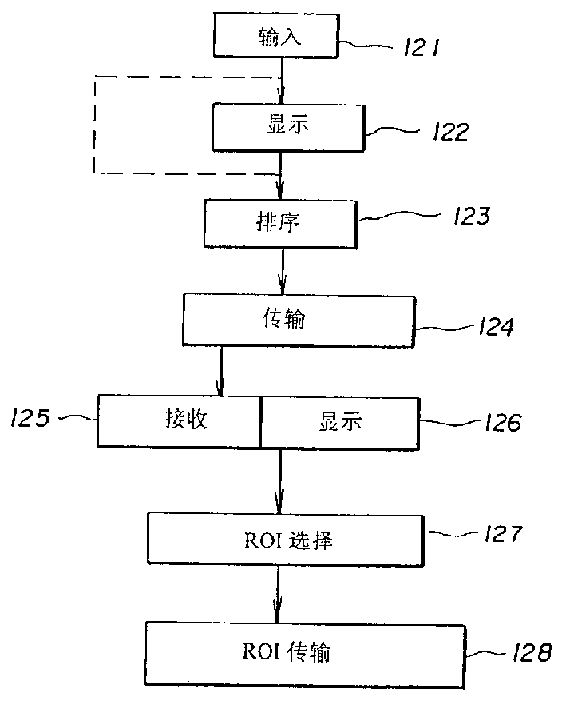
图11是一个框图,它说明了用于实施本发明的各环节,其中的ROI选择是在线完成的。Figure 11 is a block diagram illustrating the steps used to implement the present invention, wherein ROI selection is done on-line.
优选实施例的详细描述:Detailed description of the preferred embodiment:
本发明的目的是一种完成静止图象压缩的方法和装置,其中处于传输方的用户可以在编码处理前指定在他或她看来是重要的区域,或者是其中处于接收方的用户能够根据正在收到的比特流来确定感兴趣区域,并在其后的编码过程中标识所需区域,以加重感兴趣区域。在第一种情况下,由在传输方的用户确认ROI,编码可以离线完成。当由在接收方的用户标识ROI时,则编码必须在线完成。The object of the present invention is a method and apparatus for performing still image compression, wherein the user on the transmitting side can designate areas that are important to him or her before the encoding process, or wherein the user on the receiving side can The region of interest is determined by the bitstream being received, and the desired region is identified in the subsequent encoding process to emphasize the region of interest. In the first case, the encoding can be done offline by the user at the transmitting side confirming the ROI. When the ROI is identified by the user at the recipient, then the encoding must be done online.
当ROI被确定后,压缩方法或算法只对相应于ROI中数据的子波变换系按比例加以放大。压缩方法可以是,举例来说,塞德和皮尔曼的SPIHT方法;为便于进行本描述,将使用SPIHT方法作为例子,但是不应因此而理解为本发明受限于SPIHT应用。前面讨论过的按比例放大是由选定的系数来完成的,这些系数通过一定数目的左位移位而被给予较高的优先级,每一左位移位对应于在每个子带上按比例放大一次或在位数值上增加两倍。左移位数目越大,则对于WT系数加重程度越高,ROI重建的速度增加也就越显著。因此根据本发明,编码器或解码器可以选择感兴趣区域,并控制感兴趣区域重建的速度,或是该感兴趣区域与图像其余部分相比受到额外加重的程度。关于本发明,如图4所示,使用SPIHT型的压缩方法,排序传送作业以起始值或者说n=N的阈值开始。这一方法要求进行N+1次传送来为整个图像编码,使其达到最高的保真度(当子波分解是通过整数变换完成时,则是无损失的)。在完成了编码方法的P次传送(P=0,1,…,N)并且发送了结果输出后,编码器或者解码器标识感兴趣区域,相应的WT系数左位移位S位。应当注意到,P=0相应于由编码器来确定感兴趣区域的情况。因此,S的大数值结果使得感兴趣区域快速无损失重建。S的较低数值则会导致对于感兴趣区域来说较小幅度的速度增加,但也导致对于图像剩余部分的更好的重建,或者是提供了更好的整体速率失真性能。因此通过控制S值,用户就可以控制感兴趣区域相对于图像剩余部分的重要性水平。After the ROI is determined, the compression method or algorithm only scales up the wavelet transform system corresponding to the data in the ROI. The compression method may be, for example, the SPIHT method of Seid and Perelman; for the convenience of this description, the SPIHT method will be used as an example, but it should not be construed as limiting the invention to SPIHT applications. The scaling up discussed earlier is accomplished by selecting coefficients that are given higher priority by a certain number of left shifts, each corresponding to a shift in each subband by Scale up once or double the bit value. The larger the number of left shifts, the higher the degree of emphasis on WT coefficients, and the more significant the speed of ROI reconstruction will be. Thus according to the present invention, an encoder or a decoder can select a region of interest and control the speed at which the region of interest is reconstructed, or the degree to which this region of interest is extra emphasized compared to the rest of the image. With regard to the present invention, as shown in FIG. 4, using a compression method of the SPIHT type, the sort transfer job starts with a starting value or a threshold of n=N. This method requires N+1 passes to encode the entire image to the highest fidelity (lossless when the wavelet decomposition is done by an integer transform). After completing P passes (P=0, 1, ..., N) of the encoding method and sending the resulting output, the encoder or decoder identifies the region of interest and the corresponding WT coefficients are shifted left by S bits. It should be noted that P=0 corresponds to the case where the region of interest is determined by the encoder. Therefore, large values of S result in fast and lossless reconstruction of regions of interest. Lower values of S result in a smaller velocity increase for the region of interest, but also result in a better reconstruction of the rest of the image, or provide better overall rate-distortion performance. So by controlling the S value, the user can control the importance level of the region of interest relative to the rest of the image.
图4说明了在象SPIHT这样的一种压缩方法中,本发明的ROI编码。编码之前,或是在编码进行当中,在方框400进行ROI选择。ROI选择后,在方框401,对于给定阈值水平,将ROI系数按比例增大。在方框402和403,分别完成对于ROI图像数据的排序传送和改进传送。在方框404,根据设定阈值来确定是否传送数量已经达到。如果传送数量未尚未达到,则进行进一步的排序和改进。如果传送数量已经完成,则在方框405确定是否ROI数据已经被完全重建了。如果还没有,则对后续的ROI图像数据进行相关的排序和改进。如果ROI已经完成,则在方框406对于图像数据的其余部分作排序和改进传送。排序和改进是根据最大阈限水平N,ROI编码起初的阈限水平k和左位移位值S来进行的。Figure 4 illustrates the ROI encoding of the present invention in a compression method like SPIHT. Before encoding, or during encoding, ROI selection is performed at block 400 . After ROI selection, at block 401, the ROI coefficients are scaled up for a given threshold level. In blocks 402 and 403, sorted transfer and improved transfer for ROI image data are completed, respectively. At block 404, it is determined based on a set threshold whether the number of transfers has been reached. If the number of transfers has not yet been reached, further sequencing and refinement is performed. If the transfer quantity has been completed, then at block 405 it is determined whether the ROI data has been fully reconstructed. If not, perform relevant sorting and improvement on subsequent ROI image data. If the ROI is complete, at block 406 the remainder of the image data is sequenced and improved for delivery. Sorting and refinement are performed according to the maximum threshold level N, the initial threshold level k of ROI coding and the left shift value S.
换言之,假定完成了P次传送,则感兴趣区域与S值一同被选定,并且选定的ROI和S值被反馈给编码器。在P=0的情况下,编码器选择ROI和S,编码可以在离线或在线状态下进行。所有与感兴趣区域有关的WT系数(ROI系数)随后被标识,并向左移位S位。当前的重要性阈值n从当前值(N-P)增加为(N-P+S)。然后重新开始对ROI系数的编码,继续进行S次传送直至重要性阈值n=N-P。对于所有WT系数的编码则要继续进行,直到阈值n<0。应当注意到感兴趣区域的实际形状或轮廓是任意的,只要总的感兴趣区域可描述为或确定为许多相邻矩形或是由许多相邻矩形组成的不相邻的集合即可。感兴趣区域可以是单独一块感兴趣区域,也可以是能够以这里讨论的同样方法处理的许多块感兴趣区域。In other words, assuming that P transfers are done, the region of interest is selected together with the S value, and the selected ROI and S value are fed back to the encoder. In the case of P=0, the encoder selects ROI and S, and encoding can be performed offline or online. All WT coefficients (ROI coefficients) related to the region of interest are then identified and shifted left by S bits. The current importance threshold n is increased from the current value (N-P) to (N-P+S). Then restart the encoding of the ROI coefficients, and continue to perform S transmissions until the importance threshold n=N-P. The encoding of all WT coefficients will continue until the threshold n<0. It should be noted that the actual shape or outline of the region of interest is arbitrary as long as the overall region of interest can be described or determined as a number of adjacent rectangles or a non-adjacent set of many adjacent rectangles. A region of interest can be a single region of interest, or it can be many regions of interest that can be processed in the same way as discussed here.
换言之,一旦选定一个感兴趣区域,与该感兴趣区域重建相关的WT系数即可在子波变换域中被标识,而且只有这些WT系数被根据一种压缩方法进行编码/解码,这种压缩方法经过修改后,集中对这些特定系数进行编码/解码。因此,与SPIHT这样的压缩方法的具有最高优先级的系数相比,这些相关系数要在更早的阈值循环或更早的通路中被编码/解码。通过从图像域到WT系数域的逆子波变换的反向跟踪对ROI系数进行标识。逆子波变换将WT系数域中的图像表达转换为在图像域中的图像数据。图像中的一个像素是通过逆子波变换,以一对WT系数来重建的。因此,一旦在图像域中指定感兴趣区域,相应的WT系数,也称为ROI系数,即通过从图像域到WT域的逆子波变换的反向跟踪而被标识。In other words, once a region of interest is selected, the WT coefficients related to the reconstruction of the region of interest can be identified in the wavelet transform domain, and only these WT coefficients are encoded/decoded according to a compression method that The method is modified to focus encoding/decoding on these specific coefficients. Therefore, these correlated coefficients are coded/decoded in an earlier threshold cycle or earlier pass than the highest priority coefficients of a compression method like SPIHT. ROI coefficients are identified by backtracking from the image domain to the inverse wavelet transform of the WT coefficient domain. The inverse wavelet transform converts the image representation in the WT coefficient domain to image data in the image domain. A pixel in the image is reconstructed with a pair of WT coefficients by inverse wavelet transform. Therefore, once a region of interest is specified in the image domain, the corresponding WT coefficients, also called ROI coefficients, are identified by backtracking the inverse wavelet transform from the image domain to the WT domain.
上面讨论的左移位指的是通过左位移位使WT系数按比例增大,每次左位移位相应于放大2倍、4倍、8倍等等,依已知二进制而定。SPIHT编码算法这样的常规方法是从所有系数的最高非零位域(MSB)到最低有效位(LSB)来处理WT系数。依照从MSB到LSB的路径顺序逐位扫描所有系数,即以一种可比方法取得了信息排序。在根据本发明对感兴趣区域编码时,通过将与感兴趣区域有关的WT系数按比例增大而使信息排序,从而使这些系数可以在较早的通路或循环中被处理或访问,因此,将这些ROI系数置于编码比特流中的较前部分。左位移位越大,则在这一比特流中ROI系数所处的位置就越靠前。因此,左位移位的数值越高,则感兴趣区域的重建速度也就越高。The left shift discussed above means that the WT coefficient is increased proportionally by the left shift, and each left shift corresponds to a magnification of 2 times, 4 times, 8 times, etc., depending on the known binary. A conventional approach such as the SPIHT coding algorithm is to process the WT coefficients from the most non-zero bit field (MSB) to the least significant bit (LSB) of all coefficients. All coefficients are scanned bit by bit in the order of the path from MSB to LSB, ie information ordering is achieved in a comparable way. When encoding a region of interest according to the invention, the information is ordered by scaling up the WT coefficients related to the region of interest so that these coefficients can be processed or accessed in an earlier pass or cycle, thus, These ROI coefficients are placed earlier in the coded bitstream. The larger the left shift, the higher the position of the ROI coefficient in this bit stream. Therefore, the higher the value of the left shift, the higher the reconstruction speed of the region of interest.
当一个感兴趣区域以无损失方式重建时,在重建的感兴趣区域没有主观和客观损失。图像重建的无损失量是建立在子波变换基础上的,压缩方法以这一子波变换来产生编码比特流。这一编码比特流产生各种比特速率的图像。包括保证总图像的无损失性的图像。但是,如果在无损失性得到保证前编码或解码进程即行终止,则这一重建即要被认为是一个“有损失”重建。编码进程终止时的比特速率越低,则重建结果的损失就越多。因此,如果对感兴趣区域系数的编码早早即被终止,则即使与感兴趣区域以外的区域相比,对感兴趣区域的加重程度更高,感兴趣区域的重建结果也是有损失的。When a region of interest is reconstructed in a lossless manner, there is no subjective and objective loss in the reconstructed region of interest. The lossless amount of image reconstruction is based on the wavelet transform used by the compression method to generate the coded bit stream. This encoded bit stream produces images at various bit rates. Includes images that guarantee the losslessness of the total image. However, if the encoding or decoding process is terminated before losslessness is guaranteed, the reconstruction is considered a "lossy" reconstruction. The lower the bit rate at which the encoding process terminates, the more lossy the reconstruction results. Therefore, if the encoding of the coefficients of the region of interest is terminated early, the reconstruction result of the region of interest is lossy even if the region of interest is emphasized more than the regions outside the region of interest.
应当注意到,甚至当子波变换不是整数对整数映射类型的子波变换时,例如通常被称为子带分解的浮点对浮点映射类型的整数变换,QMF,等等,根据本发明所作的感兴趣区域编码仍然能够以上面讨论的方式工作,由于子波变换以及相应的量化过程产生某些不可补救损失,从而导致重建结果不再能被认为是无损失的情况则属例外。但是如果假定子波变换系数的量化结果对应于图像中的原始信息,那么使用这种类型子波变换的本发明的ROI编码系统就可被认为在这种构形下是无损失的。不过,如果对于非整数子波变换方法无法取得实际无损失性,则除非使用整数变换,本权利要求的方法可认为是一种最高保真度的编码方法而非无损失编码方法。It should be noted that even when the wavelet transform is not a wavelet transform of the integer-to-integer mapping type, such as a floating-point-to-floating-point mapping type of integer transform commonly referred to as subband decomposition, QMF, etc., according to the present invention The region-of-interest coding for , can still work in the manner discussed above, except for cases where the reconstruction result can no longer be considered lossless due to some irremediable losses from the wavelet transform and the corresponding quantization process. But if it is assumed that the quantization result of the wavelet transform coefficients corresponds to the original information in the image, then the inventive ROI coding system using this type of wavelet transform can be considered lossless under this configuration. However, if practically lossless is not achievable for non-integer wavelet transform methods, then unless integer transforms are used, the claimed method may be considered a highest fidelity encoding method rather than a lossless encoding method.
图5和图6是曲线图,说明对一幅512×512的图像的完成情况,其感兴趣区域由图7的矩形部分加以说明。这个感兴趣区域是一个128×128的方块,包含一部分图像。再参见图5,可看到感兴趣区域的无损失重建速度作为左位移值S的数量的函数而变化。该图表明了在两个不同P值,即P=0和P=7下的结果。图6表明了同样在P=0和P=7情况下,在感兴趣区域无损失重建时,整个图像重建的最大信噪比(PSNR)性能。对于一个确定的P值,在感兴趣区域无损失重建时,对应于给定值S的每个点都与重建PSNR和总比特速率相对应。图7是一张照片,说明本发明使用SPIHT算法,在P=7下,在0.86bbp时PSNR为28.80dB。图8是有着和图7同样的感兴趣区域的同一张照片的无损失重建的照片,重建时P=7,S=7。这幅图像在0.389bpp时PSNR为29.22dB。当S=5时,这个感兴趣区域的重建可在0.710bpp下产生,其PSNR为35.69dB。当S=0(即无确定的感兴趣区域),整个图像的无损失重建在4.378bpp下完成,这与S=7时的情况相比,总比特速率大约要慢一个数量级。因此这些图说明,根据本发明建立的感兴趣区域编码技术为嵌入式的ROI图像编码提供了高效并且灵活的系统,可适用于从各种不同水平的有损失编码直至无损失的ROI图像编码。感兴趣区域的无损失重建和图像其余部分的高效或“无主观损失”重建可在较小比特速率下完成,该比特速率比整个图像的无损失重建所需的速率要小3-4倍。Figures 5 and 6 are graphs illustrating the completion of a 512 x 512 image with the region of interest illustrated by the rectangular portion of Figure 7 . This ROI is a 128×128 box containing a portion of the image. Referring again to FIG. 5 , it can be seen that the speed of lossless reconstruction of the region of interest varies as a function of the number of left shift values S . The figure shows the results at two different P values, P=0 and P=7. Fig. 6 shows the maximum signal-to-noise ratio (PSNR) performance of the entire image reconstruction when the region of interest is reconstructed without loss under the same conditions of P=0 and P=7. For a certain value of P, each point corresponding to a given value of S corresponds to the reconstructed PSNR and total bit rate when the region of interest is reconstructed without loss. Fig. 7 is a photo illustrating that the present invention uses the SPIHT algorithm, under P=7, the PSNR is 28.80dB at 0.86bbp. Fig. 8 is a lossless reconstructed photo of the same photo with the same region of interest as Fig. 7, P=7, S=7 during reconstruction. This image has a PSNR of 29.22dB at 0.389bpp. When S=5, the reconstruction of this region of interest can be produced at 0.710 bpp with a PSNR of 35.69 dB. When S=0 (that is, there is no determined ROI), the lossless reconstruction of the entire image is completed at 4.378 bpp, which is about an order of magnitude slower in total bit rate compared with the case of S=7. These figures thus illustrate that the ROI coding technique established according to the present invention provides an efficient and flexible system for embedded ROI image coding, applicable from various levels of lossy coding to lossless ROI image coding. Lossless reconstruction of the region of interest and efficient or "subjective lossless" reconstruction of the rest of the image can be accomplished at a bit rate that is 3-4 times smaller than would be required for lossless reconstruction of the entire image.
图9(a)和图9(b)说明了相应于根据本发明的编码方法和装置的速率失真损失。这些图是整个图像的以dB为单位的PSNR与以bpp为单位的总比特速率的性能曲线的图,对应于P=7,S=2以及P=7,S=5时的情况。实线表示常规SPIHT算法的性能,对应于S=2和S=5的改进算法则用“+”和“o”表示。可以看出直到0.086bpp的比特速率为止,所有三种编码方案都是相同的,而在高于0.086bpp的比特速率下,S较大的方案与常规SPIHT方法相比,显示出了较大的速率失真损失,但也取得了更快的感兴趣区域的无损失重建。S=2的方案非常接近于SPIHT结果。FIG. 9(a) and FIG. 9(b) illustrate the rate-distortion loss corresponding to the encoding method and apparatus according to the present invention. These figures are performance curves of PSNR in dB versus total bit rate in bpp for the entire picture, corresponding to the cases P=7, S=2 and P=7, S=5. The solid line represents the performance of the conventional SPIHT algorithm, and the improved algorithm corresponding to S=2 and S=5 is represented by "+" and "o". It can be seen that up to a bit rate of 0.086 bpp, all three encoding schemes are identical, while at bit rates above 0.086 bpp, the scheme with larger S shows a larger rate-distortion loss, but also achieves faster lossless reconstruction of regions of interest. The scheme with S=2 is very close to the SPIHT results.
上面讨论的方法涵盖了许多用于图像压缩的实施例,其中感兴趣区域的选择既可在编码之前离线状态下,也可以在线方式在编码进行当中完成,当在传输当中(在线)选择感兴趣区域时,这一选择可在接收方完成。此时接收方对编码或传输方发送关于感兴趣区域的信息,排序和优先级划分过程即被相应地调整。如果编码方包括有一个可在传输或存储数据前模拟解码过程的本地解码器,则在线选择也可由编码方完成。本发明可在一个计算机系统上具体实施,该系统包括有一台显示器,一个中央处理器,内存以及相应的通信装置,诸如一台调制解调器和一条电话线等等。该通信装置的配置可以提供用于输入数字图像数据的输入装置,以使显示装置能够显示数字图像数据。可配置这个计算机系统,使得一个选择设备或选择装置可连接至显示器上以选择感兴趣区域。可将一个排序和优先级划分装置或设备连接至选择装置上,以根据至少两种优先级类别对于数字图像进行排序和优化,与对应于感兴趣区域之外的数字图像数据相比,对应于感兴趣区域的数字图像数据在这一过程中被给予更高的优先级。通信电路或装置可以作为传输装置工作,将经过排序或优先级划分的数据传输到一个远端位置,而传输装置则以比感兴趣区域以外的区域更高的优先级来传输对应于感兴趣区域的数字图像数据。传输过去的数据由一台接收计算机所接收,该接收计算机要包括接收装置或设备来接收传输数据,以及重建装置来重建传输数据,重建装置要包括一个解码装置,用于为排序和优先级划分后的数字图像数据解码。感兴趣区域由重建装置来重建,其速率高于对应于感兴趣区域以外的区域的数字图像数据。还有一个替代方法,即感兴趣区域能够以比感兴趣区域之外区域更高的保真度来重建。The method discussed above covers many embodiments for image compression, where the selection of the region of interest can be done offline before encoding, or can be done in the process of encoding in an online manner, when the region of interest is selected during transmission (online) This selection can be done at the receiver when the zone is selected. At this point the receiver sends information about the region of interest to the encoding or transmitting side, and the sorting and prioritization process is adjusted accordingly. Online selection can also be done by the encoder if the encoder includes a local decoder that simulates the decoding process before transmitting or storing the data. The present invention can be embodied on a computer system including a display, a central processing unit, memory and corresponding communication means, such as a modem and a telephone line. The configuration of the communication device may provide an input device for inputting digital image data so that the display device can display the digital image data. The computer system can be configured such that a selection device or selection means can be connected to the display to select the region of interest. A sorting and prioritization means or device may be connected to the selection means for sorting and optimizing the digital images according to at least two priority categories corresponding to digital image data outside the region of interest as compared to digital image data corresponding to Digital image data of the region of interest is given higher priority in this process. The communication circuit or device may operate as a transmitting device to transmit sorted or prioritized data to a remote location, and the transmitting device transmits data corresponding to the area of interest with a higher priority than areas outside the area of interest. digital image data. The transmitted data is received by a receiving computer that includes receiving means or equipment for receiving the transmitted data and reconstruction means for reconstructing the transmitted data, the reconstruction means including a decoding means for ordering and prioritizing after decoding the digital image data. The region of interest is reconstructed by the reconstruction means at a higher rate than the digital image data corresponding to regions outside the region of interest. Yet another alternative is that regions of interest can be reconstructed with higher fidelity than regions outside the region of interest.
感兴趣区域编码起始的阈值或通路可在对总图像的排序传送开始时,或在排序传送进行当中确定;还可以在改进传送开始时或进行当中确定;或是在整个编码过程开始时确定。如果在整个编码过程开始时确定,则这一操作可以离线方式完成。在一次排序或改进传送开始时完成的ROI选择则是一个交互式的或是在线的选择。换言之,在n等于ROI编码水平的情况下,ROI系数按比例增大,对于n=k+s;n>k则进行排序传送和改进传送。The threshold or path for the start of encoding of the region of interest can be determined at the beginning of the sorting transmission of the total image, or during the sorting transmission; it can also be determined at the beginning or during the improvement transmission; or at the beginning of the entire encoding process . This can be done offline if determined at the beginning of the entire encoding process. ROI selection done at the beginning of a sequencing or refinement transfer is an interactive or online selection. In other words, when n is equal to the coding level of the ROI, the ROI coefficient increases proportionally, and for n=k+s; n>k, sorting transmission and improved transmission are performed.
相应于本发明的系统的另一个选择的实施例可以是这样情况:其感兴趣区域的选择基于部分重建图像来进行,该部分重建图象是接收器在传输装置开始其传输后所接收到的。根据这部分重建图像,接收端的用户可选择感兴趣区域,然后由接收器向传输计算机发送标识所选感兴趣区域的数据。传输计算机随后根据所选感兴趣区域修改数字图像数据的排序。对应于这一感兴趣区域的数字图像数据与感兴趣区域以外的数字图像数据相比,被排序和优先级划分以具有更高的优先级。经过修改排序和优化的数据随后被传输到接收器,感兴趣区域以较感兴趣区域之外区域更高的优先级被传输。为具备执行以上确定的操作的装置,计算机单元的特定配置可由此技术领域中的熟练人员根据包含在技术规格中的信息来完成。Another optional embodiment of the system according to the invention may be the case that the selection of its region of interest is performed on the basis of a partially reconstructed image which the receiver receives after the transmission device has started its transmission . From this partially reconstructed image, a user at the receiving end can select a region of interest, and the receiver sends data identifying the selected region of interest to the transmitting computer. The transmitting computer then modifies the ordering of the digital image data according to the selected region of interest. Digital image data corresponding to this region of interest is sorted and prioritized to have a higher priority than digital image data outside the region of interest. The modified sorted and optimized data is then transmitted to the receiver, with regions of interest being transmitted with higher priority than regions outside the region of interest. To provide means for carrying out the operations identified above, the specific configuration of the computer unit can be done by a person skilled in the art from the information contained in the technical specifications.
图10是一个框图,它说明了在ROI选择由编码方完成的情况下,实施本发明的一系列环节。输入装置或输入设备110用于将数字图像数据输入到计算机或数据处理装置中。显示装置或设备111显示数字图像数据,选择装置112连接到显示设备上,用于选择由数字图像数据所表示的图像的一个区域。排序和优先级划分装置113连接到选择装置112上,根据至少两个优先级类别对数字图像数据进行排序和优先级划分。所选感兴趣区域的数据与对应于感兴趣区域以外区域的数字图像数据相比,被给予了更高的优先级。传输装置114将经过排序和优先级划分的数据传输到一个远程位置,这个远程位置可以为一个大容量存储器装置,互联网或网内网这样的网络,广域网络,局域网络,等等。传输过去的数据由接收装置115所接收,在这里由具备解码装置117的重建装置116来重建传输来的数字图像数据,其中与对应于感兴趣区域之外区域的数字图像数据相比,感兴趣区域要以更快的速度以及/或者更高的保真度重建。Fig. 10 is a block diagram illustrating a series of steps in implementing the present invention under the condition that ROI selection is completed by the coding side. The input means or
图11为一个框图,它说明以在线方式进行的感兴趣区域选择过程。输入装置或输入设备121将数字图像数据输入到一台计算机或是其它图像数据处理装置中。数字图像随后可被任选地显示在显示装置122上,或者作为替代方式,可直接与排序装置或排序设备123进行通信。排序装置根据一个数学排序协议为数字图像数据排序,使得数字图像数据按照预定的优先级划分公式被排序和优先级划分。传输设备或传输装置124将经过排序的数据传输出去,然后排序装置再重复对数字图像数据的排序,传输装置也重复对数据的传输。这些数据由一台接收装置125所接收,而该装置有显示装置126与其相连。在传输过程中,这台显示装置将传输来的数据显示为部分重建的图像。图像的重建随着排序装置和传输装置重复其排序和传输而进行。感兴趣区域选择装置127连接到接收装置125上,以便根据部分重建的图像选择感兴趣区域。在选择了感兴趣区域后,一台感兴趣区域传输装置或设备128将对应于所选感兴趣区域的数据传输到排序装置123。排序装置根据对应于所选感兴趣区域的数据而修改数字图像数据的排序。经过排序装置的排序和优先级划分后,对应于所选感兴趣区域的数字图像数据与对应于所选感兴趣区域之外区域的数字图像数据相比,具有更高的优先级。Figure 11 is a block diagram illustrating the region of interest selection process performed in an on-line manner. Input device or input device 121 inputs digital image data into a computer or other image data processing device. The digital image may then optionally be displayed on a display device 122 or, alternatively, may be communicated directly with a ranking device or device 123 . The sorting device sorts the digital image data according to a mathematical sorting protocol, so that the digital image data is sorted and prioritized according to a predetermined prioritization formula. The transmission device or transmission device 124 transmits the sorted data, and then the sorting device repeats the sorting of the digital image data, and the transmission device also repeats the transmission of the data. These data are received by a receiving device 125 to which a display device 126 is connected. During the transmission, the display unit displayed the transmitted data as a partially reconstructed image. The reconstruction of the images takes place as the ordering means and the transmission means repeat their ordering and transmission. A region of interest selection means 127 is connected to the receiving means 125 for selecting a region of interest based on the partially reconstructed image. After the ROI is selected, a ROI transmitting means or device 128 transmits the data corresponding to the selected ROI to the sorting means 123 . The ranking means modifies the ranking of the digital image data according to the data corresponding to the selected region of interest. After being sorted and prioritized by the sorting device, the digital image data corresponding to the selected region of interest has a higher priority than the digital image data corresponding to regions other than the selected region of interest.
本发明以计算机软件的形式具体实施在一个计算机可读存储介质上,这个计算机可读存储介质包括软盘和大容量存储设备,如硬盘驱动器、DRAM、CD-ROM,等等。该计算机软件控制一台通用计算机以完成以上所述的方法步骤。The present invention is embodied in the form of computer software on a computer readable storage medium including floppy disks and mass storage devices such as hard disk drives, DRAM, CD-ROM, and the like. The computer software controls a general purpose computer to perform the method steps described above.
如以上所讨论的,本发明被应用于一台传输计算机或设备上,数据被发送到一台接收器或一台解码装置。本发明可包括这样的配置:在该配置中,在一台计算机上完成编码;经过编码的图像数据被传输到互联网上用于互联网浏览;解码则在另一台从互联网上检索信息的计算机上进行。编码器和解码器也可配置在一个局域网(LAN)上,或是广域网(WAN)、网中网上,也可在一台计算机和一台大容量存储装置之间进行编码和解码。因此其用途实际上可包括任何必须进行图像数据传输或存储的应用,包括远程医疗和一般图像存档及检索。依据本发明的感兴趣区域编码方法和装置解决了在这些应用中存在的瓶颈问题。As discussed above, the present invention is applied to a transmitting computer or device, and data is sent to a receiver or a decoding device. The invention may include configurations in which encoding is done on one computer; encoded image data is transmitted to the Internet for Internet viewing; decoding is on another computer that retrieves information from the Internet conduct. The encoder and decoder can also be configured on a local area network (LAN), or a wide area network (WAN), or a network within a network, and can also encode and decode between a computer and a mass storage device. So its use can include virtually any application where image data transfer or storage is necessary, including telemedicine and general image archiving and retrieval. The ROI coding method and device according to the present invention solve the bottleneck problem existing in these applications.
本发明的以上描述仅用于说明目的。应当认识到,可以用其它的压缩方法来利用依据本发明而进行感兴趣区域的选择和重建,而且以上所披露的各种装置也有着许许多多的等效物,而对于一个具备这方面技术的人来说,这些等效物是在其了解范围内的。本发明的界定和范围在随附的权利要求中明确说明。The above description of the invention has been presented for illustrative purposes only. It should be recognized that other compression methods can be used to utilize the selection and reconstruction of the region of interest according to the present invention, and the various devices disclosed above also have many equivalents, and for a person with this technology Those equivalents are within their understanding. The delimitation and scope of the invention are set forth explicitly in the appended claims.
Claims (20)
Applications Claiming Priority (1)
| Application Number | Priority Date | Filing Date | Title |
|---|---|---|---|
| PCT/US1998/003811 WO1999049413A1 (en) | 1998-03-20 | 1998-03-20 | Lossy/lossless region-of-interest image coding |
Related Child Applications (1)
| Application Number | Title | Priority Date | Filing Date |
|---|---|---|---|
| CNB2004100747088A Division CN100481946C (en) | 1998-03-20 | 1998-03-20 | Method and device for coding, decoding and compressing image |
Publications (2)
| Publication Number | Publication Date |
|---|---|
| CN1291315A CN1291315A (en) | 2001-04-11 |
| CN1175373C true CN1175373C (en) | 2004-11-10 |
Family
ID=22266476
Family Applications (2)
| Application Number | Title | Priority Date | Filing Date |
|---|---|---|---|
| CNB988139065A Expired - Lifetime CN1175373C (en) | 1998-03-20 | 1998-03-20 | Method and system for lossy/lossless region of interest image coding |
| CNB988139057A Expired - Lifetime CN1231863C (en) | 1998-03-20 | 1998-09-15 | Method and apparatus for compressing and decompressing image |
Family Applications After (1)
| Application Number | Title | Priority Date | Filing Date |
|---|---|---|---|
| CNB988139057A Expired - Lifetime CN1231863C (en) | 1998-03-20 | 1998-09-15 | Method and apparatus for compressing and decompressing image |
Country Status (7)
| Country | Link |
|---|---|
| EP (6) | EP1062625A4 (en) |
| JP (1) | JP3597780B2 (en) |
| KR (2) | KR100550105B1 (en) |
| CN (2) | CN1175373C (en) |
| AU (2) | AU6441398A (en) |
| DE (2) | DE69842100D1 (en) |
| WO (2) | WO1999049413A1 (en) |
Families Citing this family (68)
| Publication number | Priority date | Publication date | Assignee | Title |
|---|---|---|---|---|
| SE512291C2 (en) * | 1997-09-23 | 2000-02-28 | Ericsson Telefon Ab L M | Embedded DCT-based still image coding algorithm |
| JP2001293915A (en) * | 2000-04-14 | 2001-10-23 | Canon Inc | Printing apparatus, control method therefor, and computer-readable memory |
| JP2002064709A (en) * | 2000-06-06 | 2002-02-28 | Canon Inc | Image processing apparatus and method, computer program and storage medium therefor |
| JP2001359117A (en) * | 2000-06-15 | 2001-12-26 | Canon Inc | Image processing apparatus and image processing method in the apparatus |
| JP4615105B2 (en) * | 2000-09-07 | 2011-01-19 | ジーイー・メディカル・システムズ・グローバル・テクノロジー・カンパニー・エルエルシー | Ultrasound imaging device |
| FR2815748B1 (en) * | 2000-10-20 | 2003-01-24 | Canon Kk | METHOD AND DEVICE FOR PROCESSING AND DECODING A CODE DIGITAL SIGNAL |
| FR2816138B1 (en) * | 2000-10-27 | 2003-01-17 | Canon Kk | DECODING OF DIGITAL DATA |
| DE10291291D2 (en) * | 2001-03-27 | 2004-04-15 | Voxar Ag | Method and device for transmitting video and / or audio data |
| AUPR432701A0 (en) * | 2001-04-10 | 2001-05-17 | Lions Eye Institute Of Western Australia Incorporated, The | Virtual service system for client and service provider users and method therefor |
| JP5388393B2 (en) * | 2001-04-27 | 2014-01-15 | キヤノン株式会社 | Image processing apparatus, image processing method, and control program |
| FR2826227B1 (en) | 2001-06-13 | 2003-11-28 | Canon Kk | METHOD AND DEVICE FOR PROCESSING A CODE DIGITAL SIGNAL |
| FR2827409B1 (en) * | 2001-07-10 | 2004-10-15 | France Telecom | WAVELLET-BASED IMAGE CODING PROCESS ALLOWING ADAPTIVE TRANSMISSION OF WAVELLET COEFFICIENTS, SYSTEM SIGNAL AND CORRESPONDING DEVICES |
| KR100440953B1 (en) * | 2001-08-18 | 2004-07-21 | 삼성전자주식회사 | Method for transcoding of image compressed bit stream |
| US6882755B2 (en) * | 2001-10-19 | 2005-04-19 | Hewlett-Packard Development Company, L.P. | Image transmission for low bandwidth with region of interest |
| GB2382940A (en) | 2001-11-27 | 2003-06-11 | Nokia Corp | Encoding objects and background blocks |
| KR20020008101A (en) * | 2001-12-12 | 2002-01-29 | 주식회사 애니콤소프트웨어 | Constriction method of data with bits index |
| US7106366B2 (en) | 2001-12-19 | 2006-09-12 | Eastman Kodak Company | Image capture system incorporating metadata to facilitate transcoding |
| KR100460947B1 (en) * | 2002-01-16 | 2004-12-09 | 삼성전자주식회사 | Device for processing image signal and method thereof |
| US7174050B2 (en) * | 2002-02-12 | 2007-02-06 | International Business Machines Corporation | Space-optimized texture maps |
| WO2003075579A2 (en) * | 2002-03-05 | 2003-09-12 | Koninklijke Philips Electronics N.V. | Method and system for layered video encoding |
| US7228000B2 (en) | 2002-03-15 | 2007-06-05 | Ricoh Co., Ltd. | Image data generation with reduced amount of processing |
| EP1349393A1 (en) | 2002-03-15 | 2003-10-01 | Ricoh Company | Image compression device, image decompression device, image compression/decompression device, program for executing on a computer to perform functions of such devices, and recording medium storing such a program |
| US20040022447A1 (en) * | 2002-07-31 | 2004-02-05 | General Electric Company | Method and system for image compression and decompression using span of interest of an imaging sequence |
| JP4003945B2 (en) | 2002-08-26 | 2007-11-07 | 株式会社リコー | Image processing apparatus, image processing method, program, and storage medium |
| JP4135888B2 (en) | 2002-09-18 | 2008-08-20 | 株式会社リコー | Image processing apparatus, image processing method, program, and storage medium |
| GB0227743D0 (en) | 2002-11-28 | 2003-01-08 | Rolls Royce Plc | Wavelet compression |
| CN1655620B (en) | 2004-02-09 | 2010-09-22 | 三洋电机株式会社 | Image display device |
| US9510005B2 (en) * | 2004-05-13 | 2016-11-29 | Koninklijke Philips N.V. | Method and device for encoding blocks of values |
| CN102790880B (en) * | 2004-06-15 | 2015-04-08 | 思科技术公司 | Hybrid variable length coding method and apparatus for video compression |
| US7720295B2 (en) | 2004-06-29 | 2010-05-18 | Sanyo Electric Co., Ltd. | Method and apparatus for coding images with different image qualities for each region thereof, and method and apparatus capable of decoding the images by adjusting the image quality |
| US7747095B2 (en) * | 2004-10-08 | 2010-06-29 | Nvidia Corporation | Methods and systems for rate control in image compression |
| JP2006129248A (en) * | 2004-10-29 | 2006-05-18 | Sanyo Electric Co Ltd | Image encoding and decoding method and apparatus thereof |
| JP4656912B2 (en) | 2004-10-29 | 2011-03-23 | 三洋電機株式会社 | Image encoding device |
| US8768084B2 (en) | 2005-03-01 | 2014-07-01 | Qualcomm Incorporated | Region-of-interest coding in video telephony using RHO domain bit allocation |
| US8693537B2 (en) | 2005-03-01 | 2014-04-08 | Qualcomm Incorporated | Region-of-interest coding with background skipping for video telephony |
| US8019175B2 (en) | 2005-03-09 | 2011-09-13 | Qualcomm Incorporated | Region-of-interest processing for video telephony |
| US8977063B2 (en) | 2005-03-09 | 2015-03-10 | Qualcomm Incorporated | Region-of-interest extraction for video telephony |
| CN101171841B (en) * | 2005-03-09 | 2012-06-27 | 高通股份有限公司 | Region-of-interest extraction for video telephony |
| CN100425066C (en) * | 2005-09-23 | 2008-10-08 | 逐点半导体(上海)有限公司 | image compression method |
| GB2456593B (en) * | 2005-12-28 | 2011-07-13 | Intel Corp | A novel user sensitive information adaptive video transcoding framework |
| KR100776822B1 (en) * | 2006-04-11 | 2007-11-19 | 고려대학교 산학협력단 | Stereo residual image coding method and apparatus therefor |
| KR101368120B1 (en) | 2006-05-25 | 2014-02-28 | 톰슨 라이센싱 | Method and system for weighted encoding |
| GB2447245B (en) * | 2007-03-05 | 2011-12-28 | Snell & Wilcox Ltd | Video transmission |
| CN101309259B (en) * | 2008-06-24 | 2012-07-11 | 广东威创视讯科技股份有限公司 | Distributed image display method |
| JP5364459B2 (en) * | 2009-06-15 | 2013-12-11 | オリンパス株式会社 | Image transmitting apparatus, image receiving apparatus, image transmitting method, image receiving method, and program |
| US10514541B2 (en) * | 2012-12-27 | 2019-12-24 | Microsoft Technology Licensing, Llc | Display update time reduction for a near-eye display |
| GB2512829B (en) | 2013-04-05 | 2015-05-27 | Canon Kk | Method and apparatus for encoding or decoding an image with inter layer motion information prediction according to motion information compression scheme |
| KR101489449B1 (en) * | 2013-04-16 | 2015-02-06 | 주식회사 비즈모델라인 | Adaptive RFID Device |
| US20150237351A1 (en) * | 2014-02-18 | 2015-08-20 | Penne Lee | Techniques for inclusion of region of interest indications in compressed video data |
| RU2557755C1 (en) * | 2014-02-25 | 2015-07-27 | Открытое акционерное общество "Центр судоремонта "Звездочка" | Method for image compression during fractal coding |
| CN105761212A (en) * | 2014-12-15 | 2016-07-13 | 南京理工大学 | Hadamard transform high sensitivity imaging method based on DMD encoding |
| RU2628122C1 (en) * | 2015-03-09 | 2017-08-15 | Открытое Акционерное Общество "Пеленг" | Method of hardware compressing digital image for shooting equipment of scanning type |
| CN106302564B (en) * | 2015-05-13 | 2019-08-06 | 宏碁股份有限公司 | File transmission method, device and system |
| JP2018182569A (en) * | 2017-04-14 | 2018-11-15 | 株式会社メガチップス | IMAGE PROCESSING APPARATUS, IMAGE PROCESSING SYSTEM, INFORMATION PROCESSING SYSTEM, AND IMAGE PROCESSING METHOD |
| KR101906066B1 (en) * | 2017-07-31 | 2018-10-08 | 서울과학기술대학교 산학협력단 | Method and apparatus for transmitting multiview image |
| EP3815368A1 (en) | 2018-06-28 | 2021-05-05 | Apple Inc. | Video encoding system |
| CN112335244B (en) | 2018-06-28 | 2022-12-23 | 苹果公司 | Priority-based video encoding and transmission |
| US11451788B2 (en) | 2018-06-28 | 2022-09-20 | Apple Inc. | Rate control for low latency video encoding and transmission |
| RU2723896C1 (en) * | 2018-11-06 | 2020-06-18 | Открытое Акционерное Общество "Пеленг" | Method for efficient encoding and decoding of a digital image |
| CN109168032B (en) * | 2018-11-12 | 2021-08-27 | 广州酷狗计算机科技有限公司 | Video data processing method, terminal, server and storage medium |
| US11216625B2 (en) | 2018-12-05 | 2022-01-04 | Vubiq Networks, Inc. | High bit density millimeter wave RFID systems, devices, and methods of use thereof |
| KR102391615B1 (en) * | 2020-03-16 | 2022-04-29 | 주식회사 카이 | Image processing method, video playback method and apparatuses thereof |
| CN112714323A (en) * | 2020-12-25 | 2021-04-27 | 人和未来生物科技(长沙)有限公司 | Medical image compression method and decoding method |
| CN113438444B (en) * | 2021-03-25 | 2023-04-28 | 贵州电网有限责任公司 | Picture transmission storage method and system |
| US12608904B2 (en) | 2022-08-25 | 2026-04-21 | Electronics And Telecommunications Research Institute | Method and apparatus for image preprocessing based on object of interest |
| TWI834503B (en) | 2023-02-24 | 2024-03-01 | 財團法人工業技術研究院 | Electronic device and method for selecting region of interest in image |
| CN116781916B (en) * | 2023-08-21 | 2023-11-17 | 北京中星微人工智能芯片技术有限公司 | Vehicle image storage method, apparatus, electronic device, and computer-readable medium |
| CN119835432A (en) * | 2025-01-07 | 2025-04-15 | 中国船舶集团有限公司第七〇九研究所 | Video encoding and decoding method and device |
Family Cites Families (8)
| Publication number | Priority date | Publication date | Assignee | Title |
|---|---|---|---|---|
| US4811210A (en) * | 1985-11-27 | 1989-03-07 | Texas Instruments Incorporated | A plurality of optical crossbar switches and exchange switches for parallel processor computer |
| FR2660139B1 (en) * | 1990-03-23 | 1995-08-25 | France Etat | ENCODING AND TRANSMISSION METHOD FOR AT LEAST TWO QUALITY LEVELS OF DIGITAL IMAGES BELONGING TO A SEQUENCE OF IMAGES, AND CORRESPONDING DEVICES. |
| US5805762A (en) * | 1993-01-13 | 1998-09-08 | Hitachi America, Ltd. | Video recording device compatible transmitter |
| US5563960A (en) * | 1993-01-22 | 1996-10-08 | David Sarnoff Research Center, Inc. | Apparatus and method for emphasizing a selected region in the compressed representation of an image |
| US5412741A (en) * | 1993-01-22 | 1995-05-02 | David Sarnoff Research Center, Inc. | Apparatus and method for compressing information |
| US5586200A (en) * | 1994-01-07 | 1996-12-17 | Panasonic Technologies, Inc. | Segmentation based image compression system |
| KR0171118B1 (en) * | 1995-03-20 | 1999-03-20 | 배순훈 | Apparatus for encoding video signal |
| US5748876A (en) * | 1995-12-29 | 1998-05-05 | Mci Communications Corporation | System and method for testing acoustic modems with semantically encoded waveforms |
-
1998
- 1998-03-20 KR KR1020007010414A patent/KR100550105B1/en not_active Expired - Lifetime
- 1998-03-20 WO PCT/US1998/003811 patent/WO1999049413A1/en not_active Ceased
- 1998-03-20 EP EP98910083A patent/EP1062625A4/en not_active Ceased
- 1998-03-20 JP JP2000538314A patent/JP3597780B2/en not_active Expired - Lifetime
- 1998-03-20 CN CNB988139065A patent/CN1175373C/en not_active Expired - Lifetime
- 1998-03-20 AU AU64413/98A patent/AU6441398A/en not_active Abandoned
- 1998-09-15 EP EP10179284A patent/EP2270718B1/en not_active Expired - Lifetime
- 1998-09-15 EP EP06076577A patent/EP1732029B1/en not_active Expired - Lifetime
- 1998-09-15 DE DE69842100T patent/DE69842100D1/en not_active Expired - Lifetime
- 1998-09-15 EP EP10179243A patent/EP2270716B1/en not_active Expired - Lifetime
- 1998-09-15 CN CNB988139057A patent/CN1231863C/en not_active Expired - Lifetime
- 1998-09-15 DE DE69842222T patent/DE69842222D1/en not_active Expired - Lifetime
- 1998-09-15 KR KR1020007010415A patent/KR100657797B1/en not_active Expired - Lifetime
- 1998-09-15 WO PCT/US1998/019065 patent/WO1999049412A1/en not_active Ceased
- 1998-09-15 AU AU94808/98A patent/AU9480898A/en not_active Abandoned
- 1998-09-15 EP EP10179263A patent/EP2270717B1/en not_active Expired - Lifetime
- 1998-09-15 EP EP98948182A patent/EP1062623B1/en not_active Expired - Lifetime
Also Published As
| Publication number | Publication date |
|---|---|
| KR20010042067A (en) | 2001-05-25 |
| JP2002508607A (en) | 2002-03-19 |
| EP2270716A1 (en) | 2011-01-05 |
| EP2270716B1 (en) | 2012-03-14 |
| EP1062623A4 (en) | 2006-06-14 |
| WO1999049413A1 (en) | 1999-09-30 |
| WO1999049412A1 (en) | 1999-09-30 |
| EP1062623B1 (en) | 2011-04-13 |
| CN1291314A (en) | 2001-04-11 |
| EP1062625A1 (en) | 2000-12-27 |
| KR100657797B1 (en) | 2006-12-14 |
| EP1732029B1 (en) | 2011-01-12 |
| AU6441398A (en) | 1999-10-18 |
| EP2270717B1 (en) | 2012-03-14 |
| DE69842222D1 (en) | 2011-05-26 |
| JP3597780B2 (en) | 2004-12-08 |
| KR100550105B1 (en) | 2006-02-08 |
| EP1732029A1 (en) | 2006-12-13 |
| CN1291315A (en) | 2001-04-11 |
| DE69842100D1 (en) | 2011-02-24 |
| EP2270718B1 (en) | 2012-12-26 |
| AU9480898A (en) | 1999-10-18 |
| KR20010042066A (en) | 2001-05-25 |
| EP1062623A1 (en) | 2000-12-27 |
| EP2270717A1 (en) | 2011-01-05 |
| CN1231863C (en) | 2005-12-14 |
| EP1062625A4 (en) | 2005-08-31 |
| EP2270718A1 (en) | 2011-01-05 |
Similar Documents
| Publication | Publication Date | Title |
|---|---|---|
| CN100481946C (en) | Method and device for coding, decoding and compressing image | |
| JP3597780B2 (en) | Lossless / lossless image coding for regions of interest | |
| US6891973B1 (en) | Lossy/lossless region-of-interest image coding | |
| US6801665B1 (en) | Method and apparatus for compressing and decompressing images | |
| CN100463488C (en) | System and method for progressively transforming and coding digital data | |
| US6862371B2 (en) | Method of compressing images of arbitrarily shaped objects | |
| EP0934572A1 (en) | System and method for scalable coding of sparse data sets | |
| Manduca et al. | Wavelet compression of medical images with set partitioning in hierarchical trees | |
| EP1862940A1 (en) | Image compression | |
| JP2002290743A (en) | Image information encoding method, encoding device, digital copying machine, digital facsimile device, and digital filing device | |
| JP2001223593A (en) | Data encoding method and apparatus, and recording medium | |
| JP2003234905A (en) | Fixed-length image encoding device and fixed-length image decoding device | |
| JP2007173940A (en) | Image processing apparatus and image processing system |
Legal Events
| Date | Code | Title | Description |
|---|---|---|---|
| C06 | Publication | ||
| PB01 | Publication | ||
| C10 | Entry into substantive examination | ||
| SE01 | Entry into force of request for substantive examination | ||
| C14 | Grant of patent or utility model | ||
| GR01 | Patent grant | ||
| CX01 | Expiry of patent term | ||
| CX01 | Expiry of patent term |
Granted publication date: 20041110 |