CN1169373C - Coded image sequence switching method and corresponding device - Google Patents
Coded image sequence switching method and corresponding device Download PDFInfo
- Publication number
- CN1169373C CN1169373C CNB998004456A CN99800445A CN1169373C CN 1169373 C CN1169373 C CN 1169373C CN B998004456 A CNB998004456 A CN B998004456A CN 99800445 A CN99800445 A CN 99800445A CN 1169373 C CN1169373 C CN 1169373C
- Authority
- CN
- China
- Prior art keywords
- bit rate
- image
- vbv
- sequence
- frame
- Prior art date
- Legal status (The legal status is an assumption and is not a legal conclusion. Google has not performed a legal analysis and makes no representation as to the accuracy of the status listed.)
- Expired - Fee Related
Links
Images



Classifications
-
- H—ELECTRICITY
- H04—ELECTRIC COMMUNICATION TECHNIQUE
- H04N—PICTORIAL COMMUNICATION, e.g. TELEVISION
- H04N21/00—Selective content distribution, e.g. interactive television or video on demand [VOD]
- H04N21/40—Client devices specifically adapted for the reception of or interaction with content, e.g. set-top-box [STB]; Operations thereof
- H04N21/43—Processing of content or additional data, e.g. demultiplexing additional data from a digital video stream; Elementary client operations, e.g. monitoring of home network or synchronising decoder's clock; Client middleware
- H04N21/434—Disassembling of a multiplex stream, e.g. demultiplexing audio and video streams, extraction of additional data from a video stream; Remultiplexing of multiplex streams; Extraction or processing of SI; Disassembling of packetised elementary stream
-
- H—ELECTRICITY
- H04—ELECTRIC COMMUNICATION TECHNIQUE
- H04N—PICTORIAL COMMUNICATION, e.g. TELEVISION
- H04N21/00—Selective content distribution, e.g. interactive television or video on demand [VOD]
- H04N21/20—Servers specifically adapted for the distribution of content, e.g. VOD servers; Operations thereof
- H04N21/23—Processing of content or additional data; Elementary server operations; Server middleware
- H04N21/234—Processing of video elementary streams, e.g. splicing of video streams or manipulating encoded video stream scene graphs
- H04N21/23424—Processing of video elementary streams, e.g. splicing of video streams or manipulating encoded video stream scene graphs involving splicing one content stream with another content stream, e.g. for inserting or substituting an advertisement
-
- H—ELECTRICITY
- H04—ELECTRIC COMMUNICATION TECHNIQUE
- H04N—PICTORIAL COMMUNICATION, e.g. TELEVISION
- H04N21/00—Selective content distribution, e.g. interactive television or video on demand [VOD]
- H04N21/20—Servers specifically adapted for the distribution of content, e.g. VOD servers; Operations thereof
- H04N21/23—Processing of content or additional data; Elementary server operations; Server middleware
- H04N21/24—Monitoring of processes or resources, e.g. monitoring of server load, available bandwidth, upstream requests
- H04N21/2401—Monitoring of the client buffer
-
- H—ELECTRICITY
- H04—ELECTRIC COMMUNICATION TECHNIQUE
- H04N—PICTORIAL COMMUNICATION, e.g. TELEVISION
- H04N21/00—Selective content distribution, e.g. interactive television or video on demand [VOD]
- H04N21/40—Client devices specifically adapted for the reception of or interaction with content, e.g. set-top-box [STB]; Operations thereof
- H04N21/43—Processing of content or additional data, e.g. demultiplexing additional data from a digital video stream; Elementary client operations, e.g. monitoring of home network or synchronising decoder's clock; Client middleware
- H04N21/439—Processing of audio elementary streams
- H04N21/4392—Processing of audio elementary streams involving audio buffer management
-
- H—ELECTRICITY
- H04—ELECTRIC COMMUNICATION TECHNIQUE
- H04N—PICTORIAL COMMUNICATION, e.g. TELEVISION
- H04N21/00—Selective content distribution, e.g. interactive television or video on demand [VOD]
- H04N21/40—Client devices specifically adapted for the reception of or interaction with content, e.g. set-top-box [STB]; Operations thereof
- H04N21/43—Processing of content or additional data, e.g. demultiplexing additional data from a digital video stream; Elementary client operations, e.g. monitoring of home network or synchronising decoder's clock; Client middleware
- H04N21/44—Processing of video elementary streams, e.g. splicing a video clip retrieved from local storage with an incoming video stream or rendering scenes according to encoded video stream scene graphs
- H04N21/44016—Processing of video elementary streams, e.g. splicing a video clip retrieved from local storage with an incoming video stream or rendering scenes according to encoded video stream scene graphs involving splicing one content stream with another content stream, e.g. for substituting a video clip
Landscapes
- Engineering & Computer Science (AREA)
- Multimedia (AREA)
- Signal Processing (AREA)
- Business, Economics & Management (AREA)
- Marketing (AREA)
- Compression Or Coding Systems Of Tv Signals (AREA)
Abstract
Description
技术领域technical field
本发明涉及在配有接收需解码的图像的缓存器的图像解码器中在解码前从一个比特率为Rold的第一编码图象序列切换到一个比特率为Rnew的第二编码图像序列的方法以及实现所述切换方法的相应装置。The invention relates to switching before decoding from a first coded picture sequence with a bit rate R old to a second coded picture sequence with a bit rate R new in a picture decoder provided with a buffer for receiving pictures to be decoded The method and the corresponding device for realizing the switching method.
背景技术Background technique
如例如在文件“MPEG图像编码:基本指导书”(“MPEG video coding:a basic tutorial introduction”,BBC report RD 1996/3)中所述,MPEG型压缩的图像序列细分为一系列图像组(GOP),各组包括不同类型的编码图像(图1示出了GOP的一个例子):As described e.g. in the document "MPEG video coding: a basic tutorial introduction", BBC report RD 1996/3, a sequence of pictures compressed by MPEG is subdivided into a series of picture groups ( GOP), each group includes different types of coded pictures (Figure 1 shows an example of GOP):
帧内编码图像(I图像),不参考任何其他图像编码的图像;An intra-coded picture (I-picture), a picture coded without reference to any other picture;
预测编码图像(P图像),采用从一个过去的参考帧预测加以编码的图像;以及predictively coded pictures (P pictures), pictures coded using prediction from a past reference frame; and
双向预测编码图像(B图像),采用从过去和/或将来的参考帧预测加以编码的图像(图中箭头分别指示各P图像或B图像的相应参考图像)。Bidirectionally predictive coded pictures (B pictures) are pictures predicted and coded from past and/or future reference frames (the arrows in the figure respectively indicate the corresponding reference pictures of each P picture or B picture).
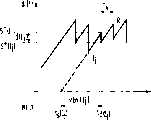
对于不同类型的预测图像编码效率是不同的,因此所得出的比特数不是不变的。此外,假设每隔一个图像周期TV按照MPEG规范要瞬时对一帧图像解码,各帧编码图像的第一个比特在解码器的缓存器内并不滞留相同的时间,这个可变时间按MPEG语法定义称为vbv延迟(vbv=video buffering verifior图像缓存校验器)。对于一个以固定比特率编码的信息流,每隔一个图像周期TV瞬时解码一帧图像的情况,图2示出了解码器的缓存器充满度S(t)随时间t变化的例子,其中相继图像I0至I4的相应vbv延迟为vbv(I0),vbv(I1),……vbv(I4)。一帧图像的比特率由斜率给出,而充满度(解码器的缓存器状态)由每个周期Tv中的最高点给出。按照图3,一帧在时间td(Ij)从解码器的缓存器移出进行解码的图像Ij的容量d(Ij)为:The coding efficiency is different for different types of predicted images, so the number of bits obtained is not constant. In addition, assuming that every other picture cycle TV needs to decode a frame of picture instantaneously according to the MPEG specification, the first bit of the coded picture of each frame does not stay in the buffer of the decoder for the same time, this variable time is according to the MPEG syntax The definition is called vbv delay (vbv=video buffering verifior image buffer verifier). For an information stream encoded at a fixed bit rate, a frame of image is instantaneously decoded every other image period TV, Fig. 2 shows an example of the decoder's buffer fullness S(t) changing with time t, where successively The corresponding vbv delays of images I 0 to I 4 are vbv(I 0 ), vbv(I 1 ), . . . vbv(I 4 ). The bit rate of a frame is given by the slope, while the fullness (decoder's buffer state) is given by the highest point in each cycle Tv. According to Fig . 3, the capacity d(I j ) of a frame at time t d (I j ) is removed from the buffer of the decoder to decode the image I j as:
d(Ij)=S-(Ij)-S+(Ij) (1)其中S-(Ij)和S+(Ij)分别表示在时间td -(Ij)(图像Ij即将从解码器的缓存器移出的时刻)和td +(Ij)图像Ij刚从解码器的缓存器移出的时刻)的解码器的缓存器状态。对于这帧图像Ij,它的vbv延迟vbv(Ij)。图像信息流比特率R和解码器缓存器状态S-(Ij)之间的关系为:d(I j )=S - (I j )-S + (I j ) (1) where S - (I j ) and S + (I j ) represent respectively at time t d - (I j ) (image I j is about to be removed from the decoder's buffer) and t d + (I j ) the moment when image I j is just removed from the decoder's buffer) the decoder's buffer state. For this frame of image I j , its vbv is delayed by vbv(I j ). The relationship between the image information stream bit rate R and the decoder buffer state S - (I j ) is:
S-(Ij)=vbv(Ij)·R (2)还可以得出:S - (I j )=vbv(I j )·R (2) can also draw:
S+(Ij)=S-(Ij+1)-R·Tv (3)由式(2)、(1)、(3)可以得出一个给出解码图像Ij的容量d(Ij)(比特数)更为精确的关系:S + (I j )=S - (I j +1)-R·Tv (3) From formula (2), (1) and (3), we can get a capacity d( I j ) (number of bits) a more precise relationship:
d(Ij)=R·(vbv(Ij)-vbv(Ij+1)+Tv) (4)d(I j )=R·(vbv(I j )-vbv(I j +1)+Tv) (4)
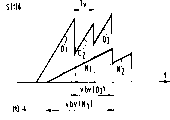
由于是这种调整模式,两个压缩(编码)图像序列之间的直接切换并不是始终可行的:用在每个周期Tv编码一帧图像进行切换在发送的第一帧新图像的vbv延迟大于所代替的第一帧老图像的vbv延迟时是不可能的。这种情况示于图4,用新序列(N1,N2)的图像N1代替老序列(O1,O2,O3)的图像O3是不可能的,因为N1的vbv延迟vbv(N1)大于O3的vbv延迟vbv(O3)。Due to this mode of adjustment, direct switching between two compressed (encoded) image sequences is not always feasible: switching is performed by encoding one frame of image per cycle Tv. The vbv delay of the first new image sent is greater than It is not possible when the vbv delay of the first frame of the old image replaced. This situation is shown in Figure 4, it is not possible to replace image O3 of the old sequence ( O1 , O2 , O3 ) with image N1 of the new sequence ( N1 , N2 ), because of the vbv delay of N1 vbv(N 1 ) is greater than the vbv delay vbv(O 3 ) of O 3 .
已知,在MPEG-2标准(例如参见欧洲专利申请EP 0692911)中,利用一些称为“接续点”的专用接入点就有利于图像切换。然而,这只能在新、老图像序列上存在相同的接续点时才能执行。It is known in the MPEG-2 standard (see for example European patent application EP 0692911) to facilitate image switching by using special access points called "splice points". However, this can only be performed if the same continuation point exists on the new and old image sequences.
发明内容Contents of the invention
本发明的目的是提出一种可以不用设立接续点的图像序列切换方法。The purpose of the present invention is to propose a method for switching image sequences without setting up a connection point.
为了达到这个目的,本发明涉及一种在解码前从一个比特率为Rold的第一编码图像序列切换到一个比特率为Rnew的更低比特率的第二编码图像序列的方法,所述方法在配有接收需解码的图像的缓存器的图像解码器内执行,其特征是:如果第二序列的第一帧发送图像N1的第一个比特在所述第一帧发送图像的解码时间前在解码器的缓存器内要滞留的时间vbv(N1),大于第一序列的第一帧被代替的图像O3的第一个比特在它本身的解码时间前在所述缓存器内要滞留的时间vbv(O3),那么就将第二序列的所述第一帧发送图像N1的比特率至少增大到使所述时间vbv(N1)相应减小到最多等于时间vbv(O3)的值Rint。To this end, the invention relates to a method for switching from a first coded image sequence with bit rate R old to a second coded image sequence with bit rate R new and lower bit rate before decoding, said Method carried out in a picture decoder equipped with a buffer for receiving pictures to be decoded, characterized in that if the first bit of the picture N 1 transmitted in the first frame of the second sequence is decoded in said first frame The time vbv(N 1 ) to stay in the buffer of the decoder before time is greater than the first bit of the image O 3 where the first frame of the first sequence is replaced in said buffer before its own decoding time The time vbv(O 3 ) to stay within the second sequence, then the bit rate of the transmitted image N 1 of the first frame of the second sequence is increased at least so that the time vbv(N 1 ) is correspondingly reduced to at most equal to time The value R int of vbv(O 3 ).
切换现在就可以执行而不需要任何接续点。按照本发明,就本帧增大比特率,使得第一帧被代替的老图像与第一帧要发送的新图像的vbv延迟现在是兼容的,从而不再需要接续点来实现换操作。Handover can now be performed without any splice points. According to the invention, the bit rate is increased with respect to this frame, so that the vbv delays of the old picture replaced by the first frame and the new picture to be sent in the first frame are now compatible, so that no splicing point is needed to realize the change operation.
然而,并不是始终能无限增大比特率以达到适当的vbv延迟值,例如,图像序列可能与其他基本信息流多路合并成一个多路复用传送信息流,从而上述方法在这种情况下可能由于在所述多路复用传送信息流中可用带宽的限制而不能使用。However, it is not always possible to increase the bit rate indefinitely to achieve a suitable value of vbv delay, for example, a sequence of pictures may be multiplexed with other elementary streams into a multiplexed transport stream, so that the above method does not work in this case May not be available due to limitations in available bandwidth in the multiplexed transport stream.
按照本发明,在对于比特率而言带宽受限的情况下,对上述方法作了改进:According to the invention, the above method is improved in the case of a bandwidth-limited bit rate:
(a)将所述第一帧发送图像N1的比特率增大到以下两个值中较小的那个值:与所述有限带宽相应的最大比特率值,或使所述时间vbv(N1)相应减小到最多等于时间vbv(O3)的值Rint。(a) increase the bit rate of the first frame transmitted image N1 to the smaller value of the following two values: the maximum bit rate value corresponding to the limited bandwidth, or make the time vbv(N 1 ) Reduce accordingly to a value R int at most equal to the time vbv(O 3 ).
(b)只要所述较小值为与所述有限带宽相应的最大比特率值,对于第二序列的第二帧图像N2重复操作(a);以及(b) as long as the smaller value is the maximum bit rate value corresponding to the limited bandwidth, repeat operation (a) for the second frame image N2 of the second sequence; and
(c)只要上次操作结束时得出的所述较小值为所述最大比特率值,对于第二序列的随后图像N3,N4,…,同样重复操作(a)。(c) Operation (a) is also repeated for subsequent images N 3 , N 4 , .
在增大比特率有带宽限制时,所提出的方法可以通过按需要相继对第二序列的多个图像增大比特率加以改善,尽管由于所述带宽限制,在某种程度上仍尽可能减小第一帧图像的vbv延迟。When increasing the bitrate has a bandwidth limitation, the proposed method can be improved by successively increasing the bitrate for as many images of the second sequence as needed, although due to said bandwidth limitation, it is still possible to minimize Small vbv delay of the first frame image.
附图说明Description of drawings
从下面的说明和附图中可以清楚地看到本发明的特色和优点。在这些附图中:The features and advantages of the present invention will be apparent from the following description and drawings. In these drawings:
图1示出了包括不同类型的编码图像的GOP的一个例子;Figure 1 shows an example of a GOP comprising different types of coded pictures;
图2给出了对于一个以固定比特率编码的信息流在每隔一定时间瞬时解码一帧时的情况;编码器的缓冲器充满度与时间的关系的例子;Figure 2 shows the situation when a frame is instantaneously decoded every certain time for an information stream encoded at a fixed bit rate; an example of the relationship between the encoder's buffer fullness and time;
图3标明了在采用图2的解码器缓存器充满度表示方式时图像Ij的主要有用参量;Fig. 3 has indicated the main useful parameter of image I j when adopting the representation mode of full degree of decoder buffer of Fig. 2;
图4例示了在一个老序列和一个新序列之间不能切换的情况;Fig. 4 illustrates the situation that cannot switch between an old sequence and a new sequence;
图5例示了本发明所提出的方法的原理;Fig. 5 illustrates the principle of the method proposed by the present invention;
图6示出了按本发明所提出的方法进行切换所得到的信息流;Fig. 6 shows the information flow obtained by switching according to the method proposed by the present invention;
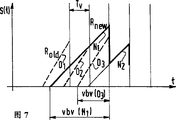
图7和8例示了本发明所提出的方法的限制,在图7中可观察到的切换问题并不能如图8所示那样实现本发明完全解决;Figures 7 and 8 illustrate the limitations of the proposed method of the present invention, the handover problem observed in Figure 7 cannot be completely solved by the present invention as shown in Figure 8;
图9例示了本发明所提出的改进方法的原理,可以解决所述限制;Fig. 9 illustrates the principle of the improved method proposed by the present invention, which can solve the limitation;
图10至12例示了出现下溢的情况;Figures 10 to 12 illustrate situations where underflow occurs;
图13和14分别例示了在实现所述方法的切换装置内和在所述装置的另一个实施例内执行的步骤。Figures 13 and 14 illustrate steps carried out in a switching device implementing the method and in another embodiment of the device, respectively.
具体实施方式Detailed ways
本发明的原理是:在转换时就本帧增大新序列的比特率,使vbv(N1)减小到最多等于或者甚至小于vbv(O3)(这个值为vbv′(N1)表示),这样就能进行切换。这种情况与图5相应,图中示出了在对N1进行比特率修改后N1和O3的vbv延迟怎样成为兼容(与图4相比较)的情况。在图像O3用图像N1代替后全程解码器的缓存器的演化示于图6,其中示出了在按照本发明的原理进行切换时得到的信息流。Principle of the present invention is: when converting, increase the bit rate of the new sequence with respect to this frame, make vbv (N 1 ) reduce to be equal to or even less than vbv (O 3 ) at most (this value is vbv' (N 1 ) representation ) to switch. This situation corresponds to Fig. 5, which shows how the vbv delays of N1 and O3 become compatible (compared with Fig. 4) after the bit rate modification of N1 . The evolution of the buffers of the global decoder after the replacement of picture O3 by picture N1 is shown in Figure 6, which shows the resulting information flow when switching in accordance with the principles of the invention.
式(2)可得:Formula (2) can get:
Rint=(vbv(N1)·Rnew)/vbv(O3) (5)R int =(vbv(N 1 )·R new )/vbv(O 3 ) (5)
其中:in:
Rnew为新图像序列的比特率;R new is the bit rate of the new image sequence;
Rint为在实现本发明所提出的方法时的中间过渡比特率。R int is the intermediate transition bit rate when implementing the method proposed by the present invention.
如图5所示,在请求切换时,即在新图像N1的第一个比特进入解码器的缓存器的时刻tsw,就对信息流应用中间比特率Rint(Rold表示老图像序列的比特率)。由图6可见,在这个时刻tsw,图像O1还没有解码,它的最后一些比特将以中间比特率Rint传入解码器的缓存器。在这帧图像O1解码时,图像O2的最后一些比特还没有完全传入解码器的缓存器,这些比特也以Rint传入。在O2解码时,N1(代替O3)的最后一些比特同样还没有完全传入解码器的缓存器,这些比特仍然以Rint传入。在N1解码时,所有以后的(N2…等)vbv延迟就都是兼容的,因此传入随后的这些图像(N2…等)的比特率就为新图像序列的比特率Rnew。As shown in Fig. 5, when switching is requested, that is, at the moment t sw when the first bit of the new image N 1 enters the buffer of the decoder, an intermediate bit rate R int is applied to the information stream (R old denotes the old image sequence bit rate). It can be seen from Fig. 6 that at this moment t sw , the image O 1 has not yet been decoded and its last bits will be transferred to the buffer of the decoder at an intermediate bit rate R int . When this frame of image O 1 is decoded, the last bits of image O 2 have not been fully transferred to the buffer of the decoder, and these bits are also transferred in R int . When O 2 is decoded, the last bits of N 1 (instead of O 3 ) are also not completely transferred to the buffer of the decoder, and these bits are still transferred in R int . When N 1 is decoded, all subsequent (N 2 ... etc.) vbv delays are compatible, so the bit rate passed into these subsequent pictures (N 2 ... etc.) is the bit rate Rnew of the new picture sequence.
本发明并不局限于上述这种实现方式,在不偏离本发明范围的情况下不可以从这种实现方式导出许多修改形式。例如,如果中间比特率Rint成为高于老比特率Rold,就必需注意不要在转换时出现溢出。The invention is not limited to this implementation described above, from which it is not possible to derive many modifications without departing from the scope of the invention. For example, if the intermediate bit rate R int becomes higher than the old bit rate R old , care must be taken not to overflow during conversion.
然而,并不是始终都能无限增大N1的比特率来达到一个适当的vbv延迟值。通常,这些图像序列与其他基本信息流合并成一个多路复用传递信息流,因此上述执行本帧比特率修改的方法在这种情况下由于在所述多路复用传送信息流中可用带宽的限制而不能使用。图7和8分别示出了切换问题(在vbv(N1)大于vbv(O3)时,不能执行切换操作)和诸如上述这种切换方法通过增大新序列第一帧发送图像N1的比特率减小vbv(N1)的实现情况。在可用带宽受到限制的情况下,单增大N1的比特率不足使vbv(N1)具有一个能与vbv(O3)兼容的值。为了使图简明起见,老序列的比特率Rold在此假设为与增大Rnew(对于图像N1)的带宽极限相应。如图8所示,值vbv(N1)在N1的比特率增大到一个等于与O3相应的比特率的值后实际上仍大于vbv(O3)(在这图中和在图9和11中,双线相应于在比特率修改前和图像N1)。However, it is not always possible to increase the bit rate of N 1 infinitely to achieve an appropriate vbv delay value. Usually, these image sequences are merged with other elementary streams into a multiplexed transport stream, so the above-mentioned method of performing bit rate modification for this frame is in this case less efficient due to the bandwidth available in said multiplexed transport stream restrictions and cannot be used. Figures 7 and 8 illustrate the handover problem (when vbv(N 1 ) is greater than vbv(O 3 ), the handover operation cannot be performed) and the handover method such as the above by increasing the first frame of the new sequence to send image N 1 Implementation of bit rate reduction vbv(N 1 ). In cases where the available bandwidth is limited, simply increasing the bit rate of N 1 is not sufficient to allow vbv(N 1 ) to have a value compatible with vbv(O 3 ). For the sake of clarity of the diagram, the bit rate R old of the old sequence is here assumed to correspond to the bandwidth limit of increasing R new (for image N 1 ). As shown in Fig. 8, the value vbv(N 1 ) remains actually greater than vbv(O 3 ) after the bit rate of N 1 is increased to a value equal to the bit rate corresponding to O 3 (in this figure and in Fig. In 9 and 11, the double lines correspond to the sum image N 1 ) before bit rate modification.
如图9所示,按照本发明,在将增大比特率再用于新序列的下一帧图像N2时,解码器的缓存器就部分空出来,从而使vbv(N1)再次减小,但这次减小量足以使N1和O3的vbv延迟兼容。推广来说,如果必要的话(即如果所述减小量仍不足使N1和O3的vbv延迟兼容的话),不仅对第一帧然后对第二帧新图像增大比特率,而且还对每个后继图像增大比特率,直至足以获得vbv延迟的所述兼容性。As shown in Fig. 9, according to the present invention, when the increased bit rate is reused for the next frame image N 2 of the new sequence, the buffer of the decoder is partially emptied, thereby reducing vbv(N 1 ) again , but this time the reduction is sufficient to make the vbv delays of N 1 and O 3 compatible. By extension, if necessary (i.e. if the reduction is still insufficient to make the vbv delays of N 1 and O 3 compatible), the bitrate is increased not only for the first frame and then for the second frame of the new image, but also for Each subsequent picture increases the bitrate until it is sufficient to obtain said compatibility of vbv delay.
所述推广可以更为精确地加以研究,从而可以得出在这种推广的比特率修改后的新的缓存器状态和vbv延迟的计算。为此假设:The generalization can be studied more precisely, so that calculations of new buffer states and vbv delays after bit rate modification of this generalization can be derived. For this assume:
a)所有带下标“b”的变量表示在比特率修改前的变量;a) All variables with subscript "b" represent variables before bit rate modification;
b)所有带下标“a”的变量表示在比特率修改后的变量;b) All variables with subscript "a" represent the variables after bit rate modification;
c)由于本发明的实现只与新信息流有关,而与老信息流中的图像无关,因此所有考虑新序列的一帧图像Nk的标记恢复为这个图像的下标k,以及c) Since the implementation of the present invention is only related to the new information flow, and has nothing to do with the images in the old information flow, all the marks of a frame of image Nk considering the new sequence are restored to the subscript k of this image, and
d)解码时刻td(k)和图像容量d(k)在这处理过程期间不作修改。d) The decoding instant t d (k) and the picture volume d(k) are not modified during this process.
其他仍未说明的所用标记如下:Other marks used that remain unspecified are as follows:
ts(I)为图像I的第一个比特进入解码器的缓存器的时间;ts (I) is the time when the first bit of the image I enters the buffer of the decoder;
tsa(1),…,tsa(i),…tsa(n)为与ts(I)类似的时间,但是为比特率修改后新序列的图像1,…,i,…,n的第一个比特分别进入解码器的缓存器的时间;以及t sa (1), ..., t sa (i), ... t sa (n) is a time similar to ts (I), but for the new sequence of
d(1),…d(i),…d(n)分别为图像1,…i,…,n的以比特数计的容量。考虑直至图像n解码的比特率修改情况(n的值必需多大的考虑将在下面介绍)。因此,对于处于tsa(1)至td(n)之间的时间t,比特率等于Rold,而对于大于td(n)的时间t,比特率等于Rnew。在td(n)以后,缓存器充满度就不变:S-a(k)=S-b(k)和S+a(k)=S+b(k),对于k>n。缓存器状态在时刻t-d(n)为S-b(n)。新的缓存器状态在时刻t-d(n-1)于是可推得为:d(1), . . . d(i), . Consider the case of bit rate modification up to the decoding of picture n (considerations of how large the value of n must be will be presented below). Thus, for times t between t sa (1) and t d (n), the bit rate is equal to R old , and for times t greater than t d (n), the bit rate is equal to R new . After t d (n), the buffer fullness is constant: S - a(k) = S - b(k) and S + a(k) = S + b(k), for k>n. The state of the buffer is S - b(n) at time t - d(n). The new buffer state at time t - d(n-1) can then be deduced as:
S- a(n-1)=S- b(n)-Rold.Tv+d(n-1) (6)S - a (n-1)=S - b (n)-R old .T v +d(n-1) (6)
而且:and:
S- b(n-1)=S- b(n)-Rnew.Tv+d(n-1) (7)S - b (n-1)=S - b (n)-R new .T v +d(n-1) (7)
从而可得thus available
S- a(n-1)=S- b(n-1)-(Rold-Rnew).Tv (8)S - a (n-1)=S - b (n-1)-(R old -R new ).T v (8)
同样可以证明:It can also be proved that:
S- a(n-2)=S- b(n-2)-(Rold-Rnew).2Tv (9)S - a (n-2)=S - b (n-2)-(R old -R new ).2T v (9)
从而可递推得:It can thus be deduced that:
S- a(n-k)=S- b(n-k)-(Rold-Rnew).kTv k=0,…,n-1 (10)S - a (nk) = S - b (nk) - (R old - R new ).kT v k = 0,..., n-1 (10)
同样可以证明:It can also be proved that:
S- a(n-k)=S- b(n-k)-(Rold-Rnew).kTv k=0,…,n-1 (11)S - a (nk) = S - b (nk) - (R old - R new ).kT v k = 0,..., n-1 (11)
新的vbv延迟也可以计算得,为:The new vbv delay can also be calculated as:
vbva(n-k)=S- a(n-k)/Rold对于k=0,…,n-1 (12)vbv a (nk) = S - a (nk)/R old for k = 0, ..., n-1 (12)
由式(10)可得:From formula (10) can get:
vbva(n-k)=(S- b(n-k)/Rnew).(Rnew-Rold)-kTv.(1-Rnew/Rold)vbv a (nk)=(S - b (nk)/R new ).(R new -R old )-kT v .(1-R new /R old )
对于k=0,…,n-1 (13)因此有:For k=0,...,n-1 (13) So there are:
对于k=0,…,n-1For k=0,...,n-1
必需指出的是,根据式(10)和(11),原来的缓存器充满度在增大一个本帧比特率后就要减小,因为Rold大于Rnew。因此,如果不注意,就可能出现下溢。不下溢的条件可以确定n的值应取多大。It must be pointed out that, according to equations (10) and (11), the original buffer fullness will decrease after increasing the bit rate of one current frame, because R old is greater than R new . Therefore, underflow can occur if you are not careful. The condition of no underflow can determine how large the value of n should be.
为了在本帧比特率增大后具有应顺的缓存器充满度,必需满足In order to have a compliant buffer fullness after the bitrate increase of the current frame, it is necessary to satisfy
S+ a(n-k)>0S + a (nk) > 0
对于k=0,…,n-1 (15)由于式(11),可得For k=0,...,n-1 (15) Due to formula (11), we can get
S+ b(n-k)>kTv.(Rold-Rnew)S + b (nk)>kT v .(R old -R new )
对于k=0,…,n-1 (16)这个条件也可以用vbv延迟表示。如果满足:For k=0,...,n-1 (16) This condition can also be expressed by vbv delay. If satisfied:
vbvb(n-k)>Tv vbv b (nk)>T v
对于k=0,…,n-1 (17)缓存器充满度就不至下溢。由于式(14),因此可得:For k=0,...,n-1 (17) The fullness of the buffer will not underflow. Due to formula (14), it can be obtained:
vbva(n-k)>Tv.(Rold-Rnew+k.(Rold/Rnew-1))vbv a (nk)>T v .(R old -R new +k.(Rold/Rnew-1))
对于k=0,…,n-1 (18)如果没有下溢的问题,将达到最小可能vbv延迟d(1)/Rold。For k=0,...,n-1 (18) If there is no underflow problem, the minimum possible vbv delay d(1)/R old will be reached.
vbva(n-k)=vbvb(n-k).(Rnew/Rold)-kTv.(1-Rnew/Rold) (14)vbv a (nk)=vbv b (nk).(R new /R old )-kT v .(1-R new /R old ) (14)
图10至12示出了如果n=2就会出现下溢情况的例子。图10表示原来的信息流,图11示出了增大比特率直至图像N1解码的情况,而图12示出了增大比特率直至图像N2解码的情况(与前面一样,双线相应于修改图像N1、N2的比特率以前的图像)。在最后的这种情况下出现下溢,而如果增大比特率只是直至N1解码就不会出现下溢。这就是最终不下溢条件,可以确定新序列中可以增大比特率而没有任何问题的图像的帧数。10 to 12 show examples of underflow conditions if n=2. Figure 10 shows the original information flow, Figure 11 shows the case where the bit rate is increased until picture N 1 is decoded, and Figure 12 shows the case where the bit rate is increased until picture N 2 is decoded (as before, the double lines correspond to before modifying the bit rate of pictures N 1 , N 2 ). Underflow occurs in this last case, whereas underflow does not occur if the bit rate is increased only up to N 1 decoding. This is the final non-underflow condition, which determines the number of frames in the new sequence for which the bitrate can be increased without any problems.
然而,应该注意的是,在按照本方法减小了vbv延迟后,有时可能仍处于vbv延迟还不能兼容的情况。于是能将所述方法与另一种如在1997年5月27日递交的欧洲专利申请书No.97401160.3(PHF 97557)中所述的基于插入所谓最小图像的方法结合起来。按照所述文件,不再修改比特率,而是将新的图像序列延迟给定的图像数K,而将K帧最小图像,即以尽可能少的比特编码而仍应顺解码过程的图像,插在老的和新的序列之间释放出的时间段。图13和14例示了分别在实现诸如所述的本帧比特率修改的装置中和在实现上面提到的结合两种方法的装置中所执行的主要步骤。在图14中,R(of-min)表示保证不溢出的最小比特率。However, it should be noted that, after reducing the vbv delay according to this method, sometimes the vbv delay may still be incompatible. The method can then be combined with another method based on the insertion of so-called minimal images as described in European Patent Application No. 97401160.3 filed on May 27, 1997 (PHF 97557). According to the document, the bit rate is no longer modified, but the new image sequence is delayed by a given number K of images, and K frames of minimum images, that is, images that are encoded with as few bits as possible and still follow the decoding process, Interpolate the released time period between the old and new sequences. Figures 13 and 14 exemplify the main steps performed in an apparatus implementing the present frame bit rate modification such as described and in an apparatus implementing the above-mentioned combination of the two methods, respectively. In FIG. 14, R(of-min) represents the minimum bit rate guaranteed not to overflow.
Claims (2)
Applications Claiming Priority (4)
| Application Number | Priority Date | Filing Date | Title |
|---|---|---|---|
| EP98400223 | 1998-02-03 | ||
| EP98400223.8 | 1998-02-03 | ||
| EP98401929 | 1998-07-28 | ||
| EP98401929.9 | 1998-07-28 |
Publications (2)
| Publication Number | Publication Date |
|---|---|
| CN1262846A CN1262846A (en) | 2000-08-09 |
| CN1169373C true CN1169373C (en) | 2004-09-29 |
Family
ID=26151561
Family Applications (1)
| Application Number | Title | Priority Date | Filing Date |
|---|---|---|---|
| CNB998004456A Expired - Fee Related CN1169373C (en) | 1998-02-03 | 1999-01-28 | Coded image sequence switching method and corresponding device |
Country Status (6)
| Country | Link |
|---|---|
| US (1) | US6351564B1 (en) |
| EP (1) | EP1004207A1 (en) |
| JP (1) | JP4275746B2 (en) |
| KR (1) | KR100664452B1 (en) |
| CN (1) | CN1169373C (en) |
| WO (1) | WO1999040728A1 (en) |
Families Citing this family (28)
| Publication number | Priority date | Publication date | Assignee | Title |
|---|---|---|---|---|
| GB2353653B (en) * | 1999-08-26 | 2003-12-31 | Sony Uk Ltd | Signal processor |
| JP2001285868A (en) * | 2000-03-29 | 2001-10-12 | Victor Co Of Japan Ltd | Device and method for changing-over animation code string |
| US7050460B1 (en) * | 2000-04-14 | 2006-05-23 | Ati International Srl | Method and apparatus for multiplexing data streams using time constraints |
| FR2841160B1 (en) * | 2002-06-19 | 2004-07-23 | Solystic | METHOD FOR PROCESSING POSTAL ITEMS USING VOICE SYNTHESIS |
| US9591339B1 (en) | 2012-11-27 | 2017-03-07 | Apple Inc. | Agnostic media delivery system |
| US9774917B1 (en) | 2012-12-10 | 2017-09-26 | Apple Inc. | Channel bar user interface |
| US10200761B1 (en) | 2012-12-13 | 2019-02-05 | Apple Inc. | TV side bar user interface |
| US9532111B1 (en) | 2012-12-18 | 2016-12-27 | Apple Inc. | Devices and method for providing remote control hints on a display |
| US10521188B1 (en) | 2012-12-31 | 2019-12-31 | Apple Inc. | Multi-user TV user interface |
| US12149779B2 (en) | 2013-03-15 | 2024-11-19 | Apple Inc. | Advertisement user interface |
| US10650052B2 (en) | 2014-06-24 | 2020-05-12 | Apple Inc. | Column interface for navigating in a user interface |
| WO2015200537A2 (en) | 2014-06-24 | 2015-12-30 | Apple Inc. | Input device and user interface interactions |
| KR102006598B1 (en) | 2014-09-24 | 2019-08-01 | 애플 인크. | Management of the channel bar |
| DK201670582A1 (en) | 2016-06-12 | 2018-01-02 | Apple Inc | Identifying applications on which content is available |
| DK201670581A1 (en) | 2016-06-12 | 2018-01-08 | Apple Inc | Device-level authorization for viewing content |
| US11966560B2 (en) | 2016-10-26 | 2024-04-23 | Apple Inc. | User interfaces for browsing content from multiple content applications on an electronic device |
| US12307082B2 (en) | 2018-02-21 | 2025-05-20 | Apple Inc. | Scrollable set of content items with locking feature |
| AU2019100574B4 (en) | 2018-06-03 | 2020-02-20 | Apple Inc. | Setup procedures for an electronic device |
| CN114302210B (en) | 2019-03-24 | 2024-07-05 | 苹果公司 | User interface for viewing and accessing content on an electronic device |
| EP4443850A3 (en) | 2019-03-24 | 2024-12-04 | Apple Inc. | User interfaces for a media browsing application |
| US11057682B2 (en) | 2019-03-24 | 2021-07-06 | Apple Inc. | User interfaces including selectable representations of content items |
| US11683565B2 (en) | 2019-03-24 | 2023-06-20 | Apple Inc. | User interfaces for interacting with channels that provide content that plays in a media browsing application |
| US11863837B2 (en) | 2019-05-31 | 2024-01-02 | Apple Inc. | Notification of augmented reality content on an electronic device |
| CN113906380A (en) | 2019-05-31 | 2022-01-07 | 苹果公司 | User interface for podcast browsing and playback applications |
| US11843838B2 (en) | 2020-03-24 | 2023-12-12 | Apple Inc. | User interfaces for accessing episodes of a content series |
| US11899895B2 (en) | 2020-06-21 | 2024-02-13 | Apple Inc. | User interfaces for setting up an electronic device |
| US11720229B2 (en) | 2020-12-07 | 2023-08-08 | Apple Inc. | User interfaces for browsing and presenting content |
| US11934640B2 (en) | 2021-01-29 | 2024-03-19 | Apple Inc. | User interfaces for record labels |
Family Cites Families (14)
| Publication number | Priority date | Publication date | Assignee | Title |
|---|---|---|---|---|
| JPS5841435B2 (en) | 1981-04-10 | 1983-09-12 | 新日本製鐵株式会社 | How to control the suction head |
| US5534944A (en) * | 1994-07-15 | 1996-07-09 | Matsushita Electric Corporation Of America | Method of splicing MPEG encoded video |
| DE69515386T2 (en) * | 1994-07-15 | 2000-08-24 | Matsushita Electric Industrial Co., Ltd. | Method for connecting MPEG video sequences |
| CA2157066C (en) * | 1994-10-21 | 1999-09-21 | Nelson Botsford Iii | Method for controlling a compressed data buffer |
| US5687095A (en) * | 1994-11-01 | 1997-11-11 | Lucent Technologies Inc. | Video transmission rate matching for multimedia communication systems |
| US5913031A (en) * | 1994-12-02 | 1999-06-15 | U.S. Philips Corporation | Encoder system level buffer management |
| AU703049B2 (en) * | 1995-02-15 | 1999-03-11 | Koninklijke Philips Electronics N.V. | Method and device for transcoding video signals |
| GB2307613B (en) * | 1995-08-31 | 2000-03-22 | British Broadcasting Corp | Switching bit-rate reduced signals |
| US6011598A (en) * | 1996-03-28 | 2000-01-04 | Sanyo Electric Co., Ltd. | Decoding start controller, decoder, and decoding system |
| EP0805601B1 (en) * | 1996-05-02 | 2005-03-30 | Sony Corporation | Encoding, storing and transmitting digital signals |
| CA2208950A1 (en) * | 1996-07-03 | 1998-01-03 | Xuemin Chen | Rate control for stereoscopic digital video encoding |
| US6188700B1 (en) * | 1996-11-07 | 2001-02-13 | Sony Corporation | Method and apparatus for encoding MPEG signals using variable rate encoding and dynamically varying transmission buffers |
| JP3555729B2 (en) * | 1997-04-22 | 2004-08-18 | 日本ビクター株式会社 | Method and apparatus for processing variable-length encoded data |
| JP2000515711A (en) | 1997-05-27 | 2000-11-21 | コーニンクレッカ フィリップス エレクトロニクス エヌ ヴィ | Video sequence switching method, switching device thereof, and decoding system |
-
1999
- 1999-01-28 KR KR1019997009016A patent/KR100664452B1/en not_active Expired - Fee Related
- 1999-01-28 WO PCT/IB1999/000163 patent/WO1999040728A1/en not_active Ceased
- 1999-01-28 CN CNB998004456A patent/CN1169373C/en not_active Expired - Fee Related
- 1999-01-28 EP EP99900608A patent/EP1004207A1/en not_active Withdrawn
- 1999-01-28 JP JP54018599A patent/JP4275746B2/en not_active Expired - Fee Related
- 1999-02-02 US US09/244,841 patent/US6351564B1/en not_active Expired - Lifetime
Also Published As
| Publication number | Publication date |
|---|---|
| WO1999040728A1 (en) | 1999-08-12 |
| EP1004207A1 (en) | 2000-05-31 |
| JP4275746B2 (en) | 2009-06-10 |
| JP2001519992A (en) | 2001-10-23 |
| US6351564B1 (en) | 2002-02-26 |
| CN1262846A (en) | 2000-08-09 |
| KR100664452B1 (en) | 2007-01-04 |
| KR20010005939A (en) | 2001-01-15 |
Similar Documents
| Publication | Publication Date | Title |
|---|---|---|
| CN1169373C (en) | Coded image sequence switching method and corresponding device | |
| CN1119757C (en) | Variable rate video grammar processor | |
| CN1253014C (en) | Image coding method and apparatus an image decoding method and apparatus | |
| CN1173572C (en) | Seamless Switching of MPEG Video Streams | |
| CN1079001C (en) | A transcoder | |
| CN1169370C (en) | Apparatus and method for encoding field of predetermined field parity | |
| CN1115055C (en) | Buffer management in variable Bit-rate compression systems | |
| CN1171158C (en) | Flowing Method of Moving Images in Video-on-Demand System | |
| CN101061718A (en) | Method and apparatus for channel change in DSL system | |
| CN1191721C (en) | Video signal encoding and buffer management | |
| CN1826812A (en) | Video encoder and method of encoding video | |
| CN1799265A (en) | Coding method and apparatus enabling fast channel change of compressed video | |
| CN1365235A (en) | Frame bit length allocation for seamless splicing, variable coding rate, compressed digital video signals | |
| CN1871854A (en) | Hypothetical reference decoder with low start-up delays for compressed image and video | |
| CN1914921A (en) | Apparatus and method for scalable video coding providing scalability in encoder part | |
| CN1669235A (en) | Method and apparatus for transcoding between hybrid video CODEC bitstreams | |
| CN1728829A (en) | Device and method for adaptively controlling buffer volume according to content attributes | |
| CN1668110A (en) | Method and apparatus for increasing the average image refresh rate in a compressed video bitstream | |
| CN1592417A (en) | Encoding device and encoding method | |
| CN101069432A (en) | Quantizer parameter determination for video encoder rate control | |
| CN1166205C (en) | Image transmission device and image transmission method | |
| CN1220392C (en) | Image compression equipment and method for processing frame jump | |
| CN1193614C (en) | Method and device for changing bit rate by changing codeword of compressed image bit stream | |
| CN1703911A (en) | Reducing bit rate of already compressed multimedia | |
| JPH1174799A (en) | Processing method of variable length encoding data and buffer controller |
Legal Events
| Date | Code | Title | Description |
|---|---|---|---|
| C06 | Publication | ||
| PB01 | Publication | ||
| C10 | Entry into substantive examination | ||
| SE01 | Entry into force of request for substantive examination | ||
| C14 | Grant of patent or utility model | ||
| GR01 | Patent grant | ||
| ASS | Succession or assignment of patent right |
Owner name: IPG ELECTRONICS 503 CO., LTD. Free format text: FORMER OWNER: ROYAL PHILIPS ELECTRONICS CO., LTD. Effective date: 20090904 |
|
| C41 | Transfer of patent application or patent right or utility model | ||
| TR01 | Transfer of patent right |
Effective date of registration: 20090904 Address after: British Channel Islands Patentee after: Koninkl Philips Electronics NV Address before: Holland Ian Deho Finn Patentee before: Koninklike Philips Electronics N. V. |
|
| ASS | Succession or assignment of patent right |
Owner name: PENDRAGON WIRELESS CO., LTD. Free format text: FORMER OWNER: IPG PHOTONICS 503 CORP. Effective date: 20130104 |
|
| C41 | Transfer of patent application or patent right or utility model | ||
| TR01 | Transfer of patent right |
Effective date of registration: 20130104 Address after: Washington State Patentee after: Pendragon wireless limited liability company Address before: British Channel Islands Patentee before: Koninkl Philips Electronics NV |
|
| CF01 | Termination of patent right due to non-payment of annual fee |
Granted publication date: 20040929 Termination date: 20170128 |
|
| CF01 | Termination of patent right due to non-payment of annual fee |