Disclosure of Invention
In order to solve the technical problems in the background art, the invention provides a myoelectric gesture recognition method and a myoelectric gesture recognition system based on Iterative Self-Training domain adaptation, namely an Iterative Self-Training domain adaptation-based algorithm (i.e. interactive Self-Training based DomainAdaptation, STDA) is adopted, and the method only utilizes few marked data and a small amount of unmarked data of a target domain to realize effective migration from a source domain to the target domain. STDA consists essentially of two parts, namely differential-based domain adaptation (differential-based DomainAdaptation, DDA) and Pseudo tag iterative update (Pseudo-label Iterative Update, PIU). DDA uses gaussian kernel based distance constraints to align existing users 'data with new users' unlabeled data. The PIU iteratively continually updates the pseudo tags to generate more accurate tag data for new users with category balancing.
In order to achieve the above purpose, the present invention adopts the following technical scheme:
the first aspect of the invention provides an electromyographic gesture recognition method based on iterative self-training domain adaptation.
An electromyographic gesture recognition method based on iterative self-training domain adaptation comprises the following steps:
acquiring myoelectricity data of a historical user and myoelectricity data of a new user;
extracting a source domain time-frequency characteristic based on myoelectricity data of a historical user, and extracting a target domain time-frequency characteristic based on myoelectricity data of a new user;
adopting a domain adaptation method based on difference to Ji Yuanyu time-frequency characteristics and target domain time-frequency characteristics;
training a model based on the aligned target domain time-frequency characteristics, judging whether the model meets the iteration frequency requirement, and if so, predicting the target domain time-frequency characteristics of myoelectricity data of a new user to obtain a gesture recognition result; otherwise, labeling the target domain time-frequency characteristic label-free data with pseudo labels, selecting label classes with the number of the pseudo labels being less than a certain value for up-sampling to balance all classes, and repeating the process from Ji Yuanyu time-frequency characteristics and target domain time-frequency characteristics to iteration number judgment until the set iteration number is reached.
Further, the process of adopting the domain adaptation method based on the difference to Ji Yuanyu time-frequency characteristics and target domain time-frequency characteristics comprises the following steps: mapping the source domain time-frequency characteristic and the target domain time-frequency characteristic to the same shared space, and measuring the distance between the source domain time-frequency characteristic and the target domain time-frequency characteristic; and optimizing the time-frequency characteristics of the target domain according to the distance.
Still further, the shared space is a regenerated kernel hilbert space.
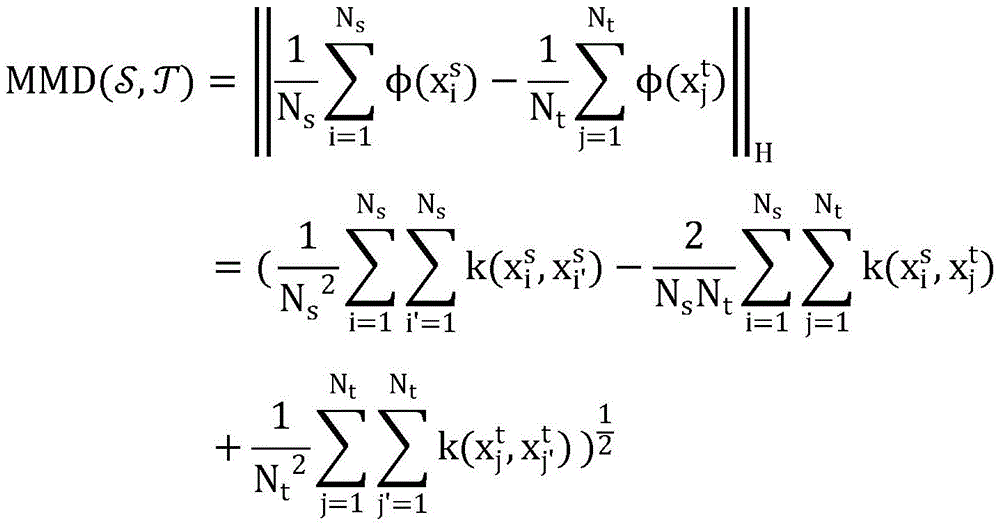
Further, the distance between the two distributions of the time-frequency characteristic of the measurement source domain and the time-frequency characteristic of the target domain adopts the following formula:
where Φ represents a function that maps the raw data to H, Φ (x) =k (·, x), and k generally takes the gaussian kernel function.
Further, in the process of training the model, the method further comprises: training a model containing a small amount of marker data; predicting class labels of unlabeled samples by using the trained model; screening out pseudo tags with confidence meeting the conditions by using a threshold value; and adopting the data with the marks and the pseudo marks to jointly train the model until the model converges, and obtaining a trained model.
Still further, the model convergence is determined according to a loss function, the loss function being:
wherein Y represents the actual label,
represents the predicted output, C represents the total number of classifications, p
i,k Representing the probability that the i-th sample is predicted as the k-th class.
Still further, the pseudo tag calculation formula for the confidence meeting the condition is:
wherein, for each sample in a C-class problem,
a second aspect of the present invention provides an electromyographic gesture recognition system based on iterative self-training domain adaptation.
An electromyographic gesture recognition system based on iterative self-training domain adaptation, comprising:
a data acquisition module configured to: acquiring myoelectricity data of a historical user and myoelectricity data of a new user;
a feature extraction module configured to: extracting a source domain time-frequency characteristic based on myoelectricity data of a historical user, and extracting a target domain time-frequency characteristic based on myoelectricity data of a new user;
an alignment module configured to: adopting a domain adaptation method based on difference to Ji Yuanyu time-frequency characteristics and target domain time-frequency characteristics;
a training recognition module configured to: training a model based on the aligned target domain time-frequency characteristics, judging whether the model meets the iteration frequency requirement, and if so, predicting the target domain time-frequency characteristics of myoelectricity data of a new user to obtain a gesture recognition result; otherwise, labeling the target domain time-frequency characteristic label-free data with pseudo labels, selecting label classes with the number of the pseudo labels being less than a certain value for up-sampling to balance all classes, and repeating the process from Ji Yuanyu time-frequency characteristics and target domain time-frequency characteristics to iteration number judgment until the set iteration number is reached.
A third aspect of the present invention provides a computer-readable storage medium.
A computer readable storage medium having stored thereon a computer program which when executed by a processor performs the steps in the method of electromyographic gesture recognition based on iterative self-training domain adaptation as described in the first aspect above.
A fourth aspect of the invention provides a computer device.
A computer device comprising a memory, a processor and a computer program stored on the memory and executable on the processor, the processor implementing the steps in the method of electromyographic gesture recognition based on iterative self-training domain adaptation as described in the first aspect above when the program is executed.
Compared with the prior art, the invention has the beneficial effects that:
the invention provides a myoelectric gesture recognition method and a system based on iterative self-training domain adaptation, and adopts a domain adaptation method STDA based on iterative self-training. STDA consists mainly of two parts, differential-based domain adaptation (DDA) and pseudo tag iterative update (PIU). DDA uses gaussian kernel based distance constraints to align existing users 'data with new users' unlabeled data. The PIU iteratively continually updates the pseudo tags to generate more accurate tag data for new users with category balancing. The pseudo tag generated by self-training is used for supervising the characteristic decoupling process so as to realize the effective migration from the source domain to the target domain, thereby improving the accuracy of myoelectric gesture recognition.
Detailed Description
The invention will be further described with reference to the drawings and examples.
It should be noted that the following detailed description is illustrative and is intended to provide further explanation of the invention. Unless defined otherwise, all technical and scientific terms used herein have the same meaning as commonly understood by one of ordinary skill in the art to which this invention belongs.
It is noted that the terminology used herein is for the purpose of describing particular embodiments only and is not intended to be limiting of exemplary embodiments according to the present invention. As used herein, the singular is also intended to include the plural unless the context clearly indicates otherwise, and furthermore, it is to be understood that the terms "comprises" and/or "comprising" when used in this specification are taken to specify the presence of stated features, steps, operations, devices, components, and/or combinations thereof.
It is noted that the flowcharts and block diagrams in the figures illustrate the architecture, functionality, and operation of possible implementations of methods and systems according to various embodiments of the present disclosure. It should be noted that each block in the flowchart or block diagrams may represent a module, segment, or portion of code, which comprises one or more executable instructions for implementing the logical functions specified in the various embodiments. It should also be noted that, in some alternative implementations, the functions noted in the block may occur out of the order noted in the figures. For example, two blocks shown in succession may, in fact, be executed substantially concurrently, or the blocks may sometimes be executed in the reverse order, depending upon the functionality involved. It will also be noted that each block of the flowchart illustrations and/or block diagrams, and combinations of blocks in the flowchart illustrations and/or block diagrams, can be implemented by special purpose hardware-based systems which perform the specified functions or operations, or combinations of special purpose hardware and computer instructions.
Example 1
The embodiment provides an electromyographic gesture recognition method based on iterative self-training domain adaptation, and the method is applied to a server for illustration, and it can be understood that the method can also be applied to a terminal, can also be applied to a system and a terminal, and can be realized through interaction of the terminal and the server. The server can be an independent physical server, a server cluster or a distributed system formed by a plurality of physical servers, and can also be a cloud server for providing cloud services, cloud databases, cloud computing, cloud functions, cloud storage, network servers, cloud communication, middleware services, domain name services, security services CDNs, basic cloud computing services such as big data and artificial intelligent platforms and the like. The terminal may be, but is not limited to, a smart phone, a tablet computer, a notebook computer, a desktop computer, a smart speaker, a smart watch, etc. The terminal and the server may be directly or indirectly connected through wired or wireless communication, which is not limited herein. In this embodiment, the method includes the steps of:
acquiring myoelectricity data of a historical user and myoelectricity data of a new user;
extracting a source domain time-frequency characteristic based on myoelectricity data of a historical user, and extracting a target domain time-frequency characteristic based on myoelectricity data of a new user;
adopting a domain adaptation method based on difference to Ji Yuanyu time-frequency characteristics and target domain time-frequency characteristics;
training a model based on the aligned target domain time-frequency characteristics, judging whether the model meets the iteration frequency requirement, and if so, predicting the target domain time-frequency characteristics of myoelectricity data of a new user to obtain a gesture recognition result; otherwise, labeling the target domain time-frequency characteristic label-free data with pseudo labels, selecting label classes with the number of the pseudo labels being less than a certain value for up-sampling to balance all classes, and repeating the process from Ji Yuanyu time-frequency characteristics and target domain time-frequency characteristics to iteration number judgment until the set iteration number is reached.
The flow chart of the myoelectric gesture recognition method based on iterative self-training domain adaptation is shown in fig. 1:
1) Start to
2) Extracting time-frequency characteristics of source domain and time-frequency characteristics of target domain
3) Judging whether the number of the pre-training wheels is satisfied, if yes, 4), otherwise, 5)
4) For Ji Yuanyu and target Domain features
5) Training classifier
6) Judging whether the set training wheel number is reached, if yes, 7), otherwise 8)
7) Predicting target domain test data, 10
8) Labeling unlabeled data of target domain with pseudo label
9) Minority classes up-sample to balance all classes, turn 4
10 Ending).
1. Problem definition
Data of existing users constitutes source domain
Wherein N is
s Representing the number of samples in the source domain, +.>
Representing the i-th sample in the source domain, +.>
Representing the label corresponding to the i-th sample in the source domain. Data of target user constitutes target domain
Wherein->
Representing a small amount of tag data in the target domain (for a C (C.epsilon.N)
+ ) Classification problem, which has only C samples), -a.about.>
Unlabeled data representing a relatively large amount in the target domain, < >>
Test data representing a target domain and satisfying
Wherein N is
l Representing the number of marked samples in the target domain.
Wherein N is
u Indicating the number of unlabeled samples in the target domain.
Wherein N is
te Representing the number of test samples in the target domain. In a cross-user scenario there is a domain offset, i.e. the distribution of source and target domains is not uniform +.>
X above
s ,x
t Is a four-dimensional data vector, y
s ,y
t Is a category label. The goal of cross-user myoelectric gesture recognition is to use the existing user's data +.>
Small amount of tag data +.>
And a tag for obtaining accurate test data with a relatively large amount of unlabeled data, i.e. +.>
2. Iterative self-training domain adaptation-based method
The Iterative Self-training domain adaptation method (STDA) is a domain adaptation method, and effective migration from a source domain to a target domain is realized through a process of Iterative Self-training generated pseudo tag supervision feature decoupling. The overall framework of the STDA method is shown in FIG. 2, and consists of two parts, namely differential-based domain adaptation (discrete-based DomainAdaptation, DDA) and Pseudo-tag iterative update (Pseudo-label Iterative Update, PIU), for aligning features and generating more accurate target domain tags, respectively.
DDA aligns source domain and target domain features in regenerated kernel hilbert space (Reproducing Kernel Hilbert Space, RKHS) using maximum mean difference (Maximum Mean Discrepancy, MMD) as a distance metric. PIU mainly comprises two parts, one continuously generates more accurate pseudo labels through iterative self-training, and the generated pseudo labels are more balanced through up-sampling of a data layer. The basic idea of STDA is to supervise the process of feature decoupling by means of more accurate target domain pseudo tags generated continuously and iteratively to achieve efficient migration of source domain to target domain.
(1) Domain adaptation based on differences
The source domain is expressed as
The target domain is denoted->
The input space and the label space of the source domain and the target domain are the same, but the probability distribution of the source domain and the target domain is inconsistent, namely P
S ≠P
t . The purpose of feature alignment is to learn a good mapping (f) while mapping the source domain and the target domain to a shared space (H) such that the distance between the two is relatively close +.>
The maximum mean difference (Maximum Mean Discrepancy, MMD) based kernel learning method effectively measures the differences between distributions. The maximum mean difference measures the distance between the two distributions in regenerated kernel hilbert space (Reproducing Kernel Hilbert Space, RKHS). Two distributions P
s And P
t The distance between them can be defined as:
Wherein,,
representing a set of functions under RKHS, E
x~ Representing the desire under the source domain or the target domain. When the distribution of the source domain and the target domain is close, the distance D is close to 0. MMD between the source domain and the target domain can be calculated as:
where Φ represents a function that maps the raw data to H, Φ (x) =k (·, x), and k generally takes the gaussian kernel function. In this high-dimensional space, the distribution difference between the source domain and target domain samples can be measured with this distance. Thus, MMD distance is generally considered a penalty, embedded in the deep-learned network higher layers, and then optimized.
(2) Pseudo tag iterative update
The pseudo tag iterative updating is mainly divided into two parts, namely iterative self-training and class rebalancing. The iterative self-training in this embodiment is mainly divided into the following four steps: 1) Training a model containing a small amount of marking data; 2) Predicting class labels of unlabeled samples by using the trained model; 3) Screening out pseudo tags with confidence meeting the conditions by using a threshold value; 4) Training the model with the labeled and pseudo-labeled data jointly and repeating 1) -4) until the model converges. For multi-classification problems, using cross entropy, the calculation formula is as follows:
wherein Y represents the actual label,
represents the predicted output, C represents the total number of classifications, p
i,k Representing the probability that the i-th sample is predicted as the k-th class. For each sample in a C-class question, +.>
The pseudo tag based on softmax confidence is calculated as follows:
the class rebalancing in this embodiment is to prevent misleading of unbalanced class samples to model learning, and a data level method is adopted to oversample, so that few class samples and most class samples are comparable. In order to balance the categories, a balance loss is defined. Assume that the number of gesture categories in a set is x 1 、x 2 、···、x n The calculation formula of the balance loss is as follows:
wherein the model is shown in fig. 2, the model mainly comprises two parts, namely domain adaptation based on difference (DDA) and pseudo tag iterative update (PIU). Firstly, extracting time-frequency characteristics from myoelectricity data of existing users in a source domain, and extracting time-frequency characteristics from new users in a target domain; secondly, extracting features of a source domain and a target domain through a Convolutional Neural Network (CNN) and Self-attention (Self-attention); then using the Maximum Mean Difference (MMD) distance of the source domain features and the target domain features as a model optimization loss, simultaneously labeling unlabeled data of the target domain with a target domain model, and balancing (Category Rebalance) all classes on the target domain by up-sampling; iterating until the model converges.
3. Experimental evaluation
(1) Data set
Table 1 common public data set
NinaPro: ninaPro DB-1 and DB-5 are myoelectric data acquired by sparse electrode sensing equipment, are one of the most common public data sets for myoelectric gesture recognition, and the NinaPro data set is developed to DB10 currently and comprises data of healthy subjects and stump patients. The DB-1 sub-dataset included 27 healthy subjects for a total of 52 gestures, of which 12 basic finger movements, 8 basic hand movements, 9 basic wrist movements, and 23 grip and function movements. The surface myoelectric data of the DB1 dataset were acquired using an OttoBock MyoBock of 10 channels (differential electrodes) with a sampling frequency of 100Hz. DB-5 included 10 subjects, 52 gestures, 16 channels, sampling frequency 200Hz.
CapgMyo: capgMyo is myoelectric data acquired by a high-density electrode array sensing device, is one of the most common public data sets for myoelectric gesture recognition, and is 128-channel high-density surface myoelectric data of 23 healthy subjects acquired by a university of Zhejiang Geng Weidong teaching team with self-grinding devices, and has a sampling frequency of 1000Hz, and comprises 3 sub-data sets, DB-a, DB-b and DB-c. DB-a contains 8 finger gestures of 18 subjects, DB-b contains 8 gestures acquired by 10 subjects over 2 different time periods, and DB-c contains 12 basic finger gestures of 10 subjects.
The 8 gestures and the 12 gestures in the CapgMyo are shown in FIG. 3 and FIG. 4 respectively.
(2) Contrast method
To verify the effect of the STDA method, this example selects seven methods as comparison methods, including:
a variant of STDA that uses Only the Source domain to train a model (Only-Source);
● A variant of STDA that uses Only the Target domain to train a model (Only-Target);
● First decomposing the channel and second re-merging the feature's fine-tuning based method (Multi-Stream');
● A dual-flow supervision domain adaptation framework (MDSDA);
● A domain adaptation method (SGAS) based on kernel space distance;
● An unsupervised domain adaptation method (Self-Tuning) with a pseudo-group contrast mechanism;
● A cyclic self-training domain adaptation method (CST).
Wherein Only-Source and Only-Target are two reference methods, multi-Stream' is a fine Tuning method based on deep learning, MDSDA and SGAS are two supervised domain adaptation methods, and Self-Tuning and CST are two unsupervised domain adaptation methods. The experimental environment is Linux 125GB, the development environment is Python3.8.3, and the third party library mainly relied on is pytorch 1.10.2+cu113. In the experimental process, the main parameters are set as follows, the confidence coefficient parameter is set to 0.99, the number of pre-training rounds is set to 400, and the learning rate is set to 0.001.
(3) Comparing the experimental results
Table 2 comparative experimental results
The results of the comparative experiments are shown in Table 2. According to the experimental results shown in table 2, the STDA method proposed in this example is significantly superior to other methods in disclosing the reference myoelectric gesture recognition dataset. An improvement of more than 25% compared to baseline method; compared with the fine tuning method, the DB-1 data set is improved by more than 8% on the rest data sets; compared with a supervision domain adaptation method, the method has the advantage that the method is improved by more than 5 percent; compared with an unsupervised domain adaptation method, the method is improved by more than 24%.
(4) Confusion matrix analysis
The confusion matrix analysis results are shown in fig. 5 (a) -5 (e). As can be seen from the confusion matrices on the DB-1 and DB-5 datasets, the 28 th and 51 th gestures on DB-1 achieve higher accuracy than other gestures; the 1 st, 4 th, 16 th, 24 th and 27 th gestures on DB-5 have higher accuracy than other gestures, which indicates that in the construction of a gesture recognition system, the design of a complex gesture set is also important. In addition, some gestures are also easily confused. For example, on the DB-1 dataset, the 50 th gesture has a probability of being misjudged as the 49 th gesture of about 24%. Likewise, the 14 th gesture is also easily erroneously determined to be the 13 th gesture. Similar phenomena occur with the DB-5 dataset. For example, the 8 th gesture is easily misjudged as the 10 th gesture, and the 13 th gesture is easily misjudged as the 14 th gesture. The false positive rate is as high as 30%. Similar conclusions were also drawn on the three sub-datasets DB-a, DB-b and DB-c of CapgMyo.
As can be seen from the two eight-class datasets DB-a and DB-b of the CapgMyo dataset, the accuracy of the fifth gesture in DB-a is the highest, 71.6%, and the accuracy of the fifth gesture in DB-b reaches the second highest, very close to the highest accuracy of 81.7% in DB-b. Meanwhile, the accuracy of the third gesture in DB-a and DB-b is the lowest, the accuracy of the third gesture in DB-a is 35.2%, and the accuracy in DB-b is 57.5%. One possible reason is that the fifth gesture is relatively different from the other seven gestures, while the third gesture is very similar to several of the remaining seven gestures.
(5) Ablation experimental analysis
Table 3 ablation experimental results
The results of the ablation experiments are shown in table 3. To explore the contribution of the parts, we performed ablation experiments. The SDTA method mainly consists of two modules. The alignment of feature space is called mmd for short and the iterative updating of pseudo tags is called self-tracking for short. Overall, the STDA method combining feature alignment and self-training has the best performance, demonstrating the effectiveness of the method. Meanwhile, experimental results show that the contribution of the self-training strategy is greatest on the DB-5, DB-a, DB-b and DB-c data sets. On the DB-1 dataset, the main contribution is the alignment of feature space.
(6) Parameter sensitivity analysis
The results of the parameter sensitivity analysis are shown in fig. 6 (a) -6 (b). The SDTA method is primarily sensitive to two parameters, namely the number of pre-trained rounds (abbreviated as "epoch") and the confidence threshold for iterative self-training (abbreviated as "thres"). To evaluate the effect of parameters on STDA process performance, we used a single variable method, in other words, changing one variable while keeping the other constant. The range of parameter "epoch" is set to {50, 100, 200, 400, 600, 800}; the range of the parameter "thres" is set to {0.7, 0.8, 0.9, 0.95, 0.99}. Triangles in the figure are optimal values. It can be seen that the STDA method performs best when "epoch" is 100 and that it performs worst when "epoch" is 600. This suggests that proper pre-training is beneficial for model learning, and excessive pre-training may lead to over-fitting of the model. The STDA method performs best when "thres" is 0.95, and is worst when "thres" is 0.8. This means that too low a confidence level can lead to a large number of false labels, misleading the learning of the model, and too high a confidence level can adversely affect the model.
Example two
The embodiment provides an electromyographic gesture recognition system based on iterative self-training domain adaptation.
An electromyographic gesture recognition system based on iterative self-training domain adaptation, comprising:
a data acquisition module configured to: acquiring myoelectricity data of a historical user and myoelectricity data of a new user;
a feature extraction module configured to: extracting a source domain time-frequency characteristic based on myoelectricity data of a historical user, and extracting a target domain time-frequency characteristic based on myoelectricity data of a new user;
an alignment module configured to: adopting a domain adaptation method based on difference to Ji Yuanyu time-frequency characteristics and target domain time-frequency characteristics;
a training recognition module configured to: training a model based on the aligned target domain time-frequency characteristics, judging whether the model meets the iteration frequency requirement, and if so, predicting the target domain time-frequency characteristics of myoelectricity data of a new user to obtain a gesture recognition result; otherwise, labeling the target domain time-frequency characteristic label-free data with pseudo labels, selecting label classes with the number of the pseudo labels being less than a certain value for up-sampling to balance all classes, and repeating the process from Ji Yuanyu time-frequency characteristics and target domain time-frequency characteristics to iteration number judgment until the set iteration number is reached.
It should be noted that the data acquisition module, the feature extraction module, the alignment module, and the training recognition module are the same as the examples and the application scenarios implemented by the steps in the first embodiment, but are not limited to the disclosure in the first embodiment. It should be noted that the modules described above may be implemented as part of a system in a computer system, such as a set of computer-executable instructions.
Example III
The present embodiment provides a computer-readable storage medium having stored thereon a computer program which, when executed by a processor, implements the steps in the electromyographic gesture recognition method based on iterative self-training domain adaptation as described in the above embodiment.
Example IV
The present embodiment provides a computer device, including a memory, a processor, and a computer program stored in the memory and executable on the processor, where the processor implements the steps in the method for identifying myoelectric gesture based on iterative self-training domain adaptation according to the above embodiment when executing the program.
It will be appreciated by those skilled in the art that embodiments of the present invention may be provided as a method, system, or computer program product. Accordingly, the present invention may take the form of a hardware embodiment, a software embodiment, or an embodiment combining software and hardware aspects. Furthermore, the present invention may take the form of a computer program product embodied on one or more computer-usable storage media (including, but not limited to, magnetic disk storage, optical storage, and the like) having computer-usable program code embodied therein.
The present invention is described with reference to flowchart illustrations and/or block diagrams of methods, apparatus (systems) and computer program products according to embodiments of the invention. It will be understood that each flow and/or block of the flowchart illustrations and/or block diagrams, and combinations of flows and/or blocks in the flowchart illustrations and/or block diagrams, can be implemented by computer program instructions. These computer program instructions may be provided to a processor of a general purpose computer, special purpose computer, embedded processor, or other programmable data processing apparatus to produce a machine, such that the instructions, which execute via the processor of the computer or other programmable data processing apparatus, create means for implementing the functions specified in the flowchart flow or flows and/or block diagram block or blocks.
These computer program instructions may also be stored in a computer-readable memory that can direct a computer or other programmable data processing apparatus to function in a particular manner, such that the instructions stored in the computer-readable memory produce an article of manufacture including instruction means which implement the function specified in the flowchart flow or flows and/or block diagram block or blocks.
These computer program instructions may also be loaded onto a computer or other programmable data processing apparatus to cause a series of operational steps to be performed on the computer or other programmable apparatus to produce a computer implemented process such that the instructions which execute on the computer or other programmable apparatus provide steps for implementing the functions specified in the flowchart flow or flows and/or block diagram block or blocks.
Those skilled in the art will appreciate that implementing all or part of the above-described methods in accordance with the embodiments may be accomplished by way of a computer program stored on a computer readable storage medium, which when executed may comprise the steps of the embodiments of the methods described above. The storage medium may be a magnetic disk, an optical disk, a Read-Only Memory (ROM), a Random access Memory (Random AccessMemory, RAM), or the like.
The above description is only of the preferred embodiments of the present invention and is not intended to limit the present invention, but various modifications and variations can be made to the present invention by those skilled in the art. Any modification, equivalent replacement, improvement, etc. made within the spirit and principle of the present invention should be included in the protection scope of the present invention.