CN115073731B - Organic ladder-shaped polymer, preparation method thereof and application thereof in lithium ion battery - Google Patents
Organic ladder-shaped polymer, preparation method thereof and application thereof in lithium ion battery Download PDFInfo
- Publication number
- CN115073731B CN115073731B CN202110274236.4A CN202110274236A CN115073731B CN 115073731 B CN115073731 B CN 115073731B CN 202110274236 A CN202110274236 A CN 202110274236A CN 115073731 B CN115073731 B CN 115073731B
- Authority
- CN
- China
- Prior art keywords
- polymer
- benzoquinone
- lithium
- polycondensation reaction
- tetraamino
- Prior art date
- Legal status (The legal status is an assumption and is not a legal conclusion. Google has not performed a legal analysis and makes no representation as to the accuracy of the status listed.)
- Active
Links
- 229920000642 polymer Polymers 0.000 title claims abstract description 134
- 229910001416 lithium ion Inorganic materials 0.000 title claims abstract description 89
- HBBGRARXTFLTSG-UHFFFAOYSA-N Lithium ion Chemical compound [Li+] HBBGRARXTFLTSG-UHFFFAOYSA-N 0.000 title claims abstract description 87
- 238000002360 preparation method Methods 0.000 title abstract description 17
- QFSYADJLNBHAKO-UHFFFAOYSA-N 2,5-dihydroxy-1,4-benzoquinone Chemical compound OC1=CC(=O)C(O)=CC1=O QFSYADJLNBHAKO-UHFFFAOYSA-N 0.000 claims abstract description 51
- 238000006068 polycondensation reaction Methods 0.000 claims abstract description 29
- DNHCPEFCQYRQQN-UHFFFAOYSA-N 2,3,5,6-tetraaminocyclohexa-2,5-diene-1,4-dione Chemical compound NC1=C(N)C(=O)C(N)=C(N)C1=O DNHCPEFCQYRQQN-UHFFFAOYSA-N 0.000 claims abstract description 25
- 239000007772 electrode material Substances 0.000 claims abstract description 21
- LFQSCWFLJHTTHZ-UHFFFAOYSA-N Ethanol Chemical compound CCO LFQSCWFLJHTTHZ-UHFFFAOYSA-N 0.000 claims description 26
- 239000007773 negative electrode material Substances 0.000 claims description 21
- 239000007774 positive electrode material Substances 0.000 claims description 20
- 238000000034 method Methods 0.000 claims description 17
- ZMXDDKWLCZADIW-UHFFFAOYSA-N N,N-Dimethylformamide Chemical compound CN(C)C=O ZMXDDKWLCZADIW-UHFFFAOYSA-N 0.000 claims description 15
- 238000000967 suction filtration Methods 0.000 claims description 15
- NBIIXXVUZAFLBC-UHFFFAOYSA-N Phosphoric acid Chemical compound OP(O)(O)=O NBIIXXVUZAFLBC-UHFFFAOYSA-N 0.000 claims description 12
- 239000003960 organic solvent Substances 0.000 claims description 11
- 238000006116 polymerization reaction Methods 0.000 claims description 11
- 238000001228 spectrum Methods 0.000 claims description 10
- QTBSBXVTEAMEQO-UHFFFAOYSA-N Acetic acid Chemical compound CC(O)=O QTBSBXVTEAMEQO-UHFFFAOYSA-N 0.000 claims description 9
- QAOWNCQODCNURD-UHFFFAOYSA-N Sulfuric acid Chemical compound OS(O)(=O)=O QAOWNCQODCNURD-UHFFFAOYSA-N 0.000 claims description 9
- SECXISVLQFMRJM-UHFFFAOYSA-N N-Methylpyrrolidone Chemical compound CN1CCCC1=O SECXISVLQFMRJM-UHFFFAOYSA-N 0.000 claims description 8
- 229910000147 aluminium phosphate Inorganic materials 0.000 claims description 6
- 239000003054 catalyst Substances 0.000 claims description 6
- 238000010438 heat treatment Methods 0.000 claims description 6
- 238000001035 drying Methods 0.000 claims description 4
- 238000004519 manufacturing process Methods 0.000 claims description 4
- 238000002411 thermogravimetry Methods 0.000 claims description 4
- 238000001816 cooling Methods 0.000 claims description 3
- 238000000605 extraction Methods 0.000 claims description 3
- 238000002329 infrared spectrum Methods 0.000 claims description 3
- 239000011261 inert gas Substances 0.000 claims description 2
- 239000011203 carbon fibre reinforced carbon Substances 0.000 abstract description 5
- OKKJLVBELUTLKV-UHFFFAOYSA-N Methanol Chemical compound OC OKKJLVBELUTLKV-UHFFFAOYSA-N 0.000 description 30
- 238000006243 chemical reaction Methods 0.000 description 27
- 238000012360 testing method Methods 0.000 description 20
- XKRFYHLGVUSROY-UHFFFAOYSA-N Argon Chemical compound [Ar] XKRFYHLGVUSROY-UHFFFAOYSA-N 0.000 description 18
- 239000007787 solid Substances 0.000 description 18
- 125000000524 functional group Chemical group 0.000 description 15
- 239000002904 solvent Substances 0.000 description 14
- 239000003792 electrolyte Substances 0.000 description 12
- 239000000463 material Substances 0.000 description 12
- XLYOFNOQVPJJNP-UHFFFAOYSA-N water Chemical compound O XLYOFNOQVPJJNP-UHFFFAOYSA-N 0.000 description 12
- 229910052799 carbon Inorganic materials 0.000 description 11
- CSCPPACGZOOCGX-UHFFFAOYSA-N Acetone Chemical compound CC(C)=O CSCPPACGZOOCGX-UHFFFAOYSA-N 0.000 description 10
- LCGLNKUTAGEVQW-UHFFFAOYSA-N Dimethyl ether Chemical compound COC LCGLNKUTAGEVQW-UHFFFAOYSA-N 0.000 description 10
- 229910052786 argon Inorganic materials 0.000 description 9
- 230000015572 biosynthetic process Effects 0.000 description 9
- 239000000203 mixture Substances 0.000 description 9
- 239000000047 product Substances 0.000 description 9
- 239000002002 slurry Substances 0.000 description 9
- 238000003786 synthesis reaction Methods 0.000 description 9
- OIFBSDVPJOWBCH-UHFFFAOYSA-N Diethyl carbonate Chemical compound CCOC(=O)OCC OIFBSDVPJOWBCH-UHFFFAOYSA-N 0.000 description 7
- KMTRUDSVKNLOMY-UHFFFAOYSA-N Ethylene carbonate Chemical compound O=C1OCCO1 KMTRUDSVKNLOMY-UHFFFAOYSA-N 0.000 description 7
- 239000011230 binding agent Substances 0.000 description 7
- 239000002482 conductive additive Substances 0.000 description 7
- 239000012043 crude product Substances 0.000 description 7
- 239000000243 solution Substances 0.000 description 7
- XTHFKEDIFFGKHM-UHFFFAOYSA-N Dimethoxyethane Chemical compound COCCOC XTHFKEDIFFGKHM-UHFFFAOYSA-N 0.000 description 6
- WHXSMMKQMYFTQS-UHFFFAOYSA-N Lithium Chemical compound [Li] WHXSMMKQMYFTQS-UHFFFAOYSA-N 0.000 description 6
- 238000000944 Soxhlet extraction Methods 0.000 description 6
- 239000006182 cathode active material Substances 0.000 description 6
- JBTWLSYIZRCDFO-UHFFFAOYSA-N ethyl methyl carbonate Chemical compound CCOC(=O)OC JBTWLSYIZRCDFO-UHFFFAOYSA-N 0.000 description 6
- 229910052744 lithium Inorganic materials 0.000 description 6
- 229910003002 lithium salt Inorganic materials 0.000 description 6
- 159000000002 lithium salts Chemical class 0.000 description 6
- 239000012046 mixed solvent Substances 0.000 description 6
- 239000011368 organic material Substances 0.000 description 6
- 239000000843 powder Substances 0.000 description 6
- RUOJZAUFBMNUDX-UHFFFAOYSA-N propylene carbonate Chemical compound CC1COC(=O)O1 RUOJZAUFBMNUDX-UHFFFAOYSA-N 0.000 description 6
- 238000003756 stirring Methods 0.000 description 6
- 238000005406 washing Methods 0.000 description 6
- IEJIGPNLZYLLBP-UHFFFAOYSA-N dimethyl carbonate Chemical compound COC(=O)OC IEJIGPNLZYLLBP-UHFFFAOYSA-N 0.000 description 5
- 239000011888 foil Substances 0.000 description 5
- QSZMZKBZAYQGRS-UHFFFAOYSA-N lithium;bis(trifluoromethylsulfonyl)azanide Chemical compound [Li+].FC(F)(F)S(=O)(=O)[N-]S(=O)(=O)C(F)(F)F QSZMZKBZAYQGRS-UHFFFAOYSA-N 0.000 description 5
- 229910052751 metal Inorganic materials 0.000 description 5
- 239000000178 monomer Substances 0.000 description 5
- 229910052760 oxygen Inorganic materials 0.000 description 5
- 238000000746 purification Methods 0.000 description 5
- OKTJSMMVPCPJKN-UHFFFAOYSA-N Carbon Chemical compound [C] OKTJSMMVPCPJKN-UHFFFAOYSA-N 0.000 description 4
- 150000001721 carbon Chemical group 0.000 description 4
- 125000004432 carbon atom Chemical group C* 0.000 description 4
- 238000010586 diagram Methods 0.000 description 4
- 238000004090 dissolution Methods 0.000 description 4
- 230000000694 effects Effects 0.000 description 4
- 230000007613 environmental effect Effects 0.000 description 4
- 150000002500 ions Chemical class 0.000 description 4
- 239000002184 metal Substances 0.000 description 4
- 239000002985 plastic film Substances 0.000 description 4
- 229920006255 plastic film Polymers 0.000 description 4
- 150000003839 salts Chemical class 0.000 description 4
- -1 small molecule salts Chemical class 0.000 description 4
- 239000000126 substance Substances 0.000 description 4
- WNXJIVFYUVYPPR-UHFFFAOYSA-N 1,3-dioxolane Chemical compound C1COCO1 WNXJIVFYUVYPPR-UHFFFAOYSA-N 0.000 description 3
- 239000002033 PVDF binder Substances 0.000 description 3
- 239000010405 anode material Substances 0.000 description 3
- 230000008901 benefit Effects 0.000 description 3
- 239000008151 electrolyte solution Substances 0.000 description 3
- 229910003473 lithium bis(trifluoromethanesulfonyl)imide Inorganic materials 0.000 description 3
- MHCFAGZWMAWTNR-UHFFFAOYSA-M lithium perchlorate Chemical compound [Li+].[O-]Cl(=O)(=O)=O MHCFAGZWMAWTNR-UHFFFAOYSA-M 0.000 description 3
- 229910001486 lithium perchlorate Inorganic materials 0.000 description 3
- 238000002156 mixing Methods 0.000 description 3
- 229910052757 nitrogen Inorganic materials 0.000 description 3
- 229920000620 organic polymer Polymers 0.000 description 3
- 229920002981 polyvinylidene fluoride Polymers 0.000 description 3
- 230000008569 process Effects 0.000 description 3
- 239000002994 raw material Substances 0.000 description 3
- 150000003384 small molecules Chemical class 0.000 description 3
- IJGRMHOSHXDMSA-UHFFFAOYSA-N Atomic nitrogen Chemical compound N#N IJGRMHOSHXDMSA-UHFFFAOYSA-N 0.000 description 2
- RYGMFSIKBFXOCR-UHFFFAOYSA-N Copper Chemical compound [Cu] RYGMFSIKBFXOCR-UHFFFAOYSA-N 0.000 description 2
- 229910052782 aluminium Inorganic materials 0.000 description 2
- XAGFODPZIPBFFR-UHFFFAOYSA-N aluminium Chemical compound [Al] XAGFODPZIPBFFR-UHFFFAOYSA-N 0.000 description 2
- 239000007864 aqueous solution Substances 0.000 description 2
- 230000008859 change Effects 0.000 description 2
- 239000007795 chemical reaction product Substances 0.000 description 2
- 238000007796 conventional method Methods 0.000 description 2
- 239000011889 copper foil Substances 0.000 description 2
- 239000008367 deionised water Substances 0.000 description 2
- 229910021641 deionized water Inorganic materials 0.000 description 2
- 238000001514 detection method Methods 0.000 description 2
- 238000011161 development Methods 0.000 description 2
- 238000005265 energy consumption Methods 0.000 description 2
- 238000004146 energy storage Methods 0.000 description 2
- 229910052739 hydrogen Inorganic materials 0.000 description 2
- 230000006872 improvement Effects 0.000 description 2
- 230000002401 inhibitory effect Effects 0.000 description 2
- 229910010272 inorganic material Inorganic materials 0.000 description 2
- 239000002861 polymer material Substances 0.000 description 2
- 238000006479 redox reaction Methods 0.000 description 2
- 229910052717 sulfur Inorganic materials 0.000 description 2
- 238000001291 vacuum drying Methods 0.000 description 2
- 238000004922 13C solid-state nuclear magnetic resonance spectroscopy Methods 0.000 description 1
- 238000001157 Fourier transform infrared spectrum Methods 0.000 description 1
- 238000004566 IR spectroscopy Methods 0.000 description 1
- 229910012851 LiCoO 2 Inorganic materials 0.000 description 1
- 229910015643 LiMn 2 O 4 Inorganic materials 0.000 description 1
- 229910013870 LiPF 6 Inorganic materials 0.000 description 1
- 238000005481 NMR spectroscopy Methods 0.000 description 1
- 238000001069 Raman spectroscopy Methods 0.000 description 1
- 239000011149 active material Substances 0.000 description 1
- 230000002776 aggregation Effects 0.000 description 1
- 238000004220 aggregation Methods 0.000 description 1
- QVGXLLKOCUKJST-UHFFFAOYSA-N atomic oxygen Chemical compound [O] QVGXLLKOCUKJST-UHFFFAOYSA-N 0.000 description 1
- 238000005452 bending Methods 0.000 description 1
- 230000009286 beneficial effect Effects 0.000 description 1
- UHOVQNZJYSORNB-UHFFFAOYSA-N benzene Substances C1=CC=CC=C1 UHOVQNZJYSORNB-UHFFFAOYSA-N 0.000 description 1
- 230000033228 biological regulation Effects 0.000 description 1
- 238000012512 characterization method Methods 0.000 description 1
- 150000001875 compounds Chemical class 0.000 description 1
- 230000001351 cycling effect Effects 0.000 description 1
- 238000013461 design Methods 0.000 description 1
- 125000006575 electron-withdrawing group Chemical group 0.000 description 1
- 238000002474 experimental method Methods 0.000 description 1
- 230000006870 function Effects 0.000 description 1
- 239000007789 gas Substances 0.000 description 1
- 239000010439 graphite Substances 0.000 description 1
- 229910002804 graphite Inorganic materials 0.000 description 1
- 229910001385 heavy metal Inorganic materials 0.000 description 1
- 150000002484 inorganic compounds Chemical class 0.000 description 1
- 239000011147 inorganic material Substances 0.000 description 1
- 238000006138 lithiation reaction Methods 0.000 description 1
- 230000014759 maintenance of location Effects 0.000 description 1
- 238000004949 mass spectrometry Methods 0.000 description 1
- 230000003446 memory effect Effects 0.000 description 1
- 238000012986 modification Methods 0.000 description 1
- 230000004048 modification Effects 0.000 description 1
- QJGQUHMNIGDVPM-UHFFFAOYSA-N nitrogen group Chemical group [N] QJGQUHMNIGDVPM-UHFFFAOYSA-N 0.000 description 1
- 150000002894 organic compounds Chemical class 0.000 description 1
- 239000005486 organic electrolyte Substances 0.000 description 1
- 239000001301 oxygen Substances 0.000 description 1
- 150000004053 quinones Chemical class 0.000 description 1
- 238000011160 research Methods 0.000 description 1
- 239000007784 solid electrolyte Substances 0.000 description 1
- 239000011232 storage material Substances 0.000 description 1
- 231100000331 toxic Toxicity 0.000 description 1
- 230000002588 toxic effect Effects 0.000 description 1
- 231100000419 toxicity Toxicity 0.000 description 1
- 230000001988 toxicity Effects 0.000 description 1
- 229910052723 transition metal Inorganic materials 0.000 description 1
- 229910000314 transition metal oxide Inorganic materials 0.000 description 1
Images


Classifications
-
- C—CHEMISTRY; METALLURGY
- C08—ORGANIC MACROMOLECULAR COMPOUNDS; THEIR PREPARATION OR CHEMICAL WORKING-UP; COMPOSITIONS BASED THEREON
- C08G—MACROMOLECULAR COMPOUNDS OBTAINED OTHERWISE THAN BY REACTIONS ONLY INVOLVING UNSATURATED CARBON-TO-CARBON BONDS
- C08G73/00—Macromolecular compounds obtained by reactions forming a linkage containing nitrogen with or without oxygen or carbon in the main chain of the macromolecule, not provided for in groups C08G12/00 - C08G71/00
- C08G73/06—Polycondensates having nitrogen-containing heterocyclic rings in the main chain of the macromolecule
- C08G73/0683—Polycondensates containing six-membered rings, condensed with other rings, with nitrogen atoms as the only ring hetero atoms
- C08G73/0694—Polycondensates containing six-membered rings, condensed with other rings, with nitrogen atoms as the only ring hetero atoms with only two nitrogen atoms in the ring, e.g. polyquinoxalines
-
- H—ELECTRICITY
- H01—ELECTRIC ELEMENTS
- H01M—PROCESSES OR MEANS, e.g. BATTERIES, FOR THE DIRECT CONVERSION OF CHEMICAL ENERGY INTO ELECTRICAL ENERGY
- H01M10/00—Secondary cells; Manufacture thereof
- H01M10/05—Accumulators with non-aqueous electrolyte
- H01M10/052—Li-accumulators
- H01M10/0525—Rocking-chair batteries, i.e. batteries with lithium insertion or intercalation in both electrodes; Lithium-ion batteries
-
- H—ELECTRICITY
- H01—ELECTRIC ELEMENTS
- H01M—PROCESSES OR MEANS, e.g. BATTERIES, FOR THE DIRECT CONVERSION OF CHEMICAL ENERGY INTO ELECTRICAL ENERGY
- H01M4/00—Electrodes
- H01M4/02—Electrodes composed of, or comprising, active material
- H01M4/36—Selection of substances as active materials, active masses, active liquids
- H01M4/60—Selection of substances as active materials, active masses, active liquids of organic compounds
- H01M4/602—Polymers
-
- Y—GENERAL TAGGING OF NEW TECHNOLOGICAL DEVELOPMENTS; GENERAL TAGGING OF CROSS-SECTIONAL TECHNOLOGIES SPANNING OVER SEVERAL SECTIONS OF THE IPC; TECHNICAL SUBJECTS COVERED BY FORMER USPC CROSS-REFERENCE ART COLLECTIONS [XRACs] AND DIGESTS
- Y02—TECHNOLOGIES OR APPLICATIONS FOR MITIGATION OR ADAPTATION AGAINST CLIMATE CHANGE
- Y02E—REDUCTION OF GREENHOUSE GAS [GHG] EMISSIONS, RELATED TO ENERGY GENERATION, TRANSMISSION OR DISTRIBUTION
- Y02E60/00—Enabling technologies; Technologies with a potential or indirect contribution to GHG emissions mitigation
- Y02E60/10—Energy storage using batteries
Landscapes
- Chemical & Material Sciences (AREA)
- Chemical Kinetics & Catalysis (AREA)
- Engineering & Computer Science (AREA)
- Electrochemistry (AREA)
- General Chemical & Material Sciences (AREA)
- Health & Medical Sciences (AREA)
- Medicinal Chemistry (AREA)
- Polymers & Plastics (AREA)
- Organic Chemistry (AREA)
- Materials Engineering (AREA)
- Manufacturing & Machinery (AREA)
- Battery Electrode And Active Subsutance (AREA)
Abstract
本申请提供一种聚合物,其具有如式1所示的结构作为主链。该聚合物可以通过2,5‑二羟基‑1,4‑苯醌和2,3,5,6‑四氨基‑1,4‑苯醌的缩聚反应得到。本申请还提供了该聚合物的制备方法,该聚合物在活性电极材料、锂离子电池、特别是柔性可充电锂离子电池中的用途以及对应的活性电极材料和锂离子电池。该聚合物为物理化学稳定的线性聚合物,具有丰富的电化学反应活性的碳氧双键、碳氮双键、碳碳双键以及稳定的梯形聚合物骨架,因此由其制备的锂离子电池具有较高的质量比容量和能量密度,同时还具有较高的循环稳定性。
Description
技术领域technical field
本发明一般地涉及有机锂离子电池的领域。具体而言,本发明涉及一种聚合物及其制备方法,以及该聚合物在锂离子电池中特别是作为活性正极材料和/或活性负极材料的应用。The present invention relates generally to the field of organic lithium-ion batteries. Specifically, the present invention relates to a polymer and a preparation method thereof, as well as the application of the polymer in a lithium ion battery, especially as an active positive electrode material and/or an active negative electrode material.
背景技术Background technique
在对能源需求持续增长的现代社会,锂离子电池已经被广泛用于多种领域,包括便携式电子设备、电动汽车、智能网络等方面。作为可充电的二次电池,锂离子电池具有高的能量密度、零记忆效应、相对环保安全等优点。随着社会的发展和人们生活水平的进一步提高,人们对能源的需求持续增大,需要进一步发展高能量密度、低成本、低污染、环保可持续和安全的储能材料,这是目前科学研究领域的重要方向。传统锂离子电池的活性电极材料主要为无机化合物材料,如LiCoO2、LiMn2O4、LiFeO4等正极材料和石墨、Li4Ti5O12等负极材料,其中这些无机过渡金属氧化物电极材料的质量比容量有限且难以继续提高,并且过渡金属元素资源短缺、价格昂贵、具有一定的毒性和污染性、这些化合物的生产制造成本较高,在未来持续广泛的发展中受到一定的限制。有机化合物材料,主要由自然界储量丰富且质量较轻的C、H、N、O、S等元素组成,使得材料可以具有较高的质量比容量和能量密度;有机材料官能团种类丰富,可以通过有机合成的方式来实现对材料结构的调控,进而调控材料的物理化学性能;有机材料在合成过程中能量消耗较低,材料还具有一定的柔性、环境友好性、可持续性,其有望成为未来锂离子电池的活性电极材料。In a modern society where the demand for energy continues to grow, lithium-ion batteries have been widely used in various fields, including portable electronic devices, electric vehicles, and smart networks. As a rechargeable secondary battery, lithium-ion batteries have the advantages of high energy density, zero memory effect, and relative environmental protection and safety. With the development of society and the further improvement of people's living standards, people's demand for energy continues to increase, and it is necessary to further develop energy storage materials with high energy density, low cost, low pollution, environmental protection, sustainability and safety. This is the current scientific research important directions in the field. The active electrode materials of traditional lithium-ion batteries are mainly inorganic compound materials, such as LiCoO 2 , LiMn 2 O 4 , LiFeO 4 and other positive electrode materials and graphite, Li 4 Ti 5 O 12 and other negative electrode materials, among which these inorganic transition metal oxide electrode materials The mass specific capacity is limited and it is difficult to continue to improve, and the resources of transition metal elements are short, expensive, and have certain toxicity and pollution. The production and manufacturing costs of these compounds are relatively high, which will be limited in the continuous and extensive development in the future. Organic compound materials are mainly composed of elements such as C, H, N, O, S, etc., which are abundant in nature and light in weight, so that the material can have high mass specific capacity and energy density; there are many types of organic material functional groups. The method of synthesis is used to control the structure of the material, and then regulate the physical and chemical properties of the material; the energy consumption of the organic material is low during the synthesis process, and the material also has certain flexibility, environmental friendliness, and sustainability. It is expected to become the future lithium Active electrode material for ion batteries.
有机材料作为锂离子电池的活性电极材料,主要的问题包括:具有高比容量的有机小分子在电解液中的溶解导致容量衰减,使得电池的循环稳定性差,循环寿命较短。一系列方法被用于解决有机小分子材料的循环稳定性问题,例如采用溶解度较低的小分子盐、采用固态电解质抑制小分子的溶解,或者将氧化还原活性官能团引入到聚合物的稳定骨架来提高循环寿命。其中,采用含有氧化还原活性官能团的有机聚合物作为电极材料可以显著提高有机锂离子电池的循环稳定性,但是由于聚合物的骨架中引入了氧化还原非活性的官能团,导致电池的比容量较低。Organic materials are used as active electrode materials for lithium-ion batteries. The main problems include: the dissolution of small organic molecules with high specific capacity in the electrolyte leads to capacity decay, resulting in poor cycle stability and short cycle life of the battery. A series of methods have been used to solve the cycle stability problem of organic small molecule materials, such as using low solubility small molecule salts, using solid electrolytes to inhibit the dissolution of small molecules, or introducing redox active functional groups into the stable backbone of polymers to Improve cycle life. Among them, the use of organic polymers containing redox-active functional groups as electrode materials can significantly improve the cycle stability of organic lithium-ion batteries, but due to the introduction of redox-inactive functional groups into the polymer skeleton, the specific capacity of the battery is low. .
因此,在锂离子电池、特别是(有机)活性电极材料的领域中,仍有许多问题需要解决,尤其期望提供一种有机聚合物,其能够实现同时具有高的质量比容量和循环稳定性的活性正极和/或负极材料。Therefore, in the field of lithium-ion batteries, especially (organic) active electrode materials, there are still many problems to be solved, and it is especially desirable to provide an organic polymer that can achieve both high mass specific capacity and cycle stability. Active cathode and/or anode materials.
发明内容Contents of the invention
本申请的发明人则发现了一种聚合物,其能够有效地解决了上述问题。因此,在一个方面中,本申请提供了一种聚合物,其具有如式1所示的结构作为主链:The inventors of the present application have found a polymer that can effectively solve the above problems. Therefore, in one aspect, the application provides a kind of polymer, it has the structure shown in

其中n为聚合度,5≤n≤2×10¹³,优选10≤n≤2×10¹⁰,特别优选10≤n≤1000。Where n is the degree of polymerization, 5≤n≤2×10 13 , preferably 10≤n≤2×10 10 , particularly preferably 10≤n≤1000.
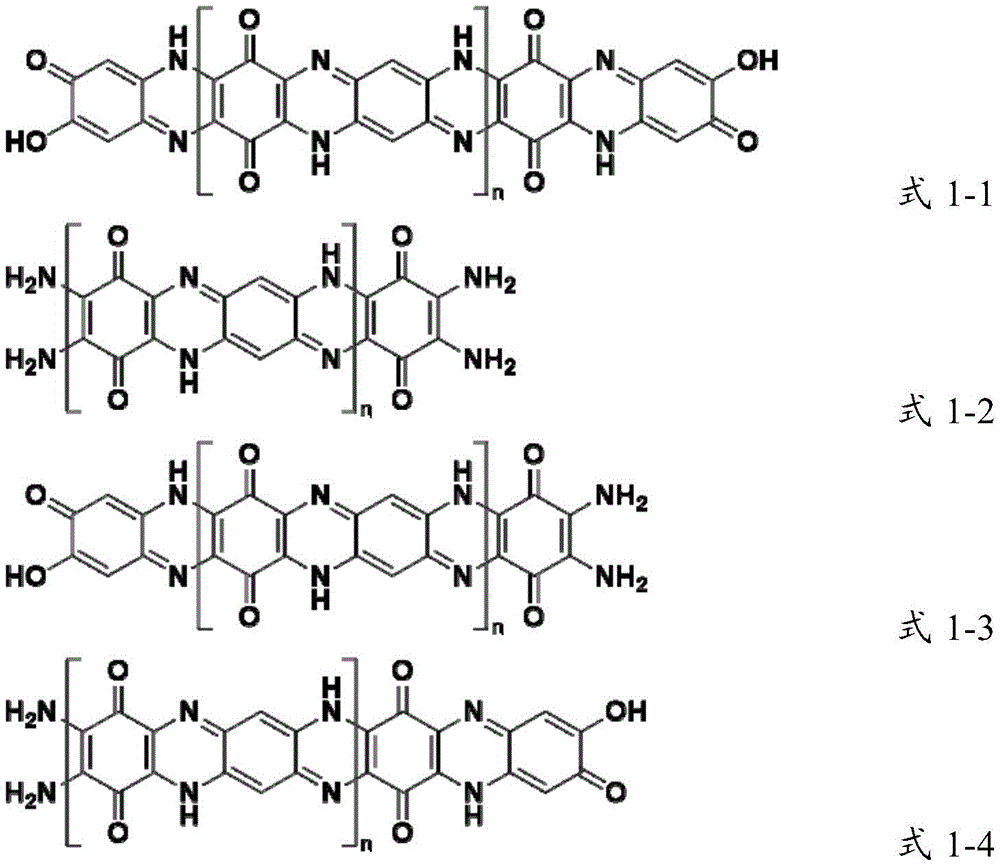
具有式1所示结构的聚合物可以选自具有以下结构式的聚合物:The polymer having the structure shown in


其中聚合度n如上定义。where the degree of polymerization n is as defined above.
在另一方面中,本申请还提供了这种聚合物的制备方法,通过2,5-二羟基-1,4-苯醌和2,3,5,6-四氨基-1,4-苯醌的缩聚反应得到所述聚合物。In another aspect, the application also provides the preparation method of this polymer, by 2,5-dihydroxy-1,4-benzoquinone and 2,3,5,6-tetraamino-1,4-benzene Polycondensation of quinones yields the polymers.
因此,本申请还提供了通过2,5-二羟基-1,4-苯醌和2,3,5,6-四氨基-1,4-苯醌的缩聚反应得到的聚合物。Therefore, the present application also provides a polymer obtained by polycondensation reaction of 2,5-dihydroxy-1,4-benzoquinone and 2,3,5,6-tetraamino-1,4-benzoquinone.
上述聚合物可以具有以下特征中的一个或多个:The polymers described above may have one or more of the following characteristics:
(i)在13C固态核磁谱图中,在146±1ppm具有特征峰,和任选地在174±1ppm、142±1ppm、134±1ppm、130±1ppm和108±1ppm处具有特征峰;(i) have characteristic peaks at 146±1ppm in13C solid-state nuclear magnetic spectrum, and optionally have characteristic peaks at 174±1ppm, 142±1ppm, 134±1ppm, 130±1ppm and 108±1ppm;
(ii)在红外图谱中,在1545±2cm-1处具有特征峰,和任选地在1626±2cm-1处具有特征峰;(ii) in the infrared spectrum, have a characteristic peak at 1545 ± 2cm -1 , and optionally have a characteristic peak at 1626 ± 2cm -1 ;
(iii)在热重分析图谱中,在300℃±10℃保持约98%的质量,在703℃±10℃仍保持约60%的质量。(iii) In the thermogravimetric analysis spectrum, about 98% of the mass is maintained at 300°C±10°C, and about 60% of the mass is maintained at 703°C±10°C.
在再一方面中,本申请还提供了所述聚合物在活性电极材料包括活性正极材料和活性负极材料中的用途,以及所述聚合物在锂离子电池、特别是柔性可充电离子电池的用途。在锂离子电池中,该聚合物可以同时作为活性正极材料和活性负极材料。In yet another aspect, the application also provides the use of the polymer in active electrode materials including active positive electrode materials and active negative electrode materials, and the use of the polymer in lithium-ion batteries, especially flexible rechargeable ion batteries . In Li-ion batteries, this polymer can serve as both active cathode material and active anode material.
附图说明Description of drawings
图1为根据本申请的聚合物的结构示意图,其中标示出了6种不同化学环境的碳原子。Fig. 1 is a schematic diagram of the structure of a polymer according to the present application, wherein carbon atoms in 6 different chemical environments are marked.
图2为实施例1中得到的梯形聚合物1的13C固态核磁谱图。FIG. 2 is the 13 C solid-state NMR spectrum of the
图3为实施例1中得到的梯形聚合物1以及两种反应单体的傅里叶变换红外谱图。其中Poly-BQ1表示梯形聚合物1;DHBQ表示2,5-二羟基-1,4-苯醌;TABQ表示2,3,5,6-四氨基-1,4-苯醌。Fig. 3 is the Fourier transform infrared spectrum of the
图4为实施例1中得到的梯形聚合物1的热重分析谱图。FIG. 4 is a thermogravimetric analysis spectrum of
图5为实施例7中组装的锂离子电池1在测试电压窗口1.2-3.6V内,在充放电电流密度为50mA g-1下的容量-电压曲线。Fig. 5 is the capacity-voltage curve of the lithium-
图6为实施例7中组装的锂离子电池1在测试电压窗口1.2-3.6V内,在充放电电流密度为500mA g-1下的充放电循环测试图。FIG. 6 is a charge-discharge cycle test diagram of the lithium-
图7为实施例8中组装的锂离子电池2在测试电压窗口0.01-3.0V内,在充放电电流密度为500mA g-1下的充放电循环测试图。FIG. 7 is a charge-discharge cycle test diagram of the lithium-
图8为实施例9中组装的全有机对称锂离子电池在测试电压窗口0.1-2.95V内,在充放电电流密度为500mA g-1下的充放电循环测试图。Fig. 8 is a charge-discharge cycle test diagram of the all-organic symmetrical lithium-ion battery assembled in Example 9 at a charge-discharge current density of 500 mA g -1 within the test voltage window of 0.1-2.95V.
具体实施方式Detailed ways
虽然本申请含有许多细节,但这些不应被解释为对发明或要求保护的任何范围的限制。在本申请的单独实施方案中描述的某些特征也可以在单个实施方案中组合实现。相反地,在单个实施方案中描述的多种特征也可以在多个实施方案中单独地或以任何合适的子组合来实现。此外,尽管这些特征可以在上文中被描述为以某些组合起作用并且甚至最初如此被要求保护,但是来自所要求保护的组合的一个或多个特征可以在一些情况下从组合中删除,并且所要求保护的组合可以涉及子组合或子组合的变型。While this application contains many specifics, these should not be construed as limitations on the scope of any invention or claim. Certain features that are described in separate embodiments of this application can also be implemented in combination in a single embodiment. Conversely, various features that are described in a single embodiment can also be implemented in multiple embodiments separately or in any suitable subcombination. Furthermore, although these features may have been described above as functioning in certain combinations and even initially claimed as such, one or more features from a claimed combination may in some cases be deleted from the combination, and Claimed combinations may relate to subcombinations or variations of subcombinations.
除非另外说明,本文中的术语的含义与本领域技术人员通常理解的含义相同,例如,涉及反应原料和反应产物、实验操作步骤、工艺技术参数、使用仪器设备和工具以及各种数值单位中的术语。Unless otherwise specified, the meanings of the terms herein are the same as those commonly understood by those skilled in the art, for example, involving reaction raw materials and reaction products, experimental operation steps, process technical parameters, equipment and tools used, and various numerical units the term.
在本文中,术语“约”(例如,在组分含量和反应条件的参数中)以本领域技术人员通常能够理解的含义来解释。一般情况下,术语“约”可以理解为给定数值的正负5%范围内的任意数值,例如,约X可以代表95%X至105%X的范围中的任意数值。Herein, the term "about" (eg, in parameters of component amounts and reaction conditions) is to be interpreted in the meaning generally understood by those skilled in the art. In general, the term "about" can be understood as any value within the range of plus or
还应当理解,本文中给出的具体数值(例如,在各种组分比例、反应温度和反应持续的时间中)不仅可以作为单独的数值理解,还应当认为提供了某一范围的端点值,并且可以相互组合提供其他的范围。例如,当公开了反应可以进行12小时或24小时时,也相应地公开了反应可以进行12-24小时。此外,本文给出的具体数值还可以理解为在所有情况下均被术语“约”修饰。因此,除非有相反的规定,本申请所记载的数值是可以根据要求改变的近似值。例如,持续时间为12小时可以被理解为持续时间为约12小时,持续时间为12-24小时可以被理解为持续时间为约12小时-约24小时或约12-24小时。It should also be understood that the specific numerical values given herein (for example, in various component ratios, reaction temperatures, and reaction durations) are not only to be understood as individual numerical values, but should also be considered as providing endpoints of a certain range, And can be combined with each other to provide other ranges. For example, when it is disclosed that the reaction can be carried out for 12 hours or 24 hours, it is also disclosed that the reaction can be carried out for 12-24 hours. Furthermore, specific numerical values given herein are to be understood as being modified in all instances by the term "about". Therefore, unless specified to the contrary, the numerical values reported in this application are approximate values that can be changed according to requirements. For example, a duration of 12 hours can be understood as a duration of about 12 hours, and a duration of 12-24 hours can be understood as a duration of about 12 hours to about 24 hours or about 12-24 hours.
在本文中,“室温”一般指约25℃的温度。Herein, "room temperature" generally refers to a temperature of about 25°C.
为了解决在本文开头提到的在锂离子电池中、特别是有机锂离子电池中存在的问题,本发明的发明人特别地提供一种聚合物,其具有如下式1所示的结构作为主链(骨架):In order to solve the problems mentioned at the beginning of this paper in lithium-ion batteries, especially in organic lithium-ion batteries, the inventors of the present invention specifically provide a polymer having the structure shown in the following

这里,n为聚合度。Here, n is the degree of aggregation.
根据本申请的聚合物由于其结构特性,也可被称为“梯形聚合物”,是一种有机聚合物。梯形聚合物又称双线聚合物,是由两个及以上的单链相连生成的带状大分子链,结构类似梯型的聚合物,其分子链由连续的环状结构所组成的。式1所表示的分子具有共轭的环状芳香结构的主链骨架,是一种氮杂稠合共轭梯形聚合物。这种聚合物可以以所示重复单元向两端延伸形成线性结构,而多个线性的分子链还可以在空间中形成一定的排列。该聚合物的梯形结构使其具有延长的共轭骨架,这有利于电子的离域与传输,从一定程度上提高了材料的导电性,并且进而可以提高由其制得的锂离子电池的倍率性能。The polymer according to the present application, which may also be called "ladder polymer" due to its structural properties, is an organic polymer. Ladder polymers, also known as double-wire polymers, are ribbon-shaped macromolecular chains formed by connecting two or more single chains. The structure is similar to ladder-shaped polymers, and its molecular chains are composed of continuous ring structures. The molecule represented by Formula 1 has a main chain skeleton of a conjugated cyclic aromatic structure, and is an aza-condensed conjugated ladder polymer. This kind of polymer can extend to both ends with the repeating unit shown to form a linear structure, and multiple linear molecular chains can also form a certain arrangement in space. The ladder structure of the polymer makes it have an extended conjugated skeleton, which is conducive to the delocalization and transport of electrons, which improves the conductivity of the material to a certain extent, and can further increase the rate of lithium-ion batteries made from it. performance.
本发明的发明人经过精巧的结构设计和调控,通过2,5-二羟基-1,4-苯醌和2,3,5,6-四氨基-1,4-苯醌的缩聚反应制备得到了根据本申请的聚合物。该制备方法简单、省时、节能环保。The inventors of the present invention prepared it through the polycondensation reaction of 2,5-dihydroxy-1,4-benzoquinone and 2,3,5,6-tetraamino-1,4-benzoquinone through delicate structural design and regulation polymers according to the present application. The preparation method is simple, time-saving, energy-saving and environment-friendly.
2,5-二羟基-1,4-苯醌和2,3,5,6-四氨基-1,4-苯醌是该缩聚反应中的两个反应单体。由于缩聚反应结束的端点不同,即反应产物的末端会在不同的反应单体处结束,即因此存在不同。理论上,该缩聚产物可能因末端基团的不同而具有以下的结构:2,5-dihydroxy-1,4-benzoquinone and 2,3,5,6-tetraamino-1,4-benzoquinone are two reactive monomers in this polycondensation reaction. Because the end points of the polycondensation reaction are different, that is, the ends of the reaction products will end at different reaction monomers, that is, there are differences. Theoretically, the polycondensation product may have the following structure due to the different terminal groups:

本领域技术人员应当理解,聚合物的末端基团会随着反应条件等的不同发生一些变化,但是由此得到的聚合物由于其主链(骨架)仍保持式1的结构,所以仍然在本发明要求保护的聚合物的范围内。因此,根据本申请的聚合物还包括其他末端基团不同的、具有式1所示结构为主链的聚合物,例如具有式1-1、式1-2、式1-3或式1-4所示结构的聚合物。It will be understood by those skilled in the art that the terminal group of the polymer will undergo some changes along with the difference in reaction conditions etc., but the polymer thus obtained still maintains the structure of
本发明的发明人对该缩聚反应得到的聚合物进行了表征。特别地,在13C固态核磁谱图中,根据本申请的聚合物在146ppm(对应于C=N键的碳原子)处具有特征峰。该碳峰的存在足以表明该缩聚反应已经成功得到了根据本申请的聚合物。The inventors of the present invention characterized the polymer obtained from this polycondensation reaction. In particular, in the 13 C solid-state nuclear magnetic spectrum, the polymer according to the present application has a characteristic peak at 146 ppm (corresponding to the carbon atom of the C=N bond). The presence of this carbon peak is sufficient to indicate that the polycondensation reaction has successfully resulted in a polymer according to the present application.
另外,根据本申请的聚合物还在174ppm(对应于C=O键的碳原子)以及142ppm、134ppm、130ppm、108ppm(对应于C=C键的碳原子)处具有特征峰。这些对应于C=O和C=C官能团的碳峰表明了根据本申请的聚合物中富含具有氧化还原活性的官能团。本领域技术人员可以理解,取决于检测条件例如设备和环境的不同,上述碳峰会在±5ppm、例如±2ppm、特别是±1ppm、例如±0.5ppm的范围内发生偏移,但是该聚合物仍在本申请的保护范围内。In addition, the polymers according to the present application also have characteristic peaks at 174ppm (corresponding to carbon atoms of C=O bonds) and 142ppm, 134ppm, 130ppm, 108ppm (corresponding to carbon atoms of C=C bonds). These carbon peaks corresponding to C=O and C=C functional groups indicate that the polymers according to the present application are enriched in functional groups with redox activity. Those skilled in the art can understand that depending on the detection conditions such as different equipment and environments, the above-mentioned carbon peaks are shifted in the range of ±5ppm, such as ±2ppm, especially ±1ppm, such as ±0.5ppm, but the polymer is still Within the protection scope of this application.
特别地,在红外图谱中,根据本申请的聚合物在1545cm-1(对应于C=N键)处具有特征峰。该红外峰的存在足以表明该缩聚反应已经成功得到了根据本申请的聚合物。In particular, in the infrared spectrum, the polymer according to the present application has a characteristic peak at 1545 cm −1 (corresponding to the C=N bond). The presence of this IR peak is sufficient to indicate that the polycondensation reaction has successfully resulted in a polymer according to the present application.
另外,根据本申请的聚合物还在1626cm-1(对应于C=O键)处具有特征峰。这些对应于C=O和C=C官能团的红外峰表明了根据本申请的聚合物中富含具有氧化还原活性的官能团。本领域技术人员可以理解,取决于检测条件例如设备和环境的不同,上述红外峰会在例如±20cm-1、例如±5cm-1、特别是±2cm-1、例如±1cm-1的范围内发生偏移,但是该聚合物仍在本申请的保护范围内。In addition, the polymer according to the present application also has a characteristic peak at 1626 cm -1 (corresponding to the C=O bond). These infrared peaks corresponding to C=O and C=C functional groups indicate that the polymers according to the present application are enriched in functional groups with redox activity. Those skilled in the art can understand that depending on the detection conditions such as different equipment and environments, the above-mentioned infrared peaks occur within the range of, for example, ±20cm -1 , such as ±5cm -1 , especially ±2cm -1 , such as ±1cm -1 Deviation, but the polymer is still within the protection scope of the present application.
特别地,在热重分析图谱中,根据本申请的聚合物在300℃±10℃、特别是300℃±5℃保持约98%的质量,在703℃±10℃、特别是703℃±5℃仍可以保持约60%的质量。In particular, in the thermogravimetric analysis spectrum, the polymer according to the present application maintains about 98% of its mass at 300°C±10°C, especially 300°C±5°C, and maintains about 98% of its mass at 703°C±10°C, especially 703°C±5°C. ℃ can still maintain about 60% of the mass.
此外,通过质谱分析,根据本申请的聚合物具有的聚合度n最小可以为5,即n≥5,优选的是n≥10。随着聚合度n的增大,聚合物材料的稳定性也相应增加。In addition, by mass spectrometry, the polymer according to the present application can have a degree of polymerization n of at least 5, ie n≧5, preferably n≧10. As the degree of polymerization n increases, the stability of the polymer material increases accordingly.
根据实验计算,根据本申请的聚合物理论上的聚合物度n最大可以达到2×10¹³。随着实验条件的调整以及其他相关参数的变化,所得到的聚合物的聚合度n最大还可以为2×10¹²、2×10¹¹、2×10¹⁰、2×10⁹、2×10⁸、2×10⁷、2×10⁶、2×10⁵、2×10⁴、2×10³、2×10²或20。对于梯形聚合物而言,更高的聚合度对聚合反应的条件更为严苛。According to experimental calculations, the theoretical polymer degree n of the polymer according to the present application can reach a maximum of 2×10 13 . With the adjustment of experimental conditions and the change of other related parameters, the maximum polymerization degree n of the obtained polymer can be 2×10 12 , 2×10 11 , 2×10 10 , 2×10 9 , 2×10 8 , 2×10 7 , 2×10 6 , 2×10 5 , 2×10 4 , 2×10 3 , 2×10 2 or 20. For ladder polymers, the higher the degree of polymerization, the more severe the conditions of the polymerization reaction.
根据本申请的聚合物优选具有最大为1000的聚合度n。适当低的聚合度足以抑制小分子在电解液中的溶解,提升电池的循环寿命,实现较好的电化学性能。当聚合度过高时,分子的骨架较大,氧化还原反应发生前后材料的结构变化更大,电池的稳定性降低。The polymers according to the present application preferably have a degree of polymerization n of at most 1000. An appropriately low degree of polymerization is enough to inhibit the dissolution of small molecules in the electrolyte, improve the cycle life of the battery, and achieve better electrochemical performance. When the polymerization is too high, the molecular skeleton is larger, the structural change of the material before and after the redox reaction occurs is greater, and the stability of the battery is reduced.
本申请还提供了根据本申请的聚合物的制备方法,包括使2,5-二羟基-1,4-苯醌和2,3,5,6-四氨基-1,4-苯醌进行缩聚反应。The present application also provides a method for preparing a polymer according to the present application, comprising
在一些优选的实施方案中,2,5-二羟基-1,4-苯醌和2,3,5,6-四氨基-1,4-苯醌进行缩聚反应的摩尔比为(0.75-1.25):1。优选地,2,5-二羟基-1,4-苯醌和2,3,5,6-四氨基-1,4-苯醌进行缩聚反应的摩尔比为约1:1。In some preferred embodiments, the molar ratio of 2,5-dihydroxy-1,4-benzoquinone and 2,3,5,6-tetraamino-1,4-benzoquinone for polycondensation reaction is (0.75-1.25 ):1. Preferably, the molar ratio of the polycondensation reaction between 2,5-dihydroxy-1,4-benzoquinone and 2,3,5,6-tetraamino-1,4-benzoquinone is about 1:1.
在一些优选的实施方案中,2,5-二羟基-1,4-苯醌和2,3,5,6-四氨基-1,4-苯醌在有机溶剂中进行缩聚反应。有机溶剂可以选自N,N-二甲基甲酰胺、N-甲基吡咯烷酮或乙醇,或其组合。In some preferred embodiments, the polycondensation reaction of 2,5-dihydroxy-1,4-benzoquinone and 2,3,5,6-tetraamino-1,4-benzoquinone is carried out in an organic solvent. The organic solvent can be selected from N,N-dimethylformamide, N-methylpyrrolidone or ethanol, or a combination thereof.
在一些优选的实施方案中,2,5-二羟基-1,4-苯醌和2,3,5,6-四氨基-1,4-苯醌在催化剂的存在下进行缩聚反应。催化剂可以选自磷酸、硫酸或乙酸,或其组合。在进一步优选的方案中,催化剂为磷酸。In some preferred embodiments, the polycondensation reaction of 2,5-dihydroxy-1,4-benzoquinone and 2,3,5,6-tetraamino-1,4-benzoquinone is carried out in the presence of a catalyst. The catalyst may be selected from phosphoric acid, sulfuric acid or acetic acid, or combinations thereof. In a further preferred solution, the catalyst is phosphoric acid.
在一些实施方案中,该反应在惰性气体如氩气或氮气的保护下进行。In some embodiments, the reaction is performed under the protection of an inert gas such as argon or nitrogen.
在一些实施方案中,该缩聚反应可以在加热条件下进行。例如,该缩聚反应可以在60℃至190℃、优选80℃至120℃、最优选约100℃的温度下进行例如12小时至24小时。In some embodiments, the polycondensation reaction can be performed with heating. For example, the polycondensation reaction may be carried out at a temperature of 60°C to 190°C, preferably 80°C to 120°C, most preferably about 100°C, eg for 12 hours to 24 hours.
在一些实施方案中,该制备方法在缩聚反应完成后继续进行冷却、抽滤、提取和/或干燥的步骤。In some embodiments, the preparation method continues the steps of cooling, suction filtration, extraction and/or drying after the polycondensation reaction is completed.
在特别具体的实施方案中,该聚合物如下制备:在氩气的保护下,将两种反应单体即2,5-二羟基-1,4-苯醌和2,3,5,6-四氨基-1,4-苯醌分别加入到容器如三口圆底烧瓶中,在室温下加入有机溶剂和催化剂,搅拌溶解混合均匀后开始加热升高温度,在加热条件下恒温保持反应一段时间,反应完成后将反应体系静置冷却至室温,通过抽滤获得固体粗产物,固体粗产物经过反复的洗涤与抽滤之后,再通过索氏提取进一步纯化,真空加热干燥后得到产物有机梯形聚合物材料。In a particularly specific embodiment, the polymer is prepared by reacting two reactive monomers, 2,5-dihydroxy-1,4-benzoquinone and 2,3,5,6- Add tetraamino-1,4-benzoquinone into containers such as three-necked round-bottomed flasks respectively, add organic solvent and catalyst at room temperature, stir to dissolve and mix evenly, then start heating to raise the temperature, and keep the reaction at a constant temperature under heating conditions for a period of time. After the reaction was completed, the reaction system was left to cool down to room temperature, and the solid crude product was obtained by suction filtration. After repeated washing and suction filtration, the solid crude product was further purified by Soxhlet extraction, and the product organic ladder polymer was obtained after vacuum heating and drying. Material.
根据本申请的聚合物具有稳定的梯形聚合物骨架,即如式1所示的结构。由于该聚合物在骨架中含有大量的正极活性的碳氧双键、碳氮双键,并且同时具有较少的氧化还原非活性官能团,因此适合用于金属(锂)离子电池中,特别适合用作锂离子电池活性正极材料。由此制得的锂离子电池具有较高的质量比容量和充放电循环稳定性。The polymer according to the present application has a stable ladder polymer backbone, that is, the structure shown in
该聚合物在骨架中还含有大量的负极活性的碳碳双键,即同时存在大量的氧化还原活性的碳氧双键、碳氮双键、碳碳双键以及较少的氧化还原非活性官能团,因此适合用于金属(锂)离子电池中,特别适合用作锂离子电池活性负极材料。由此制得的锂离子电池具有较高的质量比容量和充放电循环稳定性。The polymer also contains a large number of negative active carbon-carbon double bonds in the skeleton, that is, there are a large number of redox active carbon-oxygen double bonds, carbon-nitrogen double bonds, carbon-carbon double bonds and less redox inactive functional groups. , so it is suitable for use in metal (lithium) ion batteries, and is particularly suitable as an active negative electrode material for lithium ion batteries. The resulting lithium-ion battery has high mass specific capacity and charge-discharge cycle stability.
该聚合物由于骨架中含有的大量含氧、氮杂原子的吸电子基团,使得包含该聚合物的活性正极材料的氧化还原电位提高,具有较高的工作电位,从而有利于提高锂离子电池的能量密度。Due to the large amount of electron-withdrawing groups containing oxygen and nitrogen heteroatoms contained in the polymer skeleton, the redox potential of the active positive electrode material containing the polymer is increased, and it has a higher working potential, which is beneficial to improve the lithium-ion battery. energy density.
而且,该聚合物由于在骨架中同时含有大量的正极活性的碳氧双键和碳氮双键以及负极活性的碳碳双键,以及含有较少的氧化还原非活性官能团,而且前述氧化还原官能团有着丰富的氧化还原反应电位,因此尤其适合用于全有机对称电池、例如全有机锂离子电池中,特别适合同时用作全有机对称锂离子电池的活性正极材料和活性负极材料。由此制得的全有机对称电池不仅具有较高的质量比容量和充放电循环稳定性,而且不同的氧化还原活性的官能团在不同电位分别发挥不同的电极活性。Moreover, the polymer contains a large amount of positive active carbon-oxygen double bonds and carbon-nitrogen double bonds and negative active carbon-carbon double bonds in the skeleton, and contains less redox inactive functional groups, and the aforementioned redox functional groups It has a rich redox reaction potential, so it is especially suitable for use in all-organic symmetric batteries, such as all-organic lithium-ion batteries, and is especially suitable for both active positive electrode materials and active negative electrode materials for all-organic symmetric lithium-ion batteries. The resulting all-organic symmetric battery not only has high mass specific capacity and charge-discharge cycle stability, but also has different redox active functional groups to exert different electrode activities at different potentials.
在本文中,“全有机对称锂离子电池”是指正负极采用相同的有机材料作为活性电极材料的锂离子电池。全有机对称锂离子电池至少具有以下优势:1)正负极采用相同的活性材料,只需进行一次简单的合成制备便可以同时得到正负极的活性电极材料,操作简便;2)不含有除锂离子之外的其他金属元素,有机元素在自然界储量丰富,有望在未来的储能设备被广泛使用;3)不含有有毒的重金属元素,且生产制备过程的能耗较无机材料低,节能环保;和4)主要由选自C、H、N、O、S的元素组成,相比于无机物,具有更轻的质量,从而使其制备的电池具有更高的质量比容量。Herein, "all-organic symmetric lithium-ion battery" refers to a lithium-ion battery in which the positive and negative electrodes use the same organic material as the active electrode material. The all-organic symmetric lithium-ion battery has at least the following advantages: 1) the positive and negative electrodes use the same active material, and the active electrode materials of the positive and negative electrodes can be obtained at the same time only by a simple synthesis preparation, which is easy to operate; 2) does not contain Other metal elements other than lithium ions, organic elements are abundant in nature, and are expected to be widely used in future energy storage devices; 3) do not contain toxic heavy metal elements, and the energy consumption in the production and preparation process is lower than that of inorganic materials, energy saving and environmental protection and 4) is mainly composed of elements selected from C, H, N, O, S, and has a lighter weight than inorganic substances, so that the battery prepared by it has a higher mass specific capacity.
如上文已经描述的,根据本申请的聚合物由于在其稳定的梯形聚合物骨架中同时含有大量的正极活性的碳氧双键和碳氮双键以及负极活性的碳碳双键,因此适合在锂离子电池中用作活性正极材料,也适合用作活性负极材料,尤其适合在全有机对称锂离子电池中同时用作活性正极材料和活性负极材料。As already described above, the polymer according to the present application is suitable for use in It is used as an active positive electrode material in lithium-ion batteries, and is also suitable as an active negative electrode material, especially suitable for both active positive electrode materials and active negative electrode materials in all-organic symmetrical lithium-ion batteries.
相比于有机小分子,根据本申请的聚合物在电解液中的溶解度大大降低,有效抑制了电极活性材料在有机电解液中的溶解,抑制了锂离子电池在循环过程中的容量衰减,从而大大提高了由其制得的锂离子电池电极材料的循环稳定性。Compared with small organic molecules, the solubility of the polymer in the electrolyte according to the present application is greatly reduced, effectively inhibiting the dissolution of the electrode active material in the organic electrolyte, and inhibiting the capacity decay of the lithium-ion battery during cycling, thereby The cycle stability of the lithium ion battery electrode material prepared therefrom is greatly improved.
因此,本申请还提供了一种活性电极材料,其包括根据本申请的聚合物。由于该聚合物的特定结构和性能,其既可以用作活性正极材料,也可以用于活性负极材料。Accordingly, the present application also provides an active electrode material comprising a polymer according to the present application. Due to the specific structure and properties of this polymer, it can be used as both an active cathode material and an active anode material.
因此,本申请还提供了一种锂离子电池,其包括根据本申请的聚合物。在锂离子电池中,该聚合物可以用作活性电极材料,例如活性正极材料或活性负极材料;或者同时用作活性正极材料和活性负极材料。Accordingly, the present application also provides a lithium-ion battery comprising the polymer according to the present application. In lithium-ion batteries, the polymer can be used as an active electrode material, such as an active positive electrode material or an active negative electrode material; or simultaneously as an active positive electrode material and an active negative electrode material.
使用根据本申请的聚合物制得的锂离子电池,无论是单独使用根据本申请的聚合物作为正极材料或负极材料,还是同时用作正极材料和负极材料,均具有较高的质量比容量和能量密度、较高的充放电循环稳定性和优异的倍率性能。Use according to the lithium ion battery that the polymer of the present application makes, no matter use the polymer according to the present application alone as positive electrode material or negative electrode material, or be used as positive electrode material and negative electrode material simultaneously, all have higher mass specific capacity and Energy density, high charge-discharge cycle stability and excellent rate performance.
相应地,本申请还提供了根据本申请的聚合物在锂离子电池中作为活性电极材料(包括活性正极材料和/或活性负极材料)的用途。Correspondingly, the present application also provides the use of the polymer according to the present application as an active electrode material (including an active positive electrode material and/or an active negative electrode material) in a lithium ion battery.
作为一个实例,锂离子电池可以通过本领域中已知的常规技术操作进行制备。As an example, lithium ion batteries can be fabricated by conventional techniques known in the art.
在一些实施方案中,锂离子电池的制备可以为:将根据本申请的聚合物、导电添加剂Super P和粘合剂PVDF在溶剂N-甲基吡咯烷酮中研磨并分散均匀形成浆料,将所述浆料涂覆于相应的铝箔集流体表面,再真空加热干燥制成正极电极膜,正极电极膜进行裁剪后制成相应的正极电极片;将所述正极电极片和参比电极片锂箔通过隔膜分隔,加入适量的电解液,组装得到扣式锂离子电池。In some embodiments, the preparation of the lithium-ion battery can be as follows: the polymer according to the present application, the conductive additive Super P and the binder PVDF are ground and uniformly dispersed in the solvent N-methylpyrrolidone to form a slurry, and the The slurry is coated on the surface of the corresponding aluminum foil current collector, and then heated and dried in vacuum to form a positive electrode film, and the positive electrode film is cut to make the corresponding positive electrode sheet; the positive electrode sheet and the reference electrode sheet lithium foil are passed through The diaphragm is separated, and an appropriate amount of electrolyte is added to assemble a button lithium-ion battery.
在优选的实施方案中,根据本申请的聚合物、导电添加剂Super P和粘合剂PVDF的质量比为(30~70):(60~20):10。In a preferred embodiment, the mass ratio of the polymer according to the present application, the conductive additive Super P and the binder PVDF is (30-70):(60-20):10.
在优选的实施方案中,所使用的电解液为不同锂盐溶于不同的有机溶剂中所得到的溶液,电解质盐的浓度可为0.5-4.0mol/L,更优选的浓度约为1.0mol/L。优选地,锂盐可以选自高氯酸锂、双(三氟甲磺酰)亚胺锂或者六氟磷酸锂盐中的一种或其中几种以任意比例混合制成的混合物。优选地,所使用的有机溶剂可以为1,3-二氧戊环(DOL)、乙二醇二甲醚(DME)、碳酸丙烯酯(PC)、碳酸乙烯酯(EC)、碳酸二甲酯(DMC)、碳酸二乙酯(DEC)或者碳酸甲乙酯(EMC)中的一种或几种以任意比例混合制成的混合溶剂。In a preferred embodiment, the electrolyte solution used is a solution obtained by dissolving different lithium salts in different organic solvents. The concentration of the electrolyte salt can be 0.5-4.0mol/L, and the more preferred concentration is about 1.0mol/L. L. Preferably, the lithium salt can be selected from one of lithium perchlorate, lithium bis(trifluoromethanesulfonyl)imide or lithium hexafluorophosphate or a mixture of several of them mixed in any proportion. Preferably, the organic solvent used can be 1,3-dioxolane (DOL), ethylene glycol dimethyl ether (DME), propylene carbonate (PC), ethylene carbonate (EC), dimethyl carbonate (DMC), diethyl carbonate (DEC) or ethyl methyl carbonate (EMC) is a mixed solvent made by mixing one or more of them in any proportion.
在一些实施方案中,锂离子电池的制备可以为:将根据本申请的聚合物、导电添加剂Super P和粘合剂CMC在溶剂去离子水中研磨并分散均匀形成浆料,将所述浆料涂覆于相应的铜箔集流体表面,再真空加热干燥制成负极电极膜,负极电极膜进行裁剪后制成相应的负极电极片;将所述负极电极片和参比电极片锂箔通过隔膜分隔,加入适量的电解液,组装得到锂离子扣式电池。In some embodiments, the preparation of the lithium-ion battery can be as follows: the polymer according to the present application, the conductive additive Super P and the binder CMC are ground and dispersed in the solvent deionized water to form a slurry, and the slurry is coated Cover the surface of the corresponding copper foil current collector, and then heat and dry in vacuum to form a negative electrode film. , add an appropriate amount of electrolyte, and assemble a lithium-ion button battery.
在优选的实施方案中,根据本申请的聚合物、导电添加剂Super P和粘合剂CMC的质量比为(30~70):(60~20):10。In a preferred embodiment, the mass ratio of the polymer according to the present application, the conductive additive Super P and the binder CMC is (30-70):(60-20):10.
在优选的实施方案中,所使用的电解液为不同锂盐溶于不同的有机溶剂中所得到的溶液,电解质盐的浓度可为0.5-4.0mol/L,更优选的浓度约为1.0mol/L。优选地,锂盐可以选自高氯酸锂、双(三氟甲磺酰)亚胺锂或者六氟磷酸锂盐中的一种或其中几种以任意比例混合制成的混合物。优选地,所述有机溶剂可以为1,3-二氧戊环(DOL)、乙二醇二甲醚(DME)、碳酸丙烯酯(PC)、碳酸乙烯酯(EC)、碳酸二甲酯(DMC)、碳酸二乙酯(DEC)或者碳酸甲乙酯(EMC)中的一种或几种以任意比例混合制成的混合溶剂。In a preferred embodiment, the electrolyte solution used is a solution obtained by dissolving different lithium salts in different organic solvents. The concentration of the electrolyte salt can be 0.5-4.0mol/L, and the more preferred concentration is about 1.0mol/L. L. Preferably, the lithium salt can be selected from one of lithium perchlorate, lithium bis(trifluoromethanesulfonyl)imide or lithium hexafluorophosphate or a mixture of several of them mixed in any proportion. Preferably, the organic solvent can be 1,3-dioxolane (DOL), ethylene glycol dimethyl ether (DME), propylene carbonate (PC), ethylene carbonate (EC), dimethyl carbonate ( A mixed solvent made by mixing one or more of DMC), diethyl carbonate (DEC) or ethyl methyl carbonate (EMC) in any proportion.
在一些实施方案中,全有机对称锂离子电池可以通过本领域中已知的常规技术操作进行制备。全有机对称锂离子电池的制备可以为:将如上文制备的正极电极片和完全放电之后预锂化后的如上文制备的负极电极片以隔膜分隔,加入适量的电解液,组装得到全有机对称锂离子扣式电池。In some embodiments, all-organic symmetric lithium-ion batteries can be prepared by conventional techniques known in the art. The preparation of the all-organic symmetric lithium-ion battery can be as follows: the positive electrode sheet prepared as above and the negative electrode sheet prepared as above after pre-lithiation after complete discharge are separated by a diaphragm, and an appropriate amount of electrolyte is added to assemble to obtain an all-organic symmetric battery. Lithium-ion button cell.
在优选的实施方案中,所使用的电解液为不同锂盐溶于不同的有机溶剂中所得到的溶液,电解质盐的浓度可为0.5-4.0mol/L,更优选的浓度约为1.0mol/L。优选地,锂盐可以选自高氯酸锂、双(三氟甲磺酰)亚胺锂或者六氟磷酸锂盐中的一种或其中几种以任意比例混合制成的混合物。优选地,所述有机溶剂可以为1,3-二氧戊环(DOL)、乙二醇二甲醚(DME)、碳酸丙烯酯(PC)、碳酸乙烯酯(EC)、碳酸二甲酯(DMC)、碳酸二乙酯(DEC)或者碳酸甲乙酯(EMC)中的一种或几种以任意比例混合制成的混合溶剂。In a preferred embodiment, the electrolyte solution used is a solution obtained by dissolving different lithium salts in different organic solvents. The concentration of the electrolyte salt can be 0.5-4.0mol/L, and the more preferred concentration is about 1.0mol/L. L. Preferably, the lithium salt can be selected from one of lithium perchlorate, lithium bis(trifluoromethanesulfonyl)imide or lithium hexafluorophosphate or a mixture of several of them mixed in any proportion. Preferably, the organic solvent can be 1,3-dioxolane (DOL), ethylene glycol dimethyl ether (DME), propylene carbonate (PC), ethylene carbonate (EC), dimethyl carbonate ( A mixed solvent made by mixing one or more of DMC), diethyl carbonate (DEC) or ethyl methyl carbonate (EMC) in any proportion.
根据本申请的聚合物本身是一种有机材料,具有本征的结构柔性,因此在与导电添加剂和粘结剂制成浆料涂在集流体上形成电极后,电极片也具有一定的柔性。若利用可以弯折的电池,就可以方便地进一步制备成柔性封装的软包电池。The polymer according to the present application itself is an organic material with intrinsic structural flexibility, so after the slurry is prepared with conductive additives and binders and coated on the current collector to form electrodes, the electrode sheets also have certain flexibility. If a bendable battery is used, it can be conveniently further prepared into a flexible packaged pouch battery.
因此,本申请还提供了一种柔性可充电电池、特别是柔性可充电锂离子电池,其包括根据本申请的聚合物。根据本申请的聚合物在柔性可充电锂离子电池中可以作为活性电极材料,包括活性正极材料和/或活性负极材料。由此制得的柔性可充电锂离子电池不仅具有较高的质量比容量、较好充放电循环稳定性,不同的氧化还原活性的官能团会在不同电位分别发挥不同的电极活性等优势,还具有可折叠的额外优势,因此具有更广泛的应用场景。Accordingly, the present application also provides a flexible rechargeable battery, in particular a flexible rechargeable lithium-ion battery, comprising a polymer according to the present application. The polymers according to the present application can be used as active electrode materials, including active positive electrode materials and/or active negative electrode materials, in flexible rechargeable lithium-ion batteries. The resulting flexible rechargeable lithium-ion battery not only has a high mass specific capacity, good charge-discharge cycle stability, and different redox-active functional groups will exert different electrode activities at different potentials. The additional advantage of being foldable, thus having a wider range of application scenarios.
在一些实施方案中,还可以使用根据本申请的聚合物作为活性电极材料来制备柔性可弯折锂离子电池。因此,本申请还提供了所述聚合物在柔性可弯折锂离子电池中的用途,特别是作为柔性可弯折锂离子电池的活性电极材料(例如活性正极材料和/或活性负极材料)的用途。In some embodiments, flexible and bendable lithium-ion batteries can also be prepared using the polymers according to the present application as active electrode materials. Therefore, the present application also provides the use of the polymer in a flexible and bendable lithium-ion battery, especially as an active electrode material (such as an active positive electrode material and/or an active negative electrode material) of a flexible and bendable lithium-ion battery. use.
在一些实施方案中,锂离子电池采用铝塑膜进行封装得到柔性锂离子软包电池,其中根据本申请的聚合物可以作为柔性锂离子电池的活性正极材料。In some embodiments, the lithium-ion battery is packaged with an aluminum-plastic film to obtain a flexible lithium-ion pouch battery, wherein the polymer according to the present application can be used as an active positive electrode material for the flexible lithium-ion battery.
在一些实施方案中,锂离子电池采用铝塑膜进行封装得到柔性锂离子软包电池,其中根据本申请的聚合物材料可以作为柔性锂离子电池的活性负极材料。In some embodiments, the lithium-ion battery is packaged with an aluminum-plastic film to obtain a flexible lithium-ion pouch battery, wherein the polymer material according to the present application can be used as an active negative electrode material of the flexible lithium-ion battery.
在一些实施方案中,全有机锂离子对称电池采用铝塑膜进行封装得到柔性全有机锂离子对称软包电池,根据本申请的聚合物同时作为全有机对称柔性锂离子电池的活性正极材料和活性负极材料。In some embodiments, the all-organic lithium-ion symmetric battery is packaged with an aluminum-plastic film to obtain a flexible all-organic lithium-ion symmetric pouch battery, and the polymer according to the application is simultaneously used as an active positive electrode material and active Negative material.
根据本申请的聚合物不仅合成方法简单、制备省时高效、制备成本低、原料环保且具有可持续性,而且由其制备的多种锂离子电池均具有出色的电化学性能,包括较高的质量比容量、较好的充放电循环稳定性和优异的倍率性能。根据结构和功能的关系,这些优异的电化学性能主要是由于通过缩聚反应,在稳定的梯形聚合物骨架中引入了大量的具有不同氧化还原反应电位的碳氧双键、碳氮双键和碳碳双键,且骨架中非活性的官能团较少,因此根据本申请的聚合物具有较高的质量比容量和较好的充放电循环的稳定性。The polymer according to the present application is not only simple in synthesis, time-saving and efficient in preparation, low in preparation cost, environmentally friendly and sustainable in raw materials, but also various lithium-ion batteries prepared by it have excellent electrochemical properties, including higher Mass specific capacity, good charge-discharge cycle stability and excellent rate performance. According to the relationship between structure and function, these excellent electrochemical properties are mainly due to the introduction of a large number of carbon-oxygen double bonds, carbon-nitrogen double bonds and carbon Carbon double bonds, and less inactive functional groups in the skeleton, so the polymer according to the present application has a higher mass specific capacity and better charge-discharge cycle stability.
实施例Example
以下实施例仅用于说明而非限制本申请范围的目的。The following examples are for the purpose of illustration only and not limiting the scope of the application.
在实施例中使用到的材料的来源Sources of materials used in the examples
2,5-二羟基-1,4-苯醌2,5-Dihydroxy-1,4-benzoquinone
购买于艾览(上海)化工科技有限公司,纯度≥98%。Purchased from Alan (Shanghai) Chemical Technology Co., Ltd., purity ≥ 98%.
2,3,5,6-四氨基-1,4-苯醌2,3,5,6-tetraamino-1,4-benzoquinone
购买于吉林中科研伸科技有限公司,纯度≥97%。Purchased from Jilin Zhongke Shen Technology Co., Ltd., purity ≥ 97%.
实施例1:梯形聚合物1的合成Embodiment 1: Synthesis of
将280mg(2mmol)2,5-二羟基-1,4-苯醌和336mg(2mmol)2,3,5,6-四氨基-1,4-苯醌共同加入到50mL的三口圆底烧瓶中,在氩气的保护下,在室温下缓慢加入20mL的N-甲基吡咯烷酮溶剂和几滴85wt%的磷酸水溶液,同时搅拌溶解混合均匀,通过油浴加热升温至100℃并保持100℃反应12h,反应完成以后将反应体系静置冷却到室温,通过抽滤收集得到固体粗产物,使用甲醇、水、乙醇等溶剂反复进行洗涤与抽滤的操作,再进一步通过甲醇、水、乙醇、丙酮进行索氏提取纯化,将固体在80℃真空干燥过夜,得到纯化的黑色固体粉末产物,即梯形聚合物1。Add 280mg (2mmol) 2,5-dihydroxy-1,4-benzoquinone and 336mg (2mmol) 2,3,5,6-tetraamino-1,4-benzoquinone into a 50mL three-neck round bottom flask , under the protection of argon, slowly add 20mL of N-methylpyrrolidone solvent and a few drops of 85wt% phosphoric acid aqueous solution at room temperature, while stirring to dissolve and mix well, heat up to 100°C by oil bath and keep at 100°C for 12h After the reaction is completed, the reaction system is left to cool down to room temperature, and the solid crude product is collected by suction filtration, and the operation of washing and suction filtration is repeated using methanol, water, ethanol and other solvents, and then further carried out by methanol, water, ethanol, acetone, etc. After Soxhlet extraction and purification, the solid was vacuum-dried at 80° C. overnight to obtain a purified black solid powder product, namely
实施例2:梯形聚合物2的合成Embodiment 2: the synthesis of
将280mg(2mmol)2,5-二羟基-1,4-苯醌和336mg(2mmol)2,3,5,6-四氨基-1,4-苯醌共同加入到50mL的三口圆底烧瓶中,在氩气的保护下,在室温下缓慢加入20mL的N-甲基吡咯烷酮溶剂和几滴浓硫酸,同时搅拌溶解混合均匀,通过油浴加热升温至100℃并保持100℃反应12h,反应完成以后将反应体系静置冷却到室温,通过抽滤收集得到固体粗产物,使用甲醇、水、乙醇等溶剂反复进行洗涤与抽滤的操作,再进一步通过甲醇、水、乙醇、丙酮进行索氏提取纯化,将固体在80℃真空干燥过夜,得到纯化的黑色固体粉末产物,即梯形聚合物2。Add 280mg (2mmol) 2,5-dihydroxy-1,4-benzoquinone and 336mg (2mmol) 2,3,5,6-tetraamino-1,4-benzoquinone into a 50mL three-neck round bottom flask , under the protection of argon, slowly add 20mL of N-methylpyrrolidone solvent and a few drops of concentrated sulfuric acid at room temperature, stir to dissolve and mix well at the same time, heat up to 100°C by oil bath and keep at 100°C for 12h, the reaction is complete Afterwards, the reaction system was left to cool down to room temperature, and the solid crude product was collected by suction filtration, and the operations of washing and suction filtration were repeated with solvents such as methanol, water, and ethanol, and further Soxhlet extraction was performed with methanol, water, ethanol, and acetone. For purification, the solid was vacuum-dried at 80° C. overnight to obtain a purified black solid powder product, namely
实施例3梯形聚合物3的合成The synthesis of embodiment 3 ladder polymer 3
将280mg(2mmol)2,5-二羟基-1,4-苯醌和336mg(2mmol)2,3,5,6-四氨基-1,4-苯醌共同加入到50mL的三口圆底烧瓶中,在氩气的保护下,在室温下缓慢加入20mL的N,N-二甲基甲酰胺溶剂和几滴浓硫酸,同时搅拌溶解混合均匀,通过油浴加热升温至100℃并保持100℃反应12h,反应完成以后将反应体系静置冷却到室温,通过抽滤收集得到固体粗产物,使用甲醇、水、乙醇等溶剂反复进行洗涤与抽滤的操作,再进一步通过甲醇、水、乙醇、丙酮进行索氏提取纯化,将固体在80℃真空干燥过夜,得到纯化的黑色固体粉末产物,即梯形聚合物3。Add 280mg (2mmol) 2,5-dihydroxy-1,4-benzoquinone and 336mg (2mmol) 2,3,5,6-tetraamino-1,4-benzoquinone into a 50mL three-neck round bottom flask , under the protection of argon, slowly add 20mL of N,N-dimethylformamide solvent and a few drops of concentrated sulfuric acid at room temperature, while stirring to dissolve and mix well, heat up to 100°C through an oil bath and keep at 100°C for reaction 12h, after the completion of the reaction, the reaction system was left to cool to room temperature, and the solid crude product was collected by suction filtration, and the operation of washing and suction filtration was repeated using methanol, water, ethanol and other solvents, and then further passed through methanol, water, ethanol, acetone, etc. Purification by Soxhlet extraction was performed, and the solid was vacuum-dried overnight at 80° C. to obtain a purified black solid powder product, namely ladder polymer 3 .
实施例4梯形聚合物4的合成The synthesis of
将280mg(2mmol)2,5-二羟基-1,4-苯醌和336mg(2mmol)2,3,5,6-四氨基-1,4-苯醌共同加入到50mL的三口圆底烧瓶中,在氩气的保护下,在室温下缓慢加入20mL的N,N-二甲基甲酰胺溶剂和几滴浓硫酸,同时搅拌溶解混合均匀,通过油浴加热升温至80℃并保持80℃反应24h,反应完成以后将反应体系静置冷却到室温,通过抽滤收集得到固体粗产物,使用甲醇、水、乙醇等溶剂反复进行洗涤与抽滤的操作,再进一步通过甲醇、水、乙醇、丙酮进行索氏提取纯化,将固体在80℃真空干燥过夜,得到纯化的黑色固体粉末产物,即梯形聚合物4。Add 280mg (2mmol) 2,5-dihydroxy-1,4-benzoquinone and 336mg (2mmol) 2,3,5,6-tetraamino-1,4-benzoquinone into a 50mL three-neck round bottom flask , under the protection of argon, slowly add 20mL of N,N-dimethylformamide solvent and a few drops of concentrated sulfuric acid at room temperature, while stirring to dissolve and mix well, heat up to 80°C by oil bath and keep 80°C for reaction After 24 hours, after the reaction was completed, the reaction system was left to cool down to room temperature, and the solid crude product was collected by suction filtration, and the operation of washing and suction filtration was repeated using methanol, water, ethanol and other solvents, and then further passed through methanol, water, ethanol, acetone, etc. Purification by Soxhlet extraction was performed, and the solid was vacuum-dried overnight at 80° C. to obtain a purified black solid powder product, namely
实施例5梯形聚合物5的合成The synthesis of
将280mg(2mmol)2,5-二羟基-1,4-苯醌和336mg(2mmol)2,3,5,6-四氨基-1,4-苯醌共同加入到50mL的三口圆底烧瓶中,在氩气的保护下,在室温下缓慢加入20mL的N-甲基吡咯烷酮溶剂和几滴85wt%的磷酸水溶液,同时搅拌溶解混合均匀,通过油浴加热升温至60℃并保持60℃反应18h,反应完成以后将反应体系静置冷却到室温,通过抽滤收集得到固体粗产物,使用甲醇、水、乙醇等溶剂反复进行洗涤与抽滤的操作,再进一步通过甲醇、水、乙醇、丙酮进行索氏提取纯化,将固体在80℃真空干燥过夜,得到纯化的黑色固体粉末产物,即梯形聚合物5。Add 280mg (2mmol) 2,5-dihydroxy-1,4-benzoquinone and 336mg (2mmol) 2,3,5,6-tetraamino-1,4-benzoquinone into a 50mL three-neck round bottom flask , under the protection of argon, slowly add 20mL of N-methylpyrrolidone solvent and a few drops of 85wt% phosphoric acid aqueous solution at room temperature, while stirring to dissolve and mix well, heat up to 60°C by oil bath and keep at 60°C for 18h After the reaction is completed, the reaction system is left to cool down to room temperature, and the solid crude product is collected by suction filtration, and the operation of washing and suction filtration is repeated using methanol, water, ethanol and other solvents, and then further carried out by methanol, water, ethanol, acetone, etc. After Soxhlet extraction and purification, the solid was vacuum-dried at 80° C. overnight to obtain a purified black solid powder product, namely
实施例6梯形聚合物的结构表征The structural characterization of
使用13C固态核磁共振技术、红外光谱技术和拉曼光谱技术分别对实施例1-5中的五个纯化后的黑色固体粉末产物的结构进行表征。结果表明,实施例1-5的产物均为目标梯形聚合物。申请人通过实验比较了梯形聚合物1-5的电学性能,其中实施例1中所得的梯形聚合物1的各方面电化学性能最优异。The structures of the five purified black solid powder products in Examples 1-5 were characterized by using 13 C solid-state nuclear magnetic resonance technique, infrared spectroscopy technique and Raman spectroscopy technique. The results show that the products of Examples 1-5 are target ladder polymers. The applicant compared the electrical properties of the ladder polymers 1-5 through experiments, and the
实施例1所制备的梯形聚合物1的13C固态核磁谱图如图2所示,可以明显看到174ppm处C=O键中碳原子的峰、146ppm处C=N键中碳原子的峰以及142ppm、134ppm、130ppm、108ppm处C=C键中碳原子的峰。梯形聚合物1以及两种反应单体原料的红外谱图如图3所示,在该梯形聚合物1的红外峰中可以明显看到位于1626cm-1处的C=O键的红外特征峰和位于1545cm-1处的C=N键的红外特征峰。有机梯形聚合物1的热重谱图如图4所示,其在300℃保持约98%的质量,在703℃仍保持约60%的质量。The 13 C solid-state nuclear magnetic spectrum of the
实施例7锂离子电池1的制备以及正极电化学性能的测试Example 7 Preparation of Lithium-
以梯形聚合物1作为活性正极材料,按照下述步骤制备锂离子电池:以梯形聚合物1作为活性正极材料、super P作为导电添加剂,PVDF作为粘结剂,三者的质量比为5:4:1,N-甲基吡咯烷酮作为溶剂,研磨形成均匀的浆料,将该浆料用刮刀涂在涂碳铝箔集流体的表面,真空80℃过夜干燥后得到正极膜,正极膜经过裁剪得到正极电极片。将该正极电极片作为正极片,金属锂箔作为负极片,将1M的LiTFSI盐在DOL和DME体积比为1:1的混合溶剂中的溶液作为电解液,Gelgard2325隔膜作为隔膜,在充满氩气的手套箱中组装成扣式电池。Using
对该锂离子电池进行正极电化学性能的测试,测试结果如图5、6所示,图5中正极的容量-电压曲线有两个明显的氧化还原平台,在测试电压窗口1.2-3.6V内,首圈放电比容量可以达到454.3mAh/g,平均输出电压为2.4V,能量密度为903.1Wh/kg。如图6所示为正极的充放电循环性能测试结果,在1A/g的电流密度下,在1500圈的充放电循环测试中,平均每圈的容量保持率为99.72%,表现出良好的充放电循环稳定性。The lithium-ion battery was tested for the electrochemical performance of the positive electrode. The test results are shown in Figures 5 and 6. The capacity-voltage curve of the positive electrode in Figure 5 has two obvious redox platforms, which are within the test voltage window of 1.2-3.6V , the first discharge specific capacity can reach 454.3mAh/g, the average output voltage is 2.4V, and the energy density is 903.1Wh/kg. Figure 6 shows the test results of the charge-discharge cycle performance of the positive electrode. Under the current density of 1A/g, in the charge-discharge cycle test of 1500 cycles, the average capacity retention rate per cycle is 99.72%, showing good charge and discharge cycle performance. Discharge cycle stability.
实施例8锂离子电池2的制备以及负极电化学性能的测试Preparation of Example 8 Lithium-
以梯形聚合物1作为活性负极材料,按照下述步骤制备锂离子电池:以梯形聚合物1作为活性负极材料、super P作为导电添加剂,CMC作为粘结剂,三者的质量比为5:4:1,去离子水作为溶剂,研磨形成均匀的浆料,将该浆料用刮刀涂在铜箔集流体的表面,真空80℃过夜干燥后得到负极膜,负极膜经过裁剪得到负极电极片。将该负极电极片作为负极片,金属锂箔作为参比电极片,将1M的LiPF6盐在EC和DEC体积比为1:1的混合溶剂中的溶液作为电解液,Gelgard2325隔膜作为隔膜,在充满氩气的手套箱中组装成扣式电池。Using
对该锂离子电池进行负极电化学性能的测试,在测试电压窗口0.01-3.0V内,首圈放电比容量可以超过1000mAh/g,如图7所示为负极的充放电循环性能测试结果,在500mA/g的电流密度下,在300圈的充放电循环测试中,锂离子电池表现出良好的充放电循环稳定性。The electrochemical performance of the negative electrode of the lithium-ion battery was tested. Within the test voltage window of 0.01-3.0V, the first-cycle discharge specific capacity can exceed 1000mAh/g, as shown in Figure 7. The test results of the charge-discharge cycle performance of the negative electrode, in Under the current density of 500mA/g, in the charge-discharge cycle test of 300 cycles, the lithium-ion battery showed good charge-discharge cycle stability.
实施例9锂离子电池3的制备以及全有机对称锂离子电池电化学性能的测试Example 9 Preparation of Lithium-ion Battery 3 and Test of Electrochemical Performance of All-Organic Symmetrical Lithium-ion Battery
以实施例7制得的正极电极片为全有机对称锂离子电池的正极,以实施例8制得的负极电极片经过完全放电预锂化后得到的电极片作为全有机对称锂离子电池的负极,将1M的LiTFSI盐在DOL和DME体积比为1:1的混合溶剂中的溶液作为电解液,Gelgard2325隔膜作为隔膜,在充满氩气的手套箱中组装成全有机对称锂离子扣式电池。The positive electrode sheet obtained in Example 7 is the positive electrode of the all-organic symmetric lithium-ion battery, and the electrode sheet obtained after the negative electrode sheet obtained in Example 8 is completely discharged and pre-lithiated is used as the negative electrode of the all-organic symmetric lithium-ion battery , a solution of 1M LiTFSI salt in a mixed solvent of DOL and DME with a volume ratio of 1:1 was used as the electrolyte, and the Gelgard2325 separator was used as the separator, and an all-organic symmetrical lithium-ion button cell was assembled in an argon-filled glove box.
对该全有机对称锂离子电池进行电化学性能的测试,全有机对称锂离子电池在50mA/g的电流密度下,在0.1-2.9V的电压窗口内有高达351.5mAh/g的放电比容量;对全有机对称锂离子电池进行充放电循环性能的测试,测试结果如图8所示,在500mA/g的电流密度下循环400圈以后容量仍保持稳定,表现出高的比容量和良好的循环寿命。The electrochemical performance of the all-organic symmetric lithium-ion battery was tested. Under the current density of 50mA/g, the all-organic symmetric lithium-ion battery has a discharge specific capacity as high as 351.5mAh/g in the voltage window of 0.1-2.9V; The charge-discharge cycle performance of the all-organic symmetric lithium-ion battery was tested. The test results are shown in Figure 8. The capacity remains stable after 400 cycles at a current density of 500mA/g, showing high specific capacity and good cycle performance. life.
实施例10柔性锂离子电池的制备以及电化学性能的测试Preparation of Example 10 Flexible Li-ion Battery and Test of Electrochemical Performance
实施例7-9中制得的锂离子电池在充满氩气的手套箱中用铝塑膜封装成软包电池,对柔性锂离子软包电池进行电化学性能的测试,三种电池均具有较高的比容量和较好的充放电循环稳定性。检测发现,柔性全有机对称锂离子电池在平坦状态0°下和在180°的折叠状态下均有超过300mAh/g的质量比容量,且该柔性电池在0°到180°的弯折过程中,可以保持亮度不变地持续点亮LED发光二极管。The lithium-ion batteries prepared in Examples 7-9 were packaged into soft-pack batteries with aluminum-plastic film in a glove box filled with argon gas, and the electrochemical performance of the flexible lithium-ion soft-pack batteries was tested. High specific capacity and good charge-discharge cycle stability. The test found that the flexible all-organic symmetric lithium-ion battery has a mass specific capacity of more than 300mAh/g in the flat state at 0° and in the folded state of 180°, and the flexible battery is in the bending process from 0° to 180° , the LED light-emitting diode can be continuously lit while keeping the brightness constant.
以上结果表明,本发明所述的梯形聚合物作为一种有机材料具备非常优异的电化学性能,其作为锂离子电池的活性正极材料或活性负极材料均具有较高的比容量和充放电循环稳定性。将其同时作为全有机对称锂离子电池的活性正极和负极材料也具有较高的比容量和充放电循环稳定性,同时还可以用于制备多种高性能的柔性锂离子电池。The above results show that the ladder polymer of the present invention has very excellent electrochemical properties as an organic material, and it has high specific capacity and stable charge-discharge cycle as the active positive electrode material or active negative electrode material of lithium-ion batteries. sex. Using it as an active positive electrode and negative electrode material for an all-organic symmetric lithium-ion battery also has high specific capacity and charge-discharge cycle stability, and can also be used to prepare a variety of high-performance flexible lithium-ion batteries.
以上所述仅为本发明的较佳实施例而已,并不用以限制本发明创造,凡在本发明创造的精神和原则之内所作的任何修改、等同替换、改进等,均应包含在本发明创造的保护范围之内。The above descriptions are only preferred embodiments of the present invention, and are not intended to limit the present invention. Any modifications, equivalent replacements, improvements, etc. made within the spirit and principles of the present invention shall be included in the present invention. within the scope of protection created.
Claims (25)

Priority Applications (1)
| Application Number | Priority Date | Filing Date | Title |
|---|---|---|---|
| CN202110274236.4A CN115073731B (en) | 2021-03-15 | 2021-03-15 | Organic ladder-shaped polymer, preparation method thereof and application thereof in lithium ion battery |
Applications Claiming Priority (1)
| Application Number | Priority Date | Filing Date | Title |
|---|---|---|---|
| CN202110274236.4A CN115073731B (en) | 2021-03-15 | 2021-03-15 | Organic ladder-shaped polymer, preparation method thereof and application thereof in lithium ion battery |
Publications (2)
| Publication Number | Publication Date |
|---|---|
| CN115073731A CN115073731A (en) | 2022-09-20 |
| CN115073731B true CN115073731B (en) | 2023-03-21 |
Family
ID=83241623
Family Applications (1)
| Application Number | Title | Priority Date | Filing Date |
|---|---|---|---|
| CN202110274236.4A Active CN115073731B (en) | 2021-03-15 | 2021-03-15 | Organic ladder-shaped polymer, preparation method thereof and application thereof in lithium ion battery |
Country Status (1)
| Country | Link |
|---|---|
| CN (1) | CN115073731B (en) |
Families Citing this family (5)
| Publication number | Priority date | Publication date | Assignee | Title |
|---|---|---|---|---|
| CN115505122B (en) * | 2022-10-09 | 2023-12-08 | 南京理工大学 | Imine polymer cathode materials synthesized by solvent-free method and their applications |
| CN115894917B (en) * | 2022-12-02 | 2024-04-02 | 湖北大学 | A kind of polyarylene sulfide polymer and its preparation method and application |
| CN119320493B (en) * | 2024-09-05 | 2025-12-26 | 南开大学 | An organic polymer crystal material based on hydrogen bond network, its preparation method and application |
| CN120271819A (en) * | 2025-04-08 | 2025-07-08 | 辽宁大学 | Preparation method and application of organic polymer material with photoelectric response |
| CN120329544B (en) * | 2025-06-19 | 2025-09-05 | 南开大学 | Conjugated and expanded lithium-containing organic positive electrode material and preparation method and application thereof |
Citations (4)
| Publication number | Priority date | Publication date | Assignee | Title |
|---|---|---|---|---|
| CN104810522A (en) * | 2015-03-09 | 2015-07-29 | 杭州聚力氢能科技有限公司 | Organic positive electrode active material as well as preparation method and application of organic positive electrode active material |
| CN105047932A (en) * | 2015-08-31 | 2015-11-11 | 张家港智电芳华蓄电研究所有限公司 | Quinone compound anode material for aqueous lithium ion battery and aqueous lithium ion battery |
| JP2017052926A (en) * | 2015-09-11 | 2017-03-16 | 学校法人早稲田大学 | Ion conductive condensed ring quinone polymer, electrode active material and secondary battery |
| CN108864104A (en) * | 2018-06-05 | 2018-11-23 | 复旦大学 | A kind of tetra- nitrogen -6,13- pentacene quinone electrode material of 5,7,12,14- and its preparation method and application |
Family Cites Families (1)
| Publication number | Priority date | Publication date | Assignee | Title |
|---|---|---|---|---|
| US10326138B2 (en) * | 2015-09-11 | 2019-06-18 | Waseda University | Charge storage material, electrode active material and secondary battery |
-
2021
- 2021-03-15 CN CN202110274236.4A patent/CN115073731B/en active Active
Patent Citations (4)
| Publication number | Priority date | Publication date | Assignee | Title |
|---|---|---|---|---|
| CN104810522A (en) * | 2015-03-09 | 2015-07-29 | 杭州聚力氢能科技有限公司 | Organic positive electrode active material as well as preparation method and application of organic positive electrode active material |
| CN105047932A (en) * | 2015-08-31 | 2015-11-11 | 张家港智电芳华蓄电研究所有限公司 | Quinone compound anode material for aqueous lithium ion battery and aqueous lithium ion battery |
| JP2017052926A (en) * | 2015-09-11 | 2017-03-16 | 学校法人早稲田大学 | Ion conductive condensed ring quinone polymer, electrode active material and secondary battery |
| CN108864104A (en) * | 2018-06-05 | 2018-11-23 | 复旦大学 | A kind of tetra- nitrogen -6,13- pentacene quinone electrode material of 5,7,12,14- and its preparation method and application |
Also Published As
| Publication number | Publication date |
|---|---|
| CN115073731A (en) | 2022-09-20 |
Similar Documents
| Publication | Publication Date | Title |
|---|---|---|
| CN115073731B (en) | Organic ladder-shaped polymer, preparation method thereof and application thereof in lithium ion battery | |
| CN110429279B (en) | Organic anode material of lithium ion battery and application thereof | |
| CN103000942A (en) | Additive promoting graphite cathode to generate solid electrolyte interfacial film, and application thereof | |
| CN109256554B (en) | A kind of vulcanized polymer composite material and its preparation method and application | |
| CN106575793B (en) | Electrolyte solution for nonaqueous secondary battery and nonaqueous secondary battery using same | |
| CN102110851A (en) | Lithium ion secondary battery | |
| CN103531843A (en) | Electrolytic solution for high-temperature high-magnification type lithium ion battery | |
| CN113248707A (en) | Covalent organic framework materials, methods of making the same, and uses thereof in lithium ion batteries | |
| CN116621844A (en) | Organic nitrogen-containing polyquinone material and its preparation method and application in organic lithium-ion batteries | |
| CN112940156A (en) | Pre-lithiation polymer and preparation method and application thereof | |
| CN118239954A (en) | Organic positive electrode material of zinc ion battery, preparation method and application thereof | |
| CN116891569B (en) | A reduced graphene oxide/hexaazatriphenylene organic composite positive electrode material, preparation method and application thereof | |
| CN110224140A (en) | A kind of organic electrode materials and its application and respective battery device | |
| CN113501956A (en) | D-A type perylene conjugated polymer lithium ion battery positive electrode material with high rate performance and preparation method thereof | |
| CN117700738A (en) | Covalent organic framework material containing multiple oxidation-reduction active groups, preparation method and application thereof | |
| CN111440179A (en) | Conjugated organic lithium ion battery electrode material and preparation method and application thereof | |
| CN116143790A (en) | A functionalized hexaazatriphenylene-based lithium-ion battery positive electrode material and its preparation method and application | |
| CN110556537A (en) | A method for improving the electrochemical performance of anion intercalation electrode materials | |
| CN119462660A (en) | An organic small molecule material and its preparation method and application in aqueous zinc ion battery | |
| CN119297212A (en) | A method for preparing an organic Schiff base polymer lithium ion battery negative electrode material containing a thiophene structure | |
| CN117843893A (en) | Organic electrode material of polyquinone polymer, and preparation method and application thereof | |
| CN118359781B (en) | Polymer containing ferrocene group, preparation method and use thereof | |
| CN115197081B (en) | Low-cost zinc battery positive electrode material and preparation method thereof | |
| CN111211327A (en) | Compound for lithium ion battery anode material and preparation method and application thereof | |
| CN115160323B (en) | A conjugated macrocyclic bicarbazole derivative R-(BCz-Ph)m and its synthesis method and application |
Legal Events
| Date | Code | Title | Description |
|---|---|---|---|
| PB01 | Publication | ||
| PB01 | Publication | ||
| SE01 | Entry into force of request for substantive examination | ||
| SE01 | Entry into force of request for substantive examination | ||
| GR01 | Patent grant | ||
| GR01 | Patent grant |