Disclosure of Invention
Aiming at the defects in the prior art, the invention provides a skid-mounted self-powered organic waste biological treatment and mobile power supply system and process.
In order to achieve the purpose, the invention can adopt the following technical scheme:
a biological treatment system for organic waste, comprising:
the pretreatment feeding module is used for carrying out primary treatment on the organic waste biological material;
the anaerobic biological treatment module is used for receiving the organic waste biological material subjected to primary treatment from the pretreatment feeding module and preparing methane by utilizing anaerobic biological fermentation in the organic waste biological material;
the solid-liquid separation module is used for separating the fermented residues into biogas residues and biogas slurry, wherein the biogas slurry flows back to the pretreatment feeding module and the anaerobic biological treatment module;
the aerobic biological treatment module is used for treating the biogas residues into organic fertilizers; and the number of the first and second groups,
and the methane power generation module is used for generating power by utilizing the methane and supplying the power to each module of the system.
The organic waste biological treatment system further comprises: the system comprises a photovoltaic power generation module and an electricity storage and supply module, wherein the photovoltaic power generation module is used for generating electricity by utilizing solar energy and supplying the electricity to each module of the system, and the electricity storage and supply module is respectively connected with the photovoltaic power generation module and the methane power generation module and is used for storing electric energy generated by the photovoltaic power generation module and the methane power generation module so as to supply the electric energy to each module of the system.
The organic waste biological treatment system further comprises: the microorganism regulation and control module is respectively connected with the anaerobic organism treatment module and the aerobic organism treatment module and is used for feeding anaerobic bacteria and aerobic bacteria into the anaerobic organism treatment module and the aerobic organism treatment module.
The organic waste biological treatment system as described above, further comprising: and the intelligent control module is used for being in communication connection with each module of the system and is used for monitoring and controlling the state of each module of the system.
The organic waste biological treatment system further supplies heat generated in the operation of the biogas power generation module and the aerobic biological treatment module to the pretreatment feeding module, the anaerobic biological treatment module, the solid-liquid separation module and the aerobic biological treatment module.
The organic waste biological treatment system comprises a conveying device and a pretreatment feeding device, wherein the pretreatment feeding module comprises a conveying device and a pretreatment feeding device; the anaerobic biological treatment module comprises an anaerobic reactor, a stirring device and a first biogas pipe, the biogas power generation module comprises a biogas purification device, a second biogas pipe and a biogas power generation device, wherein the conveying device conveys organic waste raw materials to the pretreatment feeding device for preliminary treatment, the organic waste raw materials subjected to preliminary treatment are fermented in the anaerobic reactor, the stirring device is used for stirring the organic waste raw materials in the anaerobic reactor, and fermented biogas enters the biogas purification device through the first biogas pipe, is dehydrated and desulfurized and then is conveyed to the biogas power generation device through the second biogas pipe for power generation.
The organic waste biological treatment system comprises a photovoltaic power generation module, a solar energy heat collection plate and a solar energy heat collection plate, wherein the photovoltaic power generation module is provided with the foldable and unfoldable solar energy heat collection plate; the solid-liquid separation module comprises a discharge device and a solid-liquid separator, and biogas residues and biogas slurry of the anaerobic reactor are discharged to the solid-liquid separator through the discharge device and separated.
The organic waste biological treatment system is further characterized in that each module of the system is arranged in a prying box which is arranged on an automobile.
A biological treatment process for organic waste using the biological treatment system for organic waste as described above, comprising the steps of:
removing impurities from the organic waste raw material, crushing, and removing sand until the particle size is less than or equal to 10 mm;
generating biogas under the action of anaerobic bacteria, controlling the temperature of anaerobic fermentation to be 20-56 ℃ and the pH value to be 6.5-7.8;
and separating residues of anaerobic fermentation into biogas residues and biogas slurry, refluxing the biogas slurry for reuse, and adjusting the water content and the porosity of the biogas residues to prepare an organic fertilizer with the water content of less than or equal to 30%, the TS% of organic matters of more than or equal to 45% and the pH of 5.5-8.5.
The biological treatment process of organic waste uses high-activity anaerobic methanogen in the process of producing methane through anaerobic fermentation and uses corrosion-promoting nitrogen-protecting aerobic bacteria in the process of producing fertilizer.
Compared with the prior art, the invention has the beneficial effects that: according to the invention, by means of modular design, multiple technologies such as anaerobic biological treatment, aerobic biological treatment, microbial regulation and control, biogas power generation, photovoltaic power generation, electricity storage and power supply, Internet of things + intelligent control and the like are organically combined and technically complemented to form a movable skid-mounted self-powered organic waste biological treatment and mobile power supply system, so that the organic waste is timely treated and locally consumed, clean electric energy and organic fertilizer resources are obtained, external network energy input is not required, the treatment can be carried out at any time, and additional municipal facilities are not required; and can be used as a power supply to supply power to the outside in the process of treating the organic waste.
Detailed Description
The technical solutions in the embodiments of the present invention will be described clearly and completely with reference to the accompanying drawings in the embodiments of the present invention, and it is obvious that the described embodiments are only a part of the embodiments of the present application, and not all of the embodiments. All other embodiments, which can be derived by a person skilled in the art from the embodiments given herein without making any creative effort, shall fall within the protection scope of the present application.
Example (b):
it should be noted that the terms "first," "second," and the like in the description and claims of the present invention and in the drawings described above are used for distinguishing between similar elements and not necessarily for describing a particular sequential or chronological order. It is to be understood that the data so used is interchangeable under appropriate circumstances such that the embodiments of the invention described herein are capable of operation in sequences other than those illustrated or described herein. Furthermore, the terms "comprises," "comprising," and any other variation thereof, are intended to cover a non-exclusive inclusion, such that a process, method, system, article, or apparatus that comprises a list of steps or elements is not necessarily limited to those steps or elements expressly listed, but may include other steps or elements not expressly listed or inherent to such process, method, article, or apparatus.
Referring to fig. 1 to 4, the invention provides a skid-mounted self-powered organic waste biological treatment and mobile power supply system and process, which adopts a biological method to treat organic waste, integrally adopts a mobile skid-mounted and functional modular design, does not need external network energy input, and obtains electric energy and organic fertilizer while solving the problem of consuming the organic waste on site.
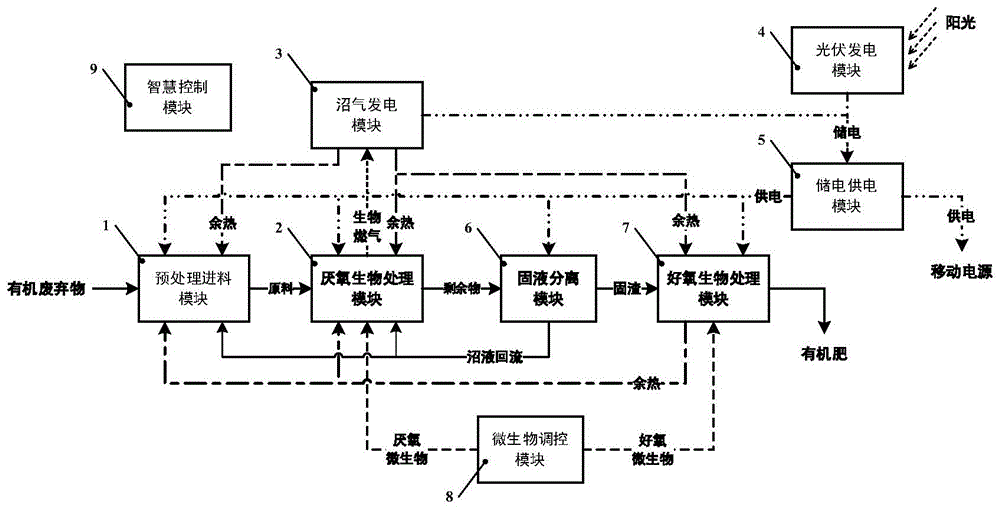
Referring to fig. 1, fig. 1 shows the connection relationship among the modules of the organic waste biological treatment system, in this case, the organic waste biological treatment system may include a pretreatment feeding module 1, an anaerobic biological treatment module 2, a biogas power generation module 3, a photovoltaic power generation module 4, an electricity storage and power supply module 5, a solid-liquid separation module 6, an aerobic biological treatment module 7, a microorganism regulation and control module 8, and an intelligent control module 9, wherein the pretreatment feeding module 1 is used for taking organic waste into the system, and after pretreatment is performed until meeting a subsequent anaerobic treatment standard, feeding is conveyed to the anaerobic biological treatment module 2 for anaerobic fermentation to prepare biogas; the anaerobic biological treatment module 2 is provided with two outlets of biogas and residues, the residue outlet is connected with the solid-liquid separation module 6, the solid-liquid separation module 6 is provided with two outlets of biogas slurry and solid residues, the biogas slurry outlet is connected with the pretreatment feeding module 1 and the anaerobic biological treatment module 2, the biogas slurry flows back to the two modules for size mixing and inoculation, and the solid residue outlet is connected with the aerobic biological treatment module 7 for aerobic fertilizer preparation; the biogas outlet of the anaerobic biological treatment module 2 is connected with the biogas power generation module 3, and the generated electric energy and the electric energy generated by the photovoltaic power generation module 4 are sent to the electricity storage and supply module 5 for temporary storage and energy supply; the waste heat generated in the power generation process of the methane power generation module 3 is supplied to the pretreatment feeding module 1 and the anaerobic biological treatment module 2 for temperature increase, biogas residue drying and rapid temperature rise in the initial stage of the aerobic biological treatment module 7. The microorganism regulation and control module 8 is connected with the anaerobic organism treatment module 2 and the aerobic organism treatment module 7, and is used for actively adding a microorganism bacterium agent in the links of producing methane through anaerobic fermentation and preparing fertilizer through aerobic organism treatment respectively to control the residence time of the anaerobic and aerobic organism treatment. The intelligent control module 9 is used for commanding, detecting and regulating the state and operation of the whole set of system.
Referring to fig. 2-3, as an alternative embodiment, in certain embodiments, the pre-treatment feed module 1 includes a conveying apparatus 1.1 and a pre-treatment feed apparatus 1.2; the anaerobic biological treatment module 2 comprises an anaerobic reactor 2.1, a stirring device 2.2 and a first biogas pipe 2.3, the biogas power generation module 3 comprises a biogas purification device 3.1, a second biogas pipe 3.2 and a biogas power generation device 3.3, wherein the organic waste biological material is conveyed to the pretreatment feeding device 1.2 by the conveying device 1.1 for preliminary treatment, the organic waste biological material after the preliminary treatment is fermented in the anaerobic reactor 2.1, the stirring device 2.2 is used for stirring the organic waste biological material in the anaerobic reactor 2.1, and the fermented biogas enters the biogas purification device 3.1 through the first biogas pipe 2.3, is dehydrated and desulfurized and then is conveyed to the biogas power generation device 3.3 through the second biogas pipe 3.2 for power generation.
The photovoltaic power generation module 4 has a solar heat collecting plate that can be folded and unfolded; the solid-liquid separation module 6 comprises a discharge device 6.1 and a solid-liquid separator 6.2, and biogas residues and biogas slurry of the anaerobic reactor 2.1 are discharged to the solid-liquid separator 6.2 through the discharge device 6.1 and separated.
Referring to fig. 4, fig. 4 illustrates an overall 3D view of the organic waste biological treatment system on a vehicle 11. as an alternative embodiment, in certain embodiments, the various modules of the system are disposed within a skid 10, and the skid 10 is disposed on the vehicle 11.
For a better understanding of the present invention, the system operation in the specific embodiment is described below.
The pretreatment feeding module 1 is mainly responsible for raw material pretreatment and feeding: crop straws are taken into the system of the invention by the conveying equipment 1.1 of the pretreatment feeding module 1, sent to the pretreatment feeding equipment 1.2 for cutting and crushing pretreatment, and after being crushed to a grain size of less than or equal to 10mm, are fed into an anaerobic reactor 2.1 of the anaerobic biological treatment module 2 by the pretreatment feeding equipment 1.2, in this embodiment, a dry anaerobic fermentation reactor (DA).
The anaerobic biological treatment module 2 is mainly responsible for anaerobic fermentation to produce biogas: the pretreated organic waste enters an anaerobic reactor 2.1 to generate marsh gas (the main component is CH) under the action of producing anaerobic bacteria 4 And CO 2 ) Controlling the temperature of anaerobic fermentation to be 20-56 ℃ and the pH value to be 6.5-7.8, and intermittently stirring the feed liquid in the anaerobic reactor 2.1 by stirring equipment 2.2 in the fermentation process to promote the contact between the substrate and the microorganism and the mass and heat transfer.
The solid-liquid separation module 6 is mainly responsible for solid-liquid separation: the fermentation liquid in the anaerobic reactor 2.1 is pumped out by the discharging device 6.1 at intervals, and is sent to the solid-liquid separator 6.2 of the solid-liquid separation module 6, and is processed by the solid-liquid separator 6.2 to be divided into biogas residues and biogas slurry, the biogas slurry flows back to the pretreatment feeding device 1.2 and the anaerobic reactor 2.1 for raw material size mixing and microorganism inoculation, the size mixing concentration is TS 6% -40%, the anaerobic fermentation process of the embodiment is dry fermentation, and the size mixing concentration is TS more than or equal to 15%.
The aerobic biological treatment module 7 is mainly responsible for aerobic biological treatment and fertilizer preparation: biogas residues obtained by separation of the solid-liquid separator 6.2 enter the aerobic biological treatment module 7, and the organic fertilizer with the water content of less than or equal to 30%, the organic matter TS% of more than or equal to 45% and the pH value of 5.5-8.5 is prepared by adding aerobic microorganisms, adjusting parameters such as the water content and the porosity, aerating, turning and the like.
The microbial regulation module 8 is mainly responsible for microbial regulation: anaerobic methanogens with high enrichment and high activity and decay-promoting nitrogen-retaining aerobic bacteria are cultured in the microorganism regulation and control module 8 respectively, and microbial inoculum is added and injected actively according to the operation conditions of the anaerobic organism treatment module 2 and the aerobic organism treatment module 7, so that the anaerobic and aerobic organism treatment efficiency is improved, and the fermentation efficiency and the product quality are improved.
The biogas power generation module 3, the biogas power generation module 3 and the electricity storage and supply module 5 are jointly responsible for power generation, electricity storage and power supply: the energy converted by the system is electric energy which is sourced from the methane power generation module 3 and the photovoltaic power generation module 4. Biogas generated by the anaerobic reactor 2.1 is introduced into biogas purification equipment 3.1 of the biogas power generation module 3 through a first biogas pipe 2.3 for dehydration, desulfurization and purification, and the purified biogas is introduced into biogas power generation equipment 3.3 through a second biogas pipe 3.2 for power generation; the photovoltaic power generation modules 4 are integrated on two sides and the top of the prying box 10 in the embodiment 1, the system is in a folded state (see a solar heat collecting plate (folded)) 4.1 during non-operation, and is in an unfolded state (see a solar heat collecting plate (unfolded)) 4.2 during operation, solar energy is converted into electric energy through the solar heat collecting plate and is connected with the methane power generation modules 3 in parallel, and the generated electric energy is temporarily stored in the electricity storage and supply module 5 to form an energy supply source of the whole system; the electricity storage and supply module 5 temporarily stores electric energy generated by methane power generation and photovoltaic power generation, supplies power to the electric equipment and the external part of the system, meets the temporary power supply requirement of local residents outside the system, and forms a movable power supply.
The system fully utilizes waste heat, particularly, heat is generated in the running process of the biogas power generation equipment 3.3 and the aerobic biological treatment module 7 of the biogas power generation module 3 of the system, and is collected by the heat exchanger and used for warming the pretreatment feeding equipment 1.2 and the anaerobic reactor 2.1, drying the solid-liquid separation biogas residues by the solid-liquid separator 6.2 and quickly warming the initial stage of the aerobic biological treatment module 7.
The intelligent control module 9 is mainly responsible for intelligent control of the system: the intelligent control module 9 automatically plans the processing route and time of the system for dispersing organic waste everywhere based on the internet of things + and navigation, displays the states and data of the modules such as the biological processing module, the power generation, the power storage and the power supply through the technologies such as the sensor and the digital signal transmission, and performs early warning and operation adjustment instructions according to the operation of a digital model and intelligently regulates and controls the stable operation of each module.
All modules and equipment of the system are integrated in a skid-mounted box 10, the skid-mounted box 10 is arranged on an automobile 11, and after the skid-mounted box is driven to an organic waste treatment address by the automobile 11, harmless and resource treatment is carried out.
By applying the skid-mounted zero-energy-consumption organic waste biological treatment and mobile power supply system of the embodiment and operating according to the processes, the automatic treatment and resource utilization of organic solid waste generated by small-scale distributed urban and rural areas, markets and enterprises can be realized, and clean energy and resources are obtained while the environmental pollution is eliminated.
Meanwhile, the invention also provides an organic waste biological treatment process, which utilizes the organic waste biological treatment system, and comprises the following steps:
removing impurities from the organic waste raw material, crushing, and removing sand until the particle size is less than or equal to 10 mm;
generating biogas under the action of anaerobic bacteria, controlling the temperature of anaerobic fermentation to be 20-56 ℃ and the pH value to be 6.5-7.8;
and separating residues of anaerobic fermentation into biogas residues and biogas slurry, refluxing the biogas slurry for reuse, and adjusting the water content and the porosity of the biogas residues to prepare an organic fertilizer with the water content of less than or equal to 30%, the TS% of organic matters of more than or equal to 45% and the pH of 5.5-8.5.
Further, high-activity anaerobic methanogens are used in the process of producing methane through anaerobic fermentation, and decay-promoting nitrogen-retaining aerobic bacteria are used in the process of producing fertilizer.
In the description herein, references to the description of the term "one embodiment," "some embodiments," "an example," "a specific example," or "some examples," etc., mean that a particular feature, structure, material, or characteristic described in connection with the embodiment or example is included in at least one embodiment or example of the invention. In this specification, the schematic representations of the terms used above are not necessarily intended to refer to the same embodiment or example. Furthermore, the particular features, structures, materials, or characteristics described may be combined in any suitable manner in any one or more embodiments or examples. Furthermore, various embodiments or examples and features of different embodiments or examples described in this specification can be combined and combined by one skilled in the art without contradiction.
The above embodiments are only for illustrating the technical concept and features of the present invention, and the purpose thereof is to enable those skilled in the art to understand the contents of the present invention and implement the present invention accordingly, and not to limit the protection scope of the present invention accordingly. All equivalent changes or modifications made in accordance with the spirit of the present disclosure are intended to be covered by the scope of the present disclosure.