CN114733552B - Preparation method and application of integral light dual-magnetic photocatalytic composite material - Google Patents
Preparation method and application of integral light dual-magnetic photocatalytic composite material Download PDFInfo
- Publication number
- CN114733552B CN114733552B CN202210501923.XA CN202210501923A CN114733552B CN 114733552 B CN114733552 B CN 114733552B CN 202210501923 A CN202210501923 A CN 202210501923A CN 114733552 B CN114733552 B CN 114733552B
- Authority
- CN
- China
- Prior art keywords
- magnetic
- carbon
- solution
- composite material
- foam
- Prior art date
- Legal status (The legal status is an assumption and is not a legal conclusion. Google has not performed a legal analysis and makes no representation as to the accuracy of the status listed.)
- Active
Links
- 230000001699 photocatalysis Effects 0.000 title claims abstract description 34
- 239000002131 composite material Substances 0.000 title claims abstract description 18
- 238000002360 preparation method Methods 0.000 title claims abstract description 10
- 230000005291 magnetic effect Effects 0.000 claims abstract description 103
- 229910052799 carbon Inorganic materials 0.000 claims abstract description 61
- OKTJSMMVPCPJKN-UHFFFAOYSA-N Carbon Chemical compound [C] OKTJSMMVPCPJKN-UHFFFAOYSA-N 0.000 claims abstract description 59
- 239000006260 foam Substances 0.000 claims abstract description 55
- JMANVNJQNLATNU-UHFFFAOYSA-N oxalonitrile Chemical compound N#CC#N JMANVNJQNLATNU-UHFFFAOYSA-N 0.000 claims abstract description 24
- 239000000463 material Substances 0.000 claims abstract description 16
- 239000003054 catalyst Substances 0.000 claims abstract description 15
- 239000002028 Biomass Substances 0.000 claims abstract description 14
- 239000000843 powder Substances 0.000 claims description 35
- 235000017166 Bambusa arundinacea Nutrition 0.000 claims description 26
- 235000017491 Bambusa tulda Nutrition 0.000 claims description 26
- 241001330002 Bambuseae Species 0.000 claims description 26
- 235000015334 Phyllostachys viridis Nutrition 0.000 claims description 26
- 239000011425 bamboo Substances 0.000 claims description 26
- HEMHJVSKTPXQMS-UHFFFAOYSA-M Sodium hydroxide Chemical compound [OH-].[Na+] HEMHJVSKTPXQMS-UHFFFAOYSA-M 0.000 claims description 21
- 239000000243 solution Substances 0.000 claims description 21
- WSFSSNUMVMOOMR-UHFFFAOYSA-N Formaldehyde Chemical compound O=C WSFSSNUMVMOOMR-UHFFFAOYSA-N 0.000 claims description 17
- ISWSIDIOOBJBQZ-UHFFFAOYSA-N Phenol Chemical compound OC1=CC=CC=C1 ISWSIDIOOBJBQZ-UHFFFAOYSA-N 0.000 claims description 15
- VNWKTOKETHGBQD-UHFFFAOYSA-N methane Chemical compound C VNWKTOKETHGBQD-UHFFFAOYSA-N 0.000 claims description 13
- 238000003756 stirring Methods 0.000 claims description 13
- XLYOFNOQVPJJNP-UHFFFAOYSA-N water Substances O XLYOFNOQVPJJNP-UHFFFAOYSA-N 0.000 claims description 12
- KXGFMDJXCMQABM-UHFFFAOYSA-N 2-methoxy-6-methylphenol Chemical compound [CH]OC1=CC=CC([CH])=C1O KXGFMDJXCMQABM-UHFFFAOYSA-N 0.000 claims description 11
- 229920001568 phenolic resin Polymers 0.000 claims description 11
- 239000005011 phenolic resin Substances 0.000 claims description 11
- 239000011259 mixed solution Substances 0.000 claims description 9
- 239000012153 distilled water Substances 0.000 claims description 6
- 238000001035 drying Methods 0.000 claims description 6
- QAOWNCQODCNURD-UHFFFAOYSA-N sulfuric acid Substances OS(O)(=O)=O QAOWNCQODCNURD-UHFFFAOYSA-N 0.000 claims description 6
- 238000010438 heat treatment Methods 0.000 claims description 5
- 239000000203 mixture Substances 0.000 claims description 5
- 229920005830 Polyurethane Foam Polymers 0.000 claims description 4
- 239000007864 aqueous solution Substances 0.000 claims description 4
- 239000008098 formaldehyde solution Substances 0.000 claims description 4
- 239000011496 polyurethane foam Substances 0.000 claims description 4
- LFQSCWFLJHTTHZ-UHFFFAOYSA-N Ethanol Chemical compound CCO LFQSCWFLJHTTHZ-UHFFFAOYSA-N 0.000 claims description 3
- 239000003795 chemical substances by application Substances 0.000 claims description 3
- 239000008367 deionised water Substances 0.000 claims description 3
- 229910021641 deionized water Inorganic materials 0.000 claims description 3
- IDGUHHHQCWSQLU-UHFFFAOYSA-N ethanol;hydrate Chemical compound O.CCO IDGUHHHQCWSQLU-UHFFFAOYSA-N 0.000 claims description 3
- 239000000725 suspension Substances 0.000 claims description 3
- 239000010865 sewage Substances 0.000 claims description 2
- 230000010355 oscillation Effects 0.000 claims 2
- 238000002791 soaking Methods 0.000 claims 2
- VHUUQVKOLVNVRT-UHFFFAOYSA-N Ammonium hydroxide Chemical compound [NH4+].[OH-] VHUUQVKOLVNVRT-UHFFFAOYSA-N 0.000 claims 1
- 235000011114 ammonium hydroxide Nutrition 0.000 claims 1
- 238000010000 carbonizing Methods 0.000 claims 1
- 239000003153 chemical reaction reagent Substances 0.000 claims 1
- 238000001816 cooling Methods 0.000 claims 1
- 238000009210 therapy by ultrasound Methods 0.000 claims 1
- 238000005406 washing Methods 0.000 claims 1
- 238000005303 weighing Methods 0.000 claims 1
- 239000011941 photocatalyst Substances 0.000 abstract description 12
- 229910010413 TiO 2 Inorganic materials 0.000 abstract description 8
- 238000000034 method Methods 0.000 abstract description 6
- 229910021536 Zeolite Inorganic materials 0.000 abstract description 4
- HNPSIPDUKPIQMN-UHFFFAOYSA-N dioxosilane;oxo(oxoalumanyloxy)alumane Chemical compound O=[Si]=O.O=[Al]O[Al]=O HNPSIPDUKPIQMN-UHFFFAOYSA-N 0.000 abstract description 4
- 239000006247 magnetic powder Substances 0.000 abstract description 4
- 239000010457 zeolite Substances 0.000 abstract description 4
- 229910020599 Co 3 O 4 Inorganic materials 0.000 abstract description 2
- 239000000969 carrier Substances 0.000 abstract description 2
- 229910000859 α-Fe Inorganic materials 0.000 abstract description 2
- XEEYBQQBJWHFJM-UHFFFAOYSA-N iron Substances [Fe] XEEYBQQBJWHFJM-UHFFFAOYSA-N 0.000 description 33
- 238000006731 degradation reaction Methods 0.000 description 9
- 230000015556 catabolic process Effects 0.000 description 7
- 238000006243 chemical reaction Methods 0.000 description 7
- 238000011068 loading method Methods 0.000 description 7
- IJGRMHOSHXDMSA-UHFFFAOYSA-N Atomic nitrogen Chemical compound N#N IJGRMHOSHXDMSA-UHFFFAOYSA-N 0.000 description 6
- GWEVSGVZZGPLCZ-UHFFFAOYSA-N Titan oxide Chemical compound O=[Ti]=O GWEVSGVZZGPLCZ-UHFFFAOYSA-N 0.000 description 6
- 229910052742 iron Inorganic materials 0.000 description 6
- 239000011148 porous material Substances 0.000 description 6
- 238000001179 sorption measurement Methods 0.000 description 5
- QGZKDVFQNNGYKY-UHFFFAOYSA-N Ammonia Chemical compound N QGZKDVFQNNGYKY-UHFFFAOYSA-N 0.000 description 4
- 238000009826 distribution Methods 0.000 description 4
- YXFVVABEGXRONW-UHFFFAOYSA-N Toluene Chemical compound CC1=CC=CC=C1 YXFVVABEGXRONW-UHFFFAOYSA-N 0.000 description 3
- 230000003197 catalytic effect Effects 0.000 description 3
- 230000007547 defect Effects 0.000 description 3
- 238000005516 engineering process Methods 0.000 description 3
- 230000007613 environmental effect Effects 0.000 description 3
- 238000005470 impregnation Methods 0.000 description 3
- 239000007788 liquid Substances 0.000 description 3
- 229910052757 nitrogen Inorganic materials 0.000 description 3
- 229910052760 oxygen Inorganic materials 0.000 description 3
- 238000013033 photocatalytic degradation reaction Methods 0.000 description 3
- 239000002351 wastewater Substances 0.000 description 3
- CSCPPACGZOOCGX-UHFFFAOYSA-N Acetone Chemical compound CC(C)=O CSCPPACGZOOCGX-UHFFFAOYSA-N 0.000 description 2
- CURLTUGMZLYLDI-UHFFFAOYSA-N Carbon dioxide Chemical compound O=C=O CURLTUGMZLYLDI-UHFFFAOYSA-N 0.000 description 2
- 244000267823 Hydrangea macrophylla Species 0.000 description 2
- 235000014486 Hydrangea macrophylla Nutrition 0.000 description 2
- 239000004964 aerogel Substances 0.000 description 2
- 229910021529 ammonia Inorganic materials 0.000 description 2
- 238000006555 catalytic reaction Methods 0.000 description 2
- 210000004027 cell Anatomy 0.000 description 2
- JOPOVCBBYLSVDA-UHFFFAOYSA-N chromium(6+) Chemical compound [Cr+6] JOPOVCBBYLSVDA-UHFFFAOYSA-N 0.000 description 2
- 230000000694 effects Effects 0.000 description 2
- 239000010408 film Substances 0.000 description 2
- 238000007667 floating Methods 0.000 description 2
- 239000006261 foam material Substances 0.000 description 2
- 239000000543 intermediate Substances 0.000 description 2
- 238000013507 mapping Methods 0.000 description 2
- 230000003647 oxidation Effects 0.000 description 2
- 238000007254 oxidation reaction Methods 0.000 description 2
- 239000002957 persistent organic pollutant Substances 0.000 description 2
- 238000004064 recycling Methods 0.000 description 2
- 238000002336 sorption--desorption measurement Methods 0.000 description 2
- 239000000126 substance Substances 0.000 description 2
- UFHFLCQGNIYNRP-UHFFFAOYSA-N Hydrogen Chemical compound [H][H] UFHFLCQGNIYNRP-UHFFFAOYSA-N 0.000 description 1
- 239000002033 PVDF binder Substances 0.000 description 1
- 239000004372 Polyvinyl alcohol Substances 0.000 description 1
- 238000010521 absorption reaction Methods 0.000 description 1
- QVGXLLKOCUKJST-UHFFFAOYSA-N atomic oxygen Chemical compound [O] QVGXLLKOCUKJST-UHFFFAOYSA-N 0.000 description 1
- 230000009286 beneficial effect Effects 0.000 description 1
- 239000001569 carbon dioxide Substances 0.000 description 1
- 229910002092 carbon dioxide Inorganic materials 0.000 description 1
- 238000003763 carbonization Methods 0.000 description 1
- 210000002421 cell wall Anatomy 0.000 description 1
- 238000005119 centrifugation Methods 0.000 description 1
- 238000012512 characterization method Methods 0.000 description 1
- 239000012141 concentrate Substances 0.000 description 1
- 230000003247 decreasing effect Effects 0.000 description 1
- 238000000151 deposition Methods 0.000 description 1
- 238000003795 desorption Methods 0.000 description 1
- 238000007598 dipping method Methods 0.000 description 1
- 230000002708 enhancing effect Effects 0.000 description 1
- 230000005294 ferromagnetic effect Effects 0.000 description 1
- 239000001257 hydrogen Substances 0.000 description 1
- 229910052739 hydrogen Inorganic materials 0.000 description 1
- 238000005286 illumination Methods 0.000 description 1
- 238000007654 immersion Methods 0.000 description 1
- 150000002500 ions Chemical class 0.000 description 1
- 210000003041 ligament Anatomy 0.000 description 1
- 238000003760 magnetic stirring Methods 0.000 description 1
- 230000005389 magnetism Effects 0.000 description 1
- 230000005415 magnetization Effects 0.000 description 1
- 238000004519 manufacturing process Methods 0.000 description 1
- 239000008204 material by function Substances 0.000 description 1
- 238000012986 modification Methods 0.000 description 1
- 230000004048 modification Effects 0.000 description 1
- 239000001301 oxygen Substances 0.000 description 1
- 238000007146 photocatalysis Methods 0.000 description 1
- 238000013032 photocatalytic reaction Methods 0.000 description 1
- 230000000704 physical effect Effects 0.000 description 1
- 229920002635 polyurethane Polymers 0.000 description 1
- 239000004814 polyurethane Substances 0.000 description 1
- 229920002689 polyvinyl acetate Polymers 0.000 description 1
- 239000011118 polyvinyl acetate Substances 0.000 description 1
- 229920002451 polyvinyl alcohol Polymers 0.000 description 1
- 229920002981 polyvinylidene fluoride Polymers 0.000 description 1
- 230000001737 promoting effect Effects 0.000 description 1
- 238000000746 purification Methods 0.000 description 1
- 239000002994 raw material Substances 0.000 description 1
- 238000011084 recovery Methods 0.000 description 1
- 238000001878 scanning electron micrograph Methods 0.000 description 1
- 239000004065 semiconductor Substances 0.000 description 1
- 238000000926 separation method Methods 0.000 description 1
- 239000002893 slag Substances 0.000 description 1
- 239000007787 solid Substances 0.000 description 1
- 239000010409 thin film Substances 0.000 description 1
- 239000012855 volatile organic compound Substances 0.000 description 1
- 239000002699 waste material Substances 0.000 description 1
- 238000004065 wastewater treatment Methods 0.000 description 1
- 230000003313 weakening effect Effects 0.000 description 1
Images


Classifications
-
- B—PERFORMING OPERATIONS; TRANSPORTING
- B01—PHYSICAL OR CHEMICAL PROCESSES OR APPARATUS IN GENERAL
- B01J—CHEMICAL OR PHYSICAL PROCESSES, e.g. CATALYSIS OR COLLOID CHEMISTRY; THEIR RELEVANT APPARATUS
- B01J35/00—Catalysts, in general, characterised by their form or physical properties
- B01J35/30—Catalysts, in general, characterised by their form or physical properties characterised by their physical properties
- B01J35/33—Electric or magnetic properties
-
- B—PERFORMING OPERATIONS; TRANSPORTING
- B01—PHYSICAL OR CHEMICAL PROCESSES OR APPARATUS IN GENERAL
- B01J—CHEMICAL OR PHYSICAL PROCESSES, e.g. CATALYSIS OR COLLOID CHEMISTRY; THEIR RELEVANT APPARATUS
- B01J27/00—Catalysts comprising the elements or compounds of halogens, sulfur, selenium, tellurium, phosphorus or nitrogen; Catalysts comprising carbon compounds
- B01J27/24—Nitrogen compounds
-
- B—PERFORMING OPERATIONS; TRANSPORTING
- B01—PHYSICAL OR CHEMICAL PROCESSES OR APPARATUS IN GENERAL
- B01J—CHEMICAL OR PHYSICAL PROCESSES, e.g. CATALYSIS OR COLLOID CHEMISTRY; THEIR RELEVANT APPARATUS
- B01J35/00—Catalysts, in general, characterised by their form or physical properties
- B01J35/60—Catalysts, in general, characterised by their form or physical properties characterised by their surface properties or porosity
- B01J35/61—Surface area
- B01J35/615—100-500 m2/g
-
- B—PERFORMING OPERATIONS; TRANSPORTING
- B01—PHYSICAL OR CHEMICAL PROCESSES OR APPARATUS IN GENERAL
- B01J—CHEMICAL OR PHYSICAL PROCESSES, e.g. CATALYSIS OR COLLOID CHEMISTRY; THEIR RELEVANT APPARATUS
- B01J35/00—Catalysts, in general, characterised by their form or physical properties
- B01J35/60—Catalysts, in general, characterised by their form or physical properties characterised by their surface properties or porosity
- B01J35/63—Pore volume
- B01J35/633—Pore volume less than 0.5 ml/g
-
- B—PERFORMING OPERATIONS; TRANSPORTING
- B01—PHYSICAL OR CHEMICAL PROCESSES OR APPARATUS IN GENERAL
- B01J—CHEMICAL OR PHYSICAL PROCESSES, e.g. CATALYSIS OR COLLOID CHEMISTRY; THEIR RELEVANT APPARATUS
- B01J35/00—Catalysts, in general, characterised by their form or physical properties
- B01J35/60—Catalysts, in general, characterised by their form or physical properties characterised by their surface properties or porosity
- B01J35/64—Pore diameter
- B01J35/647—2-50 nm
-
- C—CHEMISTRY; METALLURGY
- C02—TREATMENT OF WATER, WASTE WATER, SEWAGE, OR SLUDGE
- C02F—TREATMENT OF WATER, WASTE WATER, SEWAGE, OR SLUDGE
- C02F1/00—Treatment of water, waste water, or sewage
- C02F1/30—Treatment of water, waste water, or sewage by irradiation
-
- C—CHEMISTRY; METALLURGY
- C02—TREATMENT OF WATER, WASTE WATER, SEWAGE, OR SLUDGE
- C02F—TREATMENT OF WATER, WASTE WATER, SEWAGE, OR SLUDGE
- C02F2101/00—Nature of the contaminant
- C02F2101/30—Organic compounds
- C02F2101/38—Organic compounds containing nitrogen
-
- C—CHEMISTRY; METALLURGY
- C02—TREATMENT OF WATER, WASTE WATER, SEWAGE, OR SLUDGE
- C02F—TREATMENT OF WATER, WASTE WATER, SEWAGE, OR SLUDGE
- C02F2305/00—Use of specific compounds during water treatment
- C02F2305/02—Specific form of oxidant
- C02F2305/026—Fenton's reagent
-
- C—CHEMISTRY; METALLURGY
- C02—TREATMENT OF WATER, WASTE WATER, SEWAGE, OR SLUDGE
- C02F—TREATMENT OF WATER, WASTE WATER, SEWAGE, OR SLUDGE
- C02F2305/00—Use of specific compounds during water treatment
- C02F2305/10—Photocatalysts
-
- Y—GENERAL TAGGING OF NEW TECHNOLOGICAL DEVELOPMENTS; GENERAL TAGGING OF CROSS-SECTIONAL TECHNOLOGIES SPANNING OVER SEVERAL SECTIONS OF THE IPC; TECHNICAL SUBJECTS COVERED BY FORMER USPC CROSS-REFERENCE ART COLLECTIONS [XRACs] AND DIGESTS
- Y02—TECHNOLOGIES OR APPLICATIONS FOR MITIGATION OR ADAPTATION AGAINST CLIMATE CHANGE
- Y02W—CLIMATE CHANGE MITIGATION TECHNOLOGIES RELATED TO WASTEWATER TREATMENT OR WASTE MANAGEMENT
- Y02W10/00—Technologies for wastewater treatment
- Y02W10/30—Wastewater or sewage treatment systems using renewable energies
- Y02W10/37—Wastewater or sewage treatment systems using renewable energies using solar energy
Landscapes
- Chemical & Material Sciences (AREA)
- Engineering & Computer Science (AREA)
- Organic Chemistry (AREA)
- Materials Engineering (AREA)
- Chemical Kinetics & Catalysis (AREA)
- Health & Medical Sciences (AREA)
- Toxicology (AREA)
- Life Sciences & Earth Sciences (AREA)
- Hydrology & Water Resources (AREA)
- Environmental & Geological Engineering (AREA)
- Water Supply & Treatment (AREA)
- Catalysts (AREA)
Abstract
本发明公开了一种整体式轻质双磁性光催化复合材料的制备方法,主要包括生物质磁性泡沫碳制备、磁性氮化碳制备、整体式轻质磁性光催化复合材料;本发明采用新颖的轻质磁性载体(磁性泡沫碳、磁性沸石等)对具备磁性的催化剂(TiO2、g‑C3N4等及其复合体系)进行负载,构建了整体式磁性光催化材料,即通过磁性连接的方式使轻质磁性载体和磁性粉状光催化剂很好的结合;磁性载体可以是磁性泡沫炭,磁性沸石等;磁性粉体可以是TiO2、g‑C3N4等光催化剂与Fe3O4、Co3O4或α‑Fe2O3等形成的异质结。

The invention discloses a preparation method of a monolithic light-weight dual-magnetic photocatalytic composite material, which mainly includes the preparation of biomass magnetic foam carbon, the preparation of magnetic carbon nitride, and the monolithic light-weight magnetic photocatalytic composite material; Lightweight magnetic carriers (magnetic foam carbon, magnetic zeolite, etc.) support magnetic catalysts (TiO 2 , g‑C 3 N 4 , etc. and their composite systems) to construct a monolithic magnetic photocatalytic material, that is, through magnetic connection The light magnetic carrier and the magnetic powder photocatalyst can be well combined by the method; the magnetic carrier can be magnetic foam carbon, magnetic zeolite, etc.; the magnetic powder can be photocatalyst such as TiO 2 , g-C 3 N 4 and Fe 3 Heterojunctions formed by O 4 , Co 3 O 4 or α-Fe 2 O 3 etc.
Description
技术领域technical field
本发明属于光催化材料技术领域,具体涉及一种整体式轻质双磁性光催化复合材料的制备方法及应用。The invention belongs to the technical field of photocatalytic materials, and in particular relates to a preparation method and application of an integral light-weight dual-magnetic photocatalytic composite material.
背景技术Background technique
近年来,光催化技术在环境领域占据了重要地位,尤其在光催化制氢、染料降解、有机废水处理等领域表现出巨大潜力。其中,非金属半导体g-C3N4有着良好的化学稳定性、廉价易得、环境友好等优点,其独特的电子结构更易于进行改性调控,在污水治理等方面发挥着独特作用。然而,粉体光催化剂的催化效率高但存在分离和回收难的问题,薄膜光催化剂又存在比表面积较小,光催化反应效率低的缺陷,以上种种均极大限制了光催化技术的广泛应用。In recent years, photocatalytic technology has occupied an important position in the environmental field, especially in the fields of photocatalytic hydrogen production, dye degradation, and organic wastewater treatment. Among them, the non-metallic semiconductor gC 3 N 4 has the advantages of good chemical stability, cheap and easy availability, and environmental friendliness. Its unique electronic structure is easier to modify and control, and it plays a unique role in sewage treatment. However, powder photocatalysts have high catalytic efficiency but are difficult to separate and recycle. Thin-film photocatalysts have the defects of small specific surface area and low photocatalytic reaction efficiency, all of which greatly limit the wide application of photocatalytic technology. .
为了解决这一问题,研究者通常将粉体g-C3N4等光催化剂负载于各类大尺寸多孔状的载体上,进而获得同时具有较高催化活性和较高比表面积的负载型光催化剂。如RidhaDjellabi以聚乙烯醇、聚偏二氟乙烯及聚醋酸乙烯酯为原料制备了气凝胶,然后采用浸渍法将生物质碳/TiO2负载于气凝胶上制备了自浮型生物质碳/TiO2@气凝胶复合光催化材料。该自浮型光催化材料具有优异的光催化降解Cr(Ⅵ)的能力,并显示出了良好的可回收性能[Ridha Djellabia,b,Laiqi Zhanga,Bo Yang,et al.Sustainable self-floatinglignocellulosic biomass-TiO2@Aerogel for outdoor solar photocatalytic Cr(VI)reduction.Separation and Purification Technology 229(2019)11583]。黄宝萱等以聚氨酯泡沫炭为载体,采用浸渍法制备出聚氨酯泡沫炭负载TiO2光催化材料,表现出良好的催化降解甲醛功能的能力[黄宝萱,张弘庆,孟振东,等.光催化降解甲醛功能泡沫炭的制备与表征.功能材料,2016,47(1):1213-1217]。Qian等以酚醛树脂泡沫炭为载体,将介孔TiO2薄膜沉积在泡沫碳上制备了TiO2/泡沫炭材料,用于光催化氧化丙酮和甲苯,材料显示出优异的光催化降解能力[Xufang Qian,Meng Ren,Dongting Yue,et al.Mesoporous TiO2films coated on carbon foam based on waste polyurethane for enhancedphotocatalytic oxidation of VOCs.Applied Catalysis B:Environmental,2017(212):1–6]。In order to solve this problem, researchers usually support powder gC 3 N 4 and other photocatalysts on various large-sized porous supports, and then obtain supported photocatalysts with high catalytic activity and high specific surface area at the same time. For example, Ridha Djellabi used polyvinyl alcohol, polyvinylidene fluoride and polyvinyl acetate as raw materials to prepare aerogels, and then used the impregnation method to load biomass carbon/TiO 2 on the aerogels to prepare self-floating biomass carbon /TiO 2 @aerogel composite photocatalytic material. The self-floating photocatalytic material has excellent photocatalytic ability to degrade Cr(VI) and shows good recyclability [Ridha Djellabia,b,Laiqi Zhanga,Bo Yang, et al.Sustainable self-floatinglignocellulosic biomass- TiO 2 @Aerogel for outdoor solar photocatalytic Cr(VI) reduction. Separation and Purification Technology 229(2019) 11583]. Huang Baoxuan et al. used polyurethane foam carbon as a carrier to prepare a polyurethane foam carbon supported TiO2 photocatalytic material by impregnation method, which showed a good ability to catalyze the degradation of formaldehyde function [Huang Baoxuan, Zhang Hongqing, Meng Zhendong, et al. Photocatalytic degradation of formaldehyde functional foam Preparation and Characterization of Carbon. Functional Materials, 2016, 47(1): 1213-1217]. Qian et al. prepared TiO2 /carbon foam materials by depositing mesoporous TiO2 films on carbon foams using phenolic resin foamed carbons as a carrier for photocatalytic oxidation of acetone and toluene, and the materials showed excellent photocatalytic degradation ability [Xufang Qian, Meng Ren, Dongting Yue, et al. Mesoporous TiO 2 films coated on carbon foam based on waste polyurethane for enhanced photocatalytic oxidation of VOCs. Applied Catalysis B: Environmental, 2017(212): 1–6].
然而,分析以上研究不难发现,以往案例中合成的整体式光催化材料,粉体光催化材料通常采用浸渍法被固定于大尺寸多孔载体之上。但此类负载方式通常仅靠单纯的物理作用结合,虽然增大了光照面积,提高了光催化材料的回收利用性能,但始终存在粉体光催化材料易掉渣,吸附不牢固等问题。However, analyzing the above studies is not difficult to find that the monolithic photocatalytic materials synthesized in previous cases, powder photocatalytic materials are usually immobilized on large-sized porous supports by impregnation method. However, this kind of loading method usually only relies on the combination of pure physical action. Although the illumination area is increased and the recycling performance of photocatalytic materials is improved, there are always problems such as easy slag loss and weak adsorption of powder photocatalytic materials.
发明内容SUMMARY OF THE INVENTION
针对上述光催化剂常规负载存在的缺陷,本发明采用新颖的轻质磁性载体(磁性泡沫碳、磁性沸石等)对具备磁性的催化剂(TiO2、g-C3N4等及其复合体系)进行负载,构建了整体式磁性光催化材料,即通过磁性连接的方式使轻质磁性载体和磁性粉状光催化剂很好的结合。磁性载体可以是磁性泡沫炭,磁性沸石等。磁性粉体可以是TiO2、g-C3N4等光催化剂与Fe3O4、Co3O4或α-Fe2O3等形成的异质结。In view of the above-mentioned defects of conventional loading of photocatalysts, the present invention adopts novel lightweight magnetic carriers (magnetic foam carbon, magnetic zeolite, etc.) to support magnetic catalysts (TiO 2 , gC 3 N 4 , etc. and their composite systems), A monolithic magnetic photocatalyst material is constructed, that is, the light magnetic carrier and the magnetic powder photocatalyst are well combined by means of magnetic connection. The magnetic carrier can be magnetic foam carbon, magnetic zeolite and the like. The magnetic powder can be a heterojunction formed by photocatalysts such as TiO 2 and gC 3 N 4 and Fe 3 O 4 , Co 3 O 4 or α-Fe 2 O 3 .
为了达到上述技术目的,本发明是通过以下技术方案实现的,一种整体式轻质双磁性光催化复合材料的制备方法,包括以下步骤:In order to achieve the above technical purpose, the present invention is achieved through the following technical solutions, a preparation method of an integral lightweight dual-magnetic photocatalytic composite material, comprising the following steps:
S1:将一定量的液化剂苯酚加入到三口烧瓶中,体系加热至80-100℃时加入一定量催化剂浓硫酸,继续加热至110-120℃时,缓慢加入已干燥好的竹粉;体系继续加热到140-160℃后,恒温加热100-150min,反应结束后得到黑棕色粘稠液体竹粉液化产物;液化试剂苯酚用量为竹粉质量的3-5倍,浓硫酸用量为竹粉质量的3-5%;S1: Add a certain amount of liquefaction agent phenol into the three-necked flask, add a certain amount of catalyst concentrated sulfuric acid when the system is heated to 80-100°C, and slowly add the dried bamboo powder when the system is heated to 110-120°C; the system continues After being heated to 140-160 ℃, constant temperature heating 100-150min, after the reaction finishes, obtain black-brown viscous liquid bamboo powder liquefaction product; 3-5%;
S2:取一定量的竹粉液化产物置于圆底烧瓶中,放入60℃的水浴中,开动冷凝器,然后向其中加入溶解有1.6-1.9g的NaOH水溶液,充分搅拌3-5min后,再缓慢加入43.4-48.5ml浓度为37%甲醛溶液;S2: get a certain amount of bamboo powder liquefaction product and place it in a round-bottomed flask, put it in a water bath of 60 ° C, start the condenser, then add the NaOH aqueous solution dissolved with 1.6-1.9g therein, and fully stir after 3-5min, Then slowly add 43.4-48.5ml of 37% formaldehyde solution;
S3:向S2中加料完毕后的整个体系升温至70-80℃并开始计时,反应2h后停止搅拌,即得竹粉基可发性酚醛树脂;S3: the whole system after feeding in S2 is warmed up to 70-80° C. and starts timing, and the stirring is stopped after 2 h of reaction to obtain the bamboo powder-based expandable phenolic resin;
S4:配制1.5mol/L的FeCl3溶液,向溶液中添加S3所得竹粉基可发性酚醛树脂,搅拌使二者混合均匀;将聚氨酯泡沫切割为2cm*1cm*1cm的块状长方体,在1.5mol/LFeCl3溶液和生物质酚醛树脂的混合溶液中浸渍30min后放入100℃烘箱中干燥,反复浸渍3-6次后,在750-850℃的管式炉高温炭化2h(升温速率8℃/min),得到具有多孔结构的生物质磁性泡沫碳;S4: prepare a 1.5mol /L FeCl solution, add the bamboo powder-based expandable phenolic resin obtained from S3 to the solution, and stir to mix the two evenly; The mixed solution of 1.5mol/LFeCl 3 solution and biomass phenolic resin was immersed for 30 minutes and then placed in an oven at 100 °C for drying. After repeated dipping for 3-6 times, it was carbonized at a high temperature of 750-850 °C in a tube furnace for 2h (heating rate 8 ℃/min) to obtain the biomass magnetic foam carbon with porous structure;
S5:称取Fe掺杂氮化碳(Fe-CN)粉末,加入到120ml体积比为1:2的乙醇-水混合液中,超声20-30min使其分散均匀;随后,将0.55-0.58g FeCl3和0.3-0.4g FeCl2·4H2O溶解于蒸馏水中,所形成的溶液逐滴加入到Fe-CN悬浮液中,于80℃下磁力搅拌30min后,向其中加入9-11ml浓氨水;继续搅拌20-40min后,将混合液冷却至20-25℃;分别用无水乙醇和蒸馏水清洗3-5次后离心分离,于60℃下干燥10-12h,即得磁性氮化碳Fe3O4-Fe-CN;S5: Weigh the Fe-doped carbon nitride (Fe-CN) powder, add it to 120ml of ethanol-water mixture with a volume ratio of 1:2, and ultrasonicate for 20-30min to make it evenly dispersed; then, add 0.55-0.58g FeCl 3 and 0.3-0.4 g FeCl 2 ·4H 2 O were dissolved in distilled water, the resulting solution was added dropwise to the Fe-CN suspension, and after magnetic stirring at 80°C for 30 min, 9-11 ml of concentrated ammonia was added to it ; Continue stirring for 20-40min, cool the mixture to 20-25°C; wash with absolute ethanol and distilled water for 3-5 times, separate by centrifugation, and dry at 60°C for 10-12h to obtain magnetic carbon nitride Fe 3 O 4 -Fe-CN;
S6:将S5所得的磁性氮化碳加入到去离子水中,超声震荡5-10min后,向体系中加入生物质磁性泡沫碳,继续超声震荡5-10min后取出,于105℃烘箱中干燥4h,即得整体式轻质磁性光催化复合材料;S6: Add the magnetic carbon nitride obtained in S5 into deionized water, after ultrasonic vibration for 5-10 min, add biomass magnetic carbon foam to the system, continue to ultrasonically vibrate for 5-10 min, take out, and dry in a 105 ℃ oven for 4 h, That is, the monolithic light magnetic photocatalytic composite material is obtained;
优选的,所述S1中液化温度为140-160℃;液化时间1.5-2h;Preferably, the liquefaction temperature in the S1 is 140-160°C; the liquefaction time is 1.5-2h;
优选的,所述S1中催化剂浓硫酸用量为竹粉用量的3-5%;苯酚与竹粉的质量比为3:1-5:1;Preferably, in the described S1, the amount of catalyst concentrated sulfuric acid is 3-5% of the amount of bamboo powder; the mass ratio of phenol and bamboo powder is 3:1-5:1;
优选的,所述S2中竹粉液化产物含有苯酚,Mol甲醛/苯酚=1.7-1.9,Mol氢氧化钠/苯酚=0.48-0.49;Preferably, the bamboo powder liquefaction product in the S2 contains phenol, Mol formaldehyde/phenol=1.7-1.9, Mol sodium hydroxide/phenol=0.48-0.49;
优选的,所述S4中FeCl3溶液=1.0-2.0mol/L。Preferably, the FeCl 3 solution in the S4 = 1.0-2.0 mol/L.
本发明的有益效果是:The beneficial effects of the present invention are:
磁性负载具有负载牢固、易于解附、负载物易于更换以及易于回收等优点。同时,该整体式轻质磁性光催化材料还可漂浮于液体表面上,最大限度地接收太阳光和氧气,继而在促进各类氧化还原物质生成的同时避免了传统催化剂易沉入颜色较深的废水中,使光催化剂接受光的能力大打折扣的缺陷。该整体式轻质双磁性光催化光催化系统的另一个特点是,它可以有效地用于降解不溶性/悬浮性有机污染物,如含油废水。此外,将磁性泡沫炭作为载体与氮化碳等光催化剂复合后,磁性泡沫炭可作为吸附中心对低浓度有机污染物进行有效富集、浓缩,为氮化碳提供高浓度反应环境,加快氮化碳的光催化降解速度。磁性泡沫炭的吸附作用还可有效减少挥发性光催化中间产物的释放,减小挥发性中间产物所产生的二次污染。同时磁性泡沫炭与含磁催化剂间的磁链接,可以有效实现催化剂和泡沫炭之间的回收再利用,也使得催化剂与载体之间获得良好的结合,具备了负载牢固、不易脱落的优点。The magnetic load has the advantages of firm load, easy desorption, easy replacement of the load, and easy recovery. At the same time, the monolithic lightweight magnetic photocatalytic material can also float on the surface of the liquid to receive sunlight and oxygen to the maximum extent, thereby promoting the generation of various redox substances while avoiding the traditional catalysts easily sinking into darker colored materials. In wastewater, a defect that greatly reduces the ability of photocatalysts to accept light. Another feature of this monolithic lightweight dual-magnetic photocatalytic photocatalytic system is that it can be effectively used to degrade insoluble/suspended organic pollutants, such as oily wastewater. In addition, after the magnetic foam carbon is used as a carrier and combined with photocatalysts such as carbon nitride, the magnetic foam carbon can be used as an adsorption center to effectively enrich and concentrate low-concentration organic pollutants, provide a high-concentration reaction environment for carbon nitride, and accelerate nitrogen Photocatalytic degradation rate of carbon dioxide. The adsorption of magnetic foam carbon can also effectively reduce the release of volatile photocatalytic intermediates and reduce the secondary pollution caused by volatile intermediates. At the same time, the magnetic link between the magnetic foam carbon and the magnetic catalyst can effectively realize the recycling and reuse of the catalyst and the foam carbon, and also make the catalyst and the carrier obtain a good combination, with the advantages of firm load and not easy to fall off.
附图说明Description of drawings
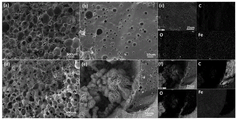
图1(a,b,c)为生物质磁性泡沫碳的SEM及EDS。图1(d,e,f)为Fe3O4-Fe-CN/磁性泡沫碳的SEM图和EDS图片;Figure 1(a, b, c) shows the SEM and EDS of the biomass magnetic foam carbon. Figure 1(d, e, f) are the SEM images and EDS images of Fe 3 O 4 -Fe-CN/magnetic carbon foam;
图2为生物质磁性泡沫碳的磁滞回线;Figure 2 is the hysteresis loop of biomass magnetic foam carbon;
图3为磁性泡沫碳和Fe3O4-Fe-CN/磁性泡沫碳的BET图像;Fig. 3 is the BET image of magnetic foam carbon and Fe 3 O 4 -Fe-CN/magnetic foam carbon;
图4为磁性泡沫碳和Fe3O4-Fe-CN/磁性泡沫碳的孔径分布曲线;Fig. 4 is the pore size distribution curve of magnetic foam carbon and Fe 3 O 4 -Fe-CN/magnetic foam carbon;
图5(a)为磁性泡沫碳负载氮化碳的光芬顿降解图像;Figure 5(a) is the photo-Fenton degradation image of carbon nitride supported on magnetic foam carbon;
图5(b)磁性泡沫碳负载氮化碳的一级动力学曲线图;Fig. 5(b) First-order kinetic curve of carbon nitride supported on magnetic foam carbon;
图5(c)磁性泡沫碳负载氮化碳的光芬顿循环降解图像。Figure 5(c) Photo-Fenton cycle degradation image of carbon nitride supported on magnetic foam carbon.
以上附图中的磁性泡沫炭所选取的FeCl3溶液的浓度均为1.5mol/L。The concentration of FeCl 3 solution selected by the magnetic foam carbon in the above drawings is all 1.5mol/L.
具体实施方式Detailed ways
为了对本发明的技术方案及技术效果做出清楚完整的描述,通过以下实施例进行详细说明;In order to make a clear and complete description of the technical solutions and technical effects of the present invention, the following examples are used to describe in detail;
实施例1Example 1
一种整体式轻质双磁性光催化复合材料的制备方法,其特征在于,包括以下步骤:A method for preparing a monolithic lightweight dual-magnetic photocatalytic composite material, characterized in that it comprises the following steps:
S1:将一定量的液化剂苯酚加入到三口烧瓶中,体系加热至90℃时加入一定量催化剂浓硫酸,继续加热至120℃时,缓慢加入已干燥好的竹粉;体系继续加热到150℃后,恒温加热2h,反应结束后得到黑棕色粘稠液体竹粉液化产物;S1: Add a certain amount of liquefying agent phenol into the three-necked flask, add a certain amount of catalyst concentrated sulfuric acid when the system is heated to 90°C, and slowly add the dried bamboo powder when the system is heated to 120°C; continue to heat the system to 150°C Then, heated at a constant temperature for 2h, and after the reaction finished, a black-brown viscous liquid bamboo powder liquefaction product was obtained;
S2:取一定量的竹粉液化产物置于圆底烧瓶中,放入60℃的水浴中,开动冷凝器,然后向其中加入一定量的NaOH水溶液,充分搅拌5min后,再缓慢加入37%甲醛溶液;NaOH水溶液为竹粉液化产物的1.63%;37%甲醛溶液与竹粉液化产物的液固比为1.203;S2: Take a certain amount of bamboo powder liquefaction product and place it in a round-bottomed flask, put it in a water bath of 60° C., start the condenser, then add a certain amount of NaOH aqueous solution to it, fully stir for 5min, then slowly add 37% formaldehyde solution; the NaOH aqueous solution is 1.63% of the bamboo powder liquefaction product; the liquid-solid ratio of the 37% formaldehyde solution and the bamboo powder liquefaction product is 1.203;
S3:向S2中加料完毕后的整个体系升温至80℃并开始计时,反应2h后停止搅拌,即得竹粉基可发性酚醛树脂;S3: the whole system after feeding in S2 is warmed up to 80° C. and starts timing, and the stirring is stopped after 2 h of reaction, to obtain the bamboo powder-based expandable phenolic resin;
S4:配制100ml的1.5mol/L的FeCl3溶液,向溶液中添加S3所得竹粉基可发性酚醛树脂,搅拌使二者混合均匀;将聚氨酯泡沫切割为2cm*1cm*1cm的块状长方体,在1.5mol/LFeCl3溶液和生物质酚醛树脂的混合溶液中浸渍30min后放入100℃烘箱中干燥,反复浸渍3-6次后,在750-850℃的管式炉高温炭化2h(升温速率8℃/min),得到具有多孔结构的生物质磁性泡沫碳;S4: prepare 100ml of 1.5mol/L FeCl 3 solution, add the bamboo powder-based expandable phenolic resin obtained from S3 to the solution, stir to mix the two evenly; cut the polyurethane foam into 2cm*1cm*1cm block-shaped cuboids , immersed in a mixed solution of 1.5mol/LFeCl 3 solution and biomass phenolic resin for 30 minutes, then put it into a 100 ℃ oven to dry, and after repeated immersion 3-6 times, carbonized at a high temperature of 750-850 ℃ in a tube furnace for 2 hours (heating up rate of 8°C/min) to obtain a biomass magnetic foam carbon with a porous structure;
S5:称取1.6g Fe掺杂氮化碳(Fe-CN)粉末,加入到120ml体积比为1:2的乙醇-水混合液中,超声20min使其分散均匀;随后,将0.5605g FeCl3和0.3435g FeCl2·4H2O溶解于20ml蒸馏水中,所形成的溶液逐滴加入到Fe-CN悬浮液中,于80℃下磁力搅拌30min后,向其中加入10ml浓氨水;继续搅拌30min后,将混合液冷却至20-25℃;分别用无水乙醇和蒸馏水清洗3次后离心分离,于在60℃下干燥12h,即得磁性氮化碳Fe3O4-Fe-CN;S5: Weigh 1.6g Fe-doped carbon nitride (Fe-CN) powder, add it to 120ml of ethanol-water mixture with a volume ratio of 1:2, and ultrasonicate for 20min to make it evenly dispersed; then, add 0.5605g FeCl 3 and 0.3435g FeCl 2 ·4H 2 O were dissolved in 20ml of distilled water, the resulting solution was added dropwise to the Fe-CN suspension, magnetically stirred at 80°C for 30min, and 10ml of concentrated ammonia was added to it; continued stirring for 30min , cooled the mixture to 20-25°C; washed with absolute ethanol and distilled water for 3 times, centrifuged, and dried at 60°C for 12h to obtain magnetic carbon nitride Fe 3 O 4 -Fe-CN;
S6:将S5所得的磁性氮化碳加入到去离子水中,超声震荡5min后,向体系中加入生物质磁性泡沫碳,继续超声震荡5min后取出,于105℃的烘箱中干燥4h,即得整体式轻质磁性光催化复合材料;S6: Add the magnetic carbon nitride obtained in S5 into deionized water, and after ultrasonic vibration for 5 minutes, add biomass magnetic carbon foam to the system, continue to ultrasonically shake for 5 minutes, take out, and dry in an oven at 105 ° C for 4 hours to obtain the overall light-weight magnetic photocatalytic composites;
优选的,所述S1中液化温度为140-160℃;液化时间1.5-2h;Preferably, the liquefaction temperature in the S1 is 140-160°C; the liquefaction time is 1.5-2h;
优选的,所述S1中催化剂浓硫酸用量为竹粉用量的3-5%;苯酚与竹粉的质量比为3:1-5:1;Preferably, in the described S1, the amount of catalyst concentrated sulfuric acid is 3-5% of the amount of bamboo powder; the mass ratio of phenol and bamboo powder is 3:1-5:1;
优选的,所述S2中竹粉液化产物含有苯酚,Mol甲醛/苯酚=1.7-1.9,Mol氢氧化钠/苯酚=0.48-0.49;Preferably, the bamboo powder liquefaction product in the S2 contains phenol, Mol formaldehyde/phenol=1.7-1.9, Mol sodium hydroxide/phenol=0.48-0.49;
优选的,所述S4中FeCl3溶液=1.0-2.0mol/L。Preferably, the FeCl 3 solution in the S4 = 1.0-2.0 mol/L.
图1为磁性泡沫碳(a,b,c)和Fe3O4-Fe-CN/磁性泡沫碳(d,e,f)的SEM及EDS映射图像。由图1(a)(50倍)可知,磁性泡沫碳由泡孔、泡孔壁及韧带组成,其表面呈多孔结构,有着较高的开孔率,大孔径约为400-600um。磁性泡沫碳的开孔结构为后续氮化碳的磁性连接以及可见光催化提供了通道。从图1(b)(2200倍)可以清楚地看到磁性泡沫碳内部的细孔结构。磁性泡沫碳的EDS(图1c)映射图谱说明,磁性泡沫碳泡沫碳主要由C、O、Fe三种元素组成,且分布均匀。由图1(d,e)(50倍/2200倍)可知,负载Fe3O4-Fe-CN后,磁性泡沫碳的大体形貌基本不变,但在其泡孔可以观察到大量的Fe3O4-Fe-CN片层结构。在磁性泡沫碳磁场的作用下,本身具有磁性的Fe3O4-Fe-CN片层自身聚集成规则的绣球状结构。此片层绣球结构一方面有利于入射光在其中进行多次反射,进而增强Fe3O4-Fe-CN/磁性泡沫碳对光的捕获能力。另一方面也为光催化提供了更丰富反应点。此外,Fe3O4-Fe-CN规则的片层绣球结构也充分证明了Fe3O4-Fe-CN与MCF之间强有力的磁性连接。Fe3O4-Fe-CN/MCF的EDS(图1f)映射图谱说明,Fe3O4-Fe-CN/MCF主要由C、O、Fe三种元素组成,且分布均匀。Figure 1 is the SEM and EDS mapping images of magnetic foam carbon (a, b, c) and Fe 3 O 4 -Fe-CN/magnetic foam carbon (d, e, f). It can be seen from Figure 1(a) (50 times) that the magnetic foam carbon is composed of cells, cell walls and ligaments. The open-cell structure of the magnetic foam carbon provides a channel for the subsequent magnetic connection of carbon nitride and visible light catalysis. The pore structure inside the magnetic foam carbon can be clearly seen from Fig. 1(b) (2200 times). The EDS (Fig. 1c) map of the magnetic foam carbon shows that the magnetic foam carbon is mainly composed of three elements, C, O, and Fe, and the distribution is uniform. It can be seen from Fig. 1(d, e) (50 times/2200 times) that after loading Fe 3 O 4 -Fe-CN, the general morphology of the magnetic foam carbon is basically unchanged, but a large amount of Fe can be observed in its cells. 3 O 4 -Fe-CN sheet structure. Under the action of the magnetic foam carbon magnetic field, the Fe 3 O 4 -Fe-CN sheets with magnetic properties themselves aggregated into regular hydrangea-like structures. On the one hand, the lamellar hydrangea structure is conducive to multiple reflections of incident light therein, thereby enhancing the light-capturing ability of Fe 3 O 4 -Fe-CN/magnetic carbon foam. On the other hand, it also provides more abundant reaction sites for photocatalysis. In addition, the regular lamellar hydrangea structure of Fe 3 O 4 -Fe-CN also fully demonstrated the strong magnetic connection between Fe 3 O 4 -Fe-CN and MCF. The EDS (Fig. 1f) mapping pattern of Fe 3 O 4 -Fe-CN/MCF shows that Fe 3 O 4 -Fe-CN/MCF is mainly composed of three elements, C, O, and Fe, and the distribution is uniform.
图2为掺杂Fe3O4磁性泡沫碳的磁滞回线,从图2中可以得出:1.5mol/LFe3O4磁性泡沫碳与负载0.04g 4%Fe3O4-Fe-CN的1.5mol/LFe3O4磁性泡沫碳均表现出良好的铁磁特性;未负载氮化碳的磁性最强,负载氮化碳后的磁性泡沫碳磁性稍有减弱,但依然表现出了较强的磁化强度;磁性减弱推测是由于负载Fe3O4-Fe-CN后,Fe3O4-Fe-CN和磁性泡沫炭之间发生了磁性连接,消耗了磁性泡明天的一部分磁性所致。这同时也证明了Fe3O4-Fe-CN和磁性泡沫炭之间构建起有效的磁性连接;Figure 2 is the hysteresis loop of Fe 3 O 4 magnetic foam carbon, from Figure 2 it can be concluded: 1.5mol/LFe 3 O 4 magnetic foam carbon and 0.04
图3为磁性泡沫炭(FeCl3溶液的浓度为1.5mol/L)和Fe3O4-Fe-CN/磁性泡沫炭的BET吸附-脱附曲线图图。由图3可知,两种泡沫碳在低压端(P/P0<0.1)的吸附曲线偏向于Y轴,吸附量快速增长。说明泡沫碳中存在有较多的微孔,N2在微孔内产生了强吸附势。三种曲线的吸附-脱附曲线均不闭合,这可能是因为,泡沫碳材料多具有墨水瓶型的孔型,气体在发生吸附之后孔口直径发生了收缩,导致吸附的气体无法全部脱附下来,产生低压滞后现象,从而导致脱氮与吸氮曲线不闭合所致。Figure 3 shows the BET adsorption-desorption curves of magnetic foamed carbon (the concentration of FeCl 3 solution is 1.5 mol/L) and Fe 3 O 4 -Fe-CN/magnetic foamed carbon. It can be seen from Fig. 3 that the adsorption curves of the two carbon foams at the low pressure end (P/P 0 <0.1) are biased towards the Y axis, and the adsorption amount increases rapidly. It shows that there are more micropores in the carbon foam, and N 2 has a strong adsorption potential in the micropores. The adsorption-desorption curves of the three curves are not closed, which may be because most of the carbon foam materials have ink bottle-type pores. Down, resulting in low pressure hysteresis, resulting in denitrification and nitrogen absorption curves are not closed.
图4为磁性泡沫炭(FeCl3溶液的浓度为1.5mol/L)和Fe3O4-Fe-CN/磁性泡沫炭的孔径分布曲线图。由图4可知,磁性泡沫炭和Fe3O4-Fe-CN/磁性泡沫炭主要存在微孔和介孔结构。由表1可见,Fe3O4-Fe-CN/磁性泡沫炭的比表面积明显小于磁性泡沫炭,这是由于负载氮化碳堵塞了通道,使得相应的比表面积有所减少。同时通过Fe3O4-Fe-CN/磁性泡沫炭的曲线可以看出,由于磁性氮化碳的负载,在一定程度上使得微孔结构减少,这与表1的数据结果一致。Figure 4 is a graph showing the pore size distribution curves of magnetic foam carbon (the concentration of FeCl 3 solution is 1.5 mol/L) and Fe 3 O 4 -Fe-CN/magnetic foam carbon. It can be seen from Fig. 4 that the magnetic foam carbon and Fe 3 O 4 -Fe-CN/magnetic foam carbon mainly have micropore and mesoporous structure. It can be seen from Table 1 that the specific surface area of Fe 3 O 4 -Fe-CN/magnetic foam carbon is significantly smaller than that of magnetic foam carbon, which is due to the fact that the supported carbon nitride blocks the channels, which reduces the corresponding specific surface area. At the same time, it can be seen from the curve of Fe 3 O 4 -Fe-CN/magnetic carbon foam that the microporous structure is reduced to a certain extent due to the loading of magnetic carbon nitride, which is consistent with the data in Table 1.
图5(a)为磁性泡沫碳负载4%Fe3O4-Fe-CN光芬顿降解反应曲线图,由图5(a)可知在负载量为0.04g条件下,复合体系对MB的降解效率最优20min内达到了近100%,这表明了Fe离子的引入有效的构建起Fenton体系,同时也证明了泡沫碳与氮化碳之间构建起了有效的磁链接;图5(b)为磁性泡沫碳负载4%Fe3O4-Fe-CN光芬顿降解的一级动力学曲线图,其中,磁性泡沫碳负载量为0.04g的样品k值为0.09026min-1,是空白泡沫碳负载样品的2.15倍,说明负载氮化碳催化剂后相比空白不掺铁泡沫碳使得催化活性显著提高,增强了复合材料在可见光作用下对MB溶液的降解能力;为了研究磁性泡沫碳负载氮化碳催化剂的耐久性和稳定性,进行了回收试验,通过对磁性泡沫碳进行烘干处理,然后在进一步的反应中重复使用;图5(c)表明,即使经过五次降解反应循环,催化剂的活性在光芬顿条件下降约30%,结果表明,磁性泡沫碳建立的载体与催化剂之间的磁性连接具有较高的稳定性和可重复使用性;二者通过自发的磁性连接后对MB模拟废水溶液5次循环反应仍可达到80%降解率。Figure 5(a) is the photo-Fenton degradation reaction curve of magnetic foam carbon loaded with 4% Fe 3 O 4 -Fe-CN. It can be seen from Figure 5(a) that the composite system degrades MB under the condition of loading 0.04g. The optimal efficiency reaches nearly 100% within 20 minutes, which shows that the introduction of Fe ions effectively builds the Fenton system, and also proves that an effective magnetic link is built between the foamed carbon and carbon nitride; Figure 5(b) The first-order kinetic curve of photo-Fenton degradation of magnetic foam carbon with 4% Fe 3 O 4 -Fe-CN, wherein the sample with a magnetic foam carbon loading of 0.04g has a k value of 0.09026min -1 , which is a blank foam 2.15 times that of the carbon-loaded sample, indicating that the supported carbon nitride catalyst significantly improves the catalytic activity compared with the blank carbon foam without iron doped, and enhances the degradation ability of the composite material to MB solution under the action of visible light; in order to study the magnetic foam carbon supported nitrogen The durability and stability of carbonization catalysts were recovered by drying the magnetic foam carbon and then reused in further reactions; Figure 5(c) shows that even after five cycles of degradation reactions, the catalyst The activity decreased by about 30% under the photo-Fenton condition. The results show that the magnetic connection between the support and the catalyst established by the magnetic foam carbon has high stability and reusability; The degradation rate of 80% can still be achieved after 5 cycles of simulated wastewater solution.
表1磁性泡沫炭与Fe3O4-Fe-CN/磁性泡沫炭的比表面积、孔容、平均孔径Table 1 Specific surface area, pore volume and average pore size of magnetic carbon foam and Fe 3 O 4 -Fe-CN/magnetic carbon foam

在本说明书的描述中,参考术语“一个实施例”、“示例”、“具体示例”等的描述意指结合该实施例或示例描述的具体特征、结构、材料或者特点包含于本发明的至少一个实施例或示例中。在本说明书中,对上述术语的示意性表述不一定指的是相同的实施例或示例。而且,描述的具体特征、结构、材料或者特点可以在任何的一个或多个实施例或示例中以合适的方式结合。In the description of this specification, description with reference to the terms "one embodiment," "example," "specific example," etc. means that a particular feature, structure, material, or characteristic described in connection with the embodiment or example is included in at least one aspect of the present invention. in one embodiment or example. In this specification, schematic representations of the above terms do not necessarily refer to the same embodiment or example. Furthermore, the particular features, structures, materials or characteristics described may be combined in any suitable manner in any one or more embodiments or examples.
以上公开的本发明优选实施例只是用于帮助阐述本发明。优选实施例并没有详尽叙述所有的细节,也不限制该发明仅为所述的具体实施方式。显然,根据本说明书的内容,可作很多的修改和变化。本说明书选取并具体描述这些实施例,是为了更好地解释本发明的原理和实际应用,从而使所属技术领域技术人员能很好地理解和利用本发明。本发明仅受权利要求书及其全部范围和等效物的限制。The above-disclosed preferred embodiments of the present invention are provided only to help illustrate the present invention. The preferred embodiments do not exhaust all the details, nor do they limit the invention to only the described embodiments. Obviously, many modifications and variations are possible in light of the content of this specification. The present specification selects and specifically describes these embodiments in order to better explain the principles and practical applications of the present invention, so that those skilled in the art can well understand and utilize the present invention. The present invention is to be limited only by the claims and their full scope and equivalents.
Claims (3)
Priority Applications (1)
| Application Number | Priority Date | Filing Date | Title |
|---|---|---|---|
| CN202210501923.XA CN114733552B (en) | 2022-05-09 | 2022-05-09 | Preparation method and application of integral light dual-magnetic photocatalytic composite material |
Applications Claiming Priority (1)
| Application Number | Priority Date | Filing Date | Title |
|---|---|---|---|
| CN202210501923.XA CN114733552B (en) | 2022-05-09 | 2022-05-09 | Preparation method and application of integral light dual-magnetic photocatalytic composite material |
Publications (2)
| Publication Number | Publication Date |
|---|---|
| CN114733552A CN114733552A (en) | 2022-07-12 |
| CN114733552B true CN114733552B (en) | 2022-09-20 |
Family
ID=82285784
Family Applications (1)
| Application Number | Title | Priority Date | Filing Date |
|---|---|---|---|
| CN202210501923.XA Active CN114733552B (en) | 2022-05-09 | 2022-05-09 | Preparation method and application of integral light dual-magnetic photocatalytic composite material |
Country Status (1)
| Country | Link |
|---|---|
| CN (1) | CN114733552B (en) |
Families Citing this family (2)
| Publication number | Priority date | Publication date | Assignee | Title |
|---|---|---|---|---|
| CN115445631A (en) * | 2022-09-27 | 2022-12-09 | 中国五冶集团有限公司 | Preparation method and test method of carbon-based catalytic material of metal organic framework |
| CN120518074B (en) * | 2025-05-21 | 2026-03-10 | 西南林业大学 | Method for preparing biochar based on eucalyptus and application of method |
Citations (9)
| Publication number | Priority date | Publication date | Assignee | Title |
|---|---|---|---|---|
| JP2005334737A (en) * | 2004-05-25 | 2005-12-08 | Futaba Shoji Kk | Magnetic adsorbent, photocatalyst supporting adsorbent, magnetic photocatalyst, photocatalyst supporting magnetic adsorbent, and harmful substance decomposing treatment method |
| CN104014343A (en) * | 2014-06-23 | 2014-09-03 | 山东大学 | Dual-functional magnetic solid base catalyst as well as preparation method and application thereof |
| CN105597724A (en) * | 2015-12-15 | 2016-05-25 | 浙江工业大学 | Method for preparing magnetic-biochar-supported photocatalyst |
| CN106732713A (en) * | 2016-11-25 | 2017-05-31 | 江苏大学 | A kind of ternary magnetic coupling photocatalysis nano material and its production and use |
| CN107469796A (en) * | 2017-08-28 | 2017-12-15 | 天津科技大学 | A kind of core-shell type magnetic lignin modification phenolic aldehyde microsphere adsorbing agent and preparation method thereof |
| CN108658057A (en) * | 2018-07-03 | 2018-10-16 | 中国矿业大学(北京) | A kind of atmospheric preparation method of magnetism Carbon foam |
| CN110327983A (en) * | 2019-07-03 | 2019-10-15 | 莆田学院 | A kind of magnetic graphite phase carbon nitride/MIL-125 (Ti) composite photo-catalyst and preparation method thereof |
| CN110483049A (en) * | 2019-09-23 | 2019-11-22 | 四川大学 | Resilient magnetic carbon foam and preparation method thereof |
| CN113926483A (en) * | 2021-11-22 | 2022-01-14 | 西南林业大学 | A kind of preparation method and application of magnetic recycling bi-Fenton Fe3O4-Fe-CN composite material |
Family Cites Families (1)
| Publication number | Priority date | Publication date | Assignee | Title |
|---|---|---|---|---|
| CN108554412B (en) * | 2018-05-11 | 2020-10-30 | 江西理工大学 | Preparation method and application of large-size high-porosity Fe-doped photocatalytic magnetic porous microspheres |
-
2022
- 2022-05-09 CN CN202210501923.XA patent/CN114733552B/en active Active
Patent Citations (9)
| Publication number | Priority date | Publication date | Assignee | Title |
|---|---|---|---|---|
| JP2005334737A (en) * | 2004-05-25 | 2005-12-08 | Futaba Shoji Kk | Magnetic adsorbent, photocatalyst supporting adsorbent, magnetic photocatalyst, photocatalyst supporting magnetic adsorbent, and harmful substance decomposing treatment method |
| CN104014343A (en) * | 2014-06-23 | 2014-09-03 | 山东大学 | Dual-functional magnetic solid base catalyst as well as preparation method and application thereof |
| CN105597724A (en) * | 2015-12-15 | 2016-05-25 | 浙江工业大学 | Method for preparing magnetic-biochar-supported photocatalyst |
| CN106732713A (en) * | 2016-11-25 | 2017-05-31 | 江苏大学 | A kind of ternary magnetic coupling photocatalysis nano material and its production and use |
| CN107469796A (en) * | 2017-08-28 | 2017-12-15 | 天津科技大学 | A kind of core-shell type magnetic lignin modification phenolic aldehyde microsphere adsorbing agent and preparation method thereof |
| CN108658057A (en) * | 2018-07-03 | 2018-10-16 | 中国矿业大学(北京) | A kind of atmospheric preparation method of magnetism Carbon foam |
| CN110327983A (en) * | 2019-07-03 | 2019-10-15 | 莆田学院 | A kind of magnetic graphite phase carbon nitride/MIL-125 (Ti) composite photo-catalyst and preparation method thereof |
| CN110483049A (en) * | 2019-09-23 | 2019-11-22 | 四川大学 | Resilient magnetic carbon foam and preparation method thereof |
| CN113926483A (en) * | 2021-11-22 | 2022-01-14 | 西南林业大学 | A kind of preparation method and application of magnetic recycling bi-Fenton Fe3O4-Fe-CN composite material |
Non-Patent Citations (3)
| Title |
|---|
| "Foam carbon loading Fe3O4 nanoparticles for superior lithium-ion batteries anode material";Kailian Sun等;《Ionics》;20150226;第21卷;全文 * |
| "Mapping the transition from carbon-onions filled with Fe3C to carbon-foam completely filled with α-Fe: Unlocking mass-production of ferromagnetic carbon foam";Xiaotian Zhang等;《Materials Today Communications》;20171229;第14卷;全文 * |
| "竹粉基聚氨酯负载Cu2O 复合材料制备及光降解亚甲基蓝";陶磊等;《工程塑料应用》;20150731;第43卷(第7期);全文 * |
Also Published As
| Publication number | Publication date |
|---|---|
| CN114733552A (en) | 2022-07-12 |
Similar Documents
| Publication | Publication Date | Title |
|---|---|---|
| Li et al. | Trace pyrolyzed ZIF-67 loaded activated carbon pellets for enhanced adsorption and catalytic degradation of Rhodamine B in water | |
| Yu et al. | Enhancing the yield of H2O2 from oxygen reduction reaction performance by hierarchically porous carbon modified active carbon fiber as an effective cathode used in electro-Fenton | |
| CN103566961A (en) | Metal-free nitrogen-doped functionalized mesoporous carbon catalyst and preparation method and applications thereof | |
| CN114733552A (en) | Preparation method and application of integral light dual-magnetic photocatalytic composite material | |
| CN114100646B (en) | Bi-iron functionalized sheep dung biochar composite material and its preparation method and application | |
| CN103752313B (en) | Meso-porous carbon material of load Fe and its preparation method and application | |
| CN108704611A (en) | It is a kind of magnetism manganese iron axinite load mesoporous fiber element charcoal composite material and preparation method with application | |
| CN103626150A (en) | Preparation method of nitrogenous porous carbon | |
| CN107032321A (en) | The hollow carbon sphere material of a kind of nitrogen-phosphor codoping and shell with classification macropore meso-hole structure and its preparation method and application | |
| Shen et al. | Recent progress and applications of aerogels in China | |
| CN104667930A (en) | Magnetic mesoporous carbon-supported cobalt catalyst and preparation method and application of catalyst | |
| CN108043458A (en) | A kind of preparation method and applications of the heterogeneous fenton catalyst of immobilization | |
| CN112316743A (en) | Preparation method of low-cost low-density catalytic functional ceramic membrane | |
| CN105833861A (en) | Preparation method for manganese dioxide/graphene composite catalyst | |
| CN110668557A (en) | Preparation method and application of carbon-based zero-valent iron material | |
| CN103551204B (en) | Multi-stage hierarchical pore structural Fenton-like catalyst and application thereof | |
| Wang et al. | Rational design of carbon-based porous aerogels with nitrogen defects and dedicated interfacial structures toward highly efficient CO2 greenhouse gas capture and separation | |
| CN110203902B (en) | Nitrogen-oxygen-phosphorus co-doped high-density microporous carbon material, preparation method and application thereof | |
| CN111908582A (en) | A kind of method and application of using sawdust biochar prepared by high temperature pyrolysis to activate persulfate to degrade golden orange Ⅱ dye | |
| CN113600195A (en) | Poplar skeleton structure-based magnetic micro-nano porous structure catalyst and preparation method thereof | |
| CN114715951B (en) | Magnetic core-shell structure porous silica carrier for laccase immobilization and preparation method and application thereof | |
| CN112158822B (en) | Preparation method of porous carbon microsphere | |
| CN114308098A (en) | A mesoporous carbon nitride photocatalyst synthesized based on template agent SBA-15 and its preparation method and application | |
| CN112915970A (en) | Method for adsorbing and treating antibiotics in water body by using three-dimensional metal organic framework/aerogel composite material | |
| CN114408922B (en) | A method for preparing activated carbon by encapsulation-assisted chemical activation |
Legal Events
| Date | Code | Title | Description |
|---|---|---|---|
| PB01 | Publication | ||
| PB01 | Publication | ||
| SE01 | Entry into force of request for substantive examination | ||
| SE01 | Entry into force of request for substantive examination | ||
| GR01 | Patent grant | ||
| GR01 | Patent grant | ||
| OL01 | Intention to license declared | ||
| OL01 | Intention to license declared |