Detailed Description
The technical solution in the present application will be described below with reference to the accompanying drawings.
The terminology used in the description of the embodiments section of the present application is for the purpose of describing particular embodiments of the present application only and is not intended to be limiting of the present application.
The terms "first," "second," "third," and the like in this application are used for distinguishing between similar items and items that have substantially the same function or similar functionality, and it is to be understood that "first," "second," and "third" do not have any logical or temporal dependency or limitation on the number or order of execution.
This application is intended to present various aspects, embodiments or features around a system that may include a number of devices, components, modules, and the like. It is to be understood and appreciated that the various systems may include additional devices, components, modules, etc. and/or may not include all of the devices, components, modules etc. discussed in connection with the figures. Furthermore, a combination of these schemes may also be used.
In addition, in the embodiments of the present application, words such as "exemplary", "for example", etc. are used to mean serving as examples, illustrations or explanations. Any embodiment or design described herein as "exemplary" is not necessarily to be construed as preferred or advantageous over other embodiments or designs. Rather, the term using examples is intended to present concepts in a concrete fashion.
In the embodiments of the present application, "corresponding" and "corresponding" may be sometimes used in a mixed manner, and it should be noted that the intended meaning is consistent when the difference is not emphasized.
In the examples of the present application, the subscripts are sometimes as W1It may be mistaken for a non-subscripted form such as W1, whose intended meaning is consistent when the distinction is de-emphasized.
Reference throughout this specification to "one embodiment" or "some embodiments," or the like, means that a particular feature, structure, or characteristic described in connection with the embodiment is included in one or more embodiments of the present application. Thus, appearances of the phrases "in one embodiment," "in some embodiments," "in other embodiments," or the like, in various places throughout this specification are not necessarily all referring to the same embodiment, but rather "one or more but not all embodiments" unless specifically stated otherwise. The terms "comprising," "including," "having," and variations thereof mean "including, but not limited to," unless expressly specified otherwise.
In the present application, "at least one" means one or more, "a plurality" means two or more. "and/or" describes the association relationship of the associated object, indicating that there may be three relationships, for example, a and/or B, which may indicate: a exists alone, A and B exist simultaneously, and B exists alone, wherein A and B can be singular or plural. The character "/" generally indicates that the former and latter associated objects are in an "or" relationship. "at least one of the following" or similar expressions refer to any combination of these items, including any combination of the singular or plural items. For example, at least one (one) of a, b, or c, may represent: a, b, c, a-b, a-c, b-c, or a-b-c, wherein a, b, c may be single or multiple.
Next, the related art of the present application is described:
for ease of understanding, before describing the method for determining cold and hot data provided in the embodiments of the present application, a brief description will be given of relevant terms referred to in the embodiments of the present application.
1. Data of cold and hot
Cold and hot data, which means that data is accessed at different frequencies. Generally, data that is accessed more frequently is referred to as hot data, and data that is accessed less frequently is referred to as cold data.
2. Structured Query Language (SQL)
SQL, a database query and programming language, is used to access data and to query, update, and manage relational database systems.
SQL is a high-level, non-procedural programming language that allows users to work on high-level data structures. The method does not require a user to specify a data storage method and does not require the user to know a specific data storage mode, so that different database systems with completely different underlying structures can use the same structured query language as an interface for data input and management. SQL can be nested, which makes it extremely flexible and powerful.
3. Data lake
A data lake, a large warehouse that stores a wide variety of raw data for an enterprise. The data in the data lake may be accessed, processed, analyzed, and transmitted.
The data in the data lake is raw data obtained from multiple data sources of the enterprise, and there may be multiple copies of the same raw data that satisfy a particular internal model format for different purposes. Thus, the data processed in the data lake may be any type of information, from structured data to completely unstructured data.
4. Data warehouse (data washhouse, DW or DWH)
The data warehouse is a strategic set which provides all types of data support for decision making processes of all levels of enterprises. It is a single data store created for analytical reporting and decision support purposes. And providing guidance for business process improvement, monitoring time, cost, quality and control for enterprises needing business intelligence.
5. Data center
The data center station is used for acquiring, calculating, storing and processing mass data through a data technology, and meanwhile, the standard and the caliber are unified. After the data are unified by the data center, standard data can be formed and stored to form a big data asset layer, and then efficient service is provided for customers.
6. Relational Database (RD)
A relational database refers to a database that uses a relational model to organize data, and stores data in rows and columns for a user to understand conveniently, a series of rows and columns of the relational database are called tables, and a group of tables constitutes the database. A user retrieves data in a database by a query, which is an executable code that defines certain areas in the database. The relational model can be simply understood as a two-dimensional table model, and a relational database is a data organization composed of two-dimensional tables and relations between them. For example, an Oracle database or a SQLServer database is a common relational database.
In the prior art, the data is accessed by the data bottom layer engine, and the data is determined to be cold and hot based on the frequency of accessing the data. For example, in order to improve the management efficiency of a data lake (e.g., the intelligent data lake operating platform DAYU), it is generally necessary to determine which data in the data lake belongs to cold data and which data belongs to hot data in the process of governing the data lake. According to the method, cold and hot data in the data lake are judged by recording the data access frequency, but the judgment method depends on an interface provided by a data engine bottom layer, so that the problems of high system overhead and inaccurate judgment exist.
The embodiment of the application provides a method for determining cold and hot data. The method can effectively reduce the system overhead on the premise of ensuring that the determination result of the cold and hot data has higher accuracy.
The method for determining cold and hot data provided by the embodiment of the present application is described in detail below with reference to fig. 1.
Fig. 1 is a schematic flow chart of a method 100 for determining cold and hot data according to an embodiment of the present disclosure.
As shown in fig. 1, method 100 may include steps 110 through 130. The following describes steps 110 to 130 in detail.
And step 110, obtaining M data development logic execution statements, wherein M is a positive integer greater than or equal to 2.
In the embodiment of the present application, a data platform for acquiring M data development logic execution statements is not specifically limited.
For example, the data platform may be a data lake, i.e., M data development logic execution statements are obtained from the data lake. For example, the data platform may be a data warehouse, i.e., M data development logic execution statements may also be obtained from the data warehouse. For example, the upper data platform may be a data center station, i.e., M pieces of data development logic execution statements may also be obtained from the data center station.
Optionally, in some implementations, the M pieces of data development logic execution statements include SQL. That is, the M pieces of data development logic execution statements may be SQL statements.
Optionally, in other implementations, the M pieces of data development logic execution statements may be in other types of database languages. For example, in another example, the M pieces of data development logic execution statements described above may also be Oracle statements.
For example, in general, the statements stored in the data lake are SQL statements, and when M pieces of data development logic execution statements are obtained from the data lake, the M pieces of SQL statements are obtained from the data lake.
In the embodiment of the present application, the type of the M data development logic execution statements is not specifically limited.
For example, when the M data development logic execution statements are SQL statements, the types of the M SQL statements may include, but are not limited to, the following types: query type (select), insert type (insert), update type (update), or delete type (delete), etc.
For example, in one example, when one of the M SQL statements is of select type, it can be expressed as: the select cno, cname from currencies where credit is 3, can be understood as finding out the course number and name of 3 scores. For example, in one example, when one of the above M SQL statements is of insert type, it can be expressed as: insert int info values ('s100102', 'Linchong', 'Man', 22,2, to _ date ('2020-5-906:30:10', 'yyyyy-mm-dd hh24: mi: ss')).
And (4) optional. In some implementations, the M data development logic execution statements obtained above are not identical. The M data development logic execution statements are different, and it can be understood that fields of the data table corresponding to each data development logic execution statement in the M data development logic execution statements are not identical.
For example, when the data development logic execution statement is an SQL statement, 3 SQL statements are obtained from the data lake, and are referred to as SQL #1 statement, SQL #2 statement, and SQL #3 statement for convenience of description. If the fields of the data table corresponding to the SQL #1 statement are obtained by analyzing the SQL #1 statement: identifying id fields and name fields, and analyzing the SQL #2 statement to obtain the fields of the data table corresponding to the SQL #2 statement: an id field, an age field, and a name field, in which case the SQL #1 statement and the SQL #2 statement may be considered to be different. If the field of the data table corresponding to the SQL #1 statement obtained by analyzing the SQL #1 statement is an id field, and the field of the data table corresponding to the SQL #2 statement obtained by analyzing the SQL #2 statement is a name field, in this case, the SQL #1 statement and the SQL #3 statement may be considered to be different. It is understood that if the field of the data table corresponding to the SQL #1 statement is parsed for the SQL #1 statement is an id field, and the field of the data table corresponding to the SQL #2 statement is parsed for the SQL #2 statement is an id field, in this case, the SQL #1 statement and the SQL #2 statement may be considered to be the same.
Optionally, before step 110, the following steps may be further included:
acquiring K data development logic execution statements, wherein the K data development logic execution statements are not identical, and K is a positive integer greater than or equal to 1.
And selecting different M data development logic execution statements from the K data development logic execution statements.
Step 120, analyzing M data development logic execution statements to obtain N association weight values, where the N association weight values correspond to the N data tables in a one-to-one manner, the N data tables are different data tables among the K data tables, the K data tables are data tables obtained by analyzing the M data development logic execution statements, an ith association weight value of the N association weight values is used to indicate the number of data tables in the K data tables which have an association relationship with an ith data table of the N data tables, N and K are positive integers greater than or equal to 1, and K is less than or equal to N, i is 1,2,3, …, N;
the N association weight values correspond to the N data tables one to one, and it can be understood that an ith association weight value of the N association weight values corresponds to an ith data table of the N data tables. That is, the ith associated weight value is the associated weight value of the corresponding ith data table.
The data table in the K data tables, which has an association relationship with the ith data table, may be understood as a data table including one or more same fields as the ith data table.
For example, in an example, when the M data development logic execution statements are SQL statements, parsing the M SQL statements results in 3 data tables, which are respectively denoted as data table 1, data table 2, and data table 3, where the data table 1 only includes an id field, the data table 2 includes an id field and an age field, and the data table 3 only includes a name field. In this case, the data table associated with the data table 1 is considered to be the data table 2, the data table associated with the data table 2 is considered to be the data table 1, and the data table not associated with the data table 3 is considered to be the data table.
In this embodiment of the present application, analyzing M data development logic execution statements, where N associated weight values may include the following steps:
analyzing the M data development logic execution statements according to the parameter information of the M data development logic execution statements to obtain a data table corresponding to each data development logic execution statement;
counting the number of data tables which have an association relation with the ith data table in the data tables corresponding to each data development logic execution statement;
and determining the ith association weight value according to the number of the data tables having association relation with the ith data table.
The parameter information of the M pieces of data development logic execution statements may include at least the following information: the operation type information of the M pieces of data development logic execution statements and the operation parameter information of the data development logic execution statements. It should be understood that, in the embodiment of the present application, the parameter information of the data development logic execution statement is not specifically limited. For example, the parameter information of the data development logic execution statement may further include parameter information of other data development logic execution statements besides the operation type information and the operation parameter information.
Optionally, in another implementation, the analyzing the M data development logic execution statements, where the N associated weight values may include the following steps:
analyzing the 1 st data development logic execution statement in the M data development logic execution statements to obtain a data table corresponding to the 1 st data development logic execution statement;
analyzing a p-th data development logic execution statement in the M data development logic execution statements to obtain a data table corresponding to the p-th data development logic execution statement, wherein p is 2,3,4, … and M;
according to the data tables corresponding to the 1 st data development logic execution statement to the p & ltth & gt data development logic execution statement, determining the associated weight value of each data table in the data tables corresponding to the p & ltth & gt data development logic execution statement, and updating the associated weight value of each data table in the data tables corresponding to the 1 st data development logic execution statement to the p-1 th data development logic execution statement.
In the embodiment of the present application, the operation type information of the data development logic execution statement and the operation parameter information of the data development logic execution statement are not specifically limited.
In one example, when the above M data development logic execution statements are SQL statements, the operation type information of SQL may include, but is not limited to, the following types: query type, insert type, update type, or delete type. For example, the SQL operational parameter information may include, but is not limited to, the following types: fields of the SQL reference data table, SQL referenced data table and SQL referenced database, SQL statement type, etc.
In this embodiment of the present application, determining N association weight values according to the number of data tables having association relations with the ith data table may include the following steps:
and if the number of data tables which have association relation with the ith data table in the K data tables is found to be P, determining that the ith association weight value is equal to P, wherein P is an integer which is more than or equal to zero.
For example, if the number of data tables in the K data tables which have an association relationship with the ith data table is found to be 3, it is determined that the ith association weight value is equal to 3. For example, if the number of data tables in the K data tables which have an association relationship with the ith data table is 1, it is determined that the ith association weight value is equal to 1.
And step 130, determining cold and hot data in the N data tables according to the N associated weight values.
In this embodiment of the application, determining cold and hot data in the N data tables according to the N associated weight values may include the following steps:
if the ith associated weight value is greater than or equal to the preset associated weight value, determining that data included in the data table corresponding to the ith associated weight value is thermal data, and i is 1,2,3, …, N;
and if the ith associated weight value is smaller than the preset associated weight value, determining that the data included in the data table corresponding to the ith associated weight value is cold data.
The preset associated weight value may be set according to a specific application scenario, which is not specifically limited in this embodiment of the application. For example, when the M data development logic execution statements are SQL statements, 20 data tables are obtained after parsing the M SQL statements, and 10 data tables are different from each other in the 20 data tables, in this case, the preset association weight value may be set to be 3,4, or 5, and so on.
It should be understood that the above-mentioned fig. 1 is only illustrative and does not constitute any limitation to the embodiments of the present application. For example, the SQL statement described above may also be replaced with another statement (e.g., an Oracle statement) that stores a data table in the database.
The method for determining the cold and hot data provided by the embodiment of the application avoids the operation of accessing the data underlying engine in the prior art. The method includes the steps that data development logic execution statements obtained from a data platform are directly analyzed, incidence relations among data tables in the data platform are determined according to analysis results, incidence weight values of the corresponding data tables are determined according to the incidence relations, and cold and hot attributes of the data tables are determined according to the incidence weight values. The method can effectively reduce the system overhead on the premise of ensuring that the determination result of the cold and hot data has higher accuracy.
In the following, a specific embodiment of determining cold and hot data provided by the present application is described with reference to fig. 2, which takes an example that a data development logic execution statement is an SQL statement.
FIG. 2 is a schematic flow chart diagram of another method 200 for determining cold and hot data provided by an embodiment of the present application.
As shown in fig. 2, method 200 may include steps 210 through 240. Details of steps 210 through 240 are described below. It should be understood that fig. 2 is illustrative only and does not constitute any limitation to the present application. For example, the SQL statements in method 200 may also be replaced with other types of statements that store data tables.
Step 210, the SQL collector obtains M different SQL statements from the data lake, where M is a positive integer greater than or equal to 2.
The M different SQL statements may be understood that fields of the data table corresponding to each SQL statement in the M SQL statements are not identical.
Step 220, storing the M SQL statements using a relational database.
In one example, the relational database described above may be an SQL Server database.
And step 230, using an SQL parser to parse M SQL statements stored in the relational database to obtain K data tables, where the K data tables include N different data tables, N and K are positive integers greater than or equal to 1, and K is less than or equal to N.
The specific analysis method is the same as the method in step 120 of the method 100, and is not described in detail here.
Step 240, processing the obtained K data tables by using the graph database to obtain a first record table, where the first record table is a mesh table used for recording the association relationship between each data table of the N different data tables and the corresponding N association weight values.
The determination of the association relationship and the corresponding association weight value between each of the N different data tables is the same as the method in step 120 of the method 100, and is not described in detail here.
In the above technical solution, a table relationship of a mesh structure (i.e., the first record table) is finally recorded in the graph database, based on the established mesh structure table, a degree of association of each data table in the data lake may be determined, and a cold-hot property (i.e., cold data or hot data) of each data table in the data lake may be further determined according to the degree of association and a preset threshold.
In one example, if the ith association weight value recorded in the first record table is greater than or equal to a preset association weight value, determining that data included in the data table corresponding to the ith association weight value is hot data, where i is 1,2,3, …, N;
and if the ith associated weight value is smaller than the preset associated weight value, determining that the data included in the data table corresponding to the ith associated weight value is cold data.
The preset associated weight value may be set according to a specific application scenario, which is not specifically limited in this embodiment of the application. For example, 20 data tables are obtained after the M SQL statements are parsed, and 10 different data tables exist in the 20 data tables, in this case, the preset association weight value may be set to be equal to 3,4, or 5, and so on.
Optionally, the following operations may be further included after the step 210 to the step 240:
a hot server is used for externally publishing the hot and cold attributes of each data table in the determined N different data tables;
and obtaining the cold and hot conditions of N different data tables by using an analysis server according to the cold and hot attributes.
The method for determining the hot and cold data provided by the present application is described in detail above in conjunction with fig. 1 and 2. The device, apparatus and system for determining cold and hot data provided by the present application are described in detail below with reference to fig. 3 to 5. It is to be understood that the description of the method embodiments corresponds to the description of the apparatus embodiments, and therefore reference may be made to the preceding method embodiments for parts not described in detail.
Fig. 3 is a schematic block diagram of an apparatus 3000 for determining cold and hot data provided by the present application.
As shown in fig. 3, the apparatus 3000 includes: an acquisition unit 3001 and a processing unit 3002.
An obtaining unit 3001, configured to obtain M data development logic execution statements, where M is a positive integer greater than or equal to 2;
a processing unit 3002, configured to analyze the M data development logic execution statements to obtain N associated weight values, where the N associated weight values correspond to N data tables in a one-to-one manner, the N data tables are different data tables among K data tables, the K data tables are data tables obtained by analyzing the M data development logic execution statements, an ith associated weight value of the N associated weight values is used to indicate the number of data tables in the K data tables having an association relationship with an ith data table of the N data tables, N and K are positive integers greater than or equal to 1, and K is less than or equal to N, i is 1,2,3, …, N;
the processing unit 3002 is further configured to determine cold and hot data in the N data tables according to the N associated weight values.
Optionally, in some implementations, the processing unit 3002 is further configured to perform the following operations:
analyzing the M data development logic execution statements according to the parameter information of the M data development logic execution statements to obtain a data table corresponding to each data development logic execution statement;
counting the number of data tables which have an association relation with the ith data table in the data tables corresponding to each data development logic execution statement;
and determining the ith associated weight value according to the number of the data tables having association relation with the ith data table.
Optionally, in some implementations, the parameter information of the M pieces of data development logic execution statements includes at least the following information: the operation type information of the M pieces of data development logic execution statements and the operation parameter information of the data development logic execution statements.
Optionally, in some implementations, the processing unit 3002 is further configured to perform the following operations:
and if the number of data tables which have association relation with the ith data table in the K data tables is found to be P, determining that the ith association weight value is equal to P, wherein P is an integer which is more than or equal to zero.
Optionally, in some implementations, the processing unit 3002 is further configured to perform the following operations:
if the ith associated weight value is greater than or equal to a preset associated weight value, determining that data included in a data table corresponding to the ith associated weight value is thermal data, and i is 1,2,3, …, N;
and if the ith associated weight value is smaller than a preset associated weight value, determining that data included in the data table corresponding to the ith associated weight value is cold data.
Optionally, in some implementations, the M pieces of data development logic execution statements are different.
Optionally, in some implementations, the M data development logic execution statements include a structured query statement SQL.
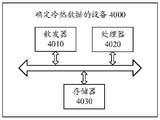
In the following, referring to fig. 4, the description will be made by taking an example in which the apparatus for determining the hot and cold data includes a transceiver, a processor and a memory.
Fig. 4 is a schematic block diagram of an apparatus 4000 for determining cold and hot data provided herein. As shown in fig. 4, the apparatus 4000 includes: a transceiver 4010, a processor 4020, and a memory 4030. The transceiver 4010, the processor 4020 and the memory 4030 communicate with each other via the internal connection path to transmit control and/or data signals, the memory 4030 is used for storing a computer program, and the processor 4010 is used for calling and running the computer program from the memory 4030 to control the transceiver 4020 to transmit and receive signals.
Specifically, the functions of the transceiver 4010 correspond to the specific functions of the obtaining unit 3001 shown in fig. 3, and are not described herein again.
Specifically, the functions of the processor 4020 correspond to the specific functions of the processing unit 3002 shown in fig. 3, and are not described herein again.
In the embodiment of the present application, the processor 4020 is included in the device 4000 for determining hot and cold data. Optionally, in some implementations, the device 4000 for determining hot and cold data may further include a transceiver 4010.
Optionally, in some implementations, the device 4000 for determining hot and cold data may further include a memory 4030.
Fig. 5 is a schematic structural diagram of a system 5000 according to an embodiment of the present application. As shown in fig. 5, the system 5000 includes: the apparatus 3000 for determining hot and cold data and/or the device 4000 for determining hot and cold data.
The present embodiment provides a computer program product, which when running on the apparatus 3000 for determining cold and hot data, enables the apparatus 3000 for determining cold and hot data to perform the method 100 and/or the method 200 in the above method embodiments.
Those of ordinary skill in the art will appreciate that the various method steps and elements described in connection with the embodiments disclosed herein can be implemented as electronic hardware, computer software, or combinations of both, and that the steps and elements of the various embodiments have been described above generally in terms of their functionality in order to clearly illustrate the interchangeability of hardware and software. Whether such functionality is implemented as hardware or software depends upon the particular application and design constraints imposed on the implementation. Skilled artisans may implement the described functionality in varying ways for each particular application, but such implementation decisions should not be interpreted as causing a departure from the scope of the present application.
It can be clearly understood by those skilled in the art that, for convenience and simplicity of description, the specific working processes of the above-described systems, apparatuses and units may refer to the corresponding processes in the foregoing method embodiments, and are not described herein again.
In the several embodiments provided in the present application, the disclosed system, apparatus and method can be implemented in other ways. For example, the above-described apparatus embodiments are merely illustrative, and for example, the division of the unit is only one logical functional division, and other divisions may be realized in practice, for example, a plurality of units or components may be combined or integrated into another system, or some features may be omitted, or not executed. In addition, the shown or discussed mutual coupling or direct coupling or communication connection may be an indirect coupling or communication connection through some interfaces, devices or units, and may also be an electric, mechanical or other form of connection.
The units described as separate parts may or may not be physically separate, and parts displayed as units may or may not be physical units, may be located in one place, or may be distributed on a plurality of network units. Some or all of the units can be selected according to actual needs to achieve the purpose of the solution of the embodiments of the present application.
In addition, functional units in the embodiments of the present application may be integrated into one processing unit, or each unit may exist alone physically, or two or more units are integrated into one unit. The integrated unit can be realized in a form of hardware, and can also be realized in a form of a software functional unit.
The integrated unit, if implemented in the form of a software functional unit and sold or used as a stand-alone product, may be stored in a computer readable storage medium. Based on such understanding, the technical solution of the present application may be substantially implemented or contributed to by the prior art, or all or part of the technical solution may be embodied in a software product, which is stored in a storage medium and includes instructions for causing a computer device (which may be a personal computer, a server, or a network device) to execute all or part of the steps of the method in the embodiments of the present application. And the aforementioned storage medium includes: various media capable of storing program codes, such as a usb disk, a removable hard disk, a read-only memory (ROM), a Random Access Memory (RAM), a magnetic disk, or an optical disk.
The above description is only for the specific embodiments of the present application, but the scope of the present application is not limited thereto, and any person skilled in the art can easily conceive various equivalent modifications or substitutions within the technical scope of the present application, and these modifications or substitutions should be covered by the scope of the present application. Therefore, the protection scope of the present application shall be subject to the protection scope of the claims.
In the above embodiments, the implementation may be wholly or partially realized by software, hardware, firmware, or any combination thereof. When implemented in software, may be implemented in whole or in part in the form of a computer program product. The computer program product includes one or more computer program instructions. When loaded and executed on a computer, produce, in whole or in part, the procedures or functions according to the embodiments of the application. The computer may be a general purpose computer, a special purpose computer, a network of computers, or other programmable device. The computer program instructions may be stored in a computer readable storage medium or transmitted from one computer readable storage medium to another computer readable storage medium, for example, the computer program instructions may be transmitted from one website site, computer, server, or data center to another website site, computer, server, or data center by wire or wirelessly. The computer-readable storage medium can be any available medium that can be accessed by a computer or a data storage device, such as a server, a data center, etc., that includes one or more of the available media. The available media may be magnetic media (e.g., floppy disks, hard disks, tapes), optical media (e.g., Digital Video Disks (DVDs), or semiconductor media (e.g., solid state disks), among others.
It will be understood by those skilled in the art that all or part of the steps for implementing the above embodiments may be implemented by hardware, or may be implemented by a program instructing relevant hardware, and the program may be stored in a computer-readable storage medium, and the above-mentioned storage medium may be a read-only memory, a magnetic disk or an optical disk, etc.
It is clear to those skilled in the art that, for convenience and brevity of description, the specific working processes of the above-described systems, apparatuses and units may refer to the corresponding processes in the foregoing method embodiments, and are not described herein again.
In addition, the term "and/or" in the present application is only one kind of association relationship describing the associated object, and means that three kinds of relationships may exist, for example, a and/or B may mean: a exists alone, A and B exist simultaneously, and B exists alone. In addition, the character "/" herein generally indicates that the former and latter related objects are in an "or" relationship; the term "at least one", as used herein, may mean "one" and "two or more", e.g., at least one of A, B and C, may mean: a exists alone, B exists alone, C exists alone, A and B exist together, A and C exist together, C and B exist together, A and B exist together, and A, B and C exist together, which are seven cases.
The above description is only for the specific embodiments of the present application, but the scope of the present application is not limited thereto, and any person skilled in the art can easily conceive of the changes or substitutions within the technical scope of the present application, and shall be covered by the scope of the present application. Therefore, the protection scope of the present application shall be subject to the protection scope of the claims.