Background
Information extraction is one of the important tasks in the field of natural language processing, and the technology of extracting specific structural information from texts and forming structured data is the basis for forming knowledge maps and knowledge bases. Entity relationship joint extraction is an important branch of an information extraction task, structured data in the form of (head Entity, relationship, tail Entity) needs to be extracted from an unstructured text, and can be regarded as a comprehensive task of Named Entity Recognition (called Entity Recognition, referred to as NER) of subtasks for information extraction and relationship extraction.
With the development of the information age, more and more texts fill various platforms, hidden information can be obtained by effectively analyzing the data, and the development of various industries is promoted, namely the original purpose and the purpose of natural language processing tasks. However, most text data is unstructured, the data processing is difficult, the amount of extracted information is rare, and the data is an undesirable data source, and the structured data is convenient, simple and orderly to process and can maximally mine information in the text. Therefore, it is an important subject to convert unstructured data into structured data, and a process of extracting structured data such as specific triples from unstructured text is generally called information extraction.
Named Entity Recognition (NER) aims to extract Named entities of predefined types from a text, such as name of a person, name of a place, name of an organization and the like, is an important subtask in a natural language processing field information extraction task, and can help subsequent text semantic understanding. Distinguished from simple word segmentation, the named entity with rich types is the most basic semantic unit and is also the basis of most natural language processing tasks, so the NER task has great function and value in the research and application fields.
The entity classification of named entity recognition is various, and more general Person name (Person), place name (Location), Organization name (Organization), Date (Date), Time (Time), etc. may also have more fine-grained classification according to task requirements and application scenarios, for example, people may be subdivided into workers, lawyers, government personnel, etc., place names including country, state, or city, and entity names in specific fields, or specific proper nouns of each company Organization, such as brand name, product name, etc. The named entity recognition task requires that all text that may be of a predefined entity type be extracted from a given unstructured text.
The NER problem can also be viewed as one of the sequence tagging problems. The sequence labeling problem can be considered as a generalization of the classification problem or as a simple form of the more complex structure prediction (structure prediction) problem. The input to the sequence labeling problem is an observation sequence and the output is a marker sequence or state sequence. The problem is aimed at learning a model that enables it to give a marker sequence as a prediction for an observed sequence.
The method for solving the sequence labeling problem can be roughly divided into two modes, one is a probability graph model, and the other is a deep learning model.
The probabilistic graph Model method mainly includes three methods, HMM (Hidden Markov Model), MEMM (Maximum Entropy Markov Model), and CRF (Conditional Random Field). When the HMM is applied to the sequence annotation, the state corresponds to the label, and it is assumed that the data to be annotated is generated by the HMM, so that the annotation can be performed by using the learning and prediction algorithm of the HMM: the learning stage adopts maximum likelihood estimation, and the prediction stage adopts Viterbi algorithm. The MEMM is a combination of HMM and ME, cancels the observation independence assumption, and is a discriminant model. HMM and MEMM have labeling bias (label bias) problems. CRF is also a discriminant model, which differs from MEMM in that the local normalization is changed to global normalization (looking at the marker sequence as a whole), thus further solving the problem of label bias. Compared with HMM and MEMM, CRF has more parameters to be trained, and has the disadvantages of high training cost and high complexity.
The deep learning model changes the model structure, the commonly used structure is the network structure such as BilSTM, transform, etc., and the CRF is also used to sort the result. However, the structures such as BilSTM and transformer are difficult to parallelize, the required running time is usually long, and the problem of low sequence labeling efficiency exists.
Disclosure of Invention
In view of the above, the present invention has been made to provide a method, an apparatus, an electronic device, and a computer-readable storage medium for feature extraction based on an expanded convolutional neural network that overcome or at least partially solve the above-mentioned problems.
One embodiment of the present invention provides a feature extraction method based on an expanded convolutional neural network, including:
acquiring a text to be analyzed, and processing the text to be analyzed to obtain at least one text character string, wherein the text character string comprises a preset number of characters;
performing word embedding on the text character string;
inputting a text character string subjected to word embedding processing into an expanded convolutional neural network, wherein the expanded convolutional neural network comprises a plurality of convolutional layers, and the width of a filter of each convolutional layer is greater than 1;
and obtaining an output vector of each character in the text character string through the expanded convolutional neural network.
Optionally, the obtaining, by the expanded convolutional neural network, an output vector of each character in the text string includes:
and taking the output of the previous convolutional layer as the input of the next convolutional layer, and iterating layer by layer to obtain the output vector of each character in the text character string.
Optionally, the expanded convolutional neural network comprises 3 convolutional layers, wherein the width of the filter of the 1 st convolutional layer is 3, the width of the filter of the 2 nd convolutional layer is 3, and the width of the filter of the 3 rd convolutional layer is 5.
Optionally, the method further comprises:
and constructing a plurality of expanded convolutional neural networks, and respectively inputting the obtained text character strings into the expanded convolutional neural networks in parallel.
Another embodiment of the present invention provides a feature extraction device based on an expanded convolutional neural network, including:
the text character string acquiring unit is used for acquiring a text to be analyzed and processing the text to be analyzed to acquire at least one text character string, wherein the text character string comprises a preset number of characters;
the word embedding processing unit is used for carrying out word embedding on the text character string;
a text character string input unit for inputting the text character string subjected to word embedding processing into an expanded convolutional neural network, wherein the expanded convolutional neural network comprises a plurality of convolutional layers, and the width of a filter of each convolutional layer is greater than 1;
and the input vector acquisition unit is used for acquiring the output vector of each character in the text character string through the expanded convolutional neural network.
Optionally, the input vector obtaining unit is further configured to:
and taking the output of the previous convolutional layer as the input of the next convolutional layer, and iterating layer by layer to obtain the output vector of each character in the text character string.
Optionally, the expanded convolutional neural network comprises 3 convolutional layers, wherein the width of the filter of the 1 st convolutional layer is 3, the width of the filter of the 2 nd convolutional layer is 3, and the width of the filter of the 3 rd convolutional layer is 5.
Optionally, the method further comprises: and the parallel processing unit is used for constructing a plurality of expanded convolutional neural networks and respectively inputting the obtained text character strings into the expanded convolutional neural networks in parallel.
Another embodiment of the present invention provides an electronic device, wherein the electronic device includes:
a processor; and the number of the first and second groups,
a memory arranged to store computer executable instructions that, when executed, cause the processor to perform the above-described method of feature extraction based on an expanded convolutional neural network.
Another embodiment of the present invention provides a computer-readable storage medium, wherein the computer-readable storage medium stores one or more programs which, when executed by a processor, implement the above-described feature extraction method based on a dilated convolutional neural network.
The method has the advantages that the method performs feature extraction on the text to be analyzed through the expanded convolutional neural network, the effective input width can exponentially increase along with the depth, and the efficiency of feature extraction is improved.
Compared with the traditional convolutional neural network, the convolutional neural network based on iterative expansion can be better used for large context and structured prediction, and maintains similar F1 performance while improving the efficiency.
The invention can also construct a plurality of expanded convolutional neural networks, and respectively input the obtained text character strings into each expanded convolutional neural network in parallel, thereby further improving the efficiency of feature extraction.
Detailed Description
In order to make the objects, technical solutions and advantages of the present invention more apparent, embodiments of the present invention will be described in detail with reference to the accompanying drawings.
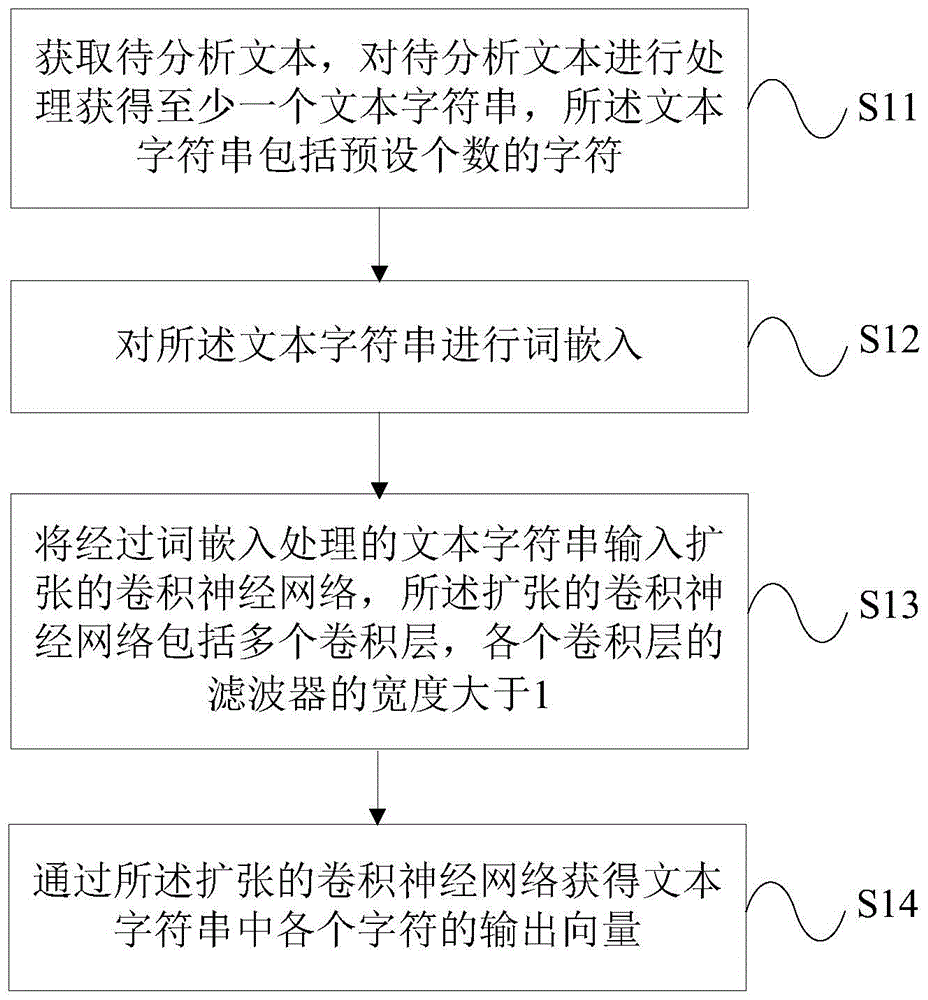
Fig. 1 is a schematic flow chart of a feature extraction method based on an expanded convolutional neural network according to an embodiment of the present invention. As shown in fig. 1, the method includes:
s11: acquiring a text to be analyzed, and processing the text to be analyzed to obtain at least one text character string, wherein the text character string comprises a preset number of characters;
it is understood that for the text to be analyzed, a text string (token string, a token in chinese usually represents one character) is first obtained by the NLP tool, for example, the token string x ═ x1, x2, x 3. In order to meet the calculation format of the neural network, text character strings are cut or supplemented, the length of the hyper-parameter text is set, the length smaller than the length needs to be supplemented, the length larger than the length needs to be truncated, and the token strings for protecting the preset number of characters are finally obtained.
S12: performing word embedding on the text character string;
in practical application, word embedding is carried out on a text character string through an embedding (embedding) layer, and each character in the text character string is converted into a numerical vector which can be processed by a computer.
S13: inputting a text character string subjected to word embedding processing into an expanded convolutional neural network, wherein the expanded convolutional neural network comprises a plurality of convolutional layers, and the width of a filter of each convolutional layer is greater than 1;
s14: and obtaining an output vector of each character in the text character string through the expanded convolutional neural network.
After the output vectors of the individual characters are obtained, they can be classified directly or further processed by CRF. The CRF is a conditional random field, and can further learn and output the output probability distribution to learn the sequenced data.
It can be appreciated that parallelization running independent of sequence length can save time and energy costs, maximize GPU resource usage and minimize the time required to train and evaluate models. Convolutional Neural Networks (CNN) provide just such a feature. Instead of incrementally composing a representation on each marker in the sequence, the filters are applied in parallel throughout the sequence at once, where the filters represent convolution kernels in the CNN.
For the expanded convolutional neural network, under the condition of the same parameter quantity and calculation quantity, the spacing distance during convolutional kernel processing is increased, the effective input width can exponentially increase along with the depth, the resolution of each layer is not lost, and the estimated parameter quantity is moderate. As with typical CNN layers, the expanded convolution operates over a sliding window of sequence context, but unlike traditional convolutions, the context need not be continuous; the expanded window will traverse each input expanded by width d. The exponential increase in effective input width with increasing number of convolutional layers may expand the size of the effective input width to cover the entire length of most sequences with only a few convolutional layers.
According to the feature extraction method based on the expanded convolutional neural network, the feature extraction is performed on the text to be analyzed through the expanded convolutional neural network, the effective input width can be exponentially increased along with the depth, and the feature extraction efficiency is improved.
In an optional implementation manner of the embodiment of the present invention, the obtaining, by the expanded convolutional neural network, an output vector of each character in a text string includes:
and taking the output of the previous convolutional layer as the input of the next convolutional layer, and iterating layer by layer to obtain the output vector of each character in the text character string.
The iteratively expanded convolutional neural network can be better used for large context and structured prediction than a traditional convolutional neural network, and maintains similar F1 performance while improving efficiency. F1 performance as an evaluation index, equals precision multiplied by recall divided by the sum of precision and recall, the precision being the proportion of samples that are actually positive and predicted as positive to all samples that are predicted as positive, and the recall being the proportion of samples that are actually positive and predicted as positive to all samples that are actually positive. When prediction is performed using independent classification, it is always better than Bi-directional LSTM (Bi-LSTM) and is the same as the inference in CRF with logarithm from Bi-LSTM (Bi-LSTM-CRF).
The whole iterative expansion CNN architecture repeatedly applies the same expansion convolution block to the token-represented token, namely token, and carries out convolution operation according to the token level. Similar to the model of logits generated using RNNs, the iteratively expanded convolutional neural network provides two methods of performing predictions: the label of each marker can be predicted independently or by running a Viterbi inference in a chain structured graph model.
Preferably, as shown in fig. 2, the expanded convolutional neural network includes 3 convolutional layers, wherein the filter of the 1 st convolutional layer has a width of 3, the filter of the 2 nd convolutional layer has a width of 3, and the filter of the 3 rd convolutional layer has a width of 5.
It can be understood that the width of the filter of the convolutional layer of the embodiment of the present invention corresponds to the radius of the convolutional layer, that the width of the filter is 3 corresponds to the radius of the convolutional layer of 1, and that the width of the filter is 5 corresponds to the radius of the convolutional layer of 2.
Further, the method further comprises:
and constructing a plurality of expanded convolutional neural networks, and respectively inputting the obtained text character strings into the expanded convolutional neural networks in parallel.
In practical application, in order to further improve the efficiency of feature extraction, 4 expanded convolutional neural networks with the same structure can be constructed, 4 text character strings are respectively input to each expanded convolutional neural network in parallel, and the 4 expanded convolutional neural networks are used for extracting features of corresponding text character strings in parallel.
Fig. 3 is a schematic structural diagram of a feature extraction device based on an expanded convolutional neural network according to an embodiment of the present invention. As shown in fig. 3, the apparatus includes:
the text character string acquiring unit 31 is configured to acquire a text to be analyzed, and process the text to be analyzed to acquire at least one text character string, where the text character string includes a preset number of characters;
a word embedding processing unit 32, configured to perform word embedding on the text character string;
a text string input unit 33 for inputting the text string subjected to the word embedding process into an expanded convolutional neural network, the expanded convolutional neural network including a plurality of convolutional layers, a width of a filter of each convolutional layer being greater than 1;
and an input vector obtaining unit 34, configured to obtain an output vector of each character in the text string through the expanded convolutional neural network.
According to the feature extraction device based on the expanded convolutional neural network, the feature extraction is performed on the text to be analyzed through the expanded convolutional neural network, the effective input width can be exponentially increased along with the depth, and the feature extraction efficiency is improved.
Further, the input vector obtaining unit 34 is further configured to:
and taking the output of the previous convolutional layer as the input of the next convolutional layer, and iterating layer by layer to obtain the output vector of each character in the text character string.
Preferably, the expanded convolutional neural network comprises 3 convolutional layers, wherein the width of the filter of the 1 st convolutional layer is 3, the width of the filter of the 2 nd convolutional layer is 3, and the width of the filter of the 3 rd convolutional layer is 5.
Further, the apparatus further comprises: and the parallel processing unit is used for constructing a plurality of expanded convolutional neural networks and respectively inputting the obtained text character strings into the expanded convolutional neural networks in parallel.
It should be noted that the feature extraction device based on the expanded convolutional neural network in the foregoing embodiments can be respectively used for executing the methods in the foregoing embodiments, and therefore, the detailed description is not repeated.
In conclusion, the method and the device perform feature extraction on the text to be analyzed through the expanded convolutional neural network, so that the effective input width can exponentially increase along with the depth, and the efficiency of feature extraction is improved.
Compared with the traditional convolutional neural network, the convolutional neural network based on iterative expansion can be better used for large context and structured prediction, and maintains similar F1 performance while improving the efficiency.
The invention can also construct a plurality of expanded convolutional neural networks, and respectively input the obtained text character strings into each expanded convolutional neural network in parallel, thereby further improving the efficiency of feature extraction.
As will be appreciated by one skilled in the art, embodiments of the present invention may be provided as a method, system, or computer program product. Accordingly, the present invention may take the form of an entirely hardware embodiment, an entirely software embodiment or an embodiment combining software and hardware aspects. Furthermore, the present invention may take the form of a computer program product embodied on one or more computer-usable storage media (including, but not limited to, disk storage, CD-ROM, optical storage, and the like) having computer-usable program code embodied therein.
It should be noted that:
the algorithms and displays presented herein are not inherently related to any particular computer, virtual machine, or other apparatus. Various general purpose devices may be used with the teachings herein. The required structure for constructing such a device will be apparent from the description above. Moreover, the present invention is not directed to any particular programming language. It is appreciated that a variety of programming languages may be used to implement the teachings of the present invention as described herein, and any descriptions of specific languages are provided above to disclose the best mode of the invention.
In the description provided herein, numerous specific details are set forth. It is understood, however, that embodiments of the invention may be practiced without these specific details. In some instances, well-known methods, structures and techniques have not been shown in detail in order not to obscure an understanding of this description.
Similarly, it should be appreciated that in the foregoing description of exemplary embodiments of the invention, various features of the invention are sometimes grouped together in a single embodiment, figure, or description thereof for the purpose of streamlining the invention and aiding in the understanding of one or more of the various inventive aspects. However, the disclosed method should not be interpreted as reflecting an intention that: that the invention as claimed requires more features than are expressly recited in each claim. Rather, as the following claims reflect, inventive aspects lie in less than all features of a single foregoing disclosed embodiment. Thus, the claims following the detailed description are hereby expressly incorporated into this detailed description, with each claim standing on its own as a separate embodiment of this invention.
Those skilled in the art will appreciate that the modules in the device in an embodiment may be adaptively changed and disposed in one or more devices different from the embodiment. The modules or units or components of the embodiments may be combined into one module or unit or component, and furthermore they may be divided into a plurality of sub-modules or sub-units or sub-components. All of the features disclosed in this specification (including any accompanying claims, abstract and drawings), and all of the processes or elements of any method or apparatus so disclosed, may be combined in any combination, except combinations where at least some of such features and/or processes or elements are mutually exclusive. Each feature disclosed in this specification (including any accompanying claims, abstract and drawings) may be replaced by alternative features serving the same, equivalent or similar purpose, unless expressly stated otherwise.
Furthermore, those skilled in the art will appreciate that while some embodiments described herein include some features included in other embodiments, rather than other features, combinations of features of different embodiments are meant to be within the scope of the invention and form different embodiments. For example, in the following claims, any of the claimed embodiments may be used in any combination.
The various component embodiments of the invention may be implemented in hardware, or in software modules running on one or more processors, or in a combination thereof. It will be appreciated by those skilled in the art that a microprocessor or Digital Signal Processor (DSP) may be used in practice to implement some or all of the functions of some or all of the components of the apparatus for detecting a wearing state of an electronic device according to embodiments of the present invention. The present invention may also be embodied as apparatus or device programs (e.g., computer programs and computer program products) for performing a portion or all of the methods described herein. Such programs implementing the present invention may be stored on computer-readable media or may be in the form of one or more signals. Such a signal may be downloaded from an internet website or provided on a carrier signal or in any other form.
For example, fig. 4 shows a schematic structural diagram of an electronic device according to an embodiment of the invention. The electronic device conventionally comprises a processor 41 and a memory 42 arranged to store computer executable instructions (program code). The memory 42 may be an electronic memory such as a flash memory, an EEPROM (electrically erasable programmable read only memory), an EPROM, a hard disk, or a ROM. The memory 42 has a storage space 43 for storing program code 44 for performing the method steps shown in fig. 1 and in any of the embodiments. For example, the storage space 43 for storing the program code may comprise respective program codes 44 for respectively implementing the various steps in the above method. The program code can be read from or written to one or more computer program products. These computer program products comprise a program code carrier such as a hard disk, a Compact Disc (CD), a memory card or a floppy disk. Such a computer program product is typically a computer readable storage medium such as described in fig. 5. The computer readable storage medium may have memory segments, memory spaces, etc. arranged similarly to the memory 42 in the electronic device of fig. 4. The program code may be compressed, for example, in a suitable form. In general, the memory space stores program code 51 for performing the steps of the method according to the invention, i.e. there may be program code, such as read by the processor 41, which, when run by the electronic device, causes the electronic device to perform the steps of the method described above.
While the foregoing is directed to embodiments of the present invention, other modifications and variations of the present invention may be devised by those skilled in the art in light of the above teachings. It should be understood by those skilled in the art that the foregoing detailed description is for the purpose of better explaining the present invention, and the scope of the present invention should be determined by the scope of the appended claims.