CN114040767A - Methods and compositions comprising 5HT receptor agonists for the treatment of psychological, cognitive, behavioral and/or emotional disorders - Google Patents
Methods and compositions comprising 5HT receptor agonists for the treatment of psychological, cognitive, behavioral and/or emotional disorders Download PDFInfo
- Publication number
- CN114040767A CN114040767A CN202080027002.3A CN202080027002A CN114040767A CN 114040767 A CN114040767 A CN 114040767A CN 202080027002 A CN202080027002 A CN 202080027002A CN 114040767 A CN114040767 A CN 114040767A
- Authority
- CN
- China
- Prior art keywords
- pharmaceutically acceptable
- less
- disorder
- pharmaceutical composition
- receptor agonist
- Prior art date
- Legal status (The legal status is an assumption and is not a legal conclusion. Google has not performed a legal analysis and makes no representation as to the accuracy of the status listed.)
- Pending
Links
Images


Classifications
-
- A—HUMAN NECESSITIES
- A61—MEDICAL OR VETERINARY SCIENCE; HYGIENE
- A61K—PREPARATIONS FOR MEDICAL, DENTAL OR TOILETRY PURPOSES
- A61K31/00—Medicinal preparations containing organic active ingredients
- A61K31/66—Phosphorus compounds
- A61K31/675—Phosphorus compounds having nitrogen as a ring hetero atom, e.g. pyridoxal phosphate
-
- C—CHEMISTRY; METALLURGY
- C07—ORGANIC CHEMISTRY
- C07F—ACYCLIC, CARBOCYCLIC OR HETEROCYCLIC COMPOUNDS CONTAINING ELEMENTS OTHER THAN CARBON, HYDROGEN, HALOGEN, OXYGEN, NITROGEN, SULFUR, SELENIUM OR TELLURIUM
- C07F9/00—Compounds containing elements of Groups 5 or 15 of the Periodic Table
- C07F9/02—Phosphorus compounds
- C07F9/547—Heterocyclic compounds, e.g. containing phosphorus as a ring hetero atom
- C07F9/553—Heterocyclic compounds, e.g. containing phosphorus as a ring hetero atom having one nitrogen atom as the only ring hetero atom
- C07F9/572—Five-membered rings
- C07F9/5728—Five-membered rings condensed with carbocyclic rings or carbocyclic ring systems
-
- A—HUMAN NECESSITIES
- A61—MEDICAL OR VETERINARY SCIENCE; HYGIENE
- A61K—PREPARATIONS FOR MEDICAL, DENTAL OR TOILETRY PURPOSES
- A61K31/00—Medicinal preparations containing organic active ingredients
- A61K31/12—Ketones
-
- A—HUMAN NECESSITIES
- A61—MEDICAL OR VETERINARY SCIENCE; HYGIENE
- A61K—PREPARATIONS FOR MEDICAL, DENTAL OR TOILETRY PURPOSES
- A61K31/00—Medicinal preparations containing organic active ingredients
- A61K31/13—Amines
- A61K31/135—Amines having aromatic rings, e.g. ketamine, nortriptyline
- A61K31/137—Arylalkylamines, e.g. amphetamine, epinephrine, salbutamol, ephedrine or methadone
-
- A—HUMAN NECESSITIES
- A61—MEDICAL OR VETERINARY SCIENCE; HYGIENE
- A61K—PREPARATIONS FOR MEDICAL, DENTAL OR TOILETRY PURPOSES
- A61K31/00—Medicinal preparations containing organic active ingredients
- A61K31/33—Heterocyclic compounds
- A61K31/38—Heterocyclic compounds having sulfur as a ring hetero atom
-
- A—HUMAN NECESSITIES
- A61—MEDICAL OR VETERINARY SCIENCE; HYGIENE
- A61K—PREPARATIONS FOR MEDICAL, DENTAL OR TOILETRY PURPOSES
- A61K31/00—Medicinal preparations containing organic active ingredients
- A61K31/33—Heterocyclic compounds
- A61K31/395—Heterocyclic compounds having nitrogen as a ring hetero atom, e.g. guanethidine or rifamycins
- A61K31/40—Heterocyclic compounds having nitrogen as a ring hetero atom, e.g. guanethidine or rifamycins having five-membered rings with one nitrogen as the only ring hetero atom, e.g. sulpiride, succinimide, tolmetin, buflomedil
- A61K31/403—Heterocyclic compounds having nitrogen as a ring hetero atom, e.g. guanethidine or rifamycins having five-membered rings with one nitrogen as the only ring hetero atom, e.g. sulpiride, succinimide, tolmetin, buflomedil condensed with carbocyclic rings, e.g. carbazole
- A61K31/404—Indoles, e.g. pindolol
- A61K31/4045—Indole-alkylamines; Amides thereof, e.g. serotonin, melatonin
-
- A—HUMAN NECESSITIES
- A61—MEDICAL OR VETERINARY SCIENCE; HYGIENE
- A61K—PREPARATIONS FOR MEDICAL, DENTAL OR TOILETRY PURPOSES
- A61K31/00—Medicinal preparations containing organic active ingredients
- A61K31/33—Heterocyclic compounds
- A61K31/395—Heterocyclic compounds having nitrogen as a ring hetero atom, e.g. guanethidine or rifamycins
- A61K31/41—Heterocyclic compounds having nitrogen as a ring hetero atom, e.g. guanethidine or rifamycins having five-membered rings with two or more ring hetero atoms, at least one of which being nitrogen, e.g. tetrazole
- A61K31/4164—1,3-Diazoles
-
- A—HUMAN NECESSITIES
- A61—MEDICAL OR VETERINARY SCIENCE; HYGIENE
- A61K—PREPARATIONS FOR MEDICAL, DENTAL OR TOILETRY PURPOSES
- A61K31/00—Medicinal preparations containing organic active ingredients
- A61K31/33—Heterocyclic compounds
- A61K31/395—Heterocyclic compounds having nitrogen as a ring hetero atom, e.g. guanethidine or rifamycins
- A61K31/41—Heterocyclic compounds having nitrogen as a ring hetero atom, e.g. guanethidine or rifamycins having five-membered rings with two or more ring hetero atoms, at least one of which being nitrogen, e.g. tetrazole
- A61K31/42—Oxazoles
- A61K31/422—Oxazoles not condensed and containing further heterocyclic rings
-
- A—HUMAN NECESSITIES
- A61—MEDICAL OR VETERINARY SCIENCE; HYGIENE
- A61K—PREPARATIONS FOR MEDICAL, DENTAL OR TOILETRY PURPOSES
- A61K31/00—Medicinal preparations containing organic active ingredients
- A61K31/33—Heterocyclic compounds
- A61K31/395—Heterocyclic compounds having nitrogen as a ring hetero atom, e.g. guanethidine or rifamycins
- A61K31/435—Heterocyclic compounds having nitrogen as a ring hetero atom, e.g. guanethidine or rifamycins having six-membered rings with one nitrogen as the only ring hetero atom
- A61K31/44—Non condensed pyridines; Hydrogenated derivatives thereof
- A61K31/4427—Non condensed pyridines; Hydrogenated derivatives thereof containing further heterocyclic ring systems
- A61K31/4439—Non condensed pyridines; Hydrogenated derivatives thereof containing further heterocyclic ring systems containing a five-membered ring with nitrogen as a ring hetero atom, e.g. omeprazole
-
- A—HUMAN NECESSITIES
- A61—MEDICAL OR VETERINARY SCIENCE; HYGIENE
- A61K—PREPARATIONS FOR MEDICAL, DENTAL OR TOILETRY PURPOSES
- A61K31/00—Medicinal preparations containing organic active ingredients
- A61K31/33—Heterocyclic compounds
- A61K31/395—Heterocyclic compounds having nitrogen as a ring hetero atom, e.g. guanethidine or rifamycins
- A61K31/435—Heterocyclic compounds having nitrogen as a ring hetero atom, e.g. guanethidine or rifamycins having six-membered rings with one nitrogen as the only ring hetero atom
- A61K31/44—Non condensed pyridines; Hydrogenated derivatives thereof
- A61K31/445—Non condensed piperidines, e.g. piperocaine
- A61K31/4523—Non condensed piperidines, e.g. piperocaine containing further heterocyclic ring systems
- A61K31/454—Non condensed piperidines, e.g. piperocaine containing further heterocyclic ring systems containing a five-membered ring with nitrogen as a ring hetero atom, e.g. pimozide, domperidone
-
- A—HUMAN NECESSITIES
- A61—MEDICAL OR VETERINARY SCIENCE; HYGIENE
- A61K—PREPARATIONS FOR MEDICAL, DENTAL OR TOILETRY PURPOSES
- A61K31/00—Medicinal preparations containing organic active ingredients
- A61K31/33—Heterocyclic compounds
- A61K31/395—Heterocyclic compounds having nitrogen as a ring hetero atom, e.g. guanethidine or rifamycins
- A61K31/435—Heterocyclic compounds having nitrogen as a ring hetero atom, e.g. guanethidine or rifamycins having six-membered rings with one nitrogen as the only ring hetero atom
- A61K31/47—Quinolines; Isoquinolines
- A61K31/48—Ergoline derivatives, e.g. lysergic acid, ergotamine
-
- A—HUMAN NECESSITIES
- A61—MEDICAL OR VETERINARY SCIENCE; HYGIENE
- A61K—PREPARATIONS FOR MEDICAL, DENTAL OR TOILETRY PURPOSES
- A61K31/00—Medicinal preparations containing organic active ingredients
- A61K31/33—Heterocyclic compounds
- A61K31/395—Heterocyclic compounds having nitrogen as a ring hetero atom, e.g. guanethidine or rifamycins
- A61K31/495—Heterocyclic compounds having nitrogen as a ring hetero atom, e.g. guanethidine or rifamycins having six-membered rings with two or more nitrogen atoms as the only ring heteroatoms, e.g. piperazine or tetrazines
- A61K31/496—Non-condensed piperazines containing further heterocyclic rings, e.g. rifampin, thiothixene or sparfloxacin
-
- A—HUMAN NECESSITIES
- A61—MEDICAL OR VETERINARY SCIENCE; HYGIENE
- A61K—PREPARATIONS FOR MEDICAL, DENTAL OR TOILETRY PURPOSES
- A61K31/00—Medicinal preparations containing organic active ingredients
- A61K31/33—Heterocyclic compounds
- A61K31/395—Heterocyclic compounds having nitrogen as a ring hetero atom, e.g. guanethidine or rifamycins
- A61K31/54—Heterocyclic compounds having nitrogen as a ring hetero atom, e.g. guanethidine or rifamycins having six-membered rings with at least one nitrogen and one sulfur as the ring hetero atoms, e.g. sulthiame
- A61K31/5415—Heterocyclic compounds having nitrogen as a ring hetero atom, e.g. guanethidine or rifamycins having six-membered rings with at least one nitrogen and one sulfur as the ring hetero atoms, e.g. sulthiame ortho- or peri-condensed with carbocyclic ring systems, e.g. phenothiazine, chlorpromazine, piroxicam
-
- A—HUMAN NECESSITIES
- A61—MEDICAL OR VETERINARY SCIENCE; HYGIENE
- A61K—PREPARATIONS FOR MEDICAL, DENTAL OR TOILETRY PURPOSES
- A61K31/00—Medicinal preparations containing organic active ingredients
- A61K31/33—Heterocyclic compounds
- A61K31/395—Heterocyclic compounds having nitrogen as a ring hetero atom, e.g. guanethidine or rifamycins
- A61K31/55—Heterocyclic compounds having nitrogen as a ring hetero atom, e.g. guanethidine or rifamycins having seven-membered rings, e.g. azelastine, pentylenetetrazole
- A61K31/551—Heterocyclic compounds having nitrogen as a ring hetero atom, e.g. guanethidine or rifamycins having seven-membered rings, e.g. azelastine, pentylenetetrazole having two nitrogen atoms, e.g. dilazep
- A61K31/5513—1,4-Benzodiazepines, e.g. diazepam or clozapine
-
- A—HUMAN NECESSITIES
- A61—MEDICAL OR VETERINARY SCIENCE; HYGIENE
- A61K—PREPARATIONS FOR MEDICAL, DENTAL OR TOILETRY PURPOSES
- A61K31/00—Medicinal preparations containing organic active ingredients
- A61K31/33—Heterocyclic compounds
- A61K31/395—Heterocyclic compounds having nitrogen as a ring hetero atom, e.g. guanethidine or rifamycins
- A61K31/55—Heterocyclic compounds having nitrogen as a ring hetero atom, e.g. guanethidine or rifamycins having seven-membered rings, e.g. azelastine, pentylenetetrazole
- A61K31/554—Heterocyclic compounds having nitrogen as a ring hetero atom, e.g. guanethidine or rifamycins having seven-membered rings, e.g. azelastine, pentylenetetrazole having at least one nitrogen and one sulfur as ring hetero atoms, e.g. clothiapine, diltiazem
-
- A—HUMAN NECESSITIES
- A61—MEDICAL OR VETERINARY SCIENCE; HYGIENE
- A61K—PREPARATIONS FOR MEDICAL, DENTAL OR TOILETRY PURPOSES
- A61K31/00—Medicinal preparations containing organic active ingredients
- A61K31/56—Compounds containing cyclopenta[a]hydrophenanthrene ring systems; Derivatives thereof, e.g. steroids
- A61K31/57—Compounds containing cyclopenta[a]hydrophenanthrene ring systems; Derivatives thereof, e.g. steroids substituted in position 17 beta by a chain of two carbon atoms, e.g. pregnane or progesterone
- A61K31/573—Compounds containing cyclopenta[a]hydrophenanthrene ring systems; Derivatives thereof, e.g. steroids substituted in position 17 beta by a chain of two carbon atoms, e.g. pregnane or progesterone substituted in position 21, e.g. cortisone, dexamethasone, prednisone or aldosterone
-
- A—HUMAN NECESSITIES
- A61—MEDICAL OR VETERINARY SCIENCE; HYGIENE
- A61K—PREPARATIONS FOR MEDICAL, DENTAL OR TOILETRY PURPOSES
- A61K31/00—Medicinal preparations containing organic active ingredients
- A61K31/66—Phosphorus compounds
- A61K31/683—Diesters of a phosphorus acid with two hydroxy compounds, e.g. phosphatidylinositols
- A61K31/685—Diesters of a phosphorus acid with two hydroxy compounds, e.g. phosphatidylinositols one of the hydroxy compounds having nitrogen atoms, e.g. phosphatidylserine, lecithin
-
- A—HUMAN NECESSITIES
- A61—MEDICAL OR VETERINARY SCIENCE; HYGIENE
- A61K—PREPARATIONS FOR MEDICAL, DENTAL OR TOILETRY PURPOSES
- A61K33/00—Medicinal preparations containing inorganic active ingredients
- A61K33/06—Aluminium, calcium or magnesium; Compounds thereof, e.g. clay
-
- A—HUMAN NECESSITIES
- A61—MEDICAL OR VETERINARY SCIENCE; HYGIENE
- A61K—PREPARATIONS FOR MEDICAL, DENTAL OR TOILETRY PURPOSES
- A61K36/00—Medicinal preparations of undetermined constitution containing material from algae, lichens, fungi or plants, or derivatives thereof, e.g. traditional herbal medicines
- A61K36/18—Magnoliophyta (angiosperms)
- A61K36/185—Magnoliopsida (dicotyledons)
- A61K36/25—Araliaceae (Ginseng family), e.g. ivy, aralia, schefflera or tetrapanax
- A61K36/258—Panax (ginseng)
-
- A—HUMAN NECESSITIES
- A61—MEDICAL OR VETERINARY SCIENCE; HYGIENE
- A61K—PREPARATIONS FOR MEDICAL, DENTAL OR TOILETRY PURPOSES
- A61K45/00—Medicinal preparations containing active ingredients not provided for in groups A61K31/00 - A61K41/00
- A61K45/06—Mixtures of active ingredients without chemical characterisation, e.g. antiphlogistics and cardiaca
-
- A—HUMAN NECESSITIES
- A61—MEDICAL OR VETERINARY SCIENCE; HYGIENE
- A61K—PREPARATIONS FOR MEDICAL, DENTAL OR TOILETRY PURPOSES
- A61K9/00—Medicinal preparations characterised by special physical form
- A61K9/10—Dispersions; Emulsions
- A61K9/127—Synthetic bilayered vehicles, e.g. liposomes or liposomes with cholesterol as the only non-phosphatidyl surfactant
-
- A—HUMAN NECESSITIES
- A61—MEDICAL OR VETERINARY SCIENCE; HYGIENE
- A61K—PREPARATIONS FOR MEDICAL, DENTAL OR TOILETRY PURPOSES
- A61K9/00—Medicinal preparations characterised by special physical form
- A61K9/20—Pills, tablets, discs, rods
- A61K9/2004—Excipients; Inactive ingredients
- A61K9/2009—Inorganic compounds
-
- A—HUMAN NECESSITIES
- A61—MEDICAL OR VETERINARY SCIENCE; HYGIENE
- A61K—PREPARATIONS FOR MEDICAL, DENTAL OR TOILETRY PURPOSES
- A61K9/00—Medicinal preparations characterised by special physical form
- A61K9/20—Pills, tablets, discs, rods
- A61K9/2004—Excipients; Inactive ingredients
- A61K9/2013—Organic compounds, e.g. phospholipids, fats
-
- A—HUMAN NECESSITIES
- A61—MEDICAL OR VETERINARY SCIENCE; HYGIENE
- A61K—PREPARATIONS FOR MEDICAL, DENTAL OR TOILETRY PURPOSES
- A61K9/00—Medicinal preparations characterised by special physical form
- A61K9/20—Pills, tablets, discs, rods
- A61K9/2004—Excipients; Inactive ingredients
- A61K9/2022—Organic macromolecular compounds
- A61K9/2027—Organic macromolecular compounds obtained by reactions only involving carbon-to-carbon unsaturated bonds, e.g. polyvinyl pyrrolidone, poly(meth)acrylates
-
- A—HUMAN NECESSITIES
- A61—MEDICAL OR VETERINARY SCIENCE; HYGIENE
- A61K—PREPARATIONS FOR MEDICAL, DENTAL OR TOILETRY PURPOSES
- A61K9/00—Medicinal preparations characterised by special physical form
- A61K9/48—Preparations in capsules, e.g. of gelatin, of chocolate
- A61K9/50—Microcapsules having a gas, liquid or semi-solid filling; Solid microparticles or pellets surrounded by a distinct coating layer, e.g. coated microspheres, coated drug crystals
- A61K9/51—Nanocapsules; Nanoparticles
- A61K9/5107—Excipients; Inactive ingredients
- A61K9/5123—Organic compounds, e.g. fats, sugars
-
- A—HUMAN NECESSITIES
- A61—MEDICAL OR VETERINARY SCIENCE; HYGIENE
- A61K—PREPARATIONS FOR MEDICAL, DENTAL OR TOILETRY PURPOSES
- A61K9/00—Medicinal preparations characterised by special physical form
- A61K9/48—Preparations in capsules, e.g. of gelatin, of chocolate
- A61K9/50—Microcapsules having a gas, liquid or semi-solid filling; Solid microparticles or pellets surrounded by a distinct coating layer, e.g. coated microspheres, coated drug crystals
- A61K9/51—Nanocapsules; Nanoparticles
- A61K9/5107—Excipients; Inactive ingredients
- A61K9/513—Organic macromolecular compounds; Dendrimers
- A61K9/5146—Organic macromolecular compounds; Dendrimers obtained otherwise than by reactions only involving carbon-to-carbon unsaturated bonds, e.g. polyethylene glycol, polyamines, polyanhydrides
- A61K9/5153—Polyesters, e.g. poly(lactide-co-glycolide)
-
- A—HUMAN NECESSITIES
- A61—MEDICAL OR VETERINARY SCIENCE; HYGIENE
- A61P—SPECIFIC THERAPEUTIC ACTIVITY OF CHEMICAL COMPOUNDS OR MEDICINAL PREPARATIONS
- A61P25/00—Drugs for disorders of the nervous system
-
- A—HUMAN NECESSITIES
- A61—MEDICAL OR VETERINARY SCIENCE; HYGIENE
- A61P—SPECIFIC THERAPEUTIC ACTIVITY OF CHEMICAL COMPOUNDS OR MEDICINAL PREPARATIONS
- A61P25/00—Drugs for disorders of the nervous system
- A61P25/28—Drugs for disorders of the nervous system for treating neurodegenerative disorders of the central nervous system, e.g. nootropic agents, cognition enhancers, drugs for treating Alzheimer's disease or other forms of dementia
-
- A—HUMAN NECESSITIES
- A61—MEDICAL OR VETERINARY SCIENCE; HYGIENE
- A61P—SPECIFIC THERAPEUTIC ACTIVITY OF CHEMICAL COMPOUNDS OR MEDICINAL PREPARATIONS
- A61P25/00—Drugs for disorders of the nervous system
- A61P25/30—Drugs for disorders of the nervous system for treating abuse or dependence
-
- A—HUMAN NECESSITIES
- A61—MEDICAL OR VETERINARY SCIENCE; HYGIENE
- A61K—PREPARATIONS FOR MEDICAL, DENTAL OR TOILETRY PURPOSES
- A61K2300/00—Mixtures or combinations of active ingredients, wherein at least one active ingredient is fully defined in groups A61K31/00 - A61K41/00
Landscapes
- Health & Medical Sciences (AREA)
- Chemical & Material Sciences (AREA)
- Life Sciences & Earth Sciences (AREA)
- General Health & Medical Sciences (AREA)
- Animal Behavior & Ethology (AREA)
- Pharmacology & Pharmacy (AREA)
- Public Health (AREA)
- Veterinary Medicine (AREA)
- Medicinal Chemistry (AREA)
- Epidemiology (AREA)
- Engineering & Computer Science (AREA)
- Bioinformatics & Cheminformatics (AREA)
- Biomedical Technology (AREA)
- Organic Chemistry (AREA)
- Neurosurgery (AREA)
- Neurology (AREA)
- Nuclear Medicine, Radiotherapy & Molecular Imaging (AREA)
- General Chemical & Material Sciences (AREA)
- Chemical Kinetics & Catalysis (AREA)
- Natural Medicines & Medicinal Plants (AREA)
- Psychiatry (AREA)
- Molecular Biology (AREA)
- Inorganic Chemistry (AREA)
- Optics & Photonics (AREA)
- Hospice & Palliative Care (AREA)
- Nanotechnology (AREA)
- Physics & Mathematics (AREA)
- Biochemistry (AREA)
- Mycology (AREA)
- Biotechnology (AREA)
- Medical Informatics (AREA)
- Emergency Medicine (AREA)
- Microbiology (AREA)
- Alternative & Traditional Medicine (AREA)
- Botany (AREA)
- Biophysics (AREA)
- Dispersion Chemistry (AREA)
- Addiction (AREA)
- Pharmaceuticals Containing Other Organic And Inorganic Compounds (AREA)
- Medicines That Contain Protein Lipid Enzymes And Other Medicines (AREA)
Abstract
本文提供了用于治疗心理、认知、行为和/或情绪障碍的方法和组合物,所述组合物包含5HT激动剂(例如裸盖菇素)。在某些实施方案中,这种组合物以足够高至提供治疗效果但不足以提供副作用的量或水平施用。
Provided herein are methods and compositions comprising a 5HT agonist (eg, psilocybin) for the treatment of psychological, cognitive, behavioral, and/or mood disorders. In certain embodiments, such compositions are administered in an amount or level high enough to provide a therapeutic effect but insufficient to provide a side effect.
Description
Cross-referencing
This application claims the benefit of U.S. provisional patent application No. 62/798,998 filed on 30.1.2019 and U.S. provisional patent application No. 62/799,010 filed on 30.1.2019, each of which is incorporated herein by reference in its entirety.
Background
Serotonin (5HT) receptors are a group of G protein-coupled receptors (GPCRs) and ligand-gated ion channels found in the central and peripheral nervous systems. Activation of 5HT receptors can significantly affect brain function.
Many people around the world suffer from psychological or emotional disorders such as depression, anxiety, obsessive compulsive disorder, and post-traumatic stress disorder. Many of these conditions are thought to be associated with the serotonin system of humans, including the interactions between (a) the neurotransmitter serotonin and (B) several different subtypes of serotonin neurotransmitter receptors found in humans.
Various compositions are known to modulate the activity of serotonin receptors. Many drugs (antidepressants, serotonin reuptake inhibitors, selective serotonin reuptake inhibitors, etc.) are already commercially available. Many leading commercial drugs for the treatment of mood disorders (e.g. depression, obsessive-compulsive disorder and/or anxiety) are directed to the serotonin pathway.
However, despite their popularity and commercial success, these drugs are characterized by long onset times, severe side effects, and poor therapeutic efficacy. In many cases, these drugs are harmful to the user. For example, many people taking prescription drugs for serotonin report suicidal thoughts, sexual dysfunction, fatigue, elevated blood pressure, blurred vision, abnormal heart rate, nausea and weight gain.
Nudiflorin (also known as 4-phosphoryloxy-N, N-dimethyltryptamine or [3- (2-trimethylaminoethyl) -1H-indol-4-yl ] dihydrogenphosphate) is considered to be the most abundant psychoactive compound in "magic mushrooms". Nudeomushroom element has also been tested for its potential in developing prescription drugs for the treatment of drug dependence, anxiety and mood disorders. However, to date, the therapeutic use of nudeomushroom has been associated with its adverse side effects, including hallucinations, panic attacks, psychosis, nausea, vomiting, muscle weakness and lack of coordination. Therefore, there is a need to develop pharmaceutical compositions of naked cap mushroom for treating disorders associated with 5HT receptors without adverse side effects.
Disclosure of Invention
In certain embodiments, provided herein are methods and compositions for treating psychological, cognitive, behavioral, and/or emotional disorders. In some embodiments, the disorders described herein are treated by administering a therapeutically effective amount of an agent described herein, e.g., a 5HT agonist (e.g., an active 5HT agonist itself (e.g., dimethyl-4-hydroxytryptamine), or a salt, solvate, metabolite, derivative, or prodrug thereof (e.g., naked cap mushroom)). In certain embodiments, such agents are administered (or are present in the compositions provided herein) in an amount or level (e.g., a low dose, a therapeutically effective amount) that is high enough to provide a therapeutic effect, e.g., but high enough to avoid an adverse reaction (e.g., hallucinogenic or other adverse reaction, such as panic attack, psychosis, nausea, vomiting, muscle weakness, or lack of coordination). In certain instances, such low dose therapeutic agents (and/or the compositions or methods provided herein) provide improved motivation, attention, accuracy, speed of response, sustained action, and/or cognitive input. In some embodiments, such low dose therapeutic agents (and/or compositions or methods provided herein) are used to treat behavioral and/or cognitive disorders, e.g., where motivational, attention, accuracy, response speed, willingness, and/or cognitive input play a role. In certain embodiments, the compositions provided herein may be used for or to treat depression, anxiety, apathy and/or hypomotivation, attention disorders, executive dysfunction and/or cognitive input, obsessive-compulsive disorders, and/or neurocognitive disorders.
In some embodiments, also provided herein is a method of managing a neurological condition or one or more symptoms thereof in a subject in need thereof, comprising administering to the subject a pharmaceutical composition comprising:
a) a therapeutically effective amount of one or more 5HT receptor agonists (e.g., dimethyl-4-hydroxytryptamine), or a pharmaceutically acceptable salt, solvate, metabolite, derivative, or prodrug thereof (e.g., nudaphantin); and
b) a pharmaceutically acceptable excipient.
In some embodiments, a therapeutically effective amount of a 5HT receptor agonist, or a pharmaceutically acceptable salt, solvate, metabolite, derivative or prodrug thereof, is provided to a subject in need thereof in an amount insufficient to provide an adverse side effect, e.g., a hallucinogenic experience.
Also provided herein is a method of treating a symptom of a neurological condition in a subject suffering from or susceptible to the neurological condition, comprising administering to the subject a pharmaceutical composition comprising:
a) a therapeutically effective amount of one or more 5HT receptor agonists (e.g., dimethyl-4-hydroxytryptamine), or a pharmaceutically acceptable salt, solvate, metabolite, derivative, or prodrug thereof (e.g., nudaphantin); and
b) A pharmaceutically acceptable excipient.
In particular embodiments, a therapeutically effective amount of a 5HT receptor agonist, or a pharmaceutically acceptable salt, solvate, metabolite, derivative or prodrug thereof, is provided to a subject in need thereof in an amount insufficient to provide an adverse side effect, such as a hallucinogenic experience.
In some embodiments, the 5HT receptor agonist, or a pharmaceutically acceptable salt, solvate, metabolite, derivative or prodrug thereof, is present in an amount of from about 0.1mg to about 50mg (e.g., from about 0.1mg to about 10mg, from about 0.2mg to about 5mg, from about 10mg to about 50mg, etc.).
In some embodiments, the 5HT receptor agonist or a pharmaceutically acceptable salt, solvate, metabolite, derivative or prodrug thereof is present in an amount from about 0.1mg to about 2 mg.
In some embodiments, the 5HT receptor agonist or a pharmaceutically acceptable salt, solvate, metabolite, derivative or prodrug thereof is present in an amount from about 1mg to about 15 mg.
In some embodiments, the pharmaceutical composition is a low dose pharmaceutical composition.
In some embodiments, the pharmaceutical composition comprises a controlled release component.
In some embodiments, the pharmaceutical composition comprises a controlled release component and an immediate release component.
In some embodiments, the maximum plasma concentration (C) of the 5HT receptor agonist (e.g., dimethyl-4-hydroxytryptamine) (e.g., an active form thereof) or a pharmaceutically acceptable salt, solvate, metabolite, derivative or prodrug thereof is insufficient to provide 6ng/mL or moremax) In an amount and/or formulation that provides a therapeutically effective amount of a 5HT receptor agonist (e.g., dimethyl-4-hydroxytryptamine) or a pharmaceutically acceptable salt, solvate, metabolite, derivative or prodrug thereof (e.g., naked cap mushroom) to a subject in need thereof.
In some embodiments, the maximum plasma concentration (C) of a 5HT receptor agonist (e.g., dimethyl-4-hydroxytryptamine) (e.g., an active form thereof) or a pharmaceutically acceptable salt, solvate, metabolite, derivative or prodrug thereof (e.g., a pharmaceutically acceptable salt, solvate, metabolite, derivative or prodrug thereof) is provided at about 0.1ng/mL or more and less than 6ng/mL (e.g., at least 0.5ng/mL and less than 6ng/mL, about 1ng/mL to about 5.5ng/mL, about 2ng/mL to about 5ng/mL, etc.)max) To provide a therapeutically effective amount of a 5HT receptor agonist or a pharmaceutically acceptable salt, solvate, metabolite, derivative or prodrug thereof (e.g., nudaphantin) to a subject in need thereof.
In some embodiments, a therapeutically effective amount of a 5HT receptor agonist (e.g., dimethyl-4-hydroxytryptamine), or a pharmaceutically acceptable salt, solvate, metabolite, derivative, or prodrug thereof, is provided to a subject in need thereof in an amount and/or formulation that provides a plasma concentration of a 5HT receptor agonist (e.g., dimethyl-4-hydroxytryptamine) (e.g., an active form thereof) of at least 0.1ng/mL (e.g., at least 0.2ng/mL, at least 0.3ng/mL, at least 0.5ng/mL, etc.) after at least 6 hours (e.g., at least 12 hours, at least 24 hours, at least 36 hours, at least 48 hours, at least 72 hours, at least 96 hours, at least 120 hours, at least 144 hours, etc.).
In some embodiments, the 5HT receptor agonist is a 5HT2 receptor agonist. In some embodiments, the 5HT receptor agonist is naked cap mushroom or a pharmaceutically acceptable salt, solvate, metabolite, derivative or prodrug thereof.
Also disclosed herein is a pharmaceutical composition comprising:
a) a therapeutically effective amount of one or more 5HT receptor agonists (e.g., dimethyl-4-hydroxytryptamine), or a pharmaceutically acceptable salt, solvate, metabolite, derivative, or prodrug thereof (e.g., nudaphantin),
b) a pharmaceutically acceptable excipient, and
c) (e.g., optionally) one or more agents selected from the group consisting of surfactants, preservatives, flavoring agents, sweeteners, and antifoaming agents.
Also disclosed herein is a pharmaceutical composition comprising:
a) a therapeutically effective amount of one or more 5HT receptor agonists (e.g., dimethyl-4-hydroxytryptamine), or a pharmaceutically acceptable salt, solvate, metabolite, derivative, or prodrug thereof (e.g., nudaphantin),
b) a pharmaceutically acceptable excipient, and
c) (e.g., optionally) one or more agents selected from the group consisting of surfactants, preservatives, flavoring agents, sweeteners, and antifoaming agents.
In some embodiments, the pharmaceutical compositions provided herein are low dose pharmaceutical compositions. In some embodiments, upon administration to an individual in need thereof, the pharmaceutical compositions provided herein provide a maximum plasma concentration (C) of a 5HT receptor agonist (e.g., dimethyl-4-hydroxytryptamine) (e.g., the active form of a 5HT receptor agonist regardless of the form administered) (or a pharmaceutically acceptable salt, solvate, metabolite, derivative, or prodrug (e.g., nudaphantin)) of less than 6ng/mL in the individual in need thereof max). In some embodiments, the 5HT receptor agonist is dimethyl-4-hydroxytryptamine or a pharmaceutically acceptable salt, solvate, metabolite, derivative or prodrug thereof. In some embodiments, the 5HT receptor agonist is naked cap mushroom or a pharmaceutically acceptable salt, solvate, metabolite, derivative or prodrug thereof.
Also disclosed herein are pharmaceutical compositions comprising an oral dosage form comprising an immediate release top layer and a controlled release core. In some embodiments, the immediate release layer comprises (i) one or more 5HT receptor agonists or pharmaceutically acceptable salts, solvates, metabolites, derivatives or prodrugs thereof and (ii) one or more second agents. In some embodiments, the one or more second agents is a stimulant, antihistamine, antiemetic, antidepressant, anti-inflammatory agent, growth factor, lithium compound, resveratrol, phosphatidylcholine, curcumin, magnesium, melatonin, pregnenolone, ginseng, or lysergic acid diethylamide. In certain embodiments, the controlled release core comprises (a) one or more 5HT receptor agonists or a pharmaceutically acceptable salt, solvate, metabolite, derivative or prodrug thereof; (b) at least one pharmaceutically acceptable excipient; and (c) optionally one or more agents selected from the group consisting of surfactants, preservatives, flavoring agents, sweeteners, and antifoaming agents. In some embodiments, the pharmaceutical composition is a low dose pharmaceutical composition. In certain embodiments, upon administration to a subject in need thereof, the pharmaceutical composition provides a maximum plasma concentration (Cmax) of the 5HT receptor agonist (e.g., the active form of the 5HT receptor agonist regardless of the form administered) (or a pharmaceutically acceptable salt, solvate, metabolite, derivative, or prodrug) of less than 6ng/mL in the subject in need thereof.
Drawings
Various aspects of the disclosure are set forth with particularity in the appended claims. A better understanding of the features and advantages of the present disclosure will be obtained by reference to the following detailed description that sets forth illustrative embodiments, in which the principles of the disclosure are utilized, and the accompanying drawings of which:
figure 1 shows the effect of naked cap mushroom on the autonomic activity and behavioral signs of treated rats. A) The graph shows the distance traveled (measured in cm) relative to a dose of naked cap mushroom ranging from 0.03 to 10 mg/kg. B) The graph shows the dose of naked cap mushroom against 5-HT2AThe impact of the associated behavior. Wet dog-like shaking (WDS) and total number of Back Muscle Contractions (BMC) (N) were plotted versus dose (mg/kg). Hatched lines indicate the dose of nudeomushroom inducing statistically the same WDS and BMC behaviour as vehicle.
FIG. 2 shows the effect of naked cap mushroom on the Progressive Ratio (PR) test in treated rats. A) The graph shows the number of lever presses by the group of high and low responder rats before treatment with vehicle or naked cap mushroom to establish a pre-test PR baseline. B) The graph shows the number of lever presses by a subset of high and low responder rats at 0.05mg/kg, 0.1mg/kg and 0.2mg/kg of naked cap mushroom dose. High responders were defined as rats that completed the highest three-point depression of the joystick in the baseline test; low responders were rats that completed the bottom three thirds of the compression of the joystick in the baseline test. Asterisks indicate statistical significance between high and low responders.
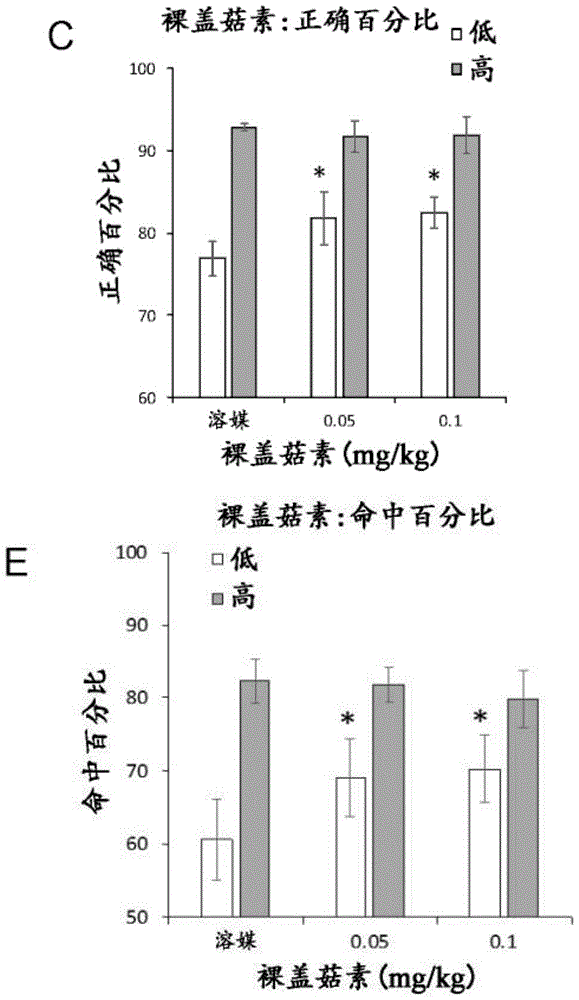
Figure 3 shows the effect of naked cap mushroom on rat cognition using 5 choice continuous reaction time tasks (5-CSRTT) with an inter-trial time interval of 5 seconds. A) The graph shows the proccognitive effect of a 0.05mg/kg dose of nudiflozin with vehicle and a 0.1mg/kg dose on all rats (measured as percentage of hits on nasal spikes to stimulation sites to collect food rewards). Asterisks indicate statistical differences from vehicle. B) The graph shows the pro-cognitive effect (measured as the correct percentage for nasal stick accuracy) of the 0.05mg/kg dose of naked cap mushroom with vehicle and 0.1mg/kg dose on all rats. C) The graph shows the pro-cognitive impact (percentage hits) of two different doses of nudiflorin on a subset of low performers. Asterisks indicate statistical differences from vehicle. D) The graph shows the effect (percentage of correct) of two different doses of nudiflorin on a subset of low performers. High-performing subjects were defined as rats that completed the highest three-quartile hit or correct nasal stick in the baseline test; low performers are rats that completed the bottom three-point hits or correct nasal sticks in the baseline test.
Figure 4 shows the effect of naked cap mushroom on rat cognition using 5-choice continuous response time tasks (5-CSRTT) and the assessment of Premature Response (PREM) and sustained response (PSV). A) The graph shows the increase in PREM and PSV responses at a 5 second inter-trial time interval (ITI), which establishes a baseline (basal) and 10 second ITI across two doses of nudeomushroom (0.05mg/kg and 0.1mg/kg) in 24 animals. Standard deviation is represented by error bars; asterisks indicate the significance compared to vehicle (P ═ 0.05) using the T test. B) The graph shows the effect of naked cap mushroom on PREM and PSV in low and high performer subgroups. Mean standard error is represented by error bars; asterisks indicate significance using T-test compared to vehicle (P < 0.01). High-performing subjects were defined as rats with the highest three-point premature response in the baseline test; low-performing individuals are rats with a bottom third digit premature response in the baseline test.
Figure 5 shows plasma levels of dimethyl-4-hydroxytryptamine over time in nudaphantin dosed rats at several dose levels: 0.05mg/kg (C)maxAbout 6 + -2 ng/ml (after 30 minutes)) or 0.1mg/kg (C) of dimethyl-4-hydroxytryptaminemaxAbout 12 + -3 ng/ml (after 30 minutes) for dimethyl-4-hydroxytryptamine, 1mg/kg (C)maxDimethyl-4-hydroxytryptamine about 83 + -5 ng/ml (after 30 min)), 10mg/kg (C)maxDimethyl-4-hydroxytryptamine about 1106 + -164 ng/ml (after 30 minutes)).
Figure 6 shows the effect of naked cap mushroom on rat cognition. A) The graph shows that the lowest performing tertile (N ═ 8) is low attention, possibly representing a low attention endophenotype of depression. B) The graph shows the hit percentage fraction for low attention rats. D) The graph shows the slower response rate in low attention rats. Similarly to the PR test, the effect of 0.05 and 0.1mg/kg of nudeomushroom on the accuracy (percentage correct and percentage hit) in 5CSRTT was observed very clearly in the low attention subgroup compared to the vehicle C) and E) charts. Asterisks indicate statistical significance relative to vehicle. Nudiflozin 0.05mg/kg also increased the reaction rate in the low attention cohort compared to vehicle D) graph.
Detailed Description
5HT (or serotonin) receptors
The 5HT (or serotonin) receptors are a group of G protein-coupled receptors (GPCRs) and ligand-gated ion channels. 5HT is an abbreviation for 5-hydroxy-tryptamine, the chemical name of serotonin:

serotonin receptors are activated by serotonin (their natural ligand) and mediate both excitatory and inhibitory neurotransmission. They regulate the release of a number of neurotransmitters, including glutamate, GABA, dopamine, epinephrine/norepinephrine and acetylcholine, as well as a number of hormones, including oxytocin, prolactin, vasopressin, cortisol, corticotropin and substance P. Serotonin receptors affect various biological and neurological processes such as aggression, anxiety, appetite, cognition, learning, memory, mood, nausea, sleep and thermoregulation.
The 5HT receptors are divided into 7G protein-coupled receptor families. 5HT1、5HT2、5HT3Is a main family; other 5HT4、5HT5、5HT6And 5HT7In most cases with 5HT1Or 5HT2The receptor works in a similar manner. The 5HT receptors work with G proteins to modify ion channels or membrane enzymes.
In certain embodiments, the 5HT agonist of the formulations, compositions, methods, etc., described herein is 5HT1An agonist. 5HT1The receptor has a strong binding affinity for serotonin. Typically, when serotonin is involved in 5HT 1Upon receptor binding, the G protein is activated, opening ion channels and allowing potassium ions to leave the neuron. This generally results in neurons carrying more negative charges, making it more difficult to trigger action potentials, serotonin and 5HT1Receptor binding is an inhibitory effect.
In some preferred embodiments, the 5HT agonist of the formulations, compositions, methods, etc., described herein is 5HT2An agonist. In certain embodiments, 5HT2Agonist pair 5HT2The receptors have relatively high affinity (e.g., relative to 5 HT)1Receptors and/or other 5HT receptors, e.g. 5HT3、5HT4、5HT5、5HT6、5HT7Or some combination or all thereof, e.g., greater affinity of 2x, 3x, 5x, 10x, 20x, 50x, etc.). 5HT2The receptor has a weaker affinity for serotonin. Thus, serotonin preferentially binds 5HT1Receptors, usually at 5HT only1Binding of 5HT only when the receptor is at least partially (or fully) saturated2A receptor. 5HT2Serotonin binding of the receptor typically activates G proteins that shut off potassium channels, resulting in potassium ion accumulation. This typically results in depolarization, making it easier to reach the excitation threshold of the neuron. Thus, when serotonin is involved in 5HT2Receptor binding, it usually has an excitatory effect.

The seven serotonin receptor families, which include fourteen receptor subtypes, are distributed throughout the body as shown in the following table:


5HT2Receptors
In general, 5HT2The receptors are characterized by a low affinity for serotonin (and other indolealkylamines) and interaction with signal-transducing GqPhospholipase C pathway. In each case, such receptors mediate a variety of physiological and behavioral functions through three distinct subtypes: 5HT2A、5HT2BAnd 5HT2C。

Atypical antipsychotics, clozapine, olanzapine, quetiapine, risperidone, ziprasidone, aripiprazole, asenapine, amitriptyline, clomipramine, cyproheptadine, elitryptiline, etoperidone, haloperidol, hydroxyzine, iloperidone, ketanserin, mexican, mianserin, mirtazapine, nefazodone, pimavarin, pithidine, ritanserin, trazodone, yohimbine
Agonists
Fenfluramine, MDMA, desfenfluramine, methylphenidate 6-APB, BW-723C86, PNU-22394, Ro60-0175
5HT2B Antagonists
Agomelatine, asenapine, ketanserin, mexicat, ritanserin, tegaserod, yohimbine, BZP, RS-127, 445
Agonists
Aripiprazole, ergometrine, lorcaserin, trazodone
PNU-22394、Ro60-0175、TFMPP、YM-348、A-372、159、AL-38022A
Antagonists
5HT2CAgomelatine, amitriptyline, asenapine, clomipramine, clozapine, cyproheptadine, demebolin (Dimebolin), eltoprazine, etoperidone, fluoxetine, haloperidol, iloperidone, ketanserin, lisuride, mexiergot, mianserin, mirtazapine, nefazodone, olanzapine, paroxetine, quetiapine, risperidone, ritanserin, tramadol, trazodone, ziprasidone, SB-242084
5HT2AIs an important excitatory serotonin receptor subtype. In some cases, physiological processes mediated by receptors include, as non-limiting examples:
central nervous System-neuronal excitation, behavioral Effect, learning, anxiety and nociception (pro-nociception)
Smooth muscle contraction (in the bronchi and gastrointestinal tract)
Vasoconstriction/vasodilation
Platelet aggregation
The role in memory and learning
Anti-inflammatory Activity
Hormone (oxytocin, prolactin, ACTH, corticosterone, renin) modulation
Mood regulation (depressed patient ratio)Other normal individuals have more 5HT2AReceptor, which means 5HT2AParticipating in pathogenesis of depression)
In some cases, 5HT2AAgonism facilitates the treatment or management of disorders or symptoms thereof involving cognitive function and social interactions, such as 5HT in brain regions mediating cognitive function and social interactions2AExtensive localization of the receptor is demonstrated. In some cases, where 5HT is involved2ADisorders of the subject include, but are not limited to, schizophrenia, depression/suicide, anxiety, Obsessive Compulsive Disorder (OCD), bipolar disorders, Attention Deficit Hyperactivity Disorder (ADHD), eating disorders such as anorexia nervosa, autism, and autism spectrum disorders, asperger's syndrome, neuropsychiatric diseases and disorders, sexual dysfunction such as erectile dysfunction, neurodegenerative diseases, inflammatory diseases, autoimmune diseases, metabolic diseases such as obesity and diabetes, central nervous system diseases, peripheral nervous system diseases, alzheimer's disease, snoring, sleep apnea (obstructive sleep apnea, central sleep apnea), insomnia, sleep deprivation, restless leg syndrome, isohypnosis, nightmare, sleep, sleepiness, narcolepsy (daytime sleepiness), narcolepsy, and pain.
Any suitable 5HT (e.g., 5 HT) is used in any of the compositions, formulations, methods, therapies, etc., described herein2E.g. 5HT2A) An agonist. In some preferred embodiments, the 5HT agonist of the formulations, compositions, methods, etc., described herein is 5HT2AAn agonist. In certain embodiments, 5HT2AAgonist pair 5HT2AThe receptors have relatively high affinity (e.g., relative to 5HT1, 5 HT)3、5HT4、5HT5、5HT6、5HT7、5HT2B、5HT2COr some combination or all thereof, e.g., greater affinity of 2x, 3x, 5x, 10x, 20x, 50x, etc.). In some cases, 5HT2AAgonists increase dopamine levels in the prefrontal cortex. In certain embodiments, the 5HT provided herein2AThe agonists are the following classes of 5HT2AOne of the agonists: ergoline,Tryptamine and phenethylamine. In particular embodiments, 5HT (e.g., 5 HT) as used herein2A) The receptor agonist is ergoline:

in some cases, ergotamine and ergotamine, synthetic derivatives include the oxytocin, methylergotamine, the antimigraine drugs dihydroergotamine and mexican, hydridotrine (mixture of dihydroergotamine mesylate, INN: ergoline mesylate), and bromocriptine. In some cases, synthetic ergolines include pergolide and lisuride.
In some cases, ergoline is an ergoline derivative, such as an ergotamine or peptide alkaloid, as described below. In some cases, ergoline is clavine (examples include festuca ergoline, fumagillin a, fumagillin B, and fumagillin C) and other derivatives not belonging to these classes, such as cabergoline, pergolide, lisuride.
Ergot amides
Exemplary ergotamines include ergotamine (LSA, D-ergotamine), ergonovine (ergobacine), ergonovine (ME-277), mexican (UML-491), LSD (D-lysergic acid diethylamide), LSH (D-lysergic acid α -hydroxyethylamide). The following table summarizes their structural formulae and relationships.

Peptide alkaloids
Exemplary peptide alkaloids include the peptide ergot alkaloid (ergopeptine, ergopeptide), which is an ergoline derivative containing a tripeptide structure (attached at the same position as the amide group of the ergonic acid derivative) comprising proline and two other a-amino acids. Examples include:
ergotoxine (R)2Valine) -ergocristine, ergocornine, alpha-ergocryptine, beta-ergocryptine
Ergotamine (R)2Alanine) -ergotamine, ergovaline, alpha-ergoline, beta-ergoline

Tryptamine
Tryptamine (2- (1H-indol-3-yl) ethylamine) comprises an indole ring attached to an amino ethylene group. The substituted tryptamine is substituted with any suitable group, for example, in the indole ring (R) as shown below1、R2) Ethylene chain (R)3) And/or amino (R)4、R5) Are modified and are collectively referred to herein as tryptamine. Examples of tryptamines include serotonin, melatonin, cap-eugonin and N, N-dimethyltryptamine. Furthermore, the tryptamine structure may comprise part of more complex compounds, such as: LSD, ibagorine, calophylline, yohimbine, and the like.

Examples of naturally occurring substituted tryptamines include, as non-limiting examples:

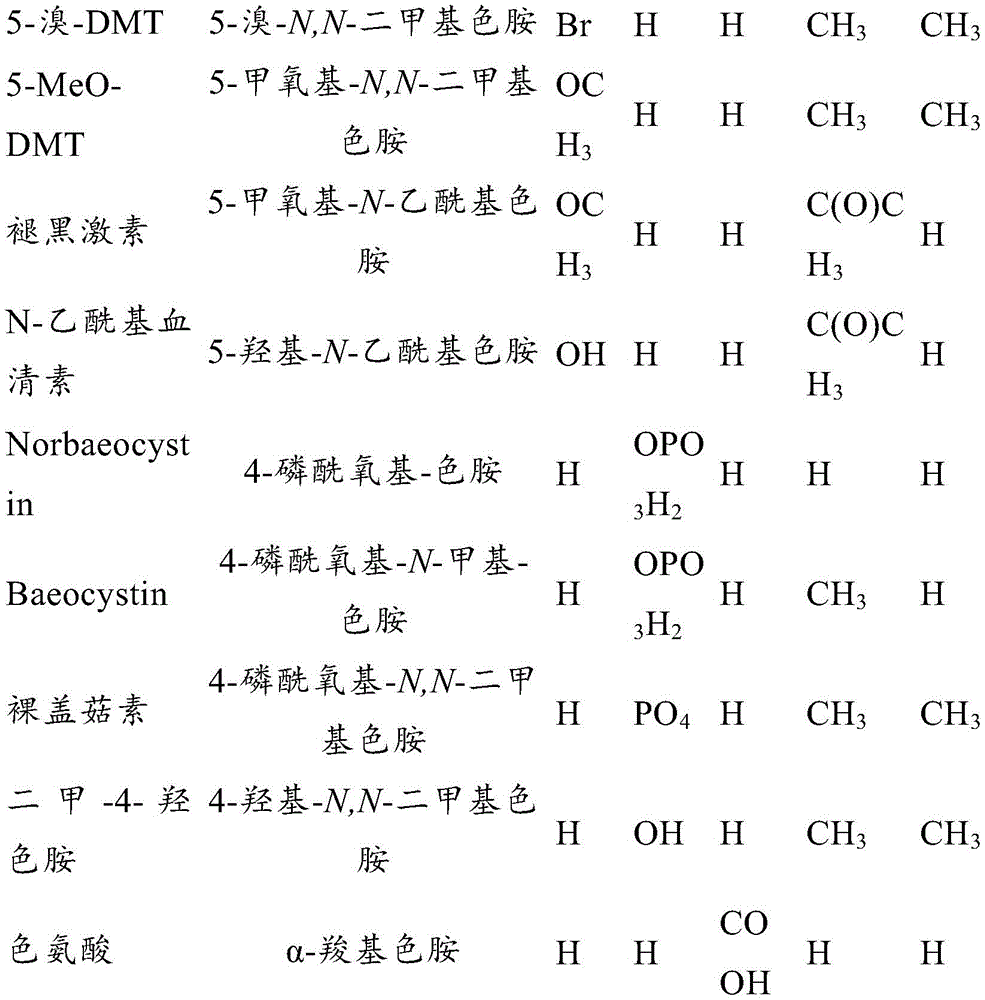
as non-limiting examples, examples of synthetic substituted tryptamines include:


phenylethylamine
Phenylethylamine comprises a benzene ring attached to an amino ethylene group; substituted phenethylamines are optionally substituted in any suitable manner, e.g. they are optionally substituted by a substituent at the phenyl ring (R)1,R2,R3,R4And/or R5) Ethylene chain (R)6And/or R7) At and/or at the amino group (R)8And/or R9) The substitution modifications above are shown below.

Examples of phenylethylamines include, but are not limited to, those listed in the following table:


in certain embodiments, the compositions or formulations described herein comprise an antidepressant. Similarly, in some embodiments, the methods of treatment provided herein comprise administering an antidepressant, e.g., using a formulation or composition described herein. In some cases, antidepressants fall into three families: monoamine oxidase inhibitors (MAOI), tricyclic, and Selective Serotonin Reuptake Inhibitors (SSRI). In general, SSRIs work by reducing serotonin reuptake by presynaptic neurons. Thus, more serotonin remains in the synaptic cleft for a longer period of time to compensate for the lower level of serotonin. SSRIs generally have fewer side effects than MAOI or tricyclic. Notably, SSRIs typically block only the serotonin reuptake pump, unlike tricyclics, which also block the norepinephrine reuptake pump. However, in general, they do affect norepinephrine indirectly because norepinephrine levels are closely related to serotonin levels; increasing serotonin levels automatically increases norepinephrine levels.
By way of non-limiting example, examples of selective serotonin reuptake inhibitors include fluoxetine Citalopram
 Fluvoxamine
 Sertraline
 And paroxetine
In certain embodiments, described herein are pharmaceutical compositions comprising a 5HT receptor agonist, or a pharmaceutically acceptable salt, solvate, metabolite, derivative or prodrug thereof, such agents collectively referred to herein as 5HT receptor agonists. In some cases, a pharmaceutical composition or formulation of a 5HT receptor agonist, or a pharmaceutically acceptable salt, solvate, metabolite, derivative or prodrug thereof, has enhanced bioavailability and efficacy, has a lower administered dose, is less cytotoxic, and/or has reduced side effects.
Method of treatment
Provided herein are methods for managing a disorder or condition and treating a symptom of a disorder or condition, comprising administering one or more 5HT receptor agonists or a pharmaceutically acceptable salt, solvate, metabolite, derivative or prodrug thereof. The methods provide improved dosage and administration such that subjects in need thereof can achieve enhanced bioavailability and efficacy.
Further provided herein are methods of managing a neurological condition or a symptom thereof in a subject in need thereof, comprising administering to the subject a pharmaceutical composition comprising a therapeutically effective amount of one or more 5HT receptor agonists or a pharmaceutically acceptable salt, solvate, metabolite, derivative or prodrug thereof, and a pharmaceutically acceptable excipient.
Further provided herein are methods of treating a symptom of a neurological condition in a subject suffering from the neurological condition, comprising administering to the subject a pharmaceutical composition comprising a therapeutically effective amount of one or more 5HT receptor agonists or a pharmaceutically acceptable salt, solvate, metabolite, derivative or prodrug thereof, and a pharmaceutically acceptable excipient.
Further provided herein are methods of treating a symptom of a neurological condition in a subject predisposed to the neurological condition, comprising administering to the subject a pharmaceutical composition comprising a therapeutically effective amount of one or more 5HT receptor agonists, or a pharmaceutically acceptable salt, solvate, metabolite, derivative, or prodrug thereof, and a pharmaceutically acceptable excipient.
Further provided herein are methods for managing a neurological disorder or condition comprising administering one or more 5HT receptor agonists or pharmaceutically acceptable salts, solvates, metabolites, derivatives or prodrugs thereof. Further provided herein are methods for treating a symptom of a neurological disorder or condition comprising administering one or more 5HT receptor agonists or a pharmaceutically acceptable salt, solvate, metabolite, derivative or prodrug thereof.
Further provided herein are methods of managing a neurological condition or a symptom thereof in a subject in need thereof, comprising administering to the subject a pharmaceutical composition comprising a therapeutically effective amount of one or more 5HT2 receptor agonists or a pharmaceutically acceptable salt, solvate, metabolite, derivative or prodrug thereof, and a pharmaceutically acceptable excipient.
Further provided herein are methods wherein the 5HT receptor agonist is a 5HT2 receptor agonist. Further provided herein are methods wherein the 5HT2 receptor agonist is a 5HT2A receptor agonist, a 5HT2B receptor agonist, and/or a 5HT2C receptor agonist.
In some embodiments, any suitable dose of a 5HT receptor agonist may be administered to an individual in need thereof, for example from about 0.1mg to about 10mg or from about 10mg to about 50 mg. In certain embodiments, the 5HT receptor agonist is administered in a dosage form that provides for at least some release of the active agent over a period of at least 12 hours, at least 24 hours, at least 48 hours, at least 72 hours, at least 96 hours, or any suitable or desired period of time.
Further provided herein are methods wherein the 5HT receptor agonist, or a pharmaceutically acceptable salt, solvate, metabolite, derivative or prodrug thereof, is present in an amount of from about 0.1mg to about 50mg (e.g., from about 0.1mg to about 10mg, from about 0.2mg to about 5mg, from about 10mg to about 50mg, etc.). Further provided herein are methods wherein the 5HT receptor agonist or a pharmaceutically acceptable salt, solvate, metabolite, derivative or prodrug thereof is present in an amount of about 10 mg. Further provided herein are methods wherein the 5HT receptor agonist or a pharmaceutically acceptable salt, solvate, metabolite, derivative or prodrug thereof is present in an amount of about 20 mg. Further provided herein are methods wherein the 5HT receptor agonist or a pharmaceutically acceptable salt, solvate, metabolite, derivative or prodrug thereof is present in an amount of about 30 mg. Further provided herein are methods wherein the 5HT receptor agonist or a pharmaceutically acceptable salt, solvate, metabolite, derivative or prodrug thereof is present in an amount of about 40 mg. Further provided herein are methods wherein the 5HT receptor agonist, or a pharmaceutically acceptable salt, solvate, metabolite, derivative or prodrug thereof, is present in an amount of about 50 mg.
Further provided herein are methods wherein a therapeutically effective amount of a 5HT receptor agonist, or a pharmaceutically acceptable salt, solvate, metabolite, derivative or prodrug thereof, is provided to a subject in need thereof in an amount insufficient to provide an adverse side effect, such as a hallucinogenic experience.
Further provided herein are 5HT receptor agonists (e.g., active forms thereof) or wherein the 5HT receptor agonist is present in an amount to provide about 0.1ng/mL or more and less than 6ng/mL (e.g., at least 0.5ng/mL and less than 6ng/mL, about 1ng/mL to about 5.5ng/mL, about 2ng/mL to about 5ng/mL, etc.) orMaximum plasma concentration (C) of a pharmaceutically acceptable salt, solvate, metabolite, derivative or prodrug thereofmax) The amount and/or formulation of (a) provides a therapeutically effective amount of a 5HT receptor agonist (e.g., nudiflozin) or a pharmaceutically acceptable salt, solvate, metabolite (e.g., dimethyl-4-hydroxytryptamine, an active metabolite of nudiflozin), derivative, or prodrug thereof to a subject in need thereof.
In some embodiments, the methods provided herein comprise providing a 5HT receptor agonist (e.g., at a sufficient dose and suitable formulation) to provide, for example, a minimum therapeutic concentration of the 5HT receptor agonist (e.g., an active form thereof), or a pharmaceutically acceptable salt, solvate, metabolite, derivative or prodrug thereof, for at least 12 hours, at least 24 hours, at least 36 hours, at least 48 hours, at least 72 hours, at least 96 hours, etc.
In various embodiments provided herein, a 5HT receptor agonist, or a pharmaceutically acceptable salt, solvate, metabolite, derivative or prodrug thereof, is administered at any suitable frequency. In some cases, administration is daily, every other day, about twice weekly, at least three times weekly (e.g., five days of administration, two days of rest), or any suitable schedule.
In some embodiments, also provided herein is a method of managing a neurological condition or one or more symptoms thereof in a subject in need thereof, comprising administering to the subject a pharmaceutical composition comprising: a) a therapeutically effective amount of one or more 5HT receptor agonists or a pharmaceutically acceptable salt, solvate, metabolite, derivative or prodrug thereof; and b) a pharmaceutically acceptable excipient; wherein a therapeutically effective amount of a 5HT receptor agonist or a pharmaceutically acceptable salt, solvate, metabolite, derivative or prodrug thereof is provided to a subject in need thereof in an amount insufficient to provide an adverse side effect such as a hallucinogenic experience.
In some embodiments, also provided herein is a method of treating a symptom of a neurological condition in a subject suffering from or susceptible to the neurological condition, comprising administering to the subject a pharmaceutical composition comprising: a) a therapeutically effective amount of one or more 5HT receptor agonists or a pharmaceutically acceptable salt, solvate, metabolite, derivative or prodrug thereof; and b) a pharmaceutically acceptable excipient; wherein a therapeutically effective amount of a 5HT receptor agonist or a pharmaceutically acceptable salt, solvate, metabolite, derivative or prodrug thereof is provided to a subject in need thereof in an amount insufficient to provide an adverse side effect such as a hallucinogenic experience.
In some embodiments, the 5HT receptor agonist, or a pharmaceutically acceptable salt, solvate, metabolite, derivative or prodrug thereof, is present in an amount of from about 0.1mg to about 50mg (e.g., from about 0.1mg to about 10mg, from about 0.2mg to about 5mg, from about 10mg to about 50mg, etc.). In some embodiments, the 5HT receptor agonist or a pharmaceutically acceptable salt, solvate, metabolite, derivative or prodrug thereof is present in an amount from about 0.1mg to about 2 mg. In some embodiments, the 5HT receptor agonist or a pharmaceutically acceptable salt, solvate, metabolite, derivative or prodrug thereof is present in an amount from about 1mg to about 15 mg. In some embodiments, the pharmaceutical composition is a low dose pharmaceutical composition. In some embodiments, the pharmaceutical composition comprises a controlled release component. In some embodiments, the pharmaceutical composition comprises a controlled release component and an immediate release component.
In some embodiments, the maximum plasma concentration (C) is insufficient to provide 6ng/mL or greater of a 5HT receptor agonist (e.g., an active form thereof) or a pharmaceutically acceptable salt, solvate, metabolite, derivative or prodrug thereofmax) To provide a therapeutically effective amount of a 5HT receptor agonist or a pharmaceutically acceptable salt, solvate, metabolite, derivative or prodrug thereof to a subject in need thereof. In some embodiments, the maximum plasma concentration (C) of the 5HT receptor agonist (e.g., active form thereof) or a pharmaceutically acceptable salt, solvate, metabolite, derivative or prodrug thereof (C) is provided at about 0.1ng/mL or more and less than 6ng/mL (e.g., at least 0.5ng/mL and less than 6ng/mL, about 1ng/mL to about 5.5ng/mL, about 2ng/mL to about 5ng/mL, etc.) max) In an amount and/or formulation providing a therapeutically effective amount of a 5HT receptor agonist or a pharmaceutically acceptable salt thereof to a subject in need thereofA salt, solvate, metabolite, derivative or prodrug of a receptor. In some embodiments, a therapeutically effective amount of a 5HT receptor agonist (e.g., an active form thereof), or a pharmaceutically acceptable salt, solvate, metabolite, derivative or prodrug thereof, is provided to a subject in need thereof in an amount and/or formulation that provides a plasma concentration of at least 0.1ng/mL (e.g., at least 0.2ng/mL, at least 0.3ng/mL, at least 0.5ng/mL, etc.) of the 5HT receptor agonist (e.g., an active form thereof) or the pharmaceutically acceptable salt, solvate, metabolite, derivative or prodrug thereof after at least 6 hours (e.g., at least 12 hours, at least 24 hours, at least 36 hours, at least 48 hours, at least 72 hours, at least 96 hours, at least 120 hours, at least 144 hours, etc.).
In some embodiments, the 5HT receptor agonist is a 5HT2 receptor agonist. In some embodiments, the 5HT receptor agonist is naked cap mushroom or a pharmaceutically acceptable salt, solvate, metabolite, derivative or prodrug thereof. In some embodiments, the 5HT receptor agonist is dimethyl-4-hydroxytryptamine or a pharmaceutically acceptable salt, solvate, metabolite, derivative or prodrug thereof.
In some embodiments, the pharmaceutical composition further comprises one or more agents selected from the group consisting of surfactants, preservatives, flavoring agents, sweetening agents, and antifoaming agents. In some embodiments, the pharmaceutical composition is an oral formulation, a buccal formulation, a nasal formulation, or an inhaled formulation. In some embodiments, the pharmaceutical composition is in a form selected from the group consisting of a spray (spray), an aerosol (aerosol), a mist (mist), a spray (nebula), an ointment, a cream, a gel, a paste, an ointment, a solution, a suspension, a tincture, a patch, and an aerosolized vapor.
In some embodiments, the pharmaceutical composition further comprises an effective amount of a second agent. In some embodiments, the second agent is a vasodilator or a vasoconstrictor. In some embodiments, the vasoconstrictor is epinephrine, phenylephrine, methoxyamine, norepinephrine, zolmitriptan, tetrahydrozoline, naphazoline, or a combination thereof. In some embodiments, the second agent is a stimulant, antihistamine, antiemetic, antidepressant, anti-inflammatory agent, growth factor, lithium compound, resveratrol, phosphatidylcholine, curcumin, magnesium, melatonin, pregnenolone, ginseng, lysergic acid diethylamide, or a combination thereof. In some embodiments, the second agent is a 5HT receptor antagonist. In some embodiments, the second agent is an antipsychotic. In some embodiments, the antipsychotic agent is olanzapine, clozapine, risperidone, paliperidone, aripiprazole, quetiapine, iloperidone, ziprasidone, asenapine, lurasidone, ziprasidone, amisulpride, clothiapine, mosapamide, peroxolone, sulpride, zotepine, haloperidol, benperidol, loxapine, molindone, pimozide, thiamethoxam, mesoridazine, thiothixene, chlorprothixene, fluphenazine, trifluoperazine, chlorpromazine, perphenazine, prochlorperazine, droperidol, and zulostat. In some embodiments, the second agent is a norepinephrine modulator, an alpha adrenergic agonist (e.g., clonidine), a beta adrenergic antagonist (e.g., propranolol), or any combination thereof. In some embodiments, the second agent is administered simultaneously, sequentially or alternately with the pharmaceutical composition. In some embodiments, the second agent is administered simultaneously, sequentially or alternately with the pharmaceutical composition.
In some embodiments, the pharmaceutical composition is administered first and the second agent is administered at least once prior to a subsequent administration of the pharmaceutical composition. In some embodiments, the pharmaceutical composition is administered first and the second agent is administered more than once prior to a subsequent administration of the pharmaceutical composition. In some embodiments, the pharmaceutical composition is administered to a subject in need thereof no more frequently than once a day (e.g., no more frequently than once every other day, no more frequently than once every two days, no more frequently than twice a week, no more frequently than once every two weeks, etc.). In some embodiments, the pharmaceutical composition is administered to a subject in need thereof once daily, every other day, three times weekly, twice weekly, once weekly, every other week, two weeks monthly, three weeks monthly, once monthly, two times monthly, or three times monthly. In some embodiments, the pharmaceutical composition is administered about once a day. In some embodiments, the pharmaceutical composition is administered approximately every other day. In some embodiments, the pharmaceutical composition is administered about once per week. In some embodiments, the pharmaceutical composition is administered about once every two weeks or longer. In some embodiments, the pharmaceutical composition is administered for at least 1 month, 2 months, 3 months, 4 months, 5 months, 6 months, 7 months, 8 months, 9 months, 10 months, 11 months, 12 months, 18 months, 2 years, or 3 years.
In some embodiments, the neurological condition is a neurological disorder. In some embodiments, the neurological condition is a neurocognitive disorder. In some embodiments, the symptom of the neurological condition is physical, behavioral, emotional, mental, or a combination thereof. In some embodiments, the neurological condition is an addictive disorder. In some embodiments, the addictive disorder is alcohol abuse, drug abuse, smoking, or obesity. In some embodiments, the neurological condition is an eating disorder or a hearing disorder. In some embodiments, the neurological condition is pain (e.g., chronic pain). In some embodiments, the neurological condition is depression, bipolar disorder, anxiety, social anxiety, Post Traumatic Stress Disorder (PTSD), panic disorder, phobia, schizophrenia, psychosis, or antisocial personality disorder. In some embodiments, the neurological condition is an impulsive disorder. In some embodiments, the impulse disorder is Attention Deficit Hyperactivity Disorder (ADHD), Attention Deficit Disorder (ADD), tourette's syndrome, or autism. In some embodiments, the neurological condition is a obsessive-compulsive disorder. In some embodiments, the obsessive-compulsive disorder is obsessive-compulsive disorder (OCD), a gambling disorder, or an abnormal behavior. In some embodiments, the neurological condition is a personality disorder. In some embodiments, the personality disorder is conduct disorder, antisocial personality, or aggressive behavior.
Oral preparation
In some embodiments, described herein are compositions and formulations comprising a 5HT receptor agonist active ingredient. In some embodiments, formulations comprising a 5HT receptor agonist or a pharmaceutically acceptable salt, solvate, metabolite, derivative or prodrug thereof have enhanced bioavailability and efficacy, have lower administered doses, are less cytotoxic, and have reduced side effects.
In some embodiments, the composition or formulation is an oral formulation. In some cases, oral formulations comprising a 5HT receptor agonist or a pharmaceutically acceptable salt, solvate, metabolite, derivative or prodrug thereof have enhanced bioavailability and efficacy, have lower administered doses, are less cytotoxic, and have reduced side effects.
In some embodiments, the pharmaceutically acceptable excipient is selected from the group consisting of fillers, binders, suspending agents, disintegrants, lubricants, and combinations thereof.
In some embodiments, the composition or formulation (e.g., oral composition or formulation) comprises a filler. In some embodiments, the amount of filler is from about 10% to about 20% by weight. In some embodiments, the amount of filler is from about 10% to about 40% by weight. In some embodiments, the amount of filler is about 20% to about 40% by weight. In some embodiments, the amount of filler is about 10% w/w, about 11% w/w, about 12% w/w, about 13% w/w, about 14% w/w, about 15% w/w, about 16% w/w, about 17% w/w, about 18% w/w, about 19% w/w, about 20% w/w, about 21% w/w, about 22% w/w, about 23% w/w, about 24% w/w, about 25% w/w, about 26% w/w, about 27% w/w, about 28% w/w, about 29% w/w, about 30% w/w, about 31% w/w, about 32% w/w, about 33% w/w, about 34% w/w, about 35% w/w, about 36% w/w, About 37% w/w, about 38% w/w, about 39% w/w or about 40% w/w.
In some embodiments, the composition or formulation (e.g., oral composition or formulation) comprises a binder. In some embodiments, the amount of binder is from about 5% to about 15% by weight. In some embodiments, the amount of binder is from about 5% to about 25% by weight. In some embodiments, the amount of binder is from about 15% to about 25% by weight. In some embodiments, the amount of binder is about 5% w/w, about 6% w/w, about 7% w/w, about 8% w/w, about 9% w/w, about 10% w/w, about 11% w/w, about 12% w/w, about 13% w/w, about 14% w/w, about 15% w/w, about 16% w/w, about 17% w/w, about 18% w/w, about 19% w/w, about 20% w/w, about 21% w/w, about 22% w/w, about 23% w/w, about 24% w/w, or about 25% w/w.
In some embodiments, the composition or formulation (e.g., oral composition or formulation) comprises a suspending agent. In some embodiments, the amount of suspending agent is from about 2% to about 3% by weight. In some embodiments, the amount of suspending agent is from about 2% to about 4% by weight. In some embodiments, the amount of suspending agent is from about 1% to about 5% by weight. In some embodiments, the suspending agent is in an amount of about 1% w/w, about 1.1% w/w, about 1.2% w/w, about 1.3% w/w, about 1.4% w/w, about 1.5% w/w, about 1.6% w/w, about 1.7% w/w, about 1.8% w/w, about 1.9% w/w, about 2% w/w, about 2.1% w/w, about 2.2% w/w, about 2.3% w/w, about 2.4% w/w, about 2.5% w/w, about 2.6% w/w, about 2.7% w/w, about 2.8% w/w, about 2.9% w/w, about 3% w/w, about 3.1% w/w, about 3.2% w/w, about 3.3.3.4% w/w, about 3.5% w/w, about 3.3.3.5% w/w, about 3.6% w/w, about 3.3.3.3.3% w/w, About 3.7% w/w, about 3.8% w/w, about 3.9% w/w, about 4% w/w, about 4.1% w/w, about 4.2% w/w, about 4.3% w/w, about 4.4% w/w, about 4.5% w/w, about 4.6% w/w, about 4.7% w/w, about 4.8% w/w, about 4.9% w/w, or about 5% w/w.
In some embodiments, the composition or formulation (e.g., oral composition or formulation) comprises a disintegrant. In some embodiments, the amount of disintegrant is from about 2% to about 3% by weight. In some embodiments, the amount of disintegrant is from about 2% to about 4% by weight. In some embodiments, the amount of disintegrant is from about 1% to about 5% by weight. In some embodiments, the amount of disintegrant is about 1% w/w, about 1.1% w/w, about 1.2% w/w, about 1.3% w/w, about 1.4% w/w, about 1.5% w/w, about 1.6% w/w, about 1.7% w/w, about 1.8% w/w, about 1.9% w/w, about 2% w/w, about 2.1% w/w, about 2.2% w/w, about 2.3% w/w, about 2.4% w/w, about 2.5% w/w, about 2.6% w/w, about 2.7% w/w, about 2.8% w/w, about 2.9% w/w, about 3% w/w, about 3.1% w/w, about 3.2% w/w, about 3.3.3.4% w/w, about 3.5% w/w, about 3.6% w/w, about 3.3.3.3.3.5% w/w, about 3.3.3.5% w/w, About 3.7% w/w, about 3.8% w/w, about 3.9% w/w, about 4% w/w, about 4.1% w/w, about 4.2% w/w, about 4.3% w/w, about 4.4% w/w, about 4.5% w/w, about 4.6% w/w, about 4.7% w/w, about 4.8% w/w, about 4.9% w/w, or about 5% w/w.
In some embodiments, the composition or formulation (e.g., oral composition or formulation) comprises a lubricant. In some embodiments, the amount of lubricant is from about 2 wt% to about 3 wt%. In some embodiments, the amount of lubricant is from about 2 wt% to about 4 wt%. In some embodiments, the amount of lubricant is from about 1% to about 5% by weight. In some embodiments, the lubricant is in an amount of about 1% w/w, about 1.1% w/w, about 1.2% w/w, about 1.3% w/w, about 1.4% w/w, about 1.5% w/w, about 1.6% w/w, about 1.7% w/w, about 1.8% w/w, about 1.9% w/w, about 2% w/w, about 2.1% w/w, about 2.2% w/w, about 2.3% w/w, about 2.4% w/w, about 2.5% w/w, about 2.6% w/w, about 2.7% w/w, about 2.8% w/w, about 2.9% w/w, about 3% w/w, about 3.1% w/w, about 3.2% w/w, about 3.3.3% w/w, about 3.4% w/w, about 3.5% w/w, about 3.6% w/w, about 3.3.3.3% w/w, about 3.3.5% w/w, about 3.3.3., About 3.7% w/w, about 3.8% w/w, about 3.9% w/w, about 4% w/w, about 4.1% w/w, about 4.2% w/w, about 4.3% w/w, about 4.4% w/w, about 4.5% w/w, about 4.6% w/w, about 4.7% w/w, about 4.8% w/w, about 4.9% w/w, or about 5% w/w.
In some embodiments, the composition or formulation (e.g., oral composition or formulation) comprises a surfactant. In some embodiments, the amount of surfactant is from about 0.1% to about 2% by weight. In some embodiments, the amount of surfactant is from about 0.1% to about 5% by weight. In some embodiments, the amount of surfactant is from about 1% to about 15% by weight. In some embodiments, the amount of surfactant is about 0.5% w/w, about 0.6% w/w, about 0.7% w/w, about 0.8% w/w, about 0.9% w/w, about 1% w/w, about 1.1% w/w, about 1.2% w/w, about 1.3% w/w, about 1.4% w/w, about 1.5% w/w, about 1.6% w/w, about 1.7% w/w, about 1.8% w/w, about 1.9% w/w, about 2% w/w, about 2.1% w/w, about 2.2% w/w, about 2.3% w/w, about 2.4% w/w, about 2.5% w/w, about 2.6% w/w, about 2.7% w/w, about 2.8% w/w, about 2.3% w/w, about 3% w, about 2.4% w/w, about 2.5% w/w, about 2.6% w, about 2.7% w, about 2.8% w/w, about 3% w/w, about 1.3% w/w, About 3.2% w/w, about 3.3% w/w, about 3.4% w/w, about 3.5% w/w, about 3.6% w/w, about 3.7% w/w, about 3.8% w/w, about 3.9% w/w, about 4% w/w, about 4.1% w/w, about 4.2% w/w, about 4.3% w/w, about 4.4% w/w, about 4.5% w/w, about 4.6% w/w, about 4.7% w/w, about 4.8% w/w, about 4.9% w/w, about 5%, about 6%, about 7%, about 8%, about 9%, about 10%, about 11%, about 12%, about 13%, about 14% or about 15%.
In some embodiments, the amount of surfactant is from about 0.5% to about 5% by weight. In some embodiments, the amount of surfactant is about 0.5% by weight. In some embodiments, the amount of surfactant is about 1% by weight. In some embodiments, the amount of surfactant is about 2% by weight. In some embodiments, the amount of surfactant is about 3% by weight. In some embodiments, the amount of surfactant is about 4% by weight. In some embodiments, the amount of surfactant is from about 7% to about 15% by weight. In some embodiments, the amount of surfactant is from about 0.5% to about 2% by weight.
Bilayer formulations
In some embodiments, the composition or formulation is or comprises a bilayer formulation (e.g., an oral dosage form). In some cases, a bilayer formulation comprising a 5HT receptor agonist or a pharmaceutically acceptable salt, solvate, metabolite, derivative or prodrug thereof has enhanced bioavailability and efficacy, has a lower administered dose, is less cytotoxic, and/or has reduced side effects.
In some embodiments, the bilayer formulation is an oral dosage form comprising (e.g., immediate release or controlled release) a top layer or coating and a controlled release core, e.g., wherein at least one of (i) the top layer or coating, or (ii) the controlled release core comprises 5HT (e.g., 5 HT) 2) A receptor agonist. In particular instances, both the (e.g., immediate release or controlled release) top layer or coating and the controlled release core comprise 5HT (e.g., 5 HT)2) A receptor agonist, the core and the coating 5HT receptor agonist being the same or different. Additional agents are contemplated in either or both of (i) the top layer or coating and (ii) the core, such as any of the additional agents described herein (e.g., stimulants, antihistamines, antiemetics, antidepressants, anti-inflammatoriesGrowth factors, lithium compounds, resveratrol, phosphatidylcholine, curcumin, magnesium, melatonin, pregnenolone, ginseng, tryptophan, lysergic acid, 5HT receptor antagonists, or any combination thereof).
Controlled release coated preparation
In some embodiments, at least one (e.g., controlled release) coating surrounds (e.g., at least partially or completely) the core of the oral dosage form. In certain embodiments, the controlled release coating is a stable controlled release bulk coating formed by a process comprising coating a core with a coating composition to form a coated core having an intermediate coating, and curing the coated core to form a stable controlled release coating. In at least one embodiment, the coating composition comprises an aqueous dispersion of a neutral ester copolymer that does not contain any functional groups, polyethylene glycol having a melting point of at least 55 ℃, and one or more second pharmaceutically acceptable excipients. In some cases, curing is performed at a temperature at least equal to or greater than the melting point of the polyethylene glycol. In at least one embodiment, the stable controlled release coating comprises a neutral ester copolymer without any functional groups, polyethylene glycol having a melting point of at least 55 ℃, and one or more second pharmaceutically acceptable excipients.
In certain embodiments, the coating composition (e.g., for forming a coating) comprises an aqueous dispersion of a neutral ester copolymer that does not contain any functional groups. In some embodiments, the aqueous dispersion of the neutral ester copolymer without any functional groups is an ethyl acrylate and methyl methacrylate copolymer dispersion. Non-limiting examples of ethyl acrylate and methyl methacrylate copolymer dispersions include 30% aqueous dispersions of neutral copolymers based on ethyl acrylate and methyl methacrylate (e.g. NE30D), a 40% aqueous dispersion of a neutral copolymer based on ethyl acrylate and methyl methacrylate (e.g.,
 NM30D、
 EMM30D, and combinations thereof. In at least one embodiment, the neutral ester copolymer without any functional groups for use in the controlled release coating composition is
 NE40D or mixtures thereof. In certain embodiments, the neutral ester copolymer without any functional groups may be present in an amount of about 1% to about 35% by weight of the coating composition, depending on the therapeutically active agent used and the desired controlled release profile. In certain embodiments, the neutral ester copolymer without any functional groups is present in an amount of about 20% to about 99.5% by dry weight of the coating. In other embodiments, the neutral ester copolymer without any functional groups is present in an amount of about 25% to about 60% by dry weight of the coating. In still other embodiments, the neutral ester copolymer not containing any functional groups is present in an amount of about 37% to about 50% by dry weight of the coating. In some embodiments, the neutral ester copolymer without any functional groups is present in an amount of about 38%, about 39%, about 40%, about 41%, about 42%, about 43%, about 44%, about 45%, about 46%, about 47%, about 48%, and about 49% by dry weight of the coating. In certain embodiments, the neutral ester copolymer without any functional groups is present in the coating composition in an amount of about 0.4% to about 39.8% by dry weight of the tablet. In other embodiments, the amount is from about 0.8% to about 24% by dry weight of the tablet. In some other embodiments, the neutral ester copolymer not containing any functional groups is present in the coating composition in an amount of about 2% to about 5.5% by dry weight of the tablet, for example about 2.1%, about 2.2%, about 2.3%, about 2.4%, about 2.5%, about 2.6%, about 2.7%, about 2.8%, about 2.9%, about 3%, about 3.1%, about 3.2%, about 3.3%, about 3.4%, about 3.5%, about 3.6%, about 3.7%, about 3.8%, about 3.9%, about 4%, about 4.1%, about 4.2%, about 4.3%, about 4.4%, about 4.5%, about 4.6%, about 4.7% About 4.8%, about 4.9%, about 5%, about 5.1%, about 5.2%, about 5.3%, about 5.4%.
In some embodiments, the controlled release dosage form does not swell in a dimensionally unrestricted manner upon absorption of water. In certain embodiments, the controlled release dosage form undergoes some swelling upon absorption of water in a size-limited manner. In certain embodiments, the controlled release coating limits swelling of the dosage form upon absorption of water.
In certain embodiments, the coating composition comprises, for example, polyethylene glycol having a melting point of at least about 55 ℃. In some embodiments, the polyethylene glycol having a melting point of at least about 55 ℃ is a polyethylene glycol having an average molecular weight in the range of about 4,000 daltons to about 35,000 daltons. Non-limiting examples of polyethylene glycol having a melting point of at least about 55 ℃ include, as non-limiting examples, polyethylene glycol 4000, polyethylene glycol 4600, polyethylene glycol 6000, polyethylene glycol 8000, polyethylene glycol 10000, polyethylene glycol 12000, polyethylene glycol 20000, polyethylene glycol 35000, or mixtures thereof. In certain embodiments, the polyethylene glycol is selected from the group consisting of polyethylene glycol 6000, polyethylene glycol 8000, polyethylene glycol 10000, polyethylene glycol 12000, and mixtures thereof. In at least one embodiment, the polyethylene glycol used in the coating composition is polyethylene glycol 8000. In certain embodiments, the polyethylene glycol may be present in an amount from about 0.1% to about 10% by weight of the coating composition. In certain embodiments, the polyethylene glycol is present in an amount of about 0.5% to about 28% by dry weight of the coating. In other embodiments, the polyethylene glycol is present in an amount of about 4% to about 17% by dry weight of the coating. In still other embodiments, the polyethylene glycol is present in an amount of about 7.2% to about 15.2% by dry weight of the coating, e.g., about 7.3%, about 7.4%, about 7.5%, about 7.6%, about 7.7%, about 7.8%, about 7.9%, about 8%, about 8.1%, about 8.2%, about 8.3%, about 8.4%, about 8.5%, about 8.6%, about 8.7%, about 8.8%, about 8.9%, about 9%, about 9.1%, about 9.2%, about 9.3%, about 9.4%, about 9.5%, about 9.6%, about 9.7%, about 9.8%, about 9.9%, about 10%, about 10.1%, about 10.2%, about 10.3%, about 10.4%, about 10.5%, about 10.6%, about 10.7%, about 10.8%, about 10.9%, about 11.11%, about 11.12%, about 11.2%, about 11%, about 11.3.3%, about 11%, about 11.4%, about 12%, about 11%, about 12%, about 12.2%, about 12%, about 9.3.3%, about 9%, about 9.4%, about 9%, about 12%, about 6.4%, about 6%, about 6.6.6%, about 12%, about 6%, about 12%, about 6.7%, about 12%, about 6%, about 12%, about 6.4%, about 6%, about 6.7%, about 12%, about 6%, about 9%, about 6.4%, about 12%, about 6%, about 6.4%, about 6%, about 6.7%, about 6%, about 12%, about 3.7%, about 6%, about 12%, about 6.4%, about 12%, about 6%, about 3.4%, about 6%, about 12%, about 6%, about 12%, about 3.7%, about 3.8%, about 12%, about 6%, about 12%, about 6%, about 12%, about 3.8%, about 12%, about 3.7%, about 12%, about 3.4%, about 6%, about 3%, about 3.4.4%, about 12%, about 3.4.4%, about 12%, about 3%, about 6%, about 12%, about 3.4%, about 3%, about, About 12.7%, about 12.8%, about 12.9%, about 13%, about 13.1%, about 13.2%, about 13.3%, about 13.4%, about 13.5%, about 13.6%, about 13.7%, about 13.8%, about 13.9%, about 14%, about 14.1%, about 14.2%, about 14.3%, about 14.4%, about 14.5%, about 14.6%, about 14.7%, about 14.8%, about 14.9%, about 15%, and about 15.1%. In certain embodiments, the polyethylene glycol is present in the coating composition in an amount of about 0.1% to about 11.2% by dry weight of the tablet. In other embodiments, the polyethylene glycol is present in the coating composition in an amount of about 0.1% to about 8% by dry weight of the tablet. In still other embodiments, the polyethylene glycol is present in the coating composition in an amount of about 0.2% to about 2.8% by dry weight of the tablet, for example about 0.3%, about 0.4%, about 0.5%, about 0.6%, about 0.7%, about 0.8%, about 0.9%, about 1%, about 1.1%, about 1.2%, about 1.3%, about 1.4%, about 1.5%, about 1.6%, about 1.7%, about 1.8%, about 1.9%, about 2%, about 2.1%, about 2.2%, about 2.3%, about 2.4%, about 2.5%, about 2.6%, and about 2.7% by dry weight of the tablet. Other suitable polyethylene glycol derivatives having a melting point of at least about 55 ℃ can be, but are not limited to, poloxamer 188, poloxamer 338, poloxamer 407, polyethylene oxide, polyoxyethylene alkyl ethers, polyoxyethylene stearates, and mixtures thereof.
In addition to the copolymer and polyethylene glycol, the coating composition optionally comprises one or more other pharmaceutically acceptable excipients. Excipients may include, but are not limited to, antiadherents, emulsifiers, antifoaming agents, hydrophilic agents, flavoring agents, coloring agents, sweetening agents, and the like, and any combination thereof. In some embodiments, excipients may affect the properties of the coating in a range of ways, and thus many of the materials used in coating formulations may be described as multifunctional. The skilled person will know from their technical knowledge which pharmaceutically acceptable excipients are suitable for the desired controlled release coating composition.
In some embodiments, a hydrophilic agent is included in a composition, formulation, core, or coating described herein, e.g., to promote wetting of the coating upon contact with gastrointestinal fluids. By way of non-limiting example, such hydrophilic agents include hydrophilic water-soluble polymers, such as hydroxypropyl methylcellulose (HPMC) (e.g., 606 or hypromellose), hydroxypropyl cellulose (HPC), methylcellulose, hydroxyethylcellulose, hydroxyethylmethylcellulose, polyvinylpyrrolidone
 Polyvinyl alcohol, polyethylene oxide, vinyl pyrrolidone-vinyl acetate copolymer
  Polyethylene glycol-polyvinyl alcohol copolymer
 Copolymers thereof, and combinations thereof. In at least one embodiment, HPMC is a hydrophilic agent used in the coating composition. In certain embodiments, the hydrophilic agent comprises a pH-dependent polymer, non-limiting examples of which include: cellulose acetate phthalate (e.g.,
 cellulose acetate trimellitate, poly (methacrylic acid, ethyl acrylate) 1:1 (e.g.,
 MAE 30D; poly (methacrylic acid, ethyl acrylate) 1:1 (e.g.,
 MAE 30DP;
 FS 30D; hypromellose acetate succinate LF, MF, HF grades (e.g.,
 polyvinyl acetate phthalate and mixtures thereof. If a hydrophilic agent is to be included in the coating composition, the agent is present in any suitable amount, for example, in certain embodiments, in an amount of from about 0.1% to about 10% by weight of the coating composition. In other embodiments, from about 0.1% to about 5% by weight of the coating composition, and in still other embodiments, from about 0.1% to about 3% by weight of the coating composition. In certain embodiments, the hydrophilic agent is present in an amount of greater than about 0% to about 35% by dry weight of the coating. In other embodiments, the hydrophilic agent is present in an amount of about 8% to about 30% by dry weight of the coating. In still other embodiments, the hydrophilic agent is present in an amount of about 12% to about 26% by dry weight of the coating, for example, in an amount of about 13%, about 14%, about 15%, about 16%, about 17%, about 18%, about 19%, about 20%, about 21%, about 22%, about 23%, about 24%, and about 25% by dry weight of the coating. In certain embodiments, the hydrophilic agent is in an amount of about 0% to about 14% by dry weight of the tablet; in other embodiments, in an amount of about 0.2% to about 6% by dry weight of the tablet; and in still other embodiments, in an amount of from about 0.8% to about 2.5% by dry weight of the tablet; for example, about 0.9%, about 1%, about 1.1%, about 1.2%, about 1.3%, about 1.4%, about 1.5%, about 1.6%, about 1.7%, about 1.8%, about 1.9%, about 2%, about 2.1%, about 2.2%, about 2.3%, and about 2.4% by dry weight of the tablet is present in the coating formulation.
In some cases, the tackiness of the polymer film is important for the coating and subsequent curing step (post-coating heat treatment) of the dosage form. In some cases, during coating with cellulose or acrylic polymers, undesirable, sometimes irreversible, agglomeration of several particles or beads or, in the worst case, of the entire batch may occur, especially at higher product processing temperatures. Thus, in some embodiments, it is desirable to add an anti-tack agent to the coating formulation. Optional antisticking agents include, but are not limited to, adipic acid, magnesium stearate, calcium stearate, zinc stearate, hydrogenated vegetable oils, sterotex, glyceryl monostearate, talc (e.g. talc 400), sodium benzoate, sodium lauryl sulfate, magnesium lauryl sulfate, and mixtures thereof. In at least one embodiment, talc (e.g., talc 400) is used as an antisticking agent. In some cases, talc also acts as a wetting agent. In some embodiments, a mixture of anti-tack agents is used. Any suitable amount of antisticking agent is used in the coating composition, for example from about 1% to about 15% by weight of the coating dispersion, and in certain embodiments from about 1% to about 7% by weight of the coating dispersion. In certain embodiments, the antisticking agent is present in an amount of greater than about 0% to about 50% by dry weight of the coating. In other embodiments, the antisticking agent is present in an amount of about 2% to about 40% by dry weight of the coating. In still other embodiments, the antisticking agent is present in an amount of from about 10% to about 30% by dry weight of the coating; for example, about 11%, about 12%, about 13%, about 14%, about 15%, about 16%, about 17%, about 18%, about 19%, about 20%, about 21%, about 22%, about 23%, about 24%, about 25%, about 26%, about 27%, about 28%, and about 29% by dry weight of the coating. In certain embodiments, the anti-adherent agent is in an amount of about 0% to about 20% by dry weight of the tablet; in other embodiments, in an amount of from about 0% to about 12% by dry weight of the tablet; and in still other embodiments, from about 0.6% to about 7% by dry weight of the tablet; for example, about 0.7%, about 0.8%, about 0.9%, about 1%, about 1.1%, about 1.2%, about 1.3%, about 1.4%, about 1.5%, about 1.6%, about 1.7%, about 1.8%, about 1.9%, about 2%, about 2.1%, about 2.2%, about 2.3%, about 2.4%, about 2.5%, about 2.6%, about 2.7%, about 2.8%, about 2.9%, about 3%, about 3.1%, about 3.2%, about 3.3%, about 3.4%, about 3.5%, about 3.6%, about 3.7%, about 3.8%, about 3.9%, about 4%, about 4.1%, about 4.2%, about 4.3%, about 4.4%, about 4.5%, about 4.6%, about 4.7%, about 4.8%, about 4.9%, about 5%, about 5.1%, about 5.2%, about 5.3%, about 5.4%, about 5.5%, about 5.6%, about 5.7%, about 5.8%, about 5.9%, about 6%, about 6.1%, about 6.2%, about 6.3%, about 6.4%, about 6.5%, about 6.6%, about 6.7%, about 6.8%, and about 6.9% are present in the coating formulation.
In certain embodiments, the compositions, formulations, cores, or coatings described herein comprise an antifoaming agent, such as, by way of non-limiting example, silicone oil, dimethicone (e.g., dimethicone emulsion), and mixtures thereof. In at least one embodiment, the anti-foaming agent is dimethicone. If present, the defoamer is used in any suitable amount, for example, in an amount up to about 0.5% by weight of the coating composition, and in certain other embodiments in an amount from about 0.1% to about 0.4% by weight of the coating composition. In certain embodiments, the defoamer is present in an amount of greater than about 0% to about 3% by dry weight of the coating. In other embodiments, the defoamer is present in an amount of from about 0.4% to about 2% by dry weight of the coating. In still other embodiments, the antifoaming agent is present in an amount of from about 0.8% to about 1.5% by dry weight of the coating, for example from about 0.9%, about 1%, about 1.1%, about 1.2%, about 1.3% and about 1.4% by dry weight of the coating. In certain embodiments, the antifoaming agent is in an amount of from about 0% to about 1.2% by dry weight of the tablet; in other embodiments, in an amount of from about 0% to about 0.8% by dry weight of the tablet; and in still other embodiments, in an amount of from about 0% to about 0.2% by dry weight of the tablet; for example, an amount of about 0.01%, about 0.02%, about 0.03%, about 0.04%, about 0.05%, about 0.06%, about 0.07%, about 0.08%, about 0.09%, about 0.10%, about 0.11%, about 0.12%, about 0.13%, about 0.14%, about 0.15%, about 0.16%, about 0.17%, about 0.18%, and about 0.19% by dry weight of the tablet is present in the coating formulation.
In some embodiments, an emulsifier (also known as emulsifier or emulgent) is included in the compositions, formulations, cores, or coatings described herein, e.g., to facilitate actual emulsification during coating manufacture, and/or during coating manufactureProvides emulsion stability during product shelf life. In some cases, suitable emulsifiers include, but are not limited to, naturally occurring materials and their semi-synthetic derivatives, such as polysaccharides, as well as glycerides, cellulose ethers, sorbitan esters, and polysorbates. The mixture is operable. In at least one embodiment, the emulsifier used is polysorbate 80 (polyoxyethylene sorbitan monooleate) (e.g., polyoxyethylene sorbitan monooleate) 80). If present, one or more emulsifiers may be present in certain embodiments in an amount of from greater than 0% to about 0.5% by weight of the coating composition. In at least one embodiment, the emulsifier is present in an amount from about 0.1% to about 0.3% by weight of the coating composition. In certain embodiments, the emulsifier is present in an amount of greater than about 0% to about 2% by dry weight of the coating. In other embodiments, the emulsifier is present in an amount of about 0.1% to about 1% by dry weight of the coating. In still other embodiments, the emulsifier is from about 0.25% to about 0.75% by dry weight of the coating; for example, including about 0.30%, about 0.35%, about 0.40%, about 0.45%, about 0.50%, about 0.55%, about 0.60%, about 0.65%, and about 0.70% by dry weight of the coating. In certain embodiments, the emulsifier is present in an amount of from greater than about 0% to about 0.8% by dry weight of the tablet; in other embodiments, an amount of greater than about 0% to about 0.4% by dry weight of the tablet; and in still other embodiments, an amount of from greater than about 0% to about 0.2% by dry weight of the tablet; for example, an amount of about 0.01%, about 0.02%, about 0.03%, about 0.04%, about 0.05%, about 0.06%, about 0.07%, about 0.08%, about 0.09%, about 0.10%, about 0.11%, about 0.12%, about 0.13%, about 0.14%, about 0.15%, about 0.16%, about 0.17%, about 0.18%, and about 0.19% by dry weight of the tablet is present in the coating formulation.
In certain embodiments, a colorant is used, for example in the coatings described herein. In some cases, the colorant is a water-insoluble color (pigment). In some cases, certain advantages of pigments over water-soluble colors are that they are more chemically stable to light, provide better opacity and hiding, and optimize the impermeability of a given film to water vapor. Examples of suitable colorants include, but are not limited to, iron oxide pigments, titanium dioxide, and aluminum lakes. The mixture is operable. In at least one embodiment, the pigment or colorant used is titanium dioxide. Pigments or colorants, if present, may be present in certain embodiments in an amount of from about 0.1% to about 10% by weight of the coating composition. In at least one embodiment, the colorant is present in an amount from about 0.1% to about 5% by weight of the coating composition. In at least one other embodiment, the colorant is present in an amount from about 0.1% to about 2% by weight of the coating composition. In certain embodiments, the colorant is present in an amount of greater than about 0% to about 20% by dry weight of the coating. In other embodiments, the colorant is present in an amount of greater than about 0% to about 10% by dry weight of the coating. In still other embodiments, the colorant is present in an amount of from about 2.2% to about 6.2% by dry weight of the coating; for example, about 2.3%, about 2.4%, about 2.5%, about 2.6%, about 2.7%, about 2.8%, about 2.9%, about 3%, about 3.1%, about 3.2%, about 3.3%, about 3.4%, about 3.5%, about 3.6%, about 3.7%, about 3.8%, about 3.9%, about 4%, about 4.1%, about 4.2%, about 4.3%, about 4.4%, about 4.5%, about 4.6%, about 4.7%, about 4.8%, about 4.9%, about 5%, about 5.1%, about 5.2%, about 5.3%, about 5.4%, about 5.5%, about 5.6%, about 5.7%, about 5.8%, about 5.9%, about 6%, and about 6.1% by dry weight of the coating is included. In certain embodiments, the colorant is in an amount of greater than about 0% to about 8% by dry weight of the tablet; in other embodiments, an amount of greater than about 0% to about 5% by dry weight of the tablet; and in still other embodiments, in an amount of from greater than about 0% to about 1% by dry weight of the tablet; for example, the amount of about 0.1%, about 0.2%, about 0.3%, about 0.4%, about 0.5%, about 0.6%, about 0.7%, about 0.8% and about 0.9% by dry weight of the tablet is present in the coating formulation.
In certain embodiments, the compositions, formulations, cores, or coatings described herein comprise first and second pharmaceutically acceptable saltsAnd (c) a carrier vehicle. In at least one embodiment, the second pharmaceutically acceptable excipient (e.g., in a controlled release coating) comprises a neutral ester copolymer (e.g., in the absence of any functional groups)
 Or mixtures thereof) HPMC
 At least one of talc (e.g., talc 400), polyethylene glycol (e.g.,
 polyethylene glycol 4000, polyethylene glycol 4600, polyethylene glycol 6000, polyethylene glycol 8000, polyethylene glycol 10000, polyethylene glycol 12000, polyethylene glycol 20000, polyethylene glycol 35000, or mixtures thereof), dimethicone, polysorbate 80, titanium dioxide, and mixtures thereof.
In at least one embodiment, the compositions, formulations, cores, or coatings described herein (e.g., stable controlled release coatings) are hydrated when placed in water. In at least one embodiment, the dosage form (e.g., coated with a controlled release coating) floats in water. In at least one embodiment, a (e.g., controlled release) dosage form provides controlled release of an effective amount of an active agent to at least one region of the upper gastrointestinal tract (e.g., the stomach) of a patient following oral administration to the patient.
In some embodiments, any of the compositions, formulations, cores, or coatings described herein (e.g., a controlled release coating) are formed by a process that does not involve the use of an organic solvent. In such embodiments, the controlled release coating composition is water-based rather than solvent-based (referred to as "AQ" in certain examples of dosage forms coated with a water-based controlled release coating). In some embodiments, the compositions, formulations, cores, or coatings described herein (e.g., controlled release coatings) are applied by a solvent-based method (e.g., "PharmaPASSTM"composition") is formed.
In various embodiments, the coating composition is applied to the core comprising an effective amount of the therapeutically active agent by a methodThe process involves atomizing (spraying) the coating composition (solution or suspension) onto a bed of tablet cores. Examples of equipment suitable for film coating include: ACCELA (Manesty Machines,Liverpool,UK)、
 (Freund Company,Japan)、DRIACOATERTM(Driam Metallprodukt GmbH,Germany)、HTF/150TM(GS, Italy) and IDATM(Dumoulin, France). Examples of units operating according to the fluidized bed principle include: aeromaticTM(Fielder, Switzerland and UK) and GLATT AGTM(Switzerland). In at least one embodiment, the apparatus used is
In some cases, the coating composition is delivered at a desired rate from a peristaltic pump to the coating apparatus and sprayed onto the rotating or fluidized tablet cores. The tablet cores were preheated to about 30 ℃. The product temperature range was maintained at about 25 ℃ to about 35 ℃ during the coating process by adjusting the inlet and outlet air flow rates, inlet air temperature and spray rate. The single layer coating composition is applied and, once spraying is complete, the coated tablet cores are dried at about 30 ℃ to about 40 ℃ for about 3 to about 5 minutes at low pan speed and low air throughput. The pan was readjusted to peristaltic speed (jog speed) and drying was continued for about 12 to about 15 minutes.
In certain embodiments, the coated tablet cores are placed on a tray and cured (post-coating heat treatment) in an electric or steam oven at a temperature above the melting point temperature of the polyethylene glycol or derivative thereof. In at least one embodiment, the curing temperature is above the melting point of the polyethylene glycol or derivative thereof. In at least one embodiment, the curing time is from about 2 to about 7 hours. The solidified coated tablets were then cooled to about room temperature.
In certain other embodiments, the coated tablet cores are placed on a coating pan and cured in two stages. During the first stage, the coated tablets are cured at a first curing temperature (e.g., in certain embodiments from about 50 ℃ to about 59 ℃) for a period of time (e.g., in certain embodiments from about 15 minutes to about 90 minutes; and in at least one embodiment about 60 minutes). During the second stage, the coated tablets are cured (e.g., in certain embodiments at about 60 ℃ to about 70 ℃) at a second curing temperature that is at least equal to or greater than the melting point of the polyethylene glycol for an additional period of time (e.g., in certain embodiments from about 30 minutes to about 180 minutes; and in at least one embodiment about 120 minutes). In at least one embodiment, the two-stage curing of the coated tablet reduces non-functional defects on the tablet caused by the curing process. In at least one embodiment, the two-stage curing process substantially eliminates non-functional defects on the tablet caused by the curing process. Non-functional defects on dosage forms caused by the curing process may include visual defects in the coating (e.g., poor color uniformity and/or dull appearance), defects in the coating surface (e.g., roughness of the coating surface and/or wrinkles in the coating), and sticking of tablets to each other and/or to the coating pan. Furthermore, reduced defects in tablet color and smoothness allow for improved tablet printing.
In some embodiments, the coating formulation is used to coat a plurality of 5HT receptor agonist cores, and may be tailored to achieve a desired drug release profile. The length and time of the delay is controlled by the rate of hydration and the thickness of the coating. The rate of drug release after delay is determined by the thickness and permeability of the hydrated coating. Thus, the hydration rate and permeability of the coating can be adjusted such that a desired controlled release drug profile can be achieved. There is no preferred coating thickness as this will depend on the drug used in the core and the desired controlled release profile. Other parameters that may be combined with the thickness of the coating include varying the concentration of some of the ingredients that stabilize the coating composition and/or varying the curing temperature and length of the cured coated tablet core. One skilled in the art will know which parameters or combination of parameters to vary for a desired controlled release profile.
Quick release coated preparation
In some embodiments, a composition or formulation provided herein (e.g., an oral dosage form) comprises an immediate release coating (e.g., providing immediate release of a 5HT receptor agonist). In some embodiments, the immediate release coating comprises a 5HT receptor agonist. In some embodiments, the immediate release coating comprises more than one 5HT receptor agonist. In a further embodiment, the immediate release coating comprises a pharmaceutically acceptable excipient. In some embodiments, the immediate release coating comprises a 5HT receptor agonist and an additional (e.g., pharmaceutically active) agent. In other embodiments, the immediate release coating comprises an additional (e.g., pharmaceutically active) agent, but does not comprise a 5HT receptor agonist. In some embodiments, the additional agent reduces, alleviates, or eliminates an adverse side effect associated with administration of a 5HT receptor agonist. In some embodiments, the additional agent that reduces, alleviates, or eliminates the adverse side effects associated with administration of a 5HT receptor agonist is a 5HT receptor antagonist. In some embodiments, the additional agent in the immediate release coating is a 5HT receptor antagonist. In some embodiments, the additional agent in the immediate release coating is selected from the group consisting of stimulants, antihistamines, antiemetics, antidepressants, anti-inflammatories, growth factors, lithium compounds, resveratrol, phosphatidylcholine, curcumin, magnesium, melatonin, pregnenolone, ginseng, tryptophan, lysergic acid or 5HT receptor antagonists, and combinations thereof.
In some embodiments, an effective amount of an immediate release form of an immediate release active agent is coated onto a formulation described herein. For example, in some cases, wherein the delayed release of the 5HT receptor agonist, or a pharmaceutically acceptable salt, solvate, metabolite, derivative or prodrug thereof, from the formulation is due to a controlled release coating of an additional agent, an immediate release layer will coat on top of the controlled release coating. In some embodiments, an immediate release layer of the additional agent is coated on the surface of the substrate, wherein the 5HT receptor agonist or a pharmaceutically acceptable salt, solvate, metabolite, derivative or prodrug thereof is incorporated into a controlled release matrix. Where a variety of sustained release substrates comprising an effective unit dose of a 5HT receptor agonist or a pharmaceutically acceptable salt, solvate, metabolite, derivative or prodrug thereof (e.g., multiparticulate systems including pills, spheres, beads, etc.) are incorporated into a hard gelatin capsule, a compound that reduces side effects may be incorporated into the gelatin capsule by including within the capsule a sufficient amount of an immediate release antihistamine or antiemetic in powder or granular form. Alternatively, the gelatin capsule itself is optionally coated with an immediate release layer of additional agents.
Optionally, a coating comprising an immediate release agent comprising an additional agent such as an antihistamine or an antiemetic is added to the exterior of (e.g., a controlled release tablet core, e.g., comprising a 5HT receptor agonist as described herein) to produce a final dosage form. Such a coating may be prepared by any suitable method, for example by mixing a compound such as promethazine with polyvinylpyrrolidone (PVP)29/32 or Hydroxypropylmethylcellulose (HPMC) and water/isopropanol and triethyl acetate. Such immediate release coatings are optionally sprayed onto the tablet core. In some cases, the immediate release coating is applied using a compression coating process, and the blend consists of 80 wt% promethazine and 20 wt% lactose and hydroxypropyl methylcellulose type 2910.
In some embodiments, a composition or formulation provided herein (e.g., a formulation comprising an immediate release component and a controlled release component) is in the form of a bilayer tablet, e.g., comprising a first layer and a second layer. In some embodiments, the first layer is an immediate release layer and/or the second layer is a controlled release layer. The first (or top) or immediate release layer comprises a first active agent, such as a 5HT receptor agonist and/or another agent, such as an agent selected from the group consisting of analgesics, antitussives, antihistamines, antiemetics, and stimulants. In some cases, the second or controlled release layer comprises a second drug, such as a 5HT receptor agonist. In some embodiments, the second drug is a 5HT receptor agonist or a pharmaceutically acceptable salt, solvate, metabolite, derivative or prodrug thereof. In some embodiments, the second agent is a formulation of a 5HT receptor agonist, or a pharmaceutically acceptable salt, solvate, metabolite, derivative or prodrug thereof, as described herein. The bilayer tablet provides a plasma concentration within the therapeutic range of the second drug for a time period coextensive with a time period of at least about 70% (i.e., 12 hours) during which the bilayer tablet provides a plasma concentration within the therapeutic range of the first drug.
In some embodiments, a coating or layer described herein (e.g., an immediate release or controlled release coating or layer) comprises a stimulant. In some embodiments, the stimulant is selected from aminophylline, caffeine, theophylline (dyphylline), choline theophylline (oxitropiphylline), theophylline, amphetamine, benzphetamine, dextroamphetamine, bupropion, mazindol, methamphetamine, methylphenidate, dexmethylphenidate, pimoline, sibutramine, modafinil, tomoxetine, phendimetrazine (phendimidine), benzenetriamine (phenteramine), aclonidine, phenylpropanolamine, pseudoephedrine, nefodrine, amphetamine (amphetamine), furofenadine, or a combination thereof.
In some embodiments, the coating or layer (e.g., an immediate release or controlled release coating or layer) comprises an antiemetic agent. In some embodiments, the antiemetic agent is selected from: aprepitant, dronabinol, perphenazine, palonosetron, trimethobenzamide, metoclopramide (metoclopramide), domperidone, prochlorperazine, promethazine, chlorpromazine, trimethobenzamide, ondansetron, granisetron, hydroxyzine, acetylleucine monoethanolamine, aripride, azasetron, phencyclamine, glycoacephylline, bripride, buclizine, clopride, cyclizine, dimenhydrinate, difenidol, dolasetron, meclozine, mesalamine, metopimazine, cannabiron, oxypendyl, pipamazine, scopolamine, sulpiride, tetrahydrocannabinol, thiethylperazine, thioproperazine, tropisetron, haloperidol, prochlorperazine, metoclopramide, diphenhydramine, cannabis, midazolam, lacipam, scopolamine, dexamethasone, emetrorol, propofol, or combinations thereof.
In some embodiments, the coating or layer (e.g., an immediate release or controlled release coating or layer) comprises the antihistamine. In some embodiments, the antihistamine is selected from the group consisting of: 2- (m-fluorophenyl) -histamine, chlorpheniramine, mepyramine, terfenadine, astemizole, triprolidine, ethanolamine carbinoxamine, diphenhydramine, doxylamine, mepyramine, tripelennamine, hydroxyzine, fexofenadine, bromfenamine chlorpheniramine, cyproheptadine, loratadine, cetirizine, dimaprit, imprimedine, amthamine, cimetidine, ranitidine, nizatidine, famotidine, R-alpha-methyl histamine, imatit, immipip, thiopropionamide (thioperamide), iodophenoprotide, clobenpropit, clobenpropipt, imerit, clozapine, thiopropionamide, azelastine, brompheniramine, carbinoxamine, cetirizine, chlorpheniramine, clematidine, heptedipine, mepiridine, clofenadine, levofloxacin, levobetamethamine, levofloxacin, chlorpheniramine, levofloxacin, chlorpheniramine, levobetamethamine, chlorpheniramine, levofloxacin, chlorpheniramine, levobetamethamine, chlorpheniramine, levofloxacin, chlorpheniramine, chlorphenira, Olopatadine, phenindamine, promethazine, or combinations thereof.
In some embodiments, the coating or layer (e.g., an immediate release or controlled release coating or layer) comprises an antidepressant. In some embodiments, the antidepressant is selected from: abilify (aripiprazole), Adapin (doxepin), Annafenil (Aniranil) (clomipramine), Aplenzin (bupropion), Asendin (amoxapine), Aventyl HCI (nortriptyline), Celexa (citalopram), Cymbalta (duloxetine), Desyrel (trazodone), Effexor XR (venlafaxine), Emsam (selegiline), Etrafoxan (perphenazine and amitriptyline), Elavil (amitriptyline), Endep (amitriptyline), Fetzima (levomilnacipran), Khedezla (desmethylvenlafaxine), Latuda (luridone), Lamital (lamotrigine), prLexpro (Excisiplanel), Lixitrol (amitriptyline and chlordiazepoxide), Marcarbazepine (ison), Parazid (Parazid), phencyclamine (Primox), phenicol (propiconazole), phenicol (norfloxacin (propizine), phenicol (propine (norfloxacin), phenicol (propine), phenicol (norfloxacin (propine), phenicol (norfloxacin), phenicol (nor, Remeron (mirtazapine), Sarafem (fluoxetine), Seroquel XR (quetiapine), Serzone (nefazodone), Sinequan (doxepin), Surmontil (trimipramine), Symbyax (fluoxetine versus the atypical antipsychotic olanzapine), Tofranil (imipramine), Triavil (perphenazine versus amitriptyline), Trintelllix (vortioxetine), Viibryd (vilazodone), Vivactil (protiline), Welltribun (bupropion), Zolosoft (sertraline), and Zyprexa (olanzapine).
In some embodiments, the coating or layer (e.g., an immediate release or controlled release coating or layer) comprises an anti-inflammatory agent. In some embodiments, the anti-inflammatory agent is selected from: aceclofenac, aspirin, celecoxib, diclofenac, diflunisal, etodolac, etoricoxib, fenoprofen, flurbiprofen, ibuprofen, indomethacin, ketoprofen, ketorolac, lornoxicam, loxoprofen, mefenamic acid, meloxicam, montelukast, nabumetone, naproxen, oxaprozin, phenylbutazone, piroxicam, pranlukast, saralates, sulindac, tenoxicam, tiaprofenic acid, tolmetin, valdecoxib, zafirlukast, and zileuton.
In some embodiments, the coating or layer (e.g., an immediate release or controlled release coating or layer) comprises a growth factor. In some embodiments, the growth factor is selected from Platelet Derived Growth Factor (PDGF), transforming growth factor beta (TGF-beta), Epidermal Growth Factor (EGF), Vascular Endothelial Growth Factor (VEGF), insulin-like growth factor (IGF), basic fibroblast growth factor (bFGF).
In some embodiments, the coating or layer (e.g., immediate release layer) comprises a lithium compound, such as lithium carbonate, lithium citrate, or lithium orotate.
Controlled release matrix formulations
In some embodiments, provided herein are controlled release formulations or compositions (e.g., oral dosage forms, or cores of oral dosage forms, or layers of oral dosage forms, such as tablets). In certain embodiments, the controlled release formulation or composition is coated or layered with another composition or formulation. In some cases, the controlled release formulation or composition is coated or layered with an immediate release and/or controlled release coating or layer, such as described herein. In particular embodiments, the controlled release compositions or formulations provided herein comprise a 5HT receptor agonist formulation comprising a controlled release matrix and (e.g., about 0.1 to about 50mg, about 10mg to about 50mg, about 0.1mg to about 10mg, about 0.2mg to about 5mg, or about 0.1mg to about 2mg, or about 1mg to about 15mg) a 5HT receptor agonist, or a pharmaceutically acceptable salt, solvate, metabolite, derivative or prodrug thereof. In some embodiments, the controlled and/or immediate release coating or layer comprises a first active agent, e.g., a 5HT agonist and/or another agent, e.g., an agent selected from the group consisting of analgesics, antitussives, antihistamines, antiemetics, and stimulants. In certain embodiments, the coating (e.g., controlled release and/or immediate release coating) comprises any suitable agent, such as an agonist, an antihistamine, an antiemetic, an antidepressant, an anti-inflammatory agent, a growth factor, a lithium compound, resveratrol, phosphatidylcholine, curcumin, magnesium, melatonin, pregnenolone, ginseng, tryptophan, lysergic acid, and a 5HT receptor antagonist. In some embodiments, the coating (e.g., controlled release and/or immediate release coating) comprises a 5HT receptor agonist (e.g., as described herein) and a second agent, such as, by way of non-limiting example, a stimulant, an antihistamine, an antiemetic, an antidepressant, an anti-inflammatory agent, a growth factor, a lithium compound, resveratrol, phosphatidylcholine, curcumin, magnesium, melatonin, pregnenolone, ginseng, tryptophan, lysergic acid, a 5HT receptor antagonist, or any combination thereof.
Controlled release matrix
The active agent is released from the controlled release matrix in any suitable manner. Two exemplary mechanisms of release of one or more active agents from a controlled release matrix include diffusion and/or degradation. Typically, diffusion occurs when the bioactive agent is released through pores in the polymer matrix or through between polymer chains of the matrix. Generally, in a diffusion system, the bioactive agent may be dispersed throughout the matrix, or located in a reservoir adjacent to or within the matrix. In some embodiments, the controlled release formulation utilizes a reservoir system that typically contains a reservoir of the bioactive agent, e.g., a solid drug, dilute solution, or highly concentrated drug solution within a polymer matrix surrounded by a controlled release material through which the bioactive agent is able to diffuse. Typically, in degradable systems, the bioactive agent is released as the matrix degrades in vivo. In some cases, the bioactive agent is released by a combination of such mechanisms. In some embodiments of the controlled release matrix described herein, the release of the bioactive agent is driven by a combination of both diffusion and degradation. In some cases, the release rate is controlled by varying the drug to polymer ratio (e.g., higher drug concentrations tend to result in faster release rates) and/or by varying the chemistry of the polymer matrix (e.g., polymers comprising a glass transition temperature (Tg) of less than about 40 ℃ or less than about 0 ℃ tend to result in faster elution rates than polymers having a Tg of greater than 40 ℃, polymers that absorb water tend to elute the drug faster than more hydrophobic polymers that do not absorb water). In some cases, these variables are controlled by the choice of materials used in the manufacturing process.
In some embodiments, the controlled release matrix is configured to release at least about 40% and up to about 60%, or at least 50%, of the bioactive agent within 24 hours of administration. In another embodiment, the controlled release matrix is configured to release at least about 80% and up to about 100%, or at least 90%, of the bioactive agent within 7 days after administration.
In some embodiments, the controlled release matrix is biodegradable. In some embodiments, the controlled release matrix comprises a biodegradable polyester. Examples of biodegradable polyesters include, but are not limited to: polycaprolactone (PCL), polylactic acid (PLA), Polyglycolide (PGA) and copolymers thereof, such as poly (lactic-co-glycolic acid) Polymers (PLGA) and poly (glycolide-co-caprolactone) (PGC). PCL refers to a biodegradable polyester prepared by ring-opening polymerization of epsilon-caprolactone using a catalyst such as stannous octoate. PCL has a melting point of about 60 ℃ and is degraded under physiological conditions by hydrolysis of its ester bond. PLA is a biodegradable thermoplastic polyester that can be produced by bacterial fermentation of renewable resources such as corn, starch, or sugar cane, having a melting point of about 173 ℃ to about 178 ℃. PGA is a biodegradable thermoplastic polyester prepared from glycolic acid by polycondensation or ring-opening polymerization. It has a melting point of about 225 ℃ to about 230 ℃. PLGA polymers refer to biodegradable copolymers of lactic acid and glycolic acid formed by random ring-opening copolymerization of monomers of glycolic acid and lactic acid. During polymerization, the monomer units are linked together by ester bonds, thereby producing an aliphatic polyester. PLGA is amorphous and has a glass transition temperature of about 40 ℃ to 60 ℃. Typically, the PLGA copolymer has a weight average molecular weight of about 1000Da to about 50,000Da, or about 5000Da to 25,000 Da. The ratio of lactic acid to glycolic acid may vary. Generally, an increase in the amount of lactic acid results in a slower degrading polymer. The increase in glycolic acid results in a faster degrading polymer. In addition, an increase in glycolic acid tends to lower the Tg and water penetration into the polymer, which may result in faster release of the compound. Typically, the ratio of lactic acid to glycolic acid is from about 100:0 to about 25:75, or from about 60:40 to 40:60 or about 50: 50. Other suitable biodegradable polymers include, but are not limited to, poly (trimethylene carbonate) (PTMC), Polydioxanone (PDO), poly (4-hydroxybutyrate) (PHB), and poly (butylene succinate) (PBS). In some embodiments, the polymeric material or polymer is biostable. Examples of biostable polymers include, but are not limited to, polyurethanes, silicone rubbers, styrene-isobutylene-styrene block copolymers, ether-ester block copolymers (e.g., RTP 1500-40D from RTP co.) and vinyl materials, including, but not limited to, poly (ethylene-co-vinyl acetate) (PEVA). In some embodiments, the controlled release matrix comprises an elastic polymeric material comprising a copolymer having an elastic (or "soft") component and a non-elastic (or "hard") component. In another embodiment, the elastic polymeric material comprises a polymer blend having an elastic component and a non-elastic component. In some embodiments, the compliant polymer or polymeric material is thermoplastic. As used herein, the term "thermoplastic" refers to a polymer or polymeric material that can be softened by heating, hardened by cooling, and then softened by repeated heating. Typically, the thermoplastic material is not crosslinked. However, in another embodiment, the compliant polymer or polymeric material may be crosslinked.
If used, the bioactive agent is incorporated into the controlled release matrix using any suitable technique, such as any of the various techniques known to those skilled in the art. In one embodiment, the bioactive agent is dispersed throughout the controlled release matrix. Techniques for preparing the controlled release matrix include, but are not limited to, melt extrusion processes, injection molding, or spray casting. In a typical melt extrusion process, a mixture comprising a polymeric material and a bioactive agent is mixed in an extruder, heated to a temperature at which the polymeric material melts, and then discharged through an orifice having a desired cross-sectional shape. The extruded material is collected under controlled conditions (e.g., speed, temperature, and humidity) to obtain a product having the desired dimensions. In one embodiment, the mass flow rate of the extrudate and the collection rate of the final extruded form can be controlled to achieve the desired physical dimensions. For example, if the final extruded form is a film, the collection rate of the film can be increased relative to the mass flow rate of the extrudate to reduce the film thickness, and vice versa to increase the film thickness. The extrudate exits through an orifice in a molten state, elongating the extrudate to its final size. The extrudate is then cooled by exposure to ambient conditions, a cooled liquid or gas bath, or to a temperature controlled surface such as a chill roll to solidify the extrudate. In one embodiment, a melt extrusion process is used to form the membrane. In an alternative embodiment, a melt extrusion process is used to form pellets or beads, which can then be molded into the desired film or collar configuration. Some advantages of the melt extrusion process include: no organic solvent and high throughput, continuous manufacturing. Generally, the processing temperature is sufficient to melt the polymeric material without adversely affecting the bioactivity of the bioactive agent. Typically, the processing temperature is at least about 80 ℃ or about 100 ℃, and less than about 180 ℃, less than 160 ℃, or from about 110 ℃ to about 150 ℃. In some embodiments, the specific temperature depends on the melting and degradation temperatures of the polymeric material and the bioactive agent. In addition, melt processing provides the ability to operate continuously, to control operating parameters, and to expand manufacturing. In an alternative embodiment, an injection molding process is used. In a typical injection molding process, a mixture comprising a polymeric material and a bioactive agent is fed into a container where it is heated to a temperature sufficient to melt the polymeric material, and then forced into a mold cavity where it cools and hardens into a mold cavity configuration. The conditions (e.g., temperature and pressure) will depend on the material being molded. In one embodiment, an injection molding process is used to form the membrane or collar. In yet another embodiment, a solvent casting technique is used. In a typical solvent casting process, the polymeric material and bioactive agent are combined with a suitable solvent to form a polymer solution, which is then cast onto a substrate. The solvent is then removed, for example by evaporation, to form a film. In one embodiment, the solvent is removed under vacuum (e.g., between about 15 inches of mercury and about 28 inches of mercury, depending on the volatility of the solvent). In another embodiment, the solvent is removed at an elevated temperature (e.g., at about 30 ℃ to about 80 ℃). In an alternative embodiment, the polymer solution is applied to the substrate by a spray coating process. In the spray coating process, the polymer solution is fed to a nozzle, such as an ultrasonic nozzle, at a controlled rate by a positive displacement pump. The nozzle and substrate are moved relative to each other at a controlled speed to achieve the desired coating thickness. The nozzles are mounted on a three-axis motion control system (x-y-z) that is capable of controlling the velocity and position of the showerhead relative to the substrate. In addition, if the substrate is a curled film, it traverses under the spray head through roll-to-roll unwinding and winding equipment. The coating width is controlled by moving the nozzle along a specified path along the width of the substrate. In addition, the height (z) of the nozzle above the substrate can be increased to obtain a wider coating width. In some cases, the solvent forms a true solution with the components therein. In some cases, the bioactive agent is soluble in the solvent or forms a dispersion in the solvent. Any suitable solvent is optionally used, such as, by way of non-limiting example, alcohols (e.g., methanol, butanol, propanol, and isopropanol), alkanes (e.g., halogenated or non-halogenated alkanes, such as hexane, cyclohexane, dichloromethane, and chloroform), amides (e.g., dimethylformamide), ethers (e.g., Tetrahydrofuran (THF), dioxolane, and dioxane), ketones (e.g., methyl ethyl ketone, acetone), aromatics (e.g., toluene and xylene), nitriles (e.g., acetonitrile), and esters (e.g., ethyl acetate). THF and chloroform have been found to be suitable solvents because of their excellent solvency for various polymers and bioactive agents.
Mucoadhesive agent
Generally, mucoadhesive drug delivery systems interact with the mucus layer covering the mucosal epithelial surface to increase the residence time of the dosage form at the absorption site. In some cases, the compositions or formulations provided herein comprise a mucoadhesive agent, e.g., as a non-limiting exampleFor example, soluble PVP, carbopol, crosslinked poly (acrylic acid) (e.g., carbopol 974P), carbomer homopolymer, carbomer copolymer, water-swellable but water-insoluble, fibrous, crosslinked carboxy-functional polymer, mucoadhesive polysaccharide (e.g., hydrophilic polysaccharide gum), one or more maltodextrins, alginate, crosslinked alginate gel, water-dispersible polycarboxylate-based vinyl polymer. In some embodiments, the mucoadhesive agent is carbopol. In some embodiments, as a non-limiting example, the mucoadhesive agent is selected from Carbopol 974P, Carbopol Ultrez 10, sodium alginate LF120, and sodium alginate H120L. In some embodiments, the mucoadhesive agent is cellulose. In particular embodiments, the mucoadhesive agent is carboxymethyl cellulose (CMC), such as sodium carboxymethyl cellulose (NaCMC), microcrystalline cellulose (MCC), or a combination thereof. In one non-limiting example, the mucoadhesive is a combination of MCC and CMC (e.g., Avicel RC-591). In some embodiments, the CMC/MCC combination (e.g.,  Rc-591) is present in the composition in an amount from about 1mg/mL to about 150mg/mL, 1mg/mL to about 75mg/mL, or about 5mg/mL to about 40 mg/mL. In certain embodiments, the CMC/MCC mixing weight ratio is from about 1/99 to about 99/1, from about 20/80 to about 5/95, or from about 15/85 to about 10/90. In a specific embodiment, the CMC is NaCMC and the CMC/MCC blend weight ratio is about 11/89.
In some embodiments, the mucoadhesive drug delivery system is a composition comprising both CMC (e.g., CMC/MCC mixture) and maltodextrin. In certain embodiments, the combination of CMC (e.g., CMC/MCC blend) and maltodextrin provides increased residence time on diseased or target surfaces of a mucosal membrane (e.g., gastrointestinal tract) when compared to compositions having similar amounts of CMC (e.g., CMC/MCC blend) or maltodextrin alone.
In some embodiments, the pharmaceutical compositions, formulations and/or dosage forms of a 5HT receptor agonist, or a pharmaceutically acceptable salt, solvate, metabolite, derivative or prodrug thereof, disclosed herein comprise a mucoadhesive agent. In some embodiments, the mucoadhesive agent comprises one or more maltodextrins. In various aspects, the physical properties of the maltodextrin vary depending on, for example, the dextrose equivalent of the particular maltodextrin. In some embodiments, the dextrose equivalent of a particular maltodextrin can affect the viscosity, hygroscopicity, sweetness, wettability, plasticity, solubility, and/or mucoadhesiveness of the maltodextrin. In some embodiments, maltodextrin is selected based on the particular properties desired to be imparted to the pharmaceutical compositions described herein. In some embodiments, the maltodextrin is selected to increase the mucoadhesive properties of the compositions described herein without significantly increasing the viscosity of the composition (e.g., as compared to an otherwise identical composition lacking maltodextrin). In some embodiments, the oral pharmaceutical composition comprises a second maltodextrin that increases the viscosity of the oral pharmaceutical composition (e.g., as compared to an otherwise identical composition lacking the second maltodextrin). In some embodiments, the second maltodextrin does not substantially affect the mucoadhesive properties of the pharmaceutical composition (e.g., as compared to an otherwise identical composition lacking the second maltodextrin).
In some embodiments, the mucoadhesive agent does not substantially increase the viscosity of the oral pharmaceutical composition (e.g., as compared to an otherwise identical composition lacking the mucoadhesive agent). In some embodiments, the mucoadhesive agent is selected for its mucoadhesive properties (e.g., its ability to impart mucoadhesive properties to an oral pharmaceutical composition).
In some embodiments, the mucoadhesive agent used in the oral pharmaceutical compositions described herein imparts an increased viscosity to the oral pharmaceutical composition (e.g., as compared to an otherwise identical composition lacking the mucoadhesive agent). In other embodiments, the mucoadhesive agent does not substantially increase the viscosity of the oral pharmaceutical composition (e.g., as compared to an otherwise identical composition lacking the mucoadhesive agent).
In some embodiments, the at least one mucoadhesive agent is selected for use in combination in a pharmaceutical composition, such that the addition of the at least one mucoadhesive agent does not substantially increase the viscosity of the resulting oral pharmaceutical composition (e.g., as compared to an otherwise identical composition lacking the mucoadhesive agent).
In some embodiments, at least two mucoadhesives are selected for use in combination in a pharmaceutical composition, such that the addition of the at least two mucoadhesives does not substantially increase the viscosity of the resulting oral pharmaceutical composition (e.g., as compared to an otherwise identical composition lacking the mucoadhesive). In some embodiments, the viscosity of the resulting oral pharmaceutical composition is not substantially increased if the at least one mucoadhesive agent is taken alone in the pharmaceutical composition, but is taken together with all components of the pharmaceutical composition (e.g., as compared to an otherwise identical composition lacking the at least one mucoadhesive agent).
In some embodiments, the composition has a viscosity of at least about 2 centipoise (cP), at least about 5cP, at least about 10cP, at least about 20cP, at least about 25cP, at least about 30cP, at least about 35cP, at least about 40cP, at least about 50cP, at least about 200cP, or at least about 225 cP. In some embodiments, the viscosity of the composition is at least about 100 cP. In certain embodiments, the composition has a viscosity of about 50cP to about 250,000cP, about 50cP to about 70,000cP, about 50cP to about 25,000cP, about 50cP to about 10,000cP, about 50cP to about 3,000cP, or about 50cP to about 2,000cP, measured at 25 ℃. In one aspect, the viscosity of the composition is from about 25 centipoise (cP) to about 800cP, from about 50cP to about 800cP, or from about 300cP to about 800cP (e.g., as measured by a brookfield viscometer) measured at 25 ℃. In another aspect, the viscosity of the composition can range from about 100cP to about 200cP, from about 200cP to about 300cP, from about 250cP to about 600cP, or from about 400cP to about 600 cP. In specific embodiments, the formulation has a viscosity of about 30cP, about 100cP, about 200cP, about 300cP, about 400cP, about 500cP, or about 250,000cP (e.g., measured with a brookfield viscometer at 25 ℃).
In certain embodiments, provided herein are compositions having a viscosity of at least about 2 centipoise (cP), at least about 5cP, at least about 10cP, at least about 20cP, at least about 25cP, at least about 30cP, at least about 35cP, at least about 40cP, at least about 50cP, at least about 200cP, at least about 225cP, at least about 250cP, at least about 300cP, or at least about 400 cP. In some embodiments, the viscosity of the composition under such conditions is about 50cP to about 250,000cP, about 50cP to about 70,000cP, about 50cP to about 25,000cP, about 50cP to about 10,000cP, about 50cP to about 3,000cP, about 50cP to about 2,000cP, about 250cP to about 250,000cP, about 250cP to about 70,000cP, about 250cP to about 25,000cP, about 250cP to about 10,000cP, about 250cP to about 3,000cP, or about 250cP to about 2,000 cP. In one aspect, the viscosity of the composition is from about 25 centipoise (cP) to about 800cP, from about 50cP to about 800cP, or from about 300cP to about 800cP (e.g., as measured by a brookfield viscometer) measured at 25 ℃. In another aspect, the viscosity of the composition under such conditions can range from about 100cP to about 200cP, from about 200cP to about 300cP, from about 250cP to about 600cP, or from about 400cP to about 600 cP. In specific embodiments, the viscosity of the formulation measured under such conditions is about 30cP, about 40cP, about 100cP, about 200cP, about 300cP, about 400cP, about 500cP, or about 250,000 cP.
In one non-limiting example, the mucoadhesive agent may be at least two particulate components selected from titanium dioxide, silica, and clay, as non-limiting examples. In some embodiments, the level of silica is from about 3% to about 15% by weight of the composition when the composition is not further diluted with any liquid prior to application. In certain embodiments, the silica is selected from the group consisting of fumed silica, precipitated silica, agglomerated (coacvated) silica, colloidal silica, and mixtures thereof, as non-limiting examples. In some embodiments, the clay is selected from a kaolin mineral, a serpentine mineral, a montmorillonite, an illite, or mixtures thereof, as non-limiting examples. In certain embodiments, the clay is selected from laponite, bentonite, hectorite, saponite, montmorillonite, or mixtures thereof, as non-limiting examples.
In some embodiments, the amount of mucoadhesive agent selected is sufficient to cause a pharmaceutical composition comprising a 5HT receptor agonist or a pharmaceutically acceptable salt, solvate, metabolite, derivative or prodrug thereof to adhere to or reside on a mucosal surface for 5 seconds, 10 seconds, 15 seconds, 30 seconds, 45 seconds or 1 minute after administration to the mucosal surface. In certain embodiments, the amount of mucoadhesive agent selected is sufficient to cause a composition comprising a 5HT receptor agonist, or a pharmaceutically acceptable salt, solvate, metabolite, derivative or prodrug thereof, to adhere to or reside on a mucosal surface for 1.5, 2, 3, 4, 5, 6, 7, 8, 9, 10, 15, 20, 25, 30, 35, 40, 45, 50, 55, or 60 minutes after administration to the mucosal surface. In some embodiments, the amount of the composition comprising a 5HT receptor agonist, or a pharmaceutically acceptable salt, solvate, metabolite, derivative or prodrug thereof, that adheres to the mucosal surface for 5 seconds, 10 seconds, or 0.25, 0.5, 0.75, 1, 1.5, 2, 3, 4, 5, 6, 7, 8, 9, 10, 15, 20, 25, 30, 35, 40, 45, 50, 55, or 60 minutes after administration to the mucosal surface is at least 1%, at least 2%, at least 3%, at least 4%, at least 5%, at least 6%, at least 7%, at least 8%, at least 9%, at least 10%, at least 15%, at least 20%, at least 30%, at least 40%, at least 50%, at least 60%, at least 70%, at least 80%, at least 90%, or at least 95% by weight. In particular embodiments, at least 50% of the pharmaceutical composition adheres to or resides on the mucosal surface for at least 1 minute or at least 15 minutes after administration to the mucosal surface.
Optional viscosity-enhancing excipients for use in the pharmaceutical compositions described herein include, by way of non-limiting example, cross-linked poly (acrylic acid) (e.g., Carbopol 974P), glycerol, carbomer homopolymer, carbomer copolymer, acacia (acacia) (gum arabic), agar, magnesium aluminum silicate, sodium alginate, sodium stearate, fucus, bentonite, carbomer, carrageenan, Carbopol, cellulose, microcrystalline cellulose (MCC), carob, carrageenan, glucose, furcellaran, gelatin, ghatti gum, guar gum, hectorite, lactose, sucrose, maltodextrin, mannitol, sorbitol, honey, corn starch, wheat starch, rice starch, potato starch, gelatin, karaya gum, xanthan gum, polyethylene glycol (e.g., PEG 200-, Ethyl methyl cellulose, hydroxyethyl methyl cellulose, hydroxypropyl cellulose, poly (hydroxyethyl cellulose)Alkylmethacrylate), oxidized polygelatin, pectin, polygeline, povidone, propylene carbonate, methyl vinyl ether/maleic anhydride copolymer (PVM/MA), poly (methoxyethyl methacrylate), poly (methoxyethoxyethyl methacrylate), hydroxypropyl cellulose, hydroxypropyl methylcellulose, carboxymethyl cellulose (CMC) (including, for example, sodium carboxymethyl cellulose (NaCMC), silicon dioxide, PVP (povidone),  (glucose, maltodextrin, and sucralose), or a combination thereof.
Excipient
In certain embodiments, one or more compositions or formulations of the above 5HT receptor agonists or pharmaceutically acceptable salts, solvates, metabolites, derivatives or prodrugs thereof further comprise an excipient. In some embodiments, aqueous suspensions of the pharmaceutical compositions disclosed herein contain pharmaceutically acceptable excipients, such as suspending agents (e.g., methylcellulose), wetting agents (e.g., lecithin, lysolecithin, and/or long chain fatty alcohols), and coloring, preserving, flavoring, and the like.
Pharmaceutical preparations for oral use can be obtained using any suitable method, for example by combining the active substance with solid excipients, optionally grinding the resulting mixture, and processing the mixture of granules, after adding suitable auxiliaries, if desired, to obtain tablets or dragee cores. In some cases, suitable excipients are fillers, such as sugars, including lactose, sucrose, mannitol, or sorbitol; flavouring elements, cellulose preparations, such as, for example, maize starch, wheat starch, rice starch, potato starch, gelatin, gum tragacanth, methyl cellulose, hydroxypropylmethyl-cellulose, sodium carboxymethylcellulose and/or PVP. If desired, disintegrating agents may be added, for example cross-linked PVP, agar or alginic acid or a salt thereof such as sodium alginate. The active compounds may also be formulated as sustained release formulations.
Optionally orally available pharmaceutical preparations include push-fit capsules made of gelatin, as well as soft, sealed capsules made of gelatin and a plasticizer, such as glycerol or sorbitol. Push-fit capsules can contain the active ingredients in admixture with fillers such as lactose, binders such as starches, and/or lubricants such as talc or magnesium stearate and, optionally, stabilizers. In soft capsules, the active compounds may be dissolved or suspended in suitable liquids, for example fatty oils, liquid paraffin, or liquid polyethylene glycols. In addition, stabilizers may be added. All formulations for oral administration should be in dosages suitable for administration.
For injection, the pharmaceutical compositions disclosed herein are optionally formulated in aqueous solution, preferably in a physiologically compatible buffer, such as hank's solution, ringer's solution, or physiological saline buffer. Such compositions may also include one or more excipients, such as preservatives, solubilizers, fillers, lubricants, stabilizers, albumin, and the like. Formulation methods are known in the art, for example, as disclosed in Remington's Pharmaceutical Sciences, latest edition, Mack Publishing co. These pharmaceutical compositions may also be formulated for transmucosal administration, buccal administration, for inhalation administration, for parenteral administration, for transdermal administration, and rectal administration.
In addition to the disclosed formulations, the pharmaceutical compositions are optionally formulated as a slow-acting formulation. Such long acting formulations may be administered by implantation or transdermal delivery (e.g., subcutaneous or intramuscular), intramuscular injection, or using a transdermal patch. Thus, for example, the pharmaceutical compositions are optionally formulated with suitable polymeric or hydrophobic materials (e.g., as an emulsion in an acceptable oil) or ion exchange resins, or as sparingly soluble derivatives, e.g., as a sparingly soluble salt.
In some embodiments, the pharmaceutical formulation includes, but is not limited to, aqueous liquid dispersions, self-emulsifying dispersions, solid solutions, liposomal dispersions, aerosols, solid dosage forms, powders, immediate release formulations, controlled release formulations, fast dissolving formulations, tablets, capsules, pills, delayed release formulations, extended release formulations, pulsed release formulations, multiparticulate formulations (e.g., nanoparticle formulations), and mixed immediate release and controlled release formulations.
In some cases, the pharmaceutical formulation comprises a multiparticulate formulation. In some cases, the pharmaceutical formulation comprises a nanoparticle formulation. In some cases, the nanoparticle comprises a cyclodextrin or a lipid. In some cases, the nanoparticle comprises a solid lipid nanoparticle, a polymeric nanoparticle, a self-emulsifying nanoparticle, a liposome, a microemulsion, or a micellar solution.
In some cases, the nanoparticle comprises a core or a core and a shell, such as in the form of a core-shell nanoparticle.
In some cases, the nanoparticles are further coated with molecules for attaching functional elements. In some cases, the coating comprises chondroitin sulfate, dextran sulfate, carboxymethyl dextran, alginic acid, pectin, carrageenan, fucoidan, agar gum, metalloporphyrin, karaya gum, gellan gum, xanthan gum, hyaluronic acid, glucosamine, galactosamine, chitin (or chitosan), polyglutamic acid, polyaspartic acid, lysozyme, cytochrome C, ribonuclease, trypsinogen, chymotrypsinogen, alpha-chymotrypsin, polylysine, polyarginine, histone, protamine, ovalbumin, or dextrin or cyclodextrin.
In some cases, the nanoparticles have at least one dimension less than about 500nm, 400nm, 300nm, 200nm, or 100 nm.
In some embodiments, the pharmaceutical formulation includes a carrier or carrier material selected based on compatibility with the compositions disclosed herein and the desired release profile characteristics of the dosage form. Pharmaceutically compatible carrier materials include, but are not limited to, acacia, gelatin, colloidal silicon dioxide, calcium glycerophosphate, calcium lactate, maltodextrin, glycerol, magnesium silicate, PVP, cholesterol esters, sodium caseinate, soy lecithin, taurocholic acid, phosphatidylcholine, sodium chloride, tricalcium phosphate, dipotassium phosphate, cellulose and cellulose conjugates, the sugars sodium stearoyl lactylate, carrageenan, monoglycerides, diglycerides, pregelatinized starch, and any combination thereof. See, e.g., Remington: The Science and Practice of Pharmacy, 19 th edition (Easton, Pa.: Mack Publishing Company, 1995); hoover, John e., Remington's Pharmaceutical Sciences, Mack Publishing co, Easton, Pennsylvania 1975; liberman, h.a. and Lachman, l. editors, Pharmaceutical document Forms, Marcel Decker, New York, n.y., 1980; and Pharmaceutical document Forms and Drug Delivery Systems, 7 th edition (Lippincott Williams & Wilkins 1999).
In some cases, the pharmaceutical formulation further includes a pH adjusting agent or buffer, which includes acids such as acetic acid, boric acid, citric acid, lactic acid, phosphoric acid, and hydrochloric acid; bases such as sodium hydroxide, sodium phosphate, sodium borate, sodium citrate, sodium acetate, sodium lactate, and tris; and buffering agents such as citric acid/glucose, sodium bicarbonate and ammonium chloride. These acids, bases, and buffers are included in amounts necessary to maintain the pH of the composition within an acceptable range.
In some cases, the pharmaceutical formulation includes one or more salts in an amount necessary to achieve an acceptable range of osmotic pressure of the composition. Such salts include those having a sodium, potassium or ammonium cation and a chloride, citrate, ascorbate, borate, phosphate, bicarbonate, sulfate, thiosulfate or bisulfite anion; suitable salts include sodium chloride, potassium chloride, sodium thiosulfate, sodium bisulfite, and ammonium sulfate.
In some cases, the pharmaceutical formulation includes a binder for holding the 5HT receptor agonist, or a pharmaceutically acceptable salt, solvate, metabolite, derivative or prodrug thereof, and the inactive ingredient together in a viscous mixture. Suitable binders include, but are not limited to, carboxymethyl cellulose, methyl cellulose (e.g., methyl cellulose)  Hydroxypropyl methylcellulose (e.g., hypromellose USP Pharmacoat-603, hydroxypropyl methylcellulose acetate stearate (Aqoate HS-LF and HS), hydroxyethyl cellulose, hydroxypropyl cellulose (e.g.,
 the amount of ethyl cellulose (e.g.,
 and microcrystalline cellulose (e.g.,
 microcrystalline glucose, amylose, magnesium aluminum silicate, gluconic acid, bentonite, gelatin, PVP/vinyl acetate copolymer, crospovidone, povidone, starch, pregelatinized starch, tragacanth, dextrin, sugars such as sucrose
 Glucose, dextrose, molasses, mannitol, sorbitol, xylitol (e.g.,
 lactose, natural or synthetic gums such as acacia, tragacanth, ghatti, the mucilage of the propofol shell, starch, PVP (e.g.,
 XL-10 and
 k-12), larch arabinogalactan,
 Polyethylene glycol, wax, sodium alginate, and any combination thereof.
In some cases, the pharmaceutical formulation further comprises a diluent for stabilizing the 5HT receptor agonist or a pharmaceutically acceptable salt, solvate, metabolite, derivative or prodrug thereof, as they provide a more stable environment. Salts dissolved in buffered solutions (which also provide pH control or maintenance) are used in the art as diluents, including but not limited to phosphate buffered saline solutions. In some cases, the diluent increases the volume of the composition to facilitate compression or to create a sufficient volume for a homogeneous blend for capsule filling. Such compounds include, for example, lactose, starch, mannitol, sorbitol, dextrose, microcrystalline cellulose such as  Calcium hydrogen phosphate, dicalcium phosphate dihydrate; tricalcium phosphate, calcium phosphate; anhydrous lactose, spray dried lactose; pregelatinized starches, compressible sugars, e.g.
 Mannitol, hydroxypropyl methylcellulose acetate stearate, sucrose-based diluent, and sugar powder; calcium dihydrogen sulfate monohydrate, calcium sulfate dihydrate; calcium lactate trihydrate, dextrates; hydrolyzed cereal solids, amylose; powdered cellulose, calcium carbonate; glycine, kaolin; mannitol, sodium chloride; inositol, bentonite, and any combination thereof.
In some cases, the pharmaceutical formulation includes a disintegrant or disintegrant to facilitate disintegration or disintegration of the substance. The term "disintegration" includes dissolution and dispersion of the dosage form upon contact with gastrointestinal fluids. Examples of disintegrants include starches, such as native starches, e.g., corn starch or potato starch; pregelatinized starches, e.g. National 1551 or Or sodium carboxymethyl starch, e.g.
 Cellulose, such as wood products; methyl crystalline cellulose, e.g.
 Methyl cellulose; crosslinked carboxymethylcellulose or crosslinked cellulose, e.g. croscarmellose sodium (Ac-Di-
 Crosslinked carboxymethylcellulose or crosslinked croscarmellose; crosslinked starches such as sodium carboxymethyl starch; crosslinked polymers, such as crospovidone, crosslinked PVP; alginates, e.g. Alginic acid or salts thereof, such as sodium alginate; clays, e.g. of
 Hv (magnesium aluminum silicate); gums, such as agar, guar, locust bean, karaya, pectin or tragacanth; sodium carboxymethyl starch; bentonite; a natural sponge; a surfactant; resins, such as cation exchange resins; citrus pulp; sodium lauryl sulfate; sodium lauryl sulfate in combination with starch, and any combination thereof.
In some cases, the pharmaceutical formulation includes a filler, such as lactose, calcium carbonate, calcium phosphate, dibasic calcium phosphate, calcium sulfate, microcrystalline cellulose, cellulose powder, dextrose, dextrates, dextran, starch, pregelatinized starch, hydroxypropyl methylcellulose (HPMC), hydroxypropyl methylcellulose phthalate, hydroxypropyl methylcellulose acetate stearate (HPMCAS), sucrose, xylitol, lactitol, mannitol, sorbitol, sodium chloride, polyethylene glycol, and any combination thereof.
Lubricants and glidants are also optionally included in the pharmaceutical formulations disclosed herein to prevent, reduce or inhibit adhesion or friction of materials. Exemplary lubricants include, for example, stearic acid, calcium hydroxide, talc, sodium stearyl fumarate, hydrocarbons such as mineral oil or hydrogenated vegetable oil such as hydrogenated soybean oil  Higher fatty acids and their alkali metal and alkaline earth metal salts such as aluminum, calcium, magnesium, zinc, stearic acid, sodium stearate, glycerin, talc, wax, sodium stearate, talc, waxes, sodium stearate, and alkali metal salts of sodium stearate, and alkaline earth metals,
 Boric acid, sodium benzoate, sodium acetate, sodium chloride, leucine, polyethylene glycol (e.g., PEG-4000) or methoxypolyethylene glycol such as CarbowaxTMSodium oleate, sodium benzoate, glyceryl behenate, polyethylene glycol, magnesium sulfate or sodium lauryl sulfate, colloidal silicas, e.g. SyloidTM、
 Starches such as corn starch, silicone oils, surfactants, and any combination thereof.
Plasticizers include compounds that serve to soften the microcapsule material or film coating so that it is not brittle. Suitable plasticizers include, for example, PEGs such as PEG 300, PEG 400, PEG 600, PEG 1450, PEG 3350 and PEG 800, stearic acid, propylene glycol, oleic acid, triethylcellulose and triacetin. The plasticizer also functions as a dispersant or wetting agent.
Solubilizers include compounds such as triacetin, triethyl citrate, ethyl oleate, ethyl caprylate, sodium lauryl sulfate, sodium docussate, vitamin E TPGS, dimethylacetamide, N-methylpyrrolidone, N-hydroxyethyl pyrrolidone, PVP, hydroxypropyl methylcellulose, hydroxypropyl cyclodextrin, ethanol, N-butanol, isopropanol, cholesterol, bile salts, polyethylene glycol 200-.
Stabilizers include compounds such as any antioxidant, buffer, acid, preservative, and any combination thereof.
Suspending agents include the following compounds: such as PVP, for example PVP K12, PVP K17, PVP K25 or PVP K30, vinylpyrrolidone/vinyl acetate copolymer (S630), PEG, for example, PEG has a molecular weight of about 300 to about 6000 or about 3350 to about 4000, or about 7000 to about 5400, sodium carboxymethylcellulose, methylcellulose, hydroxypropyl methylcellulose, hydroxymethyl cellulose acetate stearate, polysorbate 80, hydroxyethyl cellulose, sodium alginate, gums, such as, for example, gum tragacanth and gum acacia, guar gum, xanthan gum, including xanthan gum, sugars, cellulosic plastics, such as, for example, sodium carboxymethylcellulose, methylcellulose, sodium carboxymethylcellulose, hydroxypropyl methylcellulose, hydroxyethyl cellulose, polysorbate 80, sodium alginate, polyethoxylated sorbitan monolaurate, povidone, and any combination thereof.
Surfactants include the following compounds: for example sodium lauryl sulphate, docusate sodium, emesis60 or 80% o, triacetin, vitamin E TPGS, sorbitan monooleate, polyoxyethylene sorbitan monooleate, polysorbate, polaxomer, bile salts, glycerol monostearate, copolymers of ethylene oxide and propylene oxide, for example  (BASF) and any combination thereof. Additional surfactants include polyoxyethylene fatty acid glycerides and vegetable oils, such as polyoxyethylene (60) hydrogenated castor oil; and polyoxyethylene alkyl ethers and alkylphenyl ethers, such as
 octoxynol 10, octoxynol 40. Sometimes, surfactants are included to enhance physical stability or for other purposes.
Viscosity increasing agents include, for example, methylcellulose, xanthan gum, carboxymethylcellulose, hydroxypropylcellulose, hydroxypropylmethylcellulose acetate stearate, hydroxypropylmethylcellulose phthalate, carbomer, polyvinyl alcohol, alginates, gum arabic, chitosan, and combinations thereof.
Wetting agents include the following compounds: such as oleic acid, glycerol monostearate, sorbitan monooleate, sorbitan monolaurate, triethanolamine oleate, polyoxyethylene sorbitan monooleate, polyoxyethylene sorbitan monolaurate, docusate sodium, sodium oleate, sodium lauryl sulfate, sodium docusate, triacetin, tween 80, vitamin E TPGS, ammonium salts, and any combination thereof.
Anti-foaming agents are chemical additives that reduce and retard foam formation in the preparation of oral liquid formulations. The terms defoamer and defoamer are often used interchangeably. Commonly used agents are insoluble oils, polydimethylsiloxanes (e.g., dimethicone) and other silicones, certain alcohols, stearates and glycols. The additive is used to prevent the formation of foam or is added to destroy foam that has already formed. The anti-foaming agent reduces foaming in the preparation of oral liquid formulations that can lead to coagulation of the aqueous dispersion. In some embodiments, a 5HT receptor agonist composition described herein comprises an antifoaming agent. In some embodiments, the anti-foaming agent is dimethicone.
In some embodiments, there is substantial overlap between excipients used in pharmaceutical compositions, formulations, and dosage forms of the 5HT receptor agonists, or pharmaceutically acceptable salts, solvates, metabolites, derivatives, or prodrugs thereof described herein. Thus, the additives listed above should be considered only as illustrative and not limiting of the types of additives that may be included in the solid dosage forms of the pharmaceutical compositions described herein.
Methods and routes of administration for pharmaceutical formulations
In some embodiments, the 5HT receptor agonist or pharmaceutical composition or formulation described herein is administered to a subject by a variety of routes of administration, including, but not limited to, oral, parenteral (e.g., intravenous, subcutaneous, intramuscular), intranasal, inhalation, buccal, topical, rectal, or transdermal routes of administration. In some embodiments, the pharmaceutical compositions described herein, including the 5HT receptor agonist or a pharmaceutically acceptable salt, solvate, metabolite, derivative or prodrug thereof, are formulated into any suitable dosage form, including, but not limited to, emulsions suitable for injection, nanosuspensions suitable for injection, aqueous oral dispersions, liquids, gels, syrups, elixirs, slurries, suspensions, aerosols, controlled release formulations, fast dissolving formulations, effervescent formulations, lyophilized formulations, tablets, powders, pills, lozenges, capsules, delayed release formulations, extended release formulations, pulsed release formulations, multiparticulate formulations, and mixed immediate and controlled release formulations.
In some embodiments, the pharmaceutical composition for oral use is a tablet (including a suspension tablet, a fast-dissolving tablet, a bite-disintegrating tablet, a fast-disintegrating tablet, an effervescent tablet or a caplet), a pill, a powder (including a sterile packaged powder, a dispensable powder or an effervescent powder), a capsule (including a soft or hard capsule, such as a capsule made of animal-derived gelatin or plant-derived HPMC, or a "dispersion capsule"), a solid dispersion, a solid solution, a bioerodible dosage form, a controlled release formulation, a pulsatile release dosage form, a multiparticulate dosage form, a pellet, a granule, or an aerosol. In some embodiments, the pharmaceutical composition for oral use is a solid dosage form, e.g., a tablet, an effervescent tablet, and a capsule. In some embodiments, the solid dosage form is prepared by mixing particles of the 5HT receptor agonist, or a pharmaceutically acceptable salt, solvate, metabolite, derivative or prodrug thereof, with one or more pharmaceutical excipients to form a bulk blend composition. When referring to these bulk blended compositions as homogeneous, this means that the particles of the 5HT receptor agonist, or a pharmaceutically acceptable salt, solvate, metabolite, derivative or prodrug thereof, are uniformly dispersed throughout the composition, such that the composition can be subdivided into equally effective unit dosage forms, such as tablets, pills and capsules. The individual unit doses may also include a film coating that disintegrates upon oral ingestion or contact with a diluent.
For oral administration, in some cases, the pharmaceutical compositions disclosed herein are readily formulated by combining one or more active compounds with pharmaceutically acceptable carriers well known in the art. Such carriers enable the compositions disclosed herein to be formulated as tablets, including chewable tablets, pills, lozenges, capsules, troches, hard candies, liquids, gels, syrups, slurries, powders, suspensions, elixirs, wafers, and the like, for oral ingestion by a patient to be treated. Such formulations may contain pharmaceutically acceptable carriers including solid diluents or fillers, sterile aqueous media and various non-toxic organic solvents. Typically, the compositions disclosed herein will be included at a concentration level of from about 0.5%, about 5%, about 10%, about 20%, or about 30% to about 50%, about 60%, about 70%, about 80%, or about 90% by weight of the total composition of the oral dosage form in an amount sufficient to provide the desired dosage unit.
Dosage form
In some embodiments, the amount of the 5HT receptor agonist, or a pharmaceutically acceptable salt, solvate, metabolite, derivative or prodrug thereof, for use in the pharmaceutical composition is from about 1mg/ml to about 30 mg/ml. In some embodiments, the amount of the 5HT receptor agonist, or a pharmaceutically acceptable salt, solvate, metabolite, derivative or prodrug thereof, for use in the pharmaceutical composition is from about 0.1mg/ml to about 10 mg/ml. In some embodiments, the amount of 5HT receptor agonist, or a pharmaceutically acceptable salt, solvate, metabolite, derivative or prodrug thereof, used in the pharmaceutical composition is about 0.1mg/ml, about 0.2mg/ml, about 0.3mg/ml, about 0.4mg/ml, about 0.5mg/ml, about 0.6mg/ml, about 0.7mg/ml, about 0.8mg/ml, about 0.9mg/ml, about 1mg/ml, about 1.1mg/ml, about 1.2mg/ml, about 1.3mg/ml, about 1.4mg/ml, about 1.5mg/ml, about 1.6mg/ml, about 1.7mg/ml, about 1.8mg/ml, about 1.9mg/ml, about 2mg/ml, about 2.1mg/ml, about 2.2mg/ml, about 2.3mg/ml, about 2.4mg/ml, about 2.5mg/ml, about 2.6mg/ml, about 2.9mg/ml, about 2.5mg/ml, about 2mg/ml, about 2.6mg/ml, about 2.5mg/ml, about 2mg/ml, about 2.3mg/ml, about 2.4mg/ml, about 2mg/ml, about 2.5mg/ml, about 2.6mg/ml, about 2mg/ml, about 2.5mg/ml, or a, About 2.7mg/ml, about 2.8mg/ml, about 2.9mg/ml, about 3mg/ml, about 3.1mg/ml, about 3.2mg/ml, about 3.3mg/ml, about 3.4mg/ml, about 3.5mg/ml, about 3.6mg/ml, about 3.7mg/ml, about 3.8mg/ml, about 3.9mg/ml, about 4mg/ml, about 4.1mg/ml, about 4.2mg/ml, about 4.3mg/ml, about 4.4mg/ml, about 4.5mg/ml, about 4.6mg/ml, about 4.7mg/ml, about 4.8mg/ml, about 4.9mg/ml, about 5mg/ml, about 5.1mg/ml, about 5.2mg/ml, about 5.3mg/ml, about 5.4mg/ml, about 5.5mg/ml, about 5.5.5 mg/ml, about 5.5mg/ml, about 5mg/ml, about 5.6mg/ml, about 5mg/ml, about 5.5mg/ml, about 5mg/ml, about 5.6mg/ml, about 5mg/ml, about 5.6mg/ml, about 5mg/ml, about 5.6mg/ml, about 5, About 6mg/ml, about 6.1mg/ml, about 6.2mg/ml, about 6.3mg/ml, about 6.4mg/ml, about 6.5mg/ml, about 6.6mg/ml, about 6.7mg/ml, about 6.8mg/ml, about 6.9mg/ml, about 7mg/ml, about 7.1mg/ml, about 7.2mg/ml, about 7.3mg/ml, about 7.4mg/ml, about 7.5mg/ml, about 7.6mg/ml, about 7.7mg/ml, about 7.8mg/ml, about 7.9mg/ml, about 8mg/ml, about 8.1mg/ml, about 8.2mg/ml, about 8.3mg/ml, about 8.4mg/ml, about 8.5mg/ml, about 8.6mg/ml, about 8.7mg/ml, about 8.9mg/ml, about 9.9mg/ml, about 9mg/ml, about 8.3mg/ml, about 8.4mg/ml, about 8.5mg/ml, about 9mg/ml, about 9.6mg/ml, about 8.9mg/ml, about 9mg/ml, about 9.9mg/ml, about 6mg/ml, about 8.7mg/ml, about 6mg/ml, about 8.9mg/ml, about 9mg/ml, about 6mg/ml, about 8.9mg/ml, about 6mg/ml, about 8.9.9 mg/ml, about 6mg/ml, about 8.9mg/ml, about 6mg/ml, about 9mg/ml, about 6mg/ml, about 6mg/ml, about 6mg/ml, about 8.9mg/ml, about 6mg/ml, about 9.9mg/ml, about 9mg/ml, about, About 9.3mg/ml, about 9.4mg/ml, about 9.5mg/ml, about 9.6mg/ml, about 9.7mg/ml, about 9.8mg/ml, about 9.9mg/ml, about 10mg/ml, about 10.1mg/ml, about 10.2mg/ml, about 10.3mg/ml, about 10.4mg/ml, about 10.5mg/ml, about 10.6mg/ml, about 10.7mg/ml, about 10.8mg/ml, about 10.9mg/ml, about 11mg/ml, about 11.1mg/ml, about 11.2mg/ml, about 11.3mg/ml, about 11.4mg/ml, about 11.5mg/ml, about 11.6mg/ml, about 11.7mg/ml, about 11.8mg/ml, about 11.9mg/ml, about 12mg/ml, about 12.1mg/ml, about 12mg/ml, about 12.5mg/ml, about 11.6mg/ml, about 11.7mg/ml, about 11.8mg/ml, about 11.9mg/ml, about 12mg/ml, about 12.12 mg/ml, about 12mg/ml, about 10.2mg/ml, about 10.1mg/ml, about 10.3mg/ml, about 10.2mg/ml, about 10.4mg/ml, about 10mg/ml, about 10.2mg/ml, about 10.4mg/ml, about 11.6mg/ml, about 11mg/ml, about 11.7mg/ml, about 10mg/ml, about 11.2mg/ml, about 11.3mg/ml, about 12mg/ml, about 1mg/ml, about 10.3mg/ml, about 10.6mg/ml, about 10mg/ml, about 10.3mg/ml, about 1mg/ml, about 10.6mg/ml, about 1mg/ml, about 1mg/ml, about 10.6mg/ml, about 10mg/ml, about 10.3mg/ml, about 10mg/ml, about 1mg/ml, about 1mg/ml, about 1mg/ml, about 1mg/ml, about 1mg/ml, about 1mg/ml, about, About 12.6mg/ml, about 12.7mg/ml, about 12.8mg/ml, about 12.9mg/ml, about 13mg/ml, about 13.1mg/ml, about 13.2mg/ml, about 13.3mg/ml, about 13.4mg/ml, about 13.5mg/ml, about 13.6mg/ml, about 13.7mg/ml, about 13.8mg/ml, about 13.9mg/ml, about 14mg/ml, about 14.1mg/ml, about 14.2mg/ml, about 14.3mg/ml, about 14.4mg/ml, about 14.5mg/ml, about 14.6mg/ml, about 14.7mg/ml, about 14.8mg/ml, about 14.9mg/ml, about 15mg/ml, about 15.5mg/ml, about 16mg/ml, about 16.5mg/ml, about 17.7 mg/ml, about 17.8 mg/ml, about 18mg/ml, about 19mg/ml, about 14.3mg/ml, about 14.4mg/ml, about, About 19.5mg/ml, about 20mg/ml, about 21mg/ml, about 22mg/ml, about 23mg/ml, about 24mg/ml, about 25mg/ml, about 27.5mg/ml, about 30 mg/ml.
In some embodiments, the amount of the 5HT receptor agonist or a pharmaceutically acceptable salt, solvate, metabolite, derivative or prodrug thereof in the pharmaceutical composition corresponds to about 0.8mg/ml to about 24mg/ml of the 5HT receptor agonist or a pharmaceutically acceptable salt, solvate, metabolite, derivative or prodrug thereof. In other embodiments, the amount of the 5HT receptor agonist, or a pharmaceutically acceptable salt, solvate, metabolite, derivative or prodrug thereof, in the pharmaceutical composition corresponds to about 0.8mg/ml, about 0.9mg/ml, about 1mg/ml, about 1.1mg/ml, about 1.2mg/ml, about 1.3mg/ml, about 1.4mg/ml, about 1.5mg/ml, about 1.6mg/ml, about 1.7mg/ml, about 1.8mg/ml, about 1.9mg/ml, about 2mg/ml, about 2.1mg/ml, about 2.2mg/ml, about 2.3mg/ml, about 2.4mg/ml, about 2.5mg/ml, about 2.6mg/ml, about 2.7mg/ml, about 2.8mg/ml, about 2.9mg/ml, about 3mg/ml, about 3.1mg/ml, about 3.3mg/ml, about 2.3mg/ml, about 3.3mg/ml, about 3mg/ml, about 3.3mg/ml, about 2mg/ml, about 2.3mg/ml, about 2mg/ml, about 1mg/ml, about 1.3.9 mg/ml, about 1mg/ml, about 1.3.3 mg/ml, about 1mg/ml, about 1.3mg/ml, about 1mg/ml, about 1.3.3.3.3 mg/ml, about 1mg/ml, about 2.3mg/ml, about 2mg/ml, about 2.3mg/ml, about 2mg/ml, about 2.3mg/ml, about 2mg/ml, about 2.3mg/ml, about 2mg/ml, about 2.3mg/ml, about 2, About 3.4mg/ml, about 3.5mg/ml, about 3.6mg/ml, about 3.7mg/ml, about 3.8mg/ml, about 3.9mg/ml, about 4mg/ml, about 4.1mg/ml, about 4.2mg/ml, about 4.3mg/ml, about 4.4mg/ml, about 4.5mg/ml, about 4.6mg/ml, about 4.7mg/ml, about 4.8mg/ml, about 4.9mg/ml, about 5mg/ml, about 5.1mg/ml, about 5.2mg/ml, about 5.3mg/ml, about 5.4mg/ml, about 5.5mg/ml, about 5.6mg/ml, about 5.7mg/ml, about 5.8mg/ml, about 5.9mg/ml, about 6mg/ml, about 6.1mg/ml, about 6.2mg/ml, about 6mg/ml, about 6.6mg/ml, about 6mg/ml, about 6.1mg/ml, about 6mg/ml, about 6.6mg/ml, about 6mg/ml, about 6.6mg/ml, about 4mg/ml, about 5.3mg/ml, about 5.3.3 mg/ml, about 5.3mg/ml, about 5.1mg/ml, about 6mg/ml, about 5.3mg/ml, about 5.6mg/ml, about 5.3mg/ml, about 6mg/ml, about 5.6mg/ml, about 6mg/ml, about, About 6.7mg/ml, about 6.8mg/ml, about 6.9mg/ml, about 7mg/ml, about 7.1mg/ml, about 7.2mg/ml, about 7.3mg/ml, about 7.4mg/ml, about 7.5mg/ml, about 7.6mg/ml, about 7.7mg/ml, about 7.8mg/ml, about 7.9mg/ml, about 8mg/ml, about 8.1mg/ml, about 8.2mg/ml, about 8.3mg/ml, about 8.4mg/ml, about 8.5mg/ml, about 8.6mg/ml, about 8.7mg/ml, about 8.8mg/ml, about 8.9mg/ml, about 9mg/ml, about 9.1mg/ml, about 9.2mg/ml, about 9.3mg/ml, about 9.4mg/ml, about 9.5mg/ml, about 9.9mg/ml, about 9.1mg/ml, about 9.2mg/ml, about 9.3mg/ml, about 9.4mg/ml, about 9mg/ml, about 9.9mg/ml, about 9mg/ml, about 9.9.9 mg/ml, about 9, About 10mg/ml, about 10.1mg/ml, about 10.2mg/ml, about 10.3mg/ml, about 10.4mg/ml, about 10.5mg/ml, about 10.6mg/ml, about 10.7mg/ml, about 10.8mg/ml, about 10.9mg/ml, about 11mg/ml, about 11.1mg/ml, about 11.2mg/ml, about 11.3mg/ml, about 11.4mg/ml, about 11.5mg/ml, about 11.6mg/ml, about 11.7mg/ml, about 11.8mg/ml, about 11.9mg/ml, about 12mg/ml, about 12.1mg/ml, about 12.2mg/ml, about 12.3mg/ml, about 12.4mg/ml, about 12.5mg/ml, about 12.6mg/ml, about 12.7mg/ml, about 12.8mg/ml, about 13.2mg/ml, about 13mg/ml, about 13.4mg/ml, about 12.5mg/ml, about 12.6mg/ml, about 12.7mg/ml, about 12.8mg/ml, about 13.9mg/ml, about 13mg/ml, about 2mg/ml, about 13mg/ml, about 1mg/ml, about 2mg/ml, about 1mg/ml, about 10.9mg/ml, about 1mg/ml, about 10.9mg/ml, about 1mg/ml, about 10.9mg/ml, about 1mg/ml, about 10.9mg/ml, about 1mg/ml, about 10.9mg/ml, about 1mg/ml, about 10.9mg/ml, about 1mg/ml, about 10.9mg/ml, about 1mg, About 13.3mg/ml, about 13.4mg/ml, about 13.5mg/ml, about 13.6mg/ml, about 13.7mg/ml, about 13.8mg/ml, about 13.9mg/ml, about 14mg/ml, about 14.1mg/ml, about 14.2mg/ml, about 14.3mg/ml, about 14.4mg/ml, about 14.5mg/ml, about 14.6mg/ml, about 14.7mg/ml, about 14.8mg/ml, about 14.9mg/ml, about 15mg/ml, about 15.5mg/ml, about 16mg/ml, about 16.5mg/ml, about 17mg/ml, about 17.5mg/ml, about 18mg/ml, about 18.5mg/ml, about 19mg/ml, about 19.5mg/ml, about 20mg/ml, about 21mg/ml, about 22mg/ml, about 23mg/ml, about 24mg/ml, or a pharmaceutically acceptable salt of an HT agonist thereof, A solvate, metabolite, derivative or prodrug.
In some embodiments, the amount of the 5HT receptor agonist or a pharmaceutically acceptable salt, solvate, metabolite, derivative or prodrug thereof for use in the pharmaceutical composition is from about 0.001mg to about 20 mg. In some embodiments, the amount of the 5HT receptor agonist or a pharmaceutically acceptable salt, solvate, metabolite, derivative or prodrug thereof used in the pharmaceutical composition is from about 0.005mg to about 10 mg. In some embodiments, the amount of the 5HT receptor agonist or a pharmaceutically acceptable salt, solvate, metabolite, derivative or prodrug thereof used in the pharmaceutical composition is from about 0.01mg to about 5 mg. In some embodiments, the amount of the 5HT receptor agonist or a pharmaceutically acceptable salt, solvate, metabolite, derivative or prodrug thereof for use in the pharmaceutical composition is from about 0.05mg to about 2.5 mg. In other embodiments, the amount of the 5HT receptor agonist, or a pharmaceutically acceptable salt, solvate, metabolite, derivative or prodrug thereof, in the pharmaceutical composition corresponds to about 0.001mg, about 0.005mg, about 0.01mg, about 0.02mg, about 0.03mg, about 0.04mg, about 0.05mg, about 0.06mg, about 0.07mg, about 0.08mg, about 0.09mg, about 0.1mg, about 0.11mg, about 0.12mg, about 0.15mg, about 0.17mg, about 0.2mg, about 0.23mg, about 0.25mg, about 0.28mg, about 0.3mg, about 0.33mg, about 0.35mg, about 0.37mg, about 0.4mg, about 0.43mg, about 0.45mg, about 0.47mg, about 0.5mg, about 0.53mg, about 0.55mg, about 0.75mg, about 0.7mg, about 0.73mg, about 0.7mg, about 0.73mg, about 0.3mg, about 0.7mg, about 0.73mg, about 0.7mg, about 0.3mg, about 0.73mg, about 0.3mg, about 0.7mg, about 0.73mg, about 0.95mg, about 0.73mg, about 0.7mg, about 0.95mg, about 0.7mg, about 0.3mg, about 0.7mg, about 0.3mg, about 0.7mg, about 0.3mg, about 0.73mg, about 0.7mg, about 0.3mg, about 0.73mg, about 0.3mg, about 0.95mg, about 0.7mg, about 1.3mg, about 0.3mg, about 0, About 1.5mg, about 1.6mg, about 1.7mg, about 1.8mg, about 1.9mg, about 2mg, about 2.1mg, about 2.2mg, about 2.3mg, about 2.4mg, about 2.5mg, about 2.6mg, about 2.7mg, about 2.8mg, about 2.9mg, about 3mg, about 3.1mg, about 3.2mg, about 3.3mg, about 3.4mg, about 3.5mg, about 3.6mg, about 3.7mg, about 3.8mg, about 3.9mg, about 4mg, about 4.1mg, about 4.2mg, about 4.3mg, about 4.4mg, about 4.5mg, about 4.6mg, about 4.7mg, about 4.8mg, about 4.9mg, about 5mg, about 6mg, about 7mg, about 9mg, about 10mg, or about 11 mg.
In other embodiments, the amount of the 5HT receptor agonist or a pharmaceutically acceptable salt, solvate, metabolite, derivative or prodrug thereof in the pharmaceutical composition corresponds to not less than 0.001mg, not less than 0.005mg, not less than 0.01mg, not less than 0.02mg, not less than 0.03mg, not less than 0.04mg, not less than 0.05mg, not less than 0.06mg, not less than 0.07mg, not less than 0.08mg, not less than 0.09mg, not less than 0.1mg, not less than 0.11mg, not less than 0.12mg, not less than 0.15mg, not less than 0.17mg, not less than 0.2mg, not less than 0.23mg, not less than 0.25mg, not less than 0.28mg, not less than 0.3mg, not less than 0.33mg, not less than 0.35mg, not less than 0.37mg, not less than 0.4mg, not less than 0.43mg, not less than 0.45mg, 0.47mg, 0.5mg, not less than 0.53mg, not less than 0.55mg, not less than 0.63mg, not less than 0.6mg, not less than 0.15mg, not less than 0.17mg, not less than 0.4mg, not less than 0.05mg, not less than 0.4mg, not less than, Not less than 0.65mg, not less than 0.67mg, not less than 0.7mg, not less than 0.73mg, not less than 0.75mg, not less than 0.78mg, not less than 0.8mg, not less than 0.83mg, not less than 0.85mg, not less than 0.87mg, not less than 0.9mg, not less than 0.95mg, not less than 1mg, not less than 1.1mg, not less than 1.2mg, not less than 1.3mg, not less than 1.4mg, not less than 1.5mg, not less than 1.6mg, not less than 1.7mg, not less than 1.8mg, not less than 1.9mg, not less than 2mg, not less than 2.1mg, not less than 2.2mg, not less than 2.3mg, not less than 2.4mg, not less than 2.5mg, not less than 2.6mg, not less than 2.7mg, not less than 2.8mg, not less than 2.9mg, not less than 3mg, not less than 3.1mg, 3.2.2.2 mg, 3.3.4 mg, not less than 3.5mg, not less than 3.6mg, not less than 3.7mg, not less than 3.9mg, not less than 3.7mg, not less than 3.9mg, not less than 3.4mg, not less than 3.7mg, not less than 3.9mg, not less than 3.4mg, not less than 3.7mg, not less than 3.4mg, not less than 3mg, not less than 3.7mg, not less than 3.9mg, not less than 3mg, not less than 3.9mg, not less than 3.4mg, not less than 3.7mg, not less than 3.4mg, not less than 3.7mg, not less than 3.9mg, not less than 3.4mg, not less than 3.9mg, not less than, Not less than 4.1mg, not less than 4.2mg, not less than 4.3mg, not less than 4.4mg, not less than 4.5mg, not less than 4.6mg, not less than 4.7mg, not less than 4.8mg, not less than 4.9mg, not less than 5mg, not less than 5.1mg, not less than 5.2mg, not less than 5.3mg, not less than 5.4mg, not less than 5.5mg, not less than 5.6mg, not less than 5.7mg, not less than 5.8mg or not less than 5.9 mg.
In other embodiments, the amount of the 5HT receptor agonist, or a pharmaceutically acceptable salt, solvate, metabolite, derivative or prodrug thereof, in the pharmaceutical composition corresponds to no greater than 0.005mg, no greater than 0.01mg, no greater than 0.02mg, no greater than 0.03mg, no greater than 0.04mg, no greater than 0.05mg, no greater than 0.06mg, no greater than 0.07mg, no greater than 0.08mg, no greater than 0.09mg, no greater than 0.1mg, no greater than 0.11mg, no greater than 0.12mg, no greater than 0.15mg, no greater than 0.17mg, no greater than 0.2mg, no greater than 0.23mg, no greater than 0.25mg, no greater than 0.28mg, no greater than 0.3mg, no greater than 0.33mg, no greater than 0.35mg, no greater than 0.37mg, no greater than 0.4mg, no greater than 0.43mg, no greater than 0.45mg, no greater than 0.47mg, no greater than 0.5mg, no greater than 0.53mg, no greater than 0.55mg, no greater than 0.57mg, no greater than 0.65mg, no greater than 0.6mg, no greater than 0.05mg, no greater than 0.2mg, no greater than 0.06mg, no greater than 0.4mg, no greater than 0.2mg, no greater than 0.4mg, and/or less than 0.4mg of the like, Not greater than 0.67mg, not greater than 0.7mg, not greater than 0.73mg, not greater than 0.75mg, not greater than 0.78mg, not greater than 0.8mg, not greater than 0.83mg, not greater than 0.85mg, not greater than 0.87mg, not greater than 0.9mg, not greater than 0.95mg, not greater than 1mg, not greater than 1.1mg, not greater than 1.2mg, not greater than 1.3mg, not greater than 1.4mg, not greater than 1.5mg, not greater than 1.6mg, not greater than 1.7mg, not greater than 1.9mg, not greater than 2mg, not greater than 2.1mg, not greater than 2.2mg, not greater than 2.3mg, not greater than 2.4mg, not greater than 2.5mg, not greater than 2.6mg, not greater than 2.7mg, not greater than 2.8mg, not greater than 2.9mg, not greater than 3mg, not greater than 3.1mg, not greater than 3.2.2 mg, not greater than 3.3mg, not greater than 3.4mg, not greater than 3.5mg, not greater than 3.6mg, 3.7mg, not greater than 3.8mg, not greater than 3.9mg, not greater than 4mg, not greater than 1mg, not greater than 4mg, not greater than 3.9mg, 4mg, not greater than 1.9mg, not greater than 4mg, not greater than 1.9mg, not greater than 1mg, not greater than 4mg, 4.4mg, 4mg, 4.9mg, 4mg, 4.8mg, 4.9mg, 4mg, 4.6mg, 4mg, 4.9mg, 4mg, 4.9mg, 4mg, 4.9mg, 4mg, 4.9.9 mg, 4.9mg, 4mg, 4.9mg, Not greater than 4.2mg, not greater than 4.3mg, not greater than 4.4mg, not greater than 4.5mg, not greater than 4.6mg, not greater than 4.7mg, not greater than 4.8mg, not greater than 4.9mg, not greater than 5mg, not greater than 5.1mg, not greater than 5.2mg, not greater than 5.3mg, not greater than 5.4mg, not greater than 5.5mg, not greater than 5.6mg, not greater than 5.7mg, not greater than 5.8mg, not greater than 5.9mg, or not greater than 6 mg.
In some embodiments, the amount of the 5HT receptor agonist, or a pharmaceutically acceptable salt, solvate, metabolite, derivative or prodrug thereof, for use in the pharmaceutical composition is from about 0.001mg/kg to about 50 mg/kg. In some embodiments, the amount of the 5HT receptor agonist, or a pharmaceutically acceptable salt, solvate, metabolite, derivative or prodrug thereof, for use in the pharmaceutical composition is from about 0.005mg/kg to about 10 mg/kg. In some embodiments, the amount of the 5HT receptor agonist or a pharmaceutically acceptable salt, solvate, metabolite, derivative or prodrug thereof used in the pharmaceutical composition is from about 0.01mg/kg to about 5 mg/kg. In some embodiments, the amount of the 5HT receptor agonist, or a pharmaceutically acceptable salt, solvate, metabolite, derivative or prodrug thereof, for use in the pharmaceutical composition is from about 0.05mg/kg to about 1 mg/kg. In other embodiments, the amount of the 5HT receptor agonist, or pharmaceutically acceptable salt, solvate, metabolite, derivative or prodrug thereof, in the pharmaceutical composition corresponds to about 0.001mg/kg, about 0.005mg/kg, about 0.01mg/kg, about 0.02mg/kg, about 0.03mg/kg, about 0.04mg/kg, about 0.05mg/kg, about 0.06mg/kg, about 0.07mg/kg, about 0.08mg/kg, about 0.09mg/kg, about 0.1mg/kg, about 0.11mg/kg, about 0.12mg/kg, about 0.15mg/kg, about 0.17mg/kg, about 0.2mg/kg, about 0.23mg/kg, about 0.25mg/kg, about 0.28mg/kg, about 0.3mg/kg, about 0.33mg/kg, about 0.35mg/kg, about 0.37mg/kg, about 0.43mg/kg, about 0.25mg/kg, about 0.28mg/kg, about 0.3mg/kg, About 0.45mg/kg, about 0.47mg/kg, about 0.5mg/kg, about 0.53mg/kg, about 0.55mg/kg, about 0.57mg/kg, about 0.6mg/kg, about 0.63mg/kg, about 0.65mg/kg, about 0.67mg/kg, about 0.7mg/kg, about 0.73mg/kg, about 0.75mg/kg, about 0.78mg/kg, about 0.8mg/kg, about 0.83mg/kg, about 0.85mg/kg, about 0.87mg/kg, about 0.9mg/kg, about 0.95mg/kg, about 1mg/kg, about 1.1mg/kg, about 1.2mg/kg, about 1.3mg/kg, about 1.4mg/kg, about 1.5mg/kg, about 1.6mg/kg, about 1.7mg/kg, about 1.8mg/kg, about 2mg/kg, about 1.4mg/kg, about 1.6mg/kg, About 2.3mg/kg, about 2.4mg/kg, about 2.5mg/kg, about 2.6mg/kg, about 2.7mg/kg, about 2.8mg/kg, about 2.9mg/kg, about 3mg/kg, about 3.1mg/kg, about 3.2mg/kg, about 3.3mg/kg, about 3.4mg/kg, about 3.5mg/kg, about 3.6mg/kg, about 3.7mg/kg, about 3.8mg/kg, about 3.9mg/kg, about 4mg/kg, about 4.1mg/kg, about 4.2mg/kg, about 4.3mg/kg, about 4.4mg/kg, about 4.5mg/kg, about 4.6mg/kg, about 4.7mg/kg, about 4.8mg/kg, about 4.9mg/kg, about 5mg/kg, about 6mg/kg, about 7mg/kg, about 8mg/kg, about 9mg/kg, or about 10 mg/kg.
In other embodiments, the amount of the 5HT receptor agonist, or a pharmaceutically acceptable salt, solvate, metabolite, derivative or prodrug thereof, in the pharmaceutical composition corresponds to not less than 0.001mg/kg, not less than 0.005mg/kg, not less than 0.01mg/kg, not less than 0.02mg/kg, not less than 0.03mg/kg, not less than 0.04mg/kg, not less than 0.05mg/kg, not less than 0.06mg/kg, not less than 0.07mg/kg, not less than 0.08mg/kg, not less than 0.09mg/kg, not less than 0.1mg/kg, not less than 0.11mg/kg, not less than 0.12mg/kg, not less than 0.15mg/kg, not less than 0.17mg/kg, not less than 0.2mg/kg, not less than 0.23mg/kg, not less than 0.25mg/kg, 0.28mg/kg, 0.3mg/kg, Not less than 0.33mg/kg, not less than 0.35mg/kg, not less than 0.37mg/kg, not less than 0.4mg/kg, not less than 0.43mg/kg, not less than 0.45mg/kg, not less than 0.47mg/kg, not less than 0.5mg/kg, not less than 0.53mg/kg, not less than 0.55mg/kg, not less than 0.57mg/kg, not less than 0.6mg/kg, not less than 0.63mg/kg, not less than 0.65mg/kg, not less than 0.67mg/kg, not less than 0.7mg/kg, not less than 0.73mg/kg, not less than 0.75mg/kg, not less than 0.78mg/kg, not less than 0.8mg/kg, not less than 0.83mg/kg, not less than 0.85mg/kg, not less than 0.87mg/kg, not less than 0.9mg/kg, not less than 0.95mg/kg, 1mg/kg, Not less than 1.1mg/kg, not less than 1.2mg/kg, not less than 1.3mg/kg, not less than 1.4mg/kg, not less than 1.5mg/kg, not less than 1.6mg/kg, not less than 1.7mg/kg, not less than 1.8mg/kg, not less than 1.9mg/kg, not less than 2mg/kg, not less than 2.1mg/kg, not less than 2.2mg/kg, not less than 2.3mg/kg, not less than 2.4mg/kg, not less than 2.5mg/kg, not less than 2.6mg/kg, not less than 2.7mg/kg, not less than 2.8mg/kg, not less than 2.9mg/kg, not less than 3mg/kg, not less than 3.1mg/kg, not less than 3.2mg/kg, not less than 3.3mg/kg, not less than 3.4mg/kg, not less than 3.5mg/kg, 3.6mg/kg, Not less than 3.7mg/kg, not less than 3.8mg/kg, not less than 3.9mg/kg, not less than 4mg/kg, not less than 4.1mg/kg, not less than 4.2mg/kg, not less than 4.3mg/kg, not less than 4.4mg/kg, not less than 4.5mg/kg, not less than 4.6mg/kg, not less than 4.7mg/kg, not less than 4.8mg/kg, not less than 4.9mg/kg or not less than 5 mg/kg.
In other embodiments, the amount of the 5HT receptor agonist, or a pharmaceutically acceptable salt, solvate, metabolite, derivative or prodrug thereof, in the pharmaceutical composition corresponds to no more than 0.005mg/kg, no more than 0.01mg/kg, no more than 0.02mg/kg, no more than 0.03mg/kg, no more than 0.04mg/kg, no more than 0.05mg/kg, no more than 0.06mg/kg, no more than 0.07mg/kg, no more than 0.08mg/kg, no more than 0.09mg/kg, no more than 0.1mg/kg, no more than 0.11mg/kg, no more than 0.12mg/kg, no more than 0.15mg/kg, no more than 0.17mg/kg, no more than 0.2mg/kg, no more than 0.23mg/kg, no more than 0.25mg/kg, no more than 0.28mg/kg, no more than 0.3mg/kg, no more than 0.33mg/kg, Not more than 0.35mg/kg, not more than 0.37mg/kg, not more than 0.4mg/kg, not more than 0.43mg/kg, not more than 0.45mg/kg, not more than 0.47mg/kg, not more than 0.5mg/kg, not more than 0.53mg/kg, not more than 0.55mg/kg, not more than 0.57mg/kg, not more than 0.6mg/kg, not more than 0.63mg/kg, not more than 0.65mg/kg, not more than 0.67mg/kg, not more than 0.7mg/kg, not more than 0.73mg/kg, not more than 0.75mg/kg, not more than 0.78mg/kg, not more than 0.8mg/kg, not more than 0.83mg/kg, not more than 0.85mg/kg, not more than 0.87mg/kg, not more than 0.9mg/kg, not more than 0.95mg/kg, not more than 1mg/kg, not more than 1.1mg/kg, Not more than 1.2mg/kg, not more than 1.3mg/kg, not more than 1.4mg/kg, not more than 1.5mg/kg, not more than 1.6mg/kg, not more than 1.7mg/kg, not more than 1.8mg/kg, not more than 1.9mg/kg, not more than 2mg/kg, not more than 2.1mg/kg, not more than 2.2mg/kg, not more than 2.3mg/kg, not more than 2.4mg/kg, not more than 2.5mg/kg, not more than 2.6mg/kg, not more than 2.7mg/kg, not more than 2.8mg/kg, not more than 2.9mg/kg, not more than 3mg/kg, not more than 3.1mg/kg, not more than 3.2mg/kg, not more than 3.3mg/kg, not more than 3.4mg/kg, not more than 3.5mg/kg, not more than 3.6mg/kg, not more than 3.7mg/kg, Not greater than 3.8mg/kg, not greater than 3.9mg/kg, not greater than 4mg/kg, not greater than 4.1mg/kg, not greater than 4.2mg/kg, not greater than 4.3mg/kg, not greater than 4.4mg/kg, not greater than 4.5mg/kg, not greater than 4.6mg/kg, not greater than 4.7mg/kg, not greater than 4.8mg/kg, not greater than 4.9mg/kg, not greater than 5mg/kg, not greater than 6mg/kg, not greater than 7mg/kg, not greater than 8mg/kg, not greater than 9mg/kg, or not greater than 10 mg/kg.
In some embodiments, the amount of the 5HT receptor agonist, or a pharmaceutically acceptable salt, solvate, metabolite, derivative or prodrug thereof, in the pharmaceutical composition corresponds to about 1% w/w to about 50% w/w of the solids in the oral liquid formulation. In other embodiments, the amount of the pharmaceutically acceptable salt of the 5HT receptor agonist, or pharmaceutically acceptable salt, solvate, metabolite, derivative or prodrug thereof, corresponds to about 1% w/w, about 1.1% w/w, about 1.2% w/w, about 1.3% w/w, about 1.4% w/w, about 1.5% w/w, about 1.6% w/w, about 1.7% w/w, about 1.8% w/w, about 1.9% w/w, about 2% w/w, about 2.1% w/w, about 2.2% w/w, about 2.3% w/w, about 2.4% w/w, about 2.5% w/w, about 2.6% w/w, about 2.7% w/w, about 2.8% w/w, about 2.9% w/w, about 3% w/w, about 1.3% w/w, about 1.9% w/w, about 1.3% w/w of the solids in an oral liquid formulation, About 3.2% w/w, about 3.3% w/w, about 3.4% w/w, about 3.5% w/w, about 3.6% w/w, about 3.7% w/w, about 3.8% w/w, about 3.9% w/w, about 4% w/w, about 4.1% w/w, about 4.2% w/w, about 4.3% w/w, about 4.4% w/w, about 4.5% w/w, about 4.6% w/w, about 4.7% w/w, about 4.8% w/w, about 4.9% w/w, about 5% w/w, about 5.1% w/w, about 5.2% w/w, about 5.3% w/w, about 5.4% w/w, about 5.5% w/w, about 5.6% w/w, about 5.8% w/w, about 5.9% w/w, about 5.6.5% w/w, about 5.6% w, about 5.5.5.5% w, About 6.1% w/w, about 6.2% w/w, about 6.3% w/w, about 6.4% w/w, about 6.5% w/w, about 6.6% w/w, about 6.7% w/w, about 6.8% w/w, about 6.9% w/w, about 7% w/w, about 7.1% w/w, about 7.2% w/w, about 7.3% w/w, about 7.4% w/w, about 7.5% w/w, about 7.6% w/w, about 7.7% w/w, about 7.8% w/w, about 7.9% w/w, about 8% w/w, about 8.1% w/w, about 8.2% w/w, about 8.3% w/w, about 8.4% w/w, about 8.5% w/w, about 8.8.8% w/w, about 8.8.8.8% w/w, about 8.8.8.8.8% w/w, about 8.8.8% w, about 8.8.8.8% w/w, about 8.8.8% w/w, About 9% w/w, about 9.1% w/w, about 9.2% w/w, about 9.3% w/w, about 9.4% w/w, about 9.5% w/w, about 9.6% w/w, about 9.7% w/w, about 9.8% w/w, about 9.9% w/w, about 10% w/w, about 10.2% w/w, about 10.4% w/w, about 10.6% w/w, about 10.8% w/w, about 11% w/w, about 11.2% w/w, about 11.4% w/w, about 11.6% w/w, about 11.8% w/w, about 12% w/w, about 12.2% w/w, about 12.4% w/w, about 12.6% w/w, about 12.8% w/w, about 13.13% w/w, about 13% w/w, about 13.13% w/w, about 13.6% w/w, About 13.8% w/w, about 14% w/w, about 14.2% w/w, about 14.4% w/w, about 14.6% w/w, about 14.8% w/w, about 15% w/w, about 15.5% w/w, about 16% w/w, about 16.5% w/w, about 17% w/w, about 17.5% w/w, about 18% w/w, about 18.5% w/w, about 19% w/w, about 19.5% w/w, about 20% w/w, about 21% w/w, about 22% w/w, about 23% w/w, about 24% w/w, about 25% w/w, about 26% w/w, about 27% w/w, about 28% w/w, about 29% w/w, about 30% w/w, about 31% w/w, about 32% w/w, About 33% w/w, about 34% w/w, about 35% w/w, about 36% w/w, about 37% w/w, about 38% w/w, about 39% w/w, about 40% w/w, about 41% w/w, about 42% w/w, about 43% w/w, about 44% w/w, about 45% w/w, about 46% w/w, about 47% w/w, about 48% w/w, about 49% w/w or about 50% w/w.
Therapeutic uses-disorders, conditions and symptoms
Provided herein are methods for managing a disorder or condition comprising administering one or more 5HT receptor agonists or pharmaceutically acceptable salts, solvates, metabolites, derivatives or prodrugs thereof.
Further provided herein are methods for treating a symptom of a disorder or condition comprising administering one or more 5HT receptor agonists or a pharmaceutically acceptable salt, solvate, metabolite, derivative or prodrug thereof.
In some embodiments, the disorder or condition is a neurological disorder or condition. In some embodiments, the disorder or condition is a neurocognitive disorder or condition. In some embodiments, the disorder or condition is a neurodegenerative disorder or condition. In some embodiments, the symptom of the neurological condition is physical, behavioral, emotional, mental, or a combination thereof.
Provided herein are methods for managing or treating disorders, conditions, or symptoms, including but not limited to addictive disorders, such as but not limited to alcohol abuse, drug abuse, smoking, or obesity. Provided herein are methods for managing or treating disorders, conditions, or symptoms, including but not limited to eating disorders and hearing disorders. Provided herein are methods for managing or treating a disorder, condition, or symptom, including but not limited to pain, such as but not limited to chronic pain. Provided herein are methods for managing or treating a disorder, condition, or symptom, including but not limited to depression, bipolar disorder, Post Traumatic Stress Disorder (PTSD), panic disorder, phobia, schizophrenia, psychosis, or antisocial personality disorder. Provided herein are methods for managing or treating a disorder, condition, or symptom, including but not limited to an impulsiveness disorder, such as but not limited to Attention Deficit Hyperactivity Disorder (ADHD), tourette's syndrome, or autism. Provided herein are methods for managing or treating a disorder, condition, or symptom, including but not limited to an obsessive-compulsive disorder, such as but not limited to an obsessive-compulsive disorder (OCD), a gambling disorder, or an abnormal behavior. Provided herein are methods for managing or treating a disorder, condition, or symptom, including but not limited to personality disorders, such as but not limited to conduct disorder, antisocial personality, or aggressive behavior.
Further examples of disorders, conditions, or symptoms that may be managed or treated include, as non-limiting examples:
neurodevelopmental disorders such as, but not limited to, attention deficit/hyperactivity disorder (ADHD), autism spectrum disorders, learning disorders, and the like.
Schizophrenia spectrum and other psychiatric disorders including, but not limited to, loss of reality, delusions, hallucinations, and disorganized thinking and speech.
Bipolar and related disorders, which may involve manic episodes (periods of hyperactivity, activity and energy) alternating with periods of depression.
Depressive disorders, which may involve a feeling of extreme sadness, a reduced interest in previously enjoyable activities, include, but are not limited to, depression, Major Depressive Disorder (MDD), premenstrual dysphoric disorder (PMDD), and the like.
Anxiety disorders may involve excessive fear of a potential ill or condition. Examples include Generalized Anxiety Disorder (GAD), panic disorder, and phobia (irrational fear of a particular thing), and the like.
Obsessive-compulsive disorder and related disorders, which may involve repetitive, unwanted impulses, thoughts or images (obsessive-compulsive disorder), and feelings are forced to take repetitive actions in response to them (obsessive-compulsion). Non-limiting examples include Obsessive Compulsive Disorder (OCD), hoarding symptoms, extreme nail bites, and trichotillomania (trichotillomania).
Trauma and stress-related disorders that may occur during or after stress or traumatic life events. Non-limiting examples include post-traumatic stress disorder (PTSD) and acute stress disorder.
Dissociative mental disorders in which self-perception may be disrupted, such as, but not limited to, dissociative identity recognition disorders, dissociative amnesia, and the like.
Physical symptoms and related disorders may involve distressing and incapacitating physical symptoms without a clear medical cause. Non-limiting examples include disease anxiety disorders, somatoform disorders (hypochondriasis), sexual disorders, and the like.
Eating disorders may involve disorders related to eating such as, but not limited to, anorexia nervosa, bulimia nervosa, and bulimia nervosa.
Voiding disorders, which may involve the accidental or deliberate inappropriate voiding (release) of urine or feces, such as, but not limited to, bedwetting (enuresis).
Sleep-wake disorders, which may involve severe sleep disorders, including, but not limited to, insomnia disorders, nightmare disorders, sleep apnea, and restless leg syndrome.
Disruptive, impulse control and behavioral disorders, which may involve emotional and/or behavioral control difficulties, such as, but not limited to, kleptomania (repeated theft), pyromania and intermittent manic disorders.
Substance-related disorders, which may relate to problems associated with overuse of substances, such as alcohol (alcohol dependence, heavy alcohol consumption), tobacco products, drugs, opioids (e.g., cocaine, oxycodone, morphine, etc.), recreational drugs, hallucinogens, and the like.
Addictive disorders, which may relate to problems associated with overuse of a particular behavior or abnormal attachment, such as, but not limited to, gambling disorders.
Neurocognitive disorders that may affect thinking and reasoning ability, such as, but not limited to, Traumatic Brain Injury (TBI), alzheimer's disease, and the like.
Personality disorders may involve persistent emotional instability patterns and unhealthy behaviors that disrupt daily life and interpersonal relationships. Examples include, but are not limited to, borderline, antisocial, and selfie personality disorders.
Sexual anxiety disorder may involve pain caused by persons who want to be of different sexes.
Sexual dysfunction such as, but not limited to, premature ejaculation, erectile dysfunction and female orgasmic disorder.
Disorder of sexual desire (sexual metamorphosis, sexual desire disorder) may involve an atypical object, situation, fantasy, behavior, or personal sexual interest. Examples include, but are not limited to, sexual abuse disorders, peep disorder, and childhood disorder.
Other examples of disorders, conditions, and symptoms that may be managed or treated include, as non-limiting examples, fragile X syndrome, down syndrome, migraine, cluster headache, psychotic disorders, neurodevelopmental disorders, Attention Deficit Hyperactivity Disorder (ADHD), autism spectrum disorders, learning disorders, schizophrenia spectrum, psychotic disorders, bipolar disorder, depression, Major Depressive Disorder (MDD), premenstrual dysphoric disorder (PMDD), suicidal ideation, mood-related disorders, panic attacks, phobias, situational phobias, selective mutism, Obsessive Compulsive Disorders (OCD), hoarding disorders, trichotillomania, epidermal exfoliation (scratch skin) disorders, substance/drug-induced obsessive compulsive disorders, trauma-related disorders, Traumatic Brain Injury (TBI), post-traumatic stress disorder (PTSD), Acute stress disorder, dissociative mental disorder, dissociative identity disorder, dissociative amnestic disorder, anxiety disorder, Generalized Anxiety Disorder (GAD), social anxiety disorder, dissociative anxiety disorder, anxiety disorder of the disease, physical disorder and disease, physical symptom disorder (dyscrasia), sexual disorder, feeding disorder, eating disorder, anorexia nervosa, bulimia nervosa, binge eating disorder, excretory disorder, enuresis disorder, sleep disorder, insomnia, dreaminess disorder, sleep apnea, central sleep apnea, somnolence, obstructive sleep apnea, hypopnea, sleep-related hypoventilation, restless leg syndrome, jetlag, sexual dysfunction, premature ejaculation, erectile disorder, female orgasmic disorder, sex identity disorder, sex anxiety disorder of sex, destructive disorder, impulse control disorder, Conduct disorder, destructive conduct disorder, impulse control disorder, Oppositional Defiant Disorder (ODD), aggression, kleptomania, pyromania, addictive disorders, substance dependence, drug abuse, alcoholism, drug addiction, opioid drug addiction, cocaine addiction, gambling addiction, tobacco dependence, food addiction, other forms of substance and behavior addiction, obesity, cognitive disorders, memory-related disorders, learning-related disorders, neurocognitive disorders, Alzheimer's disease, personality disorders, autistic personality disease, Asperger's syndrome, Tourette's syndrome, Huntington's disease, Parkinson's disease, Lewy body disease, Amyotrophic Lateral Sclerosis (ALS), Friedel's ataxia, muscular atrophy, prion disease, dementia, vascular dementia, infection-induced dementia/neurocognitive problems, drug abuse or contact toxin-induced dementia, dementia caused by Amyotrophic Lateral Sclerosis (ALS), neurocognitive problems, dementia caused by infection, dementia caused by drug abuse or contact toxin, and pharmaceutical composition, Frontotemporal lobar degeneration, mood disorders, delirium, aphasia, apraxia, agnosia, concussion, amnesia, antegrade amnesia, retrograde amnesia, somatoform disorder, reactive loving disorder, fragile X syndrome, down syndrome, migraine, cluster headache, cardiovascular disease, inflammatory conditions, fibromyalgia, and pain.
Provided herein are methods for managing a disorder or condition or treating a symptom of a disorder or condition, comprising administering one or more 5HT receptor agonists or a pharmaceutically acceptable salt, solvate, metabolite, derivative or prodrug thereof. In some embodiments, the 5HT receptor agonist is a 5HT2 receptor agonist. In some embodiments, the 5HT2 receptor agonist is a 5HT2A receptor agonist, a 5HT2B receptor agonist, and/or a 5HT2C receptor agonist. In some embodiments, the 5HT receptor agonist is dimethyl-4-hydroxytryptamine or naked cap mushroom or a pharmaceutically acceptable salt, solvate, metabolite, derivative or prodrug thereof. In some embodiments, a therapeutically effective amount of a 5HT receptor agonist, or a pharmaceutically acceptable salt, solvate, metabolite, derivative or prodrug thereof, is provided to a subject in need thereof in an amount insufficient to provide an adverse side effect, e.g., a hallucinogenic experience.
In some embodiments, the maximum plasma concentration (C) is insufficient to provide 6ng/mL or greater of a 5HT receptor agonist (e.g., an active form thereof) or a pharmaceutically acceptable salt, solvate, metabolite, derivative or prodrug thereofmax) To provide a therapeutically effective amount of a 5HT receptor agonist or a pharmaceutically acceptable salt, solvate, metabolite, derivative or prodrug thereof to a subject in need thereof. In some embodiments, the maximum plasma concentration (C) of the 5HT receptor agonist (e.g., active form thereof) or a pharmaceutically acceptable salt, solvate, metabolite, derivative or prodrug thereof, is about 0.1ng/mL or more and less than 6ng/mL (e.g., at least 0.5ng/mL and less than 6ng/mL, about 1ng/mL to about 5.5ng/mL, about 2ng/mL to about 5ng/mL, etc.) max) To provide a therapeutically effective amount of a 5HT receptor agonist or a pharmaceutically acceptable salt, solvate, metabolite, derivative or prodrug thereof to a subject in need thereof. In some embodiments, to provide at least 0.1ng/mL (e.g., at least 0) after at least 6 hours (e.g., at least 12 hours, at least 24 hours, at least 36 hours, at least 48 hours, at least 72 hours, at least 96 hours, at least 120 hours, at least 144 hours, etc.).2ng/mL, at least 0.3ng/mL, at least 0.5ng/mL, etc.) of a 5HT receptor agonist (e.g., an active form thereof) or a pharmaceutically acceptable salt, solvate, metabolite, derivative or prodrug thereof and/or a formulation thereof to provide a therapeutically effective amount of the 5HT receptor agonist or a pharmaceutically acceptable salt, solvate, metabolite, derivative or prodrug thereof to a subject in need thereof.
In some embodiments, the maximum plasma concentration (C) of the 5HT receptor agonist (e.g., its active form) or a pharmaceutically acceptable salt, solvate, metabolite, derivative or prodrug thereof is insufficient to provide from about 0.001ng/mL to about 10ng/mLmax) To provide a therapeutically effective amount of a 5HT receptor agonist or a pharmaceutically acceptable salt, solvate, metabolite, derivative or prodrug thereof to a subject in need thereof. In some embodiments, the maximum plasma concentration (C) of the 5HT receptor agonist (e.g., its active form) or a pharmaceutically acceptable salt, solvate, metabolite, derivative or prodrug thereof is insufficient to provide about 0.01ng/mL to about 5ng/mL max) To provide a therapeutically effective amount of a 5HT receptor agonist or a pharmaceutically acceptable salt, solvate, metabolite, derivative or prodrug thereof to a subject in need thereof. In some embodiments, the maximum plasma concentration (C) of the 5HT receptor agonist (e.g., its active form) or a pharmaceutically acceptable salt, solvate, metabolite, derivative or prodrug thereof is insufficient to provide about 0.05ng/mL to about 1ng/mLmax) To provide a therapeutically effective amount of a 5HT receptor agonist or a pharmaceutically acceptable salt, solvate, metabolite, derivative or prodrug thereof to a subject in need thereof. In other embodiments, the amount of the active agent is insufficient to provide about 0.001ng/mL, about 0.005ng/mL, about 0.01ng/mL, about 0.02ng/mL, about 0.03ng/mL, about 0.04ng/mL, about 0.05ng/mL, about 0.06ng/mL, about 0.07ng/mL, about 0.08ng/mL, about 0.09ng/mL, about 0.1ng/mL, about 0.11ng/mL, about 0.12ng/mL, about 0.15ng/mL, about 0.17ng/mL, about 0.2ng/mL, about 0.23ng/mL, about 0.25ng/mL, about 0.28ng/mL, about 0.3ng/mL, about 0.33ng/mL, about 0.35ng/mL, about 0.37ng/mL, about 0.4ng/mL, about 0.43ng/mL, about 0.45ng/mL7ng/mL, about 0.5ng/mL, about 0.53ng/mL, about 0.55ng/mL, about 0.57ng/mL, about 0.6ng/mL, about 0.63ng/mL, about 0.65ng/mL, about 0.67ng/mL, about 0.7ng/mL, about 0.73ng/mL, about 0.75ng/mL, about 0.78ng/mL, about 0.8ng/mL, about 0.83ng/mL, about 0.85ng/mL, about 0.87ng/mL, about 0.9ng/mL, about 0.95ng/mL, about 1.1ng/mL, about 1.2ng/mL, about 1.3ng/mL, about 1.4ng/mL, about 1.5ng/mL, about 1.6ng/mL, about 1.7ng/mL, about 1.8ng/mL, about 1.9ng/mL, about 2ng/mL, about 0.7ng/mL, about 1.8ng/mL, about 2ng/mL, about 0.7ng/mL, about 2ng/mL, about 2/mL, about 0.7ng/mL, about 2, About 2.4ng/mL, about 2.5ng/mL, about 2.6ng/mL, about 2.7ng/mL, about 2.8ng/mL, about 2.9ng/mL, about 3ng/mL, about 3.1ng/mL, about 3.2ng/mL, about 3.3ng/mL, about 3.4ng/mL, about 3.5ng/mL, about 3.6ng/mL, about 3.7ng/mL, about 3.8ng/mL, about 3.9ng/mL, about 4ng/mL, about 4.1ng/mL, about 4.2ng/mL, about 4.3ng/mL, about 4.4ng/mL, about 4.5ng/mL, about 4.6ng/mL, about 4.7ng/mL, about 4.8ng/mL, about 4.9ng/mL, about 5ng/mL, about 5.1ng/mL, about 5.5ng/mL, about 2ng/mL, about 5ng/mL, about 5.6ng/mL, about 4.7ng/mL, about 4.8ng/mL, about 4.9ng/mL, about 5ng/mL, (iii) a maximum plasma concentration (C) of a 5HT receptor agonist (e.g., an active form thereof) of about 5.7ng/mL, about 5.8ng/mL, about 5.9ng/mL, or about 6ng/mL, or a pharmaceutically acceptable salt, solvate, metabolite, derivative or prodrug thereof max) To provide a therapeutically effective amount of a 5HT receptor agonist or a pharmaceutically acceptable salt, solvate, metabolite, derivative or prodrug thereof to a subject in need thereof.
In other embodiments, no less than 0.001ng/mL, no less than 0.005ng/mL, no less than 0.01ng/mL, no less than 0.02ng/mL, no less than 0.03ng/mL, no less than 0.04ng/mL, no less than 0.05ng/mL, no less than 0.06ng/mL, no less than 0.07ng/mL, no less than 0.08ng/mL, no less than 0.09ng/mL, no less than 0.1ng/mL, no less than 0.11ng/mL, no less than 0.12ng/mL, no less than 0.15ng/mL, no less than 0.17ng/mL, no less than 0.2ng/mL, no less than 0.23ng/mL, no less than 0.25ng/mL, no less than 0.28ng/mL, no less than 0.3ng/mL, no less than 0.33ng/mL, no less than 0.35ng/mL, 0.37ng/mL, 0.4ng/mL, no less than, Not less than 0.43ng/mL, not less than 0.45ng/mL, not less than 0.47ng/mL, not less than 0.5ng/mL, not less than 0.53ng/mL, not less than 0.55ng/mL, not less than 0.57ng/mL, not less than 0.6ng/mL, not less than 0.63ng/mL, not less than 0.65ng/mL, not less than 0.67ng/mL, not less than 0.7ng/mL, not less than 0.73ng/mL, not less than 0.75ng/mL, not less than 0.78ng/mL, not less than 0.8ng/mL, not less than 0.83ng/mL, not less than 0.85ng/mL, not less than 0.87ng/mL, not less than 0.9ng/mL, not less than 0.95ng/mL, not less than 1ng/mL, not less than 1.1ng/mL, not less than 1.2ng/mL, not less than 1.3ng/mL, not less than 1.4ng/mL, not less than 1.5ng/mL, not less than 1.6ng/mL, not less than 1.7ng/mL, not less than 1.8ng/mL, 1.9ng/mL, 2ng/mL, 2.1ng/mL, not less than 2ng/mL, Not less than 2.2ng/mL, not less than 2.3ng/mL, not less than 2.4ng/mL, not less than 2.5ng/mL, not less than 2.6ng/mL, not less than 2.7ng/mL, not less than 2.8ng/mL, not less than 2.9ng/mL, not less than 3ng/mL, not less than 3.1ng/mL, not less than 3.2ng/mL, not less than 3.3ng/mL, not less than 3.4ng/mL, not less than 3.5ng/mL, not less than 3.6ng/mL, not less than 3.7ng/mL, not less than 3.8ng/mL, not less than 3.9ng/mL, not less than 4ng/mL, not less than 4.1/mL, not less than 4.2ng/mL, not less than 4.3ng/mL, not less than 4.4ng/mL, not less than 4.5/mL, not less than 4.6ng/mL, 4.7ng/mL, Not less than 4.8ng/mL, not less than 4.9ng/mL, not less than 5ng/mL, not less than 5.1ng/mL, not less than 5.2ng/mL, not less than 5.3ng/mL, not less than 5.4ng/mL, not less than 5.5ng/mL, not less than 5.6ng/mL, not less than 5.7ng/mL, not less than 5.8ng/mL, or not less than 5.9ng/mL of a 5HT receptor agonist (e.g., an active form thereof), or a pharmaceutically acceptable salt, solvate, metabolite, derivative or prodrug thereof (Cmax plasma concentration (Cmax) of the compound max) To provide a therapeutically effective amount of a 5HT receptor agonist or a pharmaceutically acceptable salt, solvate, metabolite, derivative or prodrug thereof to a subject in need thereof.
In other embodiments, insufficient to provide a ion cell density of no greater than 0.005ng/mL, no greater than 0.01ng/mL, no greater than 0.02ng/mL, no greater than 0.03ng/mL, no greater than 0.04ng/mL, no greater than 0.05ng/mL, no greater than 0.06ng/mL, no greater than 0.07ng/mL, no greater than 0.08ng/mL, no greater than 0.09ng/mL, no greater than 0.1ng/mL, no greater than 0.11ng/mL, no greater than 0.12ng/mL, no greater than 0.15ng/mL, no greater than 0.17ng/mL, no greater than 0.2ng/mL, no greater than 0.23 ng/mLmL, not more than 0.25ng/mL, not more than 0.28ng/mL, not more than 0.3ng/mL, not more than 0.33ng/mL, not more than 0.35ng/mL, not more than 0.37ng/mL, not more than 0.4ng/mL, not more than 0.43ng/mL, not more than 0.45ng/mL, not more than 0.47ng/mL, not more than 0.5ng/mL, not more than 0.53ng/mL, not more than 0.55ng/mL, not more than 0.57ng/mL, not more than 0.6ng/mL, not more than 0.63ng/mL, not more than 0.65ng/mL, not more than 0.67ng/mL, not more than 0.7ng/mL, not more than 0.73ng/mL, not more than 0.75ng/mL, not more than 0.78ng/mL, not more than 0.8ng/mL, not more than 0.83ng/mL, not more than 0.85ng/mL, not more than 0.87ng/mL, Not greater than 0.9ng/mL, not greater than 0.95ng/mL, not greater than 1ng/mL, not greater than 1.1ng/mL, not greater than 1.2ng/mL, not greater than 1.3ng/mL, not greater than 1.4ng/mL, not greater than 1.5ng/mL, not greater than 1.6ng/mL, not greater than 1.7ng/mL, not greater than 1.8ng/mL, not greater than 1.9ng/mL, not greater than 2ng/mL, not greater than 2.1ng/mL, not greater than 2.2ng/mL, not greater than 2.3ng/mL, not greater than 2.4ng/mL, not greater than 2.5ng/mL, not greater than 2.6ng/mL, not greater than 2.7/mL, not greater than 2.8ng/mL, not greater than 2.9ng/mL, not greater than 3ng/mL, not greater than 3.1ng/mL, not greater than 3.2ng/mL, not greater than 3.3ng/mL, No greater than 3.4ng/mL, no greater than 3.5ng/mL, no greater than 3.6ng/mL, no greater than 3.7ng/mL, no greater than 3.8ng/mL, no greater than 3.9ng/mL, no greater than 4ng/mL, no greater than 4.1ng/mL, no greater than 4.2ng/mL, no greater than 4.3ng/mL, no greater than 4.4ng/mL, no greater than 4.5ng/mL, no greater than 4.6ng/mL, no greater than 4.7ng/mL, no greater than 4.8ng/mL, no greater than 4.9ng/mL, no greater than 5ng/mL, no greater than 5.1ng/mL, no greater than 5.2ng/mL, no greater than 5.3/mL, no greater than 5.4ng/mL, no greater than 5.5ng/mL, no greater than 5.6ng/mL, no greater than 5.7ng/mL, no greater than 5.8ng/mL, no greater than 5.9ng/mL, or no greater than 6ng/mL of a 5 receptor agonist (e.g/mL, its active form) or a pharmaceutically acceptable salt, solvate, metabolite, derivative or prodrug thereof max) To provide a therapeutically effective amount of a 5HT receptor agonist or a pharmaceutically acceptable salt, solvate, metabolite, derivative or prodrug thereof to a subject in need thereof.
In some embodiments, the pharmaceutical composition is an oral formulation, a buccal formulation, a nasal formulation, or an inhaled formulation. In some embodiments, the pharmaceutical composition is in a form selected from the group consisting of a spray, an aerosol, a mist, a spray, an ointment, a cream, a gel, a paste, an ointment, a solution, a suspension, a tincture, a patch, and an aerosolized vapor.
Treatment regimens
In some embodiments, for therapeutic use, any of the pharmaceutical compositions or formulations disclosed herein or a 5HT receptor agonist is administered. In some embodiments, the pharmaceutical composition or formulation or 5HT receptor agonist is administered once daily, twice daily, three times daily, or more. In certain embodiments, the pharmaceutical composition or formulation or 5HT receptor agonist is administered daily, every other day, five days per week, once per week, every other week, two weeks per month, three weeks per month, once per month, twice per month, three times per month, or more. In some embodiments, the pharmaceutical composition or formulation or 5HT receptor agonist is administered for at least 1 month, 2 months, 3 months, 4 months, 5 months, 6 months, 7 months, 8 months, 9 months, 10 months, 11 months, 12 months, 18 months, 2 years, 3 years, or longer.
In some embodiments, one or more pharmaceutical compositions are administered simultaneously, sequentially or at intervals of time. In some embodiments, one or more pharmaceutical compositions are administered simultaneously. In some cases, one or more pharmaceutical compositions are administered sequentially. In further instances, one or more pharmaceutical compositions are administered at a time interval (e.g., the first administration of a first pharmaceutical composition is on a first day, followed by a time interval of at least 1, 2, 3, 4, 5, or more days before administration of at least a second pharmaceutical composition).
In some embodiments, two or more different pharmaceutical compositions are co-administered. In some cases, two or more different pharmaceutical compositions are co-administered simultaneously. In some cases, two or more different pharmaceutical compositions are co-administered sequentially without a time interval between administrations. In other instances, two or more different pharmaceutical compositions are co-administered sequentially with an interval of about 0.5 hour, 1 hour, 2 hours, 3 hours, 12 hours, 1 day, 2 days, or more between administrations.
In some embodiments, the amount of a given agent corresponding to such amount varies depending on factors such as the particular compound, the severity of the disease, the identity (e.g., body weight) of the subject or host in need of treatment, but is nevertheless routinely determined in a manner known in the art, depending on the particular circumstances of the case, including, for example, the particular agent being administered, the route of administration, and the subject or host being treated. In some cases, the desired dose is conveniently administered simultaneously (or within a short time) in a single or divided dose or at appropriate intervals, for example in the form of two, three, four or more sub-doses per day.
The above ranges are only implicit, as the number of variables relating to the individual treatment regimen is large, and considerable deviations from these recommended values are not uncommon. Such dosages will vary depending upon a number of variables not limited to the activity of the compound employed, the disease or condition to be treated, the mode of administration, the requirements of the individual subject, the severity of the disease or condition to be treated, and the judgment of the practitioner.
Kit/article of manufacture
In certain embodiments, provided herein are kits and articles of manufacture for use with one or more pharmaceutical compositions, formulations, and/or dosage forms of a 5HT receptor agonist disclosed herein, or a pharmaceutically acceptable salt, solvate, metabolite, derivative, or prodrug thereof. Such kits include a carrier, package, or container that is compartmentalized to receive one or more containers, e.g., vials, tubes, and the like, each of the one or more containers containing one of the individual elements to be used in the methods disclosed herein. Suitable containers include, for example, bottles, vials, syringes, and test tubes. In one embodiment, the container is formed from a variety of materials, such as glass or plastic.
Articles of manufacture provided herein comprise packaging materials. Examples of pharmaceutical packaging materials include, but are not limited to, blister packs, bottles, tubes, bags, containers, bottles, and any packaging material suitable for the selected formulation and intended mode of administration and treatment.
For example, one or more containers comprise a composition of a 5HT receptor agonist disclosed herein, or a pharmaceutically acceptable salt, solvate, metabolite, derivative or prodrug thereof. Such kits optionally include an identifying description or label or instructions relating to their use in the methods disclosed herein.
Kits typically include a label for the listed contents and/or instructions for use, and a package insert with instructions for use. A set of specifications will also typically be included.
In one embodiment, the label is located on or associated with the container. In one embodiment, the label is located on the container when the letters, numbers or other characters forming the label are attached, molded or etched into the container itself; when the label is present in the container or in a carrier also containing the container, the label is associated with the container, for example as a package insert. In one embodiment, the label is used to indicate that the contents are to be used for a particular therapeutic application. The label also indicates instructions for using the contents, for example in the methods disclosed herein.
In certain embodiments, the pharmaceutical composition is present in a pack or dispenser device comprising one or more unit dosage forms comprising a 5HT receptor agonist or a pharmaceutically acceptable salt, solvate, metabolite, derivative or prodrug thereof. The package comprises, for example, a metal or plastic foil, such as a blister pack. In some embodiments, the package comprises a pharmaceutical composition described herein and a second agent. In certain embodiments, the pharmaceutical composition is present in a pack or dispenser device containing one or more unit dosage forms comprising a 5HT receptor agonist, or a pharmaceutically acceptable salt, solvate, metabolite, derivative or prodrug thereof, and one or more unit dosage forms comprising a second agent. In some embodiments, the second agent is a placebo. In some embodiments, the second agent is a therapeutic agent. In some embodiments, the package is organized to help the patient comply with which agent is taken at what time and/or day. In some embodiments, the package or dispenser device is accompanied by instructions for administration. In one embodiment, the package or dispenser is further accompanied by a notice associated with the container in a form prescribed by a governmental agency regulating the manufacture, use or sale of pharmaceuticals, which notice reflects approval by the agency of the form of the drug for human or veterinary administration. For example, such a notification is a label approved by the U.S. food and drug administration for prescription drugs or an approved product specification. In one embodiment, a composition comprising a 5HT receptor agonist, or a pharmaceutically acceptable salt, solvate, metabolite, derivative or prodrug thereof, formulated in a compatible pharmaceutical carrier is also prepared, placed in a suitable container, and labeled for treatment of a specified condition.
Definition of
Unless defined otherwise, technical and scientific terms used herein have the same meaning as commonly understood by one of ordinary skill in the art to which the claimed subject matter belongs. It is to be understood that both the foregoing general description and the following detailed description are exemplary and explanatory only and are not restrictive of any claimed subject matter. In this application, the use of the singular includes the plural unless specifically stated otherwise. It must be noted that, as used in the specification and the appended claims, the singular forms "a," "an," and "the" include plural referents unless the context clearly dictates otherwise. In this application, the use of "or" means "and/or" unless stated otherwise. Furthermore, the use of the term "including" and other forms such as "includes", "includes" and "included" is not limiting.
The section headings used herein are for organizational purposes only and are not to be construed as limiting the subject matter disclosed.
As used herein, the terms "individual" or "individuals," subject "or" subjects, "and patient" or "patients" refer to any mammal. In some embodiments, the mammal is a human. In some embodiments, the mammal is non-human. None of these terms require or are limited to situations (e.g., on a continuous or intermittent basis) characterized by supervision by a health care worker (e.g., a doctor, a registered nurse, a practicing nurse, a physician's assistant, a caregiver, or an attending care worker).
As used herein, ranges and amounts can be expressed as "about" a particular value or range. About the exact amount is also included. Thus, "about 5. mu.L" means "about 5. mu.L" and "5. mu.L". Generally, the term "about" includes amounts that are expected to be within experimental error.
The terms "controlled release dosage form" and "controlled release layer" are used interchangeably and are defined as those in which the timing and/or location characteristics of drug release are selected to achieve therapeutic or convenience goals not provided by conventional immediate release dosage forms. The release rate of the active agent from the controlled release layer or dosage form is controlled by the characteristics of the dosage form and/or in combination with physiological or environmental conditions, rather than solely by physiological or environmental conditions. Controlled release dosage forms are used to maintain drug plasma levels within the therapeutic window. The controlled release dosage forms of certain embodiments attempt to deliver a therapeutically effective amount of the active drug at a once-daily dose such that the C in the plasma is at steady statemax/CminThe ratio is less than the therapeutic index and the drug level is maintained at a constant effective level that provides therapeutic benefit over a period of time (e.g., a 24 hour period). In certain embodiments, the controlled release dosage form provides a substantially constant or gradually decreasing drug release rate to provide a plasma level that remains substantially constant over time. In certain embodiments, the controlled release dosage form is designed to provide a rapid increase in the plasma concentration of the drug that remains substantially constant over a therapeutic range of the drug over a period of time (e.g., a 24 hour period). Alternatively, in some other embodiments, the controlled release dosage form is designed to provide a rapid increase in plasma concentration of the drug, although it may not remain constant, but decreases at a rate such that the plasma concentration remains within the therapeutic range for a period of time (e.g., a 24 hour period).
The term "controlled release matrix" refers to a polymeric matrix capable of delivering a bioactive agent at a controlled rate over a period of time. Although there may be an initial burst phase, the overall release kinetics of the bioactive agent from the matrix is generally linear, such that a relatively constant supply of the bioactive agent is released over a desired period of time. The time period may vary from a few hours to a few days depending on the bioactive agent and its intended use. Generally, it is preferred that the percentage of bioactive agent released from the controlled matrix during treatment be relatively high (e.g., at least about 50%, at least about 75%, at least about 90%, or at least about 95%) to avoid wasting unreleased bioactive agent.
The term "immediate release" layer or dosage form refers to release of the active agent substantially immediately after administration. For example, immediate release includes, but is not limited to, contact with gastric fluid and resulting in substantially complete dissolution within about 1 hour. The immediate release component may also be referred to as immediate release. The term "immediate release" when used in conjunction with the dissolution profiles discussed herein refers to the portion of the dosage form disclosed herein that delivers the active agent over a period of less than 1 hour.
As used herein, the terms "coating composition", "coating solution", "coating suspension" and "coating suspension" are used interchangeably and are defined to refer to a mixture of excipients used to form a controlled release coating. Applying the coating composition to the 5HT receptor agonist or a pharmaceutically acceptable salt, solvate, metabolite, derivative thereof or prodrug core to form an intermediate coating, and curing the intermediate coating to form the controlled release coating.
The term "effective amount" or "pharmaceutically effective amount" or "therapeutically effective amount" refers to an amount of an agent that is non-toxic but sufficient to provide the desired biological, therapeutic and/or prophylactic result. The result may be a reduction and/or alleviation of the signs, symptoms, or causes of a disease, or any other desired alteration of a biological system. For example, an "effective amount" for therapeutic use is the amount of a 5HT receptor agonist, or a pharmaceutically acceptable salt, solvate, metabolite, derivative or prodrug thereof, as disclosed herein, per se, or a composition comprising a 5HT receptor agonist, or a pharmaceutically acceptable salt, solvate, metabolite, derivative or prodrug thereof, required to provide a clinically significant reduction in disease. One of ordinary skill in the art can determine the appropriate effective amount in any individual case using routine experimentation.
In some cases, the term "low dose," as used herein, refers to an amount of a therapeutic agent (e.g., a 5HT receptor agonist or a pharmaceutically acceptable salt, solvate, metabolite, derivative, or prodrug thereof) that is sufficient to provide a desired biological, therapeutic, and/or prophylactic result, but insufficient to cause an undesirable effect (e.g., a perturbation such as an hallucinogenic experience, a user's realism, or perception).
The term "mucoadhesive agent" refers to an agent that adheres to the mucosa. The mucosa consists of one or more layers of epithelial cells covered with a layer of loose connective tissue. Examples of mucosa include, but are not limited to, lingual mucosa, bronchial mucosa, endometrium, esophageal mucosa, gastric mucosa, intestinal mucosa, nasal mucosa, olfactory mucosa, oral mucosa, penile mucosa, vaginal mucosa, and anal mucosa.
The term "transmucosal administration" refers to a route of administration in which a drug diffuses through the mucosa. This may refer to the inhalation, nasal, sublingual, vaginal, rectal or ocular route.
The term "5 HT receptor agonist" refers to a 5HT receptor agonist as a free base or a derivative or analogue thereof. The term includes salts, solvates, metabolites, prodrugs, isomers, tautomers, isotopic derivatives, and the like, of 5HT receptor agonists. In some embodiments, the derivative, analog, salt, solvate, metabolite, prodrug, isomer, tautomer, isotopic derivative, etc., is a pharmaceutically acceptable derivative, analog, salt, solvate, metabolite, prodrug, isomer, tautomer, isotopic derivative of a 5HT receptor agonist.
As used herein, the term "pharmaceutically acceptable" refers to a material, such as a carrier or diluent, that does not abrogate the biological activity or properties of the compound and is relatively non-toxic, i.e., the material is administered to an individual without causing undesirable biological effects or interacting in a deleterious manner with any of the components of the composition in which it is contained.
The term "pharmaceutically acceptable salt" refers to a form of a therapeutically active agent consisting of a cationic form of the therapeutically active agent in combination with a suitable anion, or in the alternative, an anionic form of the therapeutically active agent in combination with a suitable cation (Handbook of Pharmaceutical Salts: Properties, Selection and Use, International Union of Pure and Applied Chemistry, Wiley-VCH 2002.S.M.Berge, L.D.Bighley, D.C.Monkhouse, J.Pharm.Sci.1977,66,1-19.P.H.Stahl and C.G.Wermuth, editors, Handbook of Pharmaceutical Salts: Properties, Selection and Use, Weinheim/Z rich: Wiley-VCH/VHCA, 2002). Pharmaceutically acceptable salts are generally more soluble and rapidly dissolve in gastric and intestinal fluids than non-ionic substances and can therefore be used in solid dosage forms. Furthermore, since their solubility is generally a function of pH, selective dissolution is possible in one or another part of the digestive tract, and this ability can be manipulated as an aspect of delayed and sustained release behavior. Furthermore, since the salt-forming molecules can be in equilibrium with the neutral form, passage through biological membranes can be regulated.
In some embodiments, a pharmaceutically acceptable salt is obtained by reacting a compound described herein with an acid to provide a "pharmaceutically acceptable acid addition salt". In some embodiments, the compounds described herein (i.e., the free base form) are basic and are reacted with an organic or inorganic acid. Inorganic acids include, but are not limited to, hydrochloric acid, hydrobromic acid, metaphosphoric acid, nitric acid, phosphoric acid, and sulfuric acid. Organic acids include, but are not limited to, 1-hydroxy-2-naphthoic acid; 2, 2-dichloroacetic acid; 2-hydroxyethanesulfonic acid; 2-oxoglutaric acid; 4-acetamidobenzoic acid; 4-aminosalicylic acid; acetic acid; adipic acid; ascorbic acid (L); aspartic acid (L); benzenesulfonic acid; benzoic acid; camphoric acid (+); camphor-10-sulfonic acid (+); capric acid (capric acid, decanoic acid); caproic acid (caponic acid, hexaonic acid); octanoic acid (capric acid, octanoid acid); carbonic acid; cinnamic acid; citric acid; cyclamic acid; dodecyl sulfuric acid; ethane-1, 2-disulfonic acid; ethanesulfonic acid; formic acid; fumaric acid; acid sticking; gentisic acid; glucoheptanoic acid (D); gluconic acid (D); glucuronic acid (D); glutamic acid; glutaric acid; glycerophosphoric acid; glycolic acid; hippuric acid; isobutyric acid; lactic acid (DL); lactobionic acid; lauric acid; maleic acid; malic acid (-L); malonic acid; mandelic acid (DL); methanesulfonic acid; monomethyl fumarate, naphthalene-1, 5-disulfonic acid; naphthalene-2-sulfonic acid; nicotinic acid; oleic acid; oxalic acid; palmitic acid; pamoic acid; propionic acid; pyroglutamic acid (-L); salicylic acid; sebacic acid; stearic acid; succinic acid; sulfuric acid; tartaric acid (+ L); thiocyanic acid; toluene sulfonic acid (para); and undecylenic acid.
In some embodiments, the compounds described herein are prepared as a chloride salt, a sulfate salt, a bromide salt, a mesylate salt, a maleate salt, a citrate salt, or a phosphate salt.
In some embodiments, a pharmaceutically acceptable salt is obtained by reacting a compound described herein with a base to provide a "pharmaceutically acceptable base addition salt". In some embodiments, the compounds described herein are acidic and are reacted with a base. In this case, the acidic protons of the compounds described herein are replaced by metal ions, such as lithium, sodium, potassium, magnesium, calcium or aluminum ions. In some cases, the compounds described herein are coordinated with an organic base such as, but not limited to, ethanolamine, diethanolamine, triethanolamine, tromethamine, meglumine, N-methylglucamine, dicyclohexylamine, tris (hydroxymethyl) methylamine. In other instances, the compounds described herein form salts with amino acids such as, but not limited to, arginine, lysine, and the like. Acceptable inorganic bases for forming salts with compounds that include acidic protons include, but are not limited to, aluminum hydroxide, calcium hydroxide, potassium hydroxide, sodium carbonate, potassium carbonate, sodium hydroxide, lithium hydroxide, and the like. In some embodiments, the compounds provided herein are prepared as sodium, calcium, potassium, magnesium, meglumine, N-methylglucamine, or ammonium salts.
It will be understood that reference to a pharmaceutically acceptable salt includes the solvent addition form, i.e. the solvate. In some embodiments, solvates comprise stoichiometric or non-stoichiometric amounts of solvent and are formed during the isolation or purification of the compounds with pharmaceutically acceptable solvents such as water, ethanol, and the like. Hydrates are formed when the solvent is water, or alcoholates are formed when the solvent is alcohol. Solvates of the compounds described herein may be conveniently prepared or formed during the processes described herein. In addition, the compounds provided herein optionally exist in unsolvated and solvated forms.
The methods and formulations described herein include the use of N-oxides (if appropriate), crystalline forms (also referred to as polymorphs) or pharmaceutically acceptable salts of the compounds described herein, as well as active metabolites of these compounds having the same type of activity.
In some embodiments, sites on the organic groups of the compounds described herein (e.g., alkyl, aromatic rings) are susceptible to various metabolic reactions. Incorporation of appropriate substituents on organic groups will reduce, minimize or eliminate this metabolic pathway. In particular embodiments, suitable substituents that reduce or eliminate the sensitivity of an aromatic ring to metabolic reactions are, by way of example only, halogen, deuterium, alkyl, haloalkyl, or deuterated alkyl.
In another embodiment, the compounds described herein are labeled isotopically (e.g., with a radioisotope) or by other means including, but not limited to, the use of a chromophore or fluorescent moiety, a bioluminescent label, or a chemiluminescent label.
The compounds described herein include isotopically-labeled compounds, which are identical to those recited in the various formulae and structures presented herein, but for the fact that one or more atoms are replaced by an atom having an atomic mass or mass number different from the atomic mass or mass number usually found in nature. Examples of isotopes that can be incorporated into compounds of the invention include isotopes of hydrogen, carbon, nitrogen, oxygen, fluorine and chlorine, such as for example2H、3H、13C、14C、15N、18O、17O、35S、18F、36And (4) Cl. In one aspect, isotopically-labeled compounds described herein, for example, incorporate moieties such as3H and14those of the radioactive isotopes of C, are useful in drug and/or substrate tissue distribution assays. On the one hand, substitution with isotopes such as deuterium provides certain therapeutic advantages resulting from greater metabolic stability, such as for example increased in vivo half-life or reduced dosage requirements. In some embodiments, one or more hydrogen atoms of a compound described herein is substituted with deuterium.
In some embodiments, the compounds described herein have one or more stereocenters and each stereocenter independently exists in the R or S configuration. The compounds provided herein include all diastereomeric, enantiomeric, atropisomeric and epimeric forms and suitable mixtures thereof. The compounds and methods provided herein include all cis (cis), trans (trans), cis (syn), trans (anti), ipsilateral (entgegen) (E) and ipsilateral (zusammen) (Z) isomers and appropriate mixtures thereof.
If desired, individual stereoisomers may be obtained by methods such as stereoselective synthesis and/or separation of stereoisomers by chiral chromatography. In certain embodiments, the compounds described herein are prepared as their individual stereoisomers by reacting a racemic mixture of the compounds with an optically active resolving agent to form a pair of diastereomeric compounds/salts, separating the diastereomers and recovering the optically pure enantiomers. In some embodiments, resolution of enantiomers is performed using covalent diastereomeric derivatives of the compounds described herein. In another embodiment, the diastereomers are separated by separation/resolution techniques based on solubility differences. In other embodiments, separation of stereoisomers is performed by chromatography or by formation of diastereomeric salts And by recrystallization or chromatography or any combination thereof (Jean Jacques, Andre Collet, Samuel h.wilen, "eneromers, Racemates And solutions," John Wiley And Sons, inc., 1981). In some embodiments, the stereoisomers are obtained by stereoselective synthesis.
In some embodiments, the compounds described herein are prepared as prodrugs. "prodrug" refers to an agent that is converted in vivo to the parent drug. Prodrugs are often useful because, in some cases, they are easier to administer than the parent drug. For example, they are bioavailable by oral administration, whereas the parent is not. The prodrug may be a substrate for a transporter. Additionally or alternatively, the prodrug also has an increased solubility in the pharmaceutical composition compared to the parent drug. In some embodiments, the design of the prodrug increases the effective water solubility. One example, but not limited to, of a prodrug is a compound described herein that is administered as an ester ("prodrug") but is subsequently metabolically hydrolyzed to provide the active entity. Another example of a prodrug is a short peptide (polyamino acid) bonded to an acid group, where the peptide is metabolized to show an active moiety. In certain embodiments, upon in vivo administration, the prodrug is chemically converted to the biologically, pharmaceutically, or therapeutically active form of the compound. In certain embodiments, the prodrug is enzymatically metabolized by one or more steps or processes to the biologically, pharmaceutically, or therapeutically active form of the compound.
Prodrugs of the compounds described herein include, but are not limited to, esters, ethers, carbonates, thiocarbonates, N-acyl derivatives, N-acyloxyalkyl derivatives, quaternary derivatives of tertiary amines, N-Mannich bases, Schiff bases, amino acid conjugates, phosphates, and sulfonates. See, e.g., Design of produgs, Bundgaard, a.ed., Elseview,1985 and Method in Enzymology, Widder, k.et al, eds; academy, 1985, Vol.42, pp.309-396; a Textbook of Drug Design and Development, edited by Krosgaard-Larsen and H.Bundgaard, 1991, Chapter 5, Bundgaard in page 113 & 191, "Design and Application of Prodrugs"; and Bundgaard, h., Advanced Drug Delivery Review,1992,8,1-38, each of which is incorporated herein by reference. In some embodiments, the hydroxyl groups in the compounds disclosed herein are used to form prodrugs, wherein the hydroxyl groups are incorporated into acyloxyalkyl esters, alkoxycarbonyloxyalkyl esters, alkyl esters, aryl esters, phosphate esters, sugar esters, ethers, and the like. In some embodiments, the hydroxy group in the compounds disclosed herein is a prodrug in which the hydroxy group is then metabolized in vivo to provide a carboxylic acid group. In some embodiments, the carboxyl group is used to provide an ester or amide (i.e., a prodrug) which is then metabolized in vivo to provide a carboxylic acid group. In some embodiments, the compounds described herein are prepared as alkyl ester prodrugs.
Prodrug forms of the compounds described herein are included within the scope of the claims, wherein the prodrugs are metabolized in vivo to produce the compounds described herein as described herein. In some cases, some of the compounds described herein are prodrugs of another derivative or active compound.
In additional or further embodiments, the compounds described herein are metabolized upon administration to an organism in need thereof to produce a metabolite, which is then used to produce a desired effect, including a desired therapeutic effect.
A "metabolite" of a compound disclosed herein is a derivative of the compound that is formed when the compound is metabolized. The term "active metabolite" refers to a biologically active derivative of a compound that is formed when the compound is metabolized. As used herein, the term "metabolic" refers to the sum of processes (including but not limited to hydrolysis reactions and enzyme-catalyzed reactions) in which a particular substance is altered by an organism. Thus, enzymes may produce specific structural changes to a compound. For example, cytochrome P450 catalyzes a variety of oxidation and reduction reactions, while uridine diphosphate glucuronosyltransferase catalyzes the transfer of an activated glucuronic acid molecule to aromatic alcohols, aliphatic alcohols, carboxylic acids, amines and free thiols. Metabolites of the compounds disclosed herein are optionally identified by administering the compounds to a host and analyzing a tissue sample from the host, or by incubating the compounds with hepatocytes in vitro and analyzing the resulting compounds.
The compound is "dissolved" when it is "in solution" and does not spontaneously come out of solution to form a separate phase. To dissolve, the compound need not be completely dissociated at the molecular level, but must remain in solution in order to effectively treat the disease or condition. The solubilized compound may exist in micellar, emulsified or liposomal form.
"solubility" generally refers to the amount of a compound dissolved in a solvent. Suitable solvents include aqueous and non-aqueous solvents.
"poor solubility" refers to a small amount of a compound dissolved in a solvent. The difference in solubility is not an absolute term but depends on the amount of compound required to effectively treat the disease or condition. A compound is poorly soluble if its solubility is lower than that required for effective treatment of a disease or condition.
By "increased solubility" is meant a solubility greater than that of the 5HT receptor agonist alone or a pharmaceutically acceptable salt, solvate, metabolite, derivative or prodrug thereof. Increased solubility in water may be useful because many bodily fluids, such as blood, are water-based (aqueous), and thus more water-soluble drugs may have higher bioavailability. Although the exact solubility of a compound in pure water is different from the solubility in aqueous solutions (e.g., blood), the solubility of a composition in pure water is often a good indicator of the solubility in other aqueous solutions.
"tautomer" refers to the transfer of a proton from one atom of a molecule to another atom of the same molecule. The compounds provided herein may exist in tautomeric forms. Tautomers are compounds that are convertible with each other by the transfer of a hydrogen atom, accompanied by the conversion of a single bond and an adjacent double bond. In the bonding arrangement where tautomerization is likely to occur, there will be a chemical equilibrium of the tautomers. All tautomeric forms of the compounds disclosed herein are contemplated. The exact ratio of tautomers depends on several factors including temperature, solvent and pH. Some examples of tautomeric interconversion include:

the term "taste masking agent" as used herein refers to taste receptor blockers, compounds that mask the chalkiness, foreign body sensation, dry and/or astringent properties of the active compound, compounds that reduce throat discomfort, and compounds that increase flavor.
The term "enhancer" as used herein refers to an agent that acts to increase membrane permeability and/or acts to increase the solubility of a particular active. Both of these problems are critical to the characteristics of the formulation. The following are examples. Chelating agent: EDTA, citric acid, sodium salicylate, methoxysalicylate (see Senel & Hincal: JCR 722001133-144; Malhalilinggam et al: AAPS Pharmascitech 2007(8) volume 3 Article 55). Surfactant (b): sodium lauryl sulfate, polyoxyethylene, POE-9-dodecyl ether, POE-20-hexadecyl ether, benzalkonium chloride, 23-dodecyl ether, cetyl pyridinium chloride, cetyl trimethyl ammonium bromide, amphoteric surfactant and cationic surfactant. Membrane disruption compounds such as powdered alcohols (e.g., menthol and ethanol) and compounds such as lipophilic enhancers that are safe for oral use (Nicolazzo, Reid and Finnin J Pharmaceutical Sciences, volume 93, 8.2004, 2054-. Fatty acids and other acids: oleic acid, capric acid, lauric acid/propylene glycol, methyl oleate, lysophosphatidylcholine, phosphatidylcholine (Sudhakar et al, JCR 114(2006)15-40), oleic acid co-delivered with PEG 200, (Lee and Kellaway Int J pharmaceuticals 204(2000) 137-. Geloninic acid (Starokadamdkyy & Dubey Int J pharmaceuticals 308(2006) 149-154). Non-surfactants, such as unsaturated cyclic ureas. Others include: glycosaminoglycans (GAGs), aprotinin, azone, cyclodextrin, dextran sulfate, curcumin, menthol, polysorbate 80, sulfoxides, and various alkyl glycosides; chitosan-4-thiobutanamide, chitosan-4-thiobutanamide/GSH, chitosan-cysteine, chitosan (85% degree N-deacetylation), poly (acrylic acid) -homocysteine, polycarbophil-cysteine/GSH, chitosan-4-thioacetamide/GSH, chitosan-4-thioglycholic acid; hyaluronic acids of 3 molecular weights (Sandri et al: J Pharmacy and Pharmacology 2004,56: 1083-1090); bile salts (dihydroxy and trihydroxy), sodium glycocholate, sodium deoxycholate, sodium taurocholate, sodium deoxyglycocholate, sodium taurodeoxycholate (Artusi et al: Int J pharmaceuticals 250(2003) 203-) -213); and propranolol hydrochloride (Akbari et al: Il Farmaco 59(2004) 155-161).
The term "complexing agent" as used herein includes agents in the group consisting of: cyclodextrin, calcium acetate, poly (methyl vinyl ether/maleic anhydride).
As used herein, the term "treatment" and grammatical equivalents thereof includes achieving a therapeutic benefit and/or a prophylactic benefit. Therapeutic benefit refers to eradication or amelioration of the underlying disorder being treated. In addition, therapeutic benefit is obtained by eradicating or ameliorating one or more physiological symptoms associated with the underlying disorder such that an improvement is observed in the patient despite the fact that the patient may still be suffering from the underlying disorder. For prophylactic benefit, a method can be performed or a composition can be administered to a patient at risk of developing a disease or reporting one or more physiological symptoms of the conditions, even though a diagnosis of the condition may not be made.
While high drug solubility is generally desirable, one of ordinary skill in the art will appreciate that there are other considerations in producing a pharmaceutical composition, such as viscosity, stability, potential toxicity, etc., which may result in a composition with lower solubility being more suitable for a particular treatment or delivery method, so long as the amount of drug available is sufficient for use. The pharmaceutical compositions disclosed herein provide the ability to optimize these factors.
Examples
These examples are provided for illustrative purposes only and are not intended to limit the scope of the claims provided herein.
EXAMPLE 1.5 oral formulations of HT receptor agonists
The pharmaceutical composition of the nudaphantin is prepared as follows: 150g of naked cap mushroom was mixed with 30.4g of pregelatinized starch, 23.8g of microcrystalline cellulose, 6.1g of polyvinylpyrrolidone and 6.1g of sodium carboxymethyl starch. The mixture was blended for about 10 minutes. The resulting pharmaceutical composition is formulated into a suitable dosage form.
Example 2 controlled Release dosage forms
A controlled release dosage form of a 25mg tablet of naked cap mushroom was prepared as follows.
| Composition (I) | %w/w |
| Naked cap mushroom essence HCl | 90.20 |
| Silicon dioxide | 2.70 |
| Polyvinyl alcohol (PVA) | 3.00 |
| Atomized glyceryl behenate | 3.30 |
| Magnesium stearate | 0.80 |
| Total of | 100.00 |
PVA was prepared as a 4% (w/w) pure aqueous solution. Pure water is not considered to be part of the theoretical batch size as it evaporates during the drying core in a fluid bed granulator.
All of the naked cap mushroom and silica were transferred to a V-blender and blended for about 10 minutes. The blended material was then discharged into a fluid bed granulator and granulated in the presence of the PVA solution.
After drying, the granules were classified by passing through a 0.40mm sieve. The sieved granules were then transferred to a V-blender and blended with atomized glyceryl behenate for about 10 minutes. Finally, magnesium stearate was added and blended for about 10 minutes.
The naked cap mushroom tablet cores are then coated with a controlled release coating formulation. The coating process is carried out in an apparatus equipped with a coating booth. The mesh size of the bottom screen was 200 μm, and the nozzle size was 1 mm.
The coated tablets were dried for about 30 minutes. After the coating was applied, the tablets were cured in an oven at 62 ± 2 ℃ for about 2 hours.
The naked cap mushroom tablet core is then coated with the coating formulation to a weight gain of 14% or 16% w/w based on the weight of the tablet core and cured in an oven at about 60 ℃ to about 75 ℃ for about 2 hours to about 15 hours.
The obtained naked cap mushroom core coated with the controlled release layer was further coated with an immediate release layer containing 15mg of promethazine hydrochloride.
Example 3 controlled Release matrix of naked Gastrodin
A controlled release matrix containing naked cap mushroom essence was prepared as follows.
A mixture of 25% of naked cap mushroom or a pharmaceutically acceptable salt, solvate, metabolite, derivative or prodrug thereof (e.g., naked cap mushroom hydrochloride) is combined with a polymer matrix such as a PLGA polymer and melt extruded using a twin screw Extruder (available from American LEISTRITZ Extruder corp. usa, Somerville, n.j.08876). Naked cap mushroom was fed to the twin screw extruder in a continuous manner from a loss-in-weight feeder (available from K-Iron International, inc., Pitman, n.j.08071). The polymer matrix is fed in a similar manner. The ratio of bioactive agent to polymer matrix is controlled by the relative mass flow rate of bioactive agent from the first feeder relative to polymer matrix from the second feeder. The feeder and extruder are purged with dry air or nitrogen to maintain low humidity. The polymer matrix was melted in an extruder operated at a temperature of 120 ℃. The naked cap mushroom does not melt but is mixed in a melted and flowing polymer matrix. The extruder forces or pumps the mixed bioactive agent and polymer matrix through a rectangular orifice or die to shape the material into an extrudate having a width of about 5mm to about 10mm and a thickness of about 50 μm to about 250 μm. After cooling, the extrudate is cut into strips of the desired length and packaged. The individual strips were placed and sealed in a sterilization bag such as a foil bag (available from over Products,445six Street, NW, Grand Rapids, mich.49504usa).
Example 4 transmucosal delivery of naked Gastrodin compositions
A pharmaceutical composition for trans-nasal mucosal delivery containing nudaphantin or a pharmaceutically acceptable salt, solvate, metabolite or prodrug thereof is formulated into a suitable dosage form and administered by spraying as a topical medicament.
To prepare a spray, the naked cap mushroom or a pharmaceutically acceptable salt, solvate, metabolite, derivative or prodrug thereof (e.g., naked cap mushroom hydrochloride) is dissolved in a solvent (e.g., water, pentanediol or glycerol) or suspended. The concentration of naked cap mushroom or a pharmaceutically acceptable salt, solvate, metabolite, derivative or prodrug thereof in the solution is about 5mg/mL to about 50 mg/mL. To the resulting solution is added a mucoadhesive agent (e.g. Carbopol 974P). The concentration of mucoadhesive in the resulting mixture is from about 1mg/mL to about 25 mg/mL. The resulting medicinal liquid is filled into a container having a specific spray device (valve) of a low viscosity aerosol. For this purpose, the liquid medicine is sprayed in the form of mist using pressure. The dosage of the pharmaceutical composition containing the nudiflozin or the pharmaceutically acceptable salt, solvate, metabolite, derivative or prodrug thereof is 0.1mg to 10 mg/kg/day and varies according to the composition used and/or the condition of the patient.
Example 5 preparation of Liposomal naked Gastrodin formulations


Soy lecithin, tetraethylene glycol and dimethyl isosorbide ester were heated to about 70-75 ℃. Nudiflorin, cholesterol and butylated hydroxytoluene were dissolved in the heated mixture. Stirring until complete dissolution is obtained. Approximately one third of the water is heated to 80-95 ℃ in a separate vessel and the preservatives methyl paraben and propyl paraben are dissolved in the hot water while stirring. The solution was allowed to cool to about 25 ℃ and then disodium edetate, sodium chloride, sodium hydroxide and citric acid were added. The remaining water was added and stirred to obtain a complete solution. The organic mixture was transferred to the aqueous mixture by vacuum while homogenizing the mixture with a high shear mixer until a homogeneous product was obtained. Hydroxypropyl methylcellulose was added to the biphasic mixture by vacuum while homogenizing with a mixer. The homogenizer was a Silverson high shear mixer operating at about 3000 rpm. A single bilayer liposome is formed. The white liposome gel cream can be used.
Example 6 preparation of Nanoparticulate formulations of naked Gastrodin
Seven hundred fifty (750) mg (15mg/ml theory) of a diblock copolymer consisting of a combination of poly (d, 1-lactic acid) with a mass of 30kD and PEG with a mass of 2kD (PLA-PEG) and 250mg (5mg/ml theory) of nudaphantin were mixed in 20ml of ethyl acetate (solution A). 175mg of lecithin E80 and 90mg of sodium oleate were dispersed in 50ml of a 5% w/v glucose solution (solution B). Solution a was emulsified in solution B using an Ultra-turrax stirrer and the pre-emulsion was then introduced into a microfluidizer 110s.rtm type homogenizer for 10 minutes at 10 ℃. The volume of the recovered emulsion was about 70ml (70 g). The ethyl acetate was removed under reduced pressure (100mm mercury) using a rotary evaporator to a suspension volume of about 45ml (45 g).
Example 7 preparation of gel formulations of Gymnolence
| Composition (I) | Amount (mg/g of preparation) |
| Naked cap mushroom extract | 5.0 |
| Chitosan | 30.0 |
| Glycerol disodium phosphate | 80.0 |
| Water (W) | 880 |
5ml of acetic acid solution was titrated to a pH of about 4.0. Chitosan was added to reach a pH of about 5.5. Then, the naked cap mushroom element is dissolved in the chitosan solution. The solution was sterilized by filtration. A5 ml aqueous solution of disodium glycerophosphate was also prepared and sterilized. The two solutions were mixed and the desired gel was formed at 37 ℃ for 2 hours.
Example 8 preparation of gel/Liposomal formulations of naked cap mushroom
| Composition (I) | Measurement of |
| Naked cap mushroom extract | 5.0mg/g |
| Liposomes | 15umol/ml |
| Chitosan-glycerophosphate | 100.0mg/g |
Liposomes were prepared by reverse phase evaporation in the presence of naked cap mushroom, wherein lipids of chloroform or chloroform-methanol (2:1, v/v) were deposited on the sides of the tube by evaporation of the organic solvent. The lipid membrane was redissolved in ether and added to an aqueous phase containing 20mM Hepes and 144mM NaCl (pH 7.4300 mOsm/kg). The mixture was sonicated to obtain a homogeneous emulsion, and then the organic solvent was removed under vacuum. The formulation was extruded to obtain the desired liposome size and the free components were removed by size exclusion chromatography using a Sephadex G-50 column (Amersham Pharmacia Biotech, Uppsala, Sweden).
To prepare the chitosan-glycerophosphate formulation, 5ml of acetic acid solution was titrated to a pH of about 4.0. Chitosan was added to reach a pH of about 5.5. The solution was sterilized by filtration. A5 ml aqueous solution of disodium glycerophosphate was also prepared and sterilized. The two solutions were mixed and the desired gel was formed at 37 ℃ for 2 hours. The chitosan-glycerophosphate solution was gently mixed with the liposomes at room temperature.
Example 9: clinical trial to determine maximum dose of nudeomushroom without hallucinogenic events
Different doses of a 5HT receptor agonist (e.g., nudeomushroom) are administered to an adult individual (e.g., 25-50 years old), and the primary endpoint determines the dose at which the individual experiences the hallucinogenic event. The trial also involved administering the 5HT receptor agonist at different frequencies (e.g., daily, every other day, twice weekly, biweekly, etc.) with the endpoint determining the most effective dosing regimen that did not experience hallucinogenic events. This dose or lower regimen is used in the clinical trials described below. Different cohorts of individuals are administered different dosage forms, a first cohort being administered an immediate release 5HT receptor agonist, a second cohort being administered a controlled release 5HT receptor agonist, a third cohort being administered a dosage form (or combination) comprising an immediate release component (e.g. a coating) and a controlled release component (a core), each component comprising a 5HT receptor agonist, and a fourth cohort being administered a dosage form similar to the third cohort, except that the controlled release component further comprises an additional agent (e.g. an anti-inflammatory agent).
Example 10.5 Effect of HT receptor agonists on major Depression
In a double-blind, placebo-controlled, parallel-group, randomized, 12-week study of adult volunteers with depression, the depression-reducing activity of a 5HT receptor agonist (e.g., nudaphantin) administered on four dosing regimens (once daily, every other day, once weekly, and twice weekly) was studied.
In human subjects, the study was conducted according to the current version of the declaration of helsinki and ICH specifications for guidance of good clinical practice.
For human subjects, depressed subjects, aged between 18-55 years (inclusive), and with a Body Mass Index (BMI) of 18-30kg/m2(inclusive) range ofWritten informed consent was provided, no smoking for at least 6 months, no drug treatment (enzyme induced drug for 2 months) 2 weeks prior to screening, except for occasional acetaminophen use. Individuals were confined to the clinical site starting the day before dose administration until 72 hours after the last dose administration on day 17 and returned for follow-up on day 21 ± 1.
Terminal point
The main efficacy endpoints are:
a. the secondary efficacy endpoints evaluated for individuals with depression using the Montgomery asperg depression scale were:
a. individual assessment of changes in emotional symptoms using GRID-Hamilton
b. Recorded fantasy experience
Treatment regimens
Individuals were randomly divided into sixteen groups:
group 1 (n ═ 5): perweekly administration of placebo
Group 2 (n ═ 10): immediate release 5HT receptor agonists once weekly
Group 3 (n ═ 10): controlled release 5HT receptor agonists administered once weekly
Group 4 (n ═ 10): immediate release + controlled release 5HT receptor agonists once weekly
Group 5 (n ═ 5): twice weekly placebo administration
Group 6 (n ═ 10): twice weekly administration of immediate release 5HT receptor agonists
Group 7 (n ═ 10): twice weekly administration of controlled release 5HT receptor agonists
Group 8 (n ═ 10): immediate release + controlled release 5HT receptor agonists administered twice weekly
Group 9 (n ═ 5): placebo was administered every other day
Group 10 (n ═ 10): immediate release 5HT receptor agonists administered every other day
Group 11 (n ═ 10): controlled release 5HT receptor agonists administered every other day
Group 12 (n ═ 10): immediate release + controlled release 5HT receptor agonists every other day
Group 13 (n ═ 5): daily administration of placebo
Group 14 (n ═ 10): immediate release 5HT receptor agonists for daily administration
Group 15 (n ═ 10): controlled release 5HT receptor agonists administered daily
Group 16 (n ═ 10): immediate release + controlled release 5HT receptor agonists for daily administration
The study was conducted using a drug provided in tablet form, administered orally with water, e.g. 30 minutes after a standard meal. A matching placebo tablet is provided.
Example 11.5 Effect of HT receptor agonists on Obsessive Compulsive Disorder (OCD)
In a double-blind, placebo-controlled, parallel-group, randomized, 2-week adult volunteer study diagnosed with OCD, the activity of 5HT receptor agonist (e.g., nudaphantin) administered at four dosing regimens (once daily, every other day, once weekly, and twice weekly) to reduce the symptoms of OCD was studied.
In human subjects, the study was conducted according to the current version of the declaration of helsinki and ICH specifications for guidance of good clinical practice.
For human subjects, the formal clinical diagnosis of depression is between 20 and 60 years of age (inclusive) and a Body Mass Index (BMI) between 18 and 30kg/m2To the extent that written informed consent was provided, no drug treatment was used 2 weeks prior to screening (enzyme-induced drug for 2 months), except for occasional acetaminophen use. Individuals were confined to the clinical site starting the day before dose administration until 72 hours after the last dose administration on day 17 and returned for follow-up on day 21 ± 1.
Terminal point
The main efficacy endpoints are:
a. individual assessment of changes in OCD symptoms as measured by the Acute Yale-Brown Obsessive-Compulsive Scale (A-YBOCS)
b. Effect on the severity of obsessive-compulsive symptoms
Secondary efficacy endpoints were:
a. individual assessment of changes in emotional symptoms using GRID-Hamilton
b. Recorded fantasy experience
Treatment regimens
Individuals were randomly divided into sixteen groups:
group 1 (n ═ 5): perweekly administration of placebo
Group 2 (n ═ 10): immediate release 5HT receptor agonists once weekly
Group 3 (n ═ 10): controlled release 5HT receptor agonists administered once weekly
Group 4 (n ═ 10): immediate release + controlled release 5HT receptor agonists once weekly
Group 5 (n ═ 5): twice weekly placebo administration
Group 6 (n ═ 10): twice weekly administration of immediate release 5HT receptor agonists
Group 7 (n ═ 10): twice weekly administration of controlled release 5HT receptor agonists
Group 8 (n ═ 10): immediate release + controlled release 5HT receptor agonists administered twice weekly
Group 9 (n ═ 5): placebo was administered every other day
Group 10 (n ═ 10): immediate release 5HT receptor agonists administered every other day
Group 11 (n ═ 10): controlled release 5HT receptor agonists administered every other day
Group 12 (n ═ 10): immediate release + controlled release 5HT receptor agonists every other day
Group 13 (n ═ 5): daily administration of placebo
Group 14 (n ═ 10): immediate release 5HT receptor agonists for daily administration
Group 15 (n ═ 10): controlled release 5HT receptor agonists administered daily
Group 16 (n ═ 10): immediate release + controlled release 5HT receptor agonists for daily administration
The study was conducted using a drug provided in tablet form, administered orally with water, e.g. 30 minutes after a standard meal. A matching placebo tablet is provided.
Example 12.5HT receptor agonists promote smoking cessation
In a double-blind, placebo-controlled, parallel-group, randomized, 8-week study of adults who smoked an average of at least 10 cigarettes per day, the ability of 5HT receptor agonists (e.g., nudeomushroom) administered on four dosing schedules (once per day, every other day, once per week, and twice per week) to help quit smoking (or reduce nicotine dependence, or as a nicotine replacement therapy) was studied.
The study was conducted in accordance with the current version of the declaration of helsinki and ICH specifications for guidance of good clinical practice.
The male and female individuals smoke at least 10 cigarettes per day, and have an age of 20-60 years (inclusive) and a Body Mass Index (BMI) of 18-30kg/m2To the extent that written informed consent was provided, no drug treatment was used 2 weeks prior to screening (enzyme-induced drug for 2 months), except for occasional acetaminophen use.
Terminal point
The main efficacy endpoints are:
a. days of first cigarette
b. Days without smoking
c. Number of cigarettes per day
Secondary efficacy endpoints were:
a. amount and severity of nicotine craving
b. Recorded fantasy experience
Individuals were randomly divided into sixteen groups:
group 1 (n ═ 5): perweekly administration of placebo
Group 2 (n ═ 10): immediate release 5HT receptor agonists once weekly
Group 3 (n ═ 10): controlled release 5HT receptor agonists administered once weekly
Group 4 (n ═ 10): immediate release + controlled release 5HT receptor agonists once weekly
Group 5 (n ═ 5): twice weekly placebo administration
Group 6 (n ═ 10): twice weekly administration of immediate release 5HT receptor agonists
Group 7 (n ═ 10): twice weekly administration of controlled release 5HT receptor agonists
Group 8 (n ═ 10): immediate release + controlled release 5HT receptor agonists administered twice weekly
Group 9 (n ═ 5): placebo was administered every other day
Group 10 (n ═ 10): immediate release 5HT receptor agonists administered every other day
Group 11 (n ═ 10): controlled release 5HT receptor agonists administered every other day
Group 12 (n ═ 10): immediate release + controlled release 5HT receptor agonists every other day
Group 13 (n ═ 5): daily administration of placebo
Group 14 (n ═ 10): immediate release 5HT receptor agonists for daily administration
Group 15 (n ═ 10): controlled release 5HT receptor agonists administered daily
Group 16 (n ═ 10): immediate release + controlled release 5HT receptor agonists for daily administration
The study was conducted using a drug provided in tablet form, administered orally with water, e.g. 30 minutes after a standard meal. A matching placebo tablet is provided.
Example 13.5HT receptor agonists promote alcohol dependence reduction
In a double-blind, placebo-controlled, randomized, 3-month study of adult males who consumed at least 5 units per day of alcohol, the ability of 5HT receptor agonists (e.g., nudeomushroom) administered at four dosing regimens (every other day, once per week, twice per week, and once per three weeks) to reduce alcohol dependence was studied.
The study was conducted in accordance with the current version of the declaration of helsinki and ICH specifications for guidance of good clinical practice.
Adult males consumed at least 5 units of alcohol per day (where 1 unit of alcohol is: 1 single measure of alcohol (ABV 37.5%); half pint mean intensity (4%) beer or lager beer; one cup (85mL) of mean intensity (12%) wine) at an age of 25-65 years (inclusive), provided written informed consent, and were not treated with any drug (enzyme-induced drug for 2 months) 2 weeks prior to screening, except for occasional use of acetaminophen.
Terminal point
The main efficacy endpoints are:
a. days of non-drinking
b. Amount of alcoholic beverage consumed per day
c. Days of heavy drinking (defined as >4 units per day)
Secondary efficacy endpoints were:
a. amount and severity of alcohol craving
b. Individual assessment of changes in emotional symptoms using GRID-Hamilton
c. Recorded fantasy experience
Treatment regimens
Individuals were randomly divided into sixteen groups:
group 1 (n ═ 5): placebo was administered every other day
Group 2 (n ═ 10): immediate release 5HT receptor agonists administered every other day
Group 3 (n ═ 10): controlled release 5HT receptor agonists administered every other day
Group 4 (n ═ 10): immediate release + controlled release 5HT receptor agonists every other day
Group 5 (n ═ 5): twice weekly placebo administration
Group 6 (n ═ 10): twice weekly administration of immediate release 5HT receptor agonists
Group 7 (n ═ 10): twice weekly administration of controlled release 5HT receptor agonists
Group 8 (n ═ 10): immediate release + controlled release 5HT receptor agonists administered twice weekly
Group 9 (n ═ 5): perweekly administration of placebo
Group 10 (n ═ 10): immediate release 5HT receptor agonists once weekly
Group 11 (n ═ 10): controlled release 5HT receptor agonists administered once weekly
Group 12 (n ═ 10): immediate release + controlled release 5HT receptor agonists once weekly
Group 13 (n ═ 5): placebo administered every three weeks
Group 14 (n ═ 10): administration of immediate Release 5HT receptor agonists
Group 15 (n ═ 10): administration of controlled Release 5HT receptor agonists
Group 16 (n ═ 10): immediate release + controlled release 5HT receptor agonists for daily administration
The study was conducted using a drug provided in tablet form, administered orally with water, e.g. 30 minutes after a standard meal. A matching placebo tablet is provided.
Example 14 5HT receptor agonists for the treatment of migraine
In a double-blind, placebo-controlled, randomized, 4-month study of adults who averagely develop migraine at least once a month, the ability of 5HT receptor agonists (e.g., naked cap mushroom) administered on four dosing regimens (once daily, every other day, once weekly, and twice weekly) to treat migraine was studied.
In human subjects, the study was conducted according to the current version of the declaration of helsinki and ICH specifications for guidance of good clinical practice.
Adult, 20-50 years of age inclusive, experience migraine headache on average at least once a month, and have a Body Mass Index (BMI) of 18-30kg/m2To the extent that written informed consent was provided, no drug treatment was used 2 weeks prior to screening (2 months for enzyme-induced drug).
Terminal point
The main efficacy endpoints are:
a. acute change in pain intensity during migraine attack
b. Acute change in nausea/vomiting
c. Acute change of photophobia
d. Acute change of phonophobia
e. Time to first migraine attack
f. Variation in duration of migraine attack
g. Changes in the frequency of migraine attacks
Treatment regimens
Individuals were randomly divided into sixteen groups:
group 1 (n ═ 5): perweekly administration of placebo
Group 2 (n ═ 10): immediate release 5HT receptor agonists once weekly
Group 3 (n ═ 10): controlled release 5HT receptor agonists administered once weekly
Group 4 (n ═ 10): immediate release + controlled release 5HT receptor agonists once weekly
Group 5 (n ═ 5): twice weekly placebo administration
Group 6 (n ═ 10): twice weekly administration of immediate release 5HT receptor agonists
Group 7 (n ═ 10): twice weekly administration of controlled release 5HT receptor agonists
Group 8 (n ═ 10): immediate release + controlled release 5HT receptor agonists administered twice weekly
Group 9 (n ═ 5): placebo was administered every other day
Group 10 (n ═ 10): immediate release 5HT receptor agonists administered every other day
Group 11 (n ═ 10): controlled release 5HT receptor agonists administered every other day
Group 12 (n ═ 10): immediate release + controlled release 5HT receptor agonists every other day
Group 13 (n ═ 5): daily administration of placebo
Group 14 (n ═ 10): immediate release 5HT receptor agonists for daily administration
Group 15 (n ═ 10): controlled release 5HT receptor agonists administered daily
Group 16 (n ═ 10): immediate release + controlled release 5HT receptor agonists for daily administration
The study was conducted using a drug provided in tablet form, administered orally with water, e.g. 30 minutes after a standard meal. A matching placebo tablet is provided.
Example 15.5 Effect of HT receptor agonists on treatment promoting opioid use
In a double-blind, placebo-controlled, parallel-group, randomized, 16-week study on opioid-dependent adults, the effectiveness of 5HT receptor agonist (e.g., nudeomushroom) administered at four dosing regimens (once daily, every other day, once weekly, and twice weekly) for treating opioid-dependent individuals was studied.
In human subjects, the study was conducted according to the current version of the declaration of helsinki and ICH specifications for guidance of good clinical practice.
Male and female individuals who are actively taking one or more opioids (e.g., prescribed opioids, such as oxycodone, hydrocodone, fentanyl, tramadol, or illegal opioids (such as heroin), are 18-55 years of age (inclusive), and have a Body Mass Index (BMI) of 18-30kg/m 2Written informed consent has been provided, without smoking for at least 6 months.
Terminal point
The main efficacy endpoints are:
a. incidence of opioid use (assessed by urinalysis)
b. Maximum time to ring-off
c. Days of withdrawal
d. Number of participants remaining in the study
e. Number of participants to abstain from
Secondary efficacy endpoints were:
a. amount and severity of craving for drugs
b. Recorded fantasy experience
Individuals were randomly divided into sixteen groups:
group 1 (n ═ 5): perweekly administration of placebo
Group 2 (n ═ 10): immediate release 5HT receptor agonists once weekly
Group 3 (n ═ 10): controlled release 5HT receptor agonists administered once weekly
Group 4 (n ═ 10): immediate release + controlled release 5HT receptor agonists once weekly
Group 5 (n ═ 5): twice weekly placebo administration
Group 6 (n ═ 10): twice weekly administration of immediate release 5HT receptor agonists
Group 7 (n ═ 10): twice weekly administration of controlled release 5HT receptor agonists
Group 8 (n ═ 10): immediate release + controlled release 5HT receptor agonists administered twice weekly
Group 9 (n ═ 5): placebo was administered every other day
Group 10 (n ═ 10): immediate release 5HT receptor agonists administered every other day
Group 11 (n ═ 10): controlled release 5HT receptor agonists administered every other day
Group 12 (n ═ 10): immediate release + controlled release 5HT receptor agonists every other day
Group 13 (n ═ 5): daily administration of placebo
Group 14 (n ═ 10): immediate release 5HT receptor agonists for daily administration
Group 15 (n ═ 10): controlled release 5HT receptor agonists administered daily
Group 16 (n ═ 10): immediate release + controlled release 5HT receptor agonists for daily administration
The study was conducted using a drug provided in tablet form, administered orally with water, e.g. 30 minutes after a standard meal. A matching placebo tablet is provided.
Example 16: 5HT receptor agonists for the treatment of Cocaine Usage Disorders (CUD)
In a double-blind, placebo-controlled, parallel-group, randomized, 16-week study of adults diagnosed with CUD, the effectiveness of 5HT receptor agonists (e.g., gymnadectin) administered on four dosing regimens (once daily, every other day, once weekly, and twice weekly) to reduce cocaine use in patients diagnosed with CUD was studied.
In human subjects, the study was conducted according to the current version of the declaration of helsinki and ICH specifications for guidance of good clinical practice.
For human individuals, the clinical diagnosis is CUD, the age is 18-65 years (inclusive), and the Body Mass Index (BMI) is 18-30kg/m2To the extent that written informed consent was provided, no smoking was observed for at least 6 months, no drug treatment was used 2 weeks prior to screening (enzyme-induced drug for 2 months), except for occasional acetaminophen and cocaine use.
Terminal point
The main efficacy endpoints are:
a. the secondary efficacy endpoints of the differences between the treatment and placebo groups in the number of participants demonstrating cocaine withdrawal were:
b. recorded fantasy experience
Treatment regimens
Individuals were randomly divided into sixteen groups:
group 1 (n ═ 5): perweekly administration of placebo
Group 2 (n ═ 10): immediate release 5HT receptor agonists once weekly
Group 3 (n ═ 10): controlled release 5HT receptor agonists administered once weekly
Group 4 (n ═ 10): immediate release + controlled release 5HT receptor agonists once weekly
Group 5 (n ═ 5): twice weekly placebo administration
Group 6 (n ═ 10): twice weekly administration of immediate release 5HT receptor agonists
Group 7 (n ═ 10): twice weekly administration of controlled release 5HT receptor agonists
Group 8 (n ═ 10): immediate release + controlled release 5HT receptor agonists administered twice weekly
Group 9 (n ═ 5): placebo was administered every other day
Group 10 (n ═ 10): immediate release 5HT receptor agonists administered every other day
Group 11 (n ═ 10): controlled release 5HT receptor agonists administered every other day
Group 12 (n ═ 10): immediate release + controlled release 5HT receptor agonists every other day
Group 13 (n ═ 5): daily administration of placebo
Group 14 (n ═ 10): immediate release 5HT receptor agonists for daily administration
Group 15 (n ═ 10): controlled release 5HT receptor agonists administered daily
Group 16 (n ═ 10): immediate release + controlled release 5HT receptor agonists for daily administration
The study was conducted using a drug provided in tablet form, administered orally with water, e.g. 30 minutes after a standard meal. A matching placebo tablet is provided.
Example 17: study of naked cap mushroom essence dosage and efficacy
Dose finding experiments
Nudeomushroom was tested at a dose range of 0.03-10.0mg/kg administered subcutaneously (s.c.). The behavioral syndrome, including wet dog-like shaking (WDS) and Back Muscle Contraction (BMC), is 5-HT2AThe receptor activity may be characterized by the presence of underlying psychomotor signs. The dose of cap fungus element is 0.03-0.1mg/kg s.c. without producing signs of behavioral syndrome, while the doses of 0.3mg/kg I.P and higher produce significant signs of behavioral syndrome. These results indicate that a dose range of 0.03-0.1mg/kg s.c. is preferred for examining the cognition or motivational enhancement effects of nudiflozin (fig. 1). There is a similarity between behavior such as WDS and human hallucinations in rats (behavial Neurobiology of psychodelic Drugs, Halberstadt, Adam, Vollenweider, Franz x., Nichols, David E. (Eds.), Springer,2018, page 161).
The low dose of naked cap mushroom produced a slight stimulant effect compared to the stimulant drug, with the distance traveled at the low dose increased by about 0.3-0.4 times the distance traveled (fig. 2A), and the high dose showed a slightly decreased distance traveled. As the dose increased, the stimulant drug resulted in a large increase in distance traveled, reflecting the direct movement stimulant properties not observed with the use of naked cap mushroom.
Study of efficacy
Experiments were performed to test the s.c. administration of a range of 0.05-0.2mg/kg of nudeomushroom dose across the Progressive Ratio (PR) and 5 selection continuous reaction time tasks (5CSRTT) to examine the effect of nudeomushroom on the motivational and attentive endophenotype. In each study, a group of non-sexually mated Long Evans rat populations were first tested for response to PR and 5 CSRTT. Each group was then divided into subgroups by tertile according to performance and then immediately exposed to various dose levels before retesting at various naked cap mushroom dose levels. As described below, rats in the lowest tertile subgroup showed different responses than rats in the highest tertile group.
The PR test is used to answer how the test subject would like to work with food (i.e., motivational testing). A single 45mg food particle (i.e., fortifier) was provided to the test animal in response to the pressing of the lever. To obtain each successive pellet, the animal must perform more and more pressing levers. In general, using a progression of 2, 4, 6, 9, 12, 15, 20, 25, 32, 40, 50, 62, 77, 95, 118, etc., derived from the equation:
ratio [5xe(0.2x Reinforcement #)–5]
The hungry test animal did not find enough food particles of 45mg, and therefore, there was a power to repeatedly press the lever to obtain a plurality of food particles. At some point, the animal was abandoned because the need to obtain the movement of individual pellets was not considered worthwhile (i.e., the animal reached a "breakpoint," defined as the animal failed to obtain food pellets within 20 minutes).
Nudeomushroom was administered to rats at doses s.c. of 0.05, 0.1 and 0.2 mg/kg. When the study was conducted on an entire study population of 36 rats, no significant change in the number of lever presses or breakpoints (awards) was observed with these doses.
Rats were then regrouped into three quantiles based on the number of lever presses of food at baseline, so that 12 animals were identified as low responders in a test population of 36 animals, characterized by low motivation and possibly corresponding to a low motivational phenotypic representation of clinical depression. Twelve animals were identified as high responders. There was a significant statistical difference between high and low responders. No effect of the s.c. administered nudeomushroom doses of 0.05-0.2mg/kg on the response of the high responder subgroup was observed (fig. 2). However, an increase in food response was observed with 0.05mg/kg of naked cap mushroom in the low responder subgroup, whereas the dose of 0.1mg/kg did not. This represents a motivational enhancement of nudeomushroom in a cohort corresponding to a low-motivational internal phenotype representing clinical depression.
5CSRTT relates to the assessment of test subjects' responses to transient visual stimuli (Higgins, Guy & Silenieks, Leonardo. (2017) rodent attention and impulse tests: 5 select continuous response time tasks 10.1002 (cpph.27). animals are trained to make nasal spike responses to stimulus locations to collect food rewards.this task allows the experimenter to measure animal performance in a number of areas including:
Attention to
-impulsive behaviour
Continuous motion
Speed of reaction
The advantage of the test is that it is flexibly configured to challenge test subjects:
standard test conditions (0.75s Stimulation Duration (SD), 5s inter-trial time intervals (ITI), 100 trials)
Multiple short stimulation duration (mSD) (0.03-1s SD)
Fixed length ITI (5s vs.10s ITI)
-a plurality of ultrashort ITIs (2-5s ITI)
Extended 250 test
When studied in 24 rat study populations under 5CSRTT standard conditions, an increased (p 0.05, t-test) cognition enhancing effect (measured as percentage of hits calculated as # correct/(# correct + # error + # miss) × 100) was observed at a dose of 0.05mg/kg of nudaphantin administered s.c., i.e. 0.75S SD, 5S ITI, 100 trials. Asterisks indicate statistical significance relative to vehicle. (FIG. 3A). There was a slight non-significant increase in the pro-cognitive effect (measured as percent correct, calculated as # correct/(# correct + # wrong) × 100) (fig. 3B). There was no effect on performance, e.g., on reaction rate or number of tests completed. There was no effect on the premature or sustained response in this experiment.
When this population was divided into tertiles according to performance based on accuracy (percent correct, calculated as # correct/(# correct + # error) × 100), the lowest performing tertile (N ═ 8) was considered low attention and likely represents a low attention endophenotype of depression (fig. 6A). Low attention rats also scored poorly on the percentage of hits (fig. 6B) and the response rate was slower (fig. 6D). Similarly to the PR test, the effect of 0.05 and 0.1mg/kg of nudeomushroom on accuracy (percentage correct and percentage hit) in 5CSRTT was observed very clearly in the low attention subgroup compared to vehicle (fig. 6C and 6E). Asterisks indicate statistical significance relative to vehicle. Nudiflorin 0.05mg/kg also increased the reaction rate in the low attention cohort compared to vehicle (fig. 6D).
The 5CSRTT study uses a longer duration between stimuli and rewards to measure the Premature (PREM) and sustained (PSV) responses. The PREM/PSV response was increased by increasing the ITI from 5s (baseline) to 10s (test conditions). When studied in a study population of 24 rats, an s.c. dose of 0.05mg/kg of naked cap mushroom was observed to produce an increase in PREM and PSV responses at 10s ITI (p 0.05, t-test) (fig. 4A). Low responders (N ═ 8) were observed to significantly improve naked cap mushroom administration at both 0.05 and 0.1mg/kg doses (fig. 4B, p)<0.01, t-test), the premature and sustained response of rats in this subgroup is significantly increased compared to vehicle. PREM and PSV behavior are examples of cognitive function execution, possibly involving the frontal cortex region, rich in 5-HT2ABrain regions of the receptor.
The results of animals that do not perform well in motivation, attention, accuracy, response speed, sustained action and cognitive input measurements improve at doses that do not produce hallucinogenic effects on the animals. Improvement in low performance animals indicates the utility of non-hallucinogenic doses of nudiflozin in the treatment of behavioral and cognitive disorders involving these behaviors, including but not limited to depression, anxiety, apathy and hypodynamia, attention disorders, disorders of executive function and cognitive input, obsessive-compulsive disorder and neurocognitive disorders. At these same doses, no adverse effect of naked cap mushroom on performance was noted, i.e. there was no indication of reduced motility, impaired motor control or impaired attention or response speed. Based on three tests, the positive effect of low dose nudeomushroom was most evident in the low performing subgroup: one PR (motivational) and two 5CSRTT (attention) studies were performed using 0.05-0.2mg/kg (PR) and 0.05-0.1mg/kg s.c (5CSRTT) of naked cap mushroom. It was noted that underperforming animals were significantly improved in the following respects:
Number of levers pressed and increased breaking point in PR test (0.05mg/kg)
Percent correct and percent hit in 5CSRTT (0.05 and 0.1mg/kg)
Increase in the reaction rate in 5CSRTT (0.05mg/kg)
PREM/PSV in 5CSRTT 10s ITI (0.05 and 0.1mg/kg)
Example 18: nudiflorin and dimethyl-4-hydroxytryptamine Pharmacokinetics (PK)
Nudeomushroom and dimethyl-4-hydroxytryptamine PK in rats were evaluated using nudeomushroom doses of 0.05, 0.1, 1, 10 mg/kg. The dose of naked cap mushroom that positively affects the behavior of low performers in PR and 5CSRTT, namely 0.05-0.1mg/kg, 0.05mg/kg corresponding to naked cap mushroom C at 30 minutesmaxAbout 7 + -2 ng/ml and at a dose of 0.1mg/kg, the C of dimethyl-4-hydroxytryptaminemaxDetermined at 30 minutes to be about 12. + -. 3ng/ml (FIG. 5).
Details of the plasma concentration studies are shown in tables 1-8 (naked cap mushroom) and 9-16 (dimethyl-4-hydroxytryptamine). Values in italics are below the lower limit of quantitation (BLQ, <1ng/mL), but are included in the calculation. The values indicated in bold and underlined are considered as abnormal values and are omitted from the calculation. The concentrations of the dosing solutions were measured to be 0.0460, 0.0967, 0.948, and 9.65mg/mL for 0.05, 0.1, 1, and 10mg/mL, respectively.
Table 1.s.c. plasma concentration of nudeomushroom element after administration of 0.05 mg/kg.

n/a is not applicable
Table 2.s.c. plasma concentration of nudeomushroom element after administration of 0.1 mg/kg.

Table 3.s.c. plasma concentration of nudeomushroom element after administration of 1.0 mg/kg.


Table 4.s.c. plasma concentration of nudeomushroom element after administration of 10 mg/kg.

Table 5.s.c. summary of plasma PK parameters of nudeomushroom after administration of 0.05 mg/kg.


n/a is not applicable
TmaxTime to maximum concentration observed
CmaxMaximum observed concentration
Apparent t1/2Apparent terminal half-life
AUC0-t FinalArea under the concentration versus time curve from time 0 to time of final measurable concentration
AUC0-infFrom time to infinityArea under the concentration versus time curve
MRT0-infMean residence time from time zero to infinity
Table 6.s.c. summary of plasma PK parameters of nudeomushroom after administration of 0.1 mg/kg.

Table 7.s.c. summary of plasma PK parameters of nudeomushroom after administration of 1.0 mg/kg.


Table 8.s.c. summary of plasma PK parameters of nudeomushroom after administration of 10 mg/kg.

Table 9.s.c. plasma concentration of dimethyl-4-hydroxytryptamine after administration of 0.05mg/kg of nudaphantin.


Table 10.s.c. plasma concentration of dimethyl-4-hydroxytryptamine after administration of 0.1mg/kg of nudaphantin.

Table 11.s.c. plasma concentration of dimethyl-4-hydroxytryptamine after administration of 1mg/kg of nudaphantin.

Table 12.s.c. plasma concentration of dimethyl-4-hydroxytryptamine after administration of 10mg/kg of nudaphantin.

Table 13.s.c. summary of plasma PK parameters of dimethyl-4-hydroxytryptamine after administration of 0.05mg/kg of nudaphantin.

Table 14.s.c. summary of plasma PK parameters of dimethyl-4-hydroxytryptamine after administration of 0.1mg/kg of nudaphantin.


Table 15.s.c. summary of plasma PK parameters of dimethyl-4-hydroxytryptamine after administration of 1mg/kg of nudaphantin.

Table 16.s.c. summary of plasma PK parameters of dimethyl-4-hydroxytryptamine after administration of 10mg/kg of nudaphantin.


While preferred embodiments have been shown and described herein, it will be obvious to those skilled in the art that such embodiments are provided by way of example only. Numerous variations, changes, and substitutions will now occur to those skilled in the art without departing from the disclosure. It should be understood that various alternatives to the embodiments described herein may be employed in practicing the disclosure.
Numbered embodiments
a) a therapeutically effective amount of one or more 5HT receptor agonists or pharmaceutically acceptable salts, solvates, metabolites, derivatives or prodrugs thereof,
b) a pharmaceutically acceptable excipient, and
c) optionally one or more agents selected from surfactants, preservatives, flavouring agents, sweetening agents and antifoaming agents.
Embodiment 9 is the pharmaceutical composition of any one of the preceding embodiments, wherein the pharmaceutical composition comprises a controlled release component and an immediate release component.
Embodiment 11 is the pharmaceutical composition of any one of the preceding embodiments, wherein the pharmaceutically acceptable excipient comprises water, purified water, saline, liposomes, mineral oil, alcohol, or any combination thereof.
Embodiment 12 is the pharmaceutical composition of any one of the preceding embodiments, wherein the composition further comprises an effective amount of a vasoconstrictor.
Embodiment 13 is the pharmaceutical composition of embodiment 12, wherein the vasoconstrictor is epinephrine, phenylephrine, methoxyamine, norepinephrine, zolmitriptan, tetrahydrozoline, naphazoline, or a combination thereof.
Embodiment 13 is the pharmaceutical composition of any one of embodiments 1-13, wherein the composition further comprises an effective amount of a stimulant, antihistamine, antiemetic, antidepressant, anti-inflammatory agent, growth factor, lithium compound, resveratrol, phosphatidylcholine, curcumin, magnesium, melatonin, pregnenolone, ginseng, tryptophan, lysergic acid, 5HT receptor antagonist, or a combination thereof.
Embodiment 16 is the pharmaceutical composition of any one of the preceding embodiments, wherein the 5HT receptor agonist, or a pharmaceutically acceptable salt, solvate, metabolite, derivative or prodrug thereof, is present in an amount of about 0.1mg to about 50mg (e.g., about 0.1mg to about 10mg, or about 0.2mg to about 5 mg).
Embodiment 17 is the pharmaceutical composition of any of the preceding embodiments, further comprising a controlled release matrix.
Embodiment 18 is the pharmaceutical composition of embodiment 17, wherein the maximum plasma concentration is about 2ng/ml to 6 ng/ml.
Embodiment 19 is the pharmaceutical composition of embodiment 17, wherein the maximum plasma concentration is about 2ng/ml to about 5 ng/ml.
Embodiment 21 is the pharmaceutical composition of embodiment 17, wherein the maximum plasma concentration is about 2ng/ml to about 4 ng/ml.
Embodiment 22 is the pharmaceutical composition of embodiment 17, wherein the maximum plasma concentration is about 1ng/ml to about 4 ng/ml.
Embodiment 23 is the pharmaceutical composition of embodiment 17, wherein the maximum plasma concentration is about 1ng/ml to about 4 ng/ml.
Embodiment 24 is the pharmaceutical composition of embodiment 17, wherein the maximum plasma concentration is about 1ng/ml or higher upon oral administration to a subject in need thereof.
Embodiment 26 is the pharmaceutical composition of any one of embodiments 17-24, wherein the minimum plasma concentration (Cmax)min) From about 0.2ng/ml to about 0.4 ng/ml.
Embodiment 27 is the pharmaceutical composition of any one of embodiments 17-24, wherein the minimum plasma concentration (Cmax)min) Up to about 0.4 ng/ml.
Embodiment 28 is the pharmaceutical composition of any one of embodiments 17-27, wherein the composition comprises no greater than 5mg of a 5HT receptor agonist or a pharmaceutically acceptable salt, solvate, metabolite, derivative or prodrug thereof.
Embodiment 29 is the pharmaceutical composition of any one of embodiments 17-27 wherein the composition comprises no greater than 3mg of a 3HT receptor agonist or a pharmaceutically acceptable salt, solvate, metabolite, derivative or prodrug thereof.
Embodiment 31 is the pharmaceutical composition of any one of embodiments 17-27, wherein the composition comprises about 3mg of the 3HT receptor agonist or a pharmaceutically acceptable salt, solvate, metabolite, derivative or prodrug thereof.
Embodiment 32 is the pharmaceutical composition of any one of embodiments 17-31, wherein the composition is formulated for administration to a subject in need thereof about once per week.
Embodiment 33 is the pharmaceutical composition of any one of embodiments 17-31, wherein the composition is formulated for administration to a subject in need thereof about once every two weeks.
Embodiment 34 is the pharmaceutical composition of any one of embodiments 17-33, wherein the minimum plasma concentration (C) is determined at a time between 24 and 48 hours after administrationmin)。
Embodiment 35 is the pharmaceutical composition of any one of embodiments 17-33, wherein the minimum plasma concentration (C) is determined at a time of 48 to 72 hours after administration min)。
Embodiment 36 is the pharmaceutical composition of any one of embodiments 17-33, wherein the minimum plasma concentration (C) is determined at a time of 72 to 96 hours after administrationmin)。
Embodiment 37 is the pharmaceutical composition of any one of embodiments 17-33, wherein the minimum plasma concentration (C) is determined at a time of 96 to 120 hours after administrationmin)。
Embodiment 38 is the pharmaceutical composition of any one of embodiments 17-33, wherein the composition provides the minimum plasma concentration (C) determined at a time of 120 to 144 hours post-administrationmin)。
Embodiment 39 is the pharmaceutical composition of any one of embodiments 1-38, wherein the composition comprises an oral dosage form comprising (e.g., immediate release or controlled release) a layer or coating and a controlled release core,
the layer or coating comprises (i) one or more 5HT receptor agonists or pharmaceutically acceptable salts, solvates, metabolites, derivatives or prodrugs thereof, and optionally (ii) one or more second agents that are stimulants, antihistamines, antiemetics, antidepressants, anti-inflammatories, growth factors, lithium compounds, resveratrol, phosphatidylcholine, curcumin, magnesium, melatonin, pregnenolone, ginseng, tryptophan or lysergic acid, or 5HT receptor antagonists, or any combination thereof; and is
The controlled-release core includes:
a) one or more 5HT receptor agonists or a pharmaceutically acceptable salt, solvate, metabolite, derivative or prodrug thereof;
b) at least one pharmaceutically acceptable excipient;
c) optionally one or more agents selected from surfactants, preservatives, flavouring agents, sweetening agents and antifoaming agents; and
d) optionally one or more agents selected from: stimulants, antihistamines, antiemetics, antidepressants, anti-inflammatories, growth factors, lithium compounds, resveratrol, phosphatidylcholine, curcumin, magnesium, melatonin, pregnenolone, ginseng, tryptophan or lysergic acid diethylamide, or 5HT receptor antagonists, and any combination of one or more thereof.
the layer or coating comprises (i) one or more 5HT receptor agonists or pharmaceutically acceptable salts, solvates, metabolites, derivatives or prodrugs thereof, and optionally (ii) one or more second agents which are stimulants, antihistamines, antiemetics, antidepressants, anti-inflammatories, growth factors, lithium compounds, resveratrol, phosphatidylcholine, curcumin, magnesium, melatonin, pregnenolone, ginseng, tryptophan, lysergic acid diethylamide, or 5HT receptor antagonists; and is
The controlled-release core includes:
a) one or more 5HT receptor agonists or pharmaceutically acceptable salts, solvates, metabolites, derivatives or prodrugs thereof (e.g., with one or more additional active core agents, such as an agonist, antihistamine, antiemetic, antidepressant, anti-inflammatory agent, growth factor, lithium compound, resveratrol, phosphatidylcholine, curcumin, magnesium, melatonin, pregnenolone, ginseng, tryptophan, lysergic acid, 5HT receptor antagonist, or any combination thereof)
b) A buffering agent;
c) water; and
d) optionally one or more agents selected from preservatives, flavouring agents, sweeteners, surfactants, antifoaming agents and suspending aids.
Embodiment 41 is the pharmaceutical composition of embodiment 39 or 40, wherein the immediate release layer comprises at least about 1mg of a 5HT receptor agonist or a pharmaceutically acceptable salt, solvate, metabolite, derivative or prodrug thereof.
Embodiment 42 is the pharmaceutical composition of embodiment 39 or 40, wherein the immediate release layer comprises up to about 50mg of a 5HT receptor agonist or a pharmaceutically acceptable salt, solvate, metabolite, derivative or prodrug thereof.
Embodiment 43 is the pharmaceutical composition of embodiment 39 or 40, wherein the immediate release layer comprises about 1mg to about 50mg of a 5HT receptor agonist or a pharmaceutically acceptable salt, solvate, metabolite, derivative or prodrug thereof.
Embodiment 44 is the pharmaceutical composition of embodiment 39 or 40, wherein the immediate release layer comprises about 2mg to about 40mg of a 5HT receptor agonist or a pharmaceutically acceptable salt, solvate, metabolite, derivative or prodrug thereof.
Embodiment 45 is the pharmaceutical composition of embodiment 39 or 40, wherein the immediate release layer comprises about 3mg to about 30mg of a 5HT receptor agonist or a pharmaceutically acceptable salt, solvate, metabolite, derivative or prodrug thereof.
Embodiment 46 is the pharmaceutical composition of embodiment 39 or 40, wherein the immediate release layer comprises about 5mg to about 20mg of a 5HT receptor agonist or a pharmaceutically acceptable salt, solvate, metabolite, derivative or prodrug thereof.
Embodiment 47 is the pharmaceutical composition of embodiment 39 or 40, wherein the immediate release layer comprises about 1mg to about 10mg of a 5HT receptor agonist or a pharmaceutically acceptable salt, solvate, metabolite, derivative or prodrug thereof.
Embodiment 48 is the pharmaceutical composition of embodiment 39 or 40, wherein the immediate release layer comprises about 1mg, about 2mg, about 3mg, about 4mg, about 5mg, about 6mg, about 7mg, about 8mg, about 9mg, or about 10mg of a 5HT receptor agonist or a pharmaceutically acceptable salt, solvate, metabolite, derivative or prodrug thereof.
Embodiment 49 is the pharmaceutical composition of embodiments 39-48, wherein the controlled release core comprises at least about 10mg of a 5HT receptor agonist or a pharmaceutically acceptable salt, solvate, metabolite, derivative or prodrug thereof.
Embodiment 51 is the pharmaceutical composition of embodiments 39-48, wherein the controlled release core comprises about 10mg to about 300mg of a 5HT receptor agonist or a pharmaceutically acceptable salt, solvate, metabolite, derivative or prodrug thereof.
Embodiment 52 is the pharmaceutical composition of embodiments 39-48, wherein the controlled release core comprises about 15mg to about 250mg of a 5HT receptor agonist or a pharmaceutically acceptable salt, solvate, metabolite, derivative or prodrug thereof.
Embodiment 53 is the pharmaceutical composition of embodiments 39-48, wherein the controlled release core comprises about 20mg to about 200mg of a 5HT receptor agonist or a pharmaceutically acceptable salt, solvate, metabolite, derivative or prodrug thereof.
Embodiment 54 is the pharmaceutical composition of embodiments 39-48 wherein the controlled release core comprises about 30mg to about 150mg of a 5HT receptor agonist or a pharmaceutically acceptable salt, solvate, metabolite, derivative or prodrug thereof.
Embodiment 56 is the pharmaceutical composition of embodiments 39-48 wherein the controlled release core comprises about 10mg to about 50mg of a 5HT receptor agonist or a pharmaceutically acceptable salt, solvate, metabolite, derivative or prodrug thereof.
Embodiment 57 is the pharmaceutical composition of embodiments 39-48 wherein the controlled release core comprises about 10mg to about 30mg of a 5HT receptor agonist or a pharmaceutically acceptable salt, solvate, metabolite, derivative or prodrug thereof.
Embodiment 58 is the pharmaceutical composition of any one of embodiments 39-48, wherein the controlled release core comprises about 10mg, about 15mg, about 20mg, about 25mg, about 30mg, about 35mg, about 40mg, about 45mg, or about 50mg of the 5HT receptor agonist or a pharmaceutically acceptable salt, solvate, metabolite, derivative or prodrug thereof.
Embodiment 59 is the pharmaceutical composition of any one of the preceding embodiments, wherein the pharmaceutically acceptable excipient is selected from the group consisting of fillers, binders, suspending agents, disintegrants, lubricants, and combinations thereof.
Embodiment 61 is the pharmaceutical composition of embodiment 60, wherein the filler is in an amount from about 10% to about 20% of the total weight of the composition.
Embodiment 62 is the pharmaceutical composition of embodiment 59, wherein the composition comprises a binder.
Embodiment 63 is the pharmaceutical composition of embodiment 62, wherein the amount of the binder is about 5% to about 15% of the total weight of the composition.
Embodiment 64 is the pharmaceutical composition of embodiment 59, wherein the composition comprises a suspending agent.
Embodiment 66 is the pharmaceutical composition of embodiment 59, wherein the composition comprises a disintegrant.
Embodiment 67 is the pharmaceutical composition of embodiment 66, wherein the disintegrant is in an amount from about 1% to about 5% of the total weight of the composition.
Embodiment 68 is the pharmaceutical composition of embodiment 59, wherein the composition comprises a lubricant.
Embodiment 69 is the pharmaceutical composition of embodiment 68, wherein the lubricant is in an amount from about 1% to about 5% of the total weight of the composition.
Embodiment 71 is the pharmaceutical composition of embodiment 70, wherein the surfactant is in an amount of about 0.1% to about 2% of the total weight of the composition.
Embodiment 72 is the pharmaceutical composition of embodiment 70, wherein the surfactant is in an amount from about 1% to about 15% of the total weight of the composition.
Embodiment 73 is the pharmaceutical composition of any one of embodiments 39-72, wherein the composition is a tablet or capsule.
Embodiment 74 is the pharmaceutical composition of embodiment 73, wherein the composition is a capsule.
Embodiment 76 is the pharmaceutical composition of any one of embodiments 39-75, wherein the composition further comprises a preservative.
Embodiment 77 is the pharmaceutical composition of embodiment 76, wherein the preservative is in an amount of about 0.1% to about 2% of the total weight of the composition.
Embodiment 78 is the pharmaceutical composition of any one of embodiments 39-77, wherein the composition further comprises an anti-foaming agent.
Embodiment 79 is the pharmaceutical composition of embodiment 78, wherein the amount of the anti-foaming agent is about 0.1% to about 1% of the total weight of the composition.
Embodiment 81 is the pharmaceutical composition of any one of embodiments 39-80, wherein the composition comprises a sweetener.
Embodiment 82 is the pharmaceutical composition of embodiments 39-81, wherein the composition is formulated and/or packaged for repeated administration to a subject in need thereof about once per week (or more frequently, e.g., twice or three times per week, daily, etc.).
Embodiment 83 is the pharmaceutical composition of embodiments 39-81, wherein the composition is formulated and/or packaged for repeated administration to a subject in need thereof about once every two weeks (or more frequently).
Embodiment 84 is the pharmaceutical composition of embodiments 39-81, wherein the composition is repeatedly administered to a subject in need thereof about once a month.
(a) a 5HT receptor agonist or a pharmaceutically acceptable salt, solvate, metabolite, derivative or prodrug thereof; and
(b) a matrix that releases a 5HT receptor agonist, or a pharmaceutically acceptable salt, solvate, metabolite, derivative or prodrug thereof, at a predetermined rate for transport across the buccal membrane, wherein the matrix comprises one or more compounds selected from the group consisting of:
(i) the taste-masking agent is a substance that masks taste,
(ii) a reinforcing agent, a water-soluble polymer,
(iii) complexing agents, and mixtures thereof; and
(c) one or more pharmaceutically acceptable excipients.
Embodiment 86 is the pharmaceutical composition of embodiment 85, wherein the composition comprises at least about 10mg of a 5HT receptor agonist or a pharmaceutically acceptable salt, solvate, metabolite, derivative or prodrug thereof.
Embodiment 87 is the pharmaceutical composition of embodiment 85, wherein the composition comprises up to about 300mg of a 5HT receptor agonist or a pharmaceutically acceptable salt, solvate, metabolite, derivative or prodrug thereof.
Embodiment 88 is the pharmaceutical composition of embodiment 85, wherein the composition comprises about 10mg to about 300mg of the 5HT receptor agonist or a pharmaceutically acceptable salt, solvate, metabolite, derivative or prodrug thereof.
Embodiment 89 is the pharmaceutical composition of embodiment 85, wherein the composition comprises about 15mg to about 250mg of a 5HT receptor agonist or a pharmaceutically acceptable salt, solvate, metabolite, derivative or prodrug thereof.
Embodiment 91 is the pharmaceutical composition of embodiment 85, wherein the composition comprises about 30mg to about 150mg of a 5HT receptor agonist or a pharmaceutically acceptable salt, solvate, metabolite, derivative or prodrug thereof.
Embodiment 92 is the pharmaceutical composition of embodiment 85, wherein the composition comprises about 40mg to about 100mg of the 5HT receptor agonist or a pharmaceutically acceptable salt, solvate, metabolite, derivative or prodrug thereof.
Embodiment 93 is the pharmaceutical composition of embodiment 85, wherein the composition comprises about 10mg to about 50mg of the 5HT receptor agonist or a pharmaceutically acceptable salt, solvate, metabolite, derivative or prodrug thereof.
Embodiment 94 is the pharmaceutical composition of embodiment 85, wherein the composition comprises about 10mg to about 30mg of the 5HT receptor agonist or a pharmaceutically acceptable salt, solvate, metabolite, derivative or prodrug thereof.
Embodiment 96 is the pharmaceutical composition of any one of embodiments 85-95, wherein the enhancer is selected from the group consisting of surfactants, bile salts, bile salt derivatives, fatty acids, fatty acid derivatives, sulfoxides, chelators, alcohols, polyols, and polymers.
Embodiment 97 is the pharmaceutical composition of any one of embodiments 1-38, wherein the composition comprises a dosage form for nasal administration comprising:
(a) a therapeutically effective amount of a 5HT receptor agonist or a pharmaceutically acceptable salt, solvate, metabolite, derivative or prodrug thereof;
(b) a penetration enhancer, and
(c) one or more pharmaceutically acceptable excipients.
Embodiment 98 is the pharmaceutical composition of embodiment 97, wherein the dosage form comprises up to about 5mg of a 5HT receptor agonist or a pharmaceutically acceptable salt, solvate, metabolite, derivative or prodrug thereof.
Embodiment 99 is the pharmaceutical composition of embodiment 97, wherein the dosage form comprises at least about 0.5mg of a 5HT receptor agonist or a pharmaceutically acceptable salt, solvate, metabolite, derivative or prodrug thereof.
Embodiment 101 is the pharmaceutical composition of embodiment 97, wherein the dosage form comprises about 0.5mg to about 5mg of the 5HT receptor agonist or a pharmaceutically acceptable salt, solvate, metabolite, derivative or prodrug thereof.
Embodiment 102 is the pharmaceutical composition of embodiment 97, wherein the dosage form comprises about 1mg to about 4mg of the 5HT receptor agonist or a pharmaceutically acceptable salt, solvate, metabolite, derivative or prodrug thereof.
Embodiment 103 is the pharmaceutical composition of embodiment 97, wherein the dosage form comprises about 2mg to about 3mg of the 5HT receptor agonist or a pharmaceutically acceptable salt, solvate, metabolite, derivative or prodrug thereof.
Embodiment 104 is the pharmaceutical composition of embodiment 97, wherein the dosage form comprises about 0.5mg, about 1mg, about 1.5mg, about 2mg, about 2.5mg, about 3mg, about 3.5mg, about 4mg, about 4.5mg, or about 5mg of the 5HT receptor agonist or a pharmaceutically acceptable salt, solvate, metabolite, derivative or prodrug thereof.
Embodiment 105 is the pharmaceutical composition of any one of embodiments 97-104, wherein the penetration enhancer is selected from bile salts, surfactants, fatty acids, fatty acid derivatives, glycerides, chelators, salicylates, and polymers.
Embodiment 106 is the pharmaceutical composition of any one of embodiments 97-105, wherein the pharmaceutically acceptable excipient is selected from the group consisting of fillers, binders, suspending agents, disintegrants, lubricants, and combinations thereof.
Embodiment 107 is the pharmaceutical composition of any one of embodiments 1-38, wherein the composition comprises a patch comprising (i) a support layer and (ii) an adhesive layer, wherein the adhesive layer comprises
(a) A 5HT receptor agonist or a pharmaceutically acceptable salt, solvate, metabolite, derivative or prodrug thereof, and
(b) a rubber-based adhesive and/or a silicone-based adhesive.
Embodiment 108 is the pharmaceutical composition of any one of the preceding embodiments, wherein the 5HT receptor agonist is a 5HT2 receptor agonist.
Embodiment 109 is the pharmaceutical composition of embodiment 108, wherein the 5HT2 receptor agonist is one or more of a 5HT2A receptor agonist, a 5HT2B receptor agonist, and a 5HT2C receptor agonist.
Embodiment 110 is the pharmaceutical composition of embodiment 108, wherein the 5HT2 receptor agonist is a 5HT2A receptor agonist or a 5HT2C receptor agonist.
Embodiment 111 is the pharmaceutical composition of embodiment 108, wherein the 5HT2 receptor agonist is a 5HT2A receptor agonist and a 5HT2C receptor agonist.
Embodiment 112 is the pharmaceutical composition of any one of the preceding embodiments, wherein the 5HT receptor agonist is dimethyl-4-hydroxytryptamine or a pharmaceutically acceptable salt, solvate, metabolite, derivative, or prodrug thereof.
Embodiment 113 is the pharmaceutical composition of any one of the preceding embodiments, wherein the 5HT receptor agonist is nudoevidin or a pharmaceutically acceptable salt, solvate, metabolite, derivative, or prodrug thereof.
Embodiment 114 is a pharmaceutical composition, comprising:
a) a therapeutically effective amount of one or more 5HT receptor agonists or pharmaceutically acceptable salts, solvates, metabolites, derivatives or prodrugs thereof,
b) a pharmaceutically acceptable excipient, and
c) optionally one or more agents selected from surfactants, preservatives, flavouring agents, sweetening agents and antifoaming agents;
wherein the pharmaceutical composition is a low dose pharmaceutical composition;
wherein upon administration to an individual in need thereof, the pharmaceutical composition provides a maximum plasma concentration (C) of the 5HT receptor agonist or a pharmaceutically acceptable salt, solvate, metabolite, derivative or prodrug thereof of less than 6ng/mL in said individual in need thereofmax) (ii) a And
wherein the 5HT receptor agonist is dimethyl-4-hydroxytryptamine or a pharmaceutically acceptable salt, solvate, metabolite, derivative or prodrug thereof; or
Wherein the 5HT receptor agonist is naked cap mushroom or a pharmaceutically acceptable salt, solvate, metabolite, derivative or prodrug thereof.
Embodiment 115 is a pharmaceutical composition comprising an oral dosage form comprising an immediate release top layer and a controlled release core,
the immediate release layer comprises (i) one or more 5HT receptor agonists or pharmaceutically acceptable salts, solvates, metabolites, derivatives or prodrugs thereof, and (ii) one or more second agents which are stimulants, antihistamines, antiemetics, antidepressants, anti-inflammatory agents, growth factors, lithium compounds, resveratrol, phosphatidylcholine, curcumin, magnesium, melatonin, pregnenolone, ginseng or lysergic acid diethylamide; and is
The controlled-release core includes:
a) one or more 5HT receptor agonists or a pharmaceutically acceptable salt, solvate, metabolite, derivative or prodrug thereof;
b) at least one pharmaceutically acceptable excipient; and
c) optionally one or more agents selected from surfactants, preservatives, flavouring agents, sweetening agents and antifoaming agents;
wherein the pharmaceutical composition is a low dose pharmaceutical composition; and is
Wherein upon administration to an individual in need thereof, the pharmaceutical composition provides a maximum plasma concentration (C) of the 5HT receptor agonist or a pharmaceutically acceptable salt, solvate, metabolite, derivative or prodrug thereof of less than 6ng/mL in said individual in need thereof max)。
Embodiment 116 is the pharmaceutical composition of embodiment 115, wherein the 5HT receptor agonist is dimethyl-4-hydroxytryptamine or a pharmaceutically acceptable salt, solvate, metabolite, derivative, or prodrug thereof.
Embodiment 117 is the pharmaceutical composition of embodiment 115, wherein the 5HT receptor agonist is naked cap mushroom or a pharmaceutically acceptable salt, solvate, metabolite, derivative or prodrug thereof.
Claims (49)
Applications Claiming Priority (5)
| Application Number | Priority Date | Filing Date | Title |
|---|---|---|---|
| US201962799010P | 2019-01-30 | 2019-01-30 | |
| US201962798998P | 2019-01-30 | 2019-01-30 | |
| US62/798,998 | 2019-01-30 | ||
| US62/799,010 | 2019-01-30 | ||
| PCT/IB2020/000052 WO2020157569A1 (en) | 2019-01-30 | 2020-01-29 | Methods and compositions comprising a 5ht receptor agonist for the treatment of psychological, cognitive, behavioral, and/or mood disorders |
Publications (1)
| Publication Number | Publication Date |
|---|---|
| CN114040767A true CN114040767A (en) | 2022-02-11 |
Family
ID=71841404
Family Applications (1)
| Application Number | Title | Priority Date | Filing Date |
|---|---|---|---|
| CN202080027002.3A Pending CN114040767A (en) | 2019-01-30 | 2020-01-29 | Methods and compositions comprising 5HT receptor agonists for the treatment of psychological, cognitive, behavioral and/or emotional disorders |
Country Status (12)
| Country | Link |
|---|---|
| US (4) | US20220096504A1 (en) |
| EP (1) | EP3917537A4 (en) |
| JP (2) | JP2022523700A (en) |
| KR (1) | KR20210134313A (en) |
| CN (1) | CN114040767A (en) |
| AU (2) | AU2020215150B8 (en) |
| BR (1) | BR112021014750A2 (en) |
| CA (1) | CA3127854A1 (en) |
| IL (1) | IL285186A (en) |
| MA (1) | MA54877A (en) |
| MX (2) | MX2021009037A (en) |
| WO (1) | WO2020157569A1 (en) |
Families Citing this family (83)
| Publication number | Priority date | Publication date | Assignee | Title |
|---|---|---|---|---|
| IL311984A (en) | 2016-07-07 | 2024-06-01 | Hughes Howard Med Inst | Modified ligand-gated ion channels and methods of use |
| GB2571696B (en) | 2017-10-09 | 2020-05-27 | Compass Pathways Ltd | Large scale method for the preparation of Psilocybin and formulations of Psilocybin so produced |
| CN111556751B (en) | 2017-11-10 | 2024-07-12 | 霍华休斯医学研究院 | Modified ligand-gated ion channels and methods of use |
| MX2021009037A (en) | 2019-01-30 | 2021-10-13 | Diamond Therapeutics Inc | Methods and compositions comprising a 5ht receptor agonist for the treatment of psychological, cognitive, behavioral, and/or mood disorders. |
| US12616706B2 (en) * | 2019-03-07 | 2026-05-05 | Arbormentis LLC | Compositions and methods of use comprising substances with neural plasticity actions administered at non-psychedelic/psychotomimetic dosages and formulations |
| KR20220008824A (en) | 2019-04-17 | 2022-01-21 | 컴퍼스 패쓰파인더 리미티드 | How to treat anxiety disorders, headache disorders and eating disorders with psilocybin |
| US20210023052A1 (en) * | 2019-07-23 | 2021-01-28 | Caamtech Llc | Compositions containing toad secretion compounds |
| JP2022550463A (en) | 2019-10-01 | 2022-12-01 | エンピリアン ニューロサイエンス, インコーポレイテッド | Genetic engineering of fungi to modulate tryptamine expression |
| CN114650809A (en) | 2019-10-03 | 2022-06-21 | 斯塔顿治疗公司 | Transdermal delivery of dronabinol |
| US12409131B2 (en) | 2019-10-03 | 2025-09-09 | Pike Therapeutics Usa, Inc. | Transdermal delivery of dronabinol |
| US12016829B2 (en) | 2019-10-11 | 2024-06-25 | Pike Therapeutics Inc. | Pharmaceutical composition and method for treating seizure disorders |
| US12186280B2 (en) | 2019-10-11 | 2025-01-07 | Pike Therapeutics Inc. | Pharmaceutical composition and method for treating seizure disorders |
| US12268699B2 (en) | 2019-10-14 | 2025-04-08 | Pike Therapeutics Inc. | Transdermal delivery of tetrahydrocannabinol |
| JP2022551730A (en) | 2019-10-14 | 2022-12-13 | パイク セラピューティクス,インコーポレイテッド | Transdermal delivery of cannabidiol |
| US12121617B2 (en) | 2019-10-14 | 2024-10-22 | Pike Therapeutics Inc. | Transdermal delivery of cannabidiol |
| WO2021072530A1 (en) * | 2019-10-15 | 2021-04-22 | Tassili Life Sciences, Corp. | Controlled release formulations of psilocybe-derived agents and method for their use, and methods and compositions for threating mild traumatic brain injury with post traumatic stress disorder. |
| US20230021957A1 (en) * | 2019-12-04 | 2023-01-26 | Neonmind Biosciences Inc. | Use of psilocin, psilocybin or analogs thereof in weight loss, treatment of obesity and compulsive eating disorder |
| US20210220336A1 (en) * | 2020-01-22 | 2021-07-22 | Clexio Biosciences Ltd. | Topical detomidine formulations |
| AU2021215709A1 (en) | 2020-02-04 | 2022-09-01 | Mindset Pharma Inc. | 3-pyrrolidine-indole derivatives as serotonergic psychedelic agents for the treatment of CNS disorders |
| MX2022009527A (en) | 2020-02-04 | 2022-11-16 | Mindset Pharma Inc | Psilocin derivatives as serotonergic psychedelic agents for the treatment of cns disorders. |
| US20240277736A1 (en) * | 2020-04-17 | 2024-08-22 | Revive Therapeutics Ltd | Use of psilocybin in the treatment of neurological brain injury and migraines |
| AU2021267101B2 (en) | 2020-05-05 | 2024-03-28 | Universitätsspital Basel | MDMA treatment to enhance acute emotional effects profile of LSD, psilocybin or other psychedelics |
| IL297861A (en) | 2020-05-08 | 2023-01-01 | Psilera Inc | New compositions of pharmaceutical substances and preparations |
| IL312785B2 (en) | 2020-05-19 | 2026-06-01 | Cybin Irl Ltd | Derivatives of tryptamine and methods of use |
| WO2021243460A1 (en) * | 2020-06-03 | 2021-12-09 | Neonmind Biosciences Inc. | Method for weight loss with therapy |
| WO2022023812A1 (en) * | 2020-07-29 | 2022-02-03 | Diamond Therapeutics Inc. | Extended release 5-ht receptor agonists for neurological conditions |
| US20220062310A1 (en) * | 2020-09-03 | 2022-03-03 | Yale University | Psilocybin in patients with obsessive-compulsive disorder |
| US20230364115A1 (en) * | 2020-10-01 | 2023-11-16 | Mydecine Innovations Group Inc. | Novel psychedelic compositions, delivery systems and therapeutic uses thereof |
| WO2022079574A1 (en) * | 2020-10-12 | 2022-04-21 | Goodcap Pharmaceuticals Ltd. | Compositions for reducing inflammation to improve or maintain mental or physical health |
| WO2022094054A1 (en) * | 2020-10-28 | 2022-05-05 | Mydecine Innovations Group Inc. | Novel fungal compound formulations and their therapeutic methods of use |
| US12029718B2 (en) | 2021-11-09 | 2024-07-09 | Cct Sciences, Llc | Process for production of essentially pure delta-9-tetrahydrocannabinol |
| WO2022115798A2 (en) * | 2020-11-30 | 2022-06-02 | Wesana Health Inc. | Compositions and methods for treating migraine |
| WO2022115796A1 (en) * | 2020-11-30 | 2022-06-02 | Wesana Health Inc. | Compositions and methods for treating neurological conditions |
| CA3201913A1 (en) | 2020-12-09 | 2022-06-16 | Andrew R. Chadeayne | Dialkyl trytamines and their therapeutic uses |
| CA3113240C (en) | 2020-12-28 | 2023-09-05 | Psilo Scientific Ltd. | Transmucosal psychoactive alkaloid composition and preparation thereof |
| EP4277894A1 (en) | 2021-01-15 | 2023-11-22 | Beckley Psytech Limited | Tryptamine analogues |
| EP4126857A1 (en) | 2021-01-15 | 2023-02-08 | Beckley Psytech Limited | Ergoline analogues |
| US20220265601A1 (en) * | 2021-02-10 | 2022-08-25 | David Alan Heldreth, JR. | Methods of use and formulations of allosteric modulators of the serotonin, dopamine and other receptor systems for medical, recreational, religious, research and other uses. |
| US11312684B1 (en) | 2021-02-10 | 2022-04-26 | Eleusis Therapeutics Us, Inc. | Pharmaceutically acceptable salts of psilocin and uses thereof |
| US20220273628A1 (en) * | 2021-02-19 | 2022-09-01 | Universitätsspital Basel | Effects of lysergic acid diethylamide (lsd) and of lsd analogs to assist psychotherapy for generalized anxiety disorder or other anxiety not related to life-threatening illness |
| US20220370413A1 (en) * | 2021-03-06 | 2022-11-24 | Mind Medicine, Inc. | Formulations of psilocin that have enhanced stability |
| EP4304603A4 (en) * | 2021-03-08 | 2025-01-22 | Diamond Therapeutics Inc. | TITRATION OF SEROTONIN RECEPTOR AGONISTS |
| WO2022204323A1 (en) * | 2021-03-24 | 2022-09-29 | The Trustees Of Columbia University In The City Of New York | Non-hallucinogenic ariadne analogs for treatment of neurological and psychiatric disorders |
| MX2023011326A (en) * | 2021-03-30 | 2023-10-03 | Compass Pathfinder Ltd | Psilocybin compositions, methods of making and methods of using the same. |
| KR20240006525A (en) * | 2021-03-31 | 2024-01-15 | 라이프 씨에이치엔지 엘엘씨 | Transdermal systems, formulations and methods for therapeutic administration of hallucinogens |
| WO2022221554A2 (en) * | 2021-04-16 | 2022-10-20 | Callitas Health Inc. | Compositions and methods for delivery of psilocin and prodrugs thereof |
| WO2022221942A1 (en) * | 2021-04-19 | 2022-10-27 | Betterlife Pharma Inc. | Prevention of drug diversion |
| EP4329759A4 (en) * | 2021-04-30 | 2025-07-16 | Mind Medicine Inc | LSD SALT CRYSTAL FORMS |
| EP4333979A4 (en) * | 2021-05-03 | 2025-01-15 | Mind Medicine, Inc. | METHODS FOR TITRATION OF THE DOSE OF PSYCHEDELICS |
| WO2022235514A1 (en) * | 2021-05-04 | 2022-11-10 | Mind Medicine, Inc. | Liposome delivery of psychedelics |
| WO2022261058A1 (en) * | 2021-06-07 | 2022-12-15 | University Of Mississippi | Methods for the pulsed delivery of bioactive agents |
| US11801256B2 (en) | 2021-06-08 | 2023-10-31 | Universitätsspital Basel | Antidepressant-psilocybin co-treatment to assist psychotherapy |
| GB202109023D0 (en) * | 2021-06-23 | 2021-08-04 | Ldn Pharma Ltd | Compositions comprising an agonist of 5-hydroxytryptamine (5-ht) receptor subtype 3 |
| US20240366638A1 (en) * | 2021-06-25 | 2024-11-07 | Synaptive Therapeutics Llc | Psilocybin analogs for treating psychological disorders |
| US20230064429A1 (en) | 2021-08-19 | 2023-03-02 | Mind Medicine, Inc. | IMMEDIATE RELEASE FORMULATIONS OF d-LYSERGIC ACID DIETHYLAMIDE FOR THERAPEUTIC APPLICATIONS |
| US12492178B2 (en) | 2021-09-01 | 2025-12-09 | Empathbio, Inc. | Stable polymorph of R-MDMA HCl |
| EP4396162A4 (en) | 2021-09-03 | 2025-11-12 | Alexander Shulgin Res Institute Inc | ASYMMETRIC ALLYL TRYPTAMINES |
| US20230219955A1 (en) * | 2021-09-20 | 2023-07-13 | Betterlife Pharma Inc. | Lsd derivatives, synthesis & method for treatment of diseases and disorders |
| EP4408412A4 (en) * | 2021-09-30 | 2025-07-16 | ATAI Life Sciences AG | COMPOSITIONS AND METHODS FOR THE TREATMENT OF HEADACHES |
| WO2023086962A1 (en) * | 2021-11-12 | 2023-05-19 | Terran Biosciences Inc. | Psilocybin and o-acetylpsilocin, salts and solid state forms thereof |
| US11912680B2 (en) | 2021-12-28 | 2024-02-27 | Empathbio, Inc. | Nitric oxide releasing prodrugs of MDA and MDMA |
| CA3238440A1 (en) | 2021-12-30 | 2023-07-06 | Atai Therapeutics, Inc. | Dimethyltryptamine analogues as nitric oxide delivery drugs |
| WO2023130075A2 (en) | 2021-12-31 | 2023-07-06 | Empyrean Neuroscience, Inc. | Genetically modified organisms for producing psychotropic alkaloids |
| US20250073207A1 (en) * | 2022-01-12 | 2025-03-06 | Eleusis Therapeutics Us, Inc. | Psilocin benzoate formulation for intravenous infusion |
| WO2023168023A1 (en) | 2022-03-04 | 2023-09-07 | Reset Pharmaceuticals, Inc. | Co-crystals or salts comprising psilocin |
| EP4499109A1 (en) * | 2022-03-25 | 2025-02-05 | Ojai Energetics PBC | Psychedelic compositions and methods for forming the same |
| EP4514831A4 (en) * | 2022-04-27 | 2026-06-17 | Hughes Howard Med Inst | CHEMOGENETIC RECEPTORS AND METHODS FOR THE PREPARATION AND USE |
| EP4522165A1 (en) * | 2022-05-13 | 2025-03-19 | Reset Pharmaceuticals, Inc. | Administration of a psychedelic compound by subcutaneous injection |
| CA3247344A1 (en) | 2022-06-09 | 2023-12-14 | Diamond Therapeutics Inc. | Amorphous (a-polymorphic) psilocybin |
| WO2023248222A1 (en) * | 2022-06-21 | 2023-12-28 | Technion Research & Development Foundation Limited | 5-ht2c receptor modulating agents for the treatment of neurodegenerative, mental, cognitive and autoimmune cns disorders |
| US20240000795A1 (en) * | 2022-06-30 | 2024-01-04 | Terran Biosciences Inc. | Methods and compositions relating to controlling psychedelic effects with serotonin receptor modulators |
| US12344583B2 (en) | 2022-07-12 | 2025-07-01 | Lobe Sciences Ltd. | Solid psilocin salts |
| KR20250035567A (en) * | 2022-07-12 | 2025-03-12 | 로브 사이언시즈 엘티디. | Preparation of stable psilocin salts, esters and conjugates and uses thereof |
| WO2024019908A1 (en) * | 2022-07-19 | 2024-01-25 | Lobe Sciences Ltd. | Serotonergic psychedelic agent for treating selective mutism |
| US12264131B2 (en) | 2022-08-19 | 2025-04-01 | Beckley Psytech Limited | Pharmaceutically acceptable salts and compositions thereof |
| WO2024079648A1 (en) * | 2022-10-11 | 2024-04-18 | Sintalica S.R.L. | Delivery system for the controlled release of psychedelic compound, pharmaceutical composition and uses thereof |
| WO2024151625A1 (en) * | 2023-01-10 | 2024-07-18 | Georgetown University | Non-toxic plga compositions and methods of making and using same |
| CN121358470A (en) * | 2023-02-23 | 2026-01-16 | 布莱特西德公司 | Compositions and methods for regulating G protein-coupled receptors |
| US12246005B2 (en) | 2023-06-13 | 2025-03-11 | Beckley Psytech Limited | 5-methoxy-n,n-dimethyltryptamine (5-MeO-DMT) formulations |
| EP4739303A2 (en) * | 2023-07-03 | 2026-05-13 | EmpathBio, Inc. | Mdma enantiomer compositions and methods for modulating aggression response |
| WO2025024400A2 (en) * | 2023-07-21 | 2025-01-30 | 2A Biosciences, Inc. | Substituted tryptamines and uses thereof |
| WO2025040932A1 (en) * | 2023-08-21 | 2025-02-27 | Nechama Golan | Fully curing all mental diseases with the use of d-lysergic acid amide in different doses and time of treatment |
| WO2026068690A1 (en) * | 2024-09-27 | 2026-04-02 | Medichem, S.A. | Quetiapine long-acting injection |
Citations (1)
| Publication number | Priority date | Publication date | Assignee | Title |
|---|---|---|---|---|
| CN108619214A (en) * | 2017-03-15 | 2018-10-09 | 王慎君 | A kind of drug for treating tumour |
Family Cites Families (81)
| Publication number | Priority date | Publication date | Assignee | Title |
|---|---|---|---|---|
| LU36879A1 (en) | 1958-02-21 | |||
| US3192111A (en) | 1959-02-16 | 1965-06-29 | Sandoz Ltd | Method of inducing therapeutic tranquilization with psilocybin and psilocin |
| IL136023A0 (en) | 1999-05-14 | 2001-05-20 | Pfizer Prod Inc | 5ht1 receptor agonists and either a cox-2 inhibitor or nsaid for the treatment of migraine |
| CA2422730A1 (en) | 2000-09-19 | 2002-03-28 | Microbia, Inc. | Modulation of secondary metabolite production by zinc binuclear cluster proteins |
| US10738268B2 (en) | 2016-08-21 | 2020-08-11 | Insectergy, Llc | Cannabis nanoemulsion methods |
| US20050261237A1 (en) * | 2003-04-25 | 2005-11-24 | Boojamra Constantine G | Nucleoside phosphonate analogs |
| CA2537132A1 (en) | 2003-08-28 | 2005-03-10 | Ranbaxy Laboratories Limited | Amorphous valganciclovir hydrochloride |
| US9408405B2 (en) * | 2003-10-03 | 2016-08-09 | Veijlen N.V. | Use of compounds that are able to increase the serum IGF-1 level for the preparation of a therapeutical composition for treatment of various disease states associated with a reduced IGF-1 serum level in humans and animals |
| EP2240022B1 (en) | 2008-01-09 | 2016-12-28 | Charleston Laboratories, Inc. | Bilayered tablets comprising oxycodone and promethazine |
| WO2010123577A2 (en) | 2009-04-24 | 2010-10-28 | Galenea Corp. | Compositions and methods for evaluating cognitive deficits |
| US20120108510A1 (en) | 2010-05-20 | 2012-05-03 | Emory University | Methods of improving behavioral therapies |
| EP2884888A4 (en) | 2012-08-16 | 2016-04-20 | Ginger Io Inc | Method for modeling behavior and health changes |
| CN103778171A (en) | 2012-10-24 | 2014-05-07 | I-昂索夫特有限公司 | Health media recommendation system using health index |
| WO2014140925A2 (en) | 2013-03-10 | 2014-09-18 | Peritech Pharma Ltd. | Topical compositions and methods of treatment of topical disorders |
| WO2014195032A1 (en) | 2013-06-07 | 2014-12-11 | Medical Prognosis Institute A/S | Methods and devices for predicting treatment efficacy of fulvestrant in cancer patients |
| WO2016022462A1 (en) * | 2014-08-04 | 2016-02-11 | University Of Georgia Research Foundation Inc. | Therapeutic nanoparticles for accumulation in the brain |
| US10570457B2 (en) | 2014-09-26 | 2020-02-25 | Medical Prognosis Institute A/S | Methods for predicting drug responsiveness |
| DK3261640T3 (en) | 2015-02-25 | 2022-07-11 | Univ California | 5HT AGONISTS FOR THE TREATMENT OF EPILEPSY DISORDERS |
| EP3268086A4 (en) | 2015-03-10 | 2018-11-07 | Eleusis Benefit Corporation, PBC | Lsd for the treatment of alzheimer's disease |
| EP4173550A1 (en) | 2015-03-16 | 2023-05-03 | Magic Leap, Inc. | Diagnosing and treating health ailments |
| US10664572B2 (en) | 2015-08-06 | 2020-05-26 | Microsoft Technology Licensing, Llc | Recommendations for health benefit resources |
| US20180021326A1 (en) | 2016-07-23 | 2018-01-25 | Paul Edward Stamets | Compositions and methods for enhancing neuroregeneration and cognition by combining mushroom extracts containing active ingredients psilocin or psilocybin with erinacines or hericenones enhanced with niacin |
| TW201822139A (en) | 2016-07-29 | 2018-06-16 | 嘉康利公司 | Techniques for dynamically generating personal health-related and customized recommendations |
| US20190311789A1 (en) * | 2016-10-03 | 2019-10-10 | West Virginia University | Computer implemented discovery of biomarkers for blood brain barrier disruption |
| US10596378B2 (en) | 2016-10-18 | 2020-03-24 | Joseph Rustick | Method for treatment of depression using synaptic pathway training |
| NL2018190B1 (en) | 2017-01-18 | 2018-07-26 | Procare Beheer B V | Psilocybin or psilocin in combination with cannabinoid |
| JP7273731B2 (en) | 2017-02-09 | 2023-05-15 | カームテック、エルエルシー | Compositions and methods containing psilocybin derivatives |
| US20190142851A1 (en) | 2017-11-16 | 2019-05-16 | CaaMTech, LLC | Compositions comprising a psilocybin derivative and a cannabinoid |
| US20200147038A1 (en) | 2017-04-20 | 2020-05-14 | Eleusis Benefit Corporation, Pbc | Assessing and treating psychedelic-responsive subjects |
| GB2571696B (en) | 2017-10-09 | 2020-05-27 | Compass Pathways Ltd | Large scale method for the preparation of Psilocybin and formulations of Psilocybin so produced |
| WO2019079742A1 (en) | 2017-10-19 | 2019-04-25 | Eleusis Benefit Corporation, Pbc | Methods and systems for enhancing safety of psychedelic drug therapies |
| WO2019161050A1 (en) | 2018-02-18 | 2019-08-22 | Akili Interactive Labs, Inc. | Cognitive platform including computerized elements coupled with a therapy for mood disorder |
| FI129102B (en) | 2018-03-19 | 2021-07-15 | Teknologian Tutkimuskeskus Vtt Oy | Heterologous production of psilocybin |
| EP3813810A4 (en) | 2018-06-21 | 2022-03-30 | Robert John Petcavich | PROCESS FOR INDUCING DENDRITIC AND SYNAPTIC GENESIS IN CHRONIC NEURODEGENERATIVE DISEASES |
| US12090145B2 (en) | 2018-08-20 | 2024-09-17 | Yale University | Combination therapy for treating or preventing depression or other mood diseases |
| EP3675137A1 (en) | 2018-12-27 | 2020-07-01 | Telefonica Innovacion Alpha S.L | Method and system for more efficient wellbeing estimation and improvement |
| CA3125439A1 (en) | 2019-01-04 | 2020-07-09 | Apollo Neuroscience, Inc. | Systems and methods of wave generation for transcutaneous vibration |
| MX2021009037A (en) * | 2019-01-30 | 2021-10-13 | Diamond Therapeutics Inc | Methods and compositions comprising a 5ht receptor agonist for the treatment of psychological, cognitive, behavioral, and/or mood disorders. |
| US12616706B2 (en) | 2019-03-07 | 2026-05-05 | Arbormentis LLC | Compositions and methods of use comprising substances with neural plasticity actions administered at non-psychedelic/psychotomimetic dosages and formulations |
| KR20220008824A (en) | 2019-04-17 | 2022-01-21 | 컴퍼스 패쓰파인더 리미티드 | How to treat anxiety disorders, headache disorders and eating disorders with psilocybin |
| WO2021003467A1 (en) | 2019-07-04 | 2021-01-07 | Sw Holdings, Inc. | Metered dosing compositions and methods of use of psychedelic compounds |
| US11766445B2 (en) | 2019-07-18 | 2023-09-26 | Concept Matrix Solutions | Oral soft gel capsule containing psychedelic compound |
| GB201911024D0 (en) | 2019-08-01 | 2019-09-18 | Beckley Found | Compounds for use in a method of treating or preventing neurological and/or psychiatric disorders |
| GB201911095D0 (en) | 2019-08-02 | 2019-09-18 | Randox Laboratories Ltd | Biological status classification |
| WO2021030571A1 (en) | 2019-08-13 | 2021-02-18 | University Of Maryland, Baltimore | Methods of treating psychological and brain disorders |
| JP2022549488A (en) | 2019-09-25 | 2022-11-25 | ヤンセン ファーマシューティカルズ,インコーポレーテッド | Drug delivery devices and systems for establishing compatibility of dosage regimens and components |
| WO2021072530A1 (en) | 2019-10-15 | 2021-04-22 | Tassili Life Sciences, Corp. | Controlled release formulations of psilocybe-derived agents and method for their use, and methods and compositions for threating mild traumatic brain injury with post traumatic stress disorder. |
| US20230021957A1 (en) | 2019-12-04 | 2023-01-26 | Neonmind Biosciences Inc. | Use of psilocin, psilocybin or analogs thereof in weight loss, treatment of obesity and compulsive eating disorder |
| US20210236523A1 (en) | 2020-02-05 | 2021-08-05 | Yale University | Psychedelic treatment for headache disorders |
| IL295671A (en) | 2020-02-28 | 2022-10-01 | Universit?Tsspital Basel | Control of effects after administration of 5ht2a agonists |
| CN115916173A (en) | 2020-04-13 | 2023-04-04 | 巴塞尔大学医院 | LSD dose identification |
| AU2021267101B2 (en) | 2020-05-05 | 2024-03-28 | Universitätsspital Basel | MDMA treatment to enhance acute emotional effects profile of LSD, psilocybin or other psychedelics |
| AU2021292943B2 (en) | 2020-06-15 | 2024-04-04 | Universitätsspital Basel | MDMA response prediction |
| AU2021311493A1 (en) | 2020-07-24 | 2023-03-16 | Mindset Pharma Inc. | Scalable synthetic route for psilocin and psilocybin |
| EP4188382A4 (en) | 2020-07-29 | 2024-08-14 | The Royal Institution for the Advancement of Learning / McGill University | ADMINISTRATION OF 5-HT AND/OR AMPA RECEPTOR MODULATORS FOR THE TREATMENT OF NEUROLOGICAL CONDITIONS |
| WO2022023812A1 (en) | 2020-07-29 | 2022-02-03 | Diamond Therapeutics Inc. | Extended release 5-ht receptor agonists for neurological conditions |
| CA3188263A1 (en) | 2020-08-05 | 2022-02-10 | Matthias Emanuel LIECHTI | Intravenous dmt administration method for dmt-assisted psychotherapy |
| AU2021382158C1 (en) | 2020-11-18 | 2026-05-07 | Definium Therapeutics US, Inc. | Mdma prodrugs to assist psychotherapy |
| US20220273628A1 (en) | 2021-02-19 | 2022-09-01 | Universitätsspital Basel | Effects of lysergic acid diethylamide (lsd) and of lsd analogs to assist psychotherapy for generalized anxiety disorder or other anxiety not related to life-threatening illness |
| US20220267252A1 (en) | 2021-02-24 | 2022-08-25 | Mind Medicine, Inc. | Mescaline derivatives with modified action |
| US20220265582A1 (en) | 2021-02-24 | 2022-08-25 | Universitätsspital Basel | Effects of mescaline and of mescaline analogs (scalines) to assist psychotherapy |
| BR112023017866A2 (en) | 2021-03-06 | 2023-10-10 | Univ Basel | METHOD OF DOSING LSD IN TREATING PATIENTS, METHOD FOR DETERMINING A PREFERRED DOSE OF LSD, AND METHOD FOR DETERMINING A DOSE OF LSD BASED ON ASSESSMENT OF THE PRESENCE OF CYP2D6 INHIBITORS |
| EP4304603A4 (en) | 2021-03-08 | 2025-01-22 | Diamond Therapeutics Inc. | TITRATION OF SEROTONIN RECEPTOR AGONISTS |
| CN117177959A (en) | 2021-03-18 | 2023-12-05 | 赛本爱尔兰有限公司 | Psilocybin analogues, salts, compositions and methods of use |
| US20220323405A1 (en) | 2021-04-08 | 2022-10-13 | Universitätsspital Basel | Combination product using 3,4-methylenedioxymethamphetamine and carvedilol for the treatment of psychiatric disorders |
| EP4792879A2 (en) | 2021-05-17 | 2026-08-19 | Cybin IRL Limited | Formulations of psilocybin |
| US11801256B2 (en) | 2021-06-08 | 2023-10-31 | Universitätsspital Basel | Antidepressant-psilocybin co-treatment to assist psychotherapy |
| WO2023012524A2 (en) | 2021-08-03 | 2023-02-09 | Universitatsspital Basel | Lsd and psilocybin dose equivalence determination |
| EP4392402A4 (en) | 2021-08-24 | 2025-07-09 | Mind Medicine Inc | SYNTHETIC PATHWAYS FOR ACCESSING MDMA PRODRUGS USING CONTROLLED AND UNCONTROLLED INTERMEDIATES |
| CA3133547C (en) | 2021-10-07 | 2024-07-02 | Psilo Scientific Ltd. | Liquid-liquid extraction of purified psychoactive alkaloid |
| US20230233688A1 (en) | 2021-11-04 | 2023-07-27 | Mind Medicine, Inc. | Mdma prodrugs to assist psychotherapy |
| WO2023091437A1 (en) | 2021-11-17 | 2023-05-25 | Mind Medicine, Inc. | Desoxyscaline derivatives with modified mescaline-like action |
| US20230285327A1 (en) | 2021-11-17 | 2023-09-14 | Mind Medicine, Inc. | Desoxyscaline derivatives with modified mescaline-like action |
| CA3242786A1 (en) | 2022-01-07 | 2023-07-13 | Universitatsspital Basel | R-mdma and s-mdma to assist psychotherapy |
| US20240307345A1 (en) | 2022-01-07 | 2024-09-19 | Universitatsspital Basel | R-MDMA and S-MDMA TO ASSIST PSYCHOTHERAPY |
| US20250182901A1 (en) | 2022-03-07 | 2025-06-05 | Diamond Therapeutics Inc. | Systems and methods for affecting well-being |
| US20250176904A1 (en) | 2022-05-23 | 2025-06-05 | Diamond Therapeutics Inc. | Pre-dosing method of assessing drug benefits in patients |
| CA3247344A1 (en) | 2022-06-09 | 2023-12-14 | Diamond Therapeutics Inc. | Amorphous (a-polymorphic) psilocybin |
| CN119923261A (en) | 2022-06-20 | 2025-05-02 | 思维医学股份有限公司 | Lysergic acid derivatives with improved LSD-like effects |
| WO2024118280A1 (en) | 2022-11-30 | 2024-06-06 | Mind Medicine, Inc. | 4-alkenyl and 4-alkynyl phenethylamine derivatives and related compounds with modified dom-like action |
| WO2024263978A1 (en) | 2023-06-22 | 2024-12-26 | Mind Medicine, Inc. | Allyl- and propargylamine-type phenethylamines and tryptamines for treating medical disorders |
-
2020
- 2020-01-29 MX MX2021009037A patent/MX2021009037A/en unknown
- 2020-01-29 CA CA3127854A patent/CA3127854A1/en active Pending
- 2020-01-29 WO PCT/IB2020/000052 patent/WO2020157569A1/en not_active Ceased
- 2020-01-29 AU AU2020215150A patent/AU2020215150B8/en active Active
- 2020-01-29 EP EP20748736.4A patent/EP3917537A4/en active Pending
- 2020-01-29 KR KR1020217026762A patent/KR20210134313A/en not_active Ceased
- 2020-01-29 BR BR112021014750-0A patent/BR112021014750A2/en unknown
- 2020-01-29 JP JP2021543489A patent/JP2022523700A/en active Pending
- 2020-01-29 MA MA054877A patent/MA54877A/en unknown
- 2020-01-29 CN CN202080027002.3A patent/CN114040767A/en active Pending
- 2020-01-29 US US17/427,037 patent/US20220096504A1/en not_active Abandoned
-
2021
- 2021-07-27 MX MX2025007468A patent/MX2025007468A/en unknown
- 2021-07-28 IL IL285186A patent/IL285186A/en unknown
-
2022
- 2022-11-08 US US18/053,648 patent/US20230113351A1/en not_active Abandoned
-
2024
- 2024-08-22 US US18/812,847 patent/US20260053829A1/en active Pending
- 2024-08-23 US US18/814,163 patent/US12691130B2/en active Active
-
2025
- 2025-04-30 AU AU2025203049A patent/AU2025203049A1/en active Pending
- 2025-08-14 JP JP2025135216A patent/JP2025186241A/en active Pending
Patent Citations (1)
| Publication number | Priority date | Publication date | Assignee | Title |
|---|---|---|---|---|
| CN108619214A (en) * | 2017-03-15 | 2018-10-09 | 王慎君 | A kind of drug for treating tumour |
Non-Patent Citations (3)
| Title |
|---|
| FRANCISCO A. MORENO等: "Safety, Tolerability, and Efficacy of Psilocybin in 9 Patients With Obsessive-Compulsive Disorder", J CLIN PSYCHIATRY, vol. 67, no. 11, pages 1735 - 1740 * |
| ROBIN L CARHART-HARRIS等: "Psilocybin with psychological support for treatment-resistant depression: an open-label feasibility study", LANCET PSYCHIATRY, vol. 3, pages 619, XP055708476, DOI: 10.1016/S2215-0366(16)30065-7 * |
| 李秀婷等: "致幻蘑菇:从神灵的使者到人类的良药", 南方日报, pages 2 * |
Also Published As
| Publication number | Publication date |
|---|---|
| JP2022523700A (en) | 2022-04-26 |
| IL285186A (en) | 2021-09-30 |
| AU2020215150A1 (en) | 2021-09-09 |
| AU2025203049A1 (en) | 2025-05-22 |
| KR20210134313A (en) | 2021-11-09 |
| MA54877A (en) | 2021-12-08 |
| WO2020157569A1 (en) | 2020-08-06 |
| US12691130B2 (en) | 2026-07-28 |
| AU2020215150B8 (en) | 2025-07-03 |
| US20230113351A1 (en) | 2023-04-13 |
| AU2020215150A8 (en) | 2025-07-03 |
| MX2021009037A (en) | 2021-10-13 |
| MX2025007468A (en) | 2025-07-01 |
| AU2020215150B2 (en) | 2025-02-06 |
| EP3917537A1 (en) | 2021-12-08 |
| EP3917537A4 (en) | 2022-09-07 |
| US20260053831A1 (en) | 2026-02-26 |
| US20220096504A1 (en) | 2022-03-31 |
| US20260053829A1 (en) | 2026-02-26 |
| CA3127854A1 (en) | 2020-08-06 |
| BR112021014750A2 (en) | 2021-09-28 |
| JP2025186241A (en) | 2025-12-23 |
Similar Documents
| Publication | Publication Date | Title |
|---|---|---|
| AU2020215150B8 (en) | Methods and compositions comprising a 5HT receptor agonist for the treatment of psychological, cognitive, behavioral, and/or mood disorders | |
| US20260124174A1 (en) | Compositions of matter and pharmaceutical compositions | |
| US20230233584A1 (en) | Extended release 5-ht receptor agonists for neurological conditions | |
| EP3372229B1 (en) | Methods of increasing tonic inhibition and treating angelman syndrome | |
| JP2024533291A (en) | Combination drug therapy | |
| CN103547260A (en) | Combination comprising brexpiprazole or a salt thereof and a second drug for the treatment of diseases of the central system | |
| JP2025505745A (en) | Phenethylamine Derivatives, Compositions, and Methods of Use | |
| US20250236589A1 (en) | Therapeutic phenethylamine compositions and methods of use | |
| AU2017379247A1 (en) | Pharmaceutical dosage forms containing TASK-1 and TASK-3 channel inhibitors, and the use of same in breathing disorder therapy | |
| JP2025510942A (en) | Combination of Nitrous Oxide and 5-HT2A Receptor Agonists | |
| AU2017379245A1 (en) | Pharmaceutical dosage forms containing TASK-1 and TASK-3 channel inhibitors, and the use of same in breathing disorder therapy | |
| WO2025111482A1 (en) | Complexing agent salt formulations of pharmaceutical compounds at low stoichiometric ratios | |
| JP2025502208A (en) | Tryptamine Compositions and Methods | |
| US20250193970A1 (en) | 5-METHOXY-N,N-DIMETHYLTRYPTAMINE (5-MeO-DMT) FORMULATIONS | |
| CN120112511A (en) | Phenylethylamine compounds, compositions and methods of use | |
| US20260053830A1 (en) | Compositions and methods for improving cognitive function | |
| US20260053832A1 (en) | Compositions and methods for improving cognitive function | |
| JP2016518406A (en) | Use of (+)-1- (3,4-dichlorophenyl) -3-azabicyclo [3.1.0] hexane to treat addictive and alcohol related disorders | |
| HK1260775B (en) | Methods of increasing tonic inhibition and treating angelman syndrome | |
| HK40016673B (en) | Pharmaceutical formulation | |
| HK40016673A (en) | Pharmaceutical formulation |
Legal Events
| Date | Code | Title | Description |
|---|---|---|---|
| PB01 | Publication | ||
| PB01 | Publication | ||
| SE01 | Entry into force of request for substantive examination | ||
| SE01 | Entry into force of request for substantive examination | ||
| WD01 | Invention patent application deemed withdrawn after publication |
Application publication date: 20220211 |
|
| WD01 | Invention patent application deemed withdrawn after publication |