Disclosure of Invention
The inventors of the present disclosure found that the following problems exist in the above-described related art: the resource pool is fragmented or the larger computational requirement cannot be met, so that the resource allocation effect is poor.
In view of this, the present disclosure provides a resource allocation technical solution, which can improve a resource allocation effect.
According to some embodiments of the present disclosure, there is provided a resource allocation method, including: searching a resource pool capable of meeting the service requirement of a user as a candidate resource pool, wherein the service requirement comprises the resource requirement; judging whether a candidate resource pool with a difference value between the available resource and the resource requirement larger than a threshold exists; under the condition that the candidate resource pool larger than the threshold exists, allocating the available resource in the candidate resource pool with the least available resource in the candidate resource pool to the user so as to complete the resource allocation; and under the condition that the candidate resource pool larger than the threshold value does not exist, allocating the available resources in the candidate resource pool with the most available resources in the candidate resource pool to the user so as to complete the resource allocation.
In some embodiments, the threshold is determined according to an average value of current resource demands of each user and an adjustment parameter, and the adjustment parameter is an integer greater than or equal to 0.
In some embodiments, the allocation method further includes: and after the resource allocation is finished, adjusting the adjusting parameters according to the change trend of the historical resource demands of the users, wherein the adjusted adjusting parameters are used for the next resource allocation.
In some embodiments, the adjusting the adjustment parameter according to a variation trend of the historical resource demand of each user includes: increasing the tuning parameter in the event of an increase in the historical resource demand; in the event that the historical resource demand decreases, decreasing the tuning parameter.
In some embodiments, before determining whether there is a candidate resource pool with a difference between an available resource and the resource requirement greater than a threshold, the allocation method further comprises: judging whether a candidate resource pool with available resources equal to the resource demand exists; under the condition that equal candidate resource pools exist, allocating available resources in the candidate resource pool with the highest time delay in the candidate resource pools to the user to complete the current resource allocation; and under the condition that no equal candidate resource pool exists, judging whether a candidate resource pool with the difference value between the available resource and the resource requirement larger than a threshold value exists or not so as to complete the resource allocation.
In some embodiments, the traffic demand comprises a latency demand; the searching for the resource pool capable of meeting the service requirement of the user as the candidate resource pool comprises: and searching a resource pool capable of meeting the resource requirement and the time delay requirement of the user to serve as the candidate resource pool.
According to other embodiments of the present disclosure, there is provided an apparatus for allocating resources, including: the system comprises a searching unit, a resource pool and a resource allocation unit, wherein the searching unit is used for searching the resource pool which can meet the service requirement of a user as a candidate resource pool, and the service requirement comprises the resource requirement; the judging unit is used for judging whether a candidate resource pool with the difference value between the available resource and the resource requirement larger than a threshold exists; and the allocation unit is used for allocating the available resources in the candidate resource pool with the least available resources in the candidate resource pool to the user to complete the current resource allocation under the condition that the candidate resource pool larger than the threshold exists, and allocating the available resources in the candidate resource pool with the most available resources in the candidate resource pool to the user to complete the current resource allocation under the condition that the candidate resource pool larger than the threshold does not exist.
In some embodiments, the threshold is determined according to an average value of current resource demands of each user and an adjustment parameter, and the adjustment parameter is an integer greater than or equal to 0.
In some embodiments, the dispensing device further comprises: and the adjusting unit is used for adjusting the adjusting parameters according to the change trend of the historical resource demands of the users after the resource allocation is finished, and the adjusted adjusting parameters are used for the next resource allocation.
In some embodiments, the adjustment unit increases the adjustment parameter if the historical resource demand increases and decreases the adjustment parameter if the historical resource demand decreases.
In some embodiments, the determining unit determines whether there is a candidate resource pool having available resources equal to the resource demand before determining whether there is a candidate resource pool having a difference between the available resources and the resource demand greater than a threshold; the allocation unit allocates available resources in the candidate resource pool with the highest time delay to the user to complete the resource allocation under the condition that equal candidate resource pools exist, and judges whether the candidate resource pool with the difference value between the available resources and the resource demand larger than a threshold exists or not under the condition that the equal candidate resource pools do not exist to complete the resource allocation.
In some embodiments, the traffic demand comprises a latency demand; the searching unit searches a resource pool which can meet the resource requirement and the time delay requirement of the user to serve as the candidate resource pool.
According to still other embodiments of the present disclosure, there is provided an apparatus for allocating resources, including: a memory; and a processor coupled to the memory, the processor configured to perform the method of allocating resources of any of the above embodiments based on instructions stored in the memory device.
According to still further embodiments of the present disclosure, there is provided a computer-readable storage medium having stored thereon a computer program which, when executed by a processor, implements the method of allocating resources in any of the above embodiments.
In the above embodiment, the resource pool allocated to the user is determined according to the amount of the remaining resources of the resource pool after the resource demand is met. In this way, in the case of a large number of remaining resources, a pool of available resources can be set aside for more computational demands that may come; when the remaining resources are small, it is possible to prevent a large number of small resource pools from being difficult to use, thereby improving the effect of resource allocation.
Detailed Description
Various exemplary embodiments of the present disclosure will now be described in detail with reference to the accompanying drawings. It should be noted that: the relative arrangement of the components and steps, the numerical expressions, and numerical values set forth in these embodiments do not limit the scope of the present disclosure unless specifically stated otherwise.
Meanwhile, it should be understood that the sizes of the respective portions shown in the drawings are not drawn in an actual proportional relationship for the convenience of description.
The following description of at least one exemplary embodiment is merely illustrative in nature and is in no way intended to limit the disclosure, its application, or uses.
Techniques, methods, and apparatus known to those of ordinary skill in the relevant art may not be discussed in detail but are intended to be part of the specification where appropriate.
In all examples shown and discussed herein, any particular value should be construed as merely illustrative, and not limiting. Thus, other examples of the exemplary embodiments may have different values.
It should be noted that: like reference numbers and letters refer to like items in the following figures, and thus, once an item is defined in one figure, further discussion thereof is not required in subsequent figures.
As mentioned above, the computing network collects resource pool information and network status information (such as time delay) through a centralized or distributed method, and the ultimate goal is to provide the optimal computing power distribution and network connection scheme for the client according to the time delay and the network requirement of the user.
If the minimum free resource which can meet the requirement is always allocated to the service, the residual part cut after each allocation is always minimum, so that the small free resource which is difficult to utilize is generated; if the largest free resources are always allocated to the service, this results in a lack of large free resources, which makes the large resource demand unsatisfied.
In view of the above technical problems, the technical solution of the present disclosure may select a suitable resource pool for a customer according to the service requirement after the computing power and the delay information of each node in the network are collected by the computing power network. The technical problems that the resource pool fragmentation and the high-computing-capacity business requirements cannot be met are solved, and the utilization rate of the resource pool is maximized. For example, the technical solution of the present disclosure can be realized by the following embodiments.
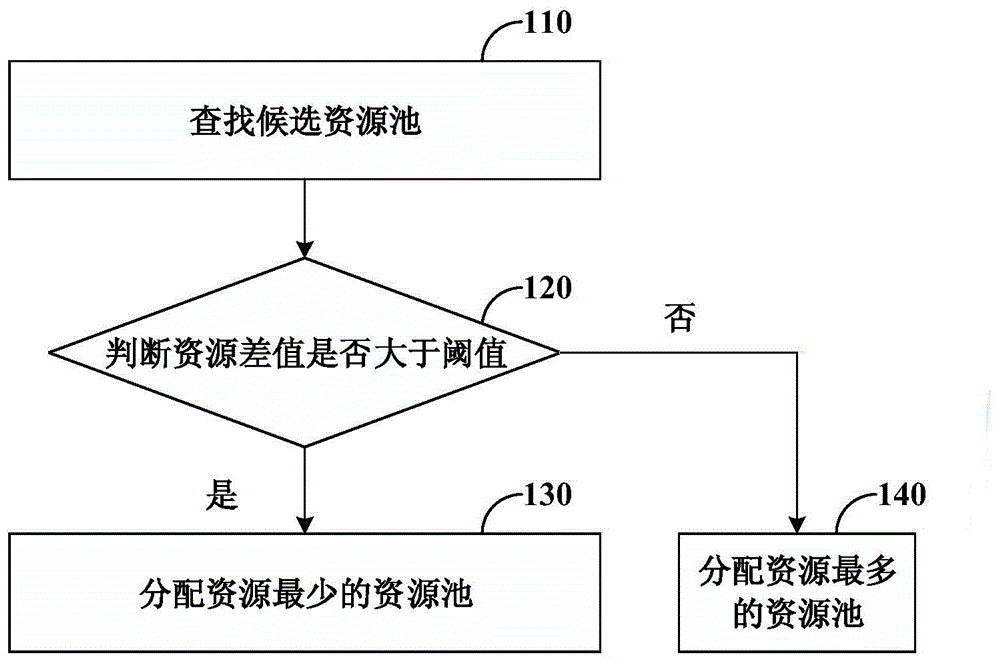
Fig. 1 illustrates a flow diagram of some embodiments of a method of allocation of resources of the present disclosure.
As shown in fig. 1, the method includes: step 110, searching a candidate resource pool; step 120, judging whether the resource difference value is larger than a threshold value; step 130, allocating a resource pool with the least resources; and step 140, allocating the resource pool with the most resources.
In step 110, a resource pool that can meet the business requirements of the user is searched as a candidate resource pool. The business requirements include resource requirements.
In some embodiments, the traffic demand comprises a latency demand. And searching a resource pool capable of meeting the resource requirement and the time delay requirement of the user as a candidate resource pool.
For example, the service demand sent by the user is r (m, l), m is the calculation demand (resource demand), and l is the delay demand. Each resource pool in the network is set as R ═ { R ═ R1,R2,……Ri,……RI}, the ith resource pool can be denoted as Ri(Mi,Li),MiAs an available resource, LiIs a time delay.
Finding out all resource pools capable of meeting business requirements in R as Ri(Mi,Li) I.e. Mi≥m,LiL or less). If the resource pool capable of meeting the service requirement does not exist, the service requirement cannot be met by all the current resource pools, and the searching is finished.
In step 120, it is determined whether there is a candidate resource pool having a difference between the available resource and the resource demand greater than a threshold. In case there is a candidate resource pool greater than the threshold, perform step 130; in the case where there is no candidate resource pool greater than the threshold, step 140 is performed.
In some embodiments, the threshold is determined based on an average of the current resource requirements of each user and the tuning parameter. The adjustment parameter is an integer of 0 or more. For example, the initial value of the adjustment parameter may be set to 1, and the adjustment may be performed according to the variation trend of the user resource demand after each resource allocation.
For example, the average traffic demand m' of each current user can be calculated, looking at all RiWhether or not M is present iniA resource pool of not less than m + k × m'.
In step 130, the available resources in the candidate resource pool with the least available resources in the candidate resource pool are allocated to the user, so as to complete the resource allocation. For example, selecting M amongiAnd finishing the search by the smallest resource pool.
In step 140, the available resources in the candidate resource pool with the most available resources in the candidate resource pool are allocated to the user, so as to complete the resource allocation. Selecting M thereiniAnd finishing the search for the largest resource pool.
In some embodiments, the technical solution of the present invention may be implemented by the embodiment in fig. 2.
Fig. 2 shows a flow diagram of further embodiments of the resource allocation method of the present disclosure.
As shown in fig. 2, compared with the embodiment in fig. 1, the present embodiment further includes: step 210, judging whether equal resource pools exist; and step 220, allocating the resource pool with the highest time delay.
In step 210, it is determined whether there is a candidate resource pool with available resources equal to the resource demand. If there is no equal candidate resource pool, step 120 is executed to determine whether there is a candidate resource pool whose difference between the available resource and the resource requirement is greater than the threshold, so as to complete the resource allocation. In case there are equal candidate resource pools, step 220 is performed.
In step 220, the available resources in the candidate resource pool with the highest time delay in the candidate resource pool are allocated to the user, so as to complete the resource allocation.
For example, look at all RiWhether or not M is present iniM, if any, is selected for allocation to the user. And if a plurality of matched resource pools exist, selecting the resource pool with the highest time delay, and finishing the search.
In some embodiments, after the resource allocation is completed, the adjustment parameters are adjusted according to the variation trend of the historical resource demand of each user, and the adjusted adjustment parameters are used for the next resource allocation. For example, in the case of an increase in historical resource demand, the tuning parameters are increased; in the event of a reduction in historical resource demand, the tuning parameters are reduced.
In some embodiments, the adjustment parameter for the next resource allocation may be determined according to each historical resource requirement and its corresponding historical allocation result.
For example, the adjustment parameters may be adjusted by algorithms such as data fitting, machine learning, and the like. For example, each historical resource demand and its corresponding historical allocation result are used as input, and the machine learning model is used to output the adjustment parameters of the next resource allocation.
Fig. 3 illustrates a flow diagram of further embodiments of the resource allocation method of the present disclosure.
As shown in fig. 3, a resource pool set R in a network, an available resource set M thereof, and a corresponding delay set L are obtained. Receiving the service requirement r (m, l) sent by the user, and calculating the average resource requirement m'.
Judging whether a resource pool (computing pool) R meeting business requirements existsi(Mi,Li),Mi≥m,LiL is less than or equal to l. If M is not presenti≥m,LiAnd if the resource pool is less than or equal to l, adjusting the size of k and feeding back k according to the statistical change trend of the historical resource demand and the corresponding resource distribution result (calculating the matching condition of the power pool), and finishing the search. If M is presenti≥m,LiJudging R in a resource pool less than or equal to liWhether or not M is present iniM resource pool.
If M is presentiSelecting the resource pool of m. And if a plurality of matched resource pools exist, selecting the resource pool with the highest time delay. And adjusting the size of k and feeding back k according to the statistical change trend of the historical resource demand and the corresponding resource distribution result, and finishing the search. If M is not presentiObtaining the k value of the resource allocation (k is a global variable, and the initial value can be 1) of the current resource pool, and then judging RiWhether or not M is present iniA resource pool of not less than m + k × m'.
If M is presentiSelecting resource pool of not less than M + k × MiA minimum pool of resources. And then, according to the statistical change trend of the historical resource demand and the corresponding resource distribution result, adjusting the size of k, feeding back k, and finishing the search.
If M is not presentiSelecting resource pool of not less than M + k × MiThe largest resource pool.And then, according to the statistical change trend of the historical resource demand and the corresponding resource distribution result, adjusting the size of k, feeding back k, and finishing the search.
In the above embodiment, whether the remaining computing power of the resource pool after processing the service with the computing power demand m reaches the average computing power demand estimation value k × m' may be set as a criterion for defining whether one resource pool is a larger resource pool or a smaller resource pool.
When a resource pool with high computational power exists, selecting a relatively small resource pool, and reserving an available resource pool for the probable high computational power service; when the resource pool with larger computing power does not exist, the resource pool with larger computing power is selected, so that a plurality of small resource pools which are difficult to utilize are prevented.
In the above embodiment, the initial value of the parameter k is 1, and the demand change trend is fitted according to the historical calculation force demand. The k value becomes larger as the trend becomes higher and vice versa. Can also be according to MiAnd determining the matching degree of the resource allocation if the degree is larger than k multiplied by m' + m, and reducing the k value if the matching degree is too low.
Therefore, when the computational demand of the service tends to increase, k is increased, the size of the reserved resource is increased, and the service can be better performed for the next service. Therefore, the computational resource pool is prevented from becoming a small resource pool which is extremely difficult to utilize, and fragmentation of the resource pool is better avoided.
Fig. 4 illustrates a block diagram of some embodiments of an apparatus for allocation of resources of the present disclosure.
As shown in fig. 4, the resource allocation apparatus 4 includes a search unit 41, a judgment unit 42, and an allocation unit 43.
The search unit 41 searches a resource pool that can satisfy the business demand of the user as a candidate resource pool. The business requirements include resource requirements.
In some embodiments, the traffic demand comprises a latency demand; the search unit 41 searches a resource pool that can satisfy the resource demand and the delay demand of the user as a candidate resource pool.
The judging unit 42 judges whether there is a candidate resource pool in which the difference between the available resource and the resource demand is larger than a threshold.
In some embodiments, the threshold is determined according to an average of the current resource demand of each user and an adjustment parameter, the adjustment parameter being an integer greater than or equal to 0.
In some embodiments, the dispensing device 4 further comprises: and an adjusting unit 44, configured to adjust the adjustment parameter according to a variation trend of the historical resource demand of each user after the current resource allocation is completed, where the adjusted adjustment parameter is used for next resource allocation.
In some embodiments, the adjustment unit 44 increases the adjustment parameter in case of an increase in the historical resource demand and decreases the adjustment parameter in case of a decrease in the historical resource demand.
The allocating unit 43 allocates, when there is a candidate resource pool greater than the threshold, available resources in the candidate resource pool with the least available resources in the candidate resource pool to the user, so as to complete the resource allocation this time; and under the condition that the candidate resource pool larger than the threshold value does not exist, allocating the available resources in the candidate resource pool with the most available resources in the candidate resource pool to the user so as to complete the resource allocation.
In some embodiments, the determining unit 42 determines whether there is a candidate resource pool with available resources equal to the resource demand before determining whether there is a candidate resource pool with a difference between the available resources and the resource demand greater than a threshold. The allocating unit 43 allocates the available resource in the candidate resource pool with the highest time delay to the user in the case that there are equal candidate resource pools, so as to complete the resource allocation this time; and under the condition that no equal candidate resource pool exists, judging whether a candidate resource pool with the difference value between the available resource and the resource requirement larger than a threshold value exists or not so as to complete the resource allocation.
Fig. 5 shows a block diagram of further embodiments of the apparatus for allocation of resources of the present disclosure.
As shown in fig. 5, the resource allocation apparatus 5 of this embodiment includes: a memory 51 and a processor 52 coupled to the memory 51, the processor 52 being configured to execute the method for allocating resources in any one of the embodiments of the present disclosure based on instructions stored in the memory 51.
The memory 51 may include, for example, a system memory, a fixed nonvolatile storage medium, and the like. The system memory stores, for example, an operating system, an application program, a Boot Loader (Boot Loader), a database, and other programs.
Fig. 6 shows a block diagram of further embodiments of an apparatus for allocation of resources of the present disclosure.
As shown in fig. 6, the resource allocation apparatus 6 of this embodiment includes: a memory 610 and a processor 620 coupled to the memory 610, the processor 620 being configured to perform the method for allocating resources in any of the foregoing embodiments based on instructions stored in the memory 610.
The memory 610 may include, for example, system memory, fixed non-volatile storage media, and the like. The system memory stores, for example, an operating system, an application program, a Boot Loader (Boot Loader), and other programs.
The resource allocation means 6 may further comprise an input output interface 630, a network interface 640, a storage interface 650, etc. These interfaces 630, 640, 650 and the connections between the memory 610 and the processor 620 may be through a bus 660, for example. The input/output interface 630 provides a connection interface for input/output devices such as a display, a mouse, a keyboard, and a touch screen. The network interface 640 provides a connection interface for various networking devices. The storage interface 650 provides a connection interface for external storage devices such as an SD card and a usb disk.
As will be appreciated by one skilled in the art, embodiments of the present disclosure may be provided as a method, system, or computer program product. Accordingly, the present disclosure may take the form of an entirely hardware embodiment, an entirely software embodiment or an embodiment combining software and hardware aspects. Furthermore, the present disclosure may take the form of a computer program product embodied on one or more computer-usable non-transitory storage media (including, but not limited to, disk storage, CD-ROM, optical storage, and the like) having computer-usable program code embodied therein.
So far, the resource allocation method, the resource allocation apparatus, and the non-volatile computer-readable storage medium according to the present disclosure have been described in detail. Some details that are well known in the art have not been described in order to avoid obscuring the concepts of the present disclosure. It will be fully apparent to those skilled in the art from the foregoing description how to practice the presently disclosed embodiments.
The method and system of the present disclosure may be implemented in a number of ways. For example, the methods and systems of the present disclosure may be implemented by software, hardware, firmware, or any combination of software, hardware, and firmware. The above-described order for the steps of the method is for illustration only, and the steps of the method of the present disclosure are not limited to the order specifically described above unless specifically stated otherwise. Further, in some embodiments, the present disclosure may also be embodied as programs recorded in a recording medium, the programs including machine-readable instructions for implementing the methods according to the present disclosure. Thus, the present disclosure also covers a recording medium storing a program for executing the method according to the present disclosure.
Although some specific embodiments of the present disclosure have been described in detail by way of example, it should be understood by those skilled in the art that the foregoing examples are for purposes of illustration only and are not intended to limit the scope of the present disclosure. It will be appreciated by those skilled in the art that modifications may be made to the above embodiments without departing from the scope and spirit of the present disclosure. The scope of the present disclosure is defined by the appended claims.