Disclosure of Invention
The invention provides an analysis system, a method, equipment and a storage medium for detecting the performance of a TEC module, and solves the technical problems that the existing method for detecting the performance of the TEC module is high in cost, low in efficiency and difficult to locate the microcrack phenomenon.
In order to solve the technical problems, the invention provides an analysis system, method, equipment and storage medium for detecting the performance of a TEC module.
In a first aspect, the present invention provides an analysis system for detecting TEC module performance, where the system includes: the system comprises a semiconductor refrigerator, an infrared optical lens, an infrared detector, an image processor and a display module;
the infrared optical lens is arranged between the semiconductor refrigerator and the infrared detector and is used for filtering infrared radiation emitted by the surface of the semiconductor refrigerator to obtain an infrared optical signal;
the infrared detector is used for processing the infrared optical signal to obtain a dot matrix thermal imaging graph and obtaining a digital image signal according to the dot matrix thermal imaging graph;
the image processor is connected with the infrared detector and is used for processing the received digital image signal to obtain a thermal imaging signal;
the display module is connected with the image processor and used for displaying real-time surface imaging of the semiconductor refrigerator according to the thermal imaging signal and comparing the real-time surface imaging with preset standard surface imaging to obtain a semiconductor abnormal area.
In a further embodiment, the image processor comprises a signal amplification unit and a signal calculation unit;
the signal amplification unit is used for amplifying the received digital image signal to obtain an amplified signal;
and the signal calculation unit is used for obtaining thermal imaging signals with different color distributions according to the amplified signals.
In further embodiments, a first power module and a second power module are also included;
the first power supply module is used for providing a first voltage for the semiconductor refrigerator;
the second power supply module is used for providing a second voltage for the infrared detector, the image processor and the display module.
In a further embodiment, the infrared optical lens is an auto-zoom infrared optical lens.
In a further embodiment, the infrared detector is an uncooled focal plane infrared detector.
In a second aspect, the invention provides an analysis method for detecting the performance of a TEC module, the method comprising the following steps:
filtering infrared radiation emitted by the surface of the semiconductor refrigerator through an infrared optical lens to obtain an infrared optical signal;
processing the infrared optical signal through the infrared detector to obtain a dot matrix thermal imaging graph, and obtaining a digital image signal according to the dot matrix thermal imaging graph;
processing the received digital image signal by the image processor to obtain a thermal imaging signal;
and displaying real-time surface imaging of the semiconductor refrigerator through a display module according to the thermal imaging signal, and comparing the real-time surface imaging with preset standard surface imaging to obtain a semiconductor abnormal area.
In a further embodiment, the step of processing the received digital image signal by the image processor to obtain a thermal imaging signal comprises:
amplifying the received digital image signal to obtain an amplified signal;
and obtaining thermal imaging signals with different color distributions according to the amplified signals.
In a third aspect, the present invention further provides a computer device, including a processor and a memory, where the processor is connected to the memory, the memory is used for storing a computer program, and the processor is used for executing the computer program stored in the memory, so that the computer device executes the steps for implementing the method.
In a fourth aspect, the present invention also provides a computer-readable storage medium having stored thereon a computer program which, when executed by a processor, performs the steps of the above method.
The invention provides a system, a method, equipment and a storage medium for detecting TEC module performance analysis, wherein the system scans the surface of TEC by an infrared focal plane array detector principle to judge the abnormal area of the TEC to be detected by obtaining the temperature difference value of the surface of the TEC to be detected, the detection process time is short, the efficiency is high, the system provided by the embodiment can realize detection automation, the infrared detector and the like are utilized to realize rapid detection and positioning of the abnormal area, the workload of manual intervention is small, and the labor cost is reduced.
Detailed Description
The embodiments of the present invention will be described in detail below with reference to the accompanying drawings, which are given solely for the purpose of illustration and are not to be construed as limitations of the invention, including the drawings which are incorporated herein by reference and for illustration only and are not to be construed as limitations of the invention, since many variations thereof are possible without departing from the spirit and scope of the invention.
Referring to fig. 1, fig. 1 is a system for analyzing the performance of a TEC module according to an embodiment of the present invention, where the system includes: the device comprises a semiconductor refrigerator (TEC)1, an infrared optical lens 2, an infrared detector 3, an image processor 4, a display module 5 and a first power module 6 connected with the semiconductor refrigerator 1.
In one embodiment, as shown in fig. 2, the semiconductor refrigerator 1 includes an upper ceramic substrate 11, a lower ceramic substrate 12, a metal block 13, N-type and P-type semiconductors 14, and electrodes 15.
In this embodiment, when the first power module 6 is electrically connected to the semiconductor refrigerator 1 while supplying the first voltage to the semiconductor refrigerator 1, the energy of the semiconductor refrigerator 1 generated by the peltier effect is thermally conducted to the ceramic substrate through the metal block 13, such as: when the N-type and P-type semiconductors are abnormal, the temperature difference occurs locally on the surface of the ceramic substrate, and the heat radiated outwards in the abnormal area and the non-abnormal area is also different; wherein, the embodiment preferentially sets the first voltage to 12V; it should be noted that, in this embodiment, a person skilled in the art may replace the semiconductor cooler (TEC) with another semiconductor according to the specific implementation, for example: and (3) performing fault location analysis on COG (chip on glass) packaging (the abbreviation of chip on glass is that a chip is directly bound on glass) and LED dot matrix.
In one embodiment, the infrared optical lens 2 is disposed between the semiconductor refrigerator 1 and the infrared detector 3, and the infrared optical lens 2 obtains infrared radiation emitted from the surface of the semiconductor refrigerator 1 and filters stray light in other bands in the infrared radiation to obtain an infrared optical signal; in this embodiment, the infrared radiation light within the set wavelength range can be transmitted to the infrared detector 3 through the infrared optical lens, and in this embodiment, the set wavelength range is preferably set to be 8um to 12um, and those skilled in the art can adjust this wavelength range according to the specific implementation situation.
In one embodiment, the infrared optical lens 2 is an auto-zoom infrared optical lens to realize auto-zoom intelligent detection.
In one embodiment, the infrared detector 3 converts the infrared optical signal into a digital image signal; in this embodiment, the infrared detector 3 is an uncooled focal plane infrared detector.
In one embodiment, the infrared detector 3 processes the received infrared optical signal, forms a dot matrix thermal image of the temperature of the surface of the semiconductor refrigerator, and converts the dot matrix thermal image into a digital image signal.
In one embodiment, the image processor 4 is connected to the infrared detector 3, and processes the received digital image signal to obtain a thermal imaging signal.
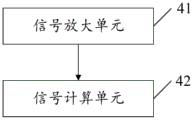
In one embodiment, as shown in fig. 3, the image processor 4 includes a signal amplifying unit 41 and a signal calculating unit 42; the signal amplifying unit 41 is configured to amplify the received digital image signal to obtain an amplified signal; the signal calculation unit 42 is configured to obtain thermal imaging signals with different color distributions according to the amplified signal; in this embodiment, the signal calculating unit is configured to convert the detected radiation energy of the semiconductor refrigerator into thermal imaging signals with different colors according to the detected radiation energy of the semiconductor refrigerator, where the thermal imaging signals include thermal imaging video or picture signals.
In one embodiment, the display module 5 is connected to the image processor 4, and is configured to display a real-time surface image of the surface of the semiconductor refrigerator according to the thermal imaging signal, and compare the real-time surface image with a preset standard surface image to obtain an abnormal region of the semiconductor.
In this embodiment, the standard surface imaging acquisition process includes:
firstly, in unit time, the embodiment screens out the standard semiconductor cooler TEC by detecting temperature or current; and then, detecting the surface temperature of the standard TEC by using an infrared detector, an image processor and a display module to obtain a standard surface image.
In this embodiment, a TEC to be tested having the same model as a standard TEC is detected in unit time to obtain a real-time surface image, the real-time surface image is compared with the standard surface image, a difference between the real-time surface image and the standard surface image of the TEC to be tested is determined, and if the real-time surface image and the standard surface image of the abnormal TEC surface have a difference, an abnormal area of the TEC is quickly located.
The present embodiment detects a semiconductor abnormal region by comparing the difference between real-time surface imaging and standard surface imaging; in the present embodiment, since the amount of heat radiated outward from the semiconductor abnormal region differs, the gray scale or pseudo color of the semiconductor abnormal region differs from that of other non-abnormal regions in the resulting real-time surface image.
In one embodiment, the present embodiment also enables intelligent detection, automatically comparing the difference between real-time surface imaging and standard surface imaging, and thereby locking out semiconductor anomaly regions.
In an embodiment, the system further includes the second power module 7 connected to the infrared detector, the image processor, and the display module, in this embodiment, the second power module 7 provides a second voltage for the infrared detector, the image processor, and the display module, and in this embodiment, the second voltage is preferably set to 5V.
According to the embodiment of the invention, the principle that the focal plane point array infrared detector is sensitive to heat radiation is utilized to obtain the surface temperature distribution of the measured object, so that a thermal imaging signal is obtained, and a detection method is provided for faults occurring in TEC packaging test.
In one embodiment, as shown in fig. 4, there is provided a method for testing TEC module performance analysis, the method comprising:
s1, filtering infrared radiation emitted by the surface of a semiconductor refrigerator through an infrared optical lens to obtain an infrared optical signal;
s2, processing the infrared optical signal through the infrared detector to obtain a dot matrix thermal imaging graph, and obtaining a digital image signal according to the dot matrix thermal imaging graph;
s3, processing the received digital image signal through the image processor to obtain a thermal imaging signal;
and S4, displaying real-time surface imaging of the semiconductor refrigerator through a display module according to the thermal imaging signal, and comparing the real-time surface imaging with preset standard surface imaging to obtain an abnormal region of the semiconductor.
In one embodiment, the step of processing the received digital image signal by the image processor to obtain a thermal imaging signal comprises:
amplifying the received digital image signal to obtain an amplified signal;
and obtaining thermal imaging signals with different color distributions according to the amplified signals.
It should be noted that, the sequence numbers of the above-mentioned processes do not mean the execution sequence, and the execution sequence of each process should be determined by the function and the inherent logic of the process, and should not constitute any limitation to the implementation process of the embodiment of the present application.
For specific limitations of a method for analyzing the performance of a semiconductor cooler, reference is made to the above limitations of a system for analyzing the performance of a semiconductor cooler, and further description is omitted here. Those of ordinary skill in the art will appreciate that the various modules and steps described in connection with the embodiments disclosed herein may be implemented as hardware, software, or combinations of both. Whether such functionality is implemented as hardware or software depends upon the particular application and design constraints imposed on the implementation. Skilled artisans may implement the described functionality in varying ways for each particular application, but such implementation decisions should not be interpreted as causing a departure from the scope of the present application.
Because the N-type and P-type semiconductors in the TEC packaging industry are very similar in shape and size in production, when a material mixing phenomenon occurs, an abnormal area cannot be detected by adopting X-RAY equipment, and the abnormal area cannot be judged by detecting the current.
FIG. 5 is a computer device including a memory, a processor, and a transceiver connected via a bus according to an embodiment of the present invention; the memory is used to store a set of computer program instructions and data and may transmit the stored data to the processor, which may execute the program instructions stored by the memory to perform the steps of the above-described method.
Wherein the memory may comprise volatile memory or nonvolatile memory, or may comprise both volatile and nonvolatile memory; the processor may be a central processing unit, a microprocessor, an application specific integrated circuit, a programmable logic device, or a combination thereof. By way of example, and not limitation, the programmable logic devices described above may be complex programmable logic devices, field programmable gate arrays, general array logic, or any combination thereof.
In addition, the memory may be a physically separate unit or may be integrated with the processor.
It will be appreciated by those of ordinary skill in the art that the architecture shown in fig. 5 is a block diagram of only a portion of the architecture associated with the present solution and is not intended to limit the computing devices to which the present solution may be applied, and that a particular computing device may include more or less components than those shown, or may combine certain components, or have the same arrangement of components.
In an embodiment, a computer-readable storage medium is provided, on which a computer program is stored, which computer program, when being executed by a processor, carries out the steps of the above-mentioned method.
According to the performance analysis system and method for detecting the semiconductor cooler, provided by the embodiment of the invention, the quality of the TEC to be detected is judged by obtaining the temperature difference value of the surface of the TEC to be detected, the detection process time is short, the efficiency is high, the method provided by the embodiment can realize detection automation, the manual intervention workload is small, the detection efficiency is improved, other expensive equipment is not needed, and the labor cost is reduced.
In the above embodiments, the implementation may be wholly or partially realized by software, hardware, firmware, or any combination thereof. When implemented in software, may be implemented in whole or in part in the form of a computer program product. The computer program product includes one or more computer instructions. When loaded and executed on a computer, cause the processes or functions described in accordance with the embodiments of the invention to occur, in whole or in part. The computer may be a general purpose computer, a special purpose computer, a network of computers, or other programmable device. The computer instructions may be stored in, or transmitted from one computer-readable storage medium to another computer-readable storage medium, the computer readable storage medium may be any available medium that can be accessed by a computer or a data storage device including one or more available media, such as a magnetic medium (e.g., floppy disks, hard disks, magnetic tapes), an optical medium (e.g., DVDs), or a semiconductor medium (e.g., SSDs), etc.
Those skilled in the art will appreciate that all or part of the processes of the methods of the embodiments described above can be implemented by a computer program, which can be stored in a computer-readable storage medium, and the computer program can include the processes of the embodiments of the methods described above when executed.
The above-mentioned embodiments only express some preferred embodiments of the present application, and the description thereof is more specific and detailed, but not construed as limiting the scope of the invention. It should be noted that, for those skilled in the art, various modifications and substitutions can be made without departing from the technical principle of the present invention, and these should be construed as the protection scope of the present application. Therefore, the protection scope of the present patent shall be subject to the protection scope of the claims.