CN113683589A - Extraction method and application of pueraria isoflavone - Google Patents
Extraction method and application of pueraria isoflavone Download PDFInfo
- Publication number
- CN113683589A CN113683589A CN202111037071.5A CN202111037071A CN113683589A CN 113683589 A CN113683589 A CN 113683589A CN 202111037071 A CN202111037071 A CN 202111037071A CN 113683589 A CN113683589 A CN 113683589A
- Authority
- CN
- China
- Prior art keywords
- isoflavone
- pueraria
- choline chloride
- radix puerariae
- ethylene glycol
- Prior art date
- Legal status (The legal status is an assumption and is not a legal conclusion. Google has not performed a legal analysis and makes no representation as to the accuracy of the status listed.)
- Pending
Links
- GOMNOOKGLZYEJT-UHFFFAOYSA-N isoflavone Chemical compound C=1OC2=CC=CC=C2C(=O)C=1C1=CC=CC=C1 GOMNOOKGLZYEJT-UHFFFAOYSA-N 0.000 title claims abstract description 76
- CJWQYWQDLBZGPD-UHFFFAOYSA-N isoflavone Natural products C1=C(OC)C(OC)=CC(OC)=C1C1=COC2=C(C=CC(C)(C)O3)C3=C(OC)C=C2C1=O CJWQYWQDLBZGPD-UHFFFAOYSA-N 0.000 title claims abstract description 76
- 235000008696 isoflavones Nutrition 0.000 title claims abstract description 76
- 241000219780 Pueraria Species 0.000 title claims abstract description 32
- 238000000605 extraction Methods 0.000 title claims description 28
- LYCAIKOWRPUZTN-UHFFFAOYSA-N Ethylene glycol Chemical compound OCCO LYCAIKOWRPUZTN-UHFFFAOYSA-N 0.000 claims abstract description 60
- XLYOFNOQVPJJNP-UHFFFAOYSA-N water Substances O XLYOFNOQVPJJNP-UHFFFAOYSA-N 0.000 claims abstract description 35
- 239000001763 2-hydroxyethyl(trimethyl)azanium Substances 0.000 claims abstract description 28
- 235000019743 Choline chloride Nutrition 0.000 claims abstract description 28
- 229960003178 choline chloride Drugs 0.000 claims abstract description 28
- SGMZJAMFUVOLNK-UHFFFAOYSA-M choline chloride Chemical compound [Cl-].C[N+](C)(C)CCO SGMZJAMFUVOLNK-UHFFFAOYSA-M 0.000 claims abstract description 28
- 238000000034 method Methods 0.000 claims abstract description 20
- 238000001291 vacuum drying Methods 0.000 claims abstract description 16
- 230000005496 eutectics Effects 0.000 claims abstract description 11
- 239000002904 solvent Substances 0.000 claims abstract description 5
- 238000002360 preparation method Methods 0.000 claims abstract description 3
- 239000000287 crude extract Substances 0.000 claims description 36
- LFQSCWFLJHTTHZ-UHFFFAOYSA-N Ethanol Chemical compound CCO LFQSCWFLJHTTHZ-UHFFFAOYSA-N 0.000 claims description 32
- 239000000243 solution Substances 0.000 claims description 32
- 238000001035 drying Methods 0.000 claims description 26
- 238000001914 filtration Methods 0.000 claims description 22
- 239000000843 powder Substances 0.000 claims description 20
- 235000010575 Pueraria lobata Nutrition 0.000 claims description 19
- 241000219781 Pueraria montana var. lobata Species 0.000 claims description 19
- 238000001816 cooling Methods 0.000 claims description 16
- 238000010438 heat treatment Methods 0.000 claims description 14
- 238000003756 stirring Methods 0.000 claims description 10
- 239000007788 liquid Substances 0.000 claims description 9
- AXCZMVOFGPJBDE-UHFFFAOYSA-L calcium dihydroxide Chemical compound [OH-].[OH-].[Ca+2] AXCZMVOFGPJBDE-UHFFFAOYSA-L 0.000 claims description 8
- 239000012153 distilled water Substances 0.000 claims description 8
- 239000002244 precipitate Substances 0.000 claims description 8
- 238000000746 purification Methods 0.000 claims description 8
- 238000005303 weighing Methods 0.000 claims description 8
- 238000002156 mixing Methods 0.000 claims description 7
- -1 hydroxyl free radical Chemical class 0.000 claims description 6
- 238000000926 separation method Methods 0.000 claims description 6
- 238000011068 loading method Methods 0.000 claims description 5
- 239000011347 resin Substances 0.000 claims description 4
- 229920005989 resin Polymers 0.000 claims description 4
- 239000007864 aqueous solution Substances 0.000 claims description 2
- OHDRQQURAXLVGJ-HLVWOLMTSA-N azane;(2e)-3-ethyl-2-[(e)-(3-ethyl-6-sulfo-1,3-benzothiazol-2-ylidene)hydrazinylidene]-1,3-benzothiazole-6-sulfonic acid Chemical compound [NH4+].[NH4+].S/1C2=CC(S([O-])(=O)=O)=CC=C2N(CC)C\1=N/N=C1/SC2=CC(S([O-])(=O)=O)=CC=C2N1CC OHDRQQURAXLVGJ-HLVWOLMTSA-N 0.000 claims description 2
- 238000004587 chromatography analysis Methods 0.000 claims description 2
- HHEAADYXPMHMCT-UHFFFAOYSA-N dpph Chemical compound [O-][N+](=O)C1=CC([N+](=O)[O-])=CC([N+]([O-])=O)=C1[N]N(C=1C=CC=CC=1)C1=CC=CC=C1 HHEAADYXPMHMCT-UHFFFAOYSA-N 0.000 claims description 2
- 239000000945 filler Substances 0.000 claims description 2
- 238000004108 freeze drying Methods 0.000 claims description 2
- 238000000703 high-speed centrifugation Methods 0.000 claims description 2
- 239000002994 raw material Substances 0.000 claims description 2
- 238000002390 rotary evaporation Methods 0.000 claims description 2
- 238000012856 packing Methods 0.000 claims 1
- 239000000203 mixture Substances 0.000 abstract description 20
- 238000005406 washing Methods 0.000 description 12
- JMGZEFIQIZZSBH-UHFFFAOYSA-N Bioquercetin Natural products CC1OC(OCC(O)C2OC(OC3=C(Oc4cc(O)cc(O)c4C3=O)c5ccc(O)c(O)c5)C(O)C2O)C(O)C(O)C1O JMGZEFIQIZZSBH-UHFFFAOYSA-N 0.000 description 9
- IVTMALDHFAHOGL-UHFFFAOYSA-N eriodictyol 7-O-rutinoside Natural products OC1C(O)C(O)C(C)OC1OCC1C(O)C(O)C(O)C(OC=2C=C3C(C(C(O)=C(O3)C=3C=C(O)C(O)=CC=3)=O)=C(O)C=2)O1 IVTMALDHFAHOGL-UHFFFAOYSA-N 0.000 description 9
- FDRQPMVGJOQVTL-UHFFFAOYSA-N quercetin rutinoside Natural products OC1C(O)C(O)C(CO)OC1OCC1C(O)C(O)C(O)C(OC=2C(C3=C(O)C=C(O)C=C3OC=2C=2C=C(O)C(O)=CC=2)=O)O1 FDRQPMVGJOQVTL-UHFFFAOYSA-N 0.000 description 9
- IKGXIBQEEMLURG-BKUODXTLSA-N rutin Chemical compound O[C@H]1[C@H](O)[C@@H](O)[C@H](C)O[C@@H]1OC[C@H]1[C@H](O)[C@@H](O)[C@H](O)[C@@H](OC=2C(C3=C(O)C=C(O)C=C3OC=2C=2C=C(O)C(O)=CC=2)=O)O1 IKGXIBQEEMLURG-BKUODXTLSA-N 0.000 description 9
- ALABRVAAKCSLSC-UHFFFAOYSA-N rutin Natural products CC1OC(OCC2OC(O)C(O)C(O)C2O)C(O)C(O)C1OC3=C(Oc4cc(O)cc(O)c4C3=O)c5ccc(O)c(O)c5 ALABRVAAKCSLSC-UHFFFAOYSA-N 0.000 description 9
- 235000005493 rutin Nutrition 0.000 description 9
- 229960004555 rutoside Drugs 0.000 description 9
- FAPWRFPIFSIZLT-UHFFFAOYSA-M Sodium chloride Chemical compound [Na+].[Cl-] FAPWRFPIFSIZLT-UHFFFAOYSA-M 0.000 description 7
- 239000011780 sodium chloride Substances 0.000 description 7
- VEXZGXHMUGYJMC-UHFFFAOYSA-N Hydrochloric acid Chemical compound Cl VEXZGXHMUGYJMC-UHFFFAOYSA-N 0.000 description 6
- 239000013078 crystal Substances 0.000 description 6
- 239000008367 deionised water Substances 0.000 description 6
- 229910021641 deionized water Inorganic materials 0.000 description 6
- 239000003814 drug Substances 0.000 description 6
- 238000010828 elution Methods 0.000 description 6
- 238000011049 filling Methods 0.000 description 6
- 239000000706 filtrate Substances 0.000 description 6
- 238000000227 grinding Methods 0.000 description 6
- 239000012535 impurity Substances 0.000 description 6
- 239000012528 membrane Substances 0.000 description 6
- 239000002245 particle Substances 0.000 description 6
- 238000007789 sealing Methods 0.000 description 6
- 238000007873 sieving Methods 0.000 description 6
- 239000007787 solid Substances 0.000 description 6
- 238000002604 ultrasonography Methods 0.000 description 6
- 229930003935 flavonoid Natural products 0.000 description 5
- 235000017173 flavonoids Nutrition 0.000 description 5
- 241000196324 Embryophyta Species 0.000 description 3
- 239000003480 eluent Substances 0.000 description 3
- 230000003647 oxidation Effects 0.000 description 3
- 238000007254 oxidation reaction Methods 0.000 description 3
- 210000002421 cell wall Anatomy 0.000 description 2
- 238000004090 dissolution Methods 0.000 description 2
- 238000005516 engineering process Methods 0.000 description 2
- 229910052739 hydrogen Inorganic materials 0.000 description 2
- 239000001257 hydrogen Substances 0.000 description 2
- ZQSIJRDFPHDXIC-UHFFFAOYSA-N Daidzein Natural products C1=CC(O)=CC=C1C1=COC2=CC(O)=CC=C2C1=O ZQSIJRDFPHDXIC-UHFFFAOYSA-N 0.000 description 1
- GMTUGPYJRUMVTC-UHFFFAOYSA-N Daidzin Natural products OC(COc1ccc2C(=O)C(=COc2c1)c3ccc(O)cc3)C(O)C(O)C(O)C=O GMTUGPYJRUMVTC-UHFFFAOYSA-N 0.000 description 1
- KYQZWONCHDNPDP-UHFFFAOYSA-N Daidzoside Natural products OC1C(O)C(O)C(CO)OC1OC1=CC=C2C(=O)C(C=3C=CC(O)=CC=3)=COC2=C1 KYQZWONCHDNPDP-UHFFFAOYSA-N 0.000 description 1
- 241000220485 Fabaceae Species 0.000 description 1
- RXUWDKBZZLIASQ-UHFFFAOYSA-N Puerarin Natural products OCC1OC(Oc2c(O)cc(O)c3C(=O)C(=COc23)c4ccc(O)cc4)C(O)C(O)C1O RXUWDKBZZLIASQ-UHFFFAOYSA-N 0.000 description 1
- 229920002472 Starch Polymers 0.000 description 1
- KYQZWONCHDNPDP-QNDFHXLGSA-N daidzein 7-O-beta-D-glucoside Chemical compound O[C@@H]1[C@@H](O)[C@H](O)[C@@H](CO)O[C@H]1OC1=CC=C2C(=O)C(C=3C=CC(O)=CC=3)=COC2=C1 KYQZWONCHDNPDP-QNDFHXLGSA-N 0.000 description 1
- 150000002215 flavonoids Chemical class 0.000 description 1
- HVQAJTFOCKOKIN-UHFFFAOYSA-N flavonol Natural products O1C2=CC=CC=C2C(=O)C(O)=C1C1=CC=CC=C1 HVQAJTFOCKOKIN-UHFFFAOYSA-N 0.000 description 1
- 150000007946 flavonol Chemical class 0.000 description 1
- 235000011957 flavonols Nutrition 0.000 description 1
- 235000013305 food Nutrition 0.000 description 1
- 239000000463 material Substances 0.000 description 1
- HKEAFJYKMMKDOR-VPRICQMDSA-N puerarin Chemical compound O[C@@H]1[C@@H](O)[C@H](O)[C@@H](CO)O[C@H]1C1=C(O)C=CC(C2=O)=C1OC=C2C1=CC=C(O)C=C1 HKEAFJYKMMKDOR-VPRICQMDSA-N 0.000 description 1
- 235000019698 starch Nutrition 0.000 description 1
- 239000008107 starch Substances 0.000 description 1
- 239000000126 substance Substances 0.000 description 1
Classifications
-
- C—CHEMISTRY; METALLURGY
- C07—ORGANIC CHEMISTRY
- C07D—HETEROCYCLIC COMPOUNDS
- C07D311/00—Heterocyclic compounds containing six-membered rings having one oxygen atom as the only hetero atom, condensed with other rings
- C07D311/02—Heterocyclic compounds containing six-membered rings having one oxygen atom as the only hetero atom, condensed with other rings ortho- or peri-condensed with carbocyclic rings or ring systems
- C07D311/04—Benzo[b]pyrans, not hydrogenated in the carbocyclic ring
- C07D311/22—Benzo[b]pyrans, not hydrogenated in the carbocyclic ring with oxygen or sulfur atoms directly attached in position 4
- C07D311/26—Benzo[b]pyrans, not hydrogenated in the carbocyclic ring with oxygen or sulfur atoms directly attached in position 4 with aromatic rings attached in position 2 or 3
- C07D311/34—Benzo[b]pyrans, not hydrogenated in the carbocyclic ring with oxygen or sulfur atoms directly attached in position 4 with aromatic rings attached in position 2 or 3 with aromatic rings attached in position 3 only
- C07D311/36—Benzo[b]pyrans, not hydrogenated in the carbocyclic ring with oxygen or sulfur atoms directly attached in position 4 with aromatic rings attached in position 2 or 3 with aromatic rings attached in position 3 only not hydrogenated in the hetero ring, e.g. isoflavones
-
- A—HUMAN NECESSITIES
- A61—MEDICAL OR VETERINARY SCIENCE; HYGIENE
- A61P—SPECIFIC THERAPEUTIC ACTIVITY OF CHEMICAL COMPOUNDS OR MEDICINAL PREPARATIONS
- A61P39/00—General protective or antinoxious agents
- A61P39/06—Free radical scavengers or antioxidants
-
- C—CHEMISTRY; METALLURGY
- C07—ORGANIC CHEMISTRY
- C07D—HETEROCYCLIC COMPOUNDS
- C07D311/00—Heterocyclic compounds containing six-membered rings having one oxygen atom as the only hetero atom, condensed with other rings
- C07D311/02—Heterocyclic compounds containing six-membered rings having one oxygen atom as the only hetero atom, condensed with other rings ortho- or peri-condensed with carbocyclic rings or ring systems
- C07D311/04—Benzo[b]pyrans, not hydrogenated in the carbocyclic ring
- C07D311/22—Benzo[b]pyrans, not hydrogenated in the carbocyclic ring with oxygen or sulfur atoms directly attached in position 4
- C07D311/26—Benzo[b]pyrans, not hydrogenated in the carbocyclic ring with oxygen or sulfur atoms directly attached in position 4 with aromatic rings attached in position 2 or 3
- C07D311/40—Separation, e.g. from natural material; Purification
Landscapes
- Chemical & Material Sciences (AREA)
- Organic Chemistry (AREA)
- Health & Medical Sciences (AREA)
- Life Sciences & Earth Sciences (AREA)
- Nuclear Medicine, Radiotherapy & Molecular Imaging (AREA)
- Chemical Kinetics & Catalysis (AREA)
- General Chemical & Material Sciences (AREA)
- Medicinal Chemistry (AREA)
- Toxicology (AREA)
- Biochemistry (AREA)
- Pharmacology & Pharmacy (AREA)
- Animal Behavior & Ethology (AREA)
- General Health & Medical Sciences (AREA)
- Public Health (AREA)
- Veterinary Medicine (AREA)
- Saccharide Compounds (AREA)
- Pharmaceuticals Containing Other Organic And Inorganic Compounds (AREA)
Abstract
The invention provides a method for extracting pueraria isoflavone and application thereof: the method comprises the following specific steps: preparation of choline chloride/ethylene glycol: 139.6g of choline chloride and 111.5-223.0mL of ethylene glycol are mixed (namely the molar ratio is controlled to be 1: 2-4), the mixture is magnetically stirred in a water bath kettle at 80 ℃ for 2-3 hours until the mixture becomes transparent solution, then the transparent solution is dried in a vacuum drying oven at 60 ℃ for 36 hours, and the deep eutectic solvent choline chloride/ethylene glycol is obtained and stored in a dryer for later use.
Description
Technical Field
The invention relates to the technical field, in particular to a method for extracting pueraria isoflavone and application thereof, belonging to the field of food processing.
Background
The root of kudzu vine is root tuber of Pueraria plant of Leguminosae, and is originally recorded in Shen nong's herbal Jing of Han Dynasty of China; the kudzu root is rich in starch and flavonoid substances (namely daidzin, pueraria flavonol and puerarin), and has high edible value and medical health care value; the department of health of China in 1988 publishes that the pueraria lobata is a plant which is both edible and medicinal, the growing area of the pueraria lobata is fast in recent years, but the processing and utilization of the pueraria lobata are still in the primary stage, the processing technology of the pueraria lobata in the prior art emphasizes on the extraction of the pueraria lobata powder or emphasizes on the extraction of the pueraria lobata total isoflavone, the technology capable of simultaneously extracting the pueraria lobata powder and the pueraria lobata total isoflavone is lacked, and the extraction rate of the pueraria lobata isoflavone is low.
Summary of the invention
In the method, the deep eutectic solvent choline chloride/ethylene glycol is utilized to have the characteristics of dissolving and destroying the plant cell wall, forming a hydrogen bond with the flavonoid compound to promote the dissolution of the flavonoid compound and the like, and the auxiliary ultrasonic crushing greatly improves the extraction rate of the pueraria isoflavone and has oxidation resistance.
The invention can achieve the purpose by the following scheme, including the following steps, but not limited to:
(1) preparation of choline chloride/ethylene glycol: mixing 139.6g of choline chloride with 111.5-223.0mL of ethylene glycol (i.e. the molar ratio is controlled at 1: 2-4), magnetically stirring for 2-3h in a water bath kettle at 80 ℃ until the choline chloride becomes a transparent solution, then drying for 36h in a vacuum drying oven at 60 ℃ to obtain a deep eutectic solvent of choline chloride/ethylene glycol, and storing in a dryer for later use;
(2) preparing 10-40% choline chloride/ethylene glycol aqueous solution with distilled water, adding into 60 mesh radix Puerariae powder, stirring, extracting under ultrasonic wave-assisted heating to obtain radix Puerariae isoflavone crude extract, and separating and purifying to obtain radix Puerariae isoflavone;
(3) the feed-liquid ratio of the kudzu root powder to the choline chloride/ethylene glycol is 1: 10-25;
(4) in the extraction process, the power of ultrasonic wave is 300-600W, the temperature is 60-80 ℃, and the extraction time is 30-90 min;
(5) after extraction, removing pueraria residue by a high-speed centrifugation mode to obtain a crude extract, wherein the content of pueraria isoflavone in the crude extract is 1.19-1.54mg/mL, and the extraction rate is 3.58-4.62%;
(6) the separation and purification uses AB-8 type macroporous resin as a filler, and the purification is realized through the separation and purification of a chromatographic column. The separation and purification process comprises the following steps: loading the crude extract into a column by a wet method, eluting the crude extract by an ethanol solution, collecting the eluent, concentrating the eluent by rotary evaporation, adjusting the pH, cooling to separate out a precipitate, filtering to obtain a crude pueraria isoflavone precipitate, dissolving the precipitate by lime water, adjusting the pH, cooling to separate out the precipitate, filtering, and freeze-drying to obtain refined pueraria isoflavone;
(7) loading AB-8 resin into a chromatography column (15mm x 500mm) by a wet method, wherein the volume of the column is 50 mL;
(8) the sample volume of the crude extract is 15 mL;
(9) collecting the eluent with 70% ethanol concentration;
(10) adjusting the pH of the concentrated eluate and the redissolved solution to pH3.0 with saline;
(11) weighing the pueraria isoflavone powder with the extraction rate of 21.48-27.23mg/g (calculated according to the pueraria raw material);
(12) and (3) determining the hydroxyl free radical clearance rate, DPPH clearance rate and ABTS clearance rate of the pueraria isoflavone.
Advantageous effects
According to the method, the choline chloride/ethylene glycol serving as the deep eutectic solvent has the characteristics of dissolving and destroying the plant cell wall, forming a hydrogen bond with a flavonoid compound to promote the dissolution of the flavonoid compound and the like, and meanwhile, the extraction rate of the pueraria isoflavone is greatly improved by assisting ultrasonic crushing, and the pueraria isoflavone has oxidation resistance.
Detailed Description
The first embodiment is as follows:
(1) and (3) preparing a deep eutectic solution. Drying choline chloride with the purity of 99% in a vacuum drying oven at the temperature of 60 ℃ for 24 hours, and then carrying out vacuum drying according to the weight ratio of 1:2, 1:3,1: 4, filling the mixture into a 50mL round bottom flask, plugging the flask with a plug, and stirring and heating the mixture for about 2 to 3 hours at the rotating speed of 300rpm in an oil bath kettle at the temperature of 100 ℃ until a uniform and transparent solution is formed. Cooling to room temperature, drying in a vacuum drying oven at 60 deg.C for 36h, transferring to a dryer, and sealing for storage. Adding appropriate amount of distilled water to adjust to 20% before use.
(2) And (4) pretreating the kudzuvine root. Drying the purchased radix Puerariae in the sun, drying for 12h, slicing, grinding with a traditional Chinese medicine grinder, sieving with a 60-mesh sieve, bagging the fine powder in a room temperature dryer, and storing.
(3) Extracting radix Puerariae isoflavone. Weighing fine powder according to a material-liquid ratio of 1 g: 20mL of DES (20% strength) is added and stirred uniformly. Then extracting for 1h at 60 ℃ under the assistance of 500W ultrasound. The mixture was centrifuged at 12000g for 10min using a tabletop high speed centrifuge to separate the solid particles and obtain a crude extract.
(4) Separating and purifying rutin. 15mL of the crude extract was slowly added to the column, followed by elution of other impurities with 600mL of deionized water, followed by 70% ethanol solution, and collection of the ethanol eluate. The eluate was then concentrated to 10mL using a rotary evaporator and the pH was adjusted to 3.0 with dilute hydrochloric acid. Placing the concentrated solution in 4 deg.C environment, standing for 24 hr to separate out radix Puerariae isoflavone crystal, filtering, and washing with cold water to obtain crude radix Puerariae isoflavone. Dissolving crude radix Puerariae isoflavone in lime water under heating, filtering with 0.22um membrane, adjusting pH of the filtrate to 3.0 with saline water, cooling, standing, recrystallizing to precipitate, filtering, washing with cold water, and lyophilizing to obtain refined radix Puerariae isoflavone.
| Molar ratio of | 1:2 | 1:3 | 1:4 |
| Content of radix Puerariae isoflavone (mg/mL) in the crude extractive solution | 1.27 | 1.35 | 1.19 |
| Extraction ratio (%) of isoflavone in the crude extract | 3.82 | 4.06 | 3.58 |
| Extraction rate (mg/g) of refined rutin | 22.95 | 24.27 | 21.48 |
Note that: the ratio of the content of the pueraria isoflavone in the crude extract to the extraction rate of the isoflavone in the crude extract is fixed.
Example two:
(1) and (3) preparing a deep eutectic solution. Drying choline chloride with the purity of 99% in a vacuum drying oven at 60 ℃ for 24 hours, mixing the choline chloride with ethylene glycol according to the molar ratio of 1:3, filling the mixture into a 50mL round-bottom flask, plugging the flask, stirring and heating the mixture in an oil bath kettle at 100 ℃ and the rotating speed of 300rpm for about 2 to 3 hours until a uniform and transparent solution is formed. Cooling to room temperature, drying in a vacuum drying oven at 60 deg.C for 36h, transferring to a dryer, and sealing for storage. Before use, appropriate amount of distilled water is added to adjust the concentration to 10,20, 30, 40%.
(2) And (4) pretreating the kudzuvine root. Drying the purchased radix Puerariae in the sun, drying for 12h, slicing, grinding with a traditional Chinese medicine grinder, sieving with a 60-mesh sieve, bagging the fine powder in a room temperature dryer, and storing.
(3) Extracting radix Puerariae isoflavone. Weighing fine powder according to a material-liquid ratio of 1 g: 20mL of DES (20% strength) is added and stirred uniformly. Then extracting for 1h at 60 ℃ under the assistance of 500W ultrasound. The mixture was centrifuged at 12000g for 10min using a tabletop high speed centrifuge to separate the solid particles and obtain a crude extract.
(4) Separating and purifying rutin. 15mL of the crude extract was slowly added to the column, followed by elution of other impurities with 600mL of deionized water, followed by 70% ethanol solution, and collection of the ethanol eluate. The eluate was then concentrated to 10mL using a rotary evaporator and the pH was adjusted to 3.0 with dilute hydrochloric acid. Placing the concentrated solution in 4 deg.C environment, standing for 24 hr to separate out radix Puerariae isoflavone crystal, filtering, and washing with cold water to obtain crude radix Puerariae isoflavone. Dissolving crude radix Puerariae isoflavone in lime water under heating, filtering with 0.22um membrane, adjusting pH of the filtrate to 3.0 with saline water, cooling, standing, recrystallizing to precipitate, filtering, washing with cold water, and lyophilizing to obtain refined radix Puerariae isoflavone.
| DES concentration%) | 10 | 20 | 30 | 40 |
| Content of radix Puerariae isoflavone (mg/mL) in the crude extractive solution | 1.21 | 1.35 | 1.31 | 1.21 |
| Extraction ratio (%) of isoflavone in the crude extract | 3.64 | 4.06 | 3.94 | 3.62 |
| Extraction rate (mg/g) of refined rutin | 21.85 | 24.47 | 23.24 | 21.72 |
Note that: the ratio of the content of the pueraria isoflavone in the crude extract to the extraction rate of the isoflavone in the crude extract is fixed.
Example three:
(1) and (3) preparing a deep eutectic solution. Drying choline chloride with the purity of 99% in a vacuum drying oven at 60 ℃ for 24 hours, mixing the choline chloride with ethylene glycol according to the molar ratio of 1:3, filling the mixture into a 50mL round-bottom flask, plugging the flask, stirring and heating the mixture in an oil bath kettle at 100 ℃ and the rotating speed of 300rpm for about 2 to 3 hours until a uniform and transparent solution is formed. Cooling to room temperature, drying in a vacuum drying oven at 60 deg.C for 36h, transferring to a dryer, and sealing for storage. Adding appropriate amount of distilled water to adjust to 20% before use.
(2) And (4) pretreating the kudzuvine root. Drying the purchased radix Puerariae in the sun, drying for 12h, slicing, grinding with a traditional Chinese medicine grinder, sieving with a 60-mesh sieve, bagging the fine powder in a room temperature dryer, and storing.
(3) Extracting radix Puerariae isoflavone. Weighing fine powder according to a material-liquid ratio of 1 g: 10,20 and 25mL of DES with the concentration of 20 percent is added and stirred evenly. Then extracting for 1h at 60 ℃ under the assistance of 500W ultrasound. The mixture was centrifuged at 12000g for 10min using a tabletop high speed centrifuge to separate the solid particles and obtain a crude extract.
(4) Separating and purifying rutin. 15mL of the crude extract was slowly added to the column, followed by elution of other impurities with 600mL of deionized water, followed by 70% ethanol solution, and collection of the ethanol eluate. The eluate was then concentrated to 10mL using a rotary evaporator and the pH was adjusted to 3.0 with dilute hydrochloric acid. Placing the concentrated solution in 4 deg.C environment, standing for 24 hr to separate out radix Puerariae isoflavone crystal, filtering, and washing with cold water to obtain crude radix Puerariae isoflavone. Dissolving crude radix Puerariae isoflavone in lime water under heating, filtering with 0.22um membrane, adjusting pH of the filtrate to 3.0 with saline water, cooling, standing, recrystallizing to precipitate, filtering, washing with cold water, and lyophilizing to obtain refined radix Puerariae isoflavone.
| Ratio of material to liquid | 10 | 20 | 25 |
| Content of radix Puerariae isoflavone (mg/mL) in the crude extractive solution | 1.22 | 1.35 | 1.44 |
| Extraction ratio (%) of isoflavone in the crude extract | 3.67 | 4.06 | 4.32 |
| Extraction rate (mg/g) of refined rutin | 22.01 | 24.47 | 25.81 |
Example four:
(1) preparing a deep eutectic solution. Drying choline chloride with the purity of 99% in a vacuum drying oven at 60 ℃ for 24 hours, mixing the choline chloride with ethylene glycol according to the molar ratio of 1:3, filling the mixture into a 50mL round-bottom flask, plugging the flask, stirring and heating the mixture in an oil bath kettle at 100 ℃ and the rotating speed of 300rpm for about 2 to 3 hours until a uniform and transparent solution is formed. Cooling to room temperature, drying in a vacuum drying oven at 60 deg.C for 36h, transferring to a dryer, and sealing for storage. Adding appropriate amount of distilled water to adjust to 20% before use.
(2) And (4) pretreating the kudzuvine root. Drying the purchased radix Puerariae in the sun, drying for 12h, slicing, grinding with a traditional Chinese medicine grinder, sieving with a 60-mesh sieve, bagging the fine powder in a room temperature dryer, and storing.
(3) Extracting radix Puerariae isoflavone. Weighing fine powder according to a material-liquid ratio of 1 g: 20% DES was added to 25mL and stirred well. Then extracting for 1h at 60 ℃ under the assistance of 300, 500 and 600W ultrasound. The mixture was centrifuged at 12000g for 10min using a tabletop high speed centrifuge to separate the solid particles and obtain a crude extract.
(4) Separating and purifying rutin. 15mL of the crude extract was slowly added to the column, followed by elution of other impurities with 600mL of deionized water, followed by 70% ethanol solution, and collection of the ethanol eluate. The eluate was then concentrated to 10mL using a rotary evaporator and the pH was adjusted to 3.0 with dilute hydrochloric acid. Placing the concentrated solution in 4 deg.C environment, standing for 24 hr to separate out radix Puerariae isoflavone crystal, filtering, and washing with cold water to obtain crude radix Puerariae isoflavone. Dissolving crude radix Puerariae isoflavone in lime water under heating, filtering with 0.22um membrane, adjusting pH of the filtrate to 3.0 with saline water, cooling, standing, recrystallizing to precipitate, filtering, washing with cold water, and lyophilizing to obtain refined radix Puerariae isoflavone.

Note that: the ratio of the content of the pueraria isoflavone in the crude extract to the extraction rate of the isoflavone in the crude extract is fixed.
Example five:
(1) preparing a deep eutectic solution. Drying choline chloride with the purity of 99% in a vacuum drying oven at 60 ℃ for 24 hours, mixing the choline chloride with ethylene glycol according to the molar ratio of 1:3, filling the mixture into a 50mL round-bottom flask, plugging the flask, stirring and heating the mixture in an oil bath kettle at 100 ℃ and the rotating speed of 300rpm for about 2 to 3 hours until a uniform and transparent solution is formed. Cooling to room temperature, drying in a vacuum drying oven at 60 deg.C for 36h, transferring to a dryer, and sealing for storage. Adding appropriate amount of distilled water to adjust to 20% before use.
(2) And (4) pretreating the kudzuvine root. Drying the purchased radix Puerariae in the sun, drying for 12h, slicing, grinding with a traditional Chinese medicine grinder, sieving with a 60-mesh sieve, bagging the fine powder in a room temperature dryer, and storing.
(3) Extracting radix Puerariae isoflavone. Weighing fine powder according to a material-liquid ratio of 1 g: 20% DES was added to 25mL and stirred well. Then extracting for 1h at 60, 70 and 80 ℃ under the assistance of 300W ultrasound. The mixture was centrifuged at 12000g for 10min using a tabletop high speed centrifuge to separate the solid particles and obtain a crude extract.
(4) Separating and purifying rutin. 15mL of the crude extract was slowly added to the column, followed by elution of other impurities with 600mL of deionized water, followed by 70% ethanol solution, and collection of the ethanol eluate. The eluate was then concentrated to 10mL using a rotary evaporator and the pH was adjusted to 3.0 with dilute hydrochloric acid. Placing the concentrated solution in 4 deg.C environment, standing for 24 hr to separate out radix Puerariae isoflavone crystal, filtering, and washing with cold water to obtain crude radix Puerariae isoflavone. Dissolving crude radix Puerariae isoflavone in lime water under heating, filtering with 0.22um membrane, adjusting pH of the filtrate to 3.0 with saline water, cooling, standing, recrystallizing to precipitate, filtering, washing with cold water, and lyophilizing to obtain refined radix Puerariae isoflavone.
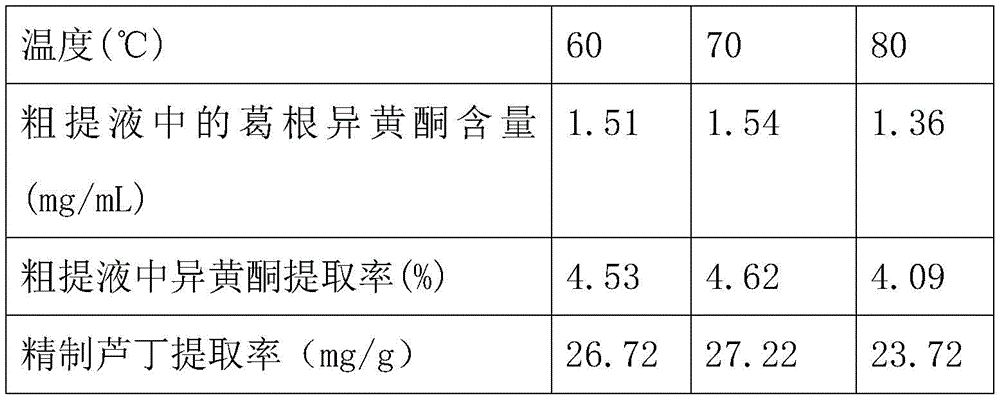
Note that: the ratio of the content of the pueraria isoflavone in the crude extract to the extraction rate of the isoflavone in the crude extract is fixed.
Example six:
(1) preparing a deep eutectic solution. Drying choline chloride with the purity of 99% in a vacuum drying oven at 60 ℃ for 24 hours, mixing the choline chloride with ethylene glycol according to the molar ratio of 1:3, filling the mixture into a 50mL round-bottom flask, plugging the flask, stirring and heating the mixture in an oil bath kettle at 100 ℃ and the rotating speed of 300rpm for about 2 to 3 hours until a uniform and transparent solution is formed. Cooling to room temperature, drying in a vacuum drying oven at 60 deg.C for 36h, transferring to a dryer, and sealing for storage. Adding appropriate amount of distilled water to adjust to 20% before use.
(2) And (4) pretreating the kudzuvine root. Drying the purchased radix Puerariae in the sun, drying for 12h, slicing, grinding with a traditional Chinese medicine grinder, sieving with a 60-mesh sieve, bagging the fine powder in a room temperature dryer, and storing.
(3) Extracting radix Puerariae isoflavone. Weighing fine powder according to a material-liquid ratio of 1 g: 20% DES was added to 25mL and stirred well. Then extracting at 70 deg.C for 30, 60, 90min under 300W ultrasound assistance. The mixture was centrifuged at 12000g for 10min using a tabletop high speed centrifuge to separate the solid particles and obtain a crude extract.
(4) Separating and purifying rutin. 15mL of the crude extract was slowly added to the column, followed by elution of other impurities with 600mL of deionized water, followed by 70% ethanol solution, and collection of the ethanol eluate. The eluate was then concentrated to 10mL using a rotary evaporator and the pH was adjusted to 3.0 with dilute hydrochloric acid. Placing the concentrated solution in 4 deg.C environment, standing for 24 hr to separate out radix Puerariae isoflavone crystal, filtering, and washing with cold water to obtain crude radix Puerariae isoflavone. Dissolving crude radix Puerariae isoflavone in lime water under heating, filtering with 0.22um membrane, adjusting pH of the filtrate to 3.0 with saline water, cooling, standing, recrystallizing to precipitate, filtering, washing with cold water, and lyophilizing to obtain refined radix Puerariae isoflavone.

Note that: the ratio of the content of the pueraria isoflavone in the crude extract to the extraction rate of the isoflavone in the crude extract is fixed.
Example six:
oxidation resistance

Claims (6)
1. A method for extracting pueraria isoflavone and application thereof are characterized in that: the method comprises the following specific steps:
(1) preparation of choline chloride/ethylene glycol: mixing 139.6g of choline chloride with 111.5-223.0mL of ethylene glycol (i.e. the molar ratio is controlled at 1: 2-4), magnetically stirring for 2-3h in a water bath kettle at 80 ℃ until the choline chloride becomes a transparent solution, then drying for 36h in a vacuum drying oven at 60 ℃ to obtain a deep eutectic solvent of choline chloride/ethylene glycol, and storing in a dryer for later use;
(2) preparing 10-40% choline chloride/ethylene glycol aqueous solution with distilled water, adding into 60 mesh radix Puerariae powder, stirring, extracting under ultrasonic wave-assisted heating to obtain radix Puerariae isoflavone crude extract, and separating and purifying to obtain radix Puerariae isoflavone;
(3) the feed-liquid ratio of the kudzu root powder to the choline chloride/ethylene glycol is 1: 10-25;
(4) in the extraction process, the power of ultrasonic wave is 300-600W, the temperature is 60-80 ℃, and the extraction time is 30-90 min;
(5) after extraction, removing pueraria residue by a high-speed centrifugation mode to obtain a crude extract, wherein the content of pueraria isoflavone in the crude extract is 1.19-1.54mg/mL, and the extraction rate is 3.58-4.62%;
(6) the separation and purification uses AB-8 type macroporous resin as a filler, and the purification is realized through the separation and purification of a chromatographic column. The separation and purification process comprises the following steps: loading on column by wet method, loading the crude extract, eluting with ethanol solution, collecting eluate, concentrating the eluate by rotary evaporation, adjusting pH, cooling to separate out precipitate, filtering to obtain crude radix Puerariae isoflavone precipitate, dissolving the precipitate with lime water, adjusting pH, cooling to separate out precipitate, filtering, and freeze drying to obtain refined radix Puerariae isoflavone.
2. The method for extracting pueraria isoflavone and the application thereof according to claim 1, wherein the method comprises the following steps: the AB-8 resin was loaded into a chromatography column (15mm by 500mm) with a column volume of 50mL by wet packing.
3. The method for extracting pueraria isoflavone and the application thereof according to claim 1, wherein the method comprises the following steps: the loading volume of the crude extract is 15 mL.
4. The method for extracting pueraria isoflavone and the application thereof according to claim 1, wherein the method comprises the following steps: the eluate was collected at 70% ethanol concentration.
5. The method for extracting pueraria isoflavone and the application thereof according to claim 1, wherein the method comprises the following steps: weighing the pueraria isoflavone powder, wherein the extraction rate is 21.48-27.23mg/g (calculated according to the pueraria raw material).
6. The method for extracting pueraria isoflavone and the application thereof according to claim 1, wherein the method comprises the following steps: and (3) determining the hydroxyl free radical clearance rate, DPPH clearance rate and ABTS clearance rate of the pueraria isoflavone.
Priority Applications (1)
| Application Number | Priority Date | Filing Date | Title |
|---|---|---|---|
| CN202111037071.5A CN113683589A (en) | 2021-09-06 | 2021-09-06 | Extraction method and application of pueraria isoflavone |
Applications Claiming Priority (1)
| Application Number | Priority Date | Filing Date | Title |
|---|---|---|---|
| CN202111037071.5A CN113683589A (en) | 2021-09-06 | 2021-09-06 | Extraction method and application of pueraria isoflavone |
Publications (1)
| Publication Number | Publication Date |
|---|---|
| CN113683589A true CN113683589A (en) | 2021-11-23 |
Family
ID=78585519
Family Applications (1)
| Application Number | Title | Priority Date | Filing Date |
|---|---|---|---|
| CN202111037071.5A Pending CN113683589A (en) | 2021-09-06 | 2021-09-06 | Extraction method and application of pueraria isoflavone |
Country Status (1)
| Country | Link |
|---|---|
| CN (1) | CN113683589A (en) |
Citations (3)
| Publication number | Priority date | Publication date | Assignee | Title |
|---|---|---|---|---|
| CN103254185A (en) * | 2013-05-25 | 2013-08-21 | 湖北省三鑫生物科技有限公司 | Novel process for producing puerarin by utilizing root of kudzu vine |
| CN108088943A (en) * | 2018-02-13 | 2018-05-29 | 沈阳药科大学 | Extractant-eutectic is dissolved in the application during effective component of chinese medicine measures |
| CN111568934A (en) * | 2020-04-28 | 2020-08-25 | 五邑大学 | Method for extracting moringa oleifera total flavonoids by using deep eutectic solvent |
-
2021
- 2021-09-06 CN CN202111037071.5A patent/CN113683589A/en active Pending
Patent Citations (3)
| Publication number | Priority date | Publication date | Assignee | Title |
|---|---|---|---|---|
| CN103254185A (en) * | 2013-05-25 | 2013-08-21 | 湖北省三鑫生物科技有限公司 | Novel process for producing puerarin by utilizing root of kudzu vine |
| CN108088943A (en) * | 2018-02-13 | 2018-05-29 | 沈阳药科大学 | Extractant-eutectic is dissolved in the application during effective component of chinese medicine measures |
| CN111568934A (en) * | 2020-04-28 | 2020-08-25 | 五邑大学 | Method for extracting moringa oleifera total flavonoids by using deep eutectic solvent |
Non-Patent Citations (1)
| Title |
|---|
| 刘洋旋: "葛根总黄酮的低共熔溶剂法提取、分离纯化及其抗氧化活性研究", 《中国优秀硕士学位论文全文数据库 工程科技Ⅰ辑》 * |
Similar Documents
| Publication | Publication Date | Title |
|---|---|---|
| CN105037573B (en) | A kind of preparation and its application with antiviral and immunocompetent Linseed pigment | |
| CN102146142B (en) | Method for preparing astragalus polysaccharides | |
| CN105294790A (en) | Method for extracting high-purity steviol glycosides from stevia rebaudiana | |
| CN112898446B (en) | Kudzu root polysaccharide extract and extraction method and application thereof | |
| CN108676102A (en) | A method of the depth congruent melting solvent extraction Moringa seed polysaccharide made of choline chloride and glycerine | |
| CN111172216A (en) | Cordyceps militaris polysaccharide with function of inhibiting macrophage from secreting NO, and preparation method and application thereof | |
| CN114105747A (en) | Method for improving curcumin extraction rate and purification effect | |
| CN101108842A (en) | Processing Technology of Extracting Tea Polyphenols from Tea Tree Flowers | |
| CN108373512A (en) | A method of the depth congruent melting solvent extraction Moringa seed polysaccharide made of choline chloride and urea | |
| CN105524183B (en) | A kind of extraction method of water chestnut polysaccharide | |
| CN104069187A (en) | Technological method extracting duckwheat flavone from duckwheat | |
| CN105902584A (en) | Moringa oleifera leaf flavone with anticomplement and hypoglycemic activity, preparation method and application thereof | |
| CN106317148A (en) | Method for extracting cordycepin from cordyceps militaris | |
| CN109400592B (en) | Preparation method of puerarin extract | |
| CN101322693B (en) | Carthamus tinctorius yellow colour injection and preparation technique thereof | |
| CN107245113A (en) | Corn silk polysaccharide extract with antitumaous effect and preparation method thereof | |
| CN113683589A (en) | Extraction method and application of pueraria isoflavone | |
| CN103275237B (en) | Preparation method and application of eggplant branch polysaccharide | |
| CN104706717B (en) | Extraction and purification method of total alkaloids of Sophora sophora | |
| CN111004335A (en) | Bletilla striata oligosaccharide extracted from rhizome of bletilla striata and preparation method thereof | |
| CN113662983A (en) | Method for extracting pueraria isoflavone | |
| CN108126000B (en) | Method for extracting and preparing panax notoginseng saponins from fresh panax notoginseng | |
| CN106046079B (en) | A method of quick separating prepares paeonidin -3- caffeoyl sophoroside -5- glucosides from purple sweet potato | |
| CN215828809U (en) | Device for extracting propolis total flavonoids by complex enzymolysis method | |
| CN113861151A (en) | Method for extracting pueraria fibre residue flavone |
Legal Events
| Date | Code | Title | Description |
|---|---|---|---|
| PB01 | Publication | ||
| PB01 | Publication | ||
| SE01 | Entry into force of request for substantive examination | ||
| SE01 | Entry into force of request for substantive examination | ||
| WD01 | Invention patent application deemed withdrawn after publication | ||
| WD01 | Invention patent application deemed withdrawn after publication |
Application publication date: 20211123 |