CN113683353B - Ultrahigh pumping concrete applying machine-made sand and preparation method thereof - Google Patents
Ultrahigh pumping concrete applying machine-made sand and preparation method thereof Download PDFInfo
- Publication number
- CN113683353B CN113683353B CN202111065067.XA CN202111065067A CN113683353B CN 113683353 B CN113683353 B CN 113683353B CN 202111065067 A CN202111065067 A CN 202111065067A CN 113683353 B CN113683353 B CN 113683353B
- Authority
- CN
- China
- Prior art keywords
- machine
- made sand
- concrete
- ultra
- auxiliary agent
- Prior art date
- Legal status (The legal status is an assumption and is not a legal conclusion. Google has not performed a legal analysis and makes no representation as to the accuracy of the status listed.)
- Active
Links
- 239000004576 sand Substances 0.000 title claims abstract description 159
- 239000004567 concrete Substances 0.000 title claims abstract description 109
- 238000005086 pumping Methods 0.000 title claims abstract description 43
- 238000002360 preparation method Methods 0.000 title abstract description 8
- 230000004048 modification Effects 0.000 claims abstract description 71
- 238000012986 modification Methods 0.000 claims abstract description 71
- 239000012752 auxiliary agent Substances 0.000 claims abstract description 52
- 239000004568 cement Substances 0.000 claims abstract description 28
- 239000000835 fiber Substances 0.000 claims abstract description 23
- XLYOFNOQVPJJNP-UHFFFAOYSA-N water Substances O XLYOFNOQVPJJNP-UHFFFAOYSA-N 0.000 claims abstract description 22
- 239000004372 Polyvinyl alcohol Substances 0.000 claims abstract description 20
- 229920002451 polyvinyl alcohol Polymers 0.000 claims abstract description 20
- 239000004793 Polystyrene Substances 0.000 claims abstract description 15
- 239000000463 material Substances 0.000 claims abstract description 15
- 239000004005 microsphere Substances 0.000 claims abstract description 15
- 229920002223 polystyrene Polymers 0.000 claims abstract description 15
- 239000002253 acid Substances 0.000 claims abstract description 14
- 239000010881 fly ash Substances 0.000 claims abstract description 14
- 238000000034 method Methods 0.000 claims abstract description 9
- 239000002893 slag Substances 0.000 claims abstract description 7
- XUIMIQQOPSSXEZ-UHFFFAOYSA-N Silicon Chemical compound [Si] XUIMIQQOPSSXEZ-UHFFFAOYSA-N 0.000 claims abstract description 4
- 229910052799 carbon Inorganic materials 0.000 claims abstract description 4
- 239000003638 chemical reducing agent Substances 0.000 claims abstract description 4
- 239000011863 silicon-based powder Substances 0.000 claims abstract description 3
- 239000002480 mineral oil Substances 0.000 claims description 22
- 235000010446 mineral oil Nutrition 0.000 claims description 22
- 239000002245 particle Substances 0.000 claims description 19
- OKTJSMMVPCPJKN-UHFFFAOYSA-N Carbon Chemical compound [C] OKTJSMMVPCPJKN-UHFFFAOYSA-N 0.000 claims description 17
- 238000003756 stirring Methods 0.000 claims description 12
- 239000002994 raw material Substances 0.000 claims description 8
- 239000000203 mixture Substances 0.000 claims description 5
- 229920000728 polyester Polymers 0.000 claims description 4
- 229920002972 Acrylic fiber Polymers 0.000 claims description 3
- 229920002334 Spandex Polymers 0.000 claims description 3
- 239000004759 spandex Substances 0.000 claims description 3
- 229920001778 nylon Polymers 0.000 claims 1
- 238000004364 calculation method Methods 0.000 abstract description 10
- 230000008569 process Effects 0.000 abstract description 5
- XJKVPKYVPCWHFO-UHFFFAOYSA-N silicon;hydrate Chemical compound O.[Si] XJKVPKYVPCWHFO-UHFFFAOYSA-N 0.000 abstract 1
- VYPSYNLAJGMNEJ-UHFFFAOYSA-N Silicium dioxide Chemical compound O=[Si]=O VYPSYNLAJGMNEJ-UHFFFAOYSA-N 0.000 description 125
- 230000000052 comparative effect Effects 0.000 description 15
- 230000000694 effects Effects 0.000 description 14
- 238000002474 experimental method Methods 0.000 description 9
- 125000001931 aliphatic group Chemical group 0.000 description 6
- 238000012360 testing method Methods 0.000 description 6
- 239000000843 powder Substances 0.000 description 5
- 239000000654 additive Substances 0.000 description 4
- 230000000996 additive effect Effects 0.000 description 4
- 230000009286 beneficial effect Effects 0.000 description 3
- 125000003178 carboxy group Chemical group [H]OC(*)=O 0.000 description 3
- 229910052500 inorganic mineral Inorganic materials 0.000 description 3
- 238000004519 manufacturing process Methods 0.000 description 3
- 230000007246 mechanism Effects 0.000 description 3
- 239000011707 mineral Substances 0.000 description 3
- VZSRBBMJRBPUNF-UHFFFAOYSA-N 2-(2,3-dihydro-1H-inden-2-ylamino)-N-[3-oxo-3-(2,4,6,7-tetrahydrotriazolo[4,5-c]pyridin-5-yl)propyl]pyrimidine-5-carboxamide Chemical compound C1C(CC2=CC=CC=C12)NC1=NC=C(C=N1)C(=O)NCCC(N1CC2=C(CC1)NN=N2)=O VZSRBBMJRBPUNF-UHFFFAOYSA-N 0.000 description 2
- WNLRTRBMVRJNCN-UHFFFAOYSA-N adipic acid Chemical compound OC(=O)CCCCC(O)=O WNLRTRBMVRJNCN-UHFFFAOYSA-N 0.000 description 2
- 238000005054 agglomeration Methods 0.000 description 2
- 230000002776 aggregation Effects 0.000 description 2
- 238000007599 discharging Methods 0.000 description 2
- 230000001050 lubricating effect Effects 0.000 description 2
- 238000011056 performance test Methods 0.000 description 2
- 229920005646 polycarboxylate Polymers 0.000 description 2
- 229910021487 silica fume Inorganic materials 0.000 description 2
- 239000008030 superplasticizer Substances 0.000 description 2
- 238000010998 test method Methods 0.000 description 2
- 239000004952 Polyamide Substances 0.000 description 1
- 230000001133 acceleration Effects 0.000 description 1
- 230000004913 activation Effects 0.000 description 1
- 235000011037 adipic acid Nutrition 0.000 description 1
- 239000001361 adipic acid Substances 0.000 description 1
- 238000006136 alcoholysis reaction Methods 0.000 description 1
- 230000015572 biosynthetic process Effects 0.000 description 1
- 239000004566 building material Substances 0.000 description 1
- 125000004432 carbon atom Chemical group C* 0.000 description 1
- 239000003795 chemical substances by application Substances 0.000 description 1
- 239000010883 coal ash Substances 0.000 description 1
- 239000002131 composite material Substances 0.000 description 1
- 238000010276 construction Methods 0.000 description 1
- 230000002596 correlated effect Effects 0.000 description 1
- 230000007613 environmental effect Effects 0.000 description 1
- 239000012530 fluid Substances 0.000 description 1
- 230000001788 irregular Effects 0.000 description 1
- 239000007788 liquid Substances 0.000 description 1
- 238000005461 lubrication Methods 0.000 description 1
- 239000000693 micelle Substances 0.000 description 1
- 239000003607 modifier Substances 0.000 description 1
- 239000008188 pellet Substances 0.000 description 1
- 229920002647 polyamide Polymers 0.000 description 1
- 230000009467 reduction Effects 0.000 description 1
- 239000012783 reinforcing fiber Substances 0.000 description 1
- 229910052710 silicon Inorganic materials 0.000 description 1
- 239000010703 silicon Substances 0.000 description 1
- 230000007480 spreading Effects 0.000 description 1
- 238000003892 spreading Methods 0.000 description 1
- TYFQFVWCELRYAO-UHFFFAOYSA-N suberic acid Chemical compound OC(=O)CCCCCCC(O)=O TYFQFVWCELRYAO-UHFFFAOYSA-N 0.000 description 1
- 239000000126 substance Substances 0.000 description 1
- 239000004094 surface-active agent Substances 0.000 description 1
- 238000010200 validation analysis Methods 0.000 description 1
Classifications
-
- C—CHEMISTRY; METALLURGY
- C04—CEMENTS; CONCRETE; ARTIFICIAL STONE; CERAMICS; REFRACTORIES
- C04B—LIME, MAGNESIA; SLAG; CEMENTS; COMPOSITIONS THEREOF, e.g. MORTARS, CONCRETE OR LIKE BUILDING MATERIALS; ARTIFICIAL STONE; CERAMICS; REFRACTORIES; TREATMENT OF NATURAL STONE
- C04B28/00—Compositions of mortars, concrete or artificial stone, containing inorganic binders or the reaction product of an inorganic and an organic binder, e.g. polycarboxylate cements
-
- C—CHEMISTRY; METALLURGY
- C04—CEMENTS; CONCRETE; ARTIFICIAL STONE; CERAMICS; REFRACTORIES
- C04B—LIME, MAGNESIA; SLAG; CEMENTS; COMPOSITIONS THEREOF, e.g. MORTARS, CONCRETE OR LIKE BUILDING MATERIALS; ARTIFICIAL STONE; CERAMICS; REFRACTORIES; TREATMENT OF NATURAL STONE
- C04B22/00—Use of inorganic materials as active ingredients for mortars, concrete or artificial stone, e.g. accelerators or shrinkage compensating agents
- C04B22/02—Elements
-
- C—CHEMISTRY; METALLURGY
- C04—CEMENTS; CONCRETE; ARTIFICIAL STONE; CERAMICS; REFRACTORIES
- C04B—LIME, MAGNESIA; SLAG; CEMENTS; COMPOSITIONS THEREOF, e.g. MORTARS, CONCRETE OR LIKE BUILDING MATERIALS; ARTIFICIAL STONE; CERAMICS; REFRACTORIES; TREATMENT OF NATURAL STONE
- C04B24/00—Use of organic materials as active ingredients for mortars, concrete or artificial stone, e.g. plasticisers
-
- C—CHEMISTRY; METALLURGY
- C04—CEMENTS; CONCRETE; ARTIFICIAL STONE; CERAMICS; REFRACTORIES
- C04B—LIME, MAGNESIA; SLAG; CEMENTS; COMPOSITIONS THEREOF, e.g. MORTARS, CONCRETE OR LIKE BUILDING MATERIALS; ARTIFICIAL STONE; CERAMICS; REFRACTORIES; TREATMENT OF NATURAL STONE
- C04B40/00—Processes, in general, for influencing or modifying the properties of mortars, concrete or artificial stone compositions, e.g. their setting or hardening ability
- C04B40/0028—Aspects relating to the mixing step of the mortar preparation
- C04B40/0039—Premixtures of ingredients
-
- C—CHEMISTRY; METALLURGY
- C04—CEMENTS; CONCRETE; ARTIFICIAL STONE; CERAMICS; REFRACTORIES
- C04B—LIME, MAGNESIA; SLAG; CEMENTS; COMPOSITIONS THEREOF, e.g. MORTARS, CONCRETE OR LIKE BUILDING MATERIALS; ARTIFICIAL STONE; CERAMICS; REFRACTORIES; TREATMENT OF NATURAL STONE
- C04B2111/00—Mortars, concrete or artificial stone or mixtures to prepare them, characterised by specific function, property or use
- C04B2111/00034—Physico-chemical characteristics of the mixtures
- C04B2111/00146—Sprayable or pumpable mixtures
-
- C—CHEMISTRY; METALLURGY
- C04—CEMENTS; CONCRETE; ARTIFICIAL STONE; CERAMICS; REFRACTORIES
- C04B—LIME, MAGNESIA; SLAG; CEMENTS; COMPOSITIONS THEREOF, e.g. MORTARS, CONCRETE OR LIKE BUILDING MATERIALS; ARTIFICIAL STONE; CERAMICS; REFRACTORIES; TREATMENT OF NATURAL STONE
- C04B2201/00—Mortars, concrete or artificial stone characterised by specific physical values
- C04B2201/50—Mortars, concrete or artificial stone characterised by specific physical values for the mechanical strength
Landscapes
- Chemical & Material Sciences (AREA)
- Engineering & Computer Science (AREA)
- Ceramic Engineering (AREA)
- Materials Engineering (AREA)
- Structural Engineering (AREA)
- Organic Chemistry (AREA)
- Inorganic Chemistry (AREA)
- Chemical Kinetics & Catalysis (AREA)
- Curing Cements, Concrete, And Artificial Stone (AREA)
Abstract
The application relates to the field of concrete, in particular to ultrahigh pumping concrete applying machine-made sand and a preparation method thereof. The ultra-high pumping concrete comprises coarse aggregate, cement, machine-made sand, fly ash, slag, micro silicon powder, water and a machine-made sand modification auxiliary agent, wherein the machine-made sand modification auxiliary agent is prepared from 6-10 carbon aliphatic polycarboxylic acid, polyvinyl alcohol, polystyrene microspheres, organic fibers and a polycarboxylic acid water reducing agent. And the calculation formula of the machine-made sand modification auxiliary agent is
Description
Technical Field
The application relates to the field of concrete, in particular to ultrahigh pumping concrete applying machine-made sand and a preparation method thereof.
Background
Ultra-high pumping concrete is an important raw material in the construction of high-rise buildings. For high-strength ultra-high pumping concrete, the strength of the concrete itself causes the viscosity of the concrete to increase, and the pumping height and the pipeline length require the concrete to have lower viscosity and higher fluidity, so that the concrete has higher requirements on the size, grading and particle type of aggregate.
Under the requirements of environmental protection and resource management, machine-made sand gradually replaces natural sand and becomes an important building material raw material. Compared with river sand, the machine-made sand has obvious edges and corners and irregular particle types, when the machine-made sand is applied to high-strength ultrahigh pumping concrete, aggregate and machine-made sand with specific particle types and grading are often required to be applied, the requirement on material selection is high, and the machine-made sand has great limitation when being applied to the ultrahigh pumping concrete.
Disclosure of Invention
In order to reduce the limitation of machine-made sand in application to ultra-high pumping concrete, the application provides the ultra-high pumping concrete applying the machine-made sand and a preparation method thereof.
Firstly, the application provides ultrahigh pumping concrete applying machine-made sand, which comprises the following raw materials:

the sand-based composite material also comprises a machine-made sand modification auxiliary agent, wherein each part of the machine-made sand modification auxiliary agent comprises the following components in parts by mass
Comprises 6 to 10% of 6 to 10 carbon aliphatic polycarboxylic acid,
15-20% of polyvinyl alcohol;
4-9% of polystyrene microspheres;
20-30% of organic fibers;
polycarboxylate superplasticizer balance
In the machine-made sand, the components with the fineness modulus of more than 3.7 account for no more than 1% by mass in the machine-made sand, and the components with the fineness modulus of less than 1.5 account for no more than 2% by mass in the machine-made sand; the addition part of the machine-made sand modification auxiliary agent is calculated by a formula I, wherein the formula I is as follows:

wherein, N1Is the part of machine-made sand modification auxiliary agent, A1~A3The machine-made sand with fineness modulus of 3.1-3.7, 2.3-3.0 and 1.6-2.2 accounts for the total mass percent of the machine-made sand, A4Is the part of fly ash, A5Is the fraction of coarse aggregate, K is the strength grade of cement, R1For adjusting the parameters, R1The range of (A) is-3 to 3.
In the technical scheme, the mineral powder, the fly ash and the machine-made sand modification auxiliary agent act together to improve the self fluidity of the concrete and reduce the resistance of the concrete in a pipeline, so that the concrete can be pumped to a higher height.
Among them, the fly ash can play a role of improving workability in a system, similar to cement particles without activation, and can play a role of similar to balls. The mineral powder can activate the concrete. In the machine-made sand modification auxiliary agent, the organic fiber can play a role in pulling each component in the concrete, so that the whole internal stress of the concrete is uniform in the fluid transportation process, the agglomeration is not easy to occur, and the concrete is not easy to crack and condense in a pipeline. The polyvinyl alcohol and the polystyrene microspheres can reduce the resistance between concrete and the inner wall of the pipeline in the transportation process and reduce the blockage or adhesion of the concrete in the pipeline on the inner wall of the pipeline. The polycarboxylic acid can improve the cohesion of the flowing concrete, so that the concrete is integrated in the flowing process, and the possibility of partial concrete wall hanging during flowing of the concrete is reduced.
In the technical scheme, the usage amount of the machine-made sand modification auxiliary agent is further limited, the usage amount of the machine-made sand modification auxiliary agent is related to the gradation of the machine-made sand, and meanwhile, the machine-made sand with various gradations can be adjusted. When the large particle component in the machine-made sand is increased, the using amount of the machine-made sand modification auxiliary agent is increased, and when the small particle component is increased, the using amount of the machine-made sand modification auxiliary agent is reduced. Meanwhile, the addition amount of the machine-made sand modification auxiliary agent is positively correlated with the strength grade of the cement, the larger the strength, the higher the dosage of the cement is needed, and experiments prove that the machine-made sand modification auxiliary agent is in direct proportion to the square root of the strength of the cement, so that the machine-made sand modification auxiliary agent has a better modification effect and has small loss on the strength.
In summary, in the above technical scheme, while the specific machine-made sand modification auxiliary agent is adopted, a calculation method of the amount of the machine-made sand modification auxiliary agent is provided for different machine-made sand gradations and cement strengths, which is helpful for reducing the raw material limitation applied to the ultra-high pumping concrete, improving the application range of various machine-made sands, and having great application value in the environment with unclear machine-made sand standard and uneven product quality at the present stage of China.
Optionally, the polyvinyl alcohol is carboxyl-modified polyvinyl alcohol.
The carboxyl modified polyvinyl alcohol has better film forming property, and the carboxyl structure of the polyvinyl alcohol is beneficial to further improving the cohesive force of concrete, so that the polyvinyl alcohol is not easy to adhere to the pipe wall in the flowing process.
Optionally, the mineral oil is further included, and the used mass of the mineral oil is calculated by a formula II, wherein the formula II is as follows:
N2=A5×0.006+A6×0.005+R2
wherein N is2Is part of mineral oil, A6In parts of machine-made sand, R2For adjusting the parameters, R2The range of (a) is-0.8 to 0.8 parts.
The mineral oil agent can play a role in lubrication, is beneficial to improving the fluidity of concrete, reducing the friction between the concrete and the inner wall of a pipeline and further expanding the application of the concrete in the field of ultrahigh pumping.
Optionally, the graphite powder is further included, and the mass of the graphite powder is not more than 2% of that of the coarse aggregate.
The graphite powder can further reduce the friction force between the concrete and the pipe wall, and simultaneously has the effect of improving the compactness and the strength of the concrete in a subsequently formed concrete system.
Optionally, the granularity of the graphite powder is 100-1000 meshes.
By adopting the graphite powder with the granularity, compared with the graphite powder with larger or smaller granularity, the finally obtained concrete has better strength, and better workability and fluidity.
Optionally, the R is1Specifically, the formula iii is calculated by the following formula iii:

wherein M is the mass ratio of water to cement, P is the average length-diameter ratio of the machine-made sand, and L is the crushing value of the machine-made sand.
In the above, the amount of the machine-made sand modification auxiliary agent is further adjusted, so that the amount of the machine-made sand modification main machine is inversely related to the mass ratio of water to cement, the amount of the machine-made sand modification regulator is further limited by the mass ratio of water to cement, and the machine-made sand modification auxiliary agent has a good application range. Because the concrete with lower mass ratio of water to cement is easier to form an agglomeration system of the cement in actual production, the increase of the dosage of the machine-made sand modification auxiliary agent is beneficial to further improving the fluidity and the workability of the concrete under the condition of not influencing the strength.
Optionally, the organic fiber is a mixed system formed by any one or any several of polyester fiber, acrylic fiber, polyamide fiber and spandex fiber.
The organic fiber has good elasticity and toughness, and can effectively improve the integrity of liquid concrete in a system, improve the cohesion and reduce the adhesion of the concrete to the inner wall of a pipeline.
Optionally, the average length of the organic fibers is 1-1.5 mm, and the length-diameter ratio is 20-30.
Choose for use above-mentioned draw ratio and length range's organic fiber, in the concrete system that flows, make the inside more even of concrete system, the fibre has better linkage effect between the region of difference, and the intensity of itself is also better, has certain promotion effect to the performance of concrete itself after solidifying.
Optionally, the polystyrene microsphere has a particle size of 200-1500 meshes.
The polystyrene microspheres with the particle size range have good uniformity in a system and small strength loss on concrete.
In addition, the application also provides a preparation method of the ultrahigh pumping concrete using the machine-made sand, which comprises the following steps:
s1, mixing and stirring the machine-made sand and the coarse aggregate for 10-15S to obtain a mixed system I;
s2, adding cement, slag, fly ash and water accounting for 40-50% of the total amount of water into the mixed system I, and continuously stirring for 20-30S to obtain a mixed system II;
and S3, adding all the rest raw materials into the mixed system II, continuously stirring for 50-60S, and discharging to obtain the ultra-high pumping concrete.
In the technical scheme, the prepared ultra-high pumping concrete has good pumping capacity and good strength. In the scheme, different machine-made sands can be suitable for use, and the application range is wide.
In summary, the present application includes at least one of the following advantages:
1. the application provides a machine-made sand modification auxiliary agent and a using method of the machine-made sand modification auxiliary agent, the coal ash, the micro silicon powder and the slag are combined, and the machine-made sand modification auxiliary agent simultaneously contains polyvinyl alcohol, aliphatic series polynary computer, polystyrene microspheres, organic fibers and a polycarboxylic acid water reducing agent, and can be prepared into ultrahigh pumping concrete suitable for production when being applied to different types of machine-made sand, so that the limitation of the machine-made sand in use is greatly reduced. The amount of the machine-made sand modification auxiliary agent is related to the gradation of the machine-made sand, the strength grade of cement and the amount of fly ash, the whole is scientific, the adjustment can be carried out in a small range, and the machine-made sand modification auxiliary agent has a clear guiding significance for industrial application.
2. In the further setting of this application, still add mineral oil or graphite powder in the concrete, further reduce the frictional force between the pipe wall of concrete and pipeline, improve the pumpability of concrete.
3. In the further setting of the application, the addition amount of the machine-made sand modification auxiliary agent is further adjusted, so that the length-diameter ratio of the machine-made sand modification auxiliary agent and the crushing value of the machine-made sand are directly related, and the concrete prepared in the range has better pumping performance and strength.
Detailed Description
The present application will be described in further detail with reference to examples.
In the following examples, the sources of some of the materials are shown in Table 1.
TABLE 1 table of sources of materials
| Cement | Producing area-Zhejiang Hangzhou |
| Aggregate material | Production area-Zhejiang Hangzhou, continuous gradation |
| Machine-made sand | Producing area-Zhejiang Huzhou |
| Polystyrene microsphere | Zhongke thunder |
| Polyvinyl alcohol 1799 | Shanghai Zheng Shi |
| Carboxyl modified polyvinyl alcohol | Alcoholysis degree of 92.5, viscosity of 26-34, Mitsubishi chemical |
| Fly ash | Produced from first-grade fly ash |
| Slag of mine | Tangshan S95 grade mineral powder |
| Silica fume | Silicon content>96% |
For the following examples and comparative examples, the following experiments were designed for validation.
1. Slump tests refer to the standard of the GB/T50080-2016 common concrete mixture performance test method to determine the slump of the concrete.
2. And (3) an expansion degree experiment, namely measuring the expansion degree of the concrete and measuring the expansion time when the expansion degree reaches 500mm by referring to a T0532-2020 cement concrete mixture slump expansion degree and expansion time test method.
3. And (3) in an inverted slump cone emptying experiment, referring to the standard of a GB/T50080-2016 common concrete mixture performance test method, determining the time required by emptying the inverted slump hole.
4. In the concrete compressive strength test, the concrete is prepared into a concrete block with the thickness of 150mm multiplied by 150mm according to the standard of the concrete physical mechanical property test method, the load acceleration is selected to be 0.8mPa/s, and the 28d compressive strength of the concrete is measured.
Scenario 1, a series of ultra-high pumping concrete with machine-made sand, in which the material ratios and the gradation of the machine-made sand are shown in table 2, except for special emphasis. In this scenario, each batch of material refers to 0.05kg of material.
Table 2, basic information of each component in scene 1

For the embodiment, the amount of the mechanical sand modification auxiliary agent is calculated by the following formula:

wherein N is1The dosage of the machine-made sand modification additive is A1~A3The machine-made sand with fineness modulus of 3.1-3.7, 2.3-3.0 and 1.6-2.2 accounts for the total mass percent of the machine-made sand, A4Is the part of fly ash, A5Is the fraction of coarse aggregate, K is the strength grade of cement, R1For adjusting the parameters, R1The range of (A) is-3 to 3.
The calculation result is as follows: n is a radical of1The weight of the powder is (0.558-0.698) kg plus or minus 0.135kg, namely 0.423-0.833 kg.
Further, R is represented by the following formula1Is limited to and madeLimiting the using amount of the machine-made sand modification auxiliary agent in one step:

wherein M is the mass ratio of water to cement, P is the average length-diameter ratio of the machine-made sand, and L is the crushing value of the machine-made sand.
The calculation result is that R11.92 to 2.18kg, i.e. N1The total weight of the powder is (0.558-0.698) kg + (0.0864-0.0982) kg, namely 0.6444-0.7962 kg.
According to the calculation result, the examples with different machine-made sand modification additive amounts are as follows:
examples 1-1 to 1-8 are respectively ultra-high pump concrete using machine-made sand, and the concrete preparation method is as follows: s1, mixing the machine-made sand and the coarse aggregate according to the mixture ratio shown in the table 1, and stirring for 10S at the speed of 15rpm to obtain a mixed system I;
s2, adding cement, slag, fly ash and water (3.6 kg) accounting for 40% of the total amount of water into the mixed system I, and stirring at the speed of 25rpm for 30S to obtain a mixed system II;
and S3, adding silica fume into the mixing system II, adding machine-made sand modification auxiliary agents with different masses, continuously stirring at the speed of 25rpm for 50S, and discharging to obtain the ultra-high pump concrete.
In examples 1-1 to 1-8, the amounts of the machine-made sand modification aids were 0.423kg, 0.485kg, 0.544kg, 0.602kg, 0.645kg, 0.710kg, 0.796kg, and 0.833kg, respectively.
In examples 1-1 to 1-8, the organic reinforcing fibers were polyester fibers, the average length of the polyester fibers was 1.2mm, and the aspect ratio was 20.
The particle size range of the polystyrene microspheres is 200-500 meshes.
The polyvinyl alcohol is polyvinyl alcohol 1799 type.
The aliphatic polycarboxylic acid having 6 to 10 carbon atoms is adipic acid.
Meanwhile, comparative examples 1-1 and 1-2 were provided, which are different from example 1-1 in that the amounts of the machine-made sand modification aids were 0.0395kg and 0.0885kg, respectively.
The results of the tests performed in examples 1 to 8 are shown in Table 3.
Table 3, examples 1-1 to 1-8 and comparative examples 1-1 to 1-2

In the embodiment, two ranges are provided, wherein the addition amount of the machine-made sand modification aid calculated according to the formula I is 0.423-0.833 kg, and the addition amount of the machine-made sand modification aid is 0.6444-0.7962 kg after the adjustment parameters in the formula I are further defined according to the formula II.
From the experimental data of examples 1-1 to 1-8, it can be seen that in scene 1, the amount of the machine-made sand modification aid is adjusted, and it is found that examples 1-1 to 1-8 have significantly better performance than comparative examples 1-1 and 1-2. With the addition of the machine-made sand modification auxiliary agent, the slump and the expansion degree are improved to a certain extent, and the expansion time and the slump emptying time are reduced to a certain extent. However, in the range calculated by formula I, the slump is over 240mm, and the minimum spreading is over 644, so that the whole workability is better, while in comparative example 1, the dosage of the machine-made sand modification auxiliary agent is only 0.04kg lower than that of example 1-1, the fluidity is obviously reduced, and the strength is not obviously changed. Compared with the examples 1-8, the comparative examples 1-2 only increase the dosage of the machine-made sand modification auxiliary agent by 0.05kg, but obviously reduce the strength. Meanwhile, when the using amount of the sand-making modifying additive is in the range of 0.6444-0.7962 kg, the concrete has the best fluidity and workability, and the strength is basically unchanged.
The specific principle of the phenomenon may be related to the mechanism of the function of the machine-made sand modification auxiliary in concrete. The main component of the machine-made sand modification auxiliary agent, namely the polycarboxylate superplasticizer, mainly plays the role of dispersing cement particles in a system, so that the cement particles are not agglomerated to form small pellets, and further water coated by the cement particles is released. In addition, the polystyrene microspheres can play a lubricating effect, so that a structure with mutual flowing is formed between the machine-made sand and the machine-made sand in a system more easily, and the 6-10 carbon aliphatic polycarboxylic acid and the polyvinyl alcohol have good film forming property and play a lubricating role as well.
The above mechanism determines that when the addition amount of the machine-made sand modification aid is less than a certain limit value, the effect in the system is greatly reduced regardless of the component, which is similar to the formation mechanism of the critical micelle concentration, so that the machine-made sand modification aid has a theoretical minimum addition value below which it is difficult for the machine-made sand modification aid to achieve the effect it should have.
In addition, because the machine-made sand modification auxiliary agent essentially has a large amount of surfactant structures, when the machine-made sand modification auxiliary agent exceeds a certain maximum theoretical addition value in a system, part of raw materials (such as polystyrene microspheres and organic fibers) in the machine-made sand modification auxiliary agent can adsorb the polycarboxylic acid water reducing agent in the machine-made sand modification auxiliary agent, so that an uneven structure is formed in concrete, and the strength of the concrete is influenced.
The definition of the range is related to the grading of the machine-made sand, and the grading of the machine-made sand and the cement strength are directly related to the using amount of the machine-made sand modification auxiliary agent, because the smaller the particle size of the machine-made sand is, the better the overall fluidity is, and the stronger the cement strength is, the stronger the overall binding performance is. The mass ratio of the fly ash to the coarse aggregate also influences the dosage of the machine-made sand modification additive. Through a plurality of experiments, the applicant obtains the calculation method shown in the formula I, and the calculation method has better regulation property in the scene 1 and the subsequent scenes.
In addition, because the shape and the strength of the machine-made sand are different to a certain extent, the closer the machine-made sand is to a circle, the better the flowing effect is, and the lower the crushing value of the machine-made sand is, the stronger the workability in the system is. Thus, the adjustment parameter R is further adjusted by the formula II1The dosage of the machine-made sand modification auxiliary agent can be more accurately obtained by adjusting, and the machine-made sand modification auxiliary agent has better effect.
In addition, the components of the machine-made sand modification auxiliary agent are adjusted, the necessity of each component is verified, and the following examples and comparative examples are obtained.
Examples 1-9 to 1-10 are all ultra-high pumping concrete using machine-made sand, and are different from examples 1-7 in that the mass fractions of the components in the machine-made sand modification aid are shown in table 4.
Comparative examples 1-3 to 1-7, which are also ultra-high pumping concrete using machine-made sand, are different from examples 1-7 in that the mass fractions of the components in the machine-made sand modification aid are shown in table 4.
Table 4, examples 1-9 to 1-10 and comparative examples 1-3 to 1-6, the mass fraction (%)


The above examples and comparative examples were examined and the results are shown in Table 5.
Table 5, examples 1-9 to 1-10 and comparative examples 1-3 to 1-6

According to the experimental data, all the components of the machine-made sand modification auxiliary agent play an important role in the preparation process of the concrete, and have obvious influence on the performance of the concrete in different aspects.
The aliphatic polycarboxylic acid obviously influences the strength of a system, and simultaneously, the expansion time and the slump cone emptying time are obviously enhanced, and probably because the cohesion of the concrete is reduced due to the absence of the aliphatic polycarboxylic acid, the concrete is more easily subjected to external resistance, and the flowability is poor. Organic fibers also have a similar effect and their effect on strength is more pronounced. The lack of polyvinyl alcohol results in poor uniformity and flowability of the overall pair, and is mainly reflected in slump and spread. The polystyrene microspheres mainly affect the overall fluidity and have obvious effects on slump, expansion time and emptying time of an inverted slump cone.
Further, in addition to examples 1 to 7, the concrete was further adjusted to obtain the following examples.
Examples 1-11 to 1-13 are all ultra-high pumping concrete using machine-made sand, and are different from examples 1-7 in that in step S3, mineral oil is further added, and the addition of the mineral oil is calculated according to the following formula:
N2=A5×0.006+A6×0.005+R2(formula III)
Wherein A is6Number of parts of machine-made sand, R2For adjusting the parameters, R2The range of (1) is-0.8, and the mineral oil is obtained by calculation, wherein the part of the mineral oil is 8.4 +/-0.8 parts, namely 0.38-0.46 kg.
The amounts of mineral oil used and the results of the experiments in examples 1-11 to 1-13 are shown in Table 6.
In addition, the concrete provided in examples 1 to 14 and 1 to 15 are all ultra-high pumping concrete using machine-made sand, and are different from the concrete provided in examples 1 to 11 in the addition amount of mineral oil; the amount of mineral oil used and the results of the experiment are shown in Table 6.
TABLE 5 mineral oil usage and experimental results for examples 1-11 to 1-15

Through the experiment, the effectiveness of the adding amount of the mineral oil can be verified, which is mainly reflected in that the slump is increased, the expanding time is shortened, and the emptying time of the inverted slump cone is shortened. The addition amount of the mineral oil is related to the usage amount of the machine-made sand and the coarse aggregate, the adjustable range is small, and the mineral oil has good effects in the range. Because the water solubility of the mineral oil is poor, the addition of the mineral oil excessively can cause the whole concrete to be segregated, and certain influence is exerted on the strength.
Examples 1 to 16 to 1 to 21 are all ultra-high pumping concrete using machine-made sand, and are different from examples 1 to 7 in that graphite powder is further added in step S3, the particle size range and the amount of the graphite powder are shown in table 6, and the concrete test results in examples 1 to 16 to 1 to 21 are shown in the following table.
Table 6, graphite powder addition and Experimental results for examples 1-16 to 1-23

In the experiment, different amounts of graphite powder are added, and the effect of the graphite powder is mainly reflected in the data of further reducing the friction force between concrete and an interface and the emptying time of the inverted slump cone. The granularity of the graphite powder is preferably within the range of 100-10000 meshes, and the excessive granularity can cause the reduction of the integral cohesion and bonding capability of the concrete, thereby causing the strength loss. Too large an amount also has similar side effects.
Further, the following examples are provided.
Examples 1 to 22, an ultra-high pumping concrete using machine-made sand, are different from examples 1 to 7 in that 0.42kg of mineral oil and 0.9kg of graphite powder having a particle size of 100 to 500 mesh are further added in step S4.
Examples 1 to 23, an ultra-high pumping concrete using machine-made sand, were different from examples 1 to 22 in that the stirring time was 15S in step S1, water was added in an amount of 50% of the total mass of water in step S2, and the stirring time was 20S; in step S3, the stirring time was 60 seconds.
Examples 1 to 24, an ultra-high pumping concrete using machine-made sand, are different from examples 1 to 22 in that the polyvinyl alcohol is a carboxyl-modified polyvinyl alcohol.
The experimental results of examples 1-22 and examples 1-23 are shown in Table 7.
Table 7, Experimental results of examples 1-22 to 1-23

Next, the experimental scenario will be changed to verify the validity of formula i and formula ii.
Scenario 2, a series of ultra-high pumping concretes using machine-made sand, in which the material ratios and the gradation of the machine-made sand are shown in table 8, except for special emphasis. In this scenario, each batch of material refers to 0.05kg of material.
Table 8, basic information of each component in scenario 2

The polystyrene microsphere has the particle size range of 800-1500 meshes, the organic fiber is acrylic fiber, the average length is 1.5mm, and the length-diameter ratio is 20. The aliphatic polycarboxylic acid is 1, 8-octanedioic acid.
According to the formula I, the dosage range of the machine-made sand modification auxiliary agent obtained by calculation is 0.430-0.875 kg.
Further calculating to obtain R according to formula II1The range of (a) is 2.044-2.323, so the calculated using amount of the machine-made sand modification auxiliary agent is 0.682-0.841 kg.
Accordingly, examples 2-1 to 2-8 and comparative examples 2-1 to 2-2 were set, wherein the amount of the machine-made sand modification aid and the results of testing the properties of the concrete are shown in Table 9.
Table 9, examples 2-1 to 2-8 and comparative examples 2-1 to 2-2


Scenario 3, a series of ultra-high pumping concretes using machine-made sand, in which the material ratios and the gradation of the machine-made sand are shown in table 10, except for special emphasis. In this scenario, each batch of material refers to 0.05kg of material.
Table 10, basic information of each component in scene 3

Wherein the particle size range of the polystyrene microsphere is 500-1000 meshes, the organic fiber is spandex, the average length is 1.2mm, and the length-diameter ratio is 30. The aliphatic polycarboxylic acid is 1, 10-pimelic acid.
According to the formula I, the dosage range of the machine-made sand modification auxiliary agent obtained by calculation is 0.167-0.512 kg.
Further calculating to obtain R according to formula II1The range of the modifier is 1.805-2.051, so the dosage range of the machine-made sand modification auxiliary agent is calculated to be 0.383-0.469 kg.
Accordingly, examples 3-1 to 3-8 and comparative examples 3-1 to 3-2 were set, wherein the amounts of the machine-made sand-modifying aids and the results of testing the properties of the concrete are shown in Table 11.
Table 11, examples 3-1 to 3-8 and comparative examples 3-1 to 3-2


According to the experimental data, the formula I and the formula II have better applicability when being applied to various scenes. Can be used as a universal standard for judgment and popularization.
The present embodiment is only for explaining the present application, and it is not limited to the present application, and those skilled in the art can make modifications of the present embodiment without inventive contribution as needed after reading the present specification, but all of them are protected by patent law within the scope of the claims of the present application.
Claims (10)
1. The ultrahigh pumping concrete applying the machine-made sand is characterized by comprising the following raw materials in parts by weight:
900-930 parts of coarse aggregate;
320-360 parts of cement;
600-640 parts of machine-made sand;
120-160 parts of fly ash;
40-50 parts of slag;
80-90 parts of micro silicon powder;
170-180 parts of water;
the sand-like material also comprises a machine-made sand modification auxiliary agent, wherein each part of the machine-made sand modification auxiliary agent comprises the following components in parts by mass:
6-10% of 6-10 carbon aliphatic polycarboxylic acid;
15-20% of polyvinyl alcohol;
4-9% of polystyrene microspheres;
20-30% of organic fibers;
the balance of polycarboxylic acid water reducing agent;
in the machine-made sand, the components with the fineness modulus of more than 3.7 account for no more than 1% by mass in the machine-made sand, and the components with the fineness modulus of less than 1.5 account for no more than 2% by mass in the machine-made sand; the addition part of the machine-made sand modification auxiliary agent is calculated by a formula I, wherein the formula I is as follows:

wherein N is1Is the part of machine-made sand modification auxiliary agent, A1~A3The machine-made sand with fineness modulus of 3.1-3.7, 2.3-3.0 and 1.6-2.2 respectively accounts for the mass percent of the total amount of the machine-made sand, A4Is the part of fly ash, A5Is the fraction of coarse aggregate, K is the strength grade of cement, R1For adjusting the parameters, R1The range of (A) is-3 to 3.
2. The ultra-high pumping concrete using machine-made sand as claimed in claim 1, wherein the polyvinyl alcohol is carboxyl-modified polyvinyl alcohol.
3. The ultra-high pumping concrete using machine-made sand as claimed in claim 1, further comprising mineral oil, wherein the mass of the mineral oil is calculated by formula ii, and the formula ii is as follows:

wherein N is2Is part of mineral oil, A6In parts of machine-made sand, R2For adjusting parameters, R2The range of (a) is-0.8 to 0.8 parts.
4. The ultra-high pumping concrete using machine-made sand as claimed in claim 1, further comprising graphite powder, wherein the graphite powder is not more than 2% by mass of the coarse aggregate.
5. The ultra-high pumping concrete using machine-made sand as claimed in claim 4, wherein the graphite powder has a particle size of 100 to 1000 mesh.
6. The ultra-high pumping concrete using machine-made sand of claim 1, wherein R is the same as R1Specifically, the formula iii is calculated by the following formula iii:
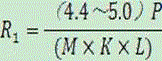
wherein M is the mass ratio of water to cement, P is the average length-diameter ratio of the machine-made sand, and L is the crushing value of the machine-made sand.
7. The ultra-high pumping concrete using machine-made sand as claimed in claim 1, wherein the organic fiber is any one or a mixture of any several of polyester fiber, acrylic fiber, nylon fiber and spandex fiber.
8. The ultra-high pumping concrete using machine-made sand as claimed in claim 7, wherein the organic fiber has an average length of 1 to 1.5mm and an aspect ratio of 20 to 30.
9. The ultra-high pumpable concrete using machine-made sand as claimed in claim 1, wherein said polystyrene microspheres have a particle size of 200-1500 mesh.
10. The method for preparing the ultra-high pumping concrete using the machine-made sand as claimed in any one of claims 1 to 9, which is characterized by comprising the following steps:
s1, mixing and stirring the machine-made sand and the coarse aggregate for 10-15S to obtain a mixed system I;
s2, adding cement, slag, fly ash and water accounting for 40-50% of the total amount of water into the mixed system I, and continuously stirring for 20-30S to obtain a mixed system II;
and S3, adding all the rest raw materials into the mixed system II, and continuously stirring for 50-60S to obtain the ultra-high pumping concrete.
Priority Applications (1)
| Application Number | Priority Date | Filing Date | Title |
|---|---|---|---|
| CN202111065067.XA CN113683353B (en) | 2021-09-11 | 2021-09-11 | Ultrahigh pumping concrete applying machine-made sand and preparation method thereof |
Applications Claiming Priority (1)
| Application Number | Priority Date | Filing Date | Title |
|---|---|---|---|
| CN202111065067.XA CN113683353B (en) | 2021-09-11 | 2021-09-11 | Ultrahigh pumping concrete applying machine-made sand and preparation method thereof |
Publications (2)
| Publication Number | Publication Date |
|---|---|
| CN113683353A CN113683353A (en) | 2021-11-23 |
| CN113683353B true CN113683353B (en) | 2022-06-17 |
Family
ID=78586060
Family Applications (1)
| Application Number | Title | Priority Date | Filing Date |
|---|---|---|---|
| CN202111065067.XA Active CN113683353B (en) | 2021-09-11 | 2021-09-11 | Ultrahigh pumping concrete applying machine-made sand and preparation method thereof |
Country Status (1)
| Country | Link |
|---|---|
| CN (1) | CN113683353B (en) |
Families Citing this family (2)
| Publication number | Priority date | Publication date | Assignee | Title |
|---|---|---|---|---|
| CN114378942A (en) * | 2022-01-17 | 2022-04-22 | 孙勇 | A kind of technological method of wet mixing ground mortar |
| CN117700175B (en) * | 2023-12-13 | 2024-07-09 | 广州兴业混凝土搅拌有限公司 | C130 high-strength machine-made sand concrete easy to pump at high altitudes and preparation method thereof |
Citations (6)
| Publication number | Priority date | Publication date | Assignee | Title |
|---|---|---|---|---|
| CN102153302A (en) * | 2010-11-29 | 2011-08-17 | 湖南振兴建材科技有限公司 | Method for producing modified mechanism sand and special admixture for dry-mixed mortar |
| CN102351449A (en) * | 2011-06-29 | 2012-02-15 | 合肥工业大学 | Nonionic surfactant-modified machine-made sand and preparation method thereof |
| CN108047395A (en) * | 2018-01-18 | 2018-05-18 | 安徽省交通控股集团有限公司 | A kind of Machine-made Sand cement concrete Special modifier |
| CN110655346A (en) * | 2019-09-29 | 2020-01-07 | 湖南中岩建材科技有限公司 | Machine-made sand regulator and preparation method thereof |
| CN110950571A (en) * | 2019-12-19 | 2020-04-03 | 深圳市君辰装饰设计工程有限公司 | Machine-made sand regulator |
| CN111153638A (en) * | 2020-01-08 | 2020-05-15 | 湖州三中混凝土有限公司 | C35 self-compacting concrete adopting machine-made sand and preparation method thereof |
Family Cites Families (1)
| Publication number | Priority date | Publication date | Assignee | Title |
|---|---|---|---|---|
| CN111377642B (en) * | 2018-12-31 | 2021-09-28 | 江苏苏博特新材料股份有限公司 | Multi-element adsorption polycarboxylate superplasticizer and preparation method and application thereof |
-
2021
- 2021-09-11 CN CN202111065067.XA patent/CN113683353B/en active Active
Patent Citations (6)
| Publication number | Priority date | Publication date | Assignee | Title |
|---|---|---|---|---|
| CN102153302A (en) * | 2010-11-29 | 2011-08-17 | 湖南振兴建材科技有限公司 | Method for producing modified mechanism sand and special admixture for dry-mixed mortar |
| CN102351449A (en) * | 2011-06-29 | 2012-02-15 | 合肥工业大学 | Nonionic surfactant-modified machine-made sand and preparation method thereof |
| CN108047395A (en) * | 2018-01-18 | 2018-05-18 | 安徽省交通控股集团有限公司 | A kind of Machine-made Sand cement concrete Special modifier |
| CN110655346A (en) * | 2019-09-29 | 2020-01-07 | 湖南中岩建材科技有限公司 | Machine-made sand regulator and preparation method thereof |
| CN110950571A (en) * | 2019-12-19 | 2020-04-03 | 深圳市君辰装饰设计工程有限公司 | Machine-made sand regulator |
| CN111153638A (en) * | 2020-01-08 | 2020-05-15 | 湖州三中混凝土有限公司 | C35 self-compacting concrete adopting machine-made sand and preparation method thereof |
Also Published As
| Publication number | Publication date |
|---|---|
| CN113683353A (en) | 2021-11-23 |
Similar Documents
| Publication | Publication Date | Title |
|---|---|---|
| CN111517718B (en) | Steel fiber high-strength concrete and preparation method thereof | |
| Luo et al. | Bonding and toughness properties of PVA fibre reinforced aqueous epoxy resin cement repair mortar | |
| CN107417221A (en) | Wear-resistant and crack-resistant cement-based self-leveling mortar and its production method | |
| CN111116132A (en) | Grouting material for combined structure and assembly type building node and preparation method thereof | |
| CN110655346A (en) | Machine-made sand regulator and preparation method thereof | |
| CN113004001A (en) | Superfluid steam-curing-free ultrahigh-performance concrete and preparation method thereof | |
| CN113683353A (en) | Ultrahigh pumping concrete applying machine-made sand and preparation method thereof | |
| CN111517714A (en) | A kind of ultra-high performance concrete containing coarse aggregate that is easy to pump and preparation method thereof | |
| CN112679162A (en) | Low-shrinkage ultrahigh-strength self-compacting concrete and preparation method thereof | |
| CN112830745A (en) | High-ductility repair mortar with micro-expansibility and preparation method thereof | |
| CN112408920A (en) | High-ductility ready-mixed fiber concrete and preparation method thereof | |
| CN111423147A (en) | Concrete glue reducing agent and preparation method thereof | |
| CN105645879A (en) | Preparation method of ultra-high-strength steel fiber reinforced concrete for super-high pumping | |
| CN113105179A (en) | Anti-cracking waterproof concrete and preparation method thereof | |
| CN112521088A (en) | Full-hole slag aggregate ultrahigh-performance concrete and preparation method thereof | |
| CN110734261A (en) | high-toughness cement-based composite material for injection and preparation method thereof | |
| CN116589215A (en) | Viscosity-reducing and anti-cracking material, improved high-strength bridge tower concrete and preparation method thereof | |
| KR102615392B1 (en) | PCC manufacturing method for self-healing cracks | |
| CN112897929B (en) | Slow-release polycarboxylate superplasticizer microsphere and preparation method thereof | |
| CN117923832A (en) | Binary composite fiber reinforced epoxy resin based rapid repair material and preparation method thereof | |
| EP3415482A1 (en) | Dry premixture for flexible concrete and method for its preparation and use thereof | |
| KR101222920B1 (en) | Manufacturing method of styrene-butadiene latex for very early strength modified concrete | |
| CN116514428B (en) | Molybdenum tailing powder artificial aggregate and preparation method and application thereof | |
| CN110981345A (en) | A kind of shotcrete and its construction method | |
| CN105271888A (en) | Modification additive suitable for low-quality aggregate concrete, and preparation method thereof |
Legal Events
| Date | Code | Title | Description |
|---|---|---|---|
| PB01 | Publication | ||
| PB01 | Publication | ||
| SE01 | Entry into force of request for substantive examination | ||
| SE01 | Entry into force of request for substantive examination | ||
| GR01 | Patent grant | ||
| GR01 | Patent grant |