CN1136801A - Reactor container, plant and process for production of sulfuric acid - Google Patents
Reactor container, plant and process for production of sulfuric acid Download PDFInfo
- Publication number
- CN1136801A CN1136801A CN95191033A CN95191033A CN1136801A CN 1136801 A CN1136801 A CN 1136801A CN 95191033 A CN95191033 A CN 95191033A CN 95191033 A CN95191033 A CN 95191033A CN 1136801 A CN1136801 A CN 1136801A
- Authority
- CN
- China
- Prior art keywords
- sulfuric acid
- tower
- contact
- reactor
- gas
- Prior art date
- Legal status (The legal status is an assumption and is not a legal conclusion. Google has not performed a legal analysis and makes no representation as to the accuracy of the status listed.)
- Pending
Links
Images


Classifications
-
- B—PERFORMING OPERATIONS; TRANSPORTING
- B01—PHYSICAL OR CHEMICAL PROCESSES OR APPARATUS IN GENERAL
- B01J—CHEMICAL OR PHYSICAL PROCESSES, e.g. CATALYSIS OR COLLOID CHEMISTRY; THEIR RELEVANT APPARATUS
- B01J19/00—Chemical, physical or physico-chemical processes in general; Their relevant apparatus
- B01J19/0053—Details of the reactor
-
- B—PERFORMING OPERATIONS; TRANSPORTING
- B01—PHYSICAL OR CHEMICAL PROCESSES OR APPARATUS IN GENERAL
- B01J—CHEMICAL OR PHYSICAL PROCESSES, e.g. CATALYSIS OR COLLOID CHEMISTRY; THEIR RELEVANT APPARATUS
- B01J19/00—Chemical, physical or physico-chemical processes in general; Their relevant apparatus
- B01J19/24—Stationary reactors without moving elements inside
- B01J19/245—Stationary reactors without moving elements inside placed in series
-
- C—CHEMISTRY; METALLURGY
- C01—INORGANIC CHEMISTRY
- C01B—NON-METALLIC ELEMENTS; COMPOUNDS THEREOF; METALLOIDS OR COMPOUNDS THEREOF NOT COVERED BY SUBCLASS C01C
- C01B17/00—Sulfur; Compounds thereof
- C01B17/69—Sulfur trioxide; Sulfuric acid
- C01B17/74—Preparation
- C01B17/76—Preparation by contact processes
- C01B17/80—Apparatus
- C01B17/806—Absorbers; Heat exchangers
-
- C—CHEMISTRY; METALLURGY
- C01—INORGANIC CHEMISTRY
- C01B—NON-METALLIC ELEMENTS; COMPOUNDS THEREOF; METALLOIDS OR COMPOUNDS THEREOF NOT COVERED BY SUBCLASS C01C
- C01B21/00—Nitrogen; Compounds thereof
- C01B21/20—Nitrogen oxides; Oxyacids of nitrogen; Salts thereof
- C01B21/24—Nitric oxide (NO)
- C01B21/26—Preparation by catalytic or non-catalytic oxidation of ammonia
- C01B21/28—Apparatus
-
- C—CHEMISTRY; METALLURGY
- C01—INORGANIC CHEMISTRY
- C01B—NON-METALLIC ELEMENTS; COMPOUNDS THEREOF; METALLOIDS OR COMPOUNDS THEREOF NOT COVERED BY SUBCLASS C01C
- C01B25/00—Phosphorus; Compounds thereof
- C01B25/16—Oxyacids of phosphorus; Salts thereof
- C01B25/18—Phosphoric acid
-
- B—PERFORMING OPERATIONS; TRANSPORTING
- B01—PHYSICAL OR CHEMICAL PROCESSES OR APPARATUS IN GENERAL
- B01J—CHEMICAL OR PHYSICAL PROCESSES, e.g. CATALYSIS OR COLLOID CHEMISTRY; THEIR RELEVANT APPARATUS
- B01J2219/00—Chemical, physical or physico-chemical processes in general; Their relevant apparatus
- B01J2219/00049—Controlling or regulating processes
- B01J2219/00051—Controlling the temperature
- B01J2219/00074—Controlling the temperature by indirect heating or cooling employing heat exchange fluids
- B01J2219/00087—Controlling the temperature by indirect heating or cooling employing heat exchange fluids with heat exchange elements outside the reactor
- B01J2219/00103—Controlling the temperature by indirect heating or cooling employing heat exchange fluids with heat exchange elements outside the reactor in a heat exchanger separate from the reactor
-
- B—PERFORMING OPERATIONS; TRANSPORTING
- B01—PHYSICAL OR CHEMICAL PROCESSES OR APPARATUS IN GENERAL
- B01J—CHEMICAL OR PHYSICAL PROCESSES, e.g. CATALYSIS OR COLLOID CHEMISTRY; THEIR RELEVANT APPARATUS
- B01J2219/00—Chemical, physical or physico-chemical processes in general; Their relevant apparatus
- B01J2219/00049—Controlling or regulating processes
- B01J2219/00051—Controlling the temperature
- B01J2219/00159—Controlling the temperature controlling multiple zones along the direction of flow, e.g. pre-heating and after-cooling
Landscapes
- Chemical & Material Sciences (AREA)
- Organic Chemistry (AREA)
- Inorganic Chemistry (AREA)
- Chemical Kinetics & Catalysis (AREA)
- Treating Waste Gases (AREA)
- Physical Or Chemical Processes And Apparatus (AREA)
- Drying Of Gases (AREA)
- Organic Low-Molecular-Weight Compounds And Preparation Thereof (AREA)
Abstract
提供了一个新型的化学反应容器(43),它适于用接触法生产硫酸的加工装置。它包括一个圆柱形体的塔,该塔被垂直的分隔壁分成至少两部分,通常是三个部分。第一部分都有一个进口和一个出口,底部的分隔壁有一个或几个开口以便于硫酸在不同部分之间进行可能接触。本发明的优点在于既可以干燥加工气体,而且可以在一个相同的反应器内进行程间吸收步骤和最后吸收步骤,而不是从前那样要用到三个反应器。这样就可以节省空间和原材料。进而提供了一种用接触生产硫酸的装置和方法。在这种装置和方法中包括如上所述的反应器。
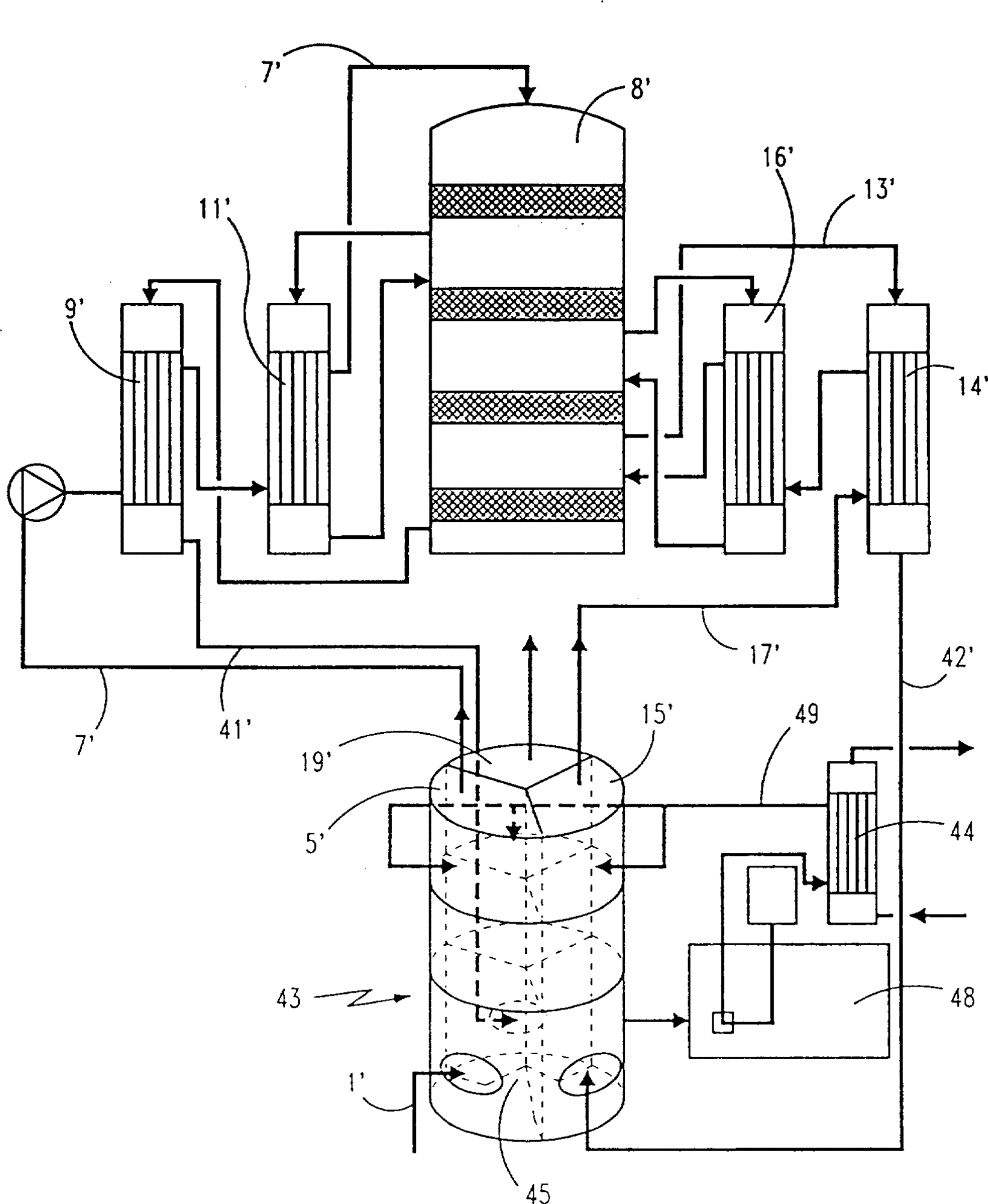
A novel chemical reaction vessel (43) is provided, suitable for a processing apparatus for producing sulfuric acid by contact process. It comprises a cylindrical tower divided into at least two, typically three, sections by vertical partition walls. Each section has an inlet and an outlet, and the bottom partition wall has one or more openings to allow possible contact between the different sections with sulfuric acid. An advantage of this invention is that it allows for the drying of process gases and the carrying out of-process absorption and final absorption steps within a single reactor, instead of requiring three reactors as before. This saves space and raw materials. Furthermore, an apparatus and method for producing sulfuric acid by contact process are provided. This apparatus and method include the reactor described above.
Description
本发明是关于基础硫酸生产的一种新型反应器和新型设备以及基础硫酸生产的新方法,此方法与所说的接触法有关。The present invention relates to a new reactor and new equipment for the production of basic sulfuric acid and a new method for the production of basic sulfuric acid, which method is related to the said contact method.
硫酸属于基本化学品,是许多其它产品的基础原料,例如盐酸、硫酸铝、硫酸铵、硫酸钙和过磷酸盐。因此,它在化学工业中占中心地位。Sulfuric acid is a basic chemical that is the basis for many other products such as hydrochloric acid, aluminum sulfate, ammonium sulfate, calcium sulfate and superphosphate. Therefore, it occupies a central place in the chemical industry.
生产硫酸有两种工业方法,即:接触法和铅室(leaden chamber)法。铅室法是最老的方法,几乎不再用了。There are two industrial methods for the production of sulfuric acid, namely: the contact method and the leaden chamber method. The lead chamber method is the oldest method and is hardly used anymore.
当根据接触法生产硫酸时,第一步开始于元素硫、含硫矿物和/或不纯净的硫酸。在前两种情况下,原料燃烧生成二氧化硫,其再氧化成三氧化硫,它根据最后产品浓度是94%,98%或发烟硫酸这一情况,而被不同浓度的硫酸吸收。氧化反应中的接触物质或催化剂通常是五氧化二矾与钾-铝硅酸盐或其它不熔物质的混合物。为进一步阐明通常所用的接触法,将参考图1进行描述。When producing sulfuric acid according to the contact process, the first step starts with elemental sulfur, sulfur-containing minerals and/or impure sulfuric acid. In the first two cases, the raw material is combusted to form sulfur dioxide, which is reoxidized to sulfur trioxide, which is absorbed by sulfuric acid of different concentrations, depending on whether the final product concentration is 94%, 98% or oleum. The contact material or catalyst in the oxidation reaction is usually a mixture of vanadium pentoxide and potassium-aluminosilicate or other infusible material. To further clarify the generally used contact method, description will be made with reference to FIG. 1 .
采用二氧化硫源的(未示出)原料二氧化硫流入管1中。SO2可通过与元素硫、黄铁矿或称之为硫化铁的矿精砂燃烧得到。在SO2通过管1以前,首先要冷却到40℃,放出的热量可用作例如产生蒸汽。管1与管2连接,来自于管2的干空气流与SO2混合,就可以通过稀释来调整适当的SO2浓度,以及为进行氧化反应而增加O2。这些空气是通过一个常规的空气过滤器4到达干燥塔3,在这里被浓硫酸干燥。在其底尾部,管1与干燥塔5接通,塔5中的温度保持在60℃-80℃之间,SO2和空气在干燥塔5内被硫酸干燥。干燥塔5填充的是一些如拉西环或弧鞍填料。在这些气体混合物流出干燥塔以前,还要经过除雾器6。Feed sulfur dioxide from a sulfur dioxide source (not shown) flows into
为避免在以后的加工步骤中产生H2SO4雾,从而造成对环境和设备的重大不利,干燥塔5是非常必要的。In order to avoid generating H2SO4 mist in the subsequent processing steps, which will cause major disadvantages to the environment and equipment , the
干燥后,气体混合物经过管7泵入一个接触塔或转化塔8中,在这里它与热催化剂(大约420℃)分几级接触,从而实现SO2转化成SO3。这个反应是强放热反应(大约100KS/mole转化的SO2),并且为了保持一个适当的温度水平,根据图1可看到,气体要通过一个热交换器,于是,流入的气体在热交换器9首先与来自于接触塔8底部的主要含有纯SO3的气体混合物进行热交换,从塔8底部出来的物流要经过管10。通过热交换器9,来自于管7的气体入流就可得到提高。为了进一步提高这些气体的温度,紧接着要让它通过第二个热交换器11,在这里与来自于接触塔的侧排出口12的气体进行热交换,通过热交换器11后,这些气体再重回到接触塔里,通常是进到同一级里。After drying, the gas mixture is pumped through line 7 into a contactor or
为了提高加热的经济性,物流13的一部分也可从接触塔8的较低的部位排出来,在热交换器14中冷却,然后再通过管42进入中间吸收塔15,在这里SO3可以被浓硫酸吸收,而SO2可通过热交换器14和16,经管17返回到接触塔8中,在热交换器14和16中,气体可在进到塔8以前得到预热。在后一个热交换器16中,气体是通过侧排出口18的物流进行预热,侧排出口18的物流经这个热交换器后再返回到接触塔的较低的部位。吸收塔15经常叫做“IPAT”,它表示“程间吸收塔”。In order to improve the economy of heating, a part of the
主要含有SO3、空气的产品物流在热交换器9中被冷却后,经过管41进入最后一个吸收塔19(经常叫做“FAT”表示“最后吸收塔”)。在此塔内SO3被浓硫酸吸收,主要为纯空气的物流通过顶部管20经过除雾器21除去可能存在的H2SO4后,排入大气里。塔19(以及塔15)通常填入陶瓷填料物如拉西环或弧鞍形填料。The product stream, mainly containing SO3 , air, is cooled in heat exchanger 9 and enters the last absorber 19 via line 41 (often called "FAT" for "final absorber"). In this tower, SO 3 is absorbed by concentrated sulfuric acid, and the stream that is mainly pure air passes through the
干燥塔5、程间吸按塔15和最后吸收塔19的任一个对浓硫酸来说都可连成一个独立的环路,这些环路相互连接。始于最后一个环路的浓硫酸从罐22中经过管23泵入最后吸收塔19中,并且与上升的SO3和空气混合物相遇,经过这里,硫酸中的水份与SO3结合,从而进一步增加了硫酸的浓度。根据水份多少,也可生产基本上无水的发烟硫酸。产品物流可经过管24再返回罐22中。因为在FAT中吸收反应是强放热反应,进来的硫酸物流在热交换器27中冷却,通常是水冷。Any one of the
浓硫酸(或发烟硫酸)的一部分经管26再转入第二个泵罐25。一般硫酸物流经连接管28和再循环管29,在泵罐和程间吸收塔之间进行循环。这部分物流也可通过热交换器30进行冷却。通过连接管31也要引入必要的水到泵罐25中,用来进行SO3的吸收。当然,所加的水量要与其它运行操数相适应,这决定着最后产品的浓度。A part of the concentrated sulfuric acid (or oleum) is transferred to the
一部分硫酸经管32从管28中排出,进入到与干燥塔5有关的环路中,所说的排出硫酸进到泵罐33,用来在干燥塔5中进行干燥的硫酸通过它进行循环。这部分硫酸经过一个管子进到干燥塔5的上部,并且形成向下流的物流(例如通过陶瓷填料物质),从而吸收那些可能存在的雾状物。经过这一步骤后,这部分硫酸经管子返回到泵罐33中。因为干燥过程是放热反应,所以反应放出高热量要用热交换器36冷却掉,也通常是用水冷。管34中的一部分硫酸通过管37进入汽提塔3中,在这里硫酸被冷却,而且进来的反应空气被加热,除此以外,由于可能存在的雾沫被吸收,所以还被预干燥。汽提塔3也可填入陶瓷填料如拉西环或弧鞍形填料。经过汽提塔3后,硫酸经过管38返回到泵罐25中。该物流的一部分通过管39排出作为产品物流,可能的话要经过热交换器40后排放出来。A part of sulfuric acid is discharged from
根据上面的描述,能很容易地建立起按接触法的常规硫酸厂,它需要大量设备如吸收塔、管子、泵、罐、热交换器。这些通常是用耐磨蚀的铁合金做的,它能承受与浓硫酸和发烟硫的长期接触。举例如,奥氏体钢“Sandvik SX”(注册商标)已经证明可用作硫酸生产装置中的组成材料。这种钢在GB-A-1534926中进一步被描述。然而,它相对来说比较贵,因此,希望减少这种材料的消费。进一步来说,装置相对来说庞大而且对空间也有要求,因此,希望减少工厂的面积。According to the above description, a conventional sulfuric acid plant by contact method can be easily established, which requires a lot of equipment such as absorption towers, pipes, pumps, tanks, heat exchangers. These are usually made of a corrosion-resistant iron alloy that can withstand prolonged contact with concentrated sulfuric acid and fuming sulfur. For example, the austenitic steel "Sandvik SX" (registered trademark) has proven useful as a constituent material in sulfuric acid production plants. Such steels are further described in GB-A-1534926. However, it is relatively expensive and, therefore, it is desirable to reduce the consumption of this material. Furthermore, the device is relatively bulky and requires space, so it is desirable to reduce the area of the factory.
因此,本发明的第一目的就是解决在一般的化工生产过程,特别是在以接触法为基础的硫酸生产装置中所用到的构成材料的消耗问题。Therefore, a first object of the present invention is to solve the problem of consumption of constituent materials used in general chemical production processes, particularly in contact-based sulfuric acid production plants.
本发明的第二目的是减少这些加工装置中必需的设备面积。A second object of the present invention is to reduce the necessary equipment area in these processing devices.
这些以及进一步的目的可通过包含权利要求6和7中的特征的方法和设备实现,为了说明但不是限制,本文将进一步参考附图进行描述,这些附图在下面有简要说明。These and further objects are achieved by a method and apparatus comprising the features of
图1是根据本技术领域的一个流程简图,上面已描述过。Fig. 1 is a schematic flow diagram according to the technical field, which has been described above.
图2是根据本发明的装置的流程图。Figure 2 is a flow diagram of the apparatus according to the invention.
图3是根据本发明的吸收塔的基本示意图,从上俯视看。Figure 3 is a basic schematic view of an absorption tower according to the invention, viewed from above.
图4是根据本发明的吸收塔剖面的基本示意图。Fig. 4 is a basic schematic diagram of a section of an absorption tower according to the present invention.
首先,在图2至图4中的相应部分具有同图1相同的标号,但有一上撇。First, corresponding parts in FIGS. 2 to 4 have the same reference numerals as in FIG. 1, but with a prime.
图2中有一个接触塔8′,它相应于图1的接触塔8,而且具有同样的结构。这个塔连有四个热交换器9′,11′,14′和16′,它们又依次相连接并且分别与接触塔连接,其方式与图1一样,因此,就不再描述了。In FIG. 2 there is a contact tower 8' which corresponds to the
本发明的基本特征在于用一个简单的多部分(multisectional)塔43取代了塔5,塔15和塔19三个塔,它将分成5′,15′和19′三部分进行描述。当然,这就能节省相当大量的结构材料,当它由昂贵的特种钢材构成时,这一点非常重要。而且,可节省大量的管子和其它设备。塔43的各部件被适当焊在一起,但用螺钉连接也很方便。The essential feature of the present invention is that the three
因此,根据本发明,产品气体的物流经过热交换器9′从接触塔8′到达FAT或多部分塔43的最后吸收部分19′的底部,在这里与逆流下流的浓硫酸相遇。根据本发明所提供的优选方案,可看到,这些硫酸来自于热交换器44,对三个部分来说都是一样的,同现有技术中的三个冷却器27,30,33一样优选水冷形式。这些硫酸从塔43底部泵入,在塔里它们可以自由流动,并且可以通过分隔壁46的下部的开口45,在三个截面之间自由流动。举例来说,这些开口可以在分隔壁底边与塔底47之间形成间隙,或者在分隔壁最低部分形成一个或几个小孔。硫酸在塔底部同时用作三股气流的水封,每一股都引入分开的开口50,并且在每一部分的顶部转向(见图4的51),而不让它们相互混合。塔43任一部分的硫酸通过泵罐48的泵打到冷却器44中。在其中冷却后,经过一个分支管49再返回到三个截面里。因此图1中的冷却器的数目可从3减少到唯一的一个。Thus, in accordance with the present invention, the product gas stream passes from the contacting column 8' through the heat exchanger 9' to the bottom of the final absorption section 19' of the FAT or multi-section column 43 where it encounters a countercurrent downflow of concentrated sulfuric acid. According to the preferred solution provided by the present invention, it can be seen that these sulfuric acids come from the
塔43中的各部分的基本结构示于图4。底部的52可部分用于收集硫酸,在硫酸液面之上是气体入口50。中间部分53用于装适当的填料,如拉西环、弧鞍形填料或一些如“Sandvik SX”(注册商标)的不锈钢结构的规整料。对FAT和IPAT两部分来说,上面部54是一个空的气体收集室,而空分干燥部分5′可一般填充常用的除沫材料。在部分53和54之间的液体分配器55的设置是为了使硫酸在整个截面上有一个水平的流入。例如这些分配器可包括一个径向主管,主管带有很多垂直分管,在它下面有很多小孔利于流出硫酸的均匀分布。The basic structure of each part in column 43 is shown in FIG. 4 . The bottom 52 can be used in part to collect sulfuric acid, above the sulfuric acid level is the
类似于图1,加工空气经管1′引入干燥部分5′的底部,并从其上部经管7泵入接触塔8′,通过换热器9′和11′时,气体被预热。Similar to Fig. 1, the process air is introduced into the bottom of the drying section 5' through the pipe 1', and is pumped into the contact tower 8' from the upper part through the pipe 7, and the gas is preheated when passing through the heat exchangers 9' and 11'.
从上面已清楚地看到,根据本文说明的一个多部分塔可节省材料和空间。根据两个优选方案可知,泵罐和冷却器的数量可依次从3个减少到1个,进一步表明比如在建一个工厂时,本发明在耗资和所要外形方面具有优越性。可用几种不同的结构材料,然而奥氏体质量的“Sandvix SX”(注册商标)已经证明在硫酸介质里具有特别的耐腐蚀性。From the above it is clear that a multi-part column according to the present description saves material and space. According to the two preferred solutions, the number of pump tanks and coolers can be reduced from 3 to 1 in turn, which further shows that the present invention is superior in terms of cost and desired shape, for example, when building a factory. Several different materials of construction are available, however the austenitic quality "Sandvix SX" (registered trade mark) has proven exceptional corrosion resistance in sulfuric acid media.
本发明已经根据优选方案进行描述,把三个塔(空气干燥塔、最后吸收塔和程间吸收塔)组合成一个塔。根据另一个合适的、然而不太优选的方案,它可能只把三个塔中的两个塔组成一个两部分的塔,第三个塔不受影响。根据此例,这个塔可分成两个非常相似的、半环形截面形状的两半。The invention has been described according to a preferred version, combining three towers (air drying tower, final absorption tower and interpass absorption tower) into one tower. According to another suitable, but less preferred solution, it is possible to combine only two of the three towers into a two-part tower, leaving the third tower unaffected. According to this example, the tower can be divided into two halves of very similar semi-circular cross-sectional shape.
本文确实根据硫酸生产进行了描述,然而,本发明所提供的塔可以在其它化工生产装置中的应用也不会有任何问题,如磷酸和硝酸的生产中。This paper is indeed described in terms of sulfuric acid production, however, the column provided by the present invention can be applied without any problem in other chemical production plants, such as phosphoric acid and nitric acid production.
Claims (11)
Applications Claiming Priority (2)
| Application Number | Priority Date | Filing Date | Title |
|---|---|---|---|
| SE9403471A SE502789C2 (en) | 1994-10-13 | 1994-10-13 | Process for the manufacture of sulfuric acid and apparatus for carrying out the process |
| SE9403471-7 | 1994-10-13 |
Publications (1)
| Publication Number | Publication Date |
|---|---|
| CN1136801A true CN1136801A (en) | 1996-11-27 |
Family
ID=20395581
Family Applications (1)
| Application Number | Title | Priority Date | Filing Date |
|---|---|---|---|
| CN95191033A Pending CN1136801A (en) | 1994-10-13 | 1995-10-03 | Reactor container, plant and process for production of sulfuric acid |
Country Status (10)
| Country | Link |
|---|---|
| US (1) | US5800788A (en) |
| EP (1) | EP0734353A1 (en) |
| JP (1) | JPH09507208A (en) |
| CN (1) | CN1136801A (en) |
| AU (1) | AU689330B2 (en) |
| CA (1) | CA2177841A1 (en) |
| NZ (1) | NZ294349A (en) |
| PL (1) | PL314951A1 (en) |
| SE (1) | SE502789C2 (en) |
| WO (1) | WO1996011876A1 (en) |
Cited By (3)
| Publication number | Priority date | Publication date | Assignee | Title |
|---|---|---|---|---|
| CN101706095B (en) * | 2009-09-02 | 2011-07-20 | 陈祥明 | Method for recovering acid making waste heat |
| CN102502529A (en) * | 2011-11-11 | 2012-06-20 | 王强斌 | Automatic control temperature-regulating acid-regulating water-regulating system in drying absorption contact sulfuric acid production |
| CN101801523B (en) * | 2007-09-25 | 2014-08-20 | 奥图泰有限公司 | Support ring for accommodating a plate-like element in a vessel |
Families Citing this family (17)
| Publication number | Priority date | Publication date | Assignee | Title |
|---|---|---|---|---|
| WO1998032523A1 (en) * | 1997-01-24 | 1998-07-30 | Kvaerner Pulping Oy | Flue gas scrubber |
| US7485454B1 (en) | 2000-03-10 | 2009-02-03 | Bioprocessors Corp. | Microreactor |
| RU2198840C2 (en) * | 2001-01-24 | 2003-02-20 | Открытое акционерное общество "Научно-исследовательский институт по удобрениям и инсектофунгицидам им. проф.Я.В.Самойлова" | Plant for production of sulfuric acid |
| RU2201393C1 (en) * | 2001-09-18 | 2003-03-27 | Открытое Акционерное Общество "Научно-Исследовательский Институт По Удобрениям И Инсектофунгицидам Им. Проф. Я.В. Самойлова" | Sulfur dioxide oxidation unit |
| US6936968B2 (en) * | 2001-11-30 | 2005-08-30 | Mule Lighting, Inc. | Retrofit light emitting diode tube |
| US20080197790A1 (en) * | 2002-12-11 | 2008-08-21 | Mangiaracina Anthony A | Lighting utilizing power over the ethernet |
| US20070189001A1 (en) * | 2002-12-11 | 2007-08-16 | Safeexits, Inc. | Multi-functional ballast and location-specific lighting |
| DE102004012293B4 (en) * | 2004-03-12 | 2016-09-08 | Outotec Oyj | Process and plant for the production of sulfuric acid |
| JP2007534601A (en) * | 2004-04-27 | 2007-11-29 | アルベマール・コーポレーシヨン | Cocurrent oxidation of sulfur dioxide and its use in the production of tetrabromophthalic anhydride. |
| US20080266849A1 (en) * | 2007-04-30 | 2008-10-30 | Nielson Lyman O | Fluorescent lighting conversion to led lighting using a power converter |
| ITPI20110018A1 (en) | 2011-02-21 | 2012-08-22 | Sime S R L | METHOD AND APPARATUS FOR THE SOFTENING AND / OR DEHYDRATION OF A GAS BASED ON HYDROCARBONS, IN PARTICULAR NATURAL GAS |
| MX2013011484A (en) * | 2011-04-06 | 2013-11-04 | Haldor Topsoe As | Process for production of sulphuric acid. |
| CN102228768B (en) * | 2011-06-15 | 2015-12-16 | 广西明利化工有限公司 | With phosphate adsorption dehumidifying and the device of dedusting air cleaning |
| RU2521626C1 (en) * | 2013-01-15 | 2014-07-10 | Открытое акционерное общество "Научно-исследовательский институт по удобрениям и инсектофунгицидам им. проф. Я.В. Самойлова" (ОАО "НИУИФ") | Apparatus for oxidising sulphur dioxide |
| JP2015054805A (en) * | 2013-09-13 | 2015-03-23 | 住友金属鉱山株式会社 | Method of drying sulfuric acid raw material gas |
| US10532929B2 (en) | 2016-05-03 | 2020-01-14 | Chemetics Inc. | Energy efficient sulfuric acid system for humid environments |
| CN118992984A (en) * | 2024-09-03 | 2024-11-22 | 金昌佰隆新材料有限公司 | Method and system for producing iron ore concentrate and co-producing sulfuric acid by using ferrous sulfate |
Family Cites Families (11)
| Publication number | Priority date | Publication date | Assignee | Title |
|---|---|---|---|---|
| BE538320A (en) * | 1954-07-17 | |||
| BE639992A (en) * | 1962-11-16 | |||
| DE1544066A1 (en) * | 1965-11-19 | 1970-02-26 | Linde Ag | Adsorption device |
| SE330003B (en) * | 1966-10-19 | 1970-11-02 | Boliden Ab | |
| DE1567716B2 (en) * | 1966-12-03 | 1977-02-17 | Metallgesellschaft Ag, 6000 Frankfurt | METHOD OF CATALYTIC REALIZATION OF SO LOW 2 AND SO LOW 3 AND SULFUR ACID PRODUCTION |
| BE758073A (en) * | 1969-10-28 | 1971-04-01 | Zieren Chemiebau Gmbh Dr A | PLANT FOR GAS DRYING AND SO3 ABSORPTION DURING THE MANUFACTURING OF SULFURIC ACID |
| DE2018761B2 (en) * | 1970-04-18 | 1972-09-28 | Chemiebau Dr. A. Zieren GmbH & Co KG, 5000 Köln | PLANT FOR THE PRODUCTION OF SULFURIC ACID |
| DE2711897C3 (en) * | 1977-03-18 | 1980-01-10 | Davy International Ag, 6000 Frankfurt | Process and device for the catalytic oxidation of gaseous sulfur compounds to sulfur trioxide |
| FR2527097A1 (en) * | 1982-05-21 | 1983-11-25 | Inst Francais Du Petrole | LONGITUDINAL REACTOR FOR CHEMICAL SYNTHESES IN GAS PHASE AND HETEROGENEOUS CATALYSIS |
| US4591494A (en) * | 1983-02-03 | 1986-05-27 | C-I-L | Method and apparatus for making sulphuric acid |
| US4591495A (en) * | 1985-08-29 | 1986-05-27 | C-I-L Inc. | Method and apparatus for making sulphuric acid |
-
1994
- 1994-10-13 SE SE9403471A patent/SE502789C2/en not_active IP Right Cessation
-
1995
- 1995-10-03 WO PCT/SE1995/001122 patent/WO1996011876A1/en not_active Ceased
- 1995-10-03 JP JP8513139A patent/JPH09507208A/en active Pending
- 1995-10-03 PL PL95314951A patent/PL314951A1/en unknown
- 1995-10-03 NZ NZ294349A patent/NZ294349A/en unknown
- 1995-10-03 US US08/656,227 patent/US5800788A/en not_active Expired - Fee Related
- 1995-10-03 CA CA002177841A patent/CA2177841A1/en not_active Abandoned
- 1995-10-03 CN CN95191033A patent/CN1136801A/en active Pending
- 1995-10-03 EP EP95934909A patent/EP0734353A1/en not_active Ceased
- 1995-10-03 AU AU37122/95A patent/AU689330B2/en not_active Ceased
Cited By (4)
| Publication number | Priority date | Publication date | Assignee | Title |
|---|---|---|---|---|
| CN101801523B (en) * | 2007-09-25 | 2014-08-20 | 奥图泰有限公司 | Support ring for accommodating a plate-like element in a vessel |
| CN101706095B (en) * | 2009-09-02 | 2011-07-20 | 陈祥明 | Method for recovering acid making waste heat |
| CN102502529A (en) * | 2011-11-11 | 2012-06-20 | 王强斌 | Automatic control temperature-regulating acid-regulating water-regulating system in drying absorption contact sulfuric acid production |
| CN102502529B (en) * | 2011-11-11 | 2013-06-05 | 王强斌 | Automatic control temperature-regulating acid-regulating water-regulating system in drying absorption contact sulfuric acid production |
Also Published As
| Publication number | Publication date |
|---|---|
| AU3712295A (en) | 1996-05-06 |
| SE9403471D0 (en) | 1994-10-13 |
| US5800788A (en) | 1998-09-01 |
| CA2177841A1 (en) | 1996-04-25 |
| WO1996011876A1 (en) | 1996-04-25 |
| SE9403471L (en) | 1996-01-15 |
| PL314951A1 (en) | 1996-09-30 |
| NZ294349A (en) | 1997-02-24 |
| SE502789C2 (en) | 1996-01-15 |
| EP0734353A1 (en) | 1996-10-02 |
| JPH09507208A (en) | 1997-07-22 |
| AU689330B2 (en) | 1998-03-26 |
Similar Documents
| Publication | Publication Date | Title |
|---|---|---|
| AU689330B2 (en) | Reactor container, plant and process for the production of sulfuric acid | |
| US3780499A (en) | System for the liquid-phase removal of a component from the gas stream especially the absorption of sulfur trioxide in sulfuric acid | |
| CA1256671A (en) | Heat recovery from concentrated sulfuric acid | |
| CA1158415A (en) | Process for the preparation of sulfuric acid | |
| KR20020074466A (en) | Method for producing high-purity sulphuric acid | |
| US3950493A (en) | Process for absorbing SO3 | |
| CN1140447C (en) | method of concentrating sulfuric acid | |
| US20050002852A1 (en) | Process and apparatus for scrubbing sulfur dioxide from flue gas and conversion to fertilizer | |
| JP2019537606A (en) | Integrated process and plant for the production of urea and UAS (urea-ammonium sulfate) mixtures | |
| FI67833C (en) | FOERFARANDE FOER FRAMSTAELLNING AV SVAVELSYRA | |
| US4654205A (en) | Sulphur trioxide absorption apparatus and process | |
| CA1196473A (en) | Apparatus and processes for the concentration of sulphuric acid | |
| EP3140253B1 (en) | Process and plant for the production of sulfuric acid | |
| CN101848857A (en) | Process and plant for producing sulfuric acid | |
| EP3060518B1 (en) | Process for operating a sulfuric acid plant | |
| WO2021219733A1 (en) | Absorption column comprising a feed box having a serrated weir and a structured packing and process for the production of nitric acid | |
| US3780166A (en) | Process of catalytically reacting so2 to form so3 and of producing sulfuric acid | |
| US3389960A (en) | Process for producing strong nitric acid | |
| JPH02160020A (en) | How to remove sulfur dioxide and hydrogen chloride from hot gases | |
| EP0224340B1 (en) | Sulphur trioxide absorption tower and process | |
| CA1254365A (en) | Sulphur trioxide absorption tower and process | |
| WO2003037790A2 (en) | Process and apparatus for producing sulfuric acid | |
| US20250313468A1 (en) | Tail gas treatment system and method for a sulfuric acid production plant | |
| CN109052332B (en) | Method for preparing chlorosulfonic acid by regenerating high-COD (chemical oxygen demand) saline dilute acid | |
| SU1237635A1 (en) | Method of producing copper vitriol |
Legal Events
| Date | Code | Title | Description |
|---|---|---|---|
| C06 | Publication | ||
| PB01 | Publication | ||
| C10 | Entry into substantive examination | ||
| SE01 | Entry into force of request for substantive examination | ||
| C01 | Deemed withdrawal of patent application (patent law 1993) | ||
| WD01 | Invention patent application deemed withdrawn after publication | ||
| REG | Reference to a national code |
Ref country code: HK Ref legal event code: GR Ref document number: 1014843 Country of ref document: HK |