Disclosure of Invention
In view of the above, it is necessary to provide an image retrieval method, an image retrieval apparatus, a computer device, and a storage medium for solving the technical problems of low efficiency and high error susceptibility of the existing manual search.
An image retrieval method comprises the steps of scanning an express bill to obtain pictures, collecting the pictures to form a picture library, and dividing the pictures in the picture library into a training picture set and a test picture set; extracting object feature vectors and attribute information of the training picture set based on a ResNet50 convolutional neural network; building and training a Faiss model, optimizing the Faiss model, inputting the object feature vector and attribute information into the Faiss model, calculating the similarity, screening out 1 to 10 most similar pictures and outputting the pictures; checking the effect of the training Faiss model by using the test picture set, and stopping model training if the effect meets a preset requirement to obtain a measurement model; and acquiring a picture sent by a client, inputting the picture, searching by applying the measurement model, outputting 1-10 pictures which are most similar to the searched picture in the picture library, and matching to obtain a corresponding article name and a corresponding serial number.
In one embodiment, the building and training a Faiss model, optimizing the Faiss model, inputting the object feature vector and attribute information into the Faiss model, calculating similarity, screening out 1 to 10 most similar pictures, and outputting the pictures includes: acquiring the object feature vector and attribute information; compressing and encoding the object feature vectors and the attribute information to generate a sub-cluster center; calculating the distance of the sub-cluster centers and traversing the training pictures according to the sequence of the batch, each subspace of the current query sample and the query sample; judging whether all the subspaces are traversed or not, if so, generating a query index, and if not, continuing traversing; traversing and comparing the query index with local index sets in an index database one by one; and judging whether the local index set is traversed or not, if so, calculating the nearest distance, outputting indexes in the index base with the 1 to 10 nearest distances, and if not, continuing to traverse.
In one embodiment, the building and training a Faiss model, optimizing the Faiss model, inputting the object feature vector and attribute information into the Faiss model, calculating similarity, screening out 1 to 10 most similar pictures, and outputting the pictures includes: acquiring the object feature vector and attribute information; marking the object characteristic vectors and attribute information, compressing and encoding the object characteristic vectors, and generating a sample class center by using a clustering algorithm; matching the corresponding sample class center according to the query characteristics, and calculating residual error characteristics; calculating the center distance of the sub-clusters according to the residual error characteristics; judging whether the prime subspace is traversed or not according to the clustering center distance, if so, generating a query residual index, and if not, continuing to traverse; traversing and comparing the query residual indexes with training residual index sets of the same category one by one; and judging whether the training residual index sets of the same category are traversed or not, if so, calculating the nearest distance, outputting indexes in the index base with 1 to 10 nearest distances, and if not, continuing to traverse.
In one embodiment, the extracting the object feature vectors and the attribute information of the training picture set based on the ResNet50 convolutional neural network further comprises: preprocessing the acquired picture, screening and extracting an effective data sample; carrying out data enhancement operation on the imbalance of the picture samples; and adjusting the ResNet50 convolutional neural network, and extracting weight parameters for pre-training the ResNet50 convolutional neural network as initial values for transfer learning.
In one embodiment, the adjusting the ResNet50 convolutional neural network comprises: setting the convolution kernel size in the first layer of convolution layer to be 7 multiplied by 7, stride to be 4, channel number to be 64 and activation function to be Relu; setting the core size of a Max pool layer to be 3 multiplied by 3 and stride to be 2; adding a layer of 2 × 2 average pooling layer integrated space information before downsampling the 1 × 1 convolution kernel of the residual module stride ═ 2.
In one embodiment, the adjusting the ResNet50 convolutional neural network comprises: adding a 64-dimensional 1 × 1 convolutional layer at the output of the 1 st bottleeck residual structure of chunk 1 across the 1 st bottleeck residual structure connected to chunk 4; adding a 128-dimensional 1 x 1 convolutional layer at the output of the 2 nd bottleck residual structure of chunk 1 spans the 2 nd bottleck residual structure connected to chunk 4.
An image retrieval apparatus comprising: the system comprises an acquisition module, a test module and a processing module, wherein the acquisition module is used for acquiring pictures by scanning an express bill, collecting the pictures to form a picture library, and dividing the pictures in the picture library into a training picture set and a test picture set; the extraction module is used for extracting the object feature vectors and the attribute information of the training picture set based on a ResNet50 convolutional neural network; building and training a Faiss model, optimizing the Faiss model, inputting the object feature vector and attribute information into the Faiss model, calculating the similarity, screening out 1 to 10 most similar pictures and outputting the pictures; the test module is used for testing the Faiss model effect of the training by using the test picture set, and stopping the model training if the effect meets the preset requirement to obtain a measurement model; and the matching module is used for acquiring a picture sent by a client, inputting the picture, searching by applying the measurement model, outputting 1 to 10 pictures which are most similar to the searched picture in the picture library, and matching to obtain a corresponding article name and a corresponding serial number.
In one embodiment, the building module comprises: the obtaining submodule is used for obtaining the characteristic vector and the attribute information of the object; the generating submodule is used for compressing and coding the object feature vector and the attribute information and generating a sub-clustering center; the traversal submodule is used for calculating the distance of the sub-cluster center and traversing the training pictures according to the sequence of the batch, each subspace of the current query sample and the query sample; the judgment sub-module is used for judging whether all the subspaces are traversed or not, if so, generating a query index, and if not, continuing traversing; the comparison submodule is used for traversing and comparing the query index with local index sets in an index library one by one; and the output submodule is used for judging whether the local index set is traversed or not, if so, calculating the nearest distance, outputting indexes in the index base with the 1 to 10 nearest distances, and if not, continuing to traverse.
A computer device comprising a memory and a processor, the memory having stored therein computer readable instructions which, when executed by the processor, cause the processor to perform the steps of the image retrieval method described above.
A storage medium having stored thereon computer-readable instructions which, when executed by one or more processors, cause the one or more processors to perform the steps of the image retrieval method described above.
According to the image retrieval method, the image retrieval device, the computer equipment and the storage medium, the images are obtained by scanning the express bill, the images are collected to form an image library, and the images in the image library are divided into a training image set and a test image set; extracting object feature vectors and attribute information of the training picture set based on a ResNet50 convolutional neural network; building and training a Faiss model, optimizing the Faiss model, inputting the object feature vector and attribute information into the Faiss model, calculating the similarity, screening out 1 to 10 most similar pictures and outputting the pictures; checking the effect of the training Faiss model by using the test picture set, and stopping model training if the effect meets a preset requirement to obtain a measurement model; and acquiring a picture sent by a client, inputting the picture, searching by applying the measurement model, outputting 1-10 pictures which are most similar to the searched picture in the picture library, and matching to obtain a corresponding article name and a corresponding serial number. After the technical scheme is adopted, the image searching technology is utilized to train and optimize the Faiss model, when searching headless articles, the object images needing to be searched are directly input, the matched headless article images are found out in the image library through the model, the corresponding article names, serial numbers and the like are obtained, the articles are searched in the problem article warehouse after verification, and the articles are packaged again and sent to the receiver, so that the accuracy rate of the whole process is high, the speed is high, a large amount of labor cost is reduced, and meanwhile, the Faiss model is better served for vast consumers.
Detailed Description
In order to make the objects, technical solutions and advantages of the present invention more apparent, the present invention is described in further detail below with reference to the accompanying drawings and embodiments. It should be understood that the specific embodiments described herein are merely illustrative of the invention and are not intended to limit the invention.
As used herein, the singular forms "a", "an", "the" and "the" include plural referents unless the context clearly dictates otherwise. It will be further understood that the terms "comprises" and/or "comprising," when used in this specification, specify the presence of stated features, integers, steps, operations, elements, and/or components, but do not preclude the presence or addition of one or more other features, integers, steps, operations, elements, components, and/or groups thereof.
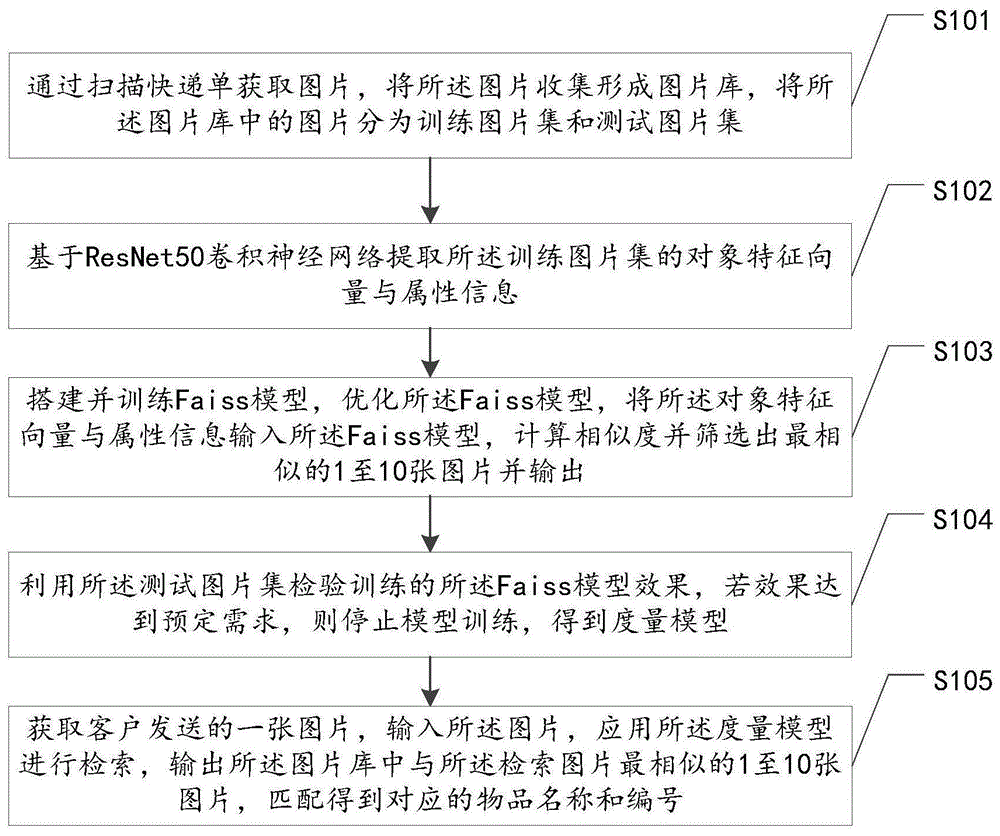
As shown in fig. 1, in one embodiment, an image retrieval method is proposed, which includes:
step S101, scanning an express bill to obtain pictures, collecting the pictures to form a picture library, and dividing the pictures in the picture library into a training picture set and a test picture set;
and collecting pictures of the existing headless module picture library, randomly dividing the pictures into a training picture set and a test picture set, and suggesting that the test picture set has a small occupation ratio. For example, the image data set is divided into a training picture set and a test picture set in turn at a ratio of 80% to 20%.
Step S102, extracting object characteristic vectors and attribute information of a training picture set based on a ResNet50 convolutional neural network;
the image feature extraction method based on the deep learning is an image feature extraction algorithm adopting the depth features. The depth feature is a feature vector obtained by performing feature extraction on original image data by a Convolutional Neural Network (CNN) model. The deep convolutional network model has strong expression capability and avoids heavy and complex manual characteristic customization flow. With the gradual improvement of hardware performance and the continuous optimization of model calculation, compared with the manual customized features generated by a feature extraction algorithm, the depth features are excellent in performance index accuracy and recall rate based on content image retrieval (CBIR) after being processed by the same index retrieval algorithm.
Step S103, a Faiss model is built and trained, the Faiss model is optimized, the characteristic vectors and the attribute information of the object are input into the Faiss model, the similarity is calculated, and 1 to 10 most similar pictures are screened out and output;
faiss is a clustering and similarity-oriented search library open to Facebook AI research team, which contains a new algorithm that searches through a set of vectors of arbitrary size until it may not fit in RAM. It also contains support code for evaluation and parameter adjustment. Faiss is written in C + +, with a complete encapsulation of Python/numpy, and uses the GPU to achieve higher memory bandwidth and computational throughput.
At the heart of Faiss is the concept of an index (index), which encapsulates a set of vectors and can choose whether to pre-process or not, helping to efficiently retrieve the vectors. There are several types of indices for Faiss, for example the simplest index type indexFlatL2, which is brute force retrieval based on the L2 distance (euclidean distance). Regardless of what type of index is built, all index builds require knowledge of the dimension d of the operation data, where d is 2048. For most index types, a training phase is included at the time of setup, and the distribution of vectors is analyzed based on a training set, but the index of L2 can be skipped. When the index is built and trained, add can be called, search two methods. If too many vectors are present, the search time will be longer by means of the brute force search index indexflat 2, and a method of speeding up the search indexivflat (inverted file) may also be used. The starting point is to establish cluster centers using k-means, then by querying the nearest cluster center, then comparing all vectors in the cluster to get similar vectors. The two index types, faiss. indexflatl2 (euclidean distance) and faiss. indexflatip (inner product), may also be selected using an exact search. The latter is used in the present invention. And converting the characteristic vector obtained in the last step into a matrix, calling a Faiss. IndexFlatIP () function, outputting a corresponding index value and similarity, and then carrying out model training.
Step S104, checking the effect of the trained Faiss model by using the test picture set, and stopping model training to obtain a measurement model if the effect meets the preset requirement;
and (3) performing headless retrieval on the pictures of the test set by applying the optimized Faiss model, outputting 10 pictures which are most similar to the pictures in the existing picture library (wherein 0 to 10 can be set by self), testing the effect of the existing model, and continuing optimization if the effect is not good.
And step S105, acquiring a picture sent by a client, inputting the picture, searching by using a measurement model, outputting 1 to 10 pictures which are most similar to the searched picture in a picture library, and matching to obtain a corresponding article name and a corresponding serial number.
When a picture is sent by a client, inputting the picture, performing headless retrieval by using a Faiss model, outputting 10 pictures which are most similar to the picture in the existing picture library), obtaining the name, the number and the like of the corresponding article, searching the article in a problem article warehouse after verification, repackaging and sending the article to a receiver.
In one embodiment, as shown in fig. 2, building and training a Faiss model, optimizing the Faiss model, inputting the object feature vector and attribute information into the Faiss model, calculating similarity, screening out 1 to 10 most similar pictures, and outputting the pictures includes:
step S201, obtaining object characteristic vectors and attribute information;
to extract object feature vectors and attribute information of the target object based on the target image. Since the target image contains the target object, the object feature vector and the attribute information of the target object in the target image can be extracted, wherein the object feature vector can be the feature vector of the target object, and the attribute information is other related information of the target object in the target image, such as information of a target object delivery point, a site where the target object is located, and the like.
Step S202, compressing and coding the object characteristic vector and the attribute information to generate a sub-cluster center;
the PQ algorithm performs codebook (clustering) training at the index construction (data training) stage of the algorithm, compresses and encodes a feature data set of a training sample, and generates an index. The CBIR feature extraction method obtains a feature vector set X of N training samples. And (3) assuming that the dimension of the characteristic vector is omega, dividing the vector dimension omega into P sub-vectors, and performing K-Means clustering on the sub-vector groups belonging to the same sub-dimension space to generate a sub-clustering center (codebook center).
Step S203, calculating the distance of the clustering centers and traversing the training pictures according to the sequence of the batch, each subspace of the current query sample and the query sample;
faiss is a code implementation of approximate search of Facebook open source, and there are some imperfect implementation places, for example, when the number of segments is large, the calculation order may seriously affect the search performance due to the limitation of L1 cache size when the Product Quantization algorithm (Product Quantization algorithm) is used. In addition, the original implementation only carries out cyclic expansion when the number of the segments is a multiple of 4, and the method has no universality, so that the method is optimized. Firstly, optimizing a calculation sequence, calculating the distance of the clustering centers, and traversing the training pictures according to the sequence of the batch, each subspace of the current query sample and the query sample. And then optimizing loop expansion, and expanding the original loop expansion only aiming at the multiple of the number of the sections to the realization of all the sections, so that the realization has better applicability.
Step S204, judging whether all the subspaces are traversed or not, if so, generating a query index, and if not, continuing traversing;
and optimizing the loop expansion, and expanding the original loop expansion only aiming at the multiple of the number of the sections to the realization of all the sections, so that the realization has better applicability.
Step S205, the query index and the local index set in the index database are traversed and compared one by one;
and step S206, judging whether the local index set is traversed or not, if so, calculating the nearest distance, outputting indexes in the index base with 1 to 10 nearest distances, and if not, continuing traversing.
The PQ algorithm performs codebook (clustering) training at the index construction (data training) stage of the algorithm, compresses and encodes a feature data set of a training sample, and generates an index. The CBIR feature extraction method obtains a feature vector set X of N training samples. And (3) assuming that the dimension of the characteristic vector is omega, dividing the vector dimension omega into P sub-vectors, and performing K-Means clustering on the sub-vector groups belonging to the same sub-dimension space to generate a sub-clustering center (codebook center). Setting the number of the sub-cluster centers as M, and taking decimal numbers between 1 and M as the serial numbers of the cluster centers. Furthermore, each sub-vector of all sample feature vectors is marked with the nearest cluster center number in the corresponding sub-dimension space. Finally, compression coding is carried out by taking the characteristic vector as a unit, and compression coding is carried out according to the ID number of the corresponding nearest decimal number clustering center marked by each sub-vector so as to generate an index. At this point, the quantization coding of the training feature vector set is completed. After obtaining the external retrieval request, carrying out the same feature extraction on the query sample to obtain a query feature vector. Secondly, according to the process of processing the training feature vectors, dividing the query feature vectors into sub-segments with the same number, and carrying out quantitative coding through a sub-cluster center generated by a previous training feature vector set to generate a query index; and finally, traversing and comparing the query index with local index sets in the index library one by one, calculating the closest distance according to the Hamming distance, selecting indexes in the index libraries with the Top10 closest distances, and returning the indexes serving as retrieval results.
In one embodiment, as shown in fig. 3, building and training a Faiss model, optimizing the Faiss model, inputting the object feature vector and attribute information into the Faiss model, calculating similarity, screening out 1 to 10 most similar pictures, and outputting the pictures includes:
step S301, obtaining object characteristic vectors and attribute information;
to extract object feature vectors and attribute information of the target object based on the target image. Since the target image contains the target object, the object feature vector and the attribute information of the target object in the target image can be extracted, wherein the object feature vector can be the feature vector of the target object, and the attribute information is other related information of the target object in the target image, such as information of a target object delivery point, a site where the target object is located, and the like.
Step S302, marking object characteristic vectors and attribute information, compressing and encoding the object characteristic vectors, and generating a sample class center by using a clustering algorithm;
step S303, matching a corresponding sample class center according to the query characteristics, and calculating residual error characteristics;
contrary to the forward Index, the reverse Index also generates document IDs and data contents for each file, and performs segmentation, but after obtaining keywords, the reverse Index also performs entry ID numbering on the keywords, and forms an Index table (Lexicon) by using the entry ID numbers as key value indexes (Index Term). The key point of the inverted index is to record position Information (position Information) such as document ID set and corresponding hit address appearing in each keyword in each index, and in addition, the position Information also comprises conventional statistical Information such as word order and word frequency. During retrieval and query, the input data is subjected to word segmentation to obtain entry ID numbers, matching query is only carried out in indexes corresponding to the entry IDs, so that nonlinear search query is realized, and finally corresponding documents are given as retrieval results according to position information and statistical information in a certain measurement mode and a sorting algorithm. The document may be queried based on the key value.
Step S304, calculating the center distance of the sub-clusters according to the residual error characteristics;
step S305, judging whether the prime subspace is traversed or not according to the clustering center distance, if so, generating a query residual index, and if not, continuing to traverse;
and (4) realizing the modified PQ index retrieval algorithm by using a Faiss framework. The CBIR adopting the improved PQ index retrieval algorithm needs to index and store specific sensitive data under the condition of not reconstructing an index database or dynamically add and delete data of the index database in real time. In order to avoid high operation and maintenance cost and time consumption caused by retraining the algorithm and constructing the index database and consider the optimization requirements of RAM read-write storage and GPU calculation acceleration, the invention adopts a Faiss framework to realize the CBIR large-scale index retrieval algorithm for improving the PQ codes, and meets the three requirements of dynamic addition and deletion of data of the index database, RAM storage expansion of the index database and GPU optimization calculation of index retrieval, so as to reduce the operation and maintenance complexity of the index database and improve the algorithm efficiency. The data flow of the external retrieval request is tracked, and the CBIR processing flow based on the Faiss framework can be subdivided into the following steps of data preprocessing, depth feature extraction, index generation by compression coding, index storage and addition and deletion, retrieval and result callback.
Step S306, traversing and comparing the query residual indexes with training residual index sets of the same category one by one;
the depth residual error network ResNet allows the network to be deepened as much as possible, but the depth residual error network ResNet directly sends a part of data in input to output without passing through a convolution network, and keeps a part of original information. The ResNet network can add deeper convolutional layer lifting effects, wherein the structure of the residual block plays a key role.
And step S307, judging whether the training residual index sets of the same category are traversed or not, if so, calculating the nearest distance, outputting indexes in the index base with the 1 to 10 nearest distances, and if not, continuously traversing.
The PQ algorithm is improved by utilizing the inverted index, and the improved product quantization coding algorithm of the inverted index is applied, so that the large-scale index retrieval requirement of CBIR is met. Before the index of the query feature and the index database of the training feature set are established, the training features of a region of interest (ROI) are quickly marked and distinguished by carrying out coarse clustering on the training feature set, namely sample clustering. When searching and inquiring, the inquiring characteristics only carry out index searching and inquiring with the training characteristic set of the same rough clustering center, traverse partial indexes in the index database in a nonlinear searching mode and calculate the distance and the sequence, thereby achieving the purposes of reducing the calculation amount and reducing the time consumption.
In one embodiment, extracting the object feature vectors and the attribute information of the training picture set based on the ResNet50 convolutional neural network further comprises:
step S401, preprocessing the acquired picture, screening and extracting an effective data sample;
step S402, carrying out data enhancement operation on the unbalance of the picture samples;
and preprocessing the data set, and cutting and enhancing the data sample to generate a model training set.
And step S403, adjusting the ResNet50 convolutional neural network, and extracting the weight parameters of the pretrained ResNet50 convolutional neural network as initial values for transfer learning.
In one embodiment, adjusting the ResNet50 convolutional neural network comprises:
step S501, setting the size of a convolution kernel in the first layer of convolution layer to be 7 multiplied by 7, stride to be 4, the number of channels to be 64 and an activation function to Relu;
step S502, setting the core size of a Max pool layer to be 3 multiplied by 3 and stride to be 2;
the ResNet network layer 1 passes through the 10 x 10 convolutional layer, the sensing view is large, and the image extraction characteristics in the ImageNet database are sufficient, but in the invention, the express single fouling condition is complex and most of fouling are very small, and more effective fine characteristics need to be extracted for more accurately classifying the fouling points, so that the invention improves the layer 1 layer 10 x 10 convolutional layer during network design, and is more suitable for the fouling point detection characteristic extraction task. In the design of the invention, the 10 × 10 convolutional layers are replaced by 7 × 7 stacked convolutional layers, so that on one hand, the convolutional layers use more nonlinear activation functions, and the decision function has more decision; on the other hand, the number of calculation parameters is effectively reduced, and if the size of the characteristic diagram of the input and the output of the convolution layer is the same as Z, a 7 x 7 convolution layer improves the layer 1 of the network under the condition of not changing the initial receptive field, and can bring better performance to the fouling detection. Adding a layer of 2 × 2 average pooling layer integrated space information before downsampling the 1 × 1 convolution kernel of the residual module stride ═ 2. In the problem of contamination detection, the contamination occupies a small area of the whole image, the proportion of the acquired information is small, and in order to avoid useless information redundancy, a layer of 2 × 2 average pooling layer is added to integrate spatial information before downsampling is carried out on a 1 × 1 convolution kernel of a residual module stride 2, the average pooling layer has no parameters, the global parameter number is not changed, meanwhile, overfitting can be prevented from occurring on the layer, the calculated amount is reduced, and meanwhile, the detection speed is improved.
In one embodiment, adjusting the ResNet50 convolutional neural network comprises:
step S601, adding a 64-dimensional 1 x 1 convolution layer to the output of the 1 st bottleeck residual structure of the chunk 1 to span the 1 st bottleeck residual structure connected to the chunk 4;
step S602, add a 128-dimensional 1 × 1 convolutional layer on the output of the 2 nd bottleck residual structure of chunk 1 across the 2 nd bottleck residual structure connected to chunk 4.
The Xception Module combines a depth separable convolution and basic residual error Module Bottleneeck residual error structure, and a network model is continuously deepened through a residual error learning unit, so that rich semantic features are extracted, the parameters of the model can be reduced under the condition of ensuring the precision, and the operation cost is reduced. Meanwhile, the multi-scale fusion of the network has a better effect, and after the characteristic extraction and fusion of the modules, the interaction of high and low resolution has better result output.
In one embodiment, as shown in fig. 4, there is provided an image retrieval apparatus including: the system comprises an acquisition module, a test module and a processing module, wherein the acquisition module is used for acquiring pictures by scanning an express bill, collecting the pictures to form a picture library, and dividing the pictures in the picture library into a training picture set and a test picture set; the extraction module is used for extracting the object feature vectors and the attribute information of the training picture set based on a ResNet50 convolutional neural network; building and training a Faiss model, optimizing the Faiss model, inputting the object feature vector and attribute information into the Faiss model, calculating the similarity, screening out 1 to 10 most similar pictures and outputting the pictures; the test module is used for testing the Faiss model effect of the training by using the test picture set, and stopping the model training if the effect meets the preset requirement to obtain a measurement model; and the matching module is used for acquiring a picture sent by a client, inputting the picture, searching by applying the measurement model, outputting 1 to 10 pictures which are most similar to the searched picture in the picture library, and matching to obtain a corresponding article name and a corresponding serial number.
In one embodiment, as shown in fig. 5, the building module includes: the obtaining submodule is used for obtaining the characteristic vector and the attribute information of the object; the generating submodule is used for compressing and coding the object feature vector and the attribute information and generating a sub-clustering center; the traversal submodule is used for calculating the distance of the sub-cluster center and traversing the training pictures according to the sequence of the batch, each subspace of the current query sample and the query sample; the judgment sub-module is used for judging whether all the subspaces are traversed or not, if so, generating a query index, and if not, continuing traversing; the comparison submodule is used for traversing and comparing the query index with local index sets in an index library one by one; and the output submodule is used for judging whether the local index set is traversed or not, if so, calculating the nearest distance, outputting indexes in the index base with the 1 to 10 nearest distances, and if not, continuing to traverse.
In one embodiment, a computer device is provided, comprising a memory and a processor, the memory having stored therein computer-readable instructions which, when executed by the processor, cause the processor to perform the following steps when executing the computer-readable instructions: scanning an express bill to obtain pictures, collecting the pictures to form a picture library, and dividing the pictures in the picture library into a training picture set and a test picture set; extracting object feature vectors and attribute information of the training picture set based on a ResNet50 convolutional neural network; building and training a Faiss model, optimizing the Faiss model, inputting the object feature vector and attribute information into the Faiss model, calculating the similarity, screening out 1 to 10 most similar pictures and outputting the pictures; checking the effect of the training Faiss model by using the test picture set, and stopping model training if the effect meets a preset requirement to obtain a measurement model; and acquiring a picture sent by a client, inputting the picture, searching by applying the measurement model, outputting 1-10 pictures which are most similar to the searched picture in the picture library, and matching to obtain a corresponding article name and a corresponding serial number.
In one embodiment, the building and training a Faiss model, optimizing the Faiss model, inputting the object feature vector and attribute information into the Faiss model, calculating similarity, screening out 1 to 10 most similar pictures, and outputting the pictures includes: acquiring the object feature vector and attribute information; compressing and encoding the object feature vectors and the attribute information to generate a sub-cluster center; calculating the distance of the sub-cluster centers and traversing the training pictures according to the sequence of the batch, each subspace of the current query sample and the query sample; judging whether all the subspaces are traversed or not, if so, generating a query index, and if not, continuing traversing; traversing and comparing the query index with local index sets in an index database one by one; and judging whether the local index set is traversed or not, if so, calculating the nearest distance, outputting indexes in the index base with the 1 to 10 nearest distances, and if not, continuing to traverse.
In one embodiment, the building and training a Faiss model, optimizing the Faiss model, inputting the object feature vector and attribute information into the Faiss model, calculating similarity, screening out 1 to 10 most similar pictures, and outputting the pictures includes: acquiring the object feature vector and attribute information; marking the object characteristic vectors and attribute information, compressing and encoding the object characteristic vectors, and generating a sample class center by using a clustering algorithm; matching the corresponding sample class center according to the query characteristics, and calculating residual error characteristics; calculating the center distance of the sub-clusters according to the residual error characteristics; judging whether the prime subspace is traversed or not according to the clustering center distance, if so, generating a query residual index, and if not, continuing to traverse; traversing and comparing the query residual indexes with training residual index sets of the same category one by one; and judging whether the training residual index sets of the same category are traversed or not, if so, calculating the nearest distance, outputting indexes in the index base with 1 to 10 nearest distances, and if not, continuing to traverse.
In one embodiment, the extracting the object feature vectors and the attribute information of the training picture set based on the ResNet50 convolutional neural network further comprises: preprocessing the acquired picture, screening and extracting an effective data sample; carrying out data enhancement operation on the imbalance of the picture samples; and adjusting the ResNet50 convolutional neural network, and extracting weight parameters for pre-training the ResNet50 convolutional neural network as initial values for transfer learning.
In one embodiment, said adjusting the ResNet50 convolutional neural network comprises: setting the convolution kernel size in the first layer of convolution layer to be 7 multiplied by 7, stride to be 4, channel number to be 64 and activation function to be Relu; setting the core size of a Max pool layer to be 3 multiplied by 3 and stride to be 2; adding a layer of 2 × 2 average pooling layer integrated space information before downsampling the 1 × 1 convolution kernel of the residual module stride ═ 2.
In one embodiment, said adjusting the ResNet50 convolutional neural network comprises: adding a 64-dimensional 1 × 1 convolutional layer at the output of the 1 st bottleeck residual structure of chunk 1 across the 1 st bottleeck residual structure connected to chunk 4; adding a 128-dimensional 1 x 1 convolutional layer at the output of the 2 nd bottleck residual structure of chunk 1 spans the 2 nd bottleck residual structure connected to chunk 4.
In one embodiment, a storage medium is presented having computer-readable instructions stored thereon which, when executed by one or more processors, cause the one or more processors to perform the steps of: scanning an express bill to obtain pictures, collecting the pictures to form a picture library, and dividing the pictures in the picture library into a training picture set and a test picture set; extracting object feature vectors and attribute information of the training picture set based on a ResNet50 convolutional neural network; building and training a Faiss model, optimizing the Faiss model, inputting the object feature vector and attribute information into the Faiss model, calculating the similarity, screening out 1 to 10 most similar pictures and outputting the pictures; checking the effect of the training Faiss model by using the test picture set, and stopping model training if the effect meets a preset requirement to obtain a measurement model; and acquiring a picture sent by a client, inputting the picture, searching by applying the measurement model, outputting 1-10 pictures which are most similar to the searched picture in the picture library, and matching to obtain a corresponding article name and a corresponding serial number.
In one embodiment, the building and training a Faiss model, optimizing the Faiss model, inputting the object feature vector and attribute information into the Faiss model, calculating similarity, screening out 1 to 10 most similar pictures, and outputting the pictures includes: acquiring the object feature vector and attribute information; compressing and encoding the object feature vectors and the attribute information to generate a sub-cluster center; calculating the distance of the sub-cluster centers and traversing the training pictures according to the sequence of the batch, each subspace of the current query sample and the query sample; judging whether all the subspaces are traversed or not, if so, generating a query index, and if not, continuing traversing; traversing and comparing the query index with local index sets in an index database one by one; and judging whether the local index set is traversed or not, if so, calculating the nearest distance, outputting indexes in the index base with the 1 to 10 nearest distances, and if not, continuing to traverse.
In one embodiment, the building and training a Faiss model, optimizing the Faiss model, inputting the object feature vector and attribute information into the Faiss model, calculating similarity, screening out 1 to 10 most similar pictures, and outputting the pictures includes: acquiring the object feature vector and attribute information; marking the object characteristic vectors and attribute information, compressing and encoding the object characteristic vectors, and generating a sample class center by using a clustering algorithm; matching the corresponding sample class center according to the query characteristics, and calculating residual error characteristics; calculating the center distance of the sub-clusters according to the residual error characteristics; judging whether the prime subspace is traversed or not according to the clustering center distance, if so, generating a query residual index, and if not, continuing to traverse; traversing and comparing the query residual indexes with training residual index sets of the same category one by one; and judging whether the training residual index sets of the same category are traversed or not, if so, calculating the nearest distance, outputting indexes in the index base with 1 to 10 nearest distances, and if not, continuing to traverse.
In one embodiment, the extracting the object feature vectors and the attribute information of the training picture set based on the ResNet50 convolutional neural network further comprises: preprocessing the acquired picture, screening and extracting an effective data sample; carrying out data enhancement operation on the imbalance of the picture samples; and adjusting the ResNet50 convolutional neural network, and extracting weight parameters for pre-training the ResNet50 convolutional neural network as initial values for transfer learning.
In one embodiment, said adjusting the ResNet50 convolutional neural network comprises: setting the convolution kernel size in the first layer of convolution layer to be 7 multiplied by 7, stride to be 4, channel number to be 64 and activation function to be Relu; setting the core size of a Max pool layer to be 3 multiplied by 3 and stride to be 2; adding a layer of 2 × 2 average pooling layer integrated space information before downsampling the 1 × 1 convolution kernel of the residual module stride ═ 2.
In one embodiment, said adjusting the ResNet50 convolutional neural network comprises: adding a 64-dimensional 1 × 1 convolutional layer at the output of the 1 st bottleeck residual structure of chunk 1 across the 1 st bottleeck residual structure connected to chunk 4; adding a 128-dimensional 1 x 1 convolutional layer at the output of the 2 nd bottleck residual structure of chunk 1 spans the 2 nd bottleck residual structure connected to chunk 4.
Those skilled in the art will appreciate that all or part of the steps in the methods of the above embodiments may be implemented by associated hardware instructed by a program, which may be stored in a computer-readable storage medium, and the storage medium may include: read Only Memory (ROM), Random Access Memory (RAM), magnetic or optical disks, and the like.
The technical features of the embodiments described above may be arbitrarily combined, and for the sake of brevity, all possible combinations of the technical features in the embodiments described above are not described, but should be considered as being within the scope of the present specification as long as there is no contradiction between the combinations of the technical features.
The above-mentioned embodiments only express some exemplary embodiments of the present invention, and the description thereof is more specific and detailed, but not construed as limiting the scope of the present invention. It should be noted that, for a person skilled in the art, several variations and modifications can be made without departing from the inventive concept, which falls within the scope of the present invention. Therefore, the protection scope of the present patent shall be subject to the appended claims.