Disclosure of Invention
The invention aims to solve the problems and provides a frequency hopping signal detection method based on the time-frequency spectrum matrix local variance.
In order to achieve the purpose, the invention adopts the following technical scheme:
a frequency hopping signal detection method based on time-frequency spectrum matrix local variance comprises the following steps:
s1, determining whether a frequency hopping signal or a frequency fixing signal exists in an observation signal intercepted by a receiver according to a frequency hopping signal model and a frequency fixing signal model, and if so, executing the subsequent steps;
s2, obtaining short-time Fourier transform (STFT) of observation signals x (m, n) and calculating a time spectrum P x (m,n);
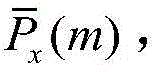
S3, converting the time frequency spectrum P
x The power of different frequency components of (m, n) at all time points is accumulated to obtain an average power spectrum only related to frequency
S4, in-situ frequency spectrum P
x (m, n) minus the average power spectrum of the corresponding frequency
Obtaining a time-frequency offset spectrum P
sub1 (m,n);
S5, the obtained time-frequency offset spectrum P sub1 (m, n) normalization processing is carried out, and the variance d (m) and the local variance T of the frequency spectrum at each frequency point are calculated.
In the above method for detecting a frequency hopping signal based on the local variance of the time-frequency spectrum matrix, in step S1, the frequency hopping signal model is a formula (1)
Wherein T is total observation time, T is more than or equal to 0 and less than or equal to T, K is total hop count in the observation time, T
H For the skip period, a (t) is the base band complex envelope, A
s For the amplitude of the frequency-hopping signal, f
k And
respectively representing the carrier frequency and phase of the k-th hop,
in the above method for detecting a frequency hopping signal based on the local variance of the time-frequency spectrum matrix, in step S1, the frequency-fixed signal model is a formula (2)
Wherein A is
J 、f
J And
respectively, as the amplitude, carrier frequency and phase of the fixed frequency signal.
In the above method for detecting a frequency hopping signal based on the local variance of the time-frequency spectrum matrix, in step S1, the observation signal is determined in the following manner:
for a given continuous signal x (t), its short-time fourier transform is expressed as equation (3):
where h (t) is a window function, h * (t) is its conjugated form;
let the hypothesis that only noise is present be H 0 The hypothesis that the frequency hopping signal and the fixed frequency signal exist in the noise is H 1 Obtaining an observation signal intercepted by the receiver as formula (4):
the short-time fourier transform of the observed signal is expressed as equation (5):
in the above method for detecting a frequency hopping signal based on the local variance of the time-frequency spectrum matrix, in step S2, the short-time fourier transform STFT is obtained in the following manner x (m,n):
Sampling an observation signal x (t), sliding a certain length every time with the window length of P, and calculating to obtain the short-time Fourier transform STFT of the observation signal x (t) x (m,n);
The time frequency spectrum P is calculated by the following method x (m,n):
Performing modular value square calculation on short-time Fourier transform of the observed signal, namely making a time frequency spectrum be P x (m,n)=|STFT x (m,n)| 2 Wherein the frequency dimension M =1,2, …, M = P/2, and the time dimension N =1,2, …, N.
In the above-mentioned frequency hopping signal detection method based on the time-frequency spectrum matrix local variance, in step S3, the average power spectrum only related to the frequency is obtained by the following formula (6)
In the frequency hopping signal detection method based on the time-frequency spectrum matrix local variance as described above,in step S4, a time-frequency compensation spectrum P is obtained through the following formula (7) sub1 (m,n):
In the above method for detecting a frequency hopping signal based on the local variance of the time-frequency spectrum matrix, in step S5, the obtained time-frequency cancellation spectrum is normalized by the following formula (8), so as to avoid the noise variance from affecting the signal detection result:
in the above method for detecting a frequency hopping signal based on the local variance of the time-frequency spectrum matrix, in step S5, the variance d (m) of the time-frequency spectrum of each frequency point is calculated by the following formula (9):
in the above method for detecting a frequency hopping signal based on the local variance of the time-frequency spectrum matrix, in step S5, the local variance T of the time-frequency spectrum is calculated by the following formula (10):
the invention has the advantages that:
1. the frequency hopping signal detection method based on the time-frequency spectrum matrix local variance combines the short-time Fourier transform and time-frequency cancellation methods with the variance characteristics, and has the advantages of effectiveness, practicability and the like.
2. An improved time-frequency cancellation algorithm is provided, and the influence of the fixed-frequency signal on the detection result of the frequency hopping signal is reduced.
3. The difference of the frequency spectrum local variance during cancellation of the noise, the fixed frequency signal and the frequency hopping signal is fully utilized, so that the frequency hopping signal can still obtain higher identification rate under low signal-to-noise ratio.
Detailed Description
The present invention will be described in further detail with reference to the accompanying drawings and specific embodiments.
As shown in fig. 1 and fig. 3, the present solution provides a frequency hopping signal detection method based on time-frequency spectrum matrix local variance, and the method includes the following steps:
s1, determining whether a frequency hopping signal or a frequency fixing signal exists in an observation signal intercepted by a receiver according to a frequency hopping signal model and a frequency fixing signal model, and if so, executing the subsequent steps;
wherein the frequency hopping signal model is formula (1):
wherein T is total observation time, T is more than or equal to 0 and less than or equal to T, K is total hop count in the observation time, T
H For the skip period, a (t) is the base band complex envelope, A
S For the amplitude of the frequency-hopping signal, f
k And
respectively representing the carrier frequency and phase of the k-th hop,
the fixed frequency signal model is formula (2):
wherein A is
J 、f
J And
respectively, as the amplitude, carrier frequency and phase of the fixed frequency signal.
For a given continuous signal x (t), the general expression of its short-time fourier transform is equation (3):
where h (t) is a window function, h * (t) is its conjugated form;
let the hypothesis that only noise exists be H 0 The hypothesis that the frequency hopping signal and the fixed frequency signal exist in the noise is H 1 Obtaining an observation signal intercepted by the receiver is formula (4):
the short-time fourier transform of the observed signal is expressed as equation (5), the observed signal is divided into noise and signal, and the noise, frequency hopping and fixed frequency signal are respectively replaced by their respective short-time fourier transforms:
s2, obtaining short-time Fourier transform (STFT) of observation signals x (m, n) and calculating a time spectrum P x (m,n);
Specifically, the short-time Fourier transform STFT is obtained in the following manner x (m,n):
Sampling an observation signal x (t), wherein the window length is P, sliding for a certain length every time, and calculating to obtain the short-time Fourier of the observation signal x (t)Transforming STFT x (m,n),
The time spectrum P is calculated by x (m,n):
Performing modular value square calculation on short-time Fourier transform of the observed signal, namely making the time frequency spectrum be P x (m,n)=|STFT x (m,n)| 2 Wherein the frequency dimension M =1,2, …, M = P/2, and the time dimension N =1,2, …, N.
The short-time Fourier transform of the observation signal is obtained through the step S2, the time frequency spectrum of the signal and the time frequency spectrum of the noise are finally obtained, and the subsequent operation is carried out by comparing the difference of the time frequency spectrums, as shown in fig. 4 and 5, the time frequency spectrum of the noise is uniformly distributed on the whole plane of the dimension of M multiplied by N; the frequency spectrum of the frequency hopping signal is not 0 in different time periods and different frequency points; therefore, the local variance of the frequency spectrum is the largest when frequency hopping signals are obtained, and the scheme is just the frequency hopping signal detection based on the principle. When a fixed frequency interference signal exists, the frequency spectrum is not 0 when the fixed frequency interference signal exists on a certain frequency, and the other fixed frequency interference signal is 0. Therefore, firstly, the influence of the fixed frequency signal on the detection of the frequency hopping signal needs to be reduced, and the scheme specifically adopts the steps S3 and S4 to eliminate the frequency spectrum component of the fixed frequency signal.
S3, converting the time frequency spectrum P
x The power of different frequency components of (m, n) at all time points is accumulated to obtain an average power spectrum only related to frequency
In particular as formula (6)
S4, in-situ frequency spectrum P
x (m, n) minus the average power spectrum of the corresponding frequency
Obtaining a time-frequency offset spectrum P
sub1 (m, n) is specifically expressed in formula (7),
due to the difference between the noise and the frequency hopping signal, and because the frequency spectrum of the fixed frequency signal is not 0 when the fixed frequency signal exists on a certain frequency, and the other frequency spectrum is 0, the influence of the fixed frequency signal is eliminated by the time-frequency cancellation method of S4, and finally the effect of detecting the frequency hopping signal is achieved.
S5, the obtained time-frequency offset spectrum P sub1 (m, n) normalization processing is carried out, and the variance d (m) and the local variance T of the frequency spectrum at each frequency point are calculated. Specifically, by performing normalization processing on the time-frequency cancellation spectrum according to the formula (8), the influence of noise variance on a signal detection result can be avoided.
Specifically, the variance d (m) of the frequency spectrum at each frequency point is calculated by the following formula (9):
the local variance T of the time spectrum is calculated by equation (10):
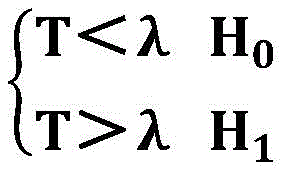
the noise variance is removed by step S5 in order to eliminate the influence of the noise variance on the signal detection. The finally obtained local variance T is to reflect the difference between noise and signals, and the detection rule of the frequency hopping signal is finally obtained by using the difference:
wherein lambda is a decision threshold, which is determined according to the Newman Pearson criterion, namely, the false alarm probability is given, and the threshold is obtained through Monte Carlo simulation.
The specific embodiments described herein are merely illustrative of the spirit of the invention. Various modifications or additions may be made to the described embodiments or alternatives may be employed by those skilled in the art without departing from the spirit or ambit of the invention as defined in the appended claims.
Although the terms frequency hopping signal, fixed frequency signal, observed signal, short-time fourier transform, time-frequency spectrum, average power spectrum, time-frequency offset spectrum, etc. are used more often herein, the possibility of using other terms is not excluded. These terms are used merely to more conveniently describe and explain the nature of the present invention; they are to be construed as being without limitation to any additional limitations that may be imposed by the spirit of the present invention.