Disclosure of Invention
The invention aims to provide a molecular marker Ahyrsc tightly linked with peanut dark red seed coats and application thereof, which are used for solving the problems in the prior art.
In order to achieve the purpose, the invention provides the following scheme:
the invention provides a molecular marker AhyRscc closely linked with a dark red peanut seed coat, and a specific primer pair of the molecular marker AhyRscc comprises:
a primer with a nucleotide sequence shown as SEQ ID No. 1;
the nucleotide sequence of the primer is shown as SEQ ID No. 2.
SEQ ID No.1:5'-GGTAATATAATGTTAACGGCC-3';
SEQ ID No.2:5'-GAAAAAGCAAAGTTGAAGGAA-3'。
The invention also provides a method for identifying the color of the peanut seed coat by using the molecular marker Ahyrsc tightly linked with the dark red peanut seed coat, which comprises the following steps:
(1) extracting DNA of peanut seeds or leaves;
(2) carrying out PCR amplification on the extracted DNA by adopting the specific primer pair;
(3) and (3) carrying out non-denaturing polyacrylamide gel electrophoresis detection on the amplification product obtained in the step (2), and if a characteristic band with the size of 271bp appears, judging that the next generation seed of the peanut material to be detected is a dark red seed coat.
Further, in step (2), the PCR amplification total volume is 25 uL: 20-30ng/uL 1uL DNA template, 0.5pmol/uL specific primer pair, 0.5uL each, 10mM dNTP mix 0.5uL, 10 XTaq Buffer 2.5uL,25mM MgCl22.0uL, Taq enzyme 5U/uL 0.25uL, add water to 25 uL.
Further, in the step (2), the PCR amplification reaction conditions are: pre-denaturation at 95 ℃ for 4 min; 30s at 94 ℃, 30s at 58 ℃, 25s at 72 ℃ and 35 cycles; extension at 72 ℃ for 5 min.
Further, in the step (3), 8% native polyacrylamide gel electrophoresis is used.
The invention also provides application of the molecular marker AhyRscc closely linked with the peanut deep red seed coat, and further the molecular marker AhyRscc is located in the region of chromosome 12 117.03-117.56Mb and is used for peanut breeding and/or peanut quality improvement.
Further, the method is used for identifying the dark red peanut with the seed coat.
The invention discloses the following technical effects:
the invention discloses a molecular marker Ahyrscc closely linked with a dark red peanut seed coat, which can be used for identifying peanuts with the dark red seed coat, wherein the peanut seed coat is developed from a peaked integument, and compared with other characters, the color of the seed coat can be shown in alternate generations, for example, a pink seed coat is used as a female parent to be hybridized with a dark red peanut male parent, F1 seed coat is pink (female parent), F2 seed coat is light red (amphiphilic intermediate type), and F3 seed coat has character separation. There is therefore great blindness to screening and cultivating dark red peanuts by the naked eye. By using the marker provided by the invention, the seed coat color of the next generation harvested material can be determined in advance by detecting the DNA of the peanuts, and the breeding efficiency is improved.
In addition, the peanut is an allotetraploid, the alleles of the A and B subgenomic groups are highly homologous, a plurality of markers are difficult to effectively distinguish the A and B subgenomic groups, and the molecular marker is screened out through multiple scientific experiments and gropes, so that the result is reliable and the reliability is high.
The molecular marker is a simple PCR marker, the technical requirement is simple, compared with CAPS molecular markers, the molecular marker does not need the steps of enzyme digestion, purification, recovery and the like, the identification can be realized directly through PCR amplification and electrophoresis, the operation requirement on instruments is lower, and the conventional instruments adopting conventional experiments can be operated and are more easily accepted by people.
The molecular marker can effectively identify the color of the deep red seed coat of the peanut, is favorable for fine positioning, separation and cloning of genes on one hand, and has important application value for molecular breeding and quality improvement of the peanut on the other hand.
Detailed Description
Reference will now be made in detail to various exemplary embodiments of the invention, the detailed description should not be construed as limiting the invention but as a more detailed description of certain aspects, features and embodiments of the invention.
It is to be understood that the terminology used herein is for the purpose of describing particular embodiments only and is not intended to be limiting of the invention. Further, for numerical ranges in this disclosure, it is understood that each intervening value, between the upper and lower limit of that range, is also specifically disclosed. Every smaller range between any stated value or intervening value in a stated range and any other stated or intervening value in a stated range is encompassed within the invention. The upper and lower limits of these smaller ranges may independently be included or excluded in the range.
Unless defined otherwise, all technical and scientific terms used herein have the same meaning as commonly understood by one of ordinary skill in the art to which this invention belongs. Although only preferred methods and materials are described herein, any methods and materials similar or equivalent to those described herein can be used in the practice or testing of the present invention. All documents mentioned in this specification are incorporated by reference herein for the purpose of disclosing and describing the methods and/or materials associated with the documents. In case of conflict with any incorporated document, the present specification will control.
It will be apparent to those skilled in the art that various modifications and variations can be made in the specific embodiments of the present disclosure without departing from the scope or spirit of the disclosure. Other embodiments will be apparent to those skilled in the art from consideration of the specification. The specification and examples are exemplary only.
As used herein, the terms "comprising," "including," "having," "containing," and the like are open-ended terms that mean including, but not limited to.
Example 1 control of the location of the color gene of the peanut dark red seed coat and design of the molecular marker Ahyrsc closely linked with the peanut dark red seed coat
In order to control the color gene of the deep red seed coat of the peanut in a positioning way, the inventor utilizes the pink seed coat peanut variety (female parent) distant hybrid 9102 to hybridize with No. 12 flowers in the deep red seed coat peanut variety (male parent) to construct a separation population, and genetic analysis shows that the seed coat color of the peanut is controlled by a single gene.
By making a pair F2And F3Phenotypic analysis of generations, selecting 33 extreme red and 33 extreme pink materials to construct deep red and pink extreme pools respectively, performing whole genome re-sequencing together with the parent strain No. 12 and the distant 9102, and sequencing the parent strain and the extreme pools respectively at 30Gb and 90Gb (FIG. 1A). The heavy sequencing data are analyzed by a colony-separating analysis method (BSA), the distribution of the linked SNP loci on the peanut genome is counted, most of the linked loci are concentrated on chromosome 12 (figure 1B), and the result shows that the major gene for controlling the color of the deep red seed coat of the peanut can be on chromosome 12. Further analysis revealed that most of the linked SNP sites were concentrated in the interval of chromosome 12, 111.56-117.66Mb, indicating that this segment is tightly linked to the color of the dark red peanut seed coat (FIG. 1C).
According to the result of BSA-seq initial positioning, further developing markers in the candidate interval, carrying out genotype detection in all strains of the isolated population, and constructing a local high-density genetic linkage map of the candidate interval. The key genes controlling the color of the peanut dark red seed coat are finely positioned and locked in the interval of 117.03-117.56Mb of chromosome 12 by linkage analysis and comparative genomics analysis in combination with the phenotypic statistics of the seed coat color of each strain (FIG. 2A). Meanwhile, the inventor finds that the marker ahyrsc is tightly linked with the color of the deep red seed coat and is verified in different color germplasm materials (fig. 2B). The marker AhyrScc is proved to be an effective marker for judging the color of the peanut seed coat.
Example 2 Rapid cultivation of high-yield deep-red peanut New variety by molecular marker Ahyrrsc
By utilizing the molecular marker AhygRscc for selection and combining with a backcross breeding method, common peanuts (recurrent parents) can be improved into new peanut varieties with deep red seed coats in about 3 years, more than 97% of genetic background of the recurrent parents is kept, and directional improvement of the seed coat color from pink to deep red can be realized on the premise of keeping most excellent characters of the original peanut varieties.
Taking Fenghua No.1 of a common peanut variety as a recurrent parent, taking flower No. 12 of a dark red peanut variety as a donor male parent, and the specific steps of improving the color of the dark red peanut seed coat comprise:
(1) hybridization of
And (3) carrying out hybridization by taking HF001 as a female parent (recurrent parent) and taking No. 12 flowers in the dark red peanut variety as a male parent. The hybridization method is as follows: emasculation begins several days after the female parent HF001 blooms, typically 16: emasculation after 00. Pinching the base part of the flower bud by the thumb and middle finger of the left hand, slightly poking the calyx, the flag petal and the petal by the forceps held by the right hand, pressing the poked petals by the index finger and the thumb of the left hand, slightly pressing the bent back part of the keel petal by the forceps to expose the flower bud, removing the anthers of 8 stamens by the forceps one or more times without damaging the stigma of the pistils, and pushing the keel petal back to the original position by the fingers. Artificial pollination is carried out on the castrated flowers 5:00-9:00 earlier on day 2. Collecting flower of 12 # in the male parent before pollination, then squeezing out pollen of the flower of the male parent with forceps, when pollinating, holding the flower without male with index finger and middle finger of the left hand, lightly squeezing the keel with thumb of the right hand or forceps to expose pistil stigma, and dipping pollen with tip of forceps to coat the stigma.
(2) Hybridization F1Authentication of authenticity
Harvested hybrid F using molecular marker AhyrScc1And (5) identifying the genuineness of the generation. The method comprises the following steps:
sampling: all pods of the female parent plant are harvested and air-dried, and all harvested seeds are numbered. Then, a part of the seed coat was removed by a scalpel, and then a part of the cotyledon tissue (about 30mg) was excised and put into a 1.5mL centrifuge tube, along with magnetic beads. And (4) putting the rest peanut seeds into a refrigeration house for storage, and planting the peanut seeds into a field after detection. Through experiments, the germination rate of the peanut seeds is not affected after partial tissues are cut off (figure 3).
DNA extraction: the method for extracting the DNA of the peanut seeds to be detected comprises the following steps:
(1) quickly cooling 1.5mL of the centrifuge tube filled with peanut tissues by using liquid nitrogen, and then grinding;
(2) preheating CTAB extract (2% CTAB, 1.4mol/L NaCl, 20mmo/L EDTA (pH8.0), 100mmol/L Tris-HCl (pH8.0), 2% pvc-40) in a 65 ℃ water bath;
(3) estimating the tissue mass of the sample, adding 700 mu L of preheated CTAB extracting solution into every 200mg of the sample, rapidly and uniformly mixing, and carrying out warm bath at 65 ℃ for 10-30 min, wherein the mixing is carried out for 2-5 times;
(4) adding 1 volume time of phenol/chloroform/isoamyl alcohol (volume ratio is 12:12:1), and mixing uniformly;
(5) centrifuging at 12000rpm for 10min at room temperature;
(6) transferring the supernatant to a new centrifuge tube;
(7) repeating the steps (4) to (6) by using chloroform/isoamyl alcohol (the volume ratio is 24: 1);
(8) adding 0.7 times volume of isopropanol pre-cooled at-20 deg.C, reversing, mixing, and standing at room temperature for 10 min;
(9) centrifuging at 12000rpm for 15min at room temperature;
(10) pouring off the supernatant, and washing the precipitate for 2-3 times by using 500 mu l of 70% ethanol pre-cooled at the temperature of 20 ℃;
(11) after the precipitate was dried, the DNA was dissolved in 50. mu.l of deionized water or TE and placed at-20 ℃ for use.
(12) Sucking 5 mul of dissolved DNA, adding 45 mul of deionized water, and uniformly mixing to prepare the genome DNA of the peanut for later use.
PCR reaction and electrophoresis detection: the parents and all F1 hybrids are subjected to molecular marker detection by using specific primer pairs (shown as SEQ ID No.1 and SEQ ID No. 2) of AhyrScc, and according to electrophoresis results, the hybrids containing male parent and female parent specific bands are true hybrids.
The PCR amplification reaction system is as follows:
amplification total volume 25 uL:
20-30ng/uL 1uL of DNA template,
0.5pmol/uL of Ahyrscc specific primer pair is 0.5uL each,
10mM dNTP mix 0.5uL,
10×Taq Buffer 2.5uL,
25mM MgCl2 2.0uL,
taq enzyme 5U/uL 0.25uL,
adding water to 25 uL;
and (3) PCR reaction conditions: pre-denaturation at 95 ℃ for 4 min; 30s at 94 ℃, 30s at 58 ℃, 25s at 72 ℃ and 35 cycles; extension at 72 ℃ for 5 min.
Detection of PCR amplification product was carried out by 8% native polyacrylamide gel electrophoresis (Acr: Bis 39: 1).
Wherein, the method for preparing 8 percent modified polyacrylamide gel is as follows;
mu.l of an indicator, i.e., loading buffer (containing 50mM Tris-HCl pH8.0, 50mM EDTA, 0.25% bromophenol blue, 0.25% xylene blue, 50% glycerol) was added to 10. mu.l of the amplification product;
the electrophoresis buffer system is 1 XTBE (90mM Tris-rate pH 8.3,2mM EDTA), and 120V electrophoresis is carried out for about 4 h.
30ml of 8% native polyacrylamide gel are formulated as shown in Table 1:
TABLE 130 ml 8% non-denaturing polyacrylamide gel formulation
Silver staining detection, the method is as follows:
a.0.1% silver nitrate solution 500ml staining 15-20 min.
b. The deionized water is rinsed quickly for about 15 sec.
c. Developing solution (1000ml deionized water +20g NaOH +0.5g Na)2CO31.5ml of formaldehyde currently added) is developed and shaken continuously until the DNA bands are clearly visible.
d. Rinsing with tap water.
e. The scanning and the photographing are carried out,
(3) backcrossing and progeny screening
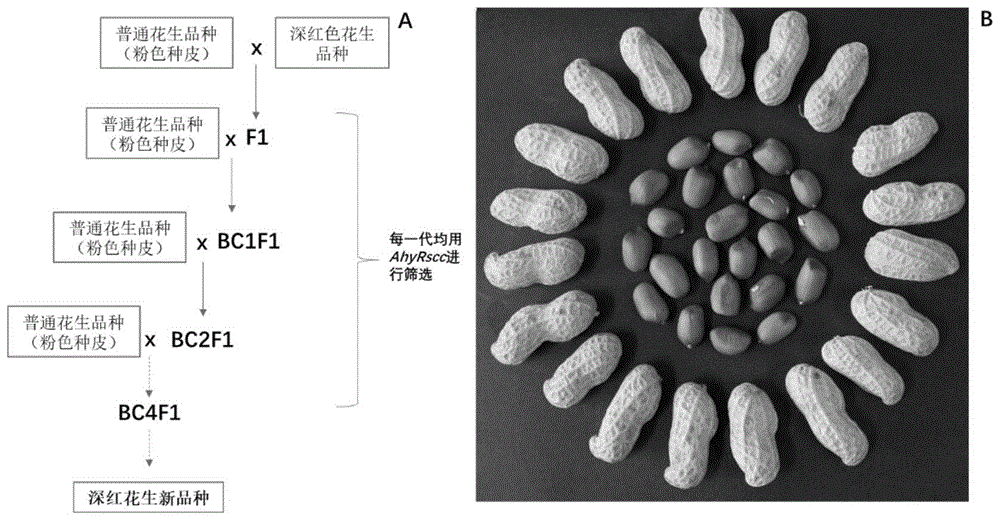
Using moleculesThe breeding scheme of the marker-assisted recurrent selection is two seasons per year, and the whole period needs about three years for generation addition. Firstly, using ordinary high-yield and high-quality peanut as female parent (recurrent parent, pink seed coat), true hybrid F1Hybridizing as male parent, the method for hybridizing is the same as above, and harvesting BC1F1And detecting by using the AhyrScc molecular marker again, reserving the offspring with the male parent specific band, and performing the DNA extraction and the molecular marker detection. Backcrossing and screening for 4 times to obtain BC4F1And (4) carrying out selfing, selecting pure and blended offspring, and carrying out test and variety registration.
Because the seed coat is developed from the integument, the color of the seed coat is inherited, and compared with other characters, the color of the seed coat can be shown in alternate generations. Therefore, there is great blindness to screening and cultivating dark red peanuts by the naked eye. By using the method for selecting the marker and the backcross recurrent, provided by the invention, the breeding efficiency can be improved, and the germplasm innovation of the dark red peanuts can be realized within about 3 years (figure 4). Compared with the traditional method, the method has higher efficiency.
The above-described embodiments are merely illustrative of the preferred embodiments of the present invention, and do not limit the scope of the present invention, and various modifications and improvements made to the technical solution of the present invention by those skilled in the art without departing from the spirit of the present invention are intended to fall within the scope of the present invention defined by the claims.
Sequence listing
<110> Shandong province academy of agricultural sciences
<120> molecular marker AhyrScc tightly linked with peanut deep red seed coat and application thereof
<160> 2
<170> SIPOSequenceListing 1.0
<210> 1
<211> 21
<212> DNA
<213> Artificial Sequence (Artificial Sequence)
<400> 1
ggtaatataa tgttaacggc c 21
<210> 2
<211> 21
<212> DNA
<213> Artificial Sequence (Artificial Sequence)
<400> 2
gaaaaagcaa agttgaagga a 21