Nuclear magnetic resonance-based combustible ice exploitation reservoir monitoring method
Technical Field
The invention relates to a combustible ice exploitation reservoir monitoring method based on nuclear magnetic resonance, which is particularly suitable for monitoring the generation rate and the space migration of methane and water in real time during exploitation of a deep-sea combustible ice reservoir and monitoring and early warning the reservoir settlement.
Background
Combustible ice, i.e. natural gas hydrate, having a molecular formula of CH4·H2O is a cage-shaped crystalline compound solid formed by combining methane and water under the conditions of low temperature and high pressure, and is mainly distributed in deep sea bottom of China and abundant in reserves through detection at present. According to the most conservative estimation, the total amount of methane stored in the global seabed combustible ice is about 1.8 billion cubic meters and about 1.1 ten thousand tons, the storage amount of the methane is more than twice of that of the traditional fossil energy (petroleum, coal and the like), and the methane can be used by human for 1000 years, so that the combustible ice is a new energy with broad prospect in the 21 st century and is called as the 21 st century energy or the future new energy by western scholars.
However, the combustible ice is not easy to be exploited, and once the condition changes and methane gas is released from the combustible ice, the physical properties of the seabed sediment can be changed, the mechanical properties of the seabed sediment are greatly reduced, so that the seabed is softened, serious accidents such as large-scale seabed landslide and sea ditch settlement collapse occur, and the life and property safety of human beings is further threatened. Therefore, continuous and stable exploitation of combustible ice is of great importance.
At present, in the process of combustible ice exploitation, small sensors such as pressure, temperature and strain are added on exploitation drill holes to realize monitoring, so that the detection range is small, a combustible ice reservoir cannot be monitored, and reliable guidance cannot be provided for combustible ice exploitation. In recent years, Nuclear Magnetic Resonance (NMR) technology has been widely used for measuring methane H signals and water signals, but engineering application based on NMR technology is currently focused only on advanced water exploration in tunnel construction, and the advantage of NMR technology for rapidly monitoring methane H signals and water signals cannot be fully exerted. In the combustible ice reservoir exploitation process, if the NMR technology is effectively applied, the generation rate and the space migration of methane and moisture in the combustible ice reservoir exploitation process can be rapidly measured, range identification and monitoring early warning can be carried out on the reservoir settlement on the basis, the advantages of the NMR technology can be fully played, more comprehensive data can be provided for combustible ice exploitation, and the continuous stability of combustible ice exploitation is guaranteed. Therefore, a nuclear magnetic resonance-based combustible ice production reservoir monitoring method is needed.
Disclosure of Invention
The technical problem is as follows: the invention aims to overcome the defects in the prior art and provide the safe and effective combustible ice exploitation reservoir monitoring method based on nuclear magnetic resonance, which is simple to operate and high in detection precision.
The technical scheme is as follows: the invention relates to a nuclear magnetic resonance-based combustible ice exploitation reservoir monitoring method, which comprises the following steps of building a sea surface operation platform, a drilling tower and a 5G signal transmitting tower which are arranged on the sea surface operation platform, and adopting a nuclear magnetic resonance miniature sensor:
a. vertically driving a detection drilling well into the seabed storage layer through the sea surface operation platform, after the detection drilling well detects the combustible ice storage layer, continuously drilling downwards until reaching a free gas storage layer, and sampling downwards from the top end of the combustible ice storage layer every other meter to obtain standard solid samples of the combustible ice storage layer at different depths;
b. detecting standard solid samples of the combustible ice reservoir and the free gas reservoir at different depths by using nuclear magnetic resonance measuring equipment, identifying methane H signals of the standard solid samples, obtaining initial water content and combustible ice content of the combustible ice reservoir at different depths and initial water content and methane content of the free gas reservoir at different depths, providing initial reference data for comparison of subsequent continuous change and space displacement, and finding out a position with the highest methane content of the free gas reservoir and the water content of less than 3 percent for horizontal drilling;
c. vertically driving an exploitation well from a drilling tower into the seabed reservoir, after the exploitation well is vertically constructed to a free gas reservoir below a combustible ice reservoir, horizontally drilling the reservoir for 50 meters at a position with the highest methane content and the water content of less than 3 percent, putting the reservoir into an extraction pipeline to support drilling, and performing combustible ice exploitation operation;
d. in the combustible ice mining process, the nuclear magnetic resonance miniature sensor is conveyed to the position of a combustible ice storage layer from a detection well by using an intelligent lifting device and moves up and down to measure, and nuclear magnetic methane H signals and water signals are measured every 3 hours from the top end of the combustible ice storage layer downwards every other meter;
e. and transmitting data measured by the nuclear magnetic resonance miniature sensor to a monitoring center by using a 5G signal transmitting tower, inverting the data to obtain the content, the spatial displacement and the analysis rate of the combustible ice at intervals of one meter downwards from the top end of the combustible ice reservoir every 3 hours, and monitoring and early warning the settlement range of the reservoir in time if the reservoir has settlement mutation.
The standard solid sample of the combustible ice storage layer is a cylinder which is prepared by taking out a position which is downward from the top end of the combustible ice storage layer and has a diameter of 50mm and a length of 50mm every other meter in the drilling process of a detection well.
And a hollow non-magnetic steel pipe is arranged in the drill hole of the exploration drilling well, after the drilling well is retreated, the bottom of the non-magnetic steel pipe is sealed, and water in the non-magnetic steel pipe is pumped out, so that the inside of the drill hole is relatively dry.
The nuclear magnetic resonance miniature sensor comprises three permanent magnets and coils, the lowest bearing temperature is-40 ℃, and the maximum bearing pressure is 80 MPa.
When a signal sudden increase or a signal sudden decrease occurs at a certain measuring point in the combustible ice mining process, key monitoring is conducted on measuring points on the periphery of the measuring point, early warning is conducted if the signal sudden increase or the signal sudden decrease also occurs at the peripheral measuring points, the fact that well collapse and reservoir sedimentation risks exist in the mining and drilling is shown, meanwhile, according to the fed-back distance range of the measuring points with the sudden change, the degree and the range of combustible ice reservoir sedimentation are obtained, a coping scheme is made in advance, and loss is reduced.
Has the advantages that: due to the adoption of the technical scheme, on one hand, the combustible ice reservoir is subjected to multi-dimensional space-time monitoring through the nuclear magnetic resonance miniature sensor, and the generation rate and the space migration of methane and water during the exploitation of the combustible ice reservoir are obtained; on the other hand, the nuclear magnetic resonance miniature sensor is used for monitoring and early warning the combustible ice reservoir settlement, and the settlement range of the combustible ice reservoir can be monitored, so that measures are taken in advance to reduce disaster loss. Compared with the prior art, the technology can provide more reliable and detailed data support for the exploitation of the combustible ice reservoir, improve the stability of the exploitation process of the combustible ice, break through the singleness of the engineering application that the nuclear magnetic resonance technology only adopts the tunnel advanced water exploration, measure the H signal and the water signal of the combustible ice reservoir and simultaneously represent the range of the reservoir settlement, and has important significance for the further development of the nuclear magnetic resonance technology.
Drawings
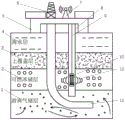
FIG. 1 is a schematic diagram of a nuclear magnetic resonance-based combustible ice production reservoir monitoring method of the invention.
In the figure: 1-free gas reservoir; 2-a combustible ice reservoir; a 3-upper cladding layer; 4-sea water layer; 5-an offshore operation platform; 6-a drilling tower; 7-5G signal transmitting towers; 8-exploration drilling; 9-an intelligent lifting device; 10-nuclear magnetic resonance miniature sensor; 11-nuclear magnetic detection field; 12-production drilling.
Detailed description of the invention
The invention will be further described with reference to examples in the drawings to which:
the invention relates to a combustible ice exploitation reservoir monitoring method based on nuclear magnetic resonance, which comprises the following specific steps of building a sea surface operation platform 5, a drilling tower 6 and a 5G signal transmitting tower 7 which are arranged on the sea surface operation platform 5, and adopting a nuclear magnetic resonance miniature sensor 10:
a. vertically driving a detection well 8 into the seabed storage layer through a sea surface operation platform 5, continuously drilling downwards until a free gas storage layer 1 after the detection well 8 detects a combustible ice storage layer 2, and sampling downwards from the top end of the combustible ice storage layer 2 every other meter to obtain standard solid samples of the combustible ice storage layer at different depths; the standard solid sample of the combustible ice storage layer is a cylinder which is prepared by taking out a position which is 50mm in diameter and 50mm in length from the top end of the combustible ice storage layer 2 downwards every other meter in the drilling process of the exploration drilling well 8. And a hollow non-magnetic steel pipe is arranged in the drill hole of the exploration drill 8, after the drilling is finished and the drill is withdrawn, the bottom of the non-magnetic steel pipe is sealed, and water in the non-magnetic steel pipe is pumped out, so that the inside of the drill hole is relatively dry.
b. Detecting standard solid samples of the combustible ice reservoir and the free gas reservoir at different depths by using nuclear magnetic resonance measuring equipment, identifying methane H signals of the standard solid samples, obtaining initial water content and combustible ice content of the combustible ice reservoir 2 at different depths and initial water content and methane content of the free gas reservoir at different depths, providing initial reference data for comparison of subsequent continuous change and space displacement, and finding out a position where the maximum water content of the methane in the free gas reservoir 1 is less than 3 percent for horizontal drilling;
c. vertically pumping an exploitation well 12 into the seabed reservoir from a drilling tower 6, after the exploitation well 12 is vertically constructed to a free gas reservoir 1 below a combustible ice reservoir 2, horizontally drilling the position with the highest methane content and the water content of less than 3 percent for 50 meters, putting an extraction pipeline to support drilling, and performing combustible ice exploitation operation;
d. in the process of exploiting the combustible ice, the nuclear magnetic resonance miniature sensor 10 is conveyed to the position of the combustible ice reservoir 2 from the detection well 8 by using the intelligent lifting device 9, the nuclear magnetic resonance miniature sensor 10 is measured by moving up and down by the intelligent lifting device 9, and nuclear magnetic methane H (hydrogen in methane molecules) signals and water signals are measured every 3 hours from the top end of the combustible ice reservoir 2 downwards every other meter; the nuclear magnetic resonance miniature sensor 10 comprises three permanent magnets and coils, the lowest bearing temperature is-40 ℃, and the maximum bearing pressure is 80 MPa.
e. Data measured by the nuclear magnetic resonance miniature sensor 10 are transmitted to a monitoring center by using a 5G signal transmitting tower 7, the data are inverted to obtain the content change, the spatial displacement and the analysis rate of the combustible ice at intervals of one meter from the top end of the combustible ice storage layer 2 downwards within a time period of every 3 hours, meanwhile, the sedimentation degree and range of the storage layer are monitored, and if the storage layer has sedimentation mutation, the sedimentation range of the storage layer is monitored and early warned in time.
Acquiring the analysis rate of the combustible ice in the combustible ice storage layer, firstly identifying and calibrating a methane gas H signal in a combustible ice sample which is extracted every other meter from a detection well 8 downwards from the top end of the combustible ice storage layer 2 by using nuclear magnetic resonance equipment, so that a methane molecule can be identified, obtaining the analysis and generation rate of methane every other meter downwards from the top end of the combustible ice storage layer 2, and then measuring from top to bottom every 3 hours to obtain the spatial displacement of the methane; obtaining the water content and the spatial displacement in the combustible ice storage layer 2, measuring every other meter downwards from the top end of the combustible ice storage layer 2 by a nuclear magnetic resonance miniature sensor 10, identifying water signals in the combustible ice storage layer, obtaining the water content every other meter downwards from the top end of the combustible ice storage layer 2 by quantitative inversion, then carrying out measurement from top to bottom once again every 3 hours, and further obtaining the spatial displacement of the water.
When a signal sudden increase or a signal sudden decrease occurs at a certain measuring point in the combustible ice mining process, the measuring points on the periphery of the measuring point are monitored in an important mode, if the signal sudden increase or the signal sudden decrease also occurs at the peripheral measuring points, early warning is conducted, the fact that well collapse and reservoir sedimentation risks exist in the mining and drilling is shown, meanwhile, the degree and the range of combustible ice reservoir 2 sedimentation are obtained according to the fed-back distance range of the measuring points where the signal sudden increase or the signal sudden decrease occurs, therefore, a coping scheme can be made in advance, and loss is reduced.