CN113166320B - Olefin-based copolymer and method for preparing the same - Google Patents
Olefin-based copolymer and method for preparing the same Download PDFInfo
- Publication number
- CN113166320B CN113166320B CN201980078657.0A CN201980078657A CN113166320B CN 113166320 B CN113166320 B CN 113166320B CN 201980078657 A CN201980078657 A CN 201980078657A CN 113166320 B CN113166320 B CN 113166320B
- Authority
- CN
- China
- Prior art keywords
- carbon atoms
- olefin
- based copolymer
- group
- hydrogen
- Prior art date
- Legal status (The legal status is an assumption and is not a legal conclusion. Google has not performed a legal analysis and makes no representation as to the accuracy of the status listed.)
- Active
Links
Classifications
-
- C—CHEMISTRY; METALLURGY
- C08—ORGANIC MACROMOLECULAR COMPOUNDS; THEIR PREPARATION OR CHEMICAL WORKING-UP; COMPOSITIONS BASED THEREON
- C08F—MACROMOLECULAR COMPOUNDS OBTAINED BY REACTIONS ONLY INVOLVING CARBON-TO-CARBON UNSATURATED BONDS
- C08F210/00—Copolymers of unsaturated aliphatic hydrocarbons having only one carbon-to-carbon double bond
- C08F210/02—Ethene
-
- C—CHEMISTRY; METALLURGY
- C08—ORGANIC MACROMOLECULAR COMPOUNDS; THEIR PREPARATION OR CHEMICAL WORKING-UP; COMPOSITIONS BASED THEREON
- C08F—MACROMOLECULAR COMPOUNDS OBTAINED BY REACTIONS ONLY INVOLVING CARBON-TO-CARBON UNSATURATED BONDS
- C08F210/00—Copolymers of unsaturated aliphatic hydrocarbons having only one carbon-to-carbon double bond
- C08F210/16—Copolymers of ethene with alpha-alkenes, e.g. EP rubbers
-
- C—CHEMISTRY; METALLURGY
- C07—ORGANIC CHEMISTRY
- C07F—ACYCLIC, CARBOCYCLIC OR HETEROCYCLIC COMPOUNDS CONTAINING ELEMENTS OTHER THAN CARBON, HYDROGEN, HALOGEN, OXYGEN, NITROGEN, SULFUR, SELENIUM OR TELLURIUM
- C07F17/00—Metallocenes
-
- C—CHEMISTRY; METALLURGY
- C08—ORGANIC MACROMOLECULAR COMPOUNDS; THEIR PREPARATION OR CHEMICAL WORKING-UP; COMPOSITIONS BASED THEREON
- C08F—MACROMOLECULAR COMPOUNDS OBTAINED BY REACTIONS ONLY INVOLVING CARBON-TO-CARBON UNSATURATED BONDS
- C08F4/00—Polymerisation catalysts
- C08F4/42—Metals; Metal hydrides; Metallo-organic compounds; Use thereof as catalyst precursors
- C08F4/44—Metals; Metal hydrides; Metallo-organic compounds; Use thereof as catalyst precursors selected from light metals, zinc, cadmium, mercury, copper, silver, gold, boron, gallium, indium, thallium, rare earths or actinides
- C08F4/60—Metals; Metal hydrides; Metallo-organic compounds; Use thereof as catalyst precursors selected from light metals, zinc, cadmium, mercury, copper, silver, gold, boron, gallium, indium, thallium, rare earths or actinides together with refractory metals, iron group metals, platinum group metals, manganese, rhenium technetium or compounds thereof
- C08F4/62—Refractory metals or compounds thereof
- C08F4/64—Titanium, zirconium, hafnium or compounds thereof
- C08F4/646—Catalysts comprising at least two different metals, in metallic form or as compounds thereof, in addition to the component covered by group C08F4/64
- C08F4/6465—Catalysts comprising at least two different metals, in metallic form or as compounds thereof, in addition to the component covered by group C08F4/64 containing silicium
-
- C—CHEMISTRY; METALLURGY
- C08—ORGANIC MACROMOLECULAR COMPOUNDS; THEIR PREPARATION OR CHEMICAL WORKING-UP; COMPOSITIONS BASED THEREON
- C08F—MACROMOLECULAR COMPOUNDS OBTAINED BY REACTIONS ONLY INVOLVING CARBON-TO-CARBON UNSATURATED BONDS
- C08F4/00—Polymerisation catalysts
- C08F4/42—Metals; Metal hydrides; Metallo-organic compounds; Use thereof as catalyst precursors
- C08F4/44—Metals; Metal hydrides; Metallo-organic compounds; Use thereof as catalyst precursors selected from light metals, zinc, cadmium, mercury, copper, silver, gold, boron, gallium, indium, thallium, rare earths or actinides
- C08F4/60—Metals; Metal hydrides; Metallo-organic compounds; Use thereof as catalyst precursors selected from light metals, zinc, cadmium, mercury, copper, silver, gold, boron, gallium, indium, thallium, rare earths or actinides together with refractory metals, iron group metals, platinum group metals, manganese, rhenium technetium or compounds thereof
- C08F4/62—Refractory metals or compounds thereof
- C08F4/64—Titanium, zirconium, hafnium or compounds thereof
- C08F4/659—Component covered by group C08F4/64 containing a transition metal-carbon bond
- C08F4/6592—Component covered by group C08F4/64 containing a transition metal-carbon bond containing at least one cyclopentadienyl ring, condensed or not, e.g. an indenyl or a fluorenyl ring
-
- C—CHEMISTRY; METALLURGY
- C08—ORGANIC MACROMOLECULAR COMPOUNDS; THEIR PREPARATION OR CHEMICAL WORKING-UP; COMPOSITIONS BASED THEREON
- C08F—MACROMOLECULAR COMPOUNDS OBTAINED BY REACTIONS ONLY INVOLVING CARBON-TO-CARBON UNSATURATED BONDS
- C08F4/00—Polymerisation catalysts
- C08F4/42—Metals; Metal hydrides; Metallo-organic compounds; Use thereof as catalyst precursors
- C08F4/44—Metals; Metal hydrides; Metallo-organic compounds; Use thereof as catalyst precursors selected from light metals, zinc, cadmium, mercury, copper, silver, gold, boron, gallium, indium, thallium, rare earths or actinides
- C08F4/60—Metals; Metal hydrides; Metallo-organic compounds; Use thereof as catalyst precursors selected from light metals, zinc, cadmium, mercury, copper, silver, gold, boron, gallium, indium, thallium, rare earths or actinides together with refractory metals, iron group metals, platinum group metals, manganese, rhenium technetium or compounds thereof
- C08F4/62—Refractory metals or compounds thereof
- C08F4/64—Titanium, zirconium, hafnium or compounds thereof
- C08F4/659—Component covered by group C08F4/64 containing a transition metal-carbon bond
- C08F4/6592—Component covered by group C08F4/64 containing a transition metal-carbon bond containing at least one cyclopentadienyl ring, condensed or not, e.g. an indenyl or a fluorenyl ring
- C08F4/65922—Component covered by group C08F4/64 containing a transition metal-carbon bond containing at least one cyclopentadienyl ring, condensed or not, e.g. an indenyl or a fluorenyl ring containing at least two cyclopentadienyl rings, fused or not
-
- C—CHEMISTRY; METALLURGY
- C08—ORGANIC MACROMOLECULAR COMPOUNDS; THEIR PREPARATION OR CHEMICAL WORKING-UP; COMPOSITIONS BASED THEREON
- C08F—MACROMOLECULAR COMPOUNDS OBTAINED BY REACTIONS ONLY INVOLVING CARBON-TO-CARBON UNSATURATED BONDS
- C08F2420/00—Metallocene catalysts
- C08F2420/02—Cp or analog bridged to a non-Cp X anionic donor
-
- C—CHEMISTRY; METALLURGY
- C08—ORGANIC MACROMOLECULAR COMPOUNDS; THEIR PREPARATION OR CHEMICAL WORKING-UP; COMPOSITIONS BASED THEREON
- C08F—MACROMOLECULAR COMPOUNDS OBTAINED BY REACTIONS ONLY INVOLVING CARBON-TO-CARBON UNSATURATED BONDS
- C08F2420/00—Metallocene catalysts
- C08F2420/06—Cp analog where at least one of the carbon atoms of the non-coordinating part of the condensed ring is replaced by a heteroatom
-
- C—CHEMISTRY; METALLURGY
- C08—ORGANIC MACROMOLECULAR COMPOUNDS; THEIR PREPARATION OR CHEMICAL WORKING-UP; COMPOSITIONS BASED THEREON
- C08F—MACROMOLECULAR COMPOUNDS OBTAINED BY REACTIONS ONLY INVOLVING CARBON-TO-CARBON UNSATURATED BONDS
- C08F2500/00—Characteristics or properties of obtained polyolefins; Use thereof
- C08F2500/12—Melt flow index or melt flow ratio
-
- C—CHEMISTRY; METALLURGY
- C08—ORGANIC MACROMOLECULAR COMPOUNDS; THEIR PREPARATION OR CHEMICAL WORKING-UP; COMPOSITIONS BASED THEREON
- C08F—MACROMOLECULAR COMPOUNDS OBTAINED BY REACTIONS ONLY INVOLVING CARBON-TO-CARBON UNSATURATED BONDS
- C08F4/00—Polymerisation catalysts
- C08F4/42—Metals; Metal hydrides; Metallo-organic compounds; Use thereof as catalyst precursors
- C08F4/44—Metals; Metal hydrides; Metallo-organic compounds; Use thereof as catalyst precursors selected from light metals, zinc, cadmium, mercury, copper, silver, gold, boron, gallium, indium, thallium, rare earths or actinides
- C08F4/60—Metals; Metal hydrides; Metallo-organic compounds; Use thereof as catalyst precursors selected from light metals, zinc, cadmium, mercury, copper, silver, gold, boron, gallium, indium, thallium, rare earths or actinides together with refractory metals, iron group metals, platinum group metals, manganese, rhenium technetium or compounds thereof
- C08F4/62—Refractory metals or compounds thereof
- C08F4/64—Titanium, zirconium, hafnium or compounds thereof
- C08F4/659—Component covered by group C08F4/64 containing a transition metal-carbon bond
- C08F4/65908—Component covered by group C08F4/64 containing a transition metal-carbon bond in combination with an ionising compound other than alumoxane, e.g. (C6F5)4B-X+
Landscapes
- Chemical & Material Sciences (AREA)
- Organic Chemistry (AREA)
- Health & Medical Sciences (AREA)
- Chemical Kinetics & Catalysis (AREA)
- Medicinal Chemistry (AREA)
- Polymers & Plastics (AREA)
- Engineering & Computer Science (AREA)
- Materials Engineering (AREA)
- Crystallography & Structural Chemistry (AREA)
- Transition And Organic Metals Composition Catalysts For Addition Polymerization (AREA)
- Addition Polymer Or Copolymer, Post-Treatments, Or Chemical Modifications (AREA)
Abstract
本发明涉及一种基于烯烃的共聚物及其制备方法,所述基于烯烃的共聚物的低温可溶级分具有高的重均分子量,并且所述基于烯烃的共聚物具有高的流动性以及改善的硬度、挠曲强度、撕裂强度等的物理性质。The present invention relates to an olefin-based copolymer, the low-temperature soluble fraction of the olefin-based copolymer has a high weight-average molecular weight, and the olefin-based copolymer has high fluidity and improved Physical properties such as hardness, flexural strength, and tear strength.
Description
技术领域technical field
相关申请的交叉引用Cross References to Related Applications
本申请要求于2019年8月28日在韩国知识产权局提交的韩国专利申请第10-2019-0105771号的权益,其内容通过引用合并于此。This application claims the benefit of Korean Patent Application No. 10-2019-0105771 filed with the Korean Intellectual Property Office on Aug. 28, 2019, the contents of which are incorporated herein by reference.
技术领域technical field
本发明涉及一种基于烯烃的共聚物及其制备方法,所述基于烯烃的共聚物的低温可溶级分具有高的重均分子量,并且所述基于烯烃的共聚物具有高的流动性以及改善的诸如硬度、挠曲强度和撕裂强度的物理性质。The present invention relates to an olefin-based copolymer, the low-temperature soluble fraction of the olefin-based copolymer has a high weight-average molecular weight, and the olefin-based copolymer has high fluidity and improved Physical properties such as hardness, flexural strength and tear strength.
背景技术Background technique
烯烃聚合催化剂体系可分为齐格勒-纳塔(Ziegler-Natta)催化剂体系和茂金属催化剂体系,并且已经根据各自的特性而开发了这两种高活性催化剂体系。齐格勒-纳塔催化剂自20世纪50年代发明以来就已在商业过程中得到广泛应用,但是它是一种其中并存许多活性位点的多位点催化剂,并且具有聚合物分子量分布宽的特点;另外,由于共聚单体的组成分布不均匀,因此在确保所需的物理性质方面存在限制。Olefin polymerization catalyst systems can be classified into Ziegler-Natta catalyst systems and metallocene catalyst systems, and these two highly active catalyst systems have been developed according to their respective characteristics. The Ziegler-Natta catalyst has been widely used in commercial processes since its invention in the 1950s, but it is a multi-site catalyst in which many active sites coexist and is characterized by a wide polymer molecular weight distribution ; In addition, since the composition distribution of the comonomer is not uniform, there is a limit in ensuring the desired physical properties.
茂金属催化剂由主催化剂(其具有过渡金属化合物作为主要成分)和促进剂(其为具有铝作为主要成分的有机金属化合物)的组合组成,并且该催化剂是均相配合物催化剂,并且是单位点催化剂。根据单位点性质,得到具有窄分子量分布和均匀的共聚单体组成分布的聚合物,并且根据催化剂的配体的结构变形和聚合条件,可以改变聚合物的空间规则性、共聚性质、分子量、结晶度等。The metallocene catalyst is composed of a combination of a main catalyst (which has a transition metal compound as a main component) and a promoter (which is an organometallic compound having aluminum as a main component), and the catalyst is a homogeneous complex catalyst, and is a single-site catalyst. According to the properties of the single site, a polymer with a narrow molecular weight distribution and a uniform comonomer composition distribution can be obtained, and according to the structural deformation of the ligand of the catalyst and the polymerization conditions, the spatial regularity, copolymerization properties, molecular weight, and crystallization of the polymer can be changed. degree etc.
同时,线性低密度聚乙烯是通过使用聚合催化剂在低压下使乙烯和α-烯烃共聚而制备的,并且是具有窄分子量分布和具有一定长度的短链分支而没有长链分支的树脂。线型低密度聚乙烯膜具有普通聚乙烯的性质,高断裂强度和伸长率,以及优异的撕裂强度和落锤冲击强度,因此被越来越多地用于传统的低密度聚乙烯或高密度聚乙烯难以应用的拉伸膜、重叠膜等中。Meanwhile, linear low density polyethylene is produced by copolymerizing ethylene and α-olefin under low pressure using a polymerization catalyst, and is a resin having a narrow molecular weight distribution and having short chain branches of a certain length without long chain branches. Linear low density polyethylene film has the properties of ordinary polyethylene, high breaking strength and elongation, and excellent tear strength and drop weight impact strength, so it is increasingly used in traditional low density polyethylene or high Stretch film, overlapping film, etc. where density polyethylene is difficult to apply.
然而,使用1-丁烯或1-己烯作为共聚单体的大多数线性低密度聚乙烯是在单气相反应器或单环管淤浆反应器中制备的,并且与使用1-辛烯的方法相比具有更高的生产率。但是,由于所使用的催化剂技术和所使用的方法技术的局限性,该产物的性质也大大劣于使用1-辛烯共聚单体的情况,并且其分子量分布窄,因此可加工性差。However, most LLDPEs using 1-butene or 1-hexene as comonomers are produced in single gas-phase reactors or single-loop slurry reactors and are comparable to those using 1-octene method has higher productivity. However, due to the limitations of the catalyst technology used and the process technology used, the properties of this product are also much inferior to the case of using 1-octene comonomer, and its molecular weight distribution is narrow, so the processability is poor.
美国专利第4,935,474号报告了通过使用两种以上茂金属化合物制备具有宽分子量分布的聚乙烯的方法。美国专利第6,828,394号报告了通过混合具有良好粘结性能的共聚单体和不具有它们的共聚单体来制备具有优异可加工性并且特别适合作为膜的聚乙烯的方法。另外,美国专利第6,841,631号和美国专利第6,894,128号指出,通过使用采用至少两种金属化合物的茂金属催化剂制备了具有双峰或多峰分子量分布的聚乙烯,并且该聚乙烯可以适用于膜、吹塑、管道等。但是,尽管这样的产品具有改善的加工性,但是由于单位颗粒中分子量的分散状态不均匀,即使在相对好的挤出条件下,挤出外观粗糙并且物理性质不稳定。US Patent No. 4,935,474 reports a method for preparing polyethylene having a broad molecular weight distribution by using two or more metallocene compounds. US Patent No. 6,828,394 reports a method of preparing polyethylene having excellent processability and being particularly suitable as a film by mixing comonomers having good adhesive properties and comonomers without them. In addition, U.S. Patent No. 6,841,631 and U.S. Patent No. 6,894,128 indicate that polyethylene having a bimodal or multimodal molecular weight distribution is prepared by using a metallocene catalyst employing at least two metal compounds, and that the polyethylene can be used in films, Blow molding, pipes, etc. However, although such products have improved processability, the extruded appearance is rough and the physical properties are not stable even under relatively good extrusion conditions due to the non-uniform dispersion state of the molecular weight in the unit particle.
在这样的背景下,一直需要制备在物理性质和加工性之间取得平衡的优异产品,特别是,越来越需要具有优异加工性的聚乙烯共聚物。Against such a background, there has been a need to produce products excellent in balance between physical properties and processability, and in particular, polyethylene copolymers having excellent processability have been increasingly demanded.
[现有技术文件][Prior Art Document]
[专利文件][Patent Document]
(专利文件1)美国注册专利第4,935,474号(Patent Document 1) US Registered Patent No. 4,935,474
(专利文件2)美国注册专利第6,828,394号(Patent Document 2) US Registered Patent No. 6,828,394
(专利文件3)美国注册专利第6,841,631号(Patent Document 3) US Registered Patent No. 6,841,631
(专利文件4)美国注册专利第6,894,128号(Patent Document 4) US Registered Patent No. 6,894,128
发明内容Contents of the invention
技术问题technical problem
本发明要解决的一个任务是提供一种基于烯烃的共聚物,所述基于烯烃的共聚物的低温可溶级分具有高的重均分子量,并且所述基于烯烃的共聚物具有高的流动性以及改善的硬度、挠曲强度、撕裂强度等的物理性质。One task to be solved by the present invention is to provide an olefin-based copolymer, the low-temperature soluble fraction of the olefin-based copolymer has a high weight-average molecular weight, and the olefin-based copolymer has high fluidity As well as improved physical properties such as hardness, flexural strength, tear strength, etc.
本发明要解决的另一个任务是提供一种制备所述基于烯烃的共聚物的方法。Another task to be solved by the present invention is to provide a process for preparing said olefin-based copolymers.
技术方案Technical solutions
本发明提供了一种基于烯烃的共聚物,其中(a)熔体指数(MI,190℃,2.16kg载荷条件)为10至100g/10min,(b)通过交叉分级色谱法(cross-fractionationchromatography,CFC)测量的在-20℃下的可溶级分(soluble fraction,SF)为0.5至10重量%,其中所述可溶级分的重均分子量(Mw(SF))为22,000以上,和(c)Mw:Mw(SF)的值为0.9:1至2:1,所述Mw:Mw(SF)的值是所述基于烯烃的共聚物的重均分子量(Mw)与所述可溶级分的重均分子量(Mw(SF))之比。The present invention provides an olefin-based copolymer, wherein (a) the melt index (MI, 190° C., 2.16 kg load condition) is 10 to 100 g/10 min, (b) is obtained by cross-fractionation chromatography (cross-fractionation chromatography, 0.5 to 10% by weight of a soluble fraction (SF) at -20°C measured by CFC), wherein the weight average molecular weight (Mw(SF)) of the soluble fraction is 22,000 or more, and ( c) The value of Mw:Mw(SF), which is the ratio of the weight average molecular weight (Mw) of the olefin-based copolymer to the soluble grade, is 0.9:1 to 2:1. The ratio of the weight average molecular weight (Mw(SF)) of the minute.
另外,本发明提供了一种制备所述基于烯烃的共聚物的方法,包括以下步骤:通过在包含由下式1表示的过渡金属化合物的催化剂组合物的存在下以10至100cc/min注入氢来聚合基于烯烃的单体:In addition, the present invention provides a method of preparing the olefin-based copolymer, comprising the step of injecting hydrogen at 10 to 100 cc/min in the presence of a catalyst composition including a transition metal compound represented by the following formula 1 to polymerize olefin-based monomers:
[式1][Formula 1]

在式1中,In formula 1,
R1为氢;1至20个碳原子的烷基;2至20个碳原子的烯基;1至20个碳原子的烷氧基;6至20个碳原子的芳基;7至20个碳原子的芳基烷氧基;7至20个碳原子的烷基芳基;或7至20个碳原子的芳基烷基,R is hydrogen ; alkyl of 1 to 20 carbon atoms; alkenyl of 2 to 20 carbon atoms; alkoxy of 1 to 20 carbon atoms; aryl of 6 to 20 carbon atoms; arylalkoxy of carbon atoms; alkylaryl of 7 to 20 carbon atoms; or arylalkyl of 7 to 20 carbon atoms,
R2和R3各自独立地为氢;卤素;1至20个碳原子的烷基;2至20个碳原子的烯基;7至20个碳原子的芳基烷基;1至20个碳原子的烷基胺基;或具有6至20个碳原子的芳基胺基,R and R are each independently hydrogen; halogen; alkyl of 1 to 20 carbon atoms; alkenyl of 2 to 20 carbon atoms; arylalkyl of 7 to 20 carbon atoms; atom; or an arylamine group having 6 to 20 carbon atoms,
R4至R9各自独立地为氢;硅烷基;1至20个碳原子的烷基;2至20个碳原子的烯基;6至20个碳原子的芳基;7至20个碳原子的烷基芳基;7至20个碳原子的芳基烷基;或被1至20个碳原子的烃基取代的第14族金属的准金属基团,R 4 to R 9 are each independently hydrogen; silyl group; alkyl group of 1 to 20 carbon atoms; alkenyl group of 2 to 20 carbon atoms; aryl group of 6 to 20 carbon atoms; 7 to 20 carbon atoms an alkylaryl group of ; an arylalkyl group of 7 to 20 carbon atoms; or a metalloid group of a Group 14 metal substituted by a hydrocarbyl group of 1 to 20 carbon atoms,
所述R2至R9中相邻的两个或更多个可以彼此连接形成环,Two or more adjacent R2 to R9 may be connected to each other to form a ring,
Q为Si、C、N、P或S,Q is Si, C, N, P or S,
M为第4族过渡金属,以及M is a Group 4 transition metal, and
X1和X2各自独立地为氢;卤素;1至20个碳原子的烷基;2至20个碳原子的烯基;6至20个碳原子的芳基;7至20个碳原子的烷基芳基;7至20个碳原子的芳基烷基;1至20个碳原子的烷基氨基;或6至20个碳原子的芳基氨基。X and X are each independently hydrogen; halogen; alkyl of 1 to 20 carbon atoms; alkenyl of 2 to 20 carbon atoms; aryl of 6 to 20 carbon atoms; alkylaryl; arylalkyl of 7 to 20 carbon atoms; alkylamino of 1 to 20 carbon atoms; or arylamino of 6 to 20 carbon atoms.
有益效果Beneficial effect
根据本发明的基于烯烃的共聚物显示出高重均分子量的低温可溶级分,具有改善的硬度和高流动性,并且具有制造具有优异复合材料的优点,与具有相似程度的密度和硬度的共聚物相比,所述复合材料具有改善的低温和室温耐冲击性。Olefin-based copolymers according to the present invention exhibit high weight-average molecular weight low-temperature soluble fractions, have improved hardness and high fluidity, and have the advantage of producing composites with excellent properties, compared to copolymers having similar degrees of density and hardness In contrast, the composite has improved low and room temperature impact resistance.
具体实施方式Detailed ways
在下文中,将更详细地描述本发明以帮助理解本发明。Hereinafter, the present invention will be described in more detail to help understanding of the present invention.
将理解的是,在本公开和权利要求中使用的词语或术语不应被解释为常用词典中定义的含义。将进一步理解的是,应当基于发明人可以适当地定义词语或术语的含义以最好地解释本发明的原则,将词语或术语解释为具有与相关领域和本发明的技术思想的背景中的含义一致的含义。It will be understood that words or terms used in the present disclosure and claims should not be interpreted as the meanings defined in commonly used dictionaries. It will be further understood that words or terms should be interpreted as having meanings in the context of the relevant field and the technical idea of the present invention based on the principle that the inventor can properly define the meaning of the words or terms to best explain the present invention consistent meaning.
在本发明中使用的术语“聚合物”是指通过聚合相同或不同种类的单体制备的高分子化合物。上位术语“聚合物”包括术语“互聚物”以及“均聚物”、“共聚物”和“三元共聚物”。术语“互聚物”是指通过聚合两种或更多种不同类型的单体制备的聚合物。上位术语“互聚物”包括术语“共聚物”(通常用于表示由两种不同单体制备的聚合物)和术语“三元共聚物”(通常用于表示由三种不同单体制备的聚合物)。术语“互聚物”包括通过聚合四种或更多种类型的单体制备的聚合物。The term "polymer" used in the present invention refers to a high molecular compound prepared by polymerizing monomers of the same or different kinds. The generic term "polymer" includes the term "interpolymer" as well as "homopolymer", "copolymer" and "terpolymer". The term "interpolymer" refers to a polymer prepared by polymerizing two or more different types of monomers. The generic term "interpolymer" includes the term "copolymer" (often used to denote a polymer prepared from two different monomers) and the term "terpolymer" (often used to denote a polymer prepared from three different monomers). polymer). The term "interpolymer" includes polymers prepared by polymerizing four or more types of monomers.
在下文中,将详细说明本发明。Hereinafter, the present invention will be explained in detail.
基于烯烃的共聚物Olefin-Based Copolymers
根据本发明的基于烯烃的共聚物的特征在于满足以下条件(a)至(c):The olefin-based copolymer according to the present invention is characterized by satisfying the following conditions (a) to (c):
(a)熔体指数(MI,190℃,2.16kg载荷条件)为10至100g/10min,(a) Melt index (MI, 190°C, 2.16kg load condition) is 10 to 100g/10min,
(b)通过交叉分级色谱法(CFC)测量的在-20℃下的可溶级分(SF)为0.5至10重量%,其中所述可溶级分的重均分子量(Mw(SF))为22,000以上,和(b) The soluble fraction (SF) measured by cross fractionation chromatography (CFC) at -20°C is 0.5 to 10% by weight, wherein the weight average molecular weight (Mw(SF)) of the soluble fraction is 22,000 or more, and
(c)Mw:Mw(SF)的值为0.9:1至2:1,所述Mw:Mw(SF)的值是所述基于烯烃的共聚物的重均分子量(Mw)与所述可溶级分的重均分子量(Mw(SF))之比。(c) The value of Mw:Mw(SF), which is the ratio of the weight average molecular weight (Mw) of the olefin-based copolymer to the soluble The ratio of the weight average molecular weight (Mw(SF)) of the fractions.
根据条件(a),根据本发明的基于烯烃的共聚物的熔体指数(MI,190℃,2.16kg载荷条件)为10至100g/10min。According to the condition (a), the melt index (MI, 190° C., 2.16 kg load condition) of the olefin-based copolymer according to the present invention is 10 to 100 g/10 min.
熔体指数(MI)可以通过控制在基于烯烃的共聚物的聚合过程中使用的催化剂相对于共聚单体的量来控制,并且影响所述基于烯烃的共聚物的机械性能、冲击强度,以及可成型性。熔体指数在低密度条件下测量,并根据ASTM D1238在190℃和2.16kg载荷条件下测量,可以为5至200g/10min,特别是10至150g/10min,更特别是10至100g/10min。特别地,熔体指数可以为10g/10min以上,或11g/10min以上,11.5g/10min以上,或12g/10min以上,且100g/10min以下,50g/10min以下,或40g/10min以下,36g/10min以下。Melt index (MI) can be controlled by controlling the amount of catalyst relative to the comonomer used during the polymerization of the olefin-based copolymer, and affects the mechanical properties, impact strength, and possible Formability. The melt index, measured under low density conditions and measured according to ASTM D1238 at 190°C and a load of 2.16 kg, may be 5 to 200 g/10 min, specifically 10 to 150 g/10 min, more specifically 10 to 100 g/10 min. In particular, the melt index can be above 10g/10min, or above 11g/10min, above 11.5g/10min, or above 12g/10min, and below 100g/10min, below 50g/10min, or below 40g/10min, or below 36g/10min. Below 10min.
根据条件(b),根据本发明的基于烯烃的共聚物具有0.5至10重量%的通过交叉分级色谱法(CFC)测量的在-20℃下的可溶级分(SF),其中所述可溶级分的重均分子量(Mw(SF))为22,000以上。According to the condition (b), the olefin-based copolymer according to the present invention has a soluble fraction (SF) at -20°C measured by cross fractionation chromatography (CFC) of 0.5 to 10% by weight, wherein the The weight average molecular weight (Mw(SF)) of the soluble fraction was 22,000 or more.
交叉分级色谱法(CFC)是升温洗脱分级(TREF)和凝胶过滤色谱法(GPC)的组合方法,并且可以同时发现基于烯烃的共聚物的结晶度分布和分子量分布。Cross Fractionation Chromatography (CFC) is a combined method of Temperature Rising Elution Fractionation (TREF) and Gel Filtration Chromatography (GPC), and can simultaneously discover the crystallinity distribution and molecular weight distribution of olefin-based copolymers.
特别地,将其中将基于烯烃的共聚物完全溶解在溶剂中的高温样品溶液注入到填充有惰性载体的柱中,并且降低该柱的温度以使样品附着于填料表面。然后,在使邻二氯苯在柱中流动的同时,将该柱的温度缓慢升高。检测在每个温度下洗脱的基于烯烃的共聚物的浓度,同时,将在每个温度下洗脱的组分通过在线逐级送入GPC以获得色谱图,并从该色谱图上,计算每个组分的分子量分布。Specifically, a high-temperature sample solution in which an olefin-based copolymer is completely dissolved in a solvent is injected into a column packed with an inert carrier, and the temperature of the column is lowered to allow the sample to adhere to the packing surface. Then, while flowing o-dichlorobenzene in the column, the temperature of the column was slowly increased. The concentration of the olefin-based copolymer eluted at each temperature was detected, and at the same time, the components eluted at each temperature were sent to the GPC step by step on-line to obtain a chromatogram, and from the chromatogram, the calculation Molecular weight distribution of each component.
另外,由于洗脱温度随着洗脱组分的结晶度的增加而增加,因此可以通过获得洗脱温度与基于烯烃的共聚物的洗脱量(重量%)的关系来发现基于烯烃的共聚物的晶体分布。In addition, since the elution temperature increases with the crystallinity of the eluted component, the olefin-based copolymer can be found by obtaining the relationship between the elution temperature and the eluted amount (% by weight) of the olefin-based copolymer. crystal distribution.
本发明的基于烯烃的共聚物具有0.5至20重量%,优选0.5至15重量%,或0.5至10重量%的通过CFC测量的在-20℃下的可溶级分。特别地,通过CFC测量的在-20℃下的可溶级分可为0.5重量%以上,或1重量%以上,2重量%以上,且10重量%以下,8重量%以下,小于8重量%,7重量%以下,或6重量%以下。The olefin-based copolymer of the present invention has a soluble fraction at -20°C measured by CFC of 0.5 to 20 wt%, preferably 0.5 to 15 wt%, or 0.5 to 10 wt%. In particular, the soluble fraction at -20°C measured by CFC may be 0.5% by weight or more, or 1% by weight or more, 2% by weight or more, and 10% by weight or less, 8% by weight or less, and less than 8% by weight , 7% by weight or less, or 6% by weight or less.
另外,在满足在-20℃下的可溶级分含量的同时,可溶级分的重均分子量(Mw(SF))可为22,000以上,优选为23,000以上,更优选为25,000以上。另外,可溶级分的重均分子量(Mw(SF))可为60,000以下,小于60,000,50,000以下,小于50,000,45,000以下,43,000以下,或40,000以下。In addition, while satisfying the soluble fraction content at -20°C, the weight average molecular weight (Mw(SF)) of the soluble fraction may be 22,000 or more, preferably 23,000 or more, more preferably 25,000 or more. In addition, the weight average molecular weight (Mw(SF)) of the soluble fraction may be 60,000 or less, less than 60,000, 50,000 or less, less than 50,000, 45,000 or less, 43,000 or less, or 40,000 or less.
已知在低洗脱温度下洗脱的基于烯烃的共聚物是具有低立构规整度、高共聚单体含量和低密度的低结晶共聚物。特别地,如本发明中所测量的,在-20℃下的可溶级分包括具有非常非常低的结晶度的组分并且具有强的非晶性质,并表示为超低结晶区域。在一般的聚合中,如果极大地提高共聚性能,则聚合物的分子量反比例降低。结果,当与整个基于烯烃的共聚物相比时,在-20℃或更低温度下洗脱的超低结晶可溶级分通常具有非常低的分子量。Olefin-based copolymers known to elute at low elution temperatures are low crystalline copolymers with low tacticity, high comonomer content and low density. In particular, the soluble fraction at -20°C, as measured in the present invention, includes components with very, very low crystallinity and has a strong amorphous nature, and is represented as an ultra-low crystallinity region. In general polymerization, if the copolymerization performance is greatly improved, the molecular weight of the polymer decreases in inverse proportion. As a result, the ultra-low crystalline soluble fraction eluting at -20°C or lower typically has a very low molecular weight when compared to the entire olefin-based copolymer.
同时,在-20℃下的可溶级分具有超低的结晶度,并且具有非常低的密度和优异的弹性,并且如果被制成基于聚丙烯的复合材料,则可获得改善冲击强度的效果。相反,考虑到分子量,与整个基于烯烃的共聚物的分子量相比,分子量明显较低,并且可溶级分导致机械强度(如拉伸强度)的降低,因此存在以下问题:在低温和高温下显示出弱的冲击强度。At the same time, the soluble fraction at -20°C has ultra-low crystallinity, and has very low density and excellent elasticity, and if it is made into a polypropylene-based composite material, the effect of improving impact strength can be obtained . On the contrary, considering the molecular weight, the molecular weight is significantly lower compared with that of the whole olefin-based copolymer, and the soluble fraction causes a decrease in mechanical strength such as tensile strength, so there are problems in that: at low and high temperatures Shows weak impact strength.
相反,在本发明的基于烯烃的共聚物中,如上所述,通过CFC测量的在-20℃下的可溶级分的含量为0.5至20重量%,但是各种物理性质(如挠曲强度和硬度以及撕裂强度和拉伸强度)均优异。这之所以能够实现,是因为可溶级分的重均分子量显示出高的值,例如22,000以上,优选23,000以上,更优选25,000以上。In contrast, in the olefin-based copolymer of the present invention, as described above, the content of the soluble fraction at -20°C measured by CFC is 0.5 to 20% by weight, but various physical properties such as flexural strength and hardness as well as tear strength and tensile strength) are excellent. This is possible because the weight average molecular weight of the soluble fraction exhibits a high value, for example, 22,000 or more, preferably 23,000 or more, more preferably 25,000 or more.
根据条件(c),Mw:Mw(SF)的值为0.9:1至2:1,所述Mw:Mw(SF)的值是所述基于烯烃的共聚物的重均分子量(Mw)与所述可溶级分的重均分子量(Mw(SF))之比。According to the condition (c), the value of Mw:Mw(SF), which is the weight average molecular weight (Mw) of the olefin-based copolymer to the value of 0.9:1 to 2:1, is 0.9:1 to 2:1. The ratio of the weight average molecular weight (Mw(SF)) of the above-mentioned soluble fraction.
如上所述,本发明的基于烯烃的共聚物具有20,000以上,优选22,000以上,更优选25,000以上的通过CFC测量的在-20℃下的可溶级分的重均分子量的高的绝对值。另外,当与常规共聚物相比时,不考虑结晶度,分子量分布被认为是均匀的,从而Mw:Mw(SF)的值满足0.9:1至2:1。如上所述,由于超低结晶区域(其为在-20℃下的可溶级分)中的分子量与总分子量相比保持相似的水平,因此机械性能(如拉伸强度)优异,同时相对于常规基于烯烃的共聚物,具有相似水平的冲击强度。As described above, the olefin-based copolymer of the present invention has a high absolute value of the weight average molecular weight of the soluble fraction at -20°C measured by CFC of 20,000 or more, preferably 22,000 or more, more preferably 25,000 or more. In addition, when compared with conventional copolymers, regardless of crystallinity, the molecular weight distribution is considered to be uniform such that the value of Mw:Mw(SF) satisfies 0.9:1 to 2:1. As mentioned above, since the molecular weight in the ultra-low crystalline region (which is the soluble fraction at -20°C) remains at a similar level compared to the total molecular weight, the mechanical properties such as tensile strength are excellent, while compared to Conventional olefin-based copolymers have similar levels of impact strength.
Mw:Mw(SF)的值可以是0.9:1至2:1,优选地1:1至2:1,并且如果Mw(SF)相对于Mw的比率增加,则在低温和高温下基于烯烃的共聚物的冲击强度也可以得到改善。The value of Mw:Mw(SF) can be 0.9:1 to 2:1, preferably 1:1 to 2:1, and if the ratio of Mw(SF) to Mw is increased, the olefin-based The impact strength of the copolymer can also be improved.
另外,如果根据ASTM D-792测量,本发明的基于烯烃的共聚物显示了为0.85g/cc至0.89g/cc,特别是0.855至0.89g/cc,更特别是0.86至0.89g/cc的低密度。即,根据本发明的基于烯烃的共聚物可以是满足上述(a)至(c)的条件的低密度的基于烯烃的共聚物并且同时具有在上述范围内的低密度,但密度值不限于此。Additionally, the olefin-based copolymers of the present invention exhibit a 0.85 to 0.89 g/cc, especially 0.855 to 0.89 g/cc, more particularly 0.86 to 0.89 g/cc if measured according to ASTM D-792. low density. That is, the olefin-based copolymer according to the present invention may be a low-density olefin-based copolymer satisfying the above-mentioned conditions (a) to (c) while having a low density within the above-mentioned range, but the density value is not limited thereto .
另外,本发明的基于烯烃的共聚物还可以满足10,000至100,000g/mol,特别是20,000至80,000g/mol,更特别是20,000至70,000g/mol,或30,000至70,000g/mol的重均分子量(Mw)。重均分子量(Mw)是通过凝胶渗透色谱法(GPC)分析的聚苯乙烯换算分子量。In addition, the olefin-based copolymer of the present invention can also meet the weight average molecular weight of 10,000 to 100,000 g/mol, especially 20,000 to 80,000 g/mol, more especially 20,000 to 70,000 g/mol, or 30,000 to 70,000 g/mol (Mw). The weight-average molecular weight (Mw) is a polystyrene-equivalent molecular weight analyzed by gel permeation chromatography (GPC).
另外,本发明的基于烯烃的共聚物的重均分子量(Mw)和数均分子量(Mn)之比(Mw/Mn),即,分子量分布(MWD)可为1.5至3.0,特别是1.5至2.8,更特别是1.9至2.5。In addition, the ratio (Mw/Mn) of the weight average molecular weight (Mw) to the number average molecular weight (Mn) of the olefin-based copolymer of the present invention, that is, the molecular weight distribution (MWD) may be 1.5 to 3.0, particularly 1.5 to 2.8 , and more particularly 1.9 to 2.5.
本发明的基于烯烃的共聚物可以具有30至80,特别是40至80,更特别是50至80的硬度(肖氏A)。当与常用的常规基于烯烃的共聚物相比时,在同等程度的密度和熔体指数值下,所述基于烯烃的共聚物可以表现出更高的硬度(肖氏A),因此可具有改善的撕裂强度、拉伸强度、伸长率和挠曲强度。The olefin-based copolymer of the present invention may have a hardness (Shore A) of 30 to 80, particularly 40 to 80, more particularly 50 to 80. When compared to commonly used conventional olefin-based copolymers, at equivalent density and melt index values, the olefin-based copolymers may exhibit higher hardness (Shore A), and thus may have improved tear strength, tensile strength, elongation and flexural strength.
如后文所述,本发明的基于烯烃的共聚物可以是通过使用由式1表示的过渡金属化合物作为催化剂并注入特定量的氢而进行聚合反应而制备的基于烯烃的共聚物,并且通过这样的制备方法进行制备,与常规的基于烯烃的共聚物相比时,本发明的基于烯烃的共聚物显示出在-20℃下可溶级分的更高的重均分子量值,并且撕裂强度、拉伸强度、伸长率和挠曲强度的物理性质得到了改善。As described later, the olefin-based copolymer of the present invention may be an olefin-based copolymer prepared by performing a polymerization reaction using a transition metal compound represented by Formula 1 as a catalyst and injecting a specific amount of hydrogen, and by doing so When compared with conventional olefin-based copolymers, the olefin-based copolymers of the present invention exhibit higher weight-average molecular weight values of soluble fractions at -20°C, and tear strength The physical properties of , tensile strength, elongation and flexural strength have been improved.
本发明的基于烯烃的共聚物可以是选自基于烯烃的单体,特别地,基于α-烯烃的单体、基于环烯烃的单体、基于二烯烯烃的单体、基于三烯烯烃的单体和基于苯乙烯的单体中的两种或更多种的共聚物,特别是乙烯和3至12个碳原子的基于α-烯烃的单体的共聚物,或乙烯和3至10个碳原子的基于α-烯烃的单体的共聚物。特别地,本发明的基于烯烃的共聚物可以是乙烯与丙烯的共聚物、乙烯与1-丁烯的共聚物、乙烯与1-己烯的共聚物、乙烯与4-甲基-1-戊烯的共聚物、或乙烯与1-辛烯的共聚物。The olefin-based copolymer of the present invention may be selected from olefin-based monomers, in particular, α-olefin-based monomers, cycloolefin-based monomers, diene-olefin-based monomers, triene-olefin-based mono Copolymers of two or more of monomers and styrene-based monomers, especially copolymers of ethylene and α-olefin-based monomers of 3 to 12 carbon atoms, or ethylene and 3 to 10 carbon atoms Atomic copolymers of alpha-olefin-based monomers. In particular, the olefin-based copolymer of the present invention may be a copolymer of ethylene and propylene, a copolymer of ethylene and 1-butene, a copolymer of ethylene and 1-hexene, a copolymer of ethylene and 4-methyl-1-pentene Copolymers of ethylene, or copolymers of ethylene and 1-octene.
所述α-烯烃单体可以包括选自丙烯、1-丁烯、1-戊烯、4-甲基-1-戊烯、1-己烯、1-庚烯、1-辛烯、1-癸烯、1-十一碳烯、1-十二碳烯、1-十四碳烯、1-十六碳烯、1-二十碳烯、降冰片烯、降冰片二烯、乙叉基降冰片烯、苯基降冰片烯、乙烯基降冰片烯、双环戊二烯、1,4-丁二烯、1,5-戊二烯、1,6-己二烯、苯乙烯、α-甲基苯乙烯、二乙烯基苯和3-氯甲基苯乙烯中的一种或多种,但不限于此。The α-olefin monomer may include propylene, 1-butene, 1-pentene, 4-methyl-1-pentene, 1-hexene, 1-heptene, 1-octene, 1- Decene, 1-undecene, 1-dodecene, 1-tetradecene, 1-hexadecene, 1-eicosene, norbornene, norbornadiene, ethylidene Norbornene, phenylnorbornene, vinyl norbornene, dicyclopentadiene, 1,4-butadiene, 1,5-pentadiene, 1,6-hexadiene, styrene, α- One or more of methylstyrene, divinylbenzene and 3-chloromethylstyrene, but not limited thereto.
本发明的基于烯烃的共聚物可以通过连续溶液聚合反应制备,通过该连续溶液聚合反应,在单反应器中,在包含一种或多种过渡金属化合物的茂金属催化剂组合物的存在下,在连续注入氢的同时聚合基于烯烃的单体。The olefin-based copolymers of the present invention can be prepared by continuous solution polymerization, in a single reactor, in the presence of a metallocene catalyst composition comprising one or more transition metal compounds, at The olefin-based monomer is polymerized while continuously injecting hydrogen.
根据本发明的基于烯烃的共聚物可以选自无规共聚物、交替共聚物和接枝共聚物,并且更特别地,可以是无规共聚物。The olefin-based copolymer according to the present invention may be selected from random copolymers, alternating copolymers and graft copolymers, and more particularly, may be a random copolymer.
制备基于烯烃的共聚物的方法Process for preparing olefin-based copolymers
本发明的基于烯烃的共聚物的制备方法的特征在于包括通过在包含由下式1表示的过渡金属化合物的催化剂组合物的存在下以10至100cc/min注入氢来聚合基于烯烃的单体的步骤:The production method of the olefin-based copolymer of the present invention is characterized by comprising polymerizing the olefin-based monomer by injecting hydrogen at 10 to 100 cc/min in the presence of a catalyst composition containing a transition metal compound represented by the following formula 1 step:
[式1][Formula 1]

在式1中,In formula 1,
R1为氢;1至20个碳原子的烷基;2至20个碳原子的烯基;1至20个碳原子的烷氧基;6至20个碳原子的芳基;7至20个碳原子的芳基烷氧基;7至20个碳原子的烷基芳基;或7至20个碳原子的芳基烷基,R is hydrogen ; alkyl of 1 to 20 carbon atoms; alkenyl of 2 to 20 carbon atoms; alkoxy of 1 to 20 carbon atoms; aryl of 6 to 20 carbon atoms; arylalkoxy of carbon atoms; alkylaryl of 7 to 20 carbon atoms; or arylalkyl of 7 to 20 carbon atoms,
R2和R3各自独立地为氢;卤素;1至20个碳原子的烷基;2至20个碳原子的烯基;7至20个碳原子的芳基烷基;1至20个碳原子的烷基胺基;或具有6至20个碳原子的芳基胺基,R and R are each independently hydrogen; halogen; alkyl of 1 to 20 carbon atoms; alkenyl of 2 to 20 carbon atoms; arylalkyl of 7 to 20 carbon atoms; atom; or an arylamine group having 6 to 20 carbon atoms,
R4至R9各自独立地为氢;硅烷基;1至20个碳原子的烷基;2至20个碳原子的烯基;6至20个碳原子的芳基;7至20个碳原子的烷基芳基;7至20个碳原子的芳基烷基;或被1至20个碳原子的烃基取代的第14族金属的准金属基团,R 4 to R 9 are each independently hydrogen; silyl group; alkyl group of 1 to 20 carbon atoms; alkenyl group of 2 to 20 carbon atoms; aryl group of 6 to 20 carbon atoms; 7 to 20 carbon atoms an alkylaryl group of ; an arylalkyl group of 7 to 20 carbon atoms; or a metalloid group of a Group 14 metal substituted by a hydrocarbyl group of 1 to 20 carbon atoms,
R2至R9中两个或更多个相邻基团可以彼此连接形成环,Two or more adjacent groups in R 2 to R 9 may be connected to each other to form a ring,
Q为Si、C、N、P或S,Q is Si, C, N, P or S,
M为第4族过渡金属,以及M is a Group 4 transition metal, and
X1和X2各自独立地为氢;卤素;1至20个碳原子的烷基;2至20个碳原子的烯基;6至20个碳原子的芳基;7至20个碳原子的烷基芳基;7至20个碳原子的芳基烷基;1至20个碳原子的烷基氨基;或6至20个碳原子的芳基氨基。X and X are each independently hydrogen; halogen; alkyl of 1 to 20 carbon atoms; alkenyl of 2 to 20 carbon atoms; aryl of 6 to 20 carbon atoms; alkylaryl; arylalkyl of 7 to 20 carbon atoms; alkylamino of 1 to 20 carbon atoms; or arylamino of 6 to 20 carbon atoms.
在本公开中描述的式1的过渡金属化合物中,通过环型键合而稠合有苯并噻吩的环戊二烯和胺基(N-R1)通过Q(Si、C、N或P)稳定地交联,并且形成其中第4族过渡金属形成配位键的结构。In the transition metal compound of Formula 1 described in this disclosure, cyclopentadiene and amine group (NR 1 ) fused with benzothiophene by ring-type bonding are stabilized by Q (Si, C, N or P) cross-linked, and form a structure in which the Group 4 transition metal forms a coordination bond.
如果将催化剂组合物应用于基于烯烃的单体的聚合反应,则可以实现在高聚合温度下生产具有高活性、高分子量和高共聚性能的共聚物。特别地,式1的过渡金属化合物,由于其结构特征,可以引入大量的α-烯烃以及0.85g/cc至0.93g/cc水平的线性低密度聚乙烯,并且可以制备在密度低于0.910g/cc的超低密度区域中的聚合物(弹性体)。If the catalyst composition is applied to the polymerization reaction of olefin-based monomers, the production of copolymers with high activity, high molecular weight, and high copolymerization performance at high polymerization temperatures can be achieved. In particular, the transition metal compound of Formula 1, due to its structural characteristics, can introduce a large amount of α-olefin and linear low density polyethylene at the level of 0.85g/cc to 0.93g/cc, and can be prepared at a density below 0.910g/cc Polymers (elastomers) in the ultra-low density region of cc.
另外,在本发明中,通过使用由式1表示的过渡金属化合物的催化剂并以10至100cc/min注入氢而使基于烯烃的单体聚合来制备基于烯烃的共聚物,并且当与通过使用不对应于式1的过渡金属化合物或不注入氢而使单体聚合来制备的基于烯烃的共聚物相比时,如上所述,可以制备具有高重均分子量的低温可溶级分并且显示出优异的物理性质(包括撕裂强度、拉伸强度和伸长率)的基于烯烃的共聚物。In addition, in the present invention, an olefin-based copolymer is prepared by polymerizing an olefin-based monomer by using a catalyst of a transition metal compound represented by Formula 1 and injecting hydrogen at 10 to 100 cc/min, and when using When compared with the transition metal compound corresponding to Formula 1 or the olefin-based copolymer prepared by polymerizing monomers without injecting hydrogen, as described above, a low-temperature soluble fraction having a high weight-average molecular weight can be prepared and exhibits excellent physical properties. properties, including tear strength, tensile strength, and elongation, of olefin-based copolymers.
在式1中,R1可为氢;1至20个碳原子的烷基;1至20个碳原子的烷氧基;6至20个碳原子的芳基;7至20个碳原子的芳基烷氧基;7至20个碳原子的烷基芳基;或7至20个碳原子的芳基烷基。优选地,R1可为1至20个碳原子的烷基;6至20个碳原子的芳基;7至20个碳原子的芳基烷氧基;7至20个碳原子的烷基芳基;或7至20个碳原子的芳基烷基,并且更优选地,可以是甲基、乙基、丙基、丁基、异丁基、叔丁基、异丙基、苄基、苯基、甲氧基苯基、乙氧基苯基、氟苯基、溴苯基、氯苯基、二甲基苯基或二乙基苯基。In Formula 1, R can be hydrogen; alkyl of 1 to 20 carbon atoms; alkoxy of 1 to 20 carbon atoms; aryl of 6 to 20 carbon atoms; aryl of 7 to 20 carbon atoms alkylalkoxy; alkylaryl of 7 to 20 carbon atoms; or arylalkyl of 7 to 20 carbon atoms. Preferably, R can be an alkyl group of 1 to 20 carbon atoms; an aryl group of 6 to 20 carbon atoms; an arylalkoxy group of 7 to 20 carbon atoms; an alkylaryl group of 7 to 20 carbon atoms or arylalkyl of 7 to 20 carbon atoms, and more preferably, may be methyl, ethyl, propyl, butyl, isobutyl, tert-butyl, isopropyl, benzyl, benzene phenyl, methoxyphenyl, ethoxyphenyl, fluorophenyl, bromophenyl, chlorophenyl, dimethylphenyl or diethylphenyl.
在式1中,R2和R3可以各自独立地为氢;1至20个碳原子的烷基;或7至20个碳原子的烷基芳基,并且优选地,R2和R3可以各自独立地为氢;或1至20个碳原子的烷基。In Formula 1, R2 and R3 may each independently be hydrogen; an alkyl group of 1 to 20 carbon atoms; or an alkylaryl group of 7 to 20 carbon atoms, and preferably, R2 and R3 may be each independently hydrogen; or an alkyl group of 1 to 20 carbon atoms.
在式1中,R4至R9可以各自独立地为氢;1至20个碳原子的烷基;6至20个碳原子的芳基;7至20个碳原子的烷基芳基;或7至20个碳原子的芳基烷基。In Formula 1, R to R may each independently be hydrogen; an alkyl group of 1 to 20 carbon atoms; an aryl group of 6 to 20 carbon atoms; an alkylaryl group of 7 to 20 carbon atoms; or Arylalkyl of 7 to 20 carbon atoms.
在式1中,R4和R5可以相同或不同,并且可以各自独立地为1至20个碳原子的烷基;或6至20个碳原子的芳基。In Formula 1, R 4 and R 5 may be the same or different, and may each independently be an alkyl group of 1 to 20 carbon atoms; or an aryl group of 6 to 20 carbon atoms.
在式1中,R4和R5可以相同或不同,并且可以各自独立地为1至6个碳原子的烷基。In Formula 1, R 4 and R 5 may be the same or different, and may each independently be an alkyl group of 1 to 6 carbon atoms.
在式1中,R4和R5可以是甲基、乙基或丙基。In Formula 1, R4 and R5 may be methyl, ethyl or propyl.
在式1中,R6至R9可以相同或不同,并且可以各自独立地为氢;1至20个碳原子的烷基;6至20个碳原子的芳基;具有7至20个碳原子的烷基芳基或7至20个碳原子的芳基烷基。In Formula 1, R 6 to R 9 may be the same or different, and may each independently be hydrogen; an alkyl group of 1 to 20 carbon atoms; an aryl group of 6 to 20 carbon atoms; an aryl group having 7 to 20 carbon atoms An alkylaryl group or an arylalkyl group of 7 to 20 carbon atoms.
在式1中,R6至R9可以相同或不同,并且可以各自独立地为氢;或1至20个碳原子的烷基。In Formula 1, R 6 to R 9 may be the same or different, and may each independently be hydrogen; or an alkyl group of 1 to 20 carbon atoms.
在式1中,R6至R9可以相同或不同,并且可以各自独立地为氢或甲基。In Formula 1, R 6 to R 9 may be the same or different, and may each independently be hydrogen or methyl.
在式1中,M可以是Ti、Hf或Zr。In Formula 1, M may be Ti, Hf or Zr.
在式1中,X1和X2可以相同或不同,并且可以各自独立地为氢、卤素、1至20个碳原子的烷基或2至20个碳原子的烯基。In Formula 1, X1 and X2 may be the same or different, and may each independently be hydrogen, halogen, an alkyl group of 1 to 20 carbon atoms, or an alkenyl group of 2 to 20 carbon atoms.
优选地,R1是氢;1至20个碳原子的烷基;1至20个碳原子的烷氧基;6至20个碳原子的芳基;7至20个碳原子的芳基烷氧基;7至20个碳原子的烷基芳基;或7至20个碳原子的芳基烷基,R2和R3各自独立地为氢;1至20个碳原子的烷基;或7至20碳原子的烷基芳基,R4至R9各自独立地为氢;1至20个碳原子的烷基;6至20个碳原子的芳基;7至20个碳原子的烷基芳基;或7至20个碳原子的芳基烷基,其中R2至R9中相邻的两个或更多个可以彼此连接形成5至20个碳原子的脂族环或6至20个碳原子的芳族环,所述脂族环或芳族环可以被卤素、1至20个碳原子的烷基、2至20个碳原子的烯基或6至20个碳原子的芳基取代,以及Q可以是Si、C、N或P。Preferably, R is hydrogen; alkyl of 1 to 20 carbon atoms; alkoxy of 1 to 20 carbon atoms; aryl of 6 to 20 carbon atoms; arylalkoxy of 7 to 20 carbon atoms An alkylaryl group of 7 to 20 carbon atoms; or an arylalkyl group of 7 to 20 carbon atoms, R 2 and R 3 are each independently hydrogen; an alkyl group of 1 to 20 carbon atoms; or 7 Alkylaryl to 20 carbon atoms, R to R are each independently hydrogen; alkyl from 1 to 20 carbon atoms; aryl from 6 to 20 carbon atoms; alkyl from 7 to 20 carbon atoms Aryl; or arylalkyl of 7 to 20 carbon atoms, wherein R 2 to R 9 adjacent two or more can be connected to each other to form an aliphatic ring of 5 to 20 carbon atoms or 6 to 20 Aromatic ring of carbon atoms, said aliphatic ring or aromatic ring can be replaced by halogen, alkyl of 1 to 20 carbon atoms, alkenyl of 2 to 20 carbon atoms or aryl of 6 to 20 carbon atoms substituted, and Q can be Si, C, N or P.
更优选地,R1可以是1至20个碳原子的烷基;6至20个碳原子的芳基;7至20个碳原子的芳基烷氧基;或7至20个碳原子的芳基烷基,R2和R3各自独立地为氢;或1至20个碳原子的烷基,R4至R9可以各自独立地为氢;1至20个碳原子的烷基;或6至20个碳原子的芳基,以及Q可以是Si。More preferably, R can be an alkyl group of 1 to 20 carbon atoms; an aryl group of 6 to 20 carbon atoms; an arylalkoxy group of 7 to 20 carbon atoms; or an aryl group of 7 to 20 carbon atoms An alkyl group, R 2 and R 3 are each independently hydrogen; or an alkyl group of 1 to 20 carbon atoms, R 4 to R 9 may each independently be hydrogen; an alkyl group of 1 to 20 carbon atoms; or 6 An aryl group of up to 20 carbon atoms, and Q may be Si.
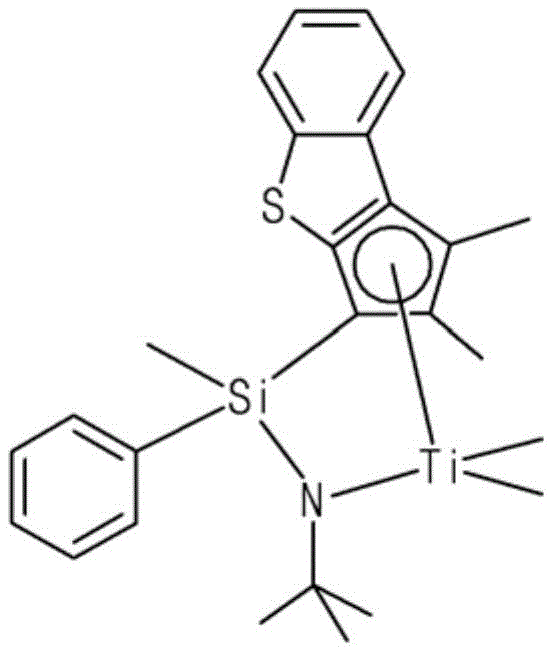
另外,由式1表示的过渡金属化合物可以选自由以下式1-1至式1-6中,但是实施方式不限于此,并且可以将在由式1限定的范围内的各种化合物应用于本发明:In addition, the transition metal compound represented by Formula 1 may be selected from the following Formula 1-1 to Formula 1-6, but the embodiment is not limited thereto, and various compounds within the range defined by Formula 1 may be applied to the present invention. invention:


将在下面详细解释本公开中使用的每个取代基。Each substituent used in the present disclosure will be explained in detail below.
本发明中使用的术语“卤素”是指氟、氯、溴或碘。The term "halogen" as used in the present invention refers to fluorine, chlorine, bromine or iodine.
在本发明中,术语“烷基”是指直链或支链的烷烃残基。In the present invention, the term "alkyl" refers to a straight or branched chain alkane residue.
在本发明中,术语“烯基”是指直链或支链的烯基。支链可以是1至20个碳原子的烷基;2至20个碳原子的烯基;6至20个碳原子的芳基;7至20个碳原子的烷基芳基;或7至20个碳原子的芳基烷基。In the present invention, the term "alkenyl" refers to straight-chain or branched-chain alkenyl. The branched chain may be an alkyl group of 1 to 20 carbon atoms; an alkenyl group of 2 to 20 carbon atoms; an aryl group of 6 to 20 carbon atoms; an alkylaryl group of 7 to 20 carbon atoms; arylalkyl groups of carbon atoms.
在本发明中,术语“芳基”可以优选具有6至20个碳原子,并且可以特别是,但不限于,苯基、萘基、蒽基等。In the present invention, the term "aryl" may preferably have 6 to 20 carbon atoms, and may be particularly, but not limited to, phenyl, naphthyl, anthracenyl, and the like.
在本发明中,术语“硅烷基”可以是被1至20个碳原子的烷基取代的甲硅烷基,并且可以是例如三甲基甲硅烷基或三乙基甲硅烷基。In the present invention, the term "silyl group" may be a silyl group substituted with an alkyl group of 1 to 20 carbon atoms, and may be, for example, a trimethylsilyl group or a triethylsilyl group.
在本发明中,术语“烷基芳基”是指被烷基取代的芳基。In the present invention, the term "alkylaryl" refers to an aryl group substituted with an alkyl group.
在本发明中,术语“芳基烷基”是指被芳基取代的烷基。In the present invention, the term "arylalkyl" refers to an alkyl group substituted with an aryl group.
在本发明中,术语“烷基氨基”是指被烷基取代的氨基,并且包括但不限于二甲基氨基、二乙基氨基等。In the present invention, the term "alkylamino" refers to an amino group substituted by an alkyl group, and includes, but is not limited to, dimethylamino, diethylamino, and the like.
在本发明中,除非另外提及,否则术语“烃基”是指1至20个碳原子的单官能烃基,其仅由碳和氢组成,而不论其结构如何,例如烷基、芳基、烯基、炔基、环烷基、烷基芳基和芳基烷基。In the present invention, unless otherwise mentioned, the term "hydrocarbyl" refers to a monofunctional hydrocarbon group of 1 to 20 carbon atoms, which consists only of carbon and hydrogen, regardless of its structure, such as alkyl, aryl, alkenyl, radical, alkynyl, cycloalkyl, alkylaryl and arylalkyl.
作为基于烯烃的单体的聚合反应的催化剂,可以单独使用由式1表示的过渡金属化合物,或者可以以组合物类型使用,所述组合物除式1的过渡金属化合物之外还包括一种或多种以下式2至式4表示的促进剂化合物。促进剂化合物可以帮助活化上式1的过渡金属化合物。As a catalyst for the polymerization reaction of an olefin-based monomer, a transition metal compound represented by Formula 1 may be used alone, or may be used in a composition type comprising, in addition to the transition metal compound of Formula 1, one or Various accelerator compounds represented by Formula 2 to Formula 4 below. A promoter compound can help activate the transition metal compound of formula 1 above.
[式2][Formula 2]
-[Al(R10)-O]a--[Al(R 10 )-O] a -
[式3][Formula 3]
A(R10)3 A(R 10 ) 3
[式4][Formula 4]
[L-H]+[W(D)4]-或[L]+[W(D)4]- [LH] + [W(D) 4 ] - or [L] + [W(D) 4 ] -
在式2至4中,In formulas 2 to 4,
R10基团可以彼此相同或不同,并且各自独立地选自卤素、1至20个碳原子的烃基和卤素取代的1至20个碳原子的烃基,The R groups may be the same or different from each other, and are each independently selected from halogen, hydrocarbon groups of 1 to 20 carbon atoms, and halogen-substituted hydrocarbon groups of 1 to 20 carbon atoms,
A是铝或硼,A is aluminum or boron,
D各自独立地是6至20个碳原子的芳基或1至20个碳原子的烷基,其中一个或多个氢原子可以被取代基取代,其中所述取代基是选自卤素、1至20个碳原子的烃基、1至20个碳原子的烷氧基和6至20个碳原子的芳氧基中的至少任何一个,D is each independently an aryl group of 6 to 20 carbon atoms or an alkyl group of 1 to 20 carbon atoms, wherein one or more hydrogen atoms may be substituted by a substituent, wherein the substituent is selected from halogen, 1 to 20 At least any one of a hydrocarbon group of 20 carbon atoms, an alkoxy group of 1 to 20 carbon atoms, and an aryloxy group of 6 to 20 carbon atoms,
H是氢原子,H is a hydrogen atom,
L是中性或阳离子路易斯酸,L is a neutral or cationic Lewis acid,
W是第13族中的元素,以及W is an element in group 13, and
a是2以上的整数。a is an integer of 2 or more.
由式2表示的化合物可以包括,但不限于,烷基铝氧烷,例如,甲基铝氧烷(MAO)、乙基铝氧烷、异丁基铝氧烷和叔丁基铝氧烷,以及通过混合两种或更多种烷基铝氧烷获得的改性烷基铝氧烷,特别是甲基铝氧烷、改性甲基铝氧烷(MMAO)。Compounds represented by Formula 2 may include, but are not limited to, alkylalumoxanes such as methylalumoxane (MAO), ethylalumoxane, isobutylalumoxane, and tert-butylalumoxane, And modified alkylalumoxanes obtained by mixing two or more alkylalumoxanes, in particular methylalumoxane, modified methylalumoxane (MMAO).
由式3表示的化合物可以包括,但不限于,三甲基铝、三乙基铝、三异丁基铝、三丙基铝、三丁基铝、二甲基氯化铝、三异丙基铝、三仲丁基铝、三环戊基铝、三戊基铝、三异戊基铝、三己基铝、三辛基铝、乙基二甲基铝、甲基二乙基铝、三苯基铝、三对甲苯基铝、二甲基甲氧基铝、二甲基乙氧基铝、三甲基硼、三乙基硼、三异丁基硼、三丙基硼、三丁基硼等,并且特别地,可以选自三甲基铝、三乙基铝和三异丁基铝。Compounds represented by Formula 3 may include, but are not limited to, trimethylaluminum, triethylaluminum, triisobutylaluminum, tripropylaluminum, tributylaluminum, dimethylaluminum chloride, triisopropylaluminum Aluminum, tri-sec-butylaluminum, tricyclopentylaluminum, tripentylaluminum, triisopentylaluminum, trihexylaluminum, trioctylaluminum, ethyldimethylaluminum, methyldiethylaluminum, triphenyl Trimethyl boron, tri-p-cresyl aluminum, dimethyl methoxy aluminum, dimethyl ethoxy aluminum, trimethyl boron, triethyl boron, triisobutyl boron, tripropyl boron, tributyl boron etc., and in particular, may be selected from trimethylaluminum, triethylaluminum, and triisobutylaluminum.
由式4表示的化合物可以包括,但不限于,三乙基铵四苯基硼、三丁基铵四苯基硼、三甲基铵四苯基硼、三丙基铵四苯基硼、三甲基铵四(对甲苯基)硼、三甲基铵四(邻,对二甲基苯基)硼、三丁基铵四(对三氟甲基苯基)硼、三甲基铵四(对三氟甲基苯基)硼、三丁基铵四(五氟苯基)硼、N,N-二乙基苯铵四苯基硼、N,N-二乙基苯铵四(五氟苯基)硼、二乙基铵四(五氟苯基)硼、三苯基鏻四苯基硼、三甲基鏻四苯基硼、二甲基苯铵四(五氟苯基)硼酸盐、三乙基铵四苯基铝、三丁基铵四苯基铝、三甲基铵四苯基铝、三丙基铵四苯基铝、三甲基铵四(对甲苯基)铝、三丙基铵四(对甲苯基)铝、三乙基铵四(邻,对二甲基苯基)铝、三丁基铵四(对三氟甲基苯基)铝、三甲基铵四(对三氟甲基苯基)铝、三丁基铵四(五氟苯基)铝、N,N-二乙基苯铵四苯基铝、N,N-二乙基苯铵四(五氟苯基)铝、二乙基铵四(五氟苯基)铝、三苯基鏻四苯基铝、三甲基鏻四苯基铝、三丙基铵四(对甲苯基)硼、三乙基铵四(邻,对二甲基苯基)硼、三苯基碳鎓四(对三氟甲基苯基)硼或三苯基碳鎓四(五氟苯基)硼。Compounds represented by Formula 4 may include, but are not limited to, triethylammoniumtetraphenylboron, tributylammoniumtetraphenylboron, trimethylammoniumtetraphenylboron, tripropylammoniumtetraphenylboron, tripropylammoniumtetraphenylboron, Methylammonium tetrakis(p-tolyl)boron, trimethylammonium tetrakis(o,p-dimethylphenyl)boron, tributylammonium tetrakis(p-trifluoromethylphenyl)boron, trimethylammonium tetrakis( p-trifluoromethylphenyl)boron, tributylammonium tetrakis(pentafluorophenyl)boron, N,N-diethylanilinium tetraphenylboron, N,N-diethylanilinium tetrakis(pentafluorophenyl)boron Phenyl) boron, diethylammonium tetrakis (pentafluorophenyl) boron, triphenylphosphonium tetraphenyl boron, trimethylphosphonium tetraphenyl boron, dimethylanilinium tetrakis (pentafluorophenyl) boric acid Salt, triethylammonium tetraphenylaluminum, tributylammonium tetraphenylaluminum, trimethylammonium tetraphenylaluminum, tripropylammonium tetraphenylaluminum, trimethylammonium tetra(p-tolyl)aluminum, Tripropylammonium tetrakis(p-tolyl)aluminum, triethylammonium tetrakis(o,p-dimethylphenyl)aluminum, tributylammonium tetrakis(p-trifluoromethylphenyl)aluminum, trimethylammonium tetrakis (p-trifluoromethylphenyl)aluminum, tributylammonium tetrakis(pentafluorophenyl)aluminum, N,N-diethylanilinium tetraphenylaluminum, N,N-diethylanilinium tetrakis(pentafluorophenyl)aluminum Fluorophenyl)aluminum, diethylammonium tetrakis(pentafluorophenyl)aluminum, triphenylphosphonium tetraphenylaluminum, trimethylphosphonium tetraphenylaluminum, tripropylammonium tetrakis(p-tolyl)boron, three Ethylammonium tetrakis(o,p-dimethylphenyl)boron, triphenylcarbenium tetrakis(p-trifluoromethylphenyl)boron or triphenylcarbenium tetrakis(pentafluorophenyl)boron.
作为第一种方法,所述催化剂组合物可以通过包括以下步骤的方法制备:通过使由式1表示的过渡金属化合物与由式2或式3表示的化合物接触而得到混合物;以及将由式4表示的化合物添加至所述混合物中。As a first method, the catalyst composition can be prepared by a method comprising the steps of: obtaining a mixture by contacting a transition metal compound represented by Formula 1 with a compound represented by Formula 2 or Formula 3; compound was added to the mixture.
在这种情况下,由式1表示的过渡金属化合物与由式2或式3表示的化合物的摩尔比可以为1:2至1:5,000,特别是1:10至1:1,000,更特别是1:2到1:500。In this case, the molar ratio of the transition metal compound represented by Formula 1 to the compound represented by Formula 2 or Formula 3 may be 1:2 to 1:5,000, specifically 1:10 to 1:1,000, more specifically 1:2 to 1:500.
如果由式1表示的过渡金属化合物与由式2或式3表示的化合物的摩尔比小于1:2,则烷基化剂的量太少,并且金属化合物的烷基化可能不完全进行,而如果摩尔比大于1:5,000,则可以实现金属化合物的烷基化,但是由于剩余的过量的烷基化剂与由式4表示的化合物的活化剂之间的副反应,烷基化的金属化合物的活化可能不完全进行。If the molar ratio of the transition metal compound represented by Formula 1 to the compound represented by Formula 2 or Formula 3 is less than 1:2, the amount of the alkylating agent is too small, and the alkylation of the metal compound may not be completely carried out, while If the molar ratio is greater than 1:5,000, the alkylation of the metal compound can be achieved, but due to the side reaction between the remaining excess alkylating agent and the activator of the compound represented by formula 4, the alkylated metal compound Activation may not be complete.
另外,由式1表示的过渡金属化合物与由式4表示的化合物的摩尔比可以为1:1至1:25,特别是1:1至1:10,更特别是1:1至1:5。In addition, the molar ratio of the transition metal compound represented by Formula 1 to the compound represented by Formula 4 may be 1:1 to 1:25, specifically 1:1 to 1:10, more specifically 1:1 to 1:5 .
如果由式1表示的过渡金属化合物与由式4表示的化合物的摩尔比小于1:1,则活化剂的量相对少,金属化合物的活化不完全进行,因此,催化剂组合物的活性可能下降。如果摩尔比大于1:25,则可以完全进行金属化合物的活化,但是由于剩余过量的活化剂,因此考虑到催化剂组合物的单位成本是不经济的,或者所生产的聚合物的纯度可能会降低。If the molar ratio of the transition metal compound represented by Formula 1 to the compound represented by Formula 4 is less than 1:1, the amount of the activator is relatively small, the activation of the metal compound is not completely performed, and thus, the activity of the catalyst composition may decrease. If the molar ratio is greater than 1:25, the activation of the metal compound can be fully performed, but due to the remaining excess activator, it is not economical considering the unit cost of the catalyst composition, or the purity of the produced polymer may be reduced .
另外,作为第二种方法,可以通过使由式1表示的过渡金属化合物与由式2表示的化合物接触的方法来制备所述催化剂组合物。In addition, as the second method, the catalyst composition may be prepared by a method of contacting a transition metal compound represented by Formula 1 with a compound represented by Formula 2.
在这种情况下,由式1表示的过渡金属化合物与由式2表示的化合物的摩尔比可以是1:10至1:10,000,特别是1:100至1:5,000,更特别是1:500至1:3,000。如果摩尔比小于1:10,则活化剂的量相对小,并且金属化合物的活化可能不完全进行,并且由此产生的催化剂组合物的活性可能降低,而如果该摩尔比大于1:10,000,则金属化合物的活化可以完全进行,但是由于剩余过量的活化剂,因此考虑到催化剂组合物的单位成本是不经济的,或者所生产的聚合物的纯度可能会降低。In this case, the molar ratio of the transition metal compound represented by Formula 1 to the compound represented by Formula 2 may be 1:10 to 1:10,000, specifically 1:100 to 1:5,000, more specifically 1:500 to 1:3,000. If the molar ratio is less than 1:10, the amount of activator is relatively small, and the activation of the metal compound may not proceed completely, and the activity of the resulting catalyst composition may decrease, while if the molar ratio is greater than 1:10,000, then Activation of the metal compound can be fully performed, but it is uneconomical in view of the unit cost of the catalyst composition or the purity of the produced polymer may be lowered due to the remaining excess of the activator.
作为制备催化剂组合物期间的反应溶剂,可以使用,但不限于,基于烃的溶剂,例如戊烷、己烷和庚烷,或者可以使用芳族溶剂,例如苯和甲苯。As a reaction solvent during preparation of the catalyst composition, hydrocarbon-based solvents such as pentane, hexane, and heptane may be used, but not limited to, or aromatic solvents such as benzene and toluene may be used.
此外,催化剂组合物可以包含在载体上的负载型过渡金属化合物和促进剂化合物。在基于茂金属的催化剂中使用的任何载体都可以用作载体,而没有特别限制。特别地,载体可以是氧化硅,氧化硅-氧化铝或氧化硅-氧化镁,并且可以使用它们中的任何一种或两种或更多种的混合物。Additionally, the catalyst composition may comprise a supported transition metal compound and a promoter compound on a support. Any support used in metallocene-based catalysts can be used as the support without particular limitation. Specifically, the support may be silica, silica-alumina or silica-magnesia, and any one of them or a mixture of two or more may be used.
在其中载体是它们中的氧化硅的情况下,由于氧化硅载体和式1的茂金属化合物的官能团形成化学键,因此在烯烃聚合过程中没有催化剂从表面分离。结果,可以防止结垢的产生,由于结垢会导致聚合物颗粒在基于烯烃的共聚物的制备过程中在反应器的壁侧或彼此之间附聚。另外,在包含氧化硅载体的催化剂的存在下制备的基于烯烃的共聚物中的聚合物的颗粒形状和表观密度优异。In the case where the support is silica among them, since the silica support and the functional group of the metallocene compound of Formula 1 form a chemical bond, there is no separation of the catalyst from the surface during olefin polymerization. As a result, generation of fouling, which would cause polymer particles to agglomerate on the wall side of the reactor or between each other during the production of the olefin-based copolymer, can be prevented. In addition, the particle shape and apparent density of the polymer in the olefin-based copolymer prepared in the presence of the catalyst including a silica support are excellent.
更特别地,载体可以是包括高反应性硅氧烷基团并通过高温干燥的方法等在高温下干燥过的氧化硅或氧化硅-氧化铝。More specifically, the support may be silica or silica-alumina that includes a highly reactive siloxane group and is dried at a high temperature by a high temperature drying method or the like.
载体可以进一步包括氧化物、碳酸盐、硫酸盐或硝酸盐组分,例如,Na2O、K2CO3、BaSO4和Mg(NO3)2。The support may further include oxide, carbonate, sulfate or nitrate components, for example, Na 2 O, K 2 CO 3 , BaSO 4 and Mg(NO 3 ) 2 .
载体的干燥温度优选为200℃至800℃,更优选为300℃至600℃,最优选为300℃至400℃。如果载体的干燥温度低于200℃,则湿度过高并且表面上的水可能与促进剂反应,而如果温度高于800℃,则可能会将载体表面上的孔合并从而减少表面积,并且可能会除去表面上的大量羟基而仅保留硅氧烷基,从而不合意地减少与促进剂的反应位点。The drying temperature of the carrier is preferably 200°C to 800°C, more preferably 300°C to 600°C, most preferably 300°C to 400°C. If the drying temperature of the support is lower than 200°C, the humidity is too high and the water on the surface may react with the accelerator, while if the temperature is higher than 800°C, the pores on the surface of the support may be merged to reduce the surface area, and there may be Removing a large number of hydroxyl groups on the surface leaving only the siloxane groups undesirably reduces the number of reactive sites with the accelerator.
此外,在载体表面上的羟基的量可以优选为0.1至10mmol/g,并且更优选为0.5至5mmol/g。载体表面上羟基的量可以通过载体的制备方法和条件或干燥条件(如温度、时间、真空和喷雾干燥)来控制。In addition, the amount of hydroxyl groups on the surface of the support may be preferably 0.1 to 10 mmol/g, and more preferably 0.5 to 5 mmol/g. The amount of hydroxyl groups on the surface of the support can be controlled by the preparation method and conditions of the support or drying conditions such as temperature, time, vacuum and spray drying.
基于烯烃的共聚物的聚合可以在约25至约500℃,特别是50至300℃,更优选地50至250℃或50至200℃下进行。The polymerization of the olefin-based copolymer may be carried out at about 25 to about 500°C, especially 50 to 300°C, more preferably 50 to 250°C or 50 to 200°C.
另外,基于烯烃的共聚物的聚合可以在1kgf/cm2至150kgf/cm2,优选1kgf/cm2至120kgf/cm2,更优选5kgf/cm2至100kgf/cm2的压力下进行。In addition, polymerization of the olefin-based copolymer may be performed at a pressure of 1 kgf/cm 2 to 150 kgf/cm 2 , preferably 1 kgf/cm 2 to 120 kgf/cm 2 , more preferably 5 kgf/cm 2 to 100 kgf/cm 2 .
烯烃单体的聚合反应可以在惰性溶剂中进行,并且作为惰性溶剂,可以使用,但不限于,苯、甲苯、二甲苯、枯烯、庚烷、环己烷、甲基环己烷、甲基环戊烷、正己烷、1-己烯和1-辛烯。Polymerization of olefin monomers can be carried out in an inert solvent, and as an inert solvent, there can be used, but not limited to, benzene, toluene, xylene, cumene, heptane, cyclohexane, methylcyclohexane, methyl Cyclopentane, n-hexane, 1-hexene and 1-octene.
所述基于烯烃的共聚物可有效地用于制造模制品。所述模制品可以特别地包括,但不限于,吹塑模制品、吹胀模制品、流延模制品、挤出层压模制品、挤出模制品、发泡模制品、注塑模制品、片材、膜、纤维、单丝或无纺布。The olefin-based copolymer can be effectively used to manufacture molded articles. Said molded articles may in particular include, but are not limited to, blow molded articles, inflation molded articles, tape cast molded articles, extrusion laminated articles, extrusion molded articles, foam molded articles, injection molded articles, sheets materials, films, fibers, monofilaments or nonwovens.
实施例Example
在下文中,将参考实施例更详细地解释本发明。然而,提供实施例仅用于说明,并且本发明的范围不限于此。Hereinafter, the present invention will be explained in more detail with reference to Examples. However, the examples are provided for illustration only, and the scope of the present invention is not limited thereto.
制备实施例1:Preparation Example 1:
<配体化合物的制备><Preparation of Ligand Compound>
N-叔丁基-1-(1,2-二甲基-3H-苯并[b]环戊并[d]噻吩-3-基)-1,1-二甲基硅烷胺N-tert-butyl-1-(1,2-dimethyl-3H-benzo[b]cyclopenta[d]thiophen-3-yl)-1,1-dimethylsilylamine 的合成Synthesis

向100ml的施伦克(schlenk)烧瓶中,称重并加入4.65g(15.88mmol)的氯-1-(1,2-二甲基-3H-苯并[b]环戊并[d]噻吩-3-基)-1,1-二甲基硅烷,并向其中加入80ml THF。在室温下,向其中加入tBuNH2(4当量,6.68ml),然后在室温下反应3天。反应完成后,除去THF,并将所得反应产物用己烷过滤。干燥溶剂后,获得4.50g(86%)的黄色液体。Into a 100 ml schlenk flask, weigh and add 4.65 g (15.88 mmol) of chloro-1-(1,2-dimethyl-3H-benzo[b]cyclopenta[d]thiophene -3-yl)-1,1-dimethylsilane, and 80ml of THF was added thereto. At room temperature, tBuNH 2 (4 equivalents, 6.68 ml) was added thereto, followed by reaction at room temperature for 3 days. After the reaction was completed, THF was removed, and the resulting reaction product was filtered with hexane. After drying of the solvent, 4.50 g (86%) of a yellow liquid were obtained.
1H-NMR(在CDCl3中,500MHz):7.99(d,1H),7.83(d,1H),7.35(dd,1H),7.24(dd,1H),3.49(s,1H),2.37(s,3H),2.17(s,3H),1.27(s,9H),0.19(s,3H),-0.17(s,3H). 1 H-NMR (in CDCl 3 , 500MHz): 7.99(d,1H), 7.83(d,1H), 7.35(dd,1H), 7.24(dd,1H), 3.49(s,1H), 2.37( s,3H),2.17(s,3H),1.27(s,9H),0.19(s,3H),-0.17(s,3H).
<过渡金属化合物的制备><Preparation of transition metal compound>

首先将配体化合物N-叔丁基-1-(1,2-二甲基-3H-苯并[b]环戊并[d]噻吩-3-基)-1,1-二甲基硅烷胺(1.06g,3.22mmol/1当量)和MTBE 16.0ml(0.2M)放入50ml的施伦克烧瓶中并搅拌。在-40℃下向其中加入n-BuLi(2.64ml,6.60mmol/2.05当量,2.5M,在THF中),然后在室温下反应过夜。之后,依次在-40℃下向其中缓慢滴加MeMgBr(2.68ml,8.05mmol/2.5当量,3.0M,在乙醚中),并放入TiCl4(2.68ml,3.22mmol/1.0当量,在甲苯中1.0M),接着在室温下反应过夜。之后,使用己烷使反应混合物通过硅藻土以过滤。干燥溶剂后,获得1.07g(82%)的棕色固体。First, the ligand compound N-tert-butyl-1-(1,2-dimethyl-3H-benzo[b]cyclopenta[d]thiophen-3-yl)-1,1-dimethylsilane Amine (1.06 g, 3.22 mmol/1 equiv) and MTBE 16.0 ml (0.2 M) were placed in a 50 ml Schlenk flask and stirred. Thereto was added n-BuLi (2.64ml, 6.60mmol/2.05eq, 2.5M in THF) at -40°C, followed by reaction overnight at room temperature. After that, MeMgBr (2.68ml, 8.05mmol/2.5eq, 3.0M, in ether) was slowly added dropwise thereto at -40°C, and TiCl 4 (2.68ml, 3.22mmol/1.0eq, in toluene 1.0M), followed by overnight reaction at room temperature. After that, the reaction mixture was passed through celite using hexane to be filtered. After drying the solvent, 1.07 g (82%) of a brown solid were obtained.
1H-NMR(在CDCl3中,500MHz):7.99(d,1H),7.68(d,1H),7.40(dd,1H),7.30(dd,1H),3.22(s,1H),2.67(s,3H),2.05(s,3H),1.54(s,9H),0.58(s,3H),0.57(s,3H),0.40(s,3H),-0.45(s,3H). 1 H-NMR (in CDCl 3 , 500MHz): 7.99(d,1H), 7.68(d,1H), 7.40(dd,1H), 7.30(dd,1H), 3.22(s,1H), 2.67( s,3H),2.05(s,3H),1.54(s,9H),0.58(s,3H),0.57(s,3H),0.40(s,3H),-0.45(s,3H).
比较制备实施例1Comparative Preparation Example 1
<配体化合物的制备><Preparation of Ligand Compound>
N-叔丁基-1-(1,2-二甲基-3H-苯并[b]环戊并[d]噻吩-3-基)-1,1-(甲基)(苯基)N-tert-butyl-1-(1,2-dimethyl-3H-benzo[b]cyclopenta[d]thiophen-3-yl)-1,1-(methyl)(phenyl) 硅烷胺的合成Synthesis of silylamines

(i)氯-1-(1,2-二甲基-3H-苯并[b]环戊并[d]噻吩-3-基)-1,1-(甲基)(苯基)硅烷的制备(i) Chloro-1-(1,2-dimethyl-3H-benzo[b]cyclopenta[d]thiophen-3-yl)-1,1-(methyl)(phenyl)silane preparation
向250ml的施伦克(schlenk)烧瓶中,加入10g(1.0当量,49.925mmol)的1,2-二甲基-3H-苯并[b]环戊并[d]噻吩和100ml的THF,并且在-30℃下向其中逐滴加入22ml(1.1当量,54.918mmol,2.5M,在己烷中)的n-BuLi,然后在室温下搅拌3小时。在-78℃下将搅拌的Li-配合物THF溶液通过导管加入含有8.1ml(1.0当量,49.925mmol)二氯(甲基)(苯基)硅烷和70ml THF的施伦克烧瓶中,然后在室温下搅拌过夜。搅拌后,真空干燥,用100ml己烷萃取。Into a 250ml schlenk (schlenk) flask, add 10g (1.0eq, 49.925mmol) of 1,2-dimethyl-3H-benzo[b]cyclopenta[d]thiophene and 100ml of THF, and Thereto was added dropwise 22 ml (1.1 equiv, 54.918 mmol, 2.5 M in hexane) of n-BuLi at -30°C, followed by stirring at room temperature for 3 hours. Stirred Li-complex THF solution was added via cannula into a Schlenk flask containing 8.1 ml (1.0 equiv, 49.925 mmol) of dichloro(methyl)(phenyl)silane and 70 ml of THF at −78 °C, followed by Stir overnight at room temperature. After stirring, it was dried in vacuo and extracted with 100 ml of hexane.
(ii)N-叔丁基-1-(1,2-二甲基-3H-苯并[b]环戊并[d]噻吩-3-基)-1,1-(甲基)(苯基)硅烷胺的制备(ii) N-tert-butyl-1-(1,2-dimethyl-3H-benzo[b]cyclopenta[d]thiophen-3-yl)-1,1-(methyl)(benzene base) preparation of silylamine
在室温下,向100ml的萃取的氯-1-(1,2-二甲基-3H-苯并[b]环戊并[d]噻吩-3-基)-1,1-(甲基)(苯基)硅烷的己烷溶液中,放入42ml(8当量,399.4mmol)的t-BuNH2,然后在室温下搅拌过夜。搅拌后,进行真空干燥,用150ml己烷进行萃取。干燥溶剂后,获得13.36g(68%,dr=1:1)的黄色固体。At room temperature, to 100ml of extracted chloro-1-(1,2-dimethyl-3H-benzo[b]cyclopenta[d]thiophen-3-yl)-1,1-(methyl) Put 42 ml (8 equivalents, 399.4 mmol) of t-BuNH 2 into the hexane solution of (phenyl)silane, and then stir overnight at room temperature. After stirring, vacuum drying was carried out, and extraction was carried out with 150 ml of hexane. After drying the solvent, 13.36 g (68%, dr=1:1) of a yellow solid were obtained.
1H NMR(CDCl3,500MHz):δ7.93(t,2H),7.79(d,1H),7.71(d,1H),7.60(d,2H),7.48(d,2H),7.40-7.10(m,10H,aromatic),3.62(s,1H),3.60(s,1H),2.28(s,6H),2.09(s,3H),1.76(s,3H),1.12(s,18H),0.23(s,3H),0.13(s,3H). 1 H NMR(CDCl 3 ,500MHz):δ7.93(t,2H),7.79(d,1H),7.71(d,1H),7.60(d,2H),7.48(d,2H),7.40-7.10 (m,10H,aromatic),3.62(s,1H),3.60(s,1H),2.28(s,6H),2.09(s,3H),1.76(s,3H),1.12(s,18H), 0.23(s,3H),0.13(s,3H).
<过渡金属化合物的制备><Preparation of transition metal compound>
向100mL的施伦克烧瓶中加入4.93g(12.575mmol,1.0当量)的配体化合物N-叔丁基-1-(1,2-二甲基-3H-苯并[b]环戊并[d]噻吩-3-基)-1,1-(甲基)(苯基)硅烷胺和50ml(0.2M)的甲苯,并在-30℃下向其中滴加10.3ml(25.779mmol,2.05当量,2.5M,在己烷中)的n-BuLi,然后在室温下搅拌过夜。搅拌后,依次向其中滴加12.6ml(37.725mmol,3.0当量,3.0M,在乙醚中)的MeMgBr,加入13.2ml(13.204mmol,1.05当量,1.0M,在甲苯中)的TiCl4,然后在室温下搅拌过夜。搅拌后,真空干燥并用150ml己烷进行萃取,将溶剂除去至50ml,并滴加4ml(37.725mmol,3.0当量)DME,然后在室温下搅拌过夜。再次,真空干燥并用150ml己烷进行萃取。将溶剂干燥后,获得2.23g(38%,dr=1:0.5)的棕色固体。Add 4.93g (12.575mmol, 1.0 equivalent) of ligand compound N-tert-butyl-1-(1,2-dimethyl-3H-benzo[b]cyclopenta[ d] thiophen-3-yl)-1,1-(methyl)(phenyl)silylamine and 50ml (0.2M) of toluene, and 10.3ml (25.779mmol, 2.05 equivalents) was added dropwise thereto at -30°C , 2.5M in hexane) of n-BuLi, then stirred overnight at room temperature. After stirring, 12.6ml (37.725mmol, 3.0equivalent, 3.0M, in ether) of MeMgBr was added dropwise thereto, and 13.2ml (13.204mmol, 1.05equivalent, 1.0M, in toluene) of TiCl 4 was added, and then in Stir overnight at room temperature. After stirring, it was dried under vacuum and extracted with 150ml of hexane, the solvent was removed to 50ml, and 4ml (37.725mmol, 3.0eq) of DME was added dropwise, then stirred overnight at room temperature. Again, dry under vacuum and extract with 150 ml of hexane. After drying the solvent, 2.23 g (38%, dr=1:0.5) of a brown solid were obtained.
1H NMR(CDCl3,500MHz):δ7.98(d,1H),7.94(d,1H),7.71(t,6H),7.50-7.30(10H),2.66(s,3H),2.61(s,3H),2.15(s,3H),1.62(s,9H),1.56(s,9H),1.53(s,3H),0.93(s,3H),0.31(s,3H),0.58(s,3H),0.51(s,3H),-0.26(s,3H),-0.39(s,3H). 1 H NMR (CDCl 3 , 500MHz): δ7.98(d,1H),7.94(d,1H),7.71(t,6H),7.50-7.30(10H),2.66(s,3H),2.61(s ,3H),2.15(s,3H),1.62(s,9H),1.56(s,9H),1.53(s,3H),0.93(s,3H),0.31(s,3H),0.58(s, 3H),0.51(s,3H),-0.26(s,3H),-0.39(s,3H).
实施例1Example 1
向1.5L高压釜连续工艺反应器中加入己烷溶剂(7kg/h)和1-丁烯(0.95kg/h),并将反应器顶部预热至141℃的温度。将三异丁基铝化合物(0.05mmol/min)、作为催化剂的在制备实施例1中制备的过渡金属化合物(0.17μmol/min)以及二甲基苯铵四(五氟苯基)硼酸盐促进剂(0.51μmol/min)同时放入反应器中。然后,向高压釜反应器中注入乙烯(0.87kg/h)和氢气(12cc/min),并在保持89巴的压力和141℃的同时连续进行共聚反应30分钟或更长时间以制备共聚物。干燥12小时或更长时间后,测量物理性质。A 1.5 L autoclave continuous process reactor was charged with hexane solvent (7 kg/h) and 1-butene (0.95 kg/h) and the top of the reactor was preheated to a temperature of 141 °C. Triisobutylaluminum compound (0.05 mmol/min), the transition metal compound (0.17 μmol/min) prepared in Preparation Example 1 as a catalyst, and dimethylanilinium tetrakis(pentafluorophenyl) borate Accelerator (0.51 μmol/min) was put into the reactor at the same time. Then, ethylene (0.87 kg/h) and hydrogen (12 cc/min) were injected into the autoclave reactor, and the copolymerization reaction was continuously performed while maintaining a pressure of 89 bar and 141°C for 30 minutes or more to prepare a copolymer . After drying for 12 hours or more, physical properties were measured.
实施例2至5Examples 2 to 5
通过进行与实施例1中相同的方法制备共聚物,不同之处在于,如下表1中所示改变反应条件。A copolymer was prepared by performing the same method as in Example 1 except that the reaction conditions were changed as shown in Table 1 below.
比较实施例1和2Comparative Examples 1 and 2
购买了DF7350(Mitsui公司)并将其用作比较实施例1,购买了EG8137(Dow Chem.)并将其用作比较实施例2。DF7350 (Mitsui Corporation) was purchased and used as Comparative Example 1, and EG8137 (Dow Chem.) was purchased and used as Comparative Example 2.
比较实施例3和4Comparing Examples 3 and 4
通过与实施例1中相同的方法制备共聚物,不同之处在于,对于比较实施例3,使用制备实施例1的催化剂,不注入氢气并如下表1中所示改变其他材料的量,并且作为比较实施例4,使用比较制备实施例1的催化剂并如下表1中所示改变其他材料的量。The copolymer was prepared by the same method as in Example 1, except that, for Comparative Example 3, the catalyst of Preparation Example 1 was used, hydrogen was not injected and the amounts of other materials were changed as shown in Table 1 below, and as Comparative Example 4, using the catalyst of Comparative Preparation Example 1 and varying the amounts of other materials as shown in Table 1 below.
比较实施例5Comparative Example 5
购买了EG8842(Dow公司),并将其用作比较实施例5。EG8842 (Dow Corporation) was purchased and used as Comparative Example 5.
[表1][Table 1]

实验实施例1Experimental Example 1
对于实施例1至5和比较实施例1至5的共聚物,根据以下方法评价物理性质,并在下表2中示出。For the copolymers of Examples 1 to 5 and Comparative Examples 1 to 5, physical properties were evaluated according to the following methods, and are shown in Table 2 below.
1)聚合物的密度1) The density of the polymer
根据ASTM D-792进行测量。Measured according to ASTM D-792.
2)聚合物的熔体指数(MI)2) Melt index (MI) of the polymer
根据ASTM D-1238(条件E,190℃,2.16kg载荷)进行测量。The measurement is performed according to ASTM D-1238 (Condition E, 190° C., 2.16 kg load).
3)重均分子量(g/mol)和分子量分布(MWD)3) Weight average molecular weight (g/mol) and molecular weight distribution (MWD)
使用凝胶渗透色谱法(GPC)分别测量数均分子量(Mn)和重均分子量(Mw),并且通过将重均分子量除以数均分子量来计算分子量分布。如此测量的重均分子量(Mw)和分子量分布(MWD)显示了所制备的聚合物的总级分的值。The number average molecular weight (Mn) and the weight average molecular weight (Mw) were respectively measured using gel permeation chromatography (GPC), and the molecular weight distribution was calculated by dividing the weight average molecular weight by the number average molecular weight. The weight average molecular weight (Mw) and molecular weight distribution (MWD) thus measured show the value of the total fraction of the polymer produced.
-柱:PL Olexis- Column: PL Olexis
-溶剂:三氯苯(TCB)- Solvent: Trichlorobenzene (TCB)
-流速:1.0ml/min-Flow rate: 1.0ml/min
-样品浓度:1.0mg/ml-Sample concentration: 1.0mg/ml
-注射量:200μl- Injection volume: 200 μl
-柱温:160℃-Column temperature: 160°C
-检测器:安捷伦高温RI检测器-Detector: Agilent high temperature RI detector
-标准物:聚苯乙烯(通过立方函数校准)- Standard: polystyrene (calibrated by cubic function)
4)熔融温度(Tm)4) Melting temperature (Tm)
使用PerKinElmer公司制造的差示扫描量热仪(DSC 6000)获得熔融温度。即,将温度升高至200℃,保持1分钟,然后降低至-100℃,然后,再次升高温度。将DSC曲线的顶点设定为熔融温度。在这种情况下,将温度的升高速率和降低速率控制为10℃/min,并且在第二次升高温度期间获得熔点。The melting temperature was obtained using a differential scanning calorimeter (DSC 6000) manufactured by PerKinElmer. That is, the temperature was raised to 200°C, held for 1 minute, then lowered to -100°C, and then the temperature was raised again. The apex of the DSC curve was set as the melting temperature. In this case, the temperature increase rate and decrease rate were controlled to be 10° C./min, and the melting point was obtained during the second temperature increase.
5)洗脱温度(Te)5) Elution temperature (Te)
使用PolymerChar公司的CFC作为测量设备。首先,在CFC分析仪中的烘箱中使用邻二氯苯作为溶剂于130℃下将聚合物溶液完全溶解60分钟,然后将溶液引入控制为130℃的TREF柱中。然后,将该柱冷却至95℃并稳定45分钟。然后,将TREF柱的温度以0.5℃/min的速率降低至-20℃,并在-20℃下保持10分钟。之后,使用红外分光光度计测量洗脱量(质量%)。然后,将TREF柱的温度以20℃/min的速率升高到预设温度,并在达到该温度时,将温度保持预设时间(即约27分钟),并且重复该工作直到TREF的温度达到130℃,并且测量每个温度范围内的洗脱级分的量(质量%)。另外,重均分子量(Mw)通过与GPC相同的测定原理进行测定,不同的是将各温度下的洗脱级分送入GPC柱并使用邻二氯苯作为溶剂。A CFC from PolymerChar Corporation was used as a measuring device. First, the polymer solution was completely dissolved in an oven in the CFC analyzer using o-dichlorobenzene as a solvent at 130°C for 60 minutes, and then the solution was introduced into a TREF column controlled at 130°C. Then, the column was cooled to 95°C and allowed to stabilize for 45 minutes. Then, the temperature of the TREF column was decreased to -20°C at a rate of 0.5°C/min and kept at -20°C for 10 minutes. After that, the elution amount (mass %) was measured using an infrared spectrophotometer. Then, the temperature of the TREF column was raised to the preset temperature at a rate of 20°C/min, and when the temperature was reached, the temperature was kept for the preset time (i.e., about 27 minutes), and the work was repeated until the temperature of the TREF reached 130° C., and the amount (% by mass) of the eluted fraction in each temperature range was measured. In addition, the weight average molecular weight (Mw) is measured by the same measurement principle as GPC, except that the eluted fraction at each temperature is sent to a GPC column and o-dichlorobenzene is used as a solvent.
洗脱温度(Te)是指在温度-洗脱分数的图上在-20℃之后存在的峰中与顶点相对应的温度。The elution temperature (Te) refers to the temperature corresponding to the apex in the peak existing after -20°C on the temperature-elution fraction graph.
6)可溶性分数(SF)含量的测量6) Measurement of soluble fraction (SF) content
可溶级分(SF)含量是指在-20℃或更低温度下洗脱的级分的量,并且可溶级分的重均分子量(Mw(SF))使用CFC的GPC柱测量。The soluble fraction (SF) content refers to the amount of a fraction eluted at -20°C or lower, and the weight average molecular weight (Mw(SF)) of the soluble fraction is measured using a GPC column of CFC.
7)可溶级分(Mw(SF))的重均分子量和Mw:Mw(SF)7) Weight average molecular weight and Mw:Mw(SF) of soluble fraction (Mw(SF))
Mw:Mw(SF)计算为通过GPC测量的重均分子量(Mw)与通过CFC测量的可溶级分的重均分子量(Mw(SF))之比。Mw:Mw(SF) is calculated as the ratio of the weight average molecular weight (Mw) measured by GPC to the weight average molecular weight of the soluble fraction (Mw(SF)) measured by CFC.
[表2][Table 2]
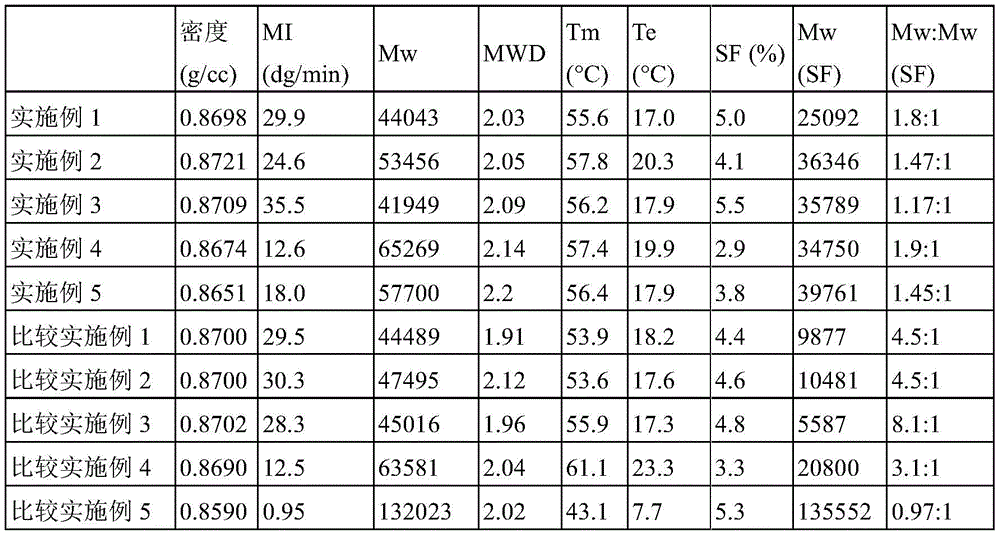
如表2所示,在通过使用式1的过渡金属化合物并注入氢来制备基于烯烃的共聚物的实施例1至5中,可溶级分显示出22,000以上高的分子量的值,并且同时,相对于基于烯烃的共聚物的总重均分子量的比率为1:1至2:1,以及可溶级分的重均分子量显示出与总重均分子量相似的水平。As shown in Table 2, in Examples 1 to 5 in which the olefin-based copolymer was prepared by using the transition metal compound of Formula 1 and injecting hydrogen, the soluble fraction showed a high molecular weight value of 22,000 or more, and at the same time, The ratio relative to the total weight average molecular weight of the olefin-based copolymer was 1:1 to 2:1, and the weight average molecular weight of the soluble fraction showed a similar level to the total weight average molecular weight.
相反,在对应于可商购的常规共聚物比较实施例1和2、在不注入氢的情况下进行聚合的比较实施例3、以及使用比较制备实施例1的催化剂(其不对应于式1)的比较实施例4中,可溶级分的重均分子量小于22,000,并且相对于全部基于烯烃的共聚物的重均分子量的比率为3.1:1至8.1:1,显示出较大的差异。In contrast, in Comparative Examples 1 and 2 corresponding to commercially available conventional copolymers, Comparative Example 3 in which polymerization was performed without hydrogen injection, and using the catalyst of Comparative Preparation Example 1 (which does not correspond to Formula 1 ) in Comparative Example 4, the weight average molecular weight of the soluble fraction was less than 22,000, and the ratio relative to the weight average molecular weight of the entire olefin-based copolymer was 3.1:1 to 8.1:1, showing a large difference.
特别地,如在比较实施例5中所证实的,如果增加了可溶级分的重均分子量相对于总重均分子量的比率,则难以维持高并且达到10以上的熔融指数。In particular, as demonstrated in Comparative Example 5, if the ratio of the weight average molecular weight of the soluble fraction to the total weight average molecular weight is increased, it is difficult to maintain a high melt index and reach 10 or more.
实验实施例2Experimental Example 2
对于实施例1和4以及比较实施例1至4的基于烯烃的共聚物,根据以下方法测量了撕裂强度、拉伸强度、伸长率、挠曲强度和硬度,并且在下表3中示出了结果。For the olefin-based copolymers of Examples 1 and 4 and Comparative Examples 1 to 4, tear strength, tensile strength, elongation, flexural strength, and hardness were measured according to the following methods, and are shown in Table 3 below got the result.
1)撕裂强度、拉伸强度和伸长率1) Tear strength, tensile strength and elongation
将每种基于烯烃的共聚物挤出以形成粒料,并基于ASTM D638(50mm/min)进行测量。Each olefin-based copolymer was extruded to form pellets, and measured based on ASTM D638 (50 mm/min).
2)挠曲强度2) Flexural strength
根据ASTM D790进行测量。Measured according to ASTM D790.
3)硬度(肖氏A)3) Hardness (Shore A)
根据ASTM D2240,使用TECLOCK公司的用于硬度计的GC610 STAND和Mitutoyo公司的A型肖氏硬度测试仪进行测量。According to ASTM D2240, GC610 STAND for hardness tester of TECLOCK company and A-type Shore hardness tester of Mitutoyo company were used for measurement.
[表3][table 3]

[表4][Table 4]

如表2中所总结,实施例1和比较实施例1至3的基于烯烃的共聚物显示出相似程度的熔体指数值。但是,存在以下差异。实施例1显示了Mw(SF)值为22,000以上,Mw:Mw(SF)值为1.8:1,并且满足(a)至(c)的全部条件,但是比较实施例1至3显示了Mw(SF)值小于11,000,Mw:Mw(SF)值为4.5:1或8:1,并且不满足(b)和(c)的条件。As summarized in Table 2, the olefin-based copolymers of Example 1 and Comparative Examples 1 to 3 exhibited melt index values to a similar extent. However, there are the following differences. Example 1 shows that the Mw(SF) value is 22,000 or more, the Mw:Mw(SF) value is 1.8:1, and satisfies all the conditions (a) to (c), but Comparative Examples 1 to 3 show that Mw( SF) value is less than 11,000, Mw:Mw(SF) value is 4.5:1 or 8:1, and conditions (b) and (c) are not met.
类似地,实施例4和比较实施例4的基于烯烃的共聚物显示出相似程度的熔体指数值。这里,有如下差异。实施例4显示了Mw(SF)值为34,750,Mw:Mw(SF)值为1.9:1,并且满足(a)至(c)的全部条件,而比较实施例4显示了Mw(SF)值小于22,000,Mw:Mw(SF)值为3.1:1,并且不满足(b)和(c)的条件。Similarly, the olefin-based copolymers of Example 4 and Comparative Example 4 exhibited melt index values to a similar extent. Here, there are differences as follows. Example 4 shows a Mw(SF) value of 34,750, a Mw:Mw(SF) value of 1.9:1, and meets all conditions (a) to (c), while Comparative Example 4 shows a Mw(SF) value of Less than 22,000, the Mw:Mw(SF) value is 3.1:1, and the conditions (b) and (c) are not satisfied.
基于上述内容,如表3所示,当与比较实施例1至3的共聚物相比,实施例1的基于烯烃的共聚物显示出相似程度的伸长率,并且具有优异的物理性质(包括撕裂强度、拉伸强度、挠曲强度、硬度等)。类似地,如表4所示,与比较实施例4的基于烯烃的共聚物相比,实施例4的基于烯烃的共聚物显示出改善的物理性质,包括撕裂强度、拉伸强度、挠曲强度、硬度等。Based on the above, as shown in Table 3, when compared with the copolymers of Comparative Examples 1 to 3, the olefin-based copolymer of Example 1 exhibited a similar degree of elongation and had excellent physical properties (including tear strength, tensile strength, flexural strength, hardness, etc.). Similarly, as shown in Table 4, compared to the olefin-based copolymer of Comparative Example 4, the olefin-based copolymer of Example 4 exhibited improved physical properties, including tear strength, tensile strength, flexural strength, Strength, hardness, etc.
即,由于本发明的基于烯烃的共聚物的熔体指数为10-100g/10min,并且满足在-20℃下的可溶级分的重均分子量和一定水平的比率,因此,满足(a)至(c)的全部条件,所以可以显示优异的物理性质,例如撕裂强度和拉伸强度。That is, since the melt index of the olefin-based copolymer of the present invention is 10-100 g/10 min, and satisfies the weight-average molecular weight of the soluble fraction at -20° C. and the ratio of a certain level, it satisfies (a) All the conditions to (c), so excellent physical properties such as tear strength and tensile strength can be exhibited.
Claims (10)
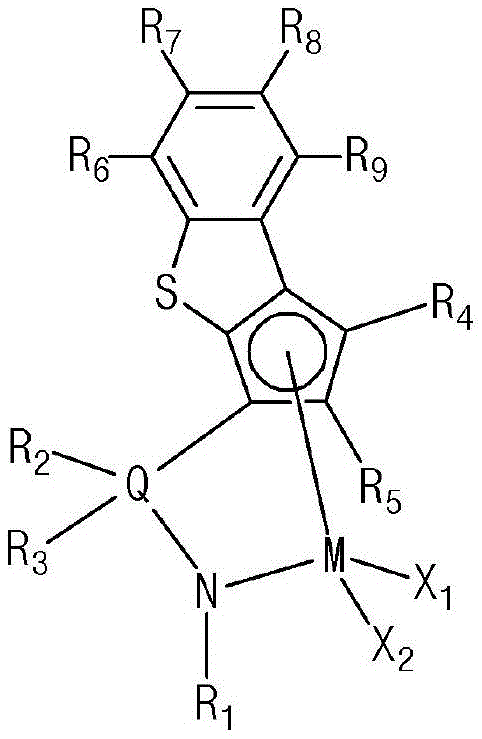
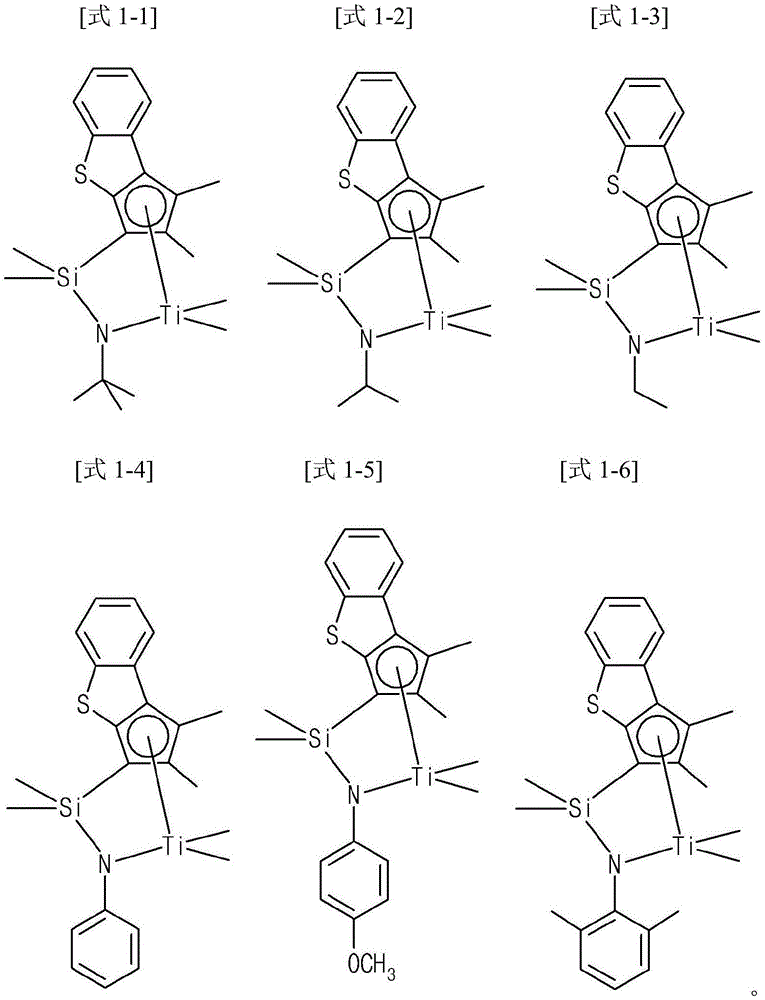
Applications Claiming Priority (3)
| Application Number | Priority Date | Filing Date | Title |
|---|---|---|---|
| KR10-2019-0105771 | 2019-08-28 | ||
| KR20190105771 | 2019-08-28 | ||
| PCT/KR2019/015695 WO2021040139A1 (en) | 2019-08-28 | 2019-11-15 | Olefinic copolymer and preparation method therefor |
Publications (2)
| Publication Number | Publication Date |
|---|---|
| CN113166320A CN113166320A (en) | 2021-07-23 |
| CN113166320B true CN113166320B (en) | 2023-02-28 |
Family
ID=69626926
Family Applications (1)
| Application Number | Title | Priority Date | Filing Date |
|---|---|---|---|
| CN201980078657.0A Active CN113166320B (en) | 2019-08-28 | 2019-11-15 | Olefin-based copolymer and method for preparing the same |
Country Status (6)
| Country | Link |
|---|---|
| US (1) | US12037426B2 (en) |
| EP (1) | EP3878875A4 (en) |
| JP (1) | JP7187098B2 (en) |
| KR (1) | KR102071594B1 (en) |
| CN (1) | CN113166320B (en) |
| WO (1) | WO2021040139A1 (en) |
Families Citing this family (15)
| Publication number | Priority date | Publication date | Assignee | Title |
|---|---|---|---|---|
| CN113661187B (en) * | 2019-08-28 | 2023-05-16 | 株式会社Lg化学 | Polypropylene composite material and preparation method thereof |
| JP7258411B2 (en) | 2020-04-16 | 2023-04-17 | エルジー・ケム・リミテッド | Composition for sealing material film containing ethylene/α-olefin copolymer and sealing material film containing the same |
| KR102348517B1 (en) * | 2020-04-16 | 2022-01-10 | 주식회사 엘지화학 | A composition for an encapsulant film and an encapsulant film comprising the same |
| US12528898B2 (en) | 2020-04-16 | 2026-01-20 | Lg Chem, Ltd. | Ethylene/alpha-olefin copolymer with excellent electrical insulation |
| EP4006065B1 (en) * | 2020-04-16 | 2025-11-26 | LG Chem, Ltd. | Composition for encapsulant film and encapsulant film comprising the same |
| ES3041315T3 (en) * | 2020-04-16 | 2025-11-11 | Lg Chemical Ltd | Ethylene/alpha-olefin copolymer having excellent electrical insulation |
| WO2021210755A1 (en) | 2020-04-16 | 2021-10-21 | 주식회사 엘지화학 | Ethylene/alpha-olefin copolymer having excellent electrical insulation |
| ES3040205T3 (en) * | 2020-04-16 | 2025-10-29 | Lg Chemical Ltd | Composition for encapsulant film comprising ethylene/alpha-olefin copolymer and encapsulant film comprising the same |
| KR102967719B1 (en) * | 2020-05-22 | 2026-05-21 | 주식회사 엘지화학 | Olefin based polymer |
| KR102885704B1 (en) * | 2020-05-22 | 2025-11-14 | 주식회사 엘지화학 | Olefin based polymer |
| US20250011588A1 (en) * | 2022-09-22 | 2025-01-09 | Lg Chem, Ltd. | Polyethylene composition and biaxially stretched film comprising the same |
| US20250282939A1 (en) * | 2022-09-22 | 2025-09-11 | Lg Chem, Ltd. | Polyethylene composition and biaxially stretched film comprising the same |
| KR102965791B1 (en) * | 2022-10-25 | 2026-05-14 | 주식회사 엘지화학 | Polyethylene composition and biaxially stretched film comprising the same |
| WO2025165130A1 (en) * | 2024-01-30 | 2025-08-07 | 주식회사 엘지화학 | Polyethylene composition and biaxially stretched film comprising same |
| WO2025165125A1 (en) * | 2024-01-30 | 2025-08-07 | 주식회사 엘지화학 | Polyethylene composition and biaxially-oriented film comprising same |
Citations (4)
| Publication number | Priority date | Publication date | Assignee | Title |
|---|---|---|---|---|
| KR20180055221A (en) * | 2016-11-16 | 2018-05-25 | 주식회사 엘지화학 | Catalystic composition comprising transition metal compound and alkylaluminoxane, preparing method for polymer using the same, and polymer prepared thereby |
| WO2019125050A1 (en) * | 2017-12-22 | 2019-06-27 | 주식회사 엘지화학 | Olefin-based polymer |
| KR20190074963A (en) * | 2017-12-20 | 2019-06-28 | 주식회사 엘지화학 | Polyethylene copolymer and method for preparing the same |
| KR20190078529A (en) * | 2017-12-26 | 2019-07-04 | 주식회사 엘지화학 | Olefin based polymer |
Family Cites Families (16)
| Publication number | Priority date | Publication date | Assignee | Title |
|---|---|---|---|---|
| US4935474A (en) | 1983-06-06 | 1990-06-19 | Exxon Research & Engineering Company | Process and catalyst for producing polyethylene having a broad molecular weight distribution |
| US6274684B1 (en) | 1999-10-22 | 2001-08-14 | Univation Technologies, Llc | Catalyst composition, method of polymerization, and polymer therefrom |
| JP4020862B2 (en) | 2001-07-19 | 2007-12-12 | ユニベーション・テクノロジーズ・エルエルシー | Mixed metallocene catalyst system containing comonomer minor incorporation catalyst and comonomer major incorporation catalyst |
| JP4056368B2 (en) | 2002-11-26 | 2008-03-05 | 日本ポリプロ株式会社 | Polypropylene resin composition for metal vapor deposited film, film comprising the same, and metal vapor deposited film |
| KR101719064B1 (en) | 2014-11-13 | 2017-03-22 | 주식회사 엘지화학 | Ligand compound, transition metal compound, and catalyst composition comprising the same |
| KR101720920B1 (en) | 2014-12-09 | 2017-03-28 | 미쯔이가가꾸가부시끼가이샤 | Propylene-based resin composition |
| KR101783897B1 (en) | 2014-12-10 | 2017-10-10 | 주식회사 엘지화학 | Polyolefin pellet for preparing fiber and fiber comprising the same |
| KR101919435B1 (en) | 2015-10-21 | 2018-11-16 | 주식회사 엘지화학 | Transition metal complexes, catalyst compositions comprising the same, and method for preparing polyolefins therewith |
| KR101967775B1 (en) * | 2015-12-08 | 2019-08-13 | 주식회사 엘지화학 | Polypropylene based composite |
| KR102223718B1 (en) | 2016-11-14 | 2021-03-05 | 주식회사 엘지화학 | Ligand compound, transition metal compound, and catalystic composition comprising the same |
| KR101920401B1 (en) | 2016-12-06 | 2019-02-08 | 한화케미칼 주식회사 | Transition metal compound used to prepare catalyst for polymerizing olefin, catalyst for polymerizing olefin comprising the same and polyolefin polymerized by using the same |
| KR20180074576A (en) | 2016-12-23 | 2018-07-03 | 주식회사 엘지화학 | Polyolefin-based resin composition and elastomer comprising the same |
| US11225568B2 (en) | 2017-12-20 | 2022-01-18 | Lg Chem, Ltd. | Polyethylene copolymer and method for preparing same |
| KR102117623B1 (en) | 2018-05-04 | 2020-06-02 | 주식회사 엘지화학 | Olefin based copolymer and preparation method for the same |
| KR20190127594A (en) | 2018-05-04 | 2019-11-13 | 주식회사 엘지화학 | Polypropylene based composite and preparation method for the same |
| CN113661187B (en) | 2019-08-28 | 2023-05-16 | 株式会社Lg化学 | Polypropylene composite material and preparation method thereof |
-
2019
- 2019-11-15 KR KR1020190147031A patent/KR102071594B1/en active Active
- 2019-11-15 US US17/312,230 patent/US12037426B2/en active Active
- 2019-11-15 EP EP19942785.7A patent/EP3878875A4/en active Pending
- 2019-11-15 JP JP2021531787A patent/JP7187098B2/en active Active
- 2019-11-15 WO PCT/KR2019/015695 patent/WO2021040139A1/en not_active Ceased
- 2019-11-15 CN CN201980078657.0A patent/CN113166320B/en active Active
Patent Citations (4)
| Publication number | Priority date | Publication date | Assignee | Title |
|---|---|---|---|---|
| KR20180055221A (en) * | 2016-11-16 | 2018-05-25 | 주식회사 엘지화학 | Catalystic composition comprising transition metal compound and alkylaluminoxane, preparing method for polymer using the same, and polymer prepared thereby |
| KR20190074963A (en) * | 2017-12-20 | 2019-06-28 | 주식회사 엘지화학 | Polyethylene copolymer and method for preparing the same |
| WO2019125050A1 (en) * | 2017-12-22 | 2019-06-27 | 주식회사 엘지화학 | Olefin-based polymer |
| KR20190078529A (en) * | 2017-12-26 | 2019-07-04 | 주식회사 엘지화학 | Olefin based polymer |
Also Published As
| Publication number | Publication date |
|---|---|
| JP7187098B2 (en) | 2022-12-12 |
| JP2022510678A (en) | 2022-01-27 |
| US12037426B2 (en) | 2024-07-16 |
| US20220049033A1 (en) | 2022-02-17 |
| KR102071594B1 (en) | 2020-02-03 |
| WO2021040139A1 (en) | 2021-03-04 |
| EP3878875A1 (en) | 2021-09-15 |
| CN113166320A (en) | 2021-07-23 |
| EP3878875A4 (en) | 2022-04-20 |
Similar Documents
| Publication | Publication Date | Title |
|---|---|---|
| JP7187098B2 (en) | Olefin-based copolymer and method for producing the same | |
| KR102058069B1 (en) | Olefin based polymer | |
| KR102065164B1 (en) | Olefin based polymer | |
| JP7177262B2 (en) | Olefin polymer | |
| CN111902438B (en) | Ethylene/alpha-olefin copolymer and process for producing the same | |
| CN111788239B (en) | Ethylene/α-olefin copolymer and its preparation method | |
| CN106232638B (en) | Polyolefins with excellent environmental stress crack resistance | |
| JP7238116B2 (en) | Olefin polymerization catalyst | |
| KR101549209B1 (en) | Olefin based polymer having excellent processibility | |
| CN113661187B (en) | Polypropylene composite material and preparation method thereof | |
| CN111491961B (en) | Olefin-based polymers | |
| CN111971313B (en) | Ethylene/alpha-olefin copolymer and process for producing the same | |
| CN106062018A (en) | Ethylene-α-olefin copolymer and olefin-based resin composition | |
| CN111511784B (en) | Adhesive compositions containing ethylene/alpha-olefin copolymers | |
| CN112020521B (en) | Olefin-based copolymers and methods for their preparation | |
| CN111989350B (en) | Olefin-based copolymers and methods for their preparation | |
| EP4592343A1 (en) | Polyethylene composition and biaxially stretched film comprising same | |
| CN116323704B (en) | Olefin polymers | |
| KR102885704B1 (en) | Olefin based polymer | |
| KR20250118802A (en) | Polyethylene composition and biaxially stretched film comprising the same | |
| KR20240062822A (en) | Polyethylene composition and biaxially stretched film comprising the same |
Legal Events
| Date | Code | Title | Description |
|---|---|---|---|
| PB01 | Publication | ||
| PB01 | Publication | ||
| SE01 | Entry into force of request for substantive examination | ||
| SE01 | Entry into force of request for substantive examination | ||
| GR01 | Patent grant | ||
| GR01 | Patent grant |