CN113166318A - Olefin polymers - Google Patents
Olefin polymers Download PDFInfo
- Publication number
- CN113166318A CN113166318A CN201980068732.5A CN201980068732A CN113166318A CN 113166318 A CN113166318 A CN 113166318A CN 201980068732 A CN201980068732 A CN 201980068732A CN 113166318 A CN113166318 A CN 113166318A
- Authority
- CN
- China
- Prior art keywords
- olefin polymer
- olefin
- molecular weight
- index
- transition metal
- Prior art date
- Legal status (The legal status is an assumption and is not a legal conclusion. Google has not performed a legal analysis and makes no representation as to the accuracy of the status listed.)
- Granted
Links
Images


Classifications
-
- C—CHEMISTRY; METALLURGY
- C08—ORGANIC MACROMOLECULAR COMPOUNDS; THEIR PREPARATION OR CHEMICAL WORKING-UP; COMPOSITIONS BASED THEREON
- C08F—MACROMOLECULAR COMPOUNDS OBTAINED BY REACTIONS ONLY INVOLVING CARBON-TO-CARBON UNSATURATED BONDS
- C08F210/00—Copolymers of unsaturated aliphatic hydrocarbons having only one carbon-to-carbon double bond
- C08F210/02—Ethene
-
- C—CHEMISTRY; METALLURGY
- C08—ORGANIC MACROMOLECULAR COMPOUNDS; THEIR PREPARATION OR CHEMICAL WORKING-UP; COMPOSITIONS BASED THEREON
- C08L—COMPOSITIONS OF MACROMOLECULAR COMPOUNDS
- C08L23/00—Compositions of homopolymers or copolymers of unsaturated aliphatic hydrocarbons having only one carbon-to-carbon double bond; Compositions of derivatives of such polymers
- C08L23/02—Compositions of homopolymers or copolymers of unsaturated aliphatic hydrocarbons having only one carbon-to-carbon double bond; Compositions of derivatives of such polymers not modified by chemical after-treatment
- C08L23/04—Homopolymers or copolymers of ethene
- C08L23/08—Copolymers of ethene
- C08L23/0807—Copolymers of ethene with unsaturated hydrocarbons only containing four or more carbon atoms
- C08L23/0815—Copolymers of ethene with unsaturated hydrocarbons only containing four or more carbon atoms with aliphatic 1-olefins containing one carbon-to-carbon double bond
-
- C—CHEMISTRY; METALLURGY
- C08—ORGANIC MACROMOLECULAR COMPOUNDS; THEIR PREPARATION OR CHEMICAL WORKING-UP; COMPOSITIONS BASED THEREON
- C08F—MACROMOLECULAR COMPOUNDS OBTAINED BY REACTIONS ONLY INVOLVING CARBON-TO-CARBON UNSATURATED BONDS
- C08F210/00—Copolymers of unsaturated aliphatic hydrocarbons having only one carbon-to-carbon double bond
- C08F210/16—Copolymers of ethene with alpha-alkenes, e.g. EP rubbers
-
- C—CHEMISTRY; METALLURGY
- C08—ORGANIC MACROMOLECULAR COMPOUNDS; THEIR PREPARATION OR CHEMICAL WORKING-UP; COMPOSITIONS BASED THEREON
- C08J—WORKING-UP; GENERAL PROCESSES OF COMPOUNDING; AFTER-TREATMENT NOT COVERED BY SUBCLASSES C08B, C08C, C08F, C08G or C08H
- C08J5/00—Manufacture of articles or shaped materials containing macromolecular substances
- C08J5/18—Manufacture of films or sheets
-
- C—CHEMISTRY; METALLURGY
- C08—ORGANIC MACROMOLECULAR COMPOUNDS; THEIR PREPARATION OR CHEMICAL WORKING-UP; COMPOSITIONS BASED THEREON
- C08F—MACROMOLECULAR COMPOUNDS OBTAINED BY REACTIONS ONLY INVOLVING CARBON-TO-CARBON UNSATURATED BONDS
- C08F2500/00—Characteristics or properties of obtained polyolefins; Use thereof
- C08F2500/04—Broad molecular weight distribution, i.e. Mw/Mn > 6
-
- C—CHEMISTRY; METALLURGY
- C08—ORGANIC MACROMOLECULAR COMPOUNDS; THEIR PREPARATION OR CHEMICAL WORKING-UP; COMPOSITIONS BASED THEREON
- C08F—MACROMOLECULAR COMPOUNDS OBTAINED BY REACTIONS ONLY INVOLVING CARBON-TO-CARBON UNSATURATED BONDS
- C08F2500/00—Characteristics or properties of obtained polyolefins; Use thereof
- C08F2500/08—Low density, i.e. < 0.91 g/cm3
-
- C—CHEMISTRY; METALLURGY
- C08—ORGANIC MACROMOLECULAR COMPOUNDS; THEIR PREPARATION OR CHEMICAL WORKING-UP; COMPOSITIONS BASED THEREON
- C08F—MACROMOLECULAR COMPOUNDS OBTAINED BY REACTIONS ONLY INVOLVING CARBON-TO-CARBON UNSATURATED BONDS
- C08F2500/00—Characteristics or properties of obtained polyolefins; Use thereof
- C08F2500/09—Long chain branches
-
- C—CHEMISTRY; METALLURGY
- C08—ORGANIC MACROMOLECULAR COMPOUNDS; THEIR PREPARATION OR CHEMICAL WORKING-UP; COMPOSITIONS BASED THEREON
- C08F—MACROMOLECULAR COMPOUNDS OBTAINED BY REACTIONS ONLY INVOLVING CARBON-TO-CARBON UNSATURATED BONDS
- C08F2500/00—Characteristics or properties of obtained polyolefins; Use thereof
- C08F2500/12—Melt flow index or melt flow ratio
-
- C—CHEMISTRY; METALLURGY
- C08—ORGANIC MACROMOLECULAR COMPOUNDS; THEIR PREPARATION OR CHEMICAL WORKING-UP; COMPOSITIONS BASED THEREON
- C08F—MACROMOLECULAR COMPOUNDS OBTAINED BY REACTIONS ONLY INVOLVING CARBON-TO-CARBON UNSATURATED BONDS
- C08F2500/00—Characteristics or properties of obtained polyolefins; Use thereof
- C08F2500/18—Bulk density
-
- C—CHEMISTRY; METALLURGY
- C08—ORGANIC MACROMOLECULAR COMPOUNDS; THEIR PREPARATION OR CHEMICAL WORKING-UP; COMPOSITIONS BASED THEREON
- C08F—MACROMOLECULAR COMPOUNDS OBTAINED BY REACTIONS ONLY INVOLVING CARBON-TO-CARBON UNSATURATED BONDS
- C08F4/00—Polymerisation catalysts
- C08F4/42—Metals; Metal hydrides; Metallo-organic compounds; Use thereof as catalyst precursors
- C08F4/44—Metals; Metal hydrides; Metallo-organic compounds; Use thereof as catalyst precursors selected from light metals, zinc, cadmium, mercury, copper, silver, gold, boron, gallium, indium, thallium, rare earths or actinides
- C08F4/60—Metals; Metal hydrides; Metallo-organic compounds; Use thereof as catalyst precursors selected from light metals, zinc, cadmium, mercury, copper, silver, gold, boron, gallium, indium, thallium, rare earths or actinides together with refractory metals, iron group metals, platinum group metals, manganese, rhenium technetium or compounds thereof
- C08F4/62—Refractory metals or compounds thereof
- C08F4/64—Titanium, zirconium, hafnium or compounds thereof
- C08F4/659—Component covered by group C08F4/64 containing a transition metal-carbon bond
- C08F4/65912—Component covered by group C08F4/64 containing a transition metal-carbon bond in combination with an organoaluminium compound
-
- C—CHEMISTRY; METALLURGY
- C08—ORGANIC MACROMOLECULAR COMPOUNDS; THEIR PREPARATION OR CHEMICAL WORKING-UP; COMPOSITIONS BASED THEREON
- C08F—MACROMOLECULAR COMPOUNDS OBTAINED BY REACTIONS ONLY INVOLVING CARBON-TO-CARBON UNSATURATED BONDS
- C08F4/00—Polymerisation catalysts
- C08F4/42—Metals; Metal hydrides; Metallo-organic compounds; Use thereof as catalyst precursors
- C08F4/44—Metals; Metal hydrides; Metallo-organic compounds; Use thereof as catalyst precursors selected from light metals, zinc, cadmium, mercury, copper, silver, gold, boron, gallium, indium, thallium, rare earths or actinides
- C08F4/60—Metals; Metal hydrides; Metallo-organic compounds; Use thereof as catalyst precursors selected from light metals, zinc, cadmium, mercury, copper, silver, gold, boron, gallium, indium, thallium, rare earths or actinides together with refractory metals, iron group metals, platinum group metals, manganese, rhenium technetium or compounds thereof
- C08F4/62—Refractory metals or compounds thereof
- C08F4/64—Titanium, zirconium, hafnium or compounds thereof
- C08F4/659—Component covered by group C08F4/64 containing a transition metal-carbon bond
- C08F4/65916—Component covered by group C08F4/64 containing a transition metal-carbon bond supported on a carrier, e.g. silica, MgCl2, polymer
-
- C—CHEMISTRY; METALLURGY
- C08—ORGANIC MACROMOLECULAR COMPOUNDS; THEIR PREPARATION OR CHEMICAL WORKING-UP; COMPOSITIONS BASED THEREON
- C08J—WORKING-UP; GENERAL PROCESSES OF COMPOUNDING; AFTER-TREATMENT NOT COVERED BY SUBCLASSES C08B, C08C, C08F, C08G or C08H
- C08J2323/00—Characterised by the use of homopolymers or copolymers of unsaturated aliphatic hydrocarbons having only one carbon-to-carbon double bond; Derivatives of such polymers
- C08J2323/02—Characterised by the use of homopolymers or copolymers of unsaturated aliphatic hydrocarbons having only one carbon-to-carbon double bond; Derivatives of such polymers not modified by chemical after treatment
- C08J2323/04—Homopolymers or copolymers of ethene
- C08J2323/08—Copolymers of ethene
-
- C—CHEMISTRY; METALLURGY
- C08—ORGANIC MACROMOLECULAR COMPOUNDS; THEIR PREPARATION OR CHEMICAL WORKING-UP; COMPOSITIONS BASED THEREON
- C08L—COMPOSITIONS OF MACROMOLECULAR COMPOUNDS
- C08L2201/00—Properties
- C08L2201/10—Transparent films; Clear coatings; Transparent materials
-
- C—CHEMISTRY; METALLURGY
- C08—ORGANIC MACROMOLECULAR COMPOUNDS; THEIR PREPARATION OR CHEMICAL WORKING-UP; COMPOSITIONS BASED THEREON
- C08L—COMPOSITIONS OF MACROMOLECULAR COMPOUNDS
- C08L2203/00—Applications
- C08L2203/16—Applications used for films
-
- C—CHEMISTRY; METALLURGY
- C08—ORGANIC MACROMOLECULAR COMPOUNDS; THEIR PREPARATION OR CHEMICAL WORKING-UP; COMPOSITIONS BASED THEREON
- C08L—COMPOSITIONS OF MACROMOLECULAR COMPOUNDS
- C08L2207/00—Properties characterising the ingredient of the composition
- C08L2207/06—Properties of polyethylene
- C08L2207/066—LDPE (radical process)
Landscapes
- Chemical & Material Sciences (AREA)
- Health & Medical Sciences (AREA)
- Chemical Kinetics & Catalysis (AREA)
- Medicinal Chemistry (AREA)
- Polymers & Plastics (AREA)
- Organic Chemistry (AREA)
- Engineering & Computer Science (AREA)
- Manufacturing & Machinery (AREA)
- Materials Engineering (AREA)
- Transition And Organic Metals Composition Catalysts For Addition Polymerization (AREA)
- Addition Polymer Or Copolymer, Post-Treatments, Or Chemical Modifications (AREA)
- Manufacture Of Macromolecular Shaped Articles (AREA)
Abstract
本发明涉及一种烯烃聚合物及由其制备的膜,更具体地,本发明涉及一种在包含不同过渡金属化合物的杂化催化剂下制备且具有优异的加工性、冲击强度和雾度的烯烃聚合物,特别是线型低密度聚乙烯及由其制备的膜。
The present invention relates to an olefin polymer and a film prepared therefrom, and more particularly, to an olefin prepared under a hybrid catalyst comprising different transition metal compounds and having excellent processability, impact strength and haze Polymers, especially linear low density polyethylene and films made therefrom.
Description
Technical Field
The present invention relates to an olefin polymer and a film prepared therefrom. More particularly, the present invention relates to an olefin polymer, particularly linear low density polyethylene, and films made therefrom, prepared with a hybrid catalyst comprising different transition metal compounds and having excellent processability, impact strength and haze (haze).
Background
As one of catalysts for polymerizing olefins, metallocene catalysts are compounds in which a transition metal or a transition metal halide is coordinately bound to a ligand such as cyclopentadienyl (cyclopentadienyl), indenyl (indenyl), cycloheptadienyl (cyclopentadienyl), etc., and have a basic form of a sandwich structure.
As another catalyst for polymerizing olefins, a Ziegler-Natta (Ziegler-Natta) catalyst is a compound having a fixed structure and thus is considered to be a single-site catalyst (single-site catalyst) in which all active sites have the same polymerization characteristics because the metal component as the active site is dispersed on the surface of an inert solid and thus the properties of the active site are not uniform. The polymers polymerized under such metallocene catalysts have a narrow molecular weight distribution and a uniform comonomer distribution.
Among them, linear low-density polyethylene (LLDPE) is made by copolymerizing ethylene and α -olefin using a polymerization catalyst at low pressure, and has a narrow molecular weight distribution and Short Chain Branches (SCB) of a certain length, usually without Long Chain Branches (LCB). Films made of linear low density polyethylene have high tensile strength and elongation and excellent tear strength, impact strength, etc. in addition to the characteristics of general polyethylene, and thus are widely used for stretch films, laminate films, etc. that are difficult to realize by low-density polyethylene (low-density polyethylene) or high-density polyethylene (high-density polyethylene).
In the linear low density polyethylene prepared by the metallocene catalyst, when processability and haze of the film are excellent, the strength of the film may be reduced. Conversely, when the strength of the film is excellent, the processability and haze may decrease.
Accordingly, there is a need for an olefin polymer, particularly a linear low density polyolefin, that can provide a film having excellent processability as well as excellent impact strength and haze.
Disclosure of Invention
Technical problem
The object of the present invention is to provide an olefin polymer, particularly a linear low density polyethylene, having excellent processability as well as excellent impact strength and haze.
It is another object of the present invention to provide a film having excellent impact strength and haze, which is formed from an olefin polymer, particularly linear low density polyethylene.
Technical scheme
In order to achieve the above object, according to one embodiment of the present invention, there is provided an olefin polymer satisfying: (1) a molecular weight distribution according to polydispersity index (Mw/Mn) of from 5 to 20; (2) the density was 0.910g/cm3To 0.930g/cm3(ii) a (3) A melt index (melt index) of 0.5g/10min to 2.0g/10min when measured at 190 ℃ under a load of 2.16 kg; and (4) melt index ratio (MI)21.6/MI2.16) From 20 to 30.
Among them, the weight average molecular weight (Mw) of the olefin polymer is preferably 50,000g/mol to 250,000 g/mol.
Wherein the BOCD Index (Broad Orthogonal Comonomer Distribution Index) of the olefin polymer calculated by the following numerical formula 1 is 0 to 3.0.
[ mathematical formula 1 ]
BOCD index (short chain branch content in high molecular weight component-short chain branch content in low molecular weight component)/(short chain branch content in low molecular weight component)
Wherein the olefin polymer has a long chain branch content of 0.01 to 0.1 per 10,000 carbon atoms.
Wherein c is when a graph of frequency (rad/s) and complex viscosity (complex index, Pa · s) of the olefin polymer is fitted by a power law (power law) of the following equation 22The value is-0.3 to-0.2.
[ mathematical formula 2 ]

Wherein the shear thinning index (shear thinning index) of the olefin polymer calculated by the following numerical formula 3 is 10 to 15.
[ mathematical formula 3 ]
Shear thinning index ═ η0/η500
In the above equation 3,. eta0Complex viscosity at a frequency of 0.1rad/s, eta500The complex viscosity is at a frequency of 500 rad/s.
Wherein the olefin polymer is a copolymer of an olefin monomer and an olefin comonomer. Specifically, the olefin monomer is ethylene, and the olefin comonomer is one or more selected from the group consisting of propylene, 1-butene, 1-pentene, 4-methyl-1-pentene, 1-hexene, 1-heptene, 1-octene, 1-decene, 1-undecene, 1-dodecene, 1-tetradecene, and 1-hexadecene.
Among them, the olefin polymer is preferably a linear low density polyethylene in which the olefin monomer is ethylene and the olefin comonomer is 1-hexene.
According to another embodiment of the present invention, there is provided a film formed from an olefin polymer.
Wherein the film has a haze of 10% or less and a falling weight impact strength of 600g or more.
Advantageous effects
The olefin polymer prepared under the condition of the metallocene catalyst for polymerizing olefins according to the embodiment of the present invention has not only excellent processability but also excellent impact strength and haze. Therefore, the film made therefrom has excellent impact strength and haze, and thus can be effectively used as a stretch film, a laminate film, or the like.
Drawings
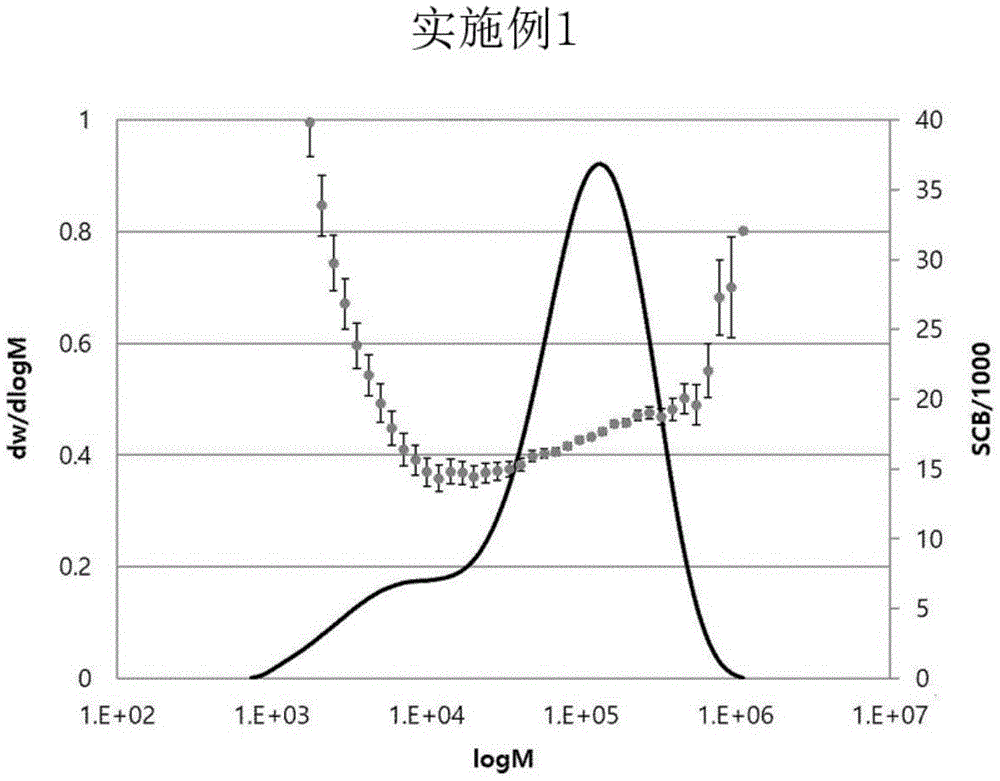
Fig. 1a and 1b show GPC-FTIR charts for determining the BOCD index of the olefin polymers of example 1 and example 2 of the present invention, respectively.
FIG. 2 shows a graph for measuring the melt strength of the olefin polymers of examples of the present invention and comparative examples.
FIG. 3 shows a graph of the complex viscosity at different frequencies of the olefin polymers of the examples of the present invention and the comparative examples.
Detailed Description
Hereinafter, the present invention will be described in detail.
Catalyst for polymerization of olefins
In one embodiment of the present invention, a catalyst for polymerizing olefins includes a first transition metal compound represented by the following chemical formula a, and a second transition metal compound represented by the following chemical formula B.
[ chemical formula A ]

[ chemical formula B ]

In the chemical formulas A and B, n and o are integers of 0 to 2 and at least one is not 0, and m and l are integers of 0 to 4, respectively. Specifically, n and o may be 1 or 2, respectively, and m and l may be 1, respectively.
M is titanium (Ti), zirconium (Zr) or hafnium (Hf). Specifically, M may be zirconium (Zr).
X is each independently halogen, C1-20Alkyl radical, C2-20Alkenyl radical, C2-20Alkynyl, C6-20Aryl radical, C1-20Alkyl radical C6-20Aryl radical, C6-20Aryl radical C1-20Alkyl radical, C1-20Alkylamide group, C6-20Aryl amido radical or C1-20An alkylene group. Specifically, X may each be halogen. More specifically, X may each be chlorine (Cl).
Q is carbon (C), silicon (Si), germanium (Ge) or tin (Sn). Specifically, Q may be carbon (C).
R1To R7Each independently is substituted or unsubstituted C1-20Alkyl, substituted or unsubstituted C2-20Alkenyl, substituted or unsubstituted C6-20Aryl, substituted or unsubstituted C1-20Alkyl radical C6-20Aryl, substituted or unsubstituted C6-20Aryl radical C1-20Alkyl, substituted or unsubstituted C1-20Heteroalkyl, substituted or unsubstituted C3-20Heteroaryl, substituted or unsubstituted C1-20Alkylamido, substituted or unsubstituted C6-20Arylamido, substituted or unsubstituted C1-20Alkylene, or substituted or unsubstituted C1-20A silyl group. Wherein R is1And R2Independently through a linkage with an adjacent group to form a substituted or unsubstituted saturated or unsaturated C4-20And (4) a ring. Furthermore, R3To R7May each independently form a substituted or unsubstituted saturated or unsaturated C by linking to an adjacent group4-20And (4) a ring.
Specifically, R1And R2May independently form a substituted or unsubstituted unsaturated C by linking to an adjacent group4-20And (4) a ring. More specifically, R1And R2May each form an unsubstituted unsaturated C by linking to an adjacent group4And (4) a ring.
Specifically, R3Can be C1-20An alkyl group. More specifically, R3Can be C1-6An alkyl group. Preferably, R3Is n-butyl.
Specifically, R4And R5Can be respectively C1-20An alkyl group. More specifically, R4And R5Can be respectively C1-6An alkyl group. Preferably, R4And R5Each is a tert-butyl group.
Specifically, R6And R7Can be respectively C6-20And (4) an aryl group. More specifically, R6And R7May each be phenyl.
In a preferred embodiment of the present invention, the compound represented by the chemical formula a may be a compound represented by the following chemical formula a-1. Further, the compound represented by the chemical formula B may be a compound represented by the following chemical formula B-1.
[ chemical formula A-1 ]

[ chemical formula B-1 ]

In a specific embodiment of the present invention, the weight ratio of the first transition metal compound and the second transition metal compound included in the catalyst for polymerizing olefins may be 20:1 to 1: 20. Preferably, the weight ratio of the first transition metal compound and the second transition metal compound included in the catalyst for polymerizing olefins may be 10:1 to 1: 10. More preferably, the weight ratio of the first transition metal compound and the second transition metal compound contained in the catalyst for polymerizing olefins may be 6:4 to 4: 6. When the content ratio of the first transition metal compound and the second transition metal compound is within the above range, appropriate supported catalyst activity can be exhibited, thereby facilitating maintenance of catalyst activity and economy. Also, the olefin polymer prepared under the catalyst condition for polymerizing olefin satisfying the above range may exhibit excellent processability, and the film made therefrom exhibits excellent strength and haze.
In general, it is known that olefin polymers containing a small amount of short chain branches have poor optical properties, while olefin polymers containing a large amount of long chain branches have poor mechanical properties due to having too high elasticity.
In the olefin polymer obtained by using the first transition metal compound alone, a small amount of short-chain branches are contained and relatively poor in optical properties. In the olefin polymer obtained by using the second transition metal compound alone, a large number of short-chain branches and long-chain branches are contained, and thus it is excellent in optical properties, but relatively poor in mechanical properties. That is, when either one of the first transition metal compound or the second transition metal compound, or the first transition metal compound and the second transition metal compound is used alone in an excessively high proportion, it is experimentally confirmed that it is difficult to satisfy both the optical properties and the mechanical properties.
In contrast, an olefin polymer having excellent strength and haze can be obtained with a catalyst for polymerizing an olefin comprising the first transition metal compound and the second transition metal compound in a weight ratio of 0.4: 1 to 2.5: 1.
In a preferred embodiment, the catalyst for polymerizing olefins according to embodiments of the present invention may further comprise a cocatalyst compound.
Wherein the cocatalyst compound may include at least one selected from the group consisting of a compound represented by the following chemical formula 1, a compound represented by the following chemical formula 2, and a compound represented by the following chemical formula 3.
[ chemical formula 1 ]

In the chemical formula 1, n is an integer of 2 or more, RaCan be a halogen atom, C1-20Hydrocarbons, or C substituted by halogen1-20A hydrocarbon. Specifically, RaAnd may be methyl, ethyl, n-butyl or isobutyl.
[ chemical formula 2 ]

In the chemical formula 2, D is aluminum (Al) or boron (B), Rb、RcAnd RdEach independently is a halogen atom, C1-20Hydrocarbyl, halogen-substituted C1-20A hydrocarbon group, or C1-20An alkoxy group. Specifically, when D is aluminum (Al), Rb、RcAnd RdMay each independently be methyl or isobutyl, when D is boron (B), Rb、RcAnd RdEach may be pentafluorophenyl.
[ chemical formula 3 ]
[L-H]+[Z(A)4]-Or [ L]+[Z(A)4]-
In the chemical formula 3, L is a neutral or cationic Lewis base, [ L-H ]]+And [ L]+Is a Bronsted acid, Z is a group 13 element, A are each independently substituted or unsubstituted C6-20Aryl, or substituted or unsubstituted C1-20An alkyl group. Specifically, [ L-H ]]+Can be a dimethylanilinium cation, [ Z (A) ]4]-Can be [ B (C)6F5)4]-,[L]+Can be [ (C)6H5)3C]+。
The compound represented by said chemical formula 1 may be, for example, methylaluminoxane, ethylaluminoxane, isobutylaluminoxane, butylaluminoxane, etc., and is preferably methylaluminoxane, but is not limited thereto.
The compound represented by the chemical formula 2 may be, for example, trimethylaluminum, triethylaluminum, triisobutylaluminum, tripropylaluminum, tributylaluminum, dimethylaluminum chloride, triisopropylaluminum, tri-sec-butylaluminum, tricyclopentylaluminum, tripentylaluminum, triisopentylaluminum, trihexylaluminum, trioctylaluminum, ethyldimethylaluminum, methyldiethylaluminum, triphenylaluminum, tri-p-tolylaluminum, dimethylaluminum methoxide (dimethylaluminum methoxide), dimethylaluminum ethoxide, trimethylboron, triethylboron, triisobutylboron, tripropylboron, tributylboron, etc., and is preferably trimethylaluminum, triethylaluminum, and triisobutylaluminum, but not limited thereto.
The compound represented by said chemical formula 3 may be, for example, triethylammonium tetraphenylboron, tributylammonium tetraphenylboron, trimethylammonium tetraphenylboron, tripropylammonium tetraphenylboron, trimethylammonium tetrakis (p-tolyl) boron, trimethylammonium tetrakis (o, p-dimethylphenyl) boron, tributylammonium tetrakis (p-trifluoromethylphenyl) boron, trimethylammonium tetrakis (p-trifluoromethylphenyl) boron, tributylammonium tetrakis (pentafluorophenyl) boron, N-diethylanilinium tetraphenylboron, N-diethylanilinium tetrakis (pentafluorophenyl) boron, diethylammonium tetrakis (pentafluorophenyl) boron, triphenylphosphonium tetraphenylboron, trimethylphosphonium tetraphenylboron, triethylammonium tetraphenylaluminum, tributylammonium tetraphenylaluminum, trimethylammonium tetraphenylaluminum, tripropylammonium tetraphenylaluminum, trimethylammonium tetrakis (p-tolyl) aluminum, tripropylammonium tetrakis (p-tolyl) aluminum, Triethylammoniumtetra (o, p-dimethylphenyl) aluminum, tributylammoniumtetra (p-trifluoromethylphenyl) aluminum, trimethylammonium tetrakis (p-trifluoromethylphenyl) aluminum, tributylammoniumtetra (pentafluorophenyl) aluminum, N-diethylphenylammonium tetraphenylaluminum, N-diethylphenylammonium tetrakis (pentafluorophenyl) aluminum, diethylammonium tetrakis (pentafluorophenyl) aluminum, triphenylphosphoniumtetraphenylaluminum, trimethylphosphonatetetraphenylaluminum, tripropylammoniumtetra (p-tolyl) boron, triethylammoniumtetra (o, p-dimethylphenyl) boron, tributylammoniumtetra (p-trifluoromethylphenyl) boron, triphenylcarboniumtetrakis (p-pentafluorophenyl) boron, and the like.
In a preferred embodiment, the catalyst for polymerizing olefins according to an embodiment of the present invention may further comprise a support supporting the first transition metal compound, the second transition metal compound, or both. Preferably, the catalyst for polymerizing olefins may further comprise a carrier supporting the first transition metal compound, the second transition metal compound, and the cocatalyst compound.
In this case, the surface of the support may contain a substance containing a hydroxyl group, and a substance which has been dried to remove moisture from the surface and has a highly reactive hydroxyl group and a siloxane group can be preferably used. For example, the support may comprise at least one selected from silica, alumina and magnesia. Specifically, silica-alumina, silica-magnesia, and the like dried at high temperature may be used as the carrier, and they may usually contain, for example, Na2O、K2CO3、BaSO4And Mg (NO)3)2Oxide, carbonate, sulfate and nitrate components. In addition, they may contain carbon, zeolites, magnesium chloride, and the like. However, the support is not limited thereto, and is not particularly limited as long as it can support the first transition metal compound and the second transition metal compoundAnd a cocatalyst compound.
The method of supporting the transition metal compound and/or the co-catalyst compound used for the catalyst for polymerizing olefins may employ a physical adsorption method or a chemical adsorption method.
For example, the physical adsorption method may be a method in which a solution in which a transition metal compound is dissolved is brought into contact with a carrier and then dried; a method of drying the solution in which the transition metal compound and the cocatalyst compound are dissolved after contacting the support; or a method in which a solution in which a transition metal compound is dissolved is brought into contact with a carrier and then dried to prepare a carrier on which a transition metal compound is supported, or a solution in which a cocatalyst compound is dissolved is brought into contact with a carrier and then dried to prepare a carrier on which a cocatalyst compound is supported, and these are mixed.
The chemisorption method may be a method in which a promoter compound is supported on the surface of a carrier, and then a transition metal compound is supported on the promoter compound; or a method of covalently bonding a functional group on the surface of the carrier (for example, in the case of silica, a hydroxyl group (-OH) on the surface of silica) to the catalyst compound.
The total amount of the first transition metal compound and the second transition metal compound supported on the carrier may be 0.001mmole to 1mmole, based on 1g of the carrier. When the ratio of the transition metal compound to the support satisfies the above range, appropriate supported catalyst activity is exhibited, thereby contributing to maintenance of catalyst activity and economy.
The amount of the cocatalyst compound supported on the carrier may be 2mmole to 15mmole, based on 1g of the carrier. When the ratio of the cocatalyst compound to the support satisfies the above range, maintenance of catalyst activity and economy may be facilitated.
One, two or more kinds of carriers may be used. For example, the first transition metal compound and the second transition metal compound may be supported on one kind of support, or the first transition metal compound and the second transition metal compound may be supported on a plurality of kinds of supports, respectively. Further, only one of the first transition metal compound and the second transition metal compound may be supported on the carrier.
The catalyst for polymerizing olefins is preferably a hybrid supported catalyst on which a first transition metal compound and a second transition metal compound are supported. More preferably, the hybrid supported catalyst in which the first transition metal compound and the second transition metal compound are supported together on a single kind of carrier.
For example, the catalyst for polymerizing olefins may be a hybrid supported catalyst in which a first transition metal compound, a second transition metal compound, and a cocatalyst compound are supported together on silica. However, embodiments of the present invention are not limited thereto.
According to another embodiment of the present invention, there is provided an olefin polymer prepared by polymerizing an olefin monomer under the above-described catalyst for polymerizing an olefin.
The olefin polymer may be, among others, a homopolymer (homopolymer) based on olefin monomers or a copolymer (copolymer) based on olefin monomers and comonomers.
The olefin monomer may be selected from C2-20Alpha-olefins (alpha-olefin), C1-20Diolefins (diolefrin), C3-20Cyclo-olefin (cycloolefin) and C3-20At least one of cyclodiolefins (cyclodiolefins).
For example, the olefin monomer may be ethylene, propylene, 1-butene, 1-pentene, 4-methyl-1-pentene, 1-hexene, 1-heptene, 1-octene, 1-decene, 1-undecene, 1-dodecene, 1-tetradecene, 1-hexadecene, or the like, and the olefin polymer may be a homopolymer containing only one kind selected from the above exemplary olefin monomers, or a copolymer containing a plurality of kinds selected from the above exemplary olefin monomers.
In exemplary embodiments, the olefin polymer may be a blend of ethylene and C3-20A copolymer obtained by copolymerizing alpha-olefin, and preferably a copolymer obtained by copolymerizing ethylene and 1-hexene, but is not limited thereto.
In this case, the content of ethylene is preferably 55 to 99.9% by weight, more preferably 90 to 99.9% by weight. The content of the alpha-olefin comonomer is preferably 0.1 to 45% by weight, more preferably 0.1 to 10% by weight.
The olefin polymer according to an embodiment of the present invention may be polymerized by polymerization such as, but not limited to, free radical (free radial), cationic (cationic), coordination (coordination), condensation (condensation), addition (addition), and the like.
In a preferred embodiment, the olefin polymer may be produced by a gas phase polymerization method, a solution polymerization method, a slurry polymerization method, or the like. When the olefin polymer is produced by a solution polymerization method or a slurry polymerization method, usable as the solvent are, for example, C such as pentane, hexane, heptane, nonane, decane and isomers thereof5-12An aliphatic hydrocarbon solvent; aromatic hydrocarbon solvents such as toluene and benzene; hydrocarbon solvents substituted with a chlorine atom such as methylene chloride and chlorobenzene; and mixtures thereof, and the like, but are not limited thereto.
Olefin polymers
The olefin polymer according to one embodiment of the present invention satisfies: (1) a molecular weight distribution according to polydispersity index (Mw/Mn) of from 5 to 20; (2) the density was 0.910g/cm3To 0.930g/cm3(ii) a (3) A melt index of 0.5g/10min to 2.0g/10min when measured at 190 ℃ under a load of 2.16 kg; and (4) melt index ratio (MFR; MI)21.6/MI2.16) From 20 to 30.
The olefin polymers have a relatively broad molecular weight distribution due to polymerization under the above-described hybrid supported catalyst conditions for polymerizing olefins. Specifically, the olefin polymer has a molecular weight distribution according to polydispersity index (Mw/Mn) of 5 to 20. Preferably, the olefin polymer may have a molecular weight distribution according to polydispersity index (Mw/Mn) of 6 to 15. Since the olefin polymer has a relatively broad molecular weight distribution, the olefin polymer exhibits excellent processability, and a film made therefrom may have good impact strength.
The olefin polymer was a density of 0.910g/cm3To 0.930g/cm3The low density polyethylene copolymer of (1). Preferably, the olefin polymer has a density of 0.915g/cm3To 0.925g/cm3. When the density of the olefin polymer is within this range, a film made of the olefin polymer may have good impact strength.
In preparing the olefin polymer according to the embodiment of the present invention, the density of the olefin polymer may be adjusted by the content of the α -olefin with respect to ethylene, preferably the content of 1-hexene. For example, the lower the alpha-olefin content the higher the density, and the higher the alpha-olefin content the lower the density, relative to ethylene. Thus, by adjusting the content of the α -olefin relative to ethylene in the olefin polymer, an olefin polymer having a density within the above range can be produced.
The olefin polymer of the present invention has a melt index of from 0.5g/10min to 2.0g/10min when measured at 190 ℃ under a load of 2.16kg according to ASTM D1238. The melt index of the olefin polymer is preferably 0.5g/10min to 1.5g/10min when measured at 190 ℃ under a load of 2.16 kg. When the melt index of the olefin polymer is within this range, the processability of the olefin polymer and the mechanical properties of a film made therefrom can be balanced.
The olefin polymer has a ratio (melt flow ratio; MFR) of 20 to 30, as determined at 190 ℃ under a load of 21.6kg, to a melt index determined at 190 ℃ under a load of 2.16kg, according to ASTM D1238. Preferably, the olefin polymer has an MFR of 22 to 26. When the MFR of the olefin polymer is within the above range, excellent processability is exhibited, and it is particularly suitable for producing a blown film.
The olefin polymer according to embodiments of the present invention may have a weight average molecular weight (Mw) of 50,000g/mole to 250,000 g/mole. Preferably, the weight average molecular weight may be 70,000g/mole to 150,000 g/mole. Wherein the weight average molecular weight is a conversion value based on standard polystyrene measured by Gel Permeation Chromatography (GPC). When the weight average molecular weight of the olefin polymer is within this range, a film made therefrom may have good mechanical properties.
The BOCD index of the olefin polymer according to embodiments of the present invention may be 0 to 3.0.
Wherein the BOCD index is a measure of how much short chain branches having from 2 to 6 carbon atoms attached to the polymer backbone are present relative to the high molecular weight component. If the BOCD index is 0 or less, it is not a polymer of a BOCD structure, and if the BOCD index is greater than 0, it may be regarded as a polymer of a BOCD structure.
The molecular weight, molecular weight distribution and short chain branch content of the polymer can be simultaneously and continuously measured by using a GPC-FTIR apparatus, and the BOCD index can be calculated by measuring the short chain branch content (unit: pieces/1,000C) in the range of Molecular Weight Distribution (MWD) based on about 30% (60% in total) of the weight average molecular weight (Mw) and by the following mathematical formula 1.
[ mathematical formula 1 ]
BOCD index (short chain branch content in high molecular weight component-short chain branch content in low molecular weight component)/(short chain branch content in low molecular weight component)
In the polymer having a BOCD structure, more tie molecules (tie molecules), such as short chain branches, are contained in the high molecular weight component, which determines physical properties, relative to the low molecular weight component, and thus the polymer may have excellent physical properties such as impact strength.
The olefin polymer according to the embodiment of the present invention has a long chain branch content of 0.01 to 0.1 per 10,000 carbon atoms.
Long chain branching refers to longer branches (branches) of 7 or more carbon atoms attached to the olefin polymer backbone, which may be formed when an alpha-olefin such as 1-butene, 1-hexene, 1-octene is typically used as a comonomer.
Long chain branching is known to initiate the physical effect of filling the voids between polymers and therefore generally affects the viscosity and elasticity of the molten polymer. When the entanglement of the polymer chain is increased by the increase of the long chain branch in the polymer chain, the intrinsic viscosity (intrinsic viscosity) at the same molecular weight is decreased, and thus the load applied to the screw at the time of extrusion or injection molding is decreased, thereby improving the processability.
In the present invention, the long chain branching of the olefin polymer can be determined by the method described in the literature (Macromolecules, volume 33, stage 29, page 7481-7488 (2000)).
Molecular Weight Distribution (MWD) values were fitted by using the complex viscosity measured by MCR702 of Anton Parr and the maximum peak (maximum peak) value was obtained, the maximum value of the MWD values was obtained by 3D-GPC, and the long chain branch was judged according to the ratio thereof. If the ratio is less than 1, the long chain branching value is 0 (the following relation 1a), and if it exceeds 1, the calculated value of the following relation 1b is taken.
[ relational expression 1a ]

[ relational expression 1b ]

The olefin polymer according to the embodiment of the present invention has excellent melt strength (melt strength).
In order to form an olefin polymer into a blown film, when a film is prepared by injecting air into a molten polymer, the property that the resulting film does not tear and maintains the shape is called foam stability (bubble stability). The foam stability is related to the melt strength.
Melt strength refers to the ability of a polymer in a molten or softened state to resist tensile forces when processed, such as blow molding or stretching. In the olefin polymer of the present invention, since many short chain branches are present in the high molecular weight component and long chain branches are also connected to the polymer main chain, high melt strength can be exhibited.
C when a graph of the frequency and the complex viscosity of the olefin polymer according to an embodiment of the present invention is fitted by the power law of the following mathematical formula 22The value is-0.3 to-0.2.
[ mathematical formula 2 ]

In particular, when a polymer is used to produce a molded article, the shear thinning phenomenon is considered to be an important consideration. The shear thinning phenomenon is a phenomenon in which the viscosity of a polymer decreases with an increase in shear rate (shear rate), and this shear thinning characteristic has a great influence on the molding method of the polymer.
The mathematical formula 2 is a model for quantitatively evaluating the shear-thinning characteristics of olefin polymers, and is also used for predicting the complex viscosity at high frequencies by applying complex viscosity data according to frequency. In the formula 2, x represents frequency, y represents complex viscosity, and c is a variable of two1Called consistency index, c2Referred to as CV index, which represents the slope of the graph. The higher the complex viscosity at low frequency, the better the physical properties, and the lower the complex viscosity at high frequency, the better the processability, so c2Smaller values, i.e. larger negative slopes of the graph, are preferred.
For example, the complex viscosity as a function of frequency can be determined by using MCR702 from Anton Parr at 190 ℃ at a frequency range of 0.1rad/s to 500rad/s and a strain condition of 5%.
The shear thinning index of the olefin polymer according to an embodiment of the present invention calculated by the following numerical formula 3 may be 10 to 15.
[ mathematical formula 3 ]
Shear thinning index ═ η0/η500
In the above equation 3,. eta0Complex viscosity at a frequency of 0.1rad/s, eta500The complex viscosity is at a frequency of 500 rad/s.
The larger the shear thinning index is, the higher the complex viscosity at low frequency is, and the lower the complex viscosity at high frequency is, and thus the polymer may have excellent physical properties and processability.
Film
According to yet another embodiment of the present invention, there is provided a film formed from an olefin polymer.
The film according to the embodiment of the present invention has excellent optical properties such as haze and mechanical properties such as impact strength by including the olefin polymer of the present invention. The olefin polymer of the present invention has a relatively broad molecular weight distribution and relatively more short chain branches are present in the high molecular weight component, and thus it can be understood that the film made therefrom has excellent haze and impact strength.
Specifically, the film according to the specific example of the present invention has a haze of 10% or less and a drop weight impact strength of 600g or more.
In exemplary embodiments, the films of the present disclosure have a haze of 8% or less, preferably 7% or less, and more preferably 6.5% or less.
Further, the falling weight impact strength of the film of the present invention is 650g or more, preferably 700g or more, more preferably 800g or more.
The method of preparing the film according to the embodiment of the present invention is not particularly limited, and a method known in the art to which the present invention pertains may be used. For example, the olefin polymer according to the embodiment of the present invention may be processed by a conventional method such as blown film molding, extrusion molding, casting molding, etc. to prepare a heat shrinkable polypropylene film. Among them, blown film molding is most preferable.
Examples
Hereinafter, the present invention will be described in more detail by way of examples and comparative examples. However, the following examples are only for illustrating the present invention, and the scope of the present invention is not limited thereto.
[ PREPARATION EXAMPLE 1 ]
The transition metal compound represented by the chemical formula A-1, which is available from sPCI, and the transition metal compound represented by the chemical formula B-1, which is available from MCN, are used without additional purification processes.
2.7387g of the compound represented by the chemical formula a-1 and 3.3741g of the compound represented by the chemical formula B-1 were mixed with 991.69g of a toluene solution containing 10 wt% of Methylaluminoxane (MAO) (Al/Zr ═ 150) in a glove box, and stirred at room temperature for 1 hour. In addition, 250g of silica (XP2402) was added to the reactor, and 500ml of purified toluene was added and mixed. Thereafter, the silica slurry was poured with a transition metal compound solution and stirred in an oil bath at 75 ℃ for 3 hours. The completed supported catalyst was washed 3 times with toluene and dried in vacuo at 60 ℃ for 30 minutes to give 355g of the hybrid supported catalyst in the form of a free-flowing powder.
[ PREPARATION EXAMPLE 2 ]
356g of the hybrid supported catalyst was obtained in the same manner as in preparation example 1, except that 1.8310g of the compound represented by the chemical formula A-1 and 5.0754g of the compound represented by the chemical formula B-1 were used.
[ PREPARATION EXAMPLE 3 ]
359g of a supported catalyst was obtained in the same manner as in preparation example 1, except that 8.5302g of the compound represented by the formula B-1 was used alone.
[ example 1 ]
An ethylene/1-hexene copolymer was prepared by using a fluidized bed gas phase reactor and under the conditions of the hybrid supported catalyst obtained in preparation example 1. The temperature in the reactor was maintained in the range of 80 ℃ to 90 ℃ and hydrogen gas was added in addition to ethylene and 1-hexene to adjust the degree of polymerization of the ethylene/1-hexene copolymer produced.
Then, the ethylene/1-hexene copolymer was extruded at a screw rate of 80rpm in an extruder having a screw diameter of 40mm, a die diameter of 75mm and a die gap of 2mm, and blown film molding was carried out at a blow-up ratio of 2.0, thereby obtaining a film having a thickness of 50 μm.
[ example 2 ]
An ethylene/1-hexene copolymer was prepared according to the same method as example 1, except that the hybrid supported catalyst obtained in preparation example 2 was used. Then, the molding was performed in the same manner as in example 1 to obtain a film having a thickness of 50 μm.
[ COMPARATIVE EXAMPLE 1 ]
An ethylene/1-hexene copolymer was prepared according to the same method as example 1, except that the supported catalyst obtained in preparation example 3 was used. Then, the molding was performed in the same manner as in example 1 to obtain a film having a thickness of 50 μm.
[ COMPARATIVE EXAMPLE 2 ]
Linear low density polyethylene (M1810HN) prepared by a single metallocene catalyst by korean chemical company was used. This resin was molded in the same manner as in example 1 to obtain a film having a thickness of 50 μm.
In example 1, example 2 and comparative example 1, the reaction conditions such as the ethylene pressure in the reactor and the molar ratio of the raw material gas to be added are shown in table 1 below.
[ TABLE 1 ]

[ Experimental example ]
The physical properties of the resins and films of the above examples and comparative examples were measured according to the following methods and standards. The results are shown in tables 2 and 3, respectively.
(1) Melt index
The measurement was carried out at 190 ℃ under a load of 2.16kg according to ASTM D1238.
(2) Melt index ratio
The melt index was measured at 190 ℃ under 2.16kg load conditions and 21.6kg load conditions, respectively, according to ASTM D1238, and the ratio (MI) thereof was calculated21.6/MI2.16)。
(3) Density of
Measured according to ASTM D1505.
(4) Molecular weight and molecular weight distribution
The measurement was carried out by using GPC-FTIR.
(5) BOCD index
The measurement was carried out by using GPC-FTIR.
(6) Number of Long Chain Branches (LCB)
Molecular Weight Distribution (MWD) values were fitted by using complex viscosity measured by MCR702(Anton Parr) and the maximum peak was obtained, the maximum value of the MWD values was obtained by 3D-GPC, and then long chain branches were obtained from the ratios thereof using the relation 1a and the relation 1 b.
(7) Complex viscosity according to frequency
The measurement was carried out by using MCR702(Anton Parr Co.) at 190 ℃ with a frequency range of 0.1rad/s to 500rad/s and strain conditions of 5%.
(8) Film processing and extrusion load
Blown films were prepared in a film processing machine with a die diameter of 75mm and a die gap of 2mm using a screw with a diameter of 40 mm. A film having a thickness of 50 μm was produced under conditions that the screw speed was fixed at 80rpm and the blow-up ratio (BUR) was fixed at 2, and the extrusion load at this time was measured.
(9) Drop hammer impact strength (B type)
Measured according to ASTM D1790.
(10) Elemendorf tear Strength
The measurements were made in the Machine Direction (MD) and width direction (TD) of the film according to ASTM D1922.
(11) Tensile strength
The measurements were made in the Machine Direction (MD) and width direction (TD) of the film according to ASTM D882.
(12) Haze degree
The haze of the blown film was measured according to ASTM D1003.
[ TABLE 2 ]
| Physical properties of the resin | Unit of | Example 1 | Example 2 | Comparative example 1 | Comparative example 2 |
| MI | g/10min | 0.9 | 1.0 | 0.9 | 1.1 |
| MFR | - | 22 | 26 | 19 | 16 |
| Density of | g/cm3 | 0.920 | 0.920 | 0.919 | 0.919 |
| Mn | g/mole | 13,700 | 7,100 | 36,700 | 41,900 |
| Mw | g/mole | 116,000 | 100,300 | 113,500 | 109,700 |
| MWD | - | 8.5 | 14.0 | 3.1 | 2.6 |
| BOCD index | - | 0.29 | 0.50 | 0.14 | 0.16 |
| Number of LCDs | 1,000C | 0.04 | 0.05 | 0.05 | 0 |
| CV index (c)2) | - | -0.26447 | -0.28252 | -0.24333 | -0.20848 |
| Index of shear thinning | - | 10.88 | 12.6 | 9.10 | 6.51 |
| Extrusion load | A | 26.0 | 24.5 | 27.5 | 28.5 |
[ TABLE 3 ]

As can be seen from tables 2 and 3 and fig. 1 to 3, the olefin polymers produced under the conditions of the hybrid supported catalyst prepared in the examples of the present invention have a broad molecular weight distribution, and relatively more short chain branches are present in the high molecular weight component, and have long chain branches. Due to such structural characteristics, the olefin polymer not only has excellent processability, but also has excellent mechanical properties such as falling weight impact strength and optical properties such as haze, as compared with a film made of the olefin polymer of comparative example.
Industrial applicability
Therefore, by the hybrid supported catalyst according to the specific embodiment of the present invention, an olefin polymer excellent in processability and excellent in impact strength and haze can be provided, and a film made of the olefin polymer can be effectively applied to a stretched film, a laminated film, a plastic film, a silage film, an agricultural film, and the like.
Claims (11)
1. An olefin polymer satisfying:
(1) a molecular weight distribution according to polydispersity index (Mw/Mn) of from 5 to 20;
(2) the density was 0.910g/cm3To 0.930g/cm3;
(3) A melt index of 0.5g/10min to 2.0g/10min when measured at 190 ℃ under a load of 2.16 kg; and
(4) melt index ratio (MI)21.6/MI2.16) From 20 to 30.
2. The olefin polymer of claim 1, wherein the weight average molecular weight (Mw) is from 50,000g/mol to 250,000 g/mol.
3. The olefin polymer according to claim 1, wherein the BOCD index calculated by the following numerical formula 1 is 0 to 3.0,
[ mathematical formula 1 ]
BOCD index ═ (short chain branch content in high molecular weight component-short chain branch content in low molecular weight component)/(short chain branch content in low molecular weight component).
4. The olefin polymer of claim 1, wherein the amount of long chain branching per 10,000 carbon atoms is 0.01 to 0.1.
5. The olefin polymer according to claim 1, wherein c is c when a graph of complex viscosity (Pa · s) according to frequency (rad/s) is fitted by a power law of the following mathematical formula 22A value of-0.3 to-0.2,
[ mathematical formula 2 ]

6. The olefin polymer according to claim 1, wherein the shear thinning index calculated by the following numerical formula 3 is 10 to 15,
[ mathematical formula 3 ]
Shear thinning index ═ η0/η500,
In the above equation 3,. eta0Complex viscosity at a frequency of 0.1rad/s, eta500The complex viscosity is at a frequency of 500 rad/s.
7. The olefin polymer of claim 1, wherein the olefin polymer is a copolymer of an olefin monomer and an olefin comonomer.
8. The olefin polymer of claim 7, wherein the olefin monomer is ethylene and the olefin comonomer is one or more selected from the group consisting of propylene, 1-butene, 1-pentene, 4-methyl-1-pentene, 1-hexene, 1-heptene, 1-octene, 1-decene, 1-undecene, 1-dodecene, 1-tetradecene, and 1-hexadecene.
9. The olefin polymer of claim 8, wherein the olefin polymer is linear low density polyethylene, wherein the olefin monomer is ethylene and the olefin comonomer is 1-hexene.
10. A film formed by molding the olefin polymer according to any one of claims 1 to 9.
11. The film of claim 10, having a haze of 10% or less and a drop weight impact strength of 600g or more.
Applications Claiming Priority (3)
| Application Number | Priority Date | Filing Date | Title |
|---|---|---|---|
| KR10-2018-0124837 | 2018-10-19 | ||
| KR1020180124837A KR102258230B1 (en) | 2018-10-19 | 2018-10-19 | Polyolefin |
| PCT/KR2019/013320 WO2020080744A1 (en) | 2018-10-19 | 2019-10-11 | Olefinic polymer |
Publications (2)
| Publication Number | Publication Date |
|---|---|
| CN113166318A true CN113166318A (en) | 2021-07-23 |
| CN113166318B CN113166318B (en) | 2023-05-30 |
Family
ID=70283516
Family Applications (1)
| Application Number | Title | Priority Date | Filing Date |
|---|---|---|---|
| CN201980068732.5A Active CN113166318B (en) | 2018-10-19 | 2019-10-11 | Olefin polymers |
Country Status (6)
| Country | Link |
|---|---|
| US (1) | US12031021B2 (en) |
| EP (1) | EP3851463A4 (en) |
| JP (1) | JP7177262B2 (en) |
| KR (1) | KR102258230B1 (en) |
| CN (1) | CN113166318B (en) |
| WO (1) | WO2020080744A1 (en) |
Cited By (2)
| Publication number | Priority date | Publication date | Assignee | Title |
|---|---|---|---|---|
| CN113227171A (en) * | 2018-12-18 | 2021-08-06 | 韩华思路信株式会社 | Catalyst for polymerizing olefin and olefin polymer prepared using the same |
| CN117567961A (en) * | 2024-01-15 | 2024-02-20 | 万华化学集团股份有限公司 | An ethylene/α-olefin random copolymer for photovoltaic film and its application |
Families Citing this family (13)
| Publication number | Priority date | Publication date | Assignee | Title |
|---|---|---|---|---|
| KR102294563B1 (en) | 2018-10-19 | 2021-08-26 | 한화솔루션 주식회사 | Catalyst for polymerizing an olefin |
| KR102608616B1 (en) * | 2020-11-23 | 2023-12-04 | 한화솔루션 주식회사 | Polyolefin, Film Prepared Therefrom, and Processes for Preparing the Same |
| KR102611798B1 (en) | 2020-11-23 | 2023-12-12 | 한화솔루션 주식회사 | Polyolefin, Film Prepared Therefrom, and Processes for Preparing the Same |
| KR102608612B1 (en) * | 2020-11-23 | 2023-12-04 | 한화솔루션 주식회사 | Polyolefin and Process for Preparing the Same |
| CN116601187B (en) * | 2020-12-08 | 2025-07-04 | 韩华思路信株式会社 | Olefin polymer, film produced therefrom, and method for producing the same |
| KR102611764B1 (en) * | 2020-12-17 | 2023-12-11 | 한화솔루션 주식회사 | Polyolefin and Process for Preparing the Same |
| KR102611686B1 (en) * | 2020-12-17 | 2023-12-08 | 한화솔루션 주식회사 | Polyolefin and Process for Preparing the Same |
| CN113307899B (en) * | 2021-04-28 | 2023-06-27 | 江苏斯尔邦石化有限公司 | Catalyst system for ethylene/alpha-olefin copolymerization, reaction method and application |
| WO2024242933A1 (en) | 2023-05-23 | 2024-11-28 | ExxonMobil Technology and Engineering Company | Catalysts and polymerizations for improved polyolefins |
| EP4716709A1 (en) | 2023-05-23 | 2026-04-01 | ExxonMobil Technology and Engineering Company | Polethylenes, catalysts for their polymerization, and films thereof |
| WO2024242929A1 (en) | 2023-05-23 | 2024-11-28 | ExxonMobil Technology and Engineering Company | Low density polethylenes, films thereof, and methods and catalysts for production thereof |
| CN121420003A (en) | 2023-05-23 | 2026-01-27 | 埃克森美孚技术与工程公司 | Catalysts, polyethylene, its polymerization and its membranes |
| EP4716704A1 (en) | 2023-05-23 | 2026-04-01 | ExxonMobil Technology and Engineering Company | Polyethylenes having improved processability and films thereof |
Citations (4)
| Publication number | Priority date | Publication date | Assignee | Title |
|---|---|---|---|---|
| KR20120081318A (en) * | 2011-01-11 | 2012-07-19 | 삼성토탈 주식회사 | Linear low density polyethylene resin with excellent hottack characteristics |
| US20120238720A1 (en) * | 2011-03-15 | 2012-09-20 | Nova Chemicals (International) S.A. | Polyethylene film |
| WO2016171808A1 (en) * | 2015-04-20 | 2016-10-27 | Exxonmobil Chemical Patents Inc. | Catalyst composition comprising fluorided support and processes for use thereof |
| WO2018089193A1 (en) * | 2016-11-08 | 2018-05-17 | Univation Technologies, Llc | Polyethylene composition |
Family Cites Families (17)
| Publication number | Priority date | Publication date | Assignee | Title |
|---|---|---|---|---|
| IT1270253B (en) | 1994-06-20 | 1997-04-29 | Spherilene Srl | ETHYLENE COPOLYMERS AND PROCEDURE FOR THE PREPARATION OF ETHYLENE POLYMERS |
| JP3768327B2 (en) * | 1997-04-30 | 2006-04-19 | 日本ポリオレフィン株式会社 | Ethylene polymer |
| MX2009000270A (en) * | 2006-06-27 | 2009-02-17 | Univation Tech Llc | Ethylene-alpha olefin copolymer's and polymerization processes for making the same. |
| GB2458160A (en) * | 2008-03-07 | 2009-09-09 | Exxonmobil Chem Patents Inc | High MIR linear polyethylene, in co-extruded films |
| JP2010150520A (en) | 2008-11-19 | 2010-07-08 | Sumitomo Chemical Co Ltd | Ethylenic resin for thermoforming sheet and thermoforming sheet |
| US8497325B2 (en) * | 2008-12-15 | 2013-07-30 | Exxonmobil Chemical Patents Inc. | Thermoplastic polyolefin blends and films therefrom |
| KR101309389B1 (en) * | 2011-06-28 | 2013-09-17 | 삼성토탈 주식회사 | Polyethylene resin composition for Heat shrinkage film and Heat shrinkage film |
| CA2752407C (en) * | 2011-09-19 | 2018-12-04 | Nova Chemicals Corporation | Polyethylene compositions and closures for bottles |
| CA2800056A1 (en) * | 2012-12-24 | 2014-06-24 | Nova Chemicals Corporation | Polyethylene blend compositions |
| SG11201606592VA (en) * | 2014-02-11 | 2016-09-29 | Univation Tech Llc | Producing polyethylene products with improved stiffness, toughness, and processability |
| CN112979853B (en) * | 2015-04-23 | 2022-12-02 | 尤尼威蒂恩技术有限责任公司 | Polyethylene copolymers with specific comonomer distribution |
| BR112019008559B1 (en) * | 2016-11-08 | 2022-12-20 | Univation Technologies, Llc | METHOD FOR PRODUCING A BIMODAL LINEAR MEDIUM-DENSITY POLYETHYLENE COMPOSITION |
| WO2018106388A1 (en) * | 2016-12-05 | 2018-06-14 | Exxonmobil Chemical Patents Inc. | Broad orthogonal distribution metallocene polyethylenes for films |
| US11274196B2 (en) * | 2017-08-04 | 2022-03-15 | Exxonmobil Chemical Patents Inc. | Polyethylene compositions and films prepared therefrom |
| CN111511781B (en) * | 2017-11-28 | 2023-07-11 | 埃克森美孚化学专利公司 | Catalyst system and polymerization process using the same |
| US11186601B2 (en) * | 2018-08-29 | 2021-11-30 | Exxonmobil Chemical Patents Inc. | Metallocene compounds having appended Lewis acids and polymerization therewith |
| KR102294563B1 (en) | 2018-10-19 | 2021-08-26 | 한화솔루션 주식회사 | Catalyst for polymerizing an olefin |
-
2018
- 2018-10-19 KR KR1020180124837A patent/KR102258230B1/en active Active
-
2019
- 2019-10-11 US US17/283,571 patent/US12031021B2/en active Active
- 2019-10-11 WO PCT/KR2019/013320 patent/WO2020080744A1/en not_active Ceased
- 2019-10-11 CN CN201980068732.5A patent/CN113166318B/en active Active
- 2019-10-11 JP JP2021520971A patent/JP7177262B2/en active Active
- 2019-10-11 EP EP19874413.8A patent/EP3851463A4/en active Pending
Patent Citations (4)
| Publication number | Priority date | Publication date | Assignee | Title |
|---|---|---|---|---|
| KR20120081318A (en) * | 2011-01-11 | 2012-07-19 | 삼성토탈 주식회사 | Linear low density polyethylene resin with excellent hottack characteristics |
| US20120238720A1 (en) * | 2011-03-15 | 2012-09-20 | Nova Chemicals (International) S.A. | Polyethylene film |
| WO2016171808A1 (en) * | 2015-04-20 | 2016-10-27 | Exxonmobil Chemical Patents Inc. | Catalyst composition comprising fluorided support and processes for use thereof |
| WO2018089193A1 (en) * | 2016-11-08 | 2018-05-17 | Univation Technologies, Llc | Polyethylene composition |
Cited By (4)
| Publication number | Priority date | Publication date | Assignee | Title |
|---|---|---|---|---|
| CN113227171A (en) * | 2018-12-18 | 2021-08-06 | 韩华思路信株式会社 | Catalyst for polymerizing olefin and olefin polymer prepared using the same |
| US12221499B2 (en) | 2018-12-18 | 2025-02-11 | Hanwha Solutions Corporation | Catalyst for olefin polymerization and polyolefin prepared using the same |
| CN117567961A (en) * | 2024-01-15 | 2024-02-20 | 万华化学集团股份有限公司 | An ethylene/α-olefin random copolymer for photovoltaic film and its application |
| CN117567961B (en) * | 2024-01-15 | 2024-04-09 | 万华化学集团股份有限公司 | Ethylene/α-olefin random copolymer for photovoltaic film and its application |
Also Published As
| Publication number | Publication date |
|---|---|
| EP3851463A1 (en) | 2021-07-21 |
| US12031021B2 (en) | 2024-07-09 |
| JP7177262B2 (en) | 2022-11-22 |
| JP2022505072A (en) | 2022-01-14 |
| US20210388191A1 (en) | 2021-12-16 |
| EP3851463A4 (en) | 2022-07-13 |
| KR102258230B1 (en) | 2021-05-28 |
| WO2020080744A1 (en) | 2020-04-23 |
| CN113166318B (en) | 2023-05-30 |
| KR20200044293A (en) | 2020-04-29 |
Similar Documents
| Publication | Publication Date | Title |
|---|---|---|
| US12031021B2 (en) | Polyolefin | |
| US12221499B2 (en) | Catalyst for olefin polymerization and polyolefin prepared using the same | |
| US11859040B2 (en) | Catalyst for olefin polymerization | |
| JP7577211B2 (en) | Olefin-based polymer, film produced therefrom, and method for producing same | |
| CN116457378B9 (en) | Olefin polymer, film produced therefrom, and method for producing the same | |
| AU657589B2 (en) | Process for producing polyolefin | |
| KR20190073264A (en) | Olefin polymer, method for preparing olefin polymer, and film using the same | |
| CN116601187B (en) | Olefin polymer, film produced therefrom, and method for producing the same | |
| JP2024541729A (en) | Olefin-based polymer with excellent processability and method for producing same | |
| US20240101728A1 (en) | Hybrid catalyst composition, catalyst comprising same, and method for preparing olefin-based polymer using same | |
| JP7745091B2 (en) | METHOD FOR PRODUCING OLEFIN POLYMER AND OLEFIN POLYMER PRODUCED USING THE SAME | |
| JP2026504253A (en) | Process for producing olefin polymer and olefin polymer produced thereby and having excellent processability |
Legal Events
| Date | Code | Title | Description |
|---|---|---|---|
| PB01 | Publication | ||
| PB01 | Publication | ||
| SE01 | Entry into force of request for substantive examination | ||
| SE01 | Entry into force of request for substantive examination | ||
| GR01 | Patent grant | ||
| GR01 | Patent grant |