CN113166316A - Polyethylene and chlorinated polyethylene thereof - Google Patents
Polyethylene and chlorinated polyethylene thereof Download PDFInfo
- Publication number
- CN113166316A CN113166316A CN202080006688.8A CN202080006688A CN113166316A CN 113166316 A CN113166316 A CN 113166316A CN 202080006688 A CN202080006688 A CN 202080006688A CN 113166316 A CN113166316 A CN 113166316A
- Authority
- CN
- China
- Prior art keywords
- polyethylene
- molecular weight
- group
- measured
- log
- Prior art date
- Legal status (The legal status is an assumption and is not a legal conclusion. Google has not performed a legal analysis and makes no representation as to the accuracy of the status listed.)
- Granted
Links
Classifications
-
- C—CHEMISTRY; METALLURGY
- C08—ORGANIC MACROMOLECULAR COMPOUNDS; THEIR PREPARATION OR CHEMICAL WORKING-UP; COMPOSITIONS BASED THEREON
- C08F—MACROMOLECULAR COMPOUNDS OBTAINED BY REACTIONS ONLY INVOLVING CARBON-TO-CARBON UNSATURATED BONDS
- C08F110/00—Homopolymers of unsaturated aliphatic hydrocarbons having only one carbon-to-carbon double bond
- C08F110/02—Ethene
-
- C—CHEMISTRY; METALLURGY
- C08—ORGANIC MACROMOLECULAR COMPOUNDS; THEIR PREPARATION OR CHEMICAL WORKING-UP; COMPOSITIONS BASED THEREON
- C08F—MACROMOLECULAR COMPOUNDS OBTAINED BY REACTIONS ONLY INVOLVING CARBON-TO-CARBON UNSATURATED BONDS
- C08F10/00—Homopolymers and copolymers of unsaturated aliphatic hydrocarbons having only one carbon-to-carbon double bond
- C08F10/02—Ethene
-
- C—CHEMISTRY; METALLURGY
- C08—ORGANIC MACROMOLECULAR COMPOUNDS; THEIR PREPARATION OR CHEMICAL WORKING-UP; COMPOSITIONS BASED THEREON
- C08F—MACROMOLECULAR COMPOUNDS OBTAINED BY REACTIONS ONLY INVOLVING CARBON-TO-CARBON UNSATURATED BONDS
- C08F4/00—Polymerisation catalysts
- C08F4/02—Carriers therefor
-
- C—CHEMISTRY; METALLURGY
- C08—ORGANIC MACROMOLECULAR COMPOUNDS; THEIR PREPARATION OR CHEMICAL WORKING-UP; COMPOSITIONS BASED THEREON
- C08F—MACROMOLECULAR COMPOUNDS OBTAINED BY REACTIONS ONLY INVOLVING CARBON-TO-CARBON UNSATURATED BONDS
- C08F4/00—Polymerisation catalysts
- C08F4/42—Metals; Metal hydrides; Metallo-organic compounds; Use thereof as catalyst precursors
- C08F4/44—Metals; Metal hydrides; Metallo-organic compounds; Use thereof as catalyst precursors selected from light metals, zinc, cadmium, mercury, copper, silver, gold, boron, gallium, indium, thallium, rare earths or actinides
- C08F4/60—Metals; Metal hydrides; Metallo-organic compounds; Use thereof as catalyst precursors selected from light metals, zinc, cadmium, mercury, copper, silver, gold, boron, gallium, indium, thallium, rare earths or actinides together with refractory metals, iron group metals, platinum group metals, manganese, rhenium technetium or compounds thereof
- C08F4/62—Refractory metals or compounds thereof
- C08F4/64—Titanium, zirconium, hafnium or compounds thereof
- C08F4/659—Component covered by group C08F4/64 containing a transition metal-carbon bond
- C08F4/6592—Component covered by group C08F4/64 containing a transition metal-carbon bond containing at least one cyclopentadienyl ring, condensed or not, e.g. an indenyl or a fluorenyl ring
- C08F4/65922—Component covered by group C08F4/64 containing a transition metal-carbon bond containing at least one cyclopentadienyl ring, condensed or not, e.g. an indenyl or a fluorenyl ring containing at least two cyclopentadienyl rings, fused or not
-
- C—CHEMISTRY; METALLURGY
- C08—ORGANIC MACROMOLECULAR COMPOUNDS; THEIR PREPARATION OR CHEMICAL WORKING-UP; COMPOSITIONS BASED THEREON
- C08F—MACROMOLECULAR COMPOUNDS OBTAINED BY REACTIONS ONLY INVOLVING CARBON-TO-CARBON UNSATURATED BONDS
- C08F8/00—Chemical modification by after-treatment
- C08F8/18—Introducing halogen atoms or halogen-containing groups
- C08F8/20—Halogenation
-
- C—CHEMISTRY; METALLURGY
- C08—ORGANIC MACROMOLECULAR COMPOUNDS; THEIR PREPARATION OR CHEMICAL WORKING-UP; COMPOSITIONS BASED THEREON
- C08F—MACROMOLECULAR COMPOUNDS OBTAINED BY REACTIONS ONLY INVOLVING CARBON-TO-CARBON UNSATURATED BONDS
- C08F8/00—Chemical modification by after-treatment
- C08F8/18—Introducing halogen atoms or halogen-containing groups
- C08F8/20—Halogenation
- C08F8/22—Halogenation by reaction with free halogens
-
- C—CHEMISTRY; METALLURGY
- C08—ORGANIC MACROMOLECULAR COMPOUNDS; THEIR PREPARATION OR CHEMICAL WORKING-UP; COMPOSITIONS BASED THEREON
- C08K—Use of inorganic or non-macromolecular organic substances as compounding ingredients
- C08K3/00—Use of inorganic substances as compounding ingredients
- C08K3/02—Elements
- C08K3/04—Carbon
-
- C—CHEMISTRY; METALLURGY
- C08—ORGANIC MACROMOLECULAR COMPOUNDS; THEIR PREPARATION OR CHEMICAL WORKING-UP; COMPOSITIONS BASED THEREON
- C08K—Use of inorganic or non-macromolecular organic substances as compounding ingredients
- C08K3/00—Use of inorganic substances as compounding ingredients
- C08K3/34—Silicon-containing compounds
-
- C—CHEMISTRY; METALLURGY
- C08—ORGANIC MACROMOLECULAR COMPOUNDS; THEIR PREPARATION OR CHEMICAL WORKING-UP; COMPOSITIONS BASED THEREON
- C08F—MACROMOLECULAR COMPOUNDS OBTAINED BY REACTIONS ONLY INVOLVING CARBON-TO-CARBON UNSATURATED BONDS
- C08F2410/00—Features related to the catalyst preparation, the catalyst use or to the deactivation of the catalyst
- C08F2410/02—Anti-static agent incorporated into the catalyst
-
- C—CHEMISTRY; METALLURGY
- C08—ORGANIC MACROMOLECULAR COMPOUNDS; THEIR PREPARATION OR CHEMICAL WORKING-UP; COMPOSITIONS BASED THEREON
- C08F—MACROMOLECULAR COMPOUNDS OBTAINED BY REACTIONS ONLY INVOLVING CARBON-TO-CARBON UNSATURATED BONDS
- C08F2420/00—Metallocene catalysts
-
- C—CHEMISTRY; METALLURGY
- C08—ORGANIC MACROMOLECULAR COMPOUNDS; THEIR PREPARATION OR CHEMICAL WORKING-UP; COMPOSITIONS BASED THEREON
- C08F—MACROMOLECULAR COMPOUNDS OBTAINED BY REACTIONS ONLY INVOLVING CARBON-TO-CARBON UNSATURATED BONDS
- C08F2420/00—Metallocene catalysts
- C08F2420/02—Cp or analog bridged to a non-Cp X anionic donor
-
- C—CHEMISTRY; METALLURGY
- C08—ORGANIC MACROMOLECULAR COMPOUNDS; THEIR PREPARATION OR CHEMICAL WORKING-UP; COMPOSITIONS BASED THEREON
- C08F—MACROMOLECULAR COMPOUNDS OBTAINED BY REACTIONS ONLY INVOLVING CARBON-TO-CARBON UNSATURATED BONDS
- C08F2420/00—Metallocene catalysts
- C08F2420/07—Heteroatom-substituted Cp, i.e. Cp or analog where at least one of the substituent of the Cp or analog ring is or contains a heteroatom
-
- C—CHEMISTRY; METALLURGY
- C08—ORGANIC MACROMOLECULAR COMPOUNDS; THEIR PREPARATION OR CHEMICAL WORKING-UP; COMPOSITIONS BASED THEREON
- C08F—MACROMOLECULAR COMPOUNDS OBTAINED BY REACTIONS ONLY INVOLVING CARBON-TO-CARBON UNSATURATED BONDS
- C08F4/00—Polymerisation catalysts
- C08F4/42—Metals; Metal hydrides; Metallo-organic compounds; Use thereof as catalyst precursors
- C08F4/44—Metals; Metal hydrides; Metallo-organic compounds; Use thereof as catalyst precursors selected from light metals, zinc, cadmium, mercury, copper, silver, gold, boron, gallium, indium, thallium, rare earths or actinides
- C08F4/60—Metals; Metal hydrides; Metallo-organic compounds; Use thereof as catalyst precursors selected from light metals, zinc, cadmium, mercury, copper, silver, gold, boron, gallium, indium, thallium, rare earths or actinides together with refractory metals, iron group metals, platinum group metals, manganese, rhenium technetium or compounds thereof
- C08F4/62—Refractory metals or compounds thereof
- C08F4/64—Titanium, zirconium, hafnium or compounds thereof
- C08F4/659—Component covered by group C08F4/64 containing a transition metal-carbon bond
- C08F4/65912—Component covered by group C08F4/64 containing a transition metal-carbon bond in combination with an organoaluminium compound
-
- C—CHEMISTRY; METALLURGY
- C08—ORGANIC MACROMOLECULAR COMPOUNDS; THEIR PREPARATION OR CHEMICAL WORKING-UP; COMPOSITIONS BASED THEREON
- C08F—MACROMOLECULAR COMPOUNDS OBTAINED BY REACTIONS ONLY INVOLVING CARBON-TO-CARBON UNSATURATED BONDS
- C08F4/00—Polymerisation catalysts
- C08F4/42—Metals; Metal hydrides; Metallo-organic compounds; Use thereof as catalyst precursors
- C08F4/44—Metals; Metal hydrides; Metallo-organic compounds; Use thereof as catalyst precursors selected from light metals, zinc, cadmium, mercury, copper, silver, gold, boron, gallium, indium, thallium, rare earths or actinides
- C08F4/60—Metals; Metal hydrides; Metallo-organic compounds; Use thereof as catalyst precursors selected from light metals, zinc, cadmium, mercury, copper, silver, gold, boron, gallium, indium, thallium, rare earths or actinides together with refractory metals, iron group metals, platinum group metals, manganese, rhenium technetium or compounds thereof
- C08F4/62—Refractory metals or compounds thereof
- C08F4/64—Titanium, zirconium, hafnium or compounds thereof
- C08F4/659—Component covered by group C08F4/64 containing a transition metal-carbon bond
- C08F4/65916—Component covered by group C08F4/64 containing a transition metal-carbon bond supported on a carrier, e.g. silica, MgCl2, polymer
Landscapes
- Chemical & Material Sciences (AREA)
- Health & Medical Sciences (AREA)
- Chemical Kinetics & Catalysis (AREA)
- Medicinal Chemistry (AREA)
- Polymers & Plastics (AREA)
- Organic Chemistry (AREA)
- Engineering & Computer Science (AREA)
- Materials Engineering (AREA)
- General Chemical & Material Sciences (AREA)
- Crystallography & Structural Chemistry (AREA)
- Addition Polymer Or Copolymer, Post-Treatments, Or Chemical Modifications (AREA)
- Transition And Organic Metals Composition Catalysts For Addition Polymerization (AREA)
Abstract
本发明提供了一种聚乙烯和使用它制备的氯化聚乙烯,通过实现具有低含量的低分子量和高含量的高分子量的分子结构,所述聚乙烯在制备氯化聚乙烯化合物时,能够在保持优异的加工性和门尼粘度特性的同时提高拉伸强度。The invention provides a polyethylene and a chlorinated polyethylene prepared by using the same. By realizing a molecular structure with a low content of low molecular weight and a high content of high molecular weight, the polyethylene can be used to prepare chlorinated polyethylene compounds. Improves tensile strength while maintaining excellent processability and Mooney viscosity characteristics.
Description
Technical Field
Cross reference to related applications
The present application claims the benefits of korean patent application nos. 10-2019-0120102 and 10-2019-0120103, which were filed on 27.9.2019, and korean patent application No. 10-2020-0123878, which was filed on 24.9.2020, the disclosures of which are incorporated herein by reference in their entireties.
The present disclosure relates to a polyethylene capable of improving tensile strength while maintaining excellent processability and mooney viscosity characteristics when preparing a chlorinated polyethylene compound, by realizing a molecular structure having a low content of a low molecular weight and a high content of a high molecular weight, and a chlorinated polyethylene prepared using the same.
Background
Olefin polymerization catalyst systems can be classified into ziegler-natta catalysts and metallocene catalysts, and these high-activity catalyst systems have been developed according to their characteristics. Ziegler-Natta catalysts have been widely used in commercial processes since the 1950 s. However, since the Ziegler-Natta catalyst is a multi-active site catalyst in which a plurality of active sites are mixed, it has a characteristic that the resulting polymer has a broad molecular weight distribution. Further, since the comonomer has a non-uniform composition distribution, there is a problem that it is difficult to obtain desired physical properties. In particular, polymer chains having relatively low molecular weights may deteriorate physical properties due to a broad molecular weight distribution.
Meanwhile, the metallocene catalyst includes a main catalyst containing a metallocene compound as a main component and an organometallic compound co-catalyst containing aluminum as a main component. The tacticity, copolymerization characteristics, molecular weight, crystallinity, etc. of the resulting polymer can be controlled by varying the ligand structure of the catalyst and polymerization conditions.
U.S. Pat. No. 5,032,562 discloses a method for preparing a polymerization catalyst by supporting two different transition metal catalysts on one support. The catalyst is prepared by supporting a titanium (Ti) type Ziegler-Natta catalyst producing a high molecular weight and a zirconium (Zr) type metallocene catalyst producing a low molecular weight on a carrier, and produces a bimodal molecular weight distribution. The catalyst is disadvantageous in that the supporting process is complicated and the polymer morphology is poor due to the cocatalyst.
U.S. Pat. No. 5,525,678 discloses a method for using a catalyst system for olefin polymerization, in which a metallocene compound and a non-metallocene compound are simultaneously supported on a carrier to achieve simultaneous polymerization of a high molecular weight polymer and a low molecular weight polymer. However, there are the following disadvantages: the metallocene compound and the non-metallocene compound must be supported separately, and the support must be pretreated with various compounds for supporting.
U.S. Pat. No. 5,914,289 discloses a method of controlling the molecular weight and molecular weight distribution of a polymer using metallocene catalysts separately supported on a carrier. However, the preparation of the supported catalyst requires a large amount of solvent and a long time, and the process of supporting the metallocene catalyst on various supports is troublesome.
Furthermore, according to the prior art, there is a disadvantage in that it is difficult to efficiently produce polyolefins, in particular ethylene (co) polymers which simultaneously satisfy the desired density level and narrow molecular weight distribution.
Meanwhile, Chlorinated Polyethylene (CPE) is a product obtained by substituting a part of hydrogen in polyethylene with chlorine, and is used as an impact modifier or crosslinking of polyvinyl chloride (PVC) to manufacture a cable sheath or a rubber hose.
The chlorinated polyethylene is used as a material for a cable sheath in a structure thermally crosslinked by a peroxide-based crosslinking agent. In order to prevent damage to the jacket when bending the cable, the chlorinated polyethylene must have excellent tensile strength in the crosslinked compound.
In the case of PVC compound products, the strength of the compound will vary depending on the nature of the chlorinated polyolefin. In the case of currently widely known general-purpose chlorinated polyethylene, since polyethylene prepared using a ziegler-natta catalyst is applied, uniformity of distribution of chlorine in the polyethylene is reduced due to a broad molecular weight distribution. A further disadvantage is the insufficient impact strength when compounded with PVC.
Recently, in order to improve the tensile strength of a chlorinated polyolefin compound for a cable, High Density Polyethylene (HDPE) prepared using a metallocene catalyst is chlorinated to produce chlorinated polyethylene, and then a crosslinking agent is added thereto to prepare the compound.
In general, the higher the Mooney Viscosity (MV) of chlorinated polyethylene, the higher the Mooney viscosity of a kneaded product, and the higher the tensile strength of the kneaded product, but there is a problem that the processability during compression is lowered.
Therefore, there is a need to prepare a high density polyethylene capable of improving the tensile strength of a compounded product without lowering the processability while having a similar mooney viscosity, and to develop a catalyst therefor.
Disclosure of Invention
Technical problem
Accordingly, a polyethylene capable of improving tensile strength while maintaining excellent processability and mooney viscosity characteristics when preparing a chlorinated polyethylene compound by realizing a molecular structure having a low content of a low molecular weight and a high content of a high molecular weight, and a method of preparing the same are provided.
Also provided is a chlorinated polyethylene prepared using the above polyethylene.
Technical scheme
According to an embodiment of the present disclosure, there is provided a density (measured according to ASTM D-1505) of 0.945g/cm3The above-mentioned Polyethylene (PE) is,
wherein the area fraction representing the high molecular weight content of log Mw >6.0 is between 4% and 12%,
an area fraction representing a medium molecular weight content of 4.5< log Mw <5.0 is from 35% to 50%, and
an area fraction representing a low molecular weight content of log Mw <4.0 of 10% or less,
the above area fraction is relative to the total area of a molecular weight distribution curve plotted using gel permeation chromatography with the logarithmic value (log Mw) of the weight average molecular weight as the x-axis and the molecular weight distribution (dw/dlog Mw) relative to the logarithmic value as the y-axis, and
entanglement molecular weight (M) of formula 1 belowe) From 27,000 to 52,000 g/mol:
[ formula 1]
Me=(ρRT)/GN 0
In the formula 1, the first and second groups,
ρ 0.8 × (density of polyethylene measured according to ASTM D-1505 (kg/m)3),
R is the gas constant of polyethylene (8.314Pa · m)3/mol·K),
T is the absolute temperature (K) of the measured temperature, and
GN 0is the plateau modulus of polyethylene, which is the storage modulus at which the loss modulus has a minimum in the region where the storage modulus is greater than the loss modulus, wherein the storage modulus and the loss modulus are measured using a rotational rheometer at 190 ℃ and 0.5% strain with varying angular frequency to 0.05 to 500 rad/s.
According to another embodiment of the present disclosure, there is provided a chlorinated polyethylene prepared by reacting the polyethylene with chlorine.
In the present disclosure, the terms "first", "second", and the like are used to describe various ingredients, and these terms are only used to distinguish a specific ingredient from other ingredients.
The terminology used herein is for the purpose of describing particular embodiments only and is not intended to be limiting of the invention. Singular forms are intended to include the plural forms as well, unless the context clearly indicates otherwise. It will be further understood that the terms "comprises," "comprising," "has," "having" or "having," when used in this specification, specify the presence of stated features, integers, steps, components, or groups thereof, but do not preclude the presence or addition of one or more other features, integers, steps, components, or groups thereof.
While the invention is amenable to various modifications and alternative forms, specifics thereof have been shown by way of example in the drawings and will be described in detail. However, it is not intended to limit the invention to the particular forms disclosed, and it should be understood that the invention includes all modifications, equivalents, and alternatives falling within the spirit and scope of the invention.
Hereinafter, a polyethylene according to embodiments of the present disclosure, a method of preparing the same, and a chlorinated polyethylene prepared using the same will be described in more detail.
Chlorinated polyethylene used for rubber hoses or cable jackets requires high tensile strength. Although the tensile strength of chlorinated polyethylene can be increased by increasing the Mooney viscosity of the chlorinated polyethylene or the Mooney viscosity of the kneaded product, there is a problem that the extrusion processability is deteriorated. In order to solve this problem, it is necessary to optimize the molecular structure of polyethylene, particularly high density polyethylene applied to chlorinated polyethylene.
In the present disclosure, it is confirmed that the combined use of two transition metal compounds having specific structures can provide a polyethylene having a high content of a high molecular weight and a minimum content of a low molecular weight. Therefore, when a chlorinated polyethylene compound is prepared, the polyethylene has an increased degree of crosslinking and maintains excellent processability and Mooney viscosity characteristics while improving tensile strength. On the basis of this, the present invention has been completed.
In the present disclosure, molecular weight distribution curves are plotted using Gel Permeation Chromatography (GPC) with the log value (log Mw) of the weight average molecular weight as the x-axis and the molecular weight distribution (dw/dlog Mw) relative to the log value as the y-axis. log Mw>6.0, i.e. weight average molecular weight (Mw) of more than 106.0g/mol, defined as "high molecular weight"; log Mw<4.0, i.e. weight average molecular weight (Mw) less than 104.0g/mol, defined as "low molecular weight"; 4.0. ltoreq. log Mw. ltoreq.6.0, i.e. 104.0g/mol or more and 106.0The weight average molecular weight (Mw) of g/mol or less is defined as "medium molecular weight".
In addition, the high molecular weight content and the low molecular weight content can be calculated from the area ratio occupied by log Mw >6.0 area or log Mw <4.0 area with respect to the total area of the molecular weight distribution curve, i.e., fraction (%) in a graph having x-axis of log Mw and y-axis of dw/dlogMw obtained by GPC.
In the present disclosure, the molecular weight distribution curve of polyethylene can be specifically measured using Waters PL-GPC220 as a Gel Permeation Chromatography (GPC) instrument and Polymer Laboratories PLgel MIX-B300 mm long column. The evaluation temperature may be 160 ℃, and 1,2, 4-trichlorobenzene may be used for the solvent at a flow rate of 1 mL/min. Each polyethylene sample can be pretreated by dissolving it in 1,2, 4-trichlorobenzene containing 0.0125% of BHT (butylated hydroxytoluene) for 10 hours using a GPC analyzer (PL-GP220), and a sample concentration of 10mg/10mL can be provided in an amount of 200. mu.L. Mw and Mn can be obtained using calibration curves formed using polystyrene standards. 9 polystyrene standards with molecular weights of 2000g/mol, 10000g/mol, 30000g/mol, 70000g/mol, 200000g/mol, 700000g/mol, 2000000g/mol, 4000000g/mol, and 10000000g/mol were used.
Specifically, the polyethylene of the present disclosure has 0.945g/cm when measured according to ASTM D-15053The above-mentioned density of the water-soluble polymer,
wherein an area fraction representing a high molecular weight content of log Mw >6.0 is 4% to 12%, an area fraction representing a medium molecular weight content of 4.5< log Mw <5.0 is 35% to 50%, and an area fraction representing a low molecular weight content of log Mw <4.0 is 10% or less, the area fractions being relative to the total area of a molecular weight distribution curve plotted using gel permeation chromatography with a logarithmic value of the weight average molecular weight as an x-axis and a molecular weight distribution relative to the logarithmic value as a y-axis, and
entanglement molecular weight (M) of formula 1 belowe) From 27,000 to 52,000 g/mol.
The high and low molecular weight content of the polyethylene molecules affects the physical properties of the polyethylene, such as the degree of crosslinking. For example, the lower the low molecular weight content and the higher the high molecular weight content in the polyethylene, the higher the degree of crosslinking. However, when a chlorinated polyethylene compound is produced, the mooney viscosity increases, resulting in a decrease in processability. On the other hand, when the low molecular weight content in the polyethylene is too high, the low molecular weight component melts and the fluidity becomes high, so that the pores of the polyethylene particles may be clogged, resulting in low chlorination productivity.
In a polyethylene according to an embodiment of the present disclosure, less than Mw 104.0Fraction of low molecular weight content in g/mol, i.e. representing log Mw in the molecular weight distribution curve<The area fraction of the low molecular weight content of 4.0 is 10% or less, more specifically 7% or less, or 5% or less. In addition, in the above low molecular weight content, Mw is less than 103.5Fraction of ultralow molecular weight content in g/mol, i.e. representing log Mw in the molecular weight distribution curve<3.5 has an area fraction of the ultralow molecular weight content of 2% or less, 1.5% or less, or 1% or less, and Mw 103.5g/mol or more and less than Mw 104.0Low molecular weight content of g/mol, i.e. 3.5. ltoreq. log Mw<4.0 has a low molecular weight content of 7% or less, 5% or less, or 4% or less. When having a low content of low molecular weight as described aboveThe degree of crosslinking increases, and the decrease in chlorination productivity caused by melting of the low-molecular weight component can be prevented.
In addition, in polyethylene, more than Mw 106.0Fraction of high molecular weight content in g/mol, i.e. representing log Mw in the molecular weight distribution curve>The area fraction of the high molecular weight content of 6.0 is from 4 to 12%. When the area fraction representing the high molecular weight content is less than 4%, there is a concern that the degree of crosslinking decreases, and when it exceeds 12%, there is a concern that the mooney viscosity of the chlorinated polyethylene increases due to an excessively high content of the high molecular weight content, and thus the processability may deteriorate. More specifically, in the molecular weight distribution curve of polyethylene, it represents log Mw>The area fraction of the high molecular weight content of 6.0 may be 5% or more, 7% or more, 12% or less, or 10% or less.
In addition, polyethylene has a structure in which a high molecular weight tail is formed in a molecular weight distribution curve. Therefore, of the above high molecular weight contents, the area fraction representing the ultra-high molecular weight content of 6.5< log Mw, more particularly 6.5< log Mw ≦ 7.0 may be 0.1% to 3%, more specifically 0.1% or more, 0.5% or more, or 0.7% or more, or 3% or less, 2% or less, or 1.6% or less. When having a higher ultra-high molecular weight content than conventional, a more improved degree of crosslinking and entanglement characteristics can be exhibited.
When the low molecular weight content is low and the high molecular weight content is high in polyethylene, there is a problem that the mooney viscosity increases and thus the processability in the process of preparing a chlorinated polyethylene compound decreases. Since the area fraction of the medium molecular weight content of the polyethylene representing 4.5< log Mw <5.0 is 35% to 50%, more particularly 35% or more and 50% or less or 45% or less, excellent processability and mooney viscosity characteristics of the chlorinated polyethylene can be maintained.
In addition, the polyethylene had a density of 0.945g/cm3Above, or 0.945 to 0.955g/cm3High density of (2). This means that the crystal structure of polyethylene is high and dense, and the crystal structure is difficult to change during chlorination. In the present disclosure, the density of the polyethylene may be measured according to ASTM D-1505.
In addition, the entanglement molecular weight (M) of the polyethylenee) From 27,000g/mol to 52,000 g/mol. Entanglement molecular weight refers to the average molecular weight of the entanglement points between the ethylene polymer chains. When the entanglement molecular weight is small, the entanglement degree of the ethylene polymer chains increases, which means excellent resistance to external force deformation and excellent crack resistance. In general, processability and long-term durability are opposite properties, and therefore, if the melt index or the melt flow rate ratio is increased to improve processability, long-term durability is reduced.
Plateau modulus (G modulus) obtained when the storage modulus and the loss modulus of polyethylene measured at a temperature of 150 to 230 ℃, particularly 190 ℃ at an angular frequency of 0.05rad/s to 500rad/s at 0.5% strain are used according to the following formula 1N 0) When calculated, the polyethylene of the present disclosure has an entanglement molecular weight within the above range, thereby having excellent long-term durability without lowering processability. More specifically, the polyethylene has an entanglement molecular weight of 30,000g/mol or more, or 33,000g/mol or more, and 50,000g/mol or less, or 49,500g/mol or less.
In the present disclosure, the entanglement molecular weight (Me) may be calculated according to the following formula 1:
[ formula 1]
Me=(ρRT)/GN 0
In the formula 1, the first and second groups,
ρ 0.8 × (density of polyethylene measured according to ASTM D-1505 (kg/m)3),
R is the gas constant of polyethylene (8.314Pa · m)3/mol·K),
T is the absolute temperature (K) of the measured temperature, and
GN 0is the plateau modulus of polyethylene, which is the storage modulus at which the loss modulus has a minimum in the region where the storage modulus is greater than the loss modulus, wherein the storage modulus and the loss modulus are measured using a rotational rheometer at 190 ℃ and 0.5% strain with varying angular frequency to 0.05 to 500 rad/s.
In addition, when the polyethylene is used for preparing the chlorinated polyethylene with the Mooney Viscosity (MV) of more than 70 so as to prevent the physical properties of the CPE mixed materialAt a reduced Melt Index (MI)5(ii) a Measured at 190 ℃ under a load of 5.0kg according to ASTM D1238) is preferably 3g/10min or less. When the polyethylene is a chlorinated polyethylene having a Mooney Viscosity (MV) of 80 or less for preventing a decrease in processability of the CPE compound, the melt index is preferably 0.5g/10min or more. In particular, MI of polyethylene5The melt index can be from 0.5 to 3g/10min, more specifically 0.5g/10min or more, or 1g/10min or more and 3g/10min or less, or 2.5g/10min or less.
Melt Flow Rate Ratio (MFRR) of the polyethylene21.6/5) May be 10 to 20, the Melt Flow Rate Ratio (MFRR)21.6/5) MFR determined by measuring the MFR at 190 ℃ under a load of 21.6kg according to ASTM D123821.6Divided by the MFR measured at 190 ℃ under a load of 5kg according to ASTM D12385And (4) obtaining. When the melt flow index is within the above range, MV can be appropriately controlled without lowering physical properties of the chlorinated polyethylene, and excellent processability and an effect of improving the tensile strength of the kneaded mixture can be obtained. If the melt flow rate ratio exceeds 20, there is a concern that the physical properties of the CPE compound may deteriorate, and if it is less than 10, the processability of the CPE compound may decrease. More specifically, it may be 10 or more, or 10.3 or more, and 20 or less, 15 or less, 12 or less, or 11 or less.
In addition, polyethylene has a high weight average molecular weight (Mw) and molecular weight distribution (PDI). Specifically, the weight average molecular weight (Mw) of the polyethylene is 150,000 to 300,000g/mol, more specifically 150,000g/mol or more, or 185,000g/mol or more, and 300,000g/mol or less, or 250,000g/mol or less. Further, the polyethylene has a PDI of 5 to 15, more specifically 5 or more, or 5.5 or more, and 15 or less, or 10 or less. If the molecular weight distribution exceeds 15, the difference in molecular weight between polyethylenes is large, and therefore it is difficult to uniformly distribute chlorine in the chlorinated polyethylene after the chlorination reaction. When Mw and PDI are within the above ranges, the effects of improving processability and having excellent mechanical properties can be obtained in good balance. In particular, since the difference in molecular weight between polyethylenes after the chlorination reaction is not large, chlorine can be uniformly substituted.
In the present disclosure, the weight average molecular weight and molecular weight distribution (PDI, polydispersity index) can be measured using gel permeation chromatography. The molecular weight distribution can be determined by measuring the weight average molecular weight (Mw) and the number average molecular weight (Mn), and then dividing the weight average molecular weight by the number average molecular weight. The specific method thereof is as described in the experimental examples described later.
In addition, the MDR torque (M) of polyethyleneH-ML) The Nm may be 7Nm or more, 10Nm or more, or 11Nm or more, and 12Nm or less, or 11.8Nm or less. When the MDR torque is within the above range, a high degree of crosslinking and excellent mechanical properties can be achieved.
Herein, the MDR torque (M) of polyethyleneH-ML) Refers to the degree of crosslinking. The higher the degree of crosslinking, MH-MLThe higher. When the same crosslinking agent is used, a high MDR torque means excellent crosslinking efficiency. The MDR torque of polyethylene can be measured, for example, by measuring M at 180 ℃ using a Moving Die Rheometer (MDR)HValue sum MLValue 10 minutes and from MHValue minus MLThe value calculates the MDR torque to measure. Here, MHIs the maximum vulcanization torque measured at full cure, and MLIs the stored minimum cure torque. The specific method thereof is as described in the experimental examples described later.
Meanwhile, the polyethylene of the present disclosure may be an ethylene homopolymer containing no comonomer.
The optimal molecular structure and physical properties of polyethylene can be achieved by a preparation method comprising the following steps: polymerizing ethylene monomer in the presence of a hybrid supported catalyst comprising a first transition metal compound of the following chemical formula 1, a second transition metal compound of the following chemical formula 2, and a carrier supporting the first and second transition metal compounds while introducing hydrogen, wherein the molar ratio of the first transition metal compound and the second transition metal compound used is 1:3 to 3: 1. Accordingly, another embodiment of the present disclosure provides a method of making polyethylene.
[ chemical formula 1]
(Cp1R11)m(Cp2R12)M1(Z1)3-m
In the chemical formula 1, the first and second,
M1is a group 4 transition metal;
Cp1and Cp2The same or different from each other, and each independently is any one selected from the group consisting of cyclopentadienyl, indenyl, 4,5,6, 7-tetrahydro-1-indenyl, and fluorenyl. Here, they may be substituted by C1-20A hydrocarbon.
R11And R12Are the same or different from each other and are each independently hydrogen, C1-20Alkyl radical, C1-20Alkoxy radical, C2-20Alkoxyalkyl group, C6-20Aryl radical, C6-20Aryloxy radical, C2-20Alkenyl radical, C7-40Alkylaryl group, C7-40Arylalkyl radical, C8-C40Arylalkenyl radical, C2-20Alkynyl, or C containing one or more heteroatoms selected from the group consisting of N, O and S2-20A heteroaryl group;
Z1is halogen, C1-20Alkyl radical, C2-20Alkenyl radical, C7-40Alkylaryl group, C7-40Aralkyl radical, C6-20Aryl, substituted or unsubstituted C1-20Alkylene, substituted or unsubstituted amino, C2-20Alkyl alkoxy or C7-40An arylalkoxy group; and is
m is 1 or 0;
[ chemical formula 2]
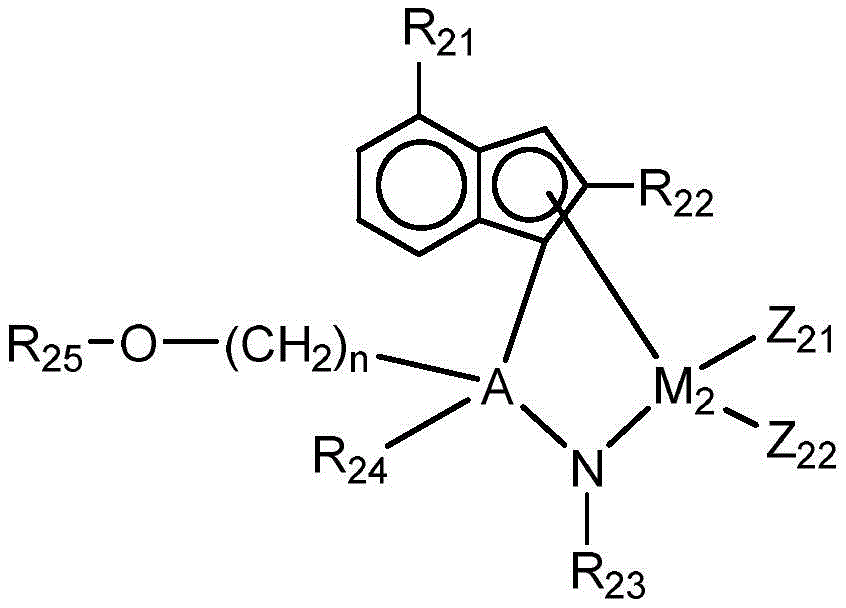
In the chemical formula 2, the first and second organic solvents,
a is carbon or silicon, and A is carbon or silicon,
m2 is a group 4 transition metal,
R21is substituted by C1-20C of alkyl6-20An aryl group, a heteroaryl group,
R22is C3-20A branched alkyl group,
R23to R25Each independently is C1-20An alkyl group, a carboxyl group,
Z21and Z22Each independently is halogen or C1-10Alkyl radical, and
n is an integer of 1 to 10.
In the hybrid supported catalyst, substituents in chemical formulas 1 and 2 will be explained in more detail below.
C1-20The alkyl group may include a straight-chain, branched or cyclic alkyl group, and specifically, methyl (Me), ethyl (Et), propyl (Pr), isopropyl, n-butyl (n-Bu), t-butyl (t-Bu), pentyl (Pt), hexyl (Hx), heptyl, octyl, cyclobutyl, cyclopentyl, cyclohexyl, or the like, but is not limited thereto.
C1-20The alkylene group may include a straight-chain or branched alkylene group, specifically, methylene, ethylene, propylene, butylene, pentylene, hexylene, or the like, but is not limited thereto.
C4-20The cycloalkyl group refers to a cyclic alkyl group among the above alkyl groups, and specifically, may include, but is not limited to, cyclobutyl, cyclopentyl, cyclohexyl, and the like.
C2-20The alkenyl group may include a straight-chain or branched alkenyl group, specifically, allyl, vinyl, propenyl, butenyl, pentenyl, or the like, but is not limited thereto.
C6-20The aryl group may include a monocyclic or fused ring aryl group, specifically, a phenyl group, a biphenyl group, a naphthyl group, a phenanthryl group, a fluorenyl group, or the like, but is not limited thereto.
C1-20The alkoxy group may include methoxy, ethoxy, phenoxy, cyclohexyloxy, or the like, but is not limited thereto.
C2-20The alkoxyalkyl group may be a functional group in which one or more hydrogens of the above-mentioned alkyl group are substituted with an alkoxy group, and specifically, may include: alkoxyalkyl groups such as methoxymethyl, methoxyethyl, ethoxymethyl, isopropoxymethyl, isopropoxyethyl, isopropoxyhexyl, tert-butoxymethyl, tert-butoxyethyl or tert-butoxyhexyl and the like; or aryloxyalkyl groups such as phenoxyhexyl and the like, but are not limited thereto.
C1-20Alkylsilyl orC1-20The alkoxysilyl group may be-SiH therein3The functional group in which 1 to 3 hydrogens are substituted with 1 to 3 alkyl groups or alkoxy groups as described above, specifically, may include: alkylsilyl groups such as methylsilyl, dimethylsilyl, trimethylsilyl, dimethylethylsilyl, diethylmethylsilyl, dimethylpropylsilyl, or the like; an alkoxysilyl group such as a methoxysilyl group, a dimethoxysilyl group, a trimethoxysilyl group, or a dimethoxyethoxysilyl group, etc.; alkoxyalkyl silyl groups such as methoxydimethylsilyl group, diethoxymethylsilyl group or dimethoxypropylsilyl group, etc., but are not limited thereto.
C1-20The silylalkyl group is a functional group in which one or more hydrogens of the above-mentioned alkyl group is substituted with a silyl group, and specifically, may include-CH2-SiH3Methylsilylmethyl or dimethylethoxysilylpropyl, and the like, but are not limited thereto.
Halogen may be fluorine (F), chlorine (Cl), bromine (Br) or iodine (I).
The sulfonate group having-O-SO2The structure of-R ', wherein R' may be C1-20An alkyl group. Specifically, C1-20The sulfonate group may include a mesylate group or a benzenesulfonate group, etc., but is not limited thereto.
Heteroaryl is C containing one or more of N, O and S as heteroatoms2-20Specific examples of the heteroaryl group may include xanthene (xanthene), thioxanthene (thioxanthen), thiophene, furan, pyrrole, imidazole, thiazole, oxazole, oxadiazole, triazole, pyridyl, bipyridyl, pyrimidinyl, triazine, acridinyl, pyridazine, pyrazinyl, quinolyl, quinazoline, quinoxalinyl, phthaloyl, pyridopyrimidinyl, pyridopyrazinyl, pyrazinyl, isoquinoline, indole, carbazole, benzoxazole, benzimidazole, benzothiazole, benzocarbazole, benzothiophene, benzofuranyl, phenanthroline (phenanthroline), isoxazolyl, thiadiazolyl, phenothiazinyl, or dibenzofuranyl, and the like, but are not limited thereto.
The above-mentioned substituent may be optionally substituted with one or more substituents selected from the group consisting of: a hydroxyl group; halogen; alkyl, alkenyl, aryl or alkoxy; an alkyl, alkenyl, aryl or alkoxy group containing one or more of the group 14 to 16 heteroatoms; a silyl group; an alkylsilyl or alkoxysilyl group; a phosphine; a phosphide compound; sulfonic acid esters and sulfones.
In addition, the transition metal of group 4 may include titanium (Ti), zirconium (Zr), hafnium (Hf), or the like, but the present disclosure is not limited thereto.
In the hybrid supported catalyst, the first transition metal compound exhibits high polymerization activity, and a low molecular weight polymer is easily prepared. Also, it is easier to prepare a high molecular weight polymer using the second transition metal compound than the first transition metal compound. Therefore, when the mixing ratio of the first transition metal compound and the second transition metal compound in the hybrid supported catalyst is adjusted, the low molecular weight content in the produced polymer is minimized, and the molecular weight distribution can be improved due to the high molecular weight characteristic of the second transition metal compound. In addition, the viscosity can be easily adjusted. The polyethylene so produced may have an increased degree of crosslinking and entanglement.
Specifically, the first transition metal compound represented by chemical formula 1 is a compound containing Cp1And Cp2Uncrosslinked compounds of ligands, in which Cp1And Cp2The ligands may be the same as or different from each other, and each is independently any one selected from the group consisting of cyclopentadienyl, indenyl, 4,5,6, 7-tetrahydro-1-indenyl, and fluorenyl. These ligands may be substituted by one or more or 1 to 3C1-20Hydrocarbons, more particularly C1-10An alkyl group. Due to Cp1And Cp2The ligand has a pair of noncovalent electrons capable of acting as a lewis base, and thus can achieve high polymerization activity. In particular, when Cp1And Cp2When the ligands are cyclopentadienyl groups having relatively small steric hindrance, they exhibit high polymerization activity and low hydrogen reactivity, and thus can be polymerized with high activity to give an olefin polymer of low molecular weight.
In addition, Cp1And Cp2The ligand can easily control properties of the olefin polymer to be produced, such as chemical structure, molecular weight distribution, mechanical properties and transparency, by adjusting the degree of steric hindrance depending on the type of the substituted functional group. In particular Cp1And Cp2Ligands are independently substituted with R11And R12Wherein R is11And R12Are identical to or different from each other and can each independently be hydrogen, C1-20Alkyl radical, C2-20Alkoxyalkyl group, C7-40Arylalkyl or C containing at least one heteroatom selected from the group consisting of N, O and S2-12Heteroaryl, more specifically C1-10Alkyl radical, C2-10Alkoxyalkyl group, C7-20Aralkyl or C containing at least one heteroatom selected from the group consisting of N, O and S4-12A heteroaryl group. In order to have excellent catalytic activity, when R11And R12Each being a substituent as defined above, R11And R12May be C2-20Alkoxyalkyl or C2-10An alkoxyalkyl group.
In addition, in Cp1And Cp2Presence of M between ligands1(Z1)3-mAnd M is1(Z1)3-mThe storage stability of the metal complex can be affected. To ensure the effect more effectively, Z1May each independently be halogen or C1-20Alkyl groups, more specifically, each independently are F, Cl, Br or I. Furthermore, M1May be Ti, Zr, or Hf, more specifically Zr or Hf, and more specifically Zr.
More specifically, in the first transition metal compound, M1Is Ti, Zr or Hf; cp1And Cp2Are the same or different from each other and are each independently selected from the group consisting of1-10Any one of the group consisting of alkyl-substituted or unsubstituted cyclopentadienyl, indenyl, 4,5,6, 7-tetrahydro-1-indenyl and fluorenyl; r11And R12Each independently is hydrogen, C1-20Alkyl radical, C2-20Alkoxyalkyl group, C6-20Aryl radical, C7-20Arylalkyl, furyl or thienyl, wherein R11And R12At least one of them is C2-20An alkoxyalkyl group; z1Is halogen.
The first transition metal compound represented by chemical formula 1 may be, for example, a compound represented by any one of the following structural formulae, but is not limited thereto:

in addition, the first transition metal compound may be a compound in which M is1Is Zr; cp1And Cp2Each independently being unsubstituted cyclopentadienyl or substituted by at least one C, e.g. methyl1-10A cyclopentadienyl group of an alkyl group; r11And R12Each independently is hydrogen, C1-20Alkyl radical, C2-20Alkoxyalkyl group, C7-20Aryl or C7-20Arylalkyl radical, wherein R11And R12At least one or two of them is C2-20Alkoxyalkyl radicals, more particularly C2-10Alkoxyalkyl, even more particularly t-butoxyhexyl; z1Is a halogen group; in chemical formula 1, m is 1.
The first transition metal compound represented by chemical formula 1 may be synthesized by applying a known reaction. Specifically, the ligand compound is prepared by various synthetic methods, and then metallation is performed by adding a metal precursor compound. However, the present disclosure is not limited thereto, and the synthesis method may refer to examples.
Meanwhile, in the hybrid supported catalyst, the second transition metal compound represented by chemical formula 2 forms a ligand structure in which an indene derivative and an amine derivative are crosslinked through a bridge compound, and has a pair of noncovalent electrons capable of acting as a lewis base in the ligand structure, thus exhibiting high polymerization activity. In particular, the catalyst may exhibit high catalytic activity by having a structurally stable and electron-rich indene structure, and may exhibit excellent load stability to a support by including a tethering group in a bridging group.
In addition, the second transition metal compound is substituted with a functional group (R) having a branched structure at the 2-position of the indene structure22) And beta-hydrogen in the polymer chain in which the nitrogen atom of the amine derivative grows is stabilized by hydrogen bonding, thereby preparing a medium molecular weight and a high molecular weight polymer. In addition, the polymers to be prepared have a narrow molecular weight distribution and thus exhibit excellent mechanical properties. In particular, R22May be C3-12Or C3-6Branched alkyl groups such as isopropyl, isobutyl, tert-butyl, isopentyl, and the like, and may be isopropyl, which is more advantageous in terms of steric effect.
Further, the indene structure has a structure obtained by bonding R at the 4-position21In particular substituted by one or more (or one or two) C1-20C of alkyl6-20The aryl group can provide sufficient electron induction effect, thereby showing higher catalytic activity. More specifically, in chemical formula 2, R21May be substituted by one or two C3-6Phenyl groups of branched alkyl groups such as 4-tert-butylphenyl and 3, 5-di-tert-butylphenyl.
In addition, R bonded to N in chemical formula 223Can be C1-20Straight-chain or branched alkyl, more particularly C3-C12Or C3-C6Branched alkyl groups, such as t-butyl. When R is23With the branched structure, the transition metal compound is sterically stabilized, and the catalyst is stabilized by an electron donating effect, thereby exhibiting higher catalytic activity.
More specifically, in chemical formula 2, R21Is substituted by one or two C3-6Phenyl of a branched alkyl group, and R22And R23May each independently be C3-6A branched alkyl group. Even more specifically, R22May be isopropyl.
Further, in chemical formula 2, the bridging group includes a group capable of reacting with R24Are tethered to the support together with the functional group of (C) (- (CH)2)n-O-R25The tethering group of (a). Thus, canTo exhibit excellent loading stability and maintain excellent catalytic activity to prepare a polymer having a high molecular weight.
Specifically, R24Can be C1-12Or C1-6Straight-chain or branched alkyl. More specifically, it may be C1-4Linear alkyl or methyl to increase solubility and thereby improve loading efficiency.
In addition, R in the tethering group25Can be C1-12Or C1-6A linear or branched alkyl radical, more particularly, it may be C3-6A branched alkyl group, or a tert-butyl group. When the tether group has a branched structure such as a t-butyl group, it can be easily detached and bound to the support, thereby exhibiting excellent load stability.
In addition, n in the tethering group may be specifically 3 to 8 or 4 to 6, and the tethering group within the above range may have an appropriate length, thereby stably exhibiting catalytic activity with excellent load stability.
In the bridging group, a may be silicon (Si).
More specifically, in chemical formula 2, A is silicon and R is25Is C3-6A branched alkyl group, and n may be an integer from 4 to 6.
In addition, the second transition metal compound of chemical formula 2 may include transition metals of group 4, such as titanium (Ti), zirconium (Zr), and hafnium (Hf), as a central metal (M)2). When the transition metal compound contains Ti as a central metal, the catalyst shows more excellent polymerization activity by increasing the structural openness than the case of containing other transition metals of group 4 such as Zr and Hf, and is stabilized by electron donating effect, thereby producing a polymer having a high molecular weight.
In chemical formula 2, Z21And Z22May each independently be a halogen such as chlorine; or C such as methyl1-4An alkyl group. More specifically, Z21And Z22May be methyl and, in this case, with Z21And Z22It can exhibit better catalytic activity than the case of halogen.
More specifically, in chemical formula 2, M2Is titanium, and Z21And Z22May each independently be C1-4An alkyl group.
More specifically, the compound of chemical formula 2 may be a compound in which a is silicon; m2Is titanium; r21Is substituted by one or two C, e.g. tert-butyl3-10A branched alkyl phenyl group; r22Is C3-6Branched alkyl groups such as isopropyl; r23Is C3-6Branched alkyl groups such as t-butyl; r24Is C1-4Straight chain alkyl groups such as methyl; r25Is C3-6Branched alkyl groups such as t-butyl; z21And Z22Each independently is C1-4Alkyl groups such as methyl; n is an integer from 4 to 6.
The second transition metal compound represented by chemical formula 2 may be a compound represented by one of the following structural formulae, but is not limited thereto:

the above-mentioned second transition metal compound may be prepared by lithiation of a ligand compound of the following chemical formula 3 and subsequent reaction with a halide containing a group 4 transition metal:
[ chemical formula 3]

In chemical formula 3, A, R21To R25And n is as defined above.
The following reaction scheme 1 represents a method of preparing the second transition metal compound of chemical formula 2 according to one embodiment of the present invention. The following reaction scheme 1 is only an example for illustrating the present invention, but the present invention is not limited thereto:
[ reaction scheme 1]

In reaction scheme 1, A, M2、R21To R25、Z21、Z22And n is as defined above, and X1And X2Each independently is halogen.
As described in reaction scheme 1, lithiation may be performed by reacting the ligand compound (3) of chemical formula 3 with alkyllithium such as n-butyllithium (NBL), and then with halide (4) containing transition metal of group 4 (e.g., TiCl)4) To prepare a compound (2) of chemical formula 2. In addition, when X in the compound (2) of chemical formula 21And X2Each is C1-10When an alkyl group is present, an alkylating agent for the alkylation of the metal M, such as MMB (methyl magnesium bromide), may additionally be added after lithiation.
In addition, the ligand compound (3) for preparing the compound (2) of chemical formula 2 may be prepared by a synthetic method as in the following reaction scheme 2. The reaction scheme 2 is only an example for explaining the present invention, and the present invention is not limited thereto.
[ reaction scheme 2]
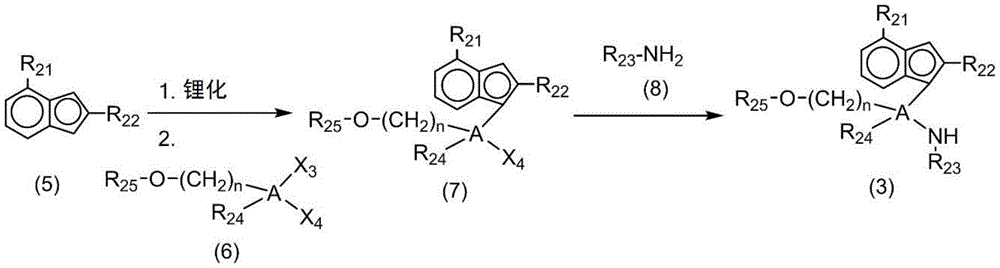
In reaction scheme 2, A, R21To R24And n is as defined above, and X3And X4Each independently is halogen.
Referring to reaction scheme 2, ligand compound (3) can be prepared, comprising the steps of: lithiation by reacting an indene compound (5) which is a Cp unit with an alkyllithium such as n-butyllithium (NBL); reacting the resulting reactant with a starting material (6) for providing a tethering group to produce a compound (7) wherein the tethering group is bonded to an indene structure; reacting a compound (7) with a compound having R3Substituted tertiary amines (8) (e.g. t-BuNH)2) And (4) reacting.
The reaction in each step can be carried out by applying a known reaction, and a more detailed synthesis method can be referred to the preparation examples described later.
As described above, the hybrid supported catalyst comprising the first transition metal compound and the second transition metal compound can effectively provide polyolefins, particularly high density polyethylene capable of improving tensile strength due to an increase in the degree of crosslinking when preparing chlorinated polyolefins and chlorinated compounds, because the polyolefins have a minimized low molecular weight content and a broad molecular weight distribution by forming a high molecular weight tail in a molecular weight distribution curve. In addition, the above effects can be further enhanced by controlling the mixing ratio of the first transition metal compound and the second transition metal compound in the hybrid supported catalyst. Specifically, the mixing molar ratio of the first transition metal compound and the second transition metal compound may be 1:3 to 3:1, or 1:1.5 to 2: 1.
In addition, in the hybrid supported catalyst, the first transition metal compound and the second transition metal compound are contained in the form of a supported catalyst supported on a carrier. When the transition metal compound is used in the form of a supported catalyst, the morphology and physical properties of the prepared polyethylene can be further improved, and it can be suitably used for slurry polymerization, bulk polymerization, and gas phase polymerization.
Specifically, the support may have a hydroxyl group, a silanol group, or a siloxane group having high reactivity on its surface. The support may be surface modified by calcination or may be dried to remove moisture from the surface. For example, the support may be silica prepared by calcining silica gel, silica dried at high temperature, silica-alumina or silica-magnesia, and it may typically comprise an oxide, carbonate, sulphate or nitrate, for example Na2O、K2CO3、BaSO4And Mg (NO)3)2And the like.
The support is preferably calcined or dried at 200 to 600 c, more preferably 250 to 600 c. When the temperature is less than 200 ℃, the carrier contains so much moisture that moisture on the surface may react with the cocatalyst. In addition, the cocatalyst loading may be relatively high due to excess hydroxyl groups, but this requires a large amount of cocatalyst. When the temperature is higher than 600 ℃, pores on the surface of the support may be bonded to each other to reduce the surface area, and many hydroxyl groups or silanol groups may be lost from the surface, leaving only siloxane groups. Therefore, reactive sites with the cocatalyst may be reduced, which is not preferable.
The amount of hydroxyl groups can be controlled by the method of preparation of the support, the conditions of preparation or drying conditions, such as temperature, time, vacuum or spray drying. When the amount of hydroxyl groups is too low, reactive sites with the cocatalyst may be insufficient. When the amount of the hydroxyl groups is too high, it may be caused by moisture in addition to the hydroxyl groups present on the surface of the carrier particles, which is undesirable. For example, the amount of hydroxyl groups on the surface can be 0.1 to 10mmol/g, or 0.5 to 5 mmol/g.
Among the above-mentioned supports, silica prepared by calcining silica, particularly silica gel, hardly releases a catalyst from the surface of the support during the polymerization of propylene because a transition metal compound is chemically bonded and supported on the silica support. As a result, when polyethylene is produced by slurry polymerization or gas phase polymerization, the fouling phenomenon of adhering to the wall surface of the reactor or to each other can be minimized.
When the transition metal compound is used in the form of a supported catalyst, the content of the first transition metal compound and the second transition metal compound may be 10 μmol or more, 30 μmol or more, or 60 μmol or more, and 120 μmol or less, or 100 μmol or less, based on the weight of the support, for example, 1g of silica. When supported within the above content range, the supported catalyst can exhibit appropriate activity, which is advantageous in maintaining catalytic activity.
The hybrid supported catalyst having the above-mentioned configuration exhibits excellent polymerization activity, and can prepare polyethylene having a structure optimized to improve the tensile strength of chlorinated polyethylene or chlorinated compounded product.
The hybrid supported catalyst may be directly introduced into the polymerization system, or may be dissolved or diluted in a C5 to C12 aliphatic hydrocarbon solvent (e.g., pentane, hexane, heptane, nonane, decane and isomers thereof), an aromatic hydrocarbon solvent (e.g., toluene and benzene), or a chlorine-substituted hydrocarbon solvent (e.g., dichloromethane and chlorobenzene), and then introduced into the polymerization system. The solvent used herein is preferably used after removing a small amount of water or air as a catalyst poison by treatment with a small amount of aluminum alkyl.
In addition, the above catalyst composition may further comprise a cocatalyst in terms of improving activity and stability. The cocatalyst may include one or more compounds represented by the following chemical formula 9, chemical formula 10, and chemical formula 11:
[ chemical formula 9]
-[Al(Ra)-O]m-
In the chemical formula 9, the first and second,
Ra' may be the same or different from each other, and each is independently halogen, C1-20Hydrocarbon, or halogen substituted C1-20A hydrocarbon; and is
m is an integer of 2 or more;
[ chemical formula 10]
J(Rb)3
In the chemical formula 10, the first and second,
Rb' may be the same or different from each other, and each is independently halogen, C1-20Hydrocarbon, or halogen substituted C1-20A hydrocarbon; and is
J is aluminum or boron;
[ chemical formula 11]
[E-H]+[ZQ4]-Or [ E]+[ZQ4]-
In the chemical formula 11, the first and second,
e is a neutral or cationic Lewis base;
h is a hydrogen atom;
z is an element of group 13; and is
Q may be the same or different from each other and are each independently wherein one or more hydrogen atoms are unsubstituted or substituted by halogen, C1-20Hydrocarbon, alkoxy or phenoxy substituted C6-20Aryl or C1-20An alkyl group.
Examples of the compound represented by chemical formula 9 may include C1-20AlkylaluminoxanesExamples of the compound include methylaluminoxane, ethylaluminoxane, isobutylaluminoxane, butylaluminoxane and the like, and a mixture of any one or two or more of them may be used.
In addition, examples of the compound represented by chemical formula 10 may include trimethylaluminum, triethylaluminum, triisobutylaluminum, tripropylaluminum, tributylaluminum, dimethylaluminum chloride, triisopropylaluminum, tri-sec-butylaluminum, tricyclopentylaluminum, tripentylaluminum, triisopentylaluminum, trihexylaluminum, trioctylaluminum, ethyldimethylaluminum, methyldiethylaluminum, triphenylaluminum, tri-p-tolylaluminum, dimethylaluminum methoxide, dimethylaluminum ethoxide, trimethylboron, triethylboron, triisobutylboron, tripropylboron, tributylboron, or the like, and more specifically, it may be selected from trimethylaluminum, triethylaluminum, and triisobutylaluminum.
In addition, examples of the compound represented by chemical formula 11 may include triethylammonium tetraphenylboron, tributylammonium tetraphenylboron, trimethylammonium tetraphenylboron, tripropylammonium tetraphenylboron, trimethylammonium tetra (p-tolyl) boron, trimethylammonium tetra (o, p-dimethylphenyl) boron, tributylammonium tetra (p-trifluoromethylphenyl) boron, trimethylammonium tetra (p-trifluoromethylphenyl) boron, tributylammonium tetra (pentafluorophenyl) boron, N-diethylaniliniumtetraphenylboron, N-diethylaniliniumtetra (pentafluorophenyl) boron, diethylammonium tetra (pentafluorophenyl) boron, triphenylphosphonium tetraphenylboron, trimethylphosphonium tetraphenylboron, triethylammonium tetraphenylaluminum, tributylammonium tetraphenylaluminum, trimethylammonium tetraphenylaluminum, tripropylammonium tetraphenylaluminum, trimethylammonium tetra (p-tolyl) aluminum, tripropylammonium tetraphenylaluminum, Triethylammoniumtetra (o, p-dimethylphenyl) aluminum, tributylammoniumtetra (p-trifluoromethylphenyl) aluminum, trimethylammonium tetrakis (p-trifluoromethylphenyl) aluminum, tributylammoniumtetra (pentafluorophenyl) aluminum, N-diethylphenylammonium tetraphenylaluminum, N-diethylphenylammonium tetrakis (pentafluorophenyl) aluminum, diethylammonium tetrakis (pentafluorophenyl) aluminum, triphenylphosphonium tetraphenylaluminum, trimethylphosphonium tetraphenylaluminum, tripropylammoniumtetra (p-tolyl) boron, triethylammoniumtetra (o, p-dimethylphenyl) boron, tributylammoniumtetra (p-trifluoromethylphenyl) boron, triphenylcarboniumtetrakis (p-trifluoromethylphenyl) boron or triphenylcarboniumtetrakis (pentafluorophenyl) boron and the like, wherein any one or a mixture of two or more thereof may be used.
Among the above-mentioned cocatalysts, the cocatalyst may be a compound represented by chemical formula 9, more specifically, C, in view of that the cocatalyst may exhibit more excellent catalytic activity when used together with a transition metal compound1-C20Alkylaluminoxane compounds such as methylaluminoxane and the like. The alkylaluminoxane compound serves as a scavenger of hydroxyl groups present on the surface of the support to improve catalytic activity and convert halogen groups of the catalyst precursor into methyl groups, thereby promoting chain growth during the polymerization of polyethylene.
The supported amount of the cocatalyst may be 0.1mmol or more, or 5mmol or more, or 8mmol or more, or 10mmol or more, and 25mmol or less, or 20mmol or less, based on the weight of the support, for example, 1g of silica. When the content of the co-catalyst is within the above content range, the effect of improving the catalytic activity and the effect of reducing the generation of fine powder due to the use of the co-catalyst can be sufficiently obtained.
In addition, the catalyst composition may further comprise an antistatic agent. As the antistatic agent, ethoxylated alkylamine can be used, and specifically, a compound represented by the following chemical formula 12 can be used. When the catalyst composition includes an antistatic agent, the generation of static electricity is suppressed during the polymerization of polyethylene, thereby further improving the physical properties of the prepared polyethylene.
[ chemical formula 12]
RN-(CH2CH2OH)2
In chemical formula 12, R may be C8-30And when R includes an alkyl group having a carbon number within the above range, it may exhibit an effect of reducing fine powder without causing an unpleasant odor by an excellent antistatic effect.
More specifically, the ethoxylated alkylamine may be a compound of chemical formula 12, wherein R is C8-22Straight chain alkyl or C10-18Straight chain alkyl or C13-15Straight chain alkyl groups, and these compounds may be used alone or in a mixture of two or moreThe product is used. Specific examples thereof may include N, N-bis (2-hydroxyethyl) tridecylamine or N, N-bis (2-hydroxyethyl) pentadecaalkylamine, and the like, and commercially available Atmer 163 may be usedTM(available from CRODA).
When the antistatic agent is further included, the content thereof may be 0.5 parts by weight or more, 1 part by weight or more, or 2 parts by weight or more, and 20 parts by weight or less, 10 parts by weight or less, or 7 parts by weight or less, based on 100 parts by weight of the carrier, for example, silica.
The above-mentioned co-catalyst and antistatic agent may be used in combination with the above-mentioned hybrid supported catalyst, respectively, or may be used in a state of being supported on a carrier in the hybrid supported catalyst. When they are used in a state of being supported on a carrier in a hybrid supported catalyst, the catalyst composition can be prepared by a preparation method comprising the steps of: supporting a cocatalyst compound on a carrier, and supporting a transition metal compound on the carrier; the antistatic agent in a slurry state is introduced into a support carrying a cocatalyst and a transition metal compound, and then heat-treated. In this regard, the supporting of the transition metal compound may be performed by supporting the first transition metal compound and then supporting the second transition metal compound, and vice versa. The supported catalyst having a structure determined according to such a supporting order may exhibit higher catalytic activity and excellent process stability in the preparation of polyethylene.
The catalyst composition may be used in the form of a slurry or a diluted solution in a solvent according to the polymerization method, or may be used in the form of a slurry catalyst mixed with a mixture of fats and oils.
When the catalyst composition is used in the form of a slurry or a dilution in a solvent, the solvent is an aliphatic hydrocarbon solvent having 5 to 12 carbon atoms suitable for the polymerization process of propylene monomers, such as pentane, hexane, heptane, nonane, decane and isomers thereof, and aromatic hydrocarbon solvents such as toluene and benzene, or chlorine atom-substituted hydrocarbon solvents such as dichloromethane and chlorobenzene, and the like, and any one or a mixture of two or more of them may be used. In this case, the catalyst composition may further comprise the above-mentioned solvent, and a small amount of water or air, which may act as a catalyst poison, may be removed by treating the solvent with a small amount of aluminum alkyl before use.
On the other hand, the polymerization reaction for preparing polyethylene may be performed using a continuous slurry polymerization reactor, a loop slurry reactor, a gas phase reactor, or a solution reactor. However, according to the method of the present embodiment, slurry polymerization or gas phase polymerization is more suitable for more effective control of the molecular weight distribution.
In particular, the polymerization reaction may be carried out by slurry phase polymerization in a hydrocarbon solvent (for example, an aliphatic hydrocarbon solvent such as hexane, butane or pentane). Since the first transition metal compound and the second transition metal compound of the present disclosure have excellent solubility in the aliphatic hydrocarbon solvent, they are stably dissolved and supplied to the reaction system, and thus the polymerization reaction can be efficiently performed.
Furthermore, the process for preparing polyethylene according to one embodiment of the present invention may be carried out in a single CSTR reactor.
In the polymerization reactor, the polymerization may be carried out, for example, in the presence of an inert gas such as nitrogen. The inert gas can prolong the reactivity of the metallocene compound contained in the catalyst by suppressing a rapid reaction of the metallocene catalyst at the start of the polymerization reaction.
In addition, the polymerization reaction was carried out while introducing hydrogen.
Hydrogen introduced during the polymerization reaction activates the inert sites of the metallocene catalyst and causes a chain transfer reaction, thereby controlling the molecular weight and molecular weight distribution. In the preparation of the polyethylene according to the present disclosure, hydrogen may be introduced in an amount of 0.001 parts by weight or more or 0.005 parts by weight or more and 15 parts by weight or less, 5 parts by weight or less, 1 part by weight or less or 0.015 parts by weight or less, based on 100 parts by weight of the ethylene monomer. When hydrogen is introduced in the above range in the presence of the hybrid supported catalyst as described above, the optimized molecular structure and physical properties of the polyethylene of the present disclosure can be achieved.
In addition, the temperature during the polymerization reaction may be 70 ℃ to 100 ℃, or 80 ℃ to 90 ℃. When the polymerization temperature is too low, it is not preferable in terms of polymerization rate and productivity. In contrast, when the polymerization temperature is higher than necessary, fouling in the reactor may be caused.
Further, the polymerization pressure may be 6.8 to 8.7kg/cm27.0 to 8.5kg/cm2Or 7.0 to 7.5kg/cm2To ensure optimum productivity. The polymerization pressure may be about 6.8kg/cm2The above to prevent blocking due to excessive generation of high molecular weight and optimize productivity, and may be about 8.7kg/cm2To prevent unit degradation of the ethylene source under high pressure polymerization conditions.
In addition, the organic solvent may further serve as a reaction medium or diluent in the polymerization reaction. Such an organic solvent may be used in an amount sufficient to suitably perform slurry phase polymerization or the like, in consideration of the content of the ethylene monomer.
In addition, a trialkylaluminum, such as triethylaluminum, may optionally be added during the polymerization reaction.
When moisture or impurities are present in the polymerization reactor, a portion of the catalyst decomposes. The trialkylaluminum is used as a scavenger to previously trap moisture or impurities in the reactor or moisture contained in the monomer. Therefore, the activity of the catalyst used in the preparation can be maximized, and as a result, homopolyethylene having excellent physical properties, particularly, a narrow molecular weight distribution can be more efficiently prepared. In particular, in the trialkylaluminums, the alkyl group is as defined above, in particular C1-20Alkyl, and more specifically C1-6Straight or branched alkyl groups such as methyl, ethyl, or isobutyl, and the like.
The amount of the trialkylaluminum (based on 1M) added may be 10cc or more and 50cc or less, or 30cc or less based on 1kg of ethylene monomer. When the polymerization reaction is performed in the presence of trialkylaluminum in this content range, homopolyethylene having excellent strength characteristics can be more easily prepared.
Polyethylene having an optimized molecular structure, particularly a molecular structure having a minimized low molecular weight content and a higher high molecular weight content, is prepared by the above preparation method. Polyethylene can increase the degree of crosslinking in the preparation of chlorinated polyethylene, and as a result, the tensile strength can be greatly improved.
The polyethylene may be a homopolymer of ethylene that does not contain additional copolymers. For example, when the polyethylene is an ethylene homopolymer, preferably High Density Polyethylene (HDPE), the above physical properties can be more suitably satisfied. High-density polyethylene has excellent softening point, hardness, strength and electrical insulation, and thus can be used for various containers, packaging films, fibers, tubes, and the like.
Preparation of chlorinated polyethylene
According to another embodiment of the present disclosure, there is provided a chlorinated polyethylene prepared by chlorinating the above polyethylene with chlorine and a method for preparing the same.
Specifically, the preparation method of the chlorinated polyethylene comprises the following steps: preparing polyethylene by polymerizing ethylene-based monomers in the presence of a catalyst composition comprising a hybrid supported catalyst in which at least one first transition metal compound represented by chemical formula 1 and at least one second transition metal compound represented by chemical formula 2 are supported on a carrier, while introducing hydrogen; and chlorinating the polyethylene by treating it with chlorine.
As described above, specific examples of the reaction conditions, the first and second transition metal compounds, the support, the cocatalyst and the hybrid supported catalyst including them in the step of polymerizing the vinylic monomer to prepare polyethylene are described above.
Further, the chlorination of polyethylene can be carried out by an aqueous phase method in which polyethylene is reacted with chlorine in a suspended state, or an acid phase method in which polyethylene is reacted with chlorine in an aqueous HCl solution. For example, the aqueous phase method is a method of chlorinating using an emulsifier and a dispersant and water, and the acid phase method is a method of chlorinating an acidic aqueous solution such as a hydrochloric acid (HCl) solution using an emulsifier and a dispersant.
More specifically, in the preparation method of chlorinated polyethylene according to the present disclosure, the chlorination reaction may be performed by dispersing the prepared polyethylene together with water, an emulsifier and a dispersant, and then adding a catalyst and chlorine to perform a reaction.
As emulsifiers, polyethers or polyalkylene oxides may be used. The dispersant may be a polymer salt or an organic acid polymer salt. The organic acid may be methacrylic acid or acrylic acid.
The catalyst is, for example, a chlorination catalyst, and another example thereof is a peroxide or an organic peroxide. Chlorine may be used alone or may be mixed with an inert gas and then used.
The chlorination reaction may be carried out at a temperature of 60 ℃ to 150 ℃, 90 ℃ to 140 ℃, or 120 ℃ to 140 ℃.
In addition, the chlorination reaction may be performed for about 10 minutes to 10 hours, 1 hour to 6 hours, or 2 hours to 4 hours.
For example, the chlorination reaction may be performed by dispersing 100 parts by weight of polyethylene, 0.01 to 1.0 parts by weight or 0.05 to 0.5 parts by weight of an emulsifier and 0.1 to 10 parts by weight or 0.5 to 5.0 parts by weight of a dispersant in water, and then adding 0.01 to 1.0 parts by weight or 0.05 to 0.5 parts by weight of a catalyst and 80 to 200 parts by weight or 100 to 150 parts by weight of chlorine to perform the reaction.
The chlorinated polyethylene prepared by the above reaction or chlorination process may be further subjected to a neutralization process, a washing process and a drying process, and thus may be obtained in the form of powder.
The neutralization process may be, for example, a process of neutralizing the reactant having been subjected to the chlorination treatment with an alkali solution at 70 to 90 ℃ or 75 to 80 ℃ for 4 to 8 hours.
The chlorinated polyethylene obtained according to the production method of this embodiment has a high degree of crosslinking and an appropriate level of mooney viscosity, and thus can exhibit excellent tensile strength.
Specifically, the chlorinated polyethylene has a Mooney Viscosity (MV) of 70 to 80, more specifically 70 or more and 80 or less, or 76 or less, measured at a temperature of 121 ℃.
The Mooney viscosity of the chlorinated polyethylene can be measured using a Mooney viscometer, and specifically, can be measured by preheating at 121 ℃ for 1 minute and then rotating a rotor for 4 minutes. More specific methods thereof will be described in detail in experimental examples described later.
In addition, the chlorinated polyethylene may be, for example, a randomly chlorinated polyethylene.
The chlorinated polyethylene has excellent chemical resistance, weather resistance, flame retardancy, processability and impact strength enhancing effect, and thus can be used for wires or cables.
The mixture is
According to another embodiment of the present disclosure, there is provided a compounded product having excellent tensile strength properties comprising the chlorinated polyethylene prepared by the above-described method.
The kneaded product may specifically be a CPE kneaded product containing a crosslinked chlorinated polyethylene prepared by crosslinking a chlorinated polyethylene in the presence of a peroxide-based crosslinking agent.
The crosslinking reaction may be carried out at 140 to 230 ℃, and a peroxide-based crosslinking agent such as dicumyl peroxide may be used as the crosslinking agent. In addition, an antioxidant may be optionally further added during the crosslinking reaction.
For example, a Chlorinated Polyethylene (CPE) compound may include 100 to 280 parts by weight of inorganic additives such as talc and carbon black, 20 to 50 parts by weight of a plasticizer, and 1 to 20 parts by weight of a crosslinking agent, based on 100 parts by weight of chlorinated polyethylene.
The compound including chlorinated polyethylene may exhibit excellent tensile strength, specifically, tensile strength measured at 500mm/min according to astm d412 of 12 or more, or 12 to 14.
In addition, conventional methods in the art may be applied to the method of preparing a shaped article from the chlorinated polyethylene according to the present disclosure. For example, chlorinated polyethylene may be roll compounded and extruded to produce shaped products.
Advantageous effects
The polyethylene of the present disclosure has a molecular structure with a low content of low molecular weight and a high content of high molecular weight, and thus, tensile strength can be improved while maintaining excellent processability and mooney viscosity characteristics when preparing a chlorinated polyethylene compound.
Detailed Description
The present invention will be described in more detail by the following examples. However, these examples are for illustrative purposes only, and the present invention is not intended to be limited by these examples.
< preparation of first transition Metal Compound >
Synthesis example 1: [ tert-butyl-O- (CH)2)6-C5H4]2ZrCl2Preparation of
tert-butyl-O- (CH)2)6-Cl was prepared by the method shown in Tetrahedron Lett.2951(1988) using 6-chlorohexanol and reacted with NaCp to give tert-butyl-O- (CH)2)6-C5H5(yield 60%, boiling point 80 ℃ C./0.1 mmHg).
In addition, tert-butyl-O- (CH) is reacted at-78 deg.C2)6-C5H5Dissolved in THF, and n-butyllithium (n-BuLi) was slowly added thereto. Thereafter, it was heated to room temperature and reacted for 8 hours. The lithium salt solution synthesized as described above was slowly added to ZrCl at-78 deg.C4(THF)2(1.70g, 4.50mmol) in THF (30mL) and reacted further at room temperature for about 6 hours.
All volatiles were dried in vacuo and the resulting oily liquid material was filtered by addition of hexane solvent. The filtered solution was dried in vacuo, and hexane was added to obtain a precipitate at low temperature (-20 ℃). The obtained precipitate was filtered at low temperature to obtain [ tert-butyl-O- (CH) as a white solid2)6-C5H4]2ZrCl2(yield 92%).
1H NMR(300MHz,CDCl3):6.28(t,J=2.6Hz,2H),6.19(t,J=2.6Hz,2H),3.31(t,6.6Hz,2H),2.62(t,J=8Hz),1.7-1.3(m,8H),1.17(s,9H)。
13CNMR(CDCl3):135.09,116.66,112.28,72.42,61.52,30.66,30.61,30.14,29.18,27.58,26.00。
< preparation of second transition Metal Compound >
Synthesis example 2
Step 1: preparation of ligand compounds
4- (3, 5-di-tert-butylphenyl) -2-isopropyl-1H-indene (1.39g, 4mmol) was added as a Cp unit to a 50ml Schlenk flask, and THF (13ml) was added thereto, followed by cooling to-20 ℃ or lower. After stirring the cooled mixed solution for 5 minutes, NBL (1.7ml, 2.5M hexane solution) was added and reacted overnight to prepare lithiated Cp. When NBL was added, the mixed solution turned reddish brown.
Dichloro (tert-butoxy) hexyl) methylsilane (1.14g) was added to another 100mL Schlenk flask, and THF (13mL) was added thereto. After cooling the Schlenk flask to-20 ℃ or lower, the lithiated Cp prepared above was added dropwise to carry out the reaction. When the reaction was completed, the solvent in the resultant reaction mass was removed by vacuum distillation under reduced pressure, and the resultant salt was filtered off with hexane (Hex). After mixing t-BuNH2(1.7ml) was added to the obtained reaction mixture to conduct a reaction, and the resulting precipitate was filtered using hexane to give a ligand compound of 1- (6- (tert-butoxy) hexyl) -N- (tert-butyl) -1- (4- (3, 5-di-tert-butylphenyl) -2-isopropyl-1H-inden-1-yl) -1-methylsilylamine (yellow oil, 2.41g, yield 97% (by mol)).
NMR(400MHz,C6D6),7.70-7.68(m,1H),7.60-7.47(m,4H),7.34-7.19(m,2H),7.07(s,0.5H),6.89(s,0.5H),3.36-3.21(m,4H),3.12(s,1H),2.52-2.44(m,0.5H),2.00-1.92(m,0.5H),1.72-1.39(m,8H),1.39(s,9H),1.31(s,9H),1.23(s,3H)1.19(s,3H),1.13(s,9H)0.98(s,9H)0.32(s,1H),0.25(s,0.5H),0.2 0(s,1H),0.12(s,0.5H)
Step 2: preparation of transition metal compounds
The ligand compound (2.4g, 3.9mmol) of 1- (6- (tert-butoxy) hexyl) -N- (tert-butyl) -1- (4- (3, 5-di-tert-butylphenyl) -2-isopropyl-1H-inden-1-yl) -1-methylsilylamine prepared in step 1 was charged into a 100ml Schlenk flask, and toluene (13ml) was added thereto, followed by cooling to-20 ℃ or lower. After sufficiently cooling for 5 minutes by stirring, NBL (5.1ml, 2.5M hexane solution) was added to the resulting mixed solution to perform lithiation. It was confirmed that the color of the mixed solution became brown after lithiation. When lithiation was complete, the resulting reaction solution was cooled to 0 ℃. Immediately after addition of NMB (13ml, 3M in ether), the temperature was loweredAt-20 ℃ and adding TiCl4(3.9ml, 1M toluene). Upon addition, smoke was generated and the reaction solution immediately turned brown. After the addition, o/n stirring was performed, and then the salt was removed by a filter to obtain transition metal compound (2a) (brown oil, 2.16g, yield 80% (by mole)).

NMR(400MHz,C6D6),7.79-7.76(m,2H),7.64-7.47(m,5H),3.35-3.21(m,2H),2.76-2.49(s,2H),1.99-1.91(m,4H),1.70-1.60(m,4H),1.53(s,9H),1.51-1.44(m,4H),1.36(s,9H),1.30(s,9H),1.20(s,6H),1.13(s,9H),0.59(s,3H),0.12(s,3H)
< preparation of hybrid Supported catalyst >
Synthesis example 3
(1) Preparation of the vector
Mixing silicon dioxide (SYLOPOL 948)TMManufactured by Grace Davison) is dehydrated and dried at a temperature of 600 c under vacuum for 12 hours.
(2) Preparation of hybrid supported catalysts
10g of the silica dried in step (1) was introduced into a glass reactor, and 100mL of toluene was additionally added and stirred. After the silica was well dispersed, 60.6mL of a 10 wt% Methylaluminoxane (MAO)/toluene solution was added thereto. Thereafter, the temperature was raised to 80 ℃ and the mixture was slowly reacted for 16 hours while stirring at 200 rpm. After the temperature was again lowered to 40 ℃, the reaction solution was washed with toluene in an amount sufficient to remove unreacted aluminum-based compounds, and the remaining toluene was removed under reduced pressure. 100mL of toluene was again added thereto, 0.24mmol of the first transition metal compound prepared in Synthesis example 1 dissolved in toluene was added thereto together and reacted for 1 hour. After the reaction was completed, 0.12mmol of the second transition metal compound prepared in Synthesis example 2 dissolved in toluene was added and the reaction was further carried out for 2 hours with stirring. After completion of the reaction, the stirring was stopped, and the toluene layer was separated and removed. Then, the remaining toluene was removed under reduced pressure at 40 ℃ to prepare a hybrid supported catalyst.
Synthesis example 4
A hybrid supported catalyst was prepared in the same manner as in synthesis example 3, except that the amount of the second transition metal compound was changed to 0.06mmol (molar ratio of the first transition metal compound: the second transition metal compound: 4: 1).
< preparation of polyethylene >
Example 1
Using the hybrid supported catalyst prepared in synthesis example 3, ethylene homopolymerization was performed under the following conditions.
First, 30kg/hr of hexane, 10kg/hr of ethylene, 1g/hr of hydrogen and 130cc/hr of Triethylaluminum (TEAL) were introduced into 0.2m3In a single CSTR reactor, the hybrid supported catalyst prepared in Synthesis example 3 was then injected at 0.2 kg/hr. At this time, the reactor was maintained at a temperature of 82 ℃ and 7.0kg/cm2To 7.5kg/cm2And the polymerization is carried out for about 4 hours. Thereafter, the polymerization product was made into a final polyethylene by a solvent removing device and a dryer.
Example 2
Polyethylene was produced in the same manner as in example 1, except that hydrogen gas was introduced at 1.5 g/hr.
Example 3
Polyethylene was produced in the same manner as in example 1, except that hydrogen gas was introduced at 0.5 g/hr.
Comparative example 1
Use of high density polyethylene (CE 2080) prepared with Ziegler-Natta catalystTMLG chemically manufactured).
Comparative example 2
High density polyethylene (SC 200) prepared using metallocene catalystTMLG chemically manufactured).
Comparative example 3
High density polyethylene prepared with metallocene catalyst (SC 100E)TMLG chemically manufactured).
Comparative example 4
Use of high density polyethylene (CE 60) prepared with Ziegler-Natta catalyst40XTMLG chemically manufactured).
Comparative example 5
Polyethylene was prepared in the same manner as in example 1, except that no hydrogen was introduced during the polymerization.
Comparative example 6
Polyethylene was prepared in the same manner as in example 1, except that the hybrid supported catalyst prepared in synthesis example 4 was used.
Comparative example 7
A commercially available polyethylene (5000 Cp) was usedTMManufactured by Lotte Chemical).
Experimental example 1
The polyethylenes prepared in examples and comparative examples were subjected to GPC analysis in the following manner, and the content of each molecular weight distribution, i.e., fraction, was calculated. The results are shown in table 1 below.
Fraction (%): GPC analysis was performed and the fraction was calculated as the area (%) occupied by the log Mw fraction relative to the total area in the resulting molecular weight distribution curve. The sum of the fractions is 100 ± 1, possibly not exactly 100.
The GPC analysis is specifically performed under the following conditions.
Waters PL-GPC220 was used as a Gel Permeation Chromatography (GPC) instrument, and Polymer Laboratories PLgel MIX-B300 mm long column was used. The evaluation temperature was 160 ℃ and 1,2, 4-trichlorobenzene was used for the solvent at a flow rate of 1 mL/min. Each polyethylene sample was pretreated by dissolving it in 1,2, 4-trichlorobenzene containing 0.0125% of BHT for 10 hours using a GPC analyzer (PL-GP220), and the sample was provided at a concentration of 10mg/10mL in an amount of 200. mu.L. Mw and Mn were obtained using calibration curves formed using polystyrene standards. 9 polystyrene standards with molecular weights of 2000g/mol, 10000g/mol, 30000g/mol, 70000g/mol, 200000g/mol, 700000g/mol, 2000000g/mol, 4000000g/mol, and 10000000g/mol were used.
[ TABLE 1]

Experimental example 2
Physical properties of the polyethylenes prepared in examples and comparative examples were measured in the following manner, and the results are shown in table 2.
(1) Weight average molecular weight (Mw, g/mol) and molecular weight distribution (PDI, polydispersity index): GPC analysis was performed in the same manner as in experimental example 1, and the molecular weight distribution (PDI) was calculated by measuring the weight average molecular weight (Mw) and the number average molecular weight (Mn), and then obtaining the ratio of Mw/Mn.
(2)MI5.0And MFRR21.6/5: the Melt Index (MI) of the polyethylenes prepared in examples and comparative examples was measured according to ASTM D1238 (condition E, 190 ℃, 5.0kg load)5.0). Further, by blending MFR21.6Divided by MFR5To calculate the Melt Flow Rate Ratio (MFRR)21.6/5),MFR21.6MFR, measured at 190 ℃ under a load of 21.6kg according to ASTM D12385Measured at 190 ℃ under a load of 5kg according to ASTM D1238.
(3) Density (g/cm)3): density (g/cm) was measured according to ASTM D-15053)。
(4) MDR Torque (M)H-ML): to evaluate the degree of crosslinking of the polyethylene, the MDR torque of each polyethylene sample was measured with an Alpha Technologies Production MDR (moving die rheometer).
Specifically, after 100g of each polyethylene sample prepared in examples and comparative examples, 0.4g of a phenolic Antioxidant (AO) and 1.2g of a crosslinking agent (DCP, dicumyl peroxide) were mixed at 80 ℃, a sample piece was prepared at 140 ℃ for 10 minutes. Then, M of the sample piece was measured at 180 ℃ by MDR (moving die rheometer)HValue sum MLValue 10 minutes. By slave MHValue minus MLValue to calculate the MDR torque (M)H-ML). Here, MHIs the maximum vulcanization torque measured at full cure, and MLIs the stored minimum cure torque.
(5) Entanglement molecular weight (Me): the entanglement molecular weight (Me) was calculated from the storage modulus and loss modulus measured with a rotational rheometer.
Specifically, examples and ratios were measured with a rotational rheometerStorage modulus and loss modulus for each polyethylene sample of the comparative examples. Then, a plateau modulus (G) was obtained from themN 0) And the entanglement molecular weight was calculated according to the following formula 1.
[ formula 1]
Me=(ρRT)/GN 0
In the formula 1, the first and second groups,
ρ 0.8 × (density of polyethylene measured according to ASTM D-1505 (kg/m)3),
R is the gas constant of polyethylene (8.314Pa · m)3/mol·K),
T is the absolute temperature (K) of the measured temperature, and
GN 0is the plateau modulus of polyethylene, which is the storage modulus at which the loss modulus has a minimum in the region where the storage modulus is greater than the loss modulus, wherein the storage modulus and the loss modulus are measured using a rotational rheometer at 190 ℃ and 0.5% strain with varying angular frequency to 0.05 to 500 rad/s.
[ TABLE 2]

Experimental example 3
A chlorinated polyethylene was prepared using the polyethylene prepared in one of the above examples and comparative examples, and physical properties of the prepared chlorinated polyethylene were evaluated by the following methods. The results are shown in FIG. 3.
(1) Preparation of chlorinated polyethylene
5,000L of water and 550kg of polyethylene prepared in one of examples and comparative examples were added to a reactor, followed by sodium polymethacrylate as a dispersing agent, propylene oxide and ethylene oxide copolyether as an emulsifier, and benzoyl peroxide as a catalyst. Then, chlorination was carried out by injecting gaseous chlorine at a final temperature of 132 ℃ for 3 hours. The chlorination reactant is added with NaOH or Na2CO3Neutralizing for 4 hr, washing with running water for 4 hr, and drying at 120 deg.C to obtain powderThe chlorinated polyethylene of (1).
(2) Mooney Viscosity (MV): the spindle was wrapped with the CPE sample in the mooney viscometer and the mold was then closed. After preheating to 121 ℃ for 1 minute, the rotor was rotated for 4 minutes to measure MV (Mooney viscosity, 121 ℃, ML1+ 4).
[ TABLE 3]
| MV | |
| Example 1 | 73 |
| Example 2 | 71 |
| Example 3 | 76 |
| Comparative example 1 | 72 |
| Comparative example 2 | 72 |
| Comparative example 3 | 85 |
| Comparative example 4 | 87 |
| Comparative example 5 | 86 |
| Comparative example 6 | 64 |
| Comparative example 7 | 83 |
Experimental example 4
CPE compounds were prepared using the polyethylene prepared in one of the above examples and comparative examples in experimental example 3, and physical properties were evaluated.
(1) Preparation of CPE Mixed product
40% by weight of chlorinated polyethylene prepared using the polyethylene prepared in one of examples and comparative examples in experimental example 3, 15% by weight of a plasticizer, 2% by weight of a crosslinking agent, and the balance of talc and carbon black inorganic additives were kneaded and treated to prepare CPE kneaded samples.
(2) MV (mooney viscosity) of CPE blend: the rotor was wrapped with the CPE mix in the mooney viscometer and the mold was closed. After preheating to 100 ℃ for 1 minute, the rotor was rotated for 4 minutes to measure MV (Mooney viscosity, 100 ℃, ML1+ 4). The results are shown in Table 4.
(3) Tensile strength (MPa) of CPE kneaded product: after crosslinking the CPE compound samples prepared above at 160 ℃ for 10 minutes, the tensile strength (MPa) of the CPE compound was measured at 500mm/min according to ASTM D-412. The results are shown in table 4 below.
[ TABLE 4 ]

Referring to the experimental results, CPE compounds prepared using the polyethylenes of examples 1 to 3 had improved tensile strength while maintaining excellent mooney viscosity characteristics, as compared to comparative examples.
Claims (12)
Applications Claiming Priority (7)
| Application Number | Priority Date | Filing Date | Title |
|---|---|---|---|
| KR20190120103 | 2019-09-27 | ||
| KR10-2019-0120102 | 2019-09-27 | ||
| KR20190120102 | 2019-09-27 | ||
| KR10-2019-0120103 | 2019-09-27 | ||
| KR10-2020-0123878 | 2020-09-24 | ||
| KR1020200123878A KR102589954B1 (en) | 2019-09-27 | 2020-09-24 | Polyethylene and its chlorinated polyethylene |
| PCT/KR2020/013051 WO2021060907A1 (en) | 2019-09-27 | 2020-09-25 | Polyethylene, and chlorinated polyethylene thereof |
Publications (2)
| Publication Number | Publication Date |
|---|---|
| CN113166316A true CN113166316A (en) | 2021-07-23 |
| CN113166316B CN113166316B (en) | 2023-05-02 |
Family
ID=76460405
Family Applications (2)
| Application Number | Title | Priority Date | Filing Date |
|---|---|---|---|
| CN202080006688.8A Active CN113166316B (en) | 2019-09-27 | 2020-09-25 | Polyethylene and chlorinated polyethylene thereof |
| CN202080006137.1A Active CN113039217B (en) | 2019-09-27 | 2020-09-25 | Hybrid supported catalyst and method for preparing polyolefin using the same |
Family Applications After (1)
| Application Number | Title | Priority Date | Filing Date |
|---|---|---|---|
| CN202080006137.1A Active CN113039217B (en) | 2019-09-27 | 2020-09-25 | Hybrid supported catalyst and method for preparing polyolefin using the same |
Country Status (4)
| Country | Link |
|---|---|
| US (3) | US12006378B2 (en) |
| EP (2) | EP3865522A4 (en) |
| JP (1) | JP7118500B2 (en) |
| CN (2) | CN113166316B (en) |
Families Citing this family (3)
| Publication number | Priority date | Publication date | Assignee | Title |
|---|---|---|---|---|
| US12173142B2 (en) * | 2019-02-20 | 2024-12-24 | Lg Chem, Ltd. | Polyethylene having high degree of crosslinking and crosslinked polyethylene pipe comprising the same |
| US12122903B2 (en) | 2019-02-20 | 2024-10-22 | Lg Chem, Ltd. | Crosslinked polyethylene pipe having excellent physical properties |
| EP3865522A4 (en) | 2019-09-27 | 2022-05-18 | LG Chem, Ltd. | POLYETHYLENE AND RELATED CHLORINATED POLYETHYLENE |
Citations (14)
| Publication number | Priority date | Publication date | Assignee | Title |
|---|---|---|---|---|
| WO2000014129A1 (en) * | 1998-09-04 | 2000-03-16 | The Dow Chemical Company | Long chain branched ethylene homopolymer made by a slurry process and blends thereof |
| US20010012496A1 (en) * | 1998-05-29 | 2001-08-09 | Exxon Chemical Patents, Inc. | Catalyst delivery method, a catalyst feeder and their use in a polymerization process |
| CN1359396A (en) * | 1999-07-15 | 2002-07-17 | 陶氏化学公司 | High density ethylene homopolymers and blend compositions |
| US20050244974A1 (en) * | 2004-04-13 | 2005-11-03 | Garcia-Franco Cesar A | High throughput property testing of olefin copolymers using rheological determinations |
| US20130018154A1 (en) * | 2010-01-29 | 2013-01-17 | Borealis Ag | Polyethylene moulding composition with improved stress crack/stiffness relationship and impact resistance |
| CN104024326A (en) * | 2011-12-28 | 2014-09-03 | 三井化学株式会社 | Ethylene polymer composition and molded body obtained therefrom |
| KR20150063823A (en) * | 2013-12-02 | 2015-06-10 | 주식회사 엘지화학 | The catalysts consist of inden derivatives and cyclopentadiene derivatives, and their applications to olefine polymerization |
| CN105008439A (en) * | 2013-02-20 | 2015-10-28 | 普瑞曼聚合物株式会社 | Biaxially stretched film, and ethylene-type polymer composition |
| KR20160112424A (en) * | 2015-03-19 | 2016-09-28 | 주식회사 엘지화학 | Method for preparing supported hybrid metallocene catalyst, and supported hybrid metallocene catalyst using the same |
| KR20170076550A (en) * | 2015-12-24 | 2017-07-04 | 주식회사 엘지화학 | Method for preparing of supported hybrid metallocene catalyst, the supported hybrid metallocene catalyst prepared by the same method, and method for preparing polyolefin using the same |
| KR20170106110A (en) * | 2016-03-11 | 2017-09-20 | 주식회사 엘지화학 | Method for preparing of supported hybrid metallocene catalyst, the supported hybrid metallocene catalyst prepared by the same method, and method for preparing polyolefin using the same |
| CN108290980A (en) * | 2015-12-08 | 2018-07-17 | 诺瓦化学品(国际)股份有限公司 | High density rotational moulding resin |
| CN109923133A (en) * | 2016-11-08 | 2019-06-21 | 尤尼威蒂恩技术有限责任公司 | Polyethylene composition |
| CN110012669A (en) * | 2016-11-08 | 2019-07-12 | 尤尼威蒂恩技术有限责任公司 | Bimodal polyethylene |
Family Cites Families (24)
| Publication number | Priority date | Publication date | Assignee | Title |
|---|---|---|---|---|
| US5032562A (en) | 1989-12-27 | 1991-07-16 | Mobil Oil Corporation | Catalyst composition and process for polymerizing polymers having multimodal molecular weight distribution |
| US5525678A (en) | 1994-09-22 | 1996-06-11 | Mobil Oil Corporation | Process for controlling the MWD of a broad/bimodal resin produced in a single reactor |
| CN1285624C (en) | 1994-12-16 | 2006-11-22 | 三菱化学株式会社 | Ethylene polymers |
| US5914289A (en) | 1996-02-19 | 1999-06-22 | Fina Research, S.A. | Supported metallocene-alumoxane catalysts for the preparation of polyethylene having a broad monomodal molecular weight distribution |
| CN1231668A (en) | 1996-08-08 | 1999-10-13 | 陶氏化学公司 | 2-heteroatom substituted cyclopentadienyl-containing metal complexes and olefin polymerization process |
| ATE403684T1 (en) | 2002-03-14 | 2008-08-15 | Dow Global Technologies Inc | METAL COMPLEXES WITH SUBSTITUTED INDENYL LIGANDS AND POLYMERIZATION PROCESSES |
| EP1501843B1 (en) | 2002-04-23 | 2006-06-14 | Dow Global Technologies Inc. | Alkaryl-substituted group 4 metal complexes, catalysts and olefin polymerization process |
| PL2256158T3 (en) | 2009-05-26 | 2014-09-30 | Borealis Ag | Polymer composition for crosslinked articles |
| JP5907079B2 (en) | 2013-01-17 | 2016-04-20 | 日立金属株式会社 | Electric wires and cables using silane-grafted chlorinated polyethylene |
| KR101603407B1 (en) | 2013-04-19 | 2016-03-21 | 주식회사 엘지화학 | Low particle size polyethylene, its chlorinated polyethylene and pvc composition containing the same |
| KR101549209B1 (en) | 2013-11-18 | 2015-09-02 | 주식회사 엘지화학 | Olefin based polymer having excellent processibility |
| EP2878623B1 (en) | 2013-11-28 | 2018-07-11 | Abu Dhabi Polymers Company Limited (Borouge) | Multimodal polymer |
| KR20150063828A (en) | 2013-12-02 | 2015-06-10 | 삼성전자주식회사 | Method for processing data by touch screen, machine-readable storage medium and electronic device |
| KR101783897B1 (en) | 2014-12-10 | 2017-10-10 | 주식회사 엘지화학 | Polyolefin pellet for preparing fiber and fiber comprising the same |
| KR20160121940A (en) | 2015-04-13 | 2016-10-21 | 주식회사 엘지화학 | Ethylene/alpha-olefin copolymer having an excellent environmental stress crack resistance |
| WO2016204457A1 (en) | 2015-06-15 | 2016-12-22 | 주식회사 엘지화학 | Method for preparing polyolefin |
| KR101725004B1 (en) | 2016-04-27 | 2017-04-18 | 한화케미칼 주식회사 | Supported hybrid metallocene catalyst and good processability polyolefin using the same |
| EP3538569B1 (en) | 2016-11-08 | 2021-12-01 | Univation Technologies, LLC | Polyethylene composition |
| KR102097132B1 (en) | 2016-11-24 | 2020-04-03 | 주식회사 엘지화학 | Assessment method for polyethylene resin |
| US20180258559A1 (en) | 2017-03-10 | 2018-09-13 | University Of Tennessee Research Foundation | Materials for improved polymeric 3d printing |
| WO2019125065A1 (en) | 2017-12-21 | 2019-06-27 | 주식회사 엘지화학 | Ethylene/1-butene copolymer having excellent processability |
| KR102411597B1 (en) | 2018-01-15 | 2022-06-22 | 주식회사 엘지화학 | Transition metal compound, and catalystic composition comprising the same |
| KR102779863B1 (en) | 2019-08-14 | 2025-03-10 | 주식회사 엘지화학 | Novel transition metal compound and method for preparing polyethlene using the same |
| EP3865522A4 (en) | 2019-09-27 | 2022-05-18 | LG Chem, Ltd. | POLYETHYLENE AND RELATED CHLORINATED POLYETHYLENE |
-
2020
- 2020-09-25 EP EP20870137.5A patent/EP3865522A4/en active Pending
- 2020-09-25 US US17/294,896 patent/US12006378B2/en active Active
- 2020-09-25 EP EP20867639.5A patent/EP3865517A4/en active Pending
- 2020-09-25 CN CN202080006688.8A patent/CN113166316B/en active Active
- 2020-09-25 US US17/294,743 patent/US11993665B2/en active Active
- 2020-09-25 CN CN202080006137.1A patent/CN113039217B/en active Active
- 2020-09-25 JP JP2021526339A patent/JP7118500B2/en active Active
-
2024
- 2024-04-25 US US18/646,039 patent/US20240294680A1/en active Pending
Patent Citations (15)
| Publication number | Priority date | Publication date | Assignee | Title |
|---|---|---|---|---|
| US20010012496A1 (en) * | 1998-05-29 | 2001-08-09 | Exxon Chemical Patents, Inc. | Catalyst delivery method, a catalyst feeder and their use in a polymerization process |
| WO2000014129A1 (en) * | 1998-09-04 | 2000-03-16 | The Dow Chemical Company | Long chain branched ethylene homopolymer made by a slurry process and blends thereof |
| CN1359396A (en) * | 1999-07-15 | 2002-07-17 | 陶氏化学公司 | High density ethylene homopolymers and blend compositions |
| US20050244974A1 (en) * | 2004-04-13 | 2005-11-03 | Garcia-Franco Cesar A | High throughput property testing of olefin copolymers using rheological determinations |
| US20130018154A1 (en) * | 2010-01-29 | 2013-01-17 | Borealis Ag | Polyethylene moulding composition with improved stress crack/stiffness relationship and impact resistance |
| CN104024326A (en) * | 2011-12-28 | 2014-09-03 | 三井化学株式会社 | Ethylene polymer composition and molded body obtained therefrom |
| CN105008439A (en) * | 2013-02-20 | 2015-10-28 | 普瑞曼聚合物株式会社 | Biaxially stretched film, and ethylene-type polymer composition |
| KR20150063823A (en) * | 2013-12-02 | 2015-06-10 | 주식회사 엘지화학 | The catalysts consist of inden derivatives and cyclopentadiene derivatives, and their applications to olefine polymerization |
| KR20160112424A (en) * | 2015-03-19 | 2016-09-28 | 주식회사 엘지화학 | Method for preparing supported hybrid metallocene catalyst, and supported hybrid metallocene catalyst using the same |
| CN108290980A (en) * | 2015-12-08 | 2018-07-17 | 诺瓦化学品(国际)股份有限公司 | High density rotational moulding resin |
| KR20170076550A (en) * | 2015-12-24 | 2017-07-04 | 주식회사 엘지화학 | Method for preparing of supported hybrid metallocene catalyst, the supported hybrid metallocene catalyst prepared by the same method, and method for preparing polyolefin using the same |
| KR20170106110A (en) * | 2016-03-11 | 2017-09-20 | 주식회사 엘지화학 | Method for preparing of supported hybrid metallocene catalyst, the supported hybrid metallocene catalyst prepared by the same method, and method for preparing polyolefin using the same |
| CN109923133A (en) * | 2016-11-08 | 2019-06-21 | 尤尼威蒂恩技术有限责任公司 | Polyethylene composition |
| CN110012669A (en) * | 2016-11-08 | 2019-07-12 | 尤尼威蒂恩技术有限责任公司 | Bimodal polyethylene |
| US20190256629A1 (en) * | 2016-11-08 | 2019-08-22 | Univation Technologies, Llc | Polyethylene composition |
Also Published As
| Publication number | Publication date |
|---|---|
| US11993665B2 (en) | 2024-05-28 |
| EP3865522A1 (en) | 2021-08-18 |
| US12006378B2 (en) | 2024-06-11 |
| US20220017663A1 (en) | 2022-01-20 |
| US20240294680A1 (en) | 2024-09-05 |
| EP3865522A4 (en) | 2022-05-18 |
| CN113039217A (en) | 2021-06-25 |
| US20220017657A1 (en) | 2022-01-20 |
| CN113166316B (en) | 2023-05-02 |
| EP3865517A1 (en) | 2021-08-18 |
| EP3865517A4 (en) | 2022-05-18 |
| JP2022508115A (en) | 2022-01-19 |
| JP7118500B2 (en) | 2022-08-16 |
| CN113039217B (en) | 2023-05-12 |
Similar Documents
| Publication | Publication Date | Title |
|---|---|---|
| CN112088174B (en) | Polyethylene and chlorinated polyethylene thereof | |
| CN112088176B (en) | Polyethylene and its chlorinated polyethylene | |
| KR102427756B1 (en) | Polyethylene and its chlorinated polyethylene | |
| JP2019515997A (en) | Hybrid supported metallocene catalyst and polyolefin resin excellent in processability using the same | |
| CN108137739B (en) | Olefin polymer and method for producing the same | |
| EP3173429B1 (en) | Metallocene compound, metallocene supported catalyst, and method for preparing polyolefin using same | |
| US20240294680A1 (en) | Polyethylene and Its Chlorinated Polyethylene | |
| CN112088173B (en) | Polyethylene and its chlorinated polyethylene | |
| CN114401977B (en) | Transition metal compound and catalyst composition containing the same | |
| CN112105653A (en) | Polyethylene and chlorinated polyethylene thereof | |
| US9994653B2 (en) | Metallocene compound, catalyst composition including the same, and method of preparing olefin-based polymer using the same | |
| KR102589954B1 (en) | Polyethylene and its chlorinated polyethylene | |
| CN113631592B (en) | Polyethylene and its chlorinated polyethylene | |
| CN117050215A (en) | Polyethylene and chlorinated polyethylene thereof | |
| KR102775684B1 (en) | Polyethylene and its chlorinated polyethylene | |
| US12612473B2 (en) | Polyethylene and its chlorinated polyethylene | |
| CN114302899B (en) | Polyethylene and chlorinated polyethylene thereof | |
| KR102568406B1 (en) | Supported hybrid catalyst and method for preparing polyolefin using the same | |
| US20220340696A1 (en) | Polyethylene and chlorinated polyethylene thereof |
Legal Events
| Date | Code | Title | Description |
|---|---|---|---|
| PB01 | Publication | ||
| PB01 | Publication | ||
| SE01 | Entry into force of request for substantive examination | ||
| SE01 | Entry into force of request for substantive examination | ||
| GR01 | Patent grant | ||
| GR01 | Patent grant |