CN113166314A - Modified conjugated diene polymer and rubber composition containing same - Google Patents
Modified conjugated diene polymer and rubber composition containing same Download PDFInfo
- Publication number
- CN113166314A CN113166314A CN201980079097.0A CN201980079097A CN113166314A CN 113166314 A CN113166314 A CN 113166314A CN 201980079097 A CN201980079097 A CN 201980079097A CN 113166314 A CN113166314 A CN 113166314A
- Authority
- CN
- China
- Prior art keywords
- conjugated diene
- modified conjugated
- based polymer
- polymer
- neodymium
- Prior art date
- Legal status (The legal status is an assumption and is not a legal conclusion. Google has not performed a legal analysis and makes no representation as to the accuracy of the status listed.)
- Granted
Links
Classifications
-
- C—CHEMISTRY; METALLURGY
- C08—ORGANIC MACROMOLECULAR COMPOUNDS; THEIR PREPARATION OR CHEMICAL WORKING-UP; COMPOSITIONS BASED THEREON
- C08L—COMPOSITIONS OF MACROMOLECULAR COMPOUNDS
- C08L9/00—Compositions of homopolymers or copolymers of conjugated diene hydrocarbons
-
- C—CHEMISTRY; METALLURGY
- C08—ORGANIC MACROMOLECULAR COMPOUNDS; THEIR PREPARATION OR CHEMICAL WORKING-UP; COMPOSITIONS BASED THEREON
- C08C—TREATMENT OR CHEMICAL MODIFICATION OF RUBBERS
- C08C19/00—Chemical modification of rubber
- C08C19/24—Incorporating phosphorus atoms into the molecule
-
- C—CHEMISTRY; METALLURGY
- C08—ORGANIC MACROMOLECULAR COMPOUNDS; THEIR PREPARATION OR CHEMICAL WORKING-UP; COMPOSITIONS BASED THEREON
- C08F—MACROMOLECULAR COMPOUNDS OBTAINED BY REACTIONS ONLY INVOLVING CARBON-TO-CARBON UNSATURATED BONDS
- C08F36/00—Homopolymers and copolymers of compounds having one or more unsaturated aliphatic radicals, at least one having two or more carbon-to-carbon double bonds
- C08F36/02—Homopolymers and copolymers of compounds having one or more unsaturated aliphatic radicals, at least one having two or more carbon-to-carbon double bonds the radical having only two carbon-to-carbon double bonds
- C08F36/04—Homopolymers and copolymers of compounds having one or more unsaturated aliphatic radicals, at least one having two or more carbon-to-carbon double bonds the radical having only two carbon-to-carbon double bonds conjugated
-
- B—PERFORMING OPERATIONS; TRANSPORTING
- B60—VEHICLES IN GENERAL
- B60C—VEHICLE TYRES; TYRE INFLATION; TYRE CHANGING; CONNECTING VALVES TO INFLATABLE ELASTIC BODIES IN GENERAL; DEVICES OR ARRANGEMENTS RELATED TO TYRES
- B60C1/00—Tyres characterised by the chemical composition or the physical arrangement or mixture of the composition
-
- B—PERFORMING OPERATIONS; TRANSPORTING
- B60—VEHICLES IN GENERAL
- B60C—VEHICLE TYRES; TYRE INFLATION; TYRE CHANGING; CONNECTING VALVES TO INFLATABLE ELASTIC BODIES IN GENERAL; DEVICES OR ARRANGEMENTS RELATED TO TYRES
- B60C1/00—Tyres characterised by the chemical composition or the physical arrangement or mixture of the composition
- B60C1/0016—Compositions of the tread
-
- C—CHEMISTRY; METALLURGY
- C08—ORGANIC MACROMOLECULAR COMPOUNDS; THEIR PREPARATION OR CHEMICAL WORKING-UP; COMPOSITIONS BASED THEREON
- C08C—TREATMENT OR CHEMICAL MODIFICATION OF RUBBERS
- C08C19/00—Chemical modification of rubber
- C08C19/20—Incorporating sulfur atoms into the molecule
-
- C—CHEMISTRY; METALLURGY
- C08—ORGANIC MACROMOLECULAR COMPOUNDS; THEIR PREPARATION OR CHEMICAL WORKING-UP; COMPOSITIONS BASED THEREON
- C08F—MACROMOLECULAR COMPOUNDS OBTAINED BY REACTIONS ONLY INVOLVING CARBON-TO-CARBON UNSATURATED BONDS
- C08F136/00—Homopolymers of compounds having one or more unsaturated aliphatic radicals, at least one having two or more carbon-to-carbon double bonds
- C08F136/02—Homopolymers of compounds having one or more unsaturated aliphatic radicals, at least one having two or more carbon-to-carbon double bonds the radical having only two carbon-to-carbon double bonds
- C08F136/04—Homopolymers of compounds having one or more unsaturated aliphatic radicals, at least one having two or more carbon-to-carbon double bonds the radical having only two carbon-to-carbon double bonds conjugated
- C08F136/06—Butadiene
-
- C—CHEMISTRY; METALLURGY
- C08—ORGANIC MACROMOLECULAR COMPOUNDS; THEIR PREPARATION OR CHEMICAL WORKING-UP; COMPOSITIONS BASED THEREON
- C08F—MACROMOLECULAR COMPOUNDS OBTAINED BY REACTIONS ONLY INVOLVING CARBON-TO-CARBON UNSATURATED BONDS
- C08F2/00—Processes of polymerisation
- C08F2/38—Polymerisation using regulators, e.g. chain terminating agents, e.g. telomerisation
-
- C—CHEMISTRY; METALLURGY
- C08—ORGANIC MACROMOLECULAR COMPOUNDS; THEIR PREPARATION OR CHEMICAL WORKING-UP; COMPOSITIONS BASED THEREON
- C08F—MACROMOLECULAR COMPOUNDS OBTAINED BY REACTIONS ONLY INVOLVING CARBON-TO-CARBON UNSATURATED BONDS
- C08F2/00—Processes of polymerisation
- C08F2/44—Polymerisation in the presence of compounding ingredients, e.g. plasticisers, dyestuffs, fillers
-
- C—CHEMISTRY; METALLURGY
- C08—ORGANIC MACROMOLECULAR COMPOUNDS; THEIR PREPARATION OR CHEMICAL WORKING-UP; COMPOSITIONS BASED THEREON
- C08F—MACROMOLECULAR COMPOUNDS OBTAINED BY REACTIONS ONLY INVOLVING CARBON-TO-CARBON UNSATURATED BONDS
- C08F4/00—Polymerisation catalysts
- C08F4/42—Metals; Metal hydrides; Metallo-organic compounds; Use thereof as catalyst precursors
- C08F4/44—Metals; Metal hydrides; Metallo-organic compounds; Use thereof as catalyst precursors selected from light metals, zinc, cadmium, mercury, copper, silver, gold, boron, gallium, indium, thallium, rare earths or actinides
- C08F4/52—Metals; Metal hydrides; Metallo-organic compounds; Use thereof as catalyst precursors selected from light metals, zinc, cadmium, mercury, copper, silver, gold, boron, gallium, indium, thallium, rare earths or actinides selected from boron, aluminium, gallium, indium, thallium or rare earths
-
- C—CHEMISTRY; METALLURGY
- C08—ORGANIC MACROMOLECULAR COMPOUNDS; THEIR PREPARATION OR CHEMICAL WORKING-UP; COMPOSITIONS BASED THEREON
- C08K—Use of inorganic or non-macromolecular organic substances as compounding ingredients
- C08K3/00—Use of inorganic substances as compounding ingredients
- C08K3/02—Elements
- C08K3/06—Sulfur
-
- C—CHEMISTRY; METALLURGY
- C08—ORGANIC MACROMOLECULAR COMPOUNDS; THEIR PREPARATION OR CHEMICAL WORKING-UP; COMPOSITIONS BASED THEREON
- C08K—Use of inorganic or non-macromolecular organic substances as compounding ingredients
- C08K3/00—Use of inorganic substances as compounding ingredients
- C08K3/16—Halogen-containing compounds
-
- C—CHEMISTRY; METALLURGY
- C08—ORGANIC MACROMOLECULAR COMPOUNDS; THEIR PREPARATION OR CHEMICAL WORKING-UP; COMPOSITIONS BASED THEREON
- C08K—Use of inorganic or non-macromolecular organic substances as compounding ingredients
- C08K3/00—Use of inorganic substances as compounding ingredients
- C08K3/32—Phosphorus-containing compounds
-
- C—CHEMISTRY; METALLURGY
- C08—ORGANIC MACROMOLECULAR COMPOUNDS; THEIR PREPARATION OR CHEMICAL WORKING-UP; COMPOSITIONS BASED THEREON
- C08K—Use of inorganic or non-macromolecular organic substances as compounding ingredients
- C08K5/00—Use of organic ingredients
- C08K5/49—Phosphorus-containing compounds
- C08K5/51—Phosphorus bound to oxygen
- C08K5/53—Phosphorus bound to oxygen bound to oxygen and to carbon only
- C08K5/5317—Phosphonic compounds, e.g. R—P(:O)(OR')2
- C08K5/5333—Esters of phosphonic acids
-
- C—CHEMISTRY; METALLURGY
- C08—ORGANIC MACROMOLECULAR COMPOUNDS; THEIR PREPARATION OR CHEMICAL WORKING-UP; COMPOSITIONS BASED THEREON
- C08L—COMPOSITIONS OF MACROMOLECULAR COMPOUNDS
- C08L21/00—Compositions of unspecified rubbers
-
- C—CHEMISTRY; METALLURGY
- C08—ORGANIC MACROMOLECULAR COMPOUNDS; THEIR PREPARATION OR CHEMICAL WORKING-UP; COMPOSITIONS BASED THEREON
- C08L—COMPOSITIONS OF MACROMOLECULAR COMPOUNDS
- C08L47/00—Compositions of homopolymers or copolymers of compounds having one or more unsaturated aliphatic radicals, at least one having two or more carbon-to-carbon double bonds; Compositions of derivatives of such polymers
Landscapes
- Chemical & Material Sciences (AREA)
- Health & Medical Sciences (AREA)
- Chemical Kinetics & Catalysis (AREA)
- Medicinal Chemistry (AREA)
- Polymers & Plastics (AREA)
- Organic Chemistry (AREA)
- Engineering & Computer Science (AREA)
- Mechanical Engineering (AREA)
- General Chemical & Material Sciences (AREA)
- Materials Engineering (AREA)
- Addition Polymer Or Copolymer, Post-Treatments, Or Chemical Modifications (AREA)
Abstract
本发明涉及一种具有高线性度和改善的混配性能的改性共轭二烯类聚合物。根据本发明的改性共轭二烯类聚合物包含特定量范围的磷、硫和氯,并且支化度得到控制,因此,如果应用于橡胶组合物中,则拉伸强度和粘弹性能可以优异,并且加工性能可以显著改善。The present invention relates to a modified conjugated diene-based polymer with high linearity and improved compounding properties. The modified conjugated diene-based polymer according to the present invention contains phosphorus, sulfur, and chlorine in a specific amount range, and the degree of branching is controlled, so that, if applied to a rubber composition, the tensile strength and viscoelastic properties can be Excellent, and processability can be significantly improved.
Description
Technical Field
Cross Reference to Related Applications
The present application claims the benefit of priority based on korean patent application No.10-2018-0167687, filed on 21.12.2018, the entire contents of which are incorporated herein by reference.
Technical Field
The present invention relates to a modified conjugated diene-based polymer having high processability and excellent compounding property, and a rubber composition comprising the modified conjugated diene-based polymer.
Background
Recently, with increasing attention to energy saving and environmental issues, it is required to reduce the fuel consumption rate of automobiles. As a method for achieving this requirement, a method of using an inorganic filler such as silica and carbon black in a rubber composition for forming a tire to reduce the heat buildup property of the tire has been proposed. However, the inorganic filler is poorly dispersed in the rubber composition, and a defect occurs in which the overall physical properties of the rubber composition, including abrasion resistance, crack resistance, or processability, are deteriorated.
In order to solve such problems, a method of modifying a polymerization active moiety of a conjugated diene-based polymer obtained by anionic polymerization using organolithium with a functional group capable of interacting with an inorganic filler has been developed as a method of increasing dispersibility of an inorganic filler such as silica and carbon black in a rubber composition. Specifically, a method of modifying the polymerization active terminal of the conjugated diene-based polymer with a tin-based compound, a method of introducing an amino group, or a method of modifying with an alkoxysilane derivative has been proposed.
However, if a rubber composition is prepared using the modified conjugated diene-based polymer modified by the above-mentioned method, low heat buildup property can be secured, but the effect of improving physical properties such as abrasion resistance and processability of the rubber composition is insufficient.
As another method, a method of modifying the active end using a specific coupling agent or modifier to improve processability and physical properties in an active polymer obtained by coordination polymerization using a catalyst containing a lanthanide rare earth element compound has been developed.
For example, U.S. Pat. No.5,557,784 discloses a method for introducing a branched structure by preparing 1, 4-cis polybutadiene using a catalyst consisting of a combination of a neodymium formate compound, an alkyl aluminum compound and a halogen-containing compound in a nonpolar solvent, adding sulfur chloride after the preparation, and terminating the reaction using a reaction quencher and an antioxidant.
If sulfur chloride is added as a modifier as described above, a branched structure may be introduced, and thus, the linearity of the polymer may be decreased and the Mooney viscosity may be increased.
However, if the degree of branching of the polymer is controlled by using sulfur chloride or the like as a modifier as in the conventional art, the modification reaction rate is affected by the catalyst system, so that the reaction rate of the modifier is increased due to the aluminum component or the like in the catalyst system containing the lanthanide rare earth element compound, and it is difficult to control the overall modification reaction rate, the degree of branching, the mooney viscosity increase rate, and the like of the finally produced modified conjugated diene-based polymer become difficult to control, and it is difficult to perform a stable modification process. That is, if only sulfur chloride is added, it is difficult to control the degree of introduction of polymer branches due to the addition of sulfur chloride, and the mooney viscosity may rapidly increase, the processability during mixing may greatly decrease, or physical properties such as tensile properties and viscoelastic properties may deteriorate.
Therefore, studies on modified conjugated diene-based polymers are required to ensure an excellent degree of physical properties and compounding properties of the modified conjugated diene-based polymers produced while ensuring improved processability.
[ Prior art documents ]
[ patent document ]
(patent document 1) U.S. Pat. No.5,557,784
Disclosure of Invention
Technical problem
The present invention is designed to solve the above-mentioned problems of the conventional techniques, and an object is to provide a modified conjugated diene-based polymer having high processability and excellent compounding property.
In addition, another object of the present invention is to provide a rubber composition comprising the modified conjugated diene-based polymer.
Technical scheme
In order to solve the above-mentioned task, the present invention provides a modified conjugated diene-based polymer comprising: 240 to 470ppm of phosphorus (P), based on the weight of the modified conjugated diene-based polymer; 490ppm to 900ppm of sulfur (S); and 450ppm to 1100ppm of chlorine (Cl).
In addition, the present invention provides a modified conjugated diene-based polymer comprising phosphorus derived from a compound represented by the following formula 1:
[ formula 1]

In the formula 1, the first and second groups,
rx may be an aliphatic hydrocarbon group of 1 to 30 carbon atoms, an alkylaryl group of 7 to 30 carbon atoms or an arylalkyl group of 7 to 30 carbon atoms,
ry may be a hydroxyl group (-OH), an aliphatic hydrocarbon group of 1 to 30 carbon atoms, an alkylaryl group of 7 to 30 carbon atoms or an arylalkyl group of 7 to 30 carbon atoms,
n may be an integer of 1 to 20.
Further, the present invention provides a modified conjugated diene-based polymer having a Mooney viscosity increase (%) of the polymer after modification of the modified conjugated diene-based polymer of 50% to 200% with respect to the Mooney viscosity of the polymer before modification, wherein the Mooney viscosity increase (%) is calculated by the following numerical formula 1:
[ mathematical formula 1]

In addition, the present invention provides a rubber composition comprising the conjugated diene-based polymer.
Advantageous effects
The modified conjugated diene-based polymer according to one embodiment of the present invention contains phosphorus, sulfur and chlorine in specific amount ranges to control the degree of branching, and the mooney viscosity increase rate before and after modification can be controlled, thereby ensuring an excellent degree of compounding properties such as tensile properties and viscoelastic properties, and remarkably improving processability.
Detailed Description
Hereinafter, the present invention will be described in more detail to help understanding the present invention.
It should be understood that the words or terms used in the specification and claims should not be construed as meaning defined in commonly used dictionaries. It should also be understood that these words or terms should be interpreted as having meanings consistent with their meanings in the technical idea of the present invention based on the principle that the inventor can appropriately define the meanings of the words or terms to best explain the invention.
[ terms ]
The term "preformed" as used in this disclosure refers to a pre-polymerization in a catalyst composition for polymerizing conjugated dienes. Specifically, if the catalyst composition for polymerizing a conjugated diene, which comprises a rare earth metal compound, an alkylating agent containing an aluminum compound, and a halogen compound, comprises an aluminum hydride-based compound such as diisobutylaluminum hydride (hereinafter, referred to as DIBAH) as the aluminum compound, monomers such as butadiene are included together in small amounts to reduce the possibility of generating various catalyst active species. Therefore, the prepolymerization of butadiene in the catalyst composition for producing a conjugated diene-based polymer is carried out before the polymerization reaction for producing a conjugated diene-based polymer, and this process is called preformation.
In addition, the term "pre-mixed" used in the present disclosure means a state in which the respective constituent components are uniformly mixed in the catalyst composition without polymerization.
In addition, the term "catalyst composition" as used in this disclosure refers to a simple mixture of constituent components, various compounds resulting from physical or chemical attraction, or the chemical reaction product of constituent components.
In addition, the term "aliphatic hydrocarbon group" used in the present disclosure means a substituent containing a hydrocarbon other than an aromatic hydrocarbon, and includes a saturated hydrocarbon group, an unsaturated hydrocarbon group, a linear hydrocarbon group, and a cyclic hydrocarbon group.
The term "alkyl" used in the present disclosure may refer to a monovalent aliphatic saturated hydrocarbon, and may include straight-chain alkyl groups such as methyl, ethyl, propyl, and butyl, and branched-chain alkyl groups such as isopropyl, sec-butyl, tert-butyl, and neopentyl.
In addition, the term "alkylaryl" used in the present disclosure may refer to an aromatic hydrocarbon substituent where an alkyl group is substituted at a monovalent aromatic hydrocarbon.
In addition, the term "arylalkyl" used in the present disclosure may refer to a substituent substituted at an alkyl group as an aryl group of an aromatic hydrocarbon.
[ measuring method ]
In the present invention, the "stress/relaxation (-S/R) value" represents a change in stress exhibited in response to the same amount of strain, and is measured using a large rotor at a rotor speed of 2. + -. 0.02rpm at 100 ℃ using MV2000E (Monsanto Co.). The polymer was left at room temperature (23. + -. 5 ℃ C.) for 30 minutes or more, 27. + -.3 g of the polymer was collected and put into a cavity, and then, the platen was operated and the Mooney viscosity was measured while applying a torque. The S/R value is obtained by measuring the gradient value of the change in Mooney viscosity exhibited during the release of torque and is expressed as an absolute value.
In the present invention, "Mooney Viscosity (MV)" is a measure for judging the processability of a polymer, and if the Mooney viscosity is low to an appropriate level, it can be judged that the flowability is good and the processability is excellent. The units are expressed in Mooney Units (MU) and ML (1+4) values are obtained at 100 ℃ where M represents Mooney, L represents the plate size, 1 represents a preheating time of 1 minute and 4 represents the reading after 4 minutes from the start of the rotor run.
Specifically, after the polymer was left at room temperature (23. + -. 5 ℃) for 30 minutes or more, 27. + -.3 g of the polymer was collected and put into a cavity, and then measured while applying a torque by operating a platen at 100 ℃ using MV2000E (Monsanto Co.) and using a large rotor at a rotor speed of 2. + -. 0.02 rpm.
In the present invention, "molecular weight distribution (PDI; MWD, Mw/Mn)" represents the degree of molecular weight distribution of a polymer, and is calculated from the ratio (Mw/Mn) of the weight average molecular weight (Mw) to the number average molecular weight (Mn) of the polymer. The weight average molecular weight and number average molecular weight were measured using Gel Permeation Chromatography (GPC) after dissolving the polymer in Tetrahydrofuran (THF) at 40 ℃ for 30 minutes. In this case, two PLgel oxides columns and one PLgel mixed-C column (trade name of Polymer Laboratories co.) were used in combination, and the newly replaced columns were all mixed bed type columns using polystyrene as a GPC standard.
The present invention provides a modified conjugated diene polymer comprising: 240 to 470ppm of phosphorus (P), based on the weight of the modified conjugated diene-based polymer; 490ppm to 900ppm of sulfur (S); and 450ppm to 1100ppm of chlorine (Cl).
The phosphorus contained in the modified conjugated diene-based polymer may be derived from a compound represented by formula 1 below, and the compound represented by formula 1 may be a compound containing an additive for terminating the polymerization reaction and/or a polymerization quencher added together with the modifier in the modification step for preparing the modified conjugated diene-based polymer:
[ formula 1]
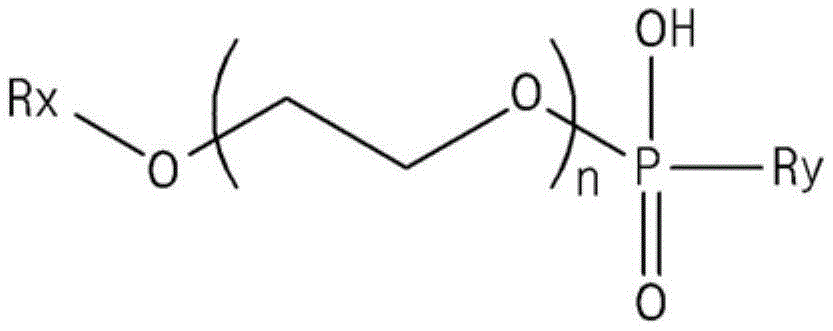
In the formula 1, the first and second groups,
rx may be an aliphatic hydrocarbon group of 1 to 30 carbon atoms, an alkylaryl group of 7 to 30 carbon atoms or an arylalkyl group of 7 to 30 carbon atoms,
ry may be a hydroxyl group (-OH), an aliphatic hydrocarbon group of 1 to 30 carbon atoms, an alkylaryl group of 7 to 30 carbon atoms or an arylalkyl group of 7 to 30 carbon atoms,
n may be an integer of 1 to 20.
Specifically, in formula 1, Rx may be an alkyl group of 1 to 30 carbon atoms, an alkylaryl group of 7 to 30 carbon atoms, or an arylalkyl group of 7 to 30 carbon atoms, more specifically, an alkyl group of 5 to 15 carbon atoms or an alkylaryl group of 10 to 20 carbon atoms, more specifically, an alkyl group of 8 to 12 carbon atoms or a nonylphenyl group. Further, Ry may be a hydroxyl group (-OH), an alkyl group of 1 to 30 carbon atoms, an alkylaryl group of 7 to 30 carbon atoms, or an arylalkyl group of 7 to 30 carbon atoms, more specifically, a hydroxyl group (-OH), an alkyl group of 5 to 15 carbon atoms, or an alkylaryl group of 10 to 20 carbon atoms, more specifically, a hydroxyl group (-OH), an alkyl group of 8 to 12 carbon atoms, or a nonylphenyl group. Further, n may be an integer of 1 to 10, more specifically, 1 to 5, 1 to 3, or 1 to 2.
In addition, the compound represented by formula 1 according to one embodiment of the present invention may be a polyoxyethylene phosphate ester compound, for example, a polyoxyethylene alkyl (aryl) phosphate ester compound.
In addition, the phosphorus contained in the modified conjugated diene-based polymer may be derived from two or more different compounds satisfying formula 1.
In addition, chlorine and sulfur contained in the modified conjugated diene-based polymer may be derived from a modifier in a modification step in the production process, and for example, the modifier may be sulfur chloride.
More specifically, the modified conjugated diene-based polymer may comprise: 250 to 400ppm of phosphorus (P), based on the weight of the modified conjugated diene-based polymer; 550ppm to 850ppm of sulfur (S); and 650 to 1000ppm of chlorine (Cl), more specifically 250 to 350ppm of phosphorus (P); 600ppm to 850ppm of sulfur (S); and 700ppm to 950ppm of chlorine (Cl).
By the above amounts of phosphorus, chlorine and sulfur, the amounts of the modifier added during modification and the additive comprising the compound represented by formula 1 can be expected, and the degree of branching of the polymer can be expected. Since the modified conjugated diene-based polymer according to one embodiment of the present invention is contained in the above-described range of specific amounts, the degree of branching of the polymer can be controlled, and an excellent degree of compounding properties such as tensile properties and viscoelastic properties can be ensured without deterioration, and at the same time, excellent processability can be exhibited during compounding of the rubber composition.
In addition, the conjugated diene-based polymer according to an embodiment of the present invention may have a narrow molecular weight distribution, which has a molecular weight distribution (PDI: polydispersity) of 3.0 or less and is a ratio (Mw/Mn) of a weight average molecular weight (Mw) to a number average molecular weight (Mn). If the conjugated diene-based polymer has a PDI of more than 3.0 and the polymer is applied to a rubber composition, mechanical properties such as abrasion resistance and impact resistance are deteriorated. More specifically, the molecular weight distribution of the conjugated diene-based polymer may be 2.0 to 3.0 in consideration of the effect of significantly improving the mechanical properties of the polymer according to the control of polydispersity.
Here, the molecular weight distribution can be calculated from the ratio (Mw/Mn) of the weight average molecular weight (Mw) to the number average molecular weight (Mn), which in this case is a general average of the molecular weights of the individual polymers, by measuring the molecular weights of n polymer molecules to give a sum of the molecular weights and dividing the sum by n, the weight average molecular weight (Mw) representing the molecular weight distribution of the polymer composition.
In addition, the conjugated diene-based polymer according to one embodiment of the present invention may satisfy the above molecular weight distribution conditions, and at the same time, the weight average molecular weight (Mw) thereof may be 300,000 to 1,200,000g/mol, specifically 400,000 to 1,000,000 g/mol. Further, the number average molecular weight (Mn) of the conjugated diene-based polymer according to one embodiment of the present invention may be 100,000g/mol to 700,000g/mol, specifically 120,000g/mol to 500,000 g/mol. If applied to the rubber composition within the range, the tensile properties may be excellent, the processability may be good, and the workability of the rubber composition may be improved. Therefore, mixing and kneading can become easy, and the balance between the mechanical properties and physical properties of the rubber composition can become excellent.
More specifically, if applied to a rubber composition, the conjugated diene-based polymer according to one embodiment of the present invention may preferably satisfy both the weight average molecular weight and the number average molecular weight and the molecular weight distribution in view of the effect of improving the rubber composition in a good balance of mechanical properties, modulus and processability. Specifically, the ratio (Mw/Mn) of the weight average molecular weight (Mw) to the number average molecular weight (Mn) of the conjugated diene-based polymer may be 3.0 or less, the weight average molecular weight (Mw) may be 300,000 to 1,200,000g/mol, the number average molecular weight (Mn) may be 100,000 to 700,000g/mol, more specifically, the ratio (Mw/Mn) of the weight average molecular weight (Mw) to the number average molecular weight (Mn) may be 2.0 to 3.0, the weight average molecular weight (Mw) may be 400,000 to 1,000,000g/mol, and the number average molecular weight (Mn) may be 120,000 to 500,000 g/mol. As described above, more specifically, if the conjugated diene-based polymer according to one embodiment of the present invention satisfies the above-described conditions of the molecular weight distribution and the weight average molecular weight (Mw) and the number average molecular weight (Mn), and if applied to a rubber composition, the effect of excellent balance among the tensile property, the viscoelastic property, and the processability and the physical properties of the rubber composition can be obtained.
In addition, the polymer before modification of the modified conjugated diene-based polymer may have a Mooney Viscosity (MV) at 100 ℃ of 10 to 90, specifically 10 to 50, more specifically 10 to 30. Further, the polymer after modification may have a Mooney Viscosity (MV) at 100 ℃ of 20 to 120, specifically, 30 to 110, more specifically, 40 to 80.
In the present invention, the Mooney viscosity can be measured using a Mooney viscometer, for example, MV2000E from Monsanto Co., at 100 ℃ using a large spindle at a spindle speed of 2. + -. 0.02 rpm. In this case, the sample to be used is left at room temperature (23. + -. 3 ℃ C.) for 30 minutes or more, and 27. + -.3 g of the sample is collected and put into a cavity, and then, the Mooney viscosity can be measured by operating the platens.
It was confirmed from the increase in the Mooney viscosity by the modification process as described above that a branched structure was introduced into the modified conjugated diene-based polymer. In this case, if the mooney viscosity of the polymer after modification satisfies the above range, the effect of further improving processability can be exhibited.
The mooney viscosity increase (%) of the polymer after modification of the modified conjugated diene-based polymer according to an embodiment of the present invention may be 50% to 200% with respect to the mooney viscosity of the polymer before modification, and is preferably 70% to 150%, more preferably 90% to 130% in view of preventing deterioration of tensile properties and viscoelastic properties and remarkably improving processability. Here, the mooney viscosity increase rate can be calculated by the following mathematical formula 1:
[ mathematical formula 1]

An increase in the mooney viscosity within the above range can show an improvement in processability, and if the above range is satisfied, mechanical properties such as tensile properties and viscoelastic properties can be maintained at an excellent level, and at the same time, processability can be improved. Further, an increase in the mooney viscosity within the above range may also contribute to improvement in processability, and a defect of deterioration in processability due to an excessive increase in the mooney viscosity may be prevented.
The standard deviation of the mooney viscosity increase rate (%) of the polymer after modification of the modified conjugated diene-based polymer according to an embodiment of the present invention may be expressed as 15% or less, preferably 12% or less, more preferably 10% or less, with respect to the mooney viscosity of the polymer before modification. In this case, the source data required for calculating the standard deviation is for the modified conjugated diene-based polymer prepared by repeating several times under the same conditions.
The modified conjugated diene-based polymer of the present invention exhibits the mooney viscosity increase rate and standard deviation within the above-mentioned ranges, and can obtain the mooney viscosity increase before and after modification within a stable range, and can achieve uniform change in physical properties under the same modification conditions. The physical properties of the modified conjugated diene-based polymer can be easily controlled according to the formation of the modified conjugated diene-based polymer which can be easily reproduced.
The stress/relaxation (-S/R) value of the modified conjugated diene polymer may be 1.00 or less, 0.90 or less, 0.80 or less, or 0.75 or less, and the lower limit is not limited, but is preferably 0.10 or more, 0.40 or more, 0.50 or more, or 0.60 or more. From this-S/R value, the linearity of the polymer can be expected. For example, a small value of-S/R indicates that the linearity of the polymer is low, whereas a large value indicates that the linearity of the polymer is high. If the linearity is too low and if applied to a rubber composition, the compounding property decreases, and the tensile property and viscoelastic property decrease, and if the linearity is too high, the processability decreases. Therefore, in order to obtain an excellent degree of processability and compounding property in balance, it is required that the linearity of the polymer is maintained at an appropriate degree, and since the modified conjugated diene-based polymer according to one embodiment of the present invention has the above-mentioned-S/R value, high processability can be exhibited, and at the same time, compounding properties such as tensile properties and viscoelastic properties can be excellent.
In addition, in the present invention, the modified conjugated diene-based polymer may be a neodymium-catalyzed modified conjugated diene-based polymer, and the neodymium-catalyzed modified conjugated diene-based polymer may represent a modified conjugated diene-based polymer prepared using a catalyst composition containing a neodymium compound. More specifically, the modified conjugated diene-based polymer may be a neodymium-catalyzed modified conjugated diene-based polymer comprising repeating units derived from a 1, 3-butadiene monomer.
In addition, the modified conjugated diene-based polymer according to an embodiment of the present invention may be a butadiene homopolymer such as polybutadiene, or a butadiene copolymer such as butadiene-isoprene copolymer.
As a specific example, the conjugated diene-based polymer may contain 80 to 100% by weight of repeating units derived from a 1, 3-butadiene monomer, and optionally, 20% by weight or less of repeating units derived from other conjugated diene-based monomers copolymerizable with 1, 3-butadiene, within which the effect of not reducing the content of 1, 4-cis bonds in the polymer can be obtained. In this case, as the 1, 3-butadiene monomer, 1, 3-butadiene or a derivative thereof including 2, 3-dimethyl-1, 3-butadiene or 2-ethyl-1, 3-butadiene may be used, and as other conjugated diene-based monomers copolymerizable with 1, 3-butadiene, 2-methyl-1, 3-pentadiene, 3-methyl-1, 3-pentadiene, 4-methyl-1, 3-pentadiene, 1, 3-hexadiene or 2, 4-hexadiene may be used, and any one or a mixture of two or more thereof may be used.
In addition, the modified conjugated diene-based polymer according to one embodiment of the present invention may be prepared according to the following preparation method.
According to an embodiment of the present invention, there is provided a method for producing a modified conjugated diene-based polymer, comprising: a step of polymerizing a conjugated diene-based monomer in the presence of a rare earth metal catalyst composition to prepare an active polymer (step 1); and a step (step 2) of adding an additive comprising a compound represented by the following formula 1 and sulfur chloride and carrying out modification:
[ formula 1]

In the formula 1, the first and second groups,
rx may be an aliphatic hydrocarbon group of 1 to 30 carbon atoms, an alkylaryl group of 7 to 30 carbon atoms or an arylalkyl group of 7 to 30 carbon atoms,
ry may be a hydroxyl group (-OH), an aliphatic hydrocarbon group of 1 to 30 carbon atoms, an alkylaryl group of 7 to 30 carbon atoms or an arylalkyl group of 7 to 30 carbon atoms,
n may be an integer of 1 to 20.
Specifically, in formula 1, Rx may be an alkyl group of 1 to 30 carbon atoms, an alkylaryl group of 7 to 30 carbon atoms, or an arylalkyl group of 7 to 30 carbon atoms, more specifically, an alkyl group of 5 to 15 carbon atoms or an alkylaryl group of 10 to 20 carbon atoms, more specifically, an alkyl group of 8 to 12 carbon atoms or a nonylphenyl group. Further, Ry may be a hydroxyl group (-OH), an alkyl group of 1 to 30 carbon atoms, or an alkylaryl group of 7 to 30 carbon atoms, a hydroxyl group (-OH), an alkyl group of 5 to 15 carbon atoms, or an alkylaryl group of 10 to 20 carbon atoms, more specifically, a hydroxyl group (-OH), an alkyl group of 8 to 12 carbon atoms, or a nonylphenyl group. Further, n may be an integer of 1 to 10, more specifically, 1 to 5, 1 to 3, or 1 to 2.
In addition, the compound represented by formula 1 according to one embodiment of the present invention may be a polyoxyethylene phosphate ester compound, for example, a polyoxyethylene alkyl (aryl) phosphate ester compound.
In addition, the additive including the compound represented by formula 1 may be a mixture including two or more different compounds satisfying formula 1.
For example, the additive including the compound represented by formula 1 may be a mixture including two or more different compounds of formula 1, wherein Rx is a nonylphenyl group or an alkyl group of 8 to 12 carbon atoms, Ry is a hydroxyl group, a nonylphenyl group or an alkyl group of 8 to 12 carbon atoms, and n is an integer of 1 or 2, and in this case, the molar ratio of the alkyl group of 8 to 12 carbon atoms to the nonylphenyl group included in the entire additive may be 70:30 to 90: 10. Further, the alkyl group of 8 to 12 carbon atoms may be more specifically an alkyl group of 12 carbon atoms.
In the modified conjugated diene-based polymer of the present invention, since sulfur chloride is used as a modifier in step 2), chlorine and sulfur contents within the above-mentioned ranges may be contained. Further, since an additive including the compound represented by formula 1 is added in addition to the sulfur chloride modifier, the phosphorus content within the above range may be satisfied.
According to an embodiment of the present invention, the modification reactivity of the modifier may be controlled by adding an additive including the compound represented by formula 1 in addition to the sulfur chloride modifier in the modification step, and thus, a gelation phenomenon that may be exhibited due to rapid modification may be prevented and modification reproducibility may be significantly improved. Further, since the degree of introduction of the branched structure into the polymer can be controlled by controlling the modification conditions such as the addition amount of the modifier and the additive comprising the compound of formula 1, the physical properties of the modified conjugated diene-based polymer, particularly the rate of change in the degree of branching represented by the increase rate of the Mooney viscosity and the decrease in the β value, can be easily controlled. In particular, if the rare earth metal catalyst system according to the present invention is applied, the reaction rate of the sulfur chloride modifier rapidly increases due to the aluminum compound in the catalyst composition, and thus it is difficult to maintain stable reactivity. If stable reactivity cannot be maintained, it is difficult to ensure reaction reproducibility, and in particular, the degree of introduction of a branched structure by a modifier cannot be controlled, and thus, the degree of branching in a polymer may be significantly increased, or a gelation phenomenon due to rapid modification may frequently occur. In this case, if the additive including the compound represented by formula 1 is added together with the modifier according to one embodiment of the present invention, the aluminum compound in the catalyst composition may form a salt due to the compound represented by formula 1, and thus, the reaction rate may be controlled, and the degree of control of the reaction rate may be controlled by controlling conditions such as the addition amount of the modifier and the additive including the compound of formula 1. Therefore, the modification reactivity can be easily controlled, and the formation of gel in the polymer can be prevented.
Step 1) according to one embodiment of the present invention is a step of polymerizing a conjugated diene-based monomer in the presence of a rare earth metal catalyst composition to prepare an active polymer, wherein the active polymer may represent an active polymer combined with an organic metal.
The polymerization according to an embodiment of the present invention may be performed by radical polymerization, may be performed by various polymerization methods such as bulk polymerization, solution polymerization, suspension polymerization, and emulsion polymerization, and may be performed by a batch method, a continuous method, and a semi-continuous method. In a specific embodiment, the polymerization for preparing the conjugated diene-based polymer may be carried out by adding the conjugated diene-based monomer to the catalyst composition and reacting in an organic solvent.
Specifically, if the preparation is carried out by solution polymerization, the preparation of the conjugated diene polymer according to one embodiment of the present invention may be carried out by adding the conjugated diene-based monomer to the catalyst composition and reacting in the polymerization solvent.
As the conjugated diene-based monomer, any one used for producing a conventional conjugated diene-based polymer may be used without specific limitation. The conjugated diene-based monomer may be specifically 1, 3-butadiene, isoprene, 1, 3-pentadiene, 1, 3-hexadiene, 2, 3-dimethyl-1, 3-butadiene, 2-ethyl-1, 3-butadiene, 2-methyl-1, 3-pentadiene, 3-methyl-1, 3-pentadiene, 4-methyl-1, 3-pentadiene, 2, 4-hexadiene, etc., and any one or a mixture of two or more thereof may be used. More specifically, the conjugated diene monomer may be 1, 3-butadiene.
In addition, in view of physical properties of the conjugated diene polymer finally prepared, other monomers copolymerizable with the conjugated diene monomer may also be used. The other monomers may specifically include: aromatic vinyl monomers such as styrene, p-methylstyrene, α -methylstyrene, 1-vinylnaphthalene, 3-vinyltoluene, ethylvinylbenzene, divinylbenzene, 4-cyclohexylstyrene and 2,4, 6-trimethylstyrene, and any one or a mixture of two or more thereof may be used. The other monomer may be used in an amount of 20 wt% or less, based on the total weight of the monomers used in the polymerization reaction.
In this case, the conjugated diene-based monomer is used in such a manner that, instead of dissolving the entire amount for producing the diene-based polymer in the nonpolar solvent, a part of the entire amount is dissolved in the polymerization solvent and polymerized, and then is injected in portions at one or more times, specifically, two or more times, more specifically, two to four times, depending on the polymerization conversion rate.
In addition, the solvent included in the polymerization process may be a hydrocarbon solvent, and the hydrocarbon solvent may be a non-polar solvent. Specifically, the hydrocarbon solvent may use one or more selected from the group consisting of: aliphatic hydrocarbon solvents such as pentane, hexane, isopentane, heptane, octane and isooctane; alicyclic hydrocarbon solvents such as cyclopentane, methylcyclopentane, cyclohexane, methylcyclohexane and ethylcyclohexane; and aromatic hydrocarbon solvents such as benzene, toluene, ethylbenzene and xylene. As a specific example of the hydrocarbon solvent, an aliphatic hydrocarbon solvent such as hexane can be used. The concentration of the monomer used in the polymerization solvent is not particularly limited, but may be 3 to 80% by weight, more specifically, 10 to 30% by weight.
In addition, during the polymerization, additives may also be used, including: molecular weight controlling agents such as trimethylaluminum, diisobutylaluminum hydride and trimethylsilane; a reaction quencher for terminating the polymerization reaction, such as polyethylene glycol phosphate; and antioxidants, such as 2, 6-di-tert-butyl-p-cresol. In addition, additives generally used to facilitate solution polymerization, specifically, additives such as a chelating agent, a dispersing agent, a pH controlling agent, a deoxidizer, and an oxygen scavenger may be selectively used.
The polymerization reaction may be carried out at a temperature of 0 ℃ to 100 ℃, more specifically, 20 ℃ to 100 ℃.
In addition, the polymerization reaction may be carried out in the above temperature range for 5 minutes to 1 hour, specifically, 15 minutes to 1 hour, until the polymerization conversion rate reaches 100%.
The rare earth metal catalyst composition according to one embodiment of the present invention may comprise: (a) a rare earth metal compound; (b) a first alkylating agent; (c) a second alkylating agent; and (d) a halogen compound, and may further contain a conjugated diene-based monomer.
Specifically, the molar ratio of the rare earth metal compound, the first alkylating agent, the second alkylating agent, the halogen compound, and the conjugated diene-based monomer may be 1: (1 to 200): (1 to 80): (1 to 5): (0 to 100). More specifically, the molar ratio of the rare earth metal compound, the first alkylating agent, the second alkylating agent, the halogen compound, and the conjugated diene-based monomer may be 1: (1 to 150): (1 to 50): (2 to 4): (5 to 30).
In particular, the catalyst composition may be prepared by sequentially injecting a rare earth metal compound, a first alkylating agent, a second alkylating agent, a halogen compound, and optionally a conjugated diene-based monomer into a hydrocarbon solvent, followed by mixing.
In this case, in order to promote the generation of the catalyst active material, the mixing process may be performed at a temperature ranging from-20 ℃ to 30 ℃, specifically, from-10 ℃ to 10 ℃, and in this case, the heat treatment may be simultaneously performed to satisfy the above temperature conditions.
More specifically, the catalyst composition may be prepared by: a mixed rare earth metal compound, a first alkylating agent and a second alkylating agent, and a solvent; a first heat treatment at a temperature of-20 ℃ to 30 ℃; adding a halogen compound to the mixture thus obtained; and a second heat treatment at a temperature in the range of-20 ℃ to 30 ℃.
In the catalyst composition prepared by the above preparation method, a catalyst active material is generated due to the interaction of the constituent components. The catalyst composition thus prepared may also be subjected to an aging process under low temperature conditions.
In this case, the hydrocarbon solvent may be a non-polar solvent that is not reactive with the constituent components of the catalyst composition. Specifically, the hydrocarbon solvent may use one or more selected from the group consisting of: aliphatic hydrocarbon solvents such as pentane, hexane, isopentane, heptane, octane and isooctane; alicyclic hydrocarbon solvents such as cyclopentane, methylcyclopentane, cyclohexane, methylcyclohexane and ethylcyclohexane; and aromatic hydrocarbon solvents such as benzene, toluene, ethylbenzene and xylene. As a specific example of the hydrocarbon solvent, an aliphatic hydrocarbon solvent such as hexane may be used.
In addition, by premixing a part of the conjugated diene-based monomer used in the polymerization reaction with the catalyst composition and then using it in the form of a preformed catalyst composition, the catalyst activity can be improved, and further, the stabilizing effect of the conjugated diene-based polymer thus produced can be achieved.
Specifically, the conjugated diene-based monomer may use any one generally used for polymerizing conjugated diene-based polymers without specific limitation. Specifically, the conjugated diene-based monomer may include: 1, 3-butadiene, isoprene, 1, 3-pentadiene, 1, 3-hexadiene, 2, 3-dimethyl-1, 3-butadiene, 2-ethyl-1, 3-butadiene, 2-methyl-1, 3-pentadiene, 3-methyl-1, 3-pentadiene, 4-methyl-1, 3-pentadiene or 2, 4-hexadiene, and any one of them or a mixture of two or more of them may be used.
The catalyst composition according to one embodiment of the present invention will be described in detail by each component.
(a) Rare earth metal compound
The rare earth metal compound according to one embodiment of the present invention is activated by the first alkylating agent and the second alkylating agent, and forms a catalyst active species for polymerizing the conjugated diene.
As the rare earth metal compound, any one generally used for preparing conjugated diene-based polymers can be used without particular limitation. Specifically, the rare earth metal compound may be a compound containing one or two or more rare earth metals having atomic numbers of 57 to 71, such as lanthanum, neodymium, cerium, gadolinium, and praseodymium, and more specifically, a compound containing one or two or more selected from neodymium, lanthanum, and gadolinium may be used.
In addition, the rare earth metal compound may be: carboxylates containing rare earth metals (e.g., neodymium acetate, neodymium acrylate, neodymium methacrylate, neodymium acetate, neodymium gluconate, neodymium citrate, neodymium fumarate, neodymium lactate, neodymium maleate, neodymium oxalate, neodymium 2-ethylhexanoate, neodymium neodecanoate, etc.); organic phosphates (e.g., neodymium dibutyl phosphate, neodymium dipentyl phosphate, neodymium dihexyl phosphateNeodymium heptyl phosphate, neodymium dioctyl phosphate, neodymium bis (1-methylheptyl) phosphate, neodymium bis (2-ethylhexyl) phosphate, neodymium didecyl phosphate, and the like); organic phosphonates (e.g., neodymium butylphosphonate, neodymium pentylphosphonate, neodymium hexylphosphonate, neodymium heptylphosphonate, neodymium octylphosphonate, neodymium (1-methylheptyl) phosphonate, neodymium (2-ethylhexyl) phosphonate, neodymium decylphosphonate, neodymium dodecylphosphonate, neodymium octadecylphosphonate, etc.); organic phosphinates (e.g., neodymium butylphosphinate, neodymium pentylphosphinate, neodymium hexylphosphinate, neodymium heptylphosphinate, neodymium octylphosphinate, (neodymium 1-methylheptyl) phosphinate, (neodymium 2-ethylhexyl) phosphinate, and the like); carbamates (e.g., neodymium dimethylcarbamate, neodymium diethylcarbamate, neodymium diisopropylcarbamate, neodymium dibutylcarbamate, neodymium dibenzylcarbamate, etc.); dithiocarbamates (e.g., neodymium dimethyldithiocarbamate, neodymium diethyldithiocarbamate, neodymium diisopropyldithiocarbamate, neodymium dibutyldithiocarbamate, etc.); xanthates (e.g., neodymium methylxanthate, neodymium ethylxanthate, neodymium isopropylxanthate, neodymium butylxanthate, neodymium benzylxanthate, etc.); beta-diketonates (e.g., neodymium acetylacetonate, neodymium trifluoroacetylacetonate, neodymium hexafluoroacetylacetonate, neodymium benzoylacetonate, etc.); alkoxides or allyl oxides (e.g., neodymium methoxide, neodymium ethoxide, neodymium isopropoxide, neodymium phenoxide, neodymium nonylphenoxide, etc.); halides or pseudohalides (neodymium fluoride, neodymium chloride, neodymium bromide, neodymium iodide, neodymium cyanide, neodymium cyanate, neodymium thiocyanate, neodymium azide, etc.); oxyhalides (e.g., neodymium oxyfluoride, neodymium oxychloride, neodymium oxybromide, etc.); or organo-lanthanide rare earth metal compounds containing one or more rare earth-carbon bonds (e.g., Cp3Ln、Cp2LnR'、Cp2LnCl、CpLnCl2CpLn (cyclooctatetraene), (C)5Me5)2LnR'、Ln(R')3Ln (allyl)3Ln (allyl)2Cl, etc., wherein Ln is a rare earth metal element, R' is a monovalent organic group bonded to the metal element through a carbon atom, and may be a hydrocarbon group), etc., and any one or a mixture of two or more thereof may be included.
More specifically, the rare earth metal compound may be a neodymium compound represented by the following formula 2:
[ formula 2]

In formula 2, R1To R3Each independently a hydrogen atom, or a straight or branched alkyl group of 1 to 12 carbon atoms.
More specifically, the rare earth metal compound may be a neodymium compound of formula 2, wherein R1Is a linear or branched alkyl group of 6 to 12 carbon atoms, R2And R3Each independently being a hydrogen atom, or a linear or branched alkyl group of 2 to 6 carbon atoms, except that R2And R3Not both being hydrogen atoms, more specifically, a neodymium compound of formula 2, wherein R1Is a linear or branched alkyl group of 6 to 8 carbon atoms, R2And R3Each independently a straight or branched chain alkyl group of 2 to 6 carbon atoms.
As described above, if the neodymium compound of formula 2 includes a carboxylate ligand including alkyl groups of different lengths having 2 or more carbon atoms as substituents at the α position, a steric change may be induced around the neodymium central metal to block entanglement between the compounds. Therefore, oligomerization is suppressed, and the conversion rate to active substances is high. Such a neodymium compound has high solubility in a polymerization solvent, and the proportion of neodymium located at the center portion, which is difficult to be converted into a catalytically active substance, is reduced, thereby improving the conversion rate into the catalytically active substance.
More specifically, the rare earth metal compound may be selected from Nd (2, 2-diethyldecanoic acid)3Nd (2, 2-dipropyldecanoic acid)3Nd (2, 2-dibutyl decanoic acid)3Nd (2, 2-dihexyldecanoic acid)3Nd (2, 2-dioctyl decanoic acid)3Nd (2-ethyl-2-propyl decanoic acid)3Nd (2-ethyl-2-butyl decanoic acid)3Nd (2-ethyl-2-hexyldecanoic acid)3Nd (2-propyl-2-butyl decanoic acid)3Nd (2-propyl-2-hexyldecanoic acid)3Nd (2-propyl-2-isopropyl decanoic acid)3Nd (2-butyl-2-hexyldecanoic acid)3Nd (2-hexyl-2-octyl decanoic acid)3Nd (2, 2-diethyl octanoic acid)3Nd (2, 2-dipropyl octanoic acid)3Nd (2, 2-dibutyl octanoic acid)3Nd (2, 2-dihexyloctanoic acid)3Nd (2-ethyl-2-propyloctanoic acid)3Nd (2-ethyl-2-hexyl octanoic acid)3Nd (2, 2-diethyl nonanoic acid)3Nd (2, 2-dipropylnonanoic acid)3Nd (2, 2-dibutylnonanoic acid)3Nd (2, 2-dihexylnonanoic acid)3Nd (2-ethyl-2-propyl nonanoic acid)3And Nd (2-ethyl-2-hexylnonanoic acid)3Or a mixture of two or more thereof. Further, the neodymium compound may be selected from Nd (2, 2-diethyldecanoic acid) in view of excellent solubility in a polymerization solvent without worrying about oligomerization, excellent conversion rate to a catalyst active substance, and subsequent improvement effect of catalyst activity3Nd (2, 2-dipropyldecanoic acid)3Nd (2, 2-dibutyl decanoic acid)3Nd (2, 2-dihexyldecanoic acid)3And Nd (2, 2-dioctyl decanoic acid)3Or a mixture of two or more thereof.
In addition, the rare earth metal compound may have a solubility at room temperature (23. + -. 5 ℃) of about 4g or more per 6g of the nonpolar solvent. In the present invention, the solubility of the neodymium compound means a degree of clear dissolution without generating a clouding phenomenon. By exhibiting such high solubility, excellent catalyst activity can be exhibited.
The rare earth metal compound may be used, for example, in an amount of 0.01mmol to 0.5mmol, more specifically, 0.05mmol to 0.2mmol per 100g of the conjugated diene-based monomer for polymerization, within which the catalyst activity is high, an appropriate catalyst concentration is obtained, and a separate demineralization process is not required.
The rare earth metal compound may be used in the form of a reaction product with a lewis base. Due to the lewis base, the reaction product can obtain an improved solubility of the rare earth metal compound in the solvent, and can obtain an effect of stable storage for a long time. The lewis base may be used in a proportion of 30mol or less, or 1mol to 10mol per 1mol of the rare earth element. The lewis base may be, for example, acetylacetone, tetrahydrofuran, pyridine, N-dimethylformamide, thiophene, diphenyl ether, triethylamine, an organic phosphorus compound, or a monohydric or dihydric alcohol.
(b) First alkylating agent
The first alkylating agent according to one embodiment of the present invention may be aluminoxane, and aluminoxane may be prepared by reacting a trihydrocarbylaluminum-based compound with water. Specifically, the aluminoxane may be a linear aluminoxane represented by the following formula 3a or a cyclic aluminoxane represented by the following formula 3 b:
[ formula 3a ]

[ formula 3b ]

In formula 3a and formula 3b, R may be a monovalent organic group bonded to the aluminum atom through a carbon atom, and may be a hydrocarbon group, and x and y may each independently be an integer of 1 or more, specifically, 1 to 100, and more specifically, 2 to 50.
More specifically, the aluminoxane may be Methylaluminoxane (MAO), Modified Methylaluminoxane (MMAO), ethylaluminoxane, n-propylaluminoxane, isopropylaluminoxane, butylaluminoxane, isobutylaluminoxane, n-pentylaluminoxane, neopentylaluminoxane, n-hexylaluminoxane, n-octylaluminoxane, 2-ethylhexylaluminoxane, cyclohexylaluminoxane, 1-methylcyclopentylaluminoxane, phenylaluminoxane, or 2, 6-dimethylphenylaluminoxane, and any one or a mixture of at least two thereof may be used.
In addition, the modified methylaluminoxane can be obtained by substituting the methyl group of methylaluminoxane with a modifier (R), specifically, a hydrocarbon group of 2 to 20 carbon atoms, and can be specifically a compound represented by the following formula 4:
[ formula 4]

In formula 4, R is the same as defined above, and m and n may be integers of 2 or more. In formula 3, Me represents a methyl group.
Specifically, R in formula 4 may be an alkyl group of 2 to 20 carbon atoms, a cycloalkyl group of 3 to 20 carbon atoms, an alkenyl group of 2 to 20 carbon atoms, a cycloalkenyl group of 3 to 20 carbon atoms, an aryl group of 6 to 20 carbon atoms, an arylalkyl group of 7 to 20 carbon atoms, an alkylaryl group of 7 to 20 carbon atoms, an allyl group, or an alkynyl group of 2 to 20 carbon atoms, more specifically, may be an alkyl group of 2 to 10 carbon atoms, such as an ethyl group, an isobutyl group, a hexyl group, and an octyl group, and still more specifically, may be an isobutyl group.
More specifically, the modified methylaluminoxane can be obtained by substituting a hydrocarbon group for a methyl group of about 50 to 90 mol% of methylaluminoxane. If the amount of the substituted hydrocarbon group in the modified methylaluminoxane is within the above range, alkylation can be promoted and catalytic activity can be improved.
Such modified methylaluminoxane can be prepared by a conventional method, and specifically, can be prepared using trimethylaluminum and an alkylaluminum other than trimethylaluminum. In this case, the aluminum alkyl may be triisobutylaluminum, triethylaluminum, trihexylaluminum or trioctylaluminum, and any one or a mixture of two or more thereof may be used.
In addition, according to an embodiment of the present invention, the prepared modified conjugated diene-based polymer may be formed to have a narrow molecular weight distribution, and thus, the first alkylating agent may be methylaluminoxane or modified methylaluminoxane, in consideration of improvement in physical properties of the polymer.
(c) Second alkylating agent
The second alkylating agent according to an embodiment of the present invention may be a hydrocarbyl aluminum dihydride, in particular, the second alkylating agent may be one or more selected from the group consisting of: dihydrocarbyl aluminum hydrides such as diethylaluminum hydride, di-n-propylaluminum hydride, diisopropylaluminum hydride, di-n-butylaluminum hydride, diisobutylaluminum hydride (DIBAH), di-n-octylaluminum hydride, diphenylaluminum hydride, di-p-tolylaluminum hydride, dibenzylaluminum hydride, phenylethylaluminum hydride, phenyl-n-propylaluminum hydride, phenylisopropylaluminum hydride, phenyl-n-butylaluminum hydride, phenylisobutylaluminum hydride, phenyl-n-octylaluminum hydride, p-tolylethylaluminum hydride, p-tolyl-n-propylaluminum hydride, p-tolylisopropylaluminum hydride, p-tolyl-n-butylaluminum hydride, p-tolylisobutylaluminum hydride, p-tolyl-n-octylaluminum hydride, benzylethylaluminum hydride, benzyl-n-propylaluminum hydride, benzylisopropylaluminum hydride, benzyl-n-butylaluminum hydride, benzylisobutylaluminum hydride and benzyl-n-octylaluminum hydride; ethyl aluminum dihydride, n-propyl aluminum dihydride, isopropyl aluminum dihydride, n-butyl aluminum dihydride, isobutyl aluminum dihydride, n-octyl aluminum dihydride, and the like.
Meanwhile, in the catalyst composition according to one embodiment of the present invention, the alkylating agent may be an organometallic compound capable of transferring a hydrocarbon group to another metal, and functions as a cocatalyst.
In addition, in the process of preparing the conjugated diene-based polymer, the catalyst composition according to an embodiment of the present invention may further include a conventional alkylating agent, which is generally used as an alkylating agent, in addition to the first alkylating agent and the second alkylating agent, as necessary. Such alkylating agents may include: alkylaluminum such as trimethylaluminum, triethylaluminum, tri-n-propylaluminum, triisopropylaluminum, tri-n-butylaluminum, triisobutylaluminum, tri-tert-butylaluminum, tripentylaluminum, trihexylaluminum, tricyclohexylaluminum, and trioctylaluminum; and alkyl magnesium compounds such as diethylmagnesium, di-n-propylmagnesium, diisopropylmagnesium, dibutylmagnesium, dihexylmagnesium, diphenylmagnesium, and dibenzylmagnesium. In addition, the organolithium compound may include an alkyllithium compound such as n-butyllithium.
(d) Halogen compound
In the catalyst composition for polymerizing a conjugated diene according to one embodiment of the present invention, the kind of the halogen compound is not particularly limited, but any halogenating agent generally used in preparing a diene-based polymer may be used without particular limitation.
Specifically, the halogen compound may be a diatomic halogen (simple substance), an interhalogen compound, a hydrogen halide, an organic halide, a non-metal halide, a metal halide, an organometallic halide, or the like, and any one or a mixture of two or more thereof may be used. Wherein the halogen compound may be any one selected from the group consisting of organic halides, metal halides and organometallic halides, or a mixture of at least two thereof, in consideration of the effect of improving catalytic activity and subsequent reactivity.
More specifically, the diatomic halogen may include fluorine, chlorine, bromine or iodine.
In addition, the interhalogen compound may specifically include iodine monochloride, iodine monobromide, iodine trichloride, iodine pentafluoride, iodine monofluoride, iodine trifluoride and the like.
In addition, the hydrogen halide may specifically include hydrogen fluoride, hydrogen chloride, hydrogen bromide, or hydrogen iodide.
In addition, the organic halide may specifically include: t-butyl chloride (t-BuCl), t-butyl bromide, allyl chloride, allyl bromide, benzyl chloride, benzyl bromide, chlorodiphenylmethane, bromodiphenylmethane, trityl chloride, trityl bromide, benzylidene chloride, benzylidene bromide, methyltrichlorosilane, phenyltrichlorosilane, dimethyldichlorosilane, diphenyldichlorosilane, trimethylchlorosilane (TMSCl), benzoyl chloride, benzoyl bromide, propionyl chloride, propionyl bromide, methyl chloroformate, methyl bromoformate, iodomethane, diiodomethane, triiodomethane (also referred to as "iodoform"), tetraiodomethane, 1-iodopropane, 2-iodopropane, 1, 3-diiodopropane, t-butyl iodide, 2-dimethyl-1-iodopropane (also referred to as "neopentyl iodide"), allyl iodide, iodobenzene, benzyl iodide, dibenzyl iodide, trityl iodide, Benzylidene iodide (also referred to as "benzylidene iodide"), trimethylsilyliodide, triethylsilyliodide, triphenylsilyliodide, dimethyldiiodosilane, diethyldiiodosilane, diphenyldiiodosilane, methyltriiodosilane, ethyltriiodosilane, phenyltriiodosilane, benzoyl iodide, propionyl iodide, methyl formate iodide (methyl iodoform), and the like.
In addition, the non-metal halide may specifically include: phosphorus trichloride, phosphorus tribromide, phosphorus pentachloride, phosphorus oxychloride, phosphorus oxybromide, boron trifluoride, boron trichloride, boron tribromide, silicon tetrafluoride, silicon tetrachloride (SiCl)4) Silicon tetrabromide, arsenic trichloride, arsenic tribromide, selenium tetrachloride, selenium tetrabromide, tellurium tetrachloride, tellurium tetrabromide, silicon tetraiodide, arsenic triiodide, tellurium tetraiodide, boron triiodide, phosphorus triiodooxyphosphate, or selenium tetraiodide.
In addition, the metal halide may specifically include: tin tetrachloride, tin tetrabromide, aluminum trichloride, aluminum tribromide, antimony trichloride, antimony pentachloride, antimony tribromide, aluminum trifluoride, gallium trichloride, gallium tribromide, gallium trifluoride, indium trichloride, indium tribromide, indium trifluoride, titanium tetrachloride, titanium tetrabromide, zinc dichloride, zinc dibromide, zinc difluoride, aluminum triiodide, gallium triiodide, indium triiodide, titanium tetraiodide, zinc diiodide, germanium tetraiodide, tin diiodide, antimony triiodide, or magnesium diiodide.
In addition, the organic metal halide may specifically include: dimethylaluminum chloride, diethylaluminum chloride, dimethylaluminum bromide, diethylaluminum bromide, dimethylaluminum fluoride, diethylaluminum fluoride, methylaluminum dichloride, ethylaluminum dichloride, methylaluminum dibromide, ethylaluminum dibromide, methylaluminum difluoride, ethylaluminum difluoride, sesquimethylaluminum chloride, ethylaluminum sesquichloride (EASC), isobutylaluminum sesquichloride, methylmagnesium chloride, methylmagnesium bromide, ethylmagnesium chloride, ethylmagnesium bromide, n-butylmagnesium chloride, n-butylmagnesium bromide, phenylmagnesium chloride, phenylmagnesium bromide, benzylmagnesium chloride, trimethyltin bromide, triethyltin chloride, triethyltin bromide, di-t-butyltin dibromide, di-n-butyltin dichloride, tri-n-butyltin dibromide, tri-n-butyltin bromide, methylmagnesium iodide, dimethylaluminum iodide, triethyltin chloride, triethyltin bromide, di-t-butyltin dichloride, di-t-butyltin dibromide, di-n-butyltin dichloride, tri-butyltin bromide, methylmagnesium iodide, dimethylaluminum iodide, diethylaluminum bromide, diethylaluminum dichloride, and the like, Diethyl aluminum iodide, di-n-butyl aluminum iodide, diisobutyl aluminum iodide, di-n-octyl aluminum iodide, methyl aluminum diiodide, ethyl aluminum diiodide, n-butyl aluminum diiodide, isobutyl aluminum diiodide, sesquimethyl aluminum iodide, sesquiethyl aluminum iodide, sesquiisobutyl aluminum iodide, ethyl magnesium iodide, n-butyl magnesium iodide, isobutyl magnesium iodide, phenyl magnesium iodide, benzyl magnesium iodide, trimethyl tin iodide, triethyl tin iodide, tri-n-butyl tin iodide, di-n-butyl tin diiodide, di-t-butyl tin diiodide, and the like.
In addition, the catalyst composition for preparing a conjugated diene polymer according to one embodiment of the present invention may include a compound containing a non-coordinating anion or a non-coordinating anion precursor compound in place of or together with the above-described halogen compound.
Specifically, in the non-coordinating anion-containing compound, the non-coordinating anion may be an anion that does not form a coordinate bond with the active center of the catalyst system due to steric hindrance and has a sterically large volume, and may be a tetraarylborate anion or a tetraarylfluoroborate anion. Further, the compound containing the non-coordinating anion, along with the non-coordinating anion, may comprise a counter cation, such as: carbonium cations, such as triarylcarbonium cations; ammonium cations, such as N, N-dialkylanilinium cations; and a phosphonium cation. More specifically, the compound containing a non-coordinating anion may be triphenylcarbenium tetrakis (pentafluorophenyl) borate, N-dimethylanilinium tetrakis (pentafluorophenyl) borate, triphenylcarbenium tetrakis [3, 5-bis (trifluoromethyl) phenyl ] borate, N-dimethylanilinium tetrakis [3, 5-bis (trifluoromethyl) phenyl ] borate, or the like.
Further, as the non-coordinating anion precursor, a triarylboron compound (BR) may be used3Wherein R is a strongly electron-withdrawing aryl group such as pentafluorophenyl and 3, 5-bis (trifluoromethyl) phenyl as the compound is capable of forming a non-coordinating anion under the reaction conditions.
In addition, according to an embodiment of the present invention, after the polymerization reaction, an additive, for example, a reaction quencher for terminating the polymerization reaction, such as polyethylene glycol phosphate; and antioxidants, such as 2, 6-di-tert-butyl-p-cresol. In addition, additives generally used to facilitate solution polymerization, specifically, additives such as a chelating agent, a dispersing agent, a pH controlling agent, a deoxidizer, and an oxygen scavenger may be selectively used.
In addition, in the polymerization reaction, preferably, in order not to deactivate the catalyst composition and the polymer, it is possible to avoid mixing a compound having a deactivation function such as oxygen, water and carbonic acid gas in the polymerization reaction system.
As a result of such polymerization, an active polymer comprising an organometallic moiety activated by a catalyst composition comprising a rare earth metal compound, more specifically, a neodymium-catalyzed conjugated diene-based polymer comprising 1, 3-butadiene monomer units can be produced, and the conjugated diene-based polymer thus produced can have pseudo-active properties.
According to an embodiment of the present invention, a polymerization quencher may be added after the step 1) to end the polymerization, and the polymerization quencher may use any polymerization quencher used in the process of polymerizing the conjugated diene-based polymer without limitation, and specifically, a phosphate-based polymerization quencher may be used. More specifically, the same composition as the additive including the compound represented by formula 1 may be used.
In the present invention, the amount of the polymerization quencher added after step 1) may be 0.01 to 0.4 parts by weight based on 100 parts by weight of the conjugated diene-based monomer.
Step 2) according to one embodiment of the present invention is a step for modifying a polymerized living polymer, and may be a step for performing modification by adding an additive comprising the compound represented by formula 1 and sulfur chloride.
According to an embodiment of the present invention, step 2) may be performed by quenching the polymerization by adding a polymerization quencher after step 1), and then adding a composition comprising the compound represented by formula 1 and sulfur chloride.
In addition, according to an embodiment of the present invention, in the additive including the compound represented by formula 1, if any of the compounds represented by formula 1 is the compound represented by formula 1 in which Ry substituent is aliphatic hydrocarbon group, alkylaryl group or arylalkyl group, the compound represented by formula 1 in which Ry is hydroxyl group may be included together.
Here, the modification may be performed by a solution reaction or a solid phase reaction, specifically, by a solution reaction. In another embodiment, the modification reaction may be performed using a batch reactor or using an apparatus such as a multi-step continuous reactor and an inline mixer (inline mixer).
In another embodiment, the modification reaction may be carried out under the same temperature and pressure conditions as in the conventional polymerization reaction, specifically, at a temperature of 20 ℃ to 100 ℃. Within the range, the viscosity of the polymer is not increased, and the activated terminal of the polymer is not inactivated.
The sulfur chloride according to one embodiment of the present invention may be used as a modifier for modifying a living polymer, and a sulfur chloride compound such as sulfur monochloride (S) may be used2Cl2) Sulfur dichloride (SCl)2) And sulfur tetrachloride (SCl)4) While not limited, preferably, the sulfur chloride of the present invention may be sulfur monochloride (S) in view of ease of introducing a branched structure into the conjugated diene-based polymer and gradual increase of the mooney viscosity2Cl2)。
In the present invention, the Mooney viscosity can be gradually increased by introducing a branched structure into the polymer using sulfur chloride as a modifier. Therefore, compounding properties such as processability can be improved, and at the same time, by adding the compound represented by formula 1 together with sulfur chloride, reactivity between the remaining aluminum component in the catalyst composition and the modifier can be controlled, and modification reactivity can be controlled. Therefore, a stable modification reaction can be performed, and modification reproducibility can be improved. Since the modification reproducibility is excellent, the degree of change in physical properties, particularly the mooney viscosity increase rate according to the modification conditions can be expected, and by controlling the modification conditions, the change in physical properties of the polymer can be easily controlled. In addition, by introducing a branched structure, the linearity of the polymer can be controlled, and the processability and compounding property of the modified conjugated diene-based polymer can be improved to an excellent degree.
In addition, in step 2) of the present invention, the compound represented by formula 1 may be added in an amount of 0.01 to 0.35 parts by weight based on 100 parts by weight of the conjugated diene-based monomer, and in view of further improving the modification reproducibility by easily controlling the modification reactivity, the amount may be preferably 0.01 to 0.3 parts by weight, more preferably 0.01 to 0.2 parts by weight.
In addition, according to an embodiment of the present invention, in step 2), the sulfur chloride and the compound represented by formula 1 may be added in a weight ratio of 1:0.1 to 1:2, and may be preferably added in a weight ratio of 1:0.1 to 1:1 in view of an improvement effect of securing excellent physical properties by modification and remarkably improving modification reproducibility without lowering modification reaction efficiency.
In addition, according to an embodiment of the present invention, a step of adding an antioxidant may be further included after the step 2). This is a treatment process for preventing oxidation of the finally produced conjugated diene-based polymer, and corresponds to a post-treatment step for stabilizing and recovering the modified conjugated diene-based polymer.
The antioxidant according to an embodiment of the present invention may use any antioxidant used in the polymerization process of the modified conjugated diene-based polymer without limitation, and may use phenolic antioxidants, phosphorus-based antioxidants, and sulfur-based antioxidants. As the phenolic antioxidant, Irganox 1010 (pentaerythritol tetrakis (3- (3, 5-di-tert-butyl-4-hydroxyphenyl) propionate), manufactured by BASF Corp.), Irganox 1076 (octadecyl-3- (3, 5-di-tert-butyl-4-hydroxyphenyl) propionate, manufactured by BASF Corp.), Irganox 1330(3,3', 5,5' -hexa-tert-butyl-a, a ' - (mesitylene-2, 4, 6-triyl) tri-p-cresol, manufactured by BASF Corp.), Irganox 3114(1,3, 5-tris (3, 5-di-tert-butyl-4-hydroxybenzyl) -1,3, 5-triazine-2, 4,6(1H,3H,5H) -trione, manufactured by BASF corporation), Irganox 3790(1,3, 5-tris ((4-tert-butyl-3-hydroxy-2, 6-xylyl) methyl) -1,3, 5-triazine-2, 4,6(1H,3H,5H) -trione, manufactured by BASF corporation), Irganox 1035 (thiodiethylene bis (3- (3, 5-di-tert-butyl-4-hydroxyphenyl) propionate), manufactured by BASF corporation), Irganox 1135 (phenylpropionic acid, 3, 5-bis (1, 1-dimethylethyl) -4-hydroxy, C7-C9 branched alkyl ester, manufactured by BASF corporation), Irganox1520 (4, 6-bis (octylthiomethyl) -o-cresol, manufactured by BASF corporation), Irganox 3125 (manufactured by BASF corporation), Irganox565(2, 4-bis (n-octylthio) -6- (4-hydroxy-3 ',5' -di-t-butylanilino) -1,3, 5-triazine manufactured by BASF corporation), Adecastave AO-80(3, 9-bis (2- (3- (3-t-butyl-4-hydroxy-5-methylphenyl) propionyloxy) -1, 1-dimethylethyl) -2,4,8, 10-tetraoxaspiro (5,5) undecane manufactured by ADEKA corporation), Sumilizer BHT (manufactured by Sumitomo Chemical corporation), Sumilizer GA-80 (manufactured by Sumitomo Chemical corporation), Sumilizer GS (manufactured by Sumitomo Chemical corporation), Cyanox1790 (manufactured by Cytec corporation), vitamin E (manufactured by Eisai corporation), and the like. As the phosphorus-based antioxidant, Irgafos 168 (tris (2, 4-di-t-butylphenyl) phosphite, manufactured by BASF corporation), Irgafos 12 (tris (2- ((2,4,8, 10-tetra-t-butylbenzo [ d, f ] [1,3,2] dioxaphosphin-6-yl) oxy) ethyl) amine, manufactured by BASF corporation), Irgafos 38 (bis (2, 4-bis (1, 1-dimethylethyl) -6-methylphenyl) ethyl ester phosphoric acid, manufactured by BASF corporation), Adecastave 329K (manufactured by ADEKA corporation), Adecastave PEP36 (manufactured by ADEKA corporation), Adecast PEP-8 (manufactured by ADEKA corporation), Sandstab P-EPQ (manufactured by Clariant corporation), Weston 618 (manufactured by GE corporation), Weston G (manufactured by GE corporation), Ultran 626 (manufactured by Ultran corporation), manufactured by Weston corporation), Irgafos 12 (manufactured by BASF corporation), Irgafos 12 (tris (2- ((2,4, 10-t-dibenzo [ d ]), Sumilizer GP (6- (3- (3-tert-butyl-4-hydroxy-5-methylphenyl) propoxy) -2,4,8, 10-tetra-tert-butyldibenzo [ d, f ] [1.3.2] dioxaphosphine (manufactured by Sumitomo Chemical Co.) As the sulfur antioxidant, for example, dialkylthiodipropionate compounds such as dilaurylthiodipropionate, dimyristyl and distearyl, β -alkylmercaptopropionate compounds of polyhydric alcohols such as tetrakis [ methylene (3-dodecylthio) propionate ] methane, etc. may be used, and furthermore, Irganox1520 (4, 6-bis (octylthiomethyl) -o-cresol) may be preferably used in order to improve the antioxidant effect of the modified conjugated diene polymer and to improve the stability of the polymer.
In addition, the present invention provides a rubber composition comprising the conjugated diene-based polymer, and a molded article produced from the rubber composition.
The rubber composition according to one embodiment of the present invention may contain 0.1 to 100% by weight, specifically 10 to 100% by weight, more specifically 20 to 90% by weight of the modified conjugated diene-based polymer. If the amount of the conjugated diene-based polymer is less than 0.1% by weight, the effect of improving the abrasion resistance and crack resistance of a molded article, for example, a tire, manufactured using the rubber composition may not be significant.
In addition, the rubber composition may contain other rubber components as needed in addition to the modified conjugated diene-based polymer, and in this case, the content of the rubber component may be 90% by weight or less with respect to the total weight of the rubber composition. Specifically, the content of the rubber component may be 1 part by weight to 900 parts by weight with respect to 100 parts by weight of the modified conjugated diene-based copolymer.
The rubber component may be a natural rubber or a synthetic rubber, for example, the rubber component may be a Natural Rubber (NR) including cis-1, 4-polyisoprene; modified natural rubber obtained by modifying or purifying conventional natural rubber, such as Epoxidized Natural Rubber (ENR), deproteinized natural rubber (DPNR) and hydrogenated natural rubber; and synthetic rubbers such as styrene-butadiene copolymer (SBR), polybutadiene (BR), polyisoprene (IR), butyl rubber (IIR), ethylene-propylene copolymer, polyisobutylene-isoprene copolymer, chloroprene rubber, ethylene-propylene copolymer, styrene-butadiene copolymer, styrene-isoprene-butadiene copolymer, ethylene-propylene-diene copolymer, polysulfide rubber, acrylic rubber, urethane rubber, silicone rubber, epichlorohydrin rubber, butyl rubber, and halogenated butyl rubber, and any one or a mixture of two or more thereof may be used.
In addition, the rubber composition may contain 0.1 parts by weight to 150 parts by weight of a filler with respect to 100 parts by weight of the conjugated diene-based polymer, and the filler may be a silica-based filler, carbon black, or a combination thereof. In particular, the filler may be carbon black.
The carbon black-based filler is not particularly limited, but the nitrogen adsorption specific surface area may be, for example, 20m2G to 250m2(based on N)2SA, JIS K6217-2: 2001 measurement). Further, the dibutyl phthalate oil absorption (DBP) of the carbon black can be from 80cc/100g to 200cc/100 g. If the nitrogen adsorption specific surface area of the carbon black is more than 250m2In terms of/g, the processability of the rubber composition is deteriorated, and if the nitrogen adsorption specific surface area of the carbon black is less than 20m2The reinforcing properties of the carbon black will not be significant. Further, if the DBP oil absorption of the carbon black is more than 200cc/100g, the processability of the rubber composition may be deteriorated, and if the DBP oil absorption of the carbon black is less than 80cc/100g, the reinforcing property of the carbon black may not be significant.
In addition, the silica is not particularly limited, but may include, for example, wet silica (hydrated silicate), dry silica (anhydrous silicate), calcium silicate, aluminum silicate, or colloidal silica. Specifically, the silica may be wet silica having the most significant compatible effect of the damage characteristic and the wet adhesion improving effect. Further, the nitrogen adsorption specific surface area (nitrogen surface area per gram, N2SA) of the silica may be 120m2G to 180m2A specific adsorption surface area of Cetyl Trimethyl Ammonium Bromide (CTAB) of 100m2G to 200m2(ii) in terms of/g. If the nitrogen adsorption specific surface area of the silica is less than 120m2(g), since the reinforcing property of silica is deteriorated, if the nitrogen adsorption specific surface area of silica is more than 180m2In terms of/g, the processability of the rubber composition is deteriorated. Further, if the CTAB adsorption specific surface area of the silica is less than 100m2The reinforcing property of the silica filler is deteriorated if the CTAB adsorption specific surface area of the silica is more than 200m2In terms of/g, the processability of the rubber composition is deteriorated.
Meanwhile, if silica is used as a filler, a silane coupling agent may be used together to improve reinforcement and low heat buildup.
The silane coupling agent may specifically include: bis (3-triethoxysilylpropyl) tetrasulfide, bis (3-triethoxysilylpropyl) trisulfide, bis (3-triethoxysilylpropyl) disulfide, bis (2-triethoxysilylethyl) tetrasulfide, bis (3-trimethoxysilylpropyl) tetrasulfide, bis (2-trimethoxysilylethyl) tetrasulfide, 3-mercaptopropyltrimethoxysilane, 3-mercaptopropyltriethoxysilane, 2-mercaptoethyltrimethoxysilane, 2-mercaptoethyltriethoxysilane, 3-trimethoxysilylpropyl-N, N-dimethylthiocarbamoyl tetrasulfide, 3-triethoxysilylpropyl-N, N-dimethylthiocarbamoyl tetrasulfide, and mixtures thereof, 2-triethoxysilylethyl-N, N-dimethylthiocarbamoyl tetrasulfide, 3-trimethoxysilylpropylbenzothiazolyl tetrasulfide, 3-triethoxysilylpropylbenzoyl tetrasulfide, 3-triethoxysilylpropyl methacrylate monosulfide, 3-trimethoxysilylpropyl methacrylate monosulfide, bis (3-diethoxymethylsilylpropyl) tetrasulfide, 3-mercaptopropyldimethoxymethylsilane, dimethoxymethylsilylpropyl-N, N-dimethylthiocarbamoyl tetrasulfide or dimethoxymethylsilylpropylbenzothiazolyl tetrasulfide, and any one of them or a mixture of two or more of them may be used. More specifically, the silane coupling agent may be bis (3-triethoxysilylpropyl) polysulfide or 3-trimethoxysilylpropyl benzothiazolyl tetrasulfide, in view of the performance-enhancing improvement effect.
In addition, the rubber composition according to one embodiment of the present invention may be sulfur-crosslinkable and thus may further contain a vulcanizing agent.
The vulcanizing agent may specifically be sulfur powder, and may be contained in an amount of 0.1 to 10 parts by weight with respect to 100 parts by weight of the rubber component. Within the above range, the elasticity and strength required for the vulcanized rubber composition can be secured, and at the same time, a low fuel consumption rate can be obtained.
In addition, the rubber composition according to one embodiment of the present invention may contain various additives commonly used in the rubber industry, specifically, a vulcanization accelerator, a processing oil, a plasticizer, an age resistor, an anti-scorching agent, zinc white, stearic acid, a thermosetting resin, a thermoplastic resin, and the like, in addition to the above-mentioned ingredients.
The vulcanization accelerator is not particularly limited, and may specifically include thiazole compounds such as 2-mercaptobenzothiazole (M), dibenzothiazyl Disulfide (DM), and N-cyclohexyl-2-benzothiazylsulfenamide (CZ); or a guanidine compound such as Diphenylguanidine (DPG). The vulcanization accelerator may be contained in an amount of 0.1 to 5 parts by weight with respect to 100 parts by weight of the rubber component.
In addition, the processing oil functions as a softener in the rubber composition, and may specifically include paraffins, naphthenes, or aromatic compounds. More specifically, an aromatic processing oil may be used in consideration of tensile strength and abrasion resistance, and a naphthenic or paraffinic processing oil may be used in consideration of hysteresis loss and low-temperature properties. The processing oil may be included in an amount of 100 parts by weight or less with respect to 100 parts by weight of the rubber component. Within the above amount range, the deterioration of the tensile strength and low heat buildup property (low fuel consumption rate) of the vulcanized rubber can be prevented.
In addition, the age resister may specifically include N-isopropyl-N '-phenyl-p-phenylenediamine, N- (1, 3-dimethylbutyl) -N' -phenyl-p-phenylenediamine, 6-ethoxy-2, 2, 4-trimethyl-1, 2-dihydroquinoline, or a condensate of diphenylamine and acetone at a high temperature. The age resistor may be used in an amount of 0.1 to 6 parts by weight relative to 100 parts by weight of the rubber component.
The rubber composition according to one embodiment of the present invention can be obtained by mixing according to the mixing formulation using a mixing device such as a Banbury mixer, a roll and an internal mixer. Further, a rubber composition having low heat buildup property and excellent abrasion resistance can be obtained by a vulcanization process after molding processing.
Thus, the rubber composition can be used for manufacturing various members of a tire, such as a tire tread, a tread base, a sidewall, a carcass coating rubber, a belt coating rubber, a bead filler, a chafer and a bead coating rubber, or for manufacturing rubber products in various industries, such as a vibration damping rubber, a conveyor belt and a hose.
The molded article manufactured using the rubber composition may include a tire or a tire tread.
Hereinafter, the present invention will be described in more detail with reference to examples. However, the following examples are merely to illustrate the present invention, and the scope of the present invention is not limited thereto.
Example 1
4.173kg of hexane and 500g of 1, 3-butadiene were injected into a 10L reactor under nitrogen and the temperature was raised to 70 ℃. To this was added a catalyst composition prepared by reacting 0.40mmol of neodymium sovalenol (NdV), 16.5mmol of diisobutylaluminum hydride (DIBAH), 0.96mmol of diethylaluminum chloride, 8.0mmol of a hexane solution of 1, 3-butadiene and 40.0mmol of a toluene solution of Methylaluminoxane (MAO), added 0.35. + -. 0.15mmol of NdV per 100g of BD, and polymerized until the conversion of 1, 3-butadiene to polybutadiene was about 100%. Thereafter, a polyethylene glycol phosphate ester-based additive (manufactured by IL Chil Chemical Co., Ltd., trade name: HPSS-81) containing 1.0g of a compound corresponding to formula 1 was injected as a polymerization quencher to terminate the polymerization. After the polymerization reaction of 1, 3-butadiene was completed, a hexane solution containing 1.0g of sulfur chloride and 0.5g of a polyethylene glycol phosphate ester additive (manufactured by IL Chil Chemical Co., Ltd., trade name: HPSS-81) comprising the compound corresponding to formula 1 was added to the polymerization solution, and then a modification reaction was performed at 70 ℃ for 30 minutes. Then, a hexane solution containing 1.0g of Irganox1520 (manufactured by BASF corporation) was added. The thus-obtained polymer was put into hot water heated with steam, the solvent was removed by stirring, and hot roll drying was performed to remove the remaining solvent and water, to prepare a modified conjugated diene polymer.
Example 2 to example 4
A modified conjugated diene polymer was prepared by carrying out the same method as described in example 1, except that the amounts of sulfur chloride and a polyethylene glycol phosphate-based additive (manufactured by IL Chil Chemical Co., Ltd., trade name: HPSS-81) added in the step of carrying out the modification reaction in example 1 were changed as follows.
Comparative example 1
An unmodified conjugated diene polymer was prepared by performing the same method as described in example 1, except that a sulfur chloride modifier and a polyethylene glycol phosphate-based additive were not added in example 1.
Comparative examples 2 to 6
A modified conjugated diene polymer was prepared by carrying out the same method as described in example 1, except that the amounts of sulfur chloride and a polyethylene glycol phosphate-based additive (manufactured by IL Chil Chemical Co., Ltd., trade name: HPSS-81) added were changed as follows in the step of carrying out the modification reaction in example 1.
Experimental example 1
For each of the polymers produced in examples and comparative examples, the Mooney Viscosity (MV), -S/R value and the contents of phosphorus, sulfur and chlorine in the modified conjugated diene-based polymer were measured by the following methods.
1) Mooney viscosity (MV, ML1+4, @100 ℃) (MU) and stress/relaxation (-S/R) values
Mooney viscosity (ML1+4, @100 ℃) (MU) was measured at 100 ℃ for each polymer by using a large rotor at a rotor speed of 2. + -. 0.02rpm using MV2000E from Monsanto. In this case, the sample used was left at room temperature (23 ± 5 ℃) for 30 minutes or more, and 27 ± 3g of the sample was collected and put into the cavity, and then, the platen was operated and the mooney viscosity was measured while applying torque. Further, the-S/R value (absolute value) was obtained by measuring the gradient value of the change in the Mooney viscosity exhibited upon release of torque.
Meanwhile, samples for measuring Mooney viscosity, -S/R and t80 values of the polymer before and after modification were obtained as follows. 1g of a polymerization quencher was injected at a point of time at which the polymerization conversion rate reached 100%, followed by stirring for 10 minutes. Then, 500g of the polymer mixture having about 50g of the polymer dissolved therein was taken out of the reactor, and then thoroughly mixed with 200ml of a mixed solution of distilled water and 0.1g of IR1520 and treated with a roll mill.
2) Measurement of phosphorus, chlorine and sulfur content
Phosphorus content was measured using ICP-OES (Optima 7300DV) from Perkinelmer. In this case, the polymer samples used were pretreated as follows. A 0.1g sample was accurately measured in a vial. To a vial containing the sample was added 2ml of a 96% concentrated sulfuric acid aqueous solution. The sample is then heated for carbonization. 0.02g of a 70% concentrated aqueous nitric acid solution was added thereto under hot conditions. The process was repeated to change the color of the solution to light yellow. The sample was heated until the remaining material in the vial reached a height of 2mm, then heating was stopped, followed by cooling to room temperature. Then, 1ml of concentrated nitric acid was added again, and 0.02g of hydrogen peroxide (concentration: 31%) was added for decomposition. 1000mg/kg of an internal standard and 200. mu.l of Sc (scandium) were added, and the resulting product was diluted with 20ml of pure water.
In addition, the contents of chlorine and sulfur were measured according to the following conditions using a Combustion IC (AQF-2100H) of Mitsubishi corporation.
a) Combustion temperature: the inlet temperature is 900 ℃ and the outlet temperature is 1000 DEG C
b) Gas flow rate: argon at 200 mL/min and oxygen at 400 mL/min
c) Humidification rate: 0.23 mL/min, internal standard (PO)4 3-):20mg/kg
d) Absorption liquid (H)2O2): 900mg/kg, volume of absorption liquid: 5mL, dilution volume of final absorption solution: 10mL
e) Column: IonPac AS18 (4X 250mm)
f) Eluent type: KOH (30.5mM), eluent flow rate: 1 mL/min
g) A detector: suppressed conductance detector, SRS current: 76mA
h) Injection volume: 100 μ L, isocratic/gradient conditions: equal degree
i) In the sample boatAbout 0.03g of a polymer sample was accurately measured and a comburent was added (WO)3)。
j) The samples were measured using a Combustion IC.
3) Weight average molecular weight (Mw), number average molecular weight (Mn), and molecular weight distribution (PDI; MWD)
Each polymer was dissolved in Tetrahydrofuran (THF) at 40 ℃ for 30 minutes, the resulting solution was loaded on a Gel Permeation Chromatograph (GPC) and flowed to measure each molecular weight, and the molecular weight distribution was calculated from the ratio of the weight average molecular weight to the number average molecular weight. In this case, two PLgel oxides columns and one PLgel mixed-C column (trade name of Polymer Laboratories, Inc.) were used in combination. In addition, newly replaced columns were all mixed bed type columns, and polystyrene was used as a GPC standard substance.
[ Table 1]


The addition amount of the polyoxyethylene phosphate ester-based additive means an addition amount added together with the sulfur chloride in the modification step.
As shown in table 1, examples 1 to 4 in which contents of phosphorus, sulfur and chlorine were included within the range of the present invention satisfied a mooney viscosity increase rate of 50% to 200%, unlike comparative examples 1 to 6 in which contents deviated from the range.
Experimental example 2
Rubber compositions and rubber samples were prepared using the modified conjugated diene polymers prepared in examples and the modified conjugated diene polymers and unmodified conjugated diene polymers prepared in comparative examples, and processability was measured by the following method. The results are shown in table 2 below.
Specifically, each rubber composition was prepared by compounding 100 parts by weight of each polymer with 70 parts by weight of carbon black, 22.5 parts by weight of processing oil, 2 parts by weight of age resistor (TMDQ), 3 parts by weight of zinc white (ZnO), and 2 parts by weight of stearic acid. Then, 2 parts by weight of sulfur, 2 parts by weight of a vulcanization accelerator (CZ), and 0.5 part by weight of a vulcanization accelerator (DPG) were added to each rubber composition, and gently mixed at 50rpm for 1.5 minutes at 50 ℃. Then, by using a roller at 50 ℃, a vulcanized compounded product having a sheet shape was obtained. The vulcanized compounded product thus obtained was vulcanized at 160 ℃ for 25 minutes to produce a rubber sample.
1) Processability (M-Y-Y
Processability was obtained by measuring the mooney viscosity (FMB, final masterbatch) using the vulcanized compound described above and confirmed by the mooney viscosity difference (Δ MV). Here, the difference in mooney viscosity represents the difference (Δ MV, FMB-RP) between the mooney viscosity of each polymer after modification and the mooney viscosity of the compounded material shown in table 1, and the smaller the difference in mooney viscosity, the more excellent the processability was represented.
Specifically, Mooney viscosity (ML1+4, @100 ℃) (MU) was measured using each of the vulcanized compounds thus prepared. Mooney Viscosity (MV) was measured at 100 ℃ for each polymer by using MV2000E from Monsanto corporation using a large rotor at a rotor speed of 2. + -. 0.02 rpm. In this case, the sample used was left at room temperature (23 ± 5 ℃) for 30 minutes or more, and 27 ± 3g of the sample was collected and put into the cavity, and then, the platen was operated and the mooney viscosity (FMB) was measured while applying torque.
2) Tensile strength, 300% modulus and elongation
After each rubber composition was vulcanized at 150 ℃ for 90 minutes, the tensile strength, 300% modulus at 300% elongation (M-300%) and elongation at break of the vulcanized product were measured according to ASTM D412.
In the present invention, the degree of improvement is indexed (index value) by setting the measurement value of comparative example 1 to 100 for each measurement value. In this case, it means that if the index value is high, the tensile strength, 300% modulus and elongation are all good.
3) Viscoelastic Properties (Tan. delta. @0 ℃ and Tan. delta. @60 ℃ C.)
Tan.delta.performance was measured by using DMTS 500N of Gabo corporation, Germany at a frequency of 10Hz, a pre-strain of 3% and a dynamic strain at viscoelasticity coefficients (Tan.delta.) at 0 ℃ and 60 ℃.
In the present invention, the degree of improvement of each measured value is indexed (index value) by setting the measured value of comparative example 1 to 100. In this case, it means that the wet surface resistance is good as the index value of the viscoelasticity coefficient at a low temperature of 0 ℃ is increased, and that the hysteresis loss is small and the rolling resistance is low as the index value of the viscoelasticity coefficient at a high temperature of 60 ℃, that is, the fuel consumption rate is excellent.
[ Table 2]

As shown in table 2, it can be confirmed that examples 1 to 4, in which the contents of phosphorus, sulfur and chlorine are included in the range of the present invention, exhibit excellent tensile properties, viscoelastic properties, small mooney viscosity, and small difference in mooney viscosity of the modified polymer of the rubber composition when compared with comparative examples 1 to 6, in which the contents deviate from the ranges, and from this result, it can be confirmed that the examples exhibit better processability than the comparative examples.
Claims (9)
1. A modified conjugated diene-based polymer comprising, based on the weight of the modified conjugated diene-based polymer:
240ppm to 470ppm of phosphorus (P);
490ppm to 900ppm of sulfur (S); and
450ppm to 1100ppm of chlorine (Cl).
2. The modified conjugated diene-based polymer according to claim 1, comprising, based on the weight of the modified conjugated diene-based polymer:
250ppm to 400ppm of phosphorus (P);
550ppm to 850ppm of sulfur (S); and
650ppm to 1000ppm of chlorine (Cl).
3. The modified conjugated diene-based polymer according to claim 1, wherein phosphorus is derived from a compound represented by the following formula 1:
[ formula 1]

In the formula 1, the first and second groups,
rx is an aliphatic hydrocarbon group of 1 to 30 carbon atoms, an alkylaryl group of 7 to 30 carbon atoms or an arylalkyl group of 7 to 30 carbon atoms,
ry is a hydroxyl group (-OH), an aliphatic hydrocarbon group of 1 to 30 carbon atoms, an alkylaryl group of 7 to 30 carbon atoms or an arylalkyl group of 7 to 30 carbon atoms,
n is an integer of 1 to 20.
4. The modified conjugated diene-based polymer according to claim 3, wherein phosphorus is derived from two or more compounds represented by formula 1.
5. The modified conjugated diene-based polymer according to claim 1, wherein the modified conjugated diene-based polymer is a neodymium-catalyzed modified conjugated diene-based polymer.
6. The modified conjugated diene polymer according to claim 1, wherein chlorine and sulfur are derived from sulfur chloride.
7. The modified conjugated diene-based polymer according to claim 1, wherein the polymer after modification of the modified conjugated diene-based polymer has a Mooney viscosity at 100 ℃ of 20 to 120.
8. The modified conjugated diene-based polymer according to claim 1, wherein a Mooney viscosity increase (%) of the polymer after modification of the modified conjugated diene-based polymer is 50% to 200% with respect to a Mooney viscosity of the polymer before modification, wherein the Mooney viscosity increase (%) is calculated by the following numerical formula 1:
[ mathematical formula 1]

9. A rubber composition comprising the modified conjugated diene-based polymer according to any one of claims 1 to 8.
Applications Claiming Priority (3)
| Application Number | Priority Date | Filing Date | Title |
|---|---|---|---|
| KR10-2018-0167687 | 2018-12-21 | ||
| KR20180167687 | 2018-12-21 | ||
| PCT/KR2019/018258 WO2020130740A1 (en) | 2018-12-21 | 2019-12-20 | Modified conjugated diene-based polymer and rubber composition comprising same |
Publications (2)
| Publication Number | Publication Date |
|---|---|
| CN113166314A true CN113166314A (en) | 2021-07-23 |
| CN113166314B CN113166314B (en) | 2023-08-01 |
Family
ID=71102639
Family Applications (1)
| Application Number | Title | Priority Date | Filing Date |
|---|---|---|---|
| CN201980079097.0A Active CN113166314B (en) | 2018-12-21 | 2019-12-20 | Modified conjugated diene polymer and rubber composition containing the same |
Country Status (6)
| Country | Link |
|---|---|
| US (1) | US11970616B2 (en) |
| EP (1) | EP3875501B1 (en) |
| JP (1) | JP7213980B2 (en) |
| KR (1) | KR102342259B1 (en) |
| CN (1) | CN113166314B (en) |
| WO (1) | WO2020130740A1 (en) |
Families Citing this family (6)
| Publication number | Priority date | Publication date | Assignee | Title |
|---|---|---|---|---|
| US11584808B2 (en) * | 2019-12-30 | 2023-02-21 | Bridgestone Corporation | Polymerization catalyst composition and method of employing same |
| KR102688981B1 (en) | 2020-08-05 | 2024-07-29 | 주식회사 엘지화학 | Modified conjugated diene-based polymer, method of preparing thereof and rubber composition comprising the same |
| KR102923646B1 (en) * | 2020-08-21 | 2026-02-05 | 주식회사 엘지화학 | Conjugated diene-based polymer, method of preparing the polymer and rubber composition comprising the polyemr |
| WO2022065902A1 (en) | 2020-09-25 | 2022-03-31 | 주식회사 엘지화학 | Neodymium-catalyzed conjugated diene-based polymer and rubber composition comprising same |
| KR102921288B1 (en) | 2020-09-25 | 2026-02-03 | 주식회사 엘지화학 | Neodymium catalyzed conjugated diene polymer and rubber composition comprising the same |
| WO2023193943A1 (en) | 2022-04-08 | 2023-10-12 | Arlanxeo Deutschland Gmbh | Branched modified diene rubbers |
Citations (10)
| Publication number | Priority date | Publication date | Assignee | Title |
|---|---|---|---|---|
| US5567784A (en) * | 1994-10-10 | 1996-10-22 | Bayer Ag | Process for producing diene rubbers polymerized by means of Nd catalysts and exhibiting reduced cold flow and low intrinsic odor |
| CN1309140A (en) * | 2000-01-28 | 2001-08-22 | 拜尔公司 | Method for preparing copolymer based on aromatic vinyl compound and conjugated diene |
| US20080114137A1 (en) * | 2006-11-14 | 2008-05-15 | Sam-Min Kim | Method for the termination of anionic polymerization using phosphate ester/water mixture |
| JP2009132907A (en) * | 2007-11-07 | 2009-06-18 | Jsr Corp | Method for producing hydrogenated conjugated diene polymer rubber, hydrogenated conjugated diene polymer rubber, composition thereof, and rubber molded product |
| KR20120078625A (en) * | 2010-12-30 | 2012-07-10 | 제일모직주식회사 | Continuous process for preparing rubber-modified styrene polymer from conjugated diene |
| CN104136238A (en) * | 2012-02-29 | 2014-11-05 | 斯泰隆欧洲有限责任公司 | Process for producing diene polymers |
| CN104395351A (en) * | 2012-06-18 | 2015-03-04 | 朗盛德国有限责任公司 | High Mooney NDBR with Mooney Jump |
| CN105764928A (en) * | 2013-10-16 | 2016-07-13 | 阿朗新科德国有限责任公司 | NdBR with molar mass break |
| CN108368196A (en) * | 2016-07-04 | 2018-08-03 | 株式会社Lg化学 | Modifier, modified conjugated diene polymer, and rubber composition containing same |
| CN108884271A (en) * | 2016-12-08 | 2018-11-23 | 株式会社Lg化学 | Modifier and modified conjugated diene polymer containing functional group derived therefrom |
Family Cites Families (12)
| Publication number | Priority date | Publication date | Assignee | Title |
|---|---|---|---|---|
| US4485833A (en) | 1983-06-03 | 1984-12-04 | Phillips Petroleum Company | Rubbery conjugated diene polymers terminated with hydrocarbyl phosphites |
| US5557784A (en) | 1995-03-30 | 1996-09-17 | International Business Machines Corporation | Power on timer for a personal computer system |
| KR100352764B1 (en) | 2000-03-16 | 2002-09-16 | 금호석유화학 주식회사 | Novel monomeric neodymium carboxylates and their use in the polymerization of conjugated dienes |
| KR100462662B1 (en) | 2002-08-05 | 2004-12-20 | 금호석유화학 주식회사 | Highly Branched High cis Polybutadiene |
| KR20080048832A (en) | 2006-11-29 | 2008-06-03 | 금호석유화학 주식회사 | Manufacturing method of diene rubber with excellent color, transparency and heat resistance |
| KR100970767B1 (en) | 2007-12-12 | 2010-07-16 | 금호석유화학 주식회사 | 1,4-cis polybutadiene functionalized with aromatic organosulfur compounds |
| WO2009155126A1 (en) | 2008-06-18 | 2009-12-23 | Dow Global Technologies Inc. | Low chloride polybutadiene |
| EP3058024B1 (en) | 2013-10-16 | 2021-09-15 | ARLANXEO Deutschland GmbH | Functionalized polymer composition |
| KR20170056569A (en) | 2014-09-10 | 2017-05-23 | 스미또모 가가꾸 가부시끼가이샤 | Conjugated diene polymer and conjugagted diene polymer composition |
| KR101770482B1 (en) | 2014-12-17 | 2017-08-22 | 주식회사 엘지화학 | Modified conjugated diene polymer and rubber composition comprising the same |
| WO2017047571A1 (en) | 2015-09-17 | 2017-03-23 | 日本ゼオン株式会社 | Nitrile rubber composition, crosslinkable nitrile rubber composition, and crosslinked rubber |
| KR101830492B1 (en) | 2016-01-26 | 2018-02-20 | 한화토탈 주식회사 | Modified conjugated diene-based polymer and a tire rubber composition using the same |
-
2019
- 2019-12-20 JP JP2021530160A patent/JP7213980B2/en active Active
- 2019-12-20 WO PCT/KR2019/018258 patent/WO2020130740A1/en not_active Ceased
- 2019-12-20 KR KR1020190172398A patent/KR102342259B1/en active Active
- 2019-12-20 EP EP19898705.9A patent/EP3875501B1/en active Active
- 2019-12-20 CN CN201980079097.0A patent/CN113166314B/en active Active
- 2019-12-20 US US17/297,099 patent/US11970616B2/en active Active
Patent Citations (11)
| Publication number | Priority date | Publication date | Assignee | Title |
|---|---|---|---|---|
| US5567784A (en) * | 1994-10-10 | 1996-10-22 | Bayer Ag | Process for producing diene rubbers polymerized by means of Nd catalysts and exhibiting reduced cold flow and low intrinsic odor |
| CN1309140A (en) * | 2000-01-28 | 2001-08-22 | 拜尔公司 | Method for preparing copolymer based on aromatic vinyl compound and conjugated diene |
| US20080114137A1 (en) * | 2006-11-14 | 2008-05-15 | Sam-Min Kim | Method for the termination of anionic polymerization using phosphate ester/water mixture |
| JP2009132907A (en) * | 2007-11-07 | 2009-06-18 | Jsr Corp | Method for producing hydrogenated conjugated diene polymer rubber, hydrogenated conjugated diene polymer rubber, composition thereof, and rubber molded product |
| KR20120078625A (en) * | 2010-12-30 | 2012-07-10 | 제일모직주식회사 | Continuous process for preparing rubber-modified styrene polymer from conjugated diene |
| CN104136238A (en) * | 2012-02-29 | 2014-11-05 | 斯泰隆欧洲有限责任公司 | Process for producing diene polymers |
| CN104395351A (en) * | 2012-06-18 | 2015-03-04 | 朗盛德国有限责任公司 | High Mooney NDBR with Mooney Jump |
| US20150252126A1 (en) * | 2012-06-18 | 2015-09-10 | Lanxess Deutschland Gmbh | High-mooney ndbr having mooney jump |
| CN105764928A (en) * | 2013-10-16 | 2016-07-13 | 阿朗新科德国有限责任公司 | NdBR with molar mass break |
| CN108368196A (en) * | 2016-07-04 | 2018-08-03 | 株式会社Lg化学 | Modifier, modified conjugated diene polymer, and rubber composition containing same |
| CN108884271A (en) * | 2016-12-08 | 2018-11-23 | 株式会社Lg化学 | Modifier and modified conjugated diene polymer containing functional group derived therefrom |
Also Published As
| Publication number | Publication date |
|---|---|
| KR20200078405A (en) | 2020-07-01 |
| EP3875501A4 (en) | 2021-12-01 |
| US20220010105A1 (en) | 2022-01-13 |
| JP2022509660A (en) | 2022-01-21 |
| US11970616B2 (en) | 2024-04-30 |
| EP3875501B1 (en) | 2024-08-21 |
| CN113166314B (en) | 2023-08-01 |
| JP7213980B2 (en) | 2023-01-27 |
| WO2020130740A1 (en) | 2020-06-25 |
| EP3875501A1 (en) | 2021-09-08 |
| KR102342259B1 (en) | 2021-12-24 |
Similar Documents
| Publication | Publication Date | Title |
|---|---|---|
| CN110366568B (en) | Method for preparing modified conjugated diene polymer | |
| EP3409718B1 (en) | Modifier and modified conjugated diene-based polymer containing functional group derived therefrom | |
| US11970616B2 (en) | Modified conjugated diene-based polymer and rubber composition comprising same | |
| CN112292410B (en) | Modified conjugated diene polymer and preparation method thereof | |
| CN111133044B (en) | Modified conjugated diene polymer and preparation method thereof | |
| EP3699203B1 (en) | Method for preparing conjugated diene-based polymer by continuous polymerization | |
| CN110785444B (en) | Process for producing conjugated diene polymer by continuous polymerization | |
| EP3409717B1 (en) | Modified conjugated diene-based polymer and method for preparing same | |
| CN111164109A (en) | Method for producing catalyst for polymerizing conjugated diene, catalyst and method for producing conjugated diene-based polymer using the same | |
| CN113166315B (en) | Preparation method of modified conjugated diene polymer | |
| CN113728023A (en) | Modifier, modified conjugated diene polymer and preparation method thereof | |
| CN115038726B (en) | Neodymium-catalyzed conjugated diene polymer and rubber composition containing the same | |
| EP4032921B1 (en) | Method for preparing modified conjugated diene-based polymer | |
| CN114502563B (en) | Novel imino-containing compound, modified conjugated diene polymer, process for producing polymer, and rubber composition | |
| EP3896105B1 (en) | Modified conjugated diene-based polymer, method for preparing the same and rubber composition including the same |
Legal Events
| Date | Code | Title | Description |
|---|---|---|---|
| PB01 | Publication | ||
| PB01 | Publication | ||
| SE01 | Entry into force of request for substantive examination | ||
| SE01 | Entry into force of request for substantive examination | ||
| GR01 | Patent grant | ||
| GR01 | Patent grant |