Disclosure of Invention
In view of the above-mentioned shortcomings of the prior art, the present invention provides a method, a system and a device for monitoring a bearing based on an acoustic radiation signal under operating conditions, which are used to solve the technical problems that the mechanical performance degradation monitoring of a rolling bearing in the prior art cannot be effectively monitored online, and that the trend prediction of the acoustic radiation signal of the rolling bearing which is not stationary and non-linear is liable to cause the occurrence of prediction hysteresis.
To achieve the above and other related objects, the present invention provides a bearing monitoring method based on an operation state acoustic radiation signal, including:
reconstructing and denoising the collected bearing life-cycle acoustic radiation data through principal component analysis;
carrying out variation modal decomposition on each sample of the bearing full-life acoustic radiation data subjected to the reconstruction and noise reduction processing to obtain the relative energy entropy of each sample;
taking the relative energy entropy and a time domain parameter which has monotonicity and is correlated with the relative energy entropy of each sample as network input parameters together, and taking the relative energy entropy as a network output parameter to construct a data set;
training a long-time memory neural network model by using the constructed data set;
and predicting the bearing degradation performance of the rolling bearing by using the trained long-time and short-time memory neural network model.
In an optional embodiment, the monitoring method further comprises:
carrying out variation modal decomposition on each sample of the bearing full-life acoustic radiation data subjected to the reconstruction and noise reduction processing to obtain a first relative energy entropy of each sample;
carrying out average moving filtering processing on the first relative energy entropy to obtain a second relative energy entropy;
and the second phase energy entropy is used as a network input parameter, the time domain parameters which have monotonicity and correlation with the second phase energy entropy are used together as a network output parameter to construct a data set.
In an optional embodiment, the step of performing variational modal decomposition on the samples of the bearing full-life acoustic radiation data after the noise reduction processing to obtain the relative energy entropy of each sample includes:
selecting a group of normal acoustic radiation data samples in the bearing full-life acoustic radiation data subjected to reconstruction denoising treatment to perform variational modal decomposition, and comparing the minimum spectral correlation coefficient between the samples and the decomposition modal components with a set threshold value to determine the number of variational modal decomposition layers;
and carrying out variation modal decomposition on each sample of the bearing full-life acoustic radiation data after the noise reduction treatment is reconstructed according to the determined variation modal decomposition layer number so as to obtain the relative energy entropy of each sample.
In an optional embodiment, the relative energy entropy and the time domain parameter that is monotonous and has a correlation with the relative energy entropy of each sample are used together as a network input parameter, and the relative energy entropy is used as a network output parameter to construct a data set, wherein the time domain parameter that is monotonous and has a correlation with the relative energy entropy includes an effective value, a mean value, a peak value, a root mean square and a variance.
In an optional embodiment, the step of predicting the bearing degradation performance of the rolling bearing by using the trained long-time memory neural network model further comprises the step of alarming when the predicted degradation curve exceeds a threshold alarm line.
In an alternative embodiment, the relative entropy of energy of a pre-specified percentage of normal samples is chosen, and the threshold warning line is determined in combination with the Lauda rule.
To achieve the above and other related objects, the present invention also provides a bearing monitoring system based on an operating state acoustic radiation signal, comprising:
the data preprocessing module is used for reconstructing and denoising the collected bearing full-life acoustic radiation data through principal component analysis;
the characteristic extraction module is used for carrying out variation modal decomposition on each sample of the bearing full-life acoustic radiation data subjected to the reconstruction and noise reduction processing so as to obtain the relative energy entropy of each sample;
and the bearing state monitoring module is used for taking the relative energy entropy and the time domain parameter which has monotonicity and is relevant to the relative energy entropy of each sample as network input parameters together, taking the relative energy entropy as a network output parameter to construct a data set, training the long-time and short-time memory neural network model by using the data set, and predicting the bearing degradation performance of the rolling bearing by using the trained long-time and short-time memory neural network model.
In an optional embodiment, the monitoring system further comprises an alarm module for implementing an alarm when the predicted degradation curve exceeds a threshold alarm line.
To achieve the above and other related objects, the present invention further provides an electronic device, including a processor and a memory coupled to each other, where the memory stores program instructions, and the program instructions stored in the memory when executed by the processor implement any one of the above-mentioned bearing monitoring methods based on an operating state acoustic radiation signal.
To achieve the above and other related objects, the present invention also provides a storage medium including a program which, when run on a computer, causes the computer to execute the bearing monitoring method based on an operating state acoustic radiation signal.
The bearing monitoring method, the bearing monitoring system and the bearing monitoring equipment based on the acoustic radiation signals in the running state combine the VMD-REE and the LSTM network model to realize the prediction of the performance degradation trend of the rolling bearing, and achieve the purpose of earlier judging and predicting the early failure of the rolling bearing.
The bearing monitoring method, the bearing monitoring system and the bearing monitoring equipment based on the acoustic radiation signals in the running state construct an index capable of monitoring the performance degradation state of the rolling bearing, the index tends to be stable in the normal running state of the bearing, and the defect that the time domain index crosses an early warning line in the normal running state in a fluctuating mode to cause false alarm is avoided.
According to the bearing monitoring method, system and device based on the acoustic radiation signals in the operating state, the bearing acoustic radiation signals are subjected to variation modal decomposition to construct the relative energy entropy as the performance degradation index of the rolling bearing, the limitation of a shallow network structure is avoided, the capability of a long-term memory neural network for learning higher-level and more abstract information from input is fully exerted, and the problem that the selection of the optimal stack layers of the long-term memory neural network is difficult is solved.
According to the bearing monitoring method, the bearing monitoring system and the bearing monitoring equipment based on the acoustic radiation signals in the running state, time domain characteristic parameters which do not have monotonicity or have inconspicuous monotonicity change are removed, the time domain characteristic parameters with high relevance with degradation indexes are reserved as input according to the relevance criterion, the degradation indexes are used as output, and the occurrence of single characteristic input and single characteristic output trend prediction hysteresis is avoided.
The bearing monitoring method, the bearing monitoring system and the bearing monitoring equipment based on the acoustic radiation signals in the running state set the early warning line based on the original data, can effectively monitor the abnormal index change of the rolling bearing, have simple method and have good practical value under different working conditions.
Detailed Description
The embodiments of the present invention are described below with reference to specific embodiments, and other advantages and effects of the present invention will be easily understood by those skilled in the art from the disclosure of the present specification. The invention is capable of other and different embodiments and of being practiced or of being carried out in various ways, and its several details are capable of modification in various respects, all without departing from the spirit and scope of the present invention.
Please refer to fig. 1-12. It should be noted that the drawings provided in the present embodiment are only for illustrating the basic idea of the present invention, and the drawings only show the components related to the present invention rather than being drawn according to the number, shape and size of the components in actual implementation, and the type, quantity and proportion of each component in actual implementation may be changed arbitrarily, and the layout of the components may be more complicated.
In order to solve the technical problems that the degradation monitoring of the mechanical performance of a rolling bearing in the prior art can not be effectively carried out on-line monitoring, and the trend prediction of the acoustic radiation signal of the rolling bearing which is not stable and nonlinear easily causes the occurrence of prediction hysteresis, the embodiment discloses a bearing monitoring method based on the acoustic radiation signal in an operating state, which is characterized in that the acoustic radiation signal of the bearing is denoised through principal component analysis, and the reconstructed life sample is subjected to Variational Modal Decomposition (VMD) to obtain K-layer finite bandwidth intrinsic mode functions (BLIMFs); carrying out relative energy entropy analysis on energy of BLIMFs components, taking the relative energy entropy after average filtering processing as a bearing performance degradation evaluation index, and determining a threshold value as an early warning line by adopting a Lauda rule; using a long-and-short memory neural network (LSTM) network of a stack as a prediction model, selecting a multi-feature parameter as a network input according to a correlation criterion, and using a degradation evaluation index as an output; and when the predicted degradation curve exceeds a threshold alarm line, an alarm is realized. Fig. 1 shows a schematic flow diagram of a bearing monitoring method according to the present invention based on an operating state acoustic radiation signal.
The steps S10-S60 of the bearing fault classification method of the present embodiment will now be described in detail with reference to fig. 1.
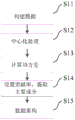
Firstly, step S10 is executed, and reconstruction and noise reduction processing are performed on the collected bearing life-cycle acoustic radiation data through principal component analysis, wherein the bearing life-cycle acoustic radiation data can collect life-cycle data from initial operation to complete failure of the bearing through a GARS acoustic sensor installed on the main shaft bearing testing machine. Referring to FIG. 2, the data preprocessing process may further include steps S11-S15.
In step S11, data construction is performed, and assuming that there are m bearings, there are m collected life-cycle acoustic radiation signals: x ═ X
1,x
2,...,x
m)
TEach full-life acoustic radiation signal has n-dimensional data
Then m bearings form an m X n dimensional matrix, and the sample mean value is calculated for X:
in the formula: u is the sample mean.
In step S12, X is centered to obtain a matrix
In step S13, a matrix is obtained
Covariance of (c):
in step S14, the covariance V is subjected to feature decomposition to obtain a feature value λiAnd corresponding feature vector omegai(ii) a The eigenvalues are arranged in descending order, and the contribution ratio is set (for example, 0.9)5) And selecting K eigenvalues according to the variance contribution rate, forming an eigenvector matrix by taking the corresponding K eigenvectors as column vectors, and projecting the sample points onto the selected eigenvectors.
In step S15, the matrix obtained by subtracting the mean value from the m bearings is data (m × n), the covariance matrix is n × n dimension, the matrix formed by the selected K eigenvectors is vector (n × K), and then the projected data is obtained as a matrix fdata by equations 1-4:
fdata(m*K)=data(m*n)×vector(n*K) (1-4);
the projected matrix is multiplied by the transpose of vector (n x K), and the reconstruction is completed by adding the de-centered mean U.
Next, step S20 is executed to perform variational modal decomposition on each sample of the bearing full-life acoustic radiation data after the noise reduction processing is performed to obtain a relative energy entropy of each sample. Specifically, the method comprises the steps of selecting a group of normal acoustic radiation data samples in the bearing full-life acoustic radiation data after reconstruction and noise reduction to perform variational modal decomposition to determine the number of variational modal decomposition layers (step S21), and performing variational modal decomposition on each sample of the bearing full-life acoustic radiation data after reconstruction and noise reduction according to the determined variational modal decomposition layers to obtain the relative energy entropy of each sample (step S22).
Step S21 may further include:
step S211, performing VMD decomposition on a normal sound radiation signal in the bearing full-life sound radiation data after reconstruction and noise reduction of the rolling bearing to obtain k BLIMF components, and calculating the spectrum correlation number of each BLIMF according to a formula (1-5): rho1,ρ2,···,ρkAnd finding out the minimum value rhominIf the number of the decomposition layers is less than the set threshold value 0.1, determining that the minimum decomposition layer number k is k-1; otherwise, let k be k +1, and repeat the above loop until a k value is found that meets the requirement, where | Uk| and | V | are the moduli of the fourier transform of the original signal and the kth BLIMF component, respectively;
step S212, initialization
And n is 0;
Step S214, formula
Updating lambda
n+1(ω); (1-6)
Step S215, repeating steps S213-S214 until the condition is satisfied
(wherein e>0 is discrimination accuracy), the iteration is stopped, and k modal components are obtained.
Step S22 may further include:
step S221, selecting a rolling bearing life-cycle acoustic radiation signal, taking the first 10 groups of samples, performing VMD decomposition on the samples to K layers, and obtaining the energy of 10 groups of K BLIMFs components
Calculate its mean value as
It can be understood that, in step S221, the number of selected samples may be reasonably selected according to needs, as long as the selected samples are sample data in a normal state.
Step S222, VMD decomposition is carried out on all samples of the full-life acoustic radiation signal to obtain energy values of N groups of K BLIMFs components
Where N represents the total number of samples of a full-life bearing datum.
Step S223, calculating the total energy of the K BLIMFs components
Step S224, calculating a relative energy entropy (first relative energy entropy) according to the following formula:
wherein p isn,q10N is the probability distribution of two signals.
Step S225, performing average moving filtering processing on the obtained relative energy entropy, and taking the time window length as 10 (or other suitable values), which not only retains the property and trend of the original data, but also stabilizes the original relative feature sequence.
And step S226, carrying out the same treatment on the sound radiation signals of the whole service lives of the rest bearings.
Next, step S30 is executed to construct a data set: and using the relative energy entropy and a time domain parameter which has monotonicity and is relevant to the relative energy entropy of each sample as network input parameters together, and using the relative energy entropy as a network output parameter to construct a data set. Specifically, removing characteristic parameters without monotonicity or with inconspicuous monotonicity change from the time domain characteristics such as effective values, average values, peak values, crest factors, margin factors, pulse coefficients, shape coefficients, root mean square, skewness, kurtosis, variance and the like; and according to the correlation criterion, keeping the characteristic parameters with large correlation with the relative energy entropy. Finally, screening 6 characteristic parameters to form a characteristic parameter set, wherein the characteristic parameter set comprises an effective value, an average value, a peak value, a root mean square, a variance and a relative energy entropy after average moving filtering as network input parameters, and the relative energy entropy after average moving filtering as network output parameters. It is understood that in other embodiments, one or more time domain characteristic parameters of the relative energy entropy and effective value, the average value, the peak value, the root mean square, and the variance after the average moving filtering may be selected as the network input parameters.
Then, step S40 is executed to train a long-term and short-term memory neural network model (LSTM model) using the constructed data set, which further includes steps S41-S46.
And step S41, constructing the LSTM network model. The forward propagation concrete formula of the LSTM network model is as follows:
ft=σ(Wfhht-1+Ufxxt+bf) (1-10)
it=σ(Wihht-1+Uixxt+bi) (1-11)
Ot=σ(Wohht-1+Uoxxt+bo) (1-12)
ht=ot*tanh(ct) (1-15)
in the formula: f. oft、it、OtAre respectivelyA forgetting gate, an input gate and an output gate at the time t; c. Ct、ht、xtRespectively unit state, hidden state and unit input at time t; w and U are weights for hidden states and unit inputs.
And step S42, constructing a training set and a testing set. In the LSTM prediction model, 6 characteristic parameters of m bearings form a data set, the first 80% of the data are taken to construct a training set, the second 20% of the data are taken to construct a test set, a time window continuously slides along a sample sequence, and a time sequence with a specified length is intercepted and used as the input [ X ] of the prediction modelt-1,Xt,Xt+1]The time step is selected to be 3, each input XtThe fourth set of data is predicted for a six-dimensional vector, i.e., the first three sets of data.
Step S43, the data set is normalized according to equations 1-16, and the normalization of the data can reduce the training time and prevent the activation function of the network from being over-saturated.
In the formula, XiIs a normalized value, XiIs a sample value, XmaxIs the maximum value of the sample, XminIs the sample minimum.
And step S44, setting network model parameters. In a specific example, the network adopts a small batch of input, the number of samples input each time is mini-batch is 20, the network training adopts 250 epochs iterative training calculations, and the initial learning rate is 0.005. Using the mean square error as a loss function, the adam optimizer is used to update the weights and biases in the LSTM network.
And step S45, selecting the network stack layer number. In a specific example, a training set is used to select an optimal stack layer number, a loop structure (the highest loop number is 6) is set, the number of neurons in each layer is set to 200, if a Root Mean Square Error (RMSE) is smaller than a set threshold value of 0.04, the stack layer number K is determined, otherwise, K is K +1, and the loop is repeated until the loop is ended.
Step S46, after the stack layer number is determined, the network is processed by the training setTraining and predicting by using the test set. Denormalization, and calculating Mean Square Error (MSE), Mean Absolute Error (MAE), Root Mean Square Error (RMSE), and correlation coefficient (R) between the predicted value and the actual value2) The value is obtained.
And then, executing step S50, and predicting the bearing degradation performance of the rolling bearing by using the trained long-time and short-time memory neural network model.
And finally, executing step S60, and realizing alarm when the predicted degradation curve exceeds a threshold alarm line, wherein the relative energy entropy of the normal samples of the previous specified percentage is selected, and the threshold alarm line is determined by combining Lauda rule. Specifically, an alarm threshold value is determined by adopting the Lauda rule, namely the absolute value of the difference between mathematical expectations is larger than 3 times of standard deviation, 10% sample data before relative energy entropy is taken, and the mathematical expectations are calculated
Calculating the standard deviation delta of sample data of 10% before the relative energy entropy;
the value of (1) is the threshold alarm line. The threshold alarm line determined by the method has 99.73% probability to judge the abnormal data points as abnormal data, so that the subjectivity of threshold selection is avoided.
Referring to fig. 3, the embodiment further discloses a bearing monitoring system 1 based on the operation state acoustic radiation signal for implementing a bearing monitoring method based on the operation state acoustic radiation signal, where the bearing monitoring system 1 based on the operation state acoustic radiation signal includes a data preprocessing module 11, a feature extraction module 12, a bearing state monitoring module 13, and an alarm module 14. The data preprocessing module 11 is used for reconstructing and denoising the collected bearing life-cycle acoustic radiation data through principal component analysis; the feature extraction module 12 is configured to perform variational modal decomposition on each sample of the bearing full-life acoustic radiation data after the reconstruction and noise reduction processing to obtain a relative energy entropy of each sample; the bearing state monitoring module 13 is configured to use the relative energy entropy and a time domain parameter that has monotonicity and is correlated with the relative energy entropy of each sample as network input parameters, use the relative energy entropy as a network output parameter to construct a data set, train a long-term and short-term memory neural network model by using the data set, and predict the bearing degradation performance of the rolling bearing by using the trained long-term and short-term memory neural network model; the alarm module 14 is used for realizing an alarm when the predicted degradation curve exceeds a threshold alarm line.
It should be noted that the bearing monitoring system 1 based on the operating state acoustic radiation signal of the present invention is a system corresponding to the above-mentioned bearing monitoring method based on the operating state acoustic radiation signal, and the functional modules in the bearing monitoring system 1 based on the operating state acoustic radiation signal respectively correspond to the corresponding steps of the bearing monitoring method based on the operating state acoustic radiation signal. The bearing monitoring system 1 based on the acoustic radiation signals under the operating condition can be implemented by being matched with a bearing monitoring method based on the acoustic radiation signals under the operating condition. The relevant technical details mentioned in the bearing monitoring method based on the operating state acoustic radiation signal of the present invention are still valid in the bearing monitoring system 1 based on the operating state acoustic radiation signal, and are not described herein again in order to reduce repetition. Accordingly, the details of the bearing monitoring system 1 based on the operating state acoustic radiation signal of the present invention can also be applied to the above-mentioned bearing monitoring method based on the operating state acoustic radiation signal.
It should be noted that, when the above functional modules are actually implemented, all or part of the functional modules may be integrated into one physical entity, or may be physically separated. And these units can be implemented entirely in software, invoked by a processing element; or may be implemented entirely in hardware; and part of the units can be realized in the form of calling software by the processing element, and part of the units can be realized in the form of hardware. In addition, all or part of the units can be integrated together or can be independently realized. The processing element described herein may be an integrated circuit having signal processing capabilities. In the implementation process, part or all of the steps of the method or the above functional modules may be implemented by hardware integrated logic circuits in a processor element or instructions in the form of software.
It should be noted that, as shown in fig. 4, the bearing monitoring system based on the operating state acoustic radiation signal according to the present embodiment may also be implemented by an electronic device 2, where the electronic device 2 includes a memory 23 and a processor 21 connected to each other, and the memory 23 stores program instructions, and the program instructions, when executed by the processor 212, implement the above-mentioned bearing monitoring method based on the operating state acoustic radiation signal. It should be noted that, when communication with the outside is required, the electronic device further includes a communicator 22, and the communicator 22 is connected to the processor 21.
The Processor 21 may be a general-purpose Processor, and includes a Central Processing Unit (CPU), a Network Processor (NP), and the like; or a Digital Signal Processor (DSP), an Application Specific Integrated Circuit (ASIC), a Field Programmable Gate Array (FPGA) or other Programmable logic device, a discrete Gate or transistor logic device, or a discrete hardware component; the Memory 23 may include a Random Access Memory (RAM), and may further include a Non-Volatile Memory (Non-Volatile Memory), such as at least one disk Memory.
It should be noted that the computer program in the memory 23 may be implemented in the form of software functional units and may be stored in a computer readable storage medium when the computer program is sold or used as a stand-alone product. Based on such understanding, the technical solution of the present invention may be embodied in the form of a software product, which is stored in a storage medium and includes instructions for causing a computer device (which may be a personal computer, an electronic device, or a network device) to perform all or part of the steps of the method according to the embodiments of the present invention.
The embodiment also discloses a storage medium, which stores a program, and the program is executed by the processor 21 to realize the bearing monitoring method based on the running state acoustic radiation signal; the storage medium includes all forms of non-volatile memory, media and memory devices, including, for example: semiconductor memory devices such as EPROM, EEPROM, and flash memory devices; magnetic disks, such as internal hard disks or removable disks; magneto-optical disks; and CD-ROM and DVD-ROM disks.
The bearing monitoring method based on the operating state acoustic radiation signal of the present embodiment will be verified with reference to a specific example.
Fig. 5 shows a block diagram of an apparatus for implementing a bearing monitoring method based on an operating state acoustic radiation signal, which includes three parts, namely a main bearing test platform 3, a signal acquisition device 4 and a signal analysis processor 5, wherein the signal acquisition device 4 includes a GARS acoustic sensor 41 and an LMS SCADAS XS data acquisition instrument 42; as shown in fig. 6, the bearing testing apparatus 3 includes supporting devices such as a bearing testing main machine 31, a cooling station 34, a loading station 32, and a lubrication station 33.
The experimental data are from bearing life experimental data collected by a sound sensor on a main shaft bearing testing machine of an aeroengine of the university of fertilizer industry, the bearing is NU1010, and the detailed parameters are shown in table 1. The experimental conditions are as follows: the rotation speed is 2000rpm, 25KN is loaded, sound signals are collected every 3min at the sampling frequency of 20480Hz, and the sampling time is 1 s. Each group of signals contains 20480 data points, and after the test is finished, the rolling bearing is disassembled and tested, so that the rolling bearing is found to be seriously damaged. Under the same experimental condition, the performance degradation process data of the three bearings from normal operation to failure are collected, and the experimental data of the bearings are shown in the table 2.
TABLE 1 parameters of the bearing NU1010
TABLE 2 bearing test data
The amplitude plots of the life-cycle acoustic radiation signals for the experimental bearings 1-3 are shown in figures 7a-7 c. Each group of samples of the collected full-life acoustic radiation signals contains 20480 data points, and one sample is taken from every 10 data points during data processing, namely each group of samples contains 2048 data points, and the process from stable operation to slow degradation and to fast degradation of the bearing can be seen from fig. 6.
In order to verify the noise reduction effect, the bearing 2 is selected as a research object, principal component analysis and reconstruction are carried out on all samples, the sampling rate is 12000, the number of sampling points is 2048, fig. 8a and 8b are a time domain diagram and a frequency domain diagram of 500 th group of original signals of the bearing 2, fig. 9a and 9b are the time domain diagram and the frequency domain diagram after noise reduction, it can be seen from the diagrams that part of high-frequency noise is removed, and main information of the original signals is reserved.
Taking a normal signal sample at the early stage of the bearing 2, calculating a spectrum phase relation number of each modal component decomposed by the VMD and an original signal, wherein the result is listed in a table 3, the threshold value is 0.1, determining that the number K of VMD decomposition layers is 4, obtaining 4 IMF components, calculating a relative energy entropy by a formula, and as shown in a figure 10, a curve is stable at a normal operation stage, the fluctuation amplitude of the curve is too large at a rapid degradation stage, the randomness of the signal is large due to a fault, processing a characteristic index at present, performing smoothing processing by adopting uniform moving average filtering, and taking the length of a time window as 10, so that the property and the trend of the original data are kept after the smoothing processing, and the original relative characteristic sequence becomes stable from the figure 10.
TABLE 3 spectral dependence of each modal component on the original signal
In an LSTM prediction model, 6 characteristic parameters of three bearings, namely a bearing 1, a bearing 3 and a bearing 2, form a data set, the first 80 percent of the data set forms a training set, the second 20 percent of the data set forms a test set, a rolling prediction method is adopted, the time step length is selected to be 3, namely the first three data are used for predicting the fourth data, and each input X is inputtIs a six-dimensional vector. The data set is normalized and the network adopts small batch inputEach time the number mini-batch of input samples is 20, the training set is used to select the optimal number of stack layers as shown in fig. 11, the threshold is set to 0.04, it can be seen in the figure that when the number of stack layers is 3, the Root Mean Square Error (RMSE) is the smallest and within the threshold line, when the number of stack layers continues to increase, the RMSE variation does not fluctuate much and is also within the threshold line, which proves that the number of stack layers of the LSTM network is not the larger and the better.
Three LSTM layers are selected to learn the hidden depth information in the input time sequence, and the number of the neurons of the LSTM layers is 200. The network training adopts 250 epochs iterative training calculation, and the initial learning rate is 0.005. Using the mean square error as a loss function, ADAM optimizers are used to update the weights and biases in LSTM networks.
The performance degradation prediction results are shown in fig. 12. The graph shows that the prediction curve exceeds an early warning line in the early degradation stage, and the alarm can be well realized. It can be seen from fig. 12 that the first 124 groups of samples are judged to be normal running samples with almost no change, the samples in the 125-222 group are slightly fluctuated, and judged to be in an early-stage slight degradation state, the bearing can be used continuously at this time, the fluctuation is large after the samples in the 223-271 group is judged to be medium-stage degradation, and the phenomenon of sharp increase after the samples in the 272 group is judged to be rapid degradation and tends to fail.
Mean Square Error (MSE), Mean Absolute Error (MAE), Root Mean Square Error (RMSE), and correlation coefficient (R) generated by the network model test set2) As shown in Table 4, the correlation coefficient R2The closer to 1, the higher the fit of the model, the better the effect. It can be seen from the table that MSE, MAE, RMSE are lowest for the stacked LSTM network model, and R is the lowest2The highest. The stack LSTM had a correlation coefficient of 0.7533 in the test set and a correlation coefficient of 0.9157 before mid-term degradation.
Wherein y is
i' is a predicted value; y is
iIs an actual value;
is the average of the actual values.
TABLE 4 prediction method comparison
The result shows that the MSE predicted by the stack SLSTM model on the bearing before early warning is 1.7169e-5, the MAE is 0.0015, the RMSE is 0.0010, the correlation coefficient R2 reaches 91.57%, the fitting degree of the model is high, the bearing performance degradation trend is accurately evaluated, and the bearing prediction curve gives an alarm in time at the early bearing degradation stage.
In summary, the bearing monitoring method, system and device based on the acoustic radiation signal in the operating state of the invention combine the VMD-REE and the LSTM network model to realize the prediction of the performance degradation trend of the rolling bearing, so as to achieve the purpose of earlier judging and predicting the early failure of the rolling bearing. The bearing monitoring method, the bearing monitoring system and the bearing monitoring equipment based on the acoustic radiation signals in the running state construct an index capable of monitoring the performance degradation state of the rolling bearing, the index tends to be stable in the normal running state of the bearing, and the defect that the time domain index crosses an early warning line in the normal running state in a fluctuating mode to cause false alarm is avoided. According to the bearing monitoring method, system and device based on the acoustic radiation signals in the operating state, the bearing acoustic radiation signals are subjected to variation modal decomposition to construct the relative energy entropy as the performance degradation index of the rolling bearing, the limitation of a shallow network structure is avoided, the capability of a long-term memory neural network for learning higher-level and more abstract information from input is fully exerted, and the problem that the selection of the optimal stack layers of the long-term memory neural network is difficult is solved. According to the bearing monitoring method, the bearing monitoring system and the bearing monitoring equipment based on the acoustic radiation signals in the running state, time domain characteristic parameters which do not have monotonicity or have inconspicuous monotonicity change are removed, the time domain characteristic parameters with high relevance with degradation indexes are reserved as input according to the relevance criterion, the degradation indexes are used as output, and the occurrence of single characteristic input and single characteristic output trend prediction hysteresis is avoided. The bearing monitoring method, the bearing monitoring system and the bearing monitoring equipment based on the acoustic radiation signals in the running state set the early warning line based on the original data, can effectively monitor the abnormal index change of the rolling bearing, have simple method and have good practical value under different working conditions. Therefore, the invention effectively overcomes various defects in the prior art and has high industrial utilization value.
In the description herein, numerous specific details are provided, such as examples of components and/or methods, to provide a thorough understanding of embodiments of the invention. One skilled in the relevant art will recognize, however, that an embodiment of the invention can be practiced without one or more of the specific details, or with other apparatus, systems, assemblies, methods, components, materials, parts, and/or the like. In other instances, well-known structures, materials, or operations are not shown or described in detail to avoid obscuring aspects of embodiments of the invention.
Reference throughout this specification to "one embodiment," "an embodiment," or "a specific embodiment" means that a particular feature, structure, or characteristic described in connection with the embodiment is included in at least one embodiment, and not necessarily in all embodiments, of the present invention. Thus, appearances of the phrases "in one embodiment," "in an embodiment," or "in a specific embodiment" in various places throughout this specification are not necessarily referring to the same embodiment. Furthermore, the particular features, structures, or characteristics of any specific embodiment of the present invention may be combined in any suitable manner with one or more other embodiments. It is to be understood that other variations and modifications of the embodiments of the invention described and illustrated herein are possible in light of the teachings herein and are to be considered as part of the spirit and scope of the present invention.
It will also be appreciated that one or more of the elements shown in the figures can also be implemented in a more separated or integrated manner, or even removed for inoperability in some circumstances or provided for usefulness in accordance with a particular application.
Additionally, any reference arrows in the drawings/figures should be considered only as exemplary, and not limiting, unless otherwise expressly specified. Further, as used herein, the term "or" is generally intended to mean "and/or" unless otherwise indicated. Combinations of components or steps will also be considered as being noted where terminology is foreseen as rendering the ability to separate or combine is unclear.
As used in the description herein and throughout the claims that follow, unless otherwise indicated, "a," "an," and "the" include plural references. Also, as used in the description herein and throughout the claims that follow, the meaning of "in …" includes "in …" and "on …" unless otherwise indicated.
The above description of illustrated embodiments of the invention, including what is described in the abstract of the specification, is not intended to be exhaustive or to limit the invention to the precise forms disclosed herein. While specific embodiments of, and examples for, the invention are described herein for illustrative purposes only, various equivalent modifications are possible within the spirit and scope of the present invention, as those skilled in the relevant art will recognize and appreciate. As indicated, these modifications may be made to the present invention in light of the foregoing description of illustrated embodiments of the present invention and are to be included within the spirit and scope of the present invention.
The systems and methods have been described herein in general terms as the details aid in understanding the invention. Furthermore, various specific details have been given to provide a general understanding of the embodiments of the invention. One skilled in the relevant art will recognize, however, that an embodiment of the invention can be practiced without one or more of the specific details, or with other apparatus, systems, assemblies, methods, components, materials, parts, and/or the like. In other instances, well-known structures, materials, and/or operations are not specifically shown or described in detail to avoid obscuring aspects of embodiments of the invention.
Thus, although the present invention has been described herein with reference to particular embodiments thereof, a latitude of modification, various changes and substitutions are intended in the foregoing disclosures, and it will be appreciated that in some instances some features of the invention will be employed without a corresponding use of other features without departing from the scope and spirit of the invention as set forth. Thus, many modifications may be made to adapt a particular situation or material to the essential scope and spirit of the present invention. It is intended that the invention not be limited to the particular terms used in following claims and/or to the particular embodiment disclosed as the best mode contemplated for carrying out this invention, but that the invention will include any and all embodiments and equivalents falling within the scope of the appended claims. Accordingly, the scope of the invention is to be determined solely by the appended claims.