Frequency stabilizing device of single-frequency laser based on intracavity self-reference
Technical Field
The invention relates to a single-frequency laser, in particular to a single-frequency laser frequency stabilizing device based on intracavity self-reference and an adjusting method thereof, wherein the device can be applied to the advanced basic science and high technology fields of laser atom cooling, high-resolution laser spectrum, cold atomic clock, laser radar, coherent laser communication and the like.
Background
In recent years, the single-frequency laser technology is rapidly developed, the performance of the single-frequency laser is continuously improved, and the application is more and more extensive. Based on the advantages of narrow line width, low noise and the like, the single-frequency laser is widely applied to many fields of laser atom cooling, high-resolution laser spectrum, cold atomic clock and the like. These application fields have high requirements on the line width and frequency stability of the laser, while the output frequency of a free-running single-frequency laser (such as a semiconductor laser, a fiber laser, etc.) is sensitive to the pumping intensity and the operating temperature, and even if the laser operates in a single longitudinal mode, the spectral line width is wide, so that the central wavelength fluctuates in a considerable range, and the frequency stability is poor. The method is a problem which needs to be solved for the application of laser atomic cooling, high-resolution laser spectroscopy and the like, and further active frequency stabilization measures need to be adopted to meet the requirements of the scientific research field on single-frequency lasers. Therefore, the frequency stabilization technology of the single-frequency laser is researched, the key physical problems involved in the frequency stabilization technology are solved, the academic significance and the application value are important, and the wide attention is paid.
The frequency stabilization technique of the single-frequency laser is to lock the center frequency of the output laser to a frequency reference with high frequency stability, such as an absorption line of atoms and molecules, a fabry-perot etalon, etc. Among them, the laser frequency stabilization technique based on atomic absorption spectrum is most widely used. The main principle of the method is that the frequency of output light of the laser is compared with the frequency at an atomic absorption peak, an error signal is obtained and fed back to a frequency tuning mechanism of the laser to complete closed-loop control, so that the central frequency of the laser is locked to a corresponding reference frequency to complete frequency stabilization. For example, the absorption line of rubidium (Rb) atom can be used for frequency stabilization of a semiconductor laser in a 780nm wave band; the absorption line of cesium (Cs) atoms can be used for frequency stabilization of 852nm band semiconductor lasers. In this respect, Motoichi Ohtsu proposes a semiconductor laser modulation frequency stabilization technique OF atomic absorption lines (see prior art [1 ]: IEEE JOURNAL OF QUANTUM ELECTRONICS, Vol. QE-21, No.12, Decumber 1985). The basic principle is to modulate the laser frequency, then compare it with the reference atomic absorption spectrum line to obtain the alternating current error signal, and generate the closed-loop control to stabilize the frequency. However, the frequency stabilization technique based on atomic absorption lines can cause a series of problems:
1. the central wavelength of the stable frequency depends on the position of an atomic or molecular absorption spectral line, the limitation is large, and the stable laser frequency of any wavelength cannot be realized.
2. In order to generate a stronger absorption line, a longer atomic or molecular absorption cell device is often needed, so that the volume of the frequency stabilizing device of the whole single-frequency laser is greatly increased.
In order to overcome the above-mentioned first problem, Timothy Day proposes a single-frequency laser frequency stabilization technique using the transmission peak OF the Fabry-Perot etalon as a frequency reference (see prior art [2 ]: Sub-hertz frequency stabilization OF two diode-pumped Nd: YAG laser locked to a Fabry-Perot Interferometer, IEEE JOURNAL OF QUANTUM ELECTRONICS, Vol.28, No.4,1992), and its main principle is that the frequency OF the output light OF the laser is compared with the frequency at the transmission peak OF the Fabry-Perot etalon to obtain an error signal and fed back to the frequency tuning mechanism OF the laser to complete closed-loop control, so that the center frequency OF the laser is locked to the reference frequency corresponding to the transmission peak OF the Fabry-Perot etalon to complete frequency stabilization. The Fabry-Perot etalon has the advantages that the Fabry-Perot etalon has a plurality of transmission peaks, and the frequency stability of any central wavelength can be realized in principle. The following disadvantages remain:
1. the center frequency of the transmission peak of the Fabry-Perot etalon is easily influenced by environmental temperature and vibration, the frequency stability of the Fabry-Perot etalon is not as good as that of an atomic or molecular absorption spectrum, and the precision of the frequency stability of the laser is directly influenced.
2. The Fabry-Perot etalon has larger volume, so that the volume of the frequency stabilizing device of the whole single-frequency laser is increased.
Disclosure of Invention
The invention aims to overcome the defects of the prior art and provides a single-frequency laser frequency stabilizing device based on intracavity self-reference and an adjusting method thereof.
The technical solution of the invention is as follows:
a frequency stabilizing device of a single-frequency laser based on intracavity self-reference comprises a frequency control module, the single-frequency laser, a semi-transparent semi-reflecting mirror, a photoelectric detector and a frequency phase discriminator, and is characterized in that two non-degenerate laser modes exist in the single-frequency laser, and the frequency difference of the two non-degenerate laser modes respectively corresponds to the laser frequency of the two non-degenerate laser modes;
the photoelectric detector is used for detecting beat frequency signals of two nondegenerate laser modes, and the frequency of the beat frequency signals is equal to the frequency difference of the two nondegenerate laser modes;
the frequency phase discriminator is used for detecting the frequency fluctuation of the beat frequency signal detected by the photoelectric detector, converting the beat frequency signal into a direct current voltage signal and inputting the direct current voltage signal into the frequency control module;
the frequency control module is used for receiving the direct-current voltage signal output by the frequency phase discriminator, outputting a corresponding frequency control signal to the single-frequency laser and controlling the output frequency of the single-frequency laser;
the laser output by the single-frequency laser is divided into reflected light and transmitted light by the semi-transmitting and semi-reflecting mirror, and the reflected light is incident to the photoelectric detector for stabilizing the laser frequency.
And an optical filter is arranged along the transmission light direction and used for filtering one of the two nondegenerate laser modes, and the rest laser mode is used as the output of the whole device.
Compared with the prior art, the invention has the following advantages and positive effects:
1. compared with the prior art [1], the frequency stabilizing device of the single-frequency laser based on the intracavity self-reference adopts beat frequency signals of two non-degenerate modes in the laser cavity of the single-frequency laser as self-reference signals of laser frequency, is not limited by the frequency position of an atomic or molecular absorption spectral line, and can realize the frequency stabilization of any central wavelength.
2. Compared with the prior art [2], the single-frequency laser frequency stabilizing device based on the intracavity self-reference adopts beat frequency signals of two nondegenerate modes in a laser cavity of the single-frequency laser as self-reference signals of laser frequency, avoids the problem that the center frequency of a transmission peak of a third-party frequency reference such as a Fabry-Perot etalon is easily influenced by environmental temperature and vibration, and can effectively improve the frequency stabilizing precision.
3. Compared with the prior art [1] and the prior art [2], the frequency stabilizing device of the single-frequency laser based on the intracavity self-reference adopts the beat frequency signals of two nondegenerate modes in the laser cavity of the single-frequency laser as the self-reference signals of the laser frequency, does not need external frequency references such as an atom/molecule absorption cell or a Fabry-Perot etalon, and the like, effectively simplifies the whole device, reduces the volume and reduces the cost.
Drawings
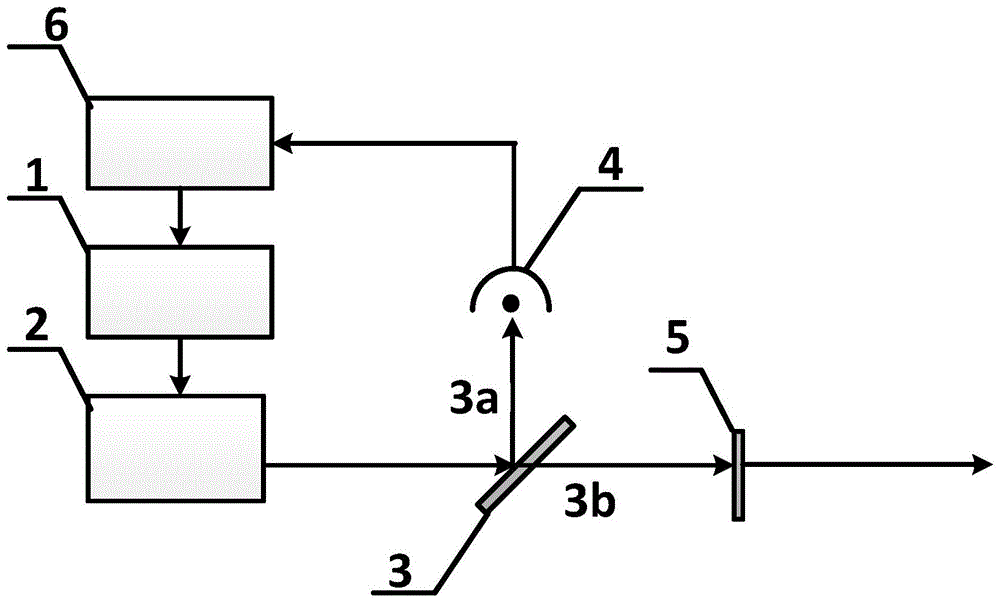
Fig. 1 is a structural block diagram of a frequency stabilizing device of a single-frequency laser based on intracavity self-reference of the invention.
Detailed Description
The present invention is further illustrated below with reference to examples and figures, but the scope of protection of the invention should not be limited thereby.
Referring to fig. 1, fig. 1 is a block diagram of a frequency stabilizing device of a single-frequency laser based on intracavity self-reference according to the present invention. It can be seen from the figure that the frequency stabilizing device of the single-frequency laser based on the intracavity self-reference comprises a single-frequency laser 2 with a frequency control module 1, a half-transmitting and half-reflecting mirror 3, a photoelectric detector 4, an optical filter 5 and a frequency phase discriminator 6.
Two nondegenerate laser modes exist in the single-frequency laser 2, and the frequency difference of the two laser modes and the absolute laser frequency of each of the two modes have a one-to-one correspondence relationship.
The photodetector 4 is configured to detect beat signals of two non-degenerate laser modes, and a frequency of the beat signals is equal to a frequency difference between the two non-degenerate laser modes.
The frequency phase discriminator 6 is used for obtaining the frequency fluctuation of the beat frequency signal detected by the photoelectric detector, converting the frequency fluctuation into a direct current voltage signal and inputting the direct current voltage signal into the frequency control module. Because the frequency fluctuation of the beat frequency signal and the absolute frequency of the laser have a one-to-one correspondence relationship, the direct current voltage signal output by the frequency phase discriminator directly represents the frequency fluctuation of the laser output by the laser.
The frequency control module 1 receives the direct-current voltage signal output by the frequency phase discriminator 6, outputs a corresponding frequency control signal to the single-frequency laser, and controls the output frequency of the single-frequency laser 2.
The half-transmitting and half-reflecting mirror 3 is used for dividing output laser into two beams, reflected light 3a is used for stabilizing laser frequency, transmitted light 3b passes through the optical filter 5, one of two nondegenerate laser modes is filtered, and the remaining laser mode is used as the output of the whole device.
The method comprises the following specific operation steps:
1. the working wavelength of the single-frequency laser is roughly adjusted through the frequency control module, and the wavelength of the single-frequency laser is roughly adjusted to be close to the required working wavelength.
2. And adjusting the whole light path, and inputting the light of the reflection part of the semi-transparent semi-reflector into the photoelectric detector to enable the photoelectric detector to detect beat frequency signals of two nondegenerate laser modes.
3. And inputting the beat frequency signal into a frequency phase discriminator, and converting the frequency fluctuation of the beat frequency signal into a direct-current voltage signal. The direct voltage signal at this time directly represents the frequency fluctuation of the single-frequency laser.
4. And directly inputting the obtained direct-current voltage signal into a frequency control module for stabilizing the output wavelength of the single-frequency laser.
The single-frequency laser frequency stabilizing device based on the intracavity self-reference uses the beat frequency signal of a nondegenerate mode in the laser cavity as a laser frequency reference signal, and has the advantages of no need of third-party frequency reference, simple and compact device, high frequency stability and capability of realizing the frequency stabilization of any central wavelength. The invention can effectively promote the application of the single-frequency laser in many fields such as microwave photonics, laser radars, coherent laser communication and the like.