Indoor illumination control system and regulation and control method based on energy conservation
Technical Field
The invention relates to the field of building energy-saving automation, in particular to an energy-saving indoor illumination control system and a regulation and control method.
Background
With the development of economy in China and the improvement of the living standard of people, the requirements of people on the indoor environment of buildings are higher and higher. Meanwhile, the problems of overhigh building energy consumption, serious waste and the like are also generated. In the years, a plurality of regulations are provided in the center, aiming at building an economical society.
The indoor illumination has important influence on the human health and the working efficiency, and the basic requirement of modern buildings is to provide comfortable and healthy indoor illumination environment. In recent years, with the improvement of living standard, the number of building lamps is greatly increased, and in addition, the thin saving consciousness of people is generated, so that a great amount of energy waste caused by lamplight is generated, and at present, building energy saving becomes a hot spot in the field of current building environment and energy application engineering. Energy consumption waste generated by the building lamp can be greatly reduced through an automatic control mode.
At present, the indoor light switch, the curtain and other internal sunshade measures are controlled manually, the indoor light illumination is controlled based on subjective consciousness of people in the control mode, but in the actual operation process, the energy-saving consciousness of indoor personnel is usually thinner, and the situation that the illumination is too high or the natural illumination can meet the illumination requirement and still turn on the lamp is generated. In an air-conditioned room, natural light can improve the cold load of the room and the energy consumption of the air conditioner, and in some cases, the whole energy consumption of the building room can be reduced by adopting sun-shading measures and lamp illumination.
Disclosure of Invention
The data acquisition system utilizes the sensing element to acquire data, the data processing center receives the data acquired by the data acquisition system, the data processing center transmits an action instruction to the indoor control system after the data processing center of the computer system transmits the action instruction, the indoor control system adjusts the brightness or opens and closes each lighting lamp according to the action instruction, and simultaneously controls the opening and closing angle of the blind to achieve the aim of reasonably adopting natural light, thereby achieving the aim of saving energy consumption.
An indoor illumination control system and a regulation and control method based on energy conservation comprise a data acquisition system, a data processing center and an indoor environment control system, and are characterized in that the data acquisition system acquires data by using an induction element, the computer system receives the data collected by the data acquisition system, transmits an action instruction to the indoor control system after passing through the data processing center of the computer system, and the indoor control system adjusts indoor illumination in real time according to the action instruction;
the regulation and control method of the indoor illumination control system comprises the following steps:
1) the orientation, height, size and window glass information of the window of the room are input into a data processing center for storage;
2) after a photoreceptor is arranged on the outer side of the window, the photoreceptor detects the light intensity, the solar altitude and the solar azimuth of outdoor natural light and transmits data to a data processing center;
3) the data processing center calculates and obtains the heat load generated by natural lighting, the outdoor light intensity and the indoor natural lighting area according to the data transmitted by the photoreceptor outside the window;
4) if the heat load generated by natural lighting calculated by the data processing center is greater than the electric energy load generated by starting the lamp, the lamp is preferentially used for lighting, otherwise, the natural light is preferentially adopted;
5) after arranging an infrared sensor and an illumination sensor on each station, detecting whether a person is on the station by using the infrared sensor on each station, executing 7) when the infrared sensor detects that the person is on the station, and executing 6) when the infrared sensor detects that the person is not on the station;
6) for an unmanned station detected by the infrared sensor, the indoor control system closes the lighting lamp above the station;
7) for a station where people are detected, the illumination sensor arranged on the station detects the illumination intensity on the station and transmits data to the data processing center, and the data processing center processes the data, generates an instruction and transmits the instruction to the indoor control system to control the lighting lamp to adjust the light intensity.
Preferably, the data acquisition system comprises a photoreceptor, an infrared sensor and an illumination sensor, the photoreceptor is arranged on the outer side of the outer window, the infrared sensor and the illumination sensor are arranged on indoor stations, and the basis of comparison analysis is provided for the data processing center by collecting indoor and outdoor real-time data.
Preferably, the photoreceptor can not only detect the outdoor light intensity, but also measure the solar altitude and the solar azimuth.
Preferably, the infrared sensor is used for sensing whether a person on the station exists, and the illumination sensor is used for collecting information of illumination intensity on the station.
Preferably, the computer system data processing center stores information of window orientation, window height, window size and window glass of the room, and can calculate and obtain heat load, natural illumination and illumination area generated by sunlight received indoors by combining data collected by the data collection system, and finally obtain a control scheme and transmit the control scheme to the indoor environment control system.
Preferably, the solar radiation data acquired in the data processing hub of the computer system is converted into a radiation heat gain data formula:
HGy=IDiγDi+Idifγdif
HGαthe glass absorbs solar radiation to heat the room;
HGyobtaining heat through solar radiation of unit area;
i is the intensity of solar radiation;
gamma is the transmittance of the glass;
α is the absorption rate of the glass;
r is the surface heat exchange thermal resistance of the glass;
in subscript DiDirect radiation with an incident angle i;
dif is scattered radiation;
i is an incident angle;
out is the outer surface;
in is the inner surface.
Preferably, the indoor control system comprises an adjustable lighting system disposed on the ceiling and an electrically controlled adjustable blind disposed outside the window, the indoor control system operating in accordance with a control scheme generated by the computer system.
Preferably, the adjustable lighting system is composed of a plurality of lighting lamps, the lighting lamps are bulbs capable of adjusting the brightness in a grading mode, and the indoor illuminance can be accurately adjusted and controlled.
Preferably, the electrically controlled adjustable blind controls the lifting of the blind and adjusts the opening and closing angle of the blind according to data transmitted by the computer system.
Preferably, the indoor control system is further provided with a local manual operation switch, and the manual operation switch can manually adjust the opening and closing angle of the venetian blind and the closing illumination of the adjustable energy-saving fluorescent lamp according to requirements.
The invention has the advantages that:
at the data acquisition end, be equipped with illuminance sensor and infrared sensor on the indoor station, every illuminance sensor detects the illuminance on the station of place, responds to the human body on the station simultaneously, collects every station meticulous with the detection of data, makes the regulation and control of luminosity more accurate, realizes controlling the local illumination on this station according to the local condition of each station and the outdoor illumination real-time situation. And a photoreceptor is arranged outside the window to measure outdoor light intensity, solar altitude and azimuth angle, so that the measured outdoor light intensity, solar altitude and azimuth angle are used as reference data for indoor luminosity adjustment, and energy-saving efficiency is improved compared with outdoor illumination conditions.
At the data processing center end, the window orientation, the window height, the window size and the window glass information of the room are firstly input into the data processing center for storage, and are used as important conditions for data calculation and analysis later, and the accuracy of luminosity regulation and control is further improved. And two lamp schemes are preset to deal with the states of the existence of the people, and the light source can be automatically turned off when the people leave aiming at the thinness of the indoor personnel to the energy-saving consciousness. When the air conditioner is arranged indoors, balance can be made between natural light and lamplight based on energy consumption, and therefore energy consumption of the air conditioner with higher energy consumption is reduced by controlling the temperature. The data processing hub also adds the effects of luminosity on human health to the calculations that make up the luminosity adjustment scheme.
At the indoor control system end, the lamps and lanterns in the adjustable lighting system installed on the ceiling adopt the energy-saving lamps and lanterns that can adjust luminance in grades, can reach when reducing the illumination energy consumption like this more accurately get to regulate and control and be interior illuminance reduction waste. The electric control adjusting type blind window installed on the outer side of the window can adjust the angle of the blind window to control sunlight to enter and utilize natural light to supplement indoor illumination to achieve the purpose of energy saving, and can also control the sunlight to enter under the command of a data processing center to adjust indoor temperature. In order to deal with special conditions, a local manual operation switch is also arranged in the indoor control system, and the opening and closing angle of the shutter blind and the closing illumination of the adjustable energy-saving fluorescent lamp can be manually adjusted according to requirements.
Drawings
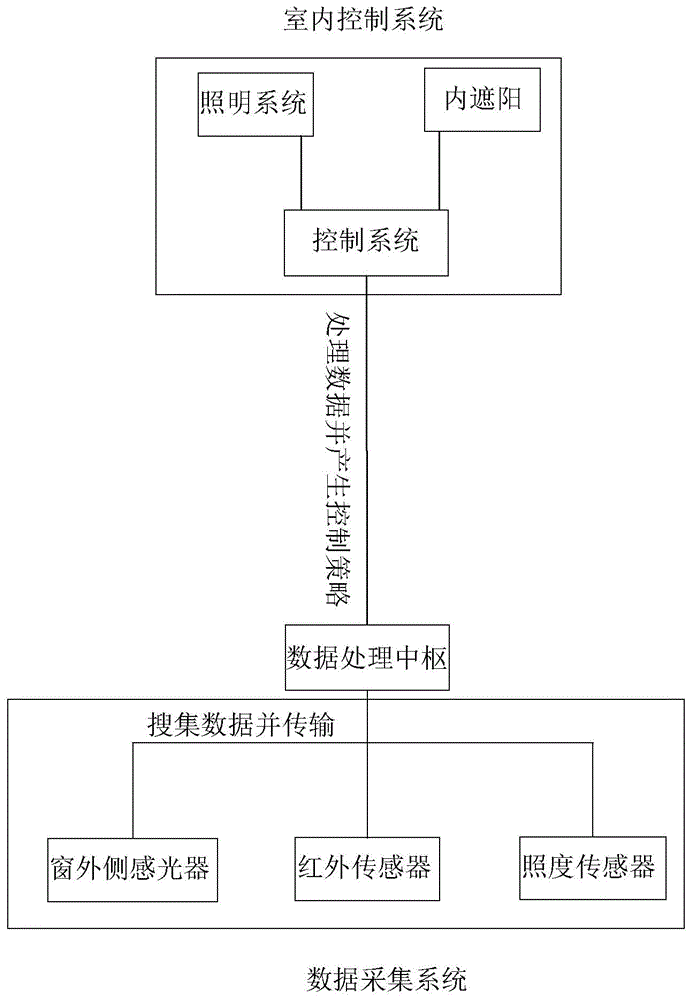
Fig. 1 is a system diagram of an energy-saving indoor illuminance control system and a regulation method according to the present invention.
Fig. 2 is a control flow chart of the indoor illuminance control system and the control method based on energy saving according to the present invention.
Detailed Description
Based on the drawings of fig. 1-2, an indoor illuminance control system and a regulation and control method based on energy saving comprise a data acquisition system, a data processing center and an indoor environment control system, and are characterized in that the data acquisition system performs data acquisition by using an induction element, the computer system receives data collected by the data acquisition system, transmits an action instruction to the indoor control system after passing through the data processing center of the computer system, and the indoor control system adjusts indoor illuminance in real time according to the action instruction;
the regulation and control method of the indoor illumination control system comprises the following steps:
1) the orientation, height, size and window glass information of the window of the room are input into a data processing center for storage;
2) after a photoreceptor is arranged on the outer side of the window, the photoreceptor detects the light intensity, the solar altitude and the solar azimuth of outdoor natural light and transmits data to a data processing center;
3) the data processing center calculates and obtains the heat load generated by natural lighting, the outdoor light intensity and the indoor natural lighting area according to the data transmitted by the photoreceptor outside the window;
4) if the heat load generated by natural lighting calculated by the data processing center is greater than the electric energy load generated by starting the lamp, the lamp is preferentially used for lighting, otherwise, the natural light is preferentially adopted;
5) after arranging an infrared sensor and an illumination sensor on each station, detecting whether a person is on the station by using the infrared sensor on each station, executing 7) when the infrared sensor detects that the person is on the station, and executing 6) when the infrared sensor detects that the person is not on the station;
6) for an unmanned station detected by the infrared sensor, the indoor control system closes the lighting lamp above the station;
7) for a station where people are detected, the illumination sensor arranged on the station detects the illumination intensity on the station and transmits data to the data processing center, and the data processing center processes the data, generates an instruction and transmits the instruction to the indoor control system to control the lighting lamp to adjust the light intensity.
In this embodiment, data acquisition system includes photoreceptor, infrared sensor and illuminance sensor, the photoreceptor sets up in the outside of outer window, infrared sensor and illuminance sensor set up on indoor station, through collecting indoor and outdoor real-time data, provide the basis of contrastive analysis for data processing center.
In this embodiment, the photoreceptor can not only detect outdoor light intensity, but also measure the solar altitude and the solar azimuth.
In this embodiment, the infrared sensor is configured to sense whether a person on the station exists, and the illuminance sensor is configured to collect information on the illuminance intensity on the station.
In this embodiment, the computer system data processing center stores information about the orientation, height, size and window glass of the window of the room, and can calculate the solar radiation generated heat load, the natural illuminance and the illumination area received indoors by combining with the data collected by the data collection system, and finally obtains a control scheme and transmits the control scheme to the indoor environment control system.
In this embodiment, the solar radiation data obtained in the data processing center of the computer system is converted into a radiation heat data formula:
HGy×IDiγDi+Idifγdif
HGαthe glass absorbs solar radiation to heat the room;
HGyobtaining heat through solar radiation of unit area;
i is the intensity of solar radiation;
gamma is the transmittance of the glass;
α is the absorption rate of the glass;
r is the surface heat exchange thermal resistance of the glass;
in subscript DiDirect radiation with an incident angle i;
dif is scattered radiation;
i is an incident angle;
out is the outer surface;
in is the inner surface.
In this embodiment, the indoor control system includes an adjustable lighting system disposed on the ceiling and an electrically controlled adjustable blind disposed outside the window, the indoor control system operating according to a control scheme generated by a computer system.
In this embodiment, the adjustable lighting system is composed of a plurality of lighting lamps, and the lighting lamps are bulbs capable of adjusting brightness in a grading manner, so that indoor illuminance can be accurately adjusted.
In this embodiment, the electrically controlled adjustable blind controls the lifting of the blind and adjusts the opening and closing angle of the blind according to data transmitted by the computer system.
In this embodiment, the indoor control system is further provided with a local manual operation switch, and the manual operation switch can manually adjust the opening and closing angle of the venetian blind and the closing intensity of the adjustable energy-saving fluorescent lamp according to requirements.
At the data acquisition end, be equipped with illuminance sensor and infrared sensor on the indoor station, every illuminance sensor detects the illuminance on the station of place, responds to the human body on the station simultaneously, collects every station meticulous with the detection of data, makes the regulation and control of luminosity more accurate, realizes controlling the local illumination on this station according to the local condition of each station and the outdoor illumination real-time situation. And a photoreceptor is arranged outside the window to measure outdoor light intensity, solar altitude and azimuth angle, so that the measured outdoor light intensity, solar altitude and azimuth angle are used as reference data for indoor luminosity adjustment, and energy-saving efficiency is improved compared with outdoor illumination conditions.
At the data processing center end, the window orientation, the window height, the window size and the window glass information of the room are firstly input into the data processing center for storage, and are used as important conditions for data calculation and analysis later, and the accuracy of luminosity regulation and control is further improved. And two lamp schemes are preset to deal with the states of the existence of the people, and the light source can be automatically turned off when the people leave aiming at the thinness of the indoor personnel to the energy-saving consciousness. When the air conditioner is arranged indoors, balance can be made between natural light and lamplight based on energy consumption, and therefore energy consumption of the air conditioner with higher energy consumption is reduced by controlling the temperature. The data processing hub also adds the effects of luminosity on human health to the calculations that make up the luminosity adjustment scheme.
At the indoor control system end, the lamps and lanterns in the adjustable lighting system installed on the ceiling adopt the energy-saving lamps and lanterns that can adjust luminance in grades, can reach when reducing the illumination energy consumption like this more accurately get to regulate and control and be interior illuminance reduction waste. The electric control adjusting type blind window installed on the outer side of the window can adjust the angle of the blind window to control sunlight to enter and utilize natural light to supplement indoor illumination to achieve the purpose of energy saving, and can also control the sunlight to enter under the command of a data processing center to adjust indoor temperature. In order to deal with special conditions, a local manual operation switch is also arranged in the indoor control system, and the opening and closing angle of the shutter blind and the closing illumination of the adjustable energy-saving fluorescent lamp can be manually adjusted according to requirements.
The infrared sensors and the illumination sensors are respectively arranged on the stations, the temperature sensors and the illumination sensors are used for detecting the illumination and the existence condition of people in the stations of each area, the detected data are transmitted to the data processing center, the data processing center automatically generates instructions after processing the data and then transmits the data to the indoor environment control system, the indoor environment control system operates the acquired instructions, the illumination lamp above each station is adjusted in brightness or opened and closed, and meanwhile, the opening and closing angle of the blind curtain is controlled to achieve the purpose of reasonably adopting natural light, so that the purpose of saving energy consumption is achieved.
Although the present invention has been described in detail with reference to the foregoing embodiments, those skilled in the art will understand that various changes, modifications and substitutions can be made without departing from the spirit and scope of the invention as defined by the appended claims. Any modification, equivalent replacement, or improvement made within the spirit and principle of the present invention should be included in the protection scope of the present invention.