CN112399552B - Synchronization method, user equipment and computer-readable storage medium - Google Patents
Synchronization method, user equipment and computer-readable storage medium Download PDFInfo
- Publication number
- CN112399552B CN112399552B CN202011330988.XA CN202011330988A CN112399552B CN 112399552 B CN112399552 B CN 112399552B CN 202011330988 A CN202011330988 A CN 202011330988A CN 112399552 B CN112399552 B CN 112399552B
- Authority
- CN
- China
- Prior art keywords
- sample
- sss
- pss
- power array
- synchronization
- Prior art date
- Legal status (The legal status is an assumption and is not a legal conclusion. Google has not performed a legal analysis and makes no representation as to the accuracy of the status listed.)
- Active
Links
- 238000000034 method Methods 0.000 title claims abstract description 57
- 238000001514 detection method Methods 0.000 claims abstract description 108
- 230000001360 synchronised effect Effects 0.000 claims abstract description 44
- 238000005070 sampling Methods 0.000 claims description 76
- 238000009825 accumulation Methods 0.000 claims description 19
- 238000004590 computer program Methods 0.000 claims description 11
- 230000008859 change Effects 0.000 claims description 7
- 238000012545 processing Methods 0.000 claims description 7
- 238000005259 measurement Methods 0.000 claims description 5
- 238000010606 normalization Methods 0.000 claims description 4
- 238000004364 calculation method Methods 0.000 claims description 3
- 230000004617 sleep duration Effects 0.000 claims description 3
- 230000005540 biological transmission Effects 0.000 claims description 2
- 239000000126 substance Substances 0.000 abstract 1
- 230000000875 corresponding effect Effects 0.000 description 33
- 239000013256 coordination polymer Substances 0.000 description 12
- 230000002596 correlated effect Effects 0.000 description 12
- 230000008569 process Effects 0.000 description 11
- 238000010586 diagram Methods 0.000 description 6
- 238000004891 communication Methods 0.000 description 3
- 230000009467 reduction Effects 0.000 description 3
- NAWXUBYGYWOOIX-SFHVURJKSA-N (2s)-2-[[4-[2-(2,4-diaminoquinazolin-6-yl)ethyl]benzoyl]amino]-4-methylidenepentanedioic acid Chemical compound C1=CC2=NC(N)=NC(N)=C2C=C1CCC1=CC=C(C(=O)N[C@@H](CC(=C)C(O)=O)C(O)=O)C=C1 NAWXUBYGYWOOIX-SFHVURJKSA-N 0.000 description 2
- 238000003491 array Methods 0.000 description 2
- 238000002474 experimental method Methods 0.000 description 2
- 230000002093 peripheral effect Effects 0.000 description 2
- 230000003068 static effect Effects 0.000 description 2
- 230000000694 effects Effects 0.000 description 1
- 238000005516 engineering process Methods 0.000 description 1
- 230000007613 environmental effect Effects 0.000 description 1
- 230000007774 longterm Effects 0.000 description 1
- 238000012986 modification Methods 0.000 description 1
- 230000004048 modification Effects 0.000 description 1
- 230000003287 optical effect Effects 0.000 description 1
- 230000008054 signal transmission Effects 0.000 description 1
- 208000019116 sleep disease Diseases 0.000 description 1
- 239000003381 stabilizer Substances 0.000 description 1
- 230000002618 waking effect Effects 0.000 description 1
Images


Classifications
-
- H—ELECTRICITY
- H04—ELECTRIC COMMUNICATION TECHNIQUE
- H04W—WIRELESS COMMUNICATION NETWORKS
- H04W56/00—Synchronisation arrangements
- H04W56/001—Synchronization between nodes
-
- H—ELECTRICITY
- H04—ELECTRIC COMMUNICATION TECHNIQUE
- H04W—WIRELESS COMMUNICATION NETWORKS
- H04W56/00—Synchronisation arrangements
- H04W56/0055—Synchronisation arrangements determining timing error of reception due to propagation delay
-
- Y—GENERAL TAGGING OF NEW TECHNOLOGICAL DEVELOPMENTS; GENERAL TAGGING OF CROSS-SECTIONAL TECHNOLOGIES SPANNING OVER SEVERAL SECTIONS OF THE IPC; TECHNICAL SUBJECTS COVERED BY FORMER USPC CROSS-REFERENCE ART COLLECTIONS [XRACs] AND DIGESTS
- Y02—TECHNOLOGIES OR APPLICATIONS FOR MITIGATION OR ADAPTATION AGAINST CLIMATE CHANGE
- Y02D—CLIMATE CHANGE MITIGATION TECHNOLOGIES IN INFORMATION AND COMMUNICATION TECHNOLOGIES [ICT], I.E. INFORMATION AND COMMUNICATION TECHNOLOGIES AIMING AT THE REDUCTION OF THEIR OWN ENERGY USE
- Y02D30/00—Reducing energy consumption in communication networks
- Y02D30/70—Reducing energy consumption in communication networks in wireless communication networks
Landscapes
- Engineering & Computer Science (AREA)
- Computer Networks & Wireless Communication (AREA)
- Signal Processing (AREA)
- Mobile Radio Communication Systems (AREA)
Abstract
Synchronization method and userAn apparatus and a computer-readable storage medium. The method comprises the following steps: synchronously detecting the s sample by adopting the following method: receiving a time domain signal with a preset data length and containing a PSS and an SSS to obtain an s-th sample; wherein the content of the first and second substances,
 represents the maximum number of samples for sync detection; performing correlation operation on the s sample and a local SSS to obtain an SSS correlation power array of the s sample; accumulating the SSS correlation power array of the s sample, the SSS correlation power array of the 1 st sample to the SSS correlation power array of the s-1 st sample to obtain an SSS accumulated power array of the s sample; and performing synchronous detection based on the SSS accumulated power array of the s-th sample. By applying the scheme, the reliability of the synchronous position estimation can be improved when the signal is weak.
Description
Technical Field
The present invention relates to the field of communications technologies, and in particular, to a synchronization method, a user equipment, and a computer-readable storage medium.
Background
In a wireless communication system, devices communicate data by transmitting and receiving signals. Before data communication is performed, the receiving device needs to perform data frame synchronization with the transmitting device. In order to achieve data frame synchronization of the receiving apparatus and the transmitting apparatus, the transmitting apparatus needs to transmit a synchronization signal. The receiving device realizes frequency synchronization and time synchronization to the target cell by detecting the known synchronization signal.
The current synchronization method has poor reliability of synchronous position estimation when the signal is weak.
Disclosure of Invention
The invention aims to solve the problems that: how to improve the reliability of the synchronization position estimation when the signal is weak.
In order to solve the above problem, an embodiment of the present invention provides a synchronization method, where the method includes: synchronously detecting the s sample by adopting the following method:
receiving a time domain signal with a preset data length and containing a PSS and a SSS to obtain an s-th sample; wherein,
 represents the maximum number of samples for sync detection;
performing correlation operation on the s sample and a local SSS to obtain an SSS correlation power array of the s sample;
accumulating the SSS correlation power array of the s-th sample, the SSS correlation power array of the 1 st sample to the SSS correlation power array of the s-1 st sample to obtain an SSS accumulated power array of the s-th sample;
and performing synchronous detection based on the SSS accumulated power array of the s-th sample.
Optionally, the SSS accumulated power array based on the s-th sample performs synchronous detection, including:
calculating a Received Signal Strength Indication (RSSI) value of the s-th sample;
performing point-by-point RSSI normalization on the SSS accumulated power array of the s sample to obtain a first sampling point position with the strongest normalized peak power;
calculating the peak-to-average ratio of the first sampling point;
when the peak-to-average ratio of the first sampling point is greater than or equal to a preset SSS threshold value, carrying out synchronous detection based on the PSS;
when the peak-to-average ratio of the first sampling point is smaller than the preset SSS threshold value, if so, determining that the peak-to-average ratio of the first sampling point is smaller than the preset SSS threshold value Then synchronously detecting the (s + 1) th sample if
 The synchronization detection is ended.
Optionally, the performing synchronization detection based on PSS includes:
performing correlation operation on the s sample and a local PSS to obtain a PSS correlation power array of the s sample;
accumulating the PSS correlation power array of the s sample, the PSS correlation power array of the 1 st sample to the PSS correlation power array of the s-1 st sample to obtain the PSS accumulated power array of the s sample;
calculating the peak-to-average ratio of the corresponding PSS position based on the peak-to-average ratio of the first sampling point;
when the peak-to-average ratio of the corresponding PSS position is larger than a preset PSS threshold value, outputting a synchronous detection result;
when the peak-to-average ratio of the corresponding PSS position is smaller than the preset PSS threshold value, if so, determining that the peak-to-average ratio is smaller than the preset PSS threshold value Then the (s + 1) th sample is synchronously detected, if so
 The synchronization detection is ended.
Optionally, before performing synchronous detection on the s-th sample, the method further includes: determining the data length of the s-th sample.
Optionally, the determining the data length of the s-th sample includes: determining the data length of the s sample according to a timing offset value obtained in advance; the timing offset value is determined based on at least one of:
a sleep duration and a frequency deviation of the target cell;
the time interval between the last measurement ending time of the target cell and the current synchronous detection starting time;
the time interval between the last time of residing in the target cell and the current synchronous detection starting time.
Optionally, the preset data length is calculated by:
L s =2*(Pos sss -T shift )+2048+Dis pss,sss ;
wherein, pos sss Indicating a preset SSS synchronization position, T shift Indicating a timing offset value, dis pss,sss Representing the time domain spacing between the PSS and SSS signals.
Optionally, the data length of the s-th sample is equal to the transmission period of the synchronization signal.
Optionally, before performing synchronization detection, the method further includes: determining a maximum number of samples for the sync detection.
Optionally, the determining the maximum number of samples of the synchronization detection comprises: determining the maximum number of samples of the synchronous detection according to the signal quality of a target cell; the signal quality of the target cell is related to any one of:
the signal quality and the signal quality fluctuation value of a target cell before user equipment is awakened, and the detection capability of the user equipment under different samples; the signal quality fluctuation value is: influence values of wireless channel signal environment change and co-channel interference on the signal quality of the target cell;
the user equipment data receives decoding capability and detection capability under different samples.
Optionally, after receiving the time-domain signal with the preset data length and containing the PSS and the SSS, before performing correlation operation on the s-th sample, the method further includes:
and performing down-sampling processing on the s sample.
An embodiment of the present invention further provides a user equipment, where the user equipment includes: a synchronization detection unit, the synchronization detection unit comprising:
the receiving subunit is suitable for receiving a time domain signal which is preset in data length and contains a PSS (power system stabilizer) and an SSS (secondary synchronization signal) to obtain an s sample; wherein,
 represents the maximum number of samples for sync detection;
an SSS correlation subunit, adapted to perform correlation operation on the s-th sample and a local SSS to obtain an SSS correlation power array of the s-th sample;
an SSS accumulation subunit adapted to accumulate the SSS correlation power array of the s-th sample with the SSS correlation power array of the 1-th sample through the SSS correlation power array of the s-1-th sample to obtain an SSS accumulation power array of the s-th sample;
and the synchronization detection subunit is suitable for performing synchronization detection based on the SSS accumulated power array of the s sample.
Optionally, the user equipment further includes:
a data reception length calculation unit adapted to determine a data length of the s-th sample.
Optionally, the user equipment further includes:
a maximum sample number determination unit adapted to determine a maximum sample number of the synchronization detection.
Optionally, the synchronization detection unit further includes:
and the down-sampling subunit is suitable for performing down-sampling processing on the s sample after receiving the time domain signal with the preset data length and containing the PSS and the SSS and before performing correlation operation on the s sample.
Embodiments of the present invention further provide a computer-readable storage medium, on which a computer program is stored, where the computer program is executed by a processor to implement the steps of any one of the methods described above.
The embodiment of the present invention further provides a user equipment, which includes a memory and a processor, where the memory stores a computer program capable of running on the processor, and is characterized in that the processor executes any of the steps of the method when running the computer program.
Compared with the prior art, the technical scheme of the embodiment of the invention has the following advantages:
by applying the scheme of the invention, when the s sample is synchronously detected, the SSS correlation power array of the s sample is accumulated from the SSS correlation power array of the 1 st sample to the SSS correlation power array of the s-1 st sample to obtain the SSS accumulation power array of the s sample, and then synchronous detection is carried out based on the SSS accumulation power array of the s sample, so that even if the current signal is weaker, the SSS accumulation power array of the s sample obtained by adopting the above method can be obviously larger than the SSS correlation power array of the s sample, and the reliability of synchronous position estimation can be effectively improved.
Further, a timing deviation value is determined based on the frequency deviation of the target cell or based on the time interval between the last measurement ending time of the target cell and the current synchronous detection starting time, and then the length of the data to be received is determined, so that the length of the data to be received can be set according to application requirements, and the accuracy of synchronous detection is further improved.
Furthermore, according to the signal quality of the serving cell before sleep awakening, the influence of factors such as wireless channel signal environment change, co-channel interference and the like is considered, and the maximum number of samples is determined by combining the detection capability of the user equipment under different samples, so that the accuracy and the efficiency of detection can be improved, and further, the balance between correct paging receiving and power consumption reduction under the standby state can be realized. And the maximum number of samples is set according to the data receiving and decoding capability of the user equipment and the detection capability of different samples, so that the accuracy and the efficiency of detection can be improved.
Drawings
Fig. 1 is a schematic diagram of positions of synchronization signals corresponding to different CPs in an FDD mode in an LTE system;
fig. 2 is a schematic diagram of synchronization signal positions corresponding to different CPs in a TDD mode in an LTE system;
FIG. 3 is a flow chart of a synchronization method in an embodiment of the present invention;
FIG. 4 is a flow chart of another synchronization method in an embodiment of the present invention;
FIG. 5 is a schematic diagram of a slip-related process in an embodiment of the present invention;
fig. 6 is a schematic structural diagram of a user equipment in an embodiment of the present invention.
Detailed Description
In a Long Term Evolution (LTE) system, two duplex modes, frequency Division Duplex (FDD) and Time Division Duplex (TDD), are defined. Fig. 1 is a schematic diagram of positions of a Primary Synchronization Signal (PSS) and a Secondary Synchronization Signal (SSS) in FDD. Fig. 2 is a schematic diagram of positions of SSS and PSS in TDD.
Referring to fig. 1, in FDD mode, if it is a Normal Prefix (CP) (i.e., normal CP), SSS is located in the 6 th Orthogonal Frequency Division Multiplexing (OFDM) symbol of subframe 0 and subframe 5, and PSS is located in the 7 th OFDM symbol of subframe 0 and subframe 5. In case of Extended CP (i.e., extended CP), SSS is located in the 5 th OFDM symbols of subframe 0 and subframe 5, and PSS is present in the 6 th OFDM symbols of subframe 0 and subframe 5.
Referring to fig. 2, in the TDD mode, regardless of the normal CP or the extended CP, SSS is located on the last OFDM symbols of subframe 0 and subframe 5, and PSS is located on the 3 rd OFDM symbols of subframe 1 and subframe 7.
In the LTE system, a Physical-layer Cell identity (PCI) of each Cell corresponds to a PSS and an SSS. The physical layer cell identity can be expressed as: there are 504 physical layer cell identities in total.
 (values 0-167) can be regarded as the ID of the base station site.
 (value 0-2) can be regarded as the ID of the sector corresponding to the base station.
In the existing synchronization method, after a time domain signal is received, correlation operation is usually performed on the received signal and a local SSS signal to obtain a plurality of SSS correlation power arrays, synchronization detection is directly performed based on the obtained plurality of SSS correlation power arrays, and a synchronization position of a target cell is estimated.
By adopting the scheme, when the signal is weak, the value of the obtained SSS correlation power array is small, and at the moment, the synchronization detection is directly carried out based on the small SSS correlation power array, the synchronization position of the target cell can not be detected frequently, and the reliability of the synchronization detection is poor.
In order to solve the problem, the present invention provides a synchronization method, and when the synchronization detection is performed on the s-th sample by using the synchronization method in the embodiment of the present invention, the SSS correlated power array of the s-th sample is accumulated with the SSS correlated power array of the 1 st sample to the SSS correlated power array of the s-1 st sample to obtain the SSS accumulated power array of the s-th sample, and then the synchronization detection is performed based on the SSS accumulated power array of the s-th sample.
In order to make the aforementioned objects, features and advantages of the present invention comprehensible, embodiments accompanied with figures are described in detail below.
The embodiment of the invention provides a synchronization method. Different from the prior art, in the embodiment of the present invention, the number of samples used for synchronous detection is at least 2, that is, synchronous detection is implemented by at least 2 samples. Each sample is a segment of a time domain signal containing a PSS and an SSS.
The samples are ordered chronologically. Specifically, the time domain signal receiving time corresponding to the 1 st sample is earlier than the time domain signal receiving time corresponding to the 2 nd sample. The time-domain signal receiving time corresponding to the 2 nd sample is earlier than the time-domain signal receiving time corresponding to the 3 rd sample. And the receiving time of the time domain signal corresponding to the s-1 th sample is earlier than the receiving time of the time domain signal corresponding to the s-1 th sample. Wherein,

 representing the maximum number of samples for sync detection. The s sample is from 2 nd to s
 Any one of the samples.
In a specific implementation, the maximum number of samples for synchronous detection May be determined based on the signal quality of the target cell. The signal quality of the target cell is related to different factors under different application scenarios.
In one embodiment, the UE typically enters sleep mode when it has no task processing. In the sleep mode, the UE turns off the high frequency clock, the peripheral analog baseband device, the radio frequency device, and the like, and is only suitable for the low frequency clock to work, so as to achieve the purpose of saving power in the idle state. When the service needs to be processed, the UE will end the sleep mode, and recover the stable working states of the high-frequency clock, the peripheral analog baseband device, the radio frequency device, and the like, and a series of actions are called sleep wakeup, and the terminal needs to receive a page (paging) after sleep wakeup.
However, after a period of sleep, the timing synchronization relationship between the UE and the base station is inevitably affected by the environmental variation of the wireless channel and the accuracy of the low frequency clock, and the previously determined synchronization position of the serving cell does not meet the requirement of paging reception, so that it is necessary to perform synchronization quickly before paging reception. In this scenario, the target cell is the serving cell before waking up.
For synchronization after sleep wakeup, the Signal quality SNR' = SNR- Δ SNR after sleep wakeup can be determined according to the Signal quality Signal-to-Noise Ratio (SNR) of the serving cell before sleep wakeup, considering the influence of factors such as wireless channel Signal environment change and co-channel interference, and the like, where Δ SNR is the Signal quality fluctuation value influenced by factors such as wireless channel Signal environment change and co-channel interference.
In specific implementation, the UE may be considered as a static scenario according to a product form (for example, the product is static deployment) or according to a determination that the UE is judged (for example, within a certain time, a Reference Signal Receiving Power (RSRP) fluctuation range of a serving cell is within a certain range), the UE serving cell is relatively less affected by a change in a wireless channel Signal environment, Δ Snr may be reasonably set according to different scenarios, and then, according to Snr ', a detection capability of the UE under different samples and a detection capability of paging, a maximum sample number with reasonable timing synchronization is set according to Snr' in combination with a detection capability of the UE under different samples and a detection capability of paging A balance between correct reception of paging and reduction of power consumption in a standby state is achieved.
The detection capability of the UE under different samples and the detection capability of the paging refer to the capability that the detection success rate and the paging success rate are greater than a certain threshold under a certain signal-to-noise ratio condition.
In another embodiment, due to the change of the channel environment, the signal quality of the UE-camped cell is deteriorated, the pilot frequency detection and measurement needs to be started, and finally the frequency point and the cell that need to be switched are determined, and the pilot frequency cell switching is performed. However, since there are many pilot frequency points, when a handover is to be performed, a timing offset may have occurred at a synchronization position estimated by the cell before, and the requirement for reading a system message MIB has not been met, so that synchronization needs to be performed before reading a system message of a target cell to be handed over.
For synchronization in the process of inter-frequency cell switching, the maximum number of samples required by synchronous detection can be set according to the data receiving and decoding capacity of the UE and the detection capacity of the UE under different samples Wherein, the UE data receiving and decoding capability refers to: at a certain signal-to-noise ratioThe success rate of the lower data decoding is larger than a certain threshold value.
In another embodiment, the UE may suddenly lose the link (the UE suddenly enters an area with no or poor signal coverage, but soon returns to the system) or return to the system from the different system, and at this time, the UE wants to camp on the previously camped serving cell quickly, so as to avoid the problem of long-time rate drop when the UE processes the service. In this scenario, the serving cell, i.e., the target cell, where the UE has camped previously.
For the synchronization in the process of reestablishing the wireless connection, similar to the synchronization in the process of switching the inter-frequency cell, the maximum number of samples required for synchronous detection can be set according to the data receiving and decoding capability of the UE and the detection capability of the UE under different samples
It is understood that, in the embodiment of the present invention, the maximum number of samples required for synchronous detection is determined The method of (3) is not limited to the above-mentioned embodiments, and in the specific implementation, other methods may also be adopted to determine the maximum number of samples required for synchronous detection
Fig. 3 is a flow chart of synchronous detection of any one of the samples. Referring to fig. 3, the synchronous detection of the s-th sample may include the steps of:
and step 31, receiving a time domain signal with a preset data length and containing a PSS and a SSS to obtain an s-th sample.
In particular implementations, the data length of the s-th sample may be determined in a variety of ways, and is not limited herein.
In an embodiment of the present invention, the data length of the s-th sample may be determined according to a timing offset value obtained in advance.
The timing offset value may be determined based on different factors in different application scenarios.
In some application scenarios, it can be known in advance whether the SSS synchronization position is in a subframe with a subframe number of 0 or a subframe with a subframe number of 5, and at this time, the data length of the s-th sample may be determined based on a preset SSS synchronization position and in combination with a timing offset value obtained in advance.
For example, for synchronization after wake-up from sleep, the timing offset value may be estimated according to a sleep duration and a frequency deviation of the target cell. The frequency deviation of the target cell, i.e. the frequency deviation of the serving cell before the sleep wake-up, is usually caused by temperature drift. Based on the influence of the temperature drift on the frequency deviation of the target cell, the frequency offset of the target cell before and after sleeping can be estimated to obtain the frequency deviation of the target cell.
For another example, for synchronization in the inter-frequency cell handover process, the time interval between the last detection measurement end time of the target cell and the current synchronization detection start time may be determined. The time interval affects the synchronization position of the target cell, so that the timing offset value is estimated based on the effect, and the data length of the sample can be determined more accurately.
For another example, for synchronization in the process of reestablishing a wireless connection, the synchronization position in the scenario may be completely unknown or the synchronization position has shifted greatly, the length of data to be received needs to be large at this time, the received data needs to ensure that the synchronization signal is completely contained therein, and the synchronization position may be determined according to a time interval between a time of last camping in the target cell (serving cell) and a current synchronization detection start time. Since the time interval between the time of last residing in the target cell and the current synchronous detection starting time is considered, the data length of the sample can be more accurately determined.
In an embodiment of the present invention, after determining the timing offset value, the data length L of the s-th sample may be obtained as follows s :
L s =2*(Pos sss -T shift )+2048+Dis pss,sss ; (1)
Wherein, pos sss Indicating a preset SSS synchronization position, T shift Indicating a timing offset value, dis pss,sss Time domain spacing between PSS and SSS signals is indicated, and 2048 indicates the number of samples taken by the SSS itself. 2 (Pos) sss -T shift ) Indicating a preset SSS synchronization position Pos sss Front (Pos) sss -T shift ) Length, and predetermined SSS synchronization position Pos sss Rear (Pos) sss -T shift ) The sum of the lengths.
Dis pss,sss Is a known quantity, taking the LTE system as an example, dis pss,sss The specific values are as follows:
FDD mode, normal CP, dis pss,sss =2192Ts;
FDD mode, extended CP, dis pss,sss =2208Ts;
TDD mode, ordinary CP, dis pss,sss =6592Ts;
TDD mode, extended CP, dis pss,sss =7680Ts。
Where Ts refers to a time unit.
In an LTE system, a preset SSS synchronization position Pos sss The subframe may be a subframe with a subframe number of 0 or a subframe with a subframe number of 5. Pos sss The values of (a) are different, and the time domain signals corresponding to the s-th sample may be different. By setting different Pos sss In combination with the timing offset values, different samples can be obtained.
As can be seen from equation (1), based on the timing offset value T shift Determining the data length L of the s-th sample s On the premise that the s-th sample contains the PSS and the SSS, the length of the s-th sample can be adapted according to the application scenario, thereby reducing the complexity of synchronous detection of the s-th sample.
In some scenarios, for example, in the process of reestablishing synchronization of a radio connection, the SSS synchronization position may be completely unknown, that is, it is not known in advance whether the SSS synchronization position is in a subframe with a subframe number of 0 or a subframe with a subframe number of 5, and at this time, in order to ensure synchronization signalsThe data length L of the s-th sample is the data length L of the time domain signal of one synchronization signal transmission period (e.g. 5 ms) needs to be received s =5ms。
And 32, performing correlation operation on the s-th sample and a local SSS to obtain an SSS correlation power array of the s-th sample.
In a specific implementation, after the time-domain signal with the preset data length and containing the PSS and the SSS is received, the sample may be down-sampled before the correlation operation is performed on the sample s, so as to reduce the operation complexity.
Specifically, when the data length of the s-th sample is Ls, the data length of the s-th sample after being down-sampled is L = Ls/M after being down-sampled. Where M is a down-sampling factor, L corresponds to M, and the system bandwidth. For example, when the system bandwidth is 20MHz, if Ls =30720 and m =16, the data length after the s-th sample is down-sampled is L =1920, and the sampling rate of the down-sampled data is 1.92MHz.
In a particular implementation, after down-sampling, the s-th sample may be slipped with the local SSS.
Specifically, for the case that the length of the s-th sample data is determined according to the timing deviation value, at this time, if the preset SSS synchronization position Pos sss And if the subframe number is the subframe with the subframe number of 0, performing sliding correlation on the s sample and the SSS with the local subframe number of 0 to obtain the corresponding SSS correlation power array when the subframe number is 0. If the preset SSS synchronous position Pos sss And if the subframe number is the subframe with the subframe number of 5, performing sliding correlation on the s-th sample and the SSS with the local subframe number of 5 to obtain the corresponding SSS correlation power array when the subframe number is 5.
And for the condition that the length of the s sample data is equal to the sending period of the synchronous signal, respectively performing sliding correlation on the s sample and the SSS with the subframe numbers of 0 and 5, wherein the obtained SSS related power array not only comprises the corresponding SSS related power array when the subframe number is 0, but also comprises the corresponding SSS related power array when the subframe number is 5.
The following describes a specific sliding correlation process with reference to fig. 5:
according to the data length of the s sample being L s And a predetermined length N of the sliding window FFT Determining the number of sliding correlations N segment :
N segment =(L s -L overlap )/(N FFT -L overlap ) (2)
Wherein L is overlap Is the sliding window overlapping length, i.e. the synchronization signal time domain length. And if the length of the received data does not meet the integral multiple of the sliding window length, zero padding is carried out at the tail part. Or, when receiving data, the data length is integer times the length of the sliding window.
Based on the number of sliding correlations N segment Divide the s sample into N segment Segment time domain signal, wherein the 0 th segment time domain signal is recdata 0 The 1 st segment of time domain signal is recdata 1 The 2 nd segment time domain signal is recdata 3 ,……。
For the ith time domain signal recdata therein by adopting formula (3) i With corresponding local SSS signals Performing correlation to obtain the i-th segment of time domain signal recdata i And when the subframe number is k, the corresponding SSS related power value is as follows:

wherein i is more than or equal to 0 and less than N segment -1。k=0,5。 Is of length N FFT The time-domain signal of the point is a local SSS time-domain signal
 The tail zero padding extension is obtained as shown in formula (4):

wherein, M represents the corresponding down-sampling factor of the current system bandwidth, and 2048/M represents the sampling point number of the s-th sample after down-sampling. m refers to the m-th sampling point in the ith sample.
The ith segment of time domain signal recdata can be obtained by adopting the formula (5) i SSS correlation power value of m-th sampling point when subframe number is k

Through the formula (5), the SSS correlation power values of the sampling points with the subframe number k can be obtained to form an SSS correlation power array of the s-th sample
And step 33, accumulating the SSS relevant power array of the s-th sample, the SSS relevant power array of the 1-th sample to the SSS relevant power array of the s-1-th sample, and obtaining the SSS accumulated power array of the s-th sample.
In a particular implementation, each sample contains the same number of sample points. SSS correlated power array of s-th sample SSS correlation power values for each sample point are included. The SSS correlated power array of the s-th sample is accumulated with the SSS correlated power array of the 1-th sample through the SSS correlated power array of the s-1-th sample, that is, the SSS correlated power value of the m-th sampling point in the SSS correlated power array of the s-th sample is accumulated with the SSS correlated power value of the m-th sampling point in the SSS correlated power array of the 1-th sample through the SSS correlated power array of the m-th sampling point in the s-1-th sample. Wherein the m-th sampling point is an arbitrary sampling point.
For example, when s =3, the SSS accumulation power value at the 1 st sampling point in the SSS accumulation power array at the 3 rd sample is the sum of the SSS correlation power value at the 1 st sampling point in the SSS accumulation power array at the 3 rd sample, the SSS correlation power value at the 1 st sampling point in the SSS accumulation power array at the 2 nd sample, and the SSS correlation power value at the 1 st sampling point in the SSS accumulation power array at the 1 st sample.
And forming an SSS accumulated power array of the s sample by the SSS accumulated power values of all sampling points of the s sample.
It can be understood that, for the SSS accumulation power array of the 1 st sample, the SSS correlation power values of the sampling points of the 1 st sample are not accumulated. When a wireless signal is weak, the position of a synchronization signal cannot be detected simply according to the SSS correlation power value of each sampling point of the 1 st sample, so in the embodiment of the present invention, the number of samples is at least 2, that is, the position of the synchronization signal can only be detected by performing synchronization detection on at least more than 2 samples.
And step 34, performing synchronous detection based on the SSS accumulated power array of the s sample.
In a specific implementation, based on the SSS accumulated power array of the s-th sample, synchronization detection may be performed by using a variety of methods, which are not limited specifically, as long as a synchronization position of a target cell can be detected.
Fig. 4 is another synchronization method provided in an embodiment of the present invention, where the synchronization method may include the following steps:

And may specifically be determined based on the signal quality of the target cell. The signal quality of the target cell is related to different factors in different application scenarios, and is implemented by specifically referring to the above description of how to determine the maximum sample number in different scenarios, which is not described herein again.
I.e. the time domain signal of the 1 st sample is received.
In the specific implementation, in order to improve the reliability and detection efficiency of the synchronous detection, after the 1 st sample is obtained, the SSS relevant power value of each sampling point in the 1 st sample is calculated as the SSS accumulated power array of the corresponding sampling point in the 1 st sample, and the PSS relevant power value of each sampling point in the 1 st sample is calculated as the PSS accumulated power array of the corresponding sampling point in the 1 st sample without performing other operations.
By executing steps 403 to 414, synchronous detection is performed on other samples except for the 1 st sample, where s ≧ 2. Specifically, the method comprises the following steps:
For step 403, reference may be specifically made to the description of step 31, which is not described herein again.
And step 404, performing correlation operation on the s-th sample and a local SSS to obtain an SSS correlation power array of the s-th sample.
For step 404, reference may be made to the above description of step 32, which is not described herein again.
After the SSS relevant power array of the s-th sample is obtained, synchronization detection is performed through steps 405 to 414 based on the SSS relevant power array of the s-th sample.
In specific implementation, the RSSI value corresponding to the mth sampling point when the subframe number is k is calculated by using formula (6):

and 406, performing point-by-point RSSI normalization on the SSS accumulated power array of the s sample to obtain a first sampling point position with the strongest normalized peak power.
In a specific implementation, the RSSI normalization may be performed on the SSS accumulated power value corresponding to the mth sampling point by using the following formula, so as to obtain a normalized correlation power value γ (m) of the mth sampling point:

selecting a normalized correlation power value with the maximum peak power from the normalized correlation power values of all sampling points, and taking the normalized correlation power value with the maximum peak power as the position of a first sampling point with the strongest normalized peak power

In specific implementation, the following formula can be adopted to calculate the first sampling point Peak to average ratio of

Wherein, representing a first sample point
 The SSS accumulated power value.
 Representing the first sample point
 The average noise power of.


By setting SSS threshold For the first sampling point
 And judging the effectiveness of the peak-to-average power ratio. SSS threshold
 The specific value can be determined according to limited experiments.
When the temperature is higher than the set temperature If the detected timing synchronization position is deemed unreliable,
 step 409 is performed, otherwise step 410 is performed.
When in use Then, synchronization detection is performed based on the PSS, specifically referring to
 steps 409 to 413.

If it is Then jump to step 403 and continue the processing of the next sample, i.e. s = s +1 again.
If it is
Step 414 is performed.
And step 410, performing correlation operation on the s-th sample and the local PSS to obtain a PSS correlation power array of the s-th sample.
In the specific implementation, after the synchronization position of the target cell SSS is determined, which subframe of the PSS is located in can be determined, so equation (9) is adopted for the i-th segment of the time domain signal recdata i Correlating with corresponding local PSS signals Lacalpss to obtain an i-th section of time domain signal recdata i Corresponding PSS correlation power value:
corrpwr i pss =|ifft(fft(recdata i )×conj(fft(Localpss time )))| 2 (9)
wherein, lacalpss time Is of length N FFT The time domain signal of the point is obtained by tail zero padding expansion of a local PSS time domain signal Lacalpss.
The ith segment of time domain signal recdata can be obtained by adopting the formula (10) i PSS correlation power value corrpwr of m-th sampling point PSS (m):
corrpwr pss (m)=corrpwr i pss (i*(N FFT -L overlap )+m) (10)
The PSS correlation power value of the s sample at each sampling point can be obtained through the formula (10), and a PSS correlation power array corrpwr of the s sample is formed pss 。
Step 411, accumulating the PSS correlation power array of the s-th sample, the PSS correlation power array of the 1-th sample to the PSS correlation power array of the s-1-th sample, to obtain the PSS accumulated power array of the s-th sample.
In an implementation, the PSS correlation power array corrpwr of the s-th sample pss Including the PSS correlation power values of the respective sampling points. And accumulating the PSS correlation power array of the s-th sample, the PSS correlation power array of the 1 st sample to the PSS correlation power array of the s-1 st sample, namely accumulating the PSS correlation power value of the m-th sampling point in the PSS correlation power array of the s-th sample, the PSS correlation power value of the m-th sampling point in the PSS correlation power array of the 1 st sample to the PSS correlation power array of the m-th sampling point in the s-1 st sample. Wherein the m-th sampling point is an arbitrary sampling point.
For example, when s =2, the PSS accumulation power value at the 1 st sampling point in the PSS accumulation power array at the 2 nd sample, that is, the SSS correlation power value at the 1 st sampling point in the SSS accumulation power array at the 2 nd sample, and the SSS correlation power value at the 1 st sampling point in the SSS accumulation power array at the 1 st sample, are the sum of the two.
And the PSS accumulated power values of all sampling points of the s sample form a PSS accumulated power array of the s sample.
It can be understood that, for the PSS accumulation power array of the 1 st sample, the PSS correlation power value of each sample of the 1 st sample is not performed.
Step 412, based on the first sampling point ζ sss And calculating the peak-to-average ratio of the corresponding PSS position.
In an implementation, ζ is sampled at a first sampling point sss Thereafter, the corresponding PSS position is also fixed. The corresponding PSS position, not only ζ - sss Is also related to the time-domain spacing Dis between PSS and SSS signals pss,sss And the down-sampling factor M, which can be obtained by the following formula (11):
ζ pss =ζ sss -Dis pss,sss /M (11)
after the PSS position is determined, the peak-to-average ratio peak of the PSS position can be obtained according to the following formula (12) PSS :

Wherein, accucorrpwr pss (ζ pss ) A PSS accumulated power value representing the PSS position; represents the average noise power of the PSS position.

By setting the PSS threshold And judging the effectiveness of the peak-to-average ratio of the corresponding PSS position. PSS threshold
 The specific value can be determined according to limited experiments.
When in use If so,
 step 414 is performed, otherwise step 409 is performed.
And step 414, outputting a synchronous detection result.
The entire synchronous detection process is now complete.
As can be seen from the above, in the synchronization method in the embodiment of the present invention, the PSS and the SSS are simultaneously used to determine the synchronization position, and in the process of performing synchronization detection on any sample except the 1 st sample, the synchronization detection is performed based on the accumulated powers of the PSS and the SSS, so that the reliability of the synchronization detection can be effectively improved. In addition, by estimating the maximum number of samples and the data length of each sample, a balance between detection performance and reduction in power consumption can be achieved.
In order to make those skilled in the art better understand and implement the present invention, the user terminal and the computer readable storage medium corresponding to the above method are described in detail below.
An embodiment of the present invention provides a user equipment 60, where the user equipment 60 may include a synchronization detection unit 61, and the synchronization detection unit 61 is adapted to perform synchronization detection on an s-th sample.
Specifically, the synchronization detecting unit 61 may include: a receiving subunit 611, an SSS correlation subunit 612, an SSS accumulation subunit 613, and a synchronization detection subunit 614. Wherein,
the receiving subunit 611 is adapted to receive a time domain signal with a preset data length and containing a PSS and an SSS, and obtain an s-th sample; wherein,
 represents the maximum number of samples for sync detection;
the SSS correlation subunit 612 is adapted to perform correlation operation on the s-th sample and a local SSS, to obtain an SSS correlation power array of the s-th sample;
the SSS accumulating subunit 613 is adapted to accumulate the SSS correlation power array of the s-th sample with the SSS correlation power array of the 1 st sample through the SSS correlation power array of the s-1 st sample to obtain the SSS accumulated power array of the s-th sample;
the synchronization detection subunit 614 is adapted to perform synchronization detection based on the SSS accumulated power array of the s-th sample.
In an embodiment of the present invention, the user equipment 60 may further include: a data reception length calculation unit 62 adapted to determine the data length of the s-th sample.
In an embodiment of the present invention, the user equipment 50 may further include: a maximum number of samples determining unit 63 adapted to determine a maximum number of samples of said synchronization detection.
In an embodiment of the present invention, the synchronization detecting unit 61 may further include:
a down-sampling sub-unit 615, adapted to perform down-sampling processing on the s-th sample after the receiving a time-domain signal with a preset data length and containing a PSS and a SSS, and before performing a correlation operation on the s-th sample.
For each functional unit in the user equipment 60, the description of the corresponding step in the method may be specifically referred to for implementation, and is not repeated here.
The embodiment of the present invention further provides another computer-readable storage medium, on which a computer program is stored, where the computer program is executed by a processor to implement any of the steps of the method described above, and details are not repeated.
In particular implementations, the computer-readable storage medium may include: ROM, RAM, magnetic or optical disks, and the like.
An embodiment of the present invention further provides a user equipment, where the user equipment includes a memory and a processor, where the memory stores a computer program capable of running on the processor, and the processor runs any of the steps of the method. And will not be described in detail.
Although the present invention is disclosed above, the present invention is not limited thereto. Various changes and modifications may be effected by one skilled in the art without departing from the spirit and scope of the invention, as defined in the appended claims.
Claims (15)
1. A synchronization method, characterized in that the s-th sample is synchronously detected by the following method:
receiving a time domain signal with a preset data length and containing a PSS and an SSS to obtain an s-th sample; wherein,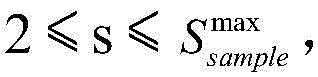
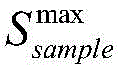 represents the maximum number of samples for sync detection;
performing correlation operation on the s sample and a local SSS to obtain an SSS correlation power array of the s sample;
accumulating the SSS correlation power array of the s sample, the SSS correlation power array of the 1 st sample to the SSS correlation power array of the s-1 st sample to obtain an SSS accumulated power array of the s sample;
performing synchronous detection on the s sample based on the SSS accumulated power array of the s sample;
the SSS accumulated power array of the s sample is based on to obtain the peak-to-average ratio of a first sampling point; when the peak-to-average ratio of the first sampling point is greater than or equal to a preset SSS threshold value, performing correlation operation on the s sample and a local PSS to obtain a PSS correlation power array of the s sample; accumulating the PSS correlation power array of the s sample, the PSS correlation power array of the 1 st sample to the PSS correlation power array of the s-1 st sample to obtain a PSS accumulated power array of the s sample; calculating the peak-to-average ratio of the corresponding PSS position based on the peak-to-average ratio of the first sampling point; outputting a synchronous detection result when the peak-to-average ratio of the corresponding PSS position is greater than a preset PSS threshold value; when the peak-to-average ratio of the corresponding PSS position is smaller than the preset PSS threshold value, if so, determining that the peak-to-average ratio is smaller than the preset PSS threshold value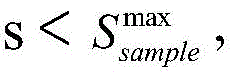 Then the (s + 1) th sample is synchronously detected, if so
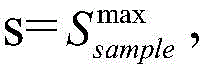 Ending the synchronous detection;
the first sampling point is the sampling point with the strongest normalized peak power in the s-th sample.
2. The synchronization method of claim 1, wherein the obtaining the peak-to-average ratio of the first sample based on the SSS accumulated power array for the s-th sample comprises:
calculating a Received Signal Strength Indication (RSSI) value of the s-th sample;
performing point-by-point RSSI normalization on the SSS accumulated power array of the s sample to obtain a first sampling point position with the strongest normalized peak power;
and calculating the peak-to-average ratio of the first sampling point.
3. The synchronization method according to claim 1 or 2, further comprising, before performing synchronization detection on the s-th sample: determining a data length of the s-th sample.
4. The synchronization method of claim 3, wherein the determining the data length of the s-th sample comprises: determining the data length of the s sample according to a timing offset value obtained in advance; the timing offset value is determined based on at least one of:
a sleep duration and a frequency deviation of a target cell;
the time interval between the last measurement ending time of the target cell and the current synchronous detection starting time;
the time interval between the last time of residing in the target cell and the current synchronous detection starting time.
5. The synchronization method of claim 4, wherein the preset data length is calculated by:
L s =2*(Pos sss -T shift )+2048+Dis pss,sss ;
wherein, pos sss Indicating a preset SSS synchronization position, T shift Indicating a timing offset value, dis pss,sss Representing the time domain spacing between the PSS and SSS signals.
6. The synchronization method according to claim 1 or 2, wherein the data length of the s-th sample is equal to a transmission period of a synchronization signal.
7. The synchronization method according to claim 1 or 2, characterized in that before performing synchronization detection, it further comprises: determining a maximum number of samples for the sync detection.
8. The synchronization method of claim 7, wherein said determining a maximum number of samples for said synchronization detection comprises: determining the maximum number of samples of the synchronous detection according to the signal quality of a target cell; the signal quality of the target cell is related to any one of:
the signal quality and the signal quality fluctuation value of a target cell before the user equipment is awakened, and the detection capability of the user equipment under different samples; the signal quality fluctuation value is: influence values of wireless channel signal environment change and co-channel interference on the signal quality of the target cell;
the user equipment receives the decoding capability and the detection capability under different samples.
9. The synchronization method of claim 1, wherein after the receiving a time domain signal with a predetermined data length and containing a PSS and an SSS, before correlating the s-th sample, the method further comprises:
and performing down-sampling processing on the s-th sample.
10. A user device, comprising: a synchronization detection unit, the synchronization detection unit comprising:
the receiving subunit is suitable for receiving a time domain signal with a preset data length and containing a PSS and a SSS to obtain an s-th sample; wherein,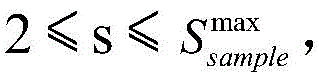
 represents the maximum number of samples for sync detection;
an SSS correlation subunit adapted to perform a correlation operation on the s-th sample and a local SSS to obtain an SSS correlation power array of the s-th sample;
an SSS accumulation subunit adapted to accumulate the SSS correlation power array of the s-th sample with the SSS correlation power array of the 1-th sample through the SSS correlation power array of the s-1-th sample to obtain an SSS accumulation power array of the s-th sample;
a synchronous detection subunit, adapted to perform synchronous detection on the s-th sample based on the SSS accumulated power array of the s-th sample;
the synchronous detection subunit is adapted to obtain a peak-to-average ratio of a first sampling point based on the SSS accumulated power array of the s-th sample; when the peak-to-average power ratio of the first sampling point is larger than or equal to a preset SSS threshold value, performing correlation operation on the s sample and a local PSS to obtain a PSS correlation power array of the s sample; accumulating the PSS correlation power array of the s sample, the PSS correlation power array of the 1 st sample to the PSS correlation power array of the s-1 st sample to obtain the PSS accumulated power array of the s sample; calculating the peak-to-average ratio of the corresponding PSS position based on the peak-to-average ratio of the first sampling point; outputting a synchronous detection result when the peak-to-average ratio of the corresponding PSS position is greater than a preset PSS threshold value; when the peak-to-average ratio of the corresponding PSS position is smaller than the preset PSS threshold value, if so, determining that the peak-to-average ratio is smaller than the preset PSS threshold value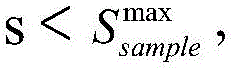 Then the (s + 1) th sample is synchronously detected, if so
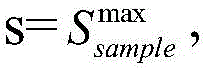 Ending the synchronous detection;
the first sampling point is the sampling point with the strongest normalized peak power in the s-th sample.
11. The user device of claim 10, further comprising:
a data reception length calculation unit adapted to determine a data length of the s-th sample.
12. The user equipment of claim 10, further comprising:
a maximum number of samples determination unit adapted to determine a maximum number of samples of the synchronization detection.
13. The user equipment of claim 10 or 12, wherein the synchronization detection unit further comprises:
and the down-sampling subunit is suitable for performing down-sampling processing on the s sample after receiving the time domain signal with the preset data length and containing the PSS and the SSS and before performing correlation operation on the s sample.
14. A computer-readable storage medium, on which a computer program is stored, which computer program is executable by a processor for carrying out the steps of the method according to any one of claims 1 to 9.
15. A user equipment comprising a memory and a processor, the memory having stored thereon a computer program operable on the processor, wherein the processor, when executing the computer program, performs the steps of the method of any of claims 1 to 9.
Priority Applications (1)
| Application Number | Priority Date | Filing Date | Title |
|---|---|---|---|
| CN202011330988.XA CN112399552B (en) | 2020-11-24 | 2020-11-24 | Synchronization method, user equipment and computer-readable storage medium |
Applications Claiming Priority (1)
| Application Number | Priority Date | Filing Date | Title |
|---|---|---|---|
| CN202011330988.XA CN112399552B (en) | 2020-11-24 | 2020-11-24 | Synchronization method, user equipment and computer-readable storage medium |
Publications (2)
| Publication Number | Publication Date |
|---|---|
| CN112399552A CN112399552A (en) | 2021-02-23 |
| CN112399552B true CN112399552B (en) | 2023-02-28 |
Family
ID=74606624
Family Applications (1)
| Application Number | Title | Priority Date | Filing Date |
|---|---|---|---|
| CN202011330988.XA Active CN112399552B (en) | 2020-11-24 | 2020-11-24 | Synchronization method, user equipment and computer-readable storage medium |
Country Status (1)
| Country | Link |
|---|---|
| CN (1) | CN112399552B (en) |
Citations (7)
| Publication number | Priority date | Publication date | Assignee | Title |
|---|---|---|---|---|
| CN102158250A (en) * | 2010-02-11 | 2011-08-17 | 富士通株式会社 | Initial cell searching method and device |
| CN102421114A (en) * | 2011-11-30 | 2012-04-18 | 合肥东芯通信股份有限公司 | Same-frequency neighbor cell searching device and method of LTE system |
| CN103379514A (en) * | 2012-04-27 | 2013-10-30 | 电信科学技术研究院 | Uplink synchronous detection method and device in indoor distributed scene |
| CN104753832A (en) * | 2013-12-27 | 2015-07-01 | 联芯科技有限公司 | Secondary synchronization signal (SSS) detection method and device |
| US9961655B1 (en) * | 2015-10-29 | 2018-05-01 | Mbit Wireless, Inc. | Method and apparatus for low complexity frequency synchronization in LTE wireless communication systems |
| CN108880608A (en) * | 2017-05-12 | 2018-11-23 | 深圳市中兴微电子技术有限公司 | Small region search method and device based on LTE system |
| CN111479311A (en) * | 2019-01-24 | 2020-07-31 | 三星电子株式会社 | Wireless communication device including synchronization signal detector and cell search method thereof |
Family Cites Families (2)
| Publication number | Priority date | Publication date | Assignee | Title |
|---|---|---|---|---|
| GB2509088A (en) * | 2012-12-19 | 2014-06-25 | Broadcom Corp | A reference sequence for synchronisation and channel estimation in local area communication scenarios |
| CN107105497B (en) * | 2017-06-07 | 2019-11-29 | 重庆重邮汇测通信技术有限公司 | Primary synchronization signal detection method in a kind of LTE system |
-
2020
- 2020-11-24 CN CN202011330988.XA patent/CN112399552B/en active Active
Patent Citations (7)
| Publication number | Priority date | Publication date | Assignee | Title |
|---|---|---|---|---|
| CN102158250A (en) * | 2010-02-11 | 2011-08-17 | 富士通株式会社 | Initial cell searching method and device |
| CN102421114A (en) * | 2011-11-30 | 2012-04-18 | 合肥东芯通信股份有限公司 | Same-frequency neighbor cell searching device and method of LTE system |
| CN103379514A (en) * | 2012-04-27 | 2013-10-30 | 电信科学技术研究院 | Uplink synchronous detection method and device in indoor distributed scene |
| CN104753832A (en) * | 2013-12-27 | 2015-07-01 | 联芯科技有限公司 | Secondary synchronization signal (SSS) detection method and device |
| US9961655B1 (en) * | 2015-10-29 | 2018-05-01 | Mbit Wireless, Inc. | Method and apparatus for low complexity frequency synchronization in LTE wireless communication systems |
| CN108880608A (en) * | 2017-05-12 | 2018-11-23 | 深圳市中兴微电子技术有限公司 | Small region search method and device based on LTE system |
| CN111479311A (en) * | 2019-01-24 | 2020-07-31 | 三星电子株式会社 | Wireless communication device including synchronization signal detector and cell search method thereof |
Also Published As
| Publication number | Publication date |
|---|---|
| CN112399552A (en) | 2021-02-23 |
Similar Documents
| Publication | Publication Date | Title |
|---|---|---|
| JP5410563B2 (en) | Channel monitoring method in wireless broadcast system | |
| KR100865935B1 (en) | Method and apparatus for searching cells utilizing downlink preamble signals | |
| KR101291859B1 (en) | Methods and systems for improved timing acquisition for varying channel conditions | |
| CN101719890B (en) | District searching method and d device applied to long-period evolution system | |
| US10405286B2 (en) | Apparatus and method for synchronization signal detection | |
| TW200838198A (en) | Random access in time division duplex communication systems | |
| CN104717725B (en) | A kind of synchronous method under LTE system discontinuous reception modes | |
| US8676137B2 (en) | Mobile wireless terminal, a method of measuring signal strength of a received signal, and a method of searching for a base station | |
| CN101646231B (en) | Timing recovery method for mobile terminal sleeping awakening in TD-SCDMA system | |
| JP2012016024A (en) | Rf channel switching in broadcast ofdm systems | |
| US9967112B2 (en) | Apparatus and methods for adaptively resuming radio channel estimation | |
| JP2020167704A (en) | Random access method for devices with different route losses | |
| US10326633B2 (en) | Adaptive selection of signal-detection mode | |
| EP2095588B1 (en) | Method of and apparatus for adaptive frequency error estimation | |
| CN108989259B (en) | Time offset estimation method and system for narrow-band physical uplink shared channel of wireless comprehensive measurement instrument | |
| CN108512570B (en) | Signal synchronization capturing method, system, computer device and readable storage medium | |
| CN116545595A (en) | Method and device for determining effective duration of reference signal and terminal | |
| CN112399552A (en) | Synchronization method, user equipment and computer-readable storage medium | |
| CN103988475B (en) | A kind of carrier frequency bias estimation and device | |
| CN114557113B (en) | Random access preamble detection for propagation delay | |
| CN108462990B (en) | Method and device for network synchronization | |
| CN100591063C (en) | Method and device for obtaining cyclic prefix length information | |
| JP2005039367A (en) | Cell search control method for mobile communication terminal and mobile communication terminal | |
| CN115176446B (en) | Apparatus and method for cyclic prefix based time and/or frequency correction | |
| CN117979398A (en) | Wake-up signal detection method and device, communication equipment, and storage medium |
Legal Events
| Date | Code | Title | Description |
|---|---|---|---|
| PB01 | Publication | ||
| PB01 | Publication | ||
| SE01 | Entry into force of request for substantive examination | ||
| SE01 | Entry into force of request for substantive examination | ||
| GR01 | Patent grant | ||
| GR01 | Patent grant |