Disclosure of Invention
The invention aims to provide a start-stop control method for judging whether a wrench should stop by monitoring output pressure of a pump station, aiming at the defects of the conventional method for judging whether the wrench should stop by monitoring torque of the wrench.
In order to achieve the purpose, the invention adopts the following technical scheme: a hydraulic ratchet wrench automatic stopping method based on oil pressure waveform similarity contrast is used for judging when a hydraulic pump station should stop driving a hydraulic ratchet wrench, and comprises judging whether a stopping program is started or not and judging whether the hydraulic ratchet wrench is stopped or not;
judging whether a judging and stopping program is started or not: comparing the waveform similarity of two nearest adjacent output oil pressures of the pump station and the waveform similarity of two output oil pressures at intervals, comparing the smaller similarity with a start and stop judging threshold, and judging whether to stop when the smaller similarity is lower than the start and stop judging threshold;
judging whether to stop: and comparing the waveform similarity of the oil pressure output by the pump station in two nearest adjacent times, and stopping driving the hydraulic ratchet wrench by the hydraulic pump station when the waveform similarity of the oil pressure output by the pump station in two nearest adjacent times is higher than a judgment stop threshold value.
The method specifically comprises the following steps:
step S1: monitoring the output oil pressure waveform of the hydraulic pump station in real time after the hydraulic pump station starts to work;
step S2: from the third pressurization, after each pressurization is completed, respectively calculating the similarity C1 between the last pressure pulse and the previous pressure pulse and the similarity C2 between the last pressure pulse and the previous pressure pulse in the oil pressure waveform, and taking the smaller value of C1 and C2 as the similarity C3; comparing C3 with a start judgment threshold value T1, and starting the judgment and stop program in the step S3 when C3 is lower than T1;
step S3: after each pressurization is finished, calculating the similarity C4 between the last pressure pulse and the previous pressure pulse in the oil pressure waveform, then comparing the similarity C4 with a wrench judgment threshold T2, and when C4 is higher than T2, closing the electromagnetic valve of the pump station and stopping the wrench.
Further, in step S1, the pump station output oil pressure data is collected in real time using a sensor, and the data is transferred to the pump station CPU.
Further, step S2 includes:
step S2-1: in each pressurizing process, a pump station CPU samples the pump station output oil pressure data collected in real time according to a set sampling frequency t1, and stores an array obtained by sampling;
step S2-2: from the third pressurizing, after each pressurizing is finished, the CPU of the pump station calculates the similarity between the last array and the previous array once, and the similarity is counted as C1, and the similarity between the last array and the previous array once is calculated again and is counted as C2.
Further, step S3 includes:
step S3-1: in each pressurizing process, a pump station CPU samples the pump station output oil pressure data collected in real time according to a set sampling frequency t1, and stores an array obtained by sampling;
step S3-2: after each pressurization, the pump station CPU calculates the similarity between the last array and the previous array, and the similarity is counted as C4.
As a modification, step S2 includes:
step S2-1: in each pressurizing process, a pump station CPU samples pump station output oil pressure data collected in real time according to a set sampling frequency t1, the sampled oil pressure data is subjected to smooth filtering processing, and an array obtained after the smooth filtering processing is stored, wherein the algorithm of the smooth filtering is as follows: the sampled oil pressure data are respectively marked as a1, a2, a3, a4 and a5 in a group of every adjacent 5 points from front to back in time sequence, and then the calculation formula is adopted: a = (-3 × (a5+ a1) +12 × (a4 + a2) +17 × a3)/35 for calculation;
step S2-2: from the third pressurizing, after each pressurizing is finished, the CPU of the pump station calculates the similarity between the last array and the previous array once, and the similarity is counted as C1, and the similarity between the last array and the previous array once is calculated again and is counted as C2.
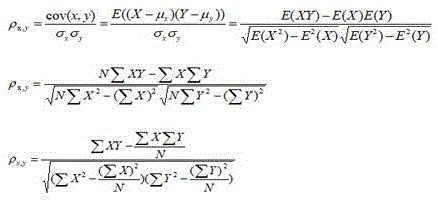
Further, the similarity calculation formula is as follows: rhox,y=cov(x,y)/(σx ×σy) Where x and y are data of two pressure waveforms to be compared, cov (x and y) is covariance of two sets of oil pressure data, sigmaxAnd σyThe standard deviation of the two groups of oil pressure data is respectively.
As a modification, step S3 includes:
step S3-1: in each pressurizing process, a pump station CPU samples pump station output oil pressure data collected in real time according to a set sampling frequency t1, the sampled oil pressure data is subjected to smooth filtering processing, and an array obtained after the smooth filtering processing is stored, wherein the algorithm of the smooth filtering is as follows: the sampled oil pressure data are respectively marked as a1, a2, a3, a4 and a5 in a group of every adjacent 5 points from front to back in time sequence, and then the calculation formula is adopted: a = (-3 × (a5+ a1) +12 × (a4 + a2) +17 × a3)/35 for calculation;
step S3-2: after each pressurization, the pump station CPU calculates the similarity between the last array and the previous array, and the similarity is counted as C4.
Further, the similarity calculation formula is as follows: rhox,y=cov(x,y)/(σx ×σy) Where x and y are data of two pressure waveforms to be compared, cov (x and y) is covariance of two sets of oil pressure data, sigmaxAnd σyThe standard deviation of the two groups of oil pressure data is respectively.
According to the hydraulic ratchet wrench stopping judging method, by collecting, filtering and analyzing correlation of real-time output oil pressure data of a pump station, a time node of a wrench from an empty load to a load is found, a bolt is judged to be in a state of starting to be screwed, a stopping judging process is started, a node at a moment after the wrench is changed from the load to a full load is found, the bolt is judged to be in a screwed state, and at the moment, an electromagnetic valve of the pump station closes the wrench to stop working. Through the algorithm, the condition that a torque sensor is required to be equipped during automatic operation of the wrench is avoided, the influence of interference existing in the torque data wireless transmission process on accurate judgment and stop of a pump station is avoided, and the workload of operators in wrench fastening operation is reduced.
Detailed Description
Referring to fig. 1 and 2, assuming that the output target pressure of the hydraulic pump station is 20MPa, when the wrench starts to work, the bolt is in a loose state, the piston in the wrench cylinder moves rapidly from the position 1 to the position 3 shown in fig. 1, the piston has no other load except the thrust of the oil pressure of the pump station in the process, when the piston moves to the position 3, the wrench completes one screwing operation, the inner wall of the cylinder provides a reaction force of 20MPa to counteract the output pressure of the pump station, the process is called as a wrench idle state, and the output oil pressure curve of the pump station is shown as pulses P1 and P2 in fig. 2;
when the bolt starts to be screwed, because the reaction force of the bolt on the spanner before the last screwing can not reach the output pressure of the pump station all the time, the piston will finally move from the position 1 to the position 3 shown in fig. 1, but in the process, taking the position 2 shown in fig. 1 as an example, the wrench is always subjected to the increasing resisting torque of the bolt, the pressure applied to the piston is also increased, the process of the piston from the position 1 to the position 3 is longer due to the reacting force of the bolt than when the piston is unloaded, when the piston moves to position 3, the cylinder wall will provide a reaction force to the piston in a short time, the reaction force is balanced with the reaction force of the bolt on the wrench and the output oil pressure of the pump station, the process is called as the load state of the wrench, and the curve of the output oil pressure of the pump station is shown as P3 pulse in figure 2.
The load movement state of the wrench is circulated for several times until the bolt is in a dead-end state, namely, the bolt can provide a reaction force of 20MPa when the next screwing operation is just started, at the moment, the piston in the wrench oil cylinder is stopped at the position 1 shown in figure 1, the pumping station pressure is instantaneously rushed to 20MPa, the process is quickly completed, the process is called as the full load state of the wrench, and the waveform of the output oil pressure of the pumping station is shown as P4 pulse in figure 2. The oil pressure waveform graph can find that when the wrench is changed from an empty load to a load, the oil pressure waveforms are obviously different, and at the moment, the bolt starts to be screwed; when the similarity of the oil pressure waveform is restored to be high, the wrench is changed into a full negative state, and the bolt is tightened.
The stopping judging method is that the corresponding relation between the motion state change of the piston inside the hydraulic ratchet wrench oil cylinder and the wrench load in one-time fastening operation of the bolt is analyzed to obtain the corresponding relation between the motion state change of the piston and the output oil pressure waveform change of the pump station, and a control algorithm is designed according to the relation. The method comprises the following specific steps: step one, a sensor collects oil pressure data output by a pump station in real time and transmits the data to a pump station control CPU; step two, setting the sampling frequency as t1, sampling the real-time data by the CPU of the pump station, and storing each pulse by taking an array; respectively calculating the similarity C1 and C2 of adjacent and two-time-spaced pressure pulses in the oil pressure waveform, and comparing the smaller similarity C3 with a starting judgment and stop threshold value to judge whether a judgment and stop program is started or not; step four, setting a starting judgment and stop threshold value as T1, starting a judgment and stop program when C1 is lower than T1, otherwise, keeping the judgment and stop program in an unexecuted state; and step five, after the judging and stopping program is started, comparing the similarity C4 of every two adjacent oil pressure pulses with a spanner judging and stopping threshold value T2, and when C4 is higher than T2, closing the electromagnetic valve of the pump station and stopping the spanner.
In the first step, a high-pressure sensor is arranged at an oil outlet of a pump station, a pump station control box supplies power to the high-pressure sensor, and after the pump station is electrified, the sensor is in an open state to measure the oil pressure of the oil outlet of the pump station in real time.
And in the second step, the CPU sampling frequency is set to be 6ms, and data transmitted by the sensor in real time are sampled at intervals of 6ms in each pressurizing process of the pump station. Since we find the similarity of two pressure waveforms separated by one pressure pulse at most, we can use three arrays with enough length to store the data of the adjacent three pressure waveforms respectively.
In the third step, in order to avoid the false triggering of the judgment and stop program caused by the change of the oil pressure waveform due to the possible error and the reduction of the similarity of the waveform, the similarity of the oil pressure pulses adjacent to and spaced 1 time is respectively calculated, the smaller value of the similarity is compared with C3 (the initial value of C3 is set as 0), if the similarity is smaller than C3, the smaller value of the correlation coefficient of the adjacent pressure waveform and the spaced pressure waveform is taken as C3 to be compared with the starting judgment and stop threshold T1, so that the judgment and stop program can be accurately started, and when the judgment and stop program is started, the bolt is inevitably in a state of starting screwing. The calculation formula of the similarity is as follows:
where ρ isx,yRepresenting the similarity of two sets of data x and y, wherein x and y are respectively the data of two pressure waveforms to be compared, cov (x and y) is the covariance of the two sets of oil pressure data, sigmaxAnd σyStandard deviation of two sets of oil pressure data, ERepresenting a mathematical expectation, X, Y represents the value of either point of the two sets of data, μx 、μyThe average values of the two sets of data are respectively shown, and N represents the number of collected oil pressure points in the two sets of data.
In the fourth and fifth steps, after the wrench is changed from the load state to the full negative state, the similarity between the oil pressure waveforms of each time is increased to be close to 100, therefore, the judgment and stop program only needs to set a higher judgment and stop threshold value T2, when the C3 is less than T1, namely after the bolt is analyzed to reach the pre-tightening state, the judgment and stop program is started, the similarity C4 obtained by comparing every two adjacent pressure waveforms is compared with the judgment and stop threshold value T2, and when the C4 is greater than T2, the electromagnetic valve of the pump station is closed, and the hydraulic wrench stops working.
Because the pressure acquisition of the sensor is easily interfered by external unnecessary factors, the acquired oil pressure data has certain errors, the accuracy of similarity calculation between waveforms is influenced, and the condition of erroneous judgment is caused, therefore, a 5-point smoothing filter algorithm is added, every adjacent 5 points of the sampled oil pressure data from front to back are taken as a group and respectively taken as a1, a2, a3, a4 and a5 according to the time sequence, the oil pressure value after noise removal is obtained through the smoothing filter algorithm, the noise removal can reduce the similarity calculation errors caused by noise disturbance in the subsequent similarity calculation, and the accuracy of wrench judgment and stop is improved, and the calculation formula is as follows:
A=(-3×(a5+a1)+12×(a4 +a2)+17×a3)/35
the following is an application example of the stopping judging method of the present invention, in this example, 2XLCT-50 is selected as the ratchet wrench, the bolt model is M32, the maximum output pressure set by the hydraulic pump is 20MPa, two similarity thresholds T1=85%, T2=96% are respectively set, the CPU sampling frequency is set to 5ms, and the hydraulic pump starts to be started. And the sampled data is recorded in multiple times.
The sample data for the 1 st to 3 rd pressurization are as follows:
pressurizing for the 1 st time: 66. 130, 191, 252, 313, 374, 435, 496, 557, 618, 680, 739, 801, 862, 923, 988, 1040, 1103, 1170, 1233, 1290, 1351, 1410, 1471, 1535, 1594, 1655, 1713, 1776, 1839, 1899, 1958;
the data after filtering processing is: 189. 496, 801, 1108, 1412, 1733, 483 (culling);
pressurizing for the 2 nd time: 62. 133, 194, 254, 310, 378, 434, 497, 556, 619, 682, 730, 807, 860, 925, 989, 1040, 1105, 1171, 1231, 1292, 1352, 1407, 1468, 1536, 1593, 1653, 1715, 1774, 1840, 1901, 1962;
the data after filtering processing is: 189. 498772110814111716484 (culling);
pressurizing for 3 rd time: 20. 40, 66, 81, 101, 125, 140, 166, 181, 200, 225, 241267, 301, 325, 347, 364, 383, 403, 426, 442, 463, 486, 505, 524, 544, 566, 587, 606, 623, 646, 727, 788, 850, 910, 972, 1033, 1093, 1154, 1210, 1271, 1332, 1396, 1449, 1509, 1565, 1624, 1682, 1741, 1803, 1865, 1927;
the data after filtering processing is: 63. 165, 272, 385, 484, 585, 781, 1092, 1393, 1683, 474 (culling);
the similarity of the oil pressure waveform of the 3 rd time and the oil pressure waveform of the 2 nd time is calculated to be 87%, the similarity of the oil pressure waveform of the 3 rd time and the oil pressure waveform of the 1 st time is calculated to be 80%, and due to the fact that 80% is less than 85%, a judging and stopping program is started.
Pressurizing for the 5 th time: 59. 127, 185, 256, 321, 379, 427, 499, 553, 620, 685, 741, 810, 862, 928, 989, 1040, 1112, 1178, 1233, 1292, 1354, 1413, 1469, 1541, 1594, 1661, 1719, 1785, 1843, 1907, 1966;
the data after filtering processing is: 187. 493, 805, 1110, 1411, 1722, 511 (culling);
pressurizing for the 6 th time: 55. 128, 187, 249, 327, 375, 431, 495, 551, 622, 686, 743, 817, 863, 926, 981, 1043, 1110, 1178, 1234, 1295, 1353, 1413, 1470, 1535, 1592, 1661, 1714, 1788, 1843, 1903, 1971;
the data after filtering processing is: 187. 492, 809, 1111, 1412, 1721, 513 (culling);
the similarity of the oil pressure waveforms of the 6 th time and the 5 th time is calculated to be 99%, and as the similarity is more than 99% and 96%, the hydraulic pump is stopped at the moment, the state of the nut is checked, and the target is achieved.