CN112215263A - Rail corrugation detection method based on deep convolutional neural network - Google Patents
Rail corrugation detection method based on deep convolutional neural network Download PDFInfo
- Publication number
- CN112215263A CN112215263A CN202011011012.6A CN202011011012A CN112215263A CN 112215263 A CN112215263 A CN 112215263A CN 202011011012 A CN202011011012 A CN 202011011012A CN 112215263 A CN112215263 A CN 112215263A
- Authority
- CN
- China
- Prior art keywords
- neural network
- convolutional neural
- pictures
- training
- deep convolutional
- Prior art date
- Legal status (The legal status is an assumption and is not a legal conclusion. Google has not performed a legal analysis and makes no representation as to the accuracy of the status listed.)
- Granted
Links
Images


Classifications
-
- G—PHYSICS
- G06—COMPUTING OR CALCULATING; COUNTING
- G06F—ELECTRIC DIGITAL DATA PROCESSING
- G06F18/00—Pattern recognition
- G06F18/20—Analysing
- G06F18/24—Classification techniques
- G06F18/241—Classification techniques relating to the classification model, e.g. parametric or non-parametric approaches
-
- G—PHYSICS
- G06—COMPUTING OR CALCULATING; COUNTING
- G06F—ELECTRIC DIGITAL DATA PROCESSING
- G06F16/00—Information retrieval; Database structures therefor; File system structures therefor
- G06F16/10—File systems; File servers
- G06F16/16—File or folder operations, e.g. details of user interfaces specifically adapted to file systems
-
- G—PHYSICS
- G06—COMPUTING OR CALCULATING; COUNTING
- G06F—ELECTRIC DIGITAL DATA PROCESSING
- G06F16/00—Information retrieval; Database structures therefor; File system structures therefor
- G06F16/50—Information retrieval; Database structures therefor; File system structures therefor of still image data
- G06F16/51—Indexing; Data structures therefor; Storage structures
-
- G—PHYSICS
- G06—COMPUTING OR CALCULATING; COUNTING
- G06F—ELECTRIC DIGITAL DATA PROCESSING
- G06F18/00—Pattern recognition
- G06F18/20—Analysing
- G06F18/21—Design or setup of recognition systems or techniques; Extraction of features in feature space; Blind source separation
- G06F18/214—Generating training patterns; Bootstrap methods, e.g. bagging or boosting
-
- G—PHYSICS
- G06—COMPUTING OR CALCULATING; COUNTING
- G06N—COMPUTING ARRANGEMENTS BASED ON SPECIFIC COMPUTATIONAL MODELS
- G06N3/00—Computing arrangements based on biological models
- G06N3/02—Neural networks
- G06N3/04—Architecture, e.g. interconnection topology
- G06N3/045—Combinations of networks
-
- G—PHYSICS
- G06—COMPUTING OR CALCULATING; COUNTING
- G06T—IMAGE DATA PROCESSING OR GENERATION, IN GENERAL
- G06T7/00—Image analysis
- G06T7/0002—Inspection of images, e.g. flaw detection
- G06T7/0004—Industrial image inspection
-
- G—PHYSICS
- G06—COMPUTING OR CALCULATING; COUNTING
- G06T—IMAGE DATA PROCESSING OR GENERATION, IN GENERAL
- G06T2207/00—Indexing scheme for image analysis or image enhancement
- G06T2207/20—Special algorithmic details
- G06T2207/20081—Training; Learning
-
- G—PHYSICS
- G06—COMPUTING OR CALCULATING; COUNTING
- G06T—IMAGE DATA PROCESSING OR GENERATION, IN GENERAL
- G06T2207/00—Indexing scheme for image analysis or image enhancement
- G06T2207/20—Special algorithmic details
- G06T2207/20084—Artificial neural networks [ANN]
-
- G—PHYSICS
- G06—COMPUTING OR CALCULATING; COUNTING
- G06T—IMAGE DATA PROCESSING OR GENERATION, IN GENERAL
- G06T2207/00—Indexing scheme for image analysis or image enhancement
- G06T2207/30—Subject of image; Context of image processing
- G06T2207/30108—Industrial image inspection
Landscapes
- Engineering & Computer Science (AREA)
- Theoretical Computer Science (AREA)
- Physics & Mathematics (AREA)
- Data Mining & Analysis (AREA)
- General Physics & Mathematics (AREA)
- General Engineering & Computer Science (AREA)
- Life Sciences & Earth Sciences (AREA)
- Artificial Intelligence (AREA)
- Computer Vision & Pattern Recognition (AREA)
- Evolutionary Computation (AREA)
- Evolutionary Biology (AREA)
- Software Systems (AREA)
- Bioinformatics & Computational Biology (AREA)
- Bioinformatics & Cheminformatics (AREA)
- Databases & Information Systems (AREA)
- Biophysics (AREA)
- Mathematical Physics (AREA)
- Computing Systems (AREA)
- Molecular Biology (AREA)
- General Health & Medical Sciences (AREA)
- Computational Linguistics (AREA)
- Biomedical Technology (AREA)
- Health & Medical Sciences (AREA)
- Quality & Reliability (AREA)
- Human Computer Interaction (AREA)
- Image Analysis (AREA)
Abstract
The invention relates to the technical field of rail corrugation detection, in particular to a rail corrugation detection method based on a deep convolutional neural network, which comprises the following steps of: firstly, shooting and storing an image of the top surface of a steel rail; selecting and calibrating long-wave mill, short-wave mill and non-wave mill pictures; thirdly, extracting a steel rail area in the middle of the image; fourthly, creating a training set data storage folder; fifthly, creating a test folder; sixthly, converting the picture according to 0.6 time, 0.8 time, 1.2 time and 1.4 time of the gray value of the original picture; constructing a deep convolutional neural network by using a DenseNet model; eighthly, leading the training set into the constructed deep convolution neural network model for training; and ninthly, inputting the test set into a deep convolutional neural network for testing, and counting evaluation index values. The invention can realize effective and high-speed detection of the long and short wave mills and realize the robustness to the change of the illumination intensity.
Description
Technical Field
The invention relates to the technical field of rail corrugation detection, in particular to a rail corrugation detection method based on a deep convolutional neural network.
Background
With the proposal of deep learning theory and the improvement of numerical calculation equipment, the convolutional neural network is rapidly developed and widely applied to the field of image recognition. The convolutional neural network has the characteristics of sparse connection and the capability of representation learning due to the unique convolutional operation and the multi-level network structure, has high calculation efficiency, is insensitive to the translation and rotation of the image, and has great success in the field of image identification. Compared with the common convolutional neural network, the deep convolutional neural network has a deeper and more delicate network structure, so that higher-order features can be extracted, and the deep convolutional neural network has more excellent recognition performance.
The vehicle-mounted track inspection system based on computer vision is widely applied at home and abroad, and can acquire high-resolution digital images of a line environment in real time and then classify the acquired images by applying an advanced pattern recognition technology. The existing classification method of rail corrugation images at present is to extract image features (Gabor texture features and local frequency features) and then use a machine learning method (K-nearest neighbor method and support vector machine) to classify the extracted features, so as to achieve the purpose of detecting corrugation.
The existing corrugation detection method mainly classifies corrugation lines through an SVM (support vector machine) method, and because an SVM algorithm is not an efficient algorithm and cannot process a large amount of data, an author of the method firstly uses the algorithm to divide a steel rail region from a picture, then manually extracts features from the acquired image, and then uses the SVM (support vector machine) method to classify the features, so that the process is complicated, the detection time is too long, the real-time detection cannot be realized in the high-speed running environment of a train, and the method does not distinguish the corrugation types. The method comprises the steps of installing image acquisition equipment comprising a linear array camera and a light source under a rail inspection vehicle carriage to acquire a clear image of the top surface of a steel rail, separating a steel rail area in the image from a background through a steel rail positioning algorithm based on position weighting by the acquired image, extracting frequency characteristics of the image, and classifying the characteristics by using a support vector machine method to achieve the purpose of corrugation detection.
Disclosure of Invention
It is an object of the present invention to provide a rail corrugation detection method based on a deep convolutional neural network that overcomes some or some of the deficiencies of the prior art.
The rail corrugation detection method based on the deep convolutional neural network comprises the following steps of:
firstly, shooting and storing an image of the top surface of a steel rail;
selecting and calibrating long-wave mill, short-wave mill and non-wave mill pictures;
thirdly, extracting a steel rail area in the middle of the image;
creating a training set data storage folder, creating three training folders in the training set data storage folder, and moving calibrated long-wave grinding, short-wave grinding and non-wave grinding pictures into corresponding folders to manufacture original training sets;
fifthly, the resolutions of the pictures in the original training set are changed to be consistent, a test folder is created, 5 main folders are created under the test folder, three sub-folders are created under each folder to correspond to the picture categories, and then 30% of the pictures of each category are randomly and correspondingly moved into the three sub-folders in one of the main folders;
sixthly, converting the picture under one of the main folders according to 0.6 time, 0.8 time, 1.2 time and 1.4 time of the gray value of the original picture, and storing the converted picture into the remaining 4 folders in the test set;
seventhly, constructing a deep convolutional neural network by using a DenseNet dense connection network model as a basic model;
introducing the training set into the constructed deep convolution neural network model for training, using the classified cross entropy as a loss function, and using an Adam algorithm to update the training parameters; when the average training loss value of the batch is less than 0.0001, considering that the requirement is met, storing the training model, and stopping training;
inputting the data of 5 gray classes in the test set into a deep convolutional neural network for testing, and counting evaluation index values; using the precision rate, the recall rate, the F1 measurement, the test time of a single picture and the TOP-1 accuracy rate corresponding to each category as evaluation indexes;
the calculation formulas of the precision rate, the recall rate and the F1 measurement are as follows:
the precision ratio is P ═ TP/(TP + FP); the recall ratio is as follows: r ═ TP/(TP + FN); f1 measures: f1 ═ 2 × (P × R)/(P + R);
in the formula, TP is a true positive case, FP is a false positive case, FN is a false negative case, and TN is a true negative case; the long-wave grinding and short-wave grinding pictures are taken as positive examples, and the non-wave grinding pictures are taken as negative examples.
Preferably, in the first step, the specific method for capturing the image of the top surface of the steel rail includes: and carrying a high-speed camera on the detection trolley, and adjusting the installation position of the camera to enable the shooting angle to be vertical to the top surface of the steel rail.
Preferably, in the first step, the preservation method comprises the following steps: and exporting the shot rail top surface image and storing the image as a jpg format picture.
Preferably, in the second step, the pictures of long wave milling, short wave milling and non-wave milling are selected and calibrated, then the number of each type of picture is counted, and the number of the discarded part of the pictures is far higher than that of the pictures of other types.
Preferably, in step five, the resolution of all the pictures in the original training set is converted to 224 × 224.
Preferably, in step five, the file name of the test folder is test, the file names of the 5 main folders are gray0.6, gray0.8, gray1.0, gray1.2 and gray1.4, the file names of the three subfolders are long, short and normal, and 30% of each type of picture is randomly moved into the folder corresponding to the gray 1.0.
Preferably, in the seventh step, the deep convolutional neural network is a convolutional neural network with more network layers, the convolutional neural network comprises a convolutional module and a fully-connected module, the convolutional module extracts features, and the fully-connected module classifies the features; the formula for the convolutional neural network is expressed as follows:


Preferably, in step eight, the calculation formula of the classification cross entropy is as follows:

b is the size of the training batch, C is the number of classes, y is the training data label, and the average loss of all batches is taken as the final index.
The invention can realize effective and high-speed detection of the long and short wave mills and realize the robustness to the change of illumination intensity; the method comprises the steps of processing and classifying long-wave mill, short-wave mill and non-wave mill pictures, constructing a deep convolution neural network by using a DenseNet dense connection network model as a basic model for testing, and using precision rate, recall rate, F1 measurement, test time of a single picture and TOP-1 precision rate corresponding to each category as evaluation indexes, so that rail wave mill can be detected better.
Drawings
FIG. 1 is a flowchart of a rail corrugation detection method based on a deep convolutional neural network in embodiment 1;
FIG. 2 is a photograph of selected short wave mills and non-wave mills of example 1;
FIG. 3 is a photograph of the short wave milling and non-wave milling after extraction in example 1;
FIG. 4 is a schematic diagram of a convolutional neural network in embodiment 1;
FIG. 5 is a schematic diagram of the average pooling calculation of 2 x 2 in example 1;
FIG. 6 is a schematic diagram of DenseNet in example 1;
FIG. 7 is a flowchart of the operation of the deep convolutional neural network in example 1;
FIG. 8 is a schematic view of the optical tape carriage in example 1.
Detailed Description
For a further understanding of the invention, reference should be made to the following detailed description taken in conjunction with the accompanying drawings and examples. It is to be understood that the examples are illustrative of the invention and not limiting.
Example 1
As shown in fig. 1, this embodiment provides a rail corrugation detection method based on a deep convolutional neural network, which includes the following steps:
firstly, shooting and storing an image of the top surface of a steel rail;
selecting and calibrating long-wave mill, short-wave mill and non-wave mill pictures; selected pictures of short and non-waved waves are shown in figure 2.
Thirdly, extracting a steel rail area in the middle of the image; since the rail regions are all in the middle region of the image, the rail regions can be artificially extracted, and the calculation amount is reduced, as shown in fig. 3, the extracted short-wave milled and non-wave milled pictures are selected with the resolution of 2976 × 3968, and the extracted resolution is 2976 × 825.
Creating a training set data storage folder, creating three training folders in the training set data storage folder, and moving calibrated long-wave grinding, short-wave grinding and non-wave grinding pictures into corresponding folders to manufacture original training sets;
fifthly, the resolutions of the pictures in the original training set are changed to be consistent, a test folder is created, 5 main folders are created under the test folder, three sub-folders are created under each folder to correspond to the picture categories, and then 30% of the pictures of each category are randomly and correspondingly moved into the three sub-folders in one of the main folders;
sixthly, considering the influence of the light intensity on the test precision, converting the picture under one main folder according to 0.6 time, 0.8 time, 1.2 times and 1.4 times of the gray value of the original picture, and storing the converted picture into the remaining 4 folders in the test set;
seventhly, constructing a deep convolutional neural network by using a DenseNet dense connection network model as a basic model;
introducing the training set into the constructed deep convolution neural network model for training, using the classified cross entropy as a loss function, and using an adam (adaptive motion) algorithm to update the training parameters; when the average training loss value of the batch is less than 0.0001, considering that the requirement is met, storing the training model, and stopping training;
inputting the data of 5 gray classes in the test set into a deep convolutional neural network for testing, and counting evaluation index values; using the precision rate, the recall rate, the F1 measurement, the test time of a single picture and the TOP-1 accuracy rate corresponding to each category as evaluation indexes;
the calculation formulas of the precision rate, the recall rate and the F1 measurement are as follows:
the precision ratio is P ═ TP/(TP + FP); the recall ratio is as follows: r ═ TP/(TP + FN); f1 measures: f1 ═ 2 × (P × R)/(P + R);
in the formula, TP is a true positive case, FP is a false positive case, FN is a false negative case, and TN is a true negative case; the long-wave grinding and short-wave grinding pictures are taken as positive examples, and the non-wave grinding pictures are taken as negative examples.
In the first step, the specific method for shooting the image of the top surface of the steel rail comprises the following steps: and carrying a high-speed camera on the detection trolley, and adjusting the installation position of the camera to enable the shooting angle to be vertical to the top surface of the steel rail. The detection trolley is a light band trolley, as shown in fig. 8.
In the first step, the storage method comprises the following steps: and exporting the shot rail top surface image and storing the image as a jpg format picture.
And step two, selecting long-wave grinding, short-wave grinding and non-wave grinding pictures, calibrating, counting the number of various pictures, and discarding the class pictures with part number far higher than that of other classes.
In step five, the resolution of the pictures in the original training set is all converted to 224 x 224.
In the fifth step, the file names of the test folders are test, and the file names of the 5 main folders are gray0.6, gray0.8, gray1.0, gray1.2 and gray1.4, so that the test folders correspond to the later gray level change; the file names of the three subfolders are long, short and normal, and 30% of all kinds of pictures are randomly moved into the folder corresponding to the gray 1.0.
Step seven, the deep convolutional neural network is a convolutional neural network with more network layers, the convolutional neural network comprises a convolutional module and a full-connection module, the convolutional module extracts features, and the full-connection module classifies the features; the principle of the convolutional neural network is shown in fig. 4, and the formula is expressed as follows:
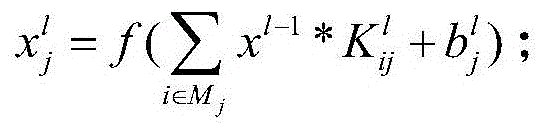


Deep convolutional neural networks also include pooling layers and convolutional layers, which often occur in pairs. The principle of the average pooling 2 by 2 calculation is shown in fig. 5, which can significantly reduce the calculation dimension.
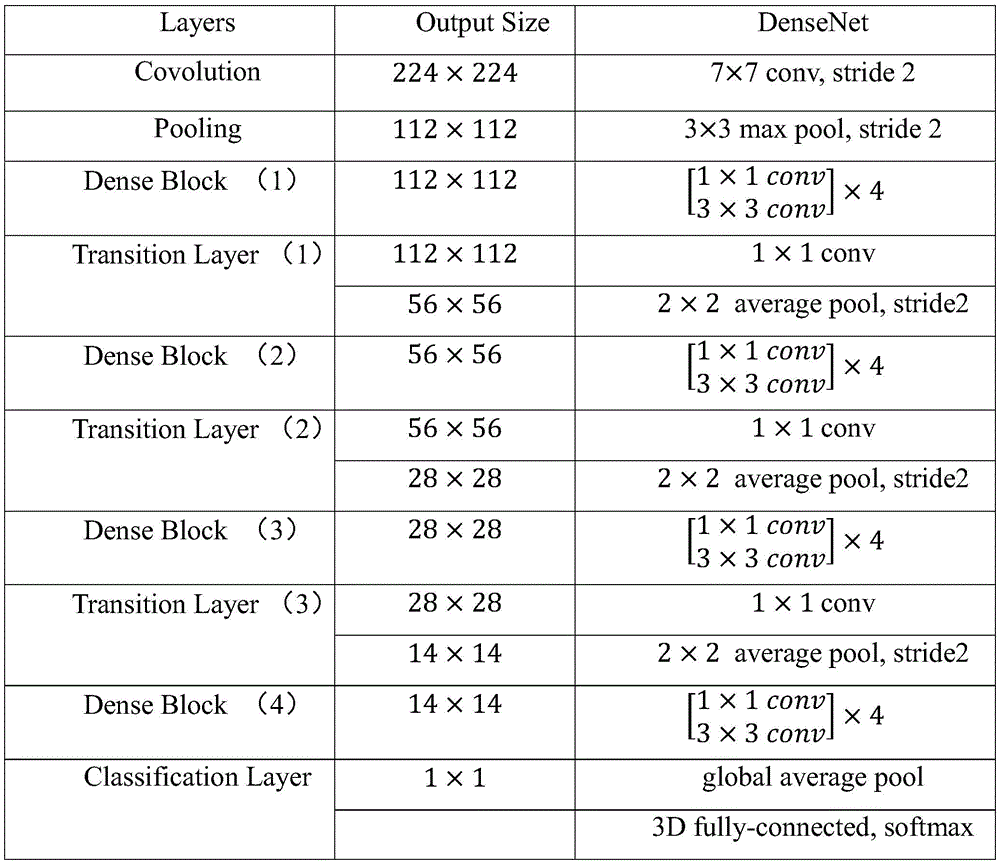
DenseNet (dense connection network), its base module Denseblock (dense block), as shown in fig. 6, where the output of one layer will be connected with all subsequent layers in the channel dimension as the input of the next layer, and not added directly as in ResNet. Thus, the DenseNet can extract and fuse the shallow feature and the deep feature of the image, so that the identification precision is improved, gradient diffusion can be prevented, feature propagation is enhanced, and the number of parameters is reduced. Since each dense block brings an increase in the number of channels, 1 × 1 convolution is used to reduce the number of channels, and the average pooling layer with step 2 is used to halve the height and width, thus reducing the model complexity, this module is called Transition _ layer. Experiment a deep convolutional neural network was constructed using the DenseNet model as the base model, and the deep convolutional neural network workflow and network structure are shown in fig. 7 and table one.
Table-network architecture
In the eighth step, the calculation formula of the classification cross entropy is as follows:

b is the size of the training batch, C is the number of classes, y is the training data label, and the average loss of all batches is taken as the final index.
The invention can realize effective and high-speed detection of long and short wave mills, the corresponding TOP-1 accuracy and recall rate reach 90%, and the single picture detection time is less than 10ms (when the sampling length is 1m and the sampling is not repeated, the detection speed is higher than 360 km/h); because the illumination intensity can seriously affect the quality of the shot picture, the robustness of the model to the illumination condition needs to be realized, and the detection accuracy and the recall rate of the long and short wave mills under different illumination intensities are more than 90 percent. And in addition, the detection effect of the evaluation model is evaluated by adopting the precision rate and the F1 metric.
Because the illumination intensity can seriously affect the gray value of a shot picture, 5 gray levels are set in the test set in total to realize the robustness of the model to the illumination condition, the gray value when the image is collected is taken as the reference 1.0, and the other gray levels are 0.6 times, 0.8 times, 1.2 times and 1.4 times of the reference gray level, and each gray level corresponds to 195 long-wave grinding pictures, 185 short-wave grinding pictures and 354 non-wave grinding pictures. The long-wave grinding and short-wave grinding pictures are taken as positive examples, the non-wave grinding pictures are taken as negative examples, and a positive example sample 380 and a negative example 354 are shared. The test results for each index are shown in the following table:
TABLE II precision, recall, F1 metric, and test time
| Grey scale level | Precision ratio (%) | Recall (%) | F1 metric | Test time (ms) |
| Gray0.6 | 96.77 | 94.47 | 0.956 | 6.2 |
| Gray0.8 | 98.08 | 93.95 | 0.960 | 6.2 |
| Gray1.0 | 98.90 | 94.47 | 0.966 | 0.63 |
| Gray1.2 | 98.62 | 93.95 | 0.962 | 6.2 |
| Gray1.4 | 97.81 | 94.21 | 0.960 | 6.2 |
TABLE TRITOP-1 accuracy (%)
| Grey scale level | Long wave mill | Short wave mill | Non-wave mill |
| Gray0.6 | 95.90 | 92.97 | 96.61 |
| Gray0.8 | 94.87 | 92.97 | 98.02 |
| Gray1.0 | 95.90 | 92.97 | 98.87 |
| Gray1.2 | 94.87 | 92.97 | 98.59 |
| Gray1.4 | 94.87 | 93.51 | 97.74 |
The TOP-1 accuracy, precision and recall rate of each category under different gray scale conditions are more than 90%, which shows that the method has robustness on illumination intensity and can realize accurate detection of long and short grinders; the average test time of a single picture is 6.2ms which is about 60 percent of the target value, which shows that when the sampling length is 1m and the sampling is not repeated, the high-speed detection with the speed exceeding 360km/h can be realized.
The present invention and its embodiments have been described above schematically, without limitation, and what is shown in the drawings is only one of the embodiments of the present invention, and the actual structure is not limited thereto. Therefore, if the person skilled in the art receives the teaching, without departing from the spirit of the invention, the person skilled in the art shall not inventively design the similar structural modes and embodiments to the technical solution, but shall fall within the scope of the invention.
Claims (8)
1. The rail corrugation detection method based on the deep convolutional neural network is characterized by comprising the following steps: the method comprises the following steps:
firstly, shooting and storing an image of the top surface of a steel rail;
selecting and calibrating long-wave mill, short-wave mill and non-wave mill pictures;
thirdly, extracting a steel rail area in the middle of the image;
creating a training set data storage folder, creating three training folders in the training set data storage folder, and moving calibrated long-wave grinding, short-wave grinding and non-wave grinding pictures into corresponding folders to manufacture original training sets;
fifthly, the resolutions of the pictures in the original training set are changed to be consistent, a test folder is created, 5 main folders are created under the test folder, three sub-folders are created under each folder to correspond to the picture categories, and then 30% of the pictures of each category are randomly and correspondingly moved into the three sub-folders in one of the main folders;
sixthly, converting the picture under one of the main folders according to 0.6 time, 0.8 time, 1.2 time and 1.4 time of the gray value of the original picture, and storing the converted picture into the remaining 4 folders in the test set;
seventhly, constructing a deep convolutional neural network by using a DenseNet dense connection network model as a basic model;
introducing the training set into the constructed deep convolution neural network model for training, using the classified cross entropy as a loss function, and using an Adam algorithm for updating the training parameters; when the average training loss value of the batch is less than 0.0001, considering that the requirement is met, storing the training model, and stopping training;
inputting the data of 5 gray classes in the test set into a deep convolutional neural network for testing, and counting evaluation index values; using the precision rate, the recall rate, the F1 measurement, the test time of a single picture and the TOP-1 accuracy rate corresponding to each category as evaluation indexes;
the calculation formulas of the precision rate, the recall rate and the F1 measurement are as follows:
the precision ratio is P ═ TP/(TP + FP); the recall ratio is as follows: r ═ TP/(TP + FN); f1 measures: f1 ═ 2 × (P × R)/(P + R);
in the formula, TP is a true positive case, FP is a false positive case, FN is a false negative case, and TN is a true negative case; the long-wave grinding and short-wave grinding pictures are taken as positive examples, and the non-wave grinding pictures are taken as negative examples.
2. The rail corrugation detection method based on the deep convolutional neural network of claim 1, wherein: in the first step, the specific method for shooting the image of the top surface of the steel rail comprises the following steps: and carrying a high-speed camera on the detection trolley, and adjusting the installation position of the camera to enable the shooting angle to be vertical to the top surface of the steel rail.
3. The rail corrugation detection method based on the deep convolutional neural network of claim 1, wherein: in the first step, the storage method comprises the following steps: and exporting the shot rail top surface image and storing the image as a jpg format picture.
4. The rail corrugation detection method based on the deep convolutional neural network of claim 1, wherein: and step two, selecting long-wave grinding, short-wave grinding and non-wave grinding pictures, calibrating, counting the number of various pictures, and discarding the class pictures with part number far higher than that of other classes.
5. The rail corrugation detection method based on the deep convolutional neural network of claim 1, wherein: in step five, the resolution of the pictures in the original training set is all converted to 224 x 224.
6. The rail corrugation detection method based on the deep convolutional neural network of claim 1, wherein: in the fifth step, the file names of the test folder are test, the file names of the 5 main folders are gray0.6, gray0.8, gray1.0, gray1.2 and gray1.4, the file names of the three subfolders are long, short and normal, and 30% of all kinds of pictures are randomly moved into the folder corresponding to the gray 1.0.
7. The rail corrugation detection method based on the deep convolutional neural network of claim 1, wherein: step seven, the deep convolutional neural network is a convolutional neural network with more network layers, the convolutional neural network comprises a convolutional module and a full-connection module, the convolutional module extracts features, and the full-connection module classifies the features; the formula for the convolutional neural network is expressed as follows:


8. The rail corrugation detection method based on the deep convolutional neural network of claim 1, wherein: in the eighth step, the calculation formula of the classification cross entropy is as follows:

b is the size of the training batch, C is the number of classes, y is the training data label, and the average loss of all batches is taken as the final index.
Priority Applications (1)
| Application Number | Priority Date | Filing Date | Title |
|---|---|---|---|
| CN202011011012.6A CN112215263B (en) | 2020-09-23 | 2020-09-23 | Rail corrugation detection method based on deep convolutional neural network |
Applications Claiming Priority (1)
| Application Number | Priority Date | Filing Date | Title |
|---|---|---|---|
| CN202011011012.6A CN112215263B (en) | 2020-09-23 | 2020-09-23 | Rail corrugation detection method based on deep convolutional neural network |
Publications (2)
| Publication Number | Publication Date |
|---|---|
| CN112215263A true CN112215263A (en) | 2021-01-12 |
| CN112215263B CN112215263B (en) | 2022-08-02 |
Family
ID=74050942
Family Applications (1)
| Application Number | Title | Priority Date | Filing Date |
|---|---|---|---|
| CN202011011012.6A Active CN112215263B (en) | 2020-09-23 | 2020-09-23 | Rail corrugation detection method based on deep convolutional neural network |
Country Status (1)
| Country | Link |
|---|---|
| CN (1) | CN112215263B (en) |
Cited By (3)
| Publication number | Priority date | Publication date | Assignee | Title |
|---|---|---|---|---|
| CN115239632A (en) * | 2022-06-23 | 2022-10-25 | 西南交通大学 | Steel rail surface damage detection method fusing inspection image and ultrasonic image |
| CN115600086A (en) * | 2022-11-15 | 2023-01-13 | 西南交通大学(Cn) | Vehicle-mounted quantitative detection method for rail corrugation roughness based on convolution regression |
| TWI800230B (en) * | 2022-01-20 | 2023-04-21 | 中國鋼鐵股份有限公司 | Milling area detection system |
Citations (9)
| Publication number | Priority date | Publication date | Assignee | Title |
|---|---|---|---|---|
| US20050279240A1 (en) * | 2004-06-22 | 2005-12-22 | Pedanekar Niranjan R | Enhanced method and apparatus for deducing a correct rail weight for use in rail wear analysis of worn railroad rails |
| CN105292177A (en) * | 2015-11-26 | 2016-02-03 | 唐智科技湖南发展有限公司 | Method for measuring track corrugation by utilizing axle box vibration and impact information |
| CN110223266A (en) * | 2019-03-08 | 2019-09-10 | 湖南工业大学 | A kind of Railway wheelset tread damage method for diagnosing faults based on depth convolutional neural networks |
| CN110992345A (en) * | 2019-12-06 | 2020-04-10 | 中科(徐州)人工智能研究院有限公司 | A kind of rail wear detection method and device |
| US20200164904A1 (en) * | 2017-07-28 | 2020-05-28 | Ensco, Inc. | Systems and methods for visualizing and analyzing a rail surface |
| CN111311567A (en) * | 2020-02-12 | 2020-06-19 | 北京交通大学 | Method for Fastener and Rail Disease Recognition in Track Route Image |
| CN111626976A (en) * | 2019-11-01 | 2020-09-04 | 东莞灵虎智能科技有限公司 | Steel rail surface damage detection method based on pulse coupling neural network |
| CN111623868A (en) * | 2020-05-12 | 2020-09-04 | 西南交通大学 | Convolutional neural network construction method for rail corrugation identification |
| CN111637964A (en) * | 2020-05-12 | 2020-09-08 | 西南交通大学 | Rail corrugation identification method |
-
2020
- 2020-09-23 CN CN202011011012.6A patent/CN112215263B/en active Active
Patent Citations (9)
| Publication number | Priority date | Publication date | Assignee | Title |
|---|---|---|---|---|
| US20050279240A1 (en) * | 2004-06-22 | 2005-12-22 | Pedanekar Niranjan R | Enhanced method and apparatus for deducing a correct rail weight for use in rail wear analysis of worn railroad rails |
| CN105292177A (en) * | 2015-11-26 | 2016-02-03 | 唐智科技湖南发展有限公司 | Method for measuring track corrugation by utilizing axle box vibration and impact information |
| US20200164904A1 (en) * | 2017-07-28 | 2020-05-28 | Ensco, Inc. | Systems and methods for visualizing and analyzing a rail surface |
| CN110223266A (en) * | 2019-03-08 | 2019-09-10 | 湖南工业大学 | A kind of Railway wheelset tread damage method for diagnosing faults based on depth convolutional neural networks |
| CN111626976A (en) * | 2019-11-01 | 2020-09-04 | 东莞灵虎智能科技有限公司 | Steel rail surface damage detection method based on pulse coupling neural network |
| CN110992345A (en) * | 2019-12-06 | 2020-04-10 | 中科(徐州)人工智能研究院有限公司 | A kind of rail wear detection method and device |
| CN111311567A (en) * | 2020-02-12 | 2020-06-19 | 北京交通大学 | Method for Fastener and Rail Disease Recognition in Track Route Image |
| CN111623868A (en) * | 2020-05-12 | 2020-09-04 | 西南交通大学 | Convolutional neural network construction method for rail corrugation identification |
| CN111637964A (en) * | 2020-05-12 | 2020-09-08 | 西南交通大学 | Rail corrugation identification method |
Non-Patent Citations (5)
| Title |
|---|
| JIANBO LI等: "Rail Corrugation Detection of High-Speed Railway Using Wheel Dynamic Responses", 《HTTPS://DOI.ORG/10.1155/2019/2695647》 * |
| WANG JIANXI等: "A Method of Determining Rail Grinding Parameters Based On Life-Cycle Cost", 《THE OPEN MECHANICAL ENGINEERING JOURNAL》 * |
| 张辉等: "钢轨缺陷无损检测与评估技术综述", 《仪器仪表学报》 * |
| 朱崇巧: "钢轨波浪磨耗检测算法研究", 《中国优秀硕士学位论文全文数据库_工程科技Ⅱ辑》 * |
| 李艳福: "基于激光位移的钢轨磨耗动态检测方法研究", 《中国博士学位论文全文数据库_工程科技Ⅱ辑》 * |
Cited By (4)
| Publication number | Priority date | Publication date | Assignee | Title |
|---|---|---|---|---|
| TWI800230B (en) * | 2022-01-20 | 2023-04-21 | 中國鋼鐵股份有限公司 | Milling area detection system |
| CN115239632A (en) * | 2022-06-23 | 2022-10-25 | 西南交通大学 | Steel rail surface damage detection method fusing inspection image and ultrasonic image |
| CN115239632B (en) * | 2022-06-23 | 2024-04-09 | 西南交通大学 | Rail surface damage detection method integrating inspection image and ultrasonic image |
| CN115600086A (en) * | 2022-11-15 | 2023-01-13 | 西南交通大学(Cn) | Vehicle-mounted quantitative detection method for rail corrugation roughness based on convolution regression |
Also Published As
| Publication number | Publication date |
|---|---|
| CN112215263B (en) | 2022-08-02 |
Similar Documents
| Publication | Publication Date | Title |
|---|---|---|
| CN108765412B (en) | A method for classifying surface defects of strip steel | |
| CN113673509B (en) | An image-text-based instrument detection and classification method | |
| CN112233067A (en) | Hot rolled steel coil end face quality detection method and system | |
| CN117036243B (en) | Method, device, equipment and storage medium for detecting surface defects of shaving board | |
| CN106610969A (en) | Multimodal information-based video content auditing system and method | |
| CN107133616A (en) | A kind of non-division character locating and recognition methods based on deep learning | |
| CN109657716A (en) | A kind of vehicle appearance damnification recognition method based on deep learning | |
| CN113808180B (en) | A heterogeneous image registration method, system and device | |
| CN112215263A (en) | Rail corrugation detection method based on deep convolutional neural network | |
| CN106446895A (en) | License plate recognition method based on deep convolutional neural network | |
| CN101059425A (en) | Method and device for identifying different variety green tea based on multiple spectrum image texture analysis | |
| CN114694178A (en) | Method and system for monitoring safety helmet in power operation based on fast-RCNN algorithm | |
| CN116912674B (en) | Object detection method and system based on improved YOLOv s network model under complex water environment | |
| CN111127417A (en) | Soft package coil stock printing defect detection method based on SIFT feature matching and improved SSD algorithm | |
| CN102385592A (en) | Image concept detection method and device | |
| CN102693427A (en) | Method and device for forming detector for detecting images | |
| CN109978014A (en) | A kind of flexible base board defect inspection method merging intensive connection structure | |
| CN110569764B (en) | A mobile phone model identification method based on convolutional neural network | |
| CN119151938A (en) | Surface defect detection method and detection system based on vision | |
| CN114821098A (en) | High-speed pavement damage detection algorithm based on gray gradient fusion characteristics and CNN | |
| Li et al. | Evaluation the performance of fully convolutional networks for building extraction compared with shallow models | |
| Weifeng et al. | Garbage image recognition and classification based on hog feature and SVM-Boosting | |
| CN110033043B (en) | Radar one-dimensional range profile rejection method based on condition generation type countermeasure network | |
| CN111523342A (en) | Two-dimensional code detection and correction method in complex scene | |
| CN110162654A (en) | It is a kind of that image retrieval algorithm is surveyed based on fusion feature and showing for search result optimization |
Legal Events
| Date | Code | Title | Description |
|---|---|---|---|
| PB01 | Publication | ||
| PB01 | Publication | ||
| SE01 | Entry into force of request for substantive examination | ||
| SE01 | Entry into force of request for substantive examination | ||
| GR01 | Patent grant | ||
| GR01 | Patent grant |