CN112098552B - A multi-chamber method for determining the initial concentration and distribution coefficient of volatile organic compounds in building materials - Google Patents
A multi-chamber method for determining the initial concentration and distribution coefficient of volatile organic compounds in building materials Download PDFInfo
- Publication number
- CN112098552B CN112098552B CN202010931827.XA CN202010931827A CN112098552B CN 112098552 B CN112098552 B CN 112098552B CN 202010931827 A CN202010931827 A CN 202010931827A CN 112098552 B CN112098552 B CN 112098552B
- Authority
- CN
- China
- Prior art keywords
- voc
- concentration
- building materials
- cabin
- gas
- Prior art date
- Legal status (The legal status is an assumption and is not a legal conclusion. Google has not performed a legal analysis and makes no representation as to the accuracy of the status listed.)
- Active
Links
Images

Classifications
-
- G—PHYSICS
- G01—MEASURING; TESTING
- G01N—INVESTIGATING OR ANALYSING MATERIALS BY DETERMINING THEIR CHEMICAL OR PHYSICAL PROPERTIES
- G01N30/00—Investigating or analysing materials by separation into components using adsorption, absorption or similar phenomena or using ion-exchange, e.g. chromatography or field flow fractionation
- G01N30/02—Column chromatography
-
- G—PHYSICS
- G06—COMPUTING OR CALCULATING; COUNTING
- G06F—ELECTRIC DIGITAL DATA PROCESSING
- G06F17/00—Digital computing or data processing equipment or methods, specially adapted for specific functions
- G06F17/10—Complex mathematical operations
- G06F17/11—Complex mathematical operations for solving equations, e.g. nonlinear equations, general mathematical optimization problems
- G06F17/12—Simultaneous equations, e.g. systems of linear equations
-
- G—PHYSICS
- G06—COMPUTING OR CALCULATING; COUNTING
- G06F—ELECTRIC DIGITAL DATA PROCESSING
- G06F30/00—Computer-aided design [CAD]
- G06F30/20—Design optimisation, verification or simulation
Landscapes
- Engineering & Computer Science (AREA)
- Physics & Mathematics (AREA)
- General Physics & Mathematics (AREA)
- Mathematical Physics (AREA)
- Theoretical Computer Science (AREA)
- Pure & Applied Mathematics (AREA)
- Computational Mathematics (AREA)
- Mathematical Analysis (AREA)
- Mathematical Optimization (AREA)
- Data Mining & Analysis (AREA)
- General Engineering & Computer Science (AREA)
- Databases & Information Systems (AREA)
- Health & Medical Sciences (AREA)
- Operations Research (AREA)
- Algebra (AREA)
- Evolutionary Computation (AREA)
- Geometry (AREA)
- Software Systems (AREA)
- Computer Hardware Design (AREA)
- Life Sciences & Earth Sciences (AREA)
- Chemical & Material Sciences (AREA)
- Analytical Chemistry (AREA)
- Biochemistry (AREA)
- General Health & Medical Sciences (AREA)
- Immunology (AREA)
- Pathology (AREA)
- Sampling And Sample Adjustment (AREA)
Abstract
The invention belongs to the technical field of indoor environment inspection, and particularly relates to a method for realizing initial concentration of volatile organic compounds in decorative building materialsThe multi-cabin method for measuring the degree and the distribution coefficient. The method comprises the following steps: establishing a physical model of the VOC release process of building materials in the multi-connected cabin; under the condition of constant temperature and humidity, placing the building materials in a certain closed cabin in a multi-connected cabin for VOC release, measuring the gas-phase equilibrium concentration of the VOC in the closed cabin after the release balance, and obtaining a series of VOC gas-phase equilibrium concentrations corresponding to different closed cabins by changing the number of the connected closed cabins; then two key parameters of the building material VOC release process are calculated according to a physical model, namely the initial concentration C0And the value of the partition coefficient K. The multi-cabin method experiment system is simple, short in test period and high in precision, can simultaneously measure the initial concentration and the distribution coefficient, and can be used for laboratory detection and engineering application.
Description
Technical Field
The invention belongs to the technical field of indoor environment inspection, and particularly relates to a multi-cabin method capable of measuring initial concentration and distribution coefficient of volatile organic compounds in decorative building materials.
Background
Volatile Organic Compounds (VOCs) are a general term for a class of low boiling organic compounds. VOC in the indoor environment of buildings has the characteristics of various types, wide sources, complex components, long action time and the like, and causes accumulative influence on human health. Epidemiological research results show that the short-term exposure of human bodies to the environment with high VOC gas concentration may cause sick building syndromes such as headache, drowsiness, nausea and allergy, and the long-term exposure of human bodies to the environment with high VOC gas concentration may cause serious health problems such as nervous system injury, leukemia and even cancer. The most common indoor VOCs in daily life include benzene, toluene, xylene, formaldehyde, and the like, which are mainly released from building materials and furniture for interior decoration. Accurate determination of initial concentration C as two key parameters of VOC release in building materials0And the distribution coefficient K is the basis for researching the VOC release rule in the building materials and further evaluating the human health risk. Many of the methods proposed to date for measuring release-critical parameters require relatively complex data processing procedures, require programming to obtain an analytical solution to trigonometric functions and involve the summation of infinite series of calculations, such as containment concentration footprints, dcCapsule concentration footprinting, etc., which, while suitable for scientific research, pose certain difficulties and challenges for laboratory testing and engineering applications. This patent proposes a convenient and quick multi-connected cabin method, through relatively simple data analysis processing procedure, just can survey initial concentration C simultaneously0And a partition coefficient K.
Disclosure of Invention
Obtaining initial concentration C of Volatile Organic Compounds (VOC) in building materials by using existing building material release analysis model0And the distribution coefficient K is relatively complex in data processing process, is inconvenient for engineering application, and often needs to determine the time-by-time concentration of change, so that certain errors exist0And the K multi-cabin method, the parameter determination method of the invention has simple experimental system, short test period and high precision (only the equilibrium concentration needs to be measured, and the concentration is measured more accurately than time by time), and is convenient for laboratory detection and engineering application.
In order to achieve the purpose, the invention provides the method for simultaneously measuring the initial concentration C based on the VOC release characteristics and the VOC release rule of building materials in the closed cabin0And a distribution coefficient K, and comprises the following steps:
1) establishing a physical model of the building material VOC release process in a multi-connected cabin (a plurality of closed cabins with zero ventilation frequency are connected); when the building material release process reaches equilibrium, the equilibrium concentration of VOC gas phase in the containment can be described as:


in this model: n tableIndicating the number of the closed cabins; cnThe gas phase equilibrium concentration of VOC is mu g/m when n closed cabins are connected3;C0Is the initial concentration of VOC in the building material, mu g/m3(ii) a K is the distribution coefficient of VOC at the interface of the building material/air, and is dimensionless; v is the volume of a single sealed chamber, m3;VmM is the volume of building material3;
2) Setting the temperature and the humidity of the environmental chamber as required values; the temperature control precision of the environmental chamber is +/-0.5 ℃ and the humidity control precision is +/-5% during the experiment; opening valves of all the environment chambers before the building materials to be tested are placed, and introducing pure air without VOC into the air cylinders to create a condition that initial gas phase concentration of VOC in a plurality of connected environment chambers is zero;
3) the valve is closed after sufficient pure air is introduced, the building material to be tested is placed in a closed cabin connected with the gas cylinder for VOC release test, and the building material placing process is short in use, so that errors caused by the process can be ignored;
4) after the building material release reaches balance, the VOC concentration in the closed cabin reaches stability; sampling VOC gas at the outlet of the closed cabin by using a Dinitrophenylhydrazone (DNPH) adsorption tube or a Tenax-TA adsorption tube connected with a high-precision sampling pump, and then carrying out quantitative analysis by using a High Performance Liquid Chromatograph (HPLC) or a gas chromatography-mass spectrometer (GC-MS) to obtain the concentration of VOC in the environment cabin after balance, wherein the concentration is recorded as the balance concentration when the number of the connected closed cabins is 1;
5) opening a valve between the building material environment cabin and the environment cabin connected with the building material environment cabin to connect the two environment cabins, and measuring the concentration of the VOC gas when the release process is balanced again and recording the concentration as the balanced concentration when the number of the connected closed cabins is 2;
6) repeating the step (5), sequentially opening valves between the connected environment cabins, and measuring the release equilibrium concentration of the VOC gas when the number of the connected closed cabins is 3, 4 and 5;
7) after gas-phase equilibrium concentrations of VOC released by building materials are measured when the quantity of the associated closed cabins is different, drawing a scatter diagram of the reciprocal of the equilibrium concentrations and the quantity of the environmental cabins, selecting data points in a linear relation, and fitting by using an equation (1) to obtain a slope A and an intercept B of a fitting straight line;
8) substituting the obtained slope A and intercept B into equations (2) and (3), and simultaneously establishing the two equations to obtain two key parameters of the VOC release process in the building material, namely initial concentration C0And the value of the partition coefficient K.
The invention has the characteristics and effects that:
according to the determination method, initial concentration C of the building material VOC in the release process is obtained by researching the release characteristics of target building material VOC in different connected closed cabins and fitting the easily-measured VOC gas-phase equilibrium concentration in the environmental cabin by using a mathematical method0And the distribution coefficient K is a test method with short experimental period (no more than 5 days), convenient sampling and high test precision, and can be used for laboratory detection and engineering application.
Drawings
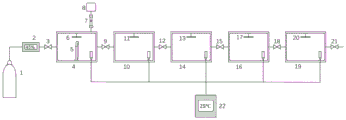
FIG. 1 is a test system diagram of VOC (volatile organic compound) release process of building materials in a multi-connected cabin
FIG. 2 is a linear fitting graph of the reciprocal of the equilibrium concentration of toluene released by building materials in the multi-connected cabin and the number of the environmental cabins
Detailed Description
The method provided by the invention can quickly, accurately and simultaneously measure the initial concentration C of the Volatile Organic Compounds (VOC) in the building materials0And a distribution coefficient K, wherein the used multi-cabin measuring method is described in detail in the following with reference to the attached drawings and examples:
the testing system for the VOC release process of the building materials in the multi-connected cabin is shown in figure 1, and is divided into four parts: the system comprises an environmental chamber system, a sampling system, a humidity control system and a temperature control system. The interior of the environmental chambers 4, 10, 14, 16, 19 is made of polished stainless steel material, and each environmental chamber is provided with an axial fan (reference numbers 6, 11, 13, 17, 20) at the top to ensure uniform mixing of the air in the chamber. The environment chamber is connected with the gas bottle 1 through valves 3, 9, 12, 15, 18 and 21. The humidity of the environmental chamber is regulated by the humidity control system 2, and the temperature is regulated by the temperature control system 22. And (3) placing the building material 5 to be detected in an environment chamber 4, sampling VOC gas at the outlet of the environment chamber by using a Dinitrophenylhydrazone (DNPH) adsorption tube or a Tenax-TA adsorption tube 7 at the outlet of the environment chamber, and then carrying out quantitative analysis by using a High Performance Liquid Chromatograph (HPLC) or a gas chromatography-mass spectrometer (GC-MS) 8.
Initial concentration C of this example0And the method for measuring the distribution coefficient K comprises the following steps:
1) establishing a physical model of the building material VOC release process in a multi-connected cabin (a plurality of closed cabins with zero ventilation frequency are connected); when the building material release process reaches equilibrium, the equilibrium concentration of VOC gas phase in the containment can be described as:


in this model: n represents the number of the closed cabins; cnThe gas phase equilibrium concentration of VOC is mu g/m when n closed cabins are connected3;C0Is the initial concentration of VOC in the building material, mu g/m3(ii) a K is the distribution coefficient of VOC at the building material/air interface; v is the volume of a single sealed chamber, m3;VmM is the volume of building material3;
2) Setting the temperature of the environmental chamber to be (25 +/-0.5) ° C and the humidity to be (45 +/-5)%, opening the valves 3, 9, 12, 15, 18 and 21 before the building material to be tested is put in, and introducing pure air without VOC in the gas cylinder 1 to create the condition that the initial gas phase concentration of VOC in a plurality of connected environmental chambers is zero;
3) after sufficient pure air is introduced, the valves 3, 9, 12, 15, 18 and 21 are closed, an indoor common medium-density board is selected as a building material to be tested, the medium-density board is quickly placed into the closed cabin 4 for VOC release test, the placing process of the building material is short, so that errors caused by the process can be ignored, and the size of the selected medium-density board is 0.02m multiplied by 0.003 m;
4) after the release process of the medium-density board reaches balance, selecting methylbenzene as a target pollutant, connecting a Tenax-TA adsorption tube with a high-precision sampling pump to sample methylbenzene gas at the outlet of a closed cabin, and then carrying out quantitative analysis on the sampled methylbenzene gas by using a gas chromatography-mass spectrometer (GC-MS) to obtain the concentration of the methylbenzene in the balanced environment cabin 4, wherein the concentration is recorded as the balance concentration when the number of the connected closed cabins is 1;
5) opening a valve 9 to communicate the environmental chamber 4 and the environmental chamber 10, when the releasing process is balanced again, measuring the concentration of the toluene gas, and recording as the balanced concentration when the number of the connected closed chambers is 2;
6) and (5) repeating the step, opening the valves 12, 15 and 18 in sequence, and measuring the release equilibrium concentration of the toluene gas when the number of the connected closed cabins is 3, 4 and 5. The test shows that when the number of the connected sealed cabins is 1, 2, 3, 4 and 5, the toluene equilibrium concentration in the sealed cabins is 4631 mu g/m3、4091.μg/m3、3744.μg/m3、3603.μg/m3、3379.μg/m3;
7) Drawing a scatter diagram of reciprocal equilibrium concentration and the number of the environmental chambers based on the gas-phase equilibrium concentration of VOC released by the building materials when the number of the associated closed chambers is different, wherein the drawing result is shown in figure 2, selecting data points in a linear relation, fitting by using an equation (1), and obtaining the slope A and the intercept B of a fitting straight line which are respectively 1.93 multiplied by 10-5、2.02×10⁻⁴The fitting results are shown in fig. 2;
8) substituting the slope A and the intercept B into the equations (2) and (3), and simultaneously solving the initial concentration C of the toluene in the medium density fiberboard0And the values of the distribution coefficient K are 1.29X 10 respectively7μg/m3And 2.62X 10³;
The principle of the invention is as follows: the built multi-connected cabin is formed by connecting a plurality of closed cabins, building materials are placed in a certain specific closed cabin for VOC release, the gas-phase equilibrium concentration of VOC in the cabin after the release equilibrium is obtained, the number of the connected closed cabins is changed by adjusting the opening and closing state of a valve, the equilibrium is repeatedly achieved for a plurality of times, a series of VOC gas-phase equilibrium concentrations corresponding to different closed cabins are obtained, and then measured equilibrium concentration data are arranged according to a physical modelIn the form of reciprocal, drawing a scatter diagram of the relation between the reciprocal of the equilibrium concentration and the quantity of the connected environment cabins, selecting points in a linear relation, and fitting to obtain a slope value and an intercept value, wherein the slope and the intercept are related to the initial concentration C0And a function of the distribution coefficient K, and two key parameters C of the building material VOC release process can be obtained by solving 2 equations0And the value of K.
Claims (1)


Priority Applications (1)
| Application Number | Priority Date | Filing Date | Title |
|---|---|---|---|
| CN202010931827.XA CN112098552B (en) | 2020-09-07 | 2020-09-07 | A multi-chamber method for determining the initial concentration and distribution coefficient of volatile organic compounds in building materials |
Applications Claiming Priority (1)
| Application Number | Priority Date | Filing Date | Title |
|---|---|---|---|
| CN202010931827.XA CN112098552B (en) | 2020-09-07 | 2020-09-07 | A multi-chamber method for determining the initial concentration and distribution coefficient of volatile organic compounds in building materials |
Publications (2)
| Publication Number | Publication Date |
|---|---|
| CN112098552A CN112098552A (en) | 2020-12-18 |
| CN112098552B true CN112098552B (en) | 2021-07-09 |
Family
ID=73751027
Family Applications (1)
| Application Number | Title | Priority Date | Filing Date |
|---|---|---|---|
| CN202010931827.XA Active CN112098552B (en) | 2020-09-07 | 2020-09-07 | A multi-chamber method for determining the initial concentration and distribution coefficient of volatile organic compounds in building materials |
Country Status (1)
| Country | Link |
|---|---|
| CN (1) | CN112098552B (en) |
Families Citing this family (4)
| Publication number | Priority date | Publication date | Assignee | Title |
|---|---|---|---|---|
| CN112881543A (en) * | 2021-01-08 | 2021-06-01 | 中山大学 | Device and method for measuring gas particle distribution coefficient of semi-volatile organic compounds |
| CN113361110B (en) * | 2021-06-09 | 2024-08-06 | 北京理工大学 | A method for determining release characteristic parameters of double-layer wooden furniture materials |
| CN114609342A (en) * | 2022-03-16 | 2022-06-10 | 中国第一汽车股份有限公司 | Method for measuring and calculating key emission parameters of VOC (volatile organic compound) of automotive interior material |
| CN117451941B (en) * | 2023-10-27 | 2025-10-21 | 西安交通大学 | A direct current environmental chamber method for determining VOC mass transfer characteristic parameters of flexible porous materials |
Citations (10)
| Publication number | Priority date | Publication date | Assignee | Title |
|---|---|---|---|---|
| US5447556A (en) * | 1994-03-04 | 1995-09-05 | Graseby-Anderson, Inc. | Sample injection apparatus and method |
| CN101650291A (en) * | 2009-09-04 | 2010-02-17 | 清华大学 | Test method for measuring mass transfer characteristic parameter of barrier layer on building material surface |
| CN101672837A (en) * | 2009-09-29 | 2010-03-17 | 清华大学 | Double-chamber system used for detecting emission characteristics of volatile organic compounds of indoor building materials |
| CN101881688A (en) * | 2010-06-13 | 2010-11-10 | 清华大学 | Standard distribution samples for testing the comprehensive performance of environmental chambers and their testing methods |
| CN107941933A (en) * | 2017-11-13 | 2018-04-20 | 北京理工大学 | The rapid assay methods of volatile organic matter release key parameter in a kind of wooden furniture |
| CN108107149A (en) * | 2018-01-19 | 2018-06-01 | 西安交通大学 | A kind of intermittent aeration method for measuring Measuring VOC emission characteristics of building materials parameter |
| WO2018199565A1 (en) * | 2017-04-24 | 2018-11-01 | 주식회사 엘지화학 | Method for determining process conditions for removing volatile organic compounds from polymer |
| CN110187025A (en) * | 2019-05-29 | 2019-08-30 | 北京卡达克数据有限公司 | It is a kind of car nonmetallic materials in VOC emission key parameter test method and device |
| CN110631853A (en) * | 2019-09-25 | 2019-12-31 | 北京理工大学 | A direct-flow cabin method for determining the emission characteristic parameters of volatile organic compounds in furniture |
| CN111562320A (en) * | 2020-01-09 | 2020-08-21 | 北京理工大学 | A method for simultaneous determination of characteristic parameters of semi-volatile organic compounds in source and sink materials |
Family Cites Families (1)
| Publication number | Priority date | Publication date | Assignee | Title |
|---|---|---|---|---|
| FR2988620B1 (en) * | 2012-03-29 | 2014-04-25 | Commissariat Energie Atomique | DEVICE AND METHOD FOR EXTRACTING COMPOUNDS CONTAINED IN A LIQUID SAMPLE FOR ANALYSIS |
-
2020
- 2020-09-07 CN CN202010931827.XA patent/CN112098552B/en active Active
Patent Citations (10)
| Publication number | Priority date | Publication date | Assignee | Title |
|---|---|---|---|---|
| US5447556A (en) * | 1994-03-04 | 1995-09-05 | Graseby-Anderson, Inc. | Sample injection apparatus and method |
| CN101650291A (en) * | 2009-09-04 | 2010-02-17 | 清华大学 | Test method for measuring mass transfer characteristic parameter of barrier layer on building material surface |
| CN101672837A (en) * | 2009-09-29 | 2010-03-17 | 清华大学 | Double-chamber system used for detecting emission characteristics of volatile organic compounds of indoor building materials |
| CN101881688A (en) * | 2010-06-13 | 2010-11-10 | 清华大学 | Standard distribution samples for testing the comprehensive performance of environmental chambers and their testing methods |
| WO2018199565A1 (en) * | 2017-04-24 | 2018-11-01 | 주식회사 엘지화학 | Method for determining process conditions for removing volatile organic compounds from polymer |
| CN107941933A (en) * | 2017-11-13 | 2018-04-20 | 北京理工大学 | The rapid assay methods of volatile organic matter release key parameter in a kind of wooden furniture |
| CN108107149A (en) * | 2018-01-19 | 2018-06-01 | 西安交通大学 | A kind of intermittent aeration method for measuring Measuring VOC emission characteristics of building materials parameter |
| CN110187025A (en) * | 2019-05-29 | 2019-08-30 | 北京卡达克数据有限公司 | It is a kind of car nonmetallic materials in VOC emission key parameter test method and device |
| CN110631853A (en) * | 2019-09-25 | 2019-12-31 | 北京理工大学 | A direct-flow cabin method for determining the emission characteristic parameters of volatile organic compounds in furniture |
| CN111562320A (en) * | 2020-01-09 | 2020-08-21 | 北京理工大学 | A method for simultaneous determination of characteristic parameters of semi-volatile organic compounds in source and sink materials |
Non-Patent Citations (10)
| Title |
|---|
| A rapid and accurate method, ventilated chamber C-history method, of measuring the emission characteristic parameters of formaldehyde/VOCs in building materials;Huang, Shaodan 等;《JOURNAL OF HAZARDOUS MATERIALS》;20131015;第261卷;第542-549页 * |
| Diffusion and sorption of volatile organic compounds through soil-cement materials;Goreham, Vincent C. 等;《ENVIRONMENTAL GEOTECHNICS》;20180630;第5卷(第3期);第134-145页 * |
| Impact of Temperature and Microstructure on the Emission Characteristics of VOC in Porous Building Materials;XiaojunZhou 等;《Procedia Engineering》;20150930;第121卷;第1067-1075页 * |
| Measurements of VOC/SVOC emission factors from burning incenses in an environmental test chamber: influence of temperature, relative humidity, and air exchange rate;Manoukian, A. 等;《ENVIRONMENTAL SCIENCE AND POLLUTION RESEARCH》;20151228;第23卷(第7期);第6300-6311页 * |
| Predicting the Gas/Particle Distribution of SVOCs in the Indoor Environment Using Poly Parameter Linear Free Energy Relationships;Salthammer, Tunga 等;《ENVIRONMENTAL SCIENCE & TECHNOLOGY》;20190305;第53卷(第5期);第2491-2499页 * |
| 室内物品和家具VOC散发环境舱设计思考和实践;刘巍巍 等;《暖通空调》;20131231;第43卷(第12期);第14-18页 * |
| 建材VOC散发特性研究:测定、微介观诠释及模拟;熊建银;《中国博士学位论文全文数据库 工程科技Ⅱ辑》;20110815(第8期);全文 * |
| 描述家具VOCs释放特性的简化模型研究;张翩翩 等;《工程热物理学报》;20181231;第39卷(第12期);第2761-2764页 * |
| 测定建材散发关键参数的密闭舱C-history方法与其他方法的比较;黄少丹 等;《化工学报》;20120531;第63卷(第S1期);第194-198页 * |
| 直流舱测定材料VOC散发关键参数的浓度轨迹法;杨韬 等;《化工学报》;20150531;第66卷(第S1期);第314-318页 * |
Also Published As
| Publication number | Publication date |
|---|---|
| CN112098552A (en) | 2020-12-18 |
Similar Documents
| Publication | Publication Date | Title |
|---|---|---|
| CN112098552A (en) | Multi-cabin method for measuring initial concentration and distribution coefficient of volatile organic compounds in building materials | |
| CN110631853B (en) | A direct current cabin method for determining the characteristic parameters of volatile organic compounds in furniture | |
| CN102162812B (en) | Method for quickly measuring building material emission key parameter | |
| Ouyang et al. | Recent developments in SPME for on-site analysis and monitoring | |
| CN107941933A (en) | The rapid assay methods of volatile organic matter release key parameter in a kind of wooden furniture | |
| Xiong et al. | Characterization of VOC emissions from composite wood furniture: Parameter determination and simplified model | |
| Sklorz et al. | Application of a miniaturised packed gas chromatography column and a SnO2 gas detector for analysis of low molecular weight hydrocarbons with focus on ethylene detection | |
| Liang et al. | The effect of humidity on formaldehyde emission parameters of a medium-density fiberboard: Experimental observations and correlations | |
| WO2012065330A1 (en) | Test method of moisturizing properties of tobacco | |
| CN111562320B (en) | A method for simultaneous determination of characteristic parameters of semi-volatile organic compounds in source and sink materials | |
| CN111829927A (en) | A method for determining the diffusion and distribution coefficients of sink materials | |
| Litvak et al. | On-line in situ determination of deuterium content in water via FTIR spectroscopy | |
| CN108918575A (en) | Step temperature rise that is a kind of while measuring building materials formaldehyde emission characterisitic parameter under multi-temperature is closed to distribute method | |
| CN113655149B (en) | A method for determining the characteristic parameters and adsorption constants of semi-volatile organic compounds in materials | |
| CN105372195A (en) | Microscale ultraviolet spectrophotometer quality detection method and kit | |
| CN113361110B (en) | A method for determining release characteristic parameters of double-layer wooden furniture materials | |
| Verbraeken et al. | Accurate blank corrections for zero length column experiments | |
| Zabielski et al. | Influence of mass transport and quenching on nitric oxide chemiluminescent analysis | |
| Brown et al. | Diffusive sampling using tube-type samplers | |
| CN104931639B (en) | The device and method of SVOC emission characteristics parameter in a kind of quick mensuration material | |
| Luo et al. | Determination of water vapor diffusion and partition coefficients in cement using one FLEC | |
| Arendes et al. | Qualification and optimisation of a gas mixing apparatus for complex trace gas mixtures | |
| CN110780002A (en) | High-efficiency low-cost detection method for quantifying essential oil components | |
| Østergaard et al. | SI-traceable water content measurements in solids, bulks, and powders | |
| Eganhouse et al. | Determination of 1-chloro-4-[2, 2, 2-trichloro-1-(4-chlorophenyl) ethyl] benzene and related compounds in marine pore water by automated thermal desorption-gas chromatography/mass spectrometry using disposable optical fiber |
Legal Events
| Date | Code | Title | Description |
|---|---|---|---|
| PB01 | Publication | ||
| PB01 | Publication | ||
| SE01 | Entry into force of request for substantive examination | ||
| SE01 | Entry into force of request for substantive examination | ||
| GR01 | Patent grant | ||
| GR01 | Patent grant |