CN111817841B - Blind time sequence error detection method, system and storage medium suitable for low signal-to-noise ratio - Google Patents
Blind time sequence error detection method, system and storage medium suitable for low signal-to-noise ratio Download PDFInfo
- Publication number
- CN111817841B CN111817841B CN202010513172.4A CN202010513172A CN111817841B CN 111817841 B CN111817841 B CN 111817841B CN 202010513172 A CN202010513172 A CN 202010513172A CN 111817841 B CN111817841 B CN 111817841B
- Authority
- CN
- China
- Prior art keywords
- timing error
- subcarrier
- error detection
- ofdm symbol
- noise ratio
- Prior art date
- Legal status (The legal status is an assumption and is not a legal conclusion. Google has not performed a legal analysis and makes no representation as to the accuracy of the status listed.)
- Active
Links
Images


Classifications
-
- H—ELECTRICITY
- H04—ELECTRIC COMMUNICATION TECHNIQUE
- H04L—TRANSMISSION OF DIGITAL INFORMATION, e.g. TELEGRAPHIC COMMUNICATION
- H04L7/00—Arrangements for synchronising receiver with transmitter
- H04L7/0054—Detection of the synchronisation error by features other than the received signal transition
- H04L7/0062—Detection of the synchronisation error by features other than the received signal transition detection of error based on data decision error, e.g. Mueller type detection
-
- H—ELECTRICITY
- H04—ELECTRIC COMMUNICATION TECHNIQUE
- H04B—TRANSMISSION
- H04B3/00—Line transmission systems
- H04B3/54—Systems for transmission via power distribution lines
-
- H—ELECTRICITY
- H04—ELECTRIC COMMUNICATION TECHNIQUE
- H04L—TRANSMISSION OF DIGITAL INFORMATION, e.g. TELEGRAPHIC COMMUNICATION
- H04L27/00—Modulated-carrier systems
- H04L27/26—Systems using multi-frequency codes
- H04L27/2601—Multicarrier modulation systems
- H04L27/2647—Arrangements specific to the receiver only
- H04L27/2655—Synchronisation arrangements
- H04L27/2668—Details of algorithms
- H04L27/2673—Details of algorithms characterised by synchronisation parameters
- H04L27/2676—Blind, i.e. without using known symbols
-
- Y—GENERAL TAGGING OF NEW TECHNOLOGICAL DEVELOPMENTS; GENERAL TAGGING OF CROSS-SECTIONAL TECHNOLOGIES SPANNING OVER SEVERAL SECTIONS OF THE IPC; TECHNICAL SUBJECTS COVERED BY FORMER USPC CROSS-REFERENCE ART COLLECTIONS [XRACs] AND DIGESTS
- Y02—TECHNOLOGIES OR APPLICATIONS FOR MITIGATION OR ADAPTATION AGAINST CLIMATE CHANGE
- Y02D—CLIMATE CHANGE MITIGATION TECHNOLOGIES IN INFORMATION AND COMMUNICATION TECHNOLOGIES [ICT], I.E. INFORMATION AND COMMUNICATION TECHNOLOGIES AIMING AT THE REDUCTION OF THEIR OWN ENERGY USE
- Y02D30/00—Reducing energy consumption in communication networks
- Y02D30/70—Reducing energy consumption in communication networks in wireless communication networks
Landscapes
- Engineering & Computer Science (AREA)
- Computer Networks & Wireless Communication (AREA)
- Signal Processing (AREA)
- Power Engineering (AREA)
- Synchronisation In Digital Transmission Systems (AREA)
Abstract
本发明公开一种适用于低信噪比的盲时序误差检测方法、系统及存储介质,方法包括步骤:对每一个OFDM符号的每一个子载波进行频域均衡以消除信道相位的影响;采用定时误差检测模块对每一个OFDM符号的每一个子载波进行判决以消除信息相位的影响;对每一个OFDM符号的每一个子载波进行估计运算以提取定时误差em。本发明重点在于定时误差检测模块,主要利用定时误差检测技术消除了信息相位的影响并提取出定时误差,从而只需要对一个OFDM符号进行估计运算;而且运用判决机制避免了使用导频,从而可以提高通信速率;再利用Early‑late思想提取相应的定时误差,并送入环路滤波器;适用于信噪比非常低的电力线环境。
The invention discloses a blind timing error detection method, system and storage medium suitable for low signal-to-noise ratio. The error detection module judges each subcarrier of each OFDM symbol to eliminate the influence of information phase; performs estimation operation on each subcarrier of each OFDM symbol to extract the timing error em . The focus of the present invention lies in the timing error detection module, which mainly uses the timing error detection technology to eliminate the influence of the information phase and extract the timing error, so that only one OFDM symbol needs to be estimated and calculated; and the use of the judgment mechanism avoids the use of pilot frequency, so that it can Improve the communication rate; then use the Early-late idea to extract the corresponding timing error and send it to the loop filter; it is suitable for the power line environment with a very low signal-to-noise ratio.
Description
技术领域technical field
本发明涉及盲时序误差检测技术领域,更具体地,涉及一种适用于低信噪比的盲时序误差检测方法、系统及存储介质。The present invention relates to the technical field of blind timing error detection, and more particularly, to a blind timing error detection method, system and storage medium suitable for low signal-to-noise ratios.
背景技术Background technique
正交频分复用技术(Orthogonal Frequency Division Multiplexing,OFDM),由MCM(Multi-Carrier Modulation,多载波调制)发展而来。OFDM技术是多载波传输方案的实现方式之一,它的调制和解调是分别基于IFFT和FFT来实现的,是实现复杂度最低、应用最广的一种多载波传输方案。OFDM主要思想是:将信道分成若干正交子信道,将高速数据信号转换成并行的低速子数据流,调制到在每一个子信道上进行传输。正交信号可以通过在接收端采用相关技术来分开,这样可以减少子信道之间的相互干扰(ISI)。每一个子信道上的信号带宽小于信道的相关带宽,因此,每一个子信道上可以看成平坦性衰落,在加上循环前缀CP,从而可以消除码间串扰,而且由于每一个子信道的带宽仅仅是原信道带宽的一小部分,信道均衡变得相对容易。Orthogonal Frequency Division Multiplexing (OFDM) is developed from MCM (Multi-Carrier Modulation, multi-carrier modulation). OFDM technology is one of the implementation methods of multi-carrier transmission schemes. Its modulation and demodulation are realized based on IFFT and FFT respectively. It is a multi-carrier transmission scheme with the lowest implementation complexity and the most widely used. The main idea of OFDM is: divide the channel into several orthogonal sub-channels, convert high-speed data signals into parallel low-speed sub-data streams, and modulate them for transmission on each sub-channel. Orthogonal signals can be separated by using correlation techniques at the receiver, which can reduce the mutual interference (ISI) between subchannels. The signal bandwidth on each subchannel is smaller than the relevant bandwidth of the channel. Therefore, each subchannel can be regarded as flat fading, and the cyclic prefix CP is added to eliminate intersymbol interference, and because the bandwidth of each subchannel Only a fraction of the original channel bandwidth, channel equalization becomes relatively easy.
由于OFDM技术的优势,被广泛使用在各种通信系统中,如LTE、WLAN、PLC等等。但是由于实际通信系统中存在采样偏差(SFO)的原因,导致各个子载波的正交性被破坏,从而在接收端会引入ICI(Inter-Channel Interference,即信道间干扰)干扰,还会引起相应子载波幅度和相位上的失真,降低了通信的质量。所以,接收端必须对SFO进行相应的估计和补偿,以保证通信的质量。Due to the advantages of OFDM technology, it is widely used in various communication systems, such as LTE, WLAN, PLC and so on. However, due to the sampling offset (SFO) in the actual communication system, the orthogonality of each subcarrier is destroyed, which will introduce ICI (Inter-Channel Interference, that is, inter-channel interference) interference at the receiving end, and will also cause corresponding Distortion in subcarrier amplitude and phase degrades communication quality. Therefore, the receiving end must estimate and compensate the SFO accordingly to ensure the quality of communication.
目前,SFO对每一个OFDM符号的定时误差的提取主要是通过导频并利用前后2个OFDM符号的相位差来估计相应的采样偏差,然后反馈到前面的补偿回路来进行相应的修正。但该方法由于插入了导频从而必然会降低速率,其次,由于是利用前后2个OFDM符号进行差分操作,如果在低信噪比环境下,必然会引入较大的噪声,从而估计误差会很大,此种方式一般只适合信道条件比较好的环境。在电力线环境下,由于噪声很大,极大的恶化定时误差的性能,从而导致整个环路不能很好的收敛到期望值。At present, SFO extracts the timing error of each OFDM symbol mainly by using the pilot frequency and using the phase difference of the two OFDM symbols before and after to estimate the corresponding sampling deviation, and then feeds back to the previous compensation loop for corresponding correction. However, this method will inevitably reduce the rate due to the insertion of pilots. Secondly, because it uses two OFDM symbols before and after the differential operation, if it is in a low signal-to-noise ratio environment, it will inevitably introduce large noise, so the estimation error will be very large. This method is generally only suitable for environments with relatively good channel conditions. In the power line environment, due to the large noise, the performance of the timing error is greatly deteriorated, so that the entire loop cannot converge well to the expected value.
发明内容Contents of the invention
本发明要解决的技术问题在于,针对现有技术的上述缺陷,提供一种适用于低信噪比的盲时序误差检测方法、系统及存储介质。The technical problem to be solved by the present invention is to provide a blind timing error detection method, system and storage medium suitable for low signal-to-noise ratio in view of the above-mentioned defects of the prior art.
本发明解决其技术问题所采用的技术方案是:根据本发明的第一方面,提供一种适用于低信噪比的盲时序误差检测方法,包括步骤:The technical solution adopted by the present invention to solve the technical problem is: according to the first aspect of the present invention, a blind timing error detection method suitable for low signal-to-noise ratio is provided, comprising steps:
对每一个OFDM符号的每一个子载波进行频域均衡以消除信道相位的影响;Frequency-domain equalization is performed on each subcarrier of each OFDM symbol to eliminate the influence of channel phase;
采用定时误差检测模块对每一个所述OFDM符号的每一个子载波进行判决以消除信息相位的影响;Using a timing error detection module to judge each subcarrier of each OFDM symbol to eliminate the influence of information phase;
对每一个所述OFDM符号的每一个子载波进行估计运算以提取定时误差em;performing an estimation operation on each subcarrier of each of said OFDM symbols to extract a timing error em ;
每一个所述OFDM符号包括多个不同的子载波,假设第m个所述OFDM符号的第k个子载波的子载波数据为ym(k),第k个所述子载波的信道系数为hk;Each of the OFDM symbols includes a plurality of different subcarriers, assuming that the subcarrier data of the kth subcarrier of the mth OFDM symbol is y m (k), and the channel coefficient of the kth subcarrier is h k ;
所述对每一个OFDM符号的每一个子载波进行频域均衡以消除信道相位的影响,具体为:The frequency domain equalization is performed on each subcarrier of each OFDM symbol to eliminate the influence of the channel phase, specifically:
对每一个所述OFDM符号的子载波进行频域均衡得到子载波数据xm(k);Perform frequency domain equalization on the subcarriers of each OFDM symbol to obtain subcarrier data x m (k);
所述采用定时误差检测模块对每一个所述OFDM符号的每一个子载波进行判决以消除信息相位的影响,具体包括步骤:Said adopting the timing error detection module to judge each subcarrier of each said OFDM symbol to eliminate the influence of information phase, specifically includes the steps of:
对每一个所述子载波数据xm(k)采用判决机制消除信息相位的影响得到phm(k);For each of the subcarrier data x m (k), a decision mechanism is used to eliminate the influence of the information phase to obtain ph m (k);
采用Early-late方法对每一个所述phm(k)分别前后取值得到Ye(k)和Yl(k);Adopt the Early-late method to obtain Y e (k) and Y l (k) respectively before and after each described ph m (k);
所述对每一个所述OFDM符号的子载波进行频域均衡,经过所述频域均衡之后的所述子载波数据xm(k)为:The frequency domain equalization is performed on the subcarriers of each of the OFDM symbols, and the subcarrier data x m (k) after the frequency domain equalization is:
xm(k)=ym(k)/hk (1);x m (k) = y m (k)/h k (1);
在所述对每一个OFDM符号的每一个子载波进行频域均衡以消除信道相位的影响步骤之前,还包括:Before the step of performing frequency domain equalization on each subcarrier of each OFDM symbol to eliminate the influence of channel phase, it also includes:
接收至少一个OFDM符号;receiving at least one OFDM symbol;
在所述对每一个所述OFDM符号的每一个子载波进行估计运算以提取定时误差em步骤之后,还包括:After the step of performing an estimation operation on each subcarrier of each of the OFDM symbols to extract the timing error em , it also includes:
将所述定时误差em送入环路滤波器;sending said timing error e m into a loop filter;
将所述环路滤波器处理后的信号送入数控振荡器。The signal processed by the loop filter is sent to a numerically controlled oscillator.
优选地,所述对每一个所述子载波数据采用判决机制消除信息相位的影响得到phm(k),具体为:Preferably, the use of a decision mechanism for each of the subcarrier data to eliminate the influence of the information phase to obtain ph m (k), specifically:
对经过所述频域均衡之后的每一个所述子载波数据xm(k)采用判决机制得到相应的dm(k),然后消除信道相位的影响得到所述phm(k):For each of the subcarrier data x m (k) after the frequency domain equalization, a decision mechanism is used to obtain the corresponding d m (k), and then the influence of the channel phase is eliminated to obtain the ph m (k):
dm(k)=fun(xm(k)) (2)d m (k) = fun(x m (k)) (2)
phm(k)=xm(k)/dm(k) (3)ph m (k) = x m (k)/d m (k) (3)
其中,所述fun()为判决机制。Wherein, the fun() is a judgment mechanism.
优选地,所述采用Early-late方法对每一个所述phm(k)分别前后取值得到Ye(k)和Yl(k),具体为:Preferably, the early-late method is used to obtain Y e (k) and Y l (k) by taking values before and after each of the ph m (k), specifically:
Ye(k)=phm(k)·e-j2πkδ/N Y e (k) = ph m (k) · e -j2πkδ/N
Yl(k)=phm(k)·ej2πkδ/N (4)。Y l (k)=ph m (k)·e j2πkδ/N (4).
优选地,所述对每一个所述OFDM符号的每一个子载波进行运算以提取定时误差em,所述定时误差em具体公式为:Preferably, the operation is performed on each subcarrier of each OFDM symbol to extract the timing error em , and the specific formula of the timing error em is:

根据本发明另一方面,还提供一种适用于低信噪比的盲时序误差检测系统,所述适用于低信噪比的盲时序误差检测系统,包括:According to another aspect of the present invention, a blind timing error detection system suitable for low signal-to-noise ratio is also provided, and the blind timing error detection system suitable for low signal-to-noise ratio includes:
一个或多个处理器;one or more processors;
存储器,用于存储一个或多个计算机程序,一个或多个所述处理器用于执行所述存储器存储的一个或多个计算机程序,以使一个或多个所述处理器执行如上文所述的适用于低信噪比的盲时序误差检测方法。Memory for storing one or more computer programs, one or more of said processors for executing one or more computer programs stored in said memory, so that one or more of said processors perform the above-mentioned Blind timing error detection method for low signal-to-noise ratio.
根据本发明另一方面,还提供一种计算机可读的存储介质,所述存储介质上存储有计算机程序,所述计算机程序被执行时实现如上文所述的适用于低信噪比的盲时序误差检测方法。According to another aspect of the present invention, there is also provided a computer-readable storage medium, on which a computer program is stored, and when the computer program is executed, the blind timing suitable for low signal-to-noise ratio as described above is realized. Error detection method.
实施本发明适用于低信噪比的盲时序误差检测方法及系统的技术方案,具有如下优点或有益效果:本发明重点在于定时误差检测模块,主要利用定时误差检测技术消除了信息相位的影响并提取出定时误差,从而只需要对一个OFDM符号进行估计运算;而且运用判决机制避免了使用导频,从而可以提高通信速率;再利用Early-late思想提取相应的定时误差,并送入环路滤波器;适用于信噪比非常低的电力线环境,效果非常好。Implementing the technical scheme of the blind timing error detection method and system suitable for low signal-to-noise ratio of the present invention has the following advantages or beneficial effects: the present invention focuses on the timing error detection module, which mainly utilizes the timing error detection technology to eliminate the influence of the information phase and The timing error is extracted, so that only one OFDM symbol needs to be estimated; and the judgment mechanism is used to avoid the use of pilot frequency, so that the communication rate can be improved; then the early-late idea is used to extract the corresponding timing error, and send it to the loop filter It is suitable for the power line environment with very low signal-to-noise ratio, and the effect is very good.
附图说明Description of drawings
为了更清楚地说明本发明实施例的技术方案,下面将对实施例描述中所需要使用的附图作简单的介绍,显而易见,下面描述中的附图仅仅是本发明的一些实施例,对于本领域普通技术人员来讲,在不付出创造性劳动的前提下,还可以根据这些附图获得其他的附图,附图中:In order to more clearly illustrate the technical solutions of the embodiments of the present invention, the following will briefly introduce the accompanying drawings that need to be used in the description of the embodiments. Obviously, the accompanying drawings in the following description are only some embodiments of the present invention. Those of ordinary skill in the art can also obtain other drawings based on these drawings without creative labor. In the drawings:
图1是OFDM通信系统中采样偏差的估计和补偿的一般流程图;Figure 1 is a general flowchart of estimation and compensation of sampling bias in an OFDM communication system;
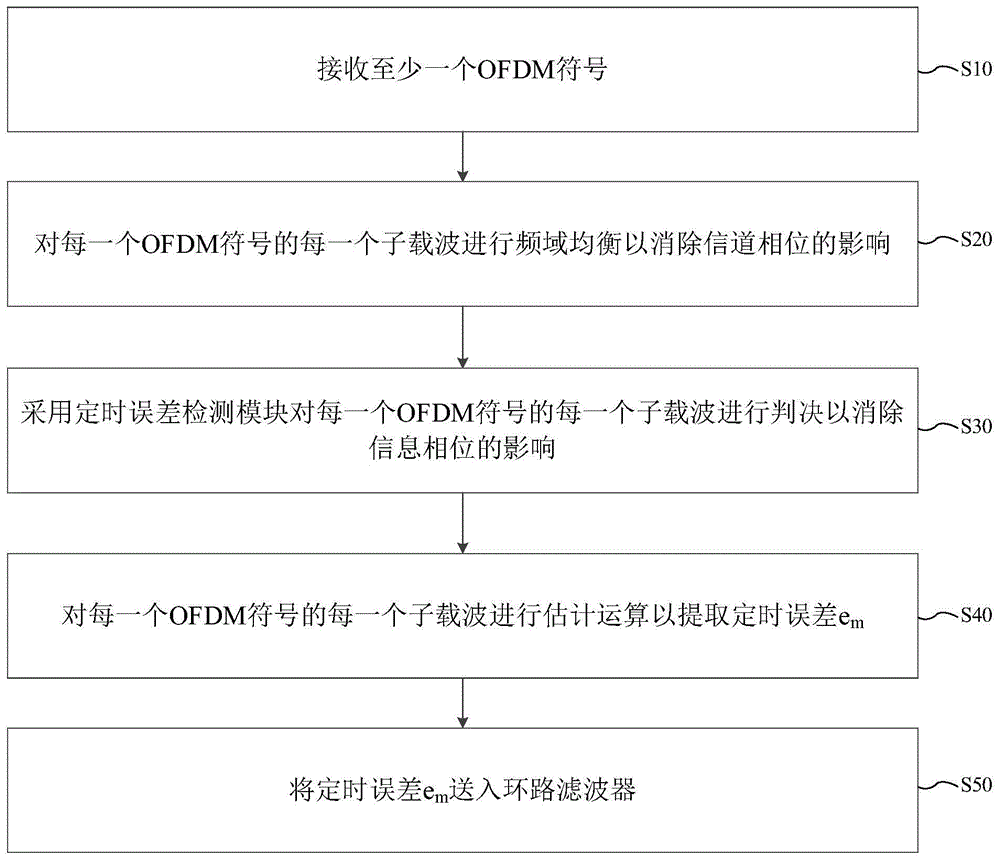
图2是本发明适用于低信噪比的盲时序误差检测方法实施例的流程图。FIG. 2 is a flow chart of an embodiment of the blind timing error detection method suitable for low signal-to-noise ratio in the present invention.
具体实施方式Detailed ways
为了使本发明的目的、技术方案及优点更加清楚明白,下文将要描述的各种示例性实施示例将要参考相应的附图,这些附图构成了示例性实施例的一部分,其中描述了实现本发明可能采用的各种示例性实施例,除非另有表示,不同附图中的相同数字表示相同或相似的要素。以下示例性实施例中所描述的实施方式并不代表与本公开相一致的所有实施方式。应明白,它们仅是与如所附权利要求书中所详述的、本发明公开的一些方面相一致的装置和方法的例子,还可使用其他的实施例,或者对本文列举的实施例进行结构和功能上的修改,而不会脱离本发明的范围和实质。在其他情况中,省略对众所周知的系统、装置、电路以及方法的详细说明,以免不必要的细节妨碍本发明的描述。In order to make the purpose, technical solutions and advantages of the present invention clearer, the various exemplary implementation examples to be described below will refer to the corresponding drawings, which constitute a part of the exemplary embodiments, and describe the implementation of the present invention. Various exemplary embodiments that may be employed, and unless otherwise indicated, the same numerals in different drawings indicate the same or similar elements. The implementations described in the following exemplary examples do not represent all implementations consistent with the present disclosure. It is to be understood that these are merely examples of apparatuses and methods consistent with aspects of the present disclosure as detailed in the appended claims and that other embodiments may be used, or modifications to, the embodiments set forth herein. structural and functional modifications without departing from the scope and spirit of the present invention. In other instances, detailed descriptions of well-known systems, devices, circuits, and methods are omitted so as not to obscure the description of the present invention with unnecessary detail.
为了说明本发明所述的技术方案,下面通过具体实施例来进行说明。In order to illustrate the technical solutions of the present invention, specific examples are used below to illustrate.
实施例一:Embodiment one:
在一般的通信模块和设备中,在其接收端的基带中,由于ADC采样时钟偏差(SFO)的原因,在其基带一般都会有定时误差检测模块(Timing Error Detector,TED)(简称TED模块)。In general communication modules and devices, in the baseband of the receiving end, due to the ADC sampling clock deviation (SFO), there is generally a timing error detection module (Timing Error Detector, TED) (referred to as the TED module) in the baseband.
如图1所示,图中描述了OFDM通信系统中采样偏差(SFO)的估计和补偿的一般流程图;INTERP模块是指时域插值模块,依据当前NCO的值来调整输入信号的采样偏差,以补偿估计运算出来的定时误差;FFT模块是指将时域的OFDM信号转换到频域,从而得到每一个子载波的接收数据ym(k);FEQ模块是指将当前的OFDM符号的每一个子载波进行频域均衡,得到xm(k),从而消除了信道相位的影响;TED模块是指依据当前频域均衡之后的信号,进行判决以消除信息相位的影响,同时进行定时误差的估计运算;LF模块(loop filter)是指环路滤波器,进一步对TED估计运算出来的定时误差进行滤波以消除高频噪声的影响;NCO模块是指数控振荡器,依据LF出来的信号来调节采样偏差的影响。As shown in Figure 1, the general flowchart of the estimation and compensation of sampling offset (SFO) in the OFDM communication system is described in the figure; the INTERP module refers to the time domain interpolation module, which adjusts the sampling offset of the input signal according to the current NCO value, To compensate the timing error estimated and calculated; the FFT module refers to converting the OFDM signal in the time domain to the frequency domain, thereby obtaining the received data y m (k) of each subcarrier; the FEQ module refers to converting each subcarrier of the current OFDM symbol A subcarrier is equalized in the frequency domain to obtain x m (k), thereby eliminating the influence of the channel phase; the TED module is based on the signal after the current frequency domain equalization, making a decision to eliminate the influence of the information phase, and at the same time the timing error Estimation operation; LF module (loop filter) refers to the loop filter, which further filters the timing error calculated by TED estimation to eliminate the influence of high-frequency noise; NCO module refers to the numerical control oscillator, which adjusts the sampling according to the signal from LF The effect of deviation.
本发明的重点在于定时误差检测模块,其主要利用相干检测技术来消除了信息相位的影响并提取出定时误差,从而只需要对一个OFDM符号进行估计运算;而且运用判决机制避免了使用导频,从而可以提高通信速率;再利用Early-late思想提取相应的定时误差,并送入环路滤波器;本发明适用于信噪比非常低的电力线环境。The focus of the present invention is the timing error detection module, which mainly utilizes the coherent detection technology to eliminate the influence of the information phase and extract the timing error, so that only one OFDM symbol needs to be estimated; and the use of the judgment mechanism avoids the use of pilot frequency, Therefore, the communication rate can be improved; the early-late idea is used to extract the corresponding timing error and sent to the loop filter; the invention is suitable for the power line environment with a very low signal-to-noise ratio.
如图2所示,本发明提供一种适用于低信噪比的盲时序误差检测方法实施例,包括步骤:As shown in Figure 2, the present invention provides an embodiment of a blind timing error detection method suitable for low SNR, including steps:
S10、接收至少一个OFDM符号;S10. Receive at least one OFDM symbol;
S20、对每一个OFDM符号的每一个子载波进行频域均衡以消除信道相位的影响;S20. Perform frequency-domain equalization on each subcarrier of each OFDM symbol to eliminate the influence of channel phase;
S30、采用定时误差检测模块对每一个OFDM符号的每一个子载波进行判决以消除信息相位的影响;具体的,采用定时误差检测模块对每一个OFDM符号的每一个子载波频域均衡之后的信号做判决以消除信息相位的影响;S30. Use the timing error detection module to judge each subcarrier of each OFDM symbol to eliminate the influence of the information phase; specifically, use the timing error detection module to perform frequency domain equalization on each subcarrier of each OFDM symbol. Make decisions to remove the influence of information phase;
S40、对每一个OFDM符号的每一个子载波进行估计运算以提取定时误差em;S40. Perform an estimation operation on each subcarrier of each OFDM symbol to extract the timing error em ;
S50、将所述定时误差em送入环路滤波器。具体的,将所述定时误差em(timingerror)送入环路滤波器(Loop Filter或者环路滤波),通过长期统计使得定时误差更为准确。S50. Send the timing error e m to a loop filter. Specifically, the timing error em (timingerror) is sent to a loop filter (Loop Filter or loop filter), and the timing error is made more accurate through long-term statistics.
在本实施例中,每一个OFDM符号可以包括多个不同的子载波,假设第m个OFDM符号的第k个子载波的子载波数据为ym(k),第k个子载波的信道系数为hk,OFDM符号在不同的系统其数量不一样,可以是任意值。In this embodiment, each OFDM symbol may include a plurality of different subcarriers, assuming that the subcarrier data of the kth subcarrier of the mth OFDM symbol is y m (k), and the channel coefficient of the kth subcarrier is h k , the number of OFDM symbols is different in different systems, and can be any value.
S20、对每一个OFDM符号的每一个子载波进行频域均衡以消除信道相位的影响。S20. Perform frequency domain equalization on each subcarrier of each OFDM symbol to eliminate the influence of channel phase.
具体的,对每一个OFDM符号的子载波进行频域均衡得到子载波数据xm(k);具体的,对每一个OFDM符号的子载波进行频域均衡,经过频域均衡之后的子载波数据xm(k)为:Specifically, frequency domain equalization is performed on the subcarriers of each OFDM symbol to obtain subcarrier data x m (k); specifically, frequency domain equalization is performed on the subcarriers of each OFDM symbol, and the subcarrier data after frequency domain equalization x m (k) is:
xm(k)=ym(k)/hk (1)。x m (k) = y m (k)/h k (1).
S30、所述采用定时误差检测模块对每一个OFDM符号的每一个子载波进行判决以消除信息相位的影响,具体包括以下步骤:S30, the use of the timing error detection module to judge each subcarrier of each OFDM symbol to eliminate the influence of information phase, specifically includes the following steps:
S31、对每一个子载波数据xm(k)采用判决机制消除信息相位的影响得到phm(k),具体的,对经过频域均衡之后的每一个子载波数据xm(k)采用判决机制得到相应的dm(k),然后消除信息相位的影响得到phm(k):S31. Use a decision mechanism for each subcarrier data x m (k) to eliminate the influence of the information phase to obtain ph m (k). Specifically, use a decision mechanism for each subcarrier data x m (k) after frequency domain equalization mechanism to obtain the corresponding d m (k), and then eliminate the influence of the information phase to obtain ph m (k):
dm(k)=fun(xm(k)) (2)d m (k) = fun(x m (k)) (2)
phm(k)=xm(k)/dm(k) (3)ph m (k) = x m (k)/d m (k) (3)
其中,所述判决机制并没有直接公式,判决机制的抽象公式为fun(),fun()为判决机制,即为硬判(Direct-decided)机制。Wherein, the decision mechanism does not have a direct formula, and the abstract formula of the decision mechanism is fun(), and fun() is a decision mechanism, that is, a direct-decided mechanism.
S32、采用Early-late方法对每一个phm(k)分别前后取值得到Ye(k)和Yl(k)。S32. Using the Early-late method to obtain Y e (k) and Y l (k) respectively for each ph m (k) before and after the value.
具体的,所述采用Early-late方法对每一个phm(k)分别前后取值得到Ye(k)和Yl(k),具体为:Specifically, the early-late method is used to obtain Y e (k) and Y l (k) by taking values before and after each ph m (k), specifically:

S40、对每一个OFDM符号的每一个子载波进行估计运算以提取定时误差em,定时误差em具体公式为:S40. Perform an estimation operation on each subcarrier of each OFDM symbol to extract the timing error em , and the specific formula of the timing error em is:

本发明重点在于TED模块,主要利用定时误差检测技术消除了信道的影响,从而只需要对一个OFDM符号进行估计;而且运用判决机制避免了使用导频,从而可以提高通信速率;再利用Early-late思想提取相应的定时误差,适用于如低信噪比环境下的电力线环境。The focus of the present invention lies in the TED module, which mainly uses the timing error detection technology to eliminate the influence of the channel, so that only one OFDM symbol needs to be estimated; and the use of the judgment mechanism avoids the use of pilots, thereby improving the communication rate; and then using the Early-late The idea is to extract the corresponding timing error, which is suitable for power line environments such as low signal-to-noise ratio environments.
实施例二:Embodiment two:
本发明还提供一种适用于低信噪比的盲时序误差检测系统实施例,包括一个或多个处理器及存储器;其中,所述存储器用于存储一个或多个计算机程序,所述一个或多个处理器用于执行存储器存储的一个或多个计算机程序,以使处理器执行实施例一所述的适用于低信噪比的盲时序误差检测方法实施例的步骤。The present invention also provides an embodiment of a blind timing error detection system suitable for low signal-to-noise ratios, including one or more processors and memories; wherein, the memories are used to store one or more computer programs, and the one or more Multiple processors are used to execute one or more computer programs stored in the memory, so that the processors execute the steps of the embodiment of the blind timing error detection method suitable for low signal-to-noise ratio described in the first embodiment.
实施例三:Embodiment three:
本发明还提供一种计算机可读的存储介质,本领域普通技术人员可以理解,实现上述各方法实施例的全部或部分步骤可以通过计算机程序相关的硬件来完成。前述的计算机程序可以存储于一计算机可读的存储介质中,存储介质上存储有计算机程序,所述计算机程序被(如处理器)执行时,执行实施例一所述的适用于低信噪比的盲时序误差检测方法的步骤,而前述的存储介质包括:ROM、RAM、磁碟或者光盘等各种可以存储程序代码的介质。The present invention also provides a computer-readable storage medium. Those skilled in the art can understand that all or part of the steps in the above-mentioned method embodiments can be completed by hardware related to computer programs. The foregoing computer program can be stored in a computer-readable storage medium, and the storage medium is stored with a computer program. When the computer program is executed (such as by a processor), the method described in Embodiment 1 that is suitable for low signal-to-noise ratio is executed. The steps of the blind timing error detection method, and the aforementioned storage medium includes: ROM, RAM, magnetic disk or optical disk and other various media that can store program codes.
在阅读完本文描述的内容之后,本领域的技术人员应当明白,本文描述的各种特征可通过方法、数据处理系统或计算机程序产品来实现。因此,这些特征可不采用硬件的方式、全部采用软件的方式或者采用硬件和软件结合的方式来表现。此外,上述特征也可采用存储在一种或多种计算机可读存储介质上的计算机程序产品的形式来表现,该计算机可读存储介质中包含计算机可读程序代码段或者指令,其存储在存储介质中。可读存储介质被配置为存储各种类型的数据以支持在装置的操作。可读存储介质可以由任何类型的易失性或非易失性存储设备或者它们的组合实现。如静硬态盘、随机存取存储器(SRAM)、电可擦除可编程只读存储器(EEPROM)、可擦除可编程只读存储器(EPROM)、可编程只读存储器(PROM)、只读存储器(ROM)、光存储设备、磁存储设备、快闪存储器、磁盘或光盘和/或上述设备的组合。After reading the content described herein, those skilled in the art should understand that various features described herein can be implemented by methods, data processing systems or computer program products. Therefore, these features may not be represented by hardware, all by software, or a combination of hardware and software. In addition, the above-mentioned features may also be embodied in the form of a computer program product stored on one or more computer-readable storage media, the computer-readable storage medium contains computer-readable program code segments or instructions, which are stored in the storage medium. The readable storage medium is configured to store various types of data to support operations at the device. A readable storage medium may be implemented by any type or combination of volatile or nonvolatile storage devices. Such as static hard disk, random access memory (SRAM), electrically erasable programmable read-only memory (EEPROM), erasable programmable read-only memory (EPROM), programmable read-only memory (PROM), read-only Memory (ROM), optical storage, magnetic storage, flash memory, magnetic or optical disks and/or combinations thereof.
以上仅为本发明的较佳实施例而已,本领域技术人员知悉,在不脱离本发明的精神和范围的情况下,可以对这些特征和实施例进行各种改变或等同替换。另外,在本发明的教导下,可以对这些特征和实施例进行修改以适应具体的情况及材料而不会脱离本发明的精神和范围。因此,本发明不受此处所公开的具体实施例的限制,所有落入本申请的权利要求范围内的实施例都属于本发明的保护范围。The above are only preferred embodiments of the present invention, and those skilled in the art know that various changes or equivalent replacements can be made to these features and embodiments without departing from the spirit and scope of the present invention. In addition, the features and examples may be modified to adapt a particular situation and material to the teachings of the invention without departing from the spirit and scope of the invention. Therefore, the present invention is not limited by the specific embodiments disclosed here, and all embodiments falling within the scope of the claims of the present application belong to the protection scope of the present invention.
Claims (6)

Priority Applications (1)
| Application Number | Priority Date | Filing Date | Title |
|---|---|---|---|
| CN202010513172.4A CN111817841B (en) | 2020-06-08 | 2020-06-08 | Blind time sequence error detection method, system and storage medium suitable for low signal-to-noise ratio |
Applications Claiming Priority (1)
| Application Number | Priority Date | Filing Date | Title |
|---|---|---|---|
| CN202010513172.4A CN111817841B (en) | 2020-06-08 | 2020-06-08 | Blind time sequence error detection method, system and storage medium suitable for low signal-to-noise ratio |
Publications (2)
| Publication Number | Publication Date |
|---|---|
| CN111817841A CN111817841A (en) | 2020-10-23 |
| CN111817841B true CN111817841B (en) | 2023-03-21 |
Family
ID=72845843
Family Applications (1)
| Application Number | Title | Priority Date | Filing Date |
|---|---|---|---|
| CN202010513172.4A Active CN111817841B (en) | 2020-06-08 | 2020-06-08 | Blind time sequence error detection method, system and storage medium suitable for low signal-to-noise ratio |
Country Status (1)
| Country | Link |
|---|---|
| CN (1) | CN111817841B (en) |
Families Citing this family (2)
| Publication number | Priority date | Publication date | Assignee | Title |
|---|---|---|---|---|
| CN114826386B (en) * | 2022-03-24 | 2025-11-14 | 安徽大学 | A long-distance reflection communication method and system under extremely weak signal-to-noise ratio conditions |
| CN116232540B (en) * | 2022-12-06 | 2025-11-11 | 西安电子科技大学 | Rapid signal blind detection synchronization method under low signal-to-noise ratio |
Citations (3)
| Publication number | Priority date | Publication date | Assignee | Title |
|---|---|---|---|---|
| US6847693B1 (en) * | 2000-05-16 | 2005-01-25 | 3Com Corporation | Method and device providing data derived timing recovery for multicarrier communications |
| CN1713628A (en) * | 2004-06-23 | 2005-12-28 | 三星电子株式会社 | Symbol timing error detector that uses a channel profile of a digital receiver and a method of detecting a symbol timing error |
| CN109361416A (en) * | 2018-10-31 | 2019-02-19 | 深圳市中科汉天下电子有限公司 | A kind of symbol timing recovery circuit and its receiver |
Family Cites Families (2)
| Publication number | Priority date | Publication date | Assignee | Title |
|---|---|---|---|---|
| KR101080969B1 (en) * | 2004-08-18 | 2011-11-09 | 엘지전자 주식회사 | Method of estimate SFO in Digital receiver and Apparatus of the same |
| EP2704387B1 (en) * | 2012-08-27 | 2015-04-29 | ST-Ericsson SA | SFO estimation technique for MIMO-OFDM frequency synchronization |
-
2020
- 2020-06-08 CN CN202010513172.4A patent/CN111817841B/en active Active
Patent Citations (3)
| Publication number | Priority date | Publication date | Assignee | Title |
|---|---|---|---|---|
| US6847693B1 (en) * | 2000-05-16 | 2005-01-25 | 3Com Corporation | Method and device providing data derived timing recovery for multicarrier communications |
| CN1713628A (en) * | 2004-06-23 | 2005-12-28 | 三星电子株式会社 | Symbol timing error detector that uses a channel profile of a digital receiver and a method of detecting a symbol timing error |
| CN109361416A (en) * | 2018-10-31 | 2019-02-19 | 深圳市中科汉天下电子有限公司 | A kind of symbol timing recovery circuit and its receiver |
Also Published As
| Publication number | Publication date |
|---|---|
| CN111817841A (en) | 2020-10-23 |
Similar Documents
| Publication | Publication Date | Title |
|---|---|---|
| CN104756453B (en) | It is received using the high spectrum validity of Orthodoxy Frequency Division Multiplex | |
| US8571000B2 (en) | Peak-to-average power ratio (PAPR) reduction scheme for wireless communication | |
| CN101115036B (en) | channel estimation device, method and phase compensator and phase compensation method | |
| US8565295B1 (en) | Low-complexity channel noise reduction method and apparatus for multi-carrier mode in wireless LANS | |
| US20210297301A1 (en) | Method and System for Designing a Waveform for Data Communication | |
| JP2007531379A (en) | Channel estimation method and channel estimator for OFDM / OFDMA receiver | |
| CN106254283B (en) | Minimize Intersymbol Interference in OFDM Signals | |
| CN105337921B (en) | Multicarrier non orthogonal transmissions method based on sub-carrier indices modulation | |
| JP2012509645A (en) | Channel estimation and peak-to-average power ratio reduction in multi-carrier modulation receivers | |
| US20200412499A1 (en) | Signal-to-noise ratio determining method and device, and channel equalization method and device | |
| CN120321084A (en) | A phase tracking enhancement method, storage medium and product | |
| US20170078116A1 (en) | Signal detection in a communication system | |
| CN111817841A (en) | Blind timing error detection method, system and storage medium suitable for low signal-to-noise ratio | |
| Barhumi et al. | IQ-imbalance compensation for OFDM in the presence of IBI and carrier-frequency offset | |
| WO2010072677A1 (en) | Method and apparatus for estimating phase noise in an ofdm transmission system | |
| CN104486274B (en) | A kind of method for transmitting signals of multiple antennas single carrier-frequency division multiple access system | |
| Muhanned | Performance analysis of OFDMA and SC-FDMA | |
| CN108880777B (en) | Channel detection reference signal sending and receiving method suitable for UFMC waveform | |
| JP2010199729A (en) | Communication system, communication method, receiver, and receiving method | |
| CN115001922B (en) | A method, device and system for fast recovery of multi-carrier symbols with low pilot overhead | |
| JP2002026865A (en) | Demodulation device and demodulation method | |
| Boiko et al. | Signal Processing in the Synchronization System of Communication Channel with OFDM | |
| CN101227697B (en) | Pilot Design Method Based on Pilot Signal Assistance | |
| JP5418835B2 (en) | QAM demodulation | |
| Jose et al. | Peak to average power ratio reduction and inter symbol interference cancellation of FBMC-OQAM signals |
Legal Events
| Date | Code | Title | Description |
|---|---|---|---|
| PB01 | Publication | ||
| PB01 | Publication | ||
| SE01 | Entry into force of request for substantive examination | ||
| SE01 | Entry into force of request for substantive examination | ||
| CB02 | Change of applicant information | ||
| CB02 | Change of applicant information |
Address after: 3rd Floor, Building 6, Guangqian Industrial Zone, Longzhu 3rd Road, Longzhu 3rd Road, Longguang Community, Taoyuan Street, Nanshan District, Shenzhen, Guangdong Province, 518000 Applicant after: SHENZHEN FRIENDCOM TECHNOLOGY DEVELOPMENT Co.,Ltd. Address before: 518000 6th floor, building 17, Guangqian Industrial Zone, Taoyuan Street, Nanshan District, Shenzhen City, Guangdong Province Applicant before: SHENZHEN FRIENDCOM TECHNOLOGY DEVELOPMENT Co.,Ltd. |
|
| GR01 | Patent grant | ||
| GR01 | Patent grant |