Detailed Description
With the diversification of network services, the requirements on the wind control system are higher and higher, and a large number of wind control strategies need to be configured to identify various risks so as to ensure the normal operation of the service system. However, for some small network platforms, a great deal of manpower and financial resources cannot be invested to develop own wind control engine, and related wind control products need to be purchased from third-party platforms. Considering that the risk operation capability of the purchaser in the early stage after purchasing the product is weak, in order to help the purchaser to quickly start the risk operation, the product party can park professionals with experience of the risk operation to deploy the wind control strategy for the purchaser. Because the wind control strategy is used as refined risk operation configuration, the information level is more, the layer-by-layer check and the dependency relationship are complex, the deployment of the wind control strategy needs to depend on professional personnel, about 10-20 person days are consumed (namely 10-20 working days are done by one person), the efficiency is low, the labor cost is high, and the service cannot be provided for a plurality of buyers simultaneously.
In view of this, an embodiment of the present disclosure provides a method for generating a wind control policy package, where a target policy rule is determined from a first wind control system, and then index relationship information of the target policy rule is obtained based on a preset data consanguinity information base; determining configuration information of the target policy rule according to the acquired index relationship information, wherein the configuration information comprises: and then, deriving the target strategy rule, the configuration information of the target strategy rule and the index relation information from the first wind control system to generate a wind control strategy packet. In this way, the wind control strategy package can be independently applied to other second wind control systems different from the first wind control system to prevent and control the risk of the target type in the second wind control system.
Further, an embodiment of the present specification further provides a method for migrating a wind control policy, where a wind control policy package is obtained first, and the wind control policy package includes: the method comprises the steps that a plurality of pieces of strategy information and index relation information among the plurality of pieces of strategy information are obtained, wherein the plurality of pieces of strategy information comprise target strategy rules, variables configured by the target strategy rules and parameters configured by the variables, and the target strategy rules are used for identifying risks of target types; and then, according to the index relation information, all the strategy information is imported into a target wind control system so as to operate a target strategy rule in a wind control strategy package in the target wind control system and prevent and control the risk of the target type.
The wind control strategy package generation method provided by the embodiment of the specification can make strategy rules of a certain risk type into a strategy package, and quickly export the strategy package from the wind control system, so that the strategy rules, the configuration information of the strategy rules and the index relation information of the strategy rules exist together as an independent file, the strategy rules, the configuration information of the strategy rules and the index relation information of the strategy rules can be migrated among a plurality of independent systems without the system, and the method is favorable for realizing cross-system application of the wind control strategy rules. Further, by the wind control policy migration method provided in the embodiment of the present specification, a wind control policy package that is separated from the wind control system in which the wind control policy package is originally located is imported into the target wind control system, so that cross-system application of the wind control policy rules is realized. Therefore, the wind control strategy package of the corresponding risk type can be derived according to the requirements of the user and provided for the user, the user can automatically and quickly complete the import of the wind control strategy package within 1 person day (namely one person is in one working day), professional personnel with risk operation experience are not required to participate, the deployment efficiency of the wind control strategy is effectively improved, and the labor cost is reduced. Moreover, the same wind control strategy package can be provided for a plurality of different users, the deployment of the wind control strategies by the users is facilitated, and the deployment efficiency is improved.
It should be noted that the wind control policy package provided in the embodiment of the present specification is a policy rule that can be executed and used for risk identification, and a set of information such as variables, accumulated policies, parameters, and the like, on which the policy rule depends. The wind control strategy package can exist and transfer in an independent file form without a wind control system. The blood relationship information refers to the associated index information of each layer of information in the policy package, and can express the index calling relationship between the policy rule and the variable and other information.
Fig. 1 illustrates an exemplary application scenario diagram provided in an embodiment of the present specification. In fig. 1, a policy providing end 100 is configured with a first wind control system and a wind control policy package generating device, where the wind control policy package generating device is configured to implement a wind control policy package generating method provided in the following first aspect of the present specification, and a policy requiring end 101 is configured with a second wind control system and a wind control policy migrating device, and the wind control policy migrating device is configured to implement a wind control policy migrating method provided in the following second aspect of the present specification. The first wind control system and the second wind control system are different and mutually independent wind control systems. The policy providing terminal 100 may derive, through the configured wind control policy package generation device, the wind control policy package of the target policy rule from the first wind control system under the trigger of the relevant person, and is configured to deploy the target policy rule in other wind control systems. For example, as shown in fig. 1, if the policy providing terminal 100 provides the derived wind control policy package to the policy requiring terminal 101 with a requirement, the policy requiring terminal 101 may import the wind control policy package into the second wind control system through the wind control policy migration device, so that the target policy rules in the wind control policy package operate online in the second wind control system 101 to prevent the risk of the target type.
It should be noted that, in this embodiment of the present specification, the policy providing terminal 100 and the policy requiring terminal 101 are different devices, and may specifically be a server or a terminal device, for example. In addition, the policy providing end may provide the generated wind control policy package to one or more different policy requiring ends, and the number of the policy requiring ends shown in fig. 1 is only an illustration, and may be determined specifically according to an actual application scenario, which is not limited herein.
In order to better understand the technical solutions provided by the embodiments of the present specification, the technical solutions of the embodiments of the present specification are described in detail below with reference to the drawings and specific embodiments, and it should be understood that the specific features in the embodiments and examples of the present specification are detailed descriptions of the technical solutions of the embodiments of the present specification, and are not limitations on the technical solutions of the embodiments of the present specification, and the technical features in the embodiments and examples of the present specification may be combined with each other without conflict.
In a first aspect, fig. 2 shows a flowchart of a method for generating a wind control policy package according to an embodiment of the present specification. The method for generating the wind control policy package is applied to the policy providing end, please refer to fig. 2, and the method may at least include the following steps S200 to S206.
Step S200, responding to a strategy package generation instruction triggered by a user, and determining a target strategy rule in the first wind control system, wherein the target strategy rule is used for identifying the risk of a target type.
After the user, i.e., the operator of the first wind control system, performs the operation for triggering the policy package generation instruction, the policy package generation flow from step S200 to step S206 may be started. For example, in an application scenario, an export button for triggering a policy package generation instruction may be displayed on a user interface pre-configured in a policy providing terminal, and a user may click the export button to trigger the policy package generation instruction. Of course, in other embodiments of the present disclosure, the policy package generation instruction may be triggered in other ways, which is not limited herein.
Before generating the wind control strategy package, a target strategy rule needs to be determined. The target strategy rule is the strategy rule which needs to generate the wind control strategy package. A policy Rule (Rule) is a Rule that is run in a wind control system to identify risks, and generally consists of a comparator and a variable, for example, if the number of login times of an account a in a day exceeds M, it is determined that the account a is at risk.
In the embodiments of this specification, there are various implementations of determining the target policy rule, and the following mainly lists three exemplary implementations for description, and in a specific implementation process, other determination manners may be adopted according to an actual application scenario, which is not limited herein.
First, the user may select a policy rule in a policy rule base of the first wind control system, and the policy rule selected by the user is used as a target policy rule.
Secondly, a user may input a risk type, that is, a target type, on a user interface pre-configured in the policy providing terminal, query a policy rule in the first wind control system that matches the risk type, and use the matched policy rule as the target policy rule, or there are multiple matched policy rules from which the user may select one or more as the target policy rules. It should be noted that, if there are a plurality of determined target policy rules, a corresponding wind control policy package may be generated for each target policy rule.
And thirdly, the strategy providing end can receive a wind control strategy request sent by the strategy requiring end on line, wherein the wind control strategy request comprises information such as identity information and risk types of the strategy requiring end. After recognizing the wind control strategy request, the strategy providing end can create a strategy packet to generate a task based on the wind control strategy request and display the task in a task list on a pre-configured user interface. The task list may include not only the policy package generation task but also a state of the policy package generation task, for example, the state type may include completed, unprocessed, processed, and the like. Therefore, the user can know the completion state of each task through the task list, select the unprocessed task and trigger the strategy package generation instruction aiming at the task. And taking the risk types contained in the task as target types, matching the target types with the risk types corresponding to the strategy rules in the system, taking the matched strategy rules as the target strategy rules, generating corresponding wind control strategy packages, and feeding the wind control strategy packages back to the strategy demand end. And, the status of the task in the task list is updated to be completed.
Step S202, based on the preset data blood relationship information base, obtaining the index relation information of the target strategy rule.
In the process of identifying risks by using the policy rules, the configuration information of the policy rules needs to be determined first when the policy rules are calculated. It is understood that the configuration information of the policy rule may include: the variables configured by the policy rules and the parameters configured by the variables. Wherein, the parameter is used for encapsulating the attribute data transmitted by the upstream system. Calculating the policy rules requires calculating the values of the configuration information layer by layer to calculate the final policy rules to give the wind control decision. For example, a policy rule is: when the user ID is "123", the user is considered to be a white list user, and then the policy rule configures the variables as: and the user ID, namely the parameter configured by the variable is the user ID value analyzed from the attribute data transmitted by the upstream system.
Of course, the configuration information of the policy rule may include other information besides the basic information, and needs to be determined according to a specific policy rule. For example, in one application scenario, the configuration information of the target policy rule includes, in addition to the variables of the policy rule configuration and the parameters of the variable configuration, the cumulative policy of the variable configuration, and the variables and parameters of the cumulative policy configuration. In the embodiment of the present specification, the accumulation policy is used for counting historical behavior data of the user. For example, the user history login time details are counted.
An exemplary layer-by-layer dependency diagram of a policy rule with its configuration information is shown in fig. 3. As shown in fig. 3, the policy Rule (Rule) depends on a Variable (Variable) which depends on a Parameter (Parameter) and a cumulative policy (velocity), which in turn depends on a Parameter and a Variable. Of course, the layer-by-layer dependency relationship shown in fig. 3 is only an illustration, and the specific layer-by-layer dependency relationship needs to be determined according to an actual target policy rule.
For example, if a policy rule is determined that a user is not active when the login number of times is 0 within seven days, the policy rule configures the following variables: the number of logins for a user in seven days, this variable is configured with the cumulative policy: counting the historical login time details of the user, and configuring parameters: the user ID. After the upstream system transmits the user ID into an accumulation strategy information hierarchy configured by the strategy rule, the accumulation strategy is triggered to inquire the historical login time detail of the user ID, the login times of the user ID within seven days are calculated, the calculation result is assigned to the variable, and then the strategy rule can be calculated to give a wind control decision.
For another example, if a policy rule needs to count the number of logins of users in the area S in one day, the configuration variables of the policy rule include: variable V1: region S, and variable V2: the number of logins a user of area S has in a day. The variable V2 is configured with an accumulation policy for counting details of the user historical login time of the area S, and the accumulation policy depends on the variable V1, that is, the accumulation policy is configured with a precondition, that is, if the area where the user ID is currently located, which is transmitted by the upstream system, is the area S, the accumulation policy statistics is triggered, and if the area where the user ID is currently located is not the area S, the accumulation policy statistics is not triggered. And calculating the login times of the users in the area S in one day based on the statistical result of the accumulated policy, and assigning a variable V2 to calculate the final policy rule.
It is understood that there is an index relationship between the policy rule and the configuration information of the policy rule. For example, the policy rule R depends on the variable 1 and the variable 2, the variable 2 depends on the parameter P and the cumulative policy T, and the cumulative policy T depends on the variable 1 and the parameter P, so that the layer-by-layer dependency relationship of each information level from the policy rule R at the top layer to the parameter P at the bottom layer is the index relationship information of the policy rule.
In order to facilitate obtaining the index relationship information of the policy rules included in the first wind control system, a data consanguinity information base may be configured in advance for the policy rules in the first wind control system. Specifically, when the information of the policy rule is created layer by layer, an index association relationship, that is, a blood relationship, is created for the information, and the created index association relationship and the identification information of the policy rule are correspondingly stored in the data blood relationship information base. In this way, the index relationship information of each policy rule in the first wind control system is stored in the data consanguinity information base, so that in the process of generating the policy package, after the target policy rule is determined, the index relationship information of the target policy rule can be searched and obtained from the data consanguinity information base, and then the following step S204 is executed.
And step S204, determining the configuration information of the target policy rule according to the index relation information.
According to the index relation information of the target policy rule, the information of each information level on which the target policy rule depends, that is, the configuration information of the target policy rule, can be sorted out, and can include variables configured by the target policy rule, parameters configured by the variables, an accumulation policy, variables and parameters configured by the accumulation policy, and the like.
And step S206, exporting the target strategy rule, the configuration information of the target strategy rule and the index relation information from the first wind control system, and generating a wind control strategy package, wherein the wind control strategy package is used for importing a second wind control system to prevent and control the risk of the target type.
After the target strategy rules and the configuration information of the target strategy rules are determined, the information and the index relation information of the target strategy rules are packaged and exported together, and then a complete wind control strategy package can be generated. The wind control strategy package is an independent file and can be imported into a second wind control system, so that the target strategy rules in the wind control strategy package can be operated in the second wind control system, and the risk of the target type can be identified.
It can be understood that there is a sequential dependency relationship between the policy rules and the configuration information of the policy rules, and the policy rules must be created layer by layer according to the dependency relationship when deployed to ensure the normal operation of the policy rules. Index relation information contained in the wind control strategy package can play a role in checking and sequencing the imported information when the strategy package is imported, so that the import of strategy rules and configuration information of the strategy rules can be completed by one file.
The method for generating the wind control policy package provided in the embodiments of the present description can make the policy rules into the policy package and quickly export the policy package from the wind control system, so that the policy rules, the configuration information of the policy rules, and the index relationship information exist together as an independent file, and the migration of the system among a plurality of independent systems can be separated, which is beneficial to implementing cross-system application of the wind control policy rules and improving the deployment efficiency of the wind control policy.
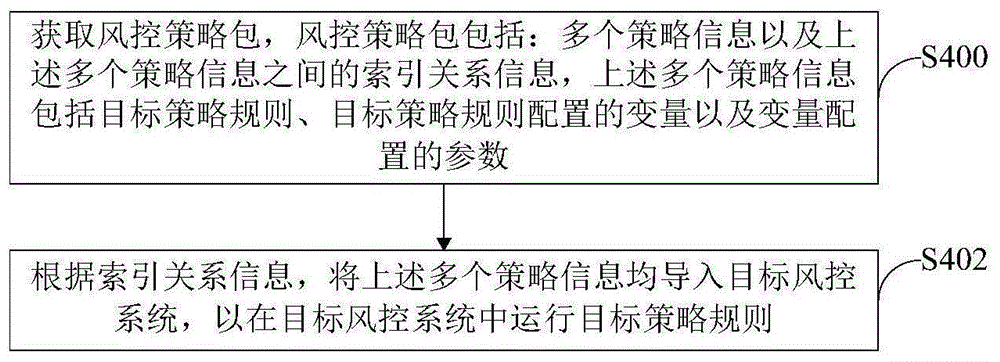
In a second aspect, fig. 4 shows a flowchart of a method for migrating a wind control policy provided in an embodiment of the present specification. Referring to fig. 4, the method for migrating the wind control policy is applied to a policy requirement end, and may at least include the following steps S400 to S402.
Step S400, acquiring a wind control strategy package, wherein the wind control strategy package comprises: the policy management system comprises a plurality of pieces of policy information and index relation information among the plurality of pieces of policy information, wherein the plurality of pieces of policy information comprise target policy rules, variables configured by the target policy rules and parameters configured by the variables.
In this embodiment of the present description, a wind control system that needs to deploy a target policy rule is a target wind control system, and a wind control policy package is derived from another wind control system that is different from the target wind control system. For example, the wind control policy package may be obtained by a relevant person of the policy requiring end offline from the policy providing end and then uploaded to the target wind control system, or the policy providing end may also generate a corresponding wind control policy package according to the wind control policy requirement sent by the policy requiring end, and then feed the package back to the policy requiring end online and upload the package to the target wind control system by the relevant person, which is not limited herein. For a specific generation process of the wind control policy packet, reference may be made to the content of the method embodiment provided in the first aspect, and details are not described here again.
For example, in an application scenario, a policy requiring end encounters a risk and requests help from a policy providing end; leading out a wind control strategy package by strategy operators of the strategy providing end according to the corresponding risk types and the strategy package generating method provided by the first aspect, and handing the wind control strategy package to the strategy requiring end as a solution; and related personnel at the strategy demand end can introduce the wind control strategy package into the target wind control system, so that the target strategy rules are operated on line, and corresponding risks are prevented.
In a specific implementation process, relevant personnel such as operators who manage the target wind control system, which may also be called users of the target wind control system, may select one or more wind control policy packages to upload to the target wind control system. For example, one or more wind control policy packages may be selected locally, and then a preset last button is clicked to upload the selected wind control policy packages.
In an optional embodiment, the obtaining of the wind control policy package may include: checking the file format of the wind control strategy package selected by the user; if the verification is passed, uploading the wind control strategy package to a pre-configured middle storage position, and waiting for further establishing strategy information contained in the wind control strategy package to a target wind control system; and if the verification fails, the wind control strategy packet cannot be uploaded. It can be understood that the file format of the wind control policy package should be an inherent format of generating, i.e., packaging, the wind control policy package, and if the file format does not meet the requirement, it indicates that the wind control policy package has an error, and the verification cannot be passed.
In an optional embodiment, the process of obtaining the wind control policy package may include: creating an import task based on the uploaded wind control strategy package, and presetting a plurality of strategy information in the wind control strategy package into the import task to be in a state to be created; if an import instruction for triggering the import task to be started is monitored, the following step S402 is executed, in which the target policy rule and the configuration information of the target policy rule, that is, the variables configured by the target policy rule, the parameters configured by the variables, and the like, are all created into the target wind control system, so as to complete the layer-by-layer creation of the policy package information and ensure the normal operation of the target policy rule in the target wind control system.
And step S402, importing the strategy information into a target wind control system according to the index relation information so as to run a target strategy rule in the target wind control system.
It will be appreciated that target policy rules are used to identify risks of a target type, and that the operation of the target policy rules may require reliance on multiple information levels. And taking the target strategy rules in the wind control strategy package and the configuration information of the target strategy rules as strategy information, wherein the wind control strategy package comprises a plurality of strategy information and index relation information among the strategy information.
In one embodiment, the configuration information of the target policy rule may include: variables configured by the target policy rules and parameters configured by the variables. At this time, the policy information includes target policy rules, variables, and parameters in the wind control policy package. In another embodiment, the configuration information of the target policy rule may include: variables of the target policy rule configuration, parameters of the variable configuration and the cumulative policy, and variables and parameters of the cumulative policy configuration. At this time, the plurality of policy information includes target policy rules, variables, accumulation policies, and parameters in the wind control policy package. It can be understood that the information has a sequential dependency relationship with mutual calling, and the information needs to be created layer by layer according to the dependency relationship to ensure the normal operation of the target policy rule.
In this embodiment of the present specification, index relationship information reflecting an index association relationship among the plurality of pieces of policy information, that is, an index association relationship from a target policy rule hierarchy to a parameter hierarchy, is further packaged in the wind control policy package.
Therefore, according to the index relation information in the wind control strategy package, the calling sequence of each information level related to the identification risk of the target strategy rule can be definitely operated so as to be created layer by layer.
In an optional embodiment of the present description, the process of importing the wind control policy package to migrate the wind control policy realizes checking the index relationship in the target wind control system while importing data, and improves the deployment efficiency of the wind control policy. Specifically, the process of importing a plurality of policy information into the target wind control system according to the index relationship information may include: determining the front information on which each strategy information in the wind control strategy package depends according to the index relation information contained in the wind control strategy package; for each policy information, performing an importing step, the importing step comprising: and detecting whether the prepositive information of the strategy information is effective in the target wind control system, if so, creating the strategy information in the target wind control system, otherwise, judging that the strategy information is failed to be imported, and displaying failure prompt information. It should be noted that each policy information in the wind control policy package depends on the prefix information, for example, the prefix information on which the target policy rule depends is variable information, the prefix information on which the variable depends is parameter information, or is the parameter information and the accumulated policy information, and the parameter-dependent prefix information may be service data, such as account ID data, transmitted by an upstream service system.
Specifically, whether the prepositive information of the policy information to be imported takes effect in the target wind control system or not is detected, whether the prepositive information is issued to be online in the target wind control system or not can be detected, if the prepositive information is issued to be online, the prepositive information is judged to take effect in the target wind control system, namely, the prepositive information is operated in the target wind control system, and if the prepositive information is not issued to be online, the prepositive information is judged not to take effect in the target wind control system. Of course, in the specific implementation process, other embodiments may be adopted to determine whether the previous information is already effective in the target wind control system according to the actual application scenario, and the present invention is not limited herein.
For example, it is assumed that the target policy rule in the wind control policy package obtained in step S400 is that if the number of login times of a user in the area S per day exceeds N, it is determined that the user in the area S has the X-class risk. The policy information included in the wind control policy package may include: the target policy rule; variable V1: region S, variable V2: the login times of the user in the area S in one day; and (4) accumulating the strategy T: counting the historical login time details of the user in the area S; parameter P1: user ID, parameter P2: and (5) identifying the area. Wherein the preposition information of the target policy rule comprises: the variable V1 and the variable V2, the prefix information for the variable V1 may be: the parameter P2 and the preposition information of the variable V2 comprise: the above-mentioned accumulation policy T and parameter P1; accumulating the prefix information of the policy T may include: variable V1 and parameter P1; the prefix information for parameter P1 may be: user ID data incoming by the upstream system; the prefix information for parameter P2 may be: the upstream system incoming zone identification data. For each piece of policy information, the import can be completed only by detecting that the front-end information of the policy information is effective in the target wind control system, and the policy information is created in the target wind control system.
Further, in order to facilitate a user to monitor the import completion condition of the wind control policy package, in an optional embodiment of this specification, the wind control policy migration method further includes: and if all the strategy information in the wind control strategy package is imported and finished, namely the creation in the target system is finished, displaying prompt information for indicating the completion of the import of the wind control strategy package. For example, a task state list may be displayed on a user interface pre-configured in the policy requirement end, and a task state of the created import task is displayed in the task state list. The task state may include a non-import state, an import state, and an import complete state, and when it is monitored that all the policy information in the wind control policy package is imported, the task state of the corresponding import task is updated from the import state to the import state, and the updated task state is used as prompt information for indicating that the import of the wind control policy package is complete. Or the task state can be displayed in a progress bar form, and when it is monitored that all the policy information in the wind control policy package is completely imported, the progress bar completes and displays characters such as "finish" indicating completion as prompt information for indicating the completion of importing the wind control policy package.
After all the strategy information in the wind control strategy package is imported, namely all the strategy information in the wind control strategy package is established in the target wind control system, the target strategy rule can be formally executed, and the risk is prevented and controlled on line. Through the wind control strategy migration method provided by the embodiment of the specification, a user can import the wind control strategy package in the system by one key without the participation of professionals with risky operation experience, so that the deployment efficiency of the wind control strategy is effectively improved, and the labor cost is reduced.
In addition, in an optional embodiment of this specification, if one or more policy information import failures exist in the wind control policy package in one import process, the policy information with the import failure may be imported again, so that multiple imports can be realized by uploading once, and the migration efficiency of the wind control policy is further improved. Specifically, the process of importing a plurality of policy information into the target wind control system according to the index relationship information may further include: if the policy information is failed to be imported, the importing step is executed again aiming at the policy information which is failed to be imported until all the policy information in the wind control policy package is imported into the target wind control system.
Specifically, for policy information that fails to be imported, the user may prompt to resolve the pre-dependency of the policy information according to a failure reason, for example, the reason that a certain policy information fails to be imported is that the dependent pre-information is not yet published online, so that the policy information may be imported after the dependent pre-information is published online. Of course, besides the reason that the pre-dependency is not effective, in an actual application scenario, there may be other reasons for the failed import, such as a reason for network anomaly, and the like, and the user may import the policy information of the failed import again after prompting that the processing is good according to the reasons for the failure.
After the user solves the problem of failure in policy information import, the import instruction corresponding to the wind control policy package can be triggered again, so that the import step is executed again for the unsuccessfully imported policy information in the wind control policy package. For example, a user may click an import button on a preconfigured user interface, trigger an import instruction for the created import task, and start an import process for policy information in a wind control policy package under the import task, after the import is finished, if there is policy information that is not successfully imported under the import task, the user may click the import button again after the problem that the policy information import fails is solved, and import the policy information that is not successfully imported again until all policy information is successfully imported under the import task, thereby completing the creation.
Of course, in other embodiments of this specification, if there is a policy information import failure in the wind control policy package, it may be determined that the entire wind control policy package is failed to import, and the import is ended, that is, the current wind control policy migration flow is ended.
The wind control strategy migration method provided by the embodiment of the specification effectively realizes cross-system application of the wind control strategy rules by importing the wind control strategy package which is separated from the wind control system where the wind control strategy is originally located and exists in an independent file into the target wind control system. Moreover, the user can automatically and quickly complete the import of the wind control strategy package within 1 person day without the participation of professionals with risky operation experience, so that the deployment efficiency of the wind control strategy is effectively improved, and the labor cost is reduced.
In a third aspect, fig. 5 shows a flowchart of a method for migrating a wind control policy provided in an embodiment of the present specification. The wind control strategy migration method is applied to a strategy migration end, and the strategy migration end is equipment for providing services for migrating wind control strategy rules among different wind control systems. Referring to fig. 5, the method may include at least the following steps S500 to S506.
Step S500, responding to a strategy package generation instruction triggered by a user, and determining a target strategy rule in the first wind control system, wherein the target strategy rule is used for identifying the risk of a target type.
Step S502, based on a preset data blood relationship information base, obtaining index relationship information of a target strategy rule, and determining configuration information of the target strategy rule according to the index relationship information, wherein the configuration information comprises: the target policy rule is configured according to the variable and the parameter configured by the variable.
Step S504, deriving the target strategy rule, the configuration information of the target strategy rule and the index relation information from the first wind control system, and generating a wind control strategy package.
Step S506, in response to a policy package importing instruction triggered by a user, importing both the target policy rule and the configuration information of the target policy rule into the second wind control system according to the index relationship information in the wind control policy package, so as to run the target policy rule in the second wind control system.
It should be noted that the implementation process of steps S500 to S504 is similar to the implementation process of steps S200 to S206 provided in the first aspect, and specific reference may be made to the corresponding description of the embodiment provided in the first aspect, and details are not repeated here. The implementation process of step S506 is similar to the implementation process of step S402 provided in the second aspect, and reference may be specifically made to the corresponding description of the embodiment provided in the first aspect, and details are not repeated here.
It is understood that the users in step S500 and step S506 are users who have the authority to export the policy package from the first wind control system and import the policy package into the second wind control system at the same time, and may be, for example, operators of the first wind control system or the second wind control system having the authority, or third-party operators having the authority. In step S506, the user may trigger the policy package import instruction by clicking a preconfigured import button or other triggering operations, which is not limited herein.
In a fourth aspect, based on the same inventive concept as the wind control policy package generation method provided in the foregoing first aspect, an embodiment of the present specification further provides a wind control policy package generation apparatus. As shown in fig. 6, the wind control policy package generation device 60 includes:
the rule determining module 61 is configured to determine a target policy rule in the first wind control system in response to a policy package generation instruction triggered by a user, where the target policy rule is used to identify a risk of a target type; a relation information obtaining module 62, configured to obtain index relation information of the target policy rule based on a preset data consanguinity information base; a configuration information obtaining module 63, configured to determine configuration information of the target policy rule according to the index relationship information, where the configuration information includes: variables configured by the target policy rules and parameters configured by the variables; and the export module 64 is configured to export the target policy rule, the configuration information of the target policy rule, and the index relationship information from the first wind control system, and generate the wind control policy package, where the wind control policy package is used to import a second wind control system to perform prevention and control on the risk of the target type.
In an optional embodiment, the configuration information further includes a cumulative policy configured by the variables, and the variables and parameters configured by the cumulative policy, where the cumulative policy is used to count historical behavior data of the user.
It should be noted that, in the wind control policy package generating device 60 provided in the embodiment of the present specification, specific ways in which the respective modules perform operations have been described in detail in the method embodiment provided in the first aspect, and specific implementation processes may refer to the method embodiment provided in the first aspect, and will not be described in detail here.
In a fifth aspect, based on the same inventive concept as the wind control policy migration method provided in the embodiment of the second aspect, an embodiment of the present specification further provides a wind control policy migration apparatus. As shown in fig. 7, the wind control policy migration apparatus 70 includes:
an obtaining module 71, configured to obtain a wind control policy package, where the wind control policy package includes: the method comprises the steps that a plurality of pieces of strategy information and index relation information among the plurality of pieces of strategy information are obtained, wherein the plurality of pieces of strategy information comprise target strategy rules, variables configured by the target strategy rules and parameters configured by the variables; and an importing module 72, configured to import the policy information into a target wind control system according to the index relationship information, so as to run the target policy rule in the target wind control system.
In an alternative embodiment, the import module 72 includes: the determining submodule 721 is configured to determine, according to the index relationship information, the preamble information on which each policy information in the wind control policy package depends; a first importing submodule 722, configured to perform an importing step for each piece of policy information, where the importing step includes: detecting whether the prepositive information of the strategy information is effective in the target wind control system, if so, creating the strategy information in the target wind control system, otherwise, judging that the strategy information is failed to be imported, and displaying failure prompt information.
In an alternative embodiment, the importing module 72 further includes: the second import sub-module 723 is configured to, if there is a policy information import failure in the plurality of policy information, execute the importing step again for the policy information with the import failure until all policy information in the wind control policy package is imported into the target wind control system.
In an optional embodiment, the wind control strategy migrating device 70 further includes: and the prompt module 73 is configured to display prompt information for indicating that the wind control policy package is completely imported if all policy information in the wind control policy package is completely imported.
In an alternative embodiment, the obtaining module 71 includes: and the format verification submodule 711 is configured to verify a file format of the wind control policy package selected by the user, and if the file format passes the verification, upload the wind control policy package.
In an alternative embodiment, the obtaining module 71 includes: the task creating sub-module 712 is configured to create an import task based on the uploaded wind control policy package, and preset the policy information in the wind control policy package into the import task; and the instruction monitoring submodule 713, configured to, if an import instruction for triggering the import task to be started is monitored, execute the step of importing the policy information into the target wind control system according to the index relationship information.
In an alternative embodiment, the wind control policy package is generated according to the following steps: responding to a strategy packet generation instruction triggered by a user, and determining a target strategy rule in the first wind control system; acquiring index relation information of the target strategy rule based on a preset data blood relationship information base; determining configuration information of the target policy rule according to the index relationship information, wherein the configuration information comprises: variables configured by the target policy rules and parameters configured by the variables; and deriving the target strategy rule, the configuration information of the target strategy rule and the index relation information from the first wind control system to generate the wind control strategy packet.
In an optional embodiment, the configuration information further includes an accumulated policy configured by the variables, and the variables and parameters configured by the accumulated policy, where the accumulated policy is used to count historical behavior data of the user.
It should be noted that, the specific manner in which each module performs operations has been described in detail in the method embodiment provided in the second aspect, and the specific implementation process may refer to the method embodiment provided in the second aspect, which will not be described in detail here.
In a sixth aspect, based on the same inventive concept as the wind control policy migration method provided in the foregoing third aspect, an embodiment of this specification further provides a wind control policy migration apparatus, which operates at a policy migration end, where the policy migration end is a device for providing services for migrating wind control policy rules between different wind control systems. As shown in fig. 8, the wind control policy migration apparatus 80 includes:
the policy package derivation module 81 is configured to determine a target policy rule in the first wind control system in response to a policy package generation instruction triggered by a user, where the target policy rule is used to identify a risk of a target type; acquiring index relation information of the target strategy rule based on a preset data consanguinity information base, and determining configuration information of the target strategy rule according to the index relation information, wherein the configuration information comprises: variables configured by the target policy rules and parameters configured by the variables; deriving the target strategy rule, the configuration information of the target strategy rule and the index relation information from the first wind control system to generate a wind control strategy packet;
and a policy package importing module 82, configured to, in response to the policy package importing instruction triggered by the user, import the target policy rule and the configuration information of the target policy rule into a second wind control system according to the index relationship information in the wind control policy package, so as to operate the target policy rule in the second wind control system.
It should be noted that, in the wind control policy migration apparatus 80 provided in the embodiment of the present specification, specific ways in which the respective modules perform operations have been described in detail in the method embodiment provided in the third aspect, and specific implementation processes may refer to the method embodiment provided in the third aspect, and will not be described in detail here.
In a seventh aspect, based on the same inventive concept as that in the foregoing embodiments, an embodiment of the present specification further provides an electronic device. As shown in fig. 9, the electronic device includes a memory 904, one or more processors 902, and a computer program stored on the memory 904 and executable on the processors 902, where the processors 902, when executing the program, implement the steps of any embodiment of the wind control policy package generating method provided in the first aspect, the steps of any embodiment of the wind control policy migration method provided in the second aspect, or the steps of any embodiment of the wind control policy migration method provided in the third aspect.
Where in fig. 9 a bus architecture (represented by bus 900), bus 900 may include any number of interconnected buses and bridges, and bus 900 links together various circuits including one or more processors, represented by processor 902, and memory, represented by memory 904. The bus 900 may also link together various other circuits such as peripherals, voltage regulators, power management circuits, and the like, which are well known in the art, and therefore, will not be described any further herein. A bus interface 905 provides an interface between the bus 900 and the receiver 901 and transmitter 903. The receiver 901 and the transmitter 903 may be the same element, i.e., a transceiver, providing a means for communicating with various other apparatus over a transmission medium. The processor 902 is responsible for managing the bus 900 and general processing, and the memory 904 may be used for storing data used by the processor 902 in performing operations.
It is to be understood that the structure shown in fig. 9 is merely an illustration, and the electronic device provided in the embodiments of the present description may further include more or less components than those shown in fig. 9, or have a different configuration than that shown in fig. 9. The components shown in fig. 9 may be implemented in hardware, software, or a combination thereof.
In an eighth aspect, based on the same inventive concept as the foregoing embodiments, this specification embodiment further provides a computer readable storage medium, on which a computer program is stored, where the computer program, when executed by a processor, implements the steps of any embodiment of the wind control policy package generating method provided in the foregoing first aspect, the steps of any embodiment of the wind control policy migration method provided in the foregoing second aspect, or the steps of any embodiment of the wind control policy migration method provided in the foregoing third aspect.
It should be noted that, in the present specification, the embodiments are all described in a progressive manner, each embodiment focuses on differences from other embodiments, and the same and similar parts among the embodiments may be referred to each other.
The foregoing description of specific embodiments has been presented for purposes of illustration and description. Other embodiments are within the scope of the following claims. In some cases, the actions or steps recited in the claims may be performed in a different order than in the embodiments and still achieve desirable results. In addition, the processes depicted in the accompanying figures do not necessarily require the particular order shown, or sequential order, to achieve desirable results. In some embodiments, multitasking and parallel processing may also be possible or may be advantageous.
The description has been described with reference to flowchart illustrations and/or block diagrams of methods, apparatus (systems), and computer program products according to embodiments of the description. It will be understood that each flow and/or block of the flowchart illustrations and/or block diagrams, and combinations of flows and/or blocks in the flowchart illustrations and/or block diagrams, can be implemented by computer program instructions. These computer program instructions may be provided to a processor of a general purpose computer, special purpose computer, embedded processor, or other programmable data processing apparatus to produce a machine, such that the instructions, which execute via the processor of the computer or other programmable data processing apparatus, create means for implementing the functions specified in the flowchart flow or flows and/or block diagram block or blocks.
These computer program instructions may also be stored in a computer-readable memory that can direct a computer or other programmable data processing apparatus to function in a particular manner, such that the instructions stored in the computer-readable memory produce an article of manufacture including instruction means which implement the function specified in the flowchart flow or flows and/or block diagram block or blocks.
These computer program instructions may also be loaded onto a computer or other programmable data processing apparatus to cause a series of operational steps to be performed on the computer or other programmable apparatus to produce a computer implemented process such that the instructions which execute on the computer or other programmable apparatus provide steps for implementing the functions specified in the flowchart flow or flows and/or block diagram block or blocks.
While preferred embodiments of the present specification have been described, additional variations and modifications in those embodiments may occur to those skilled in the art once they learn of the basic inventive concepts. Therefore, it is intended that the appended claims be interpreted as including preferred embodiments and all changes and modifications that fall within the scope of the specification.
It will be apparent to those skilled in the art that various changes and modifications may be made in the present specification without departing from the spirit and scope of the specification. Thus, if such modifications and variations of the present specification fall within the scope of the claims of the present specification and their equivalents, the specification is intended to include such modifications and variations.