Disclosure of Invention
The invention aims to overcome the defects and shortcomings of the prior art, and provides a circular contour detection method for a circular gold surface of a flexible IC substrate, which can accurately acquire a circular closed contour of the defective gold surface of the flexible IC substrate, and can be used for detecting appearance defects of the flexible IC substrate, such as Mark point defect detection and SMT Kong Buliang detection.
The aim of the invention is achieved by the following technical scheme:
a circular contour detection method under the condition of a circular gold surface of a flexible IC substrate is missing comprises the following steps:
(1) Acquiring an image of a flexible IC substrate;
(2) Converting the image into HSV color space, and extracting an H channel image as a processing object;
(3) Preprocessing an image;
(4) Constructing an edge type geometric movable contour model;
(5) The image is input into an edge type geometrical active contour model, and the optimal contour is obtained by minimizing the energy functional of the closed curve.
In the step (2), the value calculation mode of the H-channel image is as follows:
wherein max (i, j) =max (r (i, j), g (i, j), b (i, j)), min (i, j) =min (r (i, j), g (i, j), b (i, j)), represent the maximum and minimum values of the three components r, g, b at the position (i, j), respectively.
In step (3), the image preprocessing includes image enhancement and image denoising.
The image enhancement is to enhance the H-channel image by adopting a histogram equalization method, and the image denoising is to denoise the H-channel image by adopting a Gaussian smoothing method.
The step (5) specifically comprises the following steps:
inputting the preprocessed H-channel image into an edge type geometric movable contour model;
calculating a gradient modulus value of an input image, and selecting a proper edge function;
initializing a closed curve;
designing closed curve energy functional parameters including forcing term coefficients, delta function parameters and constant speed coefficients;
iterative calculation, namely introducing a regularized Heaviside function to calculate gradient descent flow corresponding to the energy functional;
updating the closed curve;
judging whether the closed curve approaches to completion, if the change amount before and after the curve updating is smaller than the set threshold value or the iteration number reaches the set threshold value, ending the curve approximation, otherwise, continuing to iteratively calculate the updated curve.
The edge function is as follows:
where r represents the gradient modulus value of each pixel point and K is the contrast constant for controlling the rate of decrease of g.
The initial state of the closed curve is a circular curve with the center of the circle at the center of the image and the radius being half of the length of the shorter side of the image.
The closed curve has an energy functional formula as follows:
wherein Ω denotes an image space; h represents a Heaviside function, u (x, y) represents an embedding function; g represents an edge function;
a forcing term representing the approximation of the curve, the coefficient μ representing the forcing term coefficient, which keeps the embedded function as a distance function;
An external force term representing the approximation of a curve, which enables the curve to approach toward and stabilize on the edge;
An internal force term representing the approximation of a curve, which accelerates the convergence of the curve inwards in a flat region of the image, and a coefficient c represents a constant velocity coefficient.
The gradient downflow corresponding to the energy functional of the closed curve is as follows:
wherein delta ε (u) represents the derivative, H, of the introduced regularized Heaiside function ε (u) and delta ε (u) the formula:
wherein ε represents the delta function coefficient for controlling delta ε Effective width of (u).
The closed curve is updated as follows:
wherein C is
t+1 Representing updated curves, C
t Representing the curve before update, t representing the time variable, dt representing the time step,
is a gradient descent flow.
Compared with the prior art, the invention has the following advantages and beneficial effects:
(1) The invention converts the image from RGB color space to HSV color space, takes the H channel representing tone as the processing object, acquires the maximum gray level difference, and reduces the influence of low contrast image saturation and brightness factors.
(2) The preprocessing mode adopted by the invention combines image enhancement and image denoising, reduces noise influence while enlarging the gray scale range, and provides preconditions for the follow-up calculation of the image gradient by utilizing finite difference.
(3) The invention builds the edge geometric movable contour model, converts the problem of edge extraction into the approximation problem of a closed curve, and overcomes the defect of incomplete contour of an edge extraction operator.
(4) The method is influenced by the image gradient modulus value in the curve approximation process, so that the curve approximates to the edge position, and the defect of inaccurate contour of the circle fitting method is overcome.
Detailed Description
The present invention will be described in further detail with reference to examples and drawings, but embodiments of the present invention are not limited thereto.
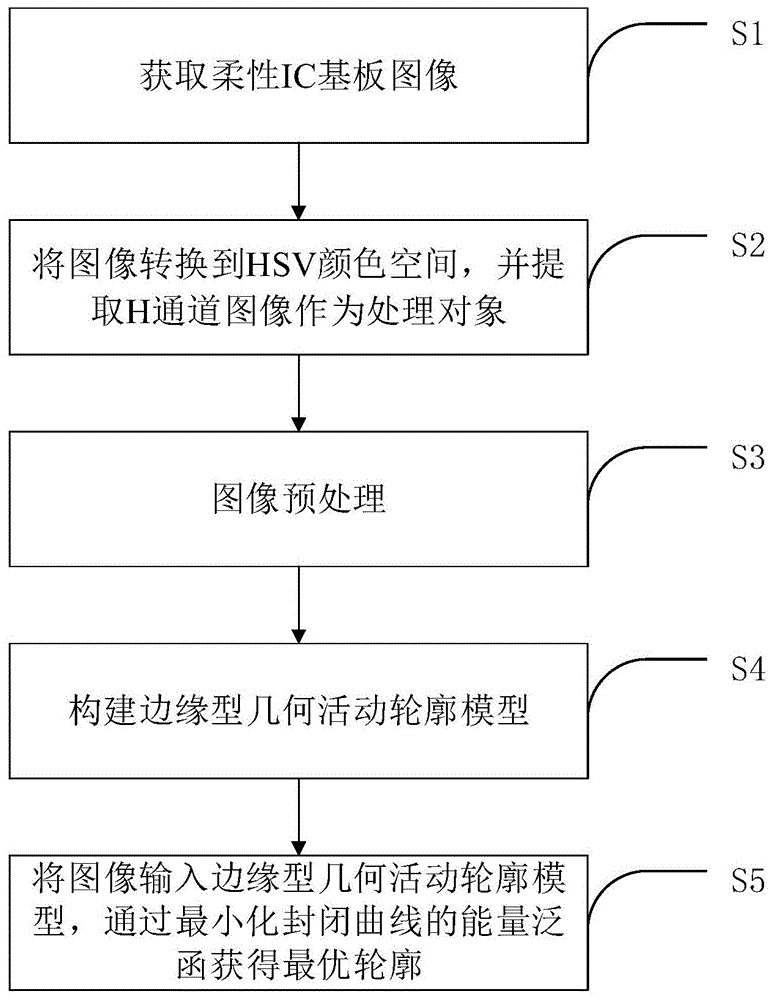
As shown in fig. 1, the present embodiment provides a method for detecting a circular outline of a flexible IC substrate in the case of a missing circular gold surface, the method comprising the following steps:
s1, acquiring an image of the flexible IC substrate.
In the embodiment, an industrial CCD camera is used for collecting the image of the flexible IC substrate, and a light source is selected as a white light source. The copper-clad area is golden in the image, commonly called as 'Jin Mian', the background is green, and when the gold surface is missing, the missing area is similar to the background, so that the detection of the outline of the gold surface becomes a difficult point.
S2, converting the image into an HSV color space, and extracting an H-channel image as a processing object.
The value of the image H channel after conversion to HSV space in this embodiment is calculated according to the following formula (1):
wherein max (i, j) =max (r (i, j), g (i, j), b (i, j)), min (i, j) =min (r (i, j), g (i, j), b (i, j)), represent the maximum and minimum values of the three components r, g, b at position (i, j), respectively.
S3, image preprocessing.
The image preprocessing of the embodiment is to perform image enhancement on an H-channel image and then perform image denoising, wherein the image enhancement adopts a histogram equalization method, and the image denoising adopts a Gaussian smoothing method. Since the gradient modulus of the image needs to be calculated subsequently, but the image gradient is very sensitive to noise by directly using finite difference calculation, the second step of image preprocessing is Gaussian smoothing to remove noise.
S4, constructing an edge type geometric movable contour model.
The energy functional of the edge geometry active contour model is as follows (2):
wherein Ω denotes an image space; h represents a Heaviside function, u (x, y) represents an embedding function; g represents an edge function;
a forcing term representing the approximation of the curve, the coefficient μ representing the forcing term coefficient, which keeps the embedded function as a distance function;
An external force term representing the approximation of a curve, which enables the curve to approach toward and stabilize on the edge;
An internal force term representing the approximation of a curve, which accelerates the convergence of the curve inwards in a flat region of the image, and a coefficient c represents a constant velocity coefficient.
Further, the gradient descent flow corresponding to the energy functional formula is as follows:
wherein delta ε (u) represents the derivative, H, of the introduced regularized Heaiside function ε (u) and delta ε (u) the following formulas (4), (5):
wherein ε represents the delta function coefficient for controlling delta ε Effective width of (u).
S5, inputting the image into an edge type geometrical active contour model, and obtaining the optimal contour by minimizing the energy functional of the closed curve.
The step S5, as shown in fig. 2, specifically includes:
s51, inputting the preprocessed H-channel image into an edge type geometric active contour model.
S52, calculating a gradient modulus value of the input image, and selecting a proper edge function.
In this embodiment, the following formula (6) is selected as the edge function:
where r represents the gradient modulus value of each pixel point and K is the contrast constant for controlling the rate of decrease of g. The contrast constant k=3 of the present embodiment.
S53, initializing a closed curve.
The initial closed curve of this embodiment is a circular curve with a center at the center of the image and a radius half the length of the shorter side of the image.
S54, designing closed curve energy functional parameters including forcing term coefficients, delta function parameters and constant speed coefficients.
The forcing term coefficient of the present embodiment is μ=0.01; delta function parameter is epsilon=1.5; constant velocity coefficient c=0.8.
S55, performing iterative computation, and introducing a regularized Heaviside function to compute gradient descent flow corresponding to the energy functional.
S56, updating the closed curve.
The update closed curve of this embodiment is expressed by the following formula (7):
wherein C is
t+1 Representing updated curves, C
t Representing the curve before update, t representing the time variable, dt representing the time step,
for the gradient descent flow. The time step of this embodiment takes dt=0.08.
S57, judging whether the closed curve approaches to completion, if the change amount before and after curve updating is smaller than a set threshold value or the iteration number reaches the set threshold value, ending curve approximation, otherwise, continuing to iteratively calculate the updated curve.
It should be noted that although the method operations of the above embodiments are depicted in the drawings in a particular order, this does not require or imply that the operations must be performed in that particular order or that all illustrated operations be performed in order to achieve desirable results. Rather, the depicted steps may change the order of execution. Additionally or alternatively, certain steps may be omitted, multiple steps combined into one step to perform, and/or one step decomposed into multiple steps to perform.
The above examples are preferred embodiments of the present invention, but the embodiments of the present invention are not limited to the above examples, and any other changes, modifications, substitutions, combinations, and simplifications that do not depart from the spirit and principle of the present invention should be made in the equivalent manner, and the embodiments are included in the protection scope of the present invention.